



NCERT Class 6 Science Curiosity Chapter 7 Temperature and its Measurement Notes cover hotness, coldness, thermometers, Celsius, Fahrenheit, kelvin and air temperature for the 2026-27 syllabus.
- Download the Chapter 7 Notes PDF for quick school-test revision.
- Revise clinical and laboratory thermometers with correct reading steps.
- Answer focus: write the reading with unit, scale and thermometer type.
Chapter7TemperatureanditsMeasurementNotes.pdf?page=1&dpi=150)
Chapter7TemperatureanditsMeasurementNotes.pdf?page=2&dpi=150)
Chapter7TemperatureanditsMeasurementNotes.pdf?page=3&dpi=150)
Chapter7TemperatureanditsMeasurementNotes.pdf?page=4&dpi=150)
Chapter7TemperatureanditsMeasurementNotes.pdf?page=5&dpi=150)
Chapter7TemperatureanditsMeasurementNotes.pdf?page=6&dpi=150)
Chapter7TemperatureanditsMeasurementNotes.pdf?page=7&dpi=150)
Chapter7TemperatureanditsMeasurementNotes.pdf?page=8&dpi=150)
Chapter7TemperatureanditsMeasurementNotes.pdf?page=9&dpi=150)
Chapter7TemperatureanditsMeasurementNotes.pdf?page=10&dpi=150)
Chapter7TemperatureanditsMeasurementNotes.pdf?page=11&dpi=150)
Chapter7TemperatureanditsMeasurementNotes.pdf?page=12&dpi=150)
Chapter7TemperatureanditsMeasurementNotes.pdf?page=13&dpi=150)
Chapter7TemperatureanditsMeasurementNotes.pdf?page=14&dpi=150)
Chapter7TemperatureanditsMeasurementNotes.pdf?page=15&dpi=150)
Chapter7TemperatureanditsMeasurementNotes.pdf?page=16&dpi=150)
Chapter7TemperatureanditsMeasurementNotes.pdf?page=17&dpi=150)
Chapter7TemperatureanditsMeasurementNotes.pdf?page=18&dpi=150)
Chapter7TemperatureanditsMeasurementNotes.pdf?page=19&dpi=150)
Chapter7TemperatureanditsMeasurementNotes.pdf?page=20&dpi=150)
Chapter7TemperatureanditsMeasurementNotes.pdf?page=21&dpi=150)
Chapter7TemperatureanditsMeasurementNotes.pdf?page=22&dpi=150)
Chapter7TemperatureanditsMeasurementNotes.pdf?page=23&dpi=150)
Chapter7TemperatureanditsMeasurementNotes.pdf?page=24&dpi=150)
Chapter7TemperatureanditsMeasurementNotes.pdf?page=25&dpi=150)
Chapter7TemperatureanditsMeasurementNotes_flat_MobileCard.pdf?page=1&dpi=150)
Chapter7TemperatureanditsMeasurementNotes_flat_MobileCard.pdf?page=2&dpi=150)
Chapter7TemperatureanditsMeasurementNotes_flat_MobileCard.pdf?page=3&dpi=150)
Chapter7TemperatureanditsMeasurementNotes_flat_MobileCard.pdf?page=4&dpi=150)
Chapter7TemperatureanditsMeasurementNotes_flat_MobileCard.pdf?page=5&dpi=150)
Chapter7TemperatureanditsMeasurementNotes_flat_MobileCard.pdf?page=6&dpi=150)
Chapter7TemperatureanditsMeasurementNotes_flat_MobileCard.pdf?page=7&dpi=150)
Chapter7TemperatureanditsMeasurementNotes_flat_MobileCard.pdf?page=8&dpi=150)
Chapter7TemperatureanditsMeasurementNotes_flat_MobileCard.pdf?page=9&dpi=150)
Chapter7TemperatureanditsMeasurementNotes_flat_MobileCard.pdf?page=10&dpi=150)
Chapter7TemperatureanditsMeasurementNotes_flat_MobileCard.pdf?page=11&dpi=150)
Chapter7TemperatureanditsMeasurementNotes_flat_MobileCard.pdf?page=12&dpi=150)
Chapter7TemperatureanditsMeasurementNotes_flat_MobileCard.pdf?page=13&dpi=150)
Chapter7TemperatureanditsMeasurementNotes_flat_MobileCard.pdf?page=14&dpi=150)
Chapter7TemperatureanditsMeasurementNotes_flat_MobileCard.pdf?page=15&dpi=150)
Chapter7TemperatureanditsMeasurementNotes_flat_MobileCard.pdf?page=16&dpi=150)
Chapter7TemperatureanditsMeasurementNotes_flat_MobileCard.pdf?page=17&dpi=150)
Chapter7TemperatureanditsMeasurementNotes_flat_MobileCard.pdf?page=18&dpi=150)
Chapter7TemperatureanditsMeasurementNotes_flat_MobileCard.pdf?page=19&dpi=150)
Chapter7TemperatureanditsMeasurementNotes_flat_MobileCard.pdf?page=20&dpi=150)
Chapter7TemperatureanditsMeasurementNotes_flat_MobileCard.pdf?page=21&dpi=150)
Chapter7TemperatureanditsMeasurementNotes_flat_MobileCard.pdf?page=22&dpi=150)
Chapter7TemperatureanditsMeasurementNotes_flat_MobileCard.pdf?page=23&dpi=150)
Chapter7TemperatureanditsMeasurementNotes_flat_MobileCard.pdf?page=24&dpi=150)
Chapter7TemperatureanditsMeasurementNotes_flat_MobileCard.pdf?page=25&dpi=150)
Chapter7TemperatureanditsMeasurementNotes_flat_MobileCard.pdf?page=26&dpi=150)
Chapter7TemperatureanditsMeasurementNotes_flat_MobileCard.pdf?page=27&dpi=150)
Chapter7TemperatureanditsMeasurementNotes_flat_MobileCard.pdf?page=28&dpi=150)
Chapter7TemperatureanditsMeasurementNotes_flat_MobileCard.pdf?page=29&dpi=150)
Chapter7TemperatureanditsMeasurementNotes_flat_MobileCard.pdf?page=30&dpi=150)
Chapter7TemperatureanditsMeasurementNotes_flat_MobileCard.pdf?page=31&dpi=150)
Chapter7TemperatureanditsMeasurementNotes_flat_MobileCard.pdf?page=32&dpi=150)
Chapter7TemperatureanditsMeasurementNotes_flat_MobileCard.pdf?page=33&dpi=150)
These notes follow the 2026-27 NCERT Curiosity textbook and keep thermometer use, scale reading and unit writing in a simple revision order.
Student Feedback on Temperature and its Measurement
In a Collegedunia revision check with 10,860 Class 6 students, most students said thermometer readings became easier after they first found the value of one small division.
|
Table of Contents |
Temperature and its Measurement Notes PDF Overview
The chapter begins with Lambok feeling feverish and Phiban using a thermometer to check his temperature. This story shows why a measured reading is better than only touching the forehead.
- Temperature tells how hot or cold a body is.
- Thermometer is the device used to measure temperature.
- Degree Celsius is the common unit used in the chapter.
Temperature and its Measurement Video Revision
Source: Magnet Brains on YouTube
Why Touch Alone Is Not Reliable
Activity 7.1 asks students to dip one hand in warm water and the other in ice-cold water. When both hands are then placed in tap water, the same water feels different to each hand.
| Observation | Meaning | Answer point |
|---|---|---|
| Right hand feels tap water cool | It was first in warm water | Touch depends on earlier condition |
| Left hand feels tap water warm | It was first in cold water | Same water can feel different |
| Thermometer gives a number | It measures temperature | Use measurement for reliable answer |
Clinical Thermometer and Body Temperature
A clinical thermometer is used to measure human body temperature. NCERT focuses on digital clinical thermometers because they are safer and easier to read than old mercury thermometers.
The normal temperature of a healthy human adult is close to 37.0 degree Celsius, which is the same as 98.6 degree Fahrenheit.
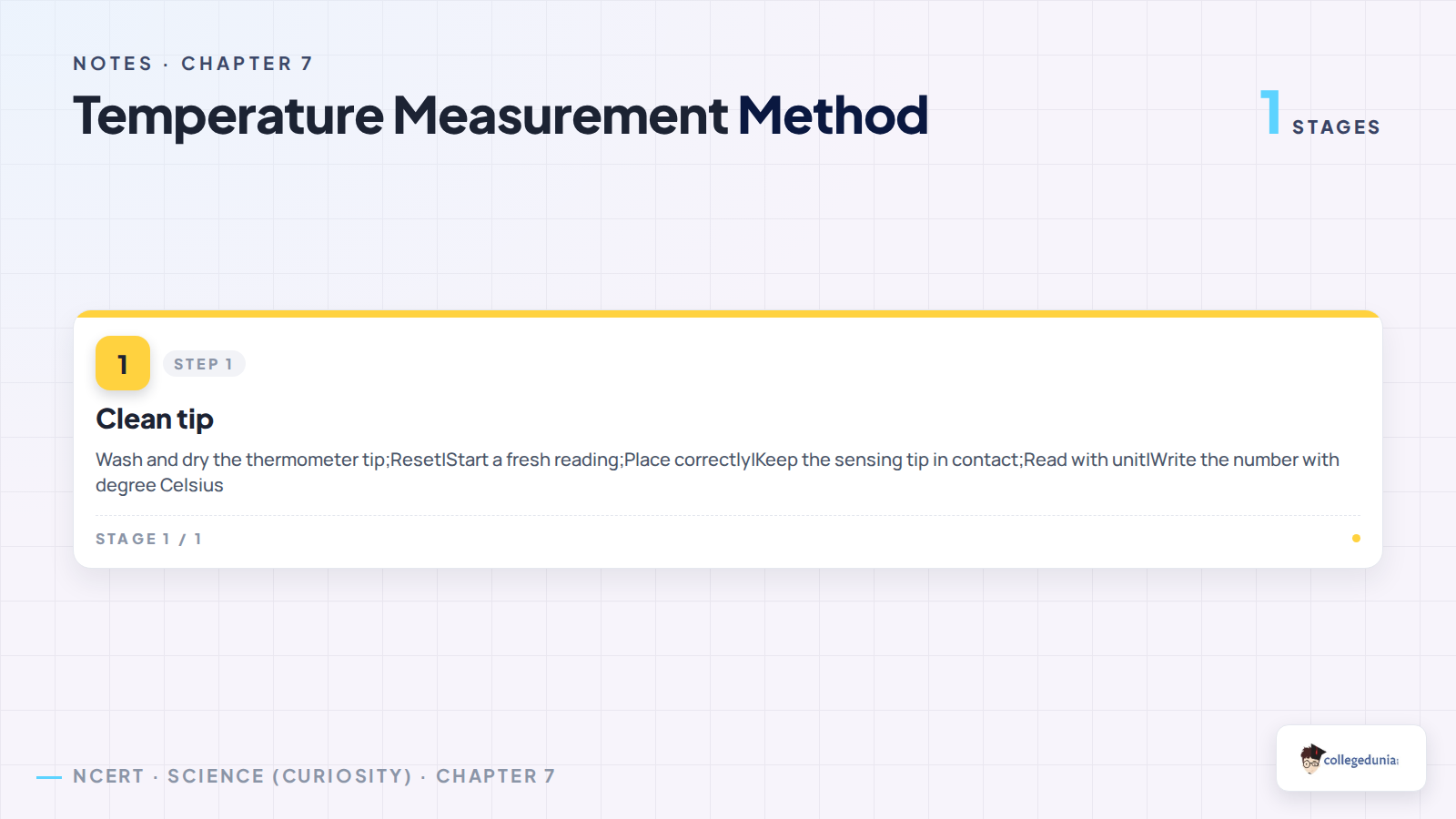
- Clean the thermometer tip before and after use.
- Reset the digital thermometer before taking a fresh reading.
- Read the display with the unit, not as a bare number.
Clinical and Laboratory Thermometers Compared
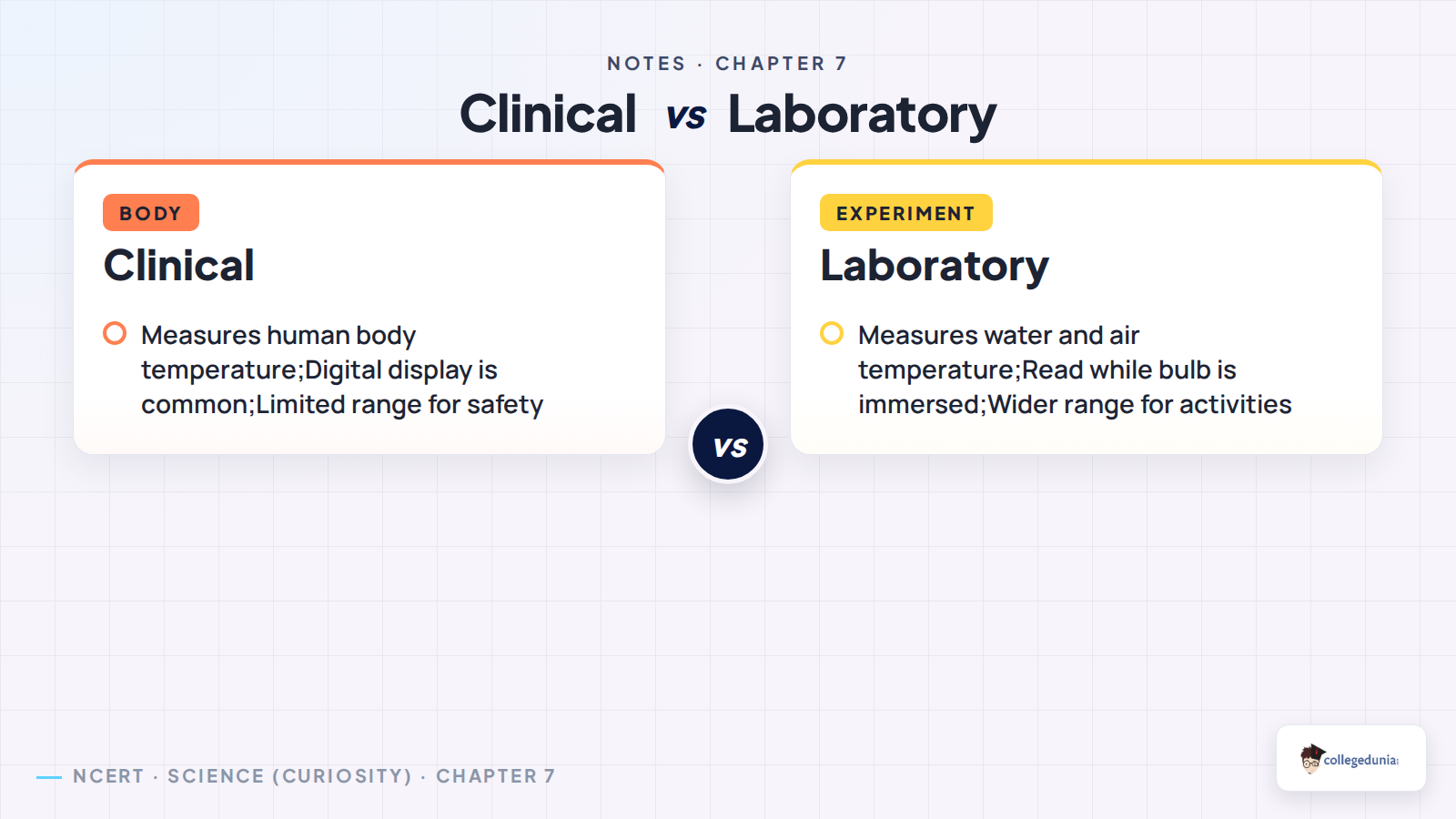
Clinical thermometers are for body temperature. Laboratory thermometers are for activities such as measuring the temperature of water or air.
| Thermometer | Used for | Important care |
|---|---|---|
| Clinical thermometer | Human body temperature | Clean the tip and stay within body range |
| Laboratory thermometer | Water, air and experiments | Read while the bulb remains immersed |
| Infrared thermometer | Non-contact body reading | Keep the correct distance from the body |
Temperature Scales and Units
NCERT explains Celsius, Fahrenheit and Kelvin scales. Celsius and Fahrenheit use the degree sign, while kelvin is written only as K.
- Celsius: degree Celsius, written as degree C in words or with the Celsius symbol in print.
- Fahrenheit: degree Fahrenheit, used in some health readings.
- Kelvin: SI unit of temperature, written as K without a degree sign.
Quick check: 37.0 degree Celsius equals 98.6 degree Fahrenheit for normal adult body temperature.
How to Read a Laboratory Thermometer
To read a laboratory thermometer, find the smallest division first. Then count the divisions from the nearest labelled mark to the top of the liquid column.
| Step | What to do | Common mistake |
|---|---|---|
| Find range | Check lowest and highest reading | Using it beyond its scale |
| Find least count | Divide the gap by small divisions | Guessing between marks |
| Place bulb | Keep bulb in the liquid | Touching the beaker bottom |
| Read level | Keep eye at liquid-column top | Reading from above or below |
Air Temperature and Weather Records
Air temperature is the temperature of the surrounding air. Weather reports usually show maximum and minimum temperatures for a day.
NCERT also mentions Anna Mani, the Weather Woman of India, who helped develop weather measurement instruments in India.
- Maximum temperature: highest air temperature of the day.
- Minimum temperature: lowest air temperature of the day.
- Trend: whether readings rise, fall or stay nearly steady.
How to Write Answers from Chapter 7
Most answers in this chapter need a reason. Link the answer to thermometer range, least count, scale, correct position or unit writing.
| Question type | What to include | Example answer focus |
|---|---|---|
| MCQ on normal temperature | 37.0 degree Celsius | Do not choose 98.6 degree Celsius |
| Least count question | Gap divided by divisions | Show the calculation |
| Lab thermometer care | Bulb position and eye level | Read while immersed |
| Fever of 101 degrees | Fahrenheit scale | 101 degree Celsius is impossible for fever |
Related Resources for Class 6 Science Chapter 7
| Resource | Use it for | Link |
|---|---|---|
| NCERT Solutions | Check textbook answers | Open Solutions |
| NCERT Book PDF | Read the official chapter | Open Book PDF |
| Handwritten Notes | Revise with compact notes | Open Handwritten Notes |
All Class 6 Science Curiosity Notes Chapters
| Chapter | Notes Link |
|---|---|
| Chapter 1 The Wonderful World of Science | Open Notes |
| Chapter 2 Diversity in the Living World | Open Notes |
| Chapter 3 Mindful Eating: A Path to a Healthy Body | Open Notes |
| Chapter 4 Exploring Magnets | Open Notes |
| Chapter 5 Measurement of Length and Motion | Open Notes |
| Chapter 6 Materials Around Us | Open Notes |
Temperature and its Measurement Class 6 Notes FAQs
Ques. What is temperature in Class 6 Science Chapter 7?
Ans. Temperature is the reliable measure of how hot or cold a body is. It is measured with a thermometer.
Ques. Why can touch give a wrong idea of temperature?
Ans. Touch depends on what the skin felt earlier. The same tap water can feel warm to one hand and cool to the other.
Ques. What is the normal temperature of a healthy human adult?
Ans. The normal temperature of a healthy human adult is close to 37.0 degree Celsius, or 98.6 degree Fahrenheit.
Ques. Why is a laboratory thermometer not used for body temperature?
Ans. A laboratory thermometer has a wider range and must be read while immersed. It is not designed for safe body-temperature use.



Comments