



The NCERT Notes for Class 6 Science Chapter 9 Methods of Separation in Everyday Life explain handpicking, threshing, winnowing, sieving, evaporation, sedimentation, decantation, filtration, churning and magnetic separation for the 2026-27 Curiosity textbook.
- Best use: revise the chapter after reading the official NCERT activities once.
- PDF focus: method names, property basis, daily examples and answer frames.
- Chapter value: helps students choose the correct separation method from size, weight, solubility and magnetism clues.
Chapter9MethodsofSeparationinEverydayLifeNotes.pdf?page=1&dpi=150)
Chapter9MethodsofSeparationinEverydayLifeNotes.pdf?page=2&dpi=150)
Chapter9MethodsofSeparationinEverydayLifeNotes.pdf?page=3&dpi=150)
Chapter9MethodsofSeparationinEverydayLifeNotes.pdf?page=4&dpi=150)
Chapter9MethodsofSeparationinEverydayLifeNotes.pdf?page=5&dpi=150)
Chapter9MethodsofSeparationinEverydayLifeNotes.pdf?page=6&dpi=150)
Chapter9MethodsofSeparationinEverydayLifeNotes.pdf?page=7&dpi=150)
Chapter9MethodsofSeparationinEverydayLifeNotes.pdf?page=8&dpi=150)
Chapter9MethodsofSeparationinEverydayLifeNotes.pdf?page=9&dpi=150)
Chapter9MethodsofSeparationinEverydayLifeNotes.pdf?page=10&dpi=150)
Chapter9MethodsofSeparationinEverydayLifeNotes.pdf?page=11&dpi=150)
Chapter9MethodsofSeparationinEverydayLifeNotes.pdf?page=12&dpi=150)
Chapter9MethodsofSeparationinEverydayLifeNotes.pdf?page=13&dpi=150)
Chapter9MethodsofSeparationinEverydayLifeNotes.pdf?page=14&dpi=150)
Chapter9MethodsofSeparationinEverydayLifeNotes.pdf?page=15&dpi=150)
Chapter9MethodsofSeparationinEverydayLifeNotes.pdf?page=16&dpi=150)
Chapter9MethodsofSeparationinEverydayLifeNotes.pdf?page=17&dpi=150)
Chapter9MethodsofSeparationinEverydayLifeNotes.pdf?page=18&dpi=150)
Chapter9MethodsofSeparationinEverydayLifeNotes.pdf?page=19&dpi=150)
Chapter9MethodsofSeparationinEverydayLifeNotes.pdf?page=20&dpi=150)
Chapter9MethodsofSeparationinEverydayLifeNotes.pdf?page=21&dpi=150)
Chapter9MethodsofSeparationinEverydayLifeNotes_flat_MobileCard.pdf?page=1&dpi=150)
Chapter9MethodsofSeparationinEverydayLifeNotes_flat_MobileCard.pdf?page=2&dpi=150)
Chapter9MethodsofSeparationinEverydayLifeNotes_flat_MobileCard.pdf?page=3&dpi=150)
Chapter9MethodsofSeparationinEverydayLifeNotes_flat_MobileCard.pdf?page=4&dpi=150)
Chapter9MethodsofSeparationinEverydayLifeNotes_flat_MobileCard.pdf?page=5&dpi=150)
Chapter9MethodsofSeparationinEverydayLifeNotes_flat_MobileCard.pdf?page=6&dpi=150)
Chapter9MethodsofSeparationinEverydayLifeNotes_flat_MobileCard.pdf?page=7&dpi=150)
Chapter9MethodsofSeparationinEverydayLifeNotes_flat_MobileCard.pdf?page=8&dpi=150)
Chapter9MethodsofSeparationinEverydayLifeNotes_flat_MobileCard.pdf?page=9&dpi=150)
Chapter9MethodsofSeparationinEverydayLifeNotes_flat_MobileCard.pdf?page=10&dpi=150)
Chapter9MethodsofSeparationinEverydayLifeNotes_flat_MobileCard.pdf?page=11&dpi=150)
Chapter9MethodsofSeparationinEverydayLifeNotes_flat_MobileCard.pdf?page=12&dpi=150)
Chapter9MethodsofSeparationinEverydayLifeNotes_flat_MobileCard.pdf?page=13&dpi=150)
Chapter9MethodsofSeparationinEverydayLifeNotes_flat_MobileCard.pdf?page=14&dpi=150)
Chapter9MethodsofSeparationinEverydayLifeNotes_flat_MobileCard.pdf?page=15&dpi=150)
Chapter9MethodsofSeparationinEverydayLifeNotes_flat_MobileCard.pdf?page=16&dpi=150)
Chapter9MethodsofSeparationinEverydayLifeNotes_flat_MobileCard.pdf?page=17&dpi=150)
Chapter9MethodsofSeparationinEverydayLifeNotes_flat_MobileCard.pdf?page=18&dpi=150)
Chapter9MethodsofSeparationinEverydayLifeNotes_flat_MobileCard.pdf?page=19&dpi=150)
Chapter9MethodsofSeparationinEverydayLifeNotes_flat_MobileCard.pdf?page=20&dpi=150)
Chapter9MethodsofSeparationinEverydayLifeNotes_flat_MobileCard.pdf?page=21&dpi=150)
Chapter9MethodsofSeparationinEverydayLifeNotes_flat_MobileCard.pdf?page=22&dpi=150)
Chapter9MethodsofSeparationinEverydayLifeNotes_flat_MobileCard.pdf?page=23&dpi=150)
Chapter9MethodsofSeparationinEverydayLifeNotes_flat_MobileCard.pdf?page=24&dpi=150)
Chapter9MethodsofSeparationinEverydayLifeNotes_flat_MobileCard.pdf?page=25&dpi=150)
Chapter9MethodsofSeparationinEverydayLifeNotes_flat_MobileCard.pdf?page=26&dpi=150)
Chapter9MethodsofSeparationinEverydayLifeNotes_flat_MobileCard.pdf?page=27&dpi=150)
Chapter9MethodsofSeparationinEverydayLifeNotes_flat_MobileCard.pdf?page=28&dpi=150)
Student Feedback: In Collegedunia NCERT revision checks, students found Chapter 9 easier when every method was linked to the property that makes it work.
- 76% needed a clear difference between filtration, decantation and evaporation.
- 69% wanted examples from kitchen, farming and recycling.
- 63% revised faster with a method-choice flow chart.
Class 6 Science Chapter 9 Notes Overview
Chapter 9 shows why substances are separated in everyday life. We may remove an unwanted component, separate two useful components, or recover a dissolved solid from a liquid. The key is to identify a difference in property.
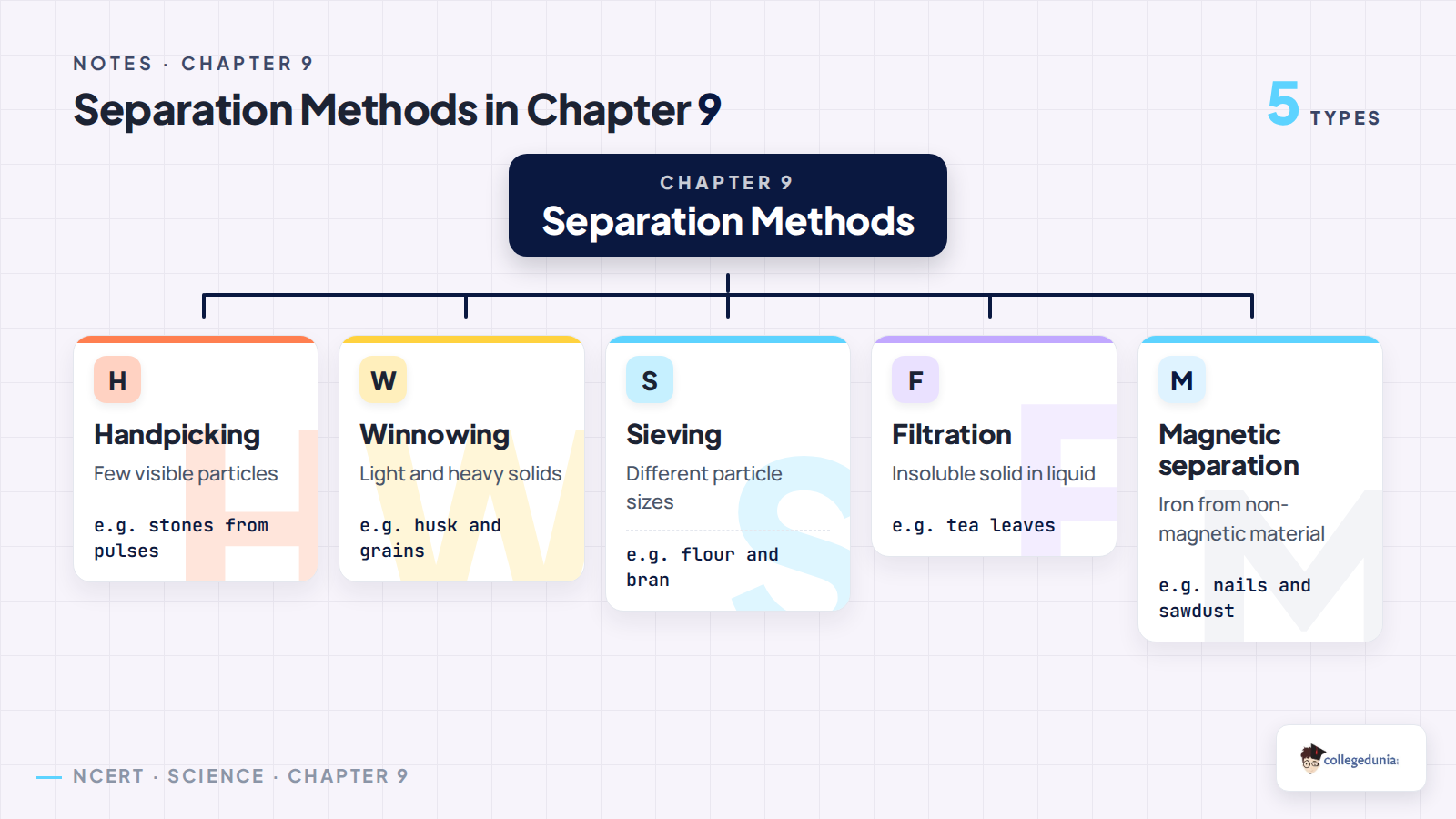
| Method | Property used | Daily example |
|---|---|---|
| Handpicking | Size, colour or shape | Stones from pulses |
| Winnowing | Weight difference | Husk from grains |
| Sieving | Particle size | Bran from flour |
| Evaporation | Water changes to vapour | Salt from salt solution |
| Filtration | Insoluble solid cannot pass through fine pores | Tea leaves from tea |
Solid Solid Separation Methods in Chapter 9
Solid solid mixtures are separated by handpicking, threshing, winnowing, sieving or magnetic separation. The chosen method depends on what difference is easiest to use.
- Handpicking works for a few visible particles.
- Threshing separates grains from stalks.
- Winnowing separates lighter husk from heavier grains.
- Sieving separates solids of different sizes.
- Magnetic separation removes iron from non-magnetic materials.
Solid Liquid Separation Methods in Chapter 9
Sedimentation, decantation, filtration and evaporation are used when a solid is mixed with a liquid. Muddy water, tea leaves in tea and salt solution are the main NCERT examples.
| Situation | Method | Reason |
|---|---|---|
| Mud settles in water | Sedimentation and decantation | Heavy insoluble particles settle |
| Tea leaves in tea | Filtration | Leaves cannot pass through strainer holes |
| Salt dissolved in water | Evaporation | Water evaporates and salt remains |
Methods of Separation Video Revision
Source: Magnet Brains on YouTube
Choosing the Correct Separation Method
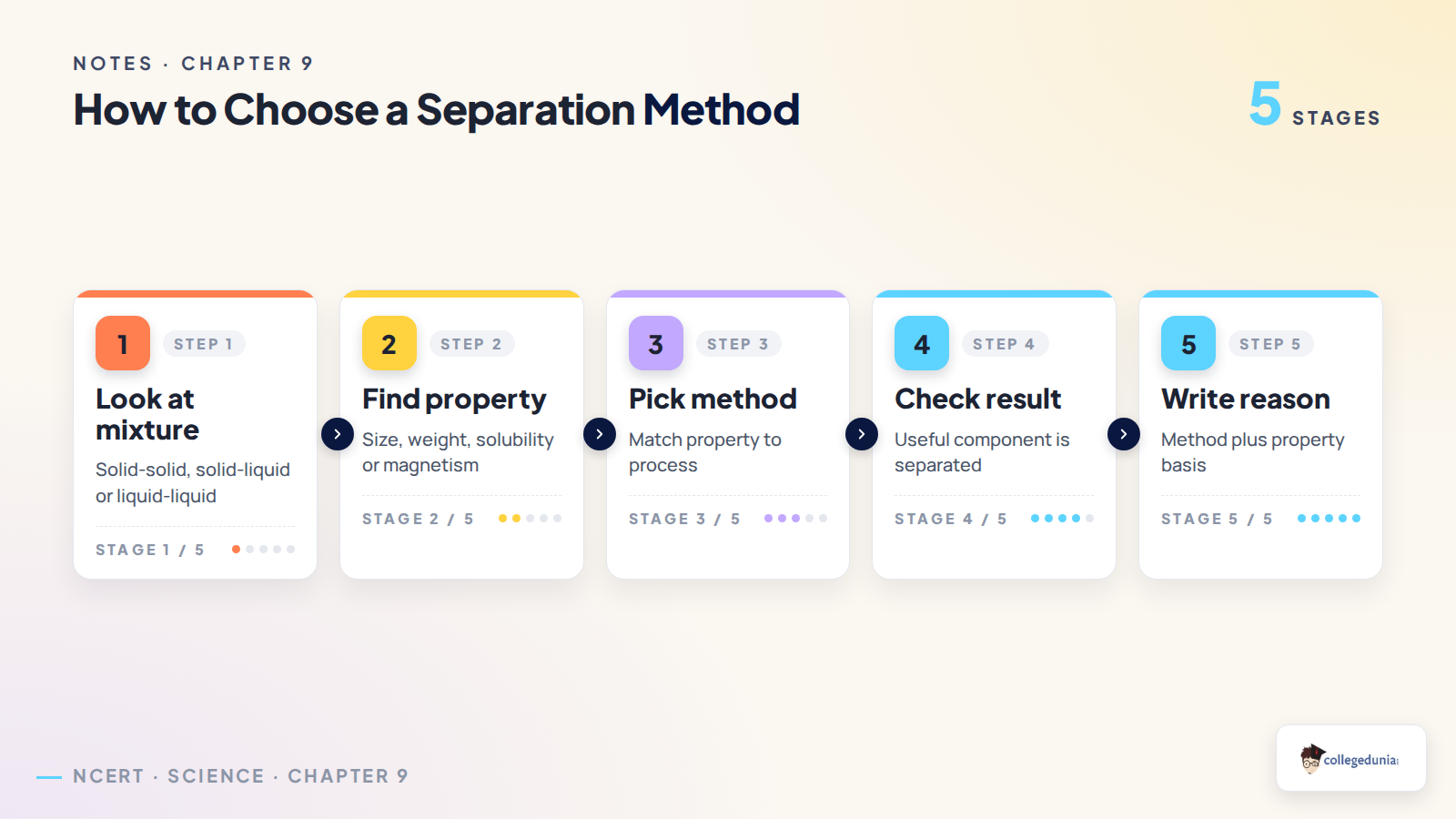
Always start with the mixture. Then ask which property differs most clearly. This prevents confusion between similar methods like decantation, filtration and evaporation.
- If particles are visible and few, use handpicking.
- If solid particles differ in size, use sieving.
- If one solid is light and another is heavy, use winnowing.
- If an insoluble solid is in a liquid, use sedimentation, decantation or filtration.
- If a solid is dissolved in a liquid, use evaporation to recover the solid.
- If one part is iron, use magnetic separation.
Related Class 6 Science Resources for Chapter 9
| Resource | Use it for | Link |
|---|---|---|
| NCERT Book PDF | Read the official chapter activities | Chapter 9 Book PDF |
| NCERT Solutions | Check exercise answers | Chapter 9 Solutions |
| Handwritten Notes | Use notebook-style revision | Chapter 9 Handwritten Notes |
More Class 6 Science Notes
| Chapter | Notes Link |
|---|---|
| Chapter 5 Measurement of Length and Motion | Open Notes |
| Chapter 6 Materials Around Us | Open Notes |
| Chapter 7 Temperature and its Measurement | Open Notes |
| Chapter 8 A Journey through States of Water | Open Notes |
| Chapter 9 Methods of Separation in Everyday Life | Current notes |
Methods of Separation in Everyday Life Class 6 Notes FAQs
Ques. What is covered in Class 6 Science Chapter 9 notes?
Ans. The notes cover handpicking, threshing, winnowing, sieving, evaporation, sedimentation, decantation, filtration, churning and magnetic separation.
Ques. What is winnowing in this chapter?
Ans. Winnowing separates lighter husk from heavier grains by wind or blowing air.
Ques. What is filtration in Class 6 Science Chapter 9?
Ans. Filtration separates insoluble solid particles from a liquid using a filter, such as tea leaves from tea.
Ques. Are these notes based on the 2026-27 NCERT Curiosity textbook?
Ans. Yes. The PDF follows Class 6 Science Curiosity Chapter 9 Methods of Separation in Everyday Life for the 2026-27 NCERT syllabus.



Comments