



NCERT Notes for Class 6 Vocational Education Kaushal Bodh Chapter 5 School Museum help students revise the 2026-27 project in a practical way. The chapter covers museums, artefacts, virtual tours, family history, Table 5.1, Table 5.2, label cards, presentation work and visitor feedback.
- Best for quick revision: use these notes before writing the School Museum project file.
- Project focus: revise artefact selection, material-wise care, labels and exhibition planning.
- Classroom focus: prepare short answers, activity tables and oral presentation points.
Chapter5SchoolMuseumNotes.pdf?page=1&dpi=150)
Chapter5SchoolMuseumNotes.pdf?page=2&dpi=150)
Chapter5SchoolMuseumNotes.pdf?page=3&dpi=150)
Chapter5SchoolMuseumNotes.pdf?page=4&dpi=150)
Chapter5SchoolMuseumNotes.pdf?page=5&dpi=150)
Chapter5SchoolMuseumNotes.pdf?page=6&dpi=150)
Chapter5SchoolMuseumNotes.pdf?page=7&dpi=150)
Chapter5SchoolMuseumNotes.pdf?page=8&dpi=150)
Chapter5SchoolMuseumNotes.pdf?page=9&dpi=150)
Chapter5SchoolMuseumNotes.pdf?page=10&dpi=150)
Chapter5SchoolMuseumNotes.pdf?page=11&dpi=150)
Chapter5SchoolMuseumNotes.pdf?page=12&dpi=150)
Chapter5SchoolMuseumNotes.pdf?page=13&dpi=150)
Chapter5SchoolMuseumNotes.pdf?page=14&dpi=150)
Chapter5SchoolMuseumNotes.pdf?page=15&dpi=150)
Chapter5SchoolMuseumNotes.pdf?page=16&dpi=150)
Chapter5SchoolMuseumNotes.pdf?page=17&dpi=150)
Chapter5SchoolMuseumNotes.pdf?page=18&dpi=150)
Chapter5SchoolMuseumNotes.pdf?page=19&dpi=150)
Chapter5SchoolMuseumNotes.pdf?page=20&dpi=150)
Chapter5SchoolMuseumNotes_flat_MobileCard.pdf?page=1&dpi=150)
Chapter5SchoolMuseumNotes_flat_MobileCard.pdf?page=2&dpi=150)
Chapter5SchoolMuseumNotes_flat_MobileCard.pdf?page=3&dpi=150)
Chapter5SchoolMuseumNotes_flat_MobileCard.pdf?page=4&dpi=150)
Chapter5SchoolMuseumNotes_flat_MobileCard.pdf?page=5&dpi=150)
Chapter5SchoolMuseumNotes_flat_MobileCard.pdf?page=6&dpi=150)
Chapter5SchoolMuseumNotes_flat_MobileCard.pdf?page=7&dpi=150)
Chapter5SchoolMuseumNotes_flat_MobileCard.pdf?page=8&dpi=150)
Chapter5SchoolMuseumNotes_flat_MobileCard.pdf?page=9&dpi=150)
Chapter5SchoolMuseumNotes_flat_MobileCard.pdf?page=10&dpi=150)
Chapter5SchoolMuseumNotes_flat_MobileCard.pdf?page=11&dpi=150)
Chapter5SchoolMuseumNotes_flat_MobileCard.pdf?page=12&dpi=150)
Chapter5SchoolMuseumNotes_flat_MobileCard.pdf?page=13&dpi=150)
Chapter5SchoolMuseumNotes_flat_MobileCard.pdf?page=14&dpi=150)
Chapter5SchoolMuseumNotes_flat_MobileCard.pdf?page=15&dpi=150)
Chapter5SchoolMuseumNotes_flat_MobileCard.pdf?page=16&dpi=150)
Chapter5SchoolMuseumNotes_flat_MobileCard.pdf?page=17&dpi=150)
Chapter5SchoolMuseumNotes_flat_MobileCard.pdf?page=18&dpi=150)
Chapter5SchoolMuseumNotes_flat_MobileCard.pdf?page=19&dpi=150)
Chapter5SchoolMuseumNotes_flat_MobileCard.pdf?page=20&dpi=150)
Chapter5SchoolMuseumNotes_flat_MobileCard.pdf?page=21&dpi=150)
Chapter5SchoolMuseumNotes_flat_MobileCard.pdf?page=22&dpi=150)
Chapter5SchoolMuseumNotes_flat_MobileCard.pdf?page=23&dpi=150)
Chapter5SchoolMuseumNotes_flat_MobileCard.pdf?page=24&dpi=150)
Chapter5SchoolMuseumNotes_flat_MobileCard.pdf?page=25&dpi=150)
Chapter5SchoolMuseumNotes_flat_MobileCard.pdf?page=26&dpi=150)
Chapter5SchoolMuseumNotes_flat_MobileCard.pdf?page=27&dpi=150)
Chapter5SchoolMuseumNotes_flat_MobileCard.pdf?page=28&dpi=150)
Chapter5SchoolMuseumNotes_flat_MobileCard.pdf?page=29&dpi=150)
Chapter5SchoolMuseumNotes_flat_MobileCard.pdf?page=30&dpi=150)
Chapter5SchoolMuseumNotes_flat_MobileCard.pdf?page=31&dpi=150)
Chapter5SchoolMuseumNotes_flat_MobileCard.pdf?page=32&dpi=150)
Chapter5SchoolMuseumNotes_flat_MobileCard.pdf?page=33&dpi=150)
Chapter5SchoolMuseumNotes_flat_MobileCard.pdf?page=34&dpi=150)
Chapter5SchoolMuseumNotes_flat_MobileCard.pdf?page=35&dpi=150)
Student Feedback: In a Collegedunia review of Class 6 Kaushal Bodh project doubts from over 8,600 students, School Museum felt easier when students wrote the label before designing the display.
- 72% needed a clear Table 5.1 and Table 5.2 format.
- 67% mixed up object history, usage and care method.
- 61% wanted a short exhibition-day checklist.
|
Table of Contents |
School Museum Chapter 5 Quick Map
School Museum is Project 5 of Class 6 Kaushal Bodh. Students learn about museums, collect artefacts, record their history, protect them, prepare presentations and organise a school exhibition. The chapter is activity-based, so tables and project-file entries matter as much as definitions.
Classroom-use anchor: A good answer should connect artefact, owner, age, material, use, care method and display label.
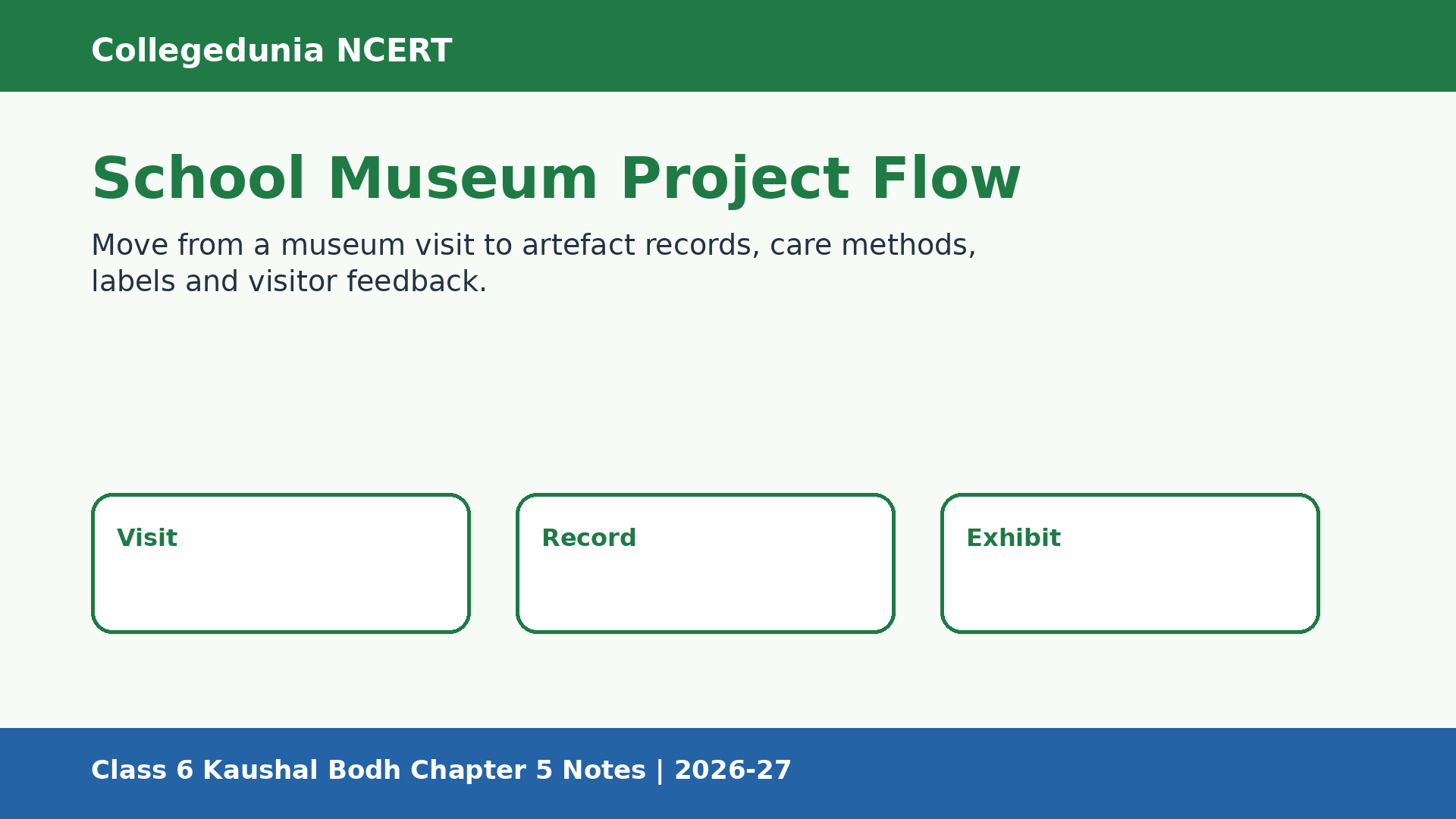
| Stage | What Students Do | Output |
|---|---|---|
| Learn | Understand museums, artefacts and preservation. | Key terms and examples |
| Find | Talk to family and identify objects. | Table 5.1 entries |
| Select | Choose five artefacts for display. | Table 5.2 records |
| Exhibit | Label, present and collect feedback. | School museum display |
School Museum Project Read Along from NCERT
The chapter is easier when students first hear the flow of the project and then fill the tables. The video below can be used as a short read-along before revising the activity sequence.
School Museum Project Read Along
Source: NCERT OFFICIAL on YouTube
Artefacts Museums and Important Terms
An artefact is a human-made object that is old, special or culturally important. A museum is a place where artefacts are kept and displayed. The chapter also uses terms such as archaeological site, curator, virtual exhibition and OCR.
- Artefact: old coin, radio, stamp, manuscript, camera, vessel or traditional cloth.
- Museum: place that protects objects and helps people understand culture.
- Curator: person who selects and looks after museum objects.
- OCR: Optical Character Recognition, used by tools such as Google Lens.
Materials Tools and Safety Rules
The project needs locally collected artefacts or photographs, storage containers, display boxes, cleaning brush, cloth, chart paper, label cards, markers, scissors and presentation equipment. Safety is about protecting both people and objects.
| Item | Use | Care Point |
|---|---|---|
| Artefact or photo | Main object for display. | Use photo if object is fragile. |
| Cleaning brush | Dust objects gently. | Avoid rough scrubbing. |
| Label card | Explain object to visitors. | Keep it short and readable. |
| Display box | Protect exhibit during viewing. | Use stable placement. |
Activity 1 Visiting a Museum or Virtual Museum
Students can visit a real museum, ask someone who has visited a museum, or use a virtual museum tour. While observing, note the layout, key exhibits, labels, lighting and interactive activities.
- Write the most interesting exhibit you saw.
- Explain why it was interesting.
- Describe one exhibit that still has significance today.
- Ask a curator or local historian a question if possible.
Activity 2 Learning Family and Area History
Before collecting objects, the chapter asks students to collect stories. Ask elders about old names of the town, family origin, traditions, local stories, landmarks and old institutions.
Classroom-use anchor: Do not guess dates. If the exact year is not known, write an approximate age or period.
Activity 3 and Table 5.1 Artefact Identification
Table 5.1 records at least five artefacts from home or the neighbourhood. The four key entries are artefact name, owner, age and whether the student will bring the object or a photograph.
| Question | What to Write | Example |
|---|---|---|
| What is the artefact? | Name the object clearly. | Old brass lamp |
| Who is the owner? | Name the person or source. | Grandmother |
| How old is it? | Write age or period. | About 50 years old |
| Bring or photograph? | Choose safe option. | Photograph from three angles |
Activity 4 and Table 5.2 Selecting Artefacts
Groups select five artefacts for the final exhibition. The choice should be based on meaning, safety, variety, condition and how clearly the object can be explained.
- Choose objects with a clear story or strong family memory.
- Prefer safe objects or good photographs for fragile items.
- Record sketch or photograph, history and usage in Table 5.2.
- Write whether the object is still being used.
Activity 5 Keeping Artefacts Safe
Every material needs a different care method. The chapter gives examples that students should learn as object-care pairs.
| Material | Care Method | Reason |
|---|---|---|
| Brass | Wash gently and polish. | Keeps shine and removes dullness. |
| Wood | Dust with a soft brush. | Protects old wooden surfaces. |
| Cloth | Hang away from nails and sharp edges. | Prevents tears and folds. |
| Photograph | Keep in envelopes. | Prevents bending and marks. |
Activity 6 Presentation on Artefacts
There is a story behind every artefact. Students may use posters, videos, interviews, slide presentations, blog-style writing or oral narration. The format should match the object and students visiting the display.
- For a fragile object, use a video or photograph-based presentation.
- For a family object, record an interview with an elder if allowed.
- For exhibition visitors, keep the explanation short and clear.
- Practise the oral description before the final display.
Activity 7 Exhibition Layout Labels and Feedback
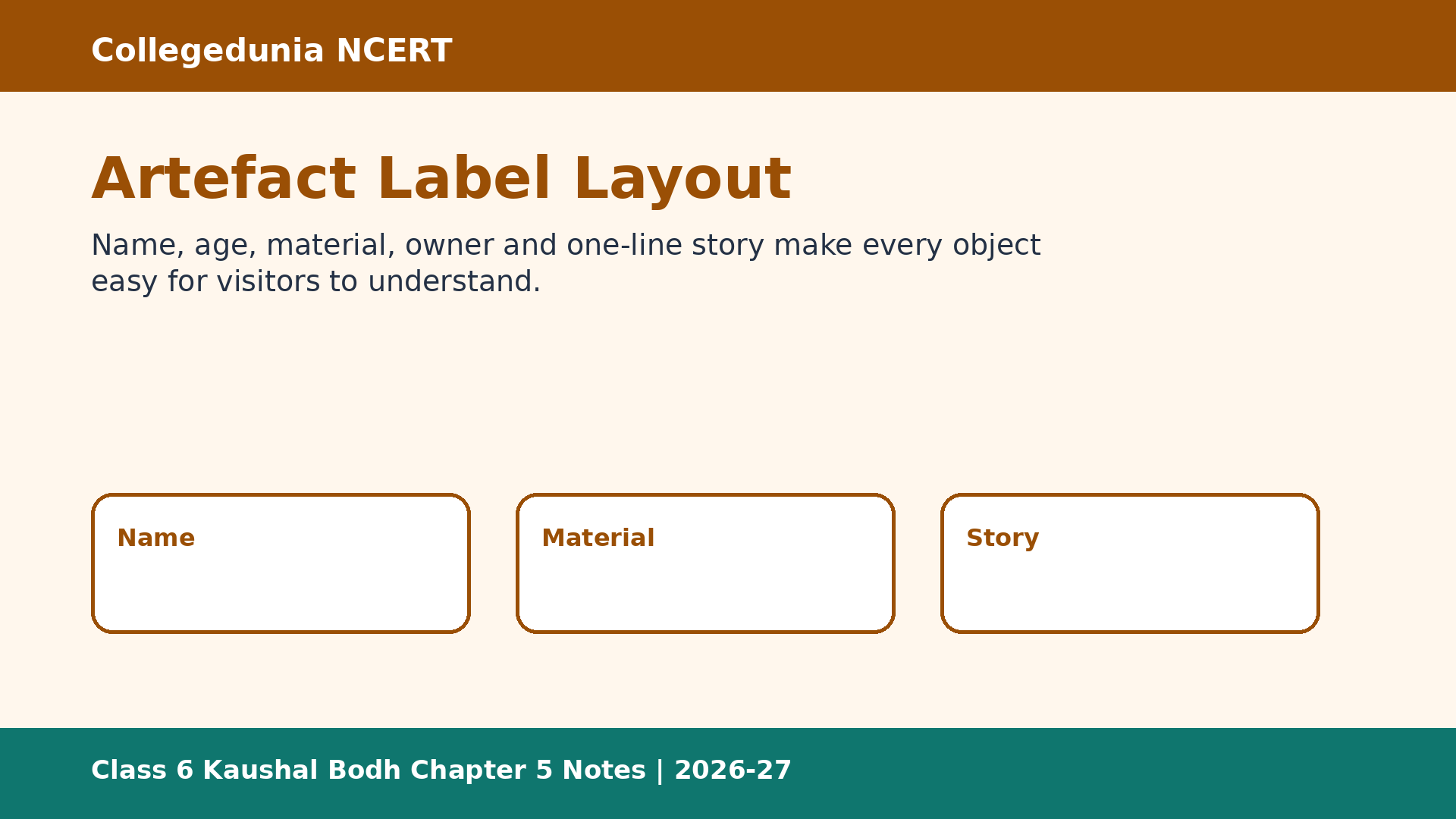
The final activity is to organise a school exhibition. Students decide the date and place, set up tables and display boards, write labels, invite visitors and collect feedback in a visitors book.
| Label Field | What to Write | Why It Helps |
|---|---|---|
| Object name | Exact artefact name. | Visitors know what they see. |
| Date or period | Approximate age. | Adds historical context. |
| Material | Brass, wood, paper, cloth or metal. | Connects to care method. |
| One-line story | Main use or memory. | Makes the object meaningful. |
AI Tools in School Museum Chapter
The chapter mentions Google Lens, OCR tools, Bhashini Anuvaad and Google Translate. These tools help identify objects, read old documents and translate text. Use them only with teacher guidance and privacy care.
- Google Lens: points the camera at an object, landmark or text.
- OCR: reads text from an image.
- Bhashini Anuvaad: translates, transcribes and transliterates Indian languages.
- Google Translate: translates words, phrases and web pages.
Related Class 6 Kaushal Bodh Resources
| Resource | Use It For | Link |
|---|---|---|
| NCERT Book PDF | Read the official School Museum chapter. | School Museum NCERT Book PDF |
| Handwritten Notes | Revise in notebook-style format. | Class 6 School Museum Handwritten Notes |
| Previous Notes | Revise the previous Kaushal Bodh project. | Animation and Games Notes |
Class 6 Vocational Education Kaushal Bodh Notes Chapter List
| Chapter | Notes Link |
|---|---|
| Chapter 1 School Kitchen Garden | School Kitchen Garden Notes |
| Chapter 2 Biodiversity Register | Biodiversity Register Notes |
| Chapter 3 Maker Skills | Maker Skills Notes |
| Chapter 4 Animation and Games | Animation and Games Notes |
| Chapter 5 School Museum | School Museum Notes |
| Chapter 6 Cooking without Fire | Cooking without Fire Notes |
Class 6 School Museum Notes FAQs
Ques. What is School Museum in Class 6 Kaushal Bodh?
Ans. School Museum is a project where students learn about museums, collect artefacts, write labels, protect objects and organise an exhibition.
Ques. What is an artefact in School Museum chapter?
Ans. An artefact is a human-made object that is old, unique, beautiful or connected to traditions, culture or family history.
Ques. What should be written in Table 5.1?
Ans. Table 5.1 records the artefact name, owner, age and whether the student will bring the object or a photograph.
Ques. How should artefacts be kept safe?
Ans. Artefacts should be cared for by material. Brass can be polished, wood dusted gently, cloth hung safely and photographs kept in envelopes.



Comments