



The NCERT Class 7 Social Science Chapter 1 notes for The Story of Indian Farming explain how farming in India depends on climate, soil, water, seeds, animal care, tools, markets and government support. These notes follow the 2026-27 NCERT textbook and help students revise the chapter through clean diagrams, comparison tables and answer frames.
- Best for revision: farming factors, crop seasons, traditional knowledge, modern methods and farmer support systems.
- Use with the PDF: read the factor flow first, then revise the rain-fed versus irrigated farming table.
- 2026-27 focus: follows Exploring Society: India and Beyond, Part 2, Chapter 1.
Chapter1TheStoryofIndianFarmingNotes.pdf?page=1&dpi=150)
Chapter1TheStoryofIndianFarmingNotes.pdf?page=2&dpi=150)
Chapter1TheStoryofIndianFarmingNotes.pdf?page=3&dpi=150)
Chapter1TheStoryofIndianFarmingNotes.pdf?page=4&dpi=150)
Chapter1TheStoryofIndianFarmingNotes.pdf?page=5&dpi=150)
Chapter1TheStoryofIndianFarmingNotes.pdf?page=6&dpi=150)
Chapter1TheStoryofIndianFarmingNotes.pdf?page=7&dpi=150)
Chapter1TheStoryofIndianFarmingNotes.pdf?page=8&dpi=150)
Chapter1TheStoryofIndianFarmingNotes.pdf?page=9&dpi=150)
Chapter1TheStoryofIndianFarmingNotes.pdf?page=10&dpi=150)
Chapter1TheStoryofIndianFarmingNotes.pdf?page=11&dpi=150)
Chapter1TheStoryofIndianFarmingNotes.pdf?page=12&dpi=150)
Chapter1TheStoryofIndianFarmingNotes.pdf?page=13&dpi=150)
Chapter1TheStoryofIndianFarmingNotes.pdf?page=14&dpi=150)
Chapter1TheStoryofIndianFarmingNotes.pdf?page=15&dpi=150)
Chapter1TheStoryofIndianFarmingNotes.pdf?page=16&dpi=150)
Chapter1TheStoryofIndianFarmingNotes.pdf?page=17&dpi=150)
Chapter1TheStoryofIndianFarmingNotes.pdf?page=18&dpi=150)
Chapter1TheStoryofIndianFarmingNotes.pdf?page=19&dpi=150)
Chapter1TheStoryofIndianFarmingNotes.pdf?page=20&dpi=150)
Chapter1TheStoryofIndianFarmingNotes.pdf?page=21&dpi=150)
Chapter1TheStoryofIndianFarmingNotes.pdf?page=22&dpi=150)
Chapter1TheStoryofIndianFarmingNotes.pdf?page=23&dpi=150)
Chapter1TheStoryofIndianFarmingNotes.pdf?page=24&dpi=150)
Chapter1TheStoryofIndianFarmingNotes.pdf?page=25&dpi=150)
Chapter1TheStoryofIndianFarmingNotes.pdf?page=26&dpi=150)
Chapter1TheStoryofIndianFarmingNotes.pdf?page=27&dpi=150)
Chapter1TheStoryofIndianFarmingNotes.pdf?page=28&dpi=150)
Chapter1TheStoryofIndianFarmingNotes.pdf?page=29&dpi=150)
Chapter1TheStoryofIndianFarmingNotes.pdf?page=30&dpi=150)
Chapter1TheStoryofIndianFarmingNotes.pdf?page=31&dpi=150)
Chapter1TheStoryofIndianFarmingNotes.pdf?page=32&dpi=150)
Chapter1TheStoryofIndianFarmingNotes_flat_MobileCard.pdf?page=1&dpi=150)
Chapter1TheStoryofIndianFarmingNotes_flat_MobileCard.pdf?page=2&dpi=150)
Chapter1TheStoryofIndianFarmingNotes_flat_MobileCard.pdf?page=3&dpi=150)
Chapter1TheStoryofIndianFarmingNotes_flat_MobileCard.pdf?page=4&dpi=150)
Chapter1TheStoryofIndianFarmingNotes_flat_MobileCard.pdf?page=5&dpi=150)
Chapter1TheStoryofIndianFarmingNotes_flat_MobileCard.pdf?page=6&dpi=150)
Chapter1TheStoryofIndianFarmingNotes_flat_MobileCard.pdf?page=7&dpi=150)
Chapter1TheStoryofIndianFarmingNotes_flat_MobileCard.pdf?page=8&dpi=150)
Chapter1TheStoryofIndianFarmingNotes_flat_MobileCard.pdf?page=9&dpi=150)
Chapter1TheStoryofIndianFarmingNotes_flat_MobileCard.pdf?page=10&dpi=150)
Chapter1TheStoryofIndianFarmingNotes_flat_MobileCard.pdf?page=11&dpi=150)
Chapter1TheStoryofIndianFarmingNotes_flat_MobileCard.pdf?page=12&dpi=150)
Chapter1TheStoryofIndianFarmingNotes_flat_MobileCard.pdf?page=13&dpi=150)
Chapter1TheStoryofIndianFarmingNotes_flat_MobileCard.pdf?page=14&dpi=150)
Chapter1TheStoryofIndianFarmingNotes_flat_MobileCard.pdf?page=15&dpi=150)
Chapter1TheStoryofIndianFarmingNotes_flat_MobileCard.pdf?page=16&dpi=150)
Chapter1TheStoryofIndianFarmingNotes_flat_MobileCard.pdf?page=17&dpi=150)
Chapter1TheStoryofIndianFarmingNotes_flat_MobileCard.pdf?page=18&dpi=150)
Chapter1TheStoryofIndianFarmingNotes_flat_MobileCard.pdf?page=19&dpi=150)
Chapter1TheStoryofIndianFarmingNotes_flat_MobileCard.pdf?page=20&dpi=150)
Chapter1TheStoryofIndianFarmingNotes_flat_MobileCard.pdf?page=21&dpi=150)
Chapter1TheStoryofIndianFarmingNotes_flat_MobileCard.pdf?page=22&dpi=150)
Chapter1TheStoryofIndianFarmingNotes_flat_MobileCard.pdf?page=23&dpi=150)
Chapter1TheStoryofIndianFarmingNotes_flat_MobileCard.pdf?page=24&dpi=150)
Chapter1TheStoryofIndianFarmingNotes_flat_MobileCard.pdf?page=25&dpi=150)
Chapter1TheStoryofIndianFarmingNotes_flat_MobileCard.pdf?page=26&dpi=150)
Chapter1TheStoryofIndianFarmingNotes_flat_MobileCard.pdf?page=27&dpi=150)
Chapter1TheStoryofIndianFarmingNotes_flat_MobileCard.pdf?page=28&dpi=150)
Chapter1TheStoryofIndianFarmingNotes_flat_MobileCard.pdf?page=29&dpi=150)
Chapter1TheStoryofIndianFarmingNotes_flat_MobileCard.pdf?page=30&dpi=150)
Chapter1TheStoryofIndianFarmingNotes_flat_MobileCard.pdf?page=31&dpi=150)
Chapter1TheStoryofIndianFarmingNotes_flat_MobileCard.pdf?page=32&dpi=150)
Chapter1TheStoryofIndianFarmingNotes_flat_MobileCard.pdf?page=33&dpi=150)
Chapter1TheStoryofIndianFarmingNotes_flat_MobileCard.pdf?page=34&dpi=150)
Chapter1TheStoryofIndianFarmingNotes_flat_MobileCard.pdf?page=35&dpi=150)
Chapter1TheStoryofIndianFarmingNotes_flat_MobileCard.pdf?page=36&dpi=150)
Chapter1TheStoryofIndianFarmingNotes_flat_MobileCard.pdf?page=37&dpi=150)
Chapter1TheStoryofIndianFarmingNotes_flat_MobileCard.pdf?page=38&dpi=150)
Chapter1TheStoryofIndianFarmingNotes_flat_MobileCard.pdf?page=39&dpi=150)
Chapter1TheStoryofIndianFarmingNotes_flat_MobileCard.pdf?page=40&dpi=150)
Chapter1TheStoryofIndianFarmingNotes_flat_MobileCard.pdf?page=41&dpi=150)
Chapter1TheStoryofIndianFarmingNotes_flat_MobileCard.pdf?page=42&dpi=150)
Chapter1TheStoryofIndianFarmingNotes_flat_MobileCard.pdf?page=43&dpi=150)
Chapter1TheStoryofIndianFarmingNotes_flat_MobileCard.pdf?page=44&dpi=150)
Chapter1TheStoryofIndianFarmingNotes_flat_MobileCard.pdf?page=45&dpi=150)

Student Feedback: In a Collegedunia revision poll of 6,240 Class 7 students, 74% said Chapter 1 became easier after they grouped farming under climate, soil, water, seeds and support systems.
|
Table of Contents |
Chapter 1 The Story of Indian Farming Notes Highlights
The Story of Indian Farming explains agriculture as a living system, not only as crop production. The chapter connects natural factors such as climate, soil and water with human effort, traditional knowledge, new technology, market access and state support. The main revision idea is simple: farming changes when nature, skill and institutions change together.
| Topic | What to remember | Exam cue |
|---|---|---|
| Climate | Rainfall, heat and seasons influence crop choice | Use for crop-season answers |
| Soil | Texture, fertility and humus affect root growth | Link soil with productivity |
| Water | Rain, tanks, canals, wells and pumps shape reliability | Compare rain-fed and irrigated farming |
| Support | Markets, insurance, storage and advice reduce risk | Use for farmer welfare answers |
Factors Behind Indian Farming
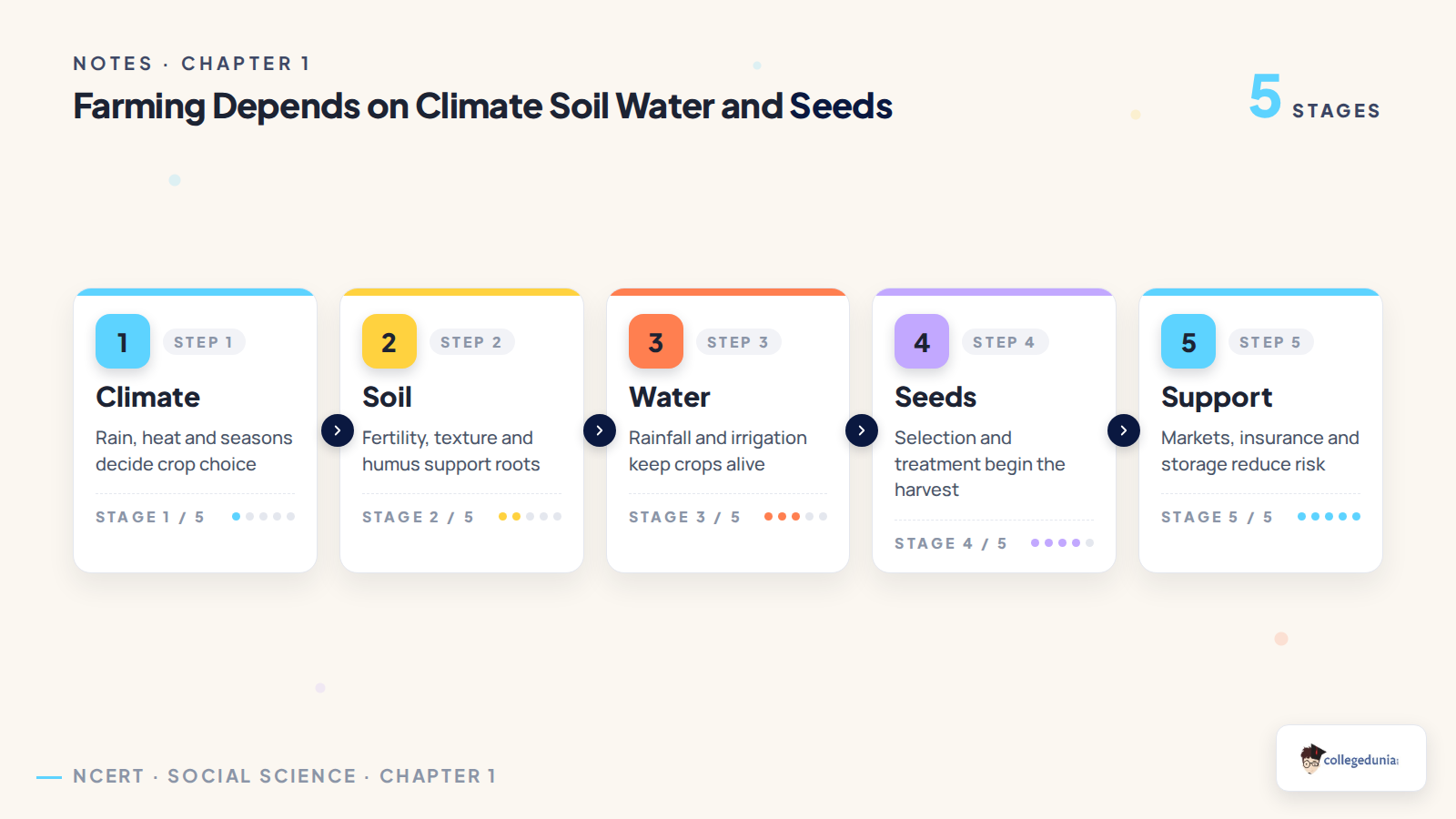
Indian farming is shaped by many connected factors. A farmer first studies the season, soil and available water. The choice of seed, animal power or machines, manure or fertiliser and storage also matters. This is why a good answer should not list one factor alone.
- Natural base: climate, rainfall, soil type, terrain and water sources.
- Human effort: seed selection, field preparation, crop care and harvesting.
- Support network: roads, markets, price information, credit, storage and government schemes.
Indian Farming Revision Video
Source: Magnet Brains on YouTube
Rain-Fed and Irrigated Farming
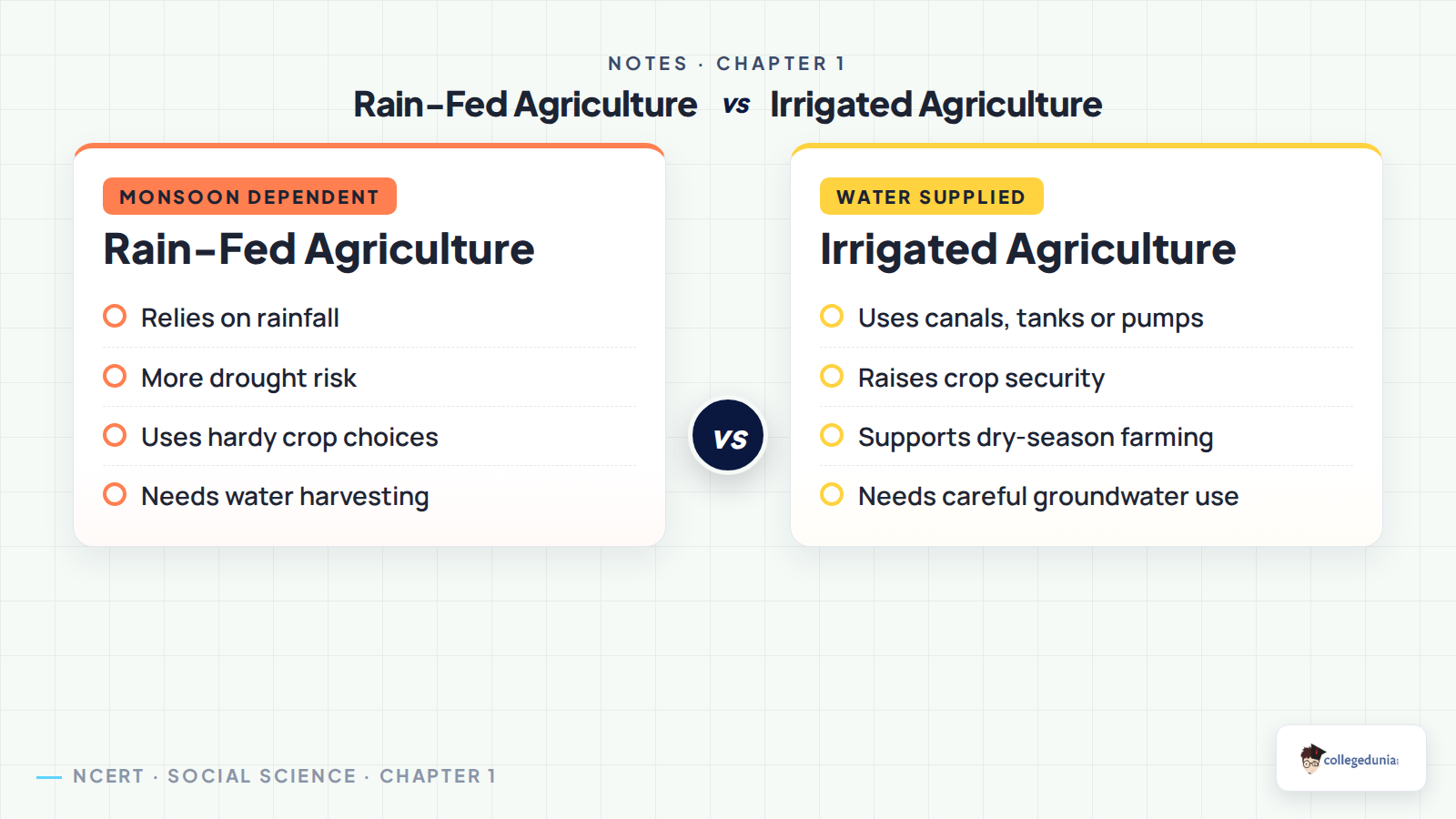
One of the easiest ways to revise the chapter is to compare rain-fed farming with irrigated farming. Rain-fed agriculture depends mainly on monsoon rainfall, while irrigated agriculture uses canals, tanks, tube wells or other water sources to supply fields when rainfall is not enough.
| Point | Rain-fed farming | Irrigated farming |
|---|---|---|
| Water source | Mostly rainfall | Canals, tanks, wells or pumps |
| Main risk | Drought or delayed monsoon | Overuse of water or groundwater stress |
| Crop choice | Often hardy crops suited to rainfall | Wider crop choice and dry-season farming |
| Revision clue | Monsoon dependent | Water supplied |
Traditional Knowledge and Modern Methods
The chapter shows that farming knowledge comes from both experience and innovation. Traditional practices include observing seasons, using local seeds, maintaining cattle, applying organic manure and conserving water. Modern methods include improved seeds, farm machines, irrigation systems, weather information and scientific advice.
- Traditional wisdom: helps farmers adjust to local soil, climate and water conditions.
- Modern innovation: improves productivity when used carefully and affordably.
- Balanced answer: mention that sustainability needs both experience and science.
How to Use the Class 7 Chapter 1 Notes PDF
Start with the flow diagram, then revise the comparison table and the quick recall boxes in the PDF. For long answers, use a four-part frame: natural factor, farming practice, example and effect on production. For this chapter, always connect crop choice with climate, soil and water.
- Use the PDF tables for direct three-mark comparison questions.
- Use the concept maps for quick revision before class tests.
- Use the answer frames for questions on sustainable farming and farmer support.
More Class 7 Social Science Chapter 1 Resources
Use these related resources when you want the same chapter in another format. The official book PDF is useful for textbook reading, while solutions help with activity and question answers.
| Resource | Best use | Link |
|---|---|---|
| NCERT Notes | Topic-by-topic revision with diagrams and tables | Current page |
| NCERT Solutions | Practice textbook questions and activity answers | Open NCERT Solutions |
| NCERT Book PDF | Read the official chapter with textbook figures | Open Book PDF |
| Handwritten Notes | Revise in a quick one-sitting format | Open Handwritten Notes |
All Chapters in Class 7 Social Science Part 2 Notes
The table below keeps the same resource type together, so students can move chapter by chapter through Class 7 Social Science Part 2 notes.
| Chapter | NCERT chapter title | Notes link |
|---|---|---|
| Chapter 1 | The Story of Indian Farming | Current notes |
| Chapter 2 | India and Her Neighbours | Open Notes |
| Chapter 3 | Empires and Kingdoms: 6th to 10th Centuries | Open Notes |
| Chapter 4 | Turning Tides: 11th and 12th Centuries | Open Notes |
| Chapter 5 | India, a Home to Many | Open Notes |
| Chapter 6 | The State, the Government, and You | Open Notes |
| Chapter 7 | Infrastructure: Engine of India's Development | Open Notes |
| Chapter 8 | Banks and the Magic of Finance | Open Notes |
Class 7 Social Science Chapter 1 The Story of Indian Farming Notes FAQs
Ques. What is The Story of Indian Farming about?
Ans. The chapter explains how Indian farming depends on climate, soil, water, seeds, tools, animals, markets and government support.
Ques. Why are climate and soil important in farming?
Ans. Climate decides heat and rainfall, while soil provides nutrients and support for roots. Together, they influence which crops grow well.
Ques. What is the difference between rain-fed and irrigated farming?
Ans. Rain-fed farming depends mainly on rainfall. Irrigated farming uses canals, tanks, wells or pumps to supply water when rain is not enough.
Ques. How should students revise Class 7 Social Science Chapter 1?
Ans. Students should revise the factor flow, compare farming types, remember traditional and modern practices, and practise short answer frames from the PDF.



Comments