




NCERT Notes for Class 7 Vocational Education Kaushal Bodh Chapter 1 Plant Nursery help students revise the 2026-27 project in a practical way. The chapter is about planning a small nursery, preparing beds, germinating seeds, raising seedlings, using stem cuttings, keeping records, and estimating basic cost.
- Best for quick revision: use these notes before reading the PDF or completing the activity record.
- Project focus: understand nursery layout, shade-net use, seed germination, seedling care, and plant propagation.
- Exam focus: revise definitions, safety points, activity sequence, observation tables, and cost terms.
Chapter1PlantNurseryNotes.pdf?page=1&dpi=150)
Chapter1PlantNurseryNotes.pdf?page=2&dpi=150)
Chapter1PlantNurseryNotes.pdf?page=3&dpi=150)
Chapter1PlantNurseryNotes.pdf?page=4&dpi=150)
Chapter1PlantNurseryNotes.pdf?page=5&dpi=150)
Chapter1PlantNurseryNotes.pdf?page=6&dpi=150)
Chapter1PlantNurseryNotes.pdf?page=7&dpi=150)
Chapter1PlantNurseryNotes.pdf?page=8&dpi=150)
Chapter1PlantNurseryNotes.pdf?page=9&dpi=150)
Chapter1PlantNurseryNotes.pdf?page=10&dpi=150)
Chapter1PlantNurseryNotes.pdf?page=11&dpi=150)
Chapter1PlantNurseryNotes.pdf?page=12&dpi=150)
Chapter1PlantNurseryNotes.pdf?page=13&dpi=150)
Chapter1PlantNurseryNotes.pdf?page=14&dpi=150)
Chapter1PlantNurseryNotes.pdf?page=15&dpi=150)
Chapter1PlantNurseryNotes.pdf?page=16&dpi=150)
Chapter1PlantNurseryNotes.pdf?page=17&dpi=150)
Chapter1PlantNurseryNotes.pdf?page=18&dpi=150)
Chapter1PlantNurseryNotes.pdf?page=19&dpi=150)
Chapter1PlantNurseryNotes.pdf?page=20&dpi=150)
Chapter1PlantNurseryNotes.pdf?page=21&dpi=150)
Chapter1PlantNurseryNotes.pdf?page=22&dpi=150)
Chapter1PlantNurseryNotes.pdf?page=23&dpi=150)
Chapter1PlantNurseryNotes_flat_MobileCard.pdf?page=1&dpi=150)
Chapter1PlantNurseryNotes_flat_MobileCard.pdf?page=2&dpi=150)
Chapter1PlantNurseryNotes_flat_MobileCard.pdf?page=3&dpi=150)
Chapter1PlantNurseryNotes_flat_MobileCard.pdf?page=4&dpi=150)
Chapter1PlantNurseryNotes_flat_MobileCard.pdf?page=5&dpi=150)
Chapter1PlantNurseryNotes_flat_MobileCard.pdf?page=6&dpi=150)
Chapter1PlantNurseryNotes_flat_MobileCard.pdf?page=7&dpi=150)
Chapter1PlantNurseryNotes_flat_MobileCard.pdf?page=8&dpi=150)
Chapter1PlantNurseryNotes_flat_MobileCard.pdf?page=9&dpi=150)
Chapter1PlantNurseryNotes_flat_MobileCard.pdf?page=10&dpi=150)
Chapter1PlantNurseryNotes_flat_MobileCard.pdf?page=11&dpi=150)
Chapter1PlantNurseryNotes_flat_MobileCard.pdf?page=12&dpi=150)
Chapter1PlantNurseryNotes_flat_MobileCard.pdf?page=13&dpi=150)
Chapter1PlantNurseryNotes_flat_MobileCard.pdf?page=14&dpi=150)
Chapter1PlantNurseryNotes_flat_MobileCard.pdf?page=15&dpi=150)
Chapter1PlantNurseryNotes_flat_MobileCard.pdf?page=16&dpi=150)
Chapter1PlantNurseryNotes_flat_MobileCard.pdf?page=17&dpi=150)
Chapter1PlantNurseryNotes_flat_MobileCard.pdf?page=18&dpi=150)
Chapter1PlantNurseryNotes_flat_MobileCard.pdf?page=19&dpi=150)
Chapter1PlantNurseryNotes_flat_MobileCard.pdf?page=20&dpi=150)
Chapter1PlantNurseryNotes_flat_MobileCard.pdf?page=21&dpi=150)
Chapter1PlantNurseryNotes_flat_MobileCard.pdf?page=22&dpi=150)
Chapter1PlantNurseryNotes_flat_MobileCard.pdf?page=23&dpi=150)
Chapter1PlantNurseryNotes_flat_MobileCard.pdf?page=24&dpi=150)
Chapter1PlantNurseryNotes_flat_MobileCard.pdf?page=25&dpi=150)
Chapter1PlantNurseryNotes_flat_MobileCard.pdf?page=26&dpi=150)
Chapter1PlantNurseryNotes_flat_MobileCard.pdf?page=27&dpi=150)
Chapter1PlantNurseryNotes_flat_MobileCard.pdf?page=28&dpi=150)
Chapter1PlantNurseryNotes_flat_MobileCard.pdf?page=29&dpi=150)
Chapter1PlantNurseryNotes_flat_MobileCard.pdf?page=30&dpi=150)
Chapter1PlantNurseryNotes_flat_MobileCard.pdf?page=31&dpi=150)
Chapter1PlantNurseryNotes_flat_MobileCard.pdf?page=32&dpi=150)
Chapter1PlantNurseryNotes_flat_MobileCard.pdf?page=33&dpi=150)
Student Feedback: Based on common revision needs seen across 12,000 students using NCERT project resources, Plant Nursery is easiest when students learn the activity order first and then revise the terms. Keep one page for nursery tools, one page for propagation methods, and one page for the cost record.
Plant Nursery Chapter 1 Overview
A plant nursery is a place where young plants are raised under care before they are shifted to a garden, field, pot, or school habitat area. In Class 7 Vocational Education Kaushal Bodh Chapter 1, students do not only memorise a definition. They observe how seedlings need soil, moisture, sunlight, air, nutrients, shade, and protection during the early stage of growth.
The chapter introduces plant nursery work as a hands-on project. Students visit or study a nursery, plan a layout, prepare land, set up a shade-net, germinate seeds, raise plants, try stem cuttings, monitor growth, and calculate simple cost. Remember the sequence: visit, plan, prepare, germinate, raise, observe, record. This order helps students answer both short questions and project-file questions.
| Chapter Area | What Students Learn | Why It Matters |
|---|---|---|
| Nursery visit | Tools, plant types, irrigation, shade, records | Connects textbook ideas with real work |
| Layout planning | Bed, path, water source, fence, and shade-net position | Prevents crowding and poor plant care |
| Propagation | Seeds, seedling trays, raised beds, and stem cuttings | Shows how many plants can be produced |
| Record keeping | Germination percentage, growth observations, and cost | Builds scientific and vocational habits |
Activity Flow for Class 7 Plant Nursery Project
The NCERT chapter is activity-based, so revise it like a project manual. First, students identify a suitable nursery area. The place should receive light, have access to water, and remain safe from animals or accidental damage. Next, they plan the layout with separate zones for beds, paths, tools, water, compost, and plant records.
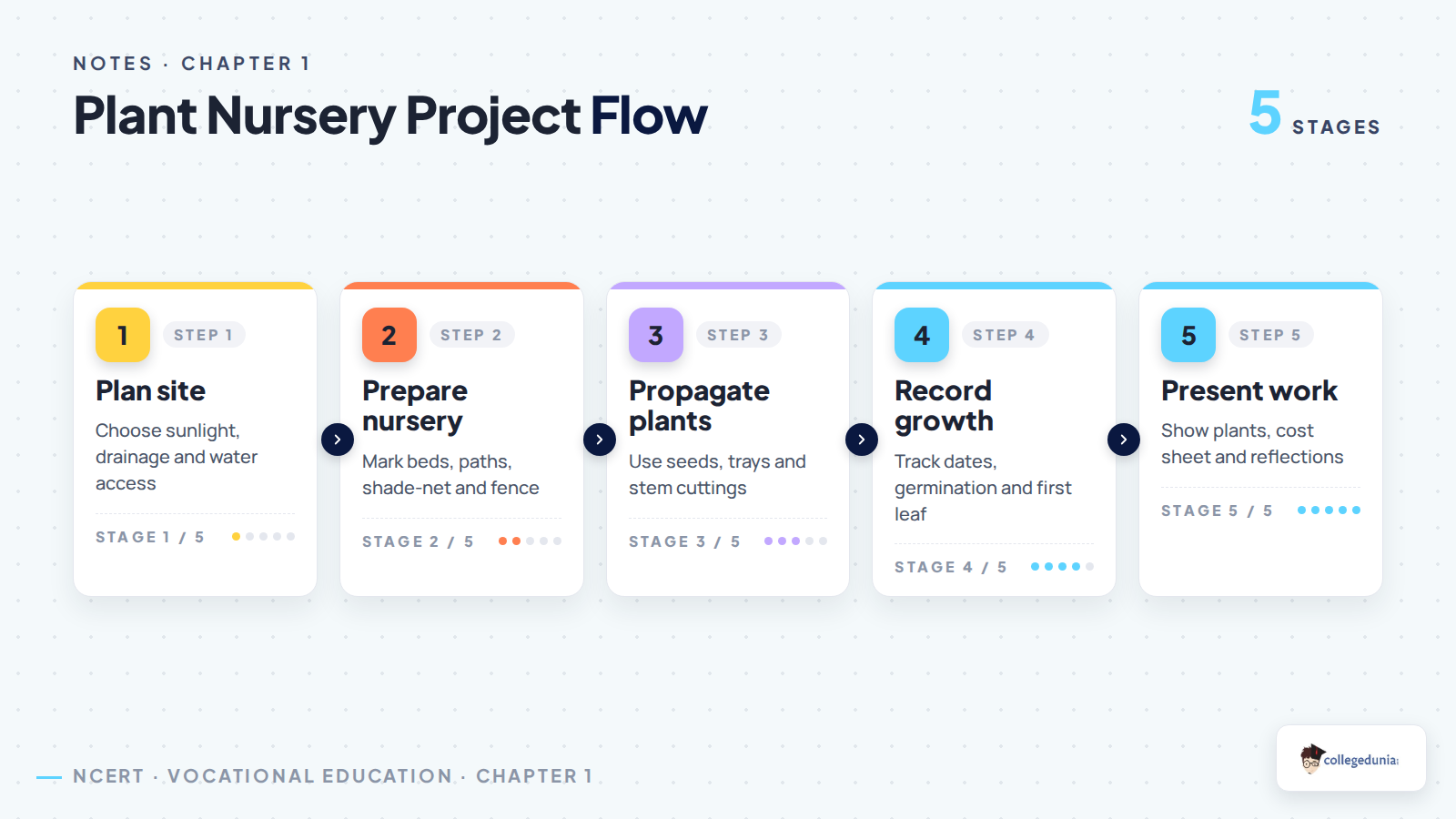
- Prepare the area: remove stones, level the soil, mix compost, and mark the bed boundaries.
- Provide protection: use a shade-net or fence when seedlings need filtered light and safety.
- Maintain records: note sowing date, number of seeds, germination count, watering schedule, and cost.
A raised bed is useful because it improves drainage and gives roots a soft growing space. A seedling tray is useful when many seedlings have to be raised in a small area. A shade-net protects young plants from harsh sunlight and reduces water loss. These are small decisions, but they show the vocational skill behind the project.
Plant Nursery Project Explained for Class 7
Source: NCERT Hindi Tutor
Propagation Methods in Plant Nursery
Plant propagation means producing new plants. In this chapter, students mainly revise seed-based propagation and vegetative propagation through stem cuttings. Seeds are commonly used for vegetables and flowers. Stem cuttings are used for plants that can grow roots from a cut stem, such as rose, bougainvillea, and croton.
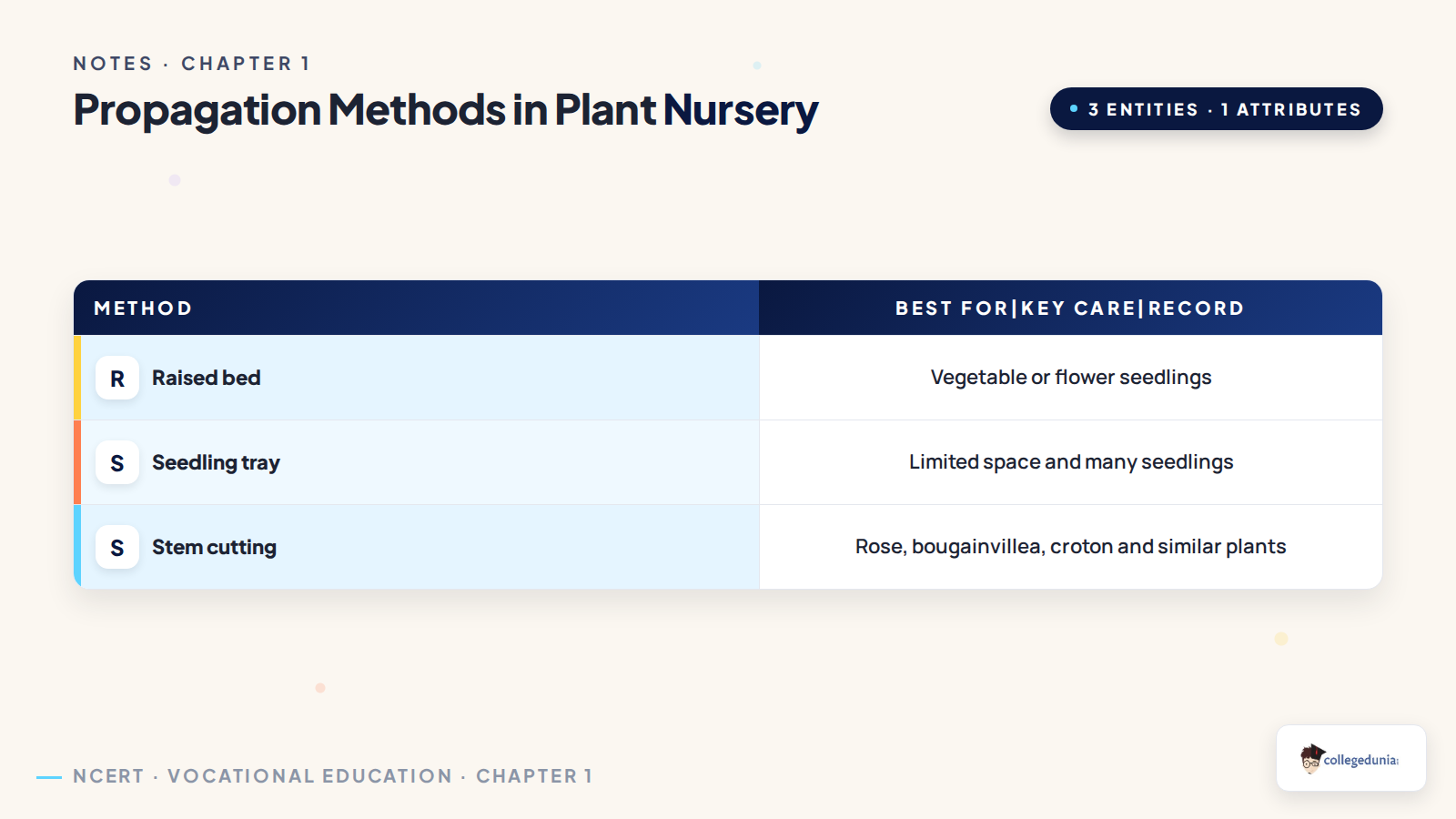
| Method | Steps to Remember | Key Care Point |
|---|---|---|
| Seed germination test | Place seeds on moist paper, keep them in a warm place, and count sprouted seeds | Paper should stay moist, not waterlogged |
| Raised bed | Prepare loose soil, add compost, sow seeds, cover lightly, and water gently | Good drainage prevents seed rot |
| Seedling tray | Fill cells with growing medium, sow seeds, label the tray, and water carefully | Labels help identify plant type and date |
| Stem cutting | Cut a healthy stem below a node, remove extra leaves, place in soil, and keep moist | The node region can form new roots |
For quick revision, connect every method with its purpose. A raised bed is for open nursery preparation, a seedling tray is for controlled and neat seedling growth, and a stem cutting is for multiplying selected plants. Healthy roots, proper moisture, and protection from strong sun are the three care ideas repeated across the chapter.
Observation, Safety, and Cost Records
Plant Nursery also teaches students how to work safely and record work scientifically. Students should wash hands after handling soil, use tools carefully, avoid overcrowding, and keep the work area clean. Tools such as hand trowels, watering cans, trays, labels, rope, and measuring tape should be returned after use.
The record part is important because it turns the project into evidence-based learning. Students may record how many seeds were sown, how many germinated, the height of seedlings, watering dates, and the cost of materials. Germination percentage is calculated by comparing sprouted seeds with total seeds sown.
- Observation record: date, plant name, height, leaf count, watering, and visible change.
- Cost record: seed, tray, compost, pot, shade-net, tool use, and transport if applicable.
- Care record: watering time, sunlight condition, pest sign, and transplanting readiness.
A good project file should show both action and reflection. Write what was done, what changed in the plant, and what could be improved next time. This is why the chapter belongs to Vocational Education: it builds a useful life skill, not just textbook memory.
Related Class 7 Kaushal Bodh Resources for Plant Nursery
| Resource | Use It For | Link |
|---|---|---|
| NCERT Book PDF | Read the official chapter text and activities | Plant Nursery NCERT Book PDF |
| Handwritten Notes | Revise the project in a notebook-style format | Class 7 Plant Nursery Handwritten Notes |
| Solutions | Check activity questions and short answers | Class 7 Plant Nursery Solutions |
Class 7 Vocational Education Kaushal Bodh Notes Chapter List
| Chapter | Notes Link |
|---|---|
| Chapter 1 Plant Nursery | Plant Nursery Notes |
| Chapter 2 School Habitat Garden | School Habitat Garden Notes |
| Chapter 3 Tie and Dye | Tie and Dye Notes |
| Chapter 4 AI Assistant | AI Assistant Notes |
| Chapter 5 Storytime with Puppets | Storytime with Puppets Notes |
| Chapter 6 Family Health Handbook | Family Health Handbook Notes |
Class 7 Plant Nursery Notes FAQs
Ques. What is a plant nursery in Class 7 Vocational Education?
Ans. A plant nursery is a place where seeds, seedlings, and young plants are raised with proper soil, water, light, shade, and protection before they are moved to a garden, field, or pot.
Ques. What are the main activities in Plant Nursery Chapter 1?
Ans. The main activities are visiting a nursery, planning the layout, preparing land, setting up shade-net protection, germinating seeds, raising plants, using stem cuttings, observing growth, and calculating cost.
Ques. Why is a raised bed useful in a nursery?
Ans. A raised bed keeps soil loose, improves drainage, reduces waterlogging, and gives young roots a healthier place to grow. It is useful for seeds and seedlings that need careful early care.
Ques. What should students write in a nursery observation record?
Ans. Students should record the date, plant name, sowing or cutting method, watering, height, leaf growth, germination count, problem noticed, and care action taken during the project.



Comments