



NCERT Class 8 Vocational Education Chapter 2 Feeding and Caring for Farm Animals Notes explain livestock care, health records, feeding charts, silage, treated dry fodder and first-aid planning for the 2026-27 Kaushal Bodh textbook.
- Project focus: observe animals safely, record care routines and prepare feed.
- Best use: revise before farm visits, activity tables and reflection answers.
- Answer focus: include safety, expert supervision and exact measures.
Chapter2FeedingandCaringforFarmAnimalsNotes.pdf?page=1&dpi=150)
Chapter2FeedingandCaringforFarmAnimalsNotes.pdf?page=2&dpi=150)
Chapter2FeedingandCaringforFarmAnimalsNotes.pdf?page=3&dpi=150)
Chapter2FeedingandCaringforFarmAnimalsNotes.pdf?page=4&dpi=150)
Chapter2FeedingandCaringforFarmAnimalsNotes.pdf?page=5&dpi=150)
Chapter2FeedingandCaringforFarmAnimalsNotes.pdf?page=6&dpi=150)
Chapter2FeedingandCaringforFarmAnimalsNotes.pdf?page=7&dpi=150)
Chapter2FeedingandCaringforFarmAnimalsNotes.pdf?page=8&dpi=150)
Chapter2FeedingandCaringforFarmAnimalsNotes.pdf?page=9&dpi=150)
Chapter2FeedingandCaringforFarmAnimalsNotes.pdf?page=10&dpi=150)
Chapter2FeedingandCaringforFarmAnimalsNotes.pdf?page=11&dpi=150)
Chapter2FeedingandCaringforFarmAnimalsNotes.pdf?page=12&dpi=150)
Chapter2FeedingandCaringforFarmAnimalsNotes.pdf?page=13&dpi=150)
Chapter2FeedingandCaringforFarmAnimalsNotes.pdf?page=14&dpi=150)
Chapter2FeedingandCaringforFarmAnimalsNotes.pdf?page=15&dpi=150)
Chapter2FeedingandCaringforFarmAnimalsNotes.pdf?page=16&dpi=150)
Chapter2FeedingandCaringforFarmAnimalsNotes.pdf?page=17&dpi=150)
Chapter2FeedingandCaringforFarmAnimalsNotes.pdf?page=18&dpi=150)
Chapter2FeedingandCaringforFarmAnimalsNotes.pdf?page=19&dpi=150)
Chapter2FeedingandCaringforFarmAnimalsNotes.pdf?page=20&dpi=150)
Chapter2FeedingandCaringforFarmAnimalsNotes.pdf?page=21&dpi=150)
Chapter2FeedingandCaringforFarmAnimalsNotes_flat_MobileCard.pdf?page=1&dpi=150)
Chapter2FeedingandCaringforFarmAnimalsNotes_flat_MobileCard.pdf?page=2&dpi=150)
Chapter2FeedingandCaringforFarmAnimalsNotes_flat_MobileCard.pdf?page=3&dpi=150)
Chapter2FeedingandCaringforFarmAnimalsNotes_flat_MobileCard.pdf?page=4&dpi=150)
Chapter2FeedingandCaringforFarmAnimalsNotes_flat_MobileCard.pdf?page=5&dpi=150)
Chapter2FeedingandCaringforFarmAnimalsNotes_flat_MobileCard.pdf?page=6&dpi=150)
Chapter2FeedingandCaringforFarmAnimalsNotes_flat_MobileCard.pdf?page=7&dpi=150)
Chapter2FeedingandCaringforFarmAnimalsNotes_flat_MobileCard.pdf?page=8&dpi=150)
Chapter2FeedingandCaringforFarmAnimalsNotes_flat_MobileCard.pdf?page=9&dpi=150)
Chapter2FeedingandCaringforFarmAnimalsNotes_flat_MobileCard.pdf?page=10&dpi=150)
Chapter2FeedingandCaringforFarmAnimalsNotes_flat_MobileCard.pdf?page=11&dpi=150)
Chapter2FeedingandCaringforFarmAnimalsNotes_flat_MobileCard.pdf?page=12&dpi=150)
Chapter2FeedingandCaringforFarmAnimalsNotes_flat_MobileCard.pdf?page=13&dpi=150)
Chapter2FeedingandCaringforFarmAnimalsNotes_flat_MobileCard.pdf?page=14&dpi=150)
Chapter2FeedingandCaringforFarmAnimalsNotes_flat_MobileCard.pdf?page=15&dpi=150)
Chapter2FeedingandCaringforFarmAnimalsNotes_flat_MobileCard.pdf?page=16&dpi=150)
Chapter2FeedingandCaringforFarmAnimalsNotes_flat_MobileCard.pdf?page=17&dpi=150)
Chapter2FeedingandCaringforFarmAnimalsNotes_flat_MobileCard.pdf?page=18&dpi=150)
Chapter2FeedingandCaringforFarmAnimalsNotes_flat_MobileCard.pdf?page=19&dpi=150)
Chapter2FeedingandCaringforFarmAnimalsNotes_flat_MobileCard.pdf?page=20&dpi=150)
Chapter2FeedingandCaringforFarmAnimalsNotes_flat_MobileCard.pdf?page=21&dpi=150)
Chapter2FeedingandCaringforFarmAnimalsNotes_flat_MobileCard.pdf?page=22&dpi=150)
Chapter2FeedingandCaringforFarmAnimalsNotes_flat_MobileCard.pdf?page=23&dpi=150)
Chapter2FeedingandCaringforFarmAnimalsNotes_flat_MobileCard.pdf?page=24&dpi=150)
Chapter2FeedingandCaringforFarmAnimalsNotes_flat_MobileCard.pdf?page=25&dpi=150)
Chapter2FeedingandCaringforFarmAnimalsNotes_flat_MobileCard.pdf?page=26&dpi=150)
Chapter2FeedingandCaringforFarmAnimalsNotes_flat_MobileCard.pdf?page=27&dpi=150)
Chapter2FeedingandCaringforFarmAnimalsNotes_flat_MobileCard.pdf?page=28&dpi=150)
Chapter2FeedingandCaringforFarmAnimalsNotes_flat_MobileCard.pdf?page=29&dpi=150)
Chapter2FeedingandCaringforFarmAnimalsNotes_flat_MobileCard.pdf?page=30&dpi=150)
Chapter2FeedingandCaringforFarmAnimalsNotes_flat_MobileCard.pdf?page=31&dpi=150)
Chapter2FeedingandCaringforFarmAnimalsNotes_flat_MobileCard.pdf?page=32&dpi=150)
Chapter2FeedingandCaringforFarmAnimalsNotes_flat_MobileCard.pdf?page=33&dpi=150)
Chapter2FeedingandCaringforFarmAnimalsNotes_flat_MobileCard.pdf?page=34&dpi=150)
Chapter2FeedingandCaringforFarmAnimalsNotes_flat_MobileCard.pdf?page=35&dpi=150)
Chapter2FeedingandCaringforFarmAnimalsNotes_flat_MobileCard.pdf?page=36&dpi=150)
Chapter2FeedingandCaringforFarmAnimalsNotes_flat_MobileCard.pdf?page=37&dpi=150)
These NCERT notes follow the 2026-27 Kaushal Bodh project sequence and keep the farm visit, health record, feeding chart and first-aid tasks in simple revision order.
Student Feedback on Farm Animal Care Notes
In a Collegedunia classroom check with 1,160 Class 8 students, learners revised the project faster after separating care, health, feed and first-aid tasks into tables.
Feeding and Caring for Farm Animals Notes Overview
Chapter 2 introduces animal husbandry through project work. Students identify local livestock, observe care routines, visit a veterinary clinic, record health signs and prepare feed with adult guidance.
- Livestock includes domestic farm animals such as cattle, buffaloes, goats, sheep, pigs, camels and poultry.
- Animal husbandry means management and care of livestock.
- Ethical care includes respect, clean housing, feed, water and medical treatment.
Farm Animal Care Map
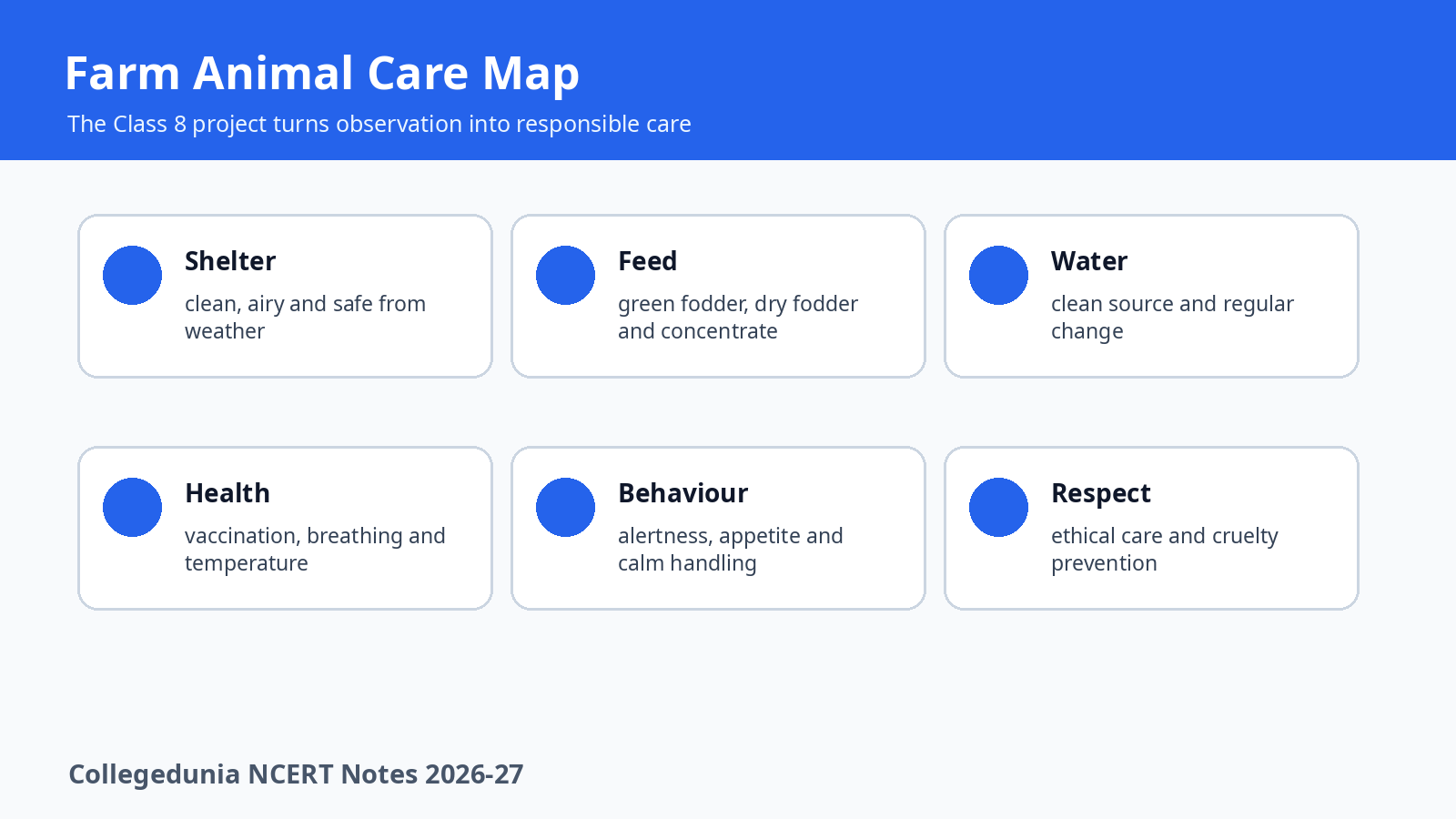
The farm visit record covers feeding, water, bathing, shelter, health, waste use and special observations. Students should notice how the animal responds to its owner and how the owner keeps the animal calm.
| Care area | What to record | Why it matters |
|---|---|---|
| Feeding | Food source, quantity, cost and daily frequency | Shows nutrition routine |
| Water | Source, cleanliness and change frequency | Prevents stress and illness |
| Shelter | Floor, light, air, cleaning and weather protection | Keeps animals safe |
| Health | Diseases, medicines, home remedies and vaccines | Supports prevention and treatment |
Farm Animal Care Video Revision
Source: BYJU'S on YouTube
Health Record and Body Weight
Health records start with visual observation. Eyes should be bright and moist, nostrils clean and wet, skin glossy and clean, behaviour alert, and appetite normal. Respiration is counted from the flank region for one minute.
| Parameter | How it is checked | Important note |
|---|---|---|
| Respiration | Count either flank rise or fall for one minute | Do not count both |
| Temperature | Veterinary professional uses a digital thermometer | Students record the reading |
| Weight | Measure length and girth | Use the correct formula for animal type |
| Formula | Goat: Length × Girth² ÷ 600 | Cow or buffalo: Length × Girth² ÷ 330 |
Feeding Chart and Dry Matter
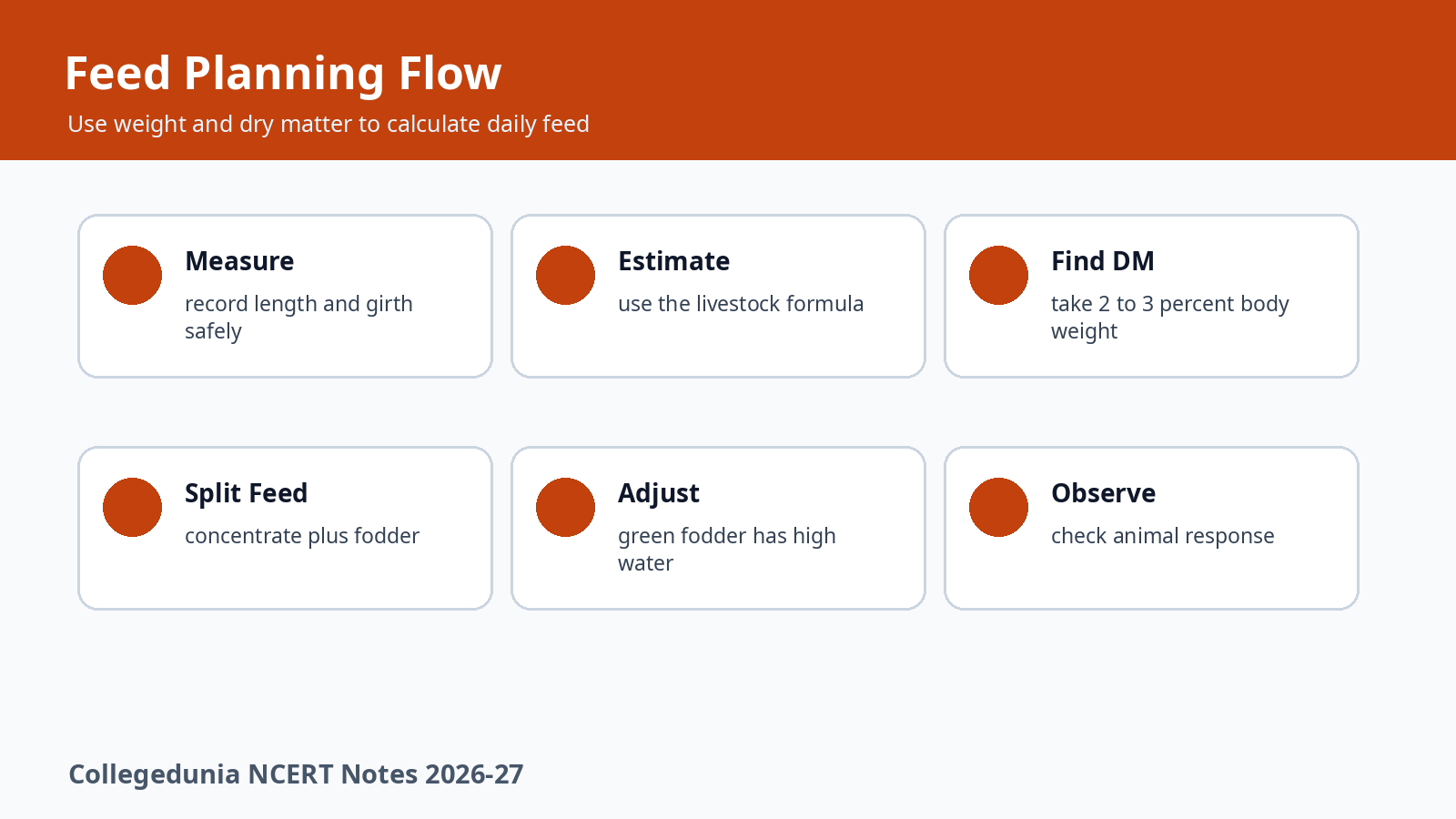
Dry Matter is the non-water part of feed. Adult animals generally need Dry Matter equal to 2 to 3 percent of live body weight every day. The goat example in the chapter uses a 32 kg goat and calculates 960 g Dry Matter per day.
| Feed part | Chapter example | Meaning |
|---|---|---|
| Concentrate | 25 percent of Dry Matter | Protein-rich feed |
| Fodder | 75 percent of Dry Matter | Dry plus green fodder |
| Dry fodder | 25 percent of total fodder | Low-water roughage |
| Green fodder | 75 percent of total fodder | Actual quantity increases because it has high water |
Silage and Treated Dry Fodder
Silage is preserved green fodder for ruminants such as cows, goats and sheep. It is made by packing chopped green fodder tightly in an air-free bag so lactic acid bacteria can preserve it.
- Chop green fodder into 2 to 3 cm pieces.
- Press it firmly into the silage bag to remove air.
- Seal the bag and do not open it for 2 to 3 weeks.
- Good silage has no mould, golden-brown colour, fruity smell and mildly acidic pH.
Important: Do not feed mouldy or bad-smelling silage to animals.
Home Remedies and First Aid
The chapter asks students to record home remedies used by farmers and elders. Ticks, external parasites and indigestion are common examples. Remedies must be written with exact ingredients, measures and use.
| Problem | Chapter detail | Safe note |
|---|---|---|
| Ticks and parasites | Neem, lantana leaves and turmeric are mentioned | Ask farmer or expert for method |
| Indigestion | Betel leaves, ginger, pepper, garlic and rock salt example | Use exact measures only with owner approval |
| Disease apps | ICAR apps can identify disease warnings | Use with teacher help |
| First-aid box | List material, ingredient and precise measure | Label everything clearly |
Related Resources for Class 8 Kaushal Bodh Chapter 2
| Resource | Use it for | Link |
|---|---|---|
| NCERT Solutions | Activity answers and reflection questions | Open Solutions |
| NCERT Book PDF | Official chapter text and activity tables | Open Book PDF |
| Handwritten Notes | Quick visual recap before project work | Open Handwritten Notes |
All Class 8 Vocational Education Notes Chapters
| Chapter | Notes Link |
|---|---|
| Chapter 1 Hydroponics: Growing Plants without Soil | Open Notes |
| Chapter 2 Feeding and Caring for Farm Animals | Current chapter notes |
| Chapter 3 Working with Wood and Bamboo | Open Notes |
| Chapter 4 Home Automation | Open Notes |
| Chapter 5 Water Audit for Water Management | Open Notes |
| Chapter 6 Creating Advertisements | Open Notes |
Feeding and Caring for Farm Animals Class 8 Notes FAQs
Ques. What is animal husbandry in Class 8 Kaushal Bodh?
Ans. Animal husbandry is the management and care of livestock, including housing, feed, clean water, healthcare and ethical treatment.
Ques. How is goat body weight estimated in this chapter?
Ans. Goat body weight is estimated as Length × Girth² ÷ 600, with length and girth measured in inches.
Ques. What is Dry Matter in animal feed?
Ans. Dry Matter is the non-water part of feed. Adult animals generally need 2 to 3 percent of live body weight as Dry Matter daily.
Ques. What are the signs of good silage?
Ans. Good silage has no mould, golden-brown colour, pleasant fruity aroma, free-flowing texture and mildly acidic pH.



Comments