



NCERT Class 8 Vocational Education Chapter 6 Creating Advertisements Notes explain advertisement types, logo, tagline, visuals, jingle, emotion, call to action, client interview and ethical advertising for the 2026-27 Kaushal Bodh textbook.
Chapter6CreatingAdvertisementsNotes.pdf?page=1&dpi=150)
Chapter6CreatingAdvertisementsNotes.pdf?page=2&dpi=150)
Chapter6CreatingAdvertisementsNotes.pdf?page=3&dpi=150)
Chapter6CreatingAdvertisementsNotes.pdf?page=4&dpi=150)
Chapter6CreatingAdvertisementsNotes.pdf?page=5&dpi=150)
Chapter6CreatingAdvertisementsNotes.pdf?page=6&dpi=150)
Chapter6CreatingAdvertisementsNotes.pdf?page=7&dpi=150)
Chapter6CreatingAdvertisementsNotes.pdf?page=8&dpi=150)
Chapter6CreatingAdvertisementsNotes.pdf?page=9&dpi=150)
Chapter6CreatingAdvertisementsNotes.pdf?page=10&dpi=150)
Chapter6CreatingAdvertisementsNotes.pdf?page=11&dpi=150)
Chapter6CreatingAdvertisementsNotes.pdf?page=12&dpi=150)
Chapter6CreatingAdvertisementsNotes.pdf?page=13&dpi=150)
Chapter6CreatingAdvertisementsNotes.pdf?page=14&dpi=150)
Chapter6CreatingAdvertisementsNotes.pdf?page=15&dpi=150)
Chapter6CreatingAdvertisementsNotes.pdf?page=16&dpi=150)
Chapter6CreatingAdvertisementsNotes.pdf?page=17&dpi=150)
Chapter6CreatingAdvertisementsNotes.pdf?page=18&dpi=150)
Chapter6CreatingAdvertisementsNotes.pdf?page=19&dpi=150)
Chapter6CreatingAdvertisementsNotes.pdf?page=20&dpi=150)
Chapter6CreatingAdvertisementsNotes.pdf?page=21&dpi=150)
Chapter6CreatingAdvertisementsNotes_flat_MobileCard.pdf?page=1&dpi=150)
Chapter6CreatingAdvertisementsNotes_flat_MobileCard.pdf?page=2&dpi=150)
Chapter6CreatingAdvertisementsNotes_flat_MobileCard.pdf?page=3&dpi=150)
Chapter6CreatingAdvertisementsNotes_flat_MobileCard.pdf?page=4&dpi=150)
Chapter6CreatingAdvertisementsNotes_flat_MobileCard.pdf?page=5&dpi=150)
Chapter6CreatingAdvertisementsNotes_flat_MobileCard.pdf?page=6&dpi=150)
Chapter6CreatingAdvertisementsNotes_flat_MobileCard.pdf?page=7&dpi=150)
Chapter6CreatingAdvertisementsNotes_flat_MobileCard.pdf?page=8&dpi=150)
Chapter6CreatingAdvertisementsNotes_flat_MobileCard.pdf?page=9&dpi=150)
Chapter6CreatingAdvertisementsNotes_flat_MobileCard.pdf?page=10&dpi=150)
Chapter6CreatingAdvertisementsNotes_flat_MobileCard.pdf?page=11&dpi=150)
Chapter6CreatingAdvertisementsNotes_flat_MobileCard.pdf?page=12&dpi=150)
Chapter6CreatingAdvertisementsNotes_flat_MobileCard.pdf?page=13&dpi=150)
Chapter6CreatingAdvertisementsNotes_flat_MobileCard.pdf?page=14&dpi=150)
Chapter6CreatingAdvertisementsNotes_flat_MobileCard.pdf?page=15&dpi=150)
Chapter6CreatingAdvertisementsNotes_flat_MobileCard.pdf?page=16&dpi=150)
Chapter6CreatingAdvertisementsNotes_flat_MobileCard.pdf?page=17&dpi=150)
Chapter6CreatingAdvertisementsNotes_flat_MobileCard.pdf?page=18&dpi=150)
Chapter6CreatingAdvertisementsNotes_flat_MobileCard.pdf?page=19&dpi=150)
Chapter6CreatingAdvertisementsNotes_flat_MobileCard.pdf?page=20&dpi=150)
Chapter6CreatingAdvertisementsNotes_flat_MobileCard.pdf?page=21&dpi=150)
Chapter6CreatingAdvertisementsNotes_flat_MobileCard.pdf?page=22&dpi=150)
Chapter6CreatingAdvertisementsNotes_flat_MobileCard.pdf?page=23&dpi=150)
Chapter6CreatingAdvertisementsNotes_flat_MobileCard.pdf?page=24&dpi=150)
Chapter6CreatingAdvertisementsNotes_flat_MobileCard.pdf?page=25&dpi=150)
Chapter6CreatingAdvertisementsNotes_flat_MobileCard.pdf?page=26&dpi=150)
Chapter6CreatingAdvertisementsNotes_flat_MobileCard.pdf?page=27&dpi=150)
Chapter6CreatingAdvertisementsNotes_flat_MobileCard.pdf?page=28&dpi=150)
Chapter6CreatingAdvertisementsNotes_flat_MobileCard.pdf?page=29&dpi=150)
Chapter6CreatingAdvertisementsNotes_flat_MobileCard.pdf?page=30&dpi=150)
- Project focus: identify advertisement elements and create a campaign for a local business.
- Best use: revise before poster design, scriptwriting, client interview and project viva.
- Answer focus: write purpose, target group, medium, message and call to action.
These NCERT notes follow the 2026-27 Kaushal Bodh project order and keep observation, client study, design choices and ethics in one revision flow.
Student Feedback on Creating Advertisements Notes
In a Collegedunia classroom check with 1,080 Class 8 students, learners revised the project faster after splitting advertisement making into observe, plan, design and review stages.
Creating Advertisements Notes Overview
Creating Advertisements is a Human Services project in the Class 8 Kaushal Bodh book. It teaches students how a message persuades people to buy, visit, vote, save, donate or change a habit.
- Advertisement: a message that asks people to take a specific action.
- Commercial advertisement: promotes a product or service.
- Social advertisement: promotes public welfare or responsible behaviour.
- Branding: creates a unique identity using name, logo, colour and tagline.
Types and Media of Advertisements
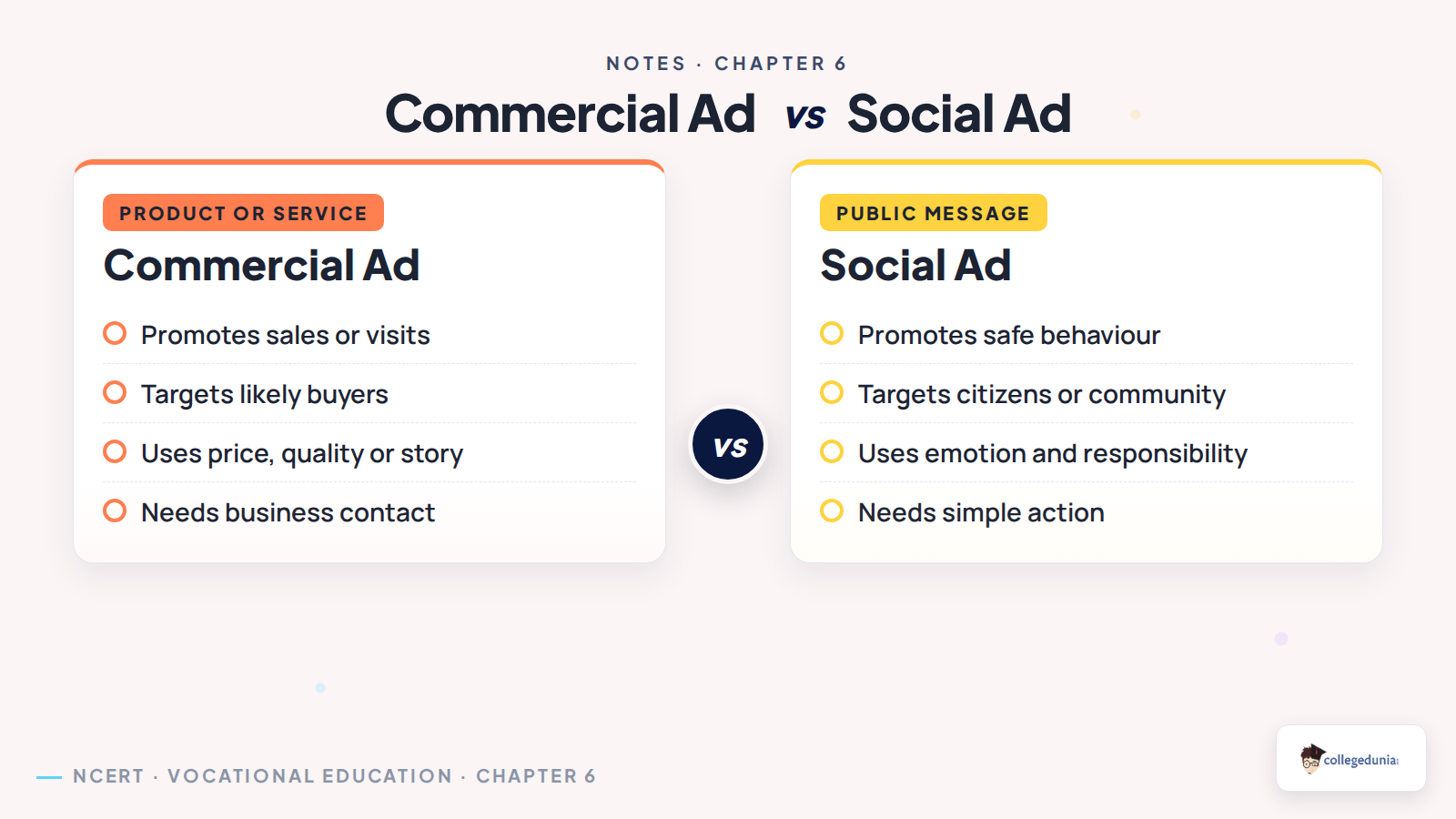
The chapter explains that advertisements appear in many places. Students observe print ads, shop boards, radio clips, television ads, hoardings, flyers, social media posts and street announcements.
| Medium | Best use | What students should check |
|---|---|---|
| details, price and address | headline, image and contact | |
| Outdoor | quick recall in public spaces | large visual and short text |
| Audio | voice, music and jingle | clarity, rhythm and duration |
| Video | story, emotion and action | script, shot order and sound |
| Digital | fast sharing and local reach | caption, image size and permission |
Creating Advertisements Video Revision
Source: Prof.Analysis on YouTube
Logo, Tagline, Visuals and Jingle
Every advertisement uses a few key elements. A logo identifies the brand, a tagline gives the promise, visuals create interest and a jingle helps recall.
- Logo: a symbol, name style or image linked with the business.
- Tagline: a short phrase that people can remember.
- Visuals: photographs, drawings, colours, font size and layout.
- Jingle: a short tune or rhyme used in audio and video ads.
- Call to action: the next step, such as visit, call, try or save.
Important: the text should be short enough to read quickly and honest enough to trust.
Advertisement Design Process
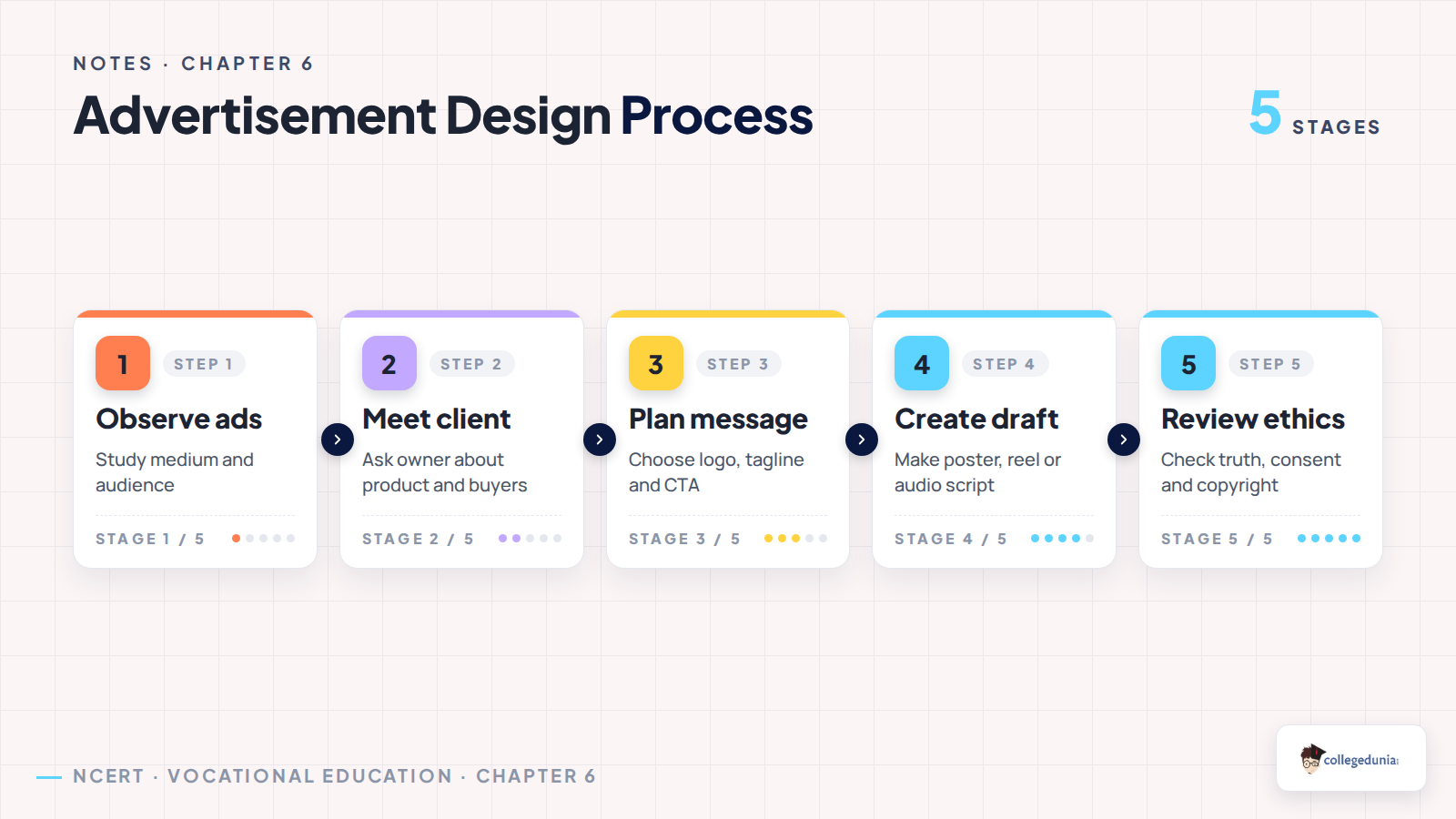
The project asks students to create an advertisement for a small business. The process starts with observation and ends with a reviewed campaign that the owner has approved.
| Stage | What students do | Project evidence |
|---|---|---|
| Observe ads | classify print, outdoor, audio and video examples | comparison table |
| Meet client | interview a small business owner | questionnaire and consent note |
| Plan message | choose product promise and target group | client brief |
| Create draft | make poster, reel, audio script or layout | rough design |
| Review ethics | check truth, copyright, privacy and respect | teacher and owner feedback |
Ethics, Safety and Permissions
Ethical advertising is truthful, fair and socially responsible. Students must not copy images, make false claims, use stereotypes or record people without permission.
- Visit businesses only with teacher, parent or guardian awareness.
- Use photographs or voice clips only after approval.
- Credit any allowed external image, music or text source.
- Check that price, quality and service claims are true.
- Avoid content that can hurt culture, gender or community feelings.
Client Interview and Final Project
A good advertisement starts with a clear client brief. Students should ask what the business sells, who buys it, what makes it special and which medium will reach the right people.
| Question area | What to ask | Why it matters |
|---|---|---|
| Product or service | What do you sell or provide? | sets the main message |
| Unique point | What makes it special? | builds the promise |
| Customers | Who usually buys it? | decides language and medium |
| Permission | May we use photos or quotes? | keeps the work ethical |
| Action | What should people do next? | creates the CTA |
Related Resources for Class 8 Kaushal Bodh Chapter 6
| Resource | Use it for | Link |
|---|---|---|
| NCERT Solutions | Project questions and reflection answers | Open Solutions |
| NCERT Book PDF | Official project text and activity tables | Open Book PDF |
| Handwritten Notes | Quick scanned recap for project work | Open Handwritten Notes |
All Class 8 Vocational Education Notes Chapters
| Chapter | Notes Link |
|---|---|
| Chapter 1 Hydroponics: Growing Plants without Soil | Open Notes |
| Chapter 2 Feeding and Caring for Farm Animals | Open Notes |
| Chapter 3 Working with Wood and Bamboo | Open Notes |
| Chapter 4 Home Automation | Open Notes |
| Chapter 5 Water Audit for Water Management | Open Notes |
Creating Advertisements Class 8 Notes FAQs
Ques. What is an advertisement in Class 8 Kaushal Bodh?
Ans. An advertisement is a message that persuades people to take an action, such as buying a product or supporting a social cause.
Ques. What are the main elements of an advertisement?
Ans. The main elements are logo, tagline or slogan, visuals, jingle or music, emotional connection and call to action.
Ques. Why is consent needed while making an advertisement?
Ans. Consent protects privacy and confirms that photos, voice clips, quotes and business details can be used in the project.
Ques. What is a call to action?
Ans. A call to action tells people the next step, such as visit the shop, call the owner, try the product or follow a safety habit.



Comments