




The NCERT Class 11 Economics Chapter 6 Correlation Book PDF gives students the official Statistics for Economics chapter for the 2026-27 syllabus. Use it to study scatter diagrams, positive and negative correlation, Karl Pearson's coefficient, Spearman's rank correlation and the way NCERT links statistical relationships with everyday economic data.
- Book section: official NCERT chapter text, examples, formulas and exercise questions.
- Best use: read the PDF before solving correlation numericals from the exercise.
- Revision cue: check the direction of movement before choosing the method.
Student Feedback: In a Collegedunia check of 11,920 Class 11 Economics students, most mistakes in this chapter came from mixing up covariance-style signs, writing the wrong rank difference and skipping the scatter diagram reading.
Correlation Class 11 Economics NCERT Book PDF: What It Covers
The chapter explains how two statistical variables may move together. NCERT first builds the idea with examples like price and demand, then moves to scatter diagrams and numerical measures of correlation.
The PDF is the official source text for Chapter 6. It gives the definitions, diagrams, solved examples and exercise questions in the same order as the NCERT book.
| NCERT area | What students should notice | Answer cue |
|---|---|---|
| Meaning of correlation | Shows whether two variables are related. | Name the direction and strength clearly. |
| Scatter diagram | Uses plotted points to judge relationship visually. | Read the pattern before writing the conclusion. |
| Karl Pearson's method | Calculates the coefficient from deviations. | Keep signs intact while finding products. |
| Rank correlation | Uses ranks when exact values are not the main focus. | Square every rank difference before summing. |
Karl Pearson Correlation Coefficient Formula
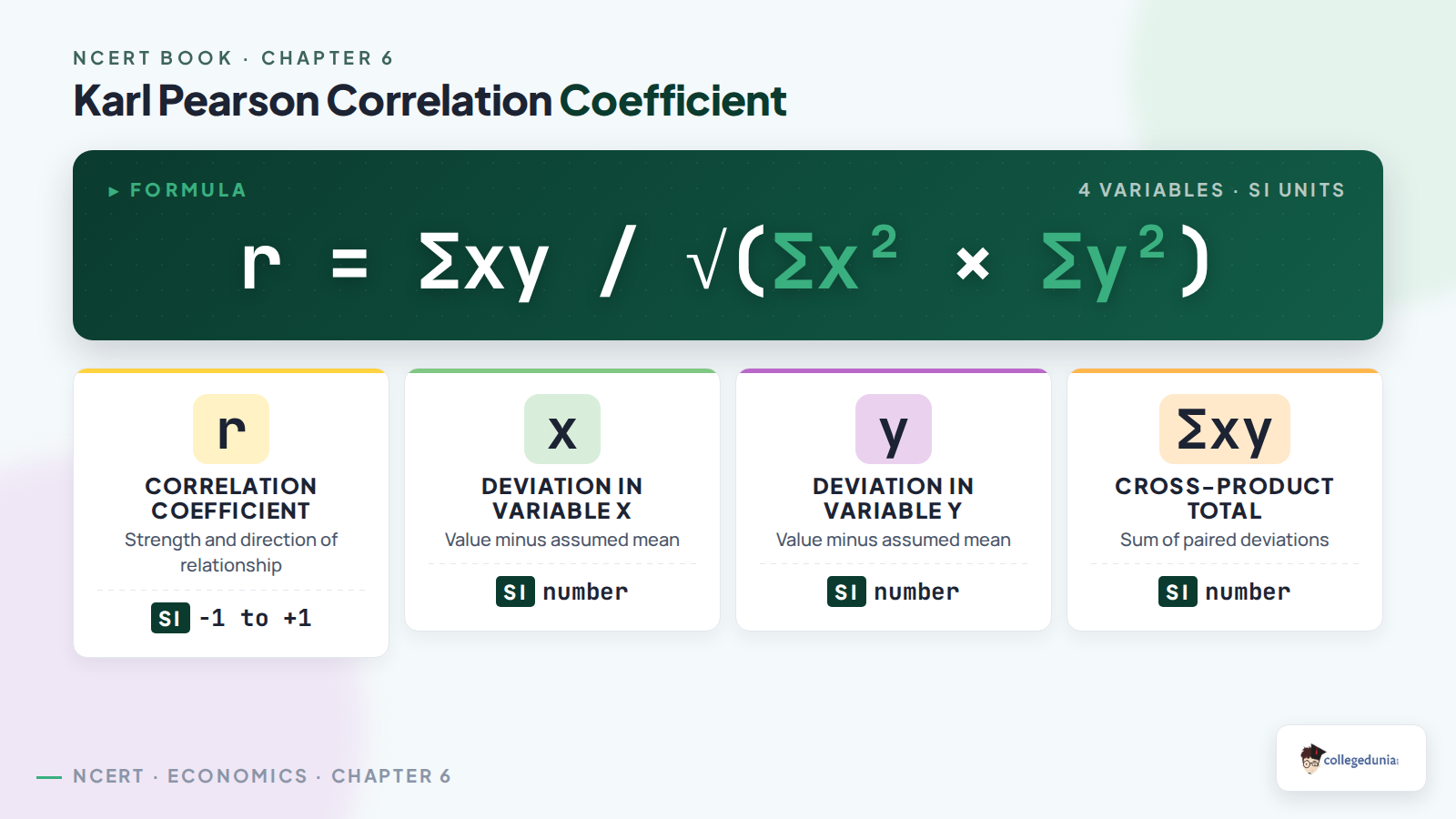
Karl Pearson's coefficient of correlation measures the degree and direction of a linear relationship. Its value lies between -1 and +1. A value close to +1 shows strong positive correlation, while a value close to -1 shows strong negative correlation.
- Positive value: both variables usually move in the same direction.
- Negative value: one variable usually rises when the other falls.
- Zero value: no clear linear relation is visible in the data.
Do not drop the minus sign while multiplying deviations. That sign decides whether the relationship is positive or negative.
Watch Correlation for Class 11 Economics
Source: Magnet Brains on YouTube
Positive and Negative Correlation: How to Read the Direction
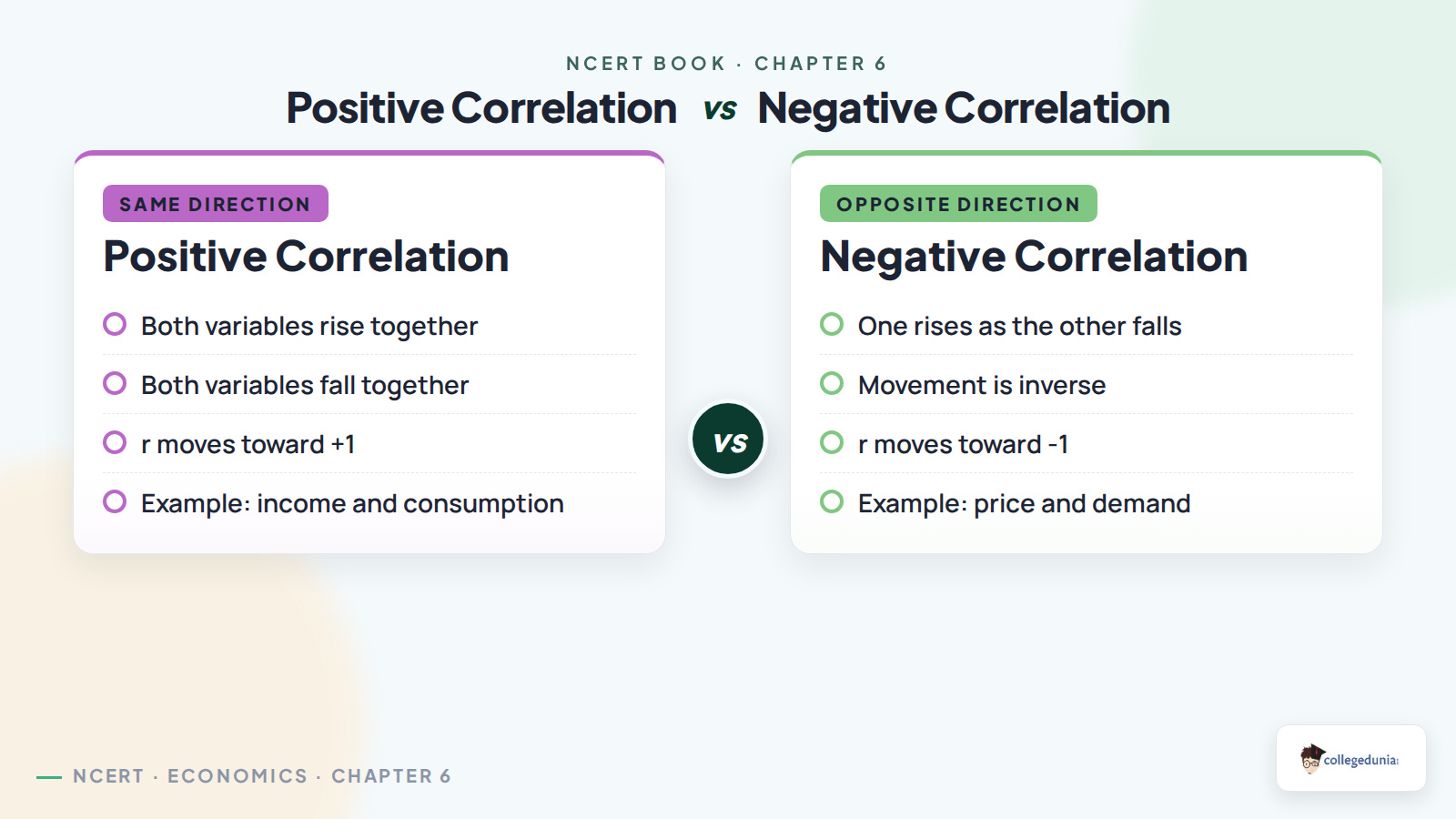
NCERT uses direction as the first check in this chapter. In positive correlation, both variables move in the same direction. In negative correlation, the variables move in opposite directions.
| Type | Meaning | Example cue |
|---|---|---|
| Positive correlation | Two variables rise or fall together. | Income and consumption often move together. |
| Negative correlation | One variable rises as the other falls. | Price and demand often move in opposite directions. |
| No correlation | No dependable movement is visible. | The scatter points do not form a clear pattern. |
| Perfect correlation | The relationship is exact. | The coefficient is +1 or -1. |
A scatter diagram is the fastest way to judge direction before calculation. Use it as a rough check on the final coefficient.
How to Use the Chapter 6 NCERT Book PDF
Use the PDF in three passes. First, read the meaning and types of correlation. Second, compare the scatter diagrams with the numerical coefficient. Third, solve the exercise after writing the formula and the sign rule clearly.
- For scatter diagrams: decide whether the points slope upward, downward or show no pattern.
- For Pearson's method: write deviations carefully and keep all negative signs.
- For rank correlation: assign ranks consistently and square the rank differences.
- For revision: compare the official NCERT book PDF with notes after solving one example of each method.
Related Class 11 Economics Resources for Correlation
Also Check: use the official book PDF with notes and practice resources for the same chapter.
| Resource | Best use | Link |
|---|---|---|
| NCERT Notes | Revise definitions, formulas and method steps quickly. | Correlation Notes |
| NCERT Solutions | Practise textbook questions after reading the PDF. | Correlation NCERT Solutions |
| Handwritten Notes | Use for quick formula revision before class tests. | Correlation Handwritten Notes |
Class 11 Economics NCERT Book PDFs for All Chapters
The table below keeps the Class 11 Economics NCERT Book PDF chapters in one place. Chapters 1 to 8 come from Statistics for Economics, and later chapters come from Indian Economic Development.
| Chapter | Title | NCERT Book PDF |
|---|---|---|
| Chapter 1 | Introduction | NCERT Book PDF |
| Chapter 2 | Collection of Data | NCERT Book PDF |
| Chapter 3 | Organisation of Data | NCERT Book PDF |
| Chapter 4 | Presentation of Data | NCERT Book PDF |
| Chapter 5 | Measures of Central Tendency | NCERT Book PDF |
| Chapter 6 | Correlation | NCERT Book PDF |
| Chapter 7 | Index Numbers | NCERT Book PDF |
| Chapter 8 | Use of Statistical Tools | NCERT Book PDF |
Correlation Class 11 Economics NCERT Book PDF FAQs
Ques. What does the Class 11 Economics Chapter 6 Correlation NCERT Book PDF include?
Ans. It includes the official NCERT chapter text, scatter diagrams, types of correlation, Pearson's coefficient, rank correlation, examples and exercise questions.
Ques. Is Correlation part of the 2026-27 Class 11 Economics syllabus?
Ans. Yes. Correlation is part of Statistics for Economics in Class 11 and is included in the 2026-27 NCERT syllabus.
Ques. Which formulas should students revise from this chapter?
Ans. Students should revise Karl Pearson's coefficient of correlation and Spearman's rank correlation formula, along with the sign rule for positive and negative correlation.
Ques. How should students use the Correlation NCERT PDF for revision?
Ans. Read the theory first, mark the scatter diagram patterns, then solve one Pearson question and one rank correlation question from the exercise.



Comments