




An Empire Across Three Continents is the chapter where Class 11 History moves from Mesopotamia's early cities to the Roman Empire, a state that ran across Europe, North Africa and West Asia at once. The ncert book class 11 history chapter 2 an empire across three continents file on this page is the official NCERT chapter for 2026-27. Download it for the full text, the Rulers and Events table and both exercise sets.
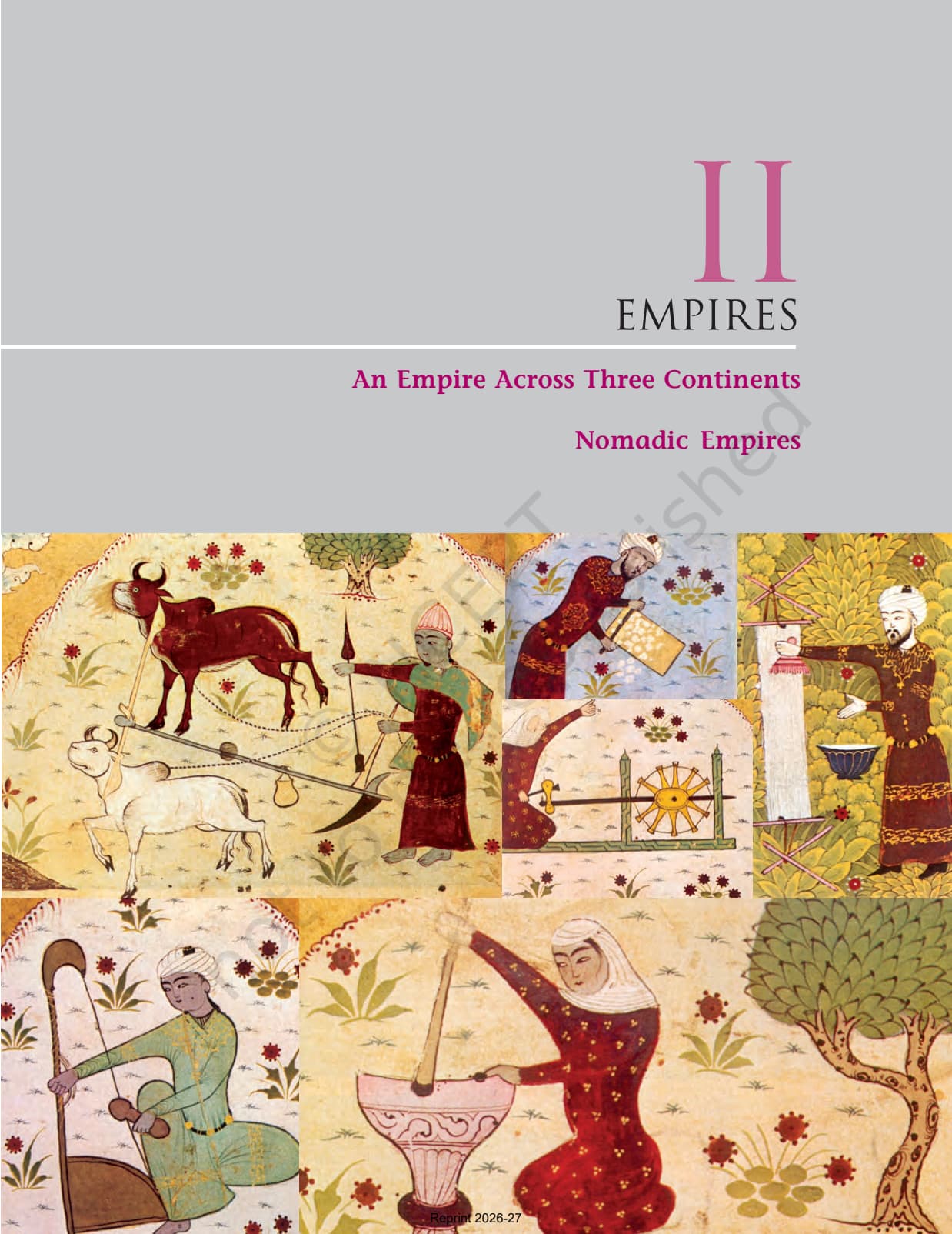
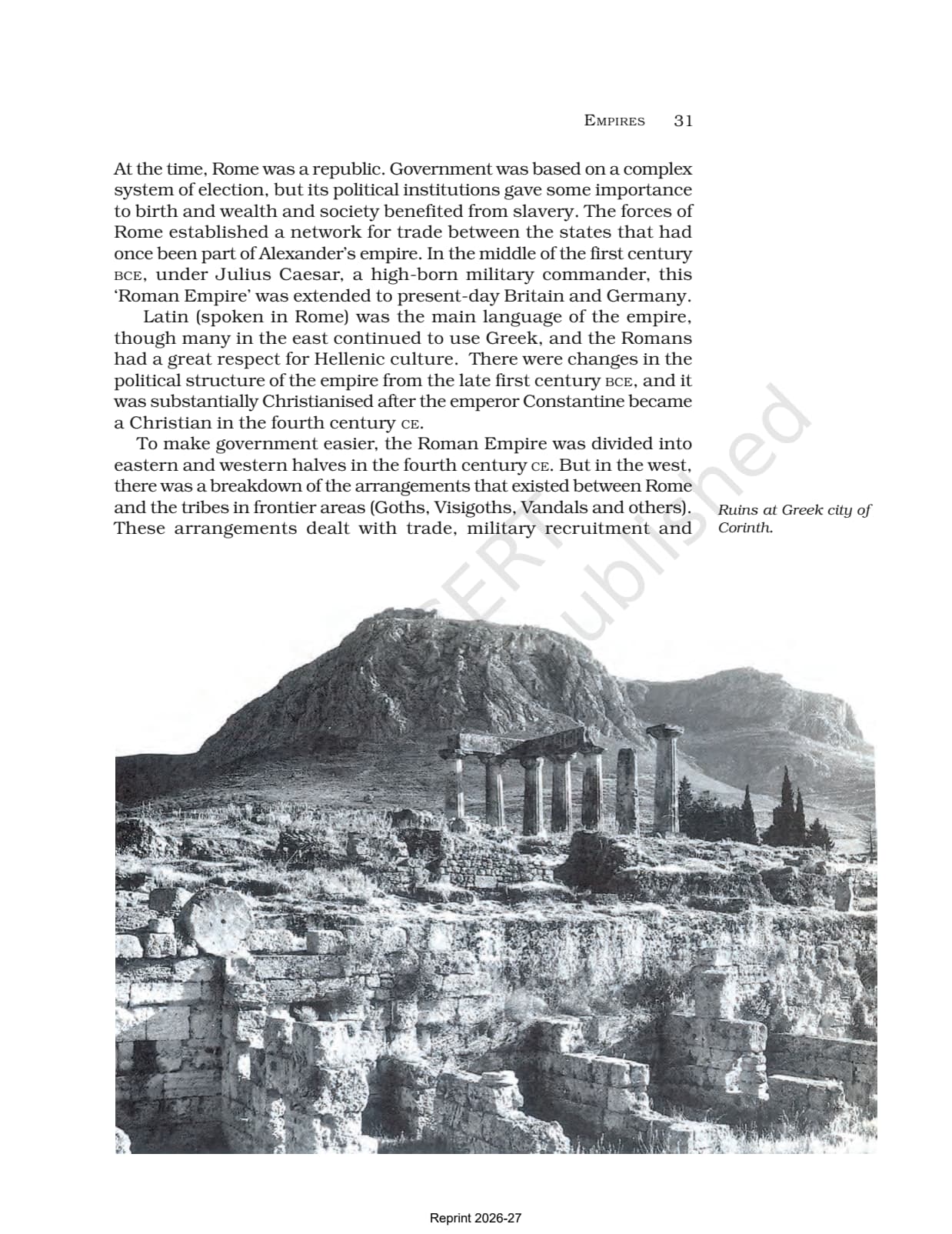
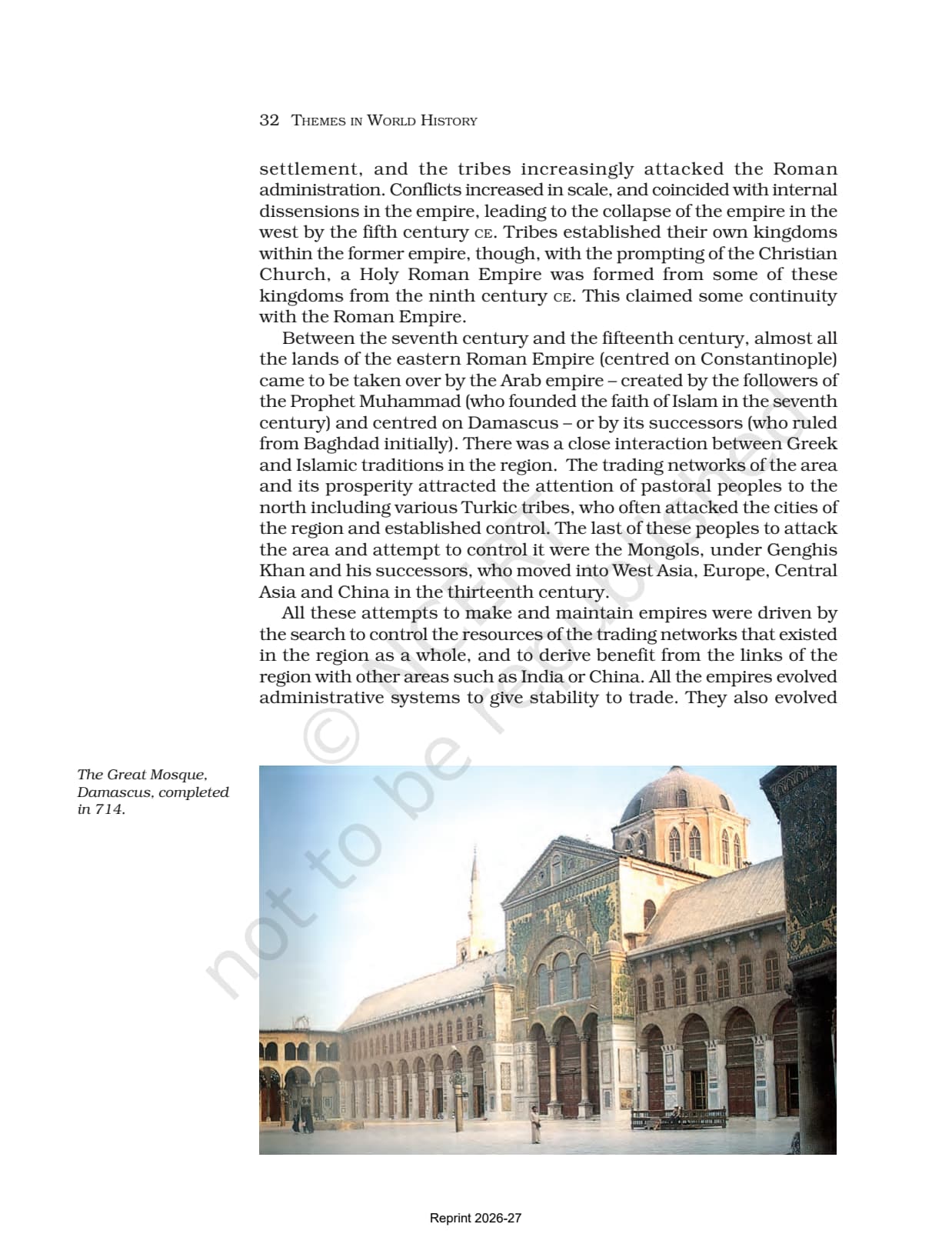
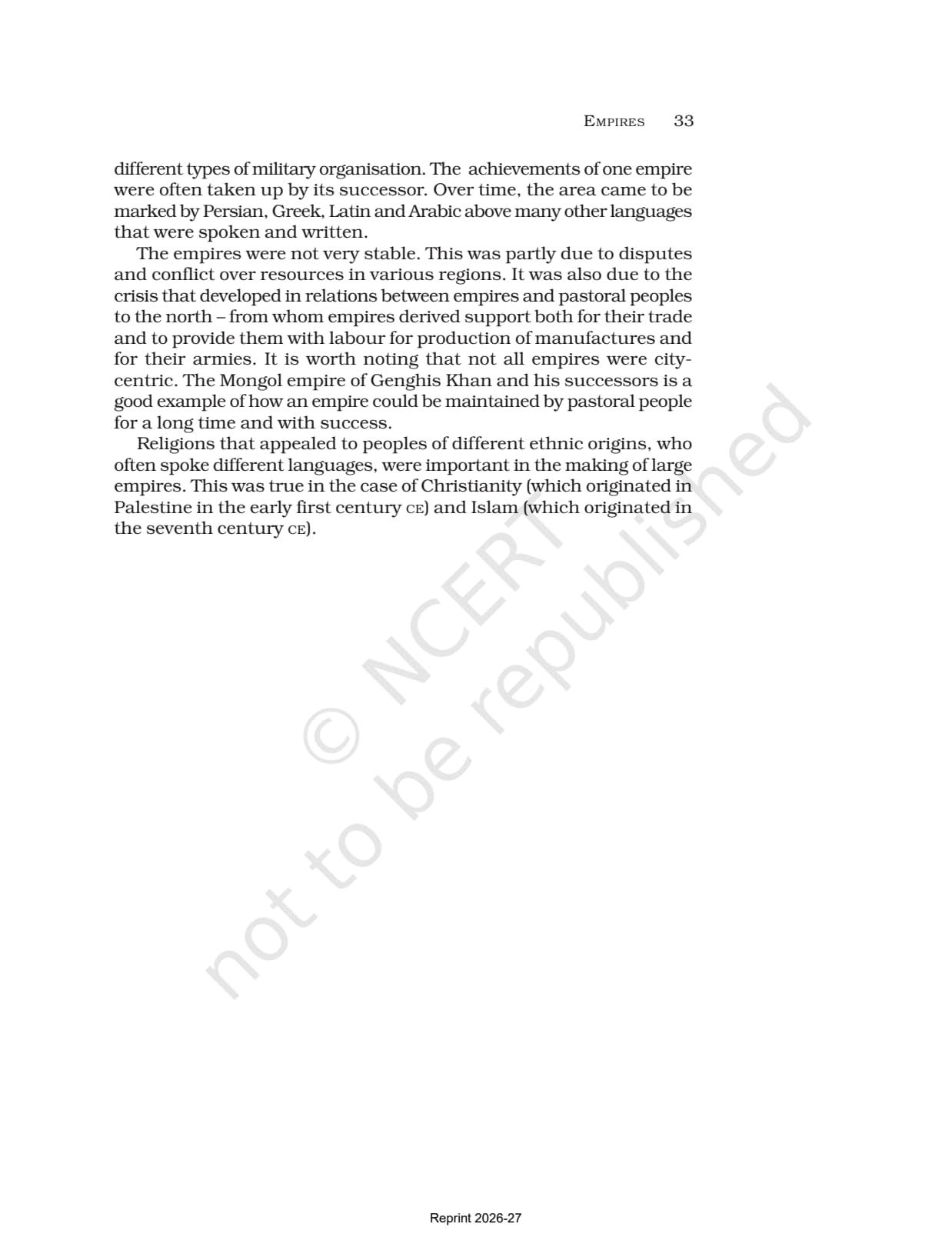
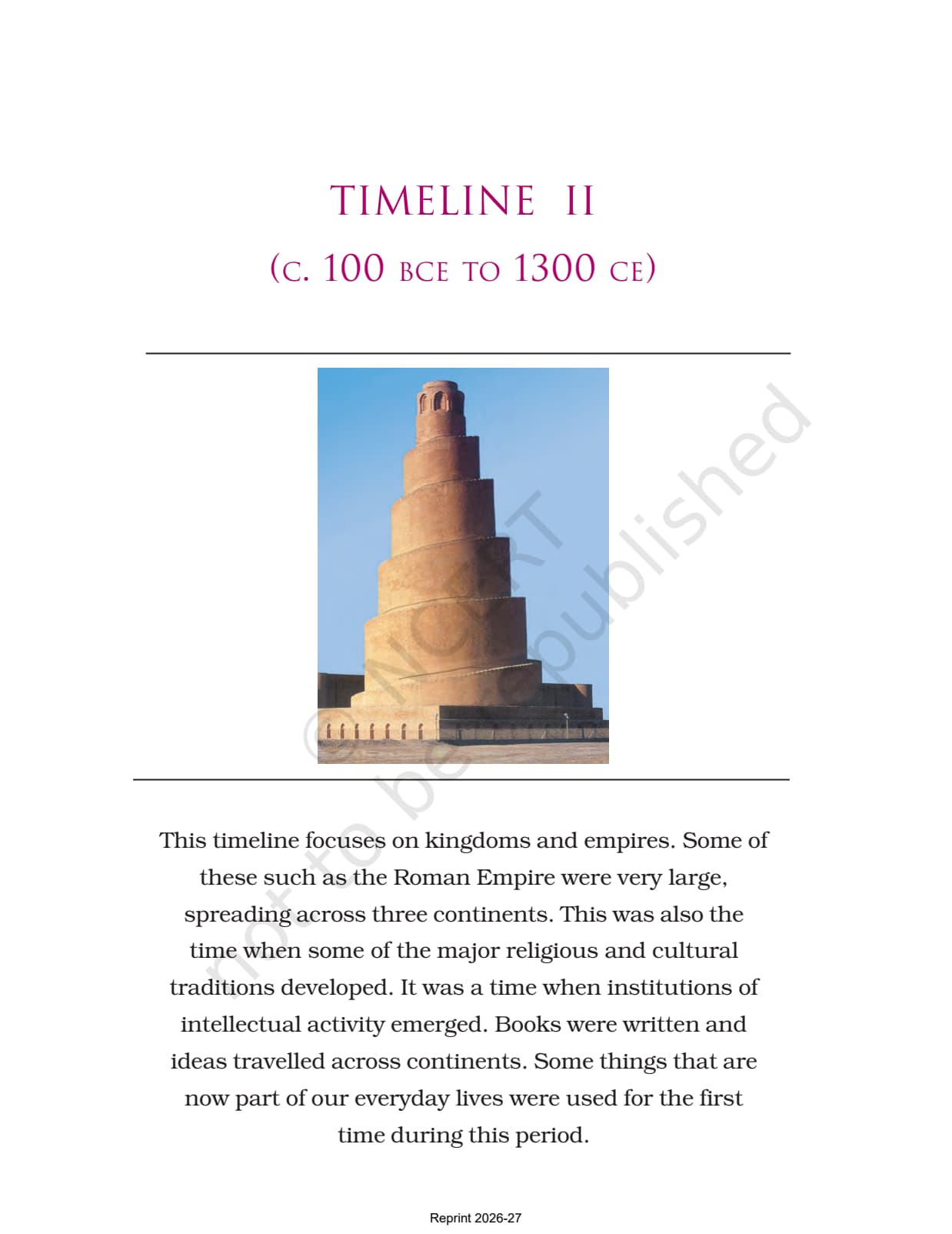
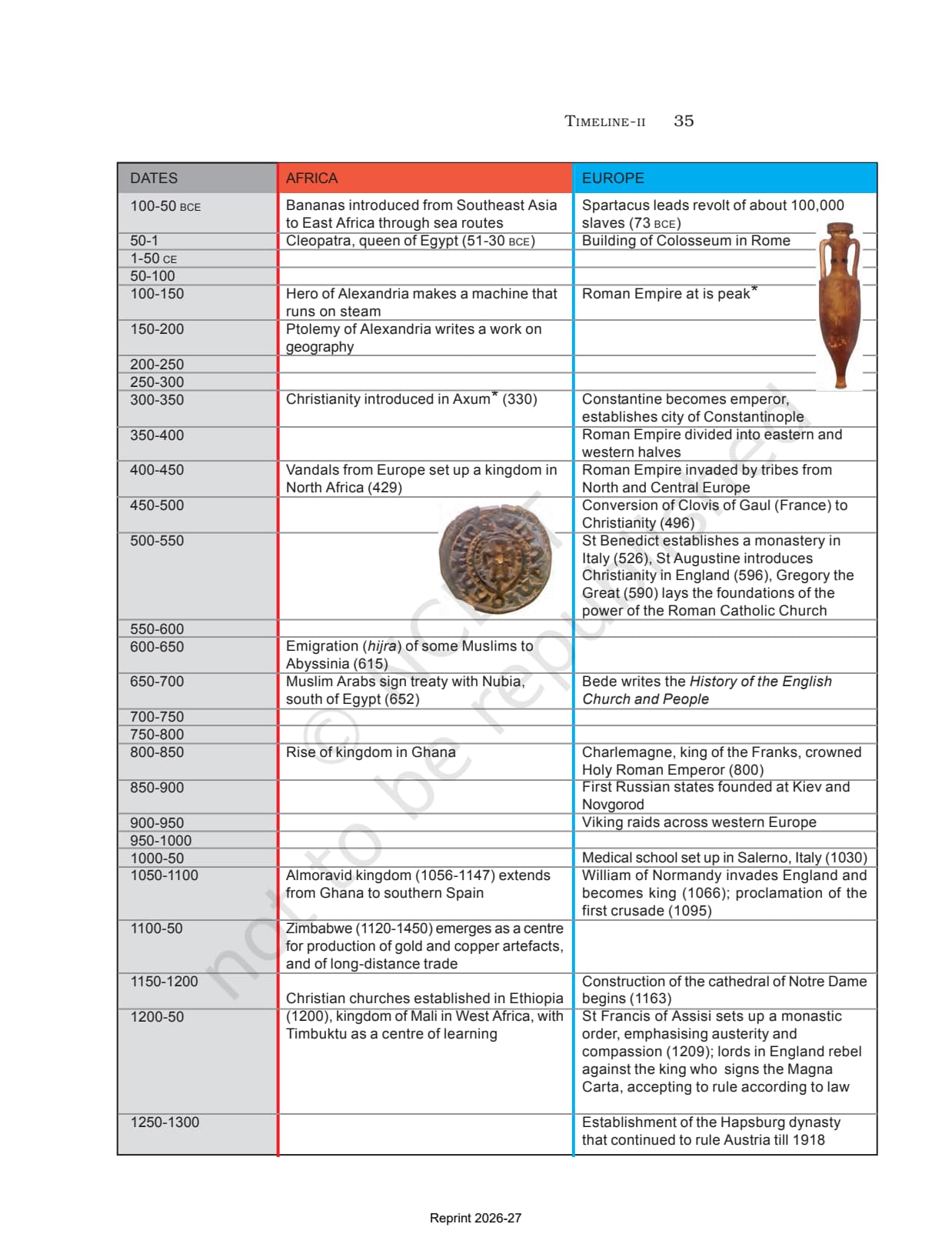
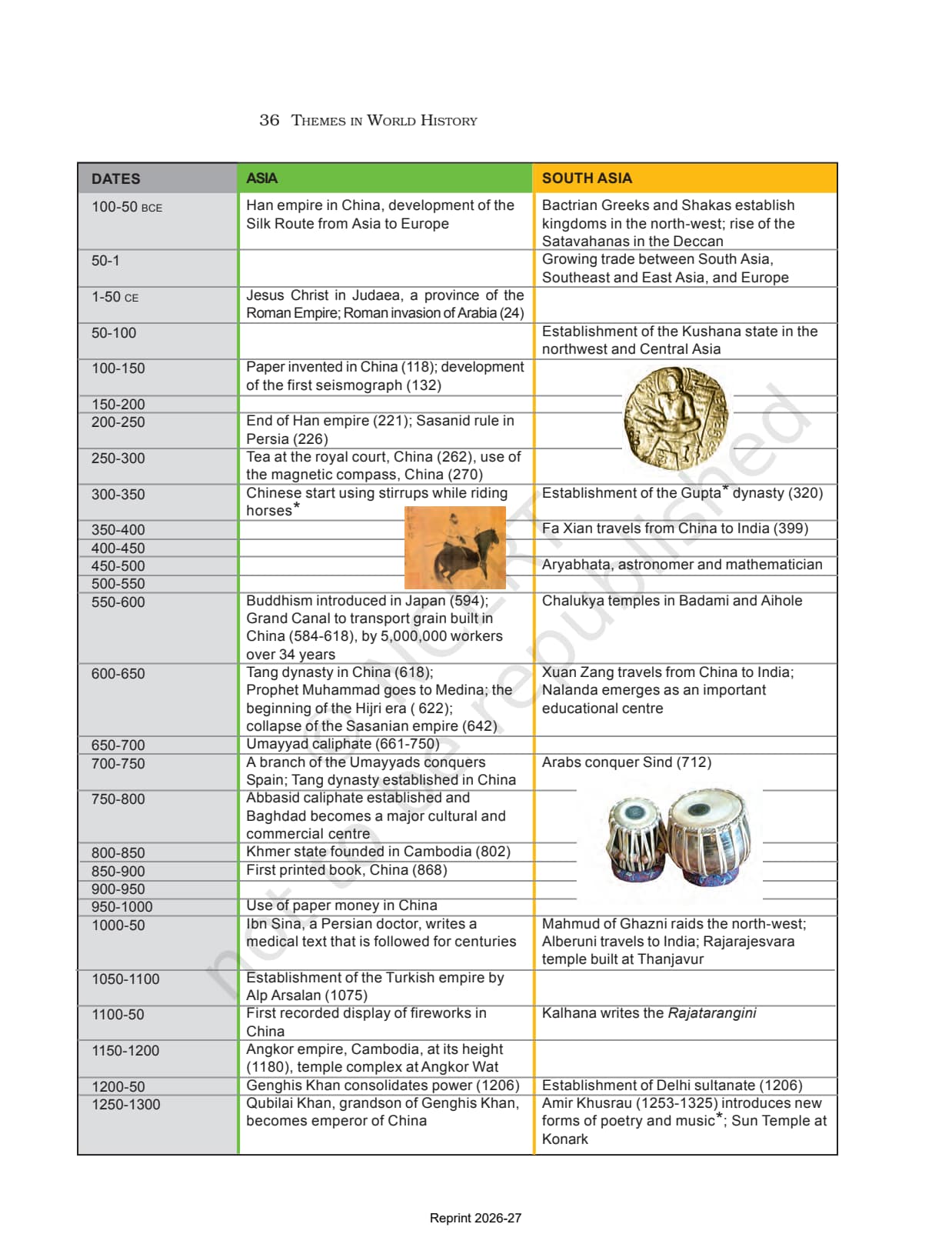
- Chapter: Chapter 2, An Empire Across Three Continents, part of the Empires theme
- Book: Themes in World History, the Class 11 NCERT textbook for 2026-27, 7 chapters
- File: 48 pages, printed pages 29 to 76, the complete official theme unit
You can page through the Timeline, the source extracts and the Rulers and Events table in the viewer above before downloading the file.
This is the official NCERT file for the 2026-27 session, hosted by Collegedunia exactly as NCERT prints it, as the shared theme unit covering this chapter and the opening of the next one.
How This Chapter Is Laid Out in the Empires Theme
NCERT groups An Empire Across Three Continents with Chapter 3, Nomadic Empires, under one shared theme called Empires. The file opens with material both chapters use before Chapter 2 even begins.
| Section | What it covers |
|---|---|
| Theme title page (p. 29) | lists both chapters that share this Empires theme |
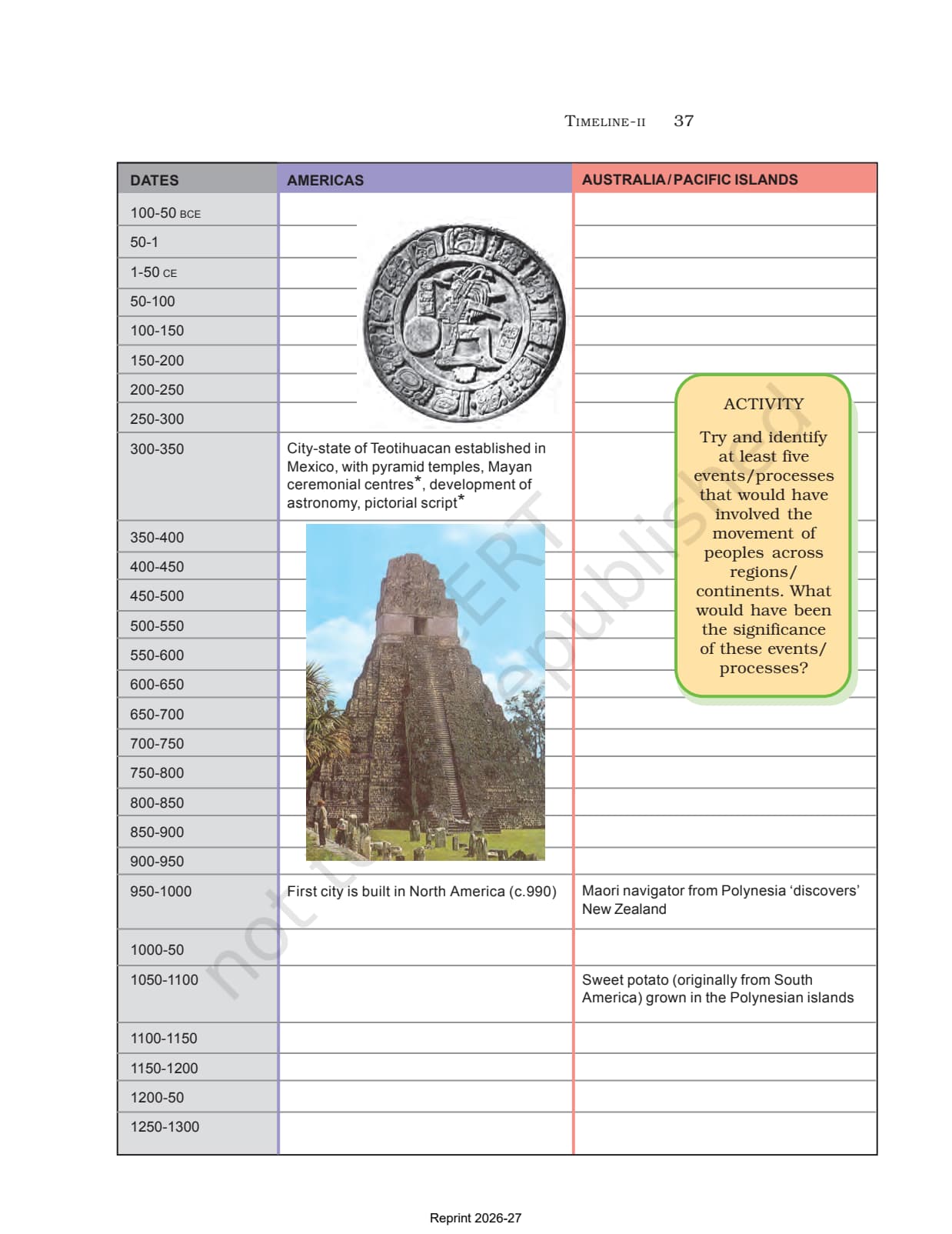
| Timeline II (p. 34-37) | a shared four-page spread charting kingdoms and empires across Africa, Europe, Asia, South Asia and the Americas from 100 BCE to 1300 CE |
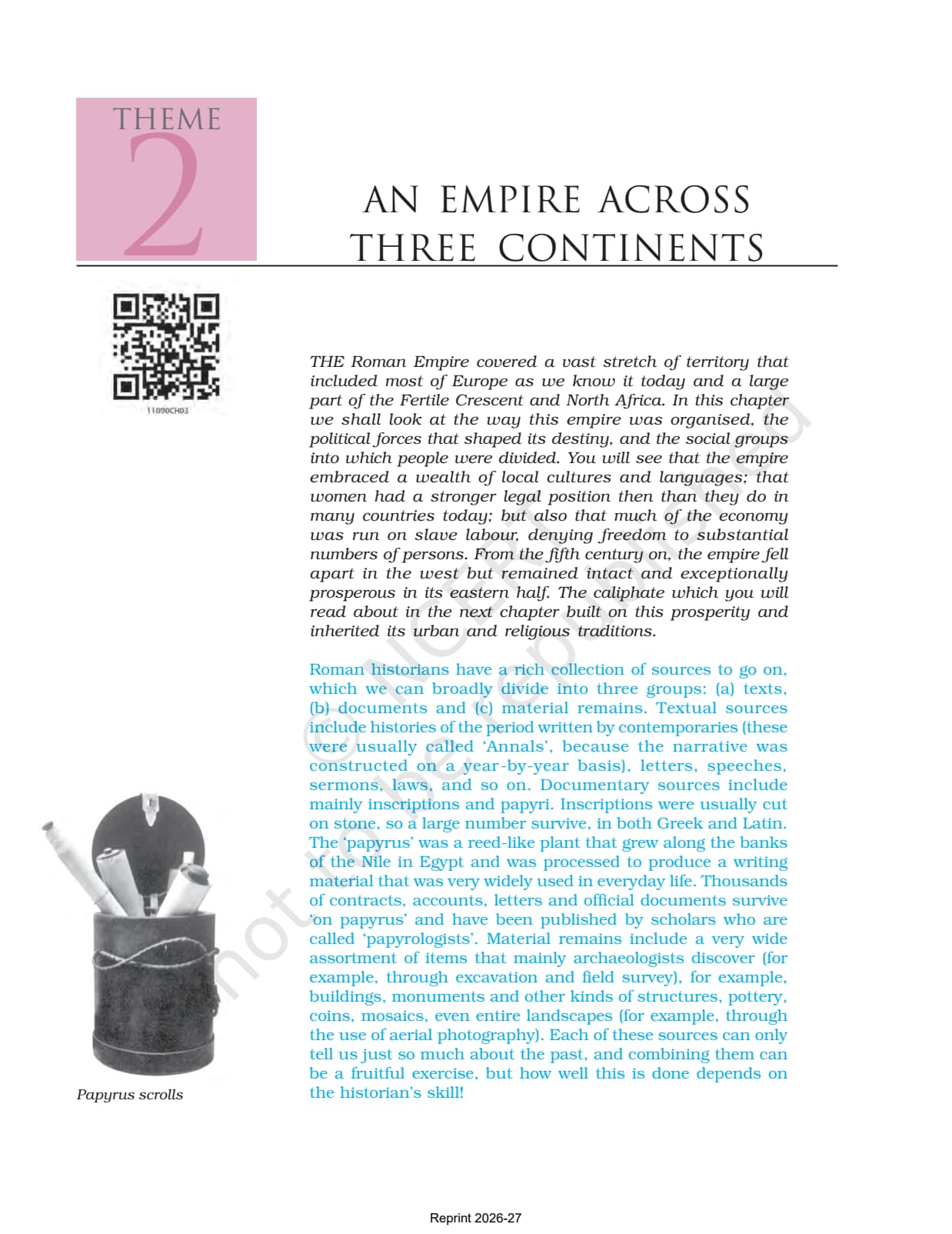
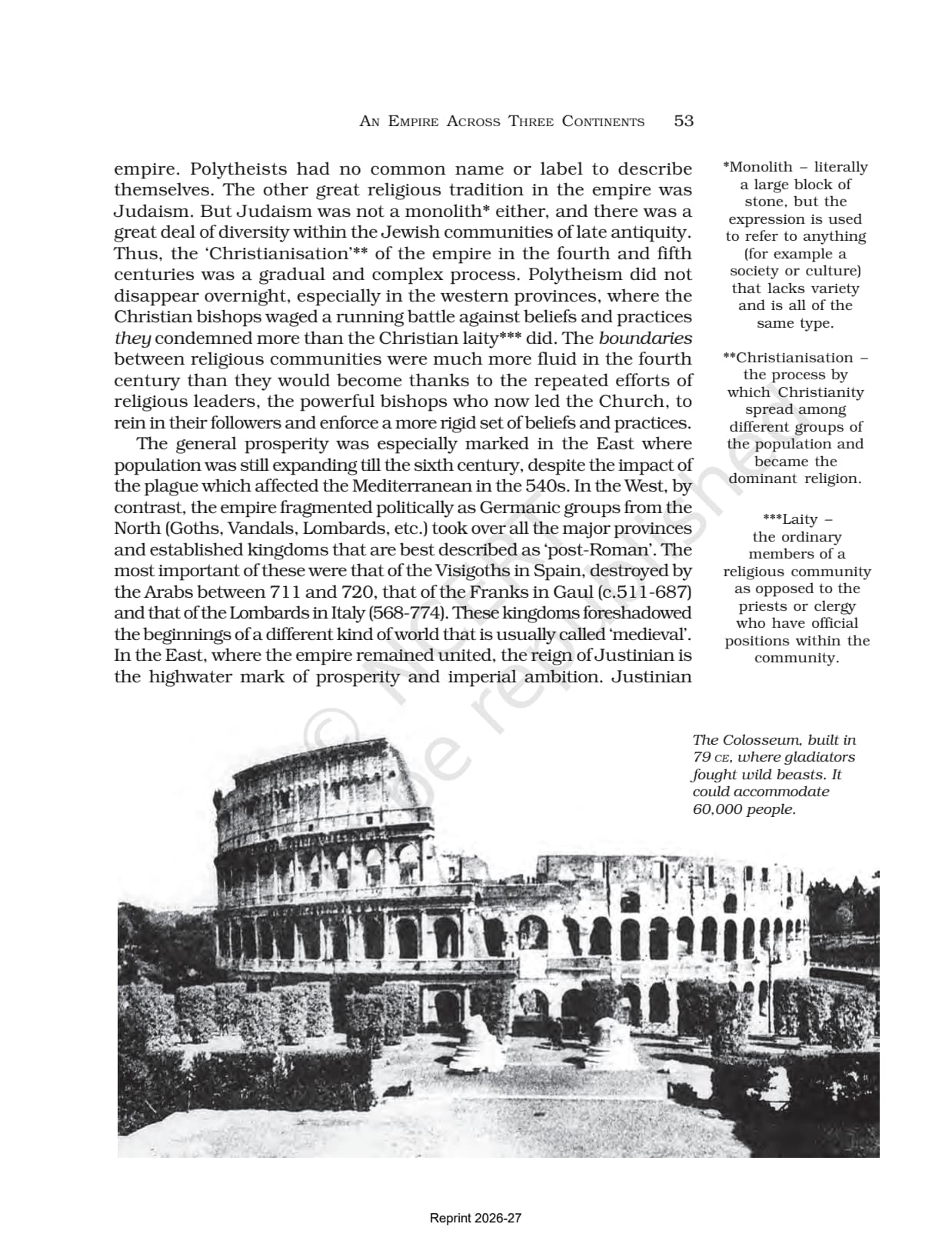
| Chapter opening (p. 38) | the Roman Empire's territory, organisation and social groups |
| Sources (p. 38-39) | texts, documents and material remains that historians use for Rome |
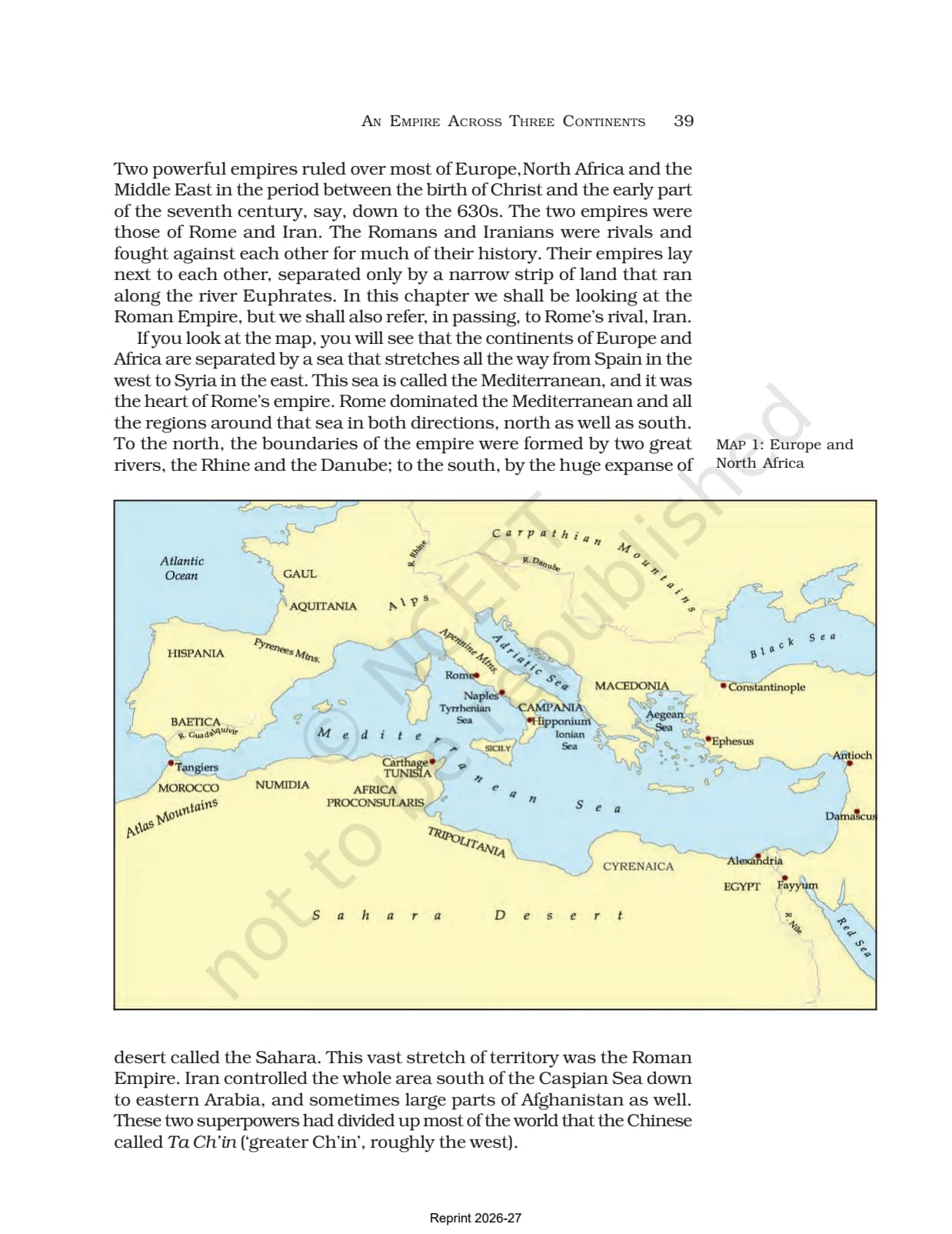
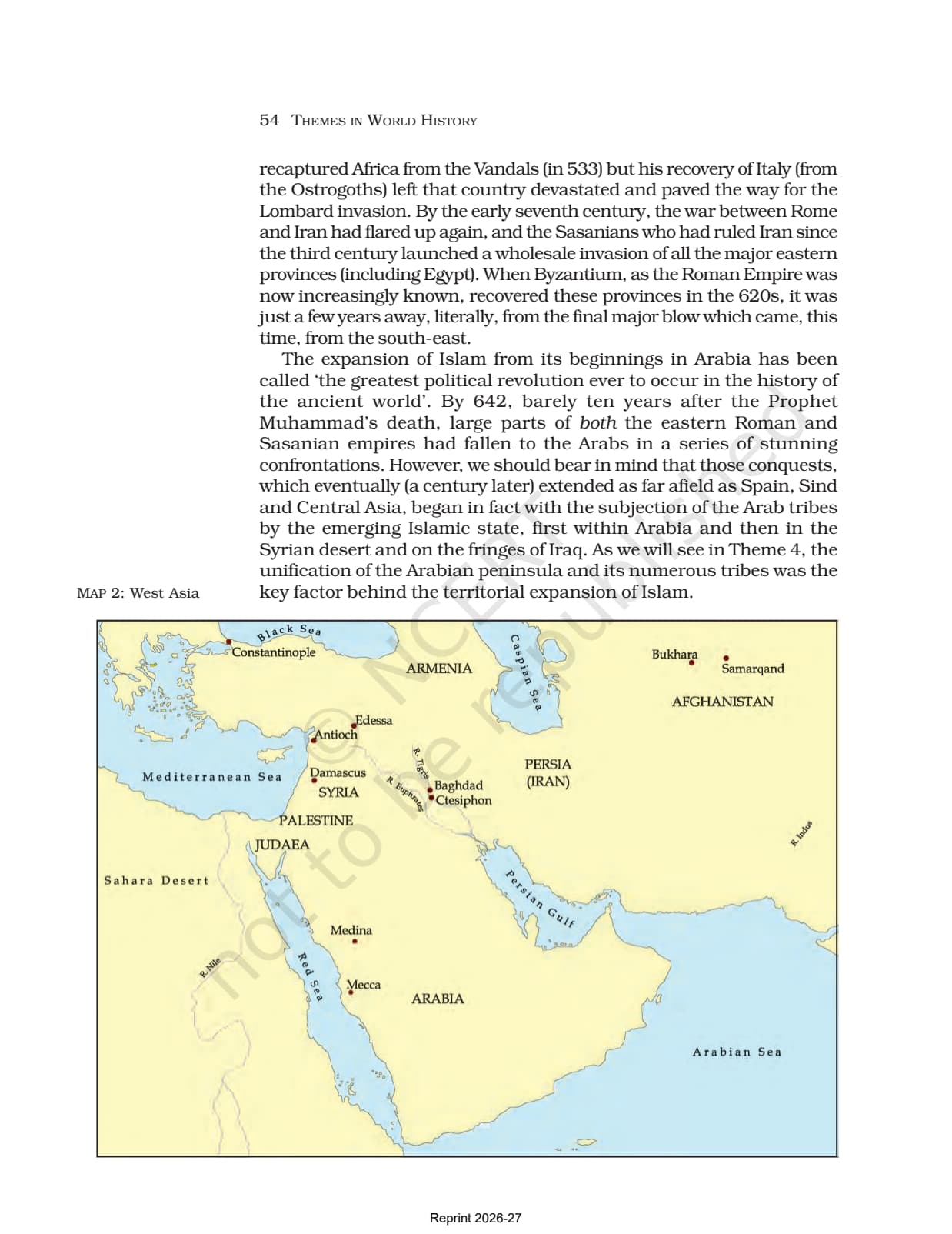
| Geography and rival Iran (p. 39-40) | the Mediterranean, the Rhine, the Danube and the Sahara as borders |
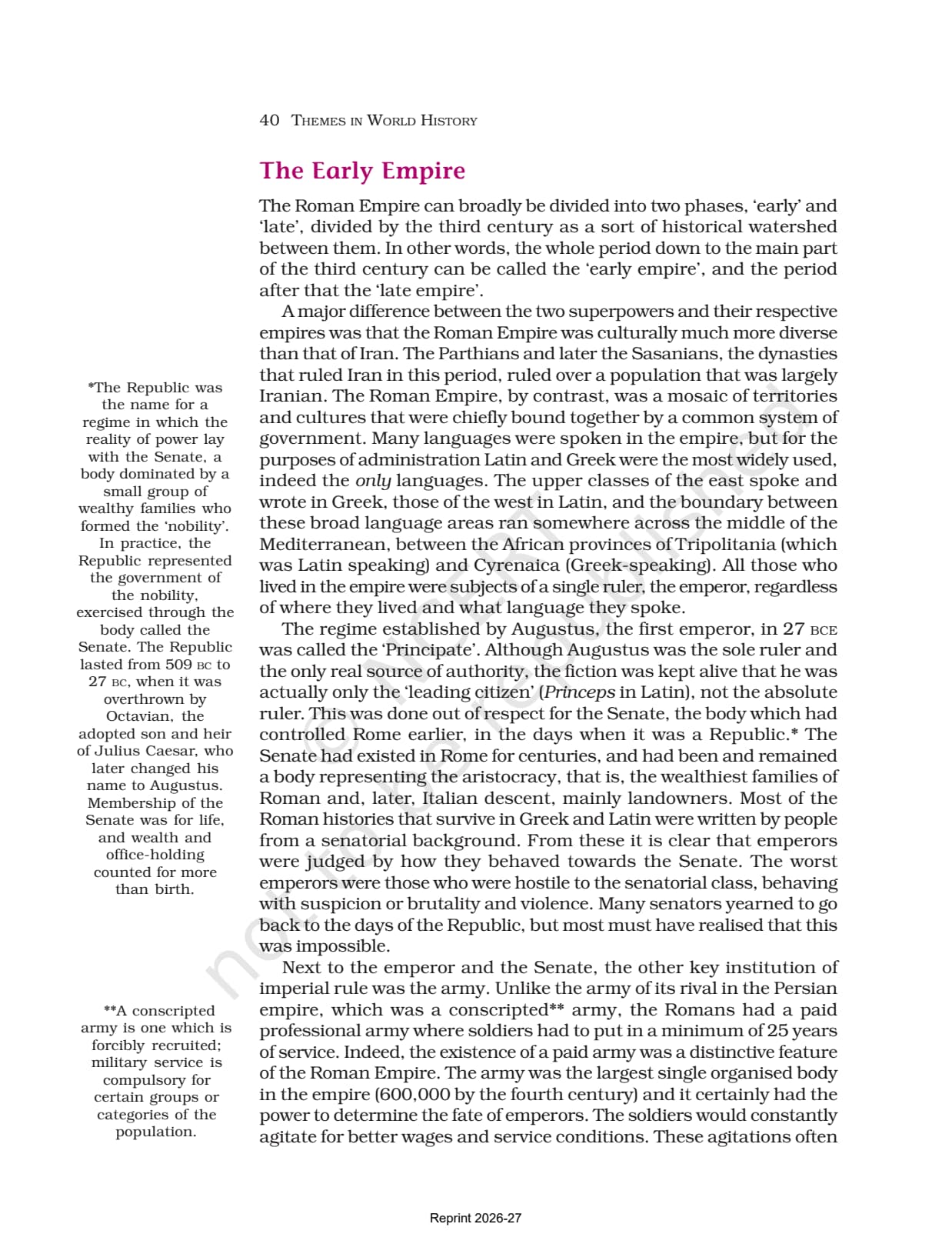
| The Early Empire (p. 40-43) | the Principate, the Senate and the paid Roman army |
| The Third-Century Crisis and Late Antiquity (p. 43-52) | Diocletian's reforms and Constantine's new capital and coinage |
| Controlling Workers, Social Hierarchies (p. 47-51) | slavery, wage labour and Rome's social classes |
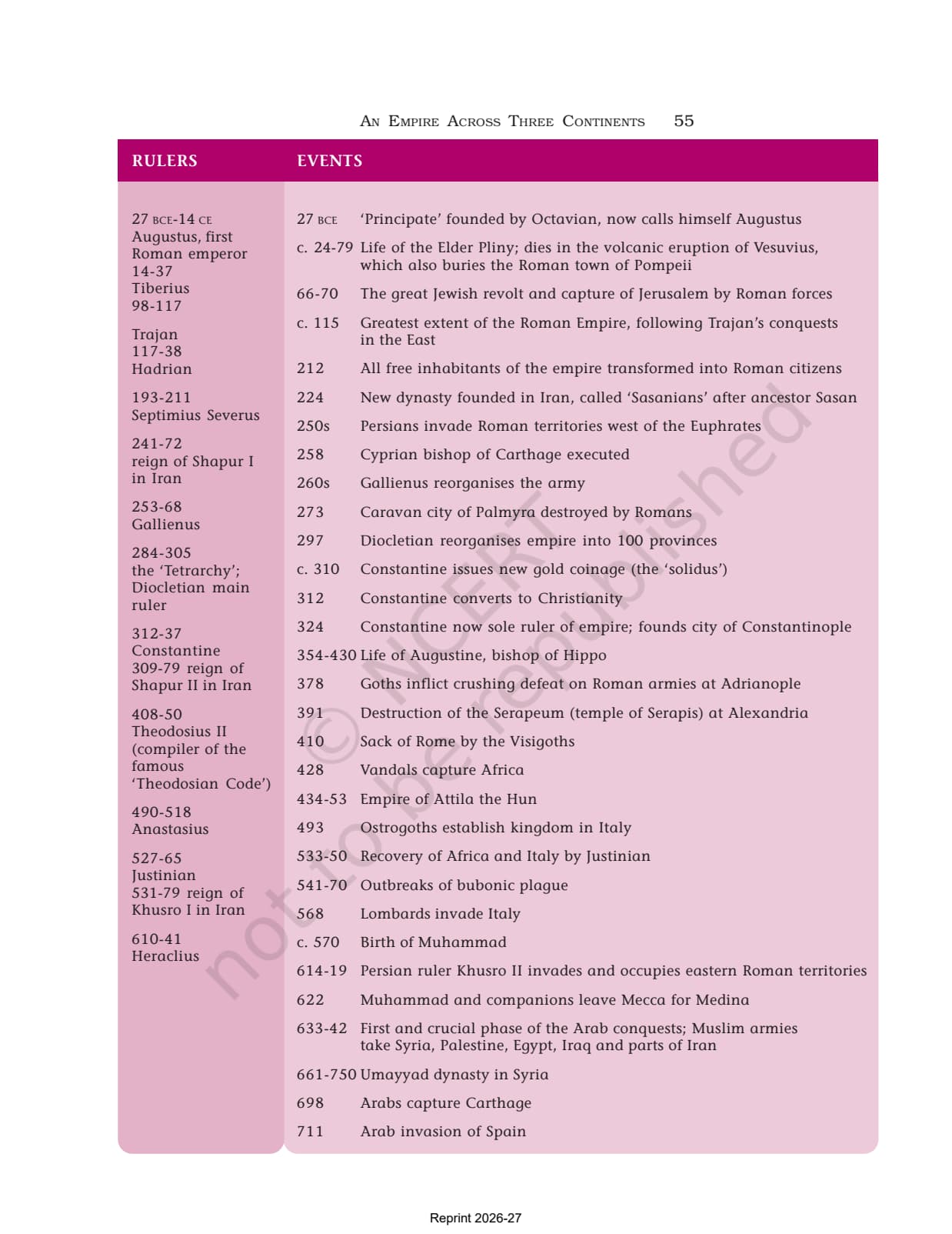
| Rulers and Events (p. 55-56) | a chronology from Augustus in 27 BCE to the Arab invasion of Spain in 711 CE |
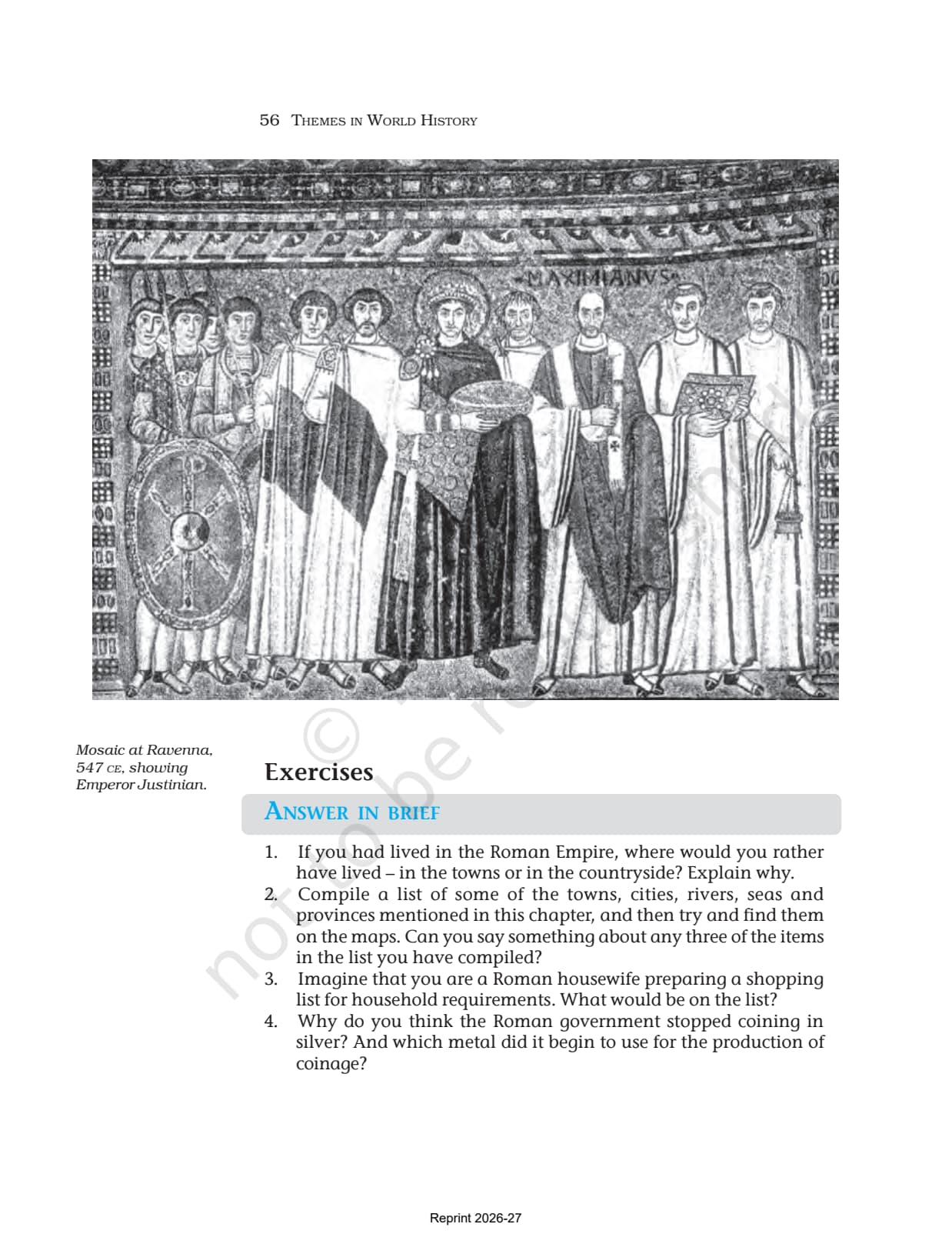
| Exercises (p. 56-57) | Answer in Brief and Answer in a Short Essay |
| Chapter 3 opening (from p. 58) | the same file continues into the complete Nomadic Empires chapter, the next chapter in the theme |
An Empire Across Three Continents Class 11 Overview
Source: Magnet Brains on YouTube
What the Chapter 2 PDF Contains
The PDF holds the full theme unit exactly as NCERT printed it. Nothing has been trimmed from either end, which is why the file runs to 48 pages rather than stopping at Chapter 2 alone.
- The shared theme title page and the four-page Timeline II spread that opens the Empires unit
- The complete text of An Empire Across Three Continents, printed pages 38 to 57
- The Rulers and Events chronology table, from Augustus in 27 BCE to the 711 CE Arab invasion of Spain
- Every source extract used in the chapter, including quotations from Trajan's biographer, the physician Galen and the historian Olympiodorus
- Both the Answer in Brief and Answer in a Short Essay exercise sets
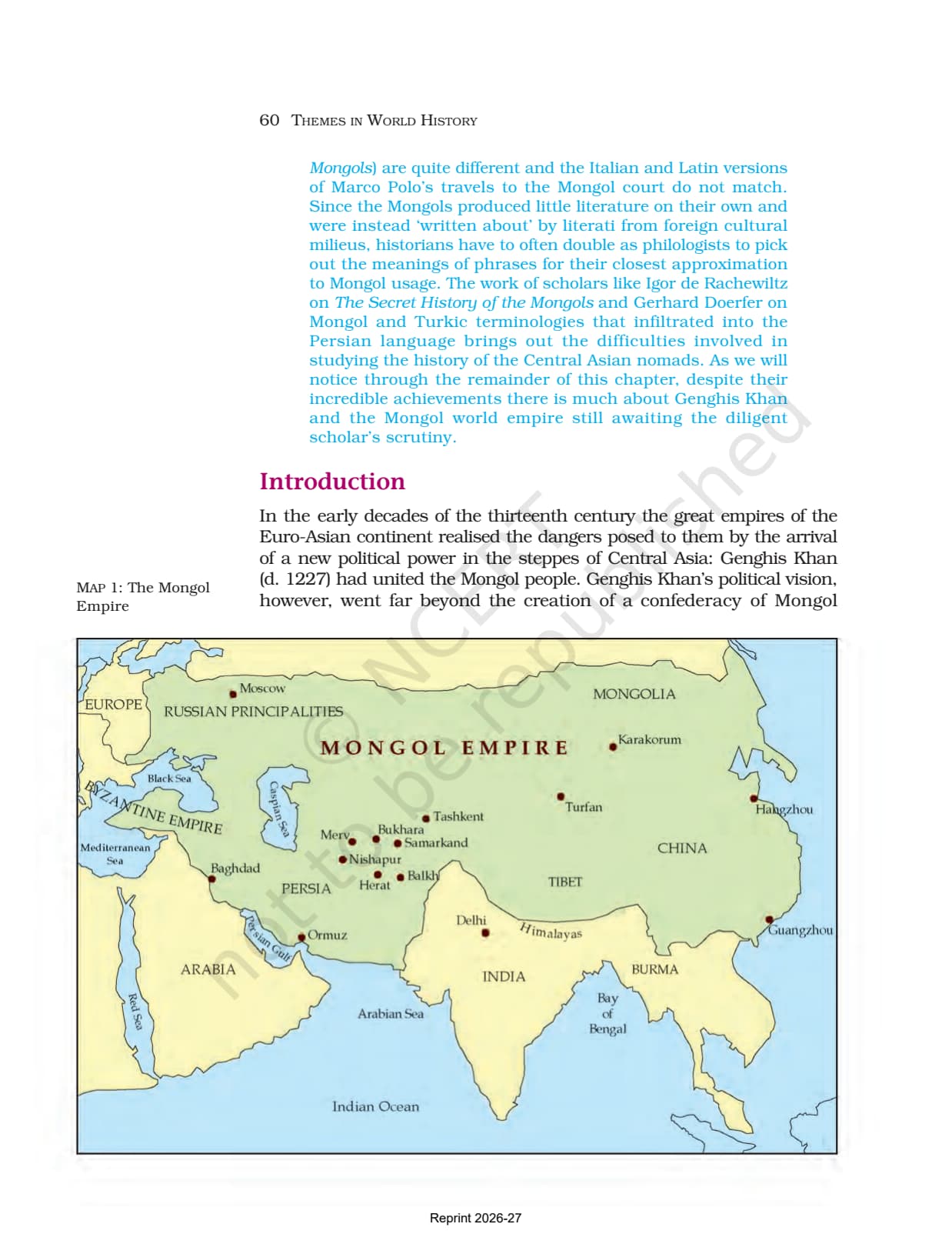
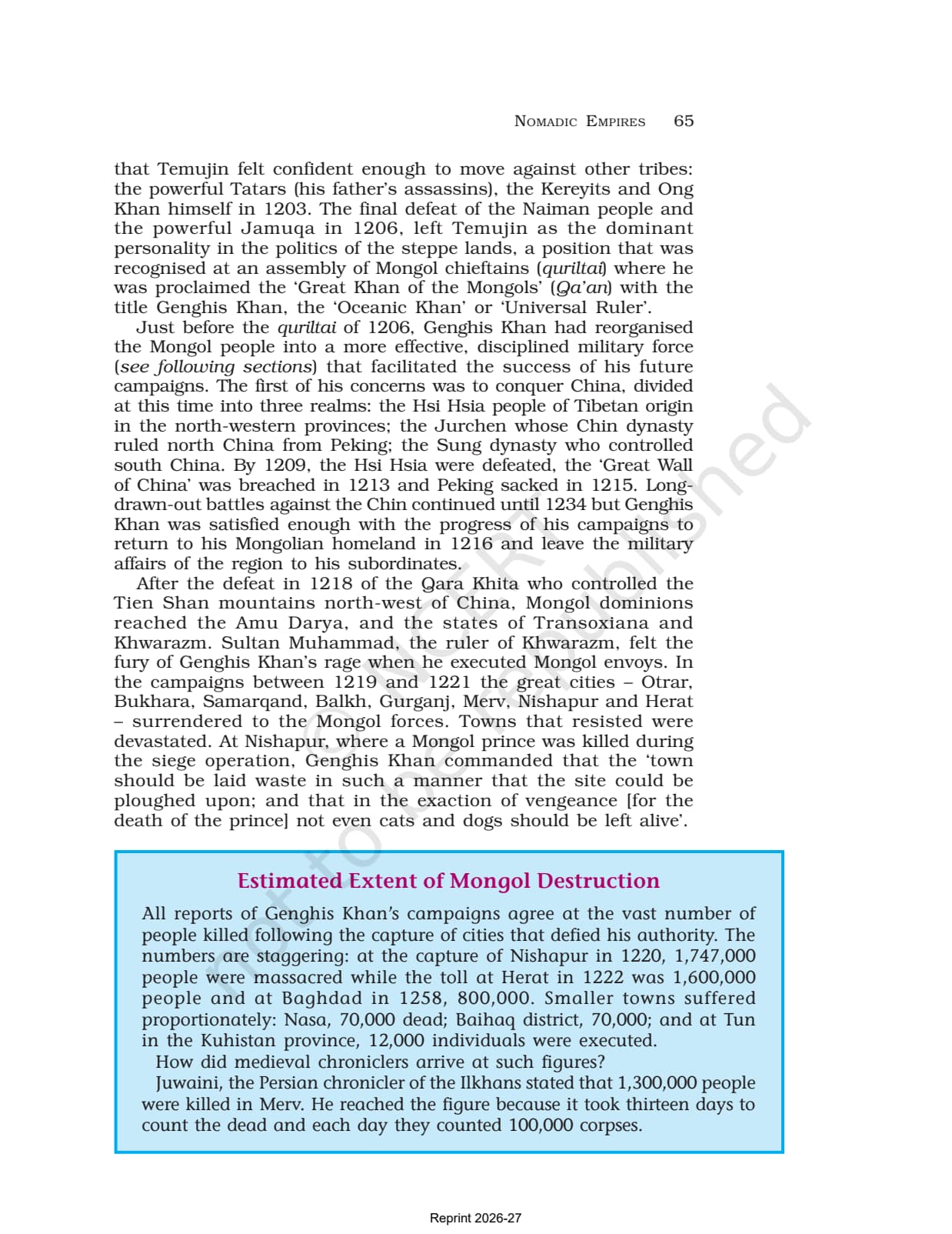
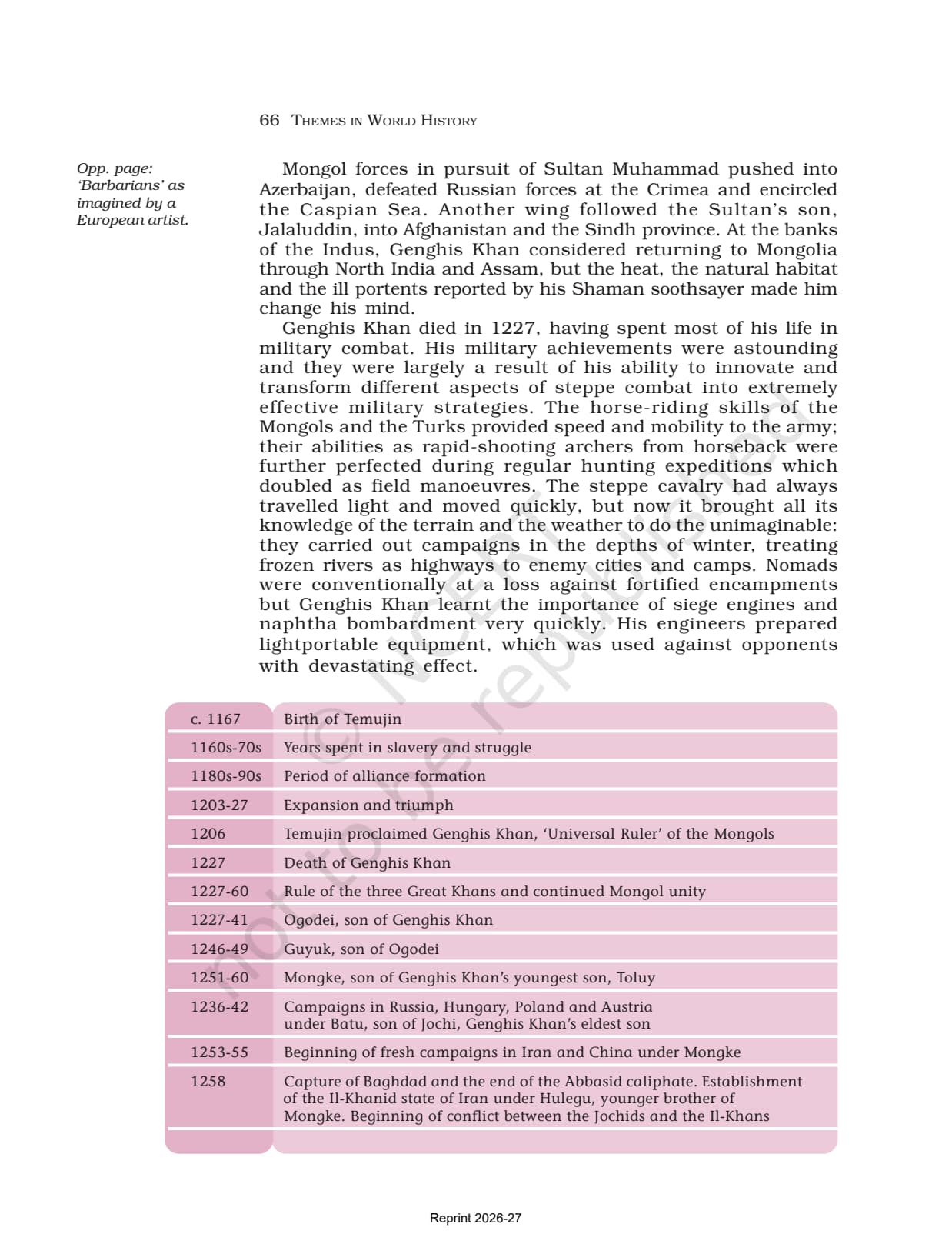
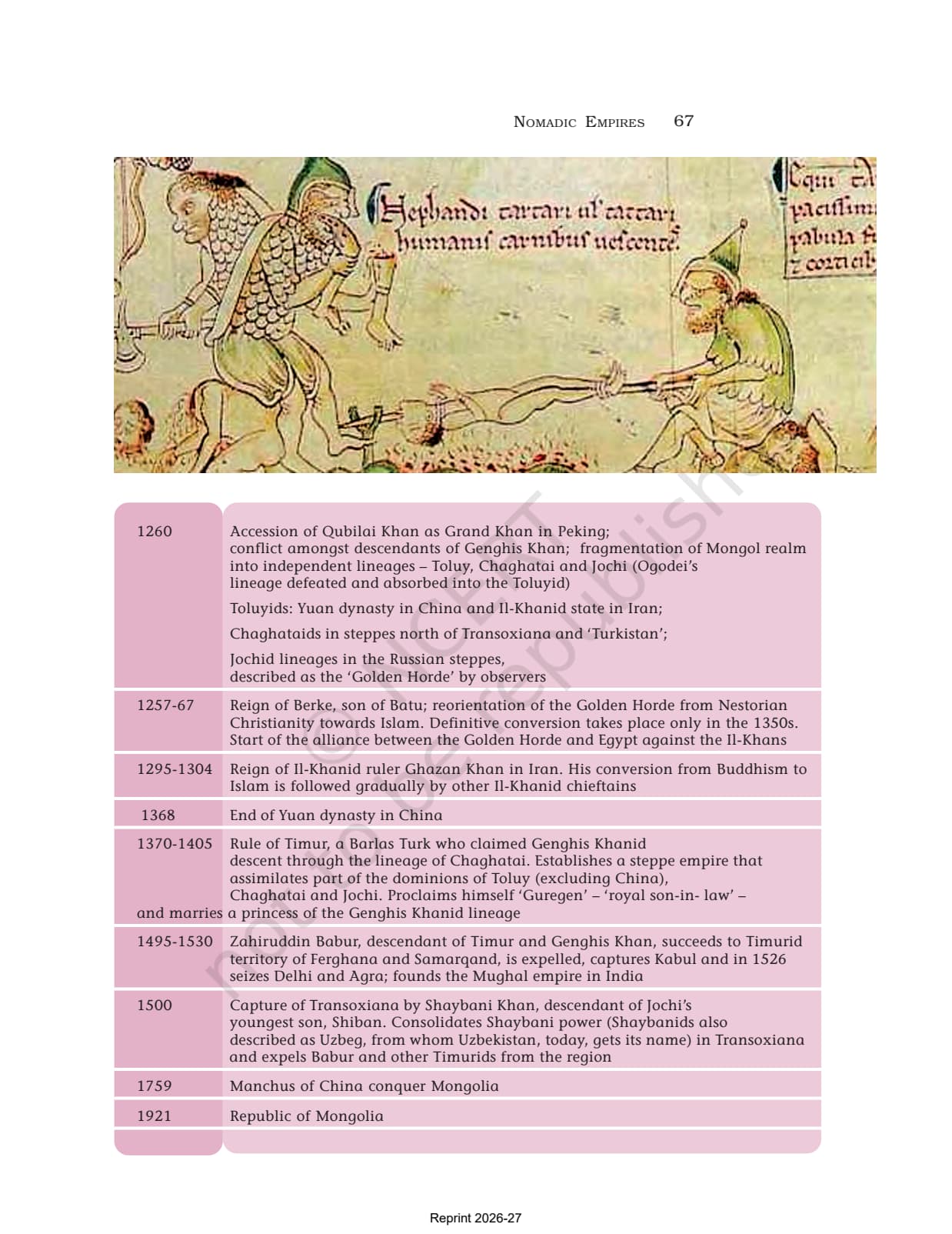
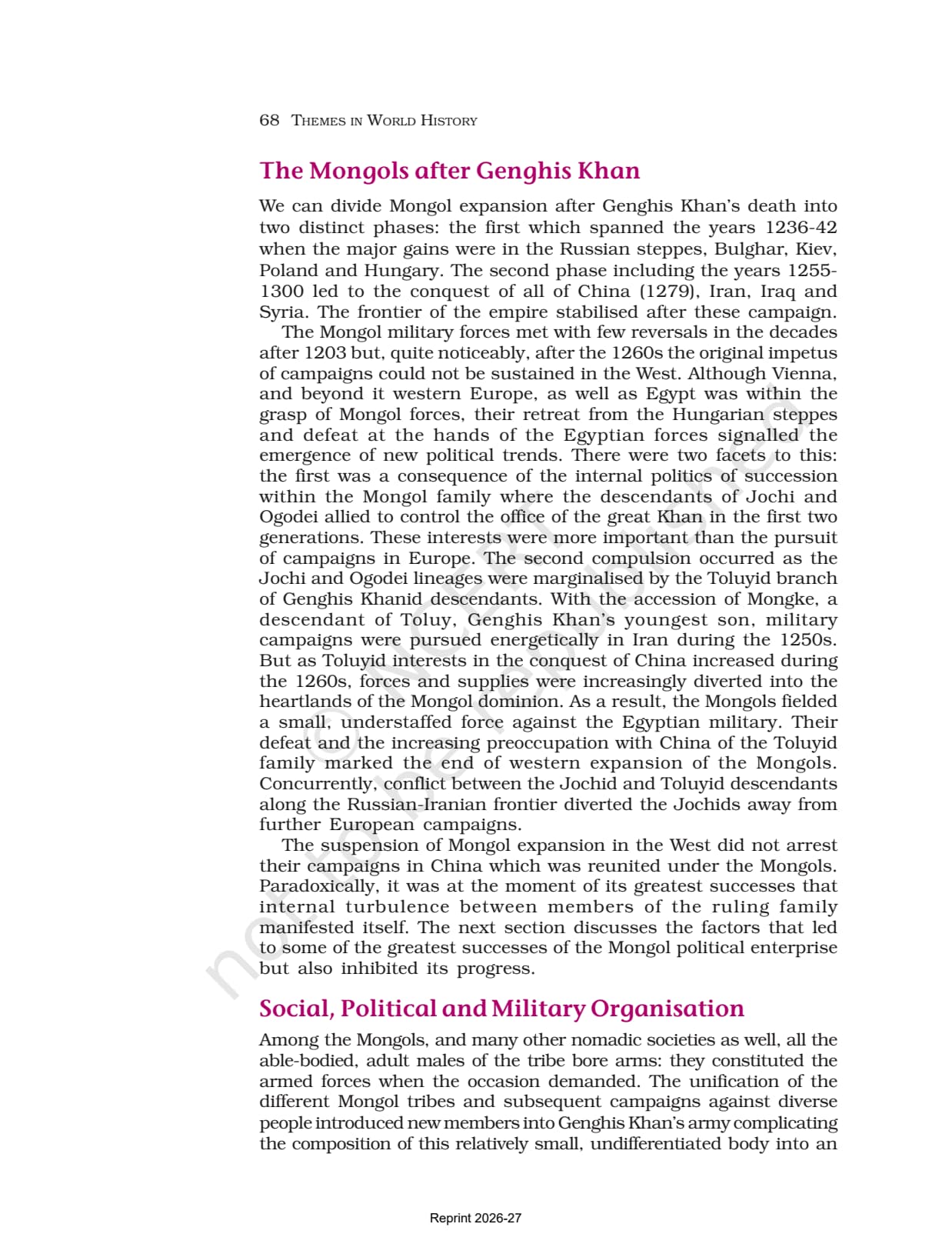
- The complete Chapter 3, Nomadic Empires, because NCERT issues this as one continuous 48-page theme file
That last point is worth saying plainly. If you page through the viewer above and see content past printed page 57, that is the start of the next chapter, not an error in this download. NCERT prints the two chapters as a single Empires unit, and this page hosts that unit in full.
Geography of an Empire That Spanned Three Continents
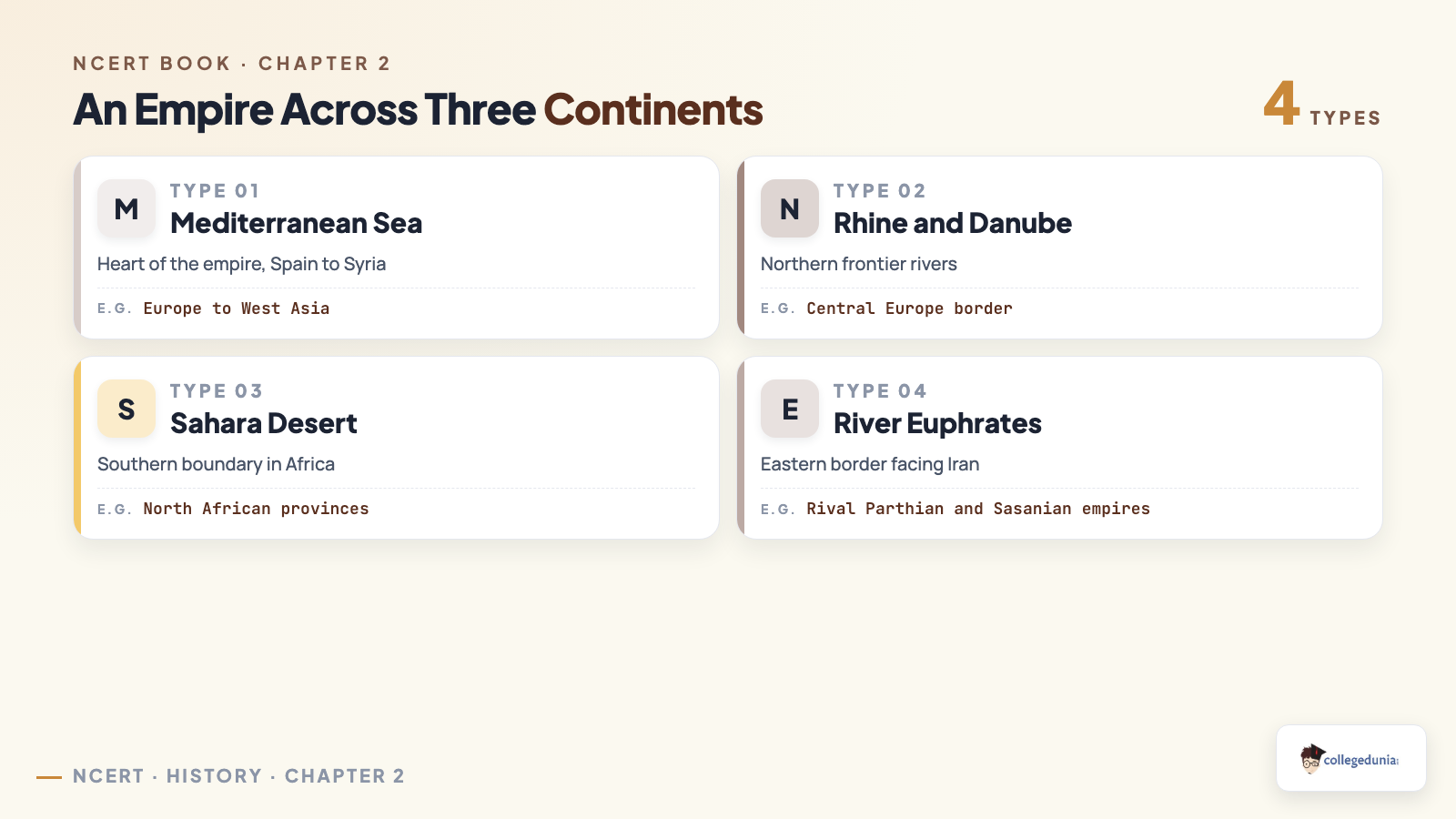
The chapter opens by placing Rome next to its great rival. Between the birth of Christ and the 630s CE, two powerful empires, Rome and Iran, controlled most of Europe, North Africa and West Asia. A narrow strip of land along the river Euphrates separated them.
- The Mediterranean Sea: the heart of Rome's empire, stretching from Spain in the west to Syria in the east
- Northern border: the rivers Rhine and Danube marked the edge of Roman territory
- Southern border: the vast Sahara desert closed off the empire's African provinces
- Iran's territory: the area south of the Caspian Sea down to eastern Arabia, and sometimes Afghanistan
- Chinese view: the Chinese called this whole western zone Ta Ch'in, or greater Ch'in
At its peak in the second century, the empire stretched from Scotland to the borders of Armenia, with a population of roughly 60 million. It held together not through a modern government but through urbanisation. Cities like Carthage, Alexandria and Antioch collected taxes from the countryside around them and supplied the local elites who ran the provinces on Rome's behalf.
Sources Historians Use to Study Ancient Rome
Before describing the empire itself, the chapter explains how historians know any of this. Roman historians work with a rich collection of material that falls into three broad groups.
| Source group | What it includes |
|---|---|
| Texts | histories called Annals, written year by year, plus letters, speeches, sermons and laws |
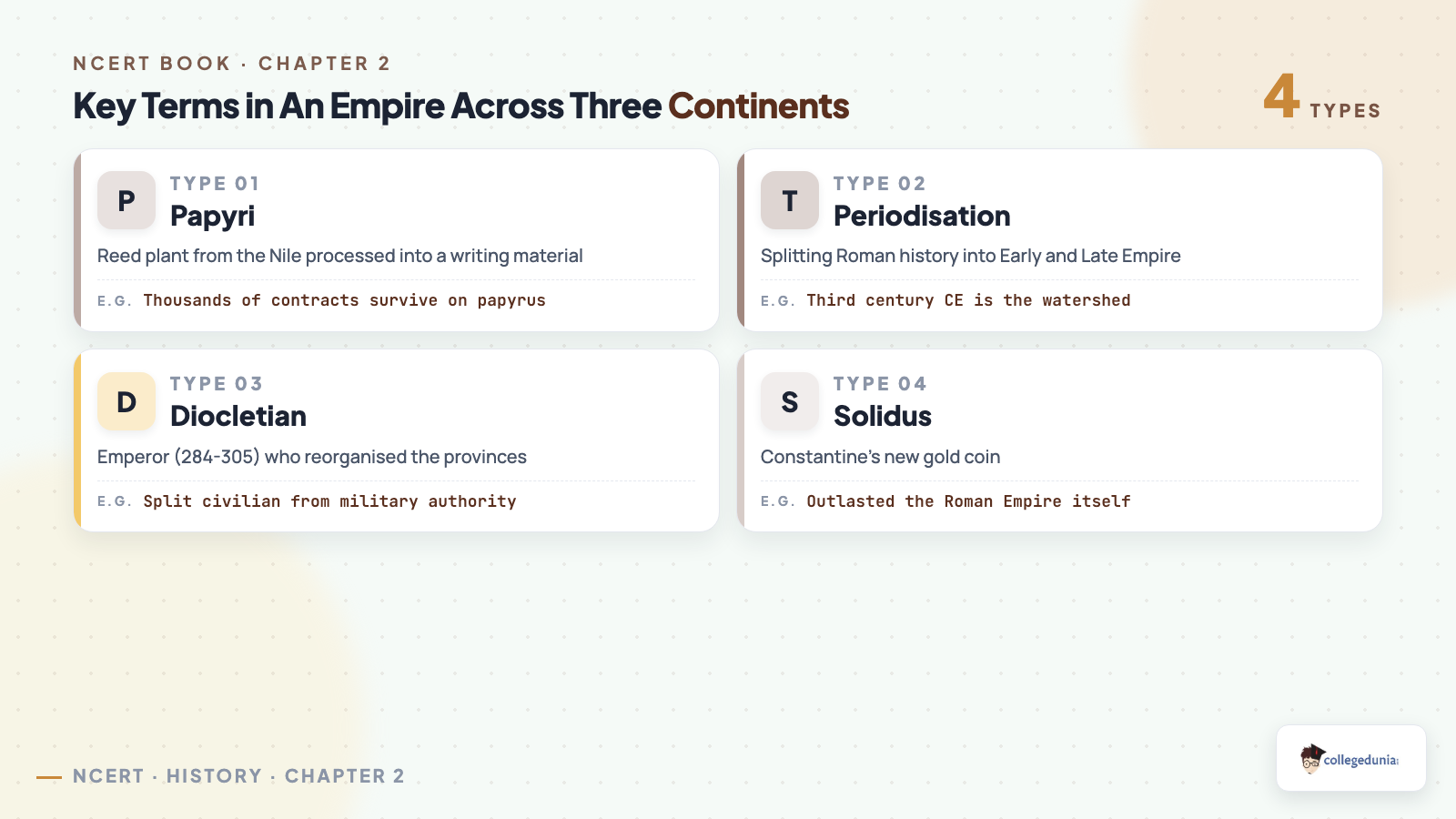
| Documents | inscriptions cut on stone, and papyri, a reed plant from the banks of the Nile in Egypt processed into a writing material |
| Material remains | buildings, monuments, pottery, coins and mosaics, found through excavation, field survey and aerial photography |
Thousands of contracts, accounts and letters survive on papyrus, and the scholars who study them are called papyrologists. Each source type answers only part of the picture, so combining texts, documents and material remains is a skill in itself.
The Early Empire and Its Institutions
The chapter divides Roman history into two broad phases, the Early Empire and the Late Empire, with the third century CE as the watershed between them. This periodisation runs through the rest of the chapter.
- The emperor: Augustus founded the Principate in 27 BCE, calling himself only the leading citizen out of respect for the Senate
- The Senate: the old aristocratic body of wealthy landowning families that had governed Rome as a Republic
- The army: a paid professional force with 25 years of service, unlike Iran's conscripted army, growing to 600,000 soldiers by the fourth century
The first two centuries were largely peaceful. Only 69 CE, when four emperors ruled in quick succession, broke that pattern. Trajan's campaign across the Euphrates (113-17 CE) was the one major expansion of this period, and even that was abandoned by his successors.
The Third-Century Crisis, Diocletian and Constantine's Reforms
From the 230s, the empire fought on several fronts at once. The new Sasanian dynasty in Iran pushed toward the Euphrates, and Germanic tribal groups such as the Alamanni, the Franks and the Goths attacked the Rhine and Danube frontier. 25 emperors ruled in just 47 years, a clear sign of the strain.
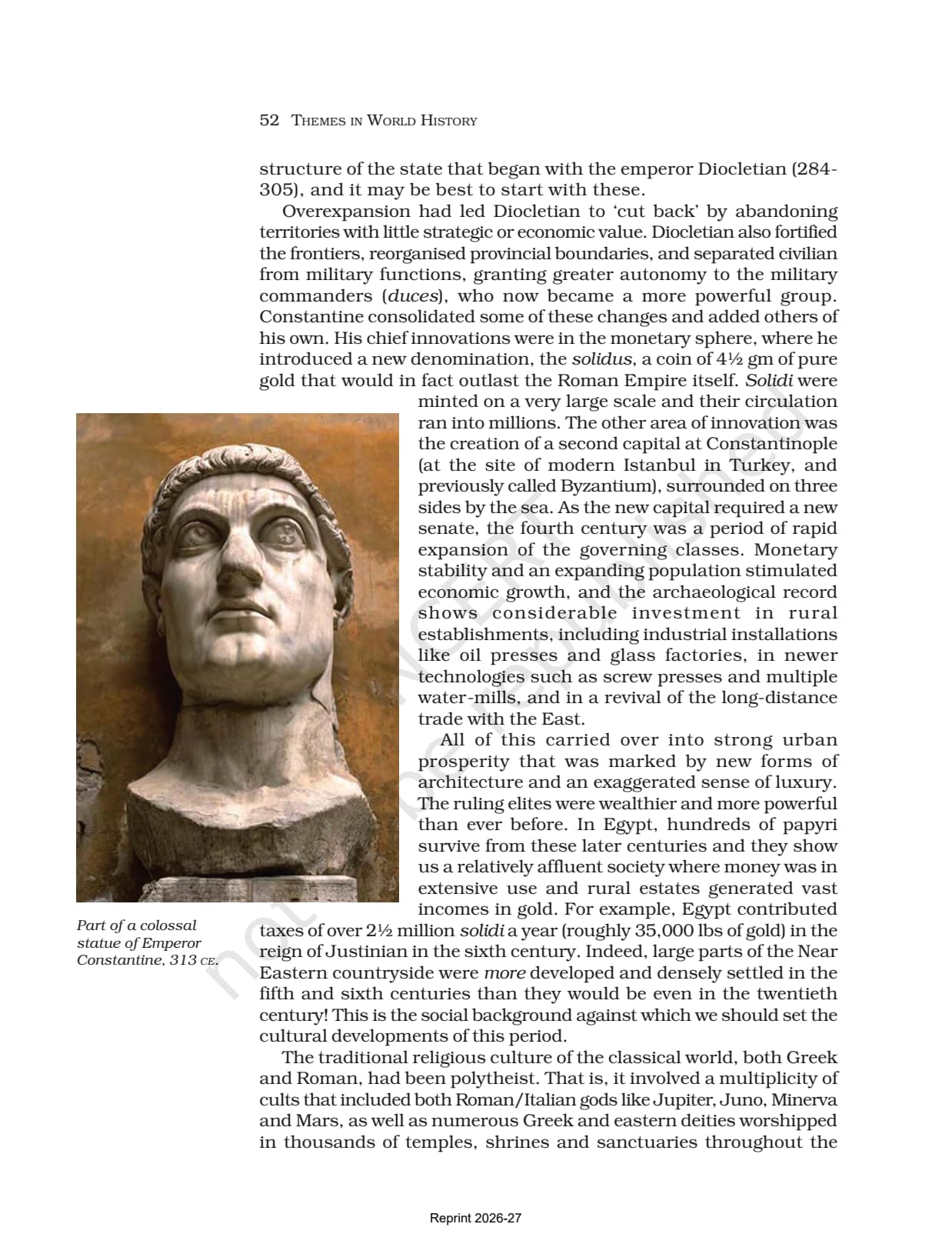
Two emperors then rebuilt the state. Diocletian (284-305) cut back overextended territory, fortified the frontiers, and split civilian from military authority by reorganising the empire into 100 provinces. Constantine (312-37) took these changes further.
| Reform | What it changed |
|---|---|
| New coinage | the solidus, a 4.5 gram gold coin that outlasted the empire itself |
| New capital | Constantinople, built at old Byzantium and surrounded on three sides by the sea |
| Religion | Constantine converted to Christianity in 312 CE, setting the empire on the path to becoming a Christian state |
These reforms brought real prosperity. Egypt alone paid over 2.5 million solidi a year in taxes under Justinian in the sixth century, and the archaeological record shows fresh investment in oil presses, glass factories and water-mills across the empire.
Slavery, Wage Labour and the Roman Economy
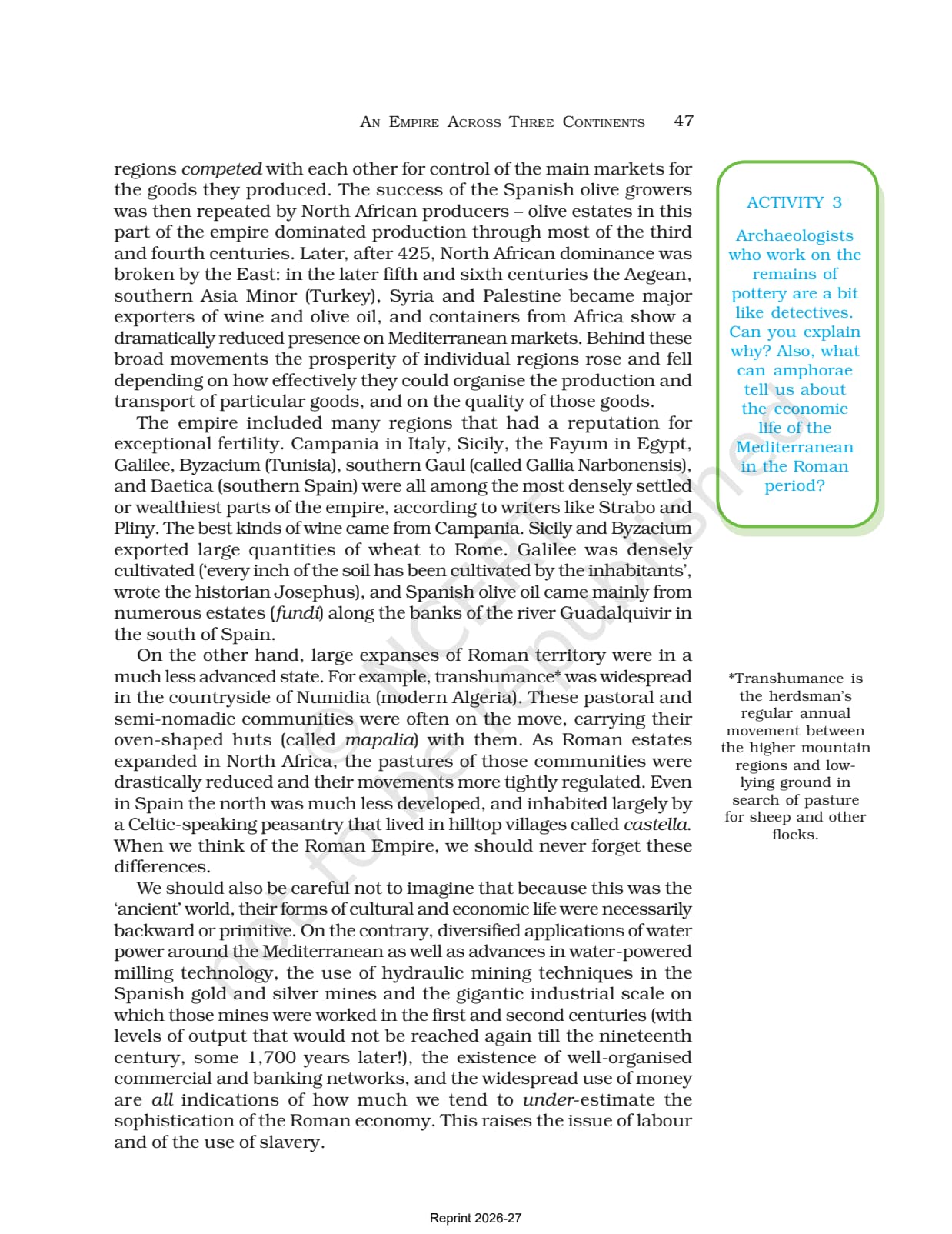
The chapter is direct about how the Roman economy actually ran. It had a substantial infrastructure of harbours, mines, quarries and olive-oil factories, and wheat, wine and olive oil travelled across the Mediterranean in clay containers called amphorae. Archaeologists trace this trade by matching amphora fragments to the clay pits that made them.
On labour, the chapter does not soften the picture. Slavery was deeply rooted, and Christianity did not seriously challenge it even after becoming the state religion. Under Augustus, Italy alone held 3 million slaves in a population of 7.5 million, though slavery was never the main source of labour for the empire as a whole.
- Slaves were expensive to keep, since they had to be fed and housed all year, so wage labour was often cheaper and widely used on public works
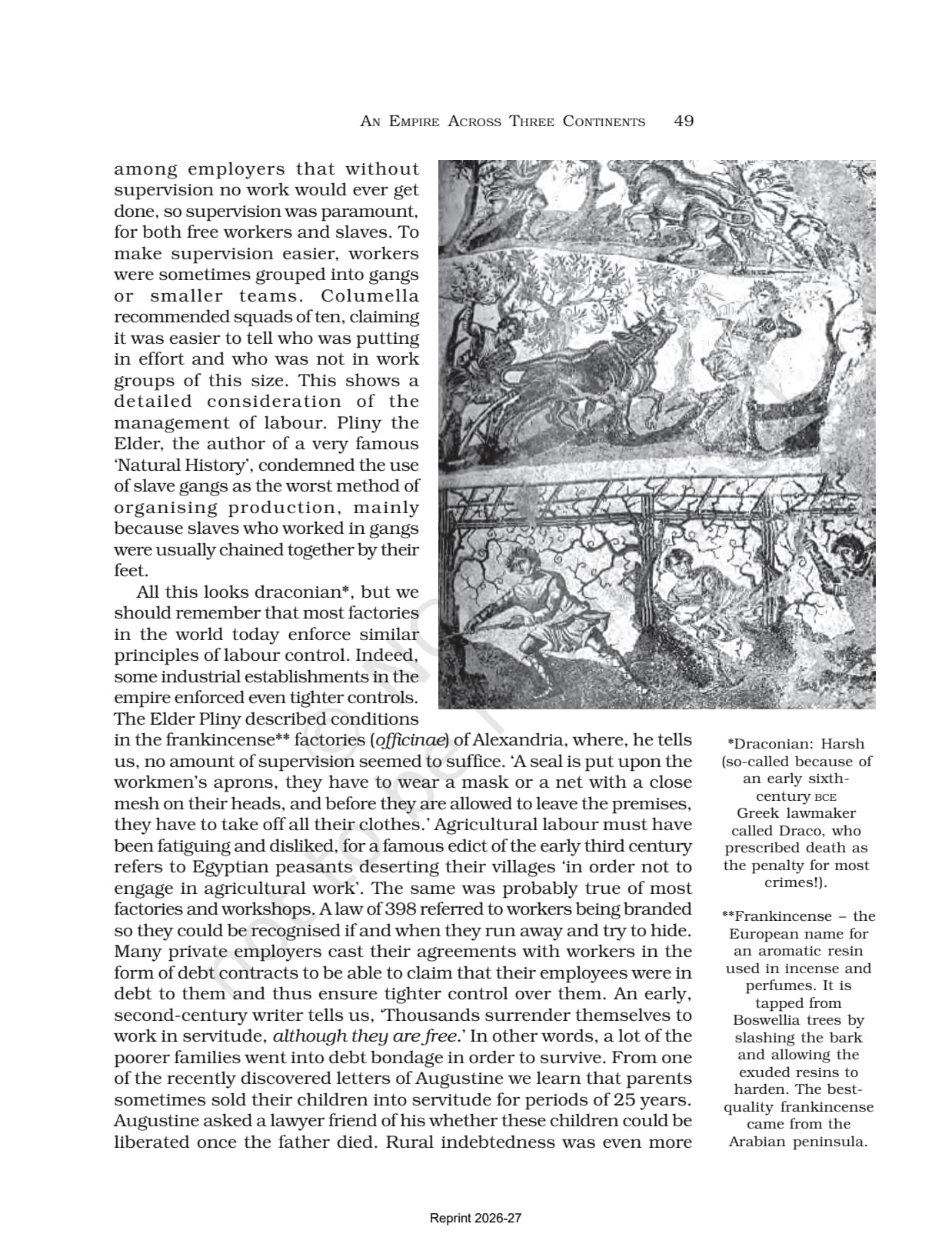
- The writer Columella recommended managing slave gangs in squads of ten for easier supervision
- A law of 398 CE mentions branding runaway workers so they could be identified
- Poor families sometimes went into debt bondage, and one letter of Augustine describes children sold into 25 years of servitude
Society itself was layered. The historian Tacitus described senators, the equestrian class, the respectable common people, an unkempt lower class, and slaves at the very bottom. By the Late Empire, senators and equites had merged into one wealthy aristocracy, while a large mass of humiliores, meaning the lower orders, supplied most of the actual labour.
Christianity, Late Antiquity and the Split Between West and East
The chapter closes by tracing what it calls Late Antiquity, the fourth to seventh centuries. Rome and Greece had long been polytheist, worshipping gods like Jupiter and Minerva alongside eastern deities, and Judaism was the other major tradition already present. The spread of Christianity across the fourth and fifth centuries was gradual, pushed forward mainly by bishops.
| Half of the empire | What happened |
|---|---|
| The West | fragmented from the fifth century as Goths, Vandals, Lombards and Franks set up their own post-Roman kingdoms |
| The East (Byzantium) | stayed united and prosperous under Constantinople, with Justinian (527-65) recapturing Africa and Italy |
The chapter ends by turning to Arabia. Within about a decade of the Prophet Muhammad's death in 632 CE, large parts of the eastern Roman and Sasanian territories had fallen to Arab armies, a change the book calls the greatest political revolution in the history of the ancient world. NCERT notes that the caliphate covered in the next chapter inherited the eastern empire's urban and religious traditions.
What Collegedunia Adds to This Chapter PDF
Collegedunia gives students the official file plus a way into it. The chapter PDF itself is untouched.
- Official file: the exact NCERT theme unit, no pages removed
- Read in the browser: page through all 48 pages before downloading
- Chapter list: jump to any other Class 11 History chapter from one table
Also Check: the other Class 11 History resources for this chapter.
| Resource | Link |
|---|---|
| Handwritten notes | An Empire Across Three Continents Handwritten Notes |
| Chapter notes | An Empire Across Three Continents Notes (coming soon) |
| Chapter solutions | An Empire Across Three Continents NCERT Solutions (coming soon) |
| Previous chapter handwritten notes | Writing and City Life Handwritten Notes |
| Next chapter handwritten notes | Nomadic Empires Handwritten Notes |
Class 11 History NCERT Book PDF: All Chapters
Every chapter of the book gets its own page. The 2026-27 Class 11 History (Themes in World History) textbook has 7 chapters, and Chapter 3 continues directly from the theme this chapter opens.
| Chapter | Download |
|---|---|
| Chapter 1 | Writing and City Life NCERT Book PDF (coming soon) |
| Chapter 2 | An Empire Across Three Continents NCERT Book PDF |
| Chapter 3 | Nomadic Empires NCERT Book PDF (coming soon) |
| Chapter 4 | The Three Orders NCERT Book PDF (coming soon) |
| Chapter 5 | Changing Cultural Traditions NCERT Book PDF (coming soon) |
| Chapter 6 | Displacing Indigenous Peoples NCERT Book PDF (coming soon) |
| Chapter 7 | Paths to Modernisation NCERT Book PDF (coming soon) |
An Empire Across Three Continents NCERT Book PDF FAQs
Common Student Questions on the Roman Empire Chapter File
Ques. Where can I download the Class 11 History Chapter 2 NCERT Book PDF?
Ans. The official 48-page theme file is on this page, free to download.
Ques. Why does the PDF have 48 pages when the chapter itself is shorter?
Ans. NCERT issues Chapter 2 and Chapter 3, Nomadic Empires, together as one Empires theme unit. This file carries the shared title page, the Timeline II spread, the complete text of An Empire Across Three Continents (printed pages 38 to 57), and then the complete Nomadic Empires chapter through its Summary and exercises, exactly as NCERT prints it.
Ques. What three types of sources do historians use for this chapter?
Ans. Texts such as Annals, letters and laws; documents such as inscriptions and papyri; and material remains such as buildings, coins and mosaics found through archaeology.
Ques. What did Diocletian and Constantine actually change?
Ans. Diocletian reorganised the empire into 100 provinces and separated civilian from military authority. Constantine introduced the gold solidus coin, founded the new capital of Constantinople, and converted to Christianity in 312 CE.
Ques. Was most labour in the Roman Empire done by slaves?
Ans. No. Slavery was deeply rooted, and Italy alone held 3 million slaves under Augustus, but the chapter is clear that slaves were not the main source of labour across the empire as a whole. Wage labour and debt bondage were both widespread.
Ques. Why did the Western and Eastern halves of the empire end up so different?
Ans. From the fifth century, Germanic groups such as the Goths and Vandals broke up the Western empire into separate kingdoms. The Eastern half, centred on Constantinople and later called Byzantium, stayed united and prosperous under rulers like Justinian.
Ques. What is periodisation in this chapter?
Ans. It is the chapter's way of splitting Roman history into the Early Empire and the Late Empire, using the third century CE as the watershed between the two phases.
Ques. Is this the official NCERT file?
Ans. Yes. It is the NCERT theme-unit PDF for 2026-27 hosted as published, with no pages removed or added.



Comments