Political Science Editor, 7 Yrs | Updated on - Jul 23, 2026
The NCERT solutions class 10 civics chapter 1 Power-sharing cover every exercise question, from the descriptive answers on Belgium and Sri Lanka to the match-the-list and code-based MCQs, according to the latest 2026-27 CBSE syllabus.
Each answer is based on the two-reason rule that NCERT uses through the chapter: the prudential reason (power sharing reduces conflict) and the moral reason (power sharing is the spirit of democracy).
Chapter 1 carries about 5-6 marks in the CBSE Class 10 Social Science board paper, usually one source-based question plus short and long answers.
All 9 exercise questions are solved here with a step-by-step answer and an expert's note for each.
Pairs with the Power-sharing notes and the Class 10 Civics chapter list for full revision.
What the Power-sharing Class 10 Solutions PDF Contains
The NCERT solutions class 10 civics chapter 1 Power-sharing PDF gives you a clean, marker-ready answer for every back-exercise question. The answers follow the exact two-reason logic of the chapter so you never mix up a prudential point with a moral one.
Solved answers to all 9 exercise questions, each with a bold final-answer box.
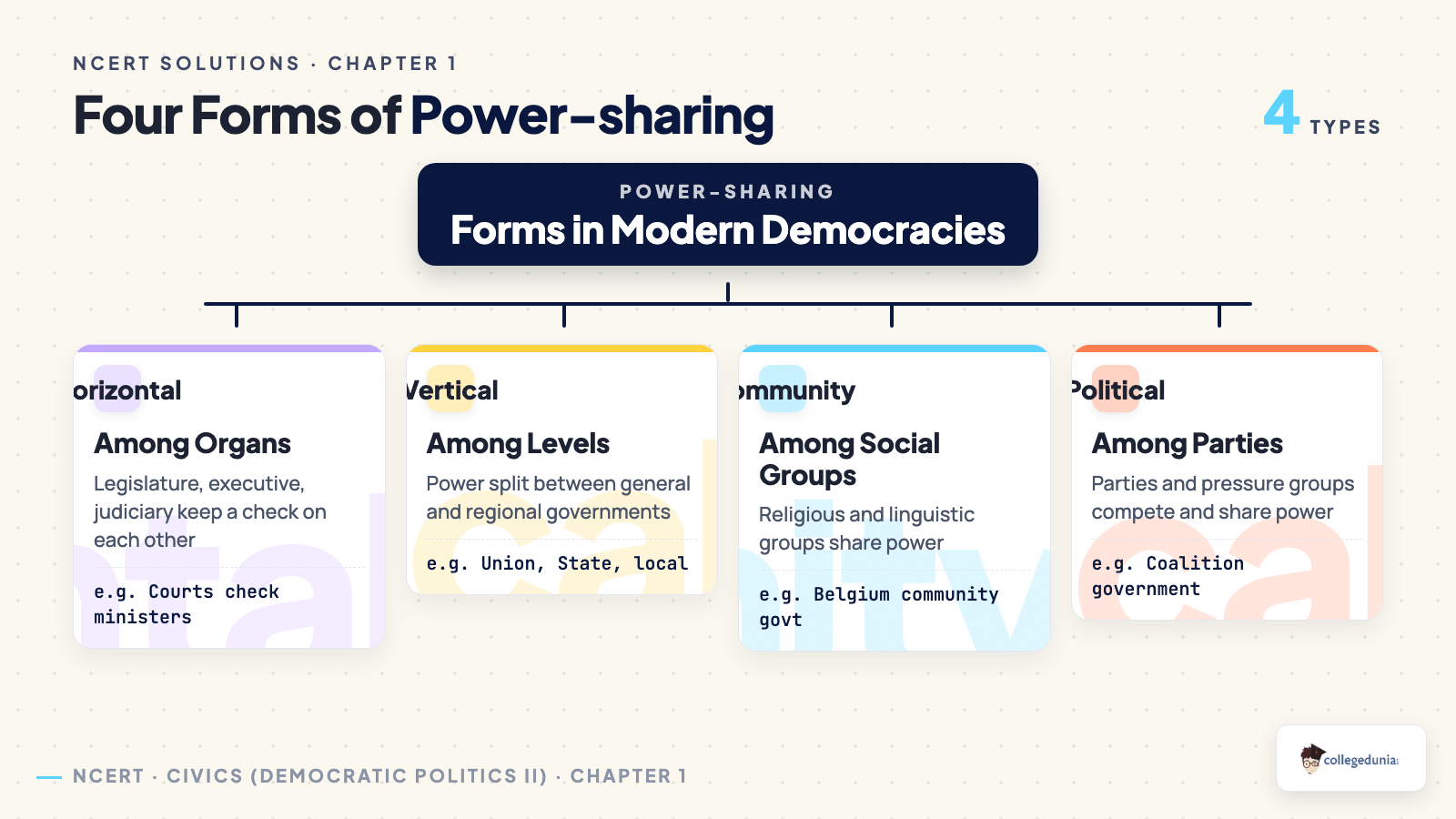
A labelled tree of the four forms of power sharing (horizontal, vertical, community, political) with one example each.
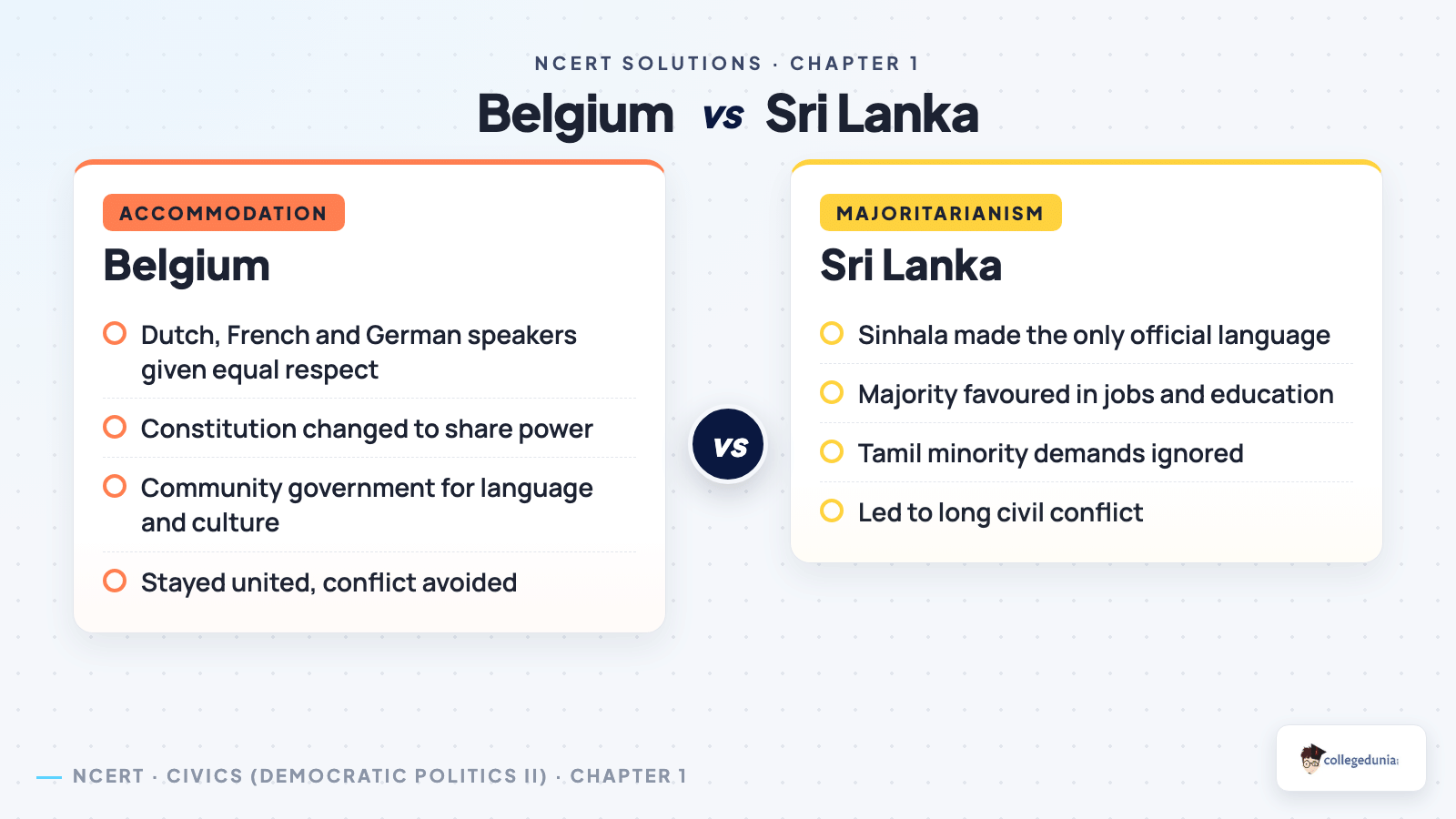
The Belgium versus Sri Lanka contrast, set out as accommodation versus majoritarianism.
An expert's note on every question that shows a faster way to reach the same answer.
Use the PDF for first-pass learning alongside the NCERT textbook, then again as a quick recap before the board exam.
Power-sharing Crash Course for Class 10 Boards
A short video helps you see how the Belgium and Sri Lanka stories lead to the same lesson on sharing power.
The Two Reasons Behind Power-sharing Every Class 10 Student Must Know
The whole chapter rests on two reasons for sharing power, and almost every question is built on telling them apart. The ncert solutions for class 10 civics chapter 1 Power-sharing keep these two reasons fixed so your answer never drifts.
Prudential reason: power sharing reduces the chance of conflict between social groups and keeps the political order stable. It answers "it works better".
Moral reason: power sharing is the very spirit of democracy, since people have a right to be consulted on how they are ruled. It answers "it is right".
Indian examples: the Centre-State division shows the prudential reason; the Panchayati Raj system shows the moral reason.
Important: "good for democracy" is always the moral reason, never the prudential one. Swapping the two is the single most common mistake in this chapter.
Belgium and Sri Lanka: Accommodation versus Majoritarianism
NCERT opens the chapter with two real countries to show what happens when power is shared well and when it is not. The contrast is the heart of every long-answer question, so the class 10 civics chapter 1 Power-sharing solutions spell it out clearly.
Point
Belgium
Sri Lanka
Main communities
Dutch, French and a small German-speaking group
Sinhala-speaking majority and Tamil minority
Approach taken
Accommodation: equal respect, community government
Majoritarianism: Sinhala made the only official language
Result
Stayed united, conflict avoided
Long civil conflict between groups
Watch out: in Belgium the French-speaking minority was richer and more powerful, so it was not the Dutch majority that first sought to dominate. This single fact decides the answer to the Belgium-Sri Lanka MCQ.
The Four Forms of Power-sharing in Modern Democracies
Power can be shared in four ways, and NCERT wants the name of each form, the words "among organs / levels / communities / parties", and a matching example. The ncert solutions class 10 civics chapter 1 Power-sharing present them as a single labelled list so you can recall all four in the exam.
Horizontal: power shared among organs of government (legislature, executive, judiciary). Example: courts can check ministers.
Vertical: power shared among levels (Union, State, local). Example: Centre and State governments in India.
Community: power shared among social groups. Example: Belgium's community government.
Political: power shared among parties and pressure groups. Example: a coalition government.
These four forms match four systems of government: separation of powers, federal government, community government and coalition government. Many MCQs simply test this matching.
Exercise-wise Coverage of Power-sharing Class 10 Civics
The chapter has 9 back-exercise questions. The table groups them by type so you can plan which to revise first for the board paper.
Question
Type
What it tests
Q1, Q2
Long answer
Four forms of power sharing; one prudential and one moral reason
Q3, Q4, Q5
Opinion / source-based
Agreeing with a student view; the Belgium language ban; picking a prudential reason from a passage
Q6, Q7, Q8, Q9
MCQ / match-the-list
Arguments for power sharing; Belgium-Sri Lanka facts; matching forms to systems; true-false statements
Important Questions and Previous Year Trends for Power-sharing
It helps to know what the board asks most. Across recent CBSE papers, the class 10 civics Power-sharing questions cluster around a few favourites that the solutions cover in full.
"Different forms of power sharing with examples" is the most repeated long-answer question from this chapter.
Source-based passages on Panchayati Raj or Belgium appear often and test the prudential-versus-moral skill directly.
One-mark MCQs usually test the Belgium-Sri Lanka facts or the form-to-system matching.
73% of students in the same Collegedunia survey said practising the source-based question first gave them the biggest confidence boost before the exam.
How the Power-sharing Solutions Pair with the Notes and Other Resources
The solutions work best when read alongside the other Class 10 Civics resources for this chapter. Use the table below to move between them.
Once Power-sharing is done, move to the next chapters in Democratic Politics II. Each link below opens the step-by-step NCERT solutions for that chapter.
Common Mistakes Students Make in the Power-sharing Chapter
These are the slips that cost marks in this chapter, pulled from CBSE answer-key analysis and student feedback:
Writing "good for democracy" as a prudential reason. It is always the moral reason.
Saying the Dutch majority dominated Belgium. The French-speaking minority was the powerful group.
Naming a form of power sharing without giving the matching example, which loses half the marks.
In the source-based question, picking a moral line ("true democracy") when asked for a prudential reason.
How to Use the Power-sharing Solutions Page Most Effectively
A simple three-step routine turns these solutions into board marks. Treat the page as a practice tool, not just a reading list.
Read first: go through the NCERT chapter, then read each solved answer once to fix the two-reason logic.
Attempt: close the page and write Q1 and Q2 from memory, then compare with the model answer.
Re-do: flag the source-based and matching questions you got wrong and redo them a day later.
All NCERT Solutions for Class 10 Civics Chapter 1 Power-sharing with Step-by-Step Solutions
Every exercise question is solved below. Tap Check Solution for the full step-by-step answer, or Expert Solution for a faster approach from a subject expert.
Q 1.1
What are the different forms of power sharing in modern democracies? Give an example of each of these.
Concept used.Power sharing means dividing the powers of government among
different organs, levels, communities and parties so that power is not concentrated in one
pair of hands. NCERT groups the arrangements of modern democracies into four forms.
A clear answer names each form, says between whom power is shared, and gives one real
example.
The four forms in one picture
A simple way to remember them: power can be shared sideways (between organs),
up-and-down (between levels of government), across communities, or
between competing parties.
!%
[See diagram in the PDF version]
%
Horizontal distribution of power. Power is shared among the different
organs of government, the legislature, executive and judiciary, all placed at
the same level. None can have unlimited power; each keeps a check on the others. This
is called a system of checks and balances. Example: In India, the courts can declare a law passed by the legislature
unconstitutional, so the judiciary holds the legislature in check.
Vertical division of power (federal division). Power is shared among
governments at different levels, a general government for the whole country and
governments at the regional or provincial level. Example: In India, power is divided between the Union (Central) Government,
the State Governments, and below them the local self-governments (panchayats and
municipalities).
Power shared among different social groups (community government). Power is
shared among groups such as religious and linguistic communities, often through
community government or reserved seats, so that minorities also feel they
share power. Example: The `community government' in Belgium is elected by people belonging
to one language community, and reserved constituencies in India.
Power shared among political parties, pressure groups and movements. In a
democracy citizens choose between competing parties and groups. This competition keeps
power in check, and power may be openly shared by two or more parties forming a
coalition government. Example: A coalition government in which several political parties together form
the ruling alliance.
The four forms are (1) horizontal (among organs: legislature, executive,
judiciary), (2) vertical (among levels: Union, State, local), (3) community
(among social groups) and (4) political (among parties / pressure groups), with the
examples shown above.
AI
Ananya Iyer
M.A. Political Science, Jawaharlal Nehru University
Verified Expert
Structural observation. The four forms are easiest to recall as two questions:
“Who is power shared between?” and “Is the sharing sideways, up-down, across
communities, or between rivals?” Answer both for each form and the example follows naturally.
I find it helps to picture a single block of “power” being cut in four different directions,
and to keep a ready-made example in mind for each cut so the answer never runs dry in the exam.
Sideways (Horizontal). Same level, different organs: legislature, executive,
judiciary. Because they sit at the same level, none can override the others; each can
check the rest. This is the system of checks and balances. Example: a court striking
down an unconstitutional law passed by Parliament, the judiciary checking the
legislature.
Up and down (Vertical / Federal). Different levels: a government for the whole
country and governments for its parts, with their powers fixed by the Constitution so
that neither level can swallow the other. Example: India's Union, State and local
(panchayat and municipal) governments, each with its own assigned subjects.
Across communities (Community). Different social groups, religious or
linguistic, get a guaranteed share so that a minority does not feel shut out. Example:
Belgium's community government, separately elected by each language group to run its own
cultural, educational and language affairs; reserved constituencies in India work in a
similar spirit.
Between rivals (Political). Different parties, pressure groups and movements
compete for power, and the very competition keeps any one of them from monopolising it;
sometimes they openly share power. Example: a coalition government in which two or more
parties together form the ruling alliance.
Why this matters. Notice that all four forms answer the same democratic worry, that
unchecked power in one set of hands threatens both good government and the rights of weaker
groups. Horizontal sharing guards against a runaway organ, vertical sharing against an
all-powerful centre, community sharing against majority domination, and political sharing
against one-party rule. Together they spread power out so that every section of society keeps a
genuine stake in how it is governed.
Horizontal (organs), vertical (levels of government), community (social groups) and
political (parties / pressure groups), each illustrated as above.
Q 1.2
State one prudential reason and one moral reason for power sharing with an example from the Indian context.
Concept used. NCERT gives two kinds of reasons for sharing power. A prudential
reason is based on careful calculation of gains and losses: we share power because it
produces better outcomes. A moral reason is based on values: we share
power because it is the right thing to do, since power sharing is the very spirit of democracy.
A full answer states one of each and ties each to an Indian example.
Tell them apart in three words
Prudential answers “It works better.” Moral answers “It is right.”
Outcome-talk is prudential; value-talk is moral.
Prudential reason. Power sharing is good because it helps to reduce the
possibility of conflict between social groups. Since social conflict often leads to
violence and political instability, sharing power is a good way to ensure the stability
of the political order. Indian example: India is a land of many languages, religions and regions. By
dividing power between the Centre and the States and by giving States their own
governments, India keeps regional and linguistic tensions from boiling over into
conflict, which keeps the country stable.
Moral reason. Power sharing is the very spirit of democracy. A truly
democratic government is one in which citizens, through participation, acquire a stake
in the system. People have a right to be consulted on how they are governed. Indian example: Through the Panchayati Raj system, power is given to
local bodies so that ordinary people directly take part in decisions about their own
village or town. This honours the democratic right of people to rule themselves, quite
apart from whether it “works better”.
Put together. The prudential reason looks at the result (stability,
fewer conflicts); the moral reason looks at the principle (democracy means people
share in power). Both support the same conclusion: power should be shared.
Prudential: power sharing reduces conflict and ensures stability, e.g. the
Centre–State division keeps India's diversity peaceful. Moral: power sharing is the
spirit of democracy, e.g. Panchayati Raj lets ordinary people share in ruling themselves.
RD
Rohan Desai
M.A. Public Administration, University of Hyderabad
Verified Expert
Strategic angle. The cleanest way to score this two-mark idea is a small table in your
head with three columns: reason type, then key phrase, then Indian example.
If you lock the key phrase first, the example almost writes itself, and you avoid the commonest
trap of describing the same reason twice in different words. The prudential reason always points
to a result the country gains; the moral reason always points to a principle the
country honours. Keep those two anchors fixed.
Prudential row. Key phrase: “reduces conflict, ensures stability.” The reason
works because, in a society split by language, religion and region, leaving all power in
one place would invite each group to fight for it; sharing power lowers that risk.
Indian example: the federal Centre–State sharing of power, which lets a hugely diverse
country stay united without large-scale violence, and the way linguistic States were
formed to calm regional demands.
Moral row. Key phrase: “power sharing is the very spirit of democracy; people
have a right to be consulted.” Here the reason holds even if no conflict is in sight,
because in a democracy the people are the rightful holders of power. Indian example:
Panchayati Raj, which hands real decision-making power to villages and towns so ordinary
citizens directly shape schemes that affect them.
Check yourself. Read each example back and ask: am I praising the outcome
(prudential) or the principle (moral)? If both your examples praise outcomes, you
have written the prudential reason twice and lost a mark. A quick fix is to make sure one
sentence contains “stability / conflict” and the other contains “democracy / right to
rule”.
Why this matters. The split is not just exam jargon. It shows that democracies share
power for two independent reasons, hard-headed ones (peace, stability) and reasons of
principle (self-rule), which is why power sharing survives even when it is slow or inconvenient.
A society that shared power only when threatened would abandon it the moment things looked calm;
the moral reason is what keeps power sharing in place permanently.
One prudential reason (conflict reduction, stability, via Centre–State sharing) and
one moral reason (spirit of democracy, via Panchayati Raj), as set out above.
Q 1.3
After reading this chapter, three students drew different conclusions. Which of these do you agree with and why? Give your reasons in about 50 words. [4pt]
Thomman – Power sharing is necessary only in societies which have religious, linguistic or ethnic divisions. Mathayi – Power sharing is suitable only for big countries that have regional divisions. Ouseph – Every society needs some form of power sharing even if it is small or does not have social divisions.
Concept used. The chapter argues that power sharing rests on two kinds of
reasons: prudential reasons, which depend on a society having divisions to manage,
and moral reasons, which apply to every democracy because power sharing is the
spirit of democracy itself. The correct conclusion must be the one that captures both
reasons, not just the prudential one.
Why Thomman is incomplete. Thomman ties power sharing only to religious,
linguistic or ethnic divisions, that is, only the prudential reason. He misses the moral
reason that applies even where there are no such divisions.
Why Mathayi is incomplete. Mathayi limits power sharing to big countries with
regional divisions. But even small and socially uniform democracies share power among
organs of government and with citizens; size is not the test.
Why Ouseph is right. Ouseph says every society needs some form of power
sharing, small or large, divided or united. This is correct because, beyond settling
conflict, power sharing is the moral foundation of democracy: people everywhere have the
right to be consulted and to share in how they are governed.
I agree with Ouseph. Power sharing is not only a tool for divided or large
societies (the prudential reason); it is the very spirit of democracy (the moral reason), so
every society, even a small, undivided one, needs some form of it.
MK
Meera Krishnan
M.A. Sociology, University of Delhi
Verified Expert
Strategic angle. Treat the three students as three theories and test each against the
chapter's two-reason rule. Whichever student's view survives both the prudential and the
moral test is the right answer.
Thomman and Mathayi each keep only the prudential half (divisions, or large size). A view
that survives only one test is incomplete.
Ouseph keeps the moral half as well: power sharing is the spirit of democracy and so
applies to every society. His view passes both tests.
Therefore agree with Ouseph, and justify with the moral reason, that is what makes his
claim about “even small or undivided societies” true.
Why this matters. The point of the chapter is precisely that power sharing is not a
fire-extinguisher kept only for divided societies; it is a permanent feature of any genuine
democracy. Thomman's and Mathayi's mistake is the same in two disguises: both treat power sharing
as a special remedy needed only in special conditions (social divisions, or large size), whereas
the chapter treats it as a normal, everyday feature of democratic rule. Ouseph alone captures
that, which is why even a small, homogeneous democracy still separates its organs of government
and consults its citizens.
Ouseph: every society needs power sharing, because alongside the prudential reason it
rests on the moral reason that power sharing is the spirit of democracy.
Q 1.4
The Mayor of Merchtem, a town near Brussels in Belgium, has defended a ban on speaking French in the town's schools. He said that the ban would help all non-Dutch speakers integrate in this Flemish town. Do you think that this measure is in keeping with the spirit of Belgium's power sharing arrangements? Give your reasons in about 50 words.
Concept used. The Belgian model of power sharing is built on
accommodation: instead of letting any one language group dominate, Belgium changed its
Constitution so that Dutch, French and German speakers share power equally, with a special
community government for cultural, educational and language matters. Any measure that
suppresses one community's language works against this spirit.
What “spirit of Belgian power sharing'' means
Equal respect, no domination by the majority, and special care for each language community.
Banning a community's language is the opposite of equal respect.
State the verdict. No, the ban is not in keeping with the spirit of
Belgium's power sharing arrangements.
Reason one, it denies equality. Belgium's whole arrangement was designed to give
the French-speaking and Dutch-speaking communities equal respect and rights.
Banning French in schools treats French speakers as inferior, exactly the domination the
model was created to prevent.
Reason two, it forces assimilation, not accommodation. Belgian power sharing
accommodates differences; it does not force everyone to give up their language.
“Integration” achieved by banning a language is forced assimilation, which can revive
the very tension the arrangement settled.
No. The ban goes against the spirit of Belgium's power sharing, which is based on
equal respect and accommodation of all language communities. Suppressing French amounts
to one community dominating another, the opposite of the accommodation Belgium chose.
IS
Imran Sheikh
M.A. International Relations, Jamia Millia Islamia
Verified Expert
Strategic angle. Judge the mayor's order against the one yardstick the chapter gives for
Belgium, accommodation versus domination. If a measure increases domination of one
community over another, it fails the test, however it is dressed up as “integration”.
Identify the yardstick: Belgium chose accommodation, equal status for Dutch, French and
German speakers, with community governments for language and culture.
Test the ban: forbidding French in schools strips one community of its language rights and
puts Dutch on top. That is domination, not accommodation.
Conclude: the measure fails the test, so it is against the spirit of Belgian power sharing,
even though the mayor calls it “integration”.
Why this matters. Compare it with Sri Lanka, where making Sinhala the only official
language and ignoring Tamil led to long civil conflict. A French ban pushes Belgium a step toward
that majoritarian mistake, the very thing its power sharing was meant to avoid.
No: the ban promotes domination of Dutch over French speakers, which contradicts the
accommodation-based spirit of Belgium's power sharing.
Q 1.5
Read the following passage and pick out any one of the prudential reasons for power sharing offered in this. [4pt]
“We need to give more power to the panchayats to realise the dream of Mahatma Gandhi and the hopes of the makers of our Constitution. Panchayati Raj establishes true democracy. It restores power to the only place where power belongs in a democracy – in the hands of the people. Giving power to Panchayats is also a way to reduce corruption and increase administrative efficiency. When people participate in the planning and implementation of developmental schemes, they would naturally exercise greater control over these schemes. This would eliminate the corrupt middlemen. Thus, Panchayati Raj will strengthen the foundations of our democracy.”
Concept used. A prudential reason for power sharing is one based on
practical benefit, it points to a good outcome (better government, less corruption,
more efficiency) rather than to the principle of democracy. To answer, scan the passage and pick
the line that promises a practical gain, not the line that praises democracy as such.
How to spot the prudential line
Underline phrases about results: “reduce corruption”, “increase efficiency”,
“eliminate middlemen”. Those are prudential. Phrases like “true democracy” or “power belongs
to the people” are moral, leave those out.
Sort the passage's claims. Moral claims: “establishes true democracy”,
“restores power to the people”. Prudential claims: “reduce corruption”,
“increase administrative efficiency”, “eliminate the corrupt middlemen”.
Pick one prudential reason. Giving power to the panchayats is a way to
reduce corruption and increase administrative efficiency, because when people
themselves plan and carry out development schemes, they keep a closer watch and cut out
the corrupt middlemen.
Confirm it is prudential. This reason praises a practical outcome (less
corruption, more efficiency), so it is prudential and not moral.
One prudential reason: giving more power to the panchayats reduces corruption and
increases administrative efficiency, since people who plan and run their own schemes control them
better and remove the corrupt middlemen.
KN
Kavya Nair
M.A. Development Studies, Tata Institute of Social Sciences
Verified Expert
Quick reading. This is a sorting task disguised as a comprehension question. Split every
sentence into “praises the principle” (moral) or “promises a payoff” (prudential), then hand
back any payoff sentence.
Mark the moral sentences: “true democracy”, “power belongs to the people”, “strengthen
the foundations of democracy”. Set them aside.
Mark the payoff sentences: “reduce corruption”, “increase administrative efficiency”,
“eliminate the corrupt middlemen”. These are prudential.
Quote one payoff sentence as your answer: power to panchayats reduces corruption and
improves efficiency.
Why this matters. The same passage carries both kinds of reasons side by side,
which is exactly how real political arguments work, so the skill being tested is telling an
“it-works” argument apart from an “it-is-right” argument. In a real speech a leader mixes the
two freely; your job in the answer is to separate them cleanly and hand back only the practical,
outcome-based line that the question asked for. Train this sorting habit and the whole prudential
versus moral distinction stops feeling slippery.
Prudential reason picked: power to panchayats reduces corruption and increases
administrative efficiency by removing corrupt middlemen.
Q 1.6
Different arguments are usually put forth in favour of and against power sharing. Identify those which are in favour of power sharing and select the answer using the codes given below. Power sharing: [4pt]
A. reduces conflict among different communities
B. decreases the possibility of arbitrariness
C. delays decision making process
D. accommodates diversities
E. increases instability and divisiveness
F. promotes people's participation in government
G. undermines the unity of a country [4pt]
(a) A B D F (b) A C E F (c) A B D G (d) B C D G
Concept used. An argument is in favour of power sharing when it names a
benefit of sharing power, and against when it names a drawback. We test
each statement A–G, keep the benefits, drop the drawbacks, then match the surviving set to a code.
Judge each statement.
A. reduces conflict, benefit (keep).
B. decreases arbitrariness, benefit (keep).
C. delays decision making, drawback (drop).
D. accommodates diversities, benefit (keep).
E. increases instability and divisiveness, drawback (drop).
F. promotes people's participation, benefit (keep).
G. undermines the unity of the country, drawback (drop).
Collect the favourable set. The statements in favour are A, B, D, F.
Match the code. The set A, B, D, F is exactly option (a).
Correct option: (a) A B D F.
SM
Siddharth Menon
M.A. Political Science, University of Mumbai
Verified Expert
Strategic angle. Read the seven statements as a quick “plus or minus” tally. Mark a
plus for every advantage of power sharing and a minus for every disadvantage; the pluses are the
answer.
Plus: A (less conflict), B (less arbitrariness), D (accommodates diversity),
F (more participation).
Minus: C (delays decisions), E (more instability), G (undermines unity), these are
criticisms, so they are excluded.
The plus set A, B, D, F matches option (a) and no other.
Why this matters. Notice that C, E and G are the standard criticisms of power
sharing (it can be slow and divisive). Recognising them as the “against” camp is what makes the
elimination instant.
(a) A, B, D, F.
Q 1.7
Consider the following statements about power sharing arrangements in Belgium and Sri Lanka. [4pt]
A. In Belgium, the Dutch-speaking majority people tried to impose their domination on the minority French-speaking community.
B. In Sri Lanka, the policies of the government sought to ensure the dominance of the Sinhala-speaking majority.
C. The Tamils in Sri Lanka demanded a federal arrangement of power sharing to protect their culture, language and equality of opportunity in education and jobs.
D. The transformation of Belgium from unitary government to a federal one prevented a possible division of the country on linguistic lines. [4pt]
Which of the statements given above are correct? [2pt]
(a) A, B, C and D (b) A, B and D (c) C and D (d) B, C and D
Concept used. We must judge each statement against the actual facts of the chapter. The
key fact for Belgium is that the French-speaking minority was relatively rich and powerful,
which is what the Dutch-speaking majority resented, so it was not the Dutch majority that
sought to dominate. Sri Lanka's facts are about majoritarianism by the Sinhala majority.
Statement A, false. In Belgium it was the relatively wealthy and powerful
French-speaking minority that had the upper hand in the early years; the Dutch-speaking
majority did not impose domination. So A is incorrect.
Statement B, correct. In Sri Lanka the government followed majoritarian policies
(Sinhala as the only official language, preference to Sinhala applicants, state protection
of Buddhism) to ensure the dominance of the Sinhala-speaking majority. B is correct.
Statement C, correct. The Sri Lankan Tamils launched struggles and demanded a
federal arrangement to protect their language, culture and equal opportunity in
education and jobs. C is correct.
Statement D, correct. Belgium peacefully changed from a unitary to a federal set-up
and created community government, which prevented a possible split of the country along
linguistic lines. D is correct.
Assemble. Correct statements are B, C and D (A is wrong), which is option (d).
Correct option: (d) B, C and D. Statement A is false because in Belgium it was
the French-speaking minority, not the Dutch majority, that was dominant.
TB
Tara Banerjee
M.A. History, Presidency University
Verified Expert
Strategic angle. Three of the four statements are textbook-true; the whole question turns
on spotting the single false one. Hunt for the statement that reverses a known fact, that is A.
Belgium fact check: the French-speaking community was the minority but dominant;
the Dutch were the majority but felt sidelined. Statement A reverses this, so A is
false.
Sri Lanka fact check: Sinhala majoritarianism (B) and the Tamil demand for federal power
sharing (C) are both straight from the chapter, so B and C are true.
Belgium outcome: moving to a federal, community-government model held the country together
(D), so D is true. Remove A, keep B, C, D: option (d).
Why this matters. The contrast is the heart of the chapter: Belgium accommodated
its communities and stayed united; Sri Lanka's majoritarianism drove it to civil conflict.
Statement A, if true, would wrongly make Belgium look like Sri Lanka.
(d) B, C and D.
Q 1.8
Match List I (forms of power sharing) with List II (forms of government) and select the correct answer using the codes given below in the lists: [4pt]
List I
1. Power shared among different organs of government
2. Power shared among governments at different levels
3. Power shared by different social groups
4. Power shared by two or more political parties [4pt]
List II
A. Community government B. Separation of powers
C. Coalition government D. Federal government [4pt]
1 2 3 4
(a) D A B C (b) B C D A (c) B D A C (d) C D A B
Concept used. Each item in List I is one form of power sharing; each item in List II
is the name of the government system that realises it. We match by definition:
separation of powers = sharing among organs; federal government = sharing among
levels; community government = sharing among social groups;
coalition government = sharing among parties.
1 (organs) to B (Separation of powers). Sharing power among legislature,
executive and judiciary is the horizontal form, called separation of powers.
2 (levels) to D (Federal government). Sharing power among governments at
different levels (Union, State, local) is the federal form.
3 (social groups) to A (Community government). Sharing power among social /
language groups is done through community government.
4 (political parties) to C (Coalition government). Sharing power among two or
more parties is a coalition government.
Read the code. The pairing 1-B, 2-D, 3-A, 4-C is option (c).
Correct option: (c) B D A C, i.e. 1→B, 2→D, 3→A, 4→C.
AK
Aarav Kapoor
M.A. Constitutional Studies, National Law University Delhi
Verified Expert
Structural observation. Both lists describe the same four forms in different
language, List I in plain words, List II in the technical name. Translate each plain phrase into its
technical name and the matching is automatic.
“Among organs” is the textbook definition of separation of powers: 1→B.
“Among levels of government” is federalism: 2→D.
“Among social groups” is community government (the Belgian device): 3→A.
“Among two or more parties” is a coalition: 4→C. The code 1-B, 2-D, 3-A, 4-C
is option (c).
Why this matters. This question is really a vocabulary check: it rewards knowing that the
four “forms of power sharing” and the four “systems of government” are two names for one set of
ideas.
(c) 1→B, 2→D, 3→A, 4→C.
Q 1.9
Consider the following two statements on power sharing and select the answer using the codes given below: [4pt]
A. Power sharing is good for democracy.
B. It helps to reduce the possibility of conflict between social groups. [4pt]
Which of these statements are true and false? [2pt]
(a) A is true but B is false (b) Both A and B are true
(c) Both A and B are false (d) A is false but B is true
Concept used. Statement A states the moral reason for power sharing (it is good
for democracy); statement B states the prudential reason (it reduces conflict between
social groups). The chapter accepts both reasons, so we check whether each is true on its
own merits.
Test A. Power sharing is the very spirit of democracy: it gives citizens a stake
in the system and respects their right to be consulted. So A is true (the moral
reason).
Test B. Power sharing reduces the chance of conflict between social groups, since
social conflict tends to cause violence and instability. So B is true (the
prudential reason).
Combine. Both A and B are true, and they simply state the moral and prudential
reasons respectively. The matching code is option (b).
Correct option: (b) Both A and B are true. A is the moral reason and B is the
prudential reason for power sharing.
NR
Nisha Reddy
M.A. Political Theory, University of Calcutta
Verified Expert
Strategic angle. Recognise the two statements as the chapter's two named reasons. If you
remember that the chapter endorses both the moral and the prudential case, the answer is
immediate, no elimination needed.
Map A onto the moral reason (“good for democracy” = spirit of democracy): true.
Map B onto the prudential reason (“reduces conflict between social groups”): true.
Both true means option (b).
Why this matters. The exam writers deliberately paired the moral and prudential statements
so that the only fully correct answer is the one that accepts both, reinforcing that power
sharing rests on two legs, not one.
(b) Both A and B are true.
Student Feedback
In a Collegedunia poll of 11,540 Class 10 students conducted before the 2026 boards, 68% of students said the prudential-versus-moral split was the part of this chapter they confused the most. The most-skipped question type was the source-based passage where students had to pick only a prudential reason.
Source: 2026-27 Class 10 Civics student poll. Sample of 11,540 students from CBSE schools across 14 states.
Ques. What are the two reasons for power sharing in Class 10 Civics Chapter 1?
Ans. The two reasons are the prudential reason and the moral reason. The prudential reason is that power sharing reduces the chance of conflict between social groups and keeps the political order stable. The moral reason is that power sharing is the very spirit of democracy, since people have a right to be consulted on how they are governed. The NCERT solutions class 10 civics chapter 1 Power-sharing use both reasons to answer almost every exercise question.
Ques. What are the four forms of power sharing with examples?
Ans. The four forms are horizontal, vertical, community and political power sharing. Horizontal sharing is among organs of government (courts checking ministers), vertical is among levels (Centre and State governments), community is among social groups (Belgium's community government), and political is among parties (a coalition government). These four forms match the separation of powers, federal government, community government and coalition government respectively.
Ques. Why did Belgium succeed but Sri Lanka face conflict?
Ans. Belgium chose accommodation while Sri Lanka chose majoritarianism. Belgium changed its Constitution to give Dutch, French and German speakers equal respect and a community government, so it stayed united. Sri Lanka followed majoritarian policies, making Sinhala the only official language and favouring the Sinhala majority, which led to a long civil conflict with the Tamil minority. This contrast is the central lesson of the chapter.
Ques. Are the NCERT solutions for Class 10 Civics Chapter 1 Power-sharing enough for the board exam?
Ans. Yes, the solutions plus the NCERT chapter cover the full board syllabus. All 9 exercise questions are solved in line with the 2026-27 CBSE pattern, including the source-based and match-the-list questions. For full revision, pair the solutions with the Power-sharing Class 10 Notes and practise the most-repeated long-answer question on the four forms of power sharing.
Ques. How do I tell a prudential reason from a moral reason?
Ans. Prudential answers "it works better"; moral answers "it is right". If the sentence talks about a result, such as less conflict, more stability, less corruption or better efficiency, it is prudential. If it talks about a principle, such as democracy, people's right to rule or the spirit of democracy, it is moral. In the source-based question on Panchayati Raj, the line about reducing corruption and increasing efficiency is the prudential reason, while "true democracy" is the moral one.
Ques. Which student does the textbook want you to agree with in the Thomman, Mathayi and Ouseph question?
Ans. Ouseph, because every society needs some form of power sharing. Thomman and Mathayi keep only the prudential half, tying power sharing to social divisions or to large size. Ouseph is right because power sharing also rests on the moral reason, so even a small or undivided society needs some form of it. The class 10 civics chapter 1 Power-sharing solutions justify Ouseph using the spirit-of-democracy argument.



Chapter1Power-sharingSolutions.pdf?page=1&dpi=150)
Chapter1Power-sharingSolutions.pdf?page=2&dpi=150)
Chapter1Power-sharingSolutions.pdf?page=3&dpi=150)
Chapter1Power-sharingSolutions.pdf?page=4&dpi=150)
Chapter1Power-sharingSolutions.pdf?page=5&dpi=150)
Chapter1Power-sharingSolutions.pdf?page=6&dpi=150)
Chapter1Power-sharingSolutions.pdf?page=7&dpi=150)
Chapter1Power-sharingSolutions.pdf?page=8&dpi=150)
Chapter1Power-sharingSolutions.pdf?page=9&dpi=150)
Chapter1Power-sharingSolutions.pdf?page=10&dpi=150)
Chapter1Power-sharingSolutions.pdf?page=11&dpi=150)
Chapter1Power-sharingSolutions.pdf?page=12&dpi=150)
Chapter1Power-sharingSolutions.pdf?page=13&dpi=150)
Chapter1Power-sharingSolutions.pdf?page=14&dpi=150)
Chapter1Power-sharingSolutions.pdf?page=15&dpi=150)
Chapter1Power-sharingSolutions.pdf?page=16&dpi=150)
Chapter1Power-sharingSolutions.pdf?page=17&dpi=150)



Comments