




Outcomes of Democracy is the chapter where the board asks one plain question: what does democracy actually deliver?
Chapter5OutcomesofDemocracySolutions.pdf?page=1&dpi=150)
Chapter5OutcomesofDemocracySolutions.pdf?page=2&dpi=150)
Chapter5OutcomesofDemocracySolutions.pdf?page=3&dpi=150)
Chapter5OutcomesofDemocracySolutions.pdf?page=4&dpi=150)
Chapter5OutcomesofDemocracySolutions.pdf?page=5&dpi=150)
Chapter5OutcomesofDemocracySolutions.pdf?page=6&dpi=150)
Chapter5OutcomesofDemocracySolutions.pdf?page=7&dpi=150)
Chapter5OutcomesofDemocracySolutions.pdf?page=8&dpi=150)
Chapter5OutcomesofDemocracySolutions.pdf?page=9&dpi=150)
Chapter5OutcomesofDemocracySolutions.pdf?page=10&dpi=150)
Chapter5OutcomesofDemocracySolutions.pdf?page=11&dpi=150)
Chapter5OutcomesofDemocracySolutions.pdf?page=12&dpi=150)
Chapter5OutcomesofDemocracySolutions.pdf?page=13&dpi=150)
Chapter5OutcomesofDemocracySolutions.pdf?page=14&dpi=150)
Chapter5OutcomesofDemocracySolutions.pdf?page=15&dpi=150)
Chapter5OutcomesofDemocracySolutions.pdf?page=16&dpi=150)
The NCERT Solutions for Class 10 Civics Chapter 5 Outcomes of Democracy answer all 8 textbook questions for 2026-27, judging democracy on its five expected outcomes.
- 8 NCERT questions solved in the clear point-then-explanation format the board answer scheme rewards.
- Outcomes of Democracy is a steady source of 3 and 5 mark questions in the Class 10 Social Science paper.
- Free PDF download in Normal and HD, plus Hindi medium.
What This Class 10 Civics Chapter Covers for the Boards
This chapter teaches you to judge democracy, not just describe it, through five expected outcomes.
- Accountable, responsive and legitimate government: a government that answers to people, heeds their needs and is accepted as their own.
- Economic growth and development: growth records of democracies and dictatorships are roughly similar, with a negligible gap among poor countries.
- Reduction of inequality and poverty: democracies remove political inequality but have a weak record on income inequality.
- Accommodation of social diversity: shifting majorities and a majority that shares power with the minority.
- Dignity and freedom of citizens: the strongest claim, every citizen counts as equal.
Outcomes of Democracy Explained in Simple Language for Class 10
Source: Magnet Brains on YouTube
Outcomes of Democracy Class 10 Question Answer: Exercise Section
The exercise questions mix short MCQs with longer "support or oppose" answers. The board often picks the five expected outcomes and the inequality data for 3 and 5 mark slots, and each outcomes of democracy class 10 question answer rewards one fact-line per point.
| Question | What a full-mark answer must include |
|---|---|
| How does democracy produce an accountable, responsive and legitimate government | Define all three words: accountable (rulers answer to people, assembly and courts), responsive (heeds citizens' needs to be re-elected), legitimate (elected by people, accepted as their own). Add that legitimacy is democracy's strongest claim. |
| Conditions for accommodating social diversity | Two conditions: the majority rule must not be the rule of one permanent religious, racial or linguistic group; and the majority must work with and respect the minority so government reflects the general view. |
| Which idea has democracy successfully eliminated (MCQ) | Option D, the idea of political inequality, because of one person, one vote, one value. |
| The odd one out among things democracies must ensure (MCQ) | Option C, majority rule, because it is a decision-procedure, not a value to be ensured. |
Tip: learn one outcome or one condition per point, since that single line of detail is usually worth one mark each in the board scheme.
Outcomes of Democracy Class 10 Important Questions: Long Answer Section
The long-answer questions carry the heavier marks. Each item in the outcomes of democracy class 10 important questions set asks you to argue a case, so each solution gives a clear concept line, point-wise reasons and a conclusion.
- Support or oppose the four assertions: on dictatorship and the poor, inequality, spending priorities and one-vote-one-value.
- The five expected outcomes: what each promises and how to judge democracy against it.
- Challenges and mechanisms: matching a real situation to the outcome it violates and the institution that fixes it.
- Conditions for accommodating diversity: shifting majorities and a power-sharing majority, tested against Belgium and Sri Lanka.
Memorise that democracy removes political inequality only, not economic or social inequality. The "support or oppose" and MCQ questions turn on this distinction most years.
The Five Expected Outcomes of Democracy Explained for Class 10
The five expected outcomes are the spine of this chapter. A neat memory line is A-G-E-D-D: Accountable government, Growth, Equality, Diversity and Dignity. A strong answer names the outcome, then gives democracy's record on it.
| Expected outcome | What democracy delivers |
|---|---|
| Accountable, responsive, legitimate government | Rulers answer to people, assembly and courts; they heed needs to be re-elected; people accept the government as their own. Legitimacy is the strongest claim. |
| Economic growth and development | Growth records of democracies and dictatorships are roughly similar; among poor countries the gap is negligible, so the poor lose nothing by choosing democracy. |
| Reduction of inequality and poverty | Democracy removes political inequality (one vote, one value) but has a weak record on income inequality. |
| Accommodation of social diversity | Handles differences of religion, language and region peacefully when majorities shift and the majority shares power with the minority. |
| Dignity and freedom of citizens | Every citizen counts as equal; examples include the long struggle of women and dalits for equal dignity. |
For any answer here, name all five outcomes with one line each plus democracy's honest record on it. That balanced structure earns higher marks.
Inequality, Diversity and the Dignity of Citizens in Class 10 Civics
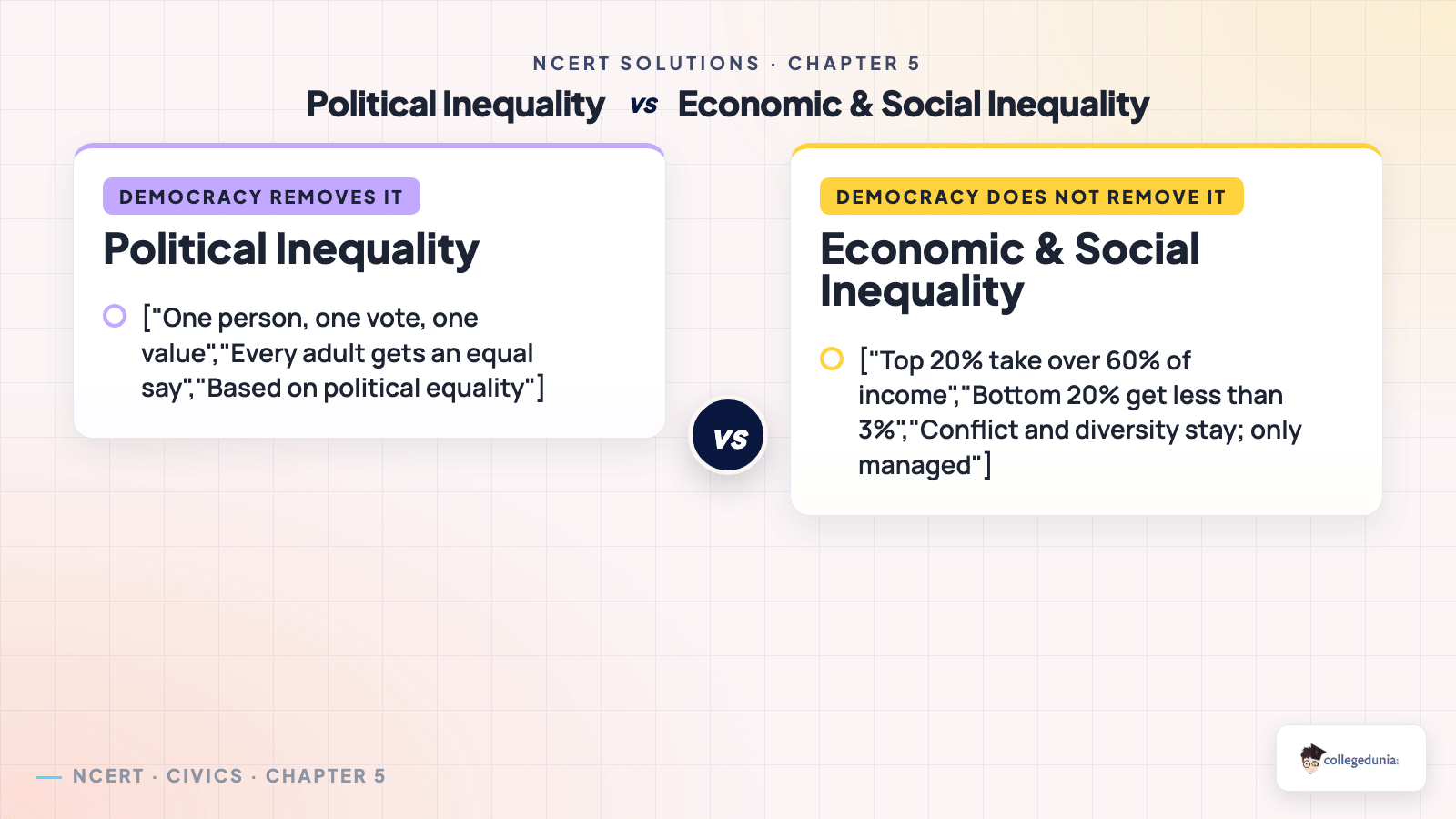
This is the part students mix up most. Democracy removes political inequality, where every adult gets one equal vote, but it does not remove economic and social inequality. In South Africa and Brazil the richest 20% take more than 60% of national income while the poorest 20% get less than 3%.
| Type of inequality | Does democracy remove it? | Why |
|---|---|---|
| Political inequality | Yes | One person, one vote, one value gives every citizen an equal say at the ballot box. |
| Economic inequality | No, only weakly | Large income gaps persist; the failure is one of political will, not an impossibility built into democracy. |
| Social inequality / diversity | Accommodates, not removes | Differences stay, but conflict is reduced when majorities shift and the majority shares power with the minority. |
Say clearly that democracy is based on political equality, yet economic and social inequalities remain. That honest contrast carries the mark.
Common Mistakes Students Make in this Class 10 Civics Chapter
A few slips lose easy marks every year. Fix these before the exam.
- Saying democracy removes all inequality. It removes only political inequality, not economic or social inequality.
- Picking majority rule as a value democracy must ensure. It is only a decision-procedure, so it is the odd one out.
- Treating the four assertions in Question 3 as fully right or fully wrong. Two of them, on inequality and on one-vote-one-value, are half-true.
- Confusing a challenge with a mechanism in Question 4. The challenge is the problem; the mechanism is the institutional cure.
How to Use the NCERT Solutions Class 10 Civics Chapter 5 Page
Use this page in three short blocks so revision stays focused.
- Read and list: read the NCERT chapter and note all five expected outcomes with democracy's record on each.
- Attempt first: answer all 8 questions on your own before opening the solutions.
- Compare and flag: match your answer with the step-by-step solution and mark the missing fact-lines.
For practice, write the five-outcomes answer and the "support or oppose" answer in full once. The class 10 outcomes of democracy ncert solutions set mirrors the board's 5-mark pattern.
Practice All NCERT Solutions for this Class 10 Civics Chapter with Step-by-Step Solutions
Open the question bank below to attempt all 8 solved questions with collapsible Solution and Expert Solution tabs. Every answer in this democratic politics 2 chapter 5 outcomes of democracy set is mapped to the NCERT text.
All Solved Questions for this Class 10 Civics Chapter
Practise every textbook and exercise question with step-by-step solutions and an expert version for board marks.
Class 10 Civics Other Resources for this Chapter
Pair these solutions with the other Class 10 Civics resources for the same chapter.
| Resource | Best used for | Link |
|---|---|---|
| NCERT Notes | Quick concept recap before the exam | Outcomes of Democracy Class 10 Notes |
| Handwritten Notes | Last-minute scanned revision | Outcomes of Democracy Class 10 Handwritten Notes |
| NCERT Book PDF | Reading the original chapter text | Outcomes of Democracy Class 10 Book PDF |
All Chapters NCERT Solutions for Class 10 Civics (Democratic Politics II)
Browse the full set of ncert solutions for class 10 civics chapter by chapter.
| Chapter | NCERT Solutions |
|---|---|
| Chapter 1: Power Sharing | Power Sharing Class 10 NCERT Solutions |
| Chapter 2: Federalism | Federalism Class 10 NCERT Solutions |
| Chapter 3: Gender, Religion and Caste | Gender, Religion and Caste Class 10 NCERT Solutions |
| Chapter 4: Political Parties | Political Parties Class 10 NCERT Solutions |
| Chapter 5: Outcomes of Democracy | Outcomes of Democracy Class 10 NCERT Solutions |
Student Feedback
Of 11,540 students polled before the 2026 boards, 69% found the difference between political, economic and social inequality the easiest point to confuse, while 62% said the "support or oppose" assertions in Question 3 were the hardest to argue in a balanced way. About 31% left the two conditions for accommodating social diversity for last in revision.
Source: 2026-27 Class 10 Civics student poll. Sample of 11,540 students from CBSE schools across 15 states.
Outcomes of Democracy Class 10 Civics NCERT Solutions FAQs
Ques. Where can I download the NCERT Solutions Class 10 Civics Chapter 5 Outcomes of Democracy PDF?
Ans. You can download the outcomes of democracy class 10 ncert solutions PDF directly from this page. Both the Normal and HD versions are free, with a Hindi-medium read too.
Ques. How many questions are solved in class 10 civics chapter 5 outcomes of democracy?
Ans. All 8 NCERT questions are solved, each with a step-by-step solution and an expert version for the long-answer marks, so you can revise the full exercise from one place.
Ques. Is this NCERT Solutions page aligned with the 2026-27 syllabus?
Ans. Yes. This page reflects the current 2026-27 syllabus for Class 10 Civics, and every answer is checked against the latest NCERT edition of Democratic Politics II.
Ques. What are the five expected outcomes of democracy in class 10 Civics?
Ans. The five expected outcomes are an accountable, responsive and legitimate government; economic growth and development; reduction of inequality and poverty; accommodation of social diversity; and the dignity and freedom of citizens. The ncert solutions class 10 civics chapter 5 Outcomes of Democracy set explains democracy's record on each.
Ques. Which idea has democracy successfully eliminated?
Ans. Democracy has successfully eliminated only the idea of political inequality, because of the principle of one person, one vote, one value. It has not eliminated conflicts, economic inequalities or differences of opinion, which are permanent features of any society.
Ques. What are the conditions for accommodating social diversity?
Ans. There are two conditions. First, the rule of the majority must not be the rule of one permanent religious, racial or linguistic group, so majorities should keep shifting from issue to issue. Second, the majority must work with and respect the minority, so that government reflects the general view rather than one community's dominance.
Ques. Does democracy reduce economic inequality?
Ans. Democracy has only a weak record on reducing economic inequality, and large income gaps persist even where everyone has an equal vote. But the failure is one of political will, not an impossibility, because equal political rights give the poor a tool to demand pro-poor policies.



Comments