




The NCERT Solutions for Class 10 Civics Chapter 3 Gender, Religion and Caste cover every textbook and exercise question, as per the latest 2026-27 CBSE syllabus.
Chapter3Gender,ReligionandCasteSolutions.pdf?page=1&dpi=150)
Chapter3Gender,ReligionandCasteSolutions.pdf?page=2&dpi=150)
Chapter3Gender,ReligionandCasteSolutions.pdf?page=3&dpi=150)
Chapter3Gender,ReligionandCasteSolutions.pdf?page=4&dpi=150)
Chapter3Gender,ReligionandCasteSolutions.pdf?page=5&dpi=150)
Chapter3Gender,ReligionandCasteSolutions.pdf?page=6&dpi=150)
Chapter3Gender,ReligionandCasteSolutions.pdf?page=7&dpi=150)
Chapter3Gender,ReligionandCasteSolutions.pdf?page=8&dpi=150)
Chapter3Gender,ReligionandCasteSolutions.pdf?page=9&dpi=150)
Chapter3Gender,ReligionandCasteSolutions.pdf?page=10&dpi=150)
Chapter3Gender,ReligionandCasteSolutions.pdf?page=11&dpi=150)
Chapter3Gender,ReligionandCasteSolutions.pdf?page=12&dpi=150)
Chapter3Gender,ReligionandCasteSolutions.pdf?page=13&dpi=150)
Chapter3Gender,ReligionandCasteSolutions.pdf?page=14&dpi=150)
Chapter3Gender,ReligionandCasteSolutions.pdf?page=15&dpi=150)
Chapter3Gender,ReligionandCasteSolutions.pdf?page=16&dpi=150)
Chapter3Gender,ReligionandCasteSolutions.pdf?page=17&dpi=150)
Chapter3Gender,ReligionandCasteSolutions.pdf?page=18&dpi=150)
Each answer names the definitions, data and thinkers the NCERT text uses, from the gender division and women's representation to communalism, the secular state and caste in politics.
- 12 NCERT questions solved, each in a step-by-step format that matches the board answer pattern.
- Gender, Religion and Caste is a frequent source of 3 and 5 mark questions in the Social Science board paper.
- Free PDF download in Normal and HD, plus a Hindi-medium read of every answer.
What This Class 10 Civics Chapter Covers for the Boards
This chapter explains how three social differences, gender, religion and caste, become social divisions and how each is expressed in politics. The ncert solutions class 10 civics chapter 3 Gender, Religion and Caste on this page keep every definition, figure and thinker you need for the exam.
- Gender and politics: the gender division is socially constructed, not biological, and patriarchy disadvantages women in education, work, safety and power.
- Women's representation: very low in the Lok Sabha and State assemblies, but strong locally where one-third of seats are reserved.
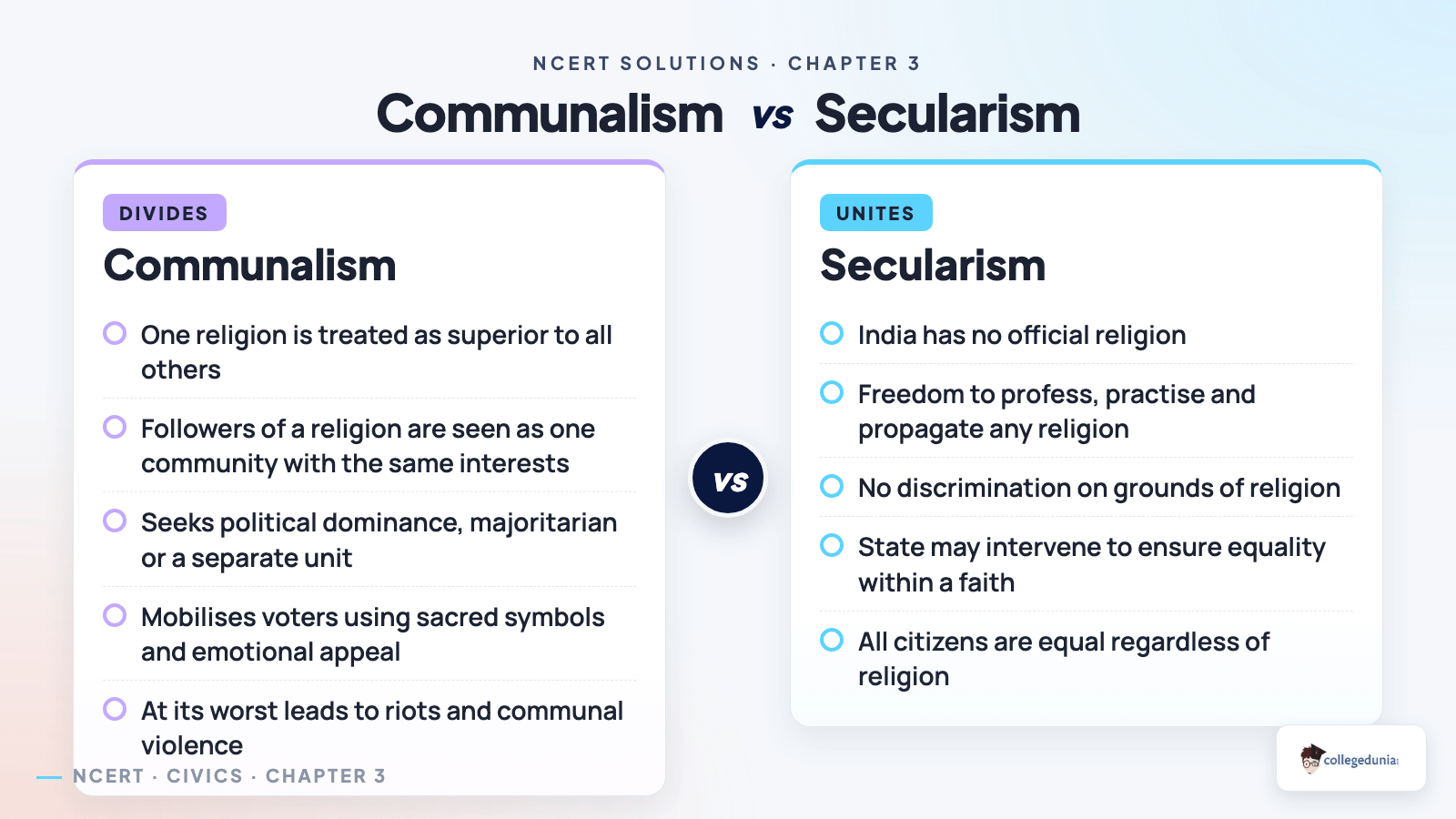
- Communalism: the belief that one religion is superior, expressed as prejudice, dominance, mobilisation and violence.
- The secular state: no official religion, freedom to profess any religion, no discrimination, and state intervention for equality.
- Caste and politics: caste division is peculiar to India and inequality survives, yet caste alone cannot decide elections.
- Key reformers: Jotiba Phule, Gandhiji, B.R. Ambedkar and Periyar Ramaswami Naicker.
One-Shot Revision of Gender, Religion and Caste for Class 10 Boards
Source: Magnet Brains on YouTube
Gender, Religion and Caste Class 10 Question Answer: Exercise Section
The exercise questions in class 10 civics chapter 3 gender religion and caste test both recall and comparison. The board often picks women's representation and the secular-state provisions for the 3 and 5 mark slots, and each answer rewards one clean fact-line per point.
| Question | What a full-mark answer must include |
|---|---|
| Aspects of life where women are discriminated | Education (54% female literacy versus 76% male), unpaid or under-paid work despite the Equal Remuneration Act 1976, the falling child sex ratio (about 919), unsafe homes, and low political representation. |
| Two constitutional provisions that make India secular | Any two of: no official religion; freedom to profess, practise and propagate any religion; no discrimination on grounds of religion; the state may intervene to ensure equality within religious communities. |
| Status of women's representation in legislative bodies | About 14% in the Lok Sabha (2019), under 5% in State assemblies, among the world's lowest, but one-third of local-body seats are reserved, giving over 10 lakh elected women. |
| Two reasons caste alone cannot decide elections | No constituency has a single-caste majority, so a winner needs many castes; and ruling parties and sitting legislators often lose, which caste-only voting could never allow. |
Tip: learn one figure or one provision per point; that single line of detail is usually worth a mark in the board scheme.
Gender, Religion and Caste Class 10 Important Questions: Long Answer Section
The long-answer questions carry the heavier marks. Each item in the gender religion and caste class 10 important questions set asks you to explain a process or list evidence, so aim for a concept line, labelled points and a one-line conclusion.
- Aspects of discrimination against women: education, work and wages, the girl child, safety, and political representation.
- Forms of communal politics: everyday prejudice, the quest for dominance, mobilisation on religious lines, and communal violence.
- How caste inequality continues: marriage within caste, lingering untouchability, and the caste-economic-status link.
- Constitutional provisions for a secular state: no official religion, freedom of religion, no discrimination, and state intervention for equality.
- Women's representation: low at the top, strong at the local tier because of the one-third reservation.
One-third of seats in local bodies are reserved for women under the 73rd and 74th Constitutional Amendments of 1992.
The Four Forms of Communal Politics Explained for Class 10
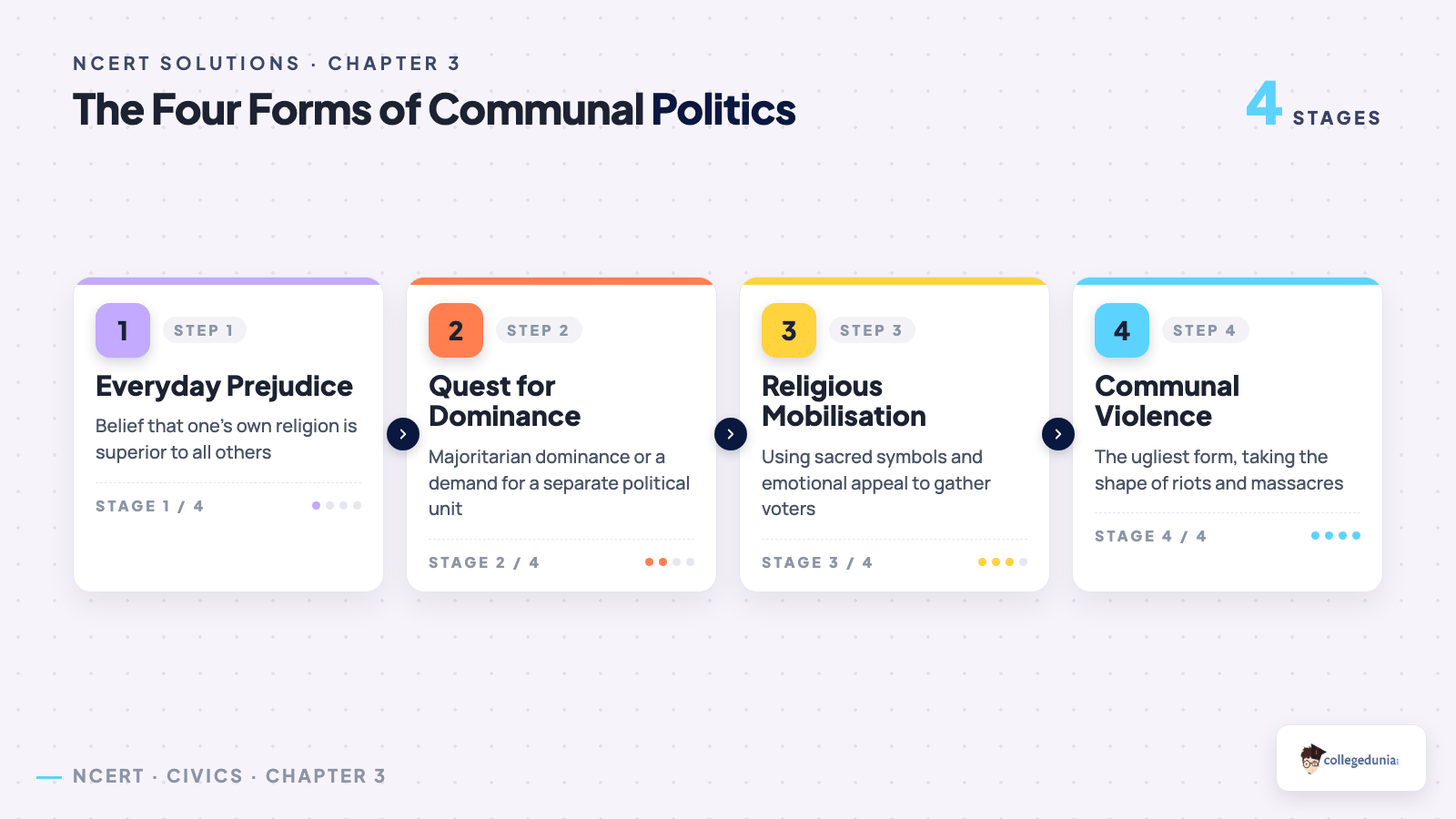
The forms of communalism are one of the most asked topics from this chapter. NCERT shows how communal thinking moves from the mind to the street, getting more dangerous at each step: prejudice, then dominance, then mobilisation, then violence.
| Form | What it means | One example |
|---|---|---|
| Everyday religious prejudice | The belief that one's own religion is superior to all others. | Routinely treating one's own religion as superior. |
| Quest for political dominance | Majoritarian dominance for a majority, or a separate political unit for a minority. | The demand for a separate nation on religious lines. |
| Political mobilisation | Using sacred symbols, religious leaders and emotional appeal in politics. | A special appeal to one religion's voters during elections. |
| Communal violence | The ugliest form, riots and massacres. | The large-scale riots at the time of Partition. |
Name each form with its example; that detail is usually worth a mark.
Caste and Politics in the Class 10 Civics Chapter
The board likes to test whether you can see both sides of caste in politics. Caste shapes elections because parties weigh caste composition, yet it alone cannot decide results, since no seat has a single-caste majority and incumbents often lose.
| How caste shapes politics | Why caste alone cannot decide elections |
|---|---|
| Parties weigh the caste composition of voters while choosing candidates. | No parliamentary constituency has a single caste with a clear majority. |
| People may feel close to a candidate of their own caste. | Each party fields one candidate, and rivals may share a caste, splitting the vote. |
| Caste appeals and caste-based parties exist in many states. | Ruling parties and sitting MPs and MLAs frequently lose elections. |
Say clearly that caste is one factor among many; that balance often carries the mark.
Common Mistakes Students Make in this Class 10 Civics Chapter
A few slips lose easy marks every year.
- Confusing biological sex with gender. A gender division is the unequal roles society assigns, not a biological difference.
- Writing that caste has disappeared. The old hierarchy is breaking down, but inequality survives in marriage, untouchability and the caste-wealth link.
- Treating secular ideas as communal in MCQs. Equal citizenship and limiting state power are secular beliefs.
- Saying seats are reserved for women in the Lok Sabha. Reservation exists only in Panchayati Raj bodies and Municipalities.
How to Use the NCERT Solutions Class 10 Civics Chapter 3 Page
Use this page in three short blocks so revision stays focused.
- Read and list: note every definition, figure and reformer in the chapter.
- Attempt first: answer all 12 questions before opening the solutions.
- Compare and flag: match your answer with the solution and mark missing fact-lines.
For practice, write the communalism-forms answer and the women's representation answer in full at least once. The gender religion and caste class 10 ncert solutions set mirrors the board's 5-mark pattern.
Practice All NCERT Solutions for this Class 10 Civics Chapter with Step-by-Step Solutions
Open the question bank below to attempt all 12 solved questions with collapsible Solution and Expert Solution tabs, every answer mapped to the NCERT text.
All Solved Questions for this Class 10 Civics Chapter
Practise every textbook and exercise question with step-by-step solutions and an expert version for board marks.
Class 10 Civics Other Resources for this Chapter
Pair these solutions with the other Class 10 Civics resources for the same chapter.
| Resource | Best used for |
|---|---|
| Gender, Religion and Caste Class 10 Notes | Quick concept recap before the exam |
| Gender, Religion and Caste Class 10 Handwritten Notes | Last-minute scanned revision |
| Gender, Religion and Caste Class 10 NCERT Book PDF | Reading the original chapter text |
All Chapters NCERT Solutions for Class 10 Civics (Democratic Politics II)
Browse the full set of ncert solutions for class 10 civics chapter by chapter.
| Chapter | NCERT Solutions |
|---|---|
| Chapter 1 | Power Sharing Class 10 NCERT Solutions |
| Chapter 2 | Federalism Class 10 NCERT Solutions |
| Chapter 3 | Gender, Religion and Caste Class 10 NCERT Solutions |
| Chapter 4 | Political Parties Class 10 NCERT Solutions |
| Chapter 5 | Outcomes of Democracy Class 10 NCERT Solutions |
Student Feedback
Out of 9,820 students polled before the 2026 boards, 66% rated the four forms of communal politics as the part they most often mixed up, and 59% said telling communalism apart from secularism was the contrast they found hardest to recall. The four constitutional provisions of a secular state were the most-skipped revision topic, left for last by about 33% of students.
Source: 2026-27 Class 10 Civics student poll. Sample of 9,820 students from CBSE schools across 14 states.
Gender, Religion and Caste Class 10 Civics NCERT Solutions FAQs
Ques. Where can I download the NCERT Solutions Class 10 Civics Chapter 3 Gender, Religion and Caste PDF?
Ans. You can download the gender religion and caste class 10 ncert solutions PDF directly from this page. Both the Normal and HD versions are free, and a Hindi-medium read is available too.
Ques. How many questions are solved in class 10 civics chapter 3 gender religion and caste?
Ans. All 12 NCERT questions are solved, each with a step-by-step solution and an expert version for the long-answer marks, so you can revise the full exercise from one place.
Ques. Is this NCERT Solutions page aligned with the 2026-27 syllabus?
Ans. Yes. This page reflects the current 2026-27 syllabus for Class 10 Civics, and every answer is checked against the latest NCERT edition of Democratic Politics II.
Ques. What is a gender division in class 10 Civics?
Ans. A gender division is the unequal set of roles that society assigns to men and women, based on expectations and stereotypes rather than on biology. It is socially constructed, not natural, which is why it can be changed through movements and laws. The ncert solutions class 10 civics chapter 3 Gender, Religion and Caste set explains every aspect in detail.
Ques. What makes India a secular state?
Ans. India is a secular state because it has no official religion, gives every person freedom to profess, practise and propagate any religion, prohibits discrimination on grounds of religion, and lets the state intervene to ensure equality within religious communities, for example by banning untouchability.
Ques. What is the status of women's representation in India's legislative bodies?
Ans. Women's representation is very low at the top, about 14 per cent in the Lok Sabha (2019) and under 5 per cent in State assemblies, among the world's lowest. It is far better at the local level, where one-third of seats are reserved for women, giving over 10 lakh elected women representatives.
Ques. Why can caste alone not decide election results in India?
Ans. No constituency has a single caste with a clear majority, so a winner must gain the trust of many castes. Each party also fields one candidate per seat, rivals may share a caste, and ruling parties and sitting legislators often lose, all of which would be impossible if caste alone decided outcomes.



Comments