


The NCERT Solutions for Class 10 Civics Chapter 4 Political Parties cover every textbook and exercise question, according to the latest 2026-27 CBSE syllabus.
Chapter4PoliticalPartiesSolutions.pdf?page=1&dpi=150)
Chapter4PoliticalPartiesSolutions.pdf?page=2&dpi=150)
Chapter4PoliticalPartiesSolutions.pdf?page=3&dpi=150)
Chapter4PoliticalPartiesSolutions.pdf?page=4&dpi=150)
Chapter4PoliticalPartiesSolutions.pdf?page=5&dpi=150)
Chapter4PoliticalPartiesSolutions.pdf?page=6&dpi=150)
Chapter4PoliticalPartiesSolutions.pdf?page=7&dpi=150)
Chapter4PoliticalPartiesSolutions.pdf?page=8&dpi=150)
Chapter4PoliticalPartiesSolutions.pdf?page=9&dpi=150)
Chapter4PoliticalPartiesSolutions.pdf?page=10&dpi=150)
Chapter4PoliticalPartiesSolutions.pdf?page=11&dpi=150)
Chapter4PoliticalPartiesSolutions.pdf?page=12&dpi=150)
Chapter4PoliticalPartiesSolutions.pdf?page=13&dpi=150)
Chapter4PoliticalPartiesSolutions.pdf?page=14&dpi=150)
Chapter4PoliticalPartiesSolutions.pdf?page=15&dpi=150)
Chapter4PoliticalPartiesSolutions.pdf?page=16&dpi=150)
Chapter4PoliticalPartiesSolutions.pdf?page=17&dpi=150)
Chapter4PoliticalPartiesSolutions.pdf?page=18&dpi=150)
Each answer names the functions, party systems, challenges and reforms the NCERT text uses.
- 12 NCERT questions solved, each with a clear step-by-step format that matches the board answer pattern.
- Political Parties is a frequent source of 3 and 5 mark questions in the Class 10 Social Science board paper.
- Free PDF download in Normal and HD, plus a Hindi-medium read.
What This Class 10 Civics Chapter Covers for the Boards
This chapter explains why a democracy needs parties, the work they do between elections, and the problems that weaken them. The ncert solutions class 10 civics chapter 4 Political Parties on this page keep every function, challenge and reform you need for the exam.
- What is a political party: a group that contests elections to hold power, with three components, the leaders, the active members and the followers.
- Functions of parties: contest elections, offer policies, make laws, run governments, form the opposition, shape opinion and give access to schemes.
- Party systems: one-party, two-party and multi-party, by how many parties can really win and form a government.
- Four challenges: lack of internal democracy, dynastic succession, money and muscle power, and no meaningful choice for voters.
- Reforms to strengthen parties: the anti-defection law, affidavits on assets and criminal cases, ECI orders, a women's quota and state funding.
One-Shot Revision of Political Parties for Class 10 Boards
Source: Magnet Brains on YouTube
Political Parties Class 10 Question Answer: Exercise Section
The exercise questions in class 10 civics chapter 4 political parties test short recall and clear comparison. The board often picks the functions of parties and the four challenges for 3 and 5 mark slots, and each political parties class 10 question answer rewards one clean fact-line per point.
| Question | What a full-mark answer must include |
|---|---|
| State the functions political parties perform in a democracy | Any five to seven of: contest elections; put forward policies and programmes; make laws; form and run governments; form the opposition; shape public opinion; provide access to government and welfare schemes. |
| What is a political party | A group of people who come together to contest elections and hold power in the government, agreeing on policies and programmes meant to promote the collective good of society. |
| What are the challenges faced by political parties | Four challenges: lack of internal democracy, dynastic succession, the growing role of money and muscle power, and no meaningful choice for voters. |
| Match the party with its alliance or category | Congress to United Progressive Alliance, BJP to National Democratic Alliance, CPI(M) to Left Front, and the Telugu Desam Party to State party, giving the code 1-C, 2-A, 3-D, 4-B. |
Tip: learn one function or one challenge per point. That single line of detail is usually worth one mark each in the board scheme.
Political Parties Class 10 Important Questions: Long Answer Section
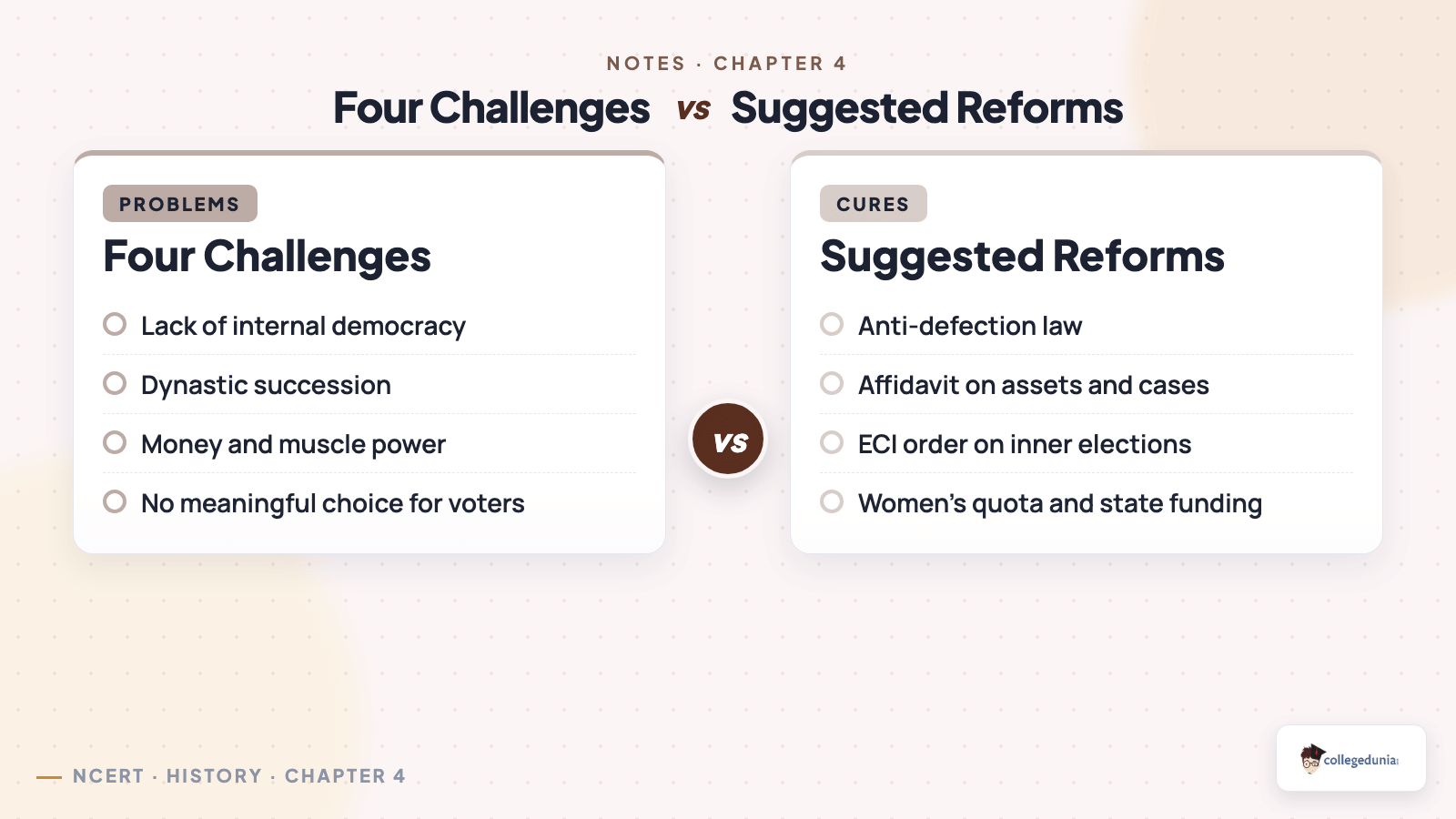
The long-answer questions carry the heavier marks. Each item in the political parties class 10 important questions set asks you to explain a process or suggest a cure.
- The seven functions of parties: from contesting elections to giving citizens access to government schemes.
- The four challenges: no inner democracy, dynastic succession, money and muscle power, and no real choice for voters.
- Reforms to strengthen parties: the anti-defection law, the affidavit on assets and criminal cases, ECI orders, a women's quota and state funding.
- Why we need parties: without them every candidate would be independent, and no one could be held responsible for running the country.
Memorise that the cure for the four challenges is the anti-defection law, affidavit rule, ECI orders, women's quota and state funding.
The Seven Functions of Political Parties Explained for Class 10
The functions of parties are one of the most asked topics from this chapter. A strong answer groups the functions by the stage at which the party acts. A neat memory line is C-P-L-G-O-S-A, for Contest, Policies, Laws, Government, Opposition, Shape opinion and Access.
| Function | What the party does |
|---|---|
| Contest elections | Put up candidates and fight elections; in India candidates are usually chosen by the top leaders of each party. |
| Put forward policies | Offer a set of policies and programmes, so voters can choose, and reduce many opinions into a few basic positions. |
| Make laws | Laws are debated and passed in the legislature, with members usually voting the way their party directs. |
| Form and run governments | The party or alliance with a majority forms the government, appoints ministers and takes big decisions. |
| Play the opposition | Losing parties form the opposition, criticise the government and mobilise people against wrong policies. |
| Shape and access | Raise and highlight issues to shape opinion, and act as a channel between citizens and government schemes. |
For any answer on this topic, name five to seven functions with one line each and group them by stage.
One-Party, Two-Party and Multi-Party Systems
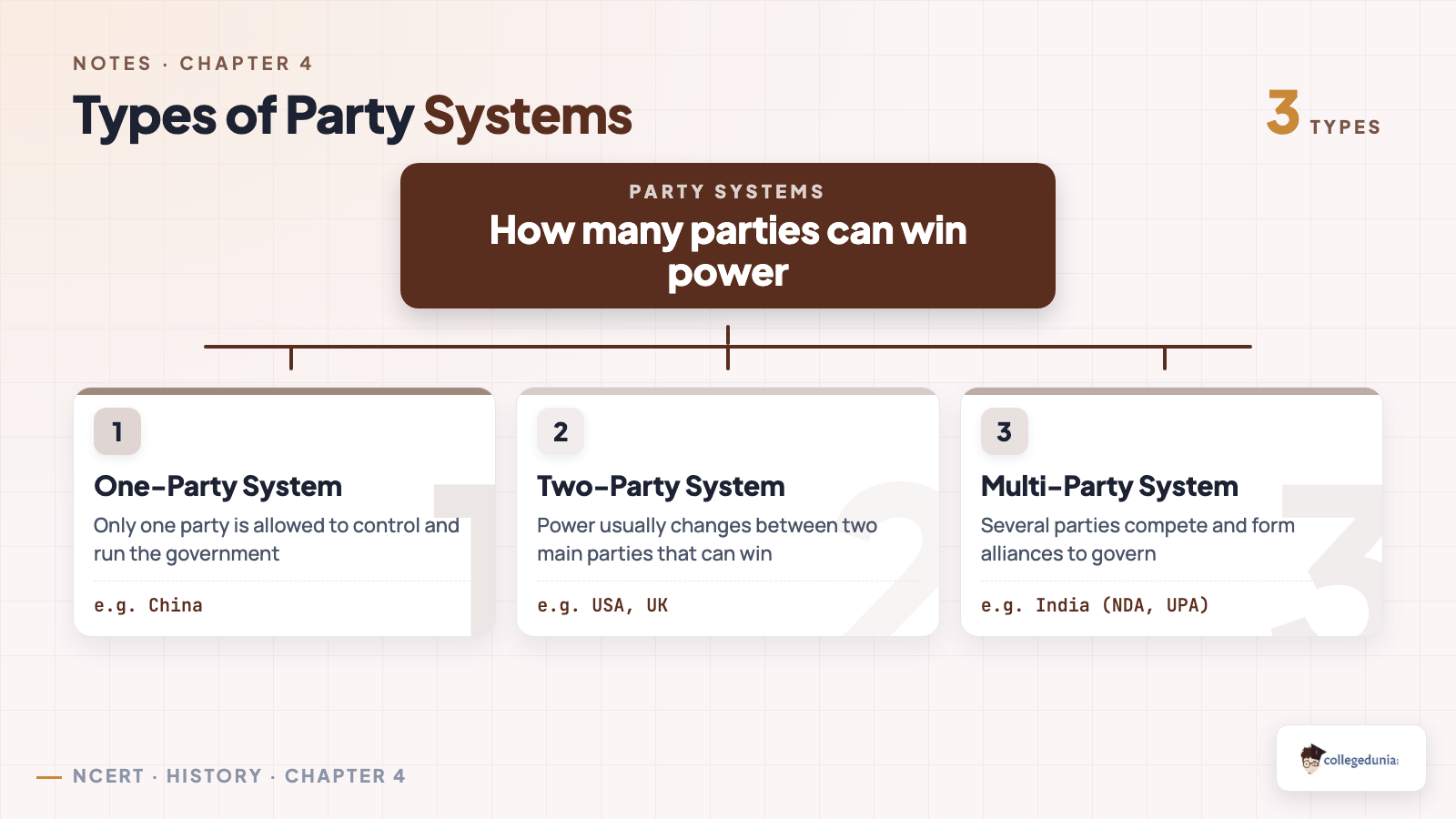
India belongs to the multi-party type, and the board likes to test whether you can tell the three systems apart. In a one-party system only one party is allowed to run the government; in a two-party system power changes between two main parties; and in a multi-party system several parties compete.
| Type | Examples | Key idea |
|---|---|---|
| One-party | China | Only one party is allowed to control and run the government. |
| Two-party | United States, United Kingdom | Power usually changes between two main parties that have a real chance to win. |
| Multi-party | India | Several parties compete, and they often join hands as an alliance, such as the NDA, UPA or Left Front, to form the government. |
Say clearly in your answer that India has a multi-party system, where parties form alliances to run the government.
Common Mistakes Students Make in this Class 10 Civics Chapter
A few slips lose easy marks every year.
- Confusing the challenges with the reforms: the challenges are the problems, the reforms are the cures.
- Naming Ambedkar or Phule as the founder of the Bahujan Samaj Party. The founder is Kanshi Ram.
- Calling a pressure group a political party. Only a party contests elections to hold power.
- Saying India has a two-party system. India has a multi-party system.
How to Use the NCERT Solutions Class 10 Civics Chapter 4 Page
Use this page in three short blocks so revision stays focused.
- Read and list: note every function, challenge and reform.
- Attempt first: answer all 12 questions before opening the solutions.
- Compare and flag: match your answer and mark the missing fact-lines.
For long-answer practice, write the seven functions answer and the challenges-and-reforms answer in full at least once. The class 10 political parties ncert solutions set mirrors the board's 5-mark pattern.
Practice All NCERT Solutions for this Class 10 Civics Chapter with Step-by-Step Solutions
Open the question bank below to attempt all 12 solved questions with collapsible Solution and Expert Solution tabs. Every answer in this democratic politics 2 chapter 4 political parties set is mapped to the NCERT text.
All Solved Questions for this Class 10 Civics Chapter
Practise every question with step-by-step solutions and an expert version for board marks.
Class 10 Civics Other Resources for this Chapter
Pair these solutions with the other Class 10 Civics resources for the same chapter.
| Resource | Best used for | Link |
|---|---|---|
| NCERT Notes | Quick concept recap before the exam | Political Parties Class 10 Notes |
| Handwritten Notes | Last-minute scanned revision | Political Parties Class 10 Handwritten Notes |
| NCERT Book PDF | Reading the original chapter text | Political Parties Class 10 Book PDF |
All Chapters NCERT Solutions for Class 10 Civics (Democratic Politics II)
Browse the full set of ncert solutions for class 10 civics chapter by chapter.
| Chapter | NCERT Solutions |
|---|---|
| Chapter 1: Power Sharing | Power Sharing Class 10 NCERT Solutions |
| Chapter 2: Federalism | Federalism Class 10 NCERT Solutions |
| Chapter 3: Gender, Religion and Caste | Gender, Religion and Caste Class 10 NCERT Solutions |
| Chapter 4: Political Parties | Political Parties Class 10 NCERT Solutions |
| Chapter 5: Outcomes of Democracy | Outcomes of Democracy Class 10 NCERT Solutions |
Student Feedback
In a poll before the 2026 boards, 71% of students mixed up the four challenges with the reforms under exam pressure, and 64% found the one-party, two-party and multi-party comparison the hardest to recall with the right examples. About 33% of students left the suggested reforms, such as the anti-defection law and the women's quota, for last in revision.
Source: 2026-27 Class 10 Civics student poll. Sample of 10,280 students from CBSE schools across 14 states.
Political Parties Class 10 Civics NCERT Solutions FAQs
Ques. Where can I download the NCERT Solutions Class 10 Civics Chapter 4 Political Parties PDF?
Ans. You can download the political parties class 10 ncert solutions PDF directly from this page. Both the Normal and HD versions are free, and a Hindi-medium read is available too.
Ques. How many questions are solved in class 10 civics chapter 4 political parties?
Ans. All 12 NCERT questions are solved, each with a step-by-step solution and an expert version for the long-answer marks, so you can revise the full exercise from one place.
Ques. Is this NCERT Solutions page aligned with the 2026-27 syllabus?
Ans. Yes. This page reflects the current 2026-27 syllabus for Class 10 Civics, and every answer is checked against the latest NCERT edition of Democratic Politics II.
Ques. What is a political party in class 10 Civics?
Ans. A political party is a group of people who come together to contest elections and hold power in the government. Its members agree on some policies and programmes meant to promote the collective good of society. The ncert solutions class 10 civics chapter 4 Political Parties set explains every component in detail.
Ques. What are the functions of political parties?
Ans. Parties contest elections, put forward policies and programmes, make laws, form and run governments, form the opposition, shape public opinion, and give citizens access to government schemes. A safe answer names five to seven of these with one line each.
Ques. What are the four challenges faced by political parties?
Ans. The four challenges are the lack of internal democracy, dynastic succession, the growing role of money and muscle power, and no meaningful choice for voters. The reforms set out in the chapter, such as the anti-defection law and a women's quota, are the cures for these problems.
Ques. Why does India have a multi-party system?
Ans. India has a multi-party system because its social and regional diversity means many parties win seats and no single party usually wins on its own. As a result several parties form alliances, such as the NDA, UPA or Left Front, to put together a majority and run the government together.



Comments