




The class 11 chemistry NCERT solutions chapter 1 Some Basic Concepts of Chemistry cover every intext and back-exercise question, according to the latest 2026-27 CBSE syllabus, and help students prepare for the CBSE Boards, JEE Main, JEE Advanced, NEET and CUET. Each answer is worked step by step, from the laws of chemical combination to the mole concept and stoichiometry that the whole of Class 11 Chemistry is built on.
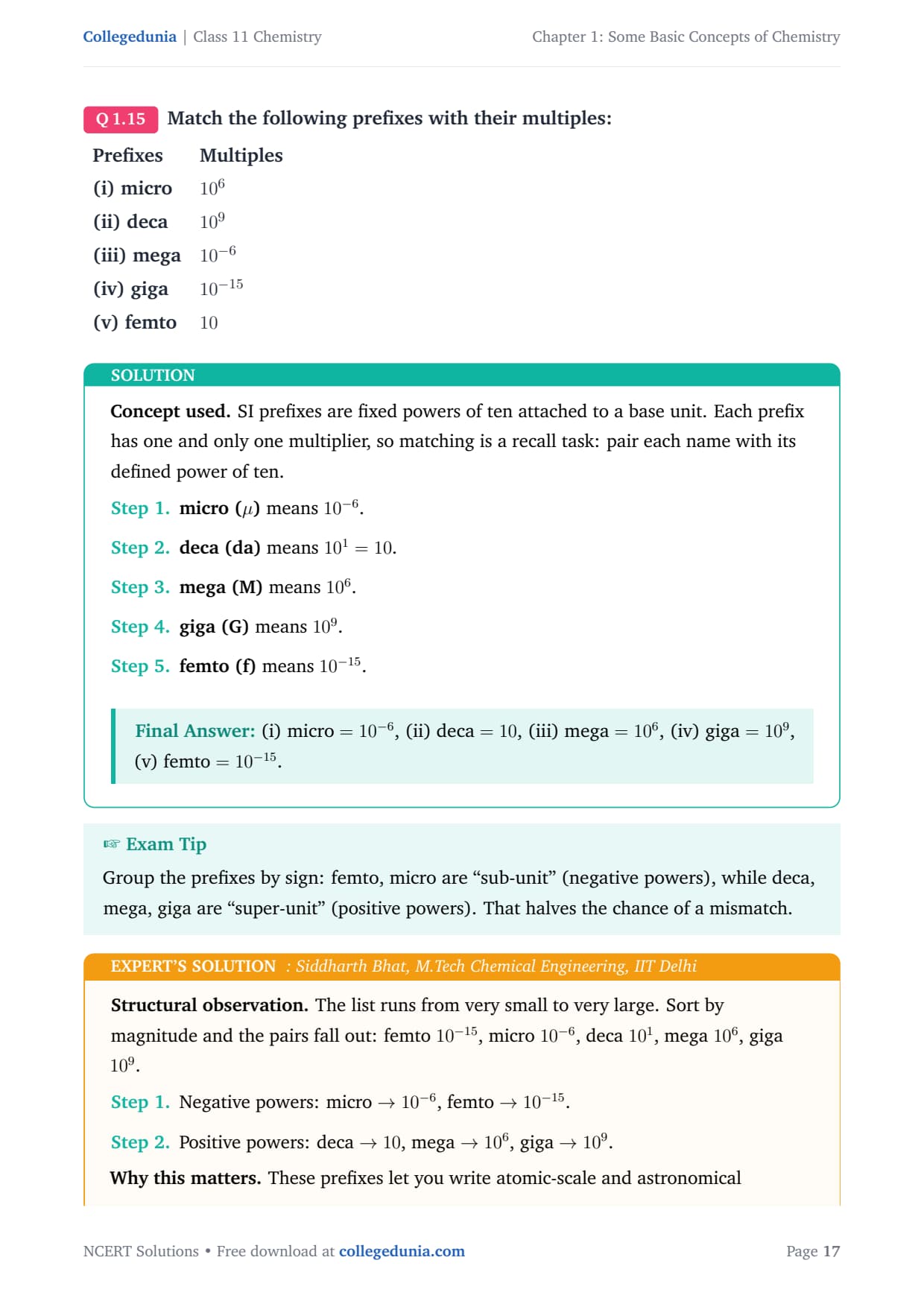
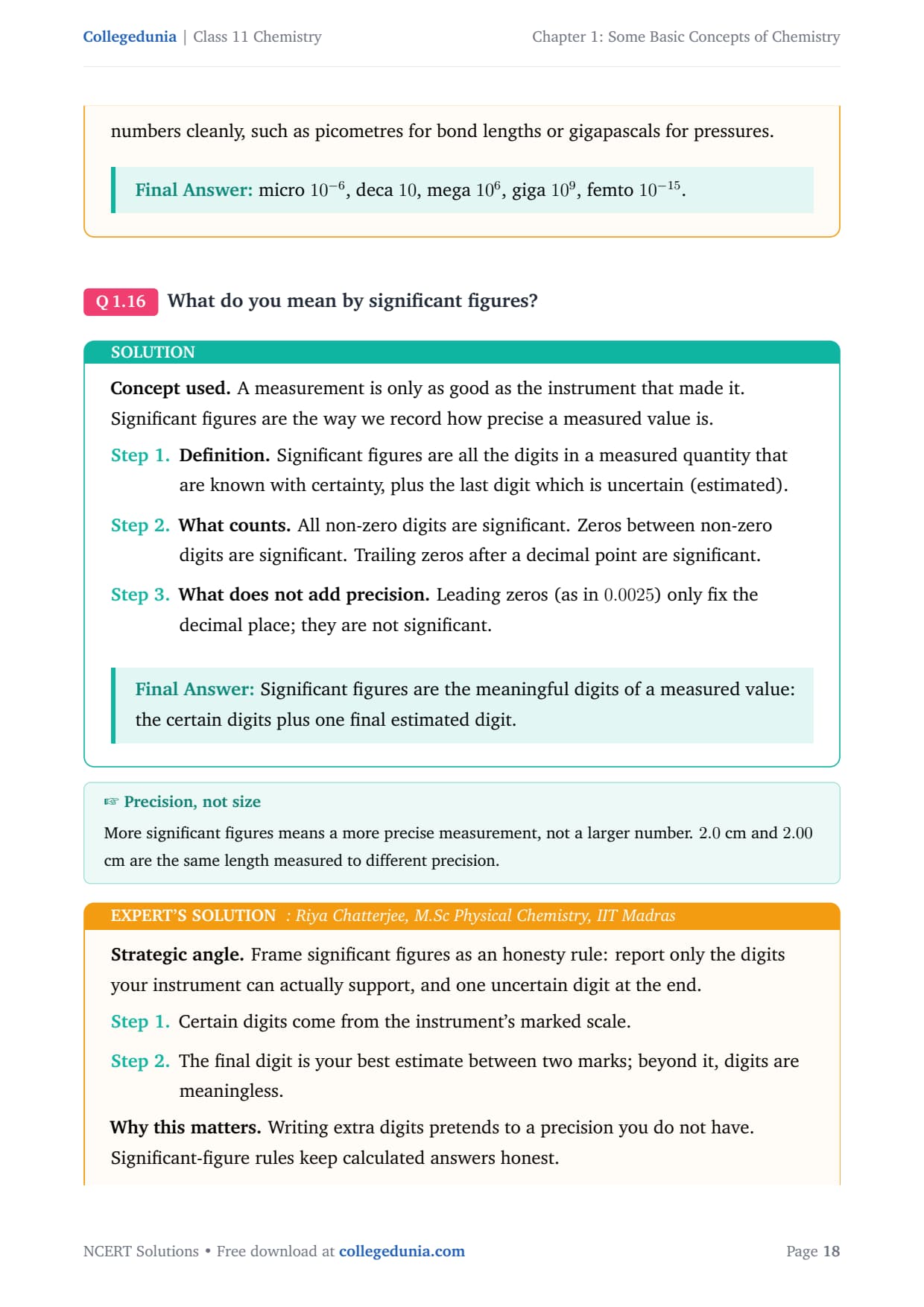
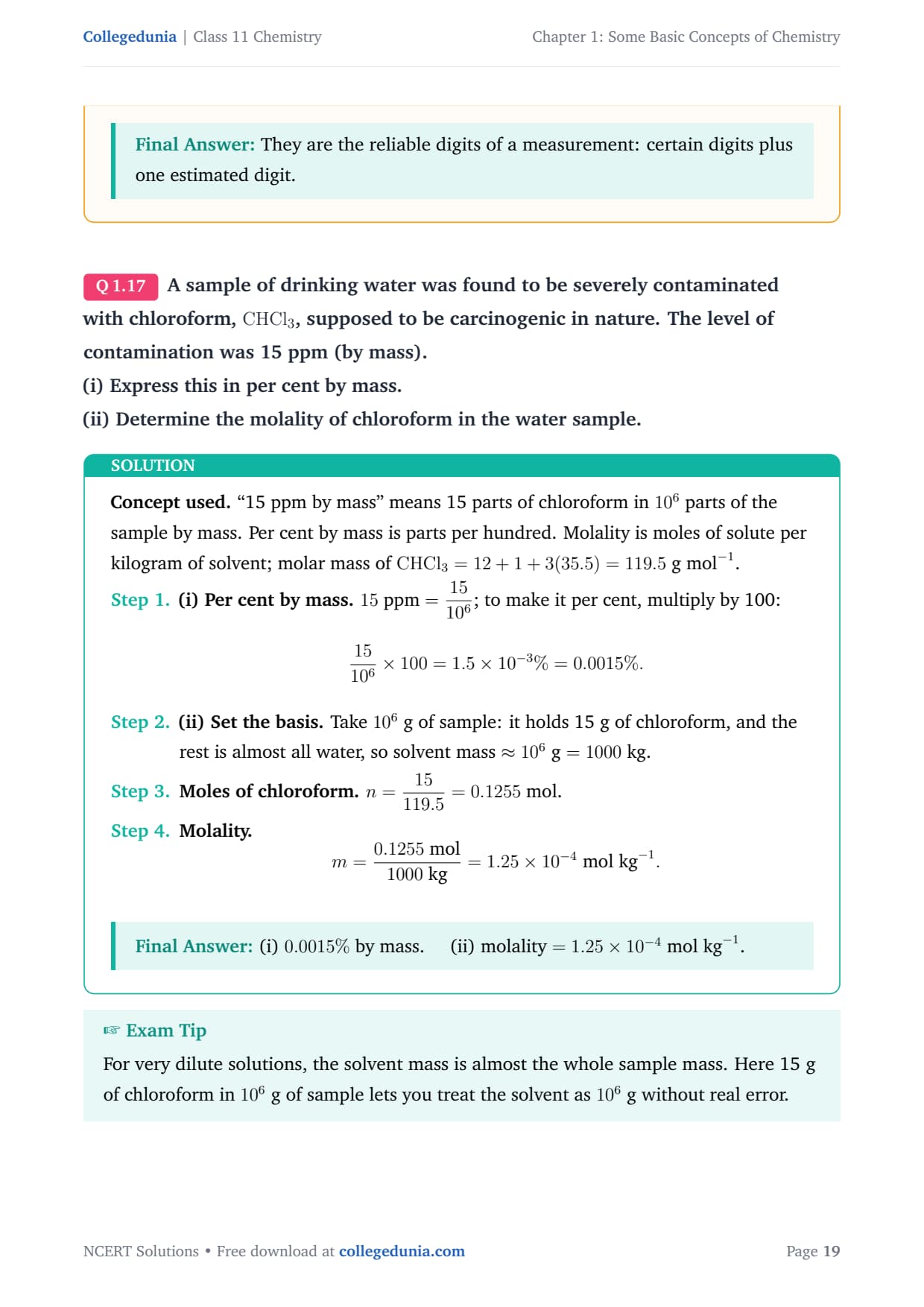
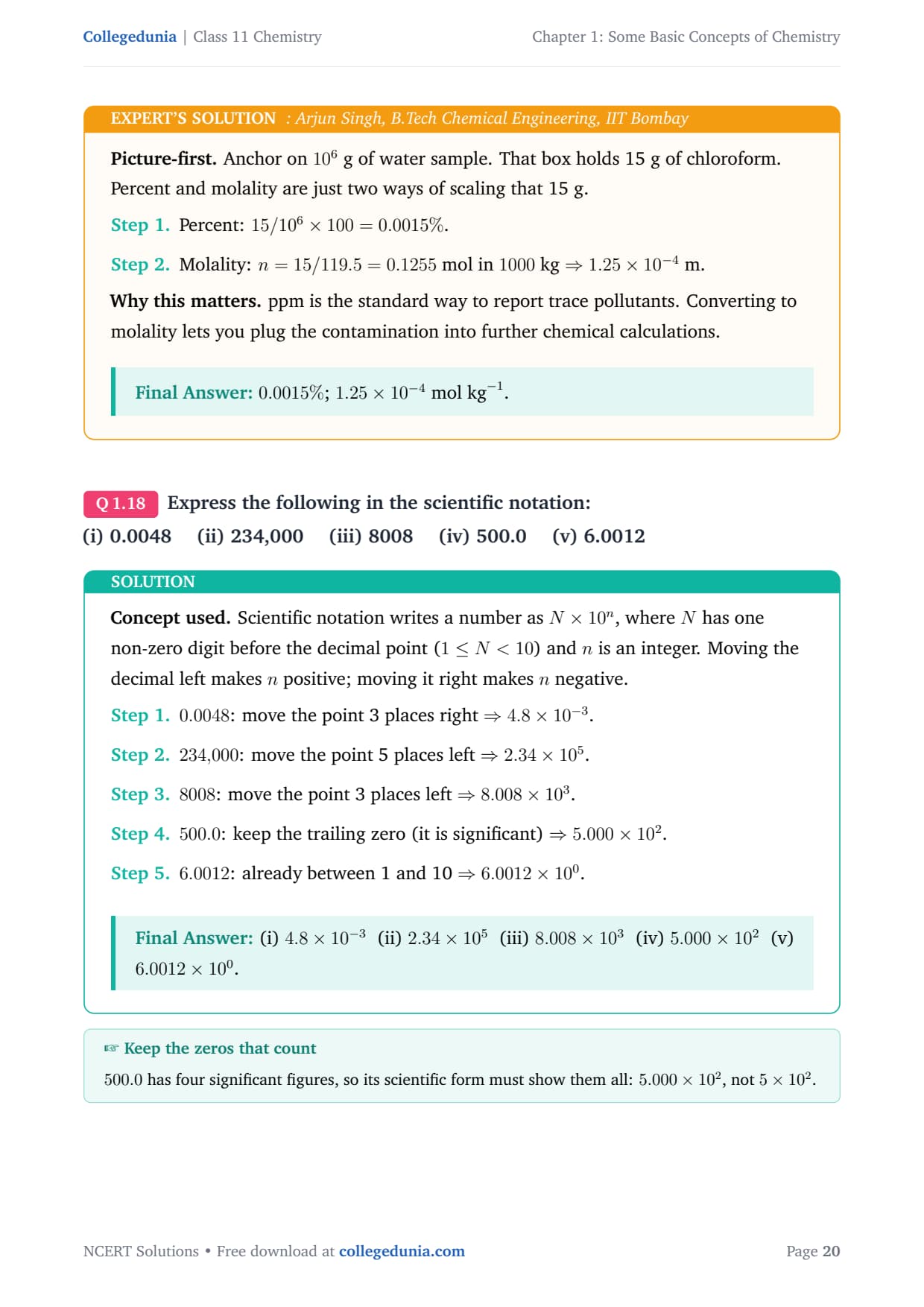
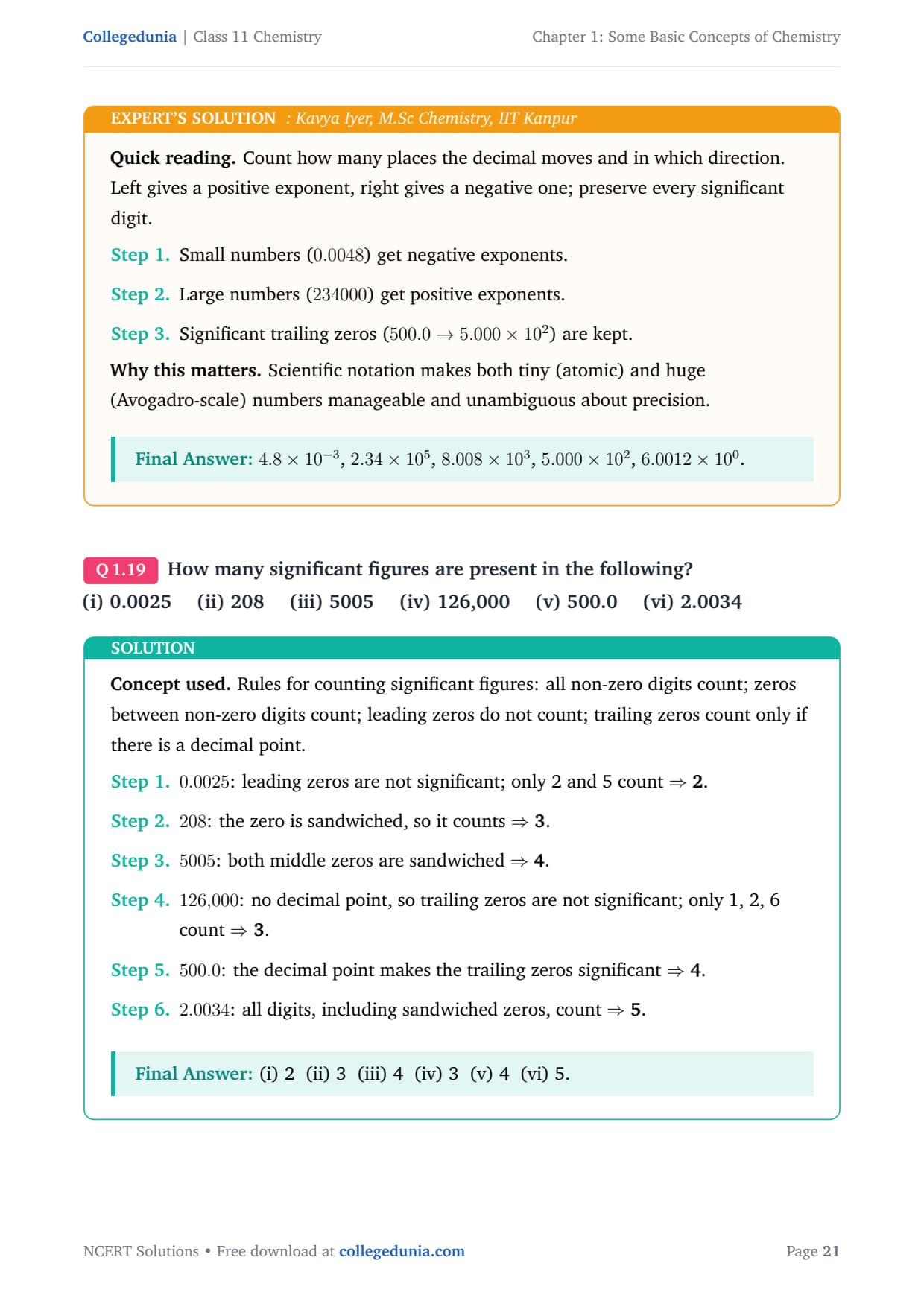
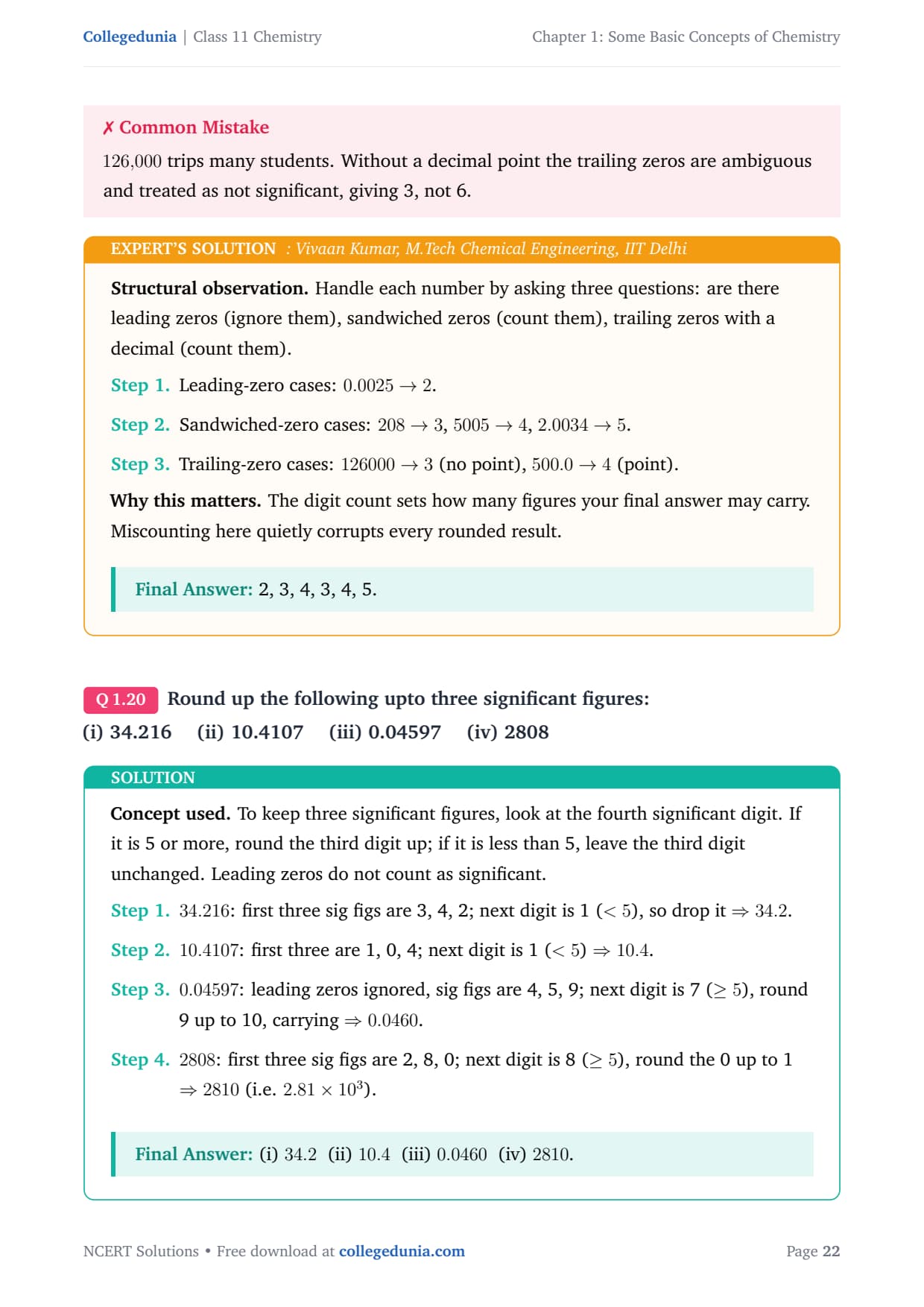
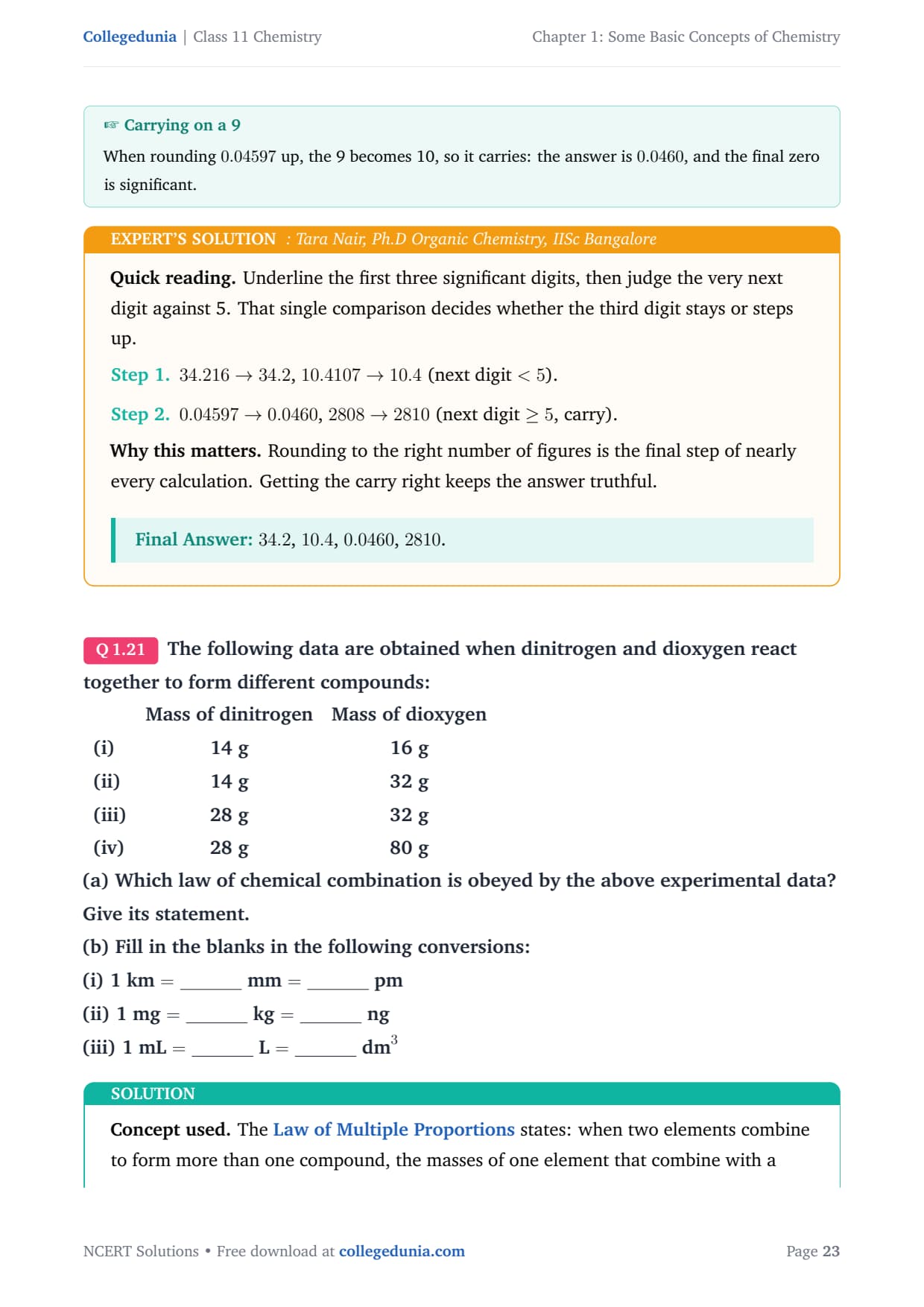
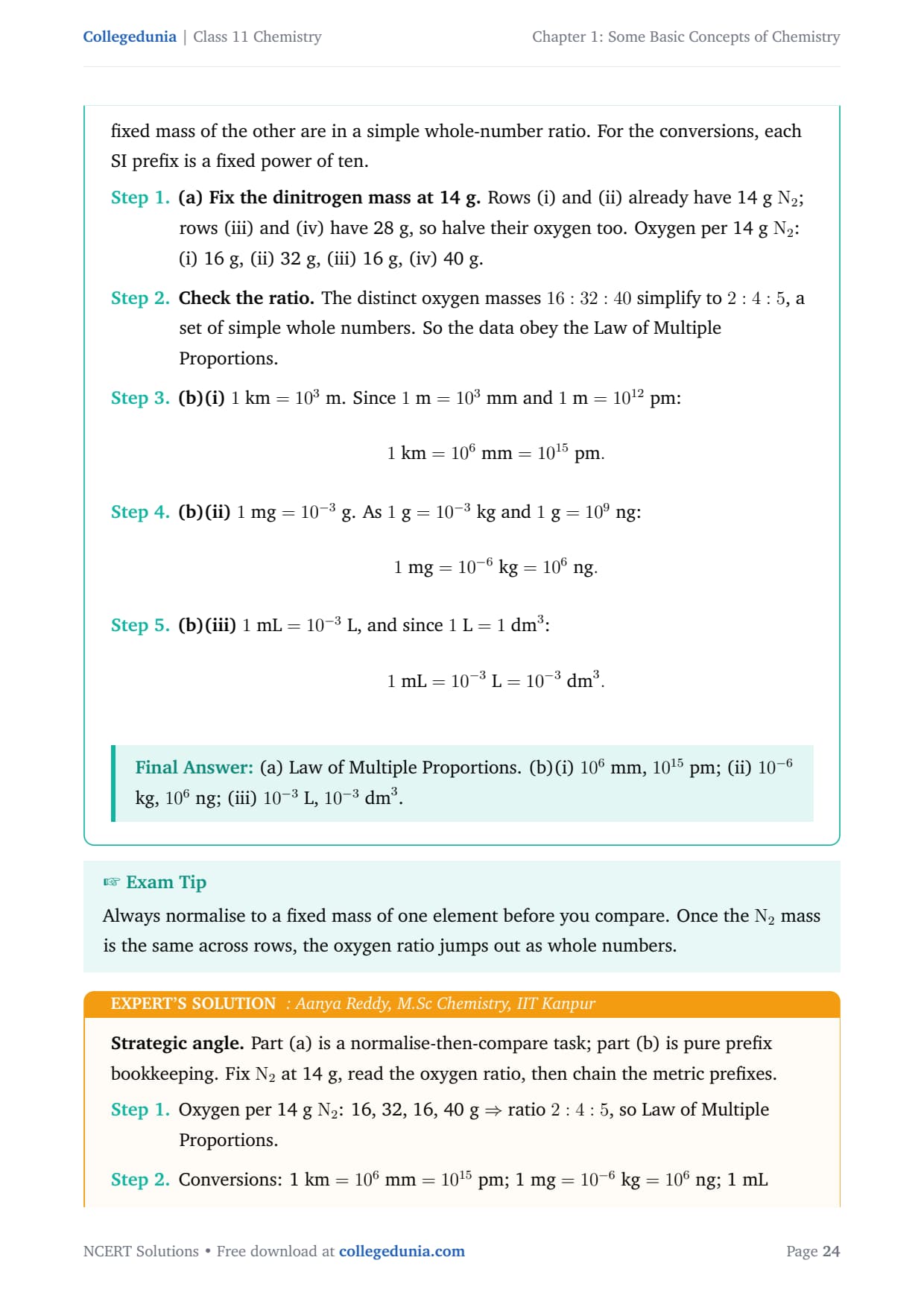
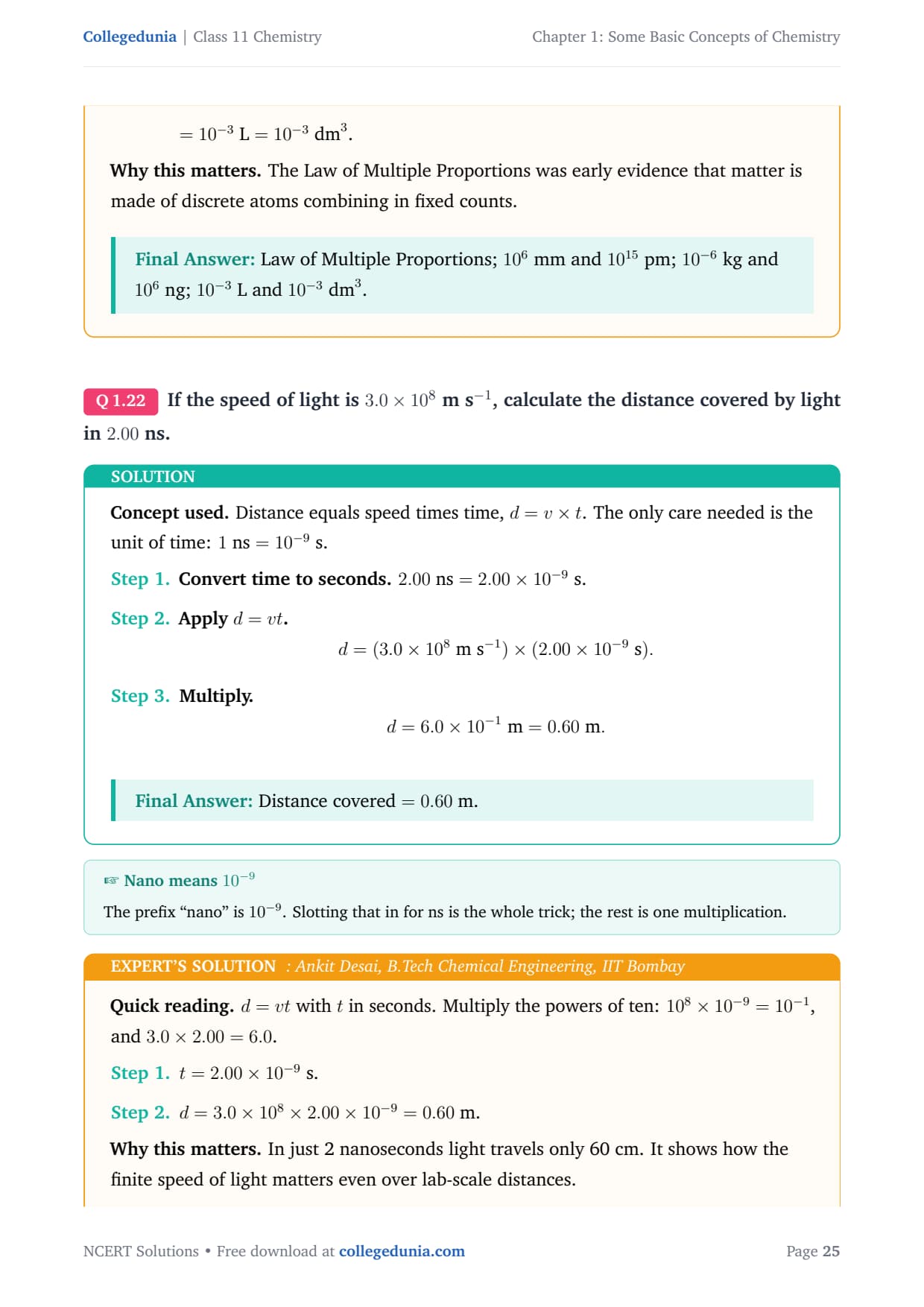
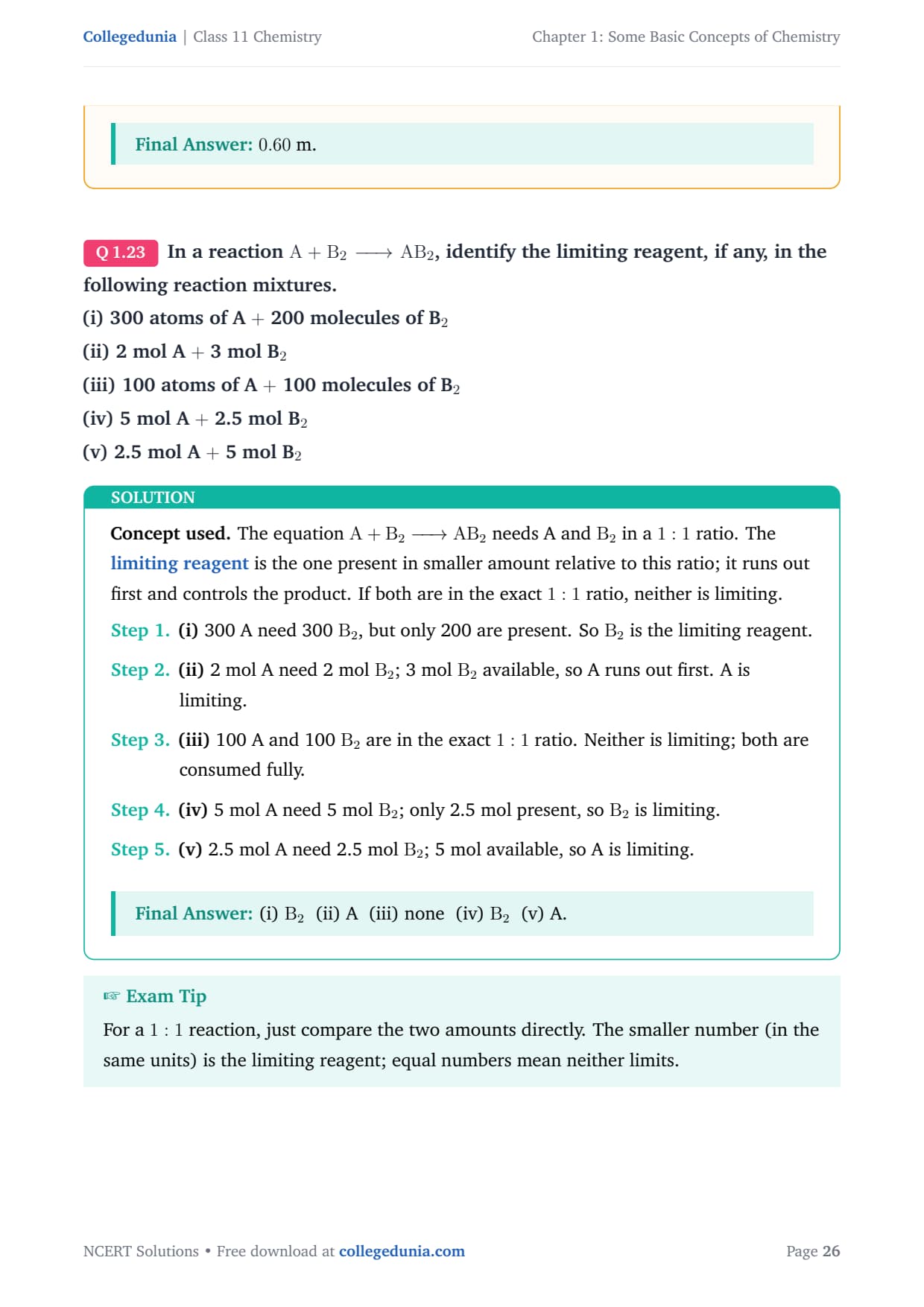
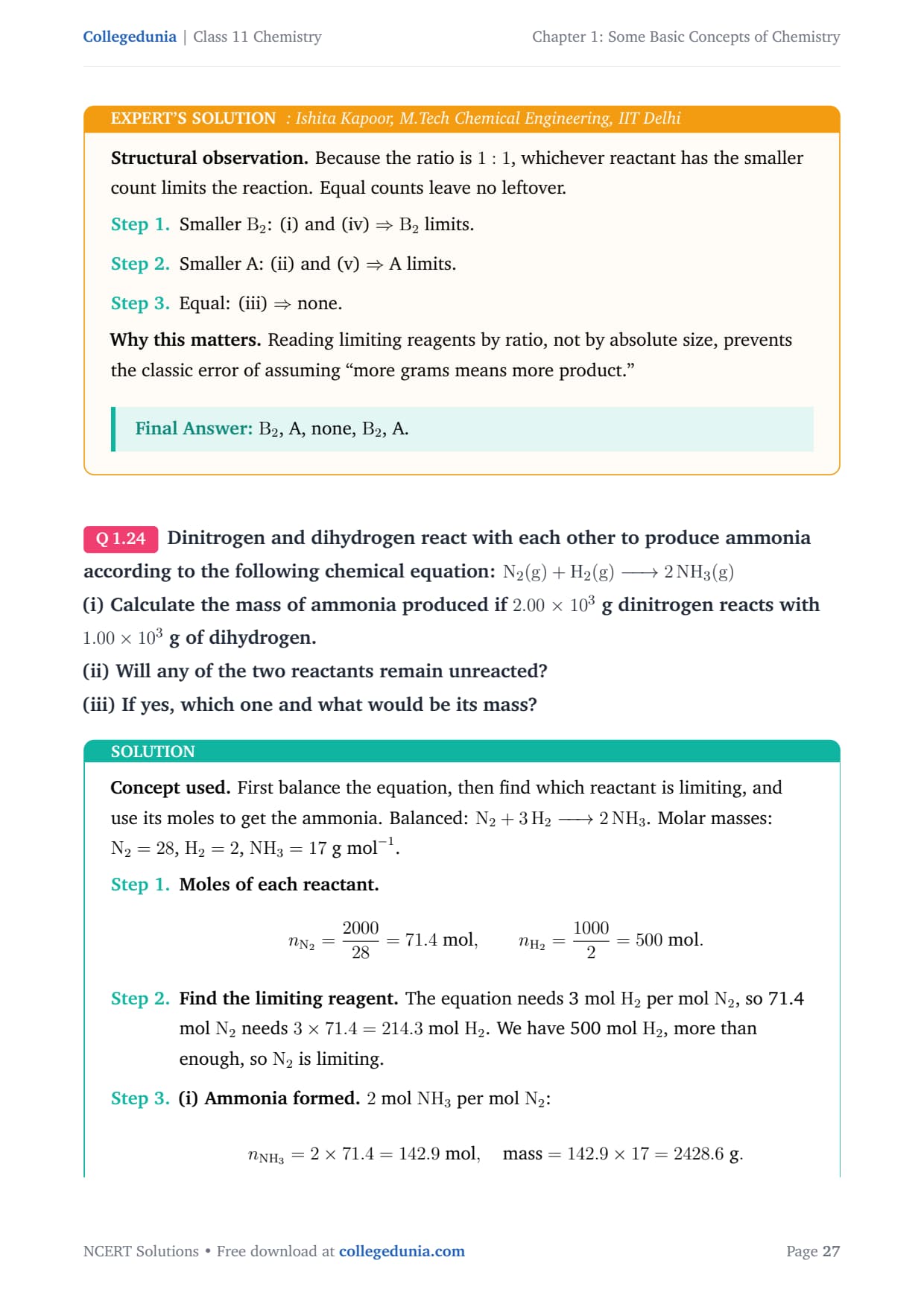
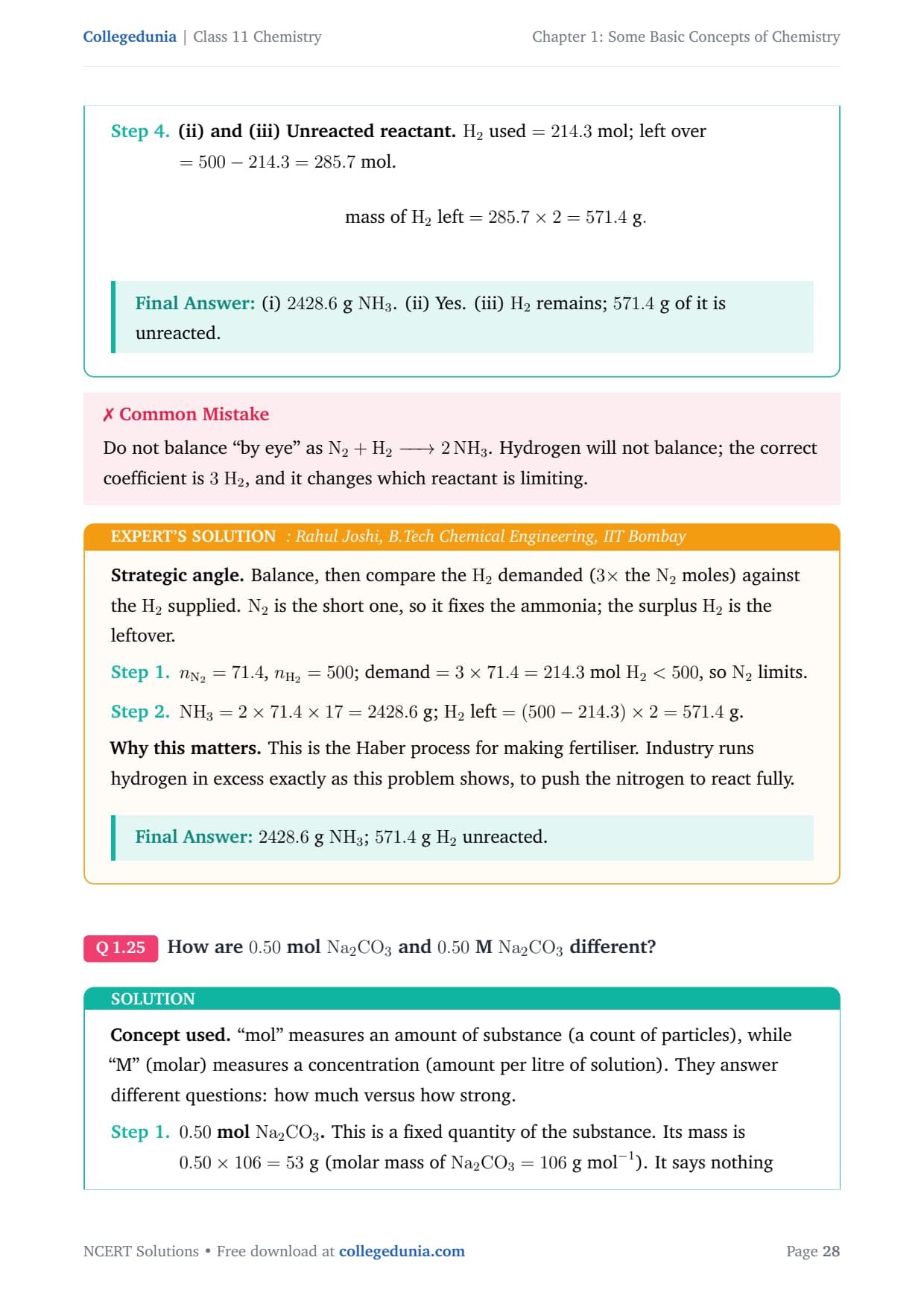
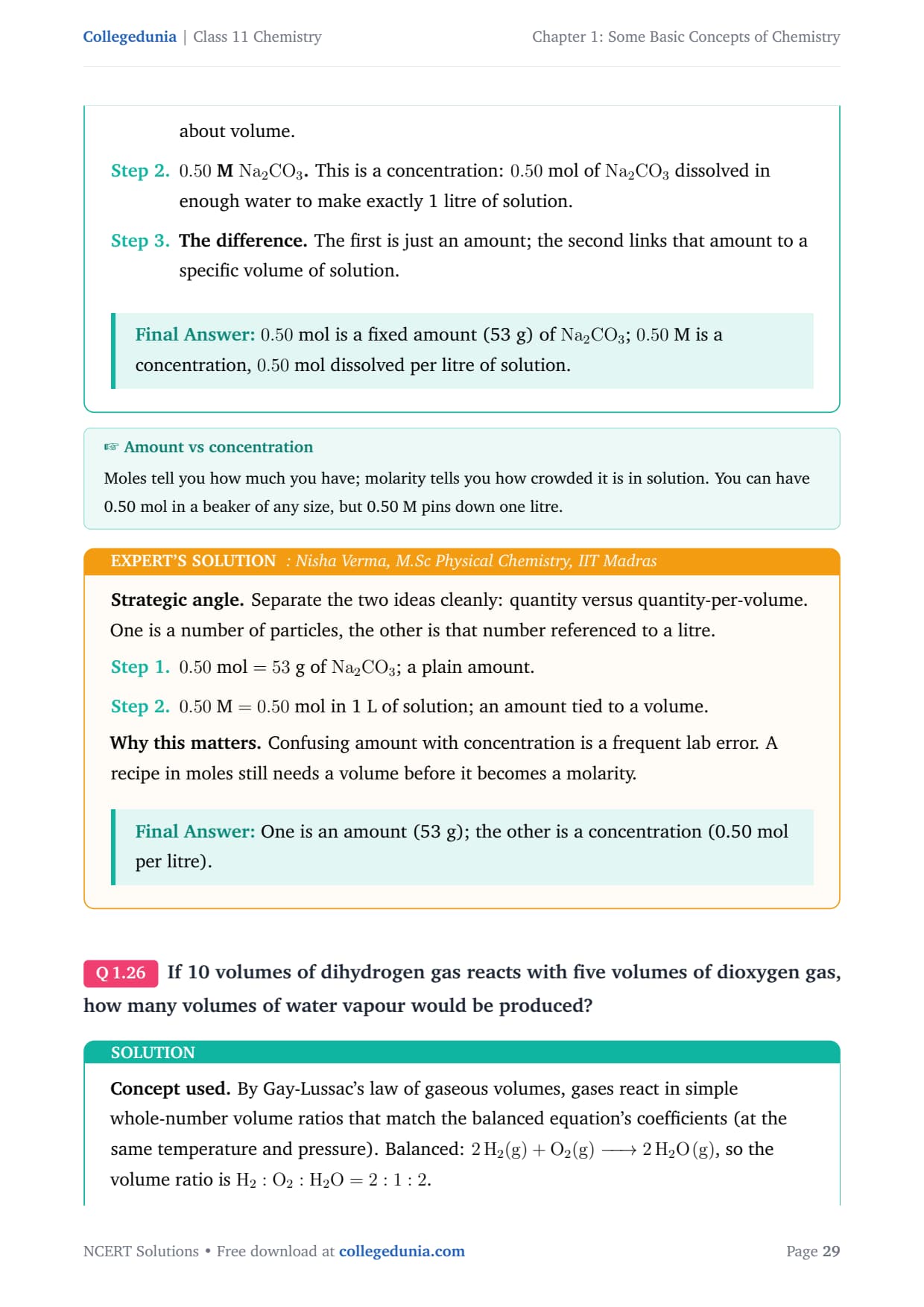
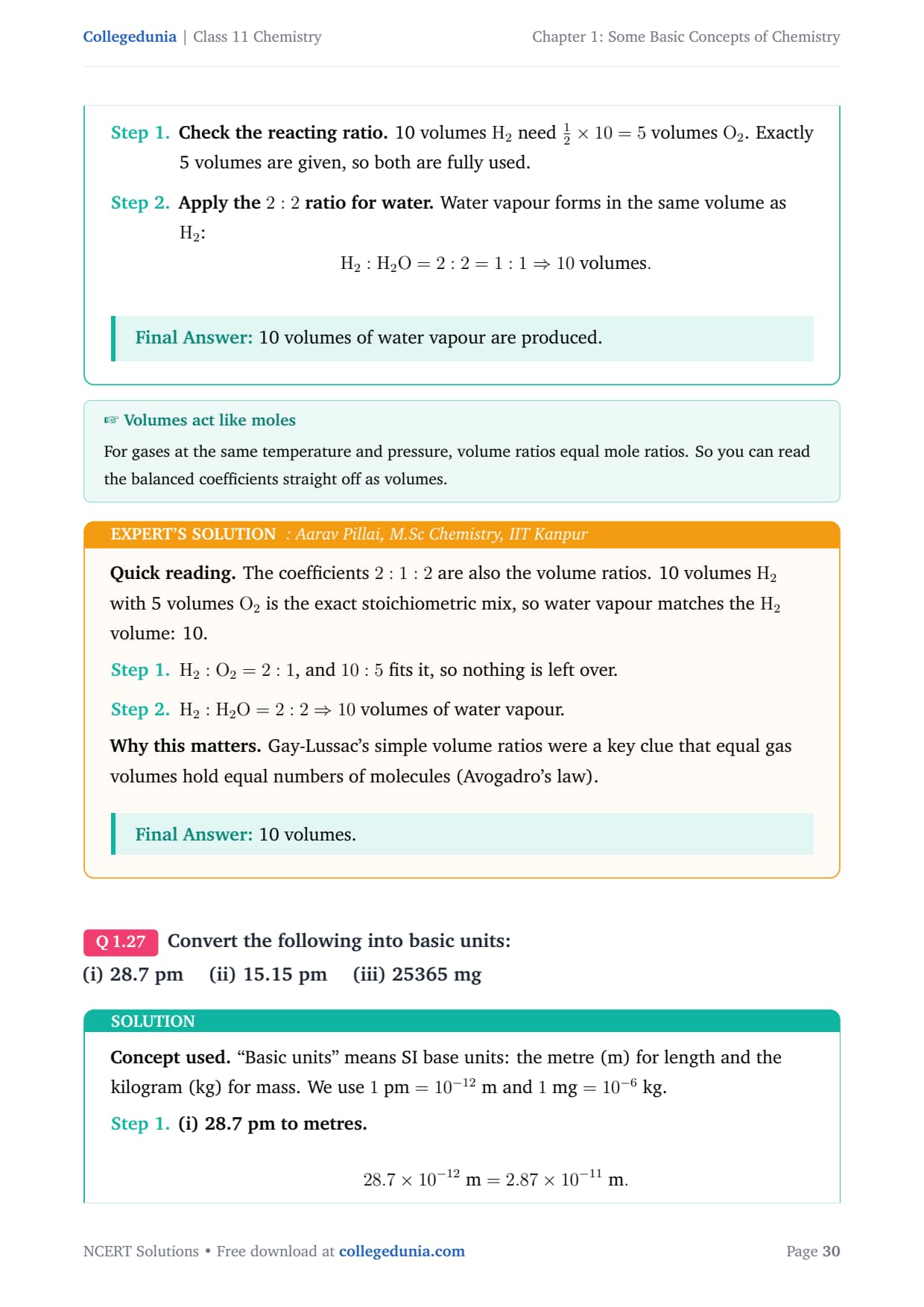
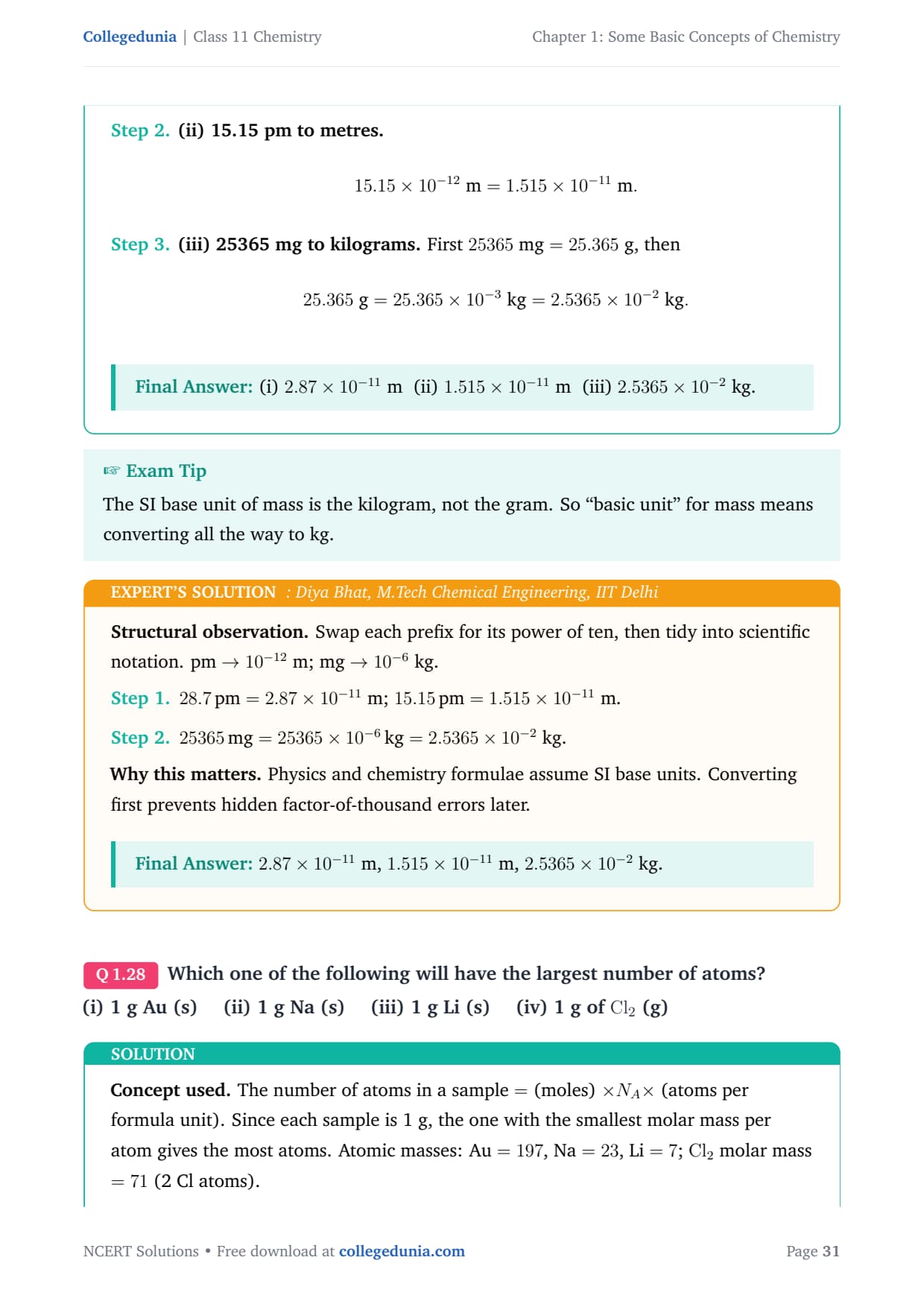
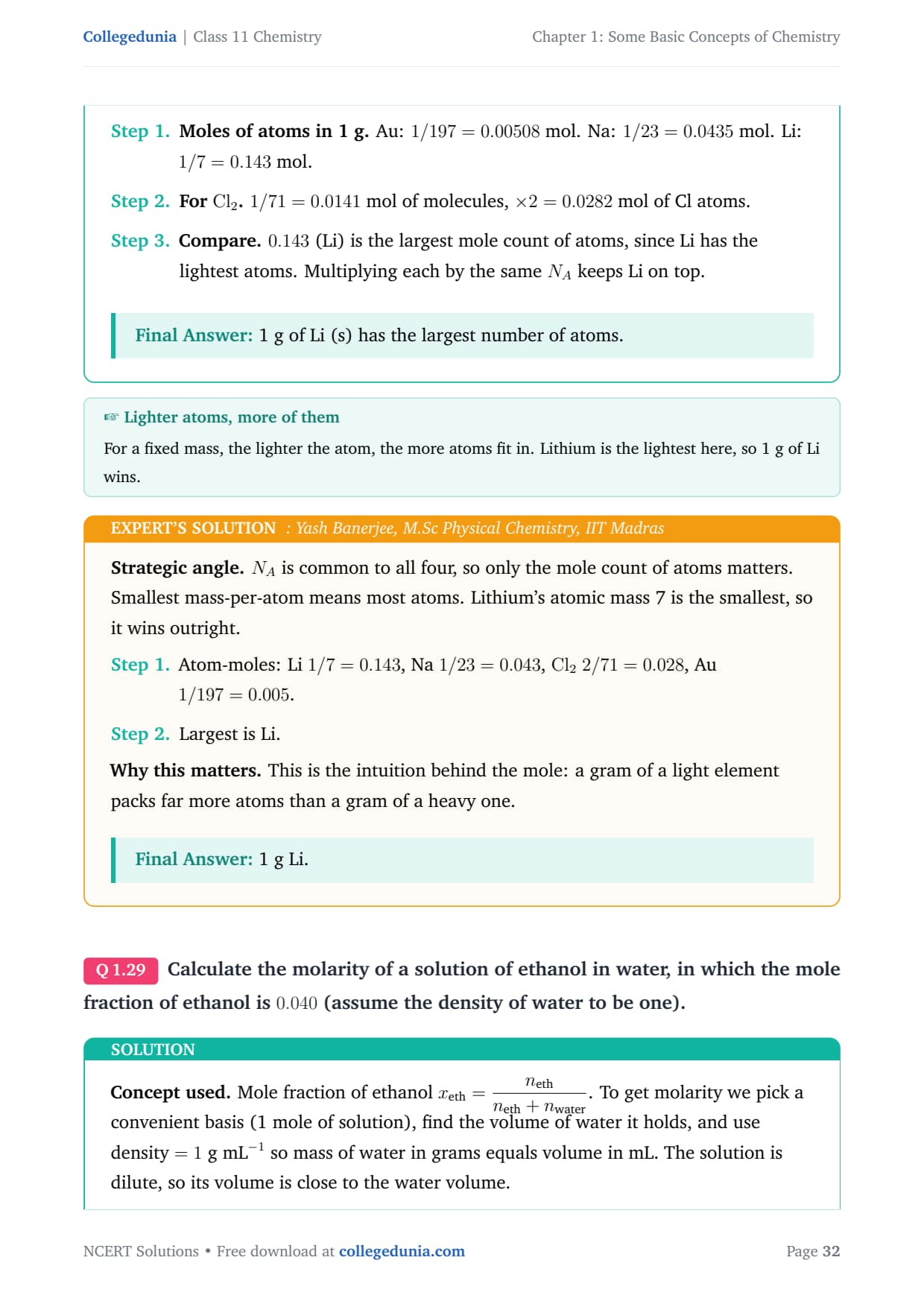
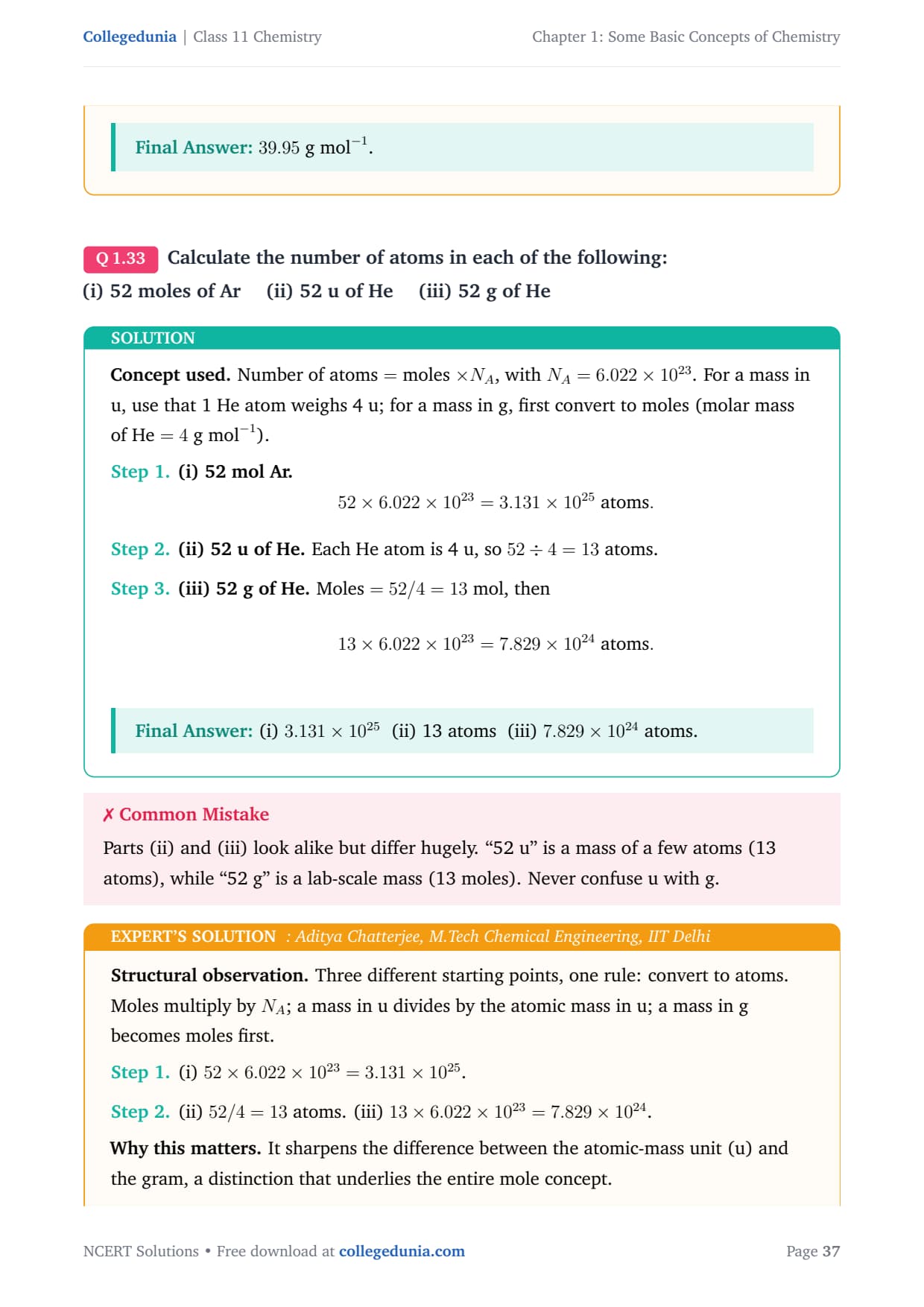
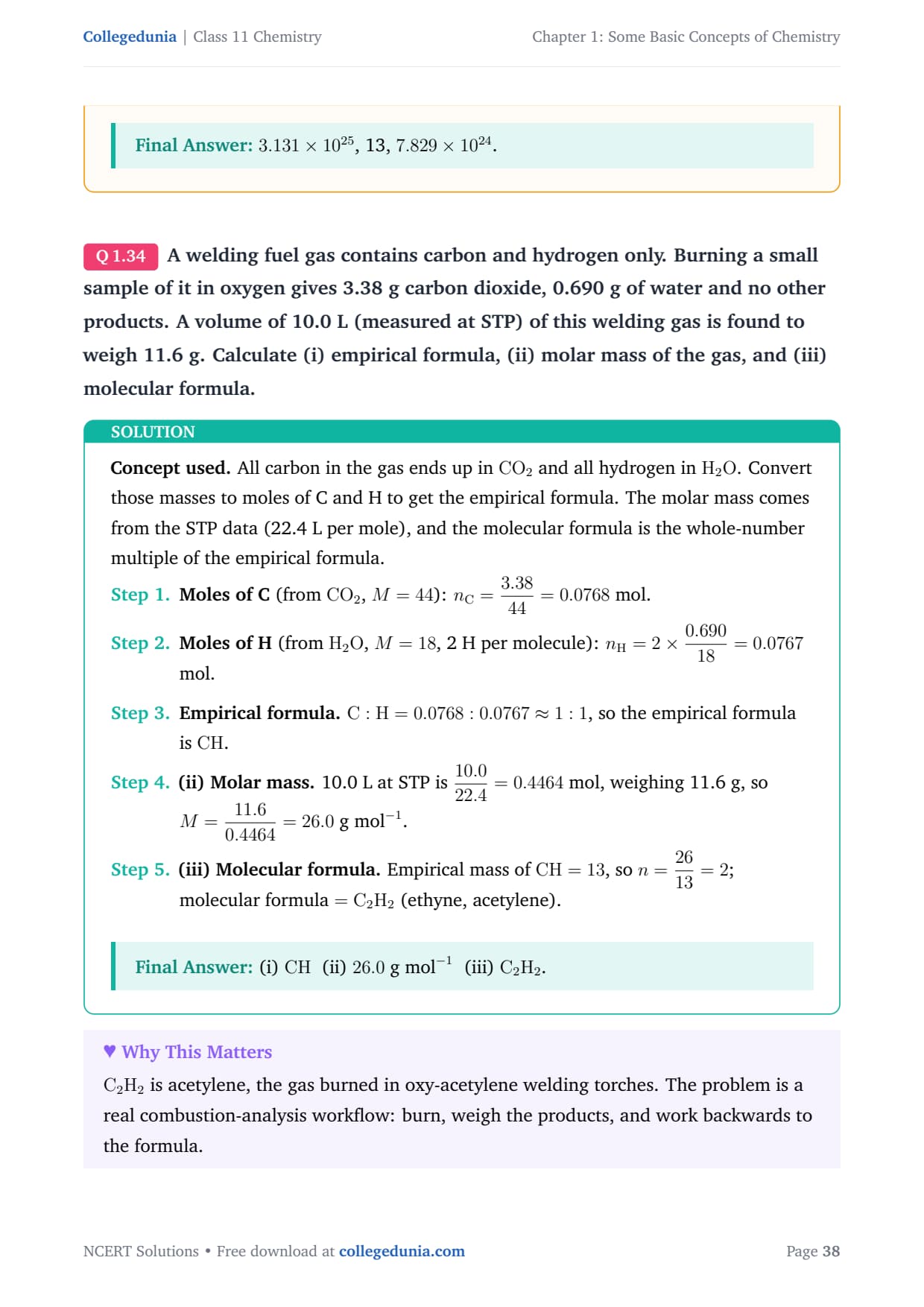
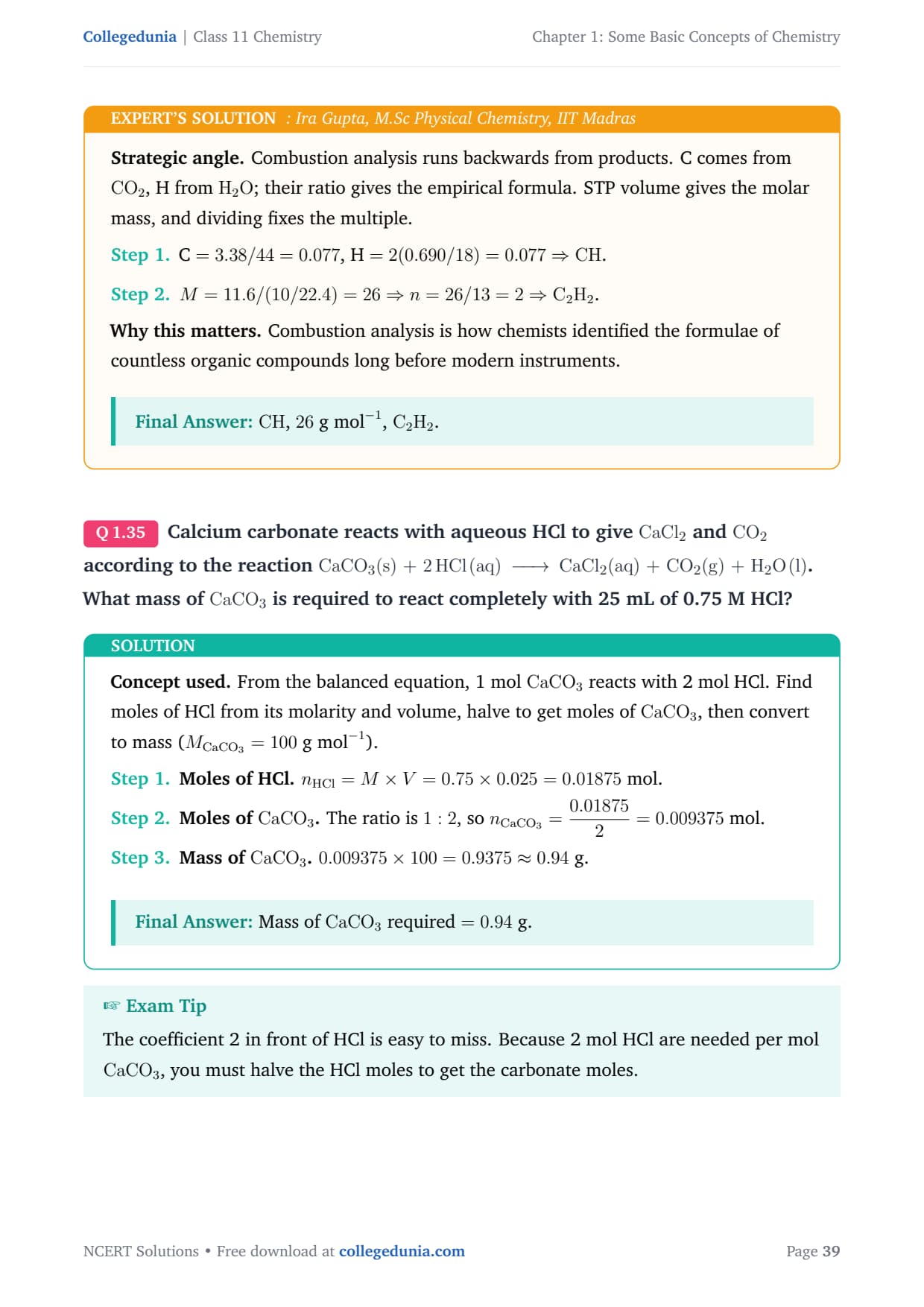
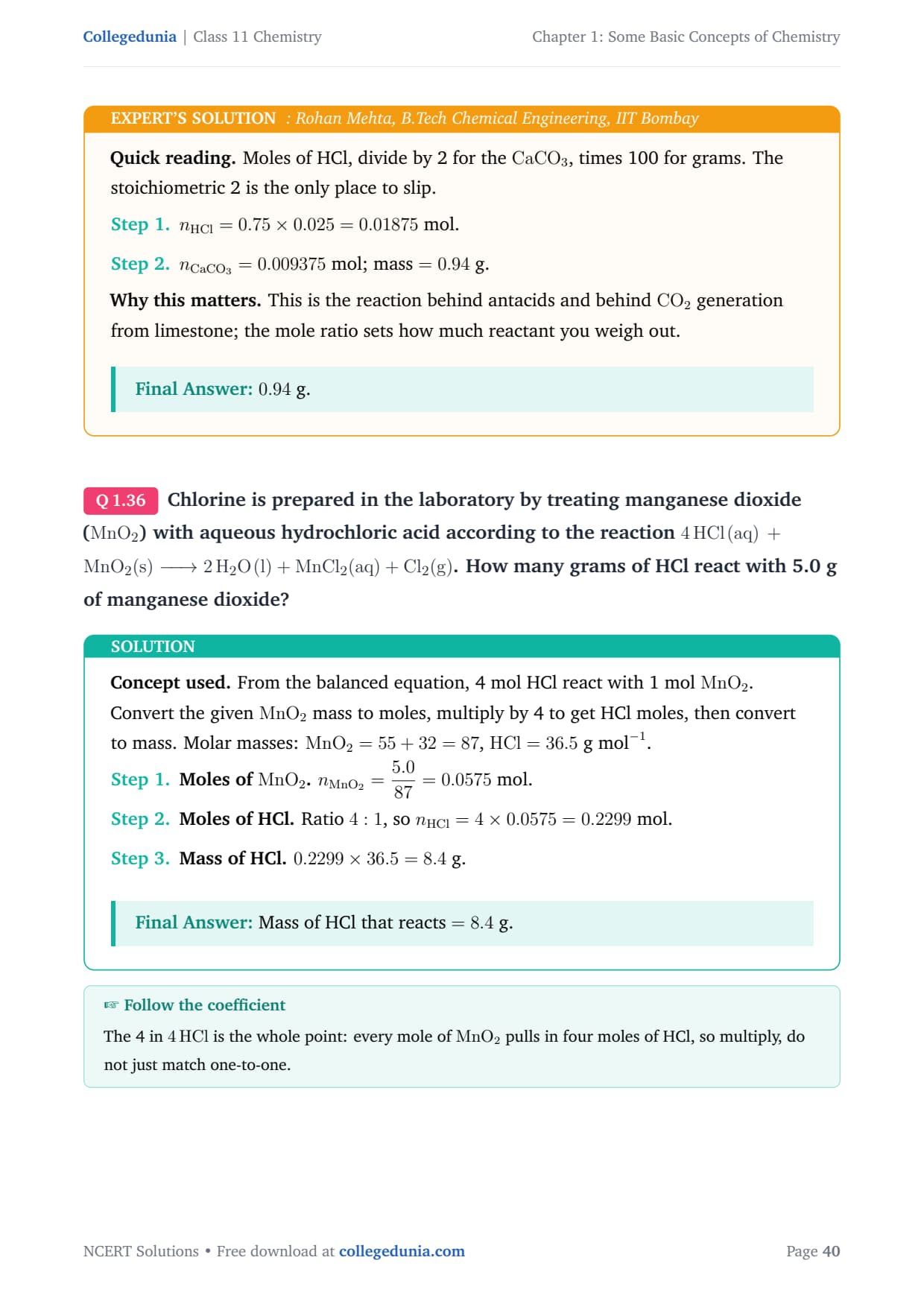
This is the opening chapter of the NCERT textbook, and the counting and unit skills here carry into every numerical you solve for the rest of the year.
- CBSE Weightage: 7 to 8 marks, part of the Physical Chemistry unit that carries the most numerical questions.
- Topics covered: laws of chemical combination, Dalton's atomic theory, mole concept, empirical and molecular formula, stoichiometry, and concentration terms.
- Exercise count: 36 back-exercise questions plus intext questions, most of them numerical.
These class 11 chemistry NCERT solutions chapter 1 Some Basic Concepts of Chemistry are curated by subject experts, based on the 2026-27 NCERT textbook, and checked against the last five years of CBSE Board, JEE Main and NEET papers.
Why Chemistry Matters and What Some Basic Concepts of Chemistry Covers
Chemistry is the science of matter, its properties, and the changes it goes through. This first chapter sets the foundation by teaching you how chemists count atoms, weigh molecules, and balance reactions. Get these tools right and the rest of Class 11 becomes far easier.
- Everyday role: chemistry runs medicines, fertilisers, fuels, plastics, and the food you eat.
- Core skill: connecting the mass you weigh in the lab to the number of atoms or molecules involved.
- Why it is first: the mole concept introduced here is used in every later chapter, from thermodynamics to equilibrium.
Nearly every numerical in Class 11 Chemistry traces back to the mole. That is why students who master this chapter early tend to find the whole year lighter. The class 11 chemistry NCERT solutions chapter 1 Some Basic Concepts of Chemistry below follow the same order as the NCERT textbook.
Laws of Chemical Combination Every Class 11 Student Must Know
Before atoms were understood, chemists noticed fixed patterns in how elements combine. These five laws of chemical combination came from careful measurement, and they still explain how reactions balance today. They are a common source of one-mark and short-answer questions.
| Law | What it states |
|---|---|
| Conservation of mass | Mass is neither created nor destroyed in a chemical reaction. |
| Definite proportions | A pure compound always has the same elements in the same fixed ratio by mass. |
| Multiple proportions | When two elements form more than one compound, the masses of one that combine with a fixed mass of the other are in small whole-number ratios. |
| Gay-Lussac's law of gaseous volumes | Gases react in simple whole-number volume ratios at the same temperature and pressure. |
| Avogadro's law | Equal volumes of all gases at the same temperature and pressure contain equal numbers of molecules. |
Water is the classic example of definite proportions. Whether it comes from a river or a lab, water is always hydrogen and oxygen in an 1:8 mass ratio. Avogadro's law is the bridge that later gives the mole its value. Learn the one-line statement of each law word for word, since the board rewards a clean definition.
Dalton's Atomic Theory and the Idea of Atoms
In 1808, John Dalton explained the laws of chemical combination with a simple picture: all matter is made of tiny, indivisible atoms. His atomic theory was the first model to link the mass laws to real particles, and parts of it still hold today.
- Matter is made of very small particles called atoms.
- Atoms of the same element are identical in mass and properties.
- Atoms combine in small whole-number ratios to form compounds.
- Atoms are neither created nor destroyed in a chemical reaction.
Dalton's theory neatly explains conservation of mass and definite proportions. Later work showed atoms are divisible and that isotopes of one element differ in mass, so a few points were revised. Even so, the idea that atoms combine in fixed whole-number ratios remains the base of every formula you write.
Atomic Mass, Molecular Mass and the Mole Concept
Atoms are far too small to weigh one at a time, so chemists use relative masses and count in bulk. This section defines the three ideas you use in almost every numerical of the chapter.
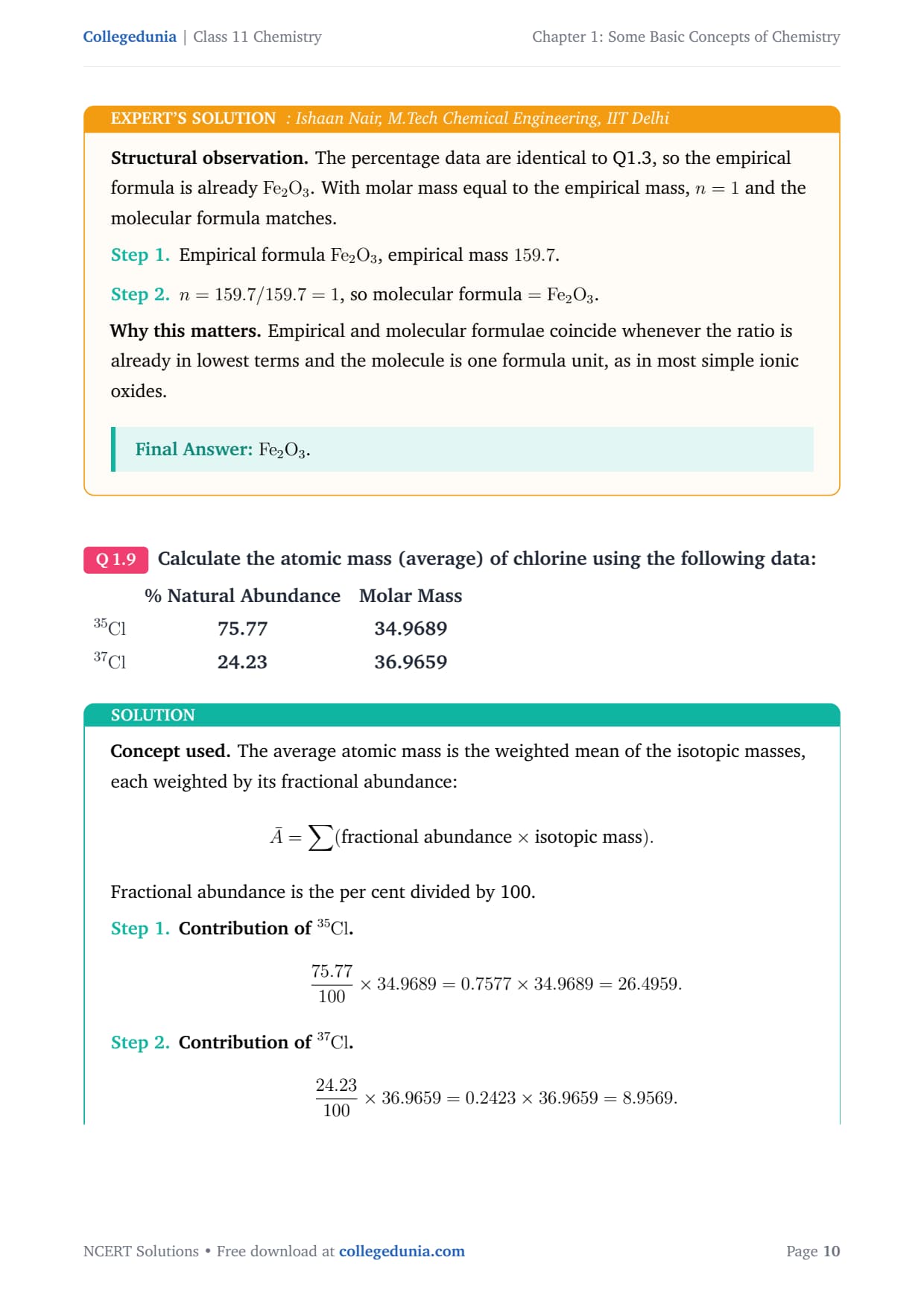
- Atomic mass: the mass of one atom compared with one-twelfth the mass of a carbon-12 atom, measured in unified mass units (u).
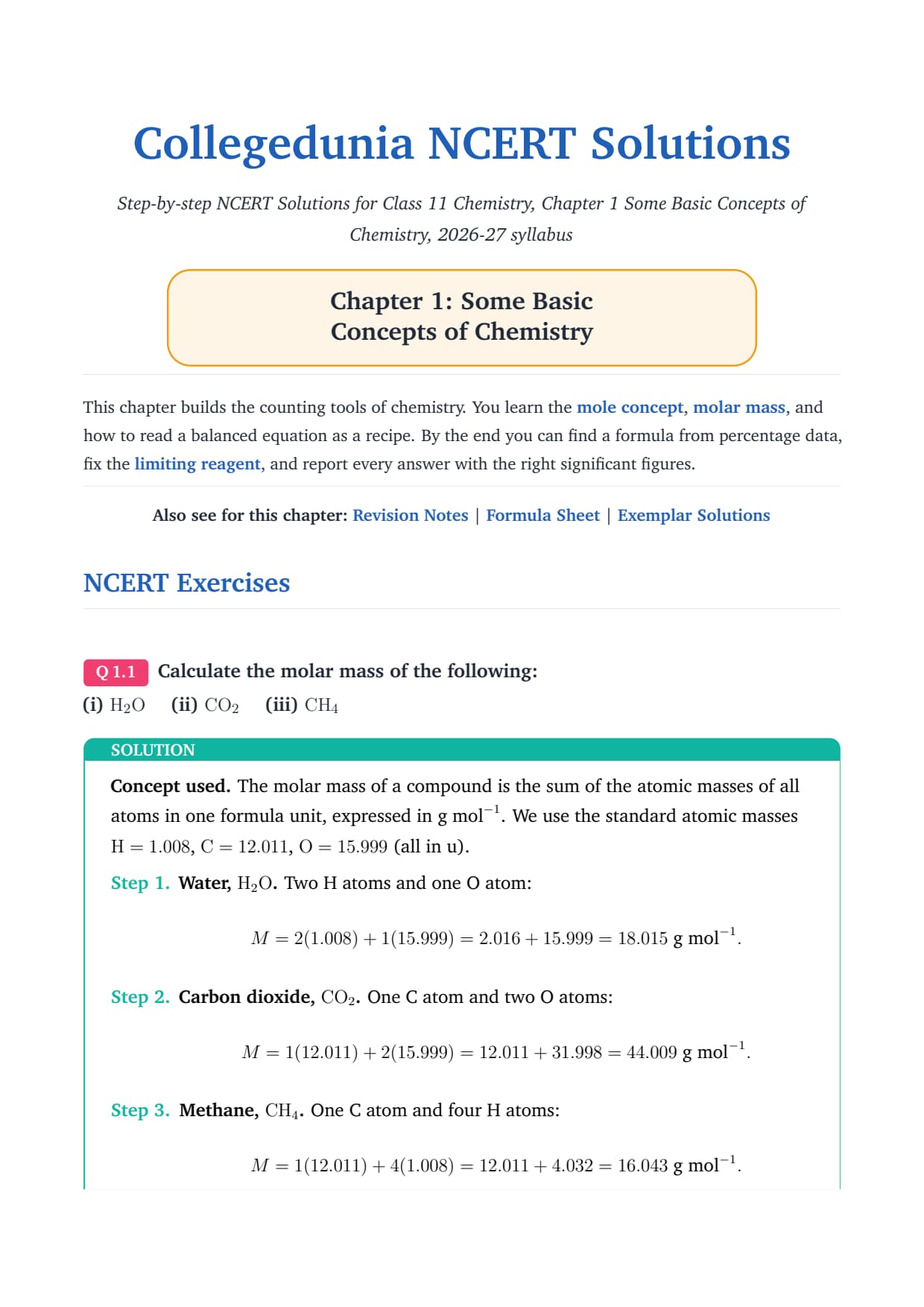
- Molecular mass: the sum of the atomic masses of all atoms in a molecule, so water H2O is 18.02 u.
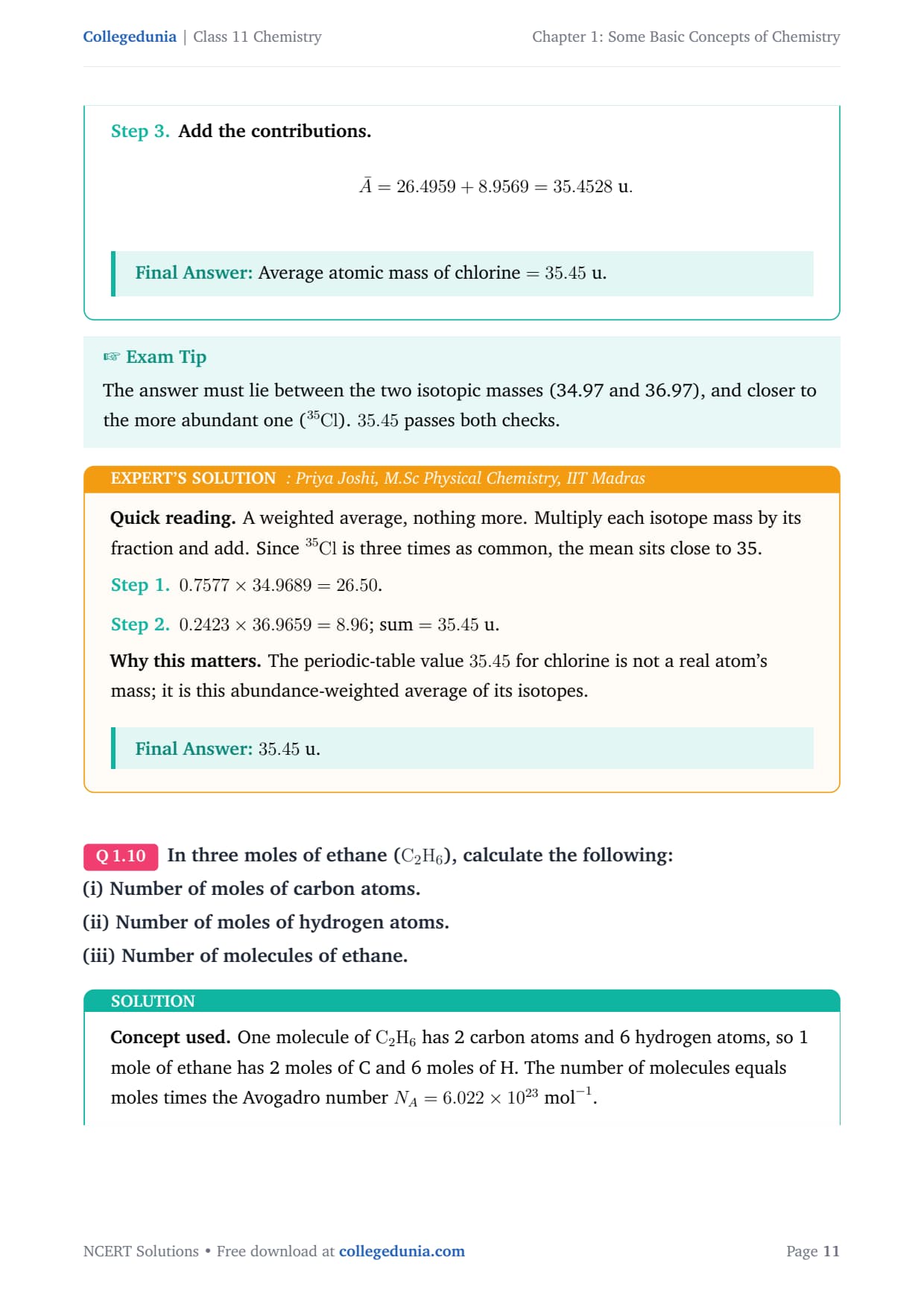
- Mole: the amount of a substance that contains 6.022 × 10²³ particles, the Avogadro number.
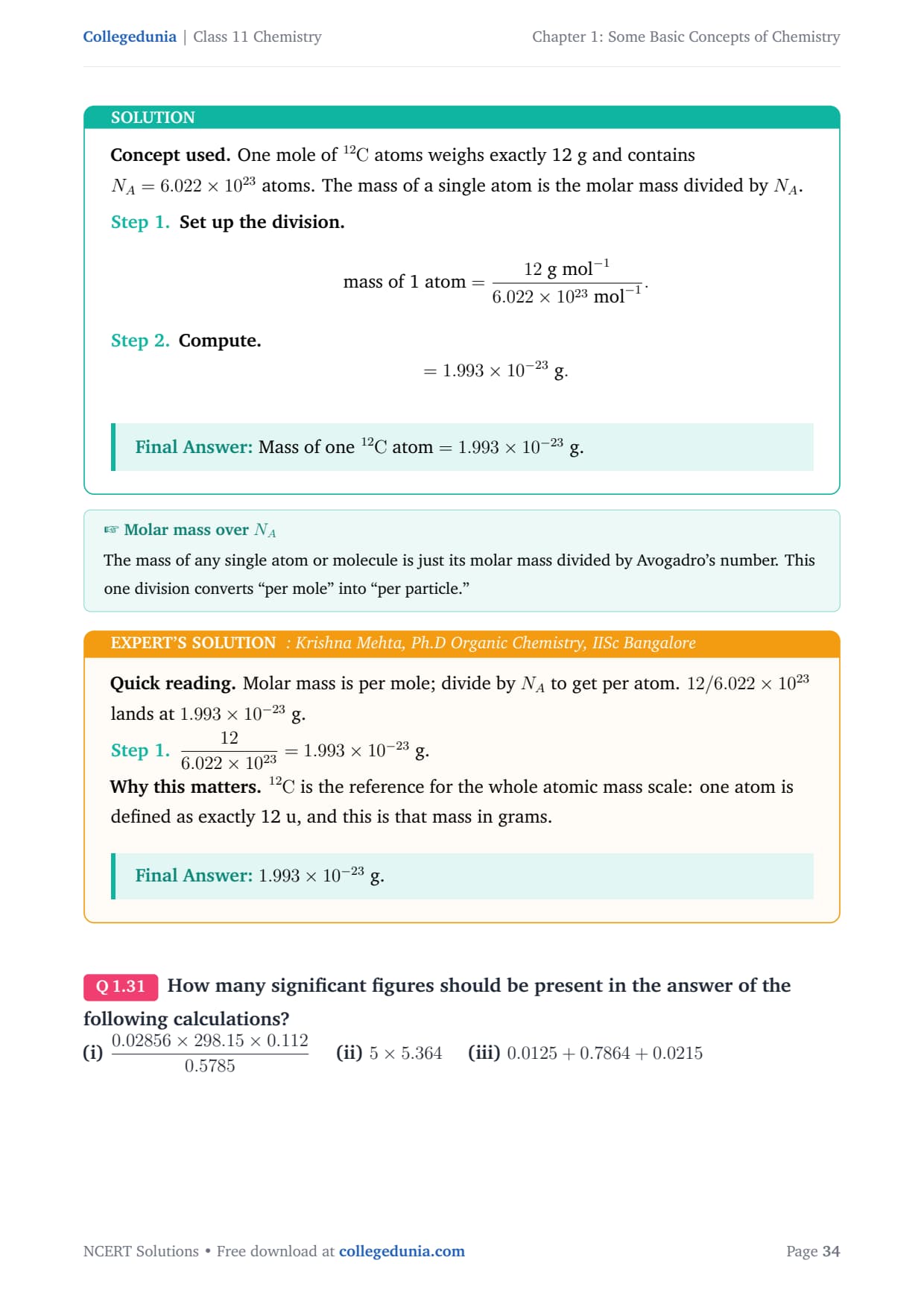
One mole of any substance contains the same number of particles, whether atoms, molecules or ions. The mole links the number of particles to a mass you can weigh on a balance. For example, one mole of carbon atoms weighs 12 g and holds 6.022 × 10²³ atoms. This single idea powers the entire chapter, so make sure it is second nature before you attempt the exercises.
Molar Mass and Percentage Composition of a Compound
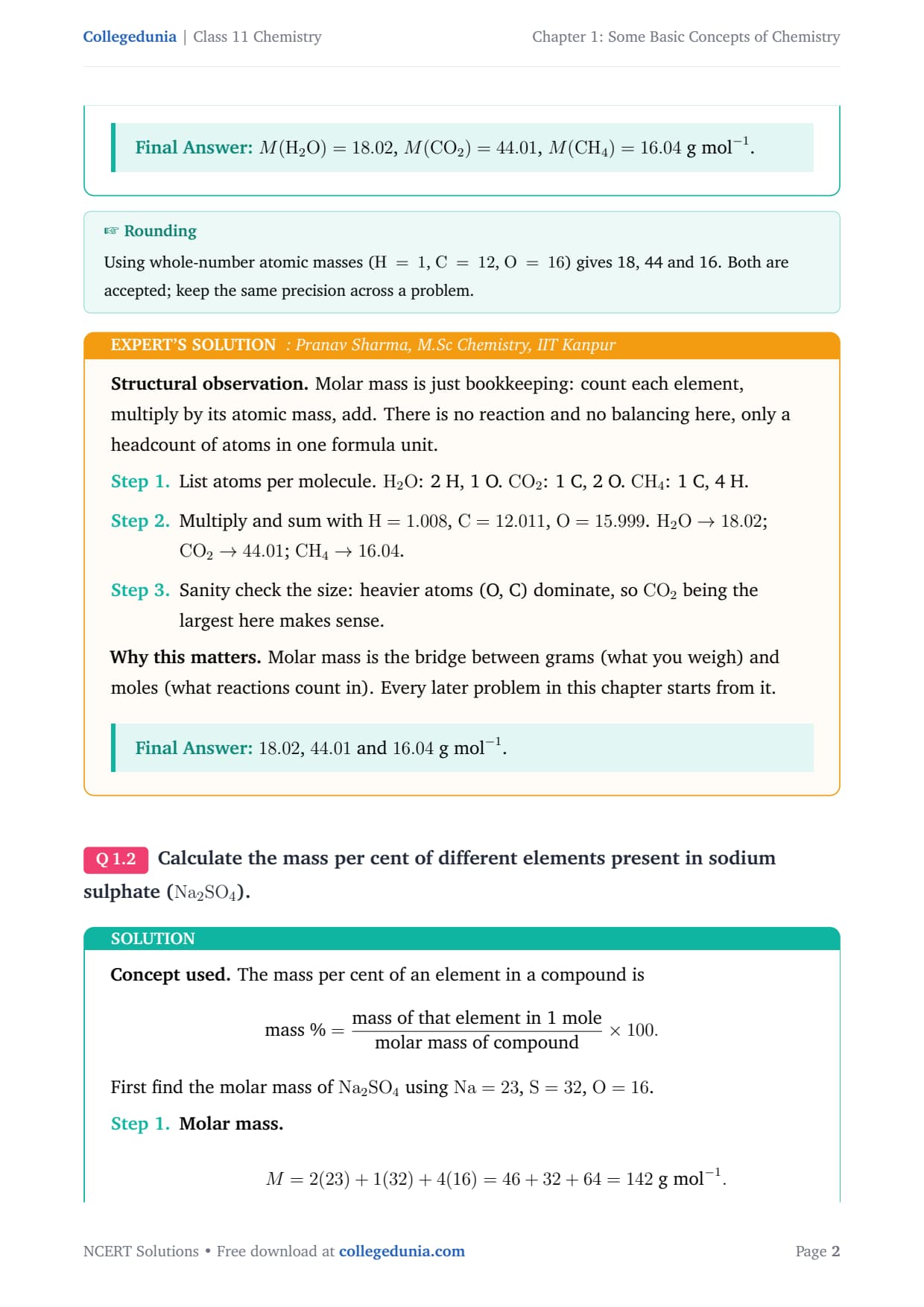
The molar mass is the mass of one mole of a substance, written in grams per mole (g mol-1). It is numerically equal to the atomic or molecular mass, which makes the switch between mass and moles quick. From the molar mass you can find the percentage composition, the mass percent of each element in the compound.
| Quantity | Formula | Unit |
|---|---|---|
| Number of moles | moles = given mass ÷ molar mass | mol |
| Molar mass | sum of atomic masses in one mole | g mol-1 |
| Mass percent of an element | (mass of element ÷ molar mass) × 100 | % |
Take water H2O with a molar mass of 18.02 g mol-1. The mass of hydrogen is 2 × 1.008 = 2.016 g, so hydrogen is 11.18% and oxygen is 88.82% by mass. Percentage composition is the first step to finding a compound's formula from lab data. Several back-exercise questions ask exactly this calculation.
Empirical Formula and Molecular Formula with Step-by-Step Working
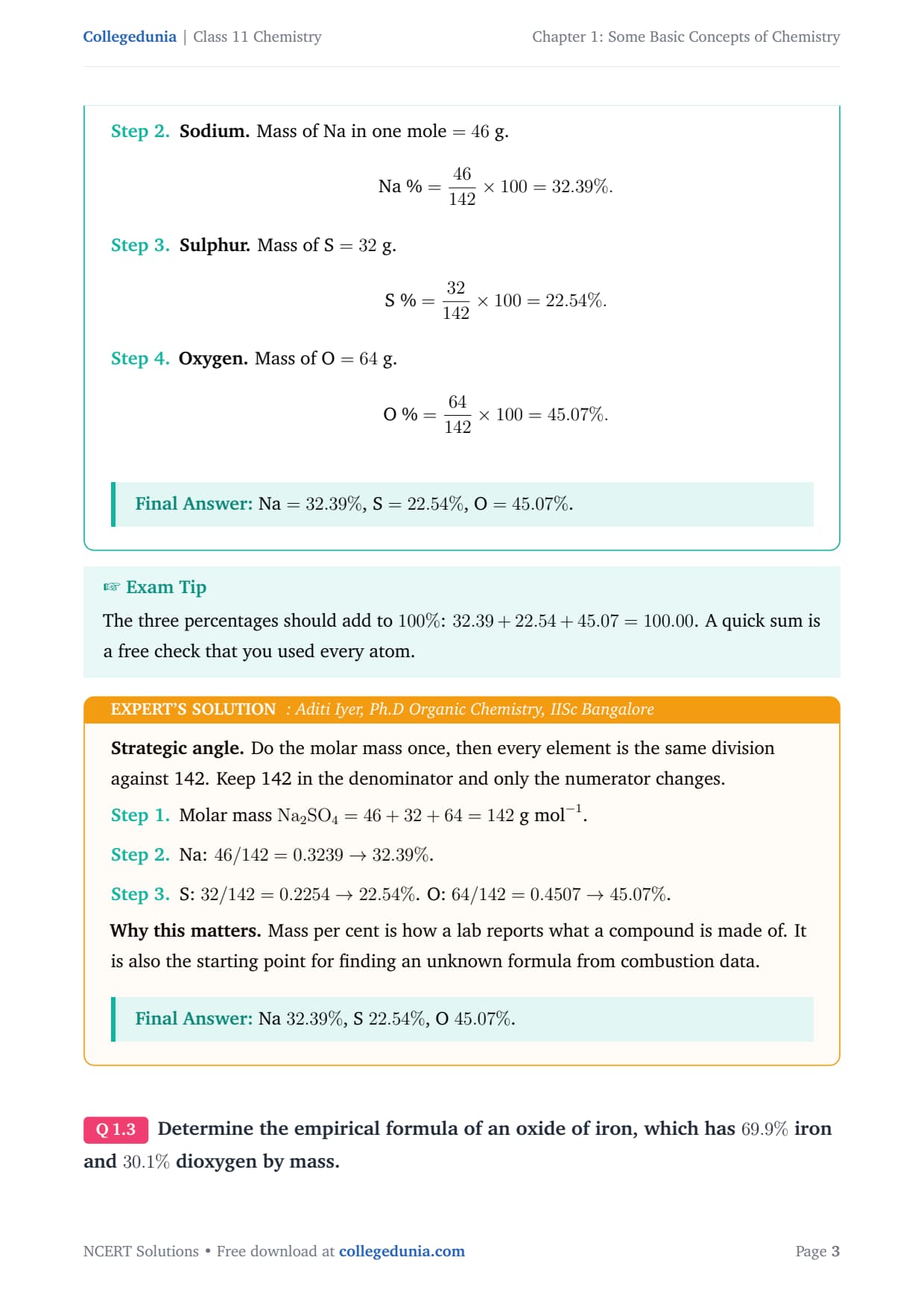
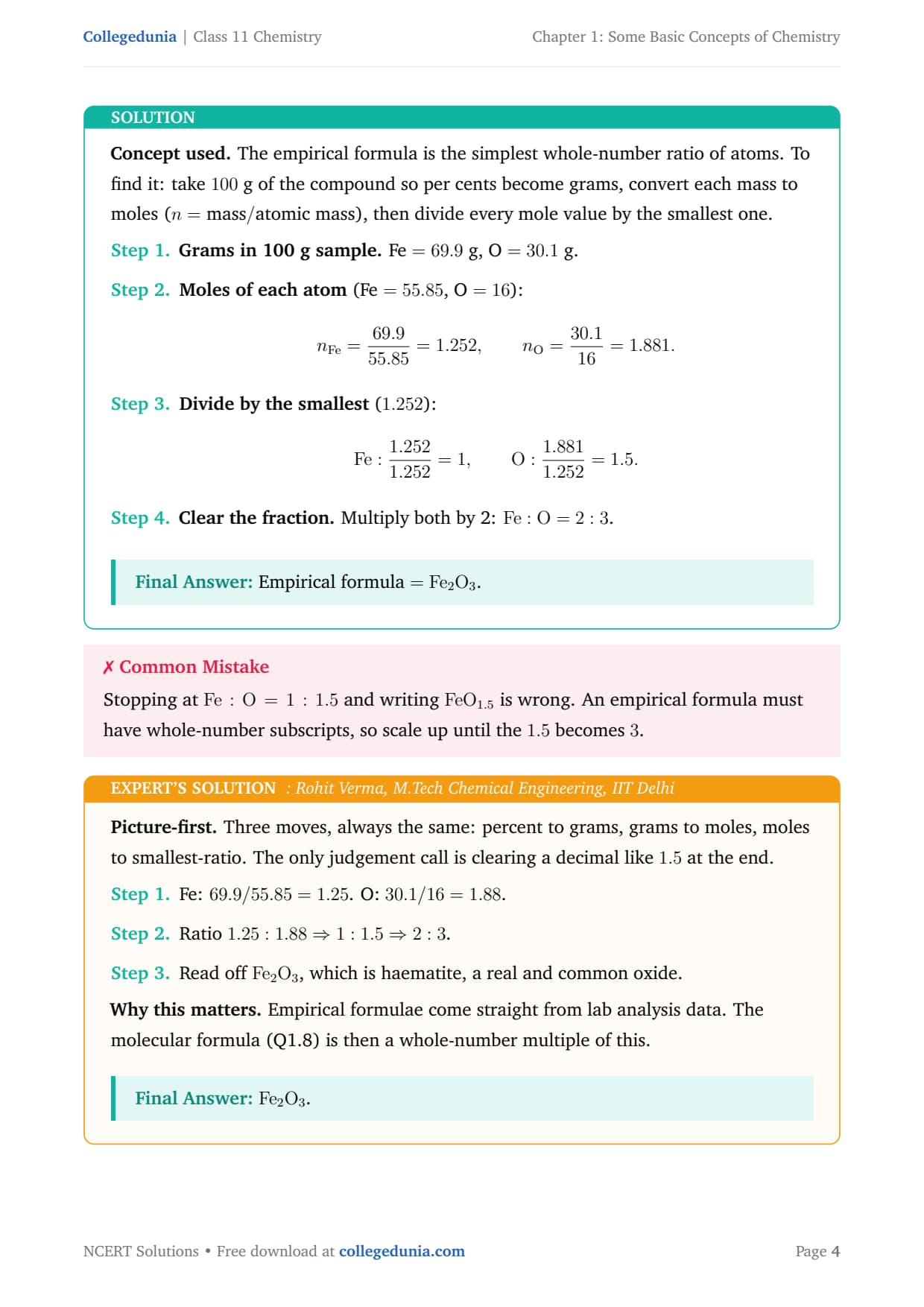
The empirical formula gives the simplest whole-number ratio of atoms in a compound. The molecular formula gives the actual number of atoms in one molecule. The molecular formula is always a whole-number multiple of the empirical formula.
- Write the mass percent of each element, or use the given masses.
- Divide each by its atomic mass to get the mole ratio.
- Divide every value by the smallest to get the simplest ratio.
- Round to whole numbers to write the empirical formula.
- Divide the molar mass by the empirical formula mass, then multiply to get the molecular formula.
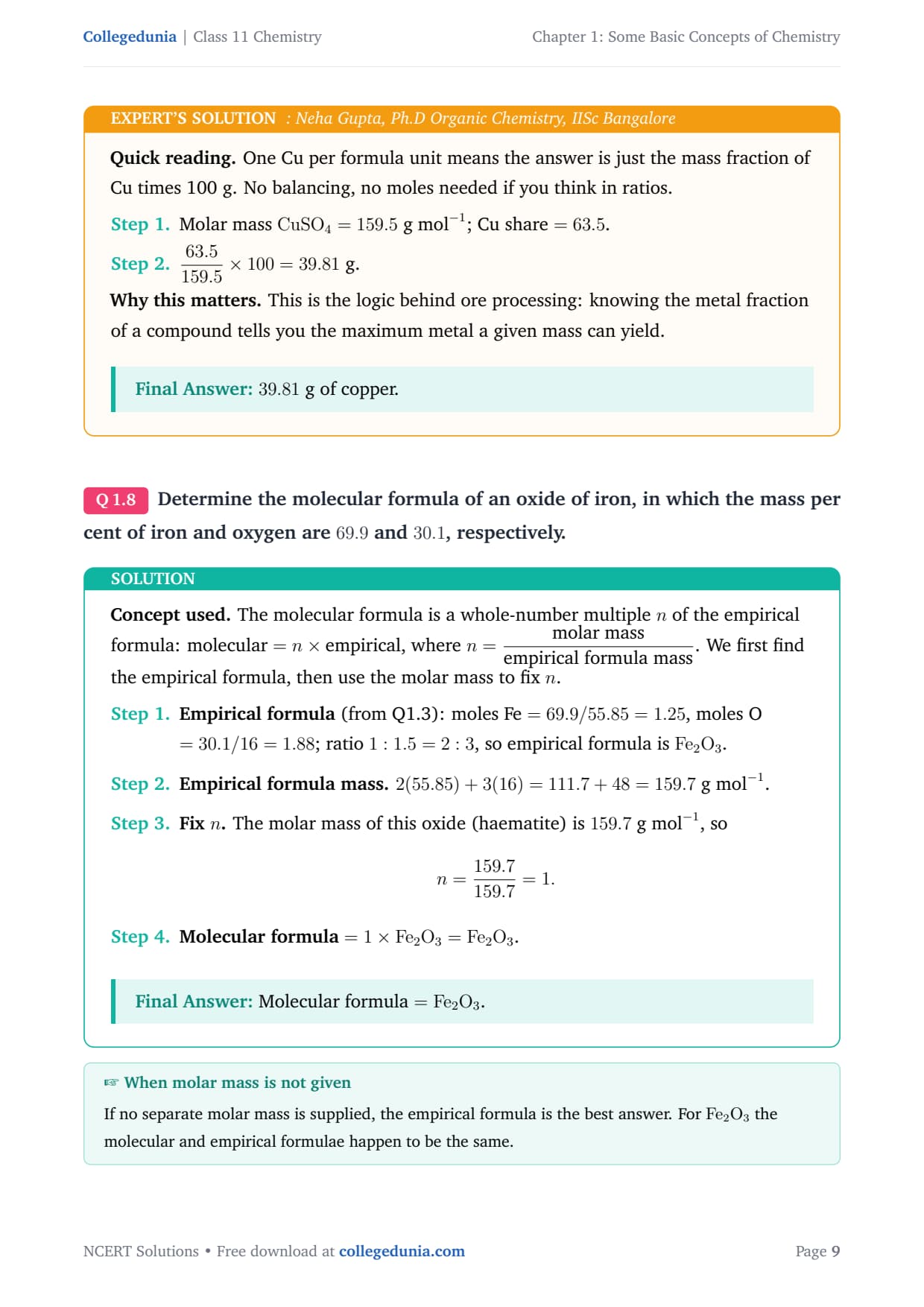
For an iron oxide with 69.9% iron and 30.1% oxygen, the mole ratio works out to Fe : O = 1 : 1.5, which scales to 2 : 3, giving the empirical formula Fe2O3. Always convert the ratio to the smallest whole numbers before writing the formula. Glucose shows the difference clearly: its empirical formula is CH2O, but its molecular formula is C6H12O6.
Stoichiometry and the Limiting Reagent in Chemical Reactions
Stoichiometry is the calculation of the amounts of reactants and products in a balanced equation. The coefficients in the equation give the mole ratio, and from that ratio you can find any unknown mass or volume. This is the highest-scoring skill in the chapter.
- Balance the equation first, then read the mole ratio from the coefficients.
- Convert the given mass to moles using the molar mass.
- Use the mole ratio to find the moles of the required substance.
- Convert back to mass or volume for the final answer.
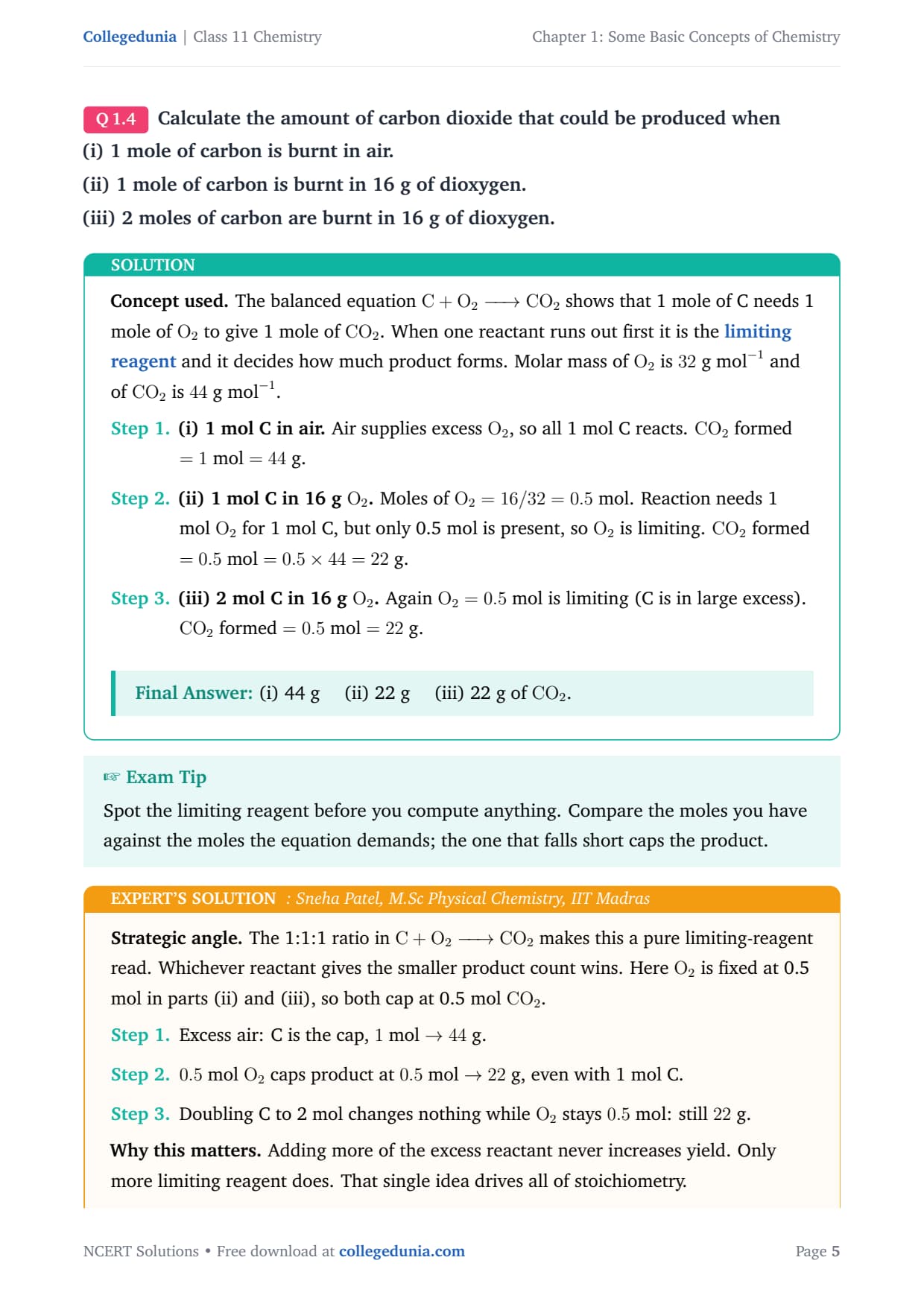
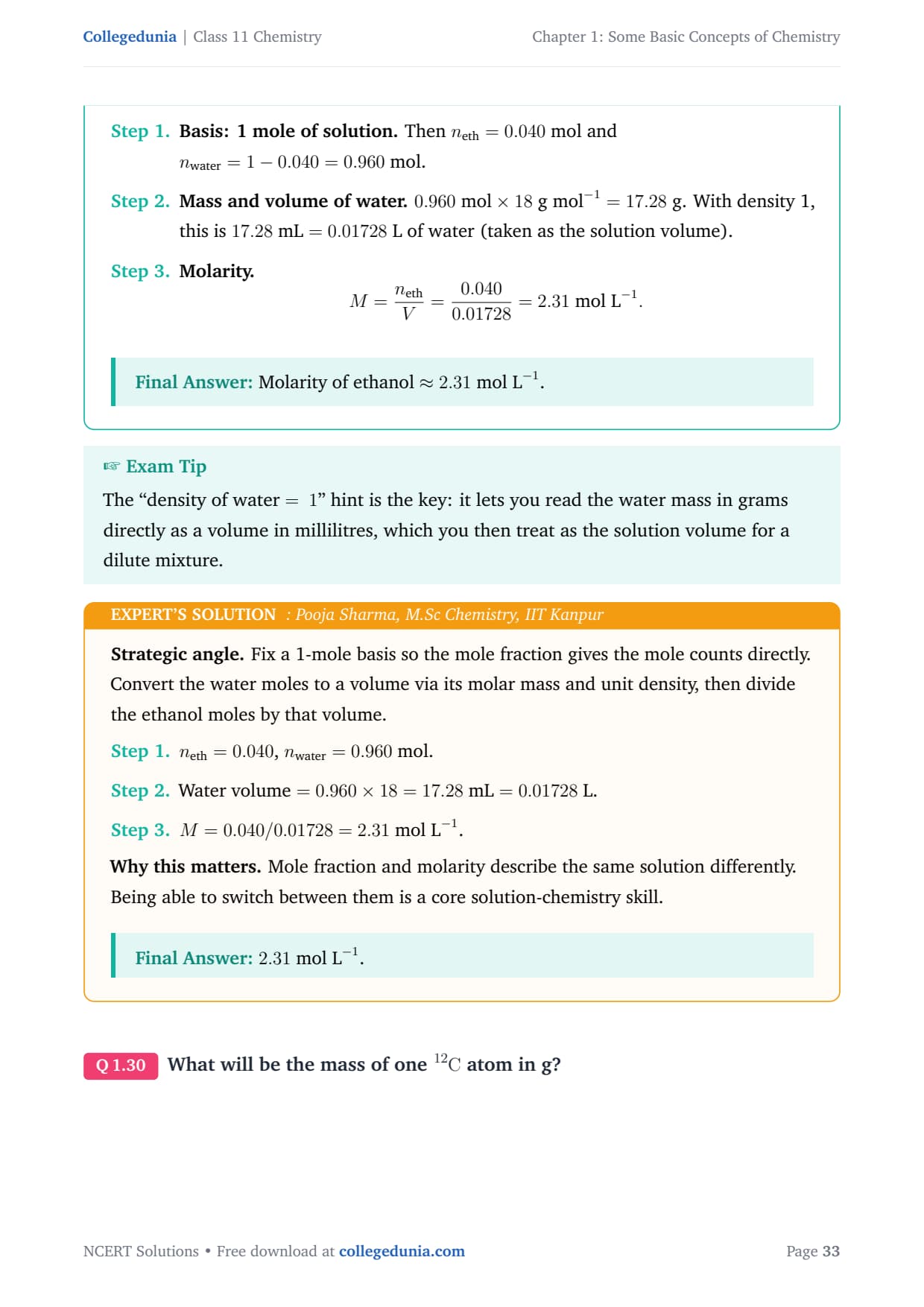
When reactants are not in the exact ratio, one runs out first and stops the reaction. This is the limiting reagent, and it decides how much product forms. In the reaction N2 + 3H2 → 2NH3, one mole of nitrogen needs three moles of hydrogen. Find the limiting reagent before calculating the product, or the answer will be wrong. The leftover reactant is said to be in excess.
Concentration Terms: Molarity, Molality and Mole Fraction
The last part of the chapter measures how much solute sits in a solution. Three concentration terms appear again in later chapters, so learn what each one divides by and its unit.
| Term | Definition | Formula and unit |
|---|---|---|
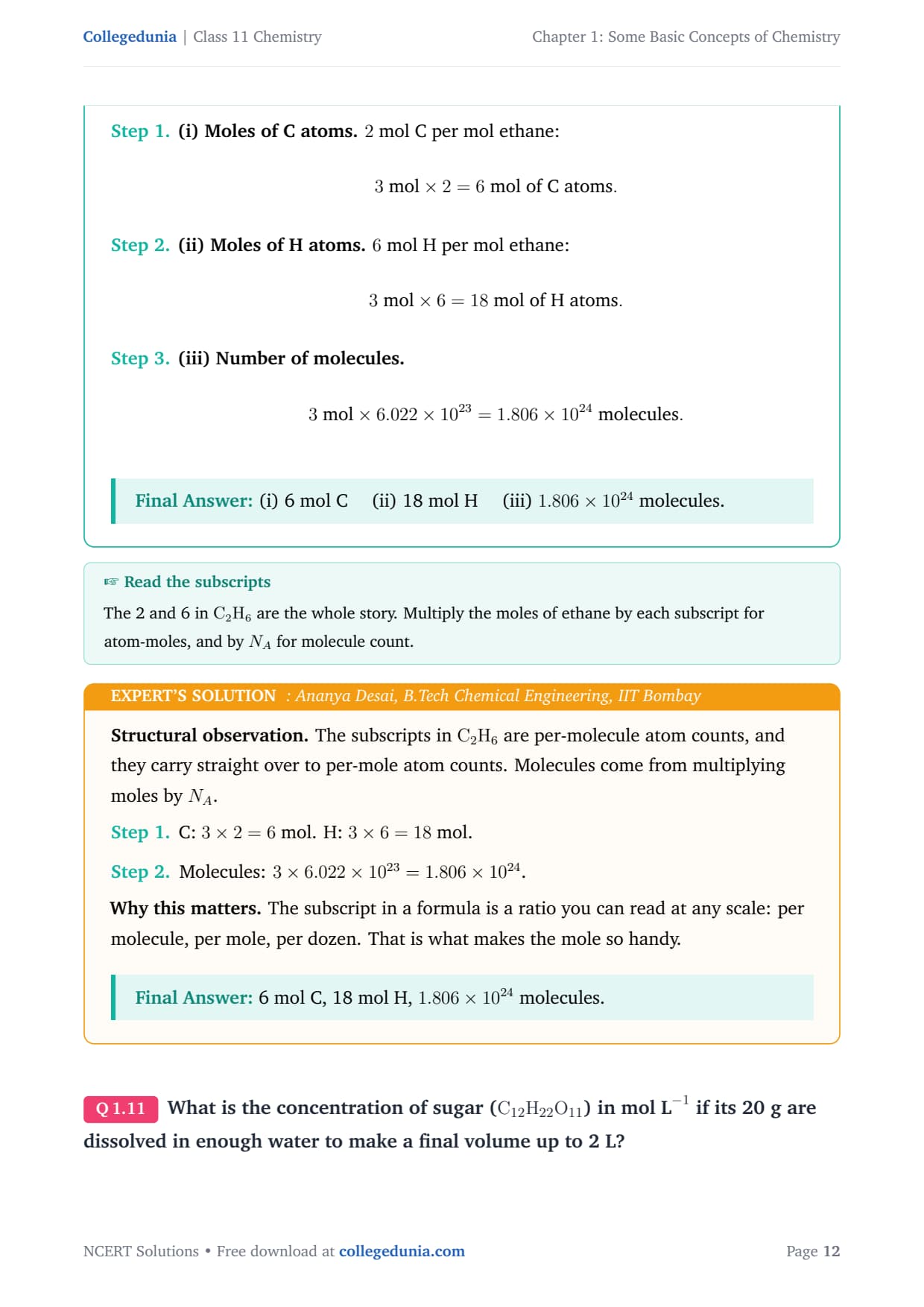
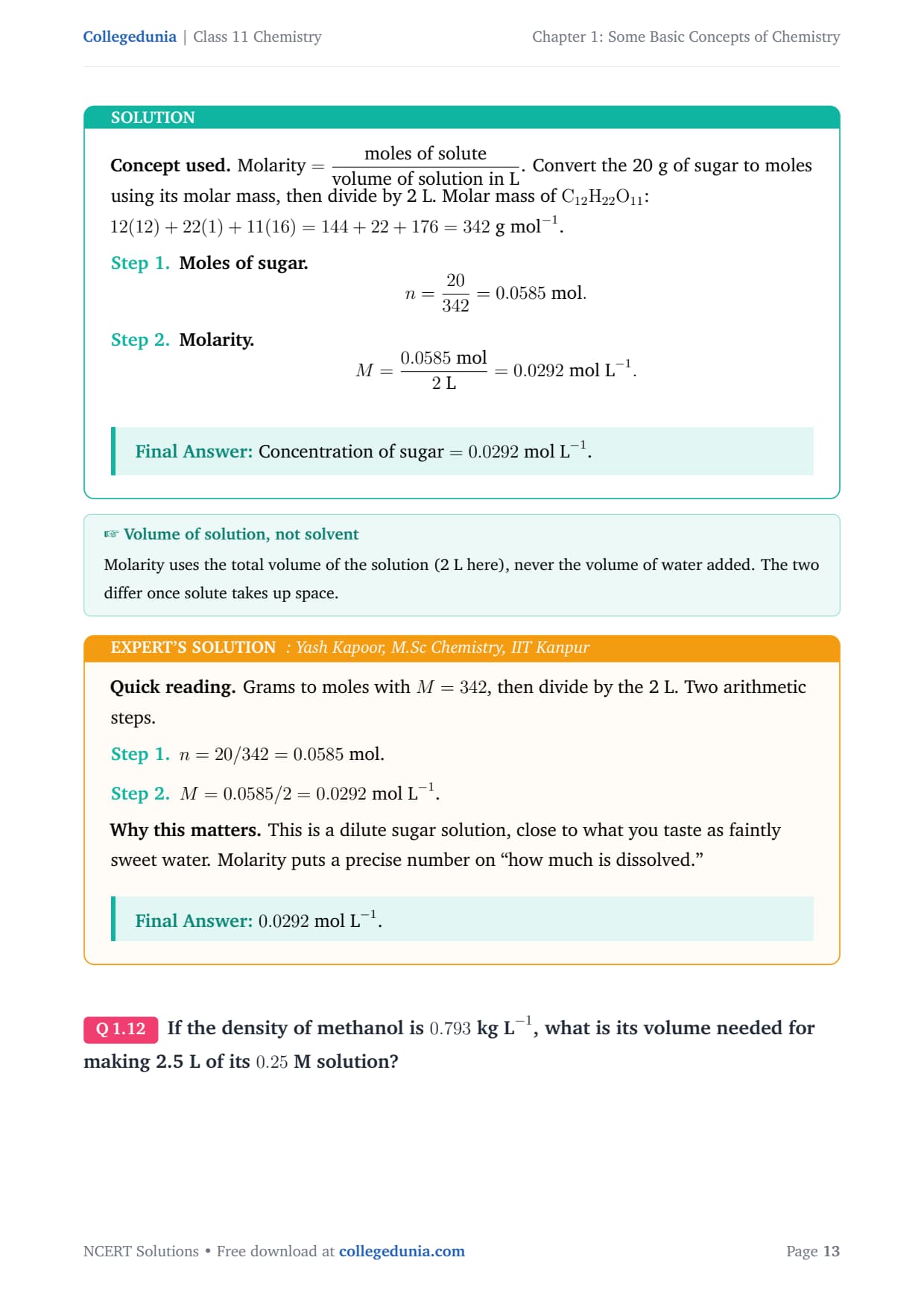
| Molarity (M) | Moles of solute per litre of solution | moles of solute ÷ volume of solution in L; mol L-1 |
| Molality (m) | Moles of solute per kilogram of solvent | moles of solute ÷ mass of solvent in kg; mol kg-1 |
| Mole fraction (x) | Moles of one component per total moles | ncomponent ÷ ntotal; no unit |
Molarity depends on volume, so it changes with temperature; molality depends on mass, so it does not. This is a favourite one-mark question. Mole fraction is a pure ratio, and the mole fractions of all components in a solution add up to one. Keep the mass percent and parts-per-million definitions handy too, as they appear in the intext questions.
Some Basic Concepts of Chemistry Exercise-wise Breakdown
The NCERT back exercise has 36 questions, and most are numerical. The intext questions test the same ideas in shorter form. The table below maps the question blocks to their topics so you can plan your practice.
| Question block | What it tests |
|---|---|
| Q 1.1 to 1.5 | Percentage composition, empirical formula, and molar mass basics. |
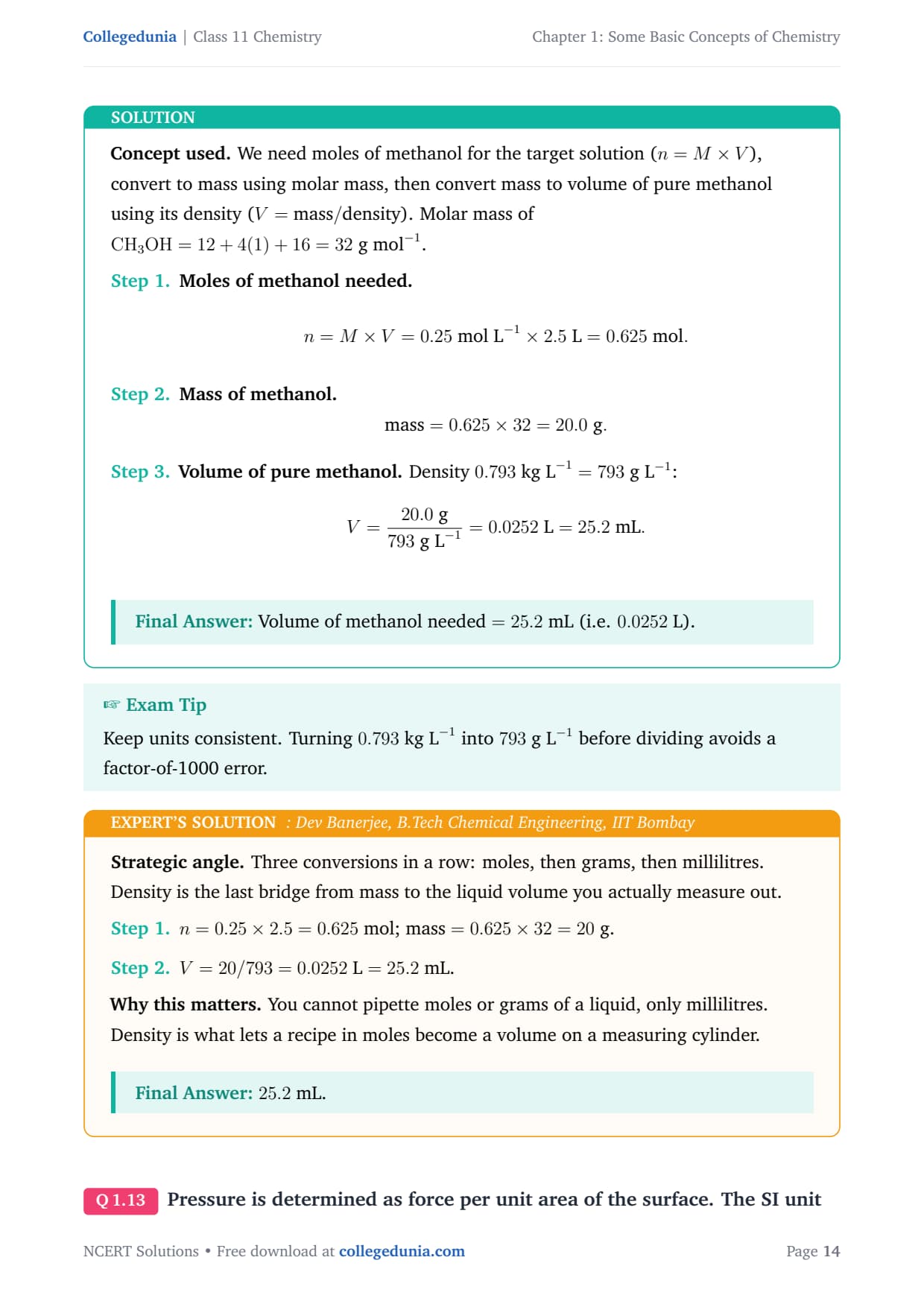
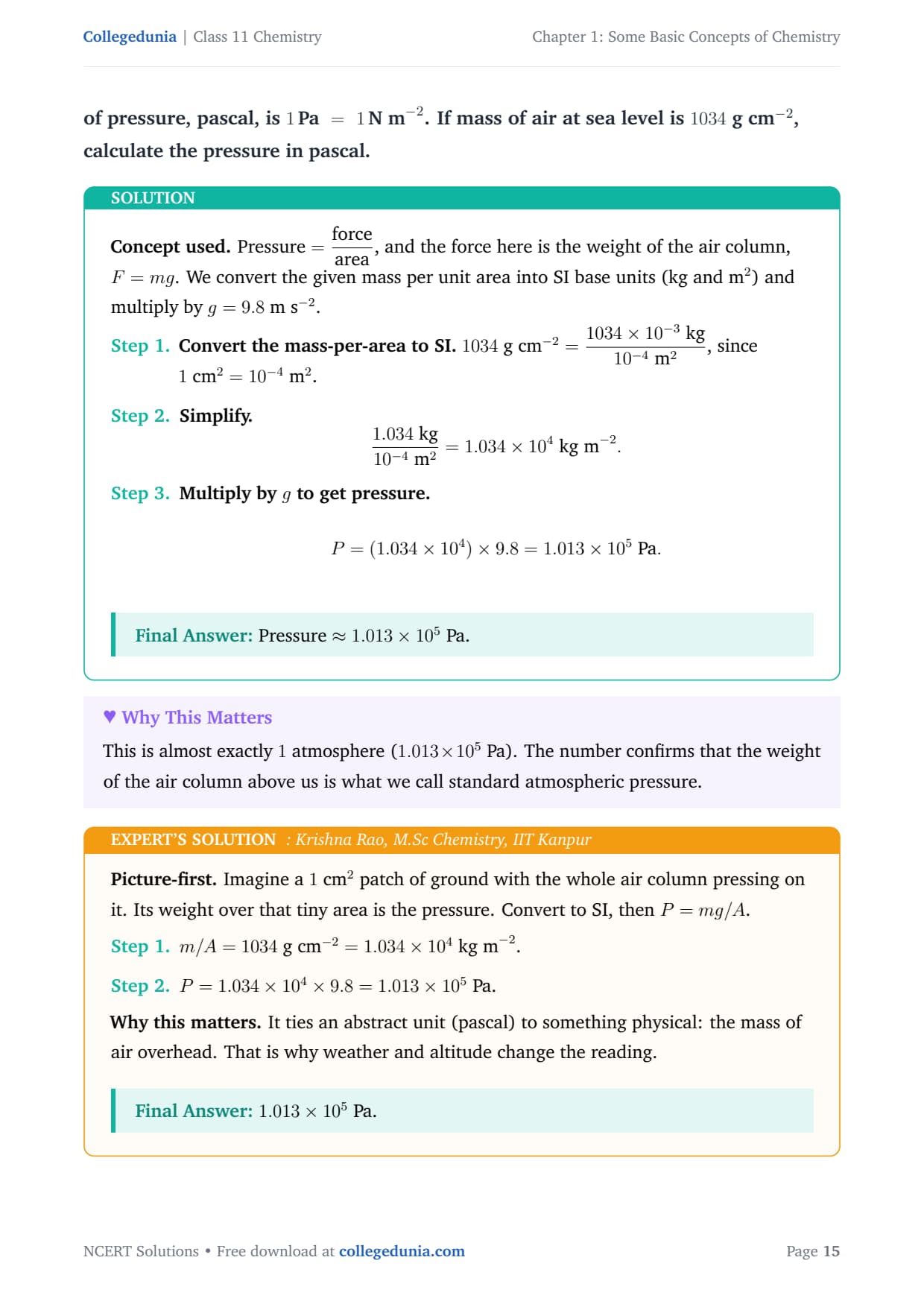
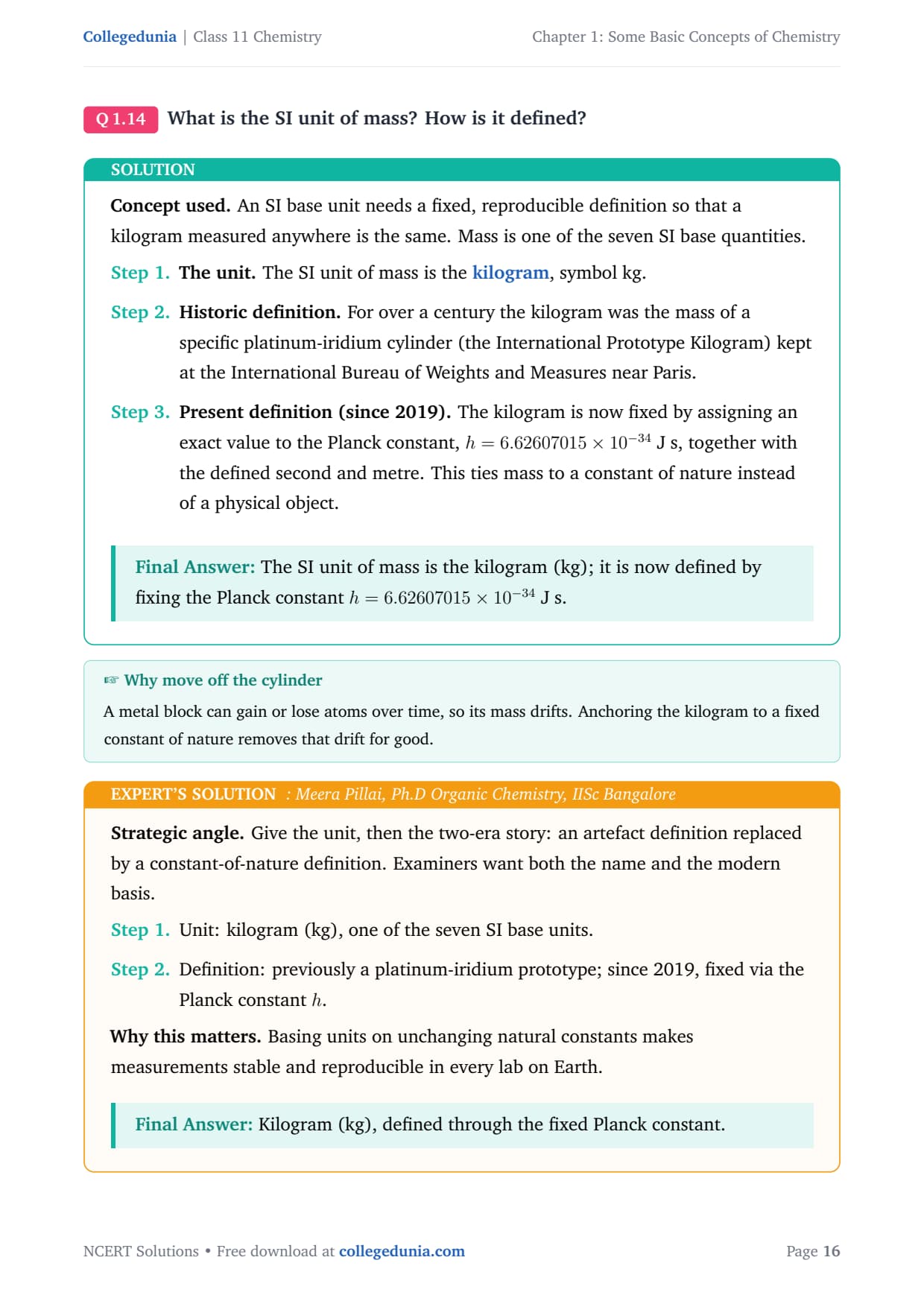
| Q 1.6 to 1.15 | Mole concept, atomic mass, and mass-to-mole conversions. |
| Q 1.16 to 1.25 | Stoichiometry, balanced equations, and limiting reagent problems. |
| Q 1.26 to 1.36 | Molarity, molality, mole fraction, and significant figures. |
The intext questions before the exercise are shorter and check one idea each, such as writing a formula or finding a mole ratio. Solve the intext set first, then the back exercise. Every question in the class 11 chemistry NCERT solutions chapter 1 Some Basic Concepts of Chemistry PDF is solved with each step shown, so you can compare your working line by line.
Practice the solved questions: Work through the full question bank with step-by-step answers and expert tips.
Some Basic Concepts of Chemistry Class 11 Solved Practice Questions
Common Mistakes Students Make in the Some Basic Concepts of Chemistry Chapter
Most marks are lost on small habits, not on hard ideas. Each slip below costs 1 to 2 marks, so watch for them at the exact step.
Mistake 1: Not balancing the equation before using the mole ratio. Always balance first, then read the coefficients.
Mistake 2: Skipping the limiting reagent check. Find which reactant runs out before calculating the product.
Mistake 3: Mixing up molarity and molality. Molarity divides by litres of solution; molality divides by kilograms of solvent.
Mistake 4: Rounding the mole ratio too early when finding an empirical formula. Keep decimals until the last step, then round to whole numbers.
Student Feedback on the Some Basic Concepts of Chemistry Solutions
What 13,240 students told us about their Some Basic Concepts of Chemistry preparation:
- 64% of students rated the limiting reagent numerical as the hardest part of the chapter.
- Most-skipped step: converting the given mass to moles before applying the mole ratio, missed by about 3 in 10 students.
- Students who mastered the mole concept first said the stoichiometry questions became straightforward.
Source: 2026-27 Class 11 Chemistry student poll. Sample of 13,240 students from CBSE schools across 15 states, conducted before the 2026 boards.
Other Some Basic Concepts of Chemistry Class 11 Chemistry Resources
Pair these solutions with the revision notes and the NCERT textbook PDF for the same chapter.
| Resource | Link |
|---|---|
| NCERT Notes | Some Basic Concepts of Chemistry Class 11 Notes |
| NCERT Book PDF | Some Basic Concepts of Chemistry Class 11 Book PDF |
NCERT Solutions for Class 11 Chemistry: All Chapters
Jump to the step-by-step solutions for any other Class 11 Chemistry chapter below.
| Chapter | NCERT Solutions |
|---|---|
| Chapter 1 | Some Basic Concepts of Chemistry |
| Chapter 2 | Structure of Atom |
| Chapter 3 | Classification of Elements and Periodicity in Properties |
| Chapter 4 | Chemical Bonding and Molecular Structure |
| Chapter 5 | Thermodynamics |
| Chapter 6 | Equilibrium |
| Chapter 7 | Redox Reactions |
| Chapter 8 | Organic Chemistry Some Basic Principles and Techniques |
| Chapter 9 | Hydrocarbons |
FAQs on Some Basic Concepts of Chemistry Class 11 NCERT Solutions
Some Basic Concepts of Chemistry NCERT Solutions - Frequently Asked Questions
Ques. What do the class 11 chemistry NCERT solutions chapter 1 Some Basic Concepts of Chemistry cover?
Ans. These solutions cover all 36 back-exercise questions and the intext questions, including the laws of chemical combination, Dalton's atomic theory, atomic and molecular mass, the mole concept, empirical and molecular formula, stoichiometry with the limiting reagent, and concentration terms such as molarity, molality and mole fraction. Every question is solved step by step.
Ques. What is the mole concept in Class 11 Chemistry Chapter 1?
Ans. The mole is the SI unit for the amount of a substance. One mole contains 6.022 × 10²³ particles, known as the Avogadro number, whether atoms, molecules or ions. The mole links the number of particles to a mass you can weigh, since one mole of a substance weighs its molar mass in grams.
Ques. What is the difference between empirical formula and molecular formula?
Ans. The empirical formula gives the simplest whole-number ratio of atoms in a compound, such as CH2O for glucose. The molecular formula gives the actual number of atoms in one molecule, such as C6H12O6 for glucose. The molecular formula is always a whole-number multiple of the empirical formula.
Ques. How do I find the limiting reagent in a reaction?
Ans. First balance the equation and convert every given mass to moles. Then compare the available moles with the ratio in the equation. The reactant that provides fewer moles than the ratio needs is the limiting reagent, and it decides how much product forms. The other reactant is in excess.
Ques. What is the difference between molarity and molality?
Ans. Molarity is the moles of solute per litre of solution, with the unit mol L-1. Molality is the moles of solute per kilogram of solvent, with the unit mol kg-1. Molarity changes with temperature because volume changes, while molality stays constant because mass does not change with temperature.
Ques. What is the weightage of Some Basic Concepts of Chemistry in CBSE Class 11?
Ans. Some Basic Concepts of Chemistry carries about 7 to 8 marks in the CBSE Class 11 Chemistry paper, mostly through numerical questions on the mole concept, stoichiometry and concentration. It is also heavily tested in JEE Main and NEET, where mole and stoichiometry problems appear every year.



Comments