




The class 11 chemistry NCERT solutions chapter 7 Redox Reactions cover every intext and back-exercise question, according to the latest 2026-27 CBSE syllabus, and help students prepare for the CBSE Boards, JEE Main, JEE Advanced, NEET and CUET. Each answer is worked step by step, from assigning oxidation numbers to balancing full redox equations by the half-reaction method.
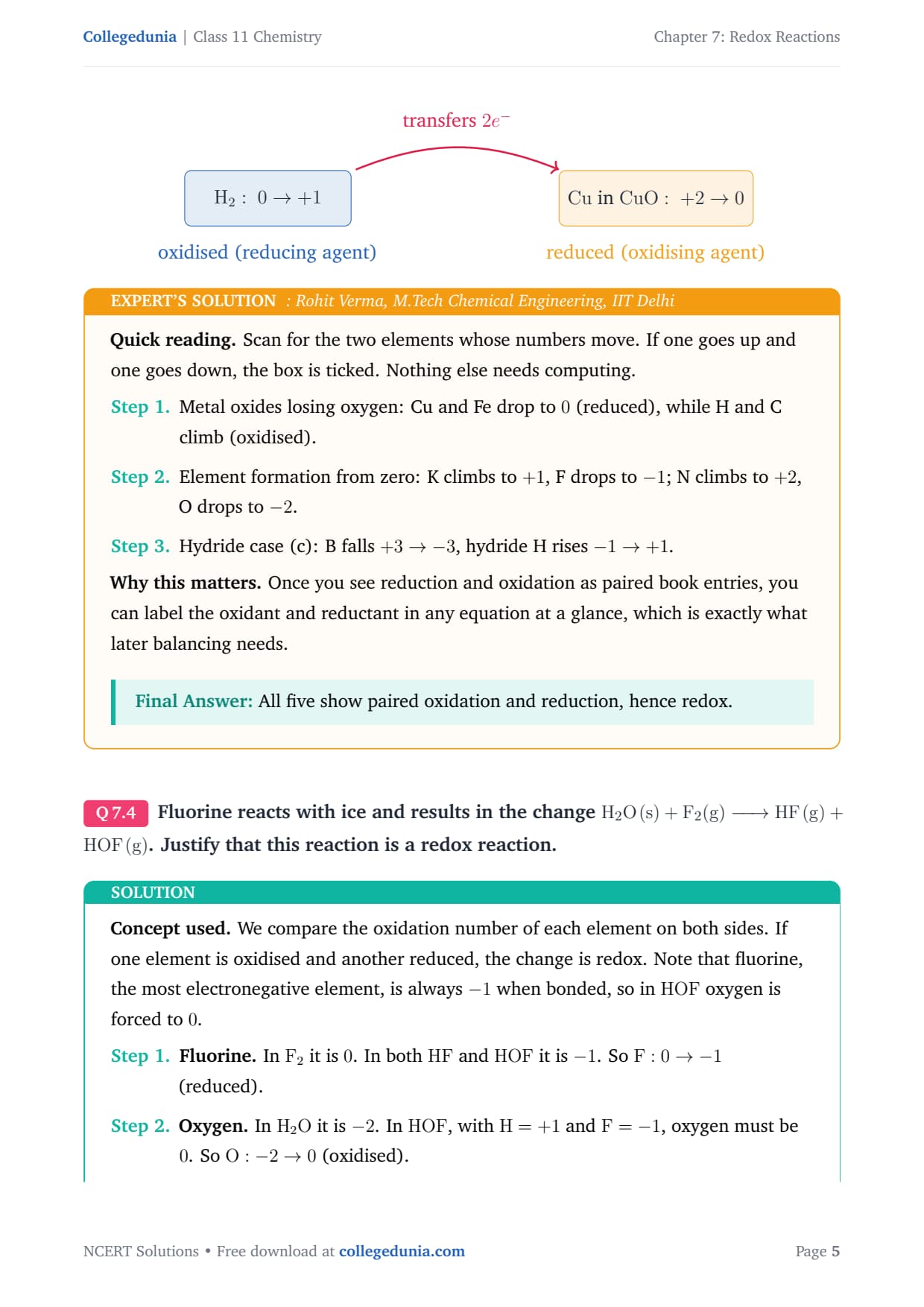
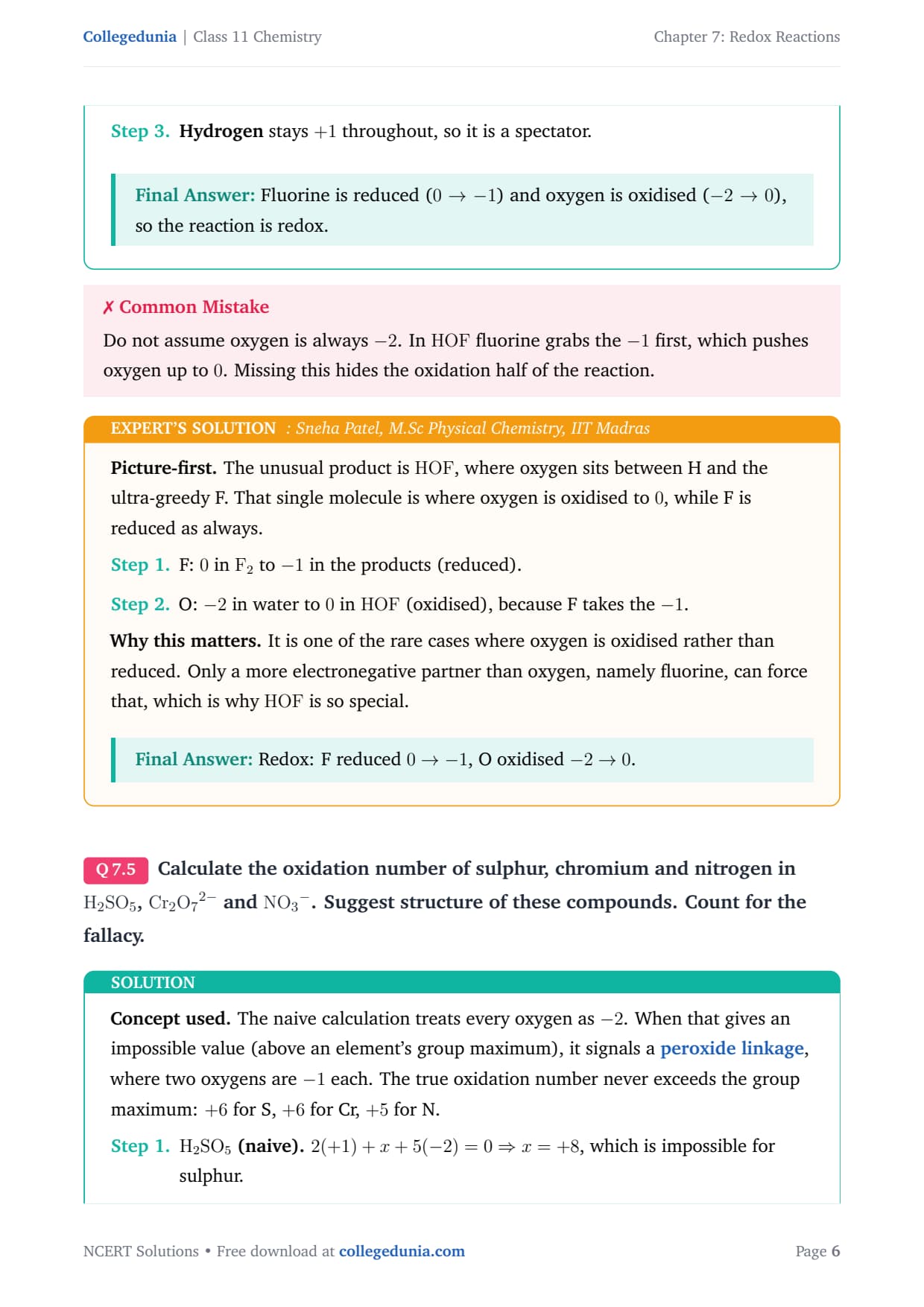
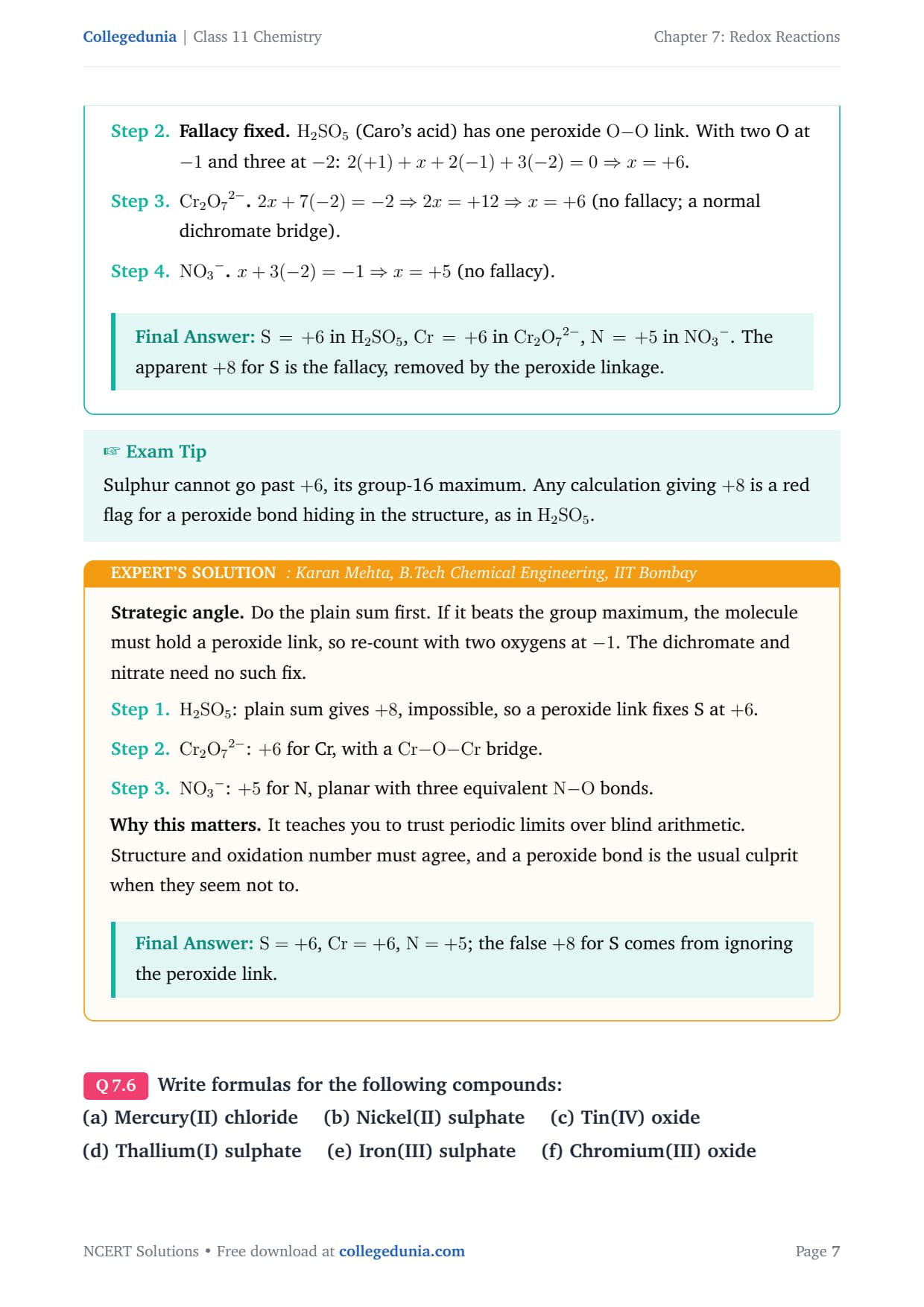
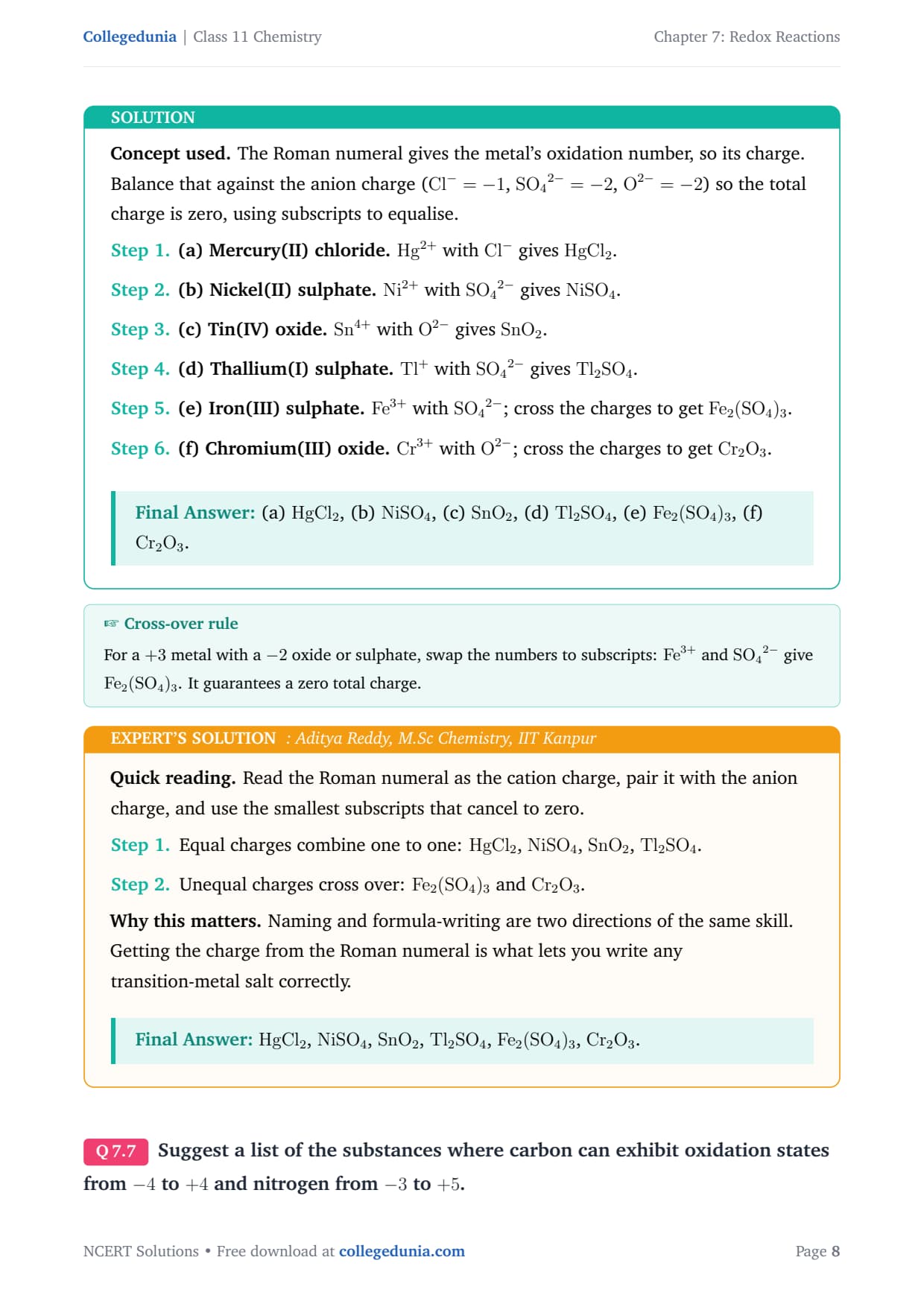
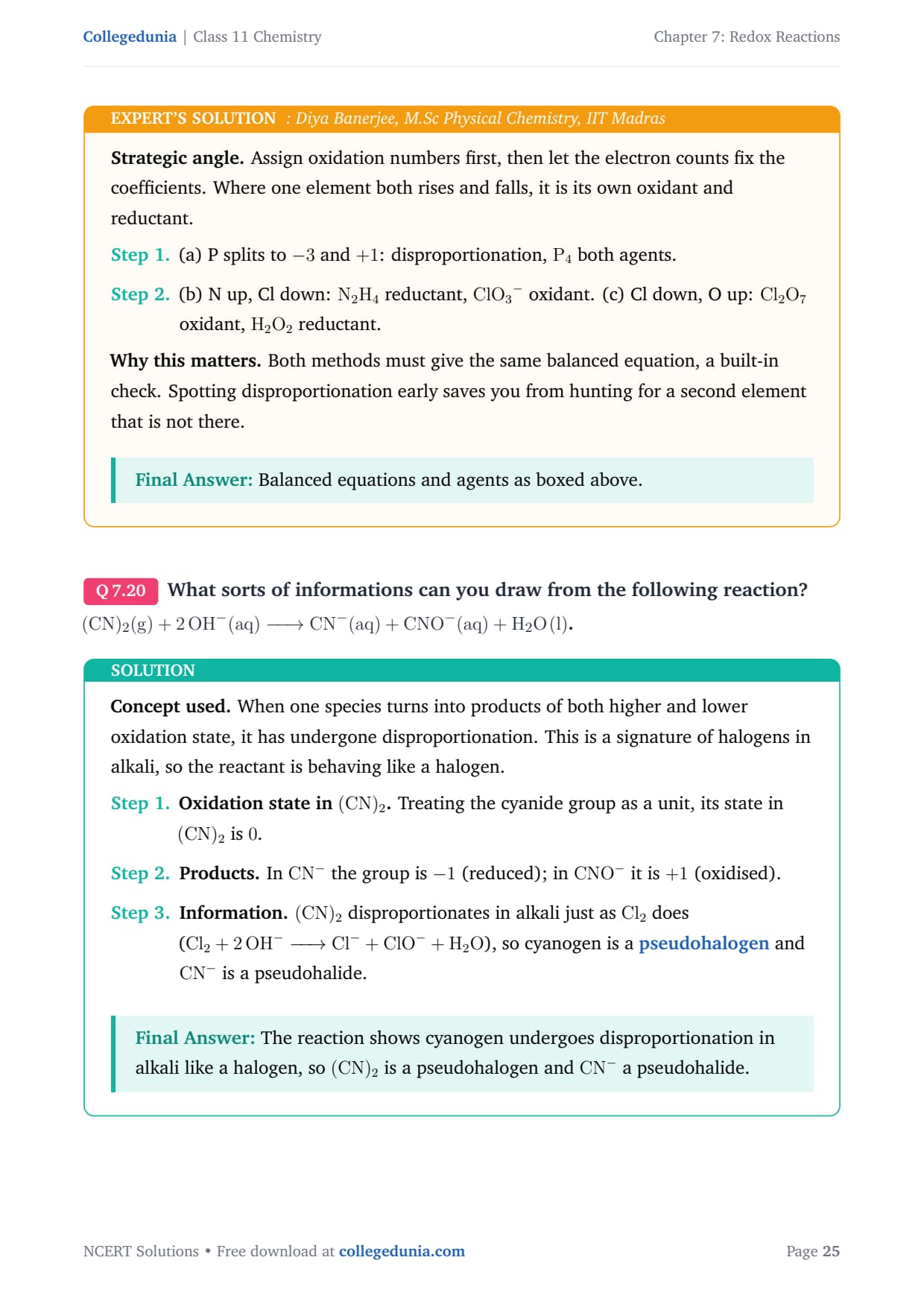
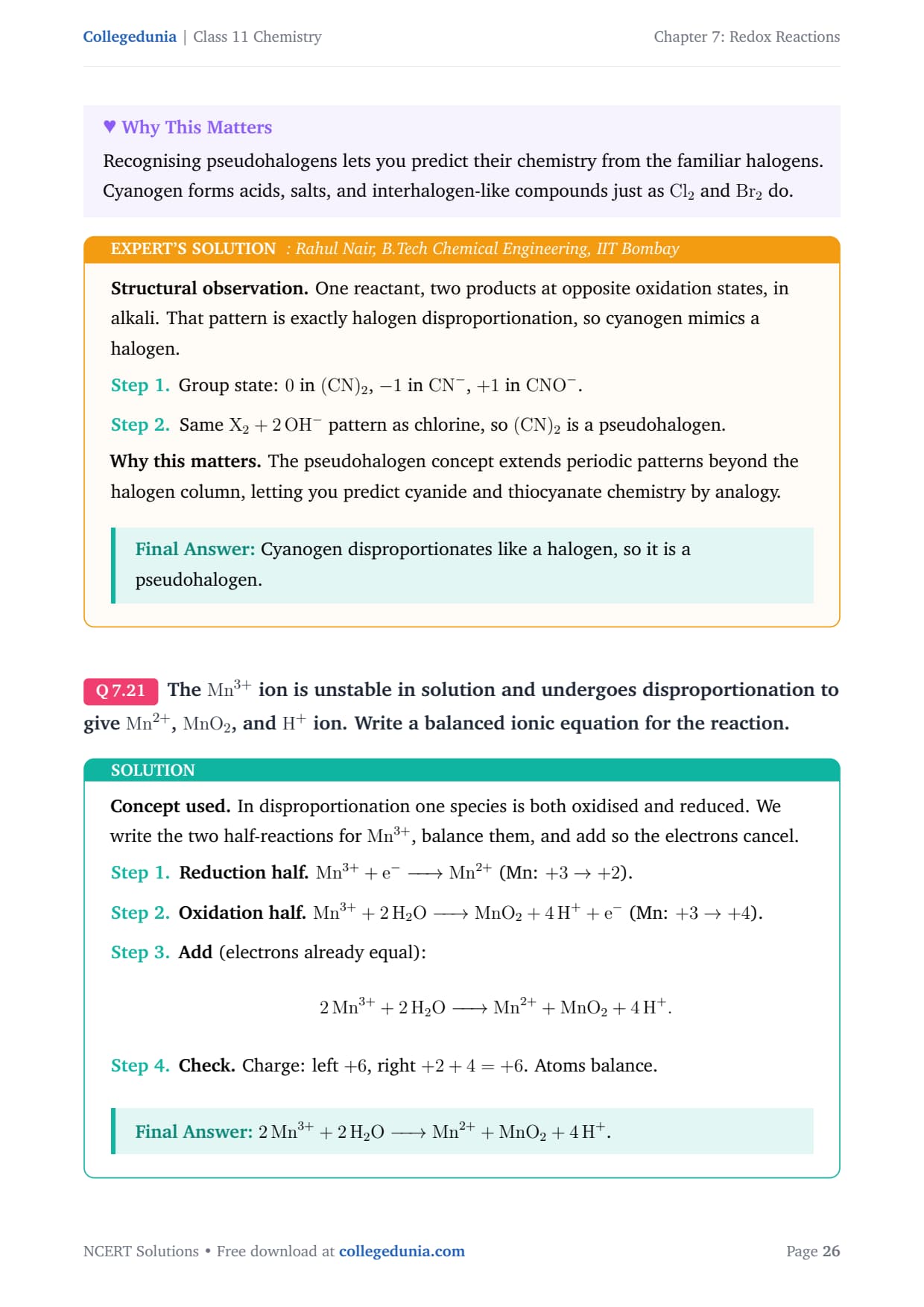
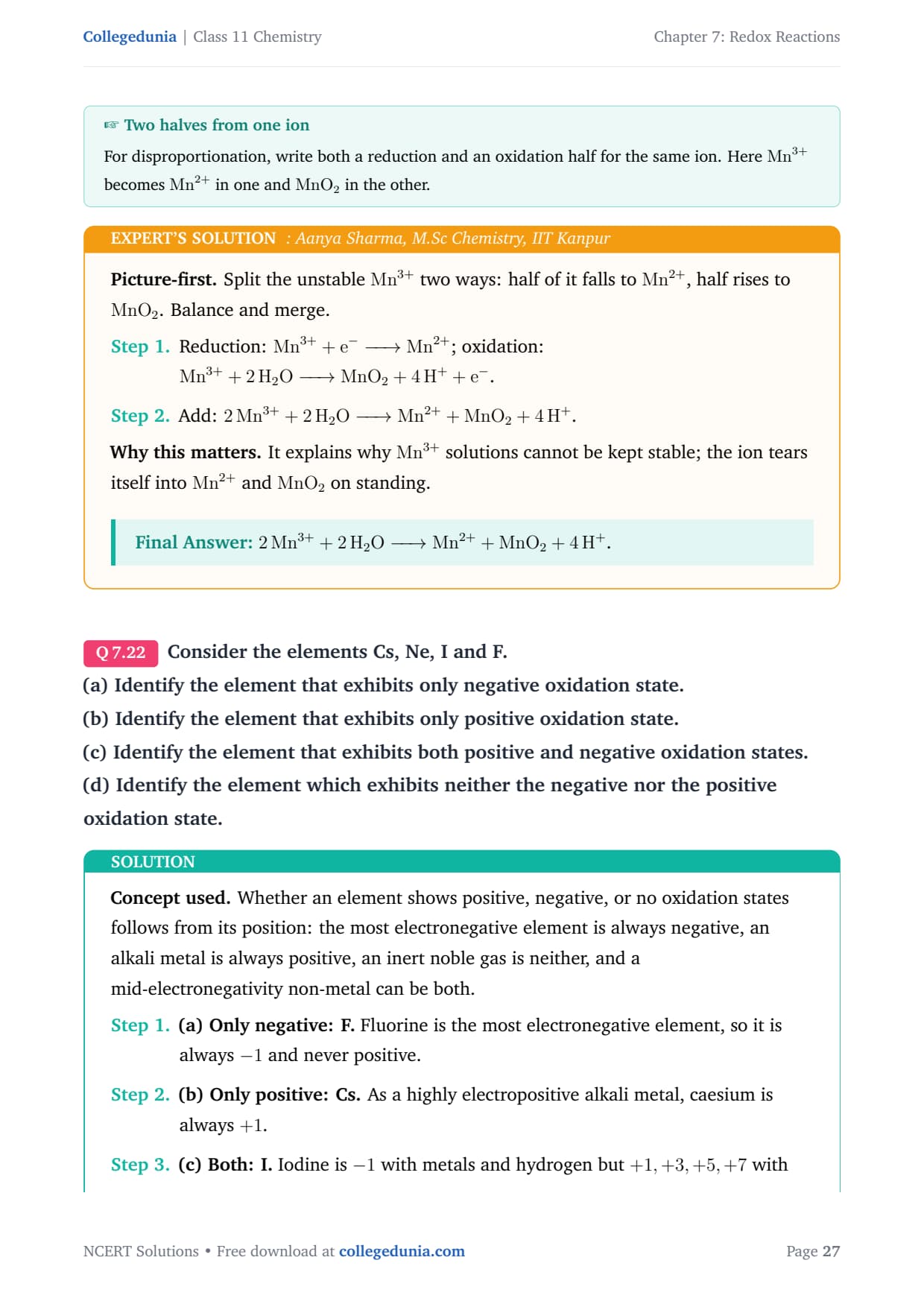
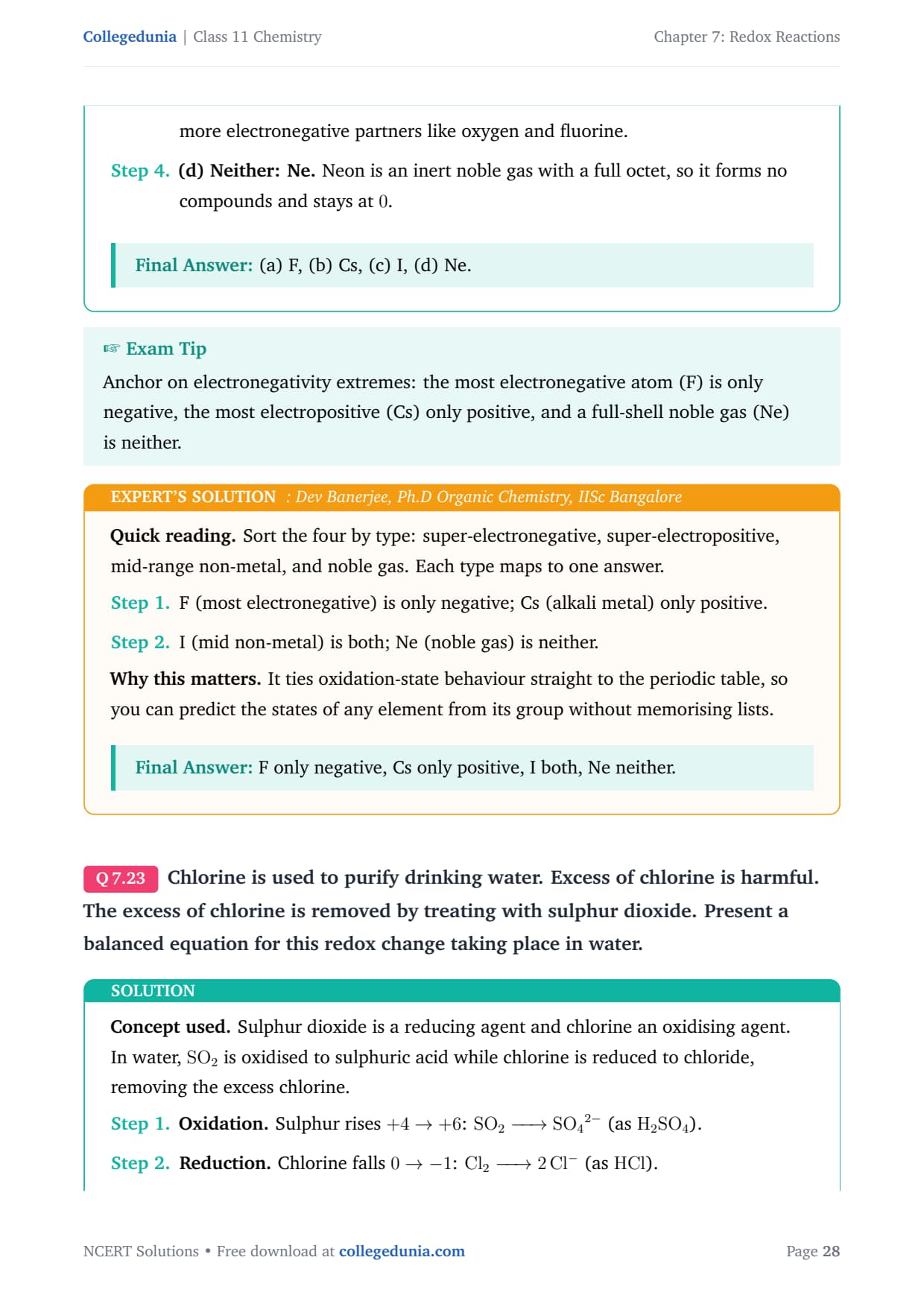
This chapter turns the vague idea of "loss and gain" into exact rules you can score with, and those rules return in electrochemistry in Class 12.
- CBSE Weightage: 6 to 7 marks, part of the Physical Chemistry unit that carries most numerical questions.
- Topics covered: classical and electronic redox concepts, oxidation number, types of redox reactions, balancing methods, redox titrations, and electrode processes.
- Exercise count: 33 back-exercise questions plus intext questions, mixing theory with balancing and titration numericals.
These class 11 chemistry NCERT solutions chapter 7 Redox Reactions are curated by subject experts, based on the 2026-27 NCERT textbook, and checked against the last five years of CBSE Board, JEE Main and NEET papers.
Why Redox Reactions Matter and What the Chapter Covers
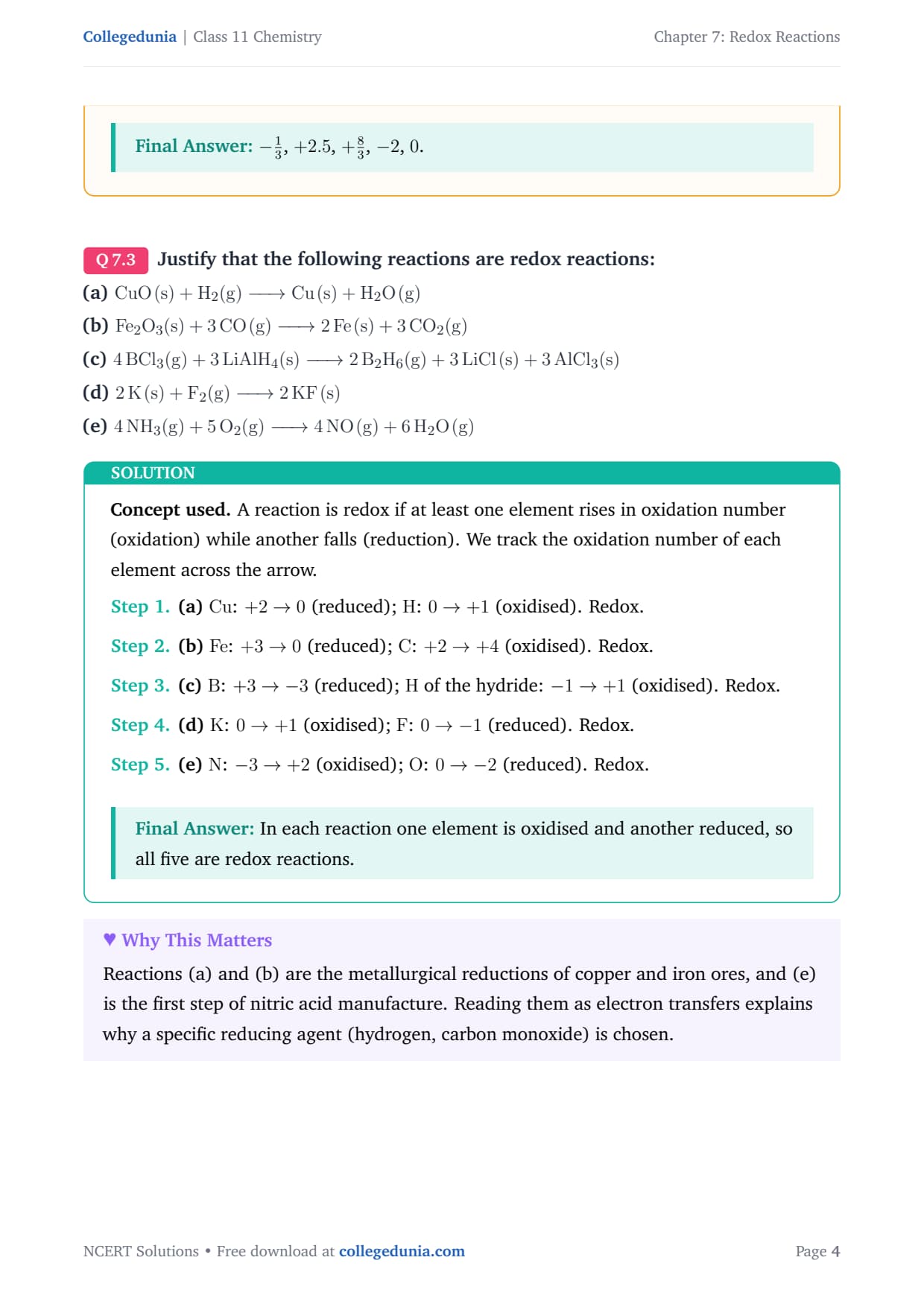
A redox reaction is any reaction where electrons move from one species to another. Rusting, respiration, batteries, and burning fuel are all redox changes. This chapter gives you the tools to spot the electron transfer and put numbers on it.
- Everyday role: redox runs cell respiration, corrosion of metals, bleaching, and every battery you use.
- Core skill: tracking which atom loses electrons and which gains them, using oxidation numbers.
- Why it matters: the electron-transfer idea here becomes the electrochemical cell and electrode potential in Class 12.
Oxidation and reduction always happen together, never alone. One species cannot lose electrons unless another gains them, which is why we call the reaction "redox". The class 11 chemistry NCERT solutions chapter 7 Redox Reactions below follow the same order as the NCERT textbook.
Classical and Electronic Concepts of Oxidation and Reduction
The meaning of oxidation and reduction has grown wider over time. The classical concept talks about oxygen and hydrogen, while the electronic concept talks about electrons. The electron view is the one you use for the rest of the chapter.
| Process | Classical view | Electronic view |
|---|---|---|
| Oxidation | Addition of oxygen or removal of hydrogen | Loss of electrons |
| Reduction | Addition of hydrogen or removal of oxygen | Gain of electrons |
Take the reaction Zn + Cu2+ → Zn2+ + Cu. Zinc loses two electrons, so it is oxidised, while the copper ion gains them, so it is reduced. The species that gives up electrons is the reducing agent; the one that takes them is the oxidising agent. A helpful memory line is OIL RIG: Oxidation Is Loss, Reduction Is Gain.
Oxidation Number Rules and How to Assign It
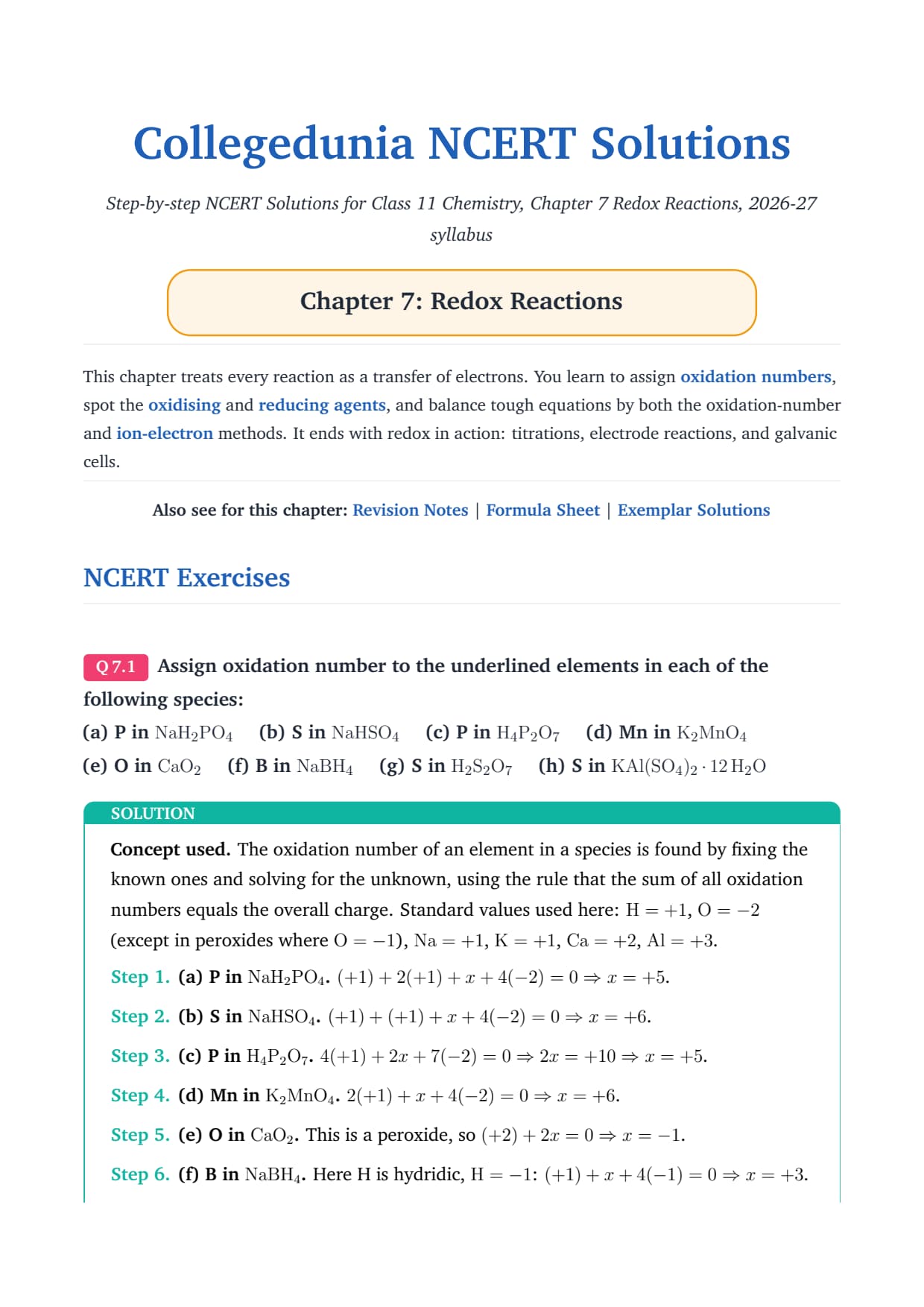
The oxidation number is the charge an atom would have if every bond were fully ionic. It lets you track electron transfer even in covalent compounds. Learning the rules in order is the fastest way to solve most exercise questions.
- A free element has an oxidation number of zero, such as O2 or Na.
- A monatomic ion equals its charge, so Na+ is +1 and Cl- is -1.
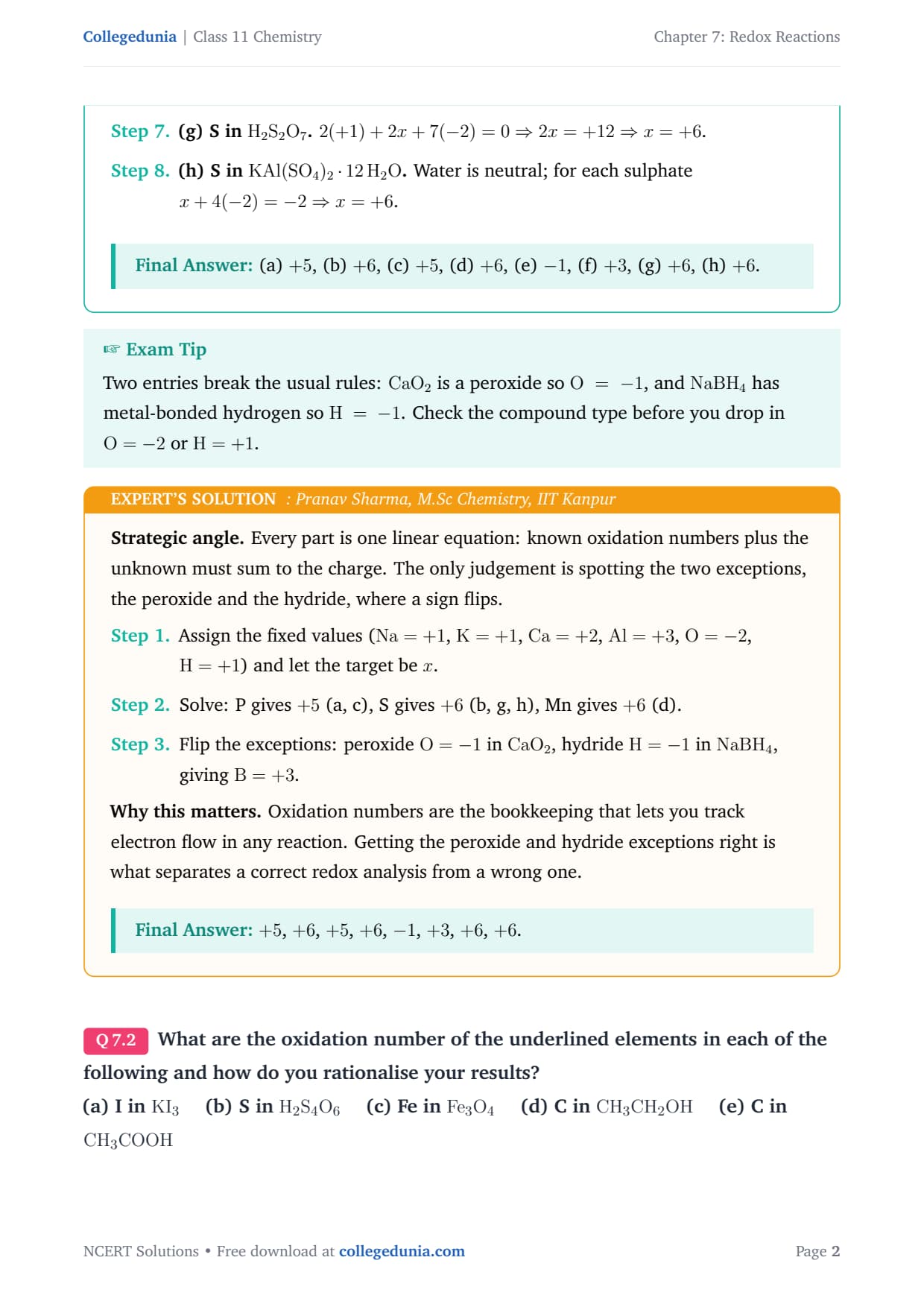
- Oxygen is usually -2, but -1 in peroxides and +2 in OF2.
- Hydrogen is usually +1, but -1 in metal hydrides like NaH.
- The sum of oxidation numbers equals the overall charge on the species.
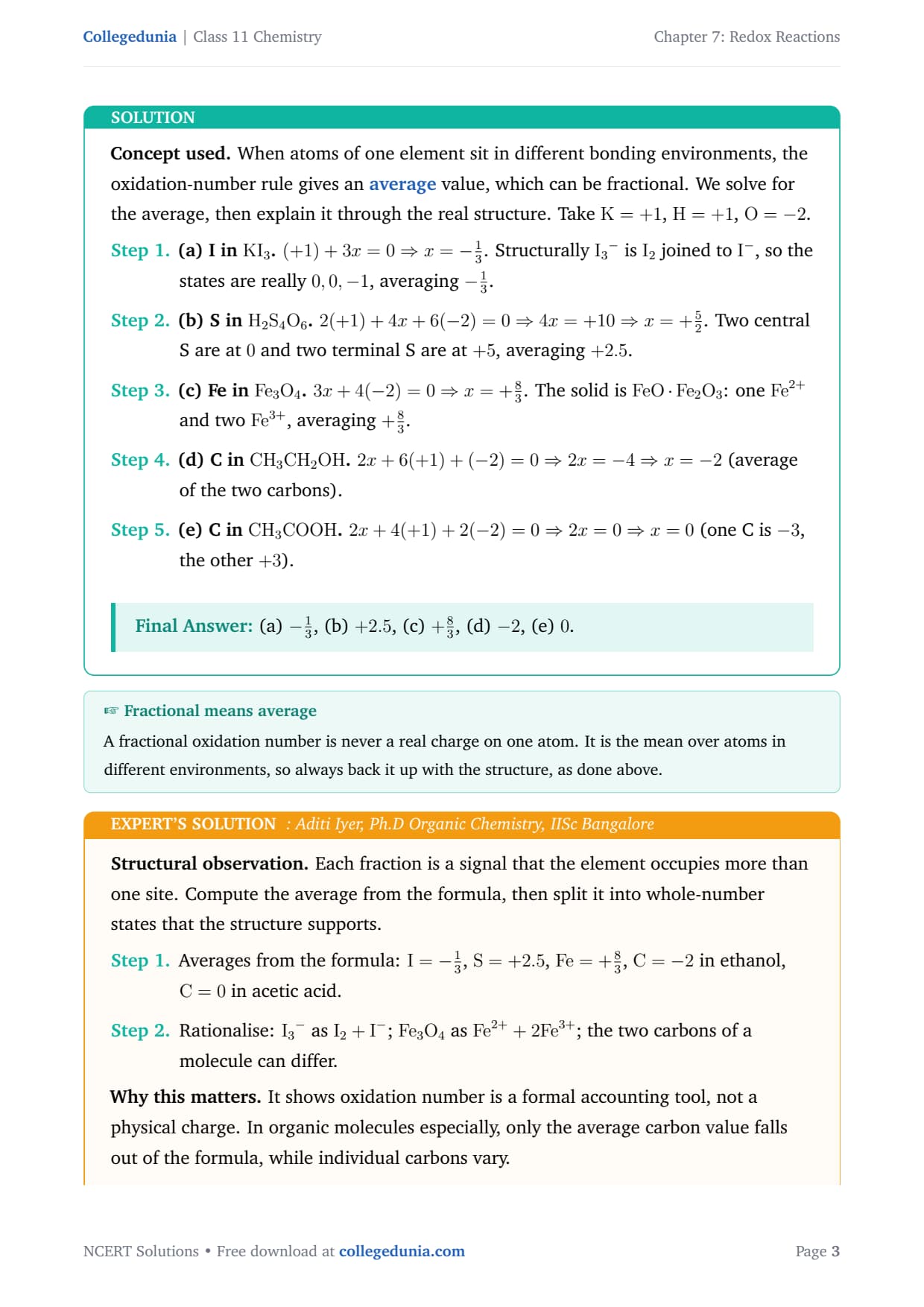
Use these rules to find sulphur in H2SO4: hydrogen gives +2, oxygen gives -8, so sulphur must be +6 to keep the molecule neutral. Always assign oxygen and hydrogen first, then solve for the unknown atom. Fractional oxidation numbers, such as +8/3 for iron in Fe3O4, simply mean the atoms are in different states averaged out.
Types of Redox Reactions Every Class 11 Student Must Know
NCERT groups redox changes into four clear types. Being able to name the type is a common one-mark question, and it also guides you on how to balance the equation.
| Type | What happens | Example |
|---|---|---|
| Combination | Two species join into one product | C + O2 → CO2 |
| Decomposition | One compound breaks into two or more products | 2H2O → 2H2 + O2 |
| Displacement | One element replaces another in a compound | Zn + CuSO4 → ZnSO4 + Cu |
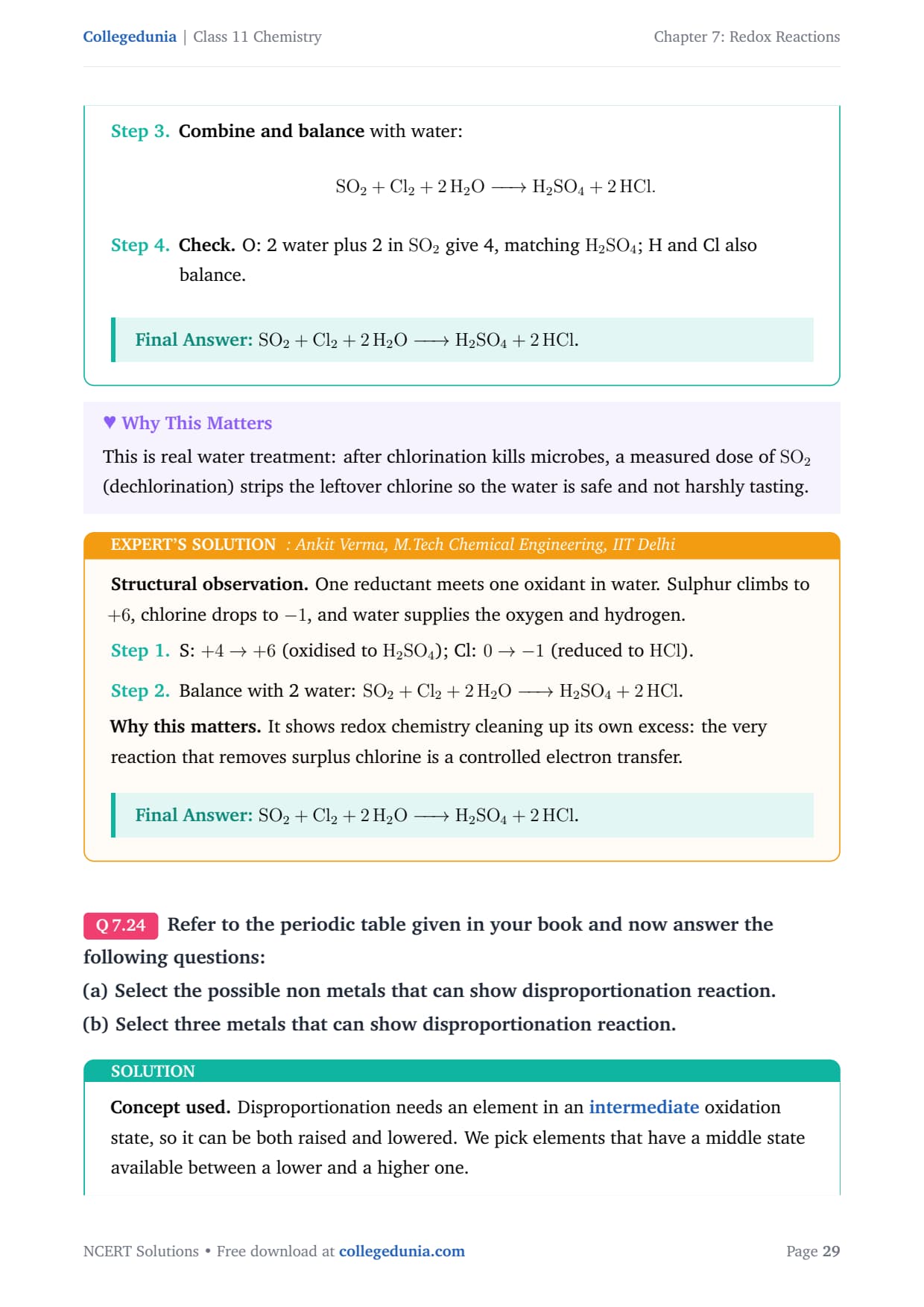
| Disproportionation | One element is both oxidised and reduced | 2H2O2 → 2H2O + O2 |
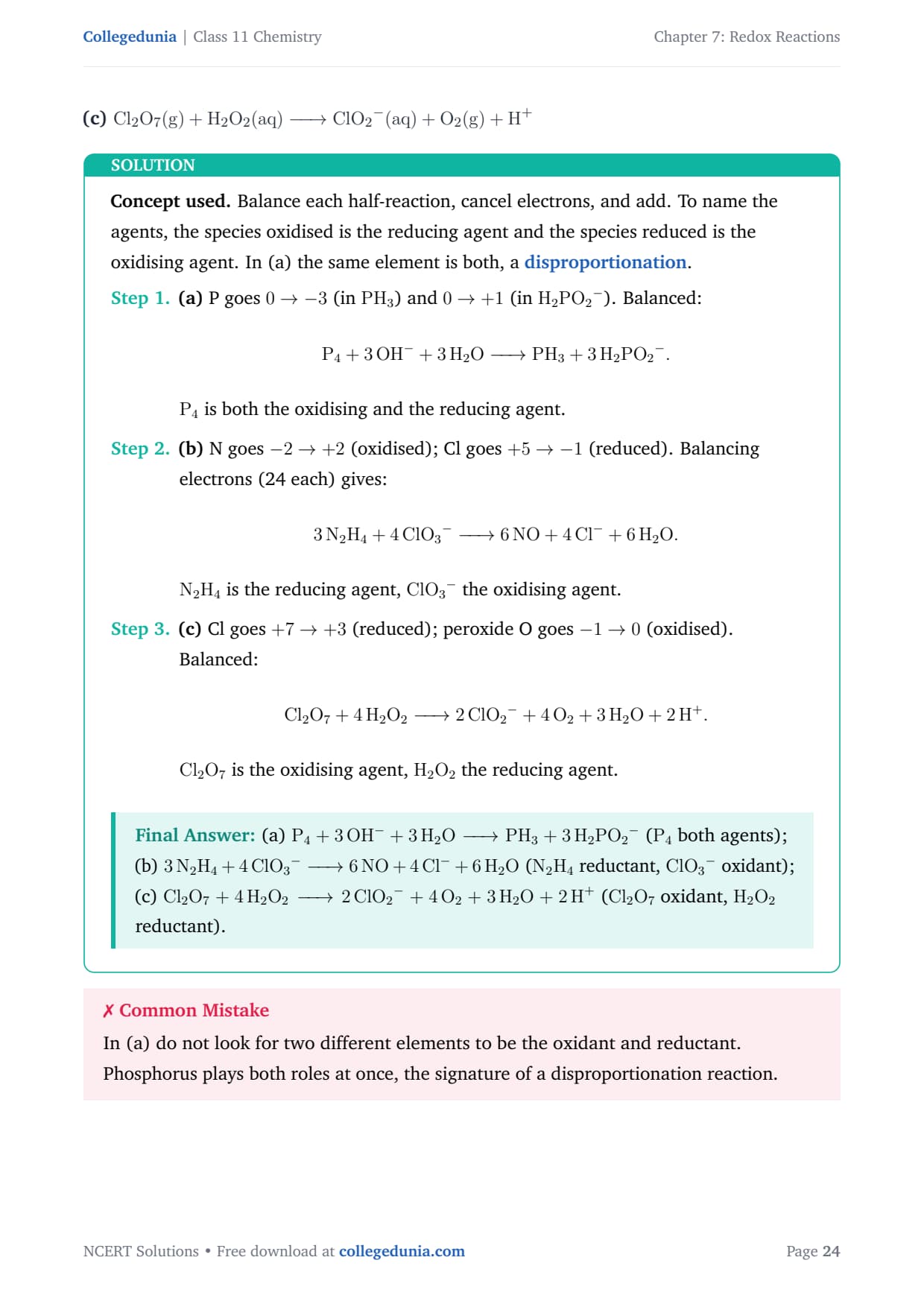
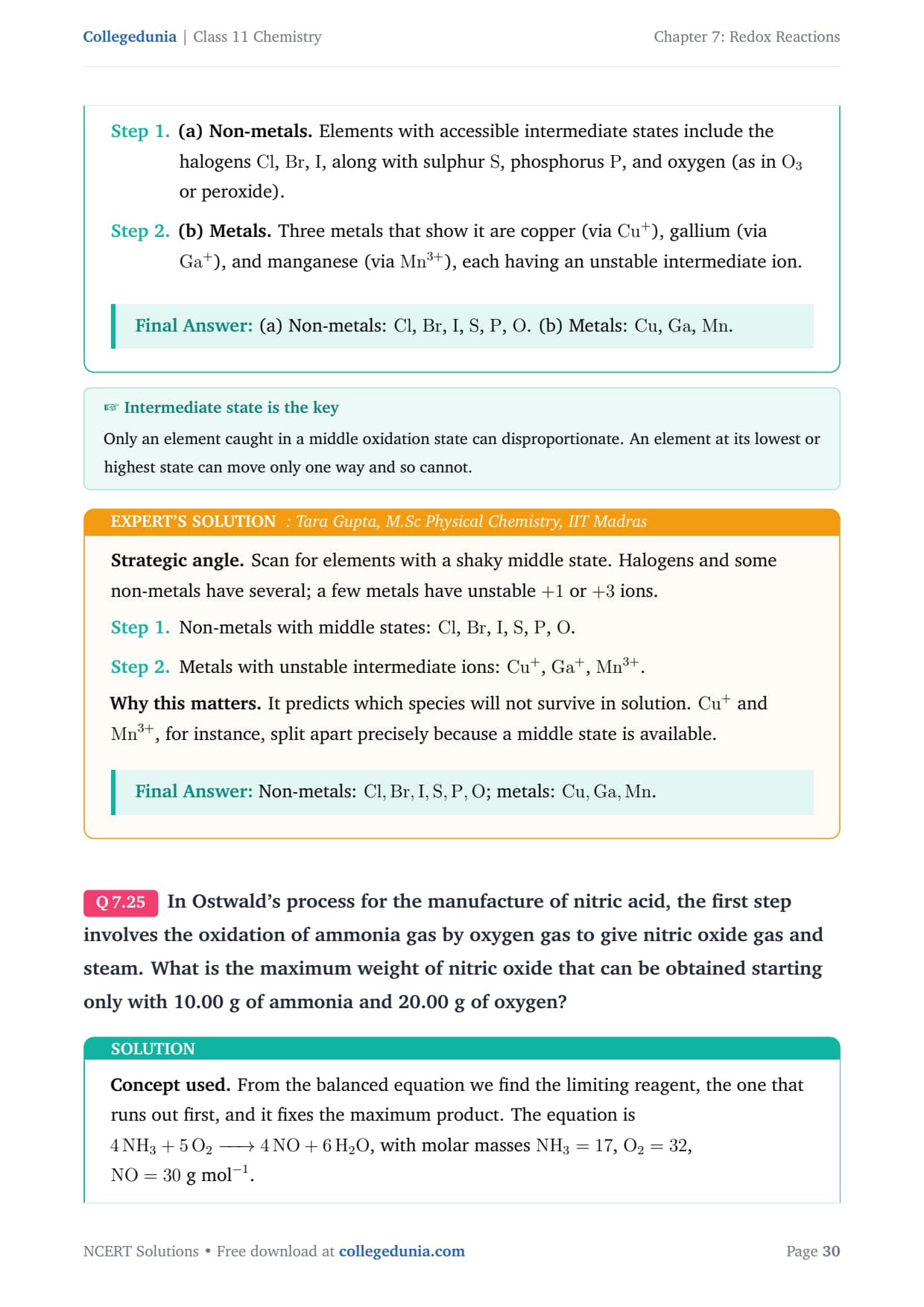
Disproportionation is the type most students miss, so learn it carefully. Here a single element in an intermediate oxidation state changes into two states, one higher and one lower. In the peroxide example, oxygen at -1 goes to -2 in water and to 0 in oxygen gas. Displacement further splits into metal displacement and non-metal displacement, both driven by the reactivity series.
Balancing Redox Equations by Oxidation Number and Half-Reaction Methods
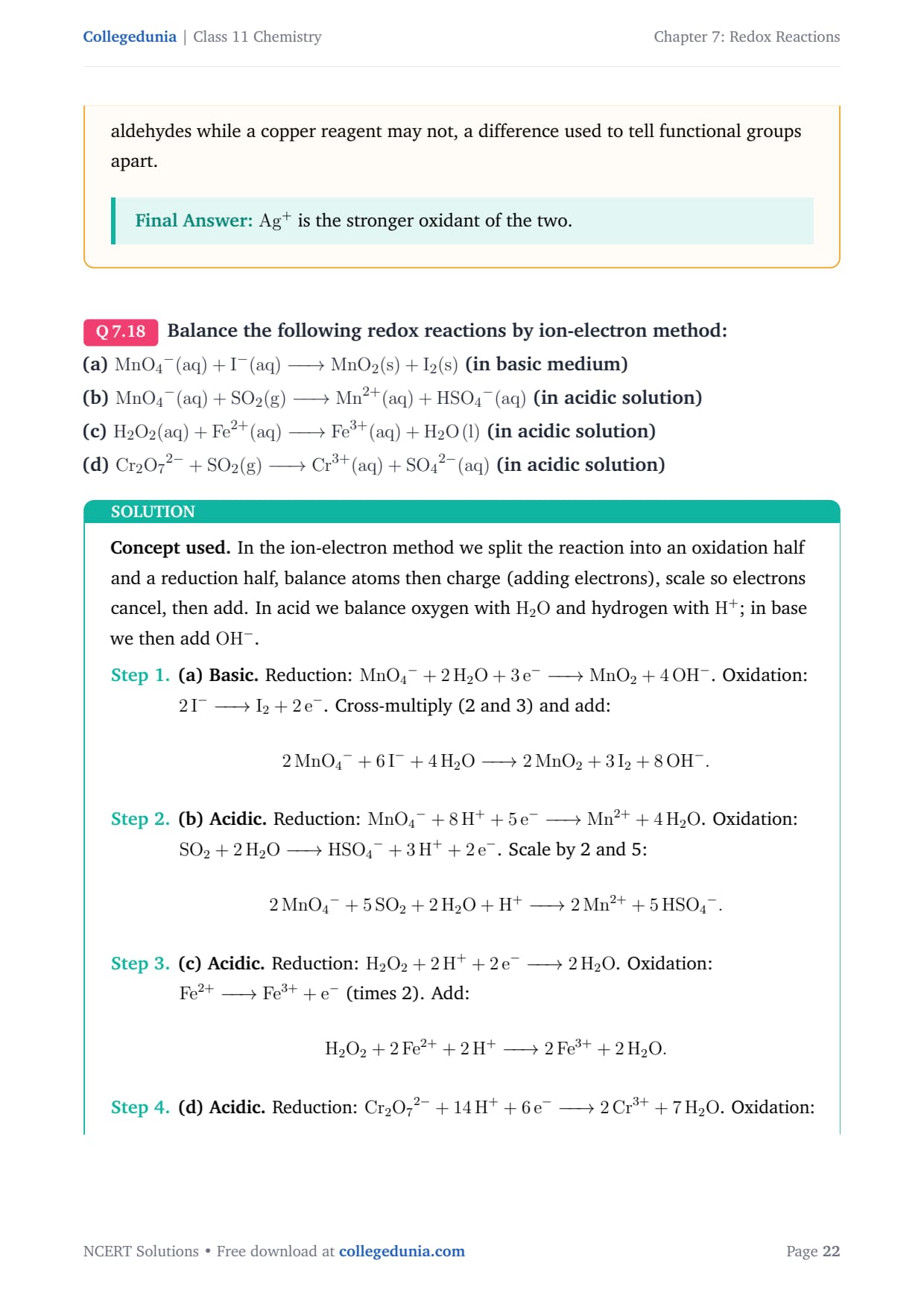
Two methods balance redox equations, and NCERT expects you to know both. The oxidation number method balances the change in oxidation number, while the half-reaction method balances two separate ion-electron equations. Most exercise questions ask for the half-reaction, or ion-electron, method.
- Split the reaction into an oxidation half and a reduction half.
- Balance atoms other than oxygen and hydrogen in each half.
- Balance oxygen using H2O, then hydrogen using H+ (acidic medium).
- Balance charge by adding electrons to each half.
- Multiply the halves so electrons cancel, then add them together.
In basic medium, add one extra step: for every H+ present, add an equal number of OH- to both sides and combine them into water. The number of electrons lost must equal the number gained, or the equation is not balanced. These class 11 chemistry NCERT solutions chapter 7 Redox Reactions balance the tricky MnO4- and Cr2O72- equations line by line so you can follow every step.
Redox Titrations and Their Applications
A redox titration measures the amount of a reducing or oxidising agent by reacting it with a standard solution of the other. The endpoint is often self-indicating, since the titrant changes colour when the reaction is complete. These appear as short numericals in the exercise.
- Permanganate titration: KMnO4 in acidic medium is deep purple and turns colourless as it reacts, so it is its own indicator.
- Dichromate titration: K2Cr2O7 is a stable primary standard used with an external indicator.
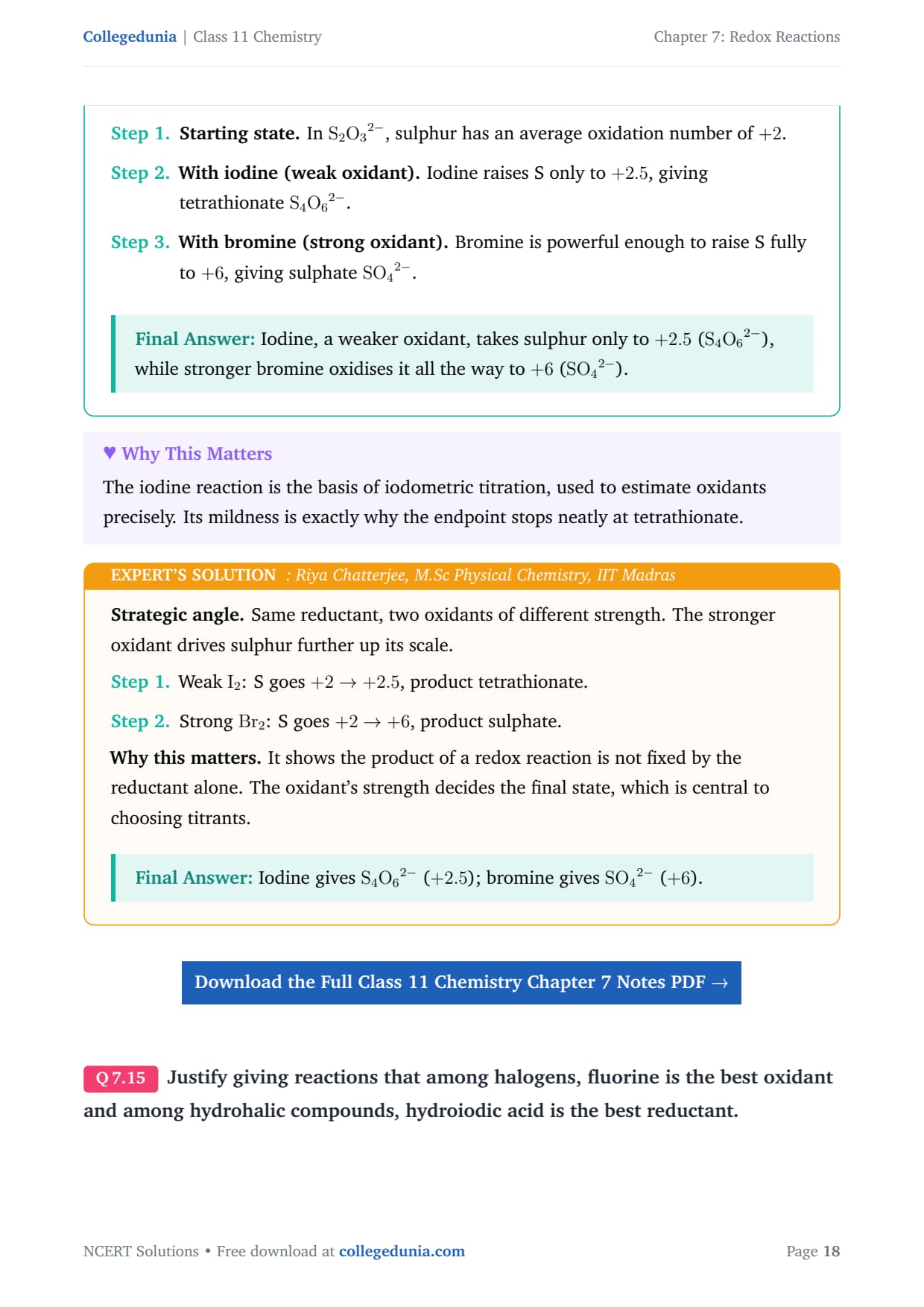
- Iodometric titration: iodine liberated in a reaction is titrated against sodium thiosulphate using starch near the endpoint.
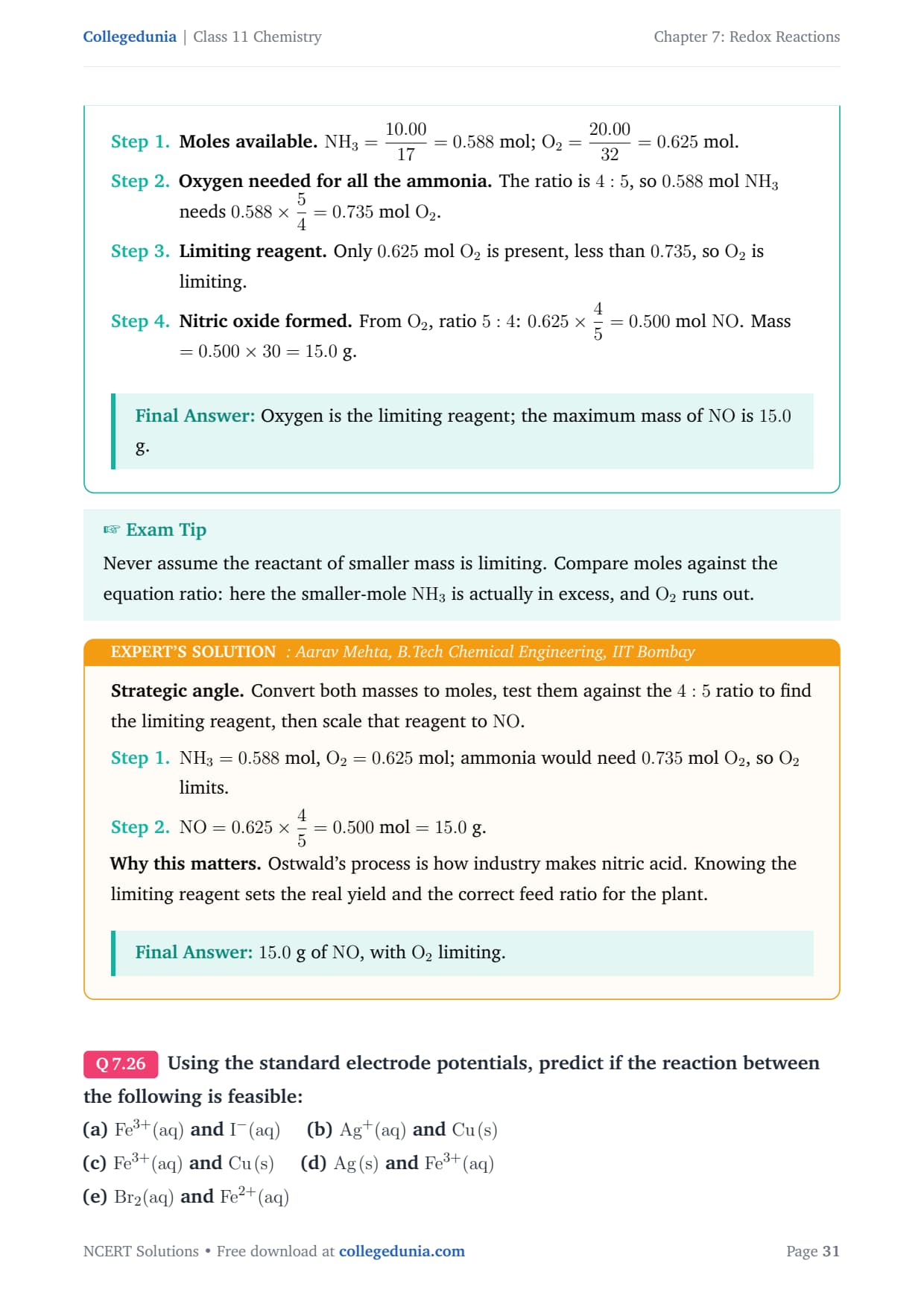
The calculation uses the mole ratio from the balanced redox equation, exactly like ordinary stoichiometry. For example, one mole of MnO4- gains five electrons, so it reacts with five moles of Fe2+. Balance the redox equation first, then read the mole ratio for the titration sum. Getting the electrons right is the whole battle in these questions.
Redox Reactions and Electrode Processes: Cells and EMF
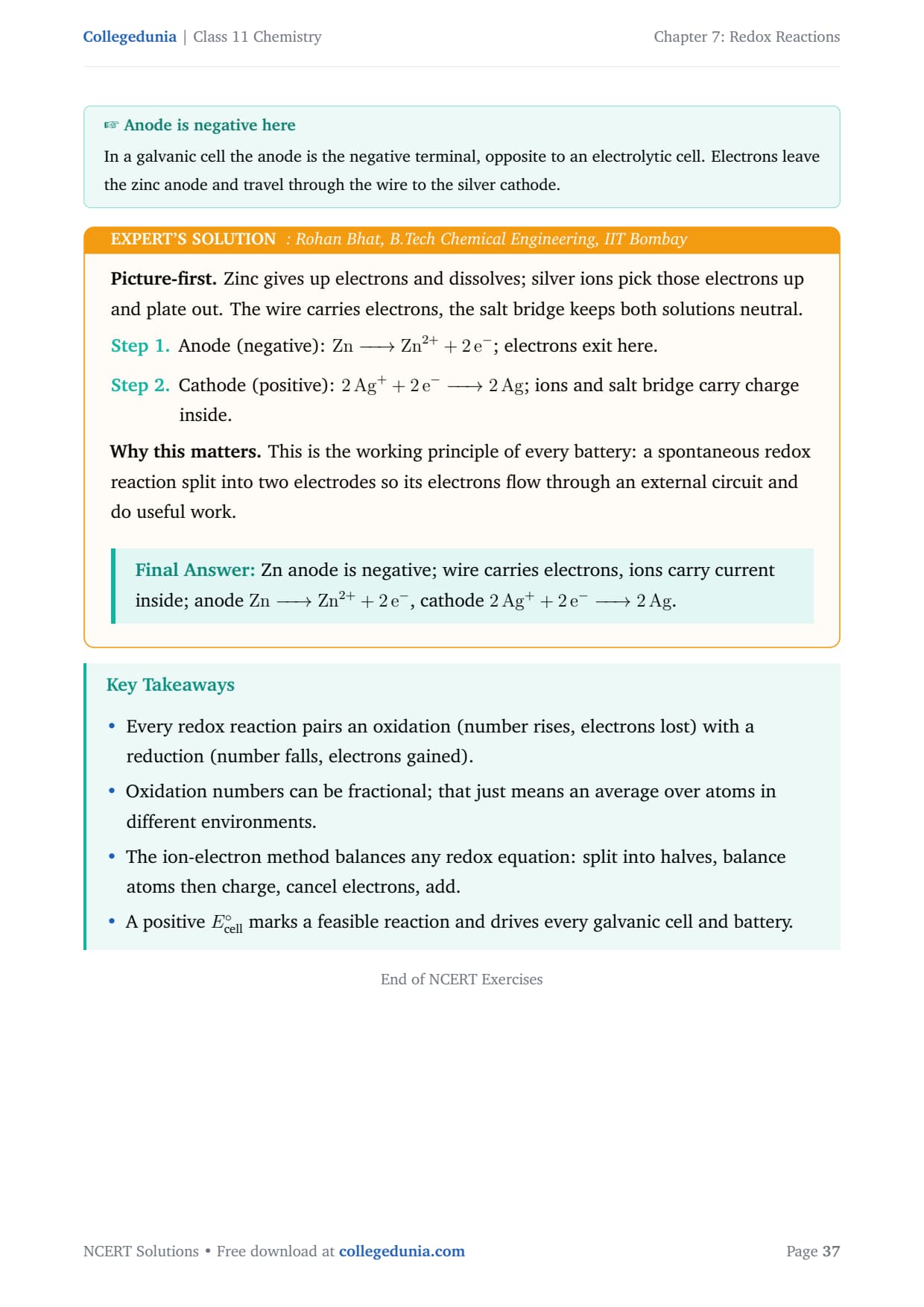
Every redox reaction can be split so the two halves happen at different places. When you do this in an electrochemical cell, the electron flow becomes an electric current. This section is the bridge to the Class 12 electrochemistry chapter.
- Oxidation half happens at the anode, the negative electrode in a galvanic cell.
- Reduction half happens at the cathode, the positive electrode in a galvanic cell.
- The push that drives the electrons is the cell potential, or EMF, measured in volts.
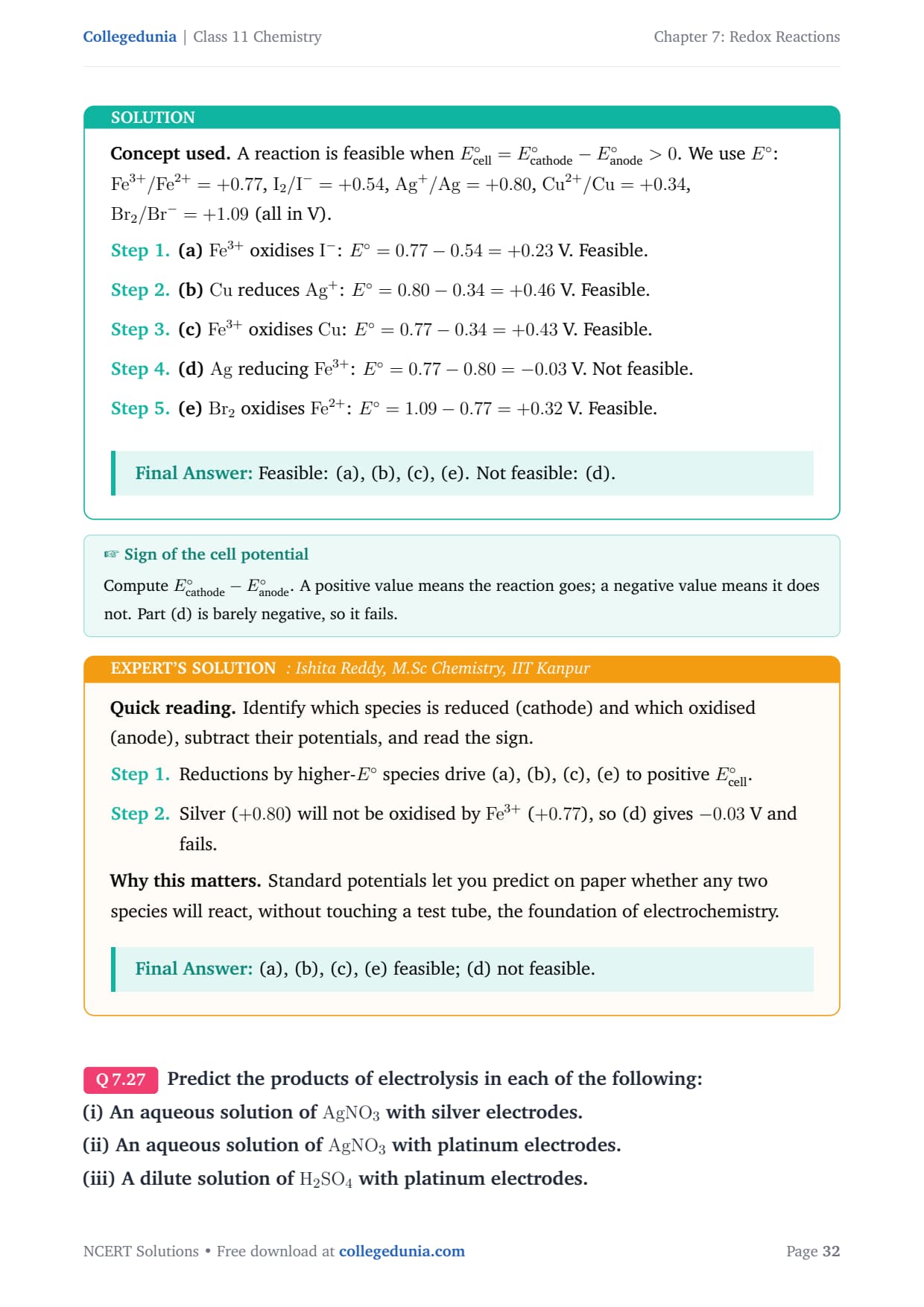
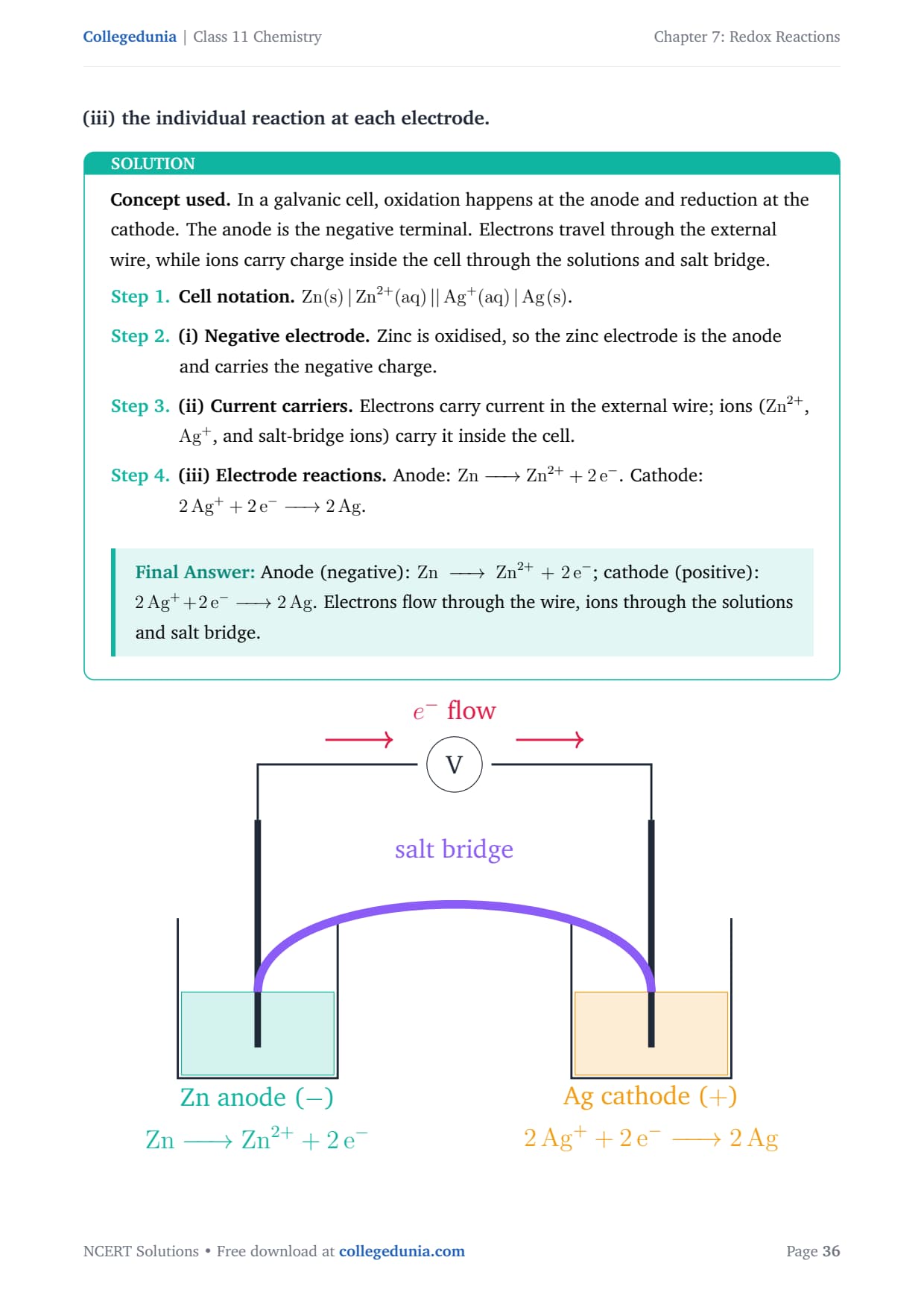
In the Daniell cell, zinc is oxidised at the anode and copper ions are reduced at the cathode, giving an EMF of about 1.1 V. The two electrodes are joined by a salt bridge that keeps the solutions neutral. A more positive standard electrode potential means a stronger tendency to get reduced. This idea of comparing electrode potentials is how you predict whether a redox reaction will happen at all.
Redox Reactions Exercise-wise Breakdown
The NCERT back exercise has 33 questions that mix theory, balancing, and titration numericals. The intext questions test the same ideas in shorter form. The table below maps the question blocks to their topics so you can plan your practice.
| Question block | What it tests |
|---|---|
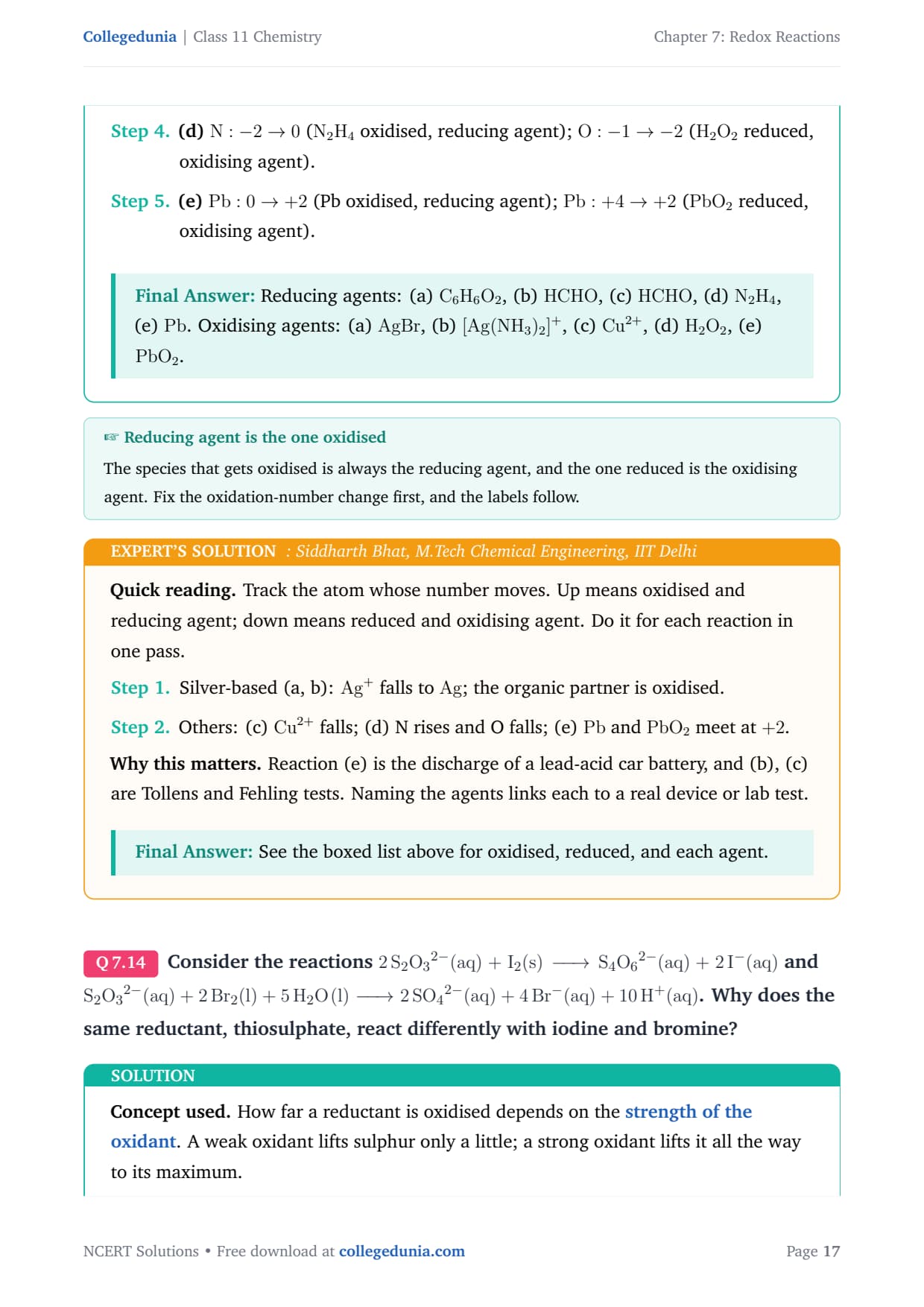
| Q 7.1 to 7.8 | Assigning oxidation numbers and identifying oxidised and reduced species. |
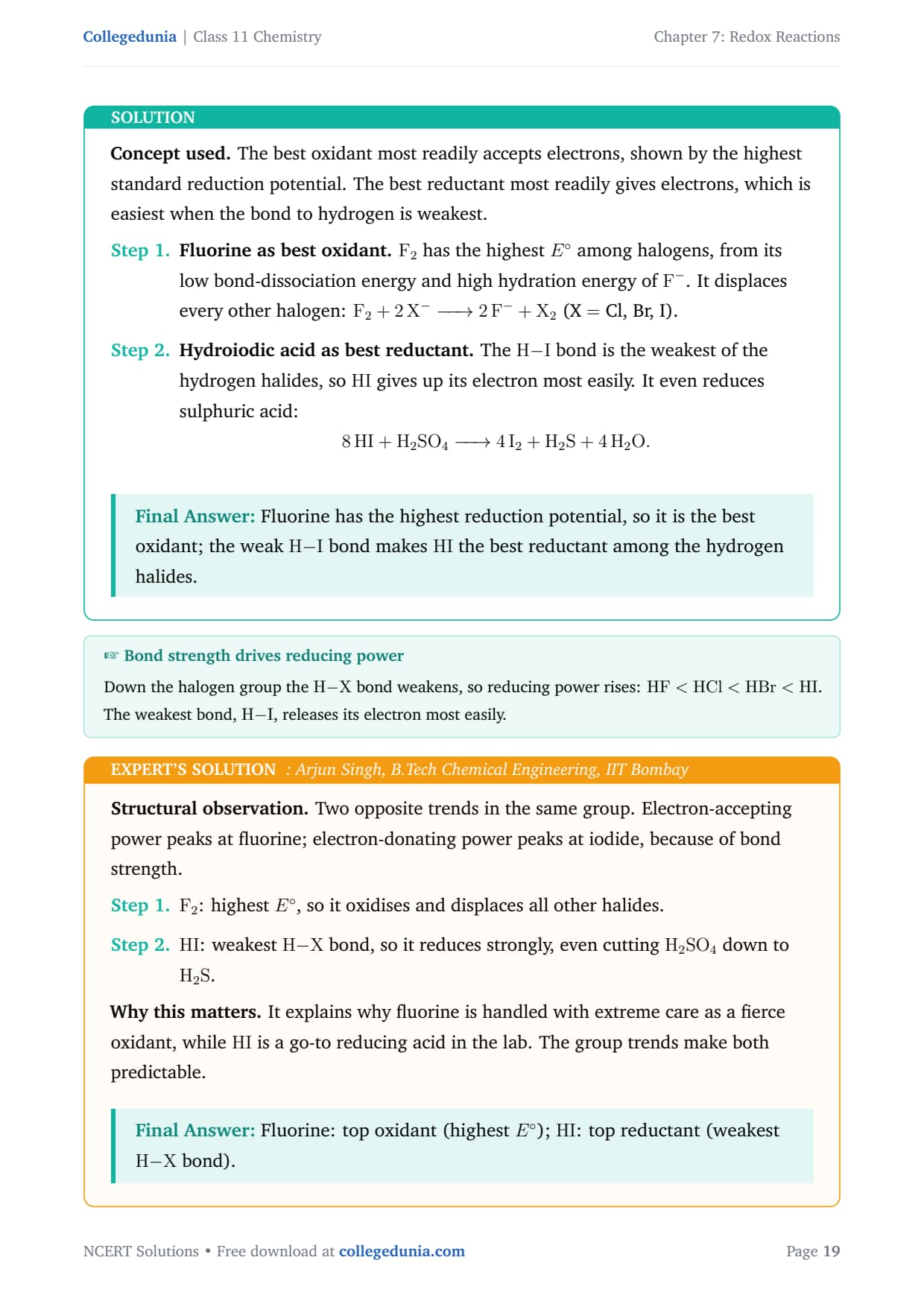
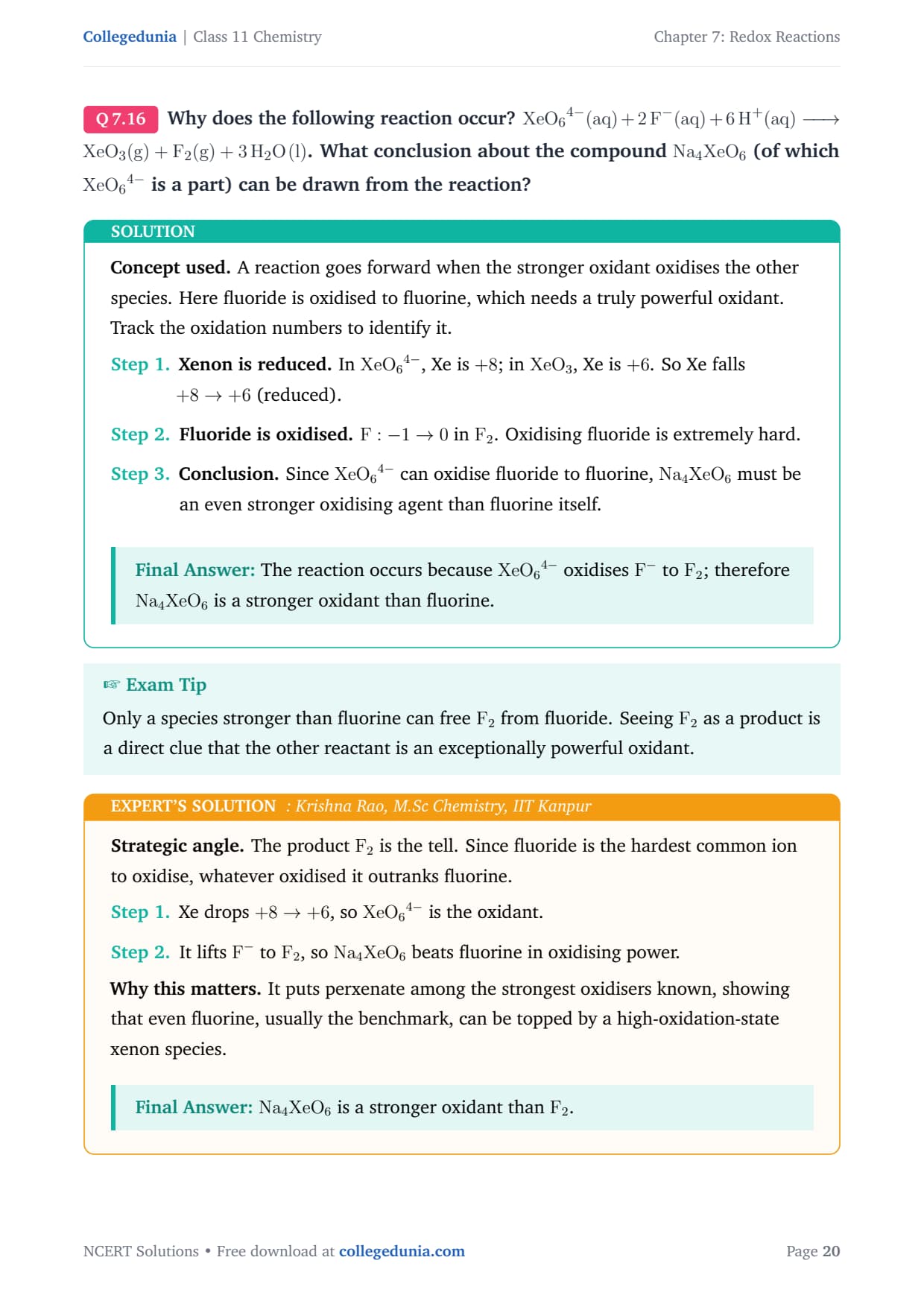
| Q 7.9 to 7.16 | Types of redox reactions, including disproportionation and displacement. |
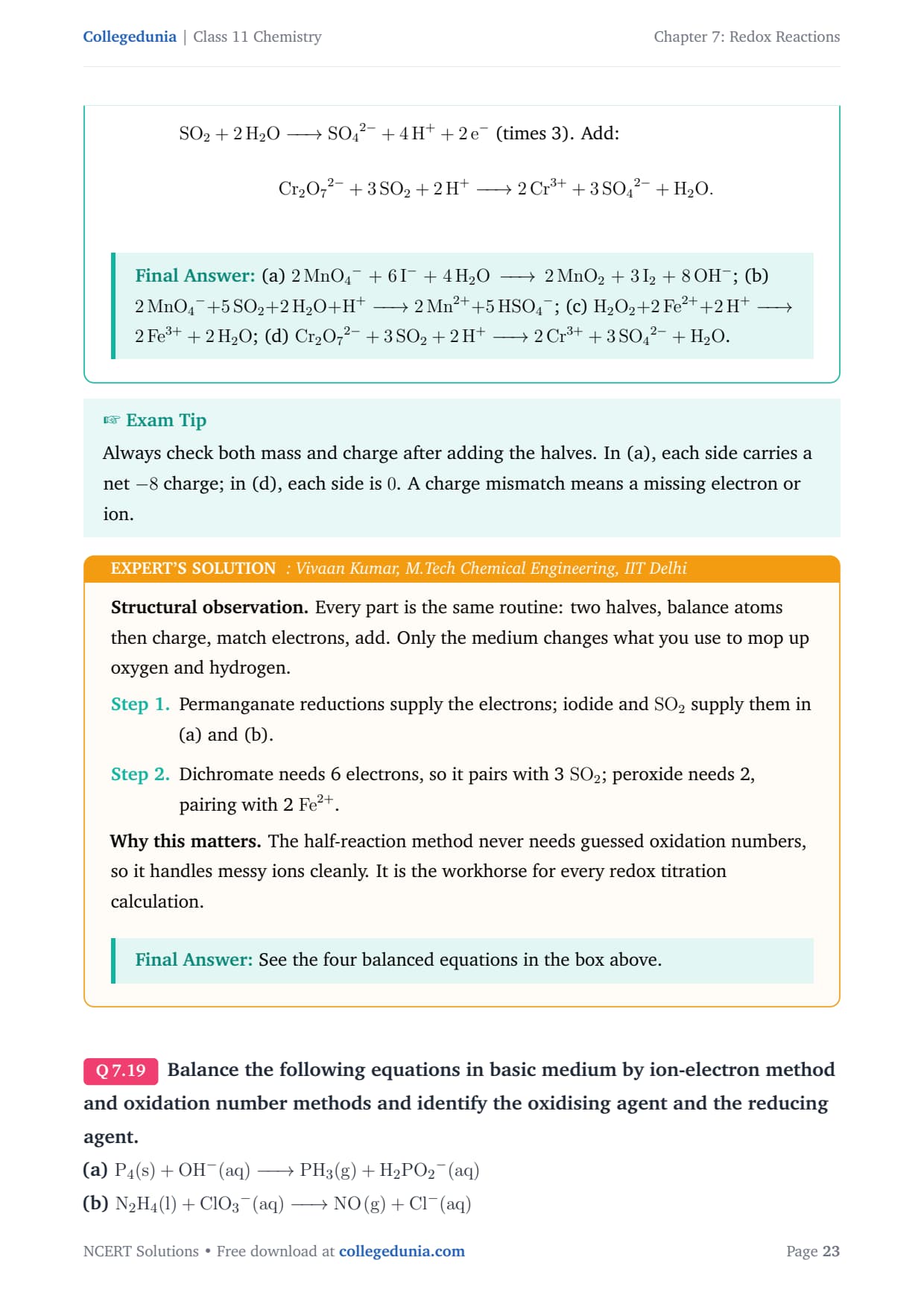
| Q 7.17 to 7.25 | Balancing redox equations by the oxidation number and half-reaction methods. |
| Q 7.26 to 7.33 | Redox titrations, electrode processes, and electrode potential comparisons. |
The intext questions before the exercise are shorter and check one idea each, such as finding an oxidation number or naming the redox type. Solve the intext set first, then the back exercise. Every question in the class 11 chemistry NCERT solutions chapter 7 Redox Reactions PDF is solved with each step shown, so you can compare your working line by line.
Practice the solved questions: Work through the full question bank with step-by-step answers and expert tips.
Common Mistakes Students Make in the Redox Reactions Chapter
Most marks are lost on small habits, not on hard ideas. Each slip below costs 1 to 2 marks, so watch for them at the exact step.
Mistake 1: Forgetting that oxygen is -1 in peroxides and hydrogen is -1 in metal hydrides. Check the compound before assuming the usual value.
Mistake 2: Not balancing electrons before adding the two half-reactions. The electrons lost must equal the electrons gained.
Mistake 3: Missing disproportionation, where one element is both oxidised and reduced in the same reaction.
Mistake 4: Swapping anode and cathode. Oxidation is always at the anode, reduction always at the cathode.
Student Feedback on the Redox Reactions Solutions
What 12,480 students told us about their Redox Reactions preparation:
- 61% of students rated balancing redox equations by the half-reaction method as the hardest part of the chapter.
- Most-skipped step: adding OH- to convert an acidic-medium balance into basic medium, missed by about 3 in 10 students.
- Students who learned the oxidation number rules first said the balancing questions became much easier.
Source: 2026-27 Class 11 Chemistry student poll. Sample of 12,480 students from CBSE schools across 15 states, conducted before the 2026 boards.
Other Redox Reactions Class 11 Chemistry Resources
Pair these solutions with the revision notes and the NCERT textbook PDF for the same chapter.
| Resource | Link |
|---|---|
| NCERT Notes | Redox Reactions Class 11 Notes |
| NCERT Book PDF | Redox Reactions Class 11 Book PDF |
NCERT Solutions for Class 11 Chemistry: All Chapters
Jump to the step-by-step solutions for any other Class 11 Chemistry chapter below.
| Chapter | NCERT Solutions |
|---|---|
| Chapter 1 | Some Basic Concepts of Chemistry |
| Chapter 2 | Structure of Atom |
| Chapter 3 | Classification of Elements and Periodicity in Properties |
| Chapter 4 | Chemical Bonding and Molecular Structure |
| Chapter 5 | Thermodynamics |
| Chapter 6 | Equilibrium |
| Chapter 7 | Redox Reactions |
| Chapter 8 | Organic Chemistry Some Basic Principles and Techniques |
| Chapter 9 | Hydrocarbons |
FAQs on Redox Reactions Class 11 NCERT Solutions
Redox Reactions NCERT Solutions - Frequently Asked Questions
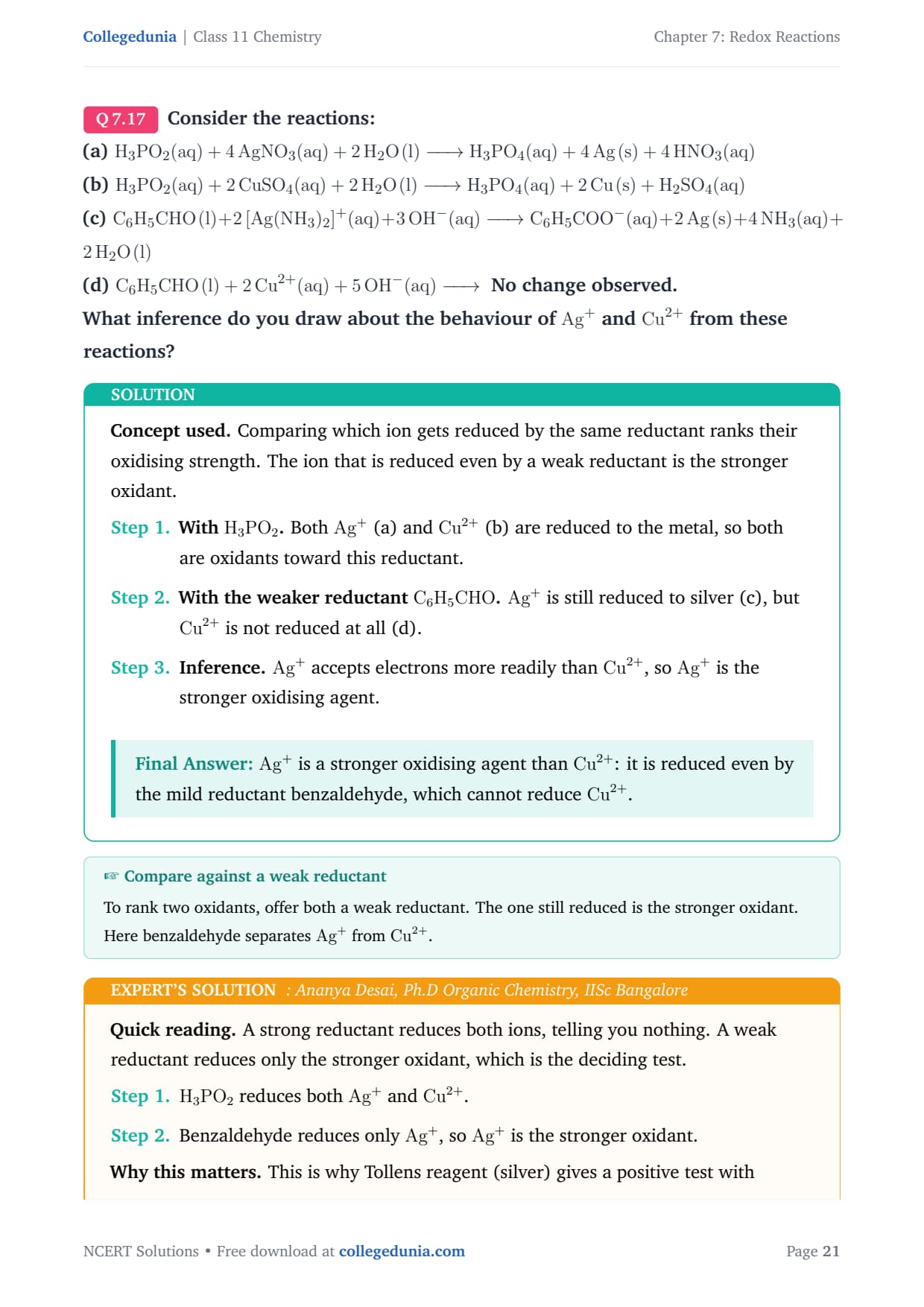
Ques. What do the class 11 chemistry NCERT solutions chapter 7 Redox Reactions cover?
Ans. These solutions cover all 33 back-exercise questions and the intext questions, including the classical and electronic concepts of oxidation and reduction, oxidation number rules, the four types of redox reactions, balancing by the oxidation number and half-reaction methods, redox titrations, and electrode processes such as EMF. Every question is solved step by step.
Ques. What is a redox reaction in Class 11 Chemistry Chapter 7?
Ans. A redox reaction is a reaction in which oxidation and reduction happen together. One species loses electrons and is oxidised, while another gains those electrons and is reduced. Because electron loss and gain always occur at the same time, the two changes are combined into one word, redox.
Ques. How do I assign an oxidation number?
Ans. Start with the fixed rules: a free element is 0, a monatomic ion equals its charge, oxygen is usually -2, and hydrogen is usually +1. Then use the fact that the oxidation numbers add up to the overall charge to find the unknown atom. For example, sulphur in H2SO4 works out to +6.
Ques. What is disproportionation in a redox reaction?
Ans. Disproportionation is a special redox reaction where a single element in an intermediate oxidation state changes into two different states, one higher and one lower. For example, in 2H2O2 → 2H2O + O2, oxygen at -1 goes to -2 in water and 0 in oxygen gas.
Ques. What is the difference between the oxidation number and half-reaction methods?
Ans. The oxidation number method balances the total increase and decrease in oxidation number across the equation. The half-reaction method splits the reaction into separate oxidation and reduction halves, balances atoms and charge in each, then adds them so electrons cancel. NCERT mainly uses the half-reaction, or ion-electron, method for exercise questions.
Ques. What is the weightage of Redox Reactions in CBSE Class 11?
Ans. Redox Reactions carries about 6 to 7 marks in the CBSE Class 11 Chemistry paper, through questions on oxidation numbers, balancing equations, and redox titrations. It is also tested in JEE Main and NEET, and it forms the base of the electrochemistry chapter you study in Class 12.



Comments