




The NCERT Solutions for Class 11 Fine Arts Chapter 5 Later Mural Traditions cover all 3 textbook exercise questions for the 2026-27 syllabus. Each answer helps students connect mural sites with dynasty, century, subject matter and style.
Student Feedback: In a Collegedunia check of more than 10,000 Class 11 Fine Arts students, most students found this chapter easier after arranging murals by dynasty and region.
Each answer in this Collegedunia PDF is written around the 2026-27 NCERT chapter and the exact three exercise questions.
- Question count: 3 descriptive NCERT exercise questions with expert-style answers.
- Focus areas: Badami, Vijayanagara, Tamil Nadu and Kerala mural traditions.
- Best use: revise site, dynasty, date and style cues before Fine Arts tests.
Later Mural Traditions NCERT Solutions: What the PDF Covers
The solutions explain the chapter through the same sequence NCERT follows. Students start with Badami and then move through Pallava, Pandya, Chola, Vijayanagara, Nayaka and Kerala murals.
| NCERT Question | Main Answer Cue | What to Mention |
|---|---|---|
| Badami cave paintings | Early Chalukya mural tradition | Vishnu Cave, palace scenes, Ajanta-like line and facial modelling |
| Vijayanagara paintings | Temple mural essay | Hampi, Lepakshi, epic panels, profile faces and frontal eyes |
| Kerala and Tamil Nadu murals | Regional comparison | Pallava, Pandya, Chola, Nayaka and Kerala temple-palace traditions |
Later Mural Traditions Explained for Class 11 Fine Arts
Source: PW OnlyIAS Prarambh on YouTube
Later Mural Traditions Timeline from Badami to Kerala Murals
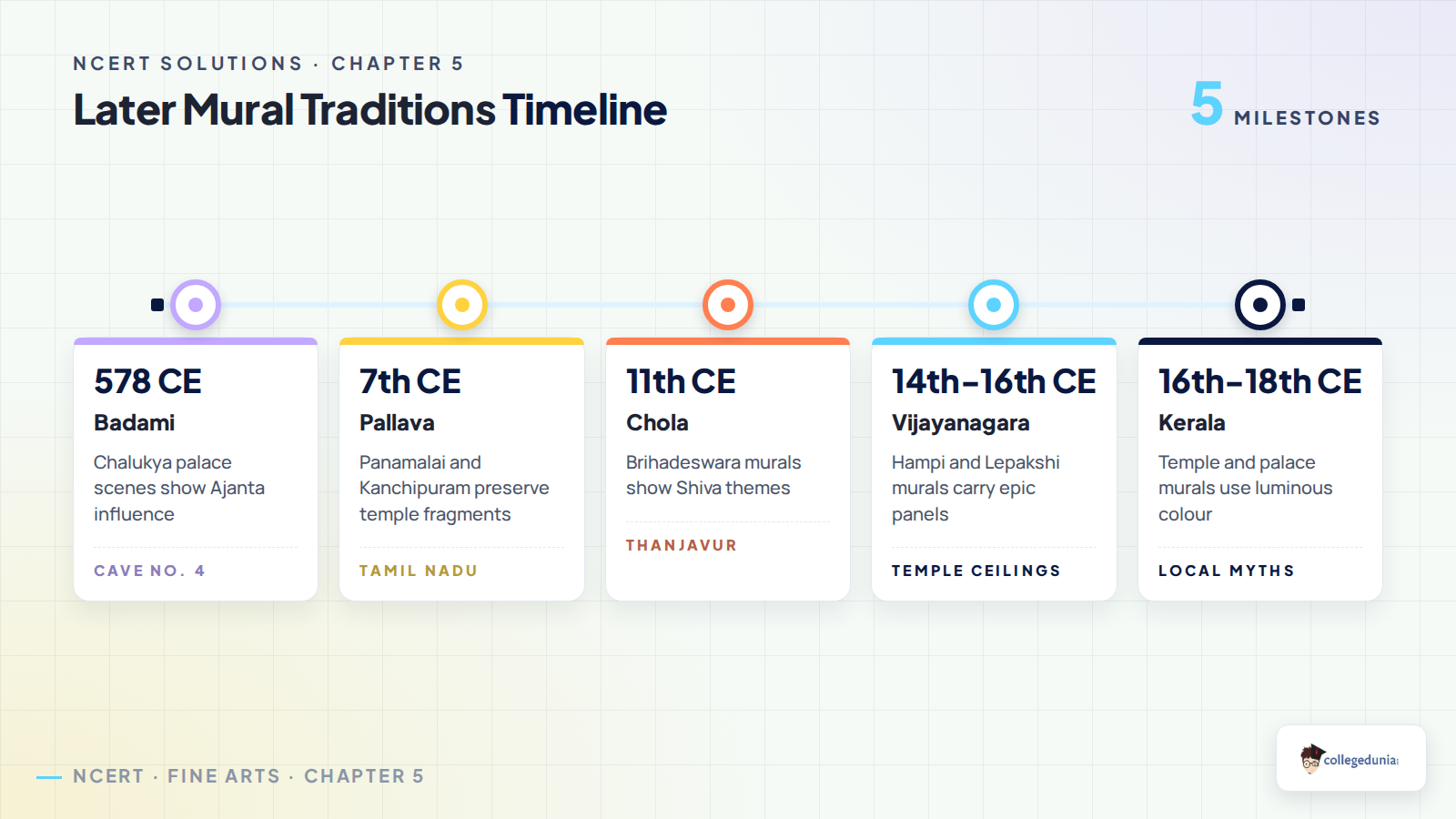
The timeline helps students avoid mixing dynasties. Badami belongs to the early Chalukya context, while Kerala murals develop much later with local mythological themes.
- Badami: palace scene, Vishnu Cave and Ajanta-style modelling.
- Pallava and Pandya: Panamalai, Kanchipuram, Tirumalaipuram and Sittanvasal.
- Chola: Brihadeswara temple murals linked with Shiva themes.
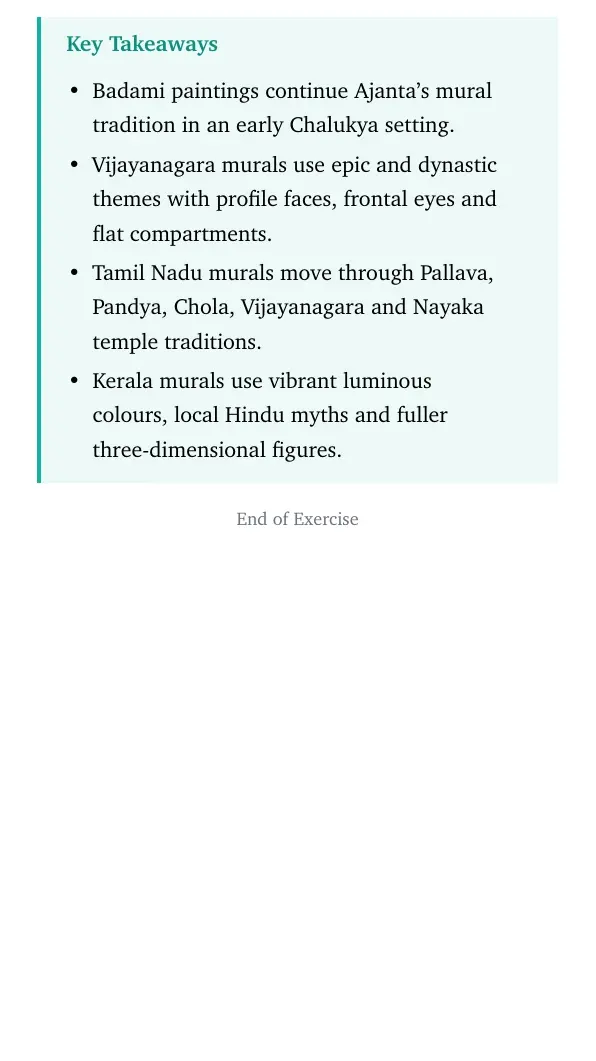
- Vijayanagara and Nayaka: epic stories, profile faces and rectangular panels.
- Kerala: luminous colour, fuller figures and local Hindu myths.
Badami and Vijayanagara Murals: Answer Writing Points
Badami answers should name the early Chalukya setting and the surviving fragment on the vaulted mandapa roof. Vijayanagara answers should read like a short essay, with examples from Hampi and Lepakshi.
| Tradition | Site Cue | Style Cue |
|---|---|---|
| Badami | Cave No. 4, also called the Vishnu Cave | Sinuous line, fluid form and compact composition |
| Vijayanagara | Virupaksha temple at Hampi and Virbhadra temple at Lepakshi | Profile faces, frontal eyes and two-dimensional panels |
| Nayaka | Tiruvarur, Chidambaram and Chengam | Extension of Vijayanagara style with regional changes |
Tamil Nadu and Kerala Murals Compared for Class 11 Fine Arts
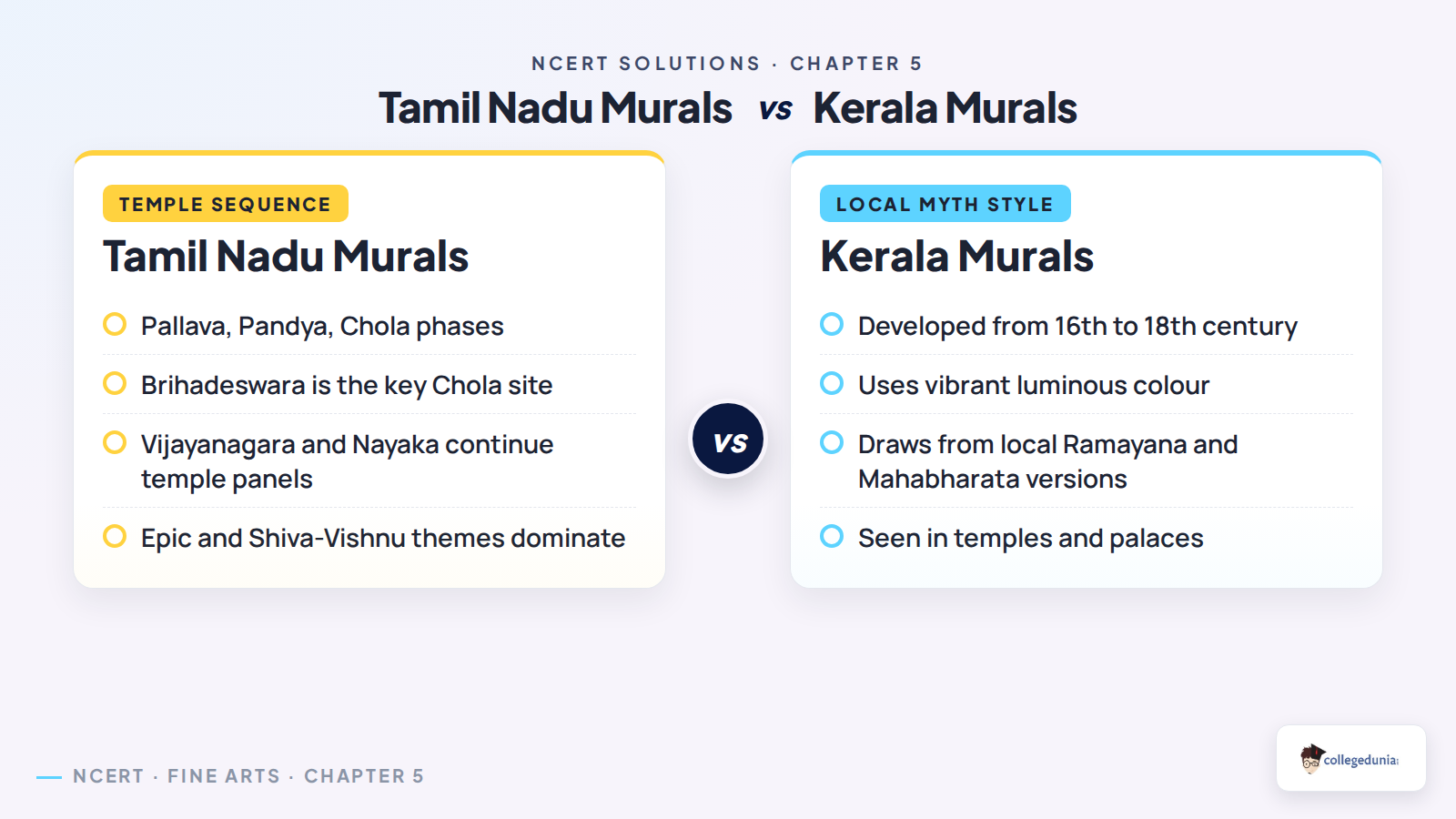
Tamil Nadu mural history is a long temple sequence. Kerala murals are later and more local in colour, theme and figure treatment. Write Tamil Nadu first and Kerala second when answering the third NCERT question.
- Tamil Nadu: Pallava, Pandya, Chola, Vijayanagara and Nayaka phases.
- Kerala: temple and palace murals from the sixteenth to eighteenth century.
- Kerala themes: local Ramayana, Mahabharata and popular Hindu mythology.
- Kerala style: vibrant colours and stronger three-dimensional figures.
How to Use Later Mural Traditions NCERT Solutions for Exam Preparation
The best answers in this chapter are not long lists. They are clear site-based answers. Students should make one chart with dynasty, location, date range, theme and style cue.
- Prepare one timeline from Badami to Kerala murals.
- Practise one full essay on Vijayanagara paintings.
- Memorise site plus style cue pairs for fast recall.
- Use the PDF answers to turn each cue into a complete paragraph.
Fine Arts Chapter 5 Resources for Later Mural Traditions
| Resource | Use it for | Link |
|---|---|---|
| NCERT Book PDF | Official source chapter for 2026-27 | Open book PDF page |
| NCERT Notes | Quick topic-wise revision | Open notes page |
| Handwritten Notes | Fast recall before tests | Open handwritten notes page |
NCERT Solutions for Class 11 Fine Arts: All Chapters
| Chapter | NCERT Solutions |
|---|---|
| Chapter 1 Prehistoric Rock Paintings | Open Chapter 1 Solutions |
| Chapter 2 Arts of the Indus Valley | Open Chapter 2 Solutions |
| Chapter 3 Arts of the Mauryan Period | Open Chapter 3 Solutions |
| Chapter 4 Post-Mauryan Trends in Indian Art and Architecture | Open Chapter 4 Solutions |
| Chapter 5 Later Mural Traditions | Open Chapter 5 Solutions |
All NCERT Solutions for Class 11 Fine Arts Chapter 5 Later Mural Traditions with Step-by-Step Solutions
| Question | Use the tab for |
|---|---|
| Q 5.1 | Badami cave painting features and Chalukya setting |
| Q 5.2 | Vijayanagara essay points and style markers |
| Q 5.3 | Tamil Nadu and Kerala mural comparison |
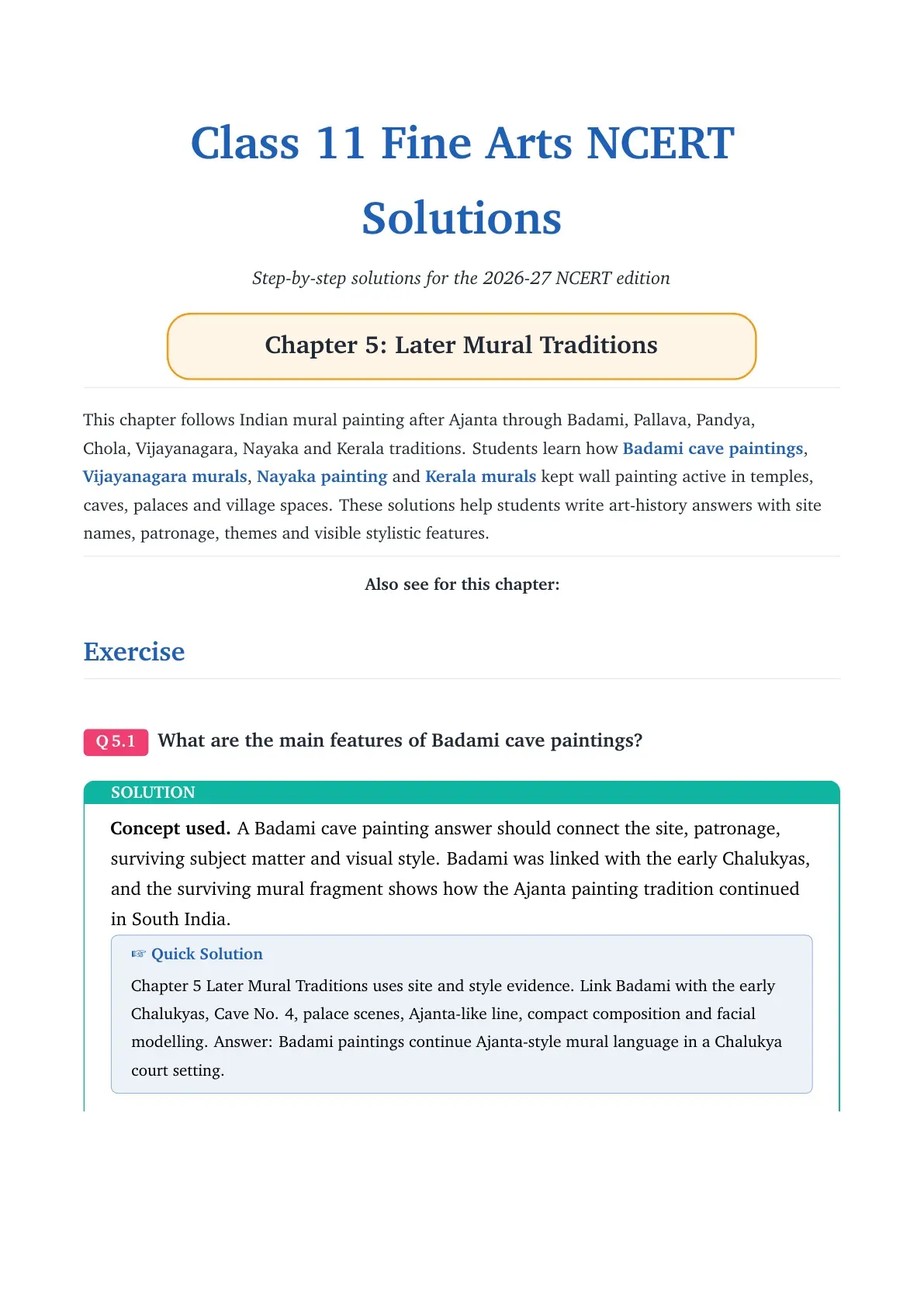
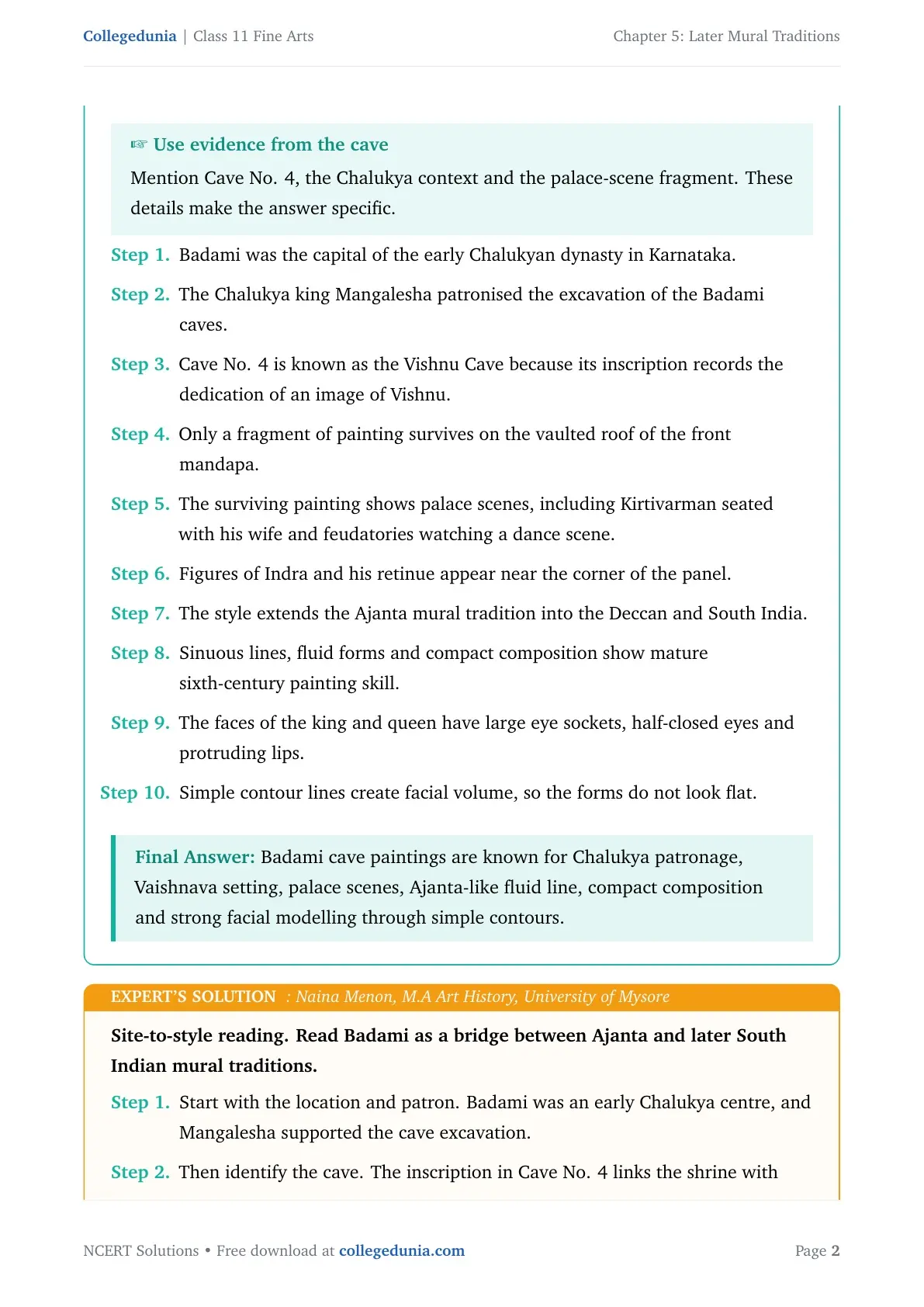
Badami cave paintings belong to the early Chalukya context. Cave No. 4, known as the Vishnu Cave, preserves a fragment on the vaulted roof of the front mandapa. The painting shows palace scenes, including Kirtivarman with his wife and feudatories. Its sinuous line, fluid form, compact composition and facial modelling show the continuation of the Ajanta mural tradition in South India.
Frame Badami as a bridge between Ajanta and later Deccan painting. Mention the Chalukya patronage, Vaishnava cave setting, palace subject and the way simple contour lines create volume in the faces.
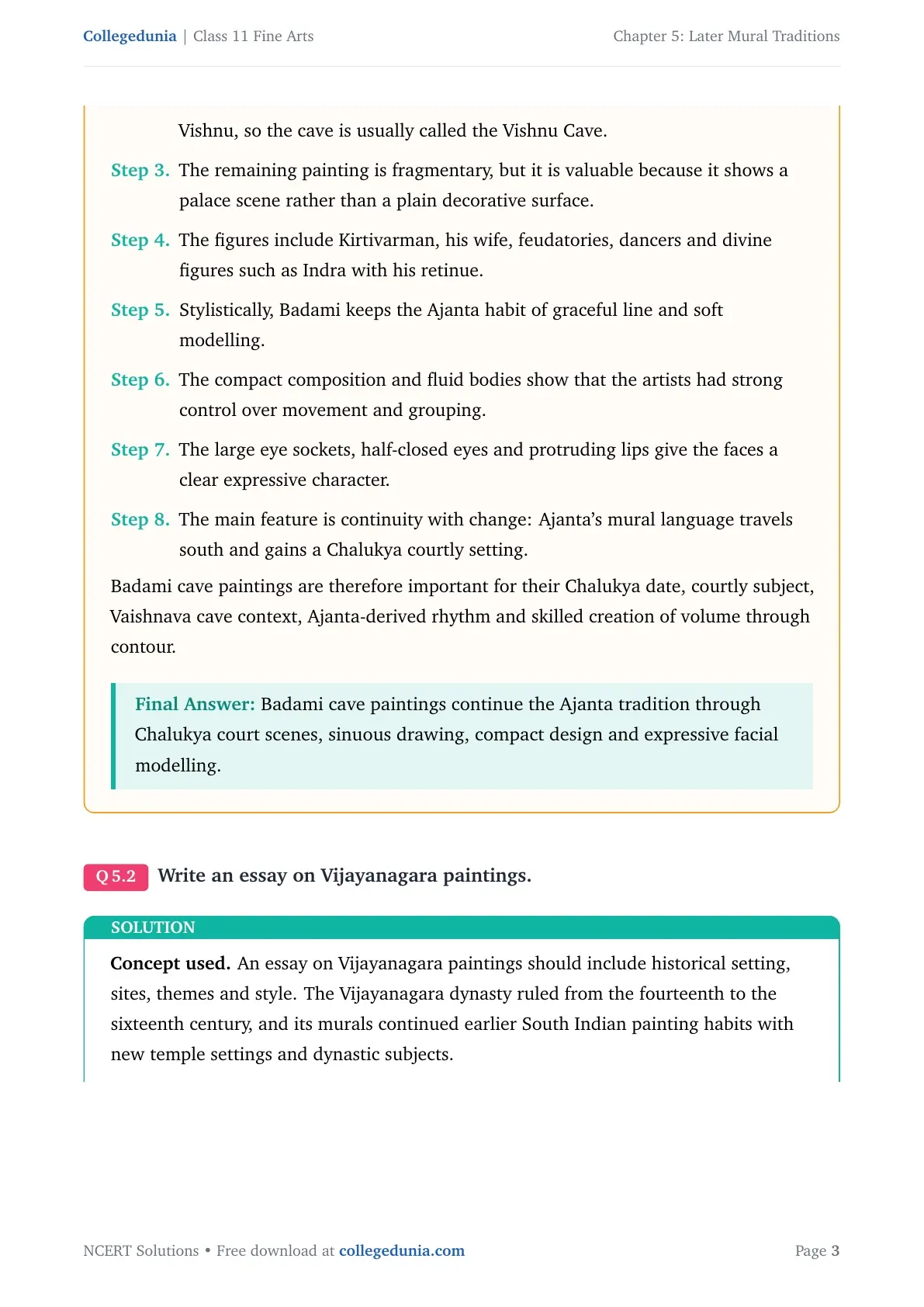
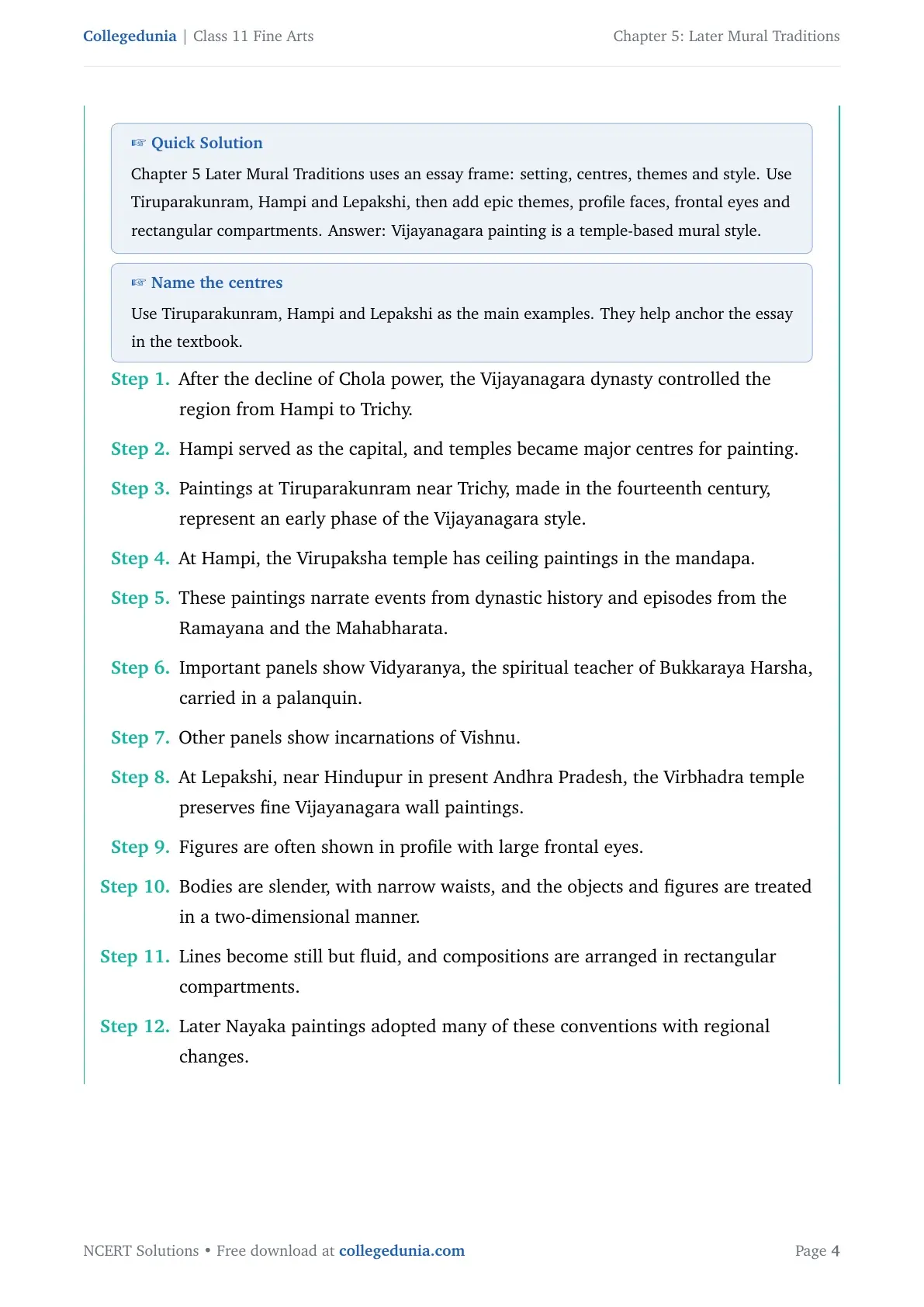
Vijayanagara paintings developed after the decline of Chola power. Important examples survive at Tiruparakunram, Hampi and Lepakshi. The Virupaksha temple at Hampi has ceiling paintings with dynastic history, Ramayana and Mahabharata scenes and Vishnu incarnations. Figures are often in profile, with large frontal eyes, narrow waists, flat treatment and rectangular compositions.
Write the essay in four parts: historical setting, sites, themes and style. Hampi gives royal and epic content. Lepakshi shows the mature spread of the style into Andhra Pradesh. Nayaka painting later continues many of the same visual habits.
Tamil Nadu murals continue through Pallava, Pandya, Chola, Vijayanagara and Nayaka traditions. Key sites include Panamalai, Kanchipuram, Sittanvasal and Brihadeswara. Kerala murals developed from the sixteenth to eighteenth century. They use vibrant colours, fuller figures and themes from local versions of the Ramayana, Mahabharata and Hindu mythology.
Compare sequence with style. Tamil Nadu gives the long temple chain, while Kerala gives a later local language shaped by temple, palace, ritual and performance traditions.
NCERT Class 11 Fine Arts Later Mural Traditions Solutions FAQs
Ques. How many exercise questions are in Later Mural Traditions?
Ans. The chapter has 3 NCERT exercise questions. They ask about Badami cave paintings, Vijayanagara paintings, and Kerala and Tamil Nadu mural traditions.
Ques. Which sites are most important in Class 11 Fine Arts Chapter 5?
Ans. Students should revise Badami, Panamalai, Kanchipuram, Sittanvasal, Brihadeswara, Hampi, Lepakshi and Kerala temple or palace mural sites.
Ques. What should I write in the Badami cave paintings answer?
Ans. Write about early Chalukya patronage, Cave No. 4, the palace scene, Ajanta-like lines, compact composition and facial modelling.
Ques. Why are Kerala murals treated separately in the chapter?
Ans. Kerala murals use vibrant colours, fuller figures and local mythological themes. They develop a distinct regional language between the sixteenth and eighteenth century.



Comments