The NCERT Solutions for Class 11 Geography Chapter 2 The Origin and Evolution of the Earth cover all exercise questions from the 2026-27 NCERT book. Students get MCQ answers, short answers, long answers, and project-work help in one printable PDF.
The PDF solves 8 exercise and project questions from the chapter.
Key terms include Big Bang Theory, differentiation, degassing, hydrosphere, and origin of life.
Use the question cards below to revise one answer at a time.
Each answer in this Class 11 Geography Chapter 2 solutions PDF follows the 2026-27 NCERT exercise and keeps the answer language school-exam ready.
Student Feedback: In a Collegedunia student survey of 12,460 Class 11 Geography students before the 2026 exams, most students said the timeline of events was the hardest part of this chapter. Keep the dates 13.7 billion, 4.6 billion, 4.0 billion, and 3.8 billion years in one notebook line.
The Origin and Evolution of the Earth Answer Key and Exercise Pattern
This exercise is short but dense. It tests dates, process names, and the order in which the earth changed from a hot rocky body to a planet with oceans and life.
Exercise area
Questions
What it checks
MCQs
3 parts
Earth age, atmosphere processes, and first life date
Short answers
3 questions
Differentiation, early surface, and early gases
Long answers
2 questions
Big Bang Theory and stages of earth evolution
Project work
1 task
NASA Stardust mission and cosmic dust samples
The correct MCQ key is (c), (b), and (d). These options match the NCERT chapter text directly.
The Origin and Evolution of the Earth Class 11 Video Explanation
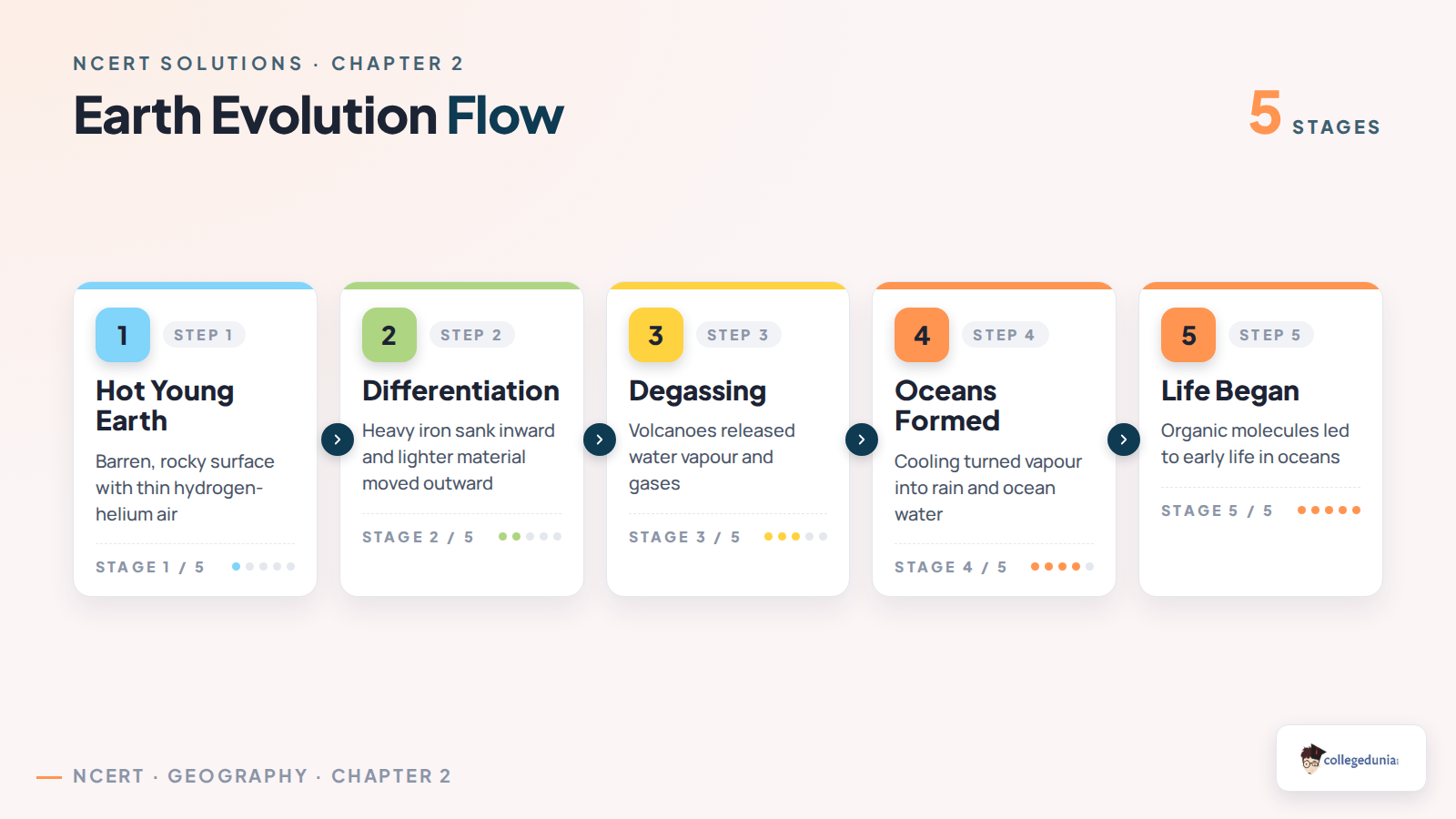
Earth Evolution Flow for Class 11 Geography Chapter 2
The chapter explains earth evolution as a chain of processes. Start with a hot young earth, then move to differentiation, degassing, ocean formation, and the origin of life.
Differentiation formed crust, mantle, outer core, and inner core.
Degassing released water vapour and gases from the earth's interior.
Photosynthesis later added oxygen to oceans and the atmosphere.
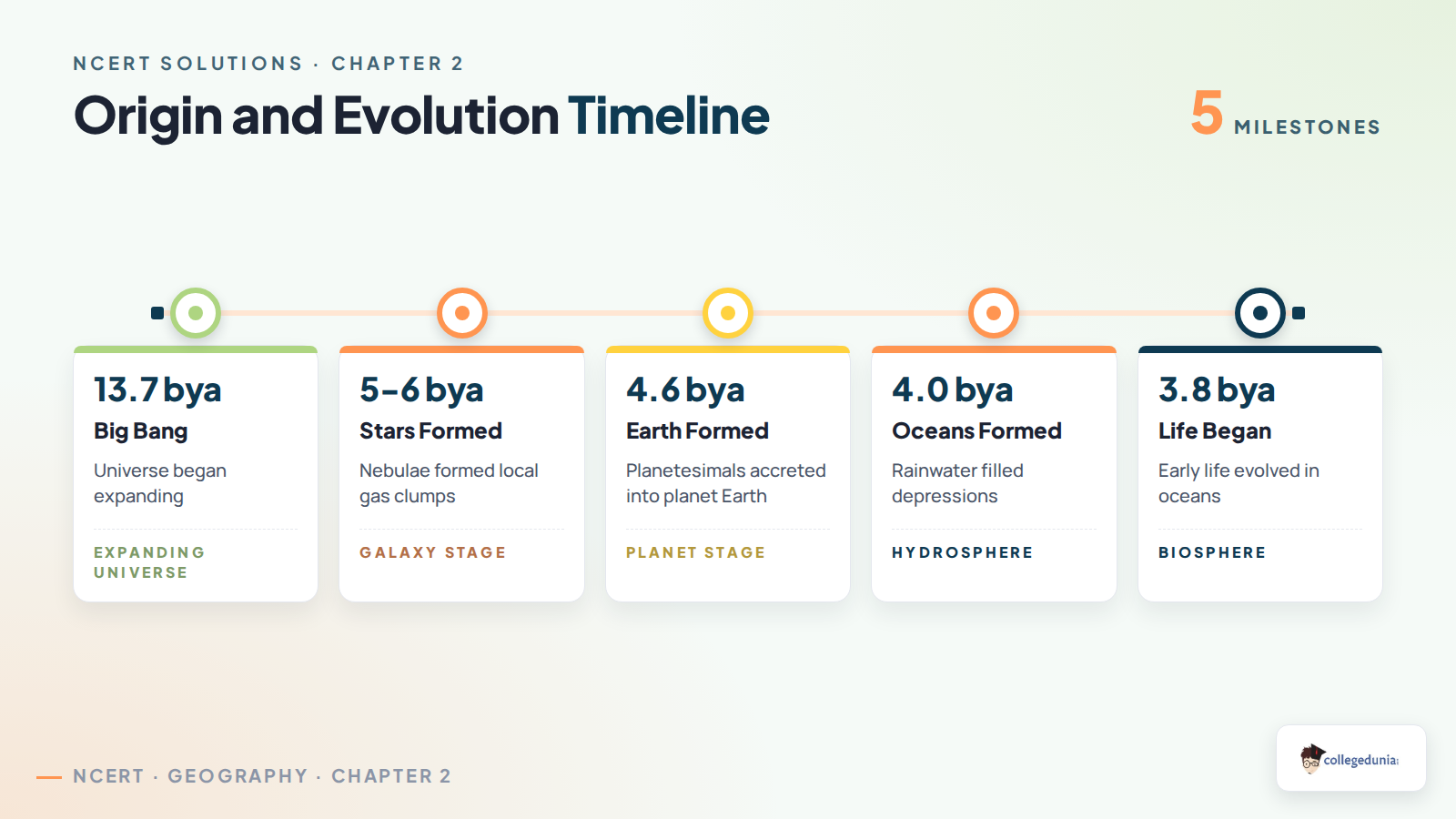
Big Bang to Life Timeline in The Origin and Evolution of the Earth
The dates are easy to mix up, so revise them as a sequence. The universe is older than the earth, and life appeared much later than oceans.
Time
Event
NCERT point to remember
13.7 billion years ago
Big Bang
Universe began expanding
5 to 6 billion years ago
Star formation
Nebulae formed localised gas clumps
4.6 billion years ago
Earth formed
Accretion of planetesimals built planets
4.0 billion years ago
Oceans formed
Rainwater collected in depressions
3.8 billion years ago
Life began
Life first evolved in oceans
How to Use the Class 11 Geography Chapter 2 Solutions PDF
Use the PDF in two rounds. First, learn the short factual answers. Then write the long answers in headings so the sequence stays clear.
Revise MCQs first because they fix the three most tested dates.
Write differentiation as a density-based process, not just a one-line definition.
For the Big Bang answer, use the sequence: tiny ball, explosion, expansion, atoms.
For earth evolution, use the order: lithosphere, atmosphere, hydrosphere, life.
The safest exam answer is one that follows the NCERT order of events.
All NCERT Solutions for Class 11 Geography Chapter 2 The Origin and Evolution of the Earth with Step-by-Step Solutions
The cards below include every exercise question. Use Check Solution for the direct answer and Expert Solution for a second explanation.
Questions
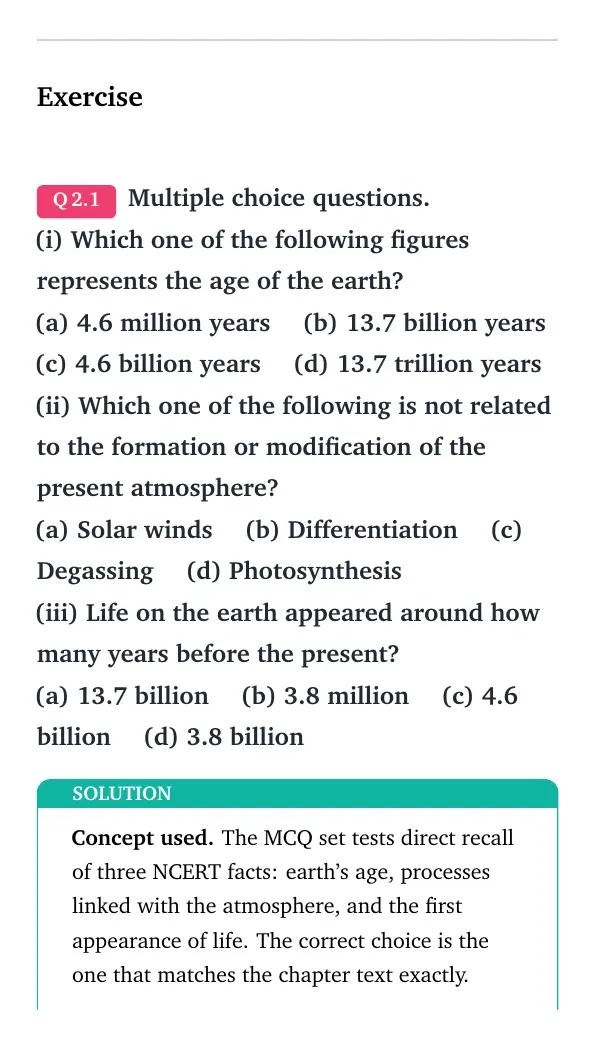
Q 2.1
Multiple choice questions.
(i) Which one of the following figures represents the age of the earth?
(a) 4.6 million years (b) 13.7 billion years (c) 4.6 billion years (d) 13.7 trillion years
(ii) Which one of the following is not related to the formation or modification of the present atmosphere?
(a) Solar winds (b) Differentiation (c) Degassing (d) Photosynthesis
(iii) Life on the earth appeared around how many years before the present?
(a) 13.7 billion (b) 3.8 million (c) 4.6 billion (d) 3.8 billion
Concept used. The MCQ set tests direct recall of three NCERT facts: earth's age, processes linked with the atmosphere, and the first appearance of life. The correct choice is the one that matches the chapter text exactly.
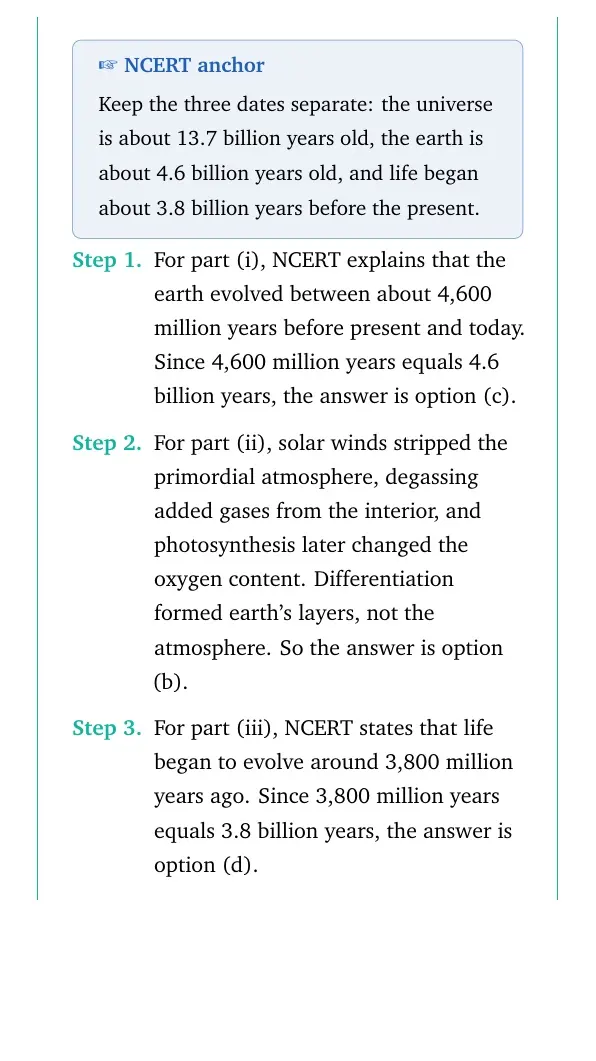
NCERT anchor
Keep the three dates separate: the universe is about 13.7 billion years old, the earth is about 4.6 billion years old, and life began about 3.8 billion years before the present.
For part (i), NCERT explains that the earth evolved between about 4,600 million years before present and today. Since 4,600 million years equals 4.6 billion years, the answer is option (c).
For part (ii), solar winds stripped the primordial atmosphere, degassing added gases from the interior, and photosynthesis later changed the oxygen content. Differentiation formed earth's layers, not the atmosphere. So the answer is option (b).
For part (iii), NCERT states that life began to evolve around 3,800 million years ago. Since 3,800 million years equals 3.8 billion years, the answer is option (d).
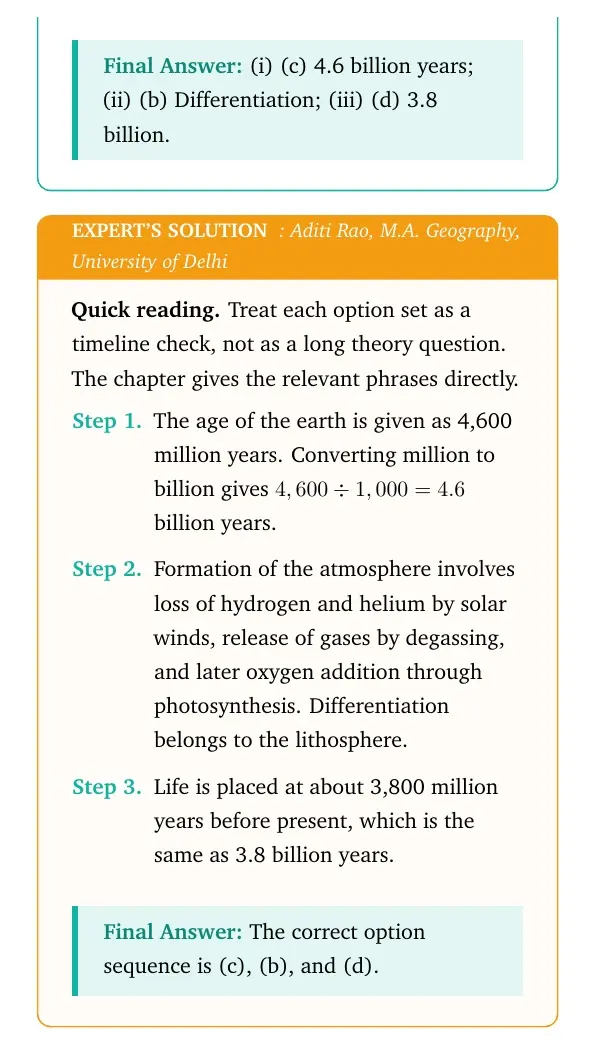
Quick reading. Treat each option set as a timeline check, not as a long theory question. The chapter gives the relevant phrases directly.
The age of the earth is given as 4,600 million years. Converting million to billion gives 4,600 ÷ 1,000 = 4.6 billion years.
Formation of the atmosphere involves loss of hydrogen and helium by solar winds, release of gases by degassing, and later oxygen addition through photosynthesis. Differentiation belongs to the lithosphere.
Life is placed at about 3,800 million years before present, which is the same as 3.8 billion years.
The correct option sequence is (c), (b), and (d).
Q 2.2
What is meant by the process of differentiation?
Concept used. Differentiation is the separation of earth-forming materials into layers according to density. Heavy materials sink downward and lighter materials move upward as the young earth heats, melts, cools, and solidifies.
Layer clue
The word differentiation means ``becoming different.'' In this chapter, it means one mixed early earth changed into distinct layers.
During the early stage, the earth was very hot and much of its material was in a volatile state.
As density and temperature increased, materials started separating by weight and density.
Heavy materials such as iron sank towards the centre.
Lighter materials moved towards the outer parts.
This separation produced the broad internal layers: crust, mantle, outer core, and inner core.
Differentiation is the process by which earth-forming material separated into layers according to density, with heavy material sinking inward and lighter material moving outward.
RM
Rohan Mehta
M.Sc Geology, Banaras Hindu University
Verified Expert
Structural observation. The answer becomes easy if we connect the process to the final result: a layered earth.
The young earth was hot enough for materials to move and separate.
Dense materials had greater tendency to move inward under gravity.
Less dense materials remained nearer the surface as the planet cooled.
This gave the earth a layered body, from crust outside to core inside.
So differentiation explains why the earth is not uniform from surface to centre. It also prepares the idea studied in the next chapter on the interior of the earth.
Differentiation means density-based separation of early earth material into layers such as crust, mantle, and core.
Q 2.3
What was the nature of the earth surface initially?
Concept used. The initial earth is described by NCERT as a hot, barren, rocky body with a very thin atmosphere. This is the starting point from which water, air, and life developed later.
Exact description
Use the three main words together: barren, rocky, and hot. They are the core of the NCERT answer.
The early earth did not look like the present life-supporting planet.
Its surface was barren, meaning it lacked vegetation and life.
It was rocky because the planet was still a solidifying mass of earth material.
It was hot because the planet had formed recently and retained strong internal heat.
It had a thin atmosphere mainly of hydrogen and helium, unlike the present nitrogen-oxygen atmosphere.
Initially, the earth's surface was barren, rocky, and hot, with a thin atmosphere mainly made of hydrogen and helium.
NV
Nisha Verma
M.A. Earth Science, Jamia Millia Islamia
Verified Expert
Picture-first. Imagine the early earth before oceans, soil, and life. That picture gives the answer in a simple order.
There was no developed hydrosphere, so oceans were absent at the start.
There was no biosphere, so the surface was lifeless and barren.
The surface was rocky and hot because the planet was still cooling after formation.
The thin early atmosphere was unlike today's air and had hydrogen and helium.
This answer also explains why later processes were necessary. Cooling, degassing, condensation, and biological change slowly transformed the earth.
The initial earth surface was a hot, rocky, barren surface with a thin hydrogen-helium atmosphere.
Q 2.4
What were the gases which initially formed the earth's atmosphere?
Concept used. The answer needs two stages of early atmospheric gases. The primordial atmosphere had hydrogen and helium. Later outgassing added water vapour, nitrogen, carbon dioxide, methane, ammonia, and very little free oxygen.
Do not mix stages
If the question says initially, begin with hydrogen and helium. Then add the later gases released from the earth's interior.
The earliest atmosphere was made mainly of hydrogen and helium.
This primordial atmosphere was stripped off by solar winds.
During cooling, gases and water vapour came out from the earth's interior through degassing and volcanic activity.
The later early atmosphere contained water vapour, nitrogen, carbon dioxide, methane, ammonia, and very little free oxygen.
The earliest atmosphere had hydrogen and helium. Later, water vapour, nitrogen, carbon dioxide, methane, ammonia, and little free oxygen were added through degassing.
KI
Kavya Iyer
M.Sc Geography, Savitribai Phule Pune University
Verified Expert
Sequence view. NCERT first names the lost primordial gases, then names the gases released from the interior.
At the very beginning, hydrogen and helium formed the thin primordial atmosphere.
Solar winds removed much of this light-gas atmosphere from terrestrial planets.
As the earth cooled, its interior released water vapour and gases.
These added nitrogen, carbon dioxide, methane, ammonia, and traces of free oxygen to the developing atmosphere.
This is why the answer should not stop only at hydrogen and helium. NCERT uses both stages to explain the present atmosphere.
Hydrogen and helium formed the first atmosphere; later water vapour, nitrogen, carbon dioxide, methane, ammonia, and little oxygen were released.
Q 2.5
Write an explanatory note on the `Big Bang Theory'.
Concept used. The Big Bang Theory, also called the expanding universe hypothesis, explains the origin of the universe from an extremely dense and hot beginning followed by rapid expansion.
Hubble's clue
Edwin Hubble's evidence that galaxies are moving apart supports the idea that space between galaxies is increasing.
According to this theory, all matter of the universe was once packed in a tiny state with very small volume, infinite density, and extremely high temperature.
Around 13.7 billion years before present, this tiny state expanded violently in the event called the Big Bang.
The expansion was very rapid in the first fractions of a second.
As expansion continued, some energy changed into matter.
Within the first three minutes, the first atoms began to form.
About 300,000 years after the Big Bang, temperature fell to about 4,500 K and atomic matter formed in a transparent universe.
The theory is supported by the observation that galaxies are moving farther apart with time.
Download the Full Revision Notes PDF
The Big Bang Theory states that the universe began from a tiny, extremely hot and dense state about 13.7 billion years ago and has been expanding since then.
AM
Arjun Menon
M.A. Geography, Jawaharlal Nehru University
Verified Expert
Timeline method. Write the answer as a time sequence. That keeps the theory clear and prevents mixing the origin of the universe with the origin of the earth.
Begin with the single dense state: all matter and energy were packed in one tiny beginning.
State the event: the Big Bang happened about 13.7 billion years before present.
Explain expansion: space between galaxies increased, so galaxies moved farther apart.
Add early changes: energy changed into matter, atoms formed, and the universe became transparent as temperature dropped.
End with evidence: Hubble's observation of expanding galaxies supports the theory.
The balloon example helps only partly. Points on a balloon move apart, like galaxies, but the galaxies themselves are not expanding in the same way.
The Big Bang Theory explains the universe as an expanding system that began about 13.7 billion years ago from a tiny, hot, dense state.
Q 2.6
List the stages in the evolution of the earth and explain each stage in brief.
Concept used. Evolution of the earth means the long change from a hot, rocky, barren planet to a layered planet with atmosphere, oceans, and life. NCERT presents this through lithosphere, atmosphere, hydrosphere, and life.
Answer frame
Use four stage headings: lithosphere, atmosphere, hydrosphere, and life. Then place the details under the correct heading.
Initial stage. The early earth was hot, rocky, barren, and had a thin atmosphere of hydrogen and helium.
Evolution of lithosphere. Due to rising density and heat, materials separated by density. Heavy material moved inward and lighter material moved outward. This process formed crust, mantle, outer core, and inner core.
Evolution of atmosphere. The first hydrogen-helium atmosphere was lost due to solar winds. Later, degassing and volcanic eruptions released water vapour, nitrogen, carbon dioxide, methane, ammonia, and small amounts of oxygen.
Evolution of hydrosphere. As the earth cooled, water vapour condensed. Rainwater collected in depressions and formed oceans within about 500 million years of earth's formation.
Origin of life. Chemical reactions formed complex organic molecules. These molecules later became self-duplicating systems, and life began around 3,800 million years ago.
Oxygen change. Photosynthesis developed later, first in oceanic life forms. Oxygen built up in oceans and then flooded the atmosphere around 2,000 million years ago.
The earth evolved through a hot initial stage, differentiation of the lithosphere, formation of atmosphere, formation of oceans, origin of life, and later oxygen enrichment.
SK
Samar Khan
M.Sc Physical Geography, Aligarh Muslim University
Verified Expert
Process chain. Think of the answer as one chain: heat created layers, cooling created oceans, gases created air, and chemical change created life.
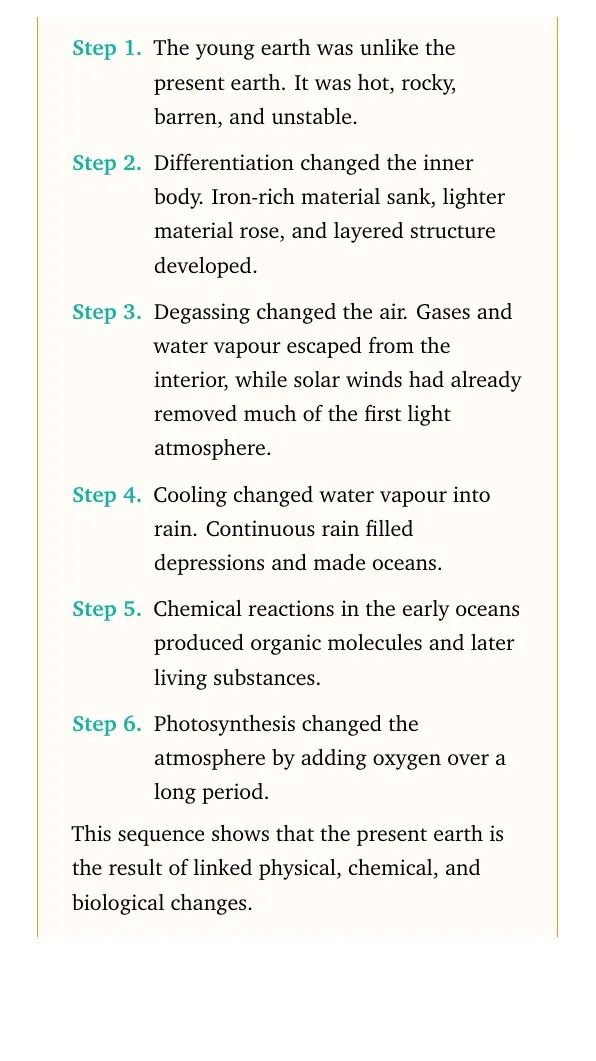
The young earth was unlike the present earth. It was hot, rocky, barren, and unstable.
Differentiation changed the inner body. Iron-rich material sank, lighter material rose, and layered structure developed.
Degassing changed the air. Gases and water vapour escaped from the interior, while solar winds had already removed much of the first light atmosphere.
Cooling changed water vapour into rain. Continuous rain filled depressions and made oceans.
Chemical reactions in the early oceans produced organic molecules and later living substances.
Photosynthesis changed the atmosphere by adding oxygen over a long period.
This sequence shows that the present earth is the result of linked physical, chemical, and biological changes.
The main stages are differentiation and lithosphere formation, atmospheric change, ocean formation, origin of life, and oxygen build-up through photosynthesis.
Q 2.7
Project Work: Which is the agency that launched the project ``Stardust''?
Concept used. Project-work questions ask for researched factual information connected to the chapter theme. Stardust was a space mission linked with collecting comet and interstellar dust for study.
Mission fact
Stardust was a NASA mission. NASA is the National Aeronautics and Space Administration of the United States.
Identify the project named in the question: Stardust.
Connect it with a space mission designed to collect dust samples.
Name the agency that launched it: NASA.
Expand the agency name for a complete answer: National Aeronautics and Space Administration.
The Stardust project was launched by NASA, the National Aeronautics and Space Administration of the United States.
MK
Meera Krishnan
M.Sc Astronomy, Osmania University
Verified Expert
Direct fact check. The safest project-work answer names both the short form and the full form of the agency.
The mission name ``Stardust'' refers to a sample-return space mission.
It was planned and launched by NASA.
NASA stands for National Aeronautics and Space Administration.
Adding the full form makes the answer clear for school project notes and avoids confusion with a private or university project.
NASA launched Stardust. Its full name is National Aeronautics and Space Administration.
Q 2.8
Project Work: Why are scientists interested in collecting Stardust, and from where is it being collected?
Concept used. Stardust samples are useful because dust from comets and interstellar space preserves clues about the early solar system. These samples help scientists study material that existed before or during planet formation.
Chapter link
This project connects with the chapter because both ask how the solar system and planets formed from earlier cosmic material.
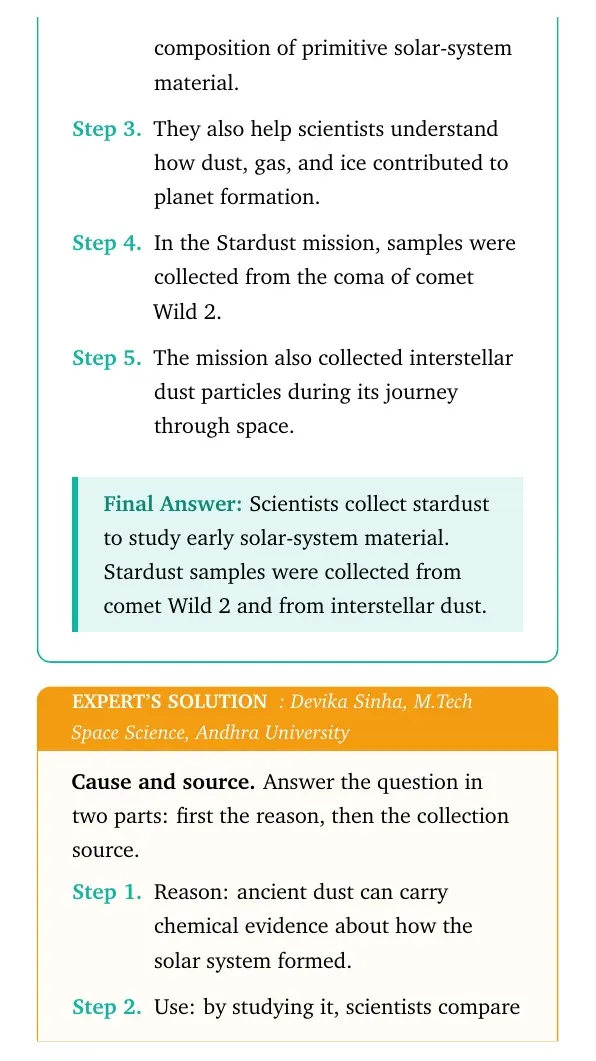
Scientists collect stardust to examine tiny particles that may preserve evidence from the early solar system.
Such particles can reveal the composition of primitive solar-system material.
They also help scientists understand how dust, gas, and ice contributed to planet formation.
In the Stardust mission, samples were collected from the coma of comet Wild 2.
The mission also collected interstellar dust particles during its journey through space.
Scientists collect stardust to study early solar-system material. Stardust samples were collected from comet Wild 2 and from interstellar dust.
DS
Devika Sinha
M.Tech Space Science, Andhra University
Verified Expert
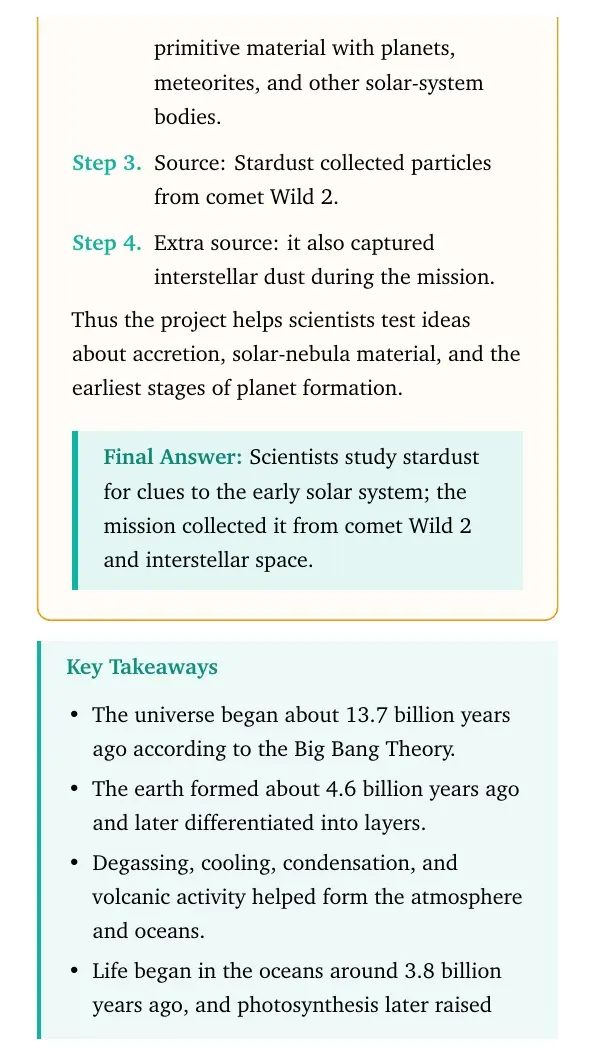
Cause and source. Answer the question in two parts: first the reason, then the collection source.
Reason: ancient dust can carry chemical evidence about how the solar system formed.
Use: by studying it, scientists compare primitive material with planets, meteorites, and other solar-system bodies.
Source: Stardust collected particles from comet Wild 2.
Extra source: it also captured interstellar dust during the mission.
Thus the project helps scientists test ideas about accretion, solar-nebula material, and the earliest stages of planet formation.
Scientists study stardust for clues to the early solar system; the mission collected it from comet Wild 2 and interstellar space.
The Origin and Evolution of the Earth Class 11 NCERT Solutions FAQs
Ques. How many questions are solved in Class 11 Geography Chapter 2 The Origin and Evolution of the Earth?
Ans. The PDF solves 8 exercise and project questions, including MCQs, short answers, long answers, and Stardust project-work answers.
Ques. What is the correct MCQ answer key for The Origin and Evolution of the Earth?
Ans. The correct answer key is (i) (c) 4.6 billion years, (ii) (b) Differentiation, and (iii) (d) 3.8 billion.
Ques. What is differentiation in Class 11 Geography Chapter 2?
Ans. Differentiation is the process where earth-forming material separated by density. Heavy material sank inward and lighter material moved outward.
Ques. What gases formed the early atmosphere of the earth?
Ans. The first atmosphere had hydrogen and helium. Later, degassing added water vapour, nitrogen, carbon dioxide, methane, ammonia, and little oxygen.
Ques. Why is the Big Bang Theory important in this chapter?
Ans. The Big Bang Theory explains the origin of the universe. It gives the starting point before stars, galaxies, planets, and the earth formed.









Comments