The NCERT Solutions for Class 11 Geography Chapter 3 Interior of the Earth cover every exercise question from the 2026-27 NCERT book. Students get the MCQ key, short answers on body waves and shadow zones, and long answers on intrusive volcanic forms in one exam-ready PDF.
The PDF solves 7 exercise question parts from Interior of the Earth.
Key terms include P waves, S waves, shadow zone, lithosphere, batholith, lacolith, sill, and dyke.
Use the embedded question cards below to revise one answer at a time.
Each answer in this Class 11 Geography Chapter 3 solutions PDF follows the 2026-27 NCERT exercise and keeps the language school-exam ready.
Student Feedback: In a Collegedunia student survey of 12,480 Class 11 Geography students before the 2026 exams, most students said the shadow zone answer and intrusive-forms names were the hardest parts of this chapter. Keep one diagram line for P waves, S waves, and surface waves before attempting the long answers.
Interior of the Earth Answer Key and Exercise Pattern
The exercise is compact, but it checks both factual recall and explanation. The MCQ set asks for the most destructive earthquake wave, one direct source of information, the eruption type behind the Deccan Traps, and the meaning of lithosphere.
Exercise area
Questions
What it checks
MCQs
4 parts
Waves, volcanoes, flood eruptions, lithosphere
Short answers
4 questions
Body waves, direct sources, shadow zone, indirect evidence
Long answers
2 questions
Rock-mass effects and intrusive volcanic forms
The correct MCQ key is (c), (b), (b), and (b). These options match the NCERT chapter explanation of surface waves, volcanic material, flood basalt eruptions, and the crust plus upper mantle.
Earthquake Waves and Shadow Zones in Interior of the Earth
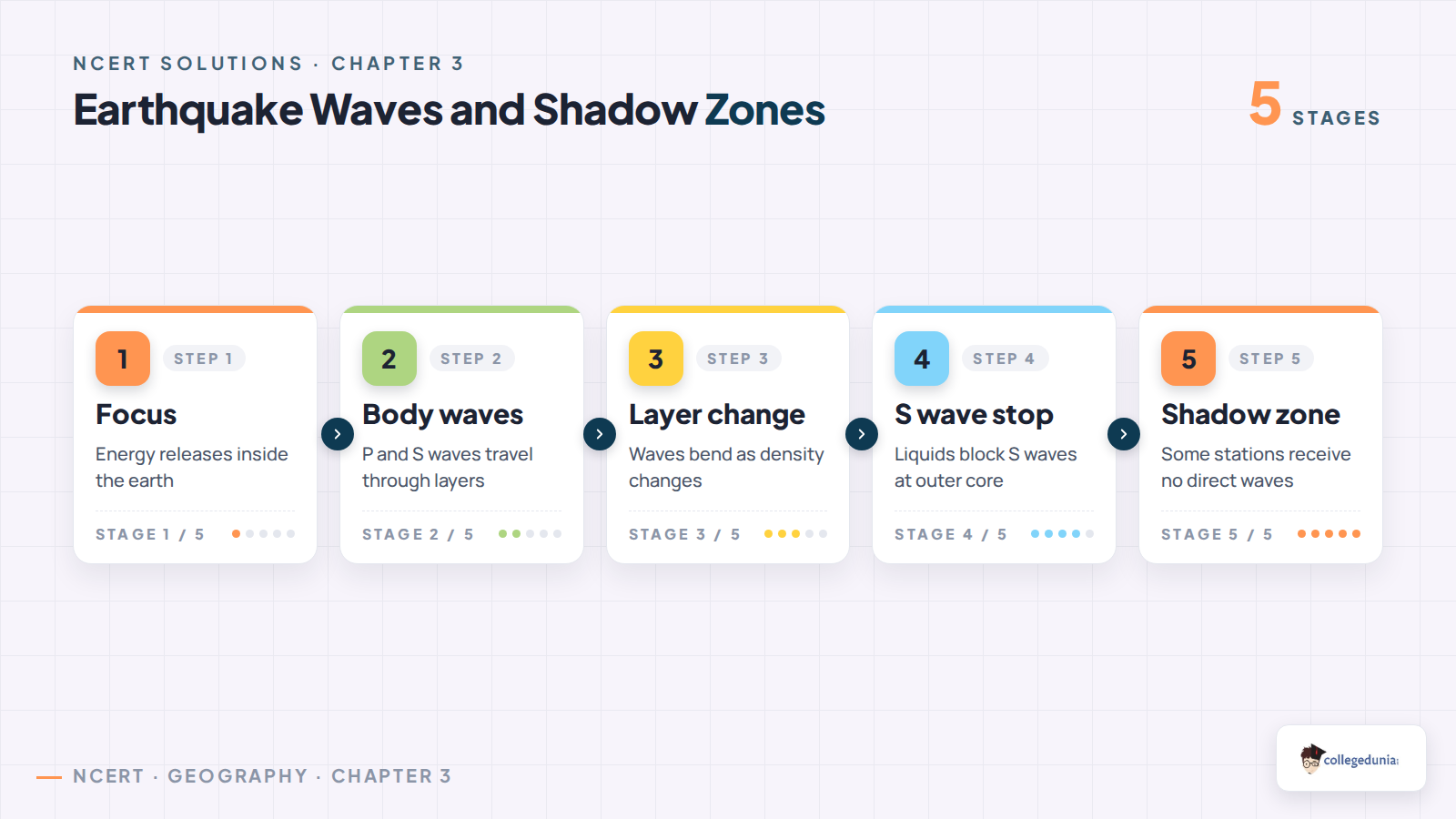
NCERT explains the earth's interior mainly through waves produced during an earthquake. P waves pass through solids, liquids, and gases, while S waves pass only through solids. This difference helps scientists infer that part of the core behaves like a liquid.
Body waves travel through the interior of the earth and are divided into P waves and S waves.
Surface waves move along the earth's surface and are the most destructive for human structures.
Shadow zones appear because waves bend at layer boundaries and S waves do not pass through liquid material.
Direct and Indirect Sources for Studying the Interior of the Earth
Class 11 Geography Chapter 3 separates sources into direct and indirect evidence. Direct sources give real material from the earth, while indirect sources help students infer conditions that cannot be reached directly.
Source type
Examples
How it helps
Direct sources
Surface rocks, mining, drilling, volcanic material
They provide samples that can be observed and tested.
Seismic sources
P waves, S waves, surface waves
Wave speed and path reveal density and state of layers.
Other indirect sources
Meteors, gravity, magnetic field, temperature, pressure
They provide clues about composition, mass distribution, and deep conditions.
Exam tip: Do not call earthquake waves a direct source. They do not bring deep material to the surface; they give signals that scientists interpret.
Intrusive Forms in Interior of the Earth: Quick Classification
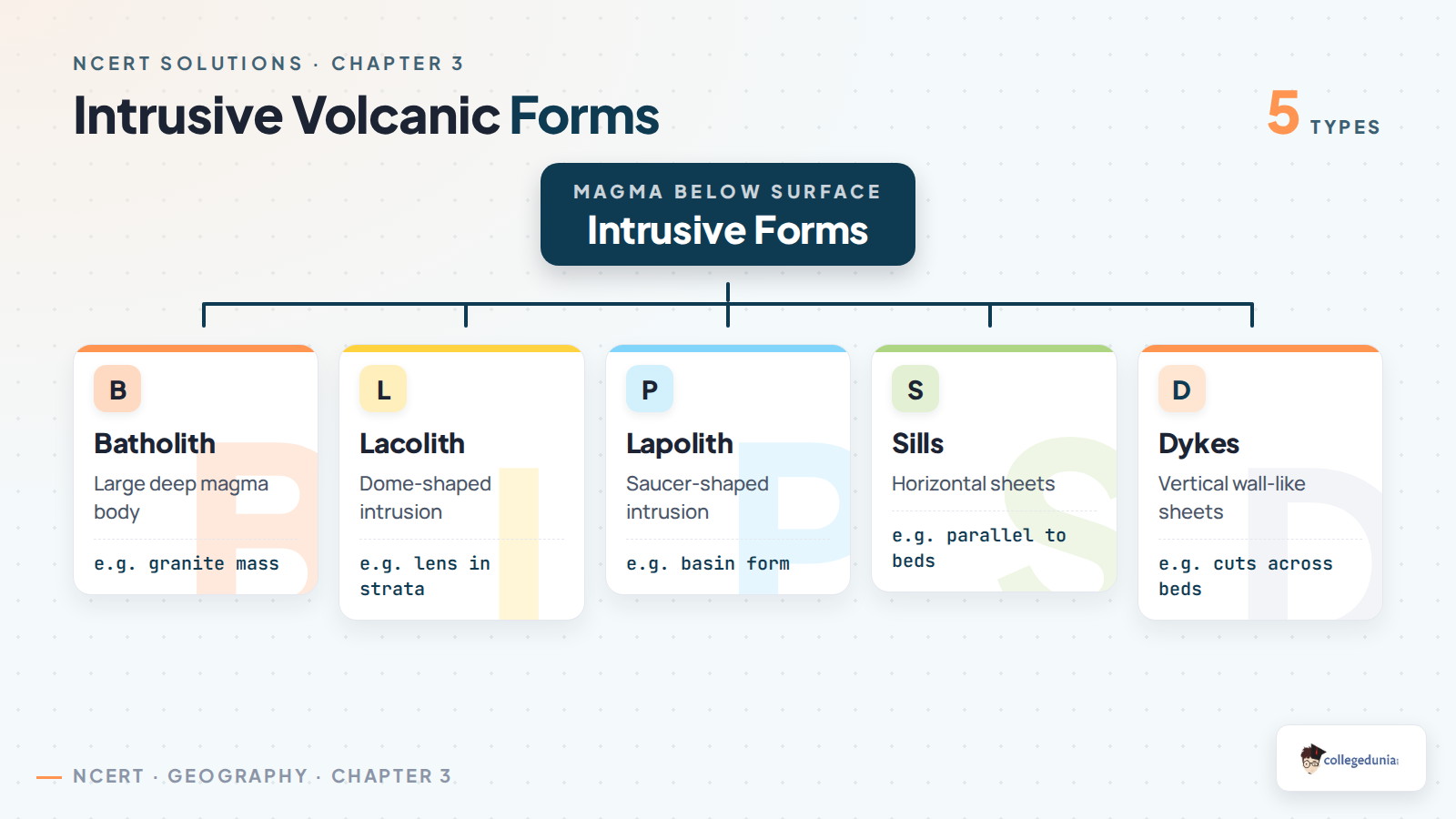
Intrusive forms are created when magma cools below the earth's surface. Their names depend on shape and position inside the crust. Batholiths are large deep bodies, lacoliths are dome-shaped, lapoliths are saucer-shaped, sills spread horizontally, and dykes cut vertically across rock layers.
Intrusive form
Shape
Revision cue
Batholith
Large deep mass
Think of a huge granite body.
Lacolith
Dome-shaped body
Magma lifts overlying strata.
Lapolith
Saucer-shaped body
It rests like a shallow basin.
Sills
Horizontal sheets
Parallel to rock beds.
Dykes
Vertical sheets
They cut across beds.
How to Use the Class 11 Geography Chapter 3 Solutions PDF
Use the PDF in two rounds. First, memorise the MCQ key and one-line definitions. Then write the short and long answers in full sentences so the explanation of waves, sources, and landforms stays clear.
Revise the wave types together: P waves, S waves, and surface waves.
Write shadow zone answers with two causes: refraction and the liquid outer core.
Keep direct and indirect sources in separate columns to avoid mixing volcanoes with seismic waves.
For intrusive forms, revise shape first and example second.
The safest exam answer is one that uses the NCERT term and then adds a short explanation in your own words.
All NCERT Solutions for Class 11 Geography Chapter 3 Interior of the Earth with Step-by-Step Solutions
The cards below include every exercise question. Use Check Solution for the direct answer and Expert Solution for a second explanation.
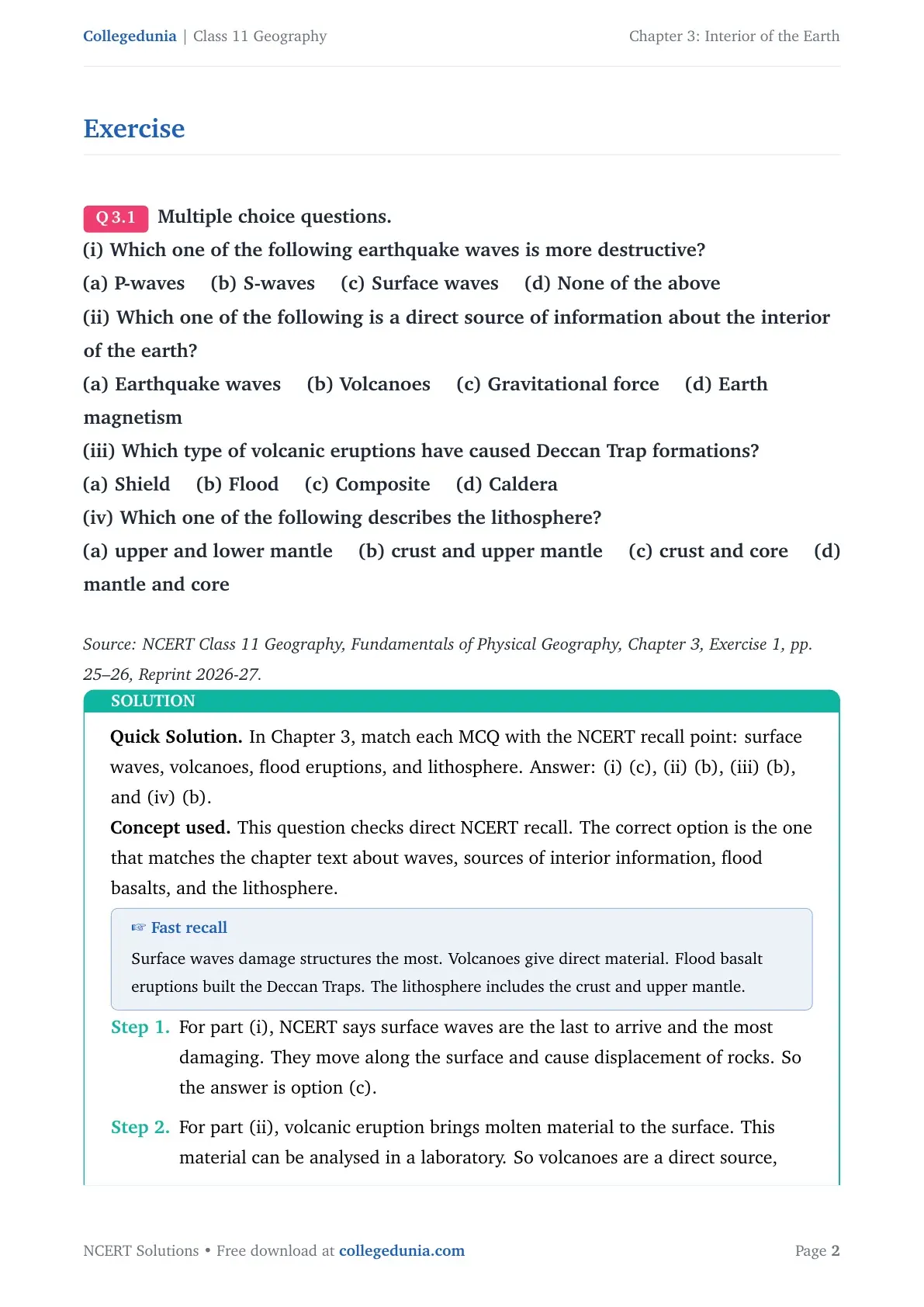
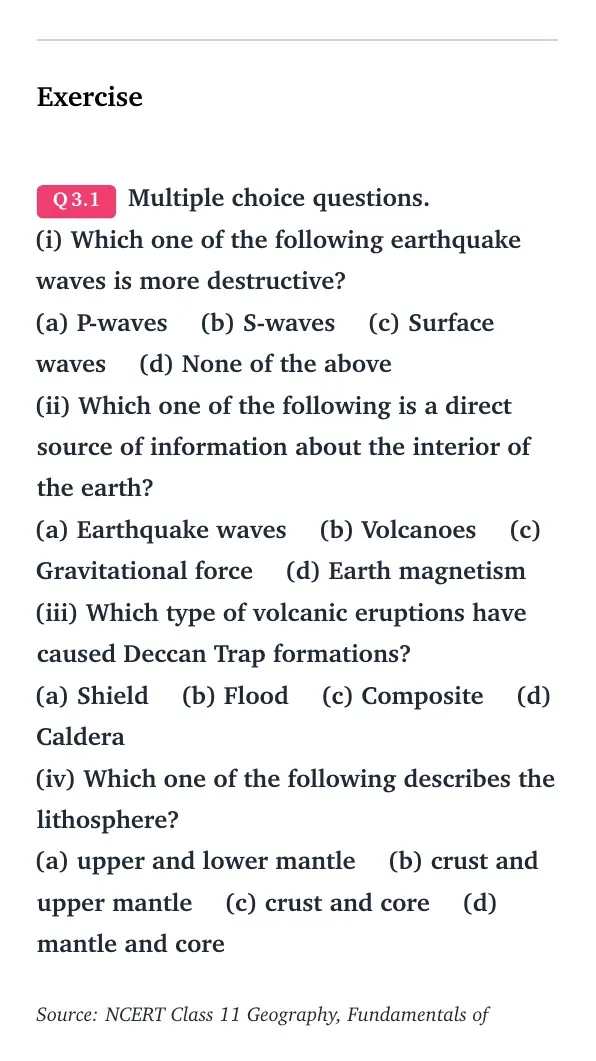
Q 3.1
Multiple choice questions.
(i) Which one of the following earthquake waves is more destructive?
(a) P-waves (b) S-waves (c) Surface waves (d) None of the above
(ii) Which one of the following is a direct source of information about the interior of the earth?
(a) Earthquake waves (b) Volcanoes (c) Gravitational force (d) Earth magnetism
(iii) Which type of volcanic eruptions have caused Deccan Trap formations?
(a) Shield (b) Flood (c) Composite (d) Caldera
(iv) Which one of the following describes the lithosphere?
(a) upper and lower mantle (b) crust and upper mantle (c) crust and core (d) mantle and core
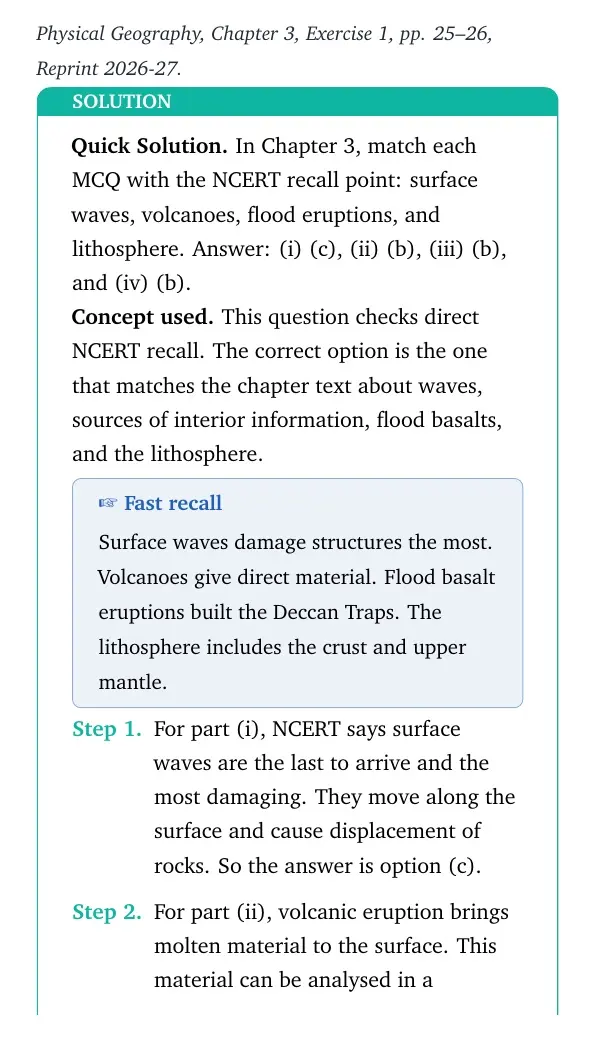
Quick Solution. In Chapter 3, match each MCQ with the NCERT recall point: surface waves, volcanoes, flood eruptions, and lithosphere. Answer: (i) (c), (ii) (b), (iii) (b), and (iv) (b).
Concept used. This question checks direct NCERT recall. The correct option is the one that matches the chapter text about waves, sources of interior information, flood basalts, and the lithosphere.
Fast recall
Surface waves damage structures the most. Volcanoes give direct material. Flood basalt eruptions built the Deccan Traps. The lithosphere includes the crust and upper mantle.
For part (i), NCERT says surface waves are the last to arrive and the most damaging. They move along the surface and cause displacement of rocks. So the answer is option (c).
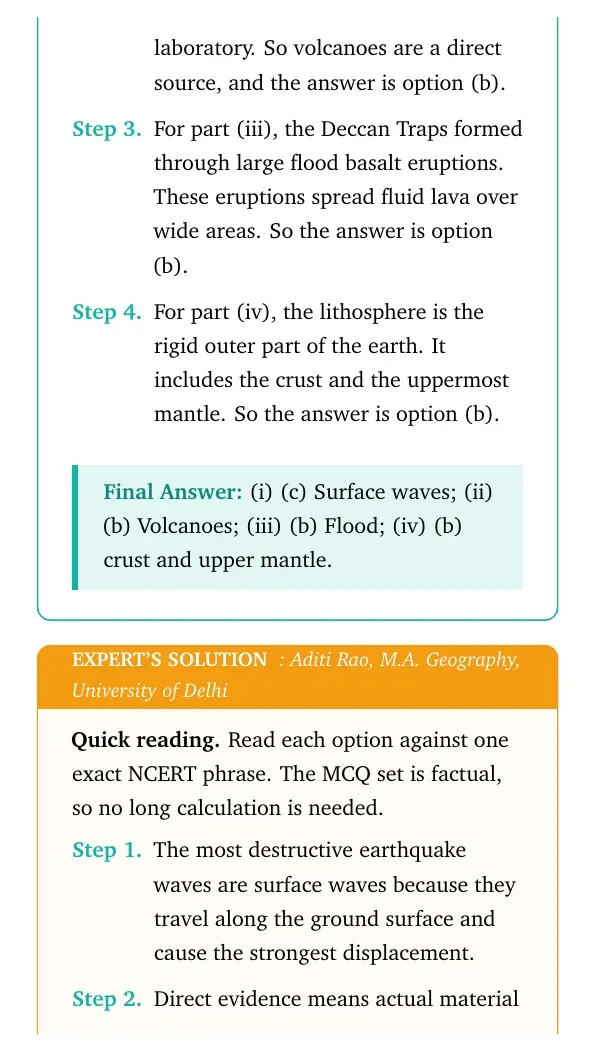
For part (ii), volcanic eruption brings molten material to the surface. This material can be analysed in a laboratory. So volcanoes are a direct source, and the answer is option (b).
For part (iii), the Deccan Traps formed through large flood basalt eruptions. These eruptions spread fluid lava over wide areas. So the answer is option (b).
For part (iv), the lithosphere is the rigid outer part of the earth. It includes the crust and the uppermost mantle. So the answer is option (b).
(i) (c) Surface waves; (ii) (b) Volcanoes; (iii) (b) Flood; (iv) (b) crust and upper mantle.
AR
Aditi Rao
M.A. Geography, University of Delhi
Verified Expert
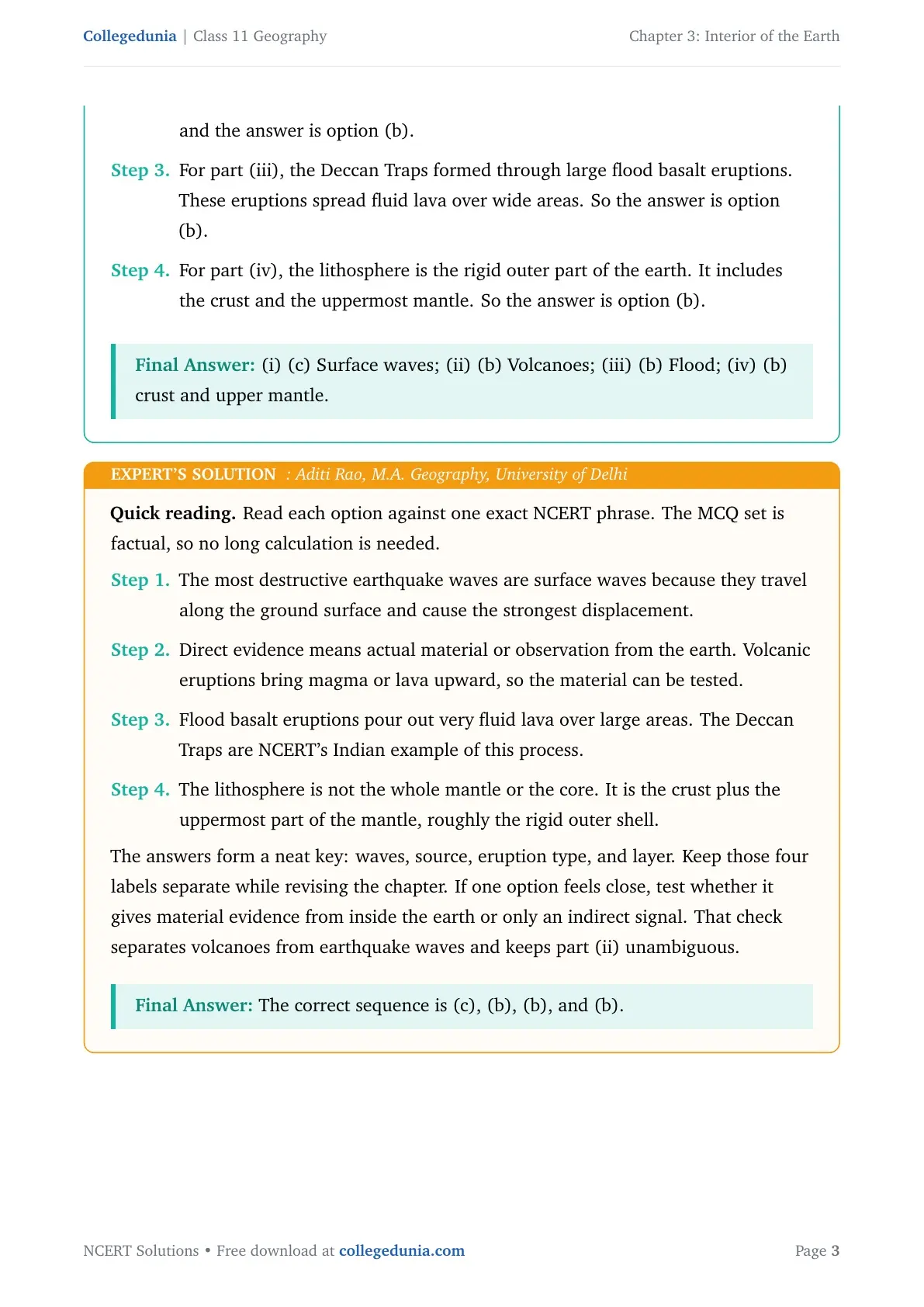
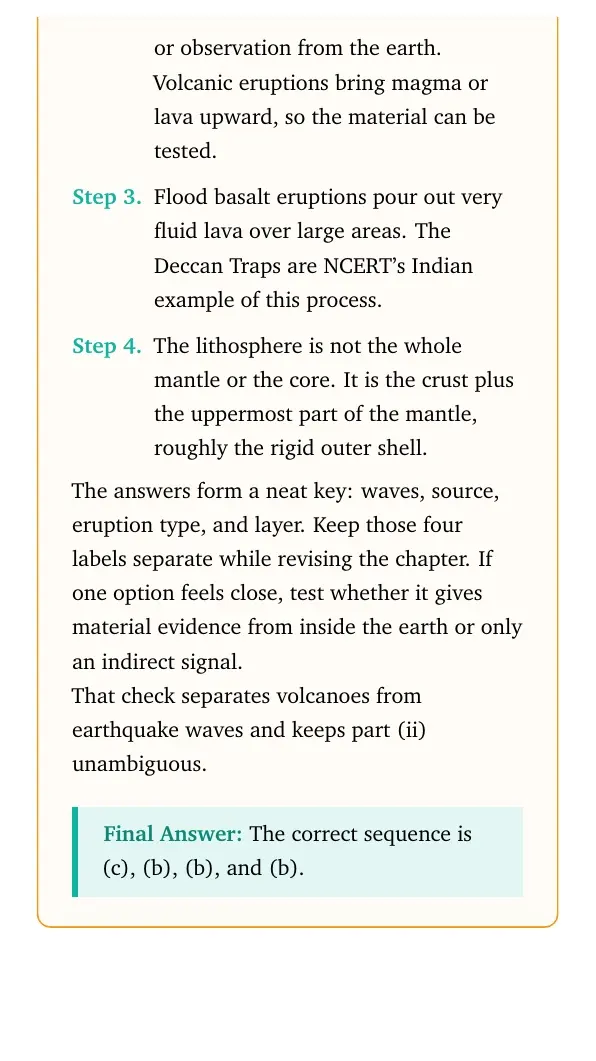
Quick reading. Read each option against one exact NCERT phrase. The MCQ set is factual, so no long calculation is needed.
The most destructive earthquake waves are surface waves because they travel along the ground surface and cause the strongest displacement.
Direct evidence means actual material or observation from the earth. Volcanic eruptions bring magma or lava upward, so the material can be tested.
Flood basalt eruptions pour out very fluid lava over large areas. The Deccan Traps are NCERT's Indian example of this process.
The lithosphere is not the whole mantle or the core. It is the crust plus the uppermost part of the mantle, roughly the rigid outer shell.
The answers form a neat key: waves, source, eruption type, and layer. Keep those four labels separate while revising the chapter. If one option feels close, test whether it gives material evidence from inside the earth or only an indirect signal. That check separates volcanoes from earthquake waves and keeps part (ii) unambiguous.
The correct sequence is (c), (b), (b), and (b).
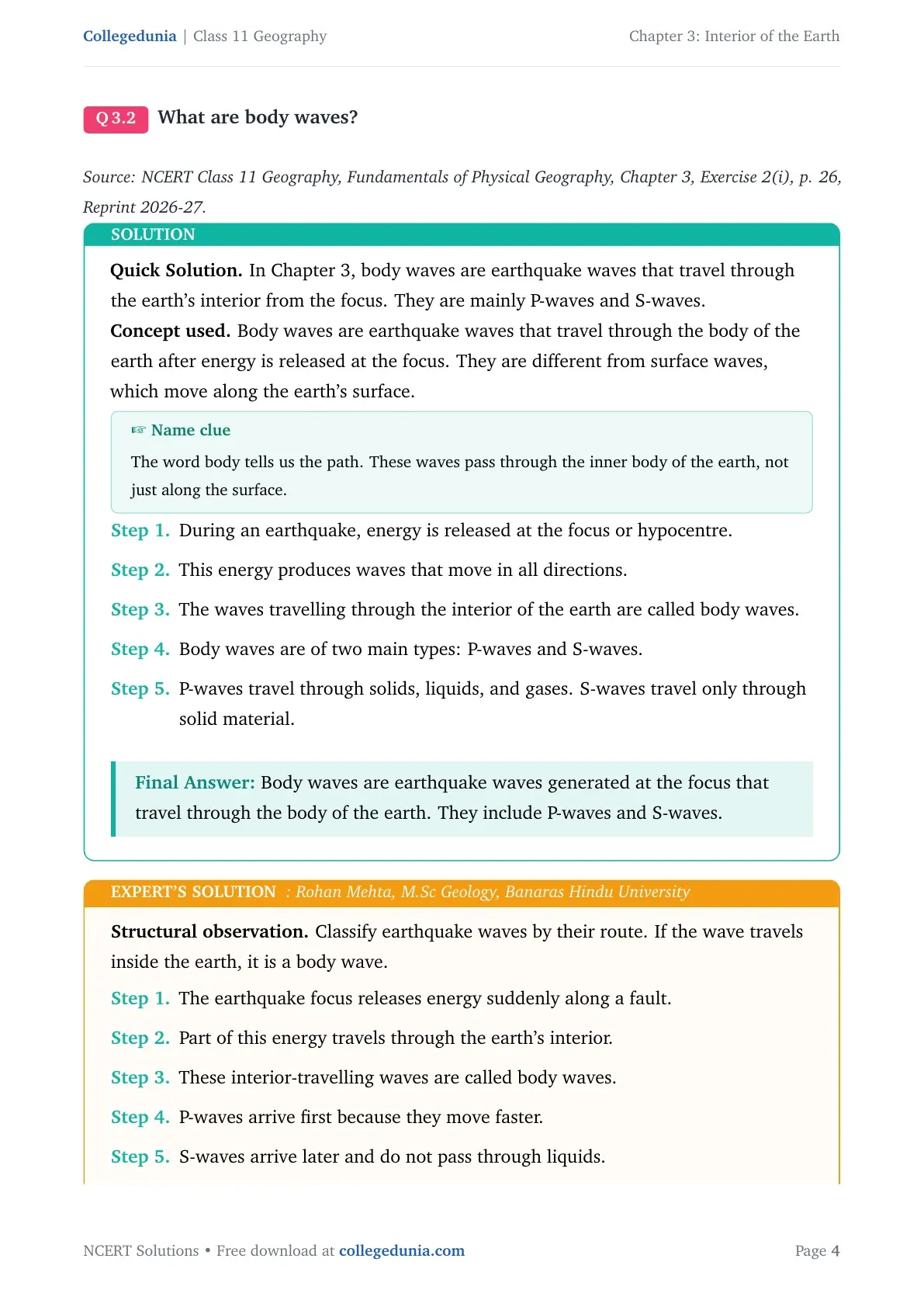
Q 3.2
What are body waves?
Quick Solution. In Chapter 3, body waves are earthquake waves that travel through the earth's interior from the focus. They are mainly P-waves and S-waves.
Concept used. Body waves are earthquake waves that travel through the body of the earth after energy is released at the focus. They are different from surface waves, which move along the earth's surface.
Name clue
The word body tells us the path. These waves pass through the inner body of the earth, not just along the surface.
During an earthquake, energy is released at the focus or hypocentre.
This energy produces waves that move in all directions.
The waves travelling through the interior of the earth are called body waves.
Body waves are of two main types: P-waves and S-waves.
P-waves travel through solids, liquids, and gases. S-waves travel only through solid material.
Body waves are earthquake waves generated at the focus that travel through the body of the earth. They include P-waves and S-waves.
RM
Rohan Mehta
M.Sc Geology, Banaras Hindu University
Verified Expert
Structural observation. Classify earthquake waves by their route. If the wave travels inside the earth, it is a body wave.
The earthquake focus releases energy suddenly along a fault.
Part of this energy travels through the earth's interior.
These interior-travelling waves are called body waves.
P-waves arrive first because they move faster.
S-waves arrive later and do not pass through liquids.
This property makes body waves useful for studying the earth's layers. Changes in their speed and path show changes in material and density. In exam writing, add one comparison line with surface waves: body waves move through the interior, while surface waves travel along the surface and cause greater damage.
Body waves are the P and S earthquake waves that move through the earth's interior from the focus.
Q 3.3
Name the direct sources of information about the interior of the earth.
Quick Solution. In Chapter 3, direct sources are materials scientists can observe or test: surface rocks, mining samples, drilling samples, and volcanic materials.
Concept used. Direct sources give actual material or direct samples from the earth. NCERT names surface rocks, mining, drilling projects, and volcanic eruptions as direct sources.
Direct means material
If the source gives a sample that can be observed or analysed, treat it as a direct source.
Surface rocks are the most easily available solid earth material.
Rocks obtained from mining areas also give direct information.
Deep drilling projects provide samples from different depths of the crust.
Volcanic eruptions bring molten material to the surface.
Once magma comes out as lava or volcanic material, it can be analysed in laboratories.
The direct sources are surface rocks, rocks from mines, samples from deep drilling, and volcanic materials brought up during eruptions.
KI
Kavya Iyer
M.Sc Geography, Savitribai Phule Pune University
Verified Expert
Source test. Ask whether scientists can handle, observe, or test the material. If yes, it belongs to the direct group.
Surface rocks are available without entering deep parts of the earth.
Mining gives rocks from a few kilometres below the surface.
Drilling projects recover material from still deeper crustal portions.
Volcanoes bring magma from inside the earth to the surface as lava, ash, or other volcanic material.
These sources are limited because humans cannot reach the centre of the earth. That is why indirect sources are also needed.
Direct information comes from surface rocks, mining, deep drilling, and volcanic eruptions.
Q 3.4
Why do earthquake waves develop shadow zone?
Quick Solution. In Chapter 3, shadow zones form because seismic waves bend at layer boundaries and S-waves cannot cross the liquid outer core.
Concept used. A shadow zone is an area where earthquake waves are not recorded by seismographs. It develops because waves change direction when they meet layers of different density, and S-waves cannot pass through liquid material.
Wave behaviour
Earthquake waves do not travel in one straight path everywhere. They reflect, refract, slow down, speed up, or stop depending on the material.
Earthquake waves pass through materials with different densities inside the earth.
When the waves meet a new layer, their direction changes by reflection or refraction.
P-waves are refracted strongly in the deeper interior.
S-waves cannot travel through the liquid outer core.
Because of these path changes and stoppages, some areas do not receive direct waves. These areas are called shadow zones.
Earthquake waves develop shadow zones because internal layers bend, reflect, or stop the waves, especially when S-waves meet the liquid outer core.
NJ
Neha Joshi
M.A. Geography, Jawaharlal Nehru University
Verified Expert
Picture-first. Imagine wave paths as lines moving through a layered earth. The lines bend or disappear at major boundaries.
Seismographs near the earthquake record waves normally.
At greater angular distances, wave paths cross deeper layers.
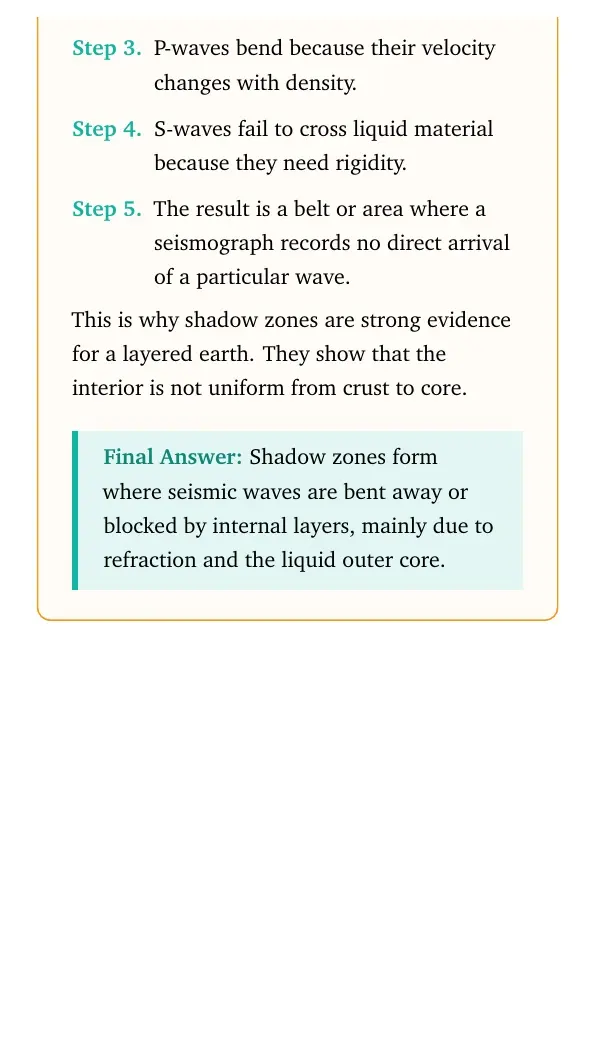
P-waves bend because their velocity changes with density.
S-waves fail to cross liquid material because they need rigidity.
The result is a belt or area where a seismograph records no direct arrival of a particular wave.
This is why shadow zones are strong evidence for a layered earth. They show that the interior is not uniform from crust to core.
Shadow zones form where seismic waves are bent away or blocked by internal layers, mainly due to refraction and the liquid outer core.
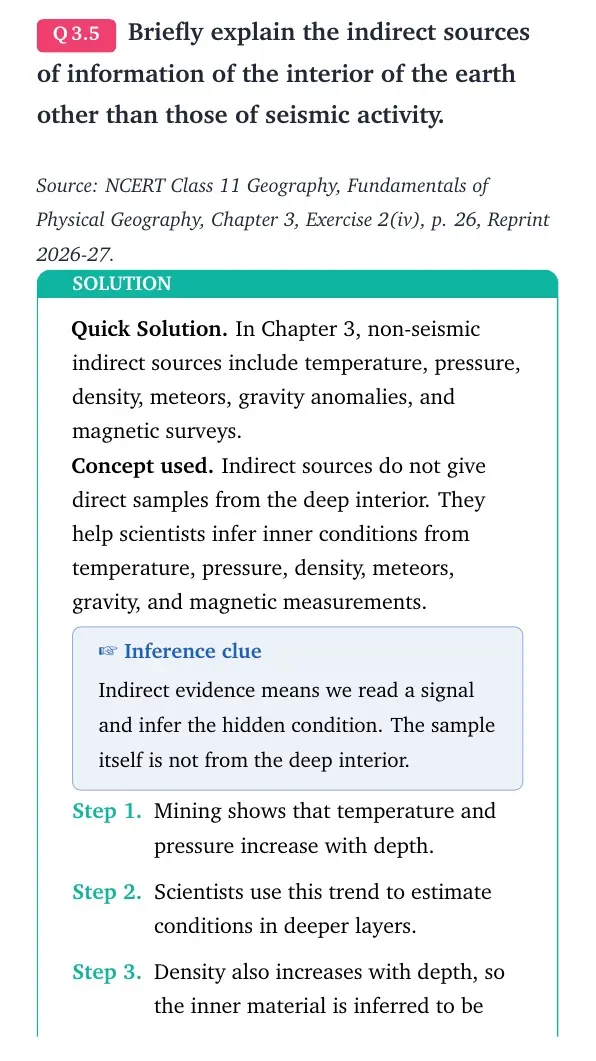
Q 3.5
Briefly explain the indirect sources of information of the interior of the earth other than those of seismic activity.
Quick Solution. In Chapter 3, non-seismic indirect sources include temperature, pressure, density, meteors, gravity anomalies, and magnetic surveys.
Concept used. Indirect sources do not give direct samples from the deep interior. They help scientists infer inner conditions from temperature, pressure, density, meteors, gravity, and magnetic measurements.
Inference clue
Indirect evidence means we read a signal and infer the hidden condition. The sample itself is not from the deep interior.
Mining shows that temperature and pressure increase with depth.
Scientists use this trend to estimate conditions in deeper layers.
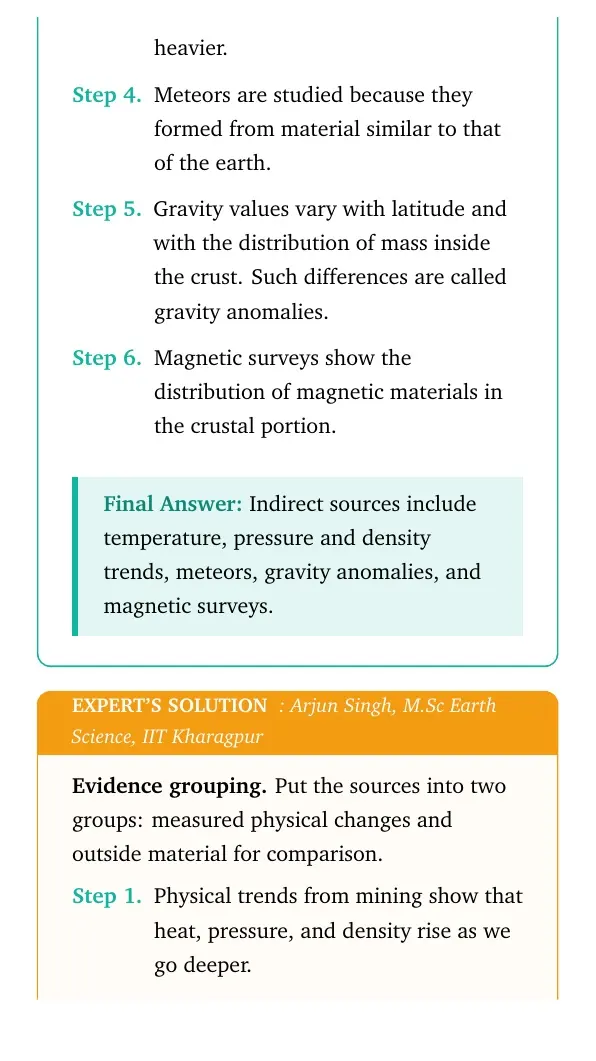
Density also increases with depth, so the inner material is inferred to be heavier.
Meteors are studied because they formed from material similar to that of the earth.
Gravity values vary with latitude and with the distribution of mass inside the crust. Such differences are called gravity anomalies.
Magnetic surveys show the distribution of magnetic materials in the crustal portion.
Indirect sources include temperature, pressure and density trends, meteors, gravity anomalies, and magnetic surveys.
AS
Arjun Singh
M.Sc Earth Science, IIT Kharagpur
Verified Expert
Evidence grouping. Put the sources into two groups: measured physical changes and outside material for comparison.
Physical trends from mining show that heat, pressure, and density rise as we go deeper.
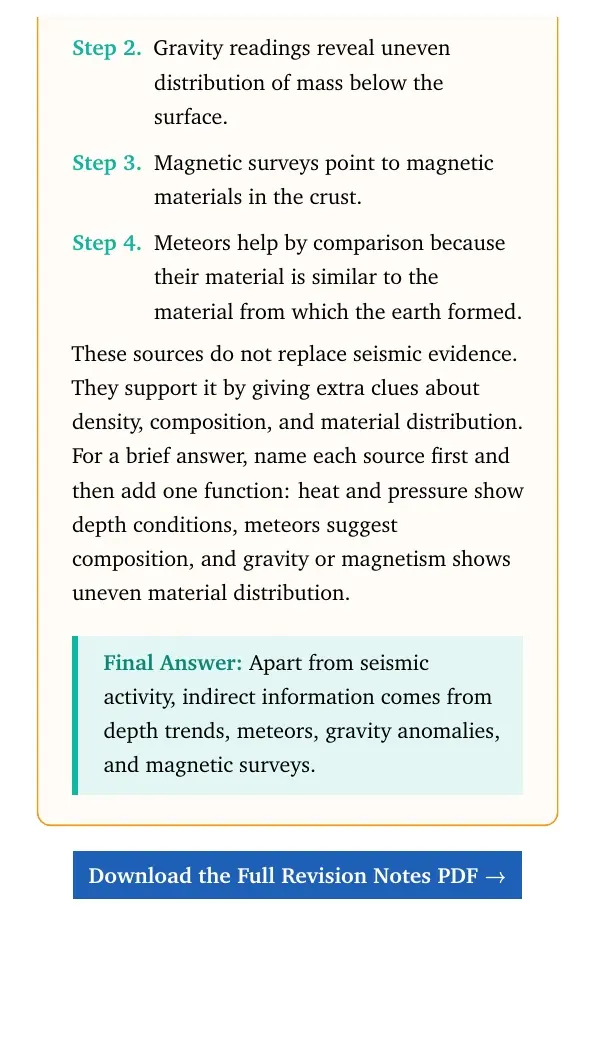
Gravity readings reveal uneven distribution of mass below the surface.
Magnetic surveys point to magnetic materials in the crust.
Meteors help by comparison because their material is similar to the material from which the earth formed.
These sources do not replace seismic evidence. They support it by giving extra clues about density, composition, and material distribution. For a brief answer, name each source first and then add one function: heat and pressure show depth conditions, meteors suggest composition, and gravity or magnetism shows uneven material distribution.
Apart from seismic activity, indirect information comes from depth trends, meteors, gravity anomalies, and magnetic surveys.
Q 3.6
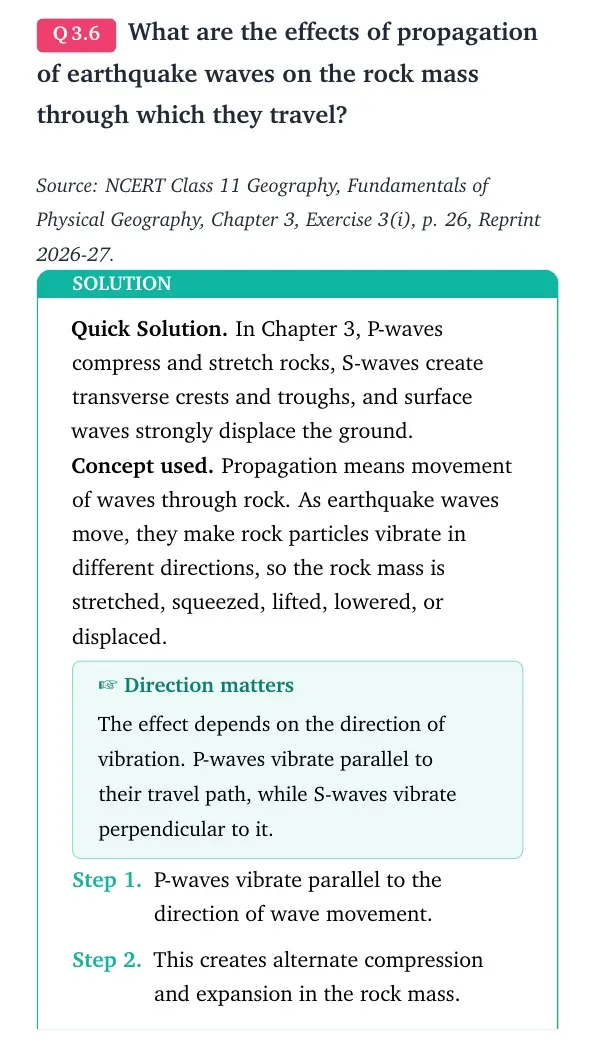
What are the effects of propagation of earthquake waves on the rock mass through which they travel?
Quick Solution. In Chapter 3, P-waves compress and stretch rocks, S-waves create transverse crests and troughs, and surface waves strongly displace the ground.
Concept used. Propagation means movement of waves through rock. As earthquake waves move, they make rock particles vibrate in different directions, so the rock mass is stretched, squeezed, lifted, lowered, or displaced.
Direction matters
The effect depends on the direction of vibration. P-waves vibrate parallel to their travel path, while S-waves vibrate perpendicular to it.
P-waves vibrate parallel to the direction of wave movement.
This creates alternate compression and expansion in the rock mass. NCERT describes this as stretching and squeezing.
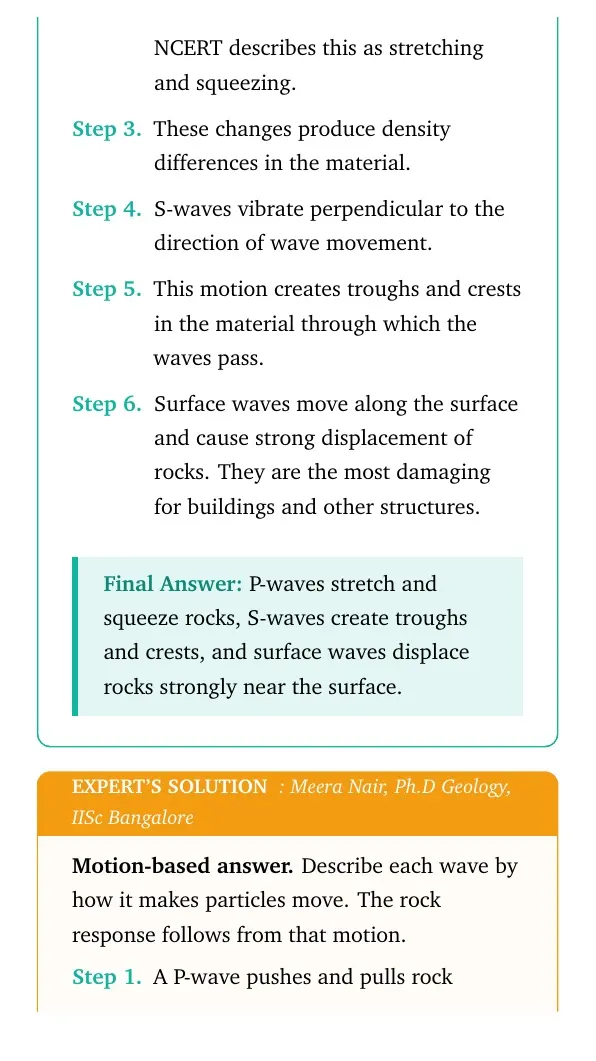
These changes produce density differences in the material.
S-waves vibrate perpendicular to the direction of wave movement.
This motion creates troughs and crests in the material through which the waves pass.
Surface waves move along the surface and cause strong displacement of rocks. They are the most damaging for buildings and other structures.
P-waves stretch and squeeze rocks, S-waves create troughs and crests, and surface waves displace rocks strongly near the surface.
MN
Meera Nair
Ph.D Geology, IISc Bangalore
Verified Expert
Motion-based answer. Describe each wave by how it makes particles move. The rock response follows from that motion.
A P-wave pushes and pulls rock particles in the same direction as the wave travels.
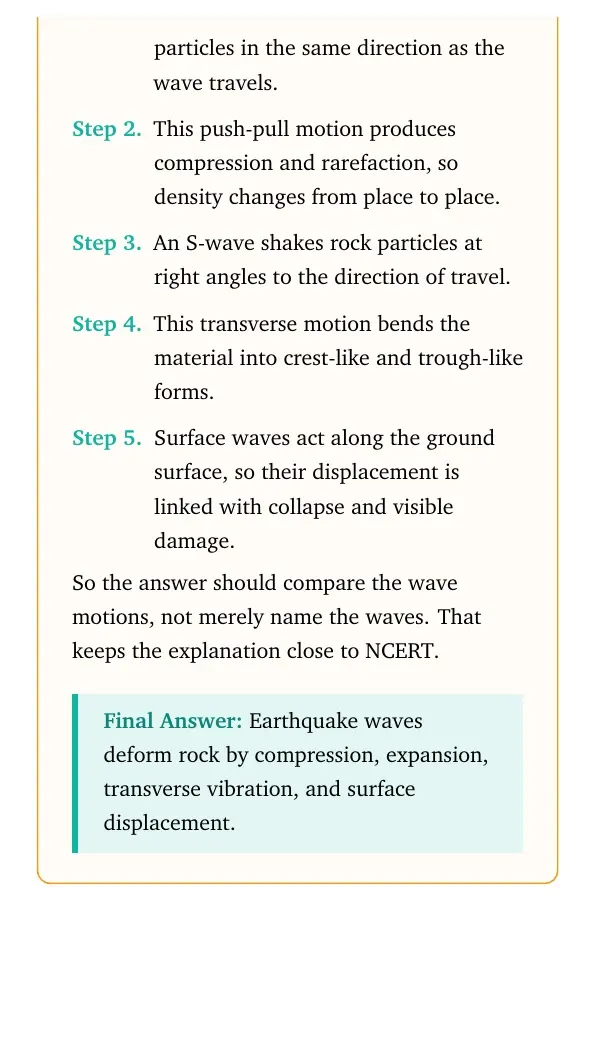
This push-pull motion produces compression and rarefaction, so density changes from place to place.
An S-wave shakes rock particles at right angles to the direction of travel.
This transverse motion bends the material into crest-like and trough-like forms.
Surface waves act along the ground surface, so their displacement is linked with collapse and visible damage.
So the answer should compare the wave motions, not merely name the waves. That keeps the explanation close to NCERT.
Earthquake waves deform rock by compression, expansion, transverse vibration, and surface displacement.
Q 3.7
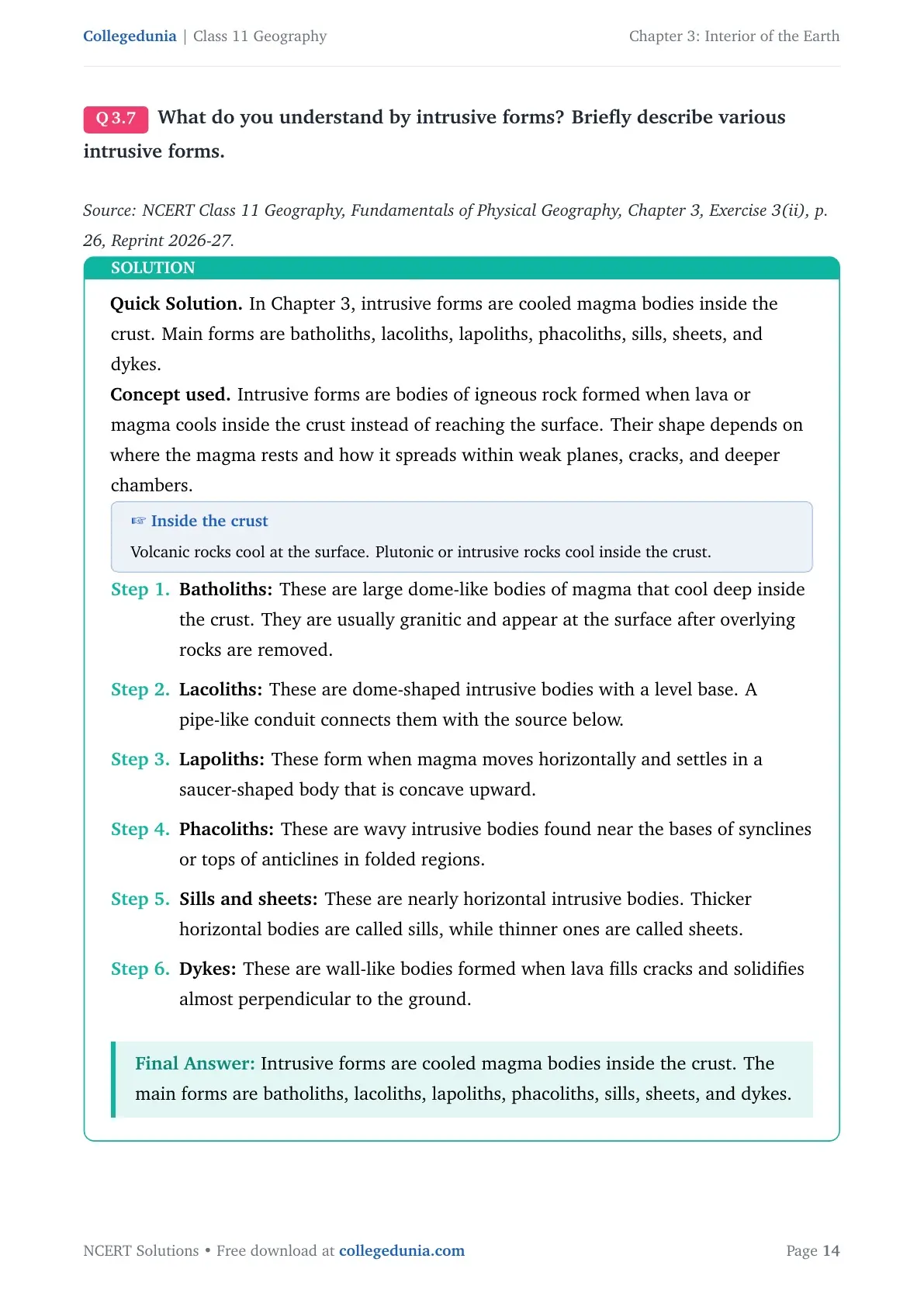
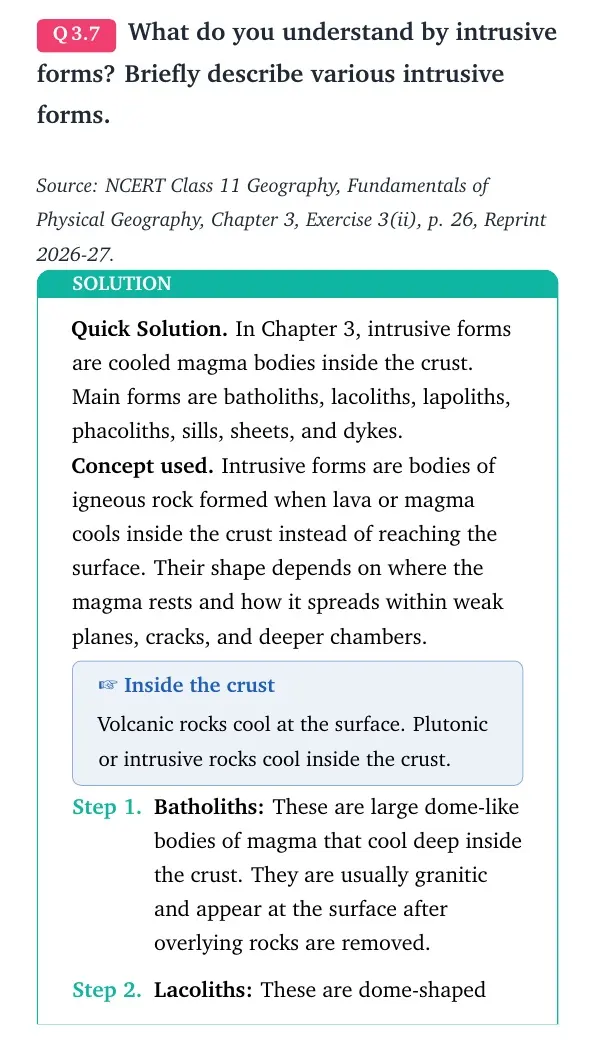
What do you understand by intrusive forms? Briefly describe various intrusive forms.
Quick Solution. In Chapter 3, intrusive forms are cooled magma bodies inside the crust. Main forms are batholiths, lacoliths, lapoliths, phacoliths, sills, sheets, and dykes.
Concept used. Intrusive forms are bodies of igneous rock formed when lava or magma cools inside the crust instead of reaching the surface. Their shape depends on where the magma rests and how it spreads within weak planes, cracks, and deeper chambers.
Inside the crust
Volcanic rocks cool at the surface. Plutonic or intrusive rocks cool inside the crust.
Batholiths: These are large dome-like bodies of magma that cool deep inside the crust. They are usually granitic and appear at the surface after overlying rocks are removed.
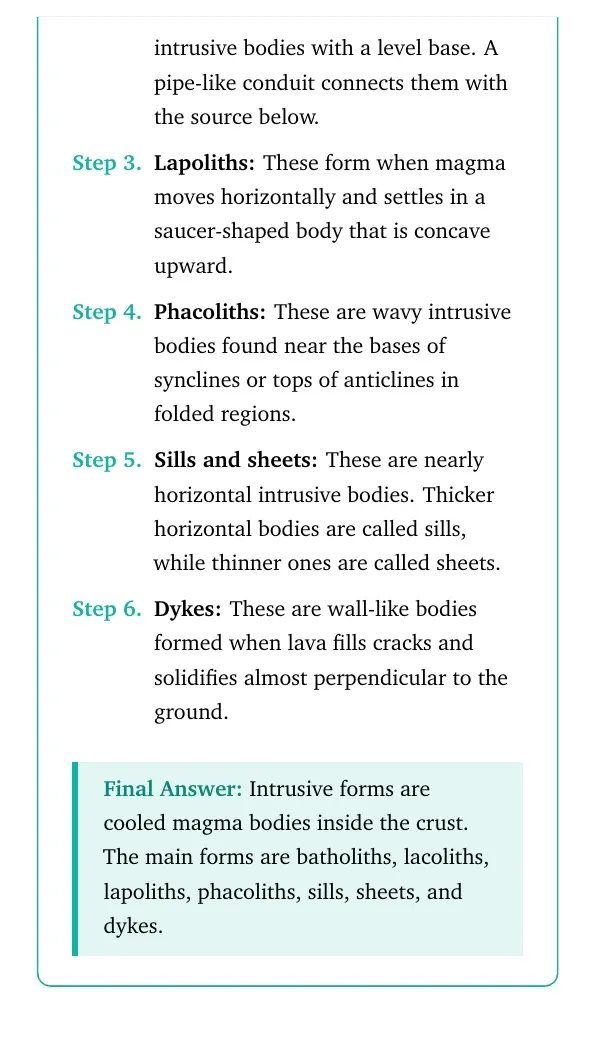
Lacoliths: These are dome-shaped intrusive bodies with a level base. A pipe-like conduit connects them with the source below.
Lapoliths: These form when magma moves horizontally and settles in a saucer-shaped body that is concave upward.
Phacoliths: These are wavy intrusive bodies found near the bases of synclines or tops of anticlines in folded regions.
Sills and sheets: These are nearly horizontal intrusive bodies. Thicker horizontal bodies are called sills, while thinner ones are called sheets.
Dykes: These are wall-like bodies formed when lava fills cracks and solidifies almost perpendicular to the ground.
Intrusive forms are cooled magma bodies inside the crust. The main forms are batholiths, lacoliths, lapoliths, phacoliths, sills, sheets, and dykes.
PK
Priya Kapoor
M.Sc Geology, University of Hyderabad
Verified Expert
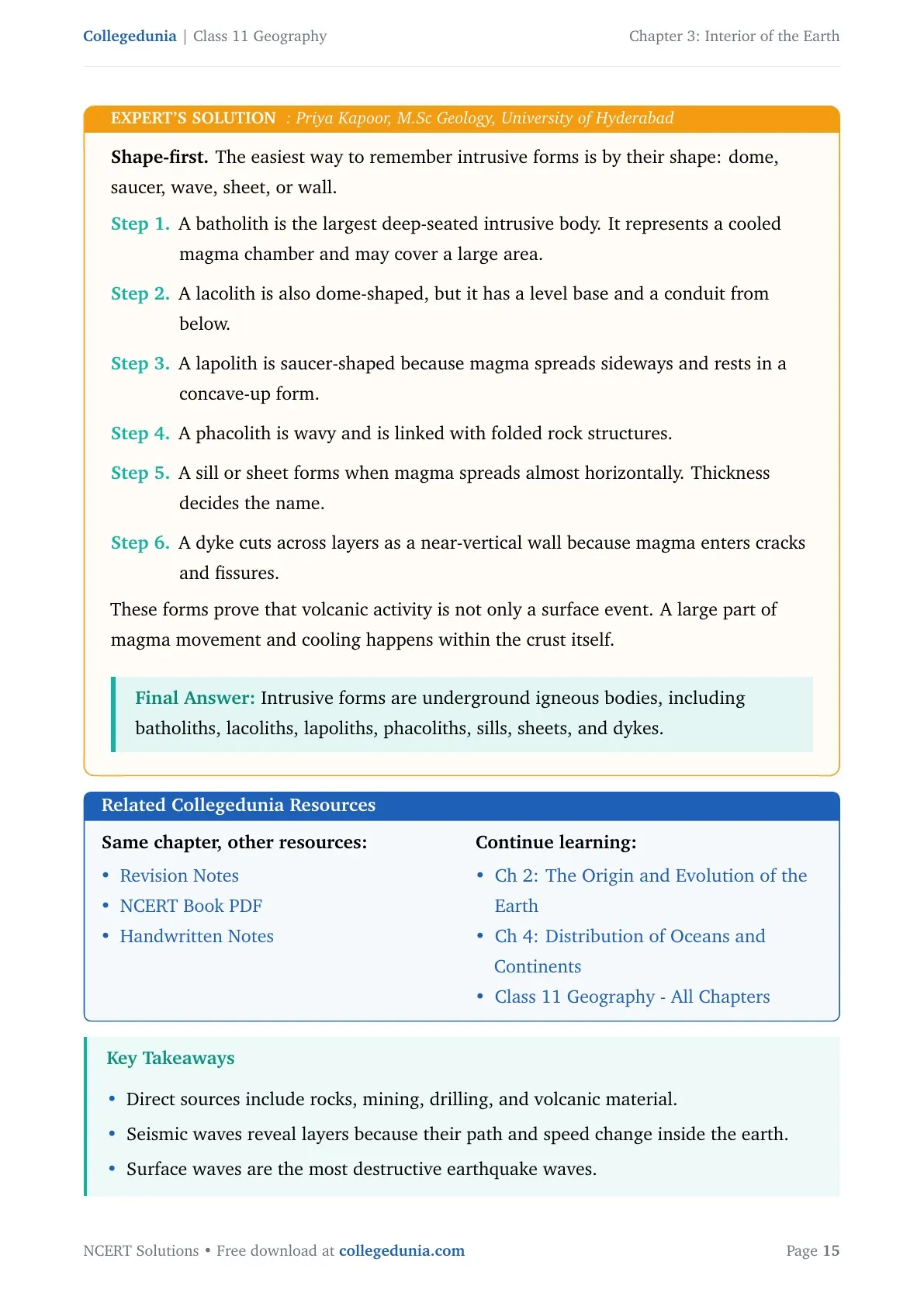
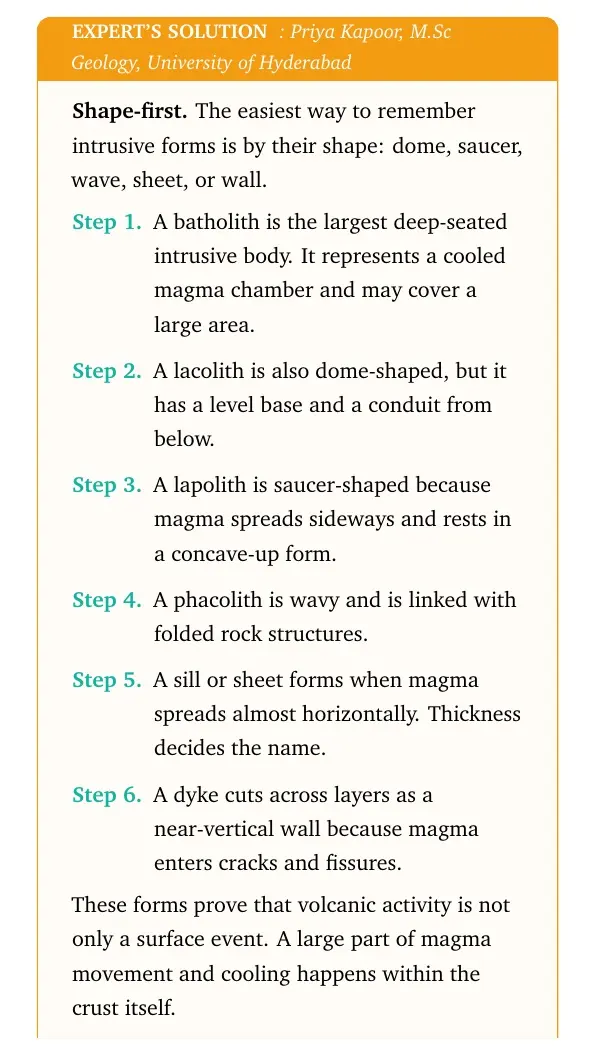
Shape-first. The easiest way to remember intrusive forms is by their shape: dome, saucer, wave, sheet, or wall.
A batholith is the largest deep-seated intrusive body. It represents a cooled magma chamber and may cover a large area.
A lacolith is also dome-shaped, but it has a level base and a conduit from below.
A lapolith is saucer-shaped because magma spreads sideways and rests in a concave-up form.
A phacolith is wavy and is linked with folded rock structures.
A sill or sheet forms when magma spreads almost horizontally. Thickness decides the name.
A dyke cuts across layers as a near-vertical wall because magma enters cracks and fissures.
These forms prove that volcanic activity is not only a surface event. A large part of magma movement and cooling happens within the crust itself.
Intrusive forms are underground igneous bodies, including batholiths, lacoliths, lapoliths, phacoliths, sills, sheets, and dykes.
Interior of the Earth Class 11 Geography NCERT Solutions FAQs
Ques. What is the correct MCQ key for Class 11 Geography Chapter 3 Interior of the Earth?
Ans. The MCQ key is (i) (c) Surface waves, (ii) (b) Volcanoes, (iii) (b) Flood, and (iv) (b) crust and upper mantle.
Ques. Why are surface waves more destructive than body waves?
Ans. Surface waves move along the ground surface and cause strong displacement of rocks and structures. That is why they usually create the greatest damage during an earthquake.
Ques. Why do earthquake waves form a shadow zone?
Ans. Shadow zones form because earthquake waves bend when they pass through layers of different density, and S waves cannot pass through liquid material in the outer core.
Ques. What are intrusive forms in Interior of the Earth?
Ans. Intrusive forms are igneous bodies made when magma cools inside the crust. Batholiths, lacoliths, lapoliths, sills, and dykes are the main intrusive forms in this chapter.










Comments