The NCERT Solutions for Class 11 Geography Chapter 5 Geomorphic Processes cover all exercise questions from the latest 2026-27 NCERT book. The chapter explains weathering, mass movement, erosion, deposition, soil formation and the balance between endogenic and exogenic forces.
The PDF solves 10 exercise and project questions from Geomorphic Processes.
Key terms include gradation, hydration, mass wasting, weathering mantle, pedogenesis, erosion and deposition.
Use the embedded question cards below for direct answers and expert explanations.
Student Feedback: In a Collegedunia student survey of 12,080 Class 11 Geography students before the 2026 exams, many students said this chapter becomes easier when weathering, mass movement and erosion are revised as separate process chains. Keep the MCQ terms ready before writing the long answers.
Each answer in this Class 11 Geography Chapter 5 solutions PDF follows the 2026-27 NCERT exercise and keeps the language school-exam ready.
Geomorphic Processes Answer Key and Exercise Pattern
The exercise checks whether students can separate land-building forces from land-wearing forces. MCQs are direct, while short and long answers need linked reasoning on weathering, biodiversity, soil formation and exogenic energy.
Exercise area
Questions
What it checks
MCQs
3 parts
Gradation, hydration and debris avalanche classification
Short answers
4 questions
Biodiversity, rapid mass movement, exogenic agents and soil formation
Long answers
2 questions
Opposing process groups and solar energy in exogenic work
Project work
1 task
Local observation of climate, weathering and soil properties
The MCQ key used in the PDF is (d), (b), and (c). The hydration item has different public answer keys, so students should follow the school key if their teacher gives one.
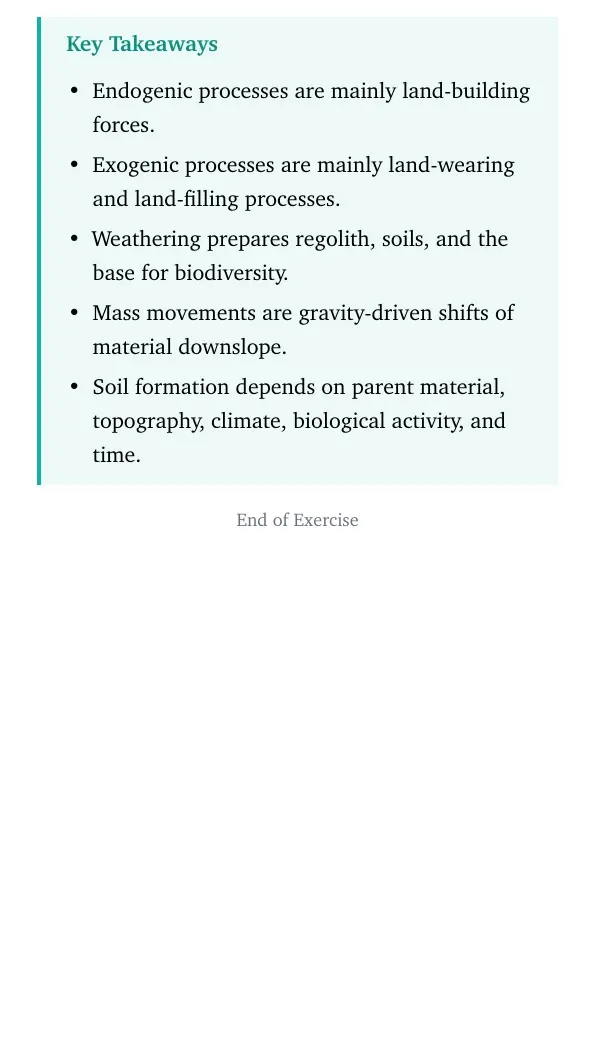
Geomorphic processes are natural actions that change the earth's surface. Endogenic processes work from inside the earth and usually build relief. Exogenic processes work at or near the surface and usually wear down relief or fill depressions.
Endogenic examples: diastrophism and volcanism create or raise landforms.
Exogenic examples: weathering, erosion, transportation and deposition reshape exposed rocks.
Controlling force: gravity and slope decide how loosened material moves downslope.
The chapter is easiest when students write each answer as a chain: process, material, movement and final landform effect.
Weathering, Mass Movement, Erosion and Deposition
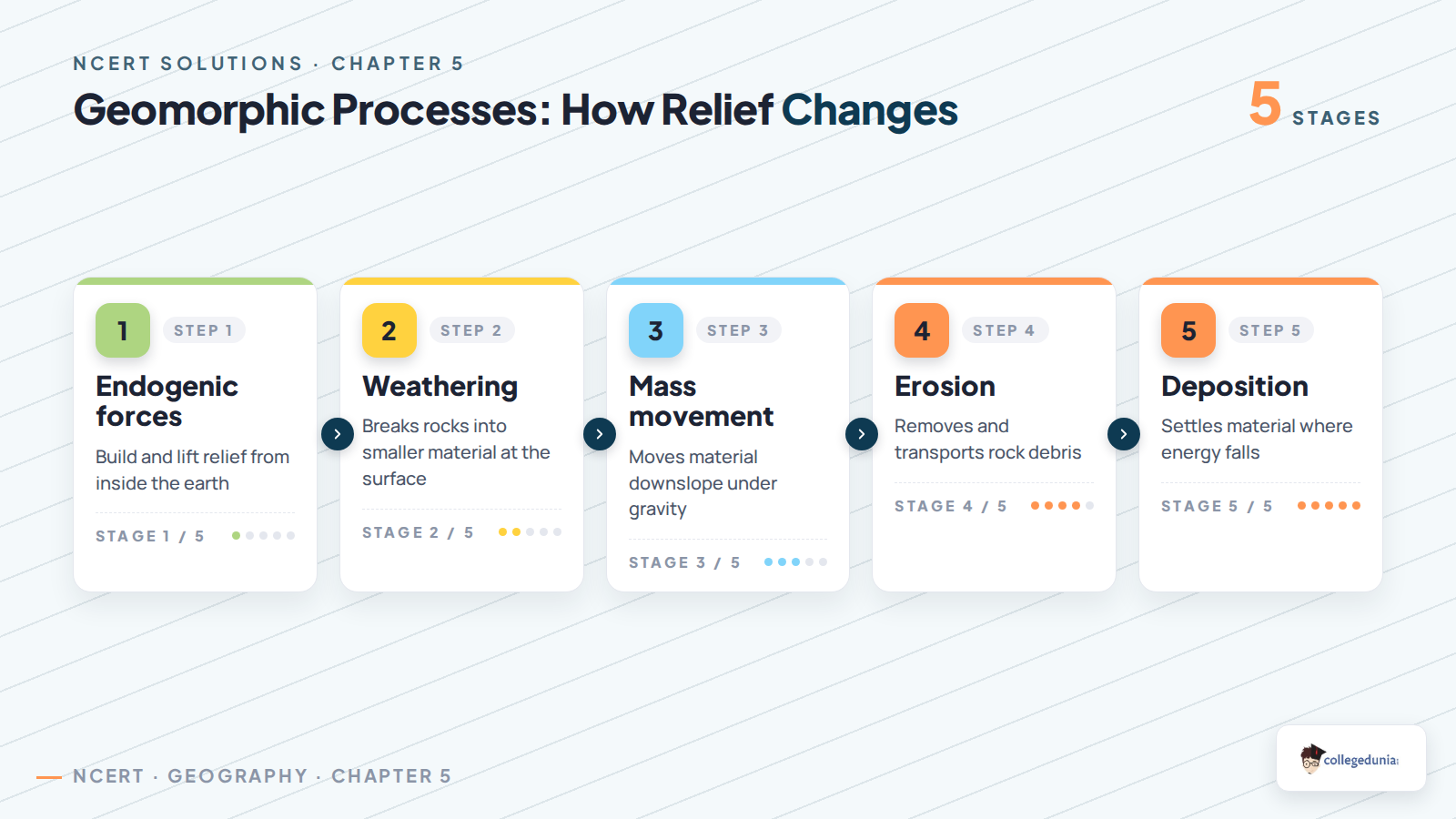
Weathering breaks or alters rocks in place. Mass movement shifts weathered material downslope mainly under gravity. Erosion removes and transports material through agents such as running water, wind, glaciers, waves and currents. Deposition places that transported load where the agent loses energy.
Process
Meaning
Revision cue
Weathering
Rock breaks down or chemically changes in place.
Creates weathering mantle
Mass movement
Rock debris or soil moves downslope under gravity.
Landslides and debris avalanche
Erosion
Material is removed and transported by an agent.
Running water, wind, waves or ice
Deposition
Transported material is laid down.
Happens when energy falls
Exam tip: Do not use erosion and weathering as the same word. Weathering prepares material; erosion moves it away.
Soil Formation in Geomorphic Processes
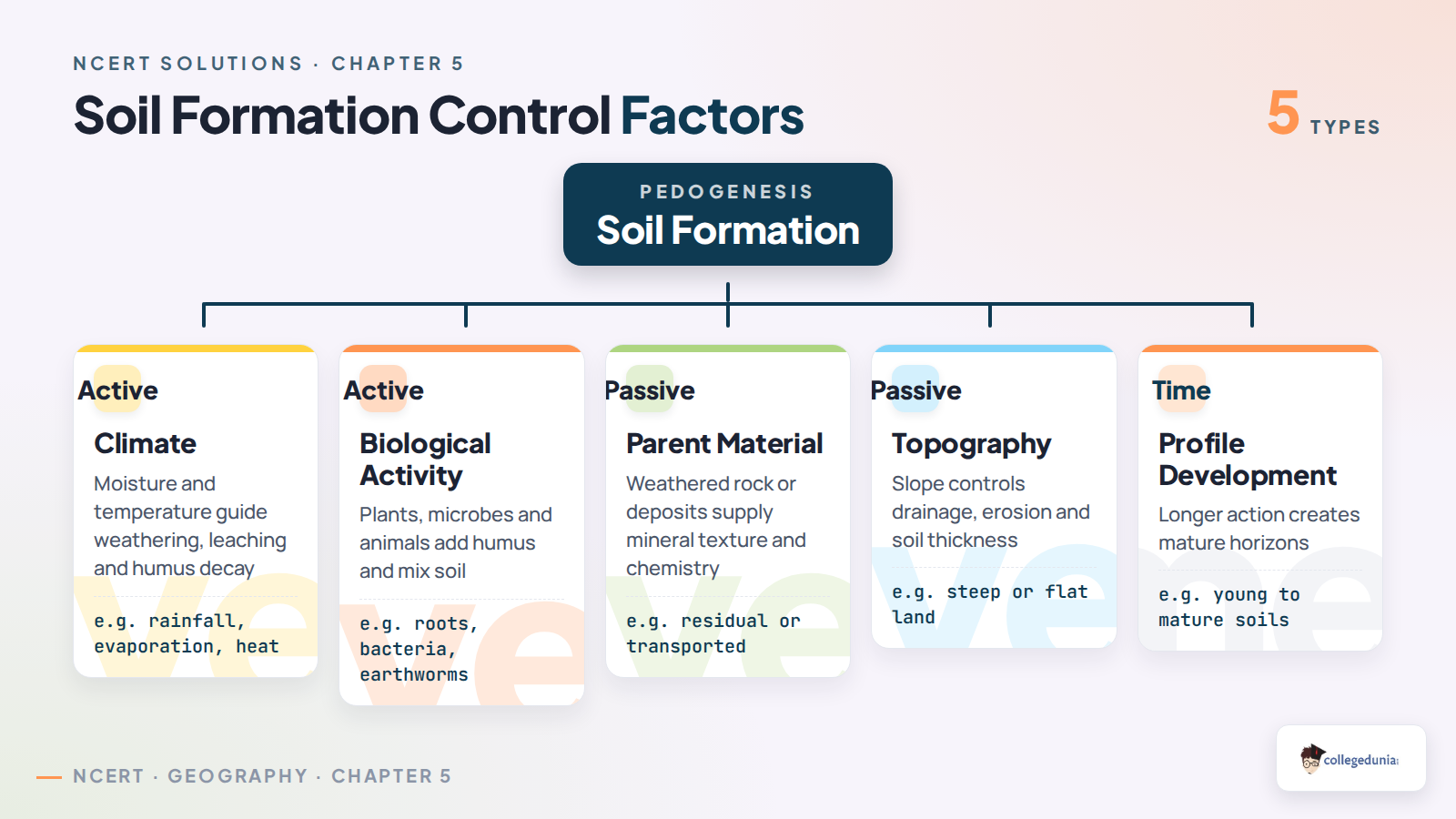
Soil formation, or pedogenesis, begins with weathered rock material. Climate and biological activity then control how quickly the material changes into soil and how much organic matter mixes with it.
Climate: temperature and rainfall control weathering intensity and chemical change.
Biological activity: plants, roots, microbes and animals add humus and mix the soil.
Parent material: original rock affects mineral content, colour and texture.
Topography and time: slope, drainage and duration affect soil depth and profile development.
How to Use the Class 11 Geography Chapter 5 Solutions PDF
Use the PDF in two rounds. First, revise the MCQ key and short definitions. Then practise the long answers with headings so the link between endogenic and exogenic processes stays clear.
Write weathering, mass movement, erosion and deposition in the correct sequence.
For biodiversity and soil answers, connect weathering mantle with soil, plants and living organisms.
For exogenic energy, mention sun's heat, climate, gravity and surface gradients together.
For project work, record location, slope, local climate, soil texture and likely weathering signs.
Quick recall: Endogenic forces create relief, while exogenic forces modify and reduce relief over time.
All NCERT Solutions for Class 11 Geography Chapter 5 Geomorphic Processes with Step-by-Step Solutions
The cards below include every exercise question. Use Check Solution for the direct answer and Expert Solution for a second explanation.
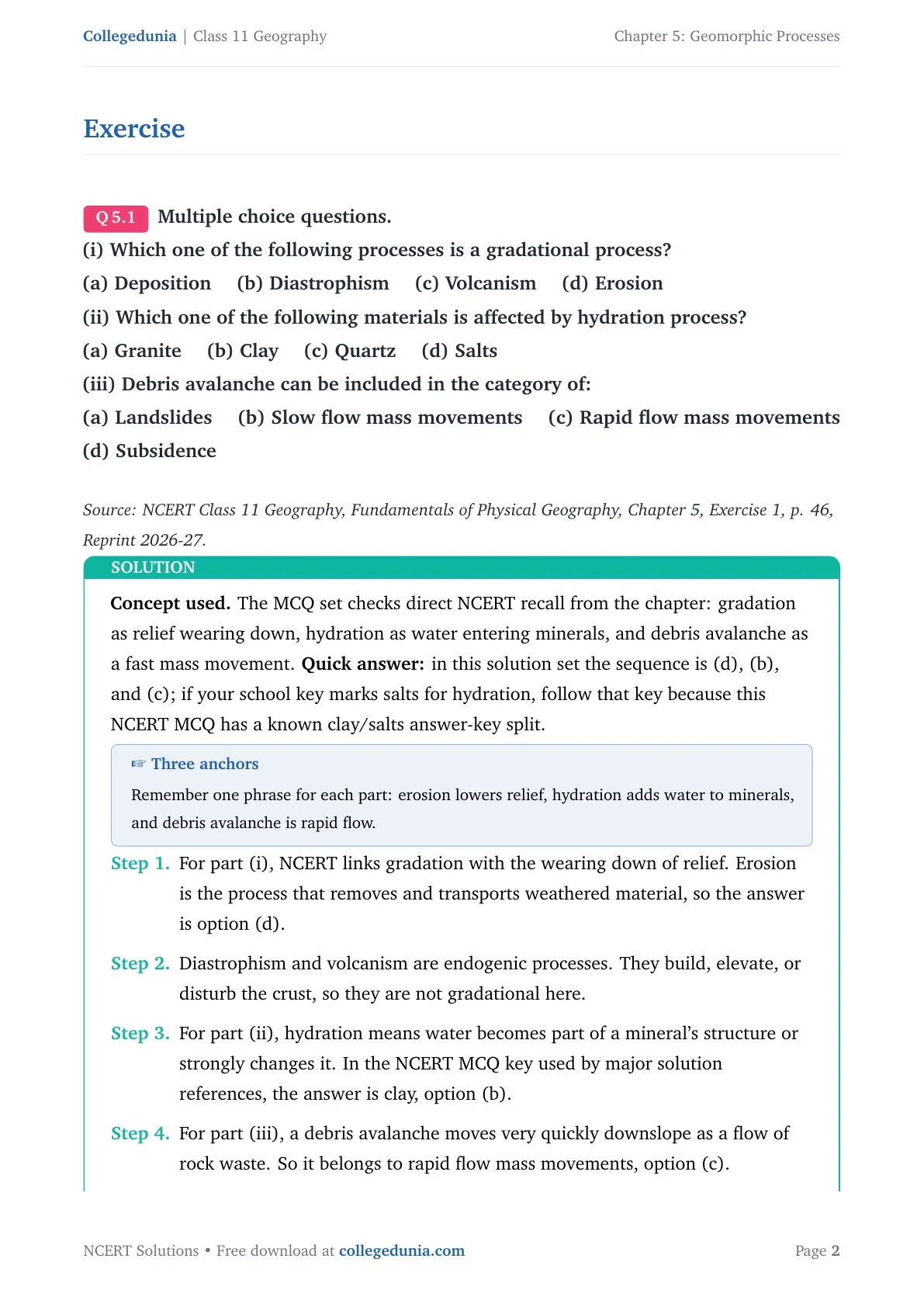
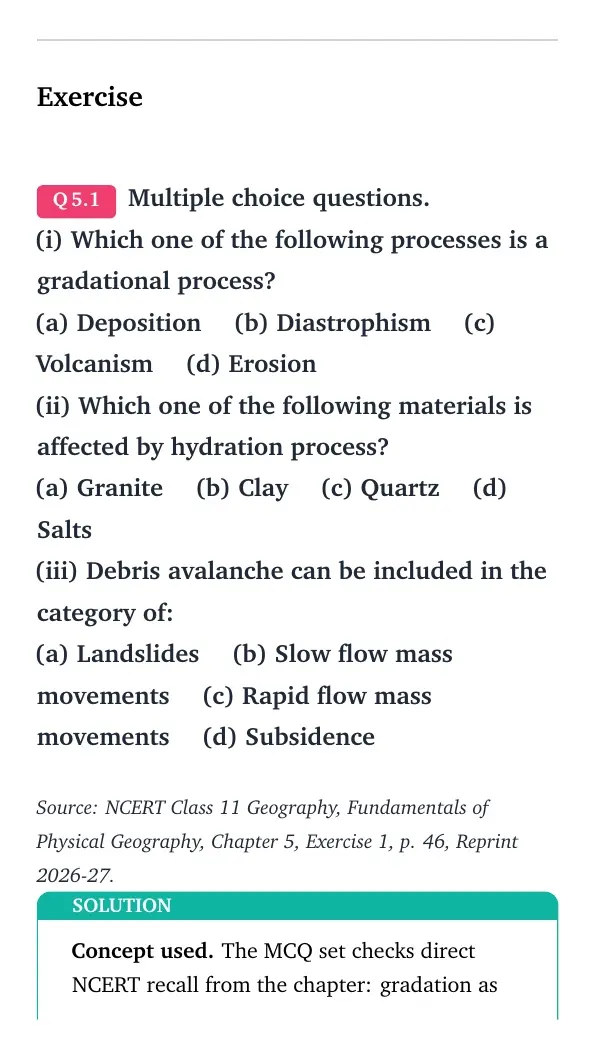
Q 5.1
Multiple choice questions.
(i) Which one of the following processes is a gradational process?
(a) Deposition (b) Diastrophism (c) Volcanism (d) Erosion
(ii) Which one of the following materials is affected by hydration process?
(a) Granite (b) Clay (c) Quartz (d) Salts
(iii) Debris avalanche can be included in the category of:
(a) Landslides (b) Slow flow mass movements (c) Rapid flow mass movements (d) Subsidence
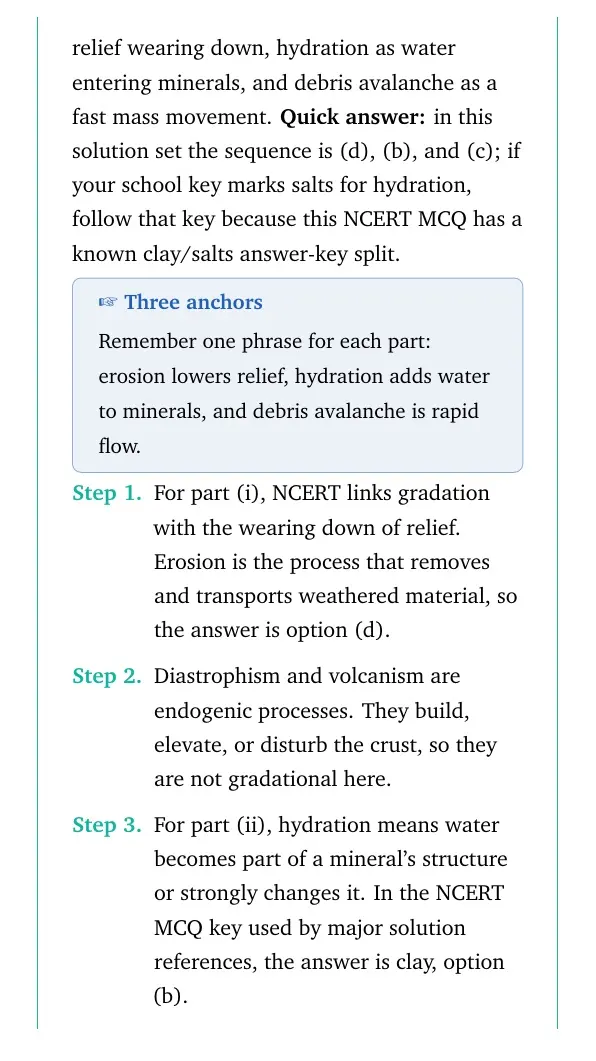
Concept used. The MCQ set checks direct NCERT recall from the
chapter: gradation as relief wearing down, hydration as water entering minerals,
and debris avalanche as a fast mass movement. Quick answer: in this
solution set the sequence is (d), (b), and (c); if your school key marks salts
for hydration, follow that key because this NCERT MCQ has a known clay/salts
answer-key split.
Three anchors
Remember one phrase for each part: erosion lowers relief, hydration adds
water to minerals, and debris avalanche is rapid flow.
For part (i), NCERT links gradation with the wearing down of relief.
Erosion is the process that removes and transports weathered material,
so the answer is option (d).
Diastrophism and volcanism are endogenic processes. They build,
elevate, or disturb the crust, so they are not gradational here.
For part (ii), hydration means water becomes part of a mineral's
structure or strongly changes it. In the NCERT MCQ key used by major
solution references, the answer is clay, option (b).
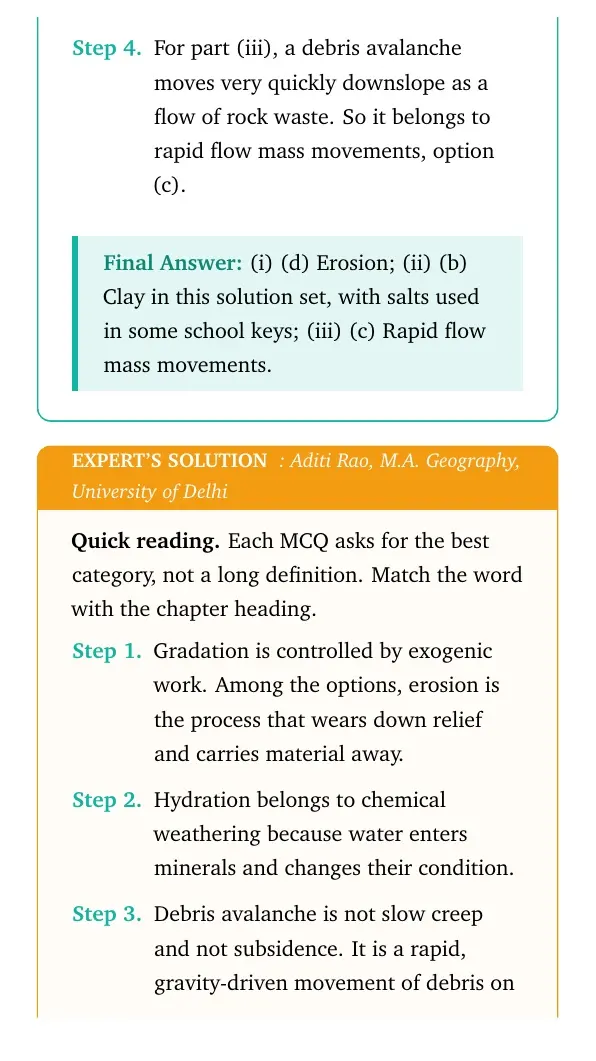
For part (iii), a debris avalanche moves very quickly downslope as a
flow of rock waste. So it belongs to rapid flow mass movements, option
(c).
(i) (d) Erosion; (ii) (b) Clay in this solution set, with salts used in some school keys; (iii) (c) Rapid flow mass movements.
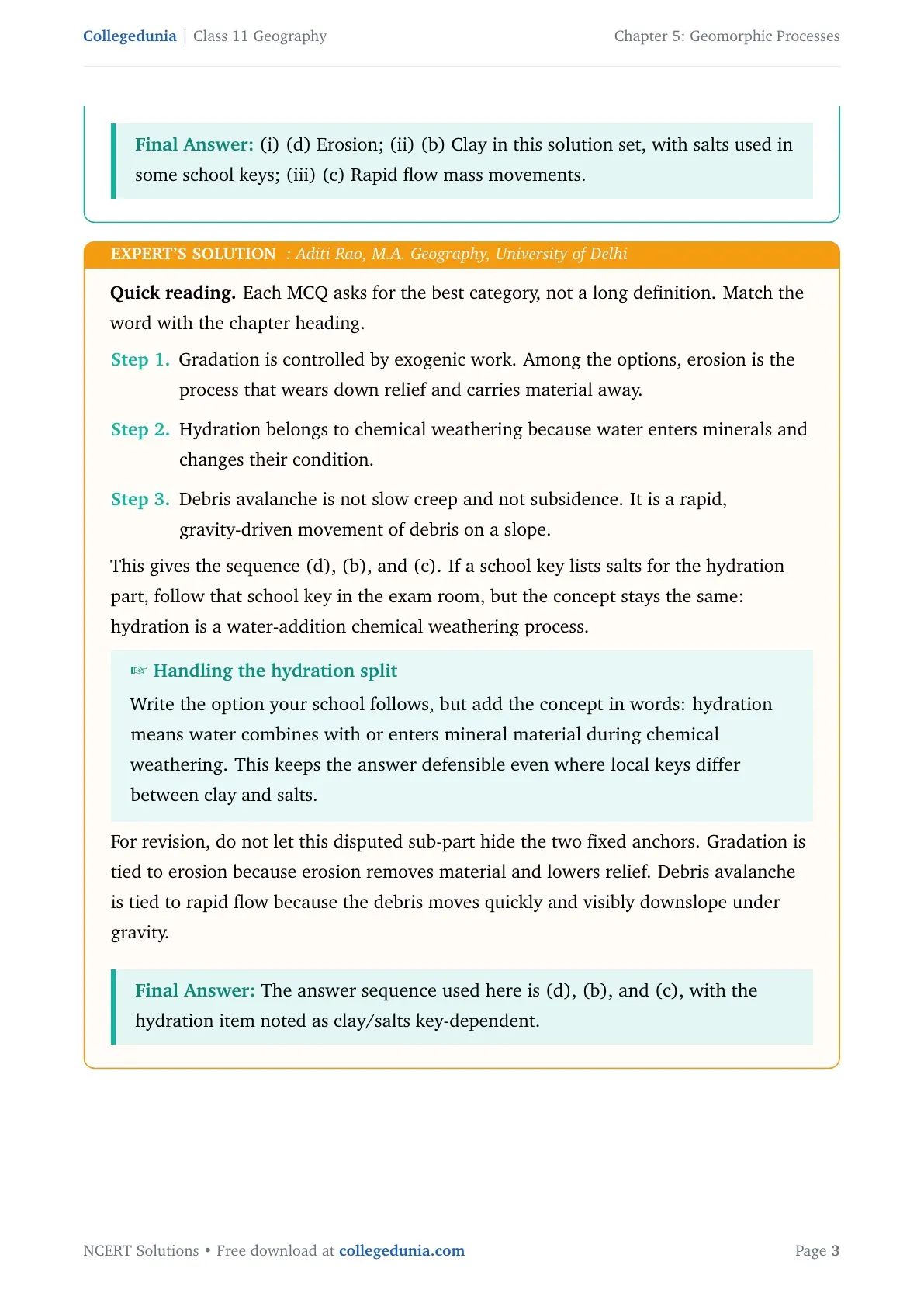
AR
Aditi Rao
M.A. Geography, University of Delhi
Verified Expert
Quick reading. Each MCQ asks for the best category, not a long
definition. Match the word with the chapter heading.
Gradation is controlled by exogenic work. Among the options, erosion is
the process that wears down relief and carries material away.
Hydration belongs to chemical weathering because water enters minerals
and changes their condition.
Debris avalanche is not slow creep and not subsidence. It is a rapid,
gravity-driven movement of debris on a slope.
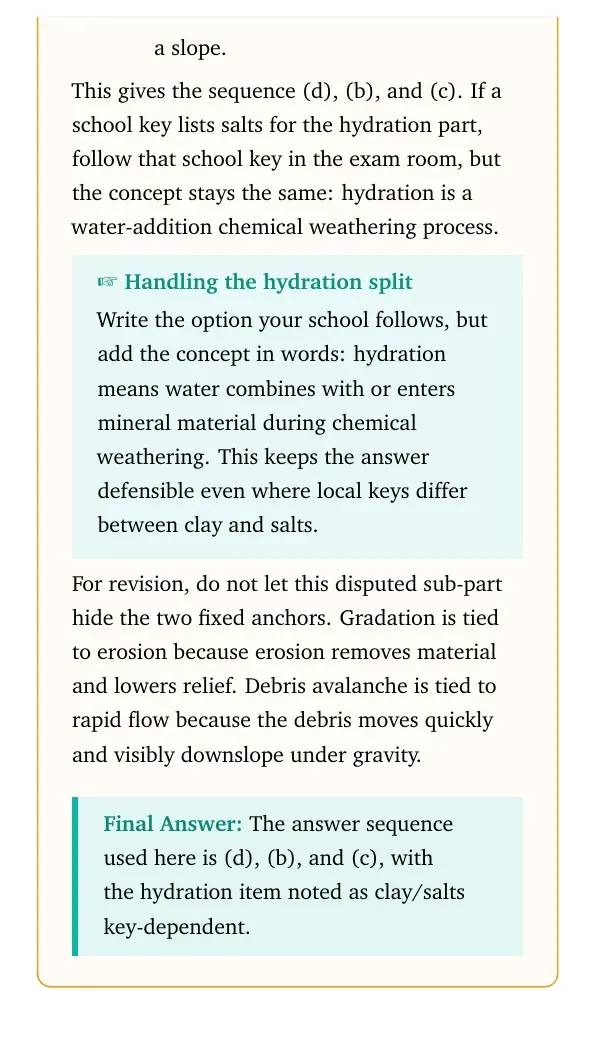
This gives the sequence (d), (b), and (c). If a school key lists salts for the
hydration part, follow that school key in the exam room, but the concept stays
the same: hydration is a water-addition chemical weathering process.
Handling the hydration split
Write the option your school follows, but add the concept in words: hydration
means water combines with or enters mineral material during chemical
weathering. This keeps the answer defensible even where local keys differ
between clay and salts.
For revision, do not let this disputed sub-part hide the two fixed anchors.
Gradation is tied to erosion because erosion removes material and lowers
relief. Debris avalanche is tied to rapid flow because the debris moves
quickly and visibly downslope under gravity.
The answer sequence used here is (d), (b), and (c), with the hydration item noted as clay/salts key-dependent.
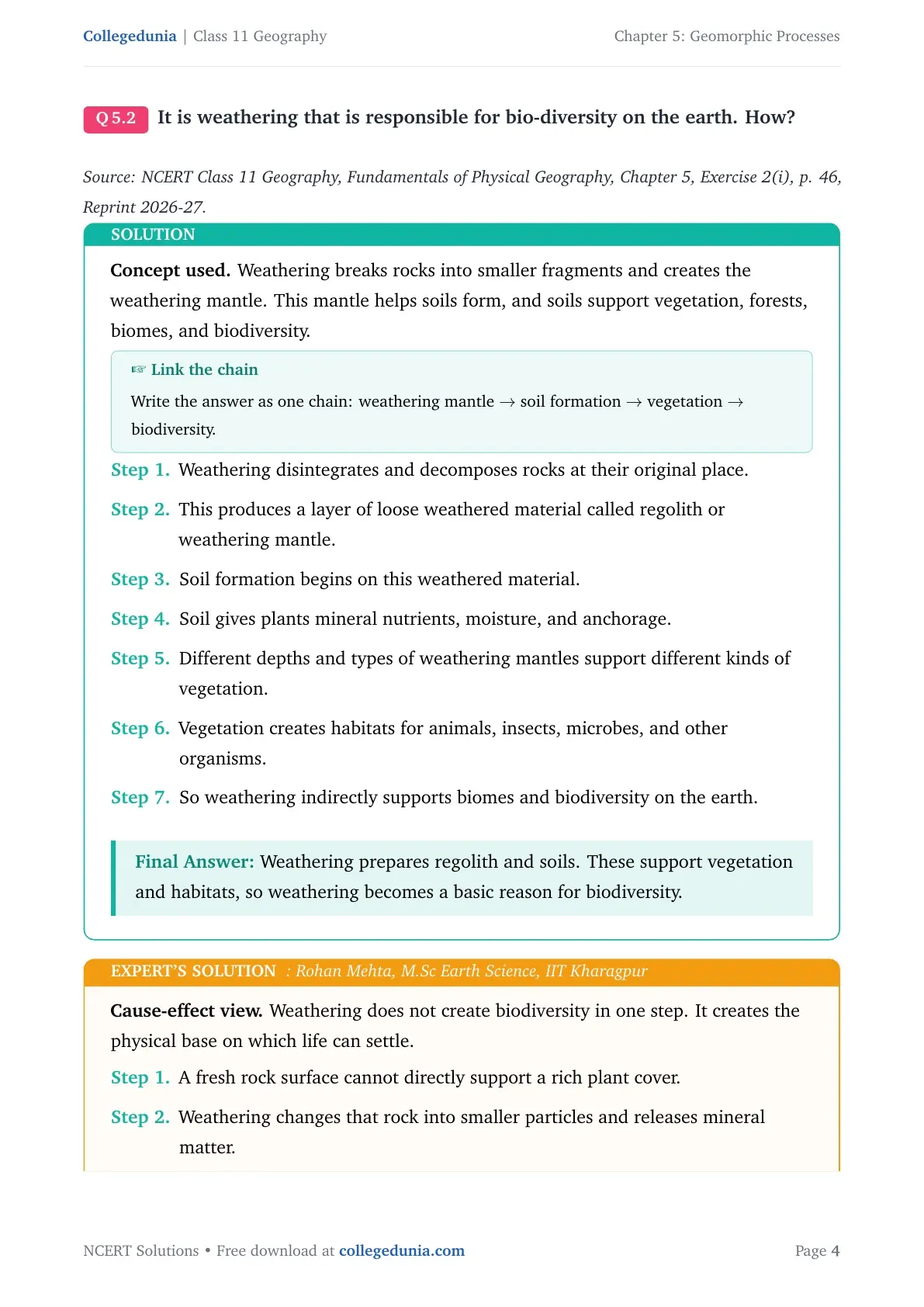
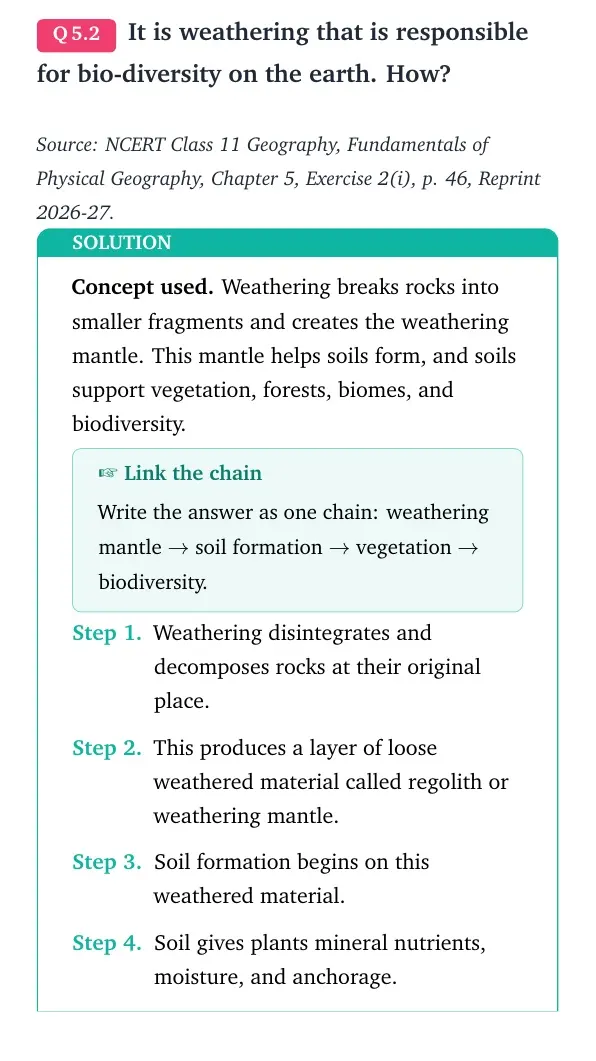
Q 5.2
It is weathering that is responsible for bio-diversity on the earth. How?
Concept used. Weathering breaks rocks into smaller fragments and
creates the weathering mantle. This mantle helps soils form, and soils support
vegetation, forests, biomes, and biodiversity.
Link the chain
Write the answer as one chain: weathering mantle → soil
formation → vegetation → biodiversity.
Weathering disintegrates and decomposes rocks at their original place.
This produces a layer of loose weathered material called regolith or
weathering mantle.
Soil formation begins on this weathered material.
Soil gives plants mineral nutrients, moisture, and anchorage.
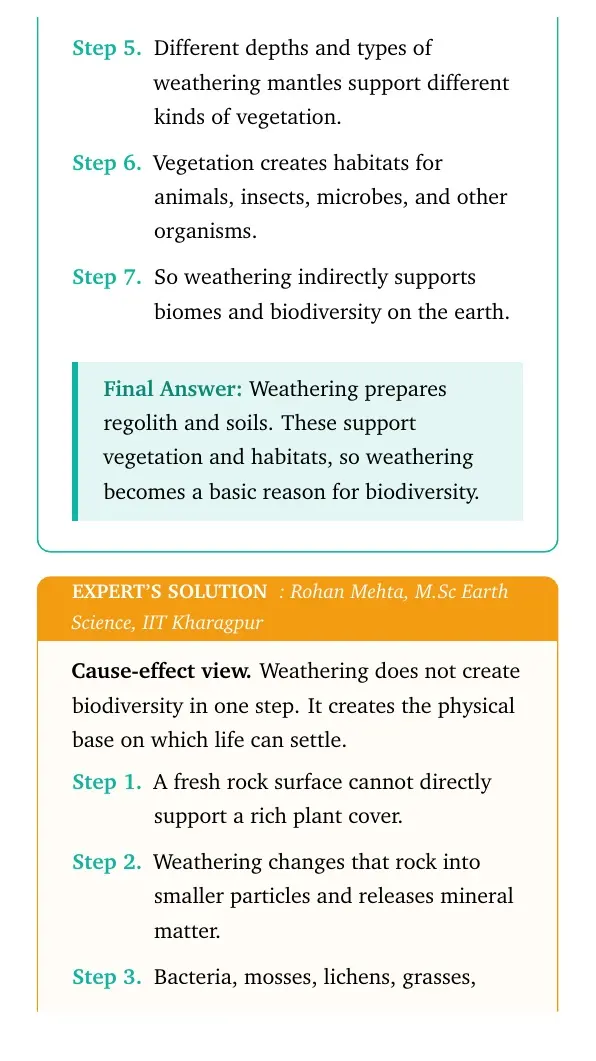
Different depths and types of weathering mantles support different
kinds of vegetation.
Vegetation creates habitats for animals, insects, microbes, and other
organisms.
So weathering indirectly supports biomes and biodiversity on the
earth.
Weathering prepares regolith and soils. These support vegetation and habitats, so weathering becomes a basic reason for biodiversity.
RM
Rohan Mehta
M.Sc Earth Science, IIT Kharagpur
Verified Expert
Cause-effect view. Weathering does not create biodiversity in one
step. It creates the physical base on which life can settle.
A fresh rock surface cannot directly support a rich plant cover.
Weathering changes that rock into smaller particles and releases
mineral matter.
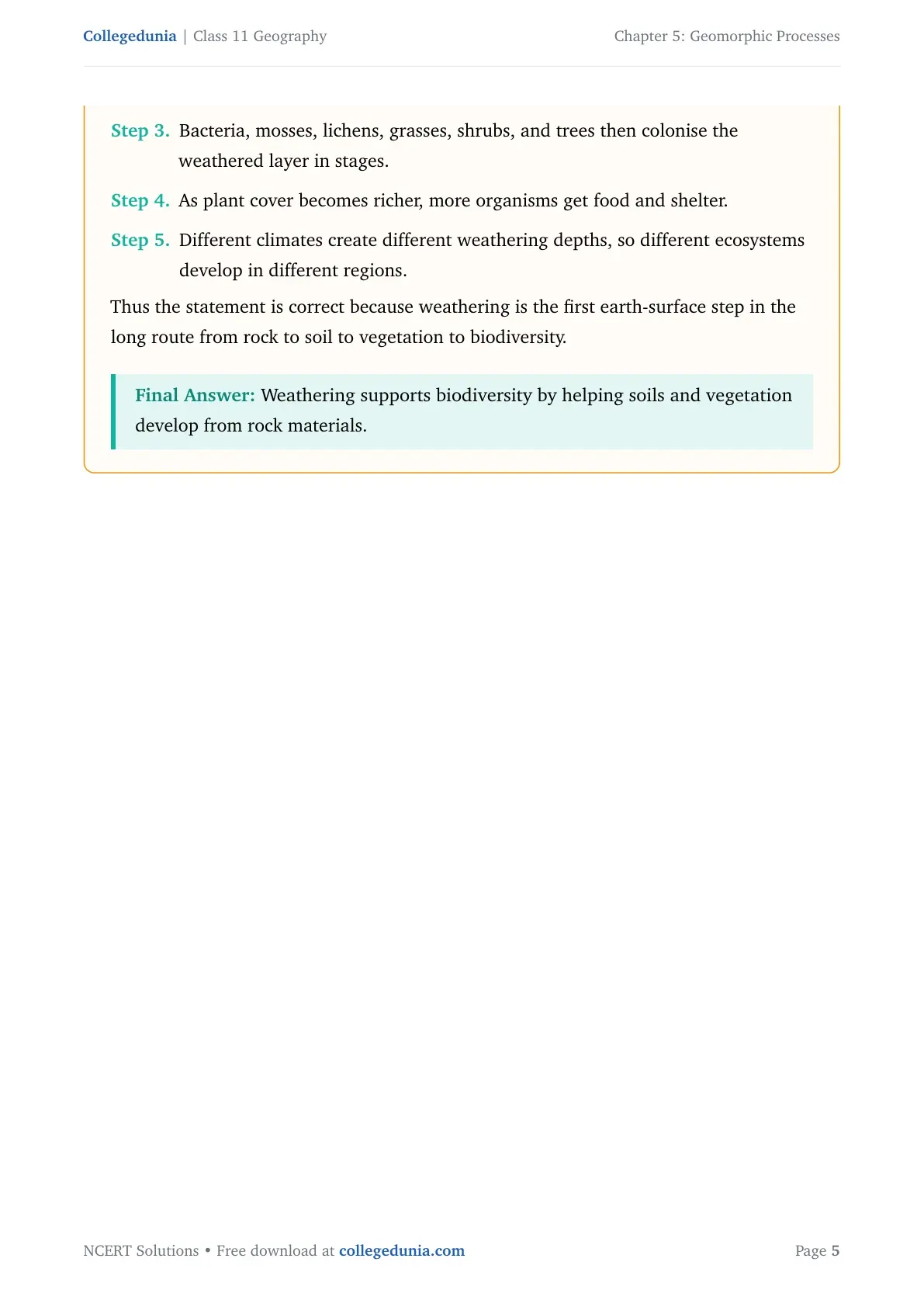
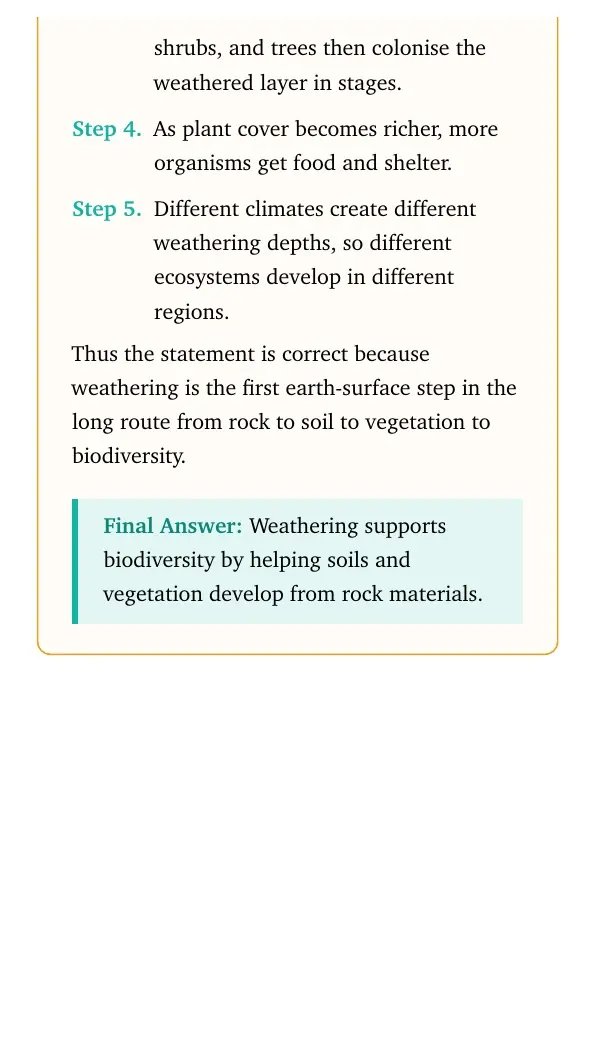
Bacteria, mosses, lichens, grasses, shrubs, and trees then colonise the
weathered layer in stages.
As plant cover becomes richer, more organisms get food and shelter.
Different climates create different weathering depths, so different
ecosystems develop in different regions.
Thus the statement is correct because weathering is the first earth-surface
step in the long route from rock to soil to vegetation to biodiversity.
Weathering supports biodiversity by helping soils and vegetation develop from rock materials.
Q 5.3
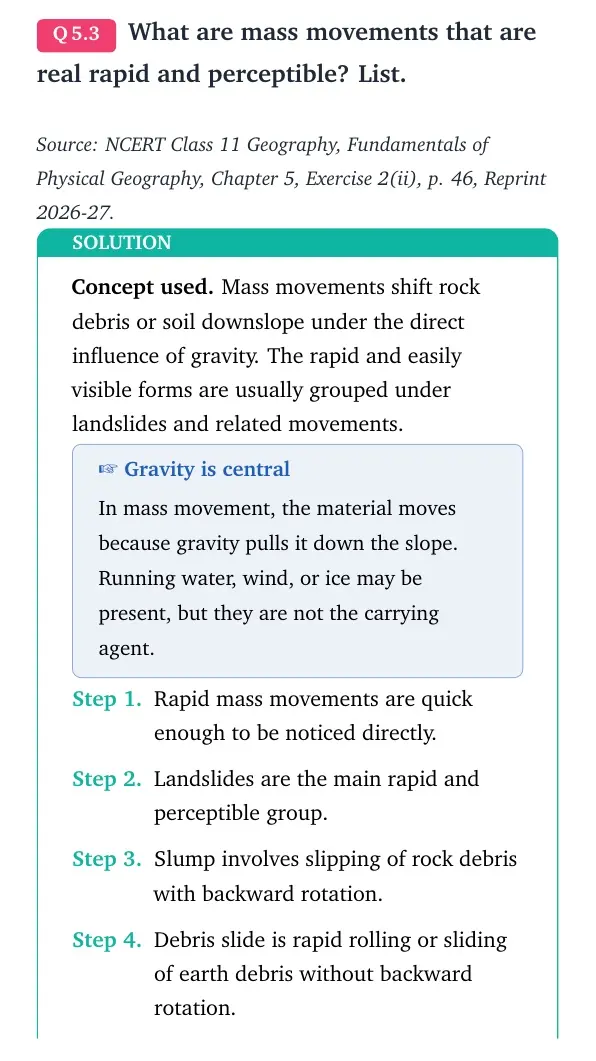
What are mass movements that are real rapid and perceptible? List.
Concept used. Mass movements shift rock debris or soil downslope
under the direct influence of gravity. The rapid and easily visible forms are
usually grouped under landslides and related movements.
Gravity is central
In mass movement, the material moves because gravity pulls it down the slope.
Running water, wind, or ice may be present, but they are not the carrying
agent.
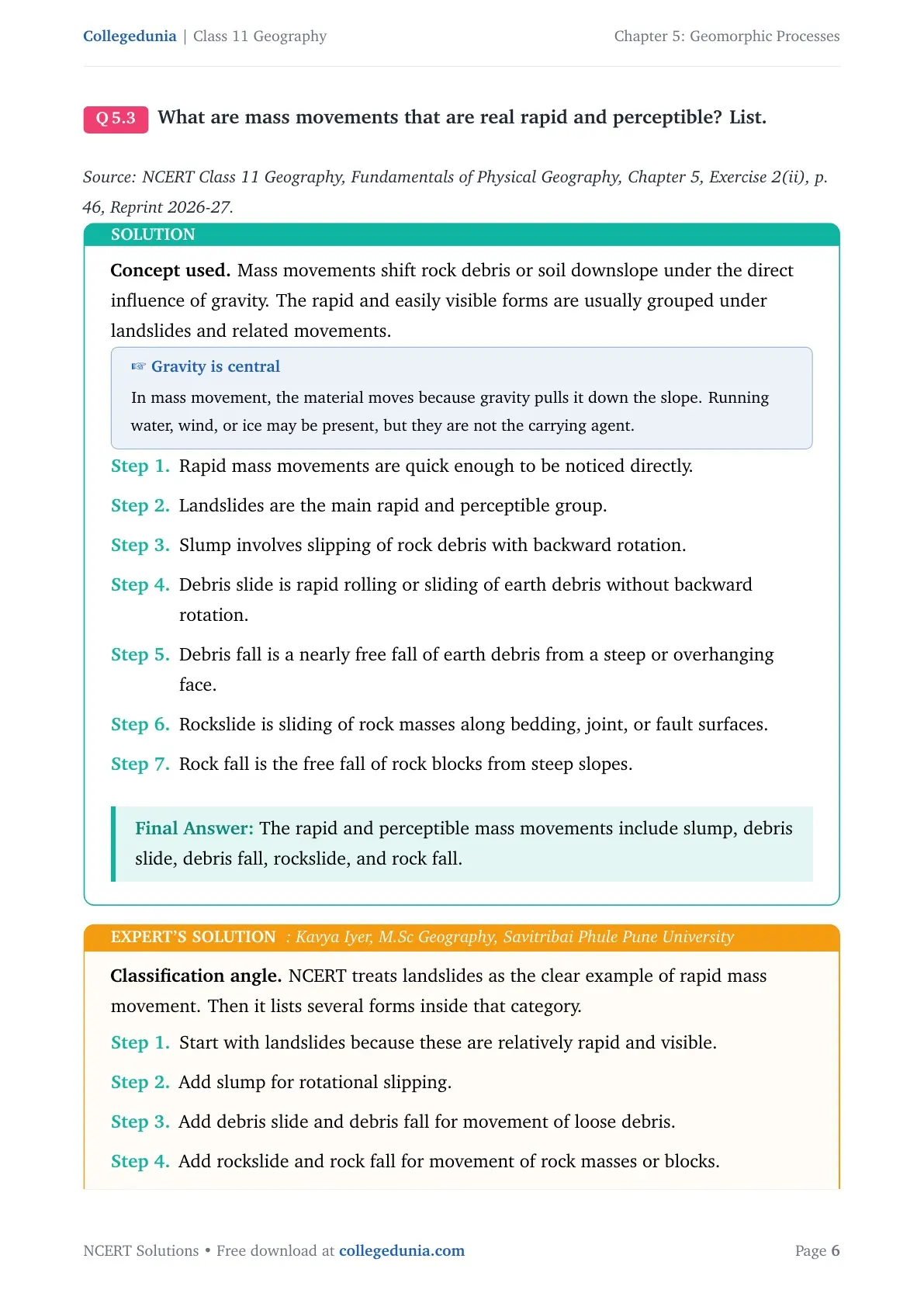
Rapid mass movements are quick enough to be noticed directly.
Landslides are the main rapid and perceptible group.
Slump involves slipping of rock debris with backward rotation.
Debris slide is rapid rolling or sliding of earth debris without
backward rotation.
Debris fall is a nearly free fall of earth debris from a steep or
overhanging face.
Rockslide is sliding of rock masses along bedding, joint, or fault
surfaces.
Rock fall is the free fall of rock blocks from steep slopes.
The rapid and perceptible mass movements include slump, debris slide, debris fall, rockslide, and rock fall.
KI
Kavya Iyer
M.Sc Geography, Savitribai Phule Pune University
Verified Expert
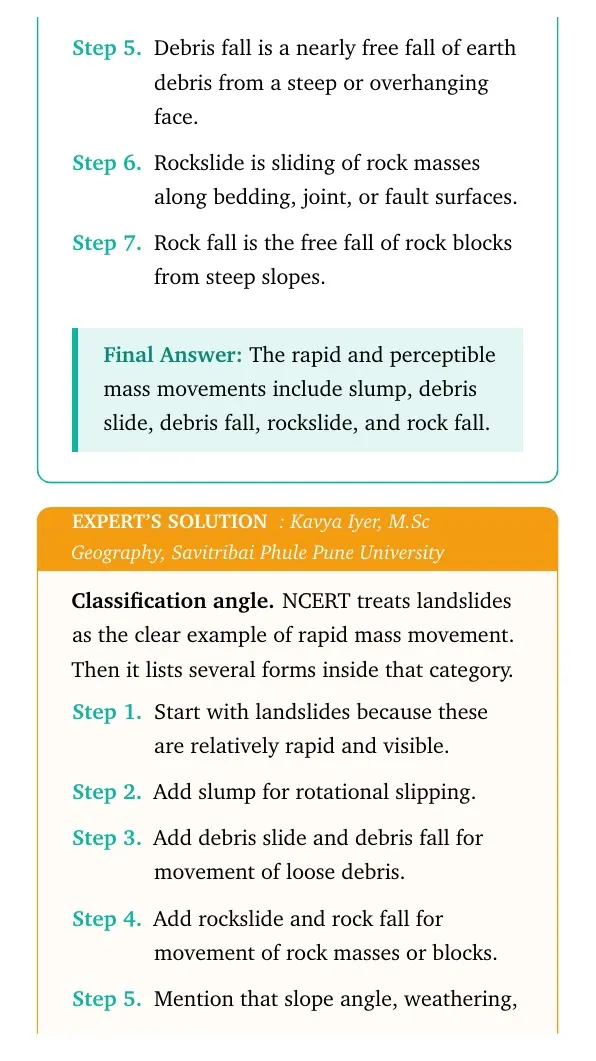
Classification angle. NCERT treats landslides as the clear example of
rapid mass movement. Then it lists several forms inside that category.
Start with landslides because these are relatively rapid and visible.
Add slump for rotational slipping.
Add debris slide and debris fall for movement of loose debris.
Add rockslide and rock fall for movement of rock masses or blocks.
Mention that slope angle, weathering, joints, faults, rainfall, and
lack of vegetation can make such movement more likely.
This answer is best written as a list, with one phrase after each type. That
keeps it inside the 30-word target while still showing NCERT detail.
Rapid perceptible mass movements are landslide forms: slump, debris slide, debris fall, rockslide, and rock fall.
Q 5.4
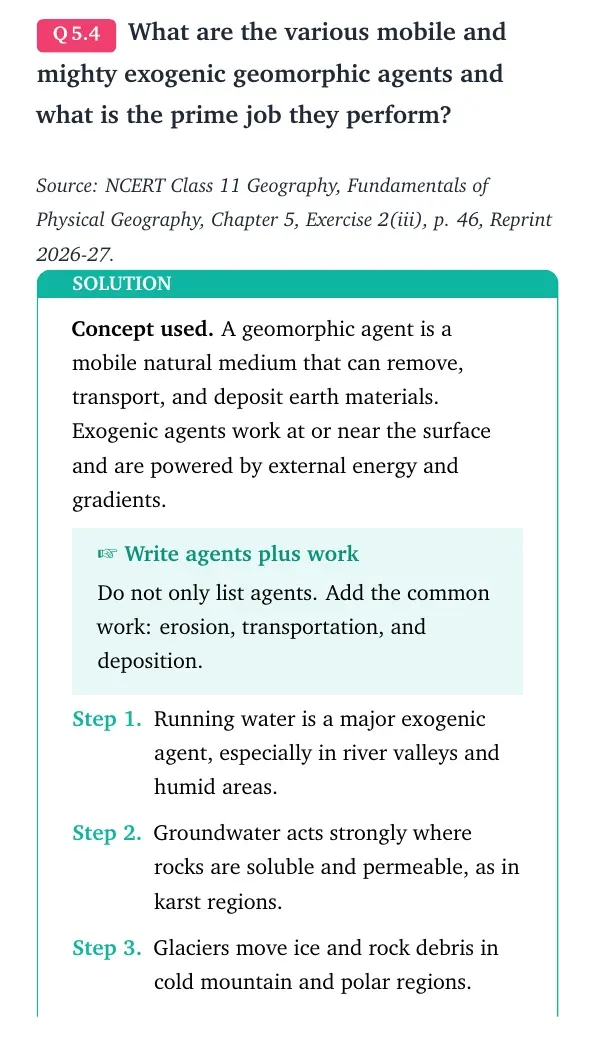
What are the various mobile and mighty exogenic geomorphic agents and what is the prime job they perform?
Concept used. A geomorphic agent is a mobile natural medium that can
remove, transport, and deposit earth materials. Exogenic agents work at or near
the surface and are powered by external energy and gradients.
Write agents plus work
Do not only list agents. Add the common work: erosion, transportation, and
deposition.
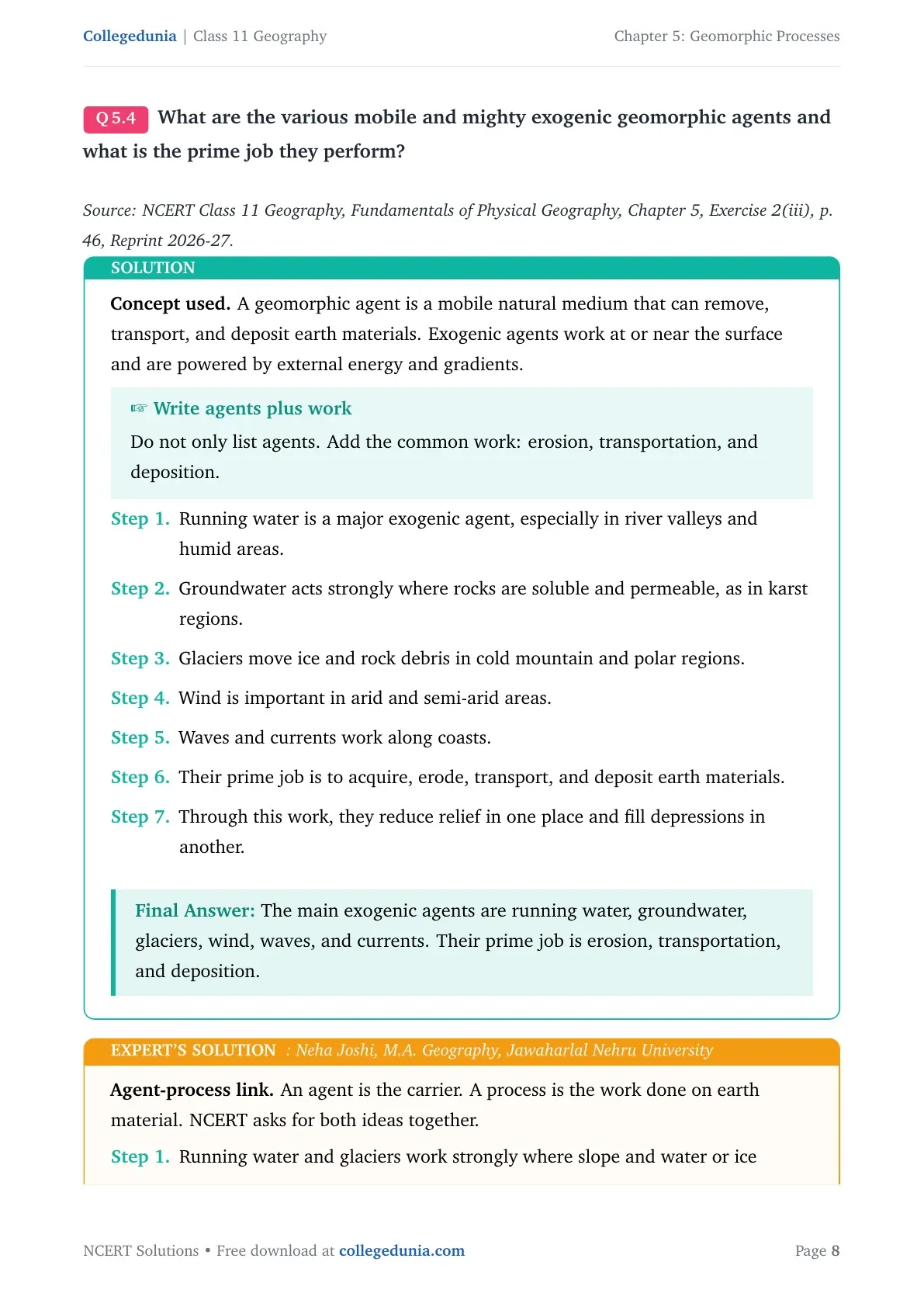
Running water is a major exogenic agent, especially in river valleys
and humid areas.
Groundwater acts strongly where rocks are soluble and permeable, as in
karst regions.
Glaciers move ice and rock debris in cold mountain and polar regions.
Wind is important in arid and semi-arid areas.
Waves and currents work along coasts.
Their prime job is to acquire, erode, transport, and deposit earth
materials.
Through this work, they reduce relief in one place and fill
depressions in another.
The main exogenic agents are running water, groundwater, glaciers, wind, waves, and currents. Their prime job is erosion, transportation, and deposition.
NJ
Neha Joshi
M.A. Geography, Jawaharlal Nehru University
Verified Expert
Agent-process link. An agent is the carrier. A process is the work
done on earth material. NCERT asks for both ideas together.
Running water and glaciers work strongly where slope and water or ice
supply are available.
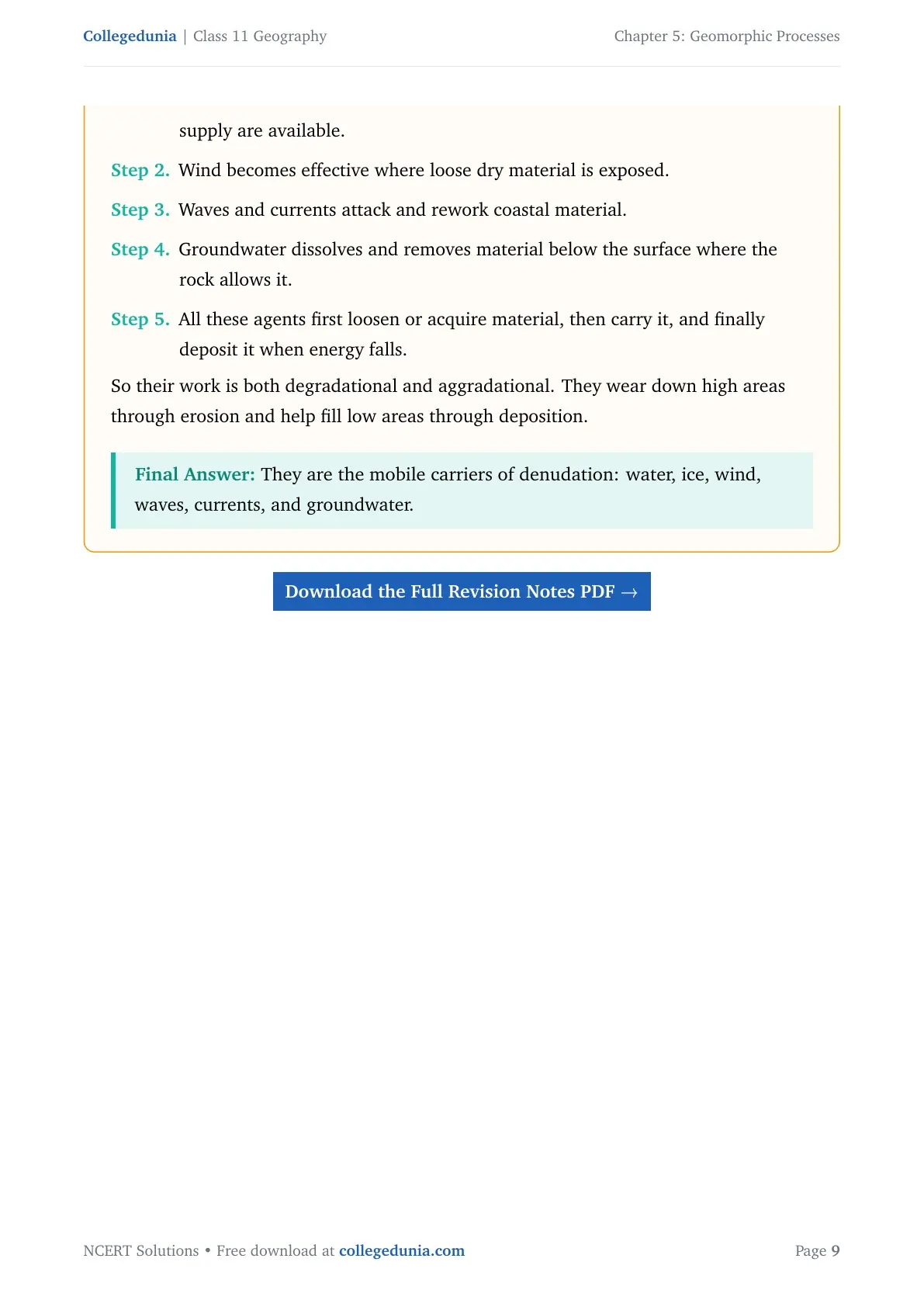
Wind becomes effective where loose dry material is exposed.
Waves and currents attack and rework coastal material.
Groundwater dissolves and removes material below the surface where the
rock allows it.
All these agents first loosen or acquire material, then carry it, and
finally deposit it when energy falls.
So their work is both degradational and aggradational. They wear down high
areas through erosion and help fill low areas through deposition.
They are the mobile carriers of denudation: water, ice, wind, waves, currents, and groundwater.
Q 5.5
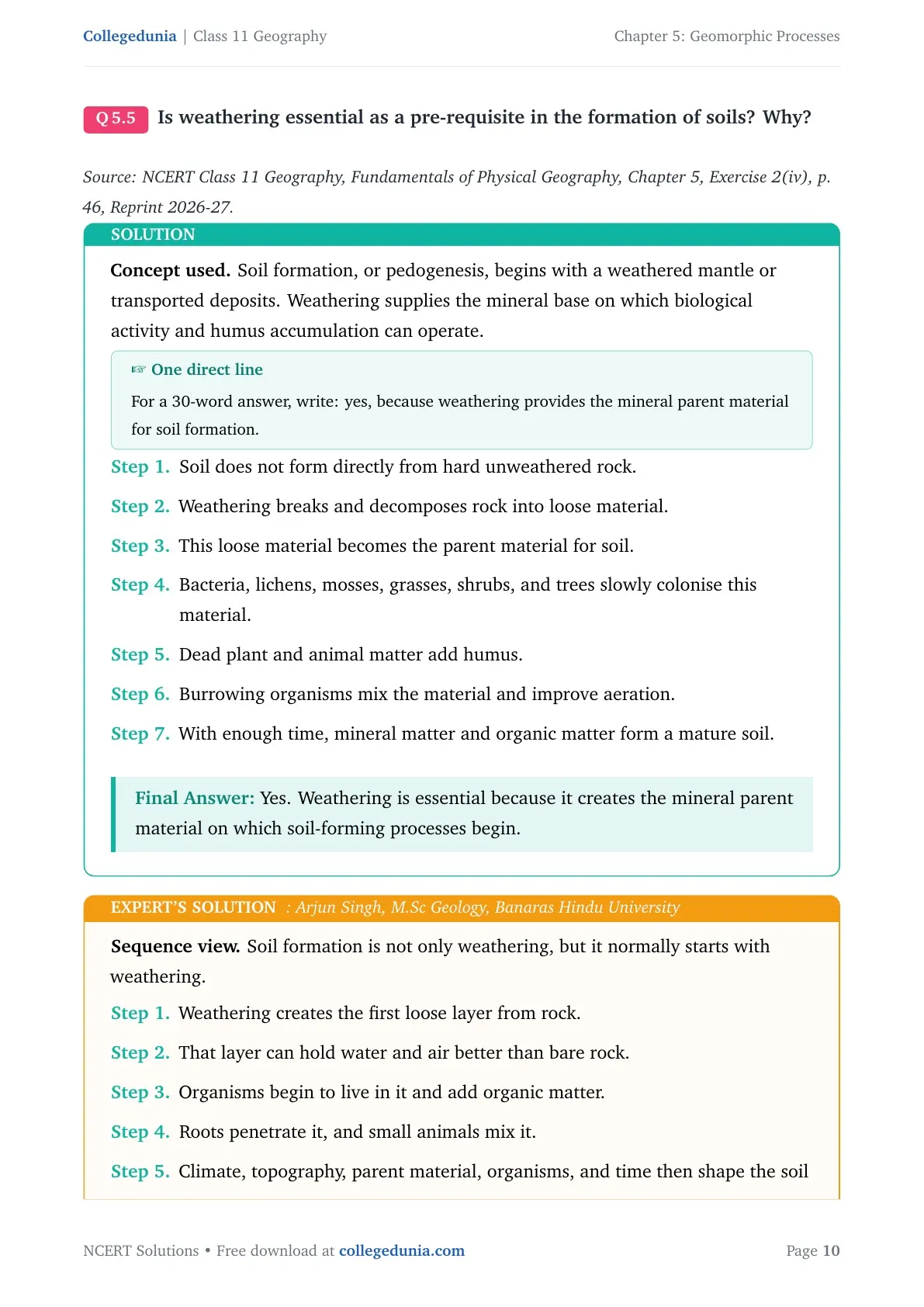
Is weathering essential as a pre-requisite in the formation of soils? Why?
Concept used. Soil formation, or pedogenesis, begins with a weathered
mantle or transported deposits. Weathering supplies the mineral base on which
biological activity and humus accumulation can operate.
One direct line
For a 30-word answer, write: yes, because weathering provides the mineral
parent material for soil formation.
Soil does not form directly from hard unweathered rock.
Weathering breaks and decomposes rock into loose material.
This loose material becomes the parent material for soil.
Bacteria, lichens, mosses, grasses, shrubs, and trees slowly colonise
this material.
Dead plant and animal matter add humus.
Burrowing organisms mix the material and improve aeration.
With enough time, mineral matter and organic matter form a mature soil.
Yes. Weathering is essential because it creates the mineral parent material on which soil-forming processes begin.
AS
Arjun Singh
M.Sc Geology, Banaras Hindu University
Verified Expert
Sequence view. Soil formation is not only weathering, but it normally
starts with weathering.
Weathering creates the first loose layer from rock.
That layer can hold water and air better than bare rock.
Organisms begin to live in it and add organic matter.
Roots penetrate it, and small animals mix it.
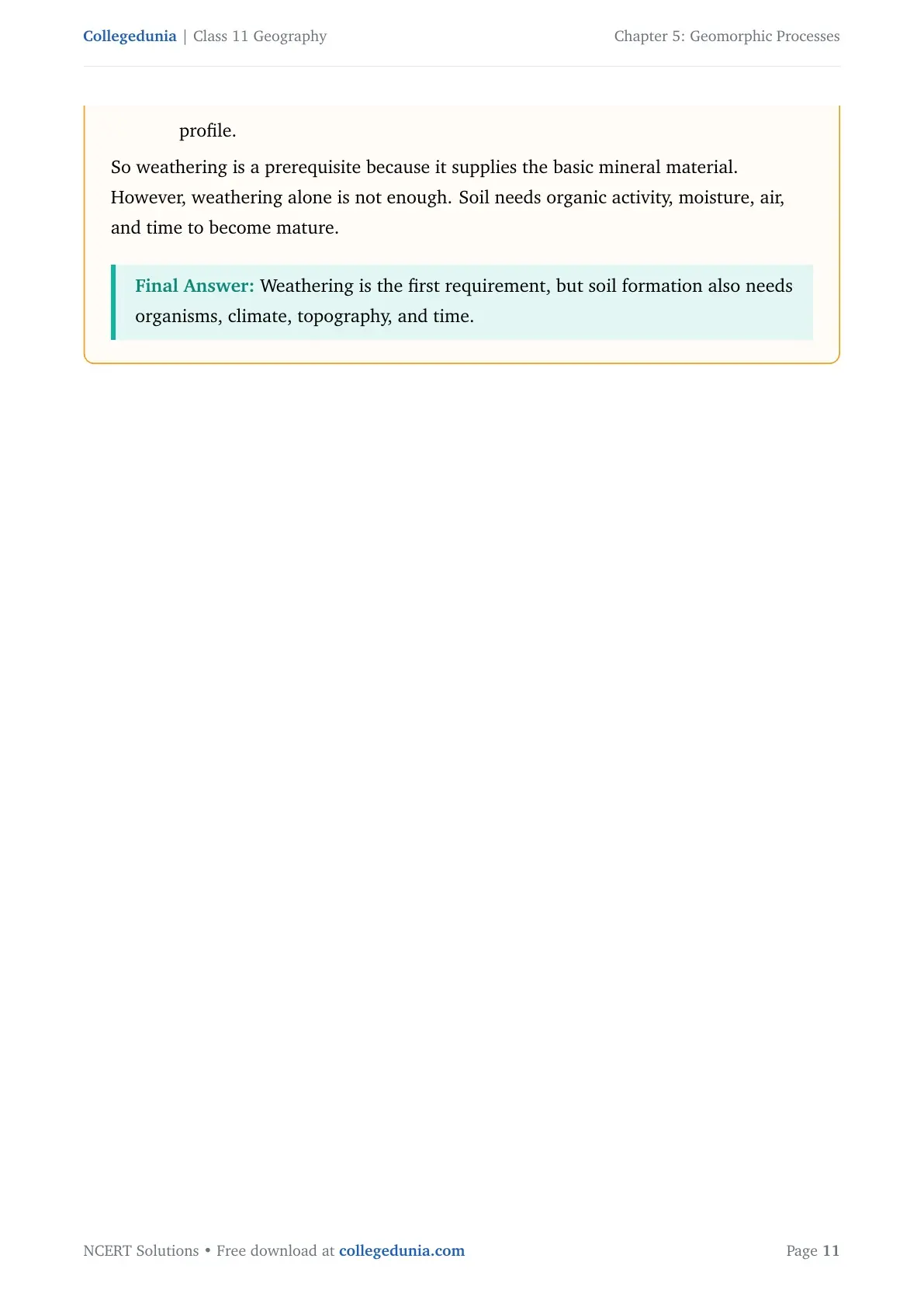
Climate, topography, parent material, organisms, and time then shape
the soil profile.
So weathering is a prerequisite because it supplies the basic mineral material.
However, weathering alone is not enough. Soil needs organic activity, moisture,
air, and time to become mature.
Weathering is the first requirement, but soil formation also needs organisms, climate, topography, and time.
Q 5.6
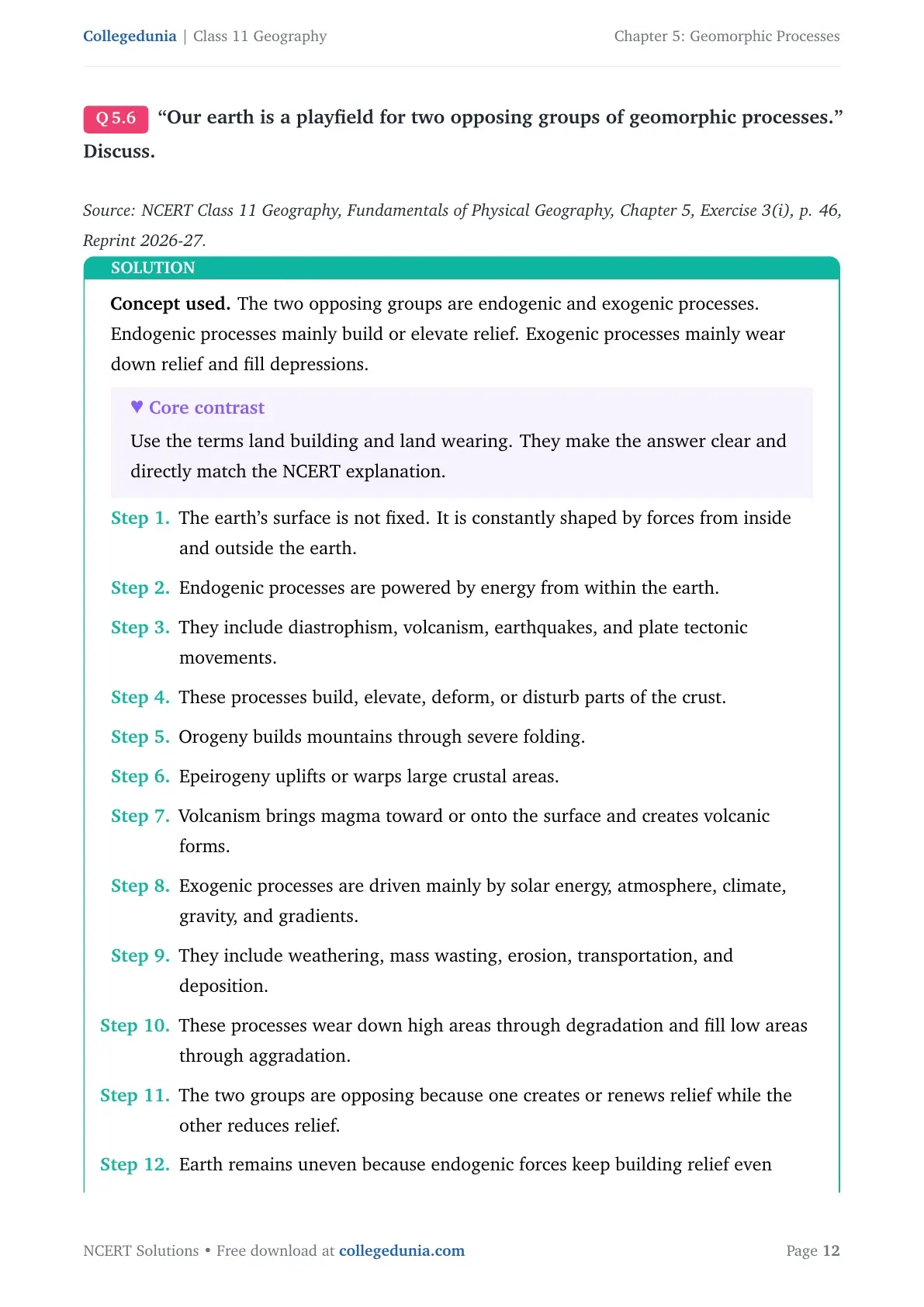
``Our earth is a playfield for two opposing groups of geomorphic processes.'' Discuss.
Concept used. The two opposing groups are endogenic and exogenic
processes. Endogenic processes mainly build or elevate relief. Exogenic
processes mainly wear down relief and fill depressions.
Core contrast
Use the terms land building and land wearing. They make the answer clear and
directly match the NCERT explanation.
The earth's surface is not fixed. It is constantly shaped by forces
from inside and outside the earth.
Endogenic processes are powered by energy from within the earth.
They include diastrophism, volcanism, earthquakes, and plate tectonic
movements.
These processes build, elevate, deform, or disturb parts of the crust.
Orogeny builds mountains through severe folding.
Epeirogeny uplifts or warps large crustal areas.
Volcanism brings magma toward or onto the surface and creates volcanic
forms.
Exogenic processes are driven mainly by solar energy, atmosphere,
climate, gravity, and gradients.
They include weathering, mass wasting, erosion, transportation, and
deposition.
These processes wear down high areas through degradation and fill low
areas through aggradation.
The two groups are opposing because one creates or renews relief while
the other reduces relief.
Earth remains uneven because endogenic forces keep building relief
even while exogenic processes keep wearing it down.
The earth is a playfield of endogenic land-building processes and exogenic land-wearing processes acting against each other continuously.
MN
Meera Nair
Ph.D Geology, IISc Bangalore
Verified Expert
Balance view. Imagine relief as a result of a contest. Internal
forces raise and deform the crust, while surface processes try to level it.
Internal heat causes movements such as folding, faulting, uplift,
earthquakes, plate motion, and volcanism.
These are constructive in the sense that they create height, roughness,
and new crustal forms.
External processes act on the exposed surface.
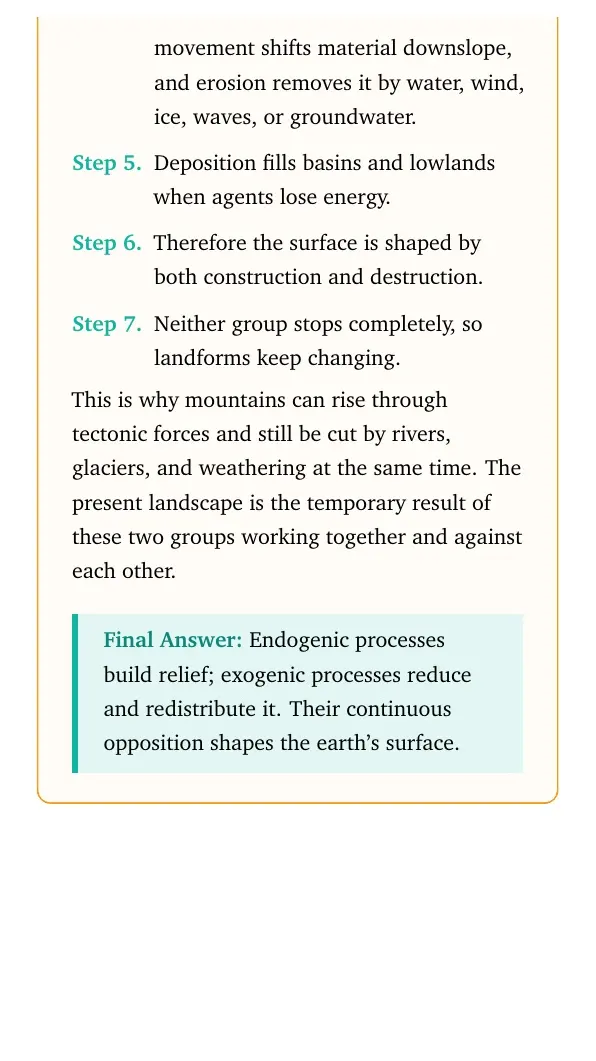
Weathering weakens rock, mass movement shifts material downslope, and
erosion removes it by water, wind, ice, waves, or groundwater.
Deposition fills basins and lowlands when agents lose energy.
Therefore the surface is shaped by both construction and destruction.
Neither group stops completely, so landforms keep changing.
This is why mountains can rise through tectonic forces and still be cut by
rivers, glaciers, and weathering at the same time. The present landscape is the
temporary result of these two groups working together and against each other.
Endogenic processes build relief; exogenic processes reduce and redistribute it. Their continuous opposition shapes the earth's surface.
Q 5.7
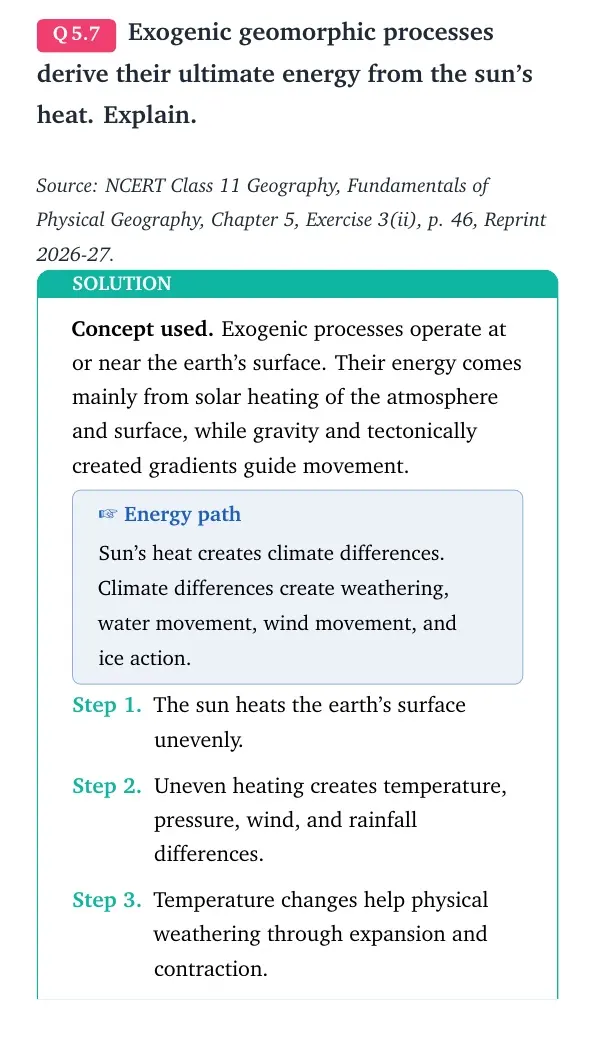
Exogenic geomorphic processes derive their ultimate energy from the sun's heat. Explain.
Concept used. Exogenic processes operate at or near the earth's
surface. Their energy comes mainly from solar heating of the atmosphere and
surface, while gravity and tectonically created gradients guide movement.
Energy path
Sun's heat creates climate differences. Climate differences create weathering,
water movement, wind movement, and ice action.
The sun heats the earth's surface unevenly.
Uneven heating creates temperature, pressure, wind, and rainfall
differences.
Temperature changes help physical weathering through expansion and
contraction.
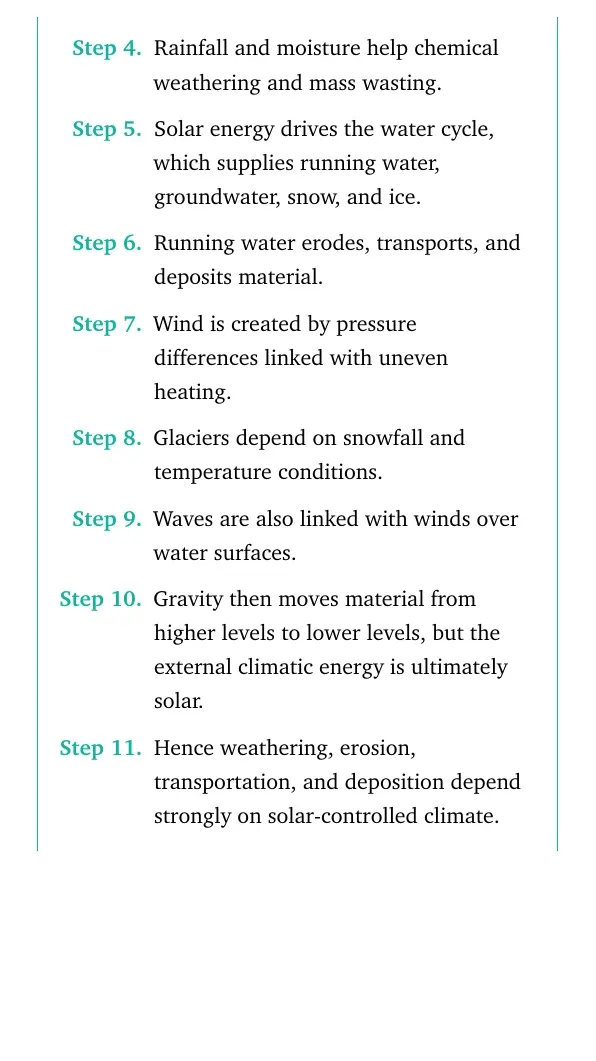
Rainfall and moisture help chemical weathering and mass wasting.
Solar energy drives the water cycle, which supplies running water,
groundwater, snow, and ice.
Running water erodes, transports, and deposits material.
Wind is created by pressure differences linked with uneven heating.
Glaciers depend on snowfall and temperature conditions.
Waves are also linked with winds over water surfaces.
Gravity then moves material from higher levels to lower levels, but the
external climatic energy is ultimately solar.
Hence weathering, erosion, transportation, and deposition depend
strongly on solar-controlled climate.
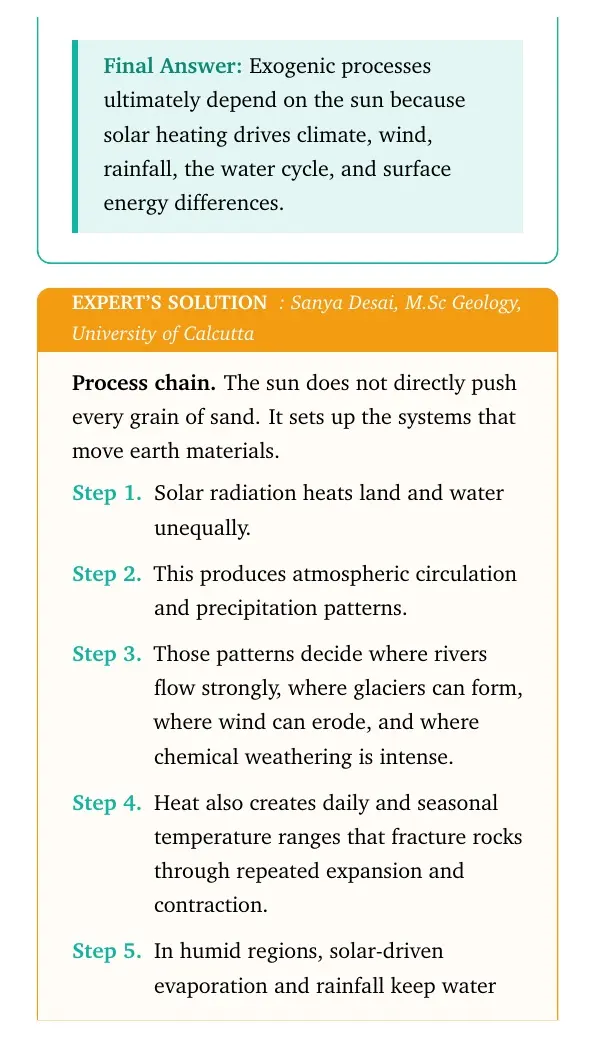
Exogenic processes ultimately depend on the sun because solar heating drives climate, wind, rainfall, the water cycle, and surface energy differences.
SD
Sanya Desai
M.Sc Geology, University of Calcutta
Verified Expert
Process chain. The sun does not directly push every grain of sand.
It sets up the systems that move earth materials.
Solar radiation heats land and water unequally.
This produces atmospheric circulation and precipitation patterns.
Those patterns decide where rivers flow strongly, where glaciers can
form, where wind can erode, and where chemical weathering is intense.
Heat also creates daily and seasonal temperature ranges that fracture
rocks through repeated expansion and contraction.
In humid regions, solar-driven evaporation and rainfall keep water
available for chemical reactions and slope saturation.
In dry regions, evaporation can bring salts upward and help form
hardpans.
So the immediate agents may be water, wind, waves, ice, or groundwater. Their
larger energy setting still comes from solar heat, modified by gravity,
gradient, rock structure, and climate.
The sun is the ultimate energy source because it controls the climate systems that power exogenic work.
Q 5.8
Are physical and chemical weathering processes independent of each other? If not, why? Explain with examples.
Concept used. Physical and chemical weathering are different in
method, but they commonly work together. Physical weathering breaks rock into
smaller pieces. Chemical weathering changes minerals and weakens bonds.
Main answer line
Say clearly: they are not fully independent because one often helps the other.
Physical weathering is mechanical disintegration of rocks.
It may happen due to pressure release, expansion and contraction, frost
action, crystal growth, wetting and drying, or animal activity.
Chemical weathering is decomposition or alteration of minerals through
reactions such as solution, carbonation, hydration, oxidation, and
reduction.
The two are not independent because rock breakage increases surface
area.
Greater surface area lets water, oxygen, carbon dioxide, and acids
attack minerals more easily.
Chemical decay weakens the rock, making it easier for physical forces
to split it.
Example: exfoliation and granular disintegration can open cracks. Water
then enters those cracks and chemical reactions speed up.
Example: plant roots may widen cracks mechanically. Decaying organic
matter also produces acids that help chemical weathering.
Example: in humid tropical areas, heat and moisture make chemical
reactions fast, but physical breakage still exposes fresh surfaces.
Example: in dry regions, salt crystal growth physically stresses rock,
while salts and moisture may also take part in chemical change.
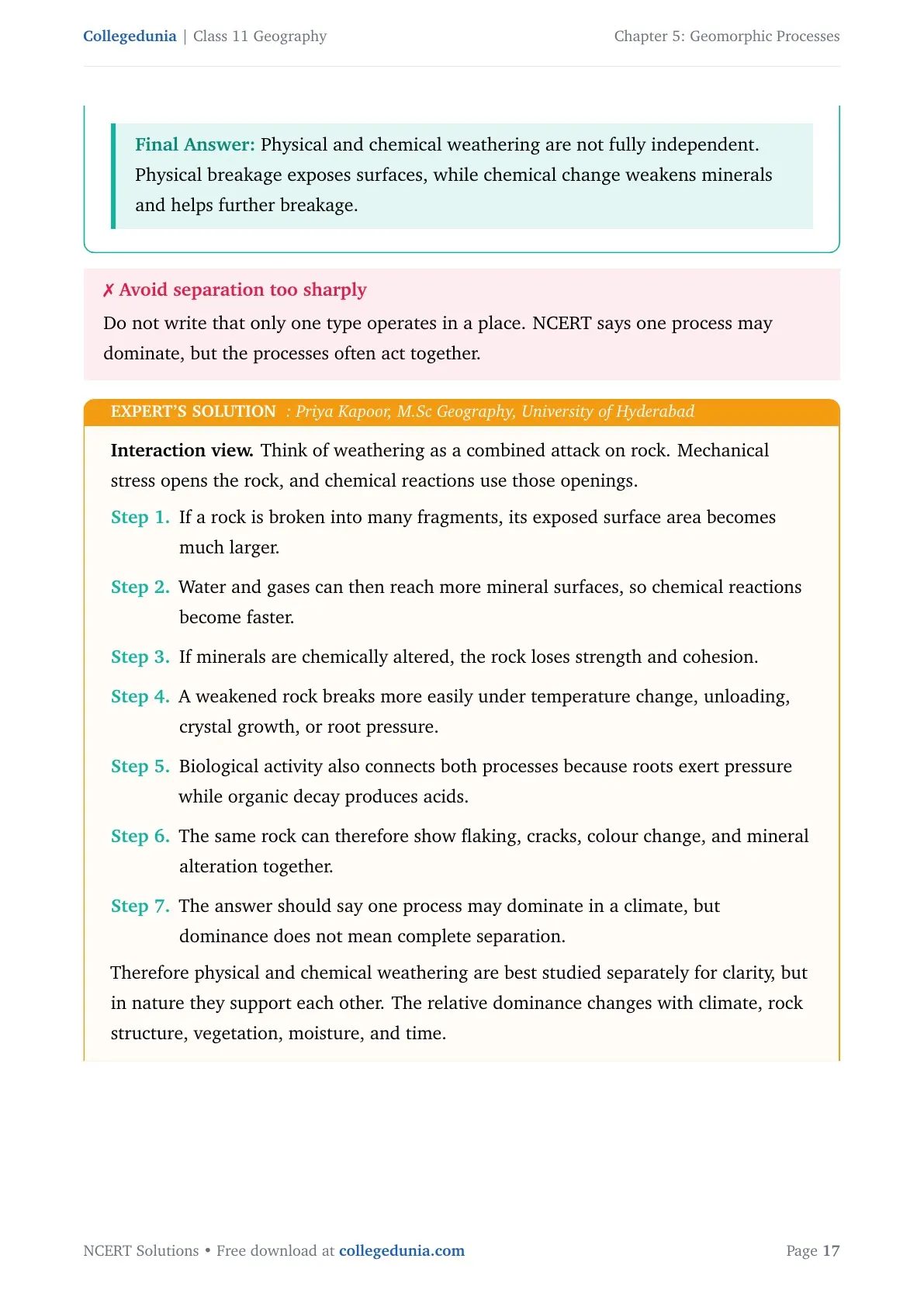
Physical and chemical weathering are not fully independent. Physical breakage exposes surfaces, while chemical change weakens minerals and helps further breakage.
PK
Priya Kapoor
M.Sc Geography, University of Hyderabad
Verified Expert
Interaction view. Think of weathering as a combined attack on rock.
Mechanical stress opens the rock, and chemical reactions use those openings.
If a rock is broken into many fragments, its exposed surface area
becomes much larger.
Water and gases can then reach more mineral surfaces, so chemical
reactions become faster.
If minerals are chemically altered, the rock loses strength and
cohesion.
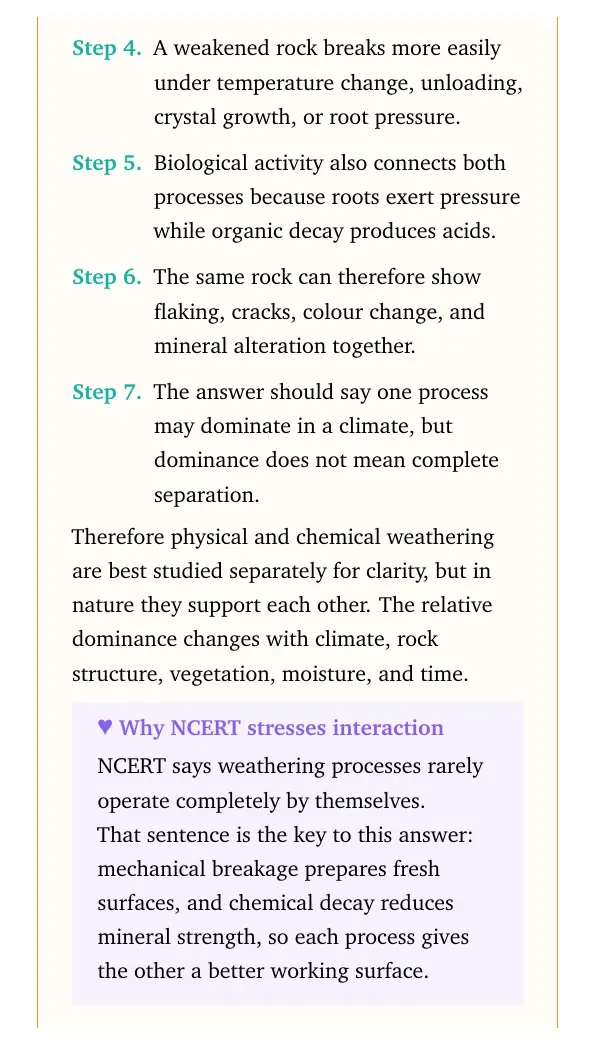
A weakened rock breaks more easily under temperature change,
unloading, crystal growth, or root pressure.
Biological activity also connects both processes because roots exert
pressure while organic decay produces acids.
The same rock can therefore show flaking, cracks, colour change, and
mineral alteration together.
The answer should say one process may dominate in a climate, but
dominance does not mean complete separation.
Therefore physical and chemical weathering are best studied separately for
clarity, but in nature they support each other. The relative dominance changes
with climate, rock structure, vegetation, moisture, and time.
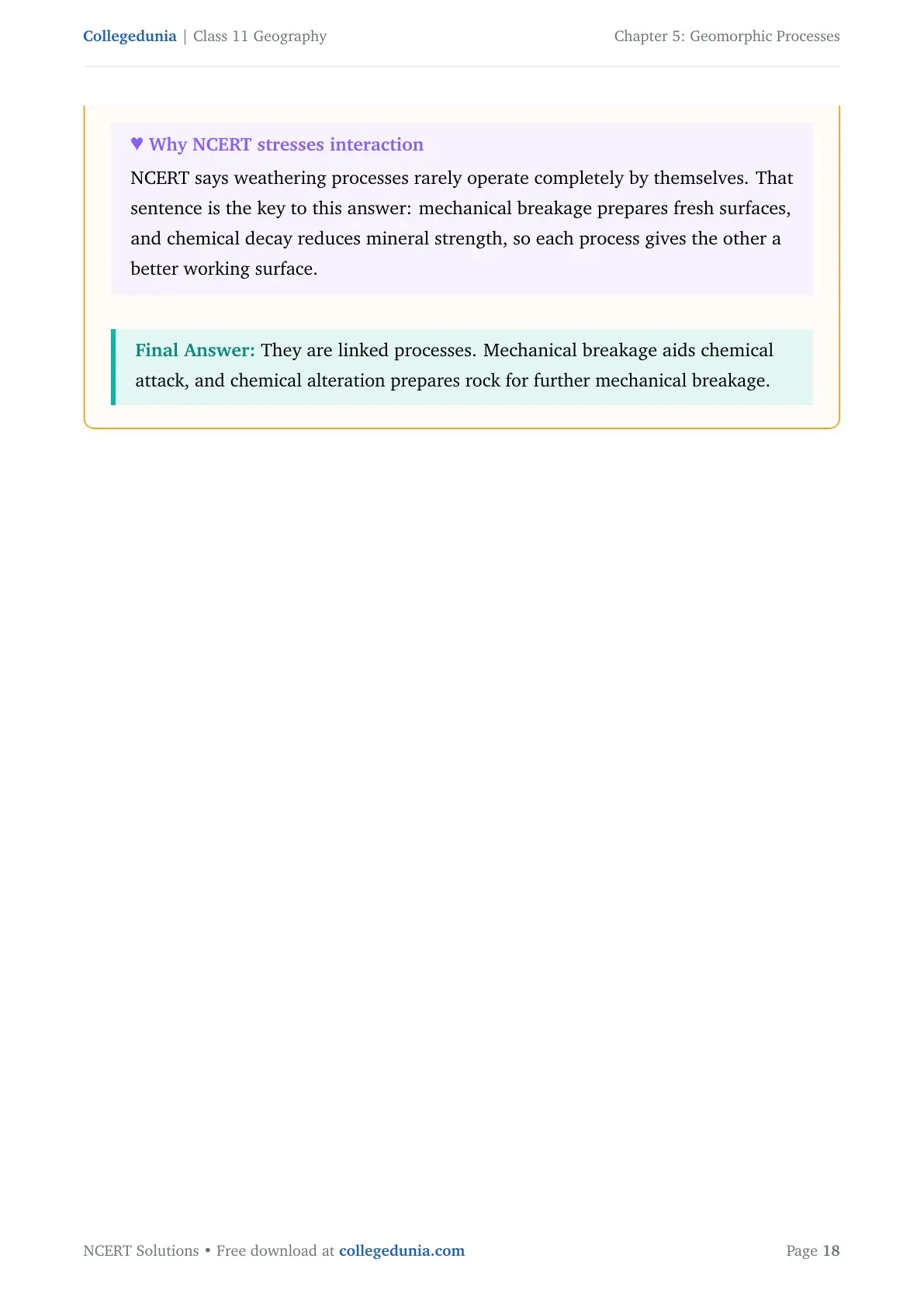
Why NCERT stresses interaction
NCERT says weathering processes rarely operate completely by themselves. That
sentence is the key to this answer: mechanical breakage prepares fresh
surfaces, and chemical decay reduces mineral strength, so each process gives
the other a better working surface.
They are linked processes. Mechanical breakage aids chemical attack, and chemical alteration prepares rock for further mechanical breakage.
Q 5.9
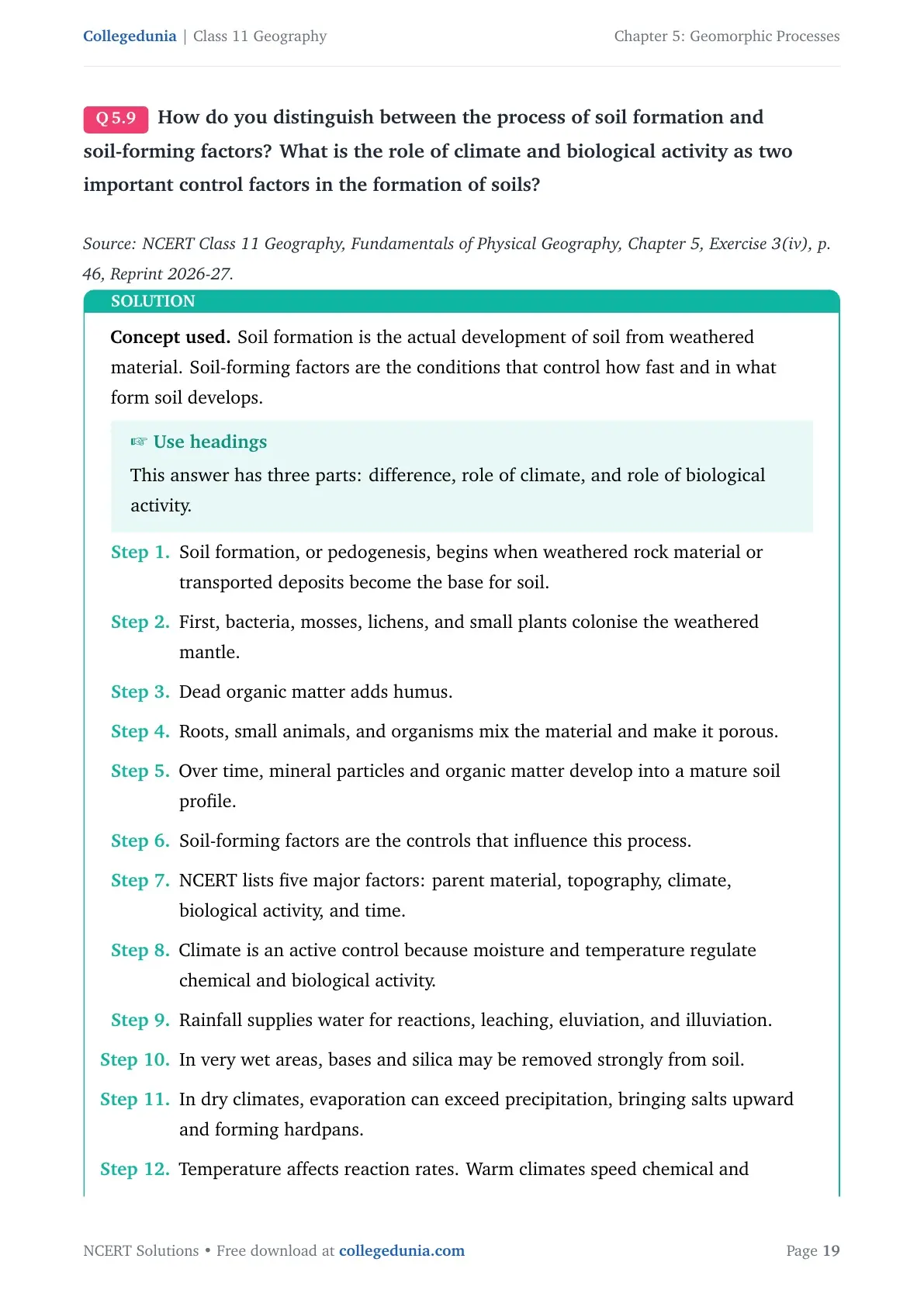
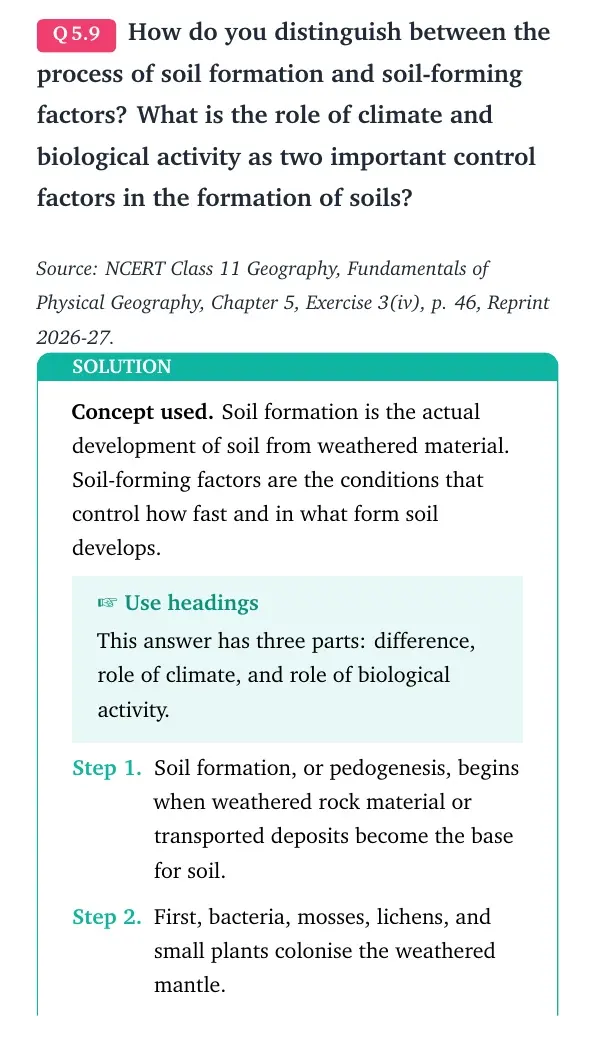
How do you distinguish between the process of soil formation and soil-forming factors? What is the role of climate and biological activity as two important control factors in the formation of soils?
Concept used. Soil formation is the actual development of soil from
weathered material. Soil-forming factors are the conditions that control how
fast and in what form soil develops.
Use headings
This answer has three parts: difference, role of climate, and role of
biological activity.
Soil formation, or pedogenesis, begins when weathered rock material or
transported deposits become the base for soil.
First, bacteria, mosses, lichens, and small plants colonise the
weathered mantle.
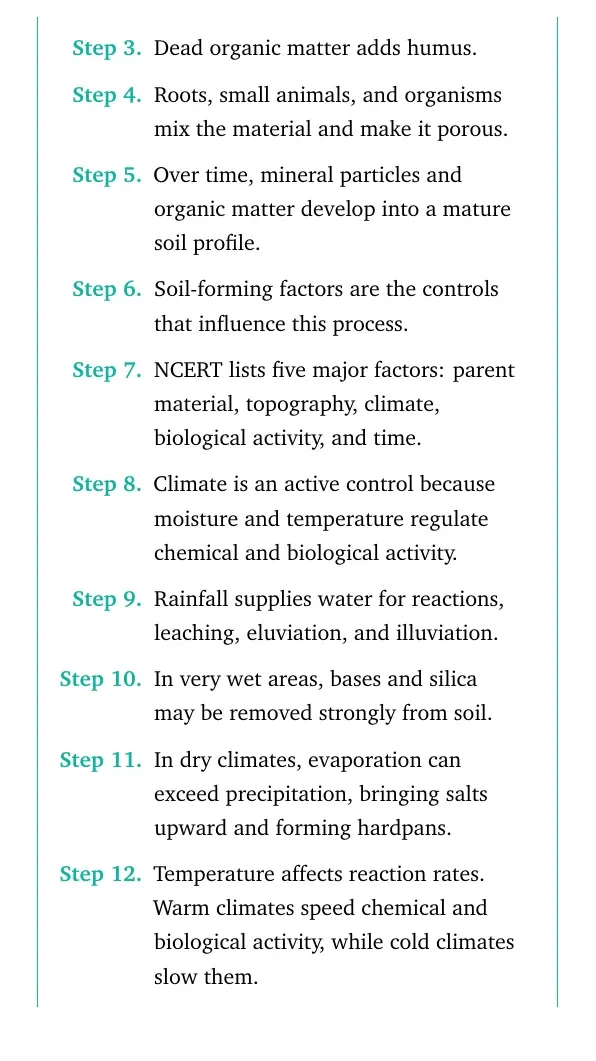
Dead organic matter adds humus.
Roots, small animals, and organisms mix the material and make it
porous.
Over time, mineral particles and organic matter develop into a mature
soil profile.
Soil-forming factors are the controls that influence this process.
NCERT lists five major factors: parent material, topography, climate,
biological activity, and time.
Climate is an active control because moisture and temperature regulate
chemical and biological activity.
Rainfall supplies water for reactions, leaching, eluviation, and
illuviation.
In very wet areas, bases and silica may be removed strongly from soil.
In dry climates, evaporation can exceed precipitation, bringing salts
upward and forming hardpans.
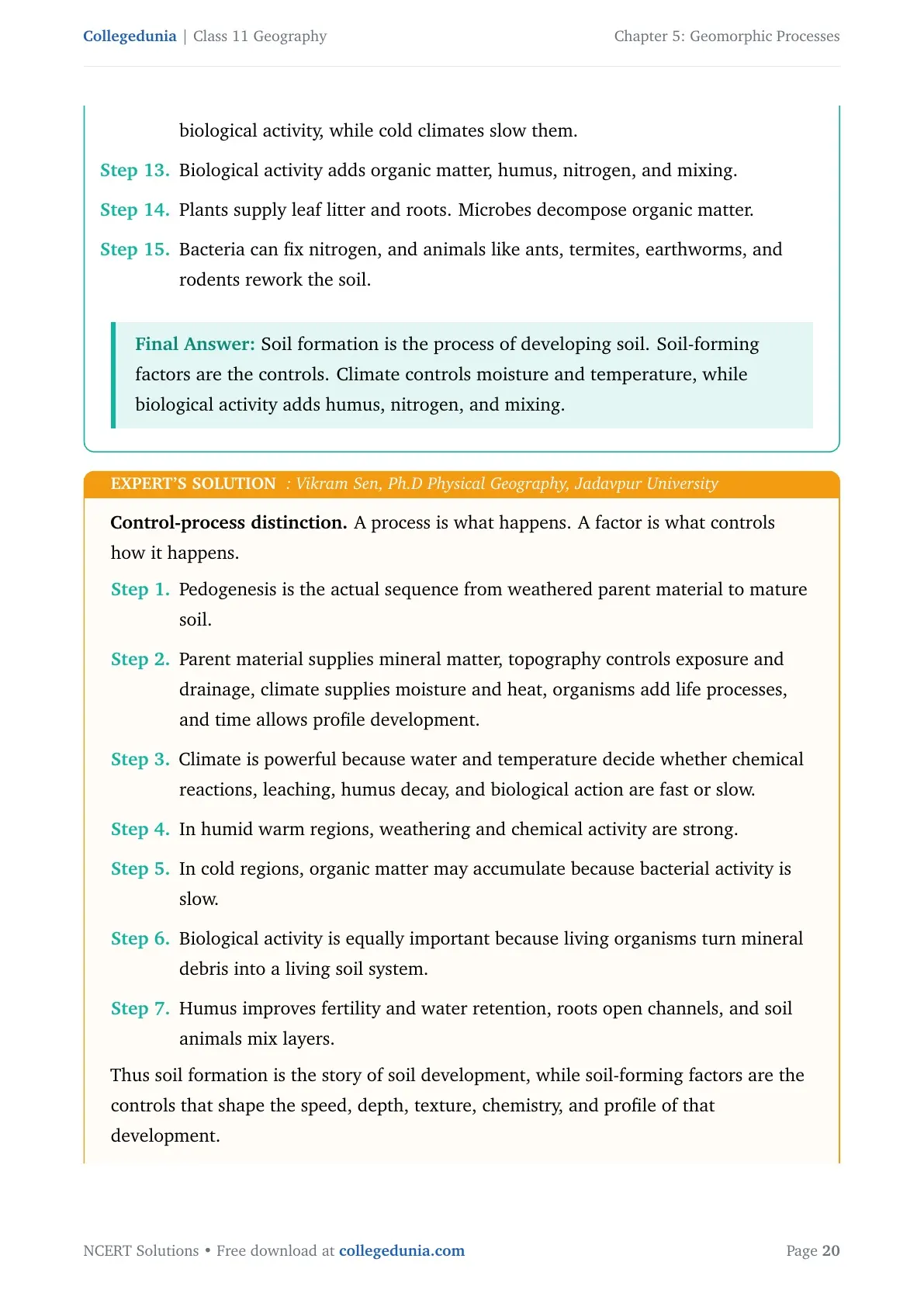
Temperature affects reaction rates. Warm climates speed chemical and
biological activity, while cold climates slow them.
Biological activity adds organic matter, humus, nitrogen, and mixing.
Plants supply leaf litter and roots. Microbes decompose organic matter.
Bacteria can fix nitrogen, and animals like ants, termites, earthworms,
and rodents rework the soil.
Soil formation is the process of developing soil. Soil-forming factors are the controls. Climate controls moisture and temperature, while biological activity adds humus, nitrogen, and mixing.
VS
Vikram Sen
Ph.D Physical Geography, Jadavpur University
Verified Expert
Control-process distinction. A process is what happens. A factor is
what controls how it happens.
Pedogenesis is the actual sequence from weathered parent material to
mature soil.
Parent material supplies mineral matter, topography controls exposure
and drainage, climate supplies moisture and heat, organisms add life
processes, and time allows profile development.
Climate is powerful because water and temperature decide whether
chemical reactions, leaching, humus decay, and biological action are
fast or slow.
In humid warm regions, weathering and chemical activity are strong.
In cold regions, organic matter may accumulate because bacterial
activity is slow.
Biological activity is equally important because living organisms turn
mineral debris into a living soil system.
Humus improves fertility and water retention, roots open channels, and
soil animals mix layers.
Thus soil formation is the story of soil development, while soil-forming
factors are the controls that shape the speed, depth, texture, chemistry, and
profile of that development.
The process is pedogenesis; the factors are its controls. Climate supplies moisture and heat, while organisms add humus, nitrogen, and mixing.
Q 5.10
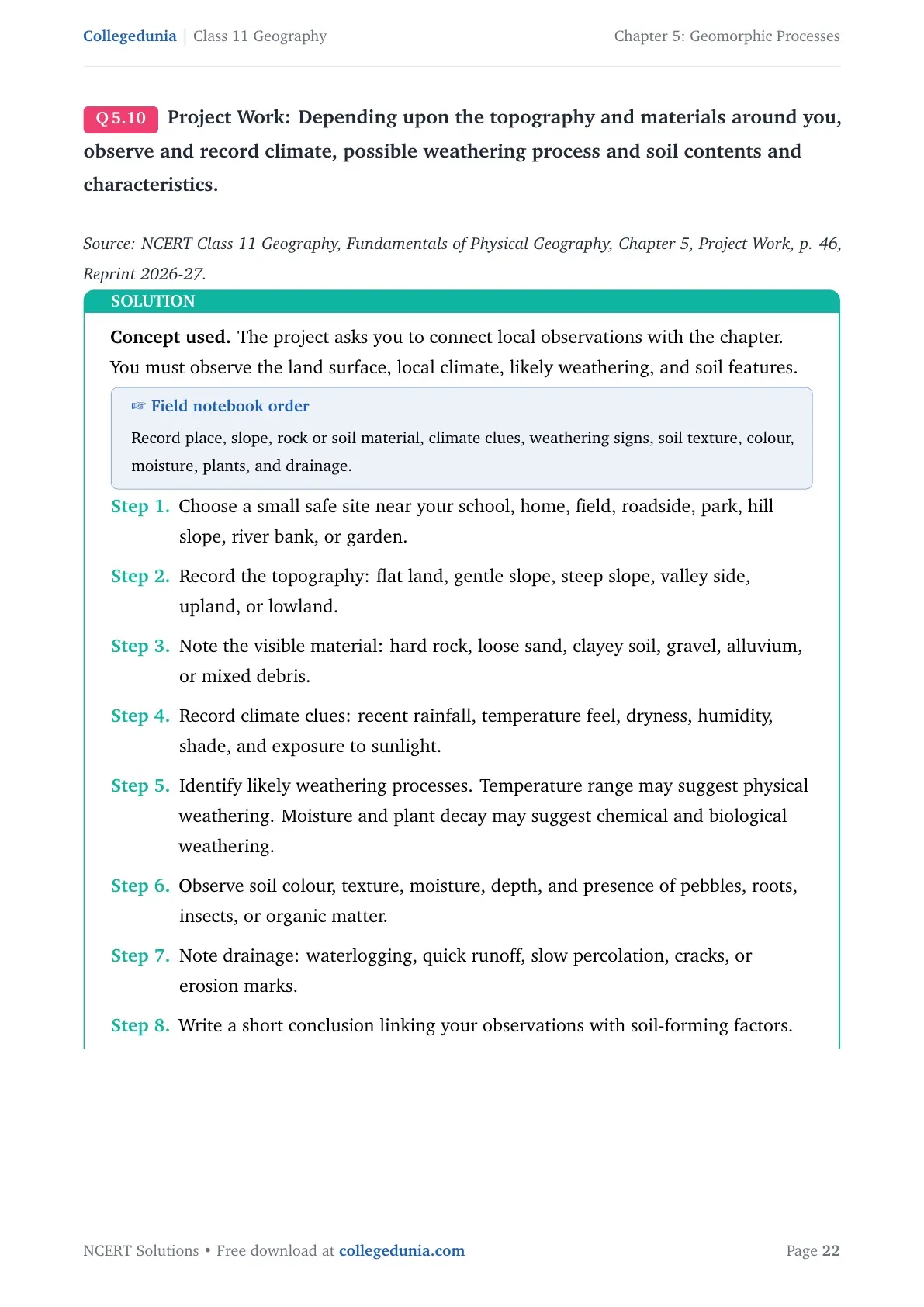
Project Work: Depending upon the topography and materials around you, observe and record climate, possible weathering process and soil contents and characteristics.
Concept used. The project asks you to connect local observations with
the chapter. You must observe the land surface, local climate, likely
weathering, and soil features.
Field notebook order
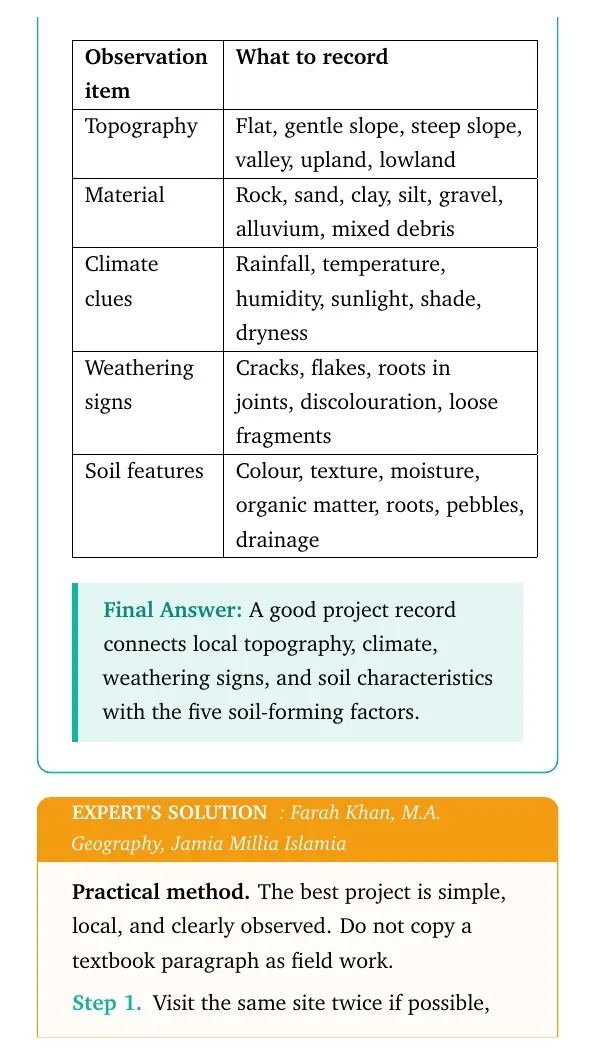
Record place, slope, rock or soil material, climate clues, weathering signs,
soil texture, colour, moisture, plants, and drainage.
Choose a small safe site near your school, home, field, roadside, park,
hill slope, river bank, or garden.
Record the topography: flat land, gentle slope, steep slope, valley
side, upland, or lowland.
Note the visible material: hard rock, loose sand, clayey soil, gravel,
alluvium, or mixed debris.
Record climate clues: recent rainfall, temperature feel, dryness,
humidity, shade, and exposure to sunlight.
Identify likely weathering processes. Temperature range may suggest
physical weathering. Moisture and plant decay may suggest chemical and
biological weathering.
Observe soil colour, texture, moisture, depth, and presence of pebbles,
roots, insects, or organic matter.
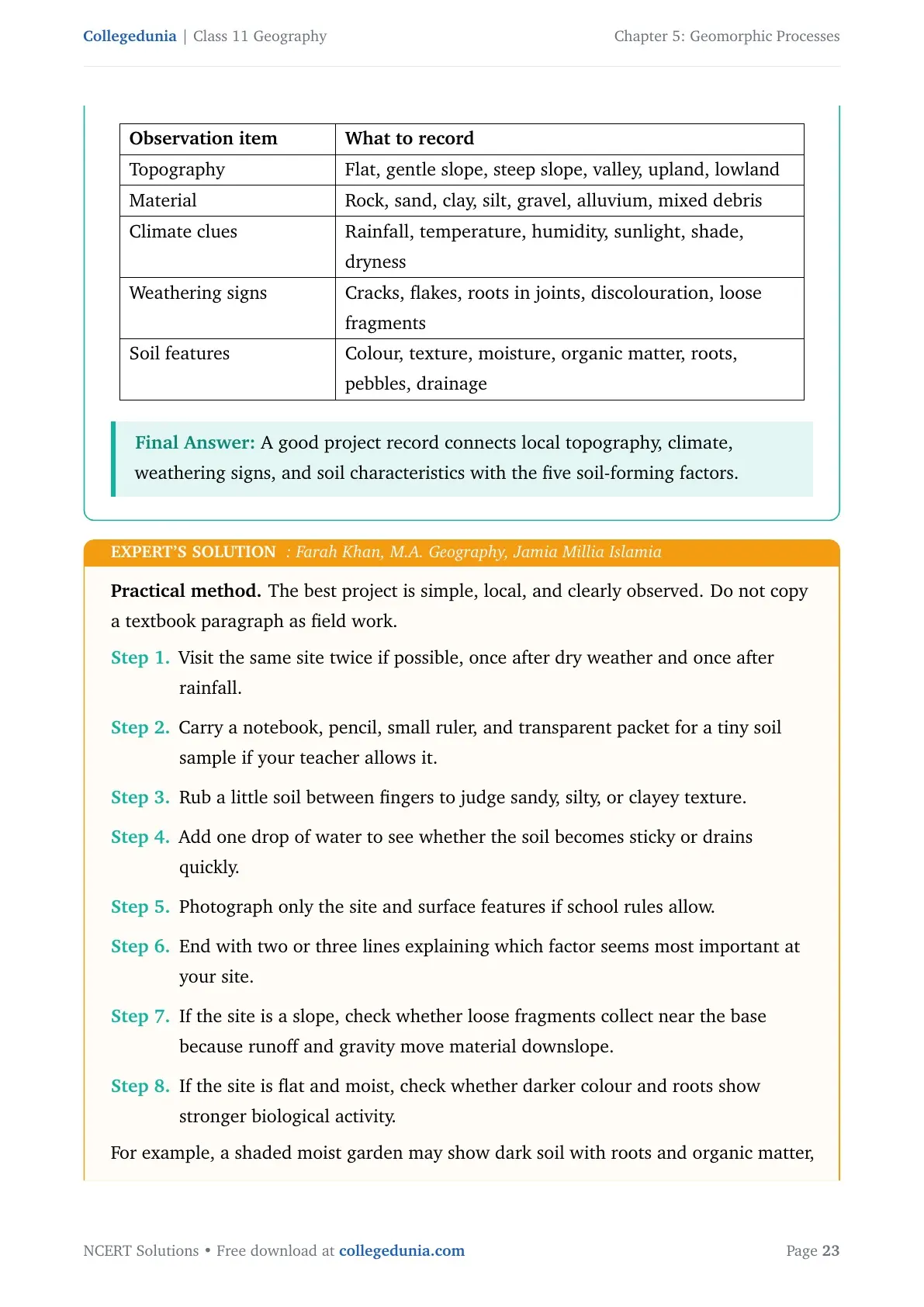
A good project record connects local topography, climate, weathering signs, and soil characteristics with the five soil-forming factors.
FK
Farah Khan
M.A. Geography, Jamia Millia Islamia
Verified Expert
Practical method. The best project is simple, local, and clearly
observed. Do not copy a textbook paragraph as field work.
Visit the same site twice if possible, once after dry weather and once
after rainfall.
Carry a notebook, pencil, small ruler, and transparent packet for a
tiny soil sample if your teacher allows it.
Rub a little soil between fingers to judge sandy, silty, or clayey
texture.
Add one drop of water to see whether the soil becomes sticky or drains
quickly.
Photograph only the site and surface features if school rules allow.
End with two or three lines explaining which factor seems most
important at your site.
If the site is a slope, check whether loose fragments collect near the
base because runoff and gravity move material downslope.
If the site is flat and moist, check whether darker colour and roots
show stronger biological activity.
For example, a shaded moist garden may show dark soil with roots and organic
matter, while an exposed roadside slope may show loose fragments, thin soil,
and runoff marks. Both observations can be explained using the same chapter
concepts.
Report format
Use a short table in the notebook: observation, evidence seen, and chapter
link. That prevents the project from becoming a copied paragraph and shows
the teacher exactly how climate, weathering, and soil features were connected.
Observe a local site and organise the record under topography, climate, weathering, soil contents, and soil characteristics.
Geomorphic Processes Class 11 NCERT Solutions FAQs
Ques. How many questions are solved in Class 11 Geography Chapter 5 Geomorphic Processes?
Ans. The PDF solves all 10 exercise and project questions from the 2026-27 NCERT Class 11 Geography Chapter 5 Geomorphic Processes textbook.
Ques. What is the difference between weathering and erosion?
Ans. Weathering breaks or alters rocks in place, while erosion removes and transports the loosened material through agents such as water, wind, waves or ice.
Ques. Why is weathering important for soil formation?
Ans. Weathering creates the mineral base or weathered mantle. Climate, organisms and time then change this material into soil with texture, nutrients and humus.
Ques. Are these Geomorphic Processes solutions useful for the 2026-27 school exam?
Ans. Yes. The answers follow the latest 2026-27 NCERT chapter sequence and explain each process with the definitions, examples and sequence needed for Class 11 exams.









Comments