




The NCERT Solutions for Class 11 Maths Chapter 6 Permutations and Combinations Exercise 6.3 cover every question of the third exercise, according to the latest 2026-27 CBSE syllabus. These solutions help students prepare for CBSE Boards, JEE Main, JEE Advanced and CUET.
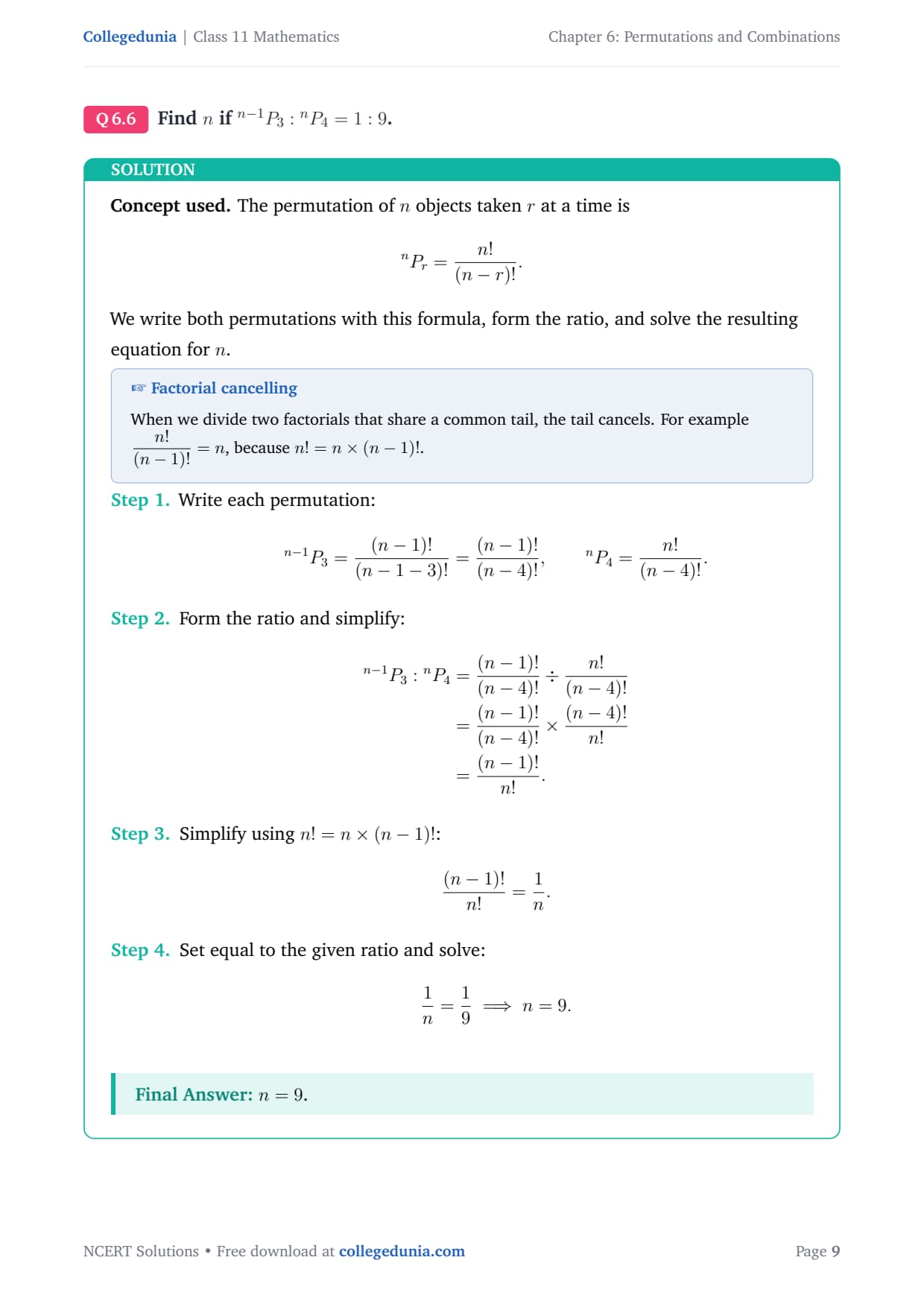
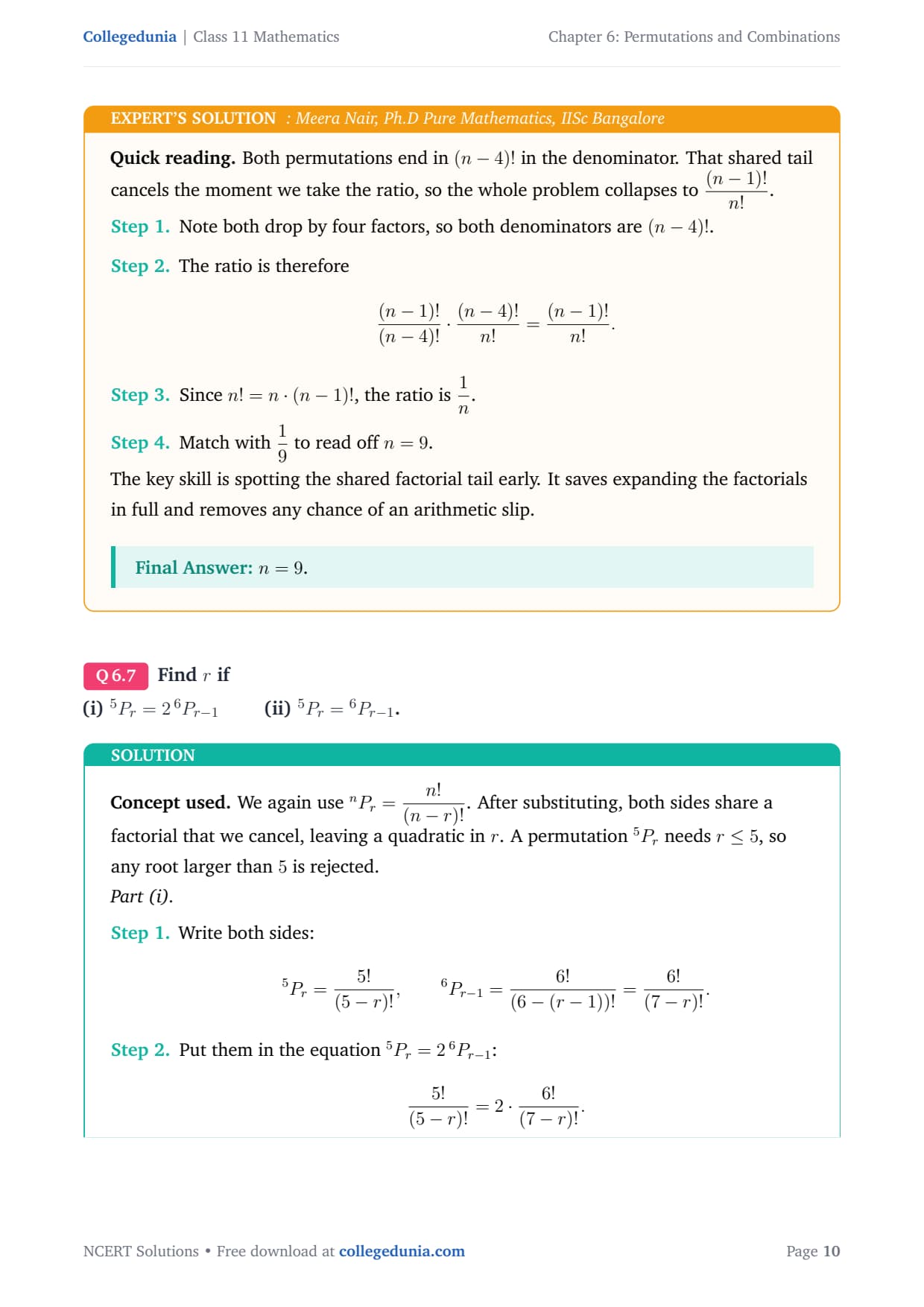
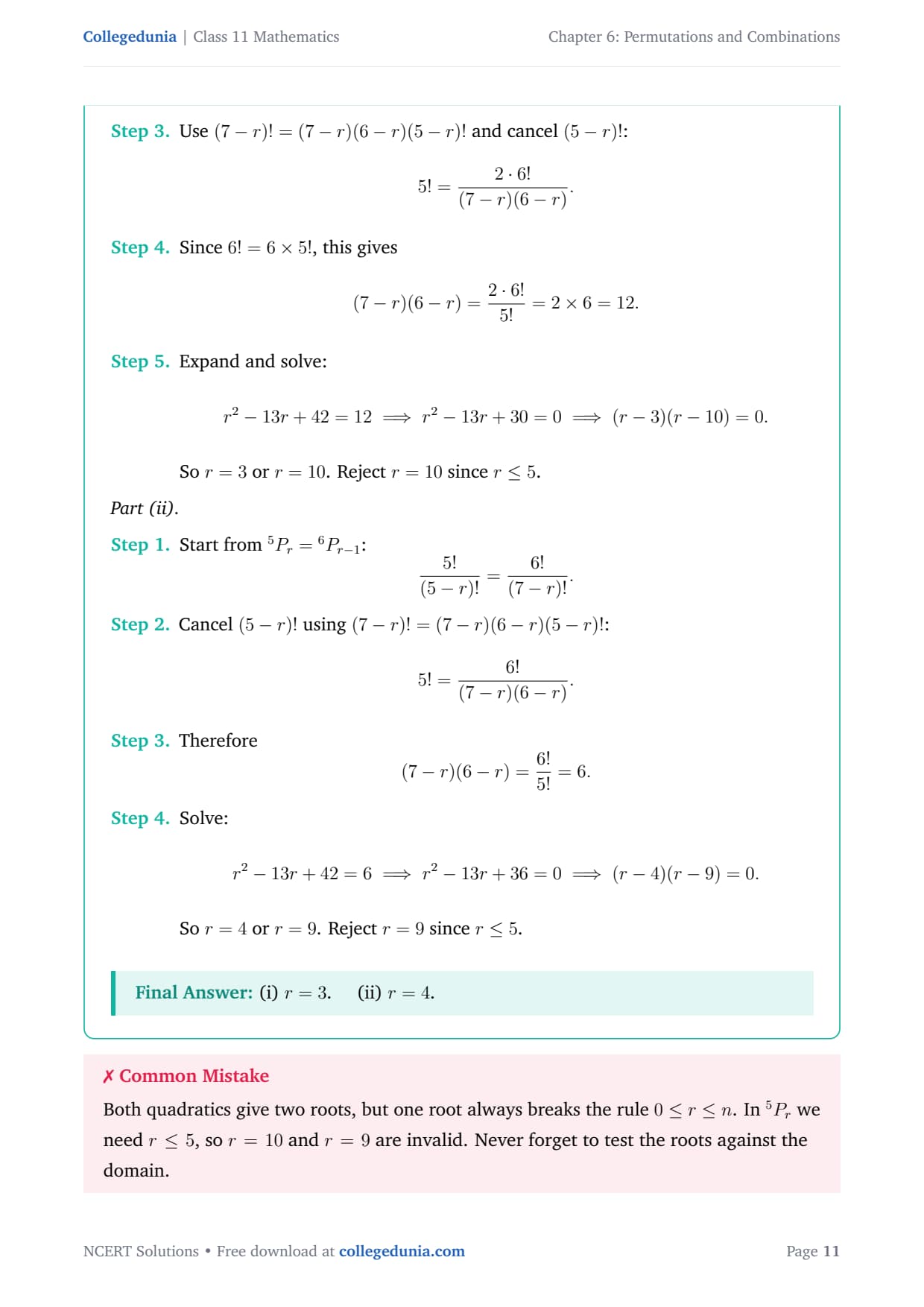
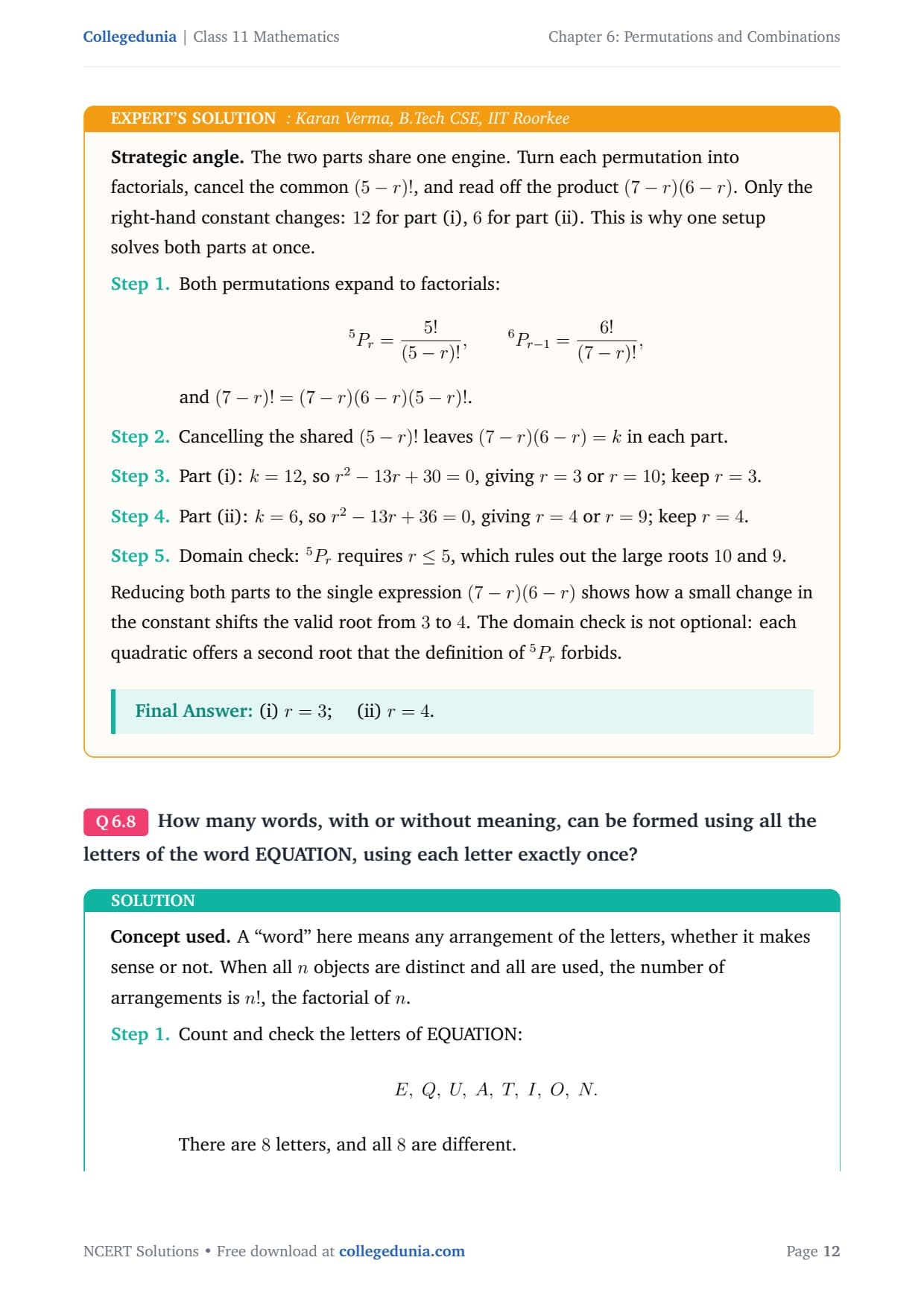
Each solution in this Collegedunia set is prepared by subject experts, based on the 2026-27 NCERT textbook, and checked against recent CBSE exam patterns.
Exercise 6.3 is the main permutations exercise, covering arrangements of distinct objects, arrangements under restrictions and arrangements when some objects repeat. The exercise has 11 questions built around these skills:
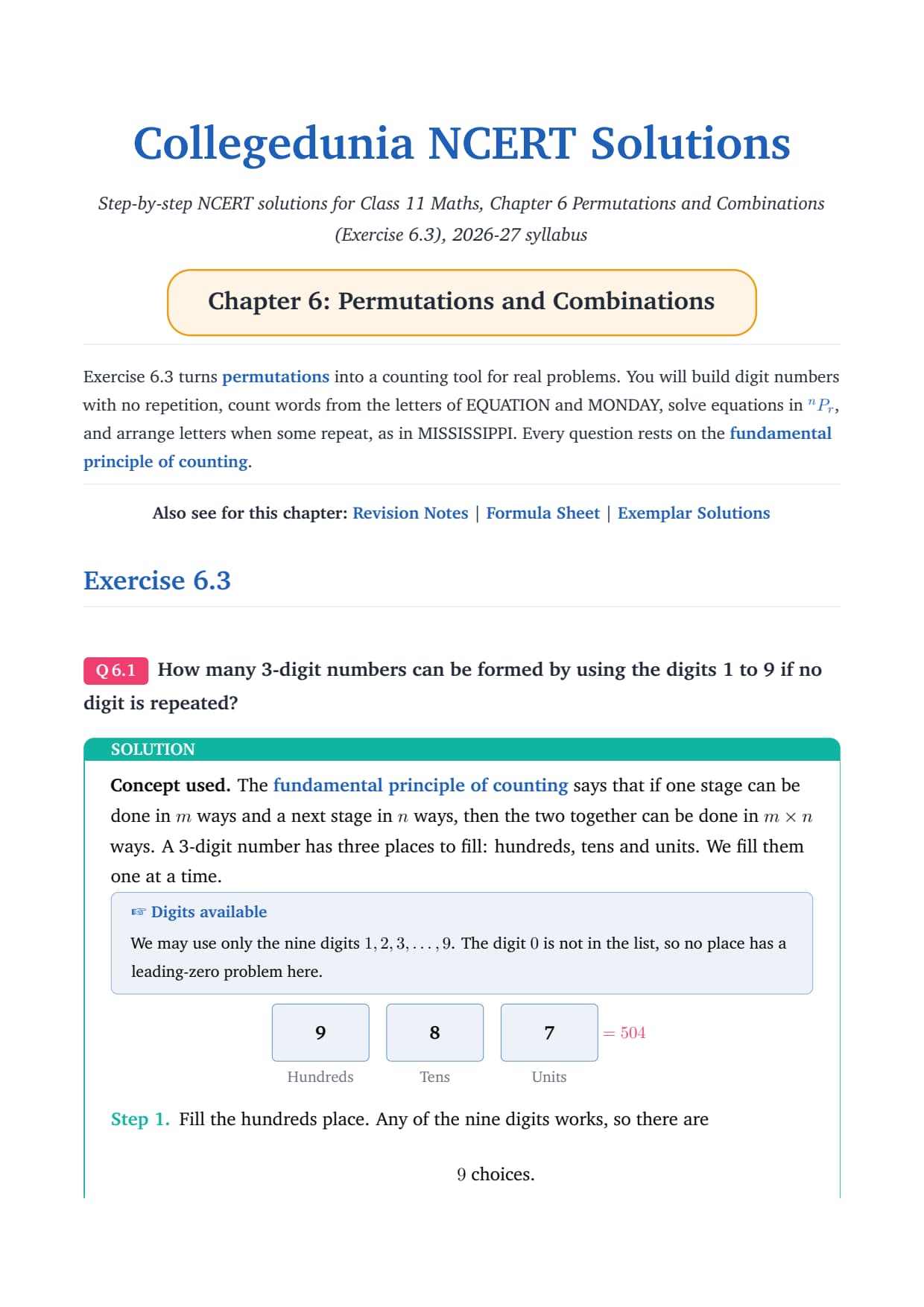
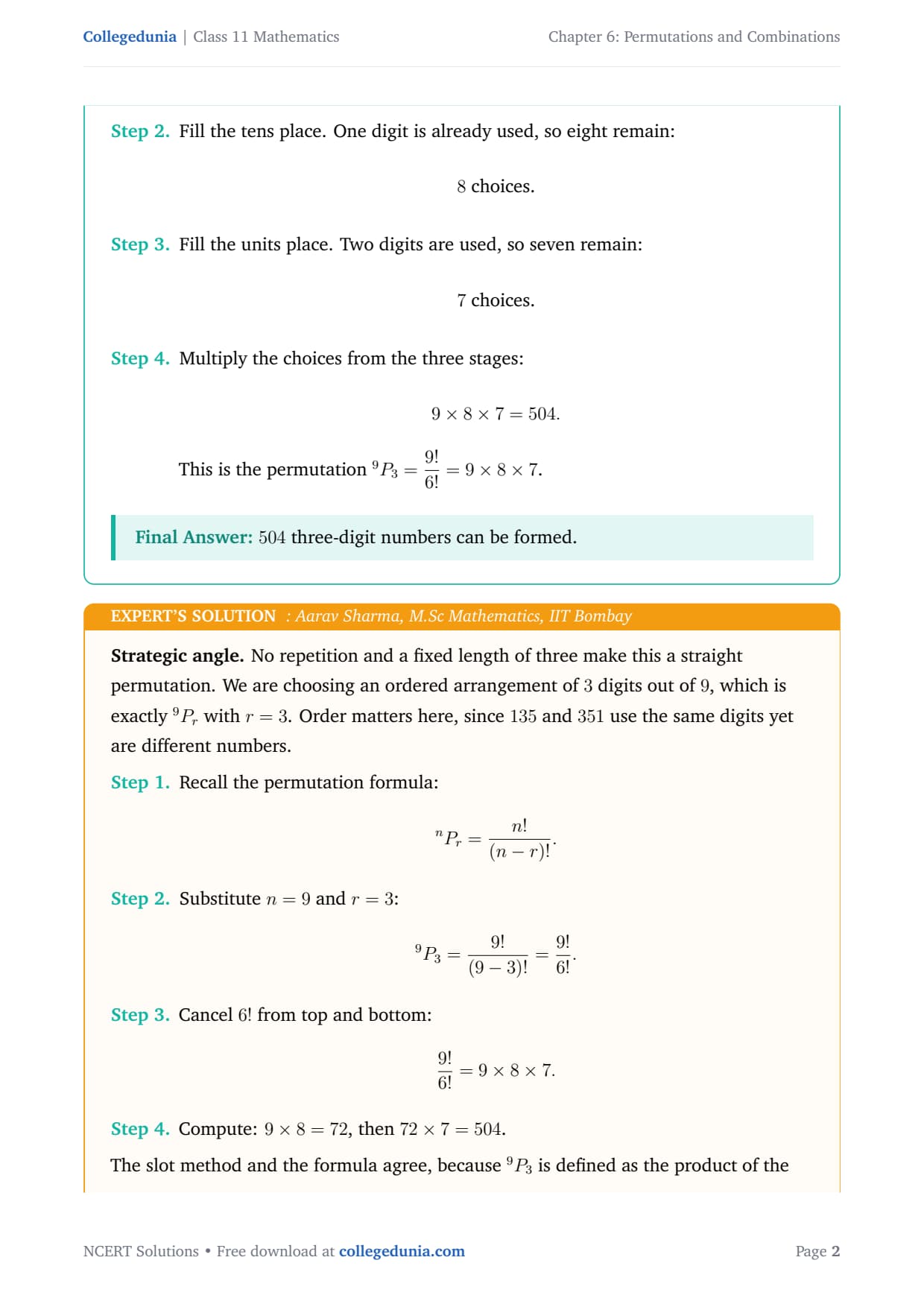
- Applying the permutation formula nPr = n! / (n − r)! to arrangements.
- Counting arrangements with restrictions, such as fixed first or last positions.
- Counting arrangements of words with repeated letters, like MISSISSIPPI.
Topics Covered in Exercise 6.3
This exercise develops the idea of a permutation, which is an arrangement of objects in a definite order. When all objects are distinct, the number of ways to arrange r of them from n is nPr. When some objects are alike, the count is divided by the factorials of the repeated groups. Exercise 6.3 covers both cases along with several restriction problems.
- Permutations of distinct objects: forming numbers and words with no repetition.
- Restrictions: fixing the first or last place, or keeping certain letters together.
- Solving for n or r: using ratios of permutations like n−1P3 : nP4.
- Permutations with repetition: arranging letters of words that have repeated letters.
- Grouping conditions: keeping vowels together or a fixed gap between two letters.
Important: when letters repeat, divide the total factorial by the factorial of each repeated group. Skipping this step is the most common error in the exercise.
Question-wise Breakdown of Exercise 6.3
The NCERT Solutions for Class 11 Maths Chapter 6 Permutations and Combinations Exercise 6.3 solve all 11 questions in order. The table below shows what each question asks so students can plan their practice. Full step-by-step answers are inside the PDF above.
| Question | What it asks | Skill tested |
|---|---|---|
| Q1 | 3-digit numbers from digits 1 to 9, no repetition | Basic permutation |
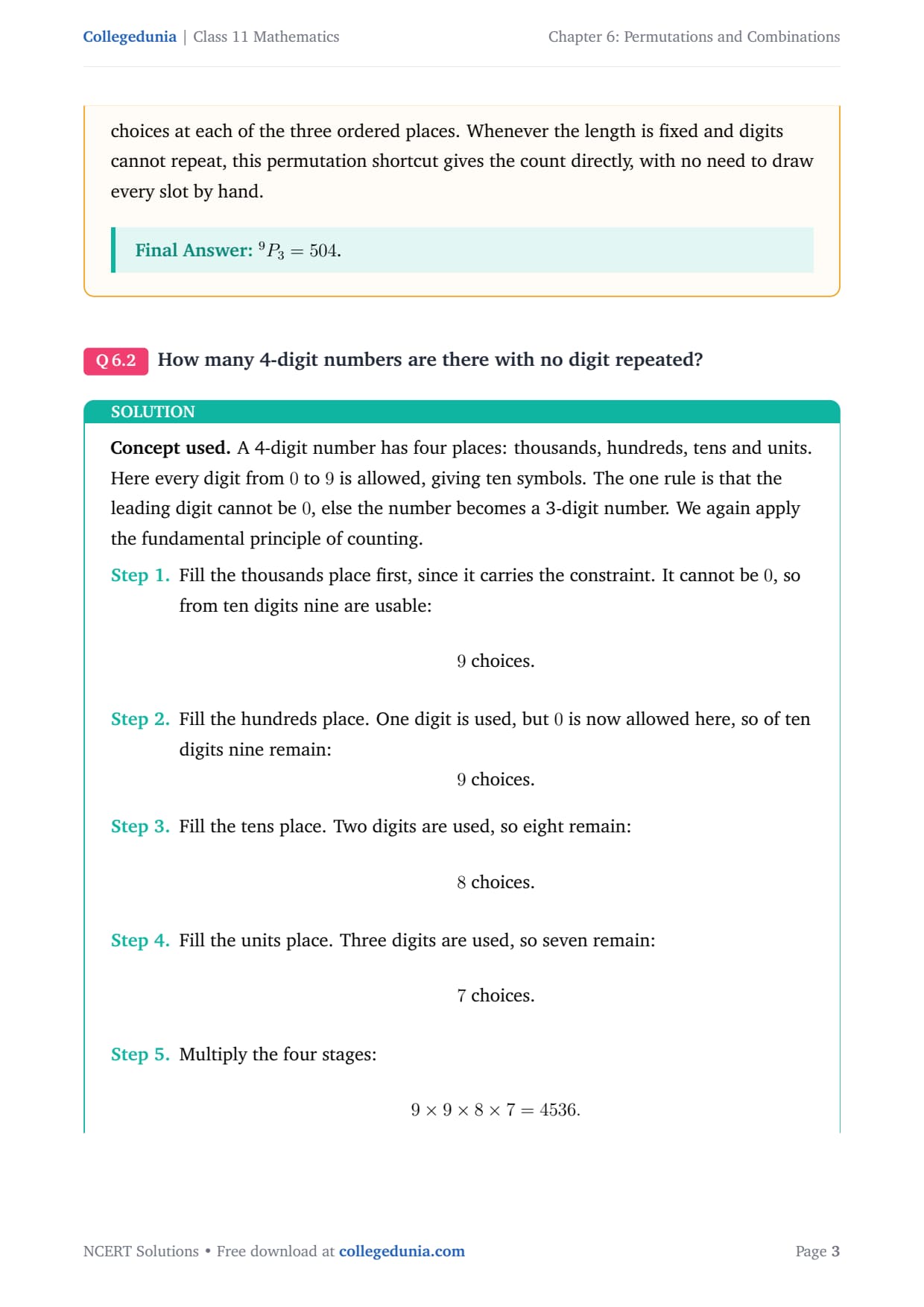
| Q2 | 4-digit numbers with no digit repeated | Handling a leading digit |
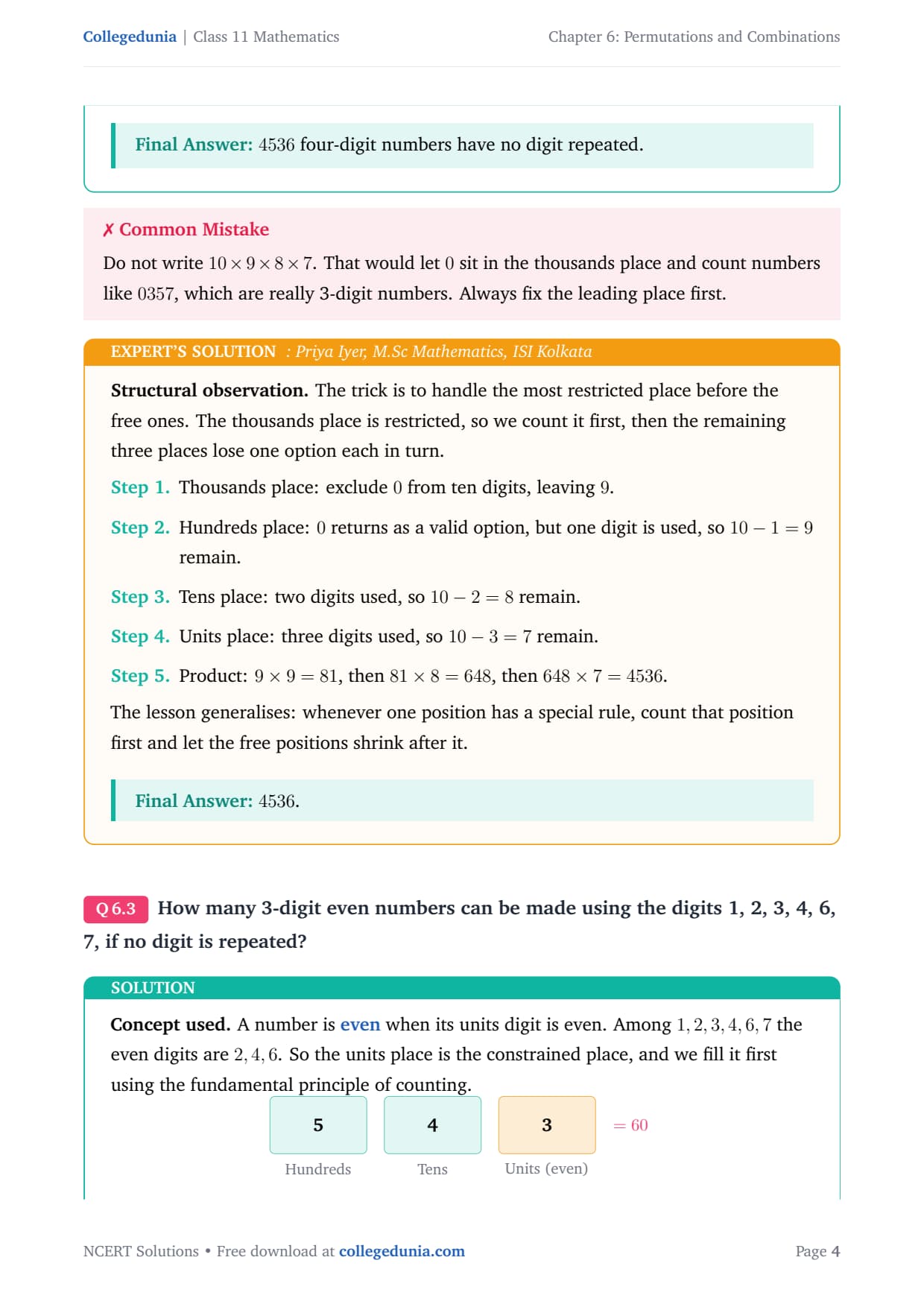
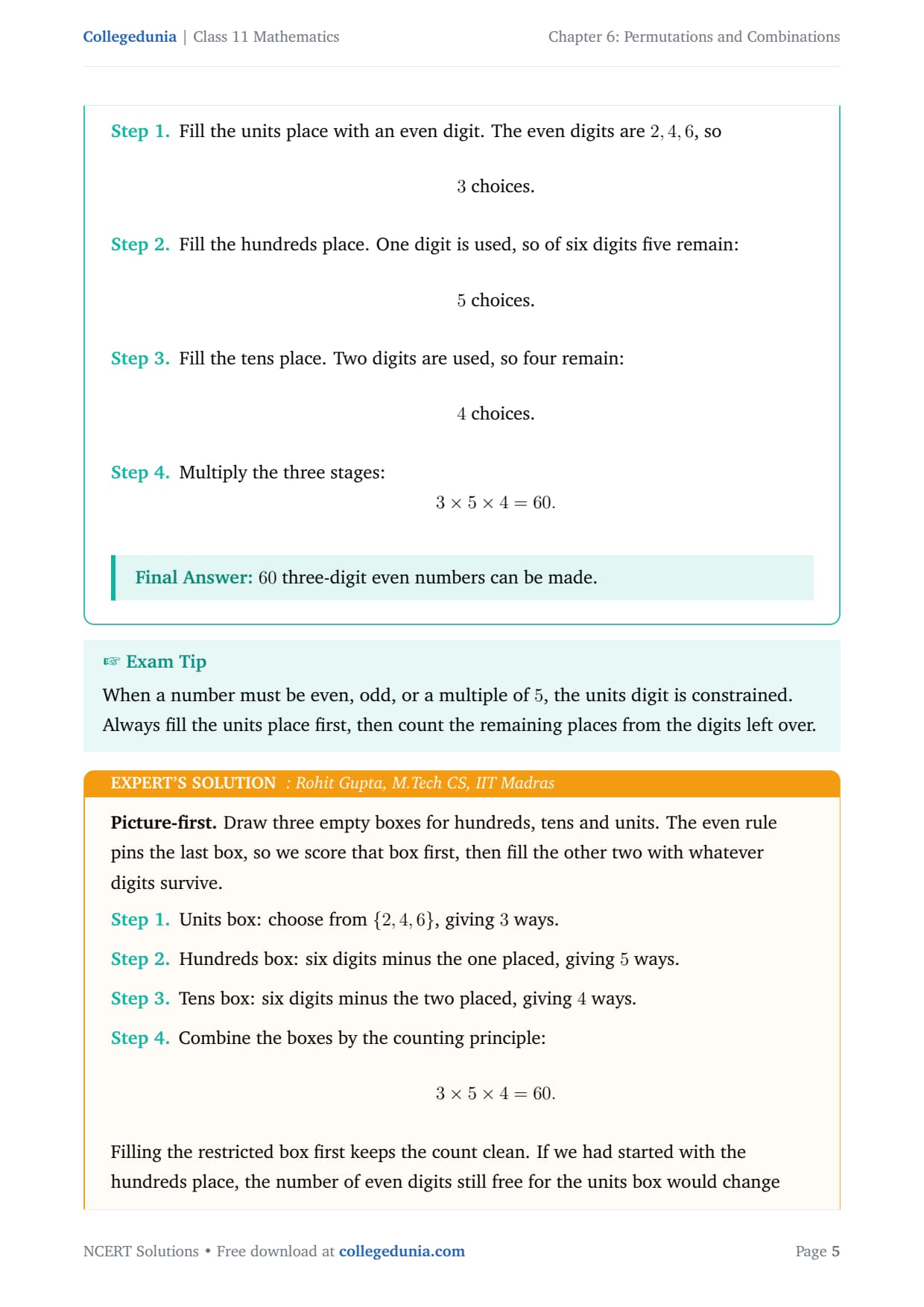
| Q3 | 3-digit even numbers from 1, 2, 3, 4, 6, 7 | Restriction on units place |
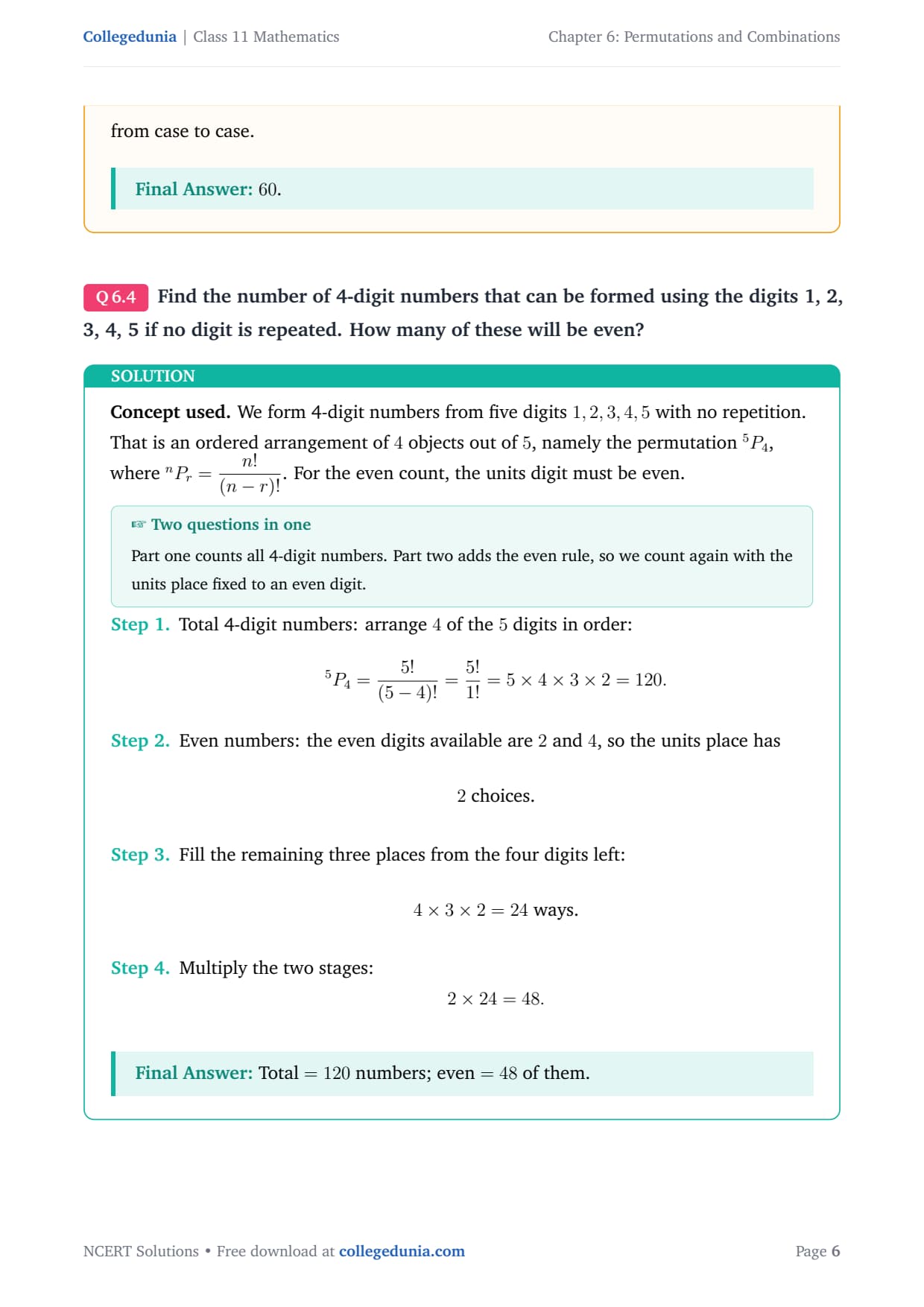
| Q4 | 4-digit numbers from 1 to 5, and how many are even | Restriction counting |
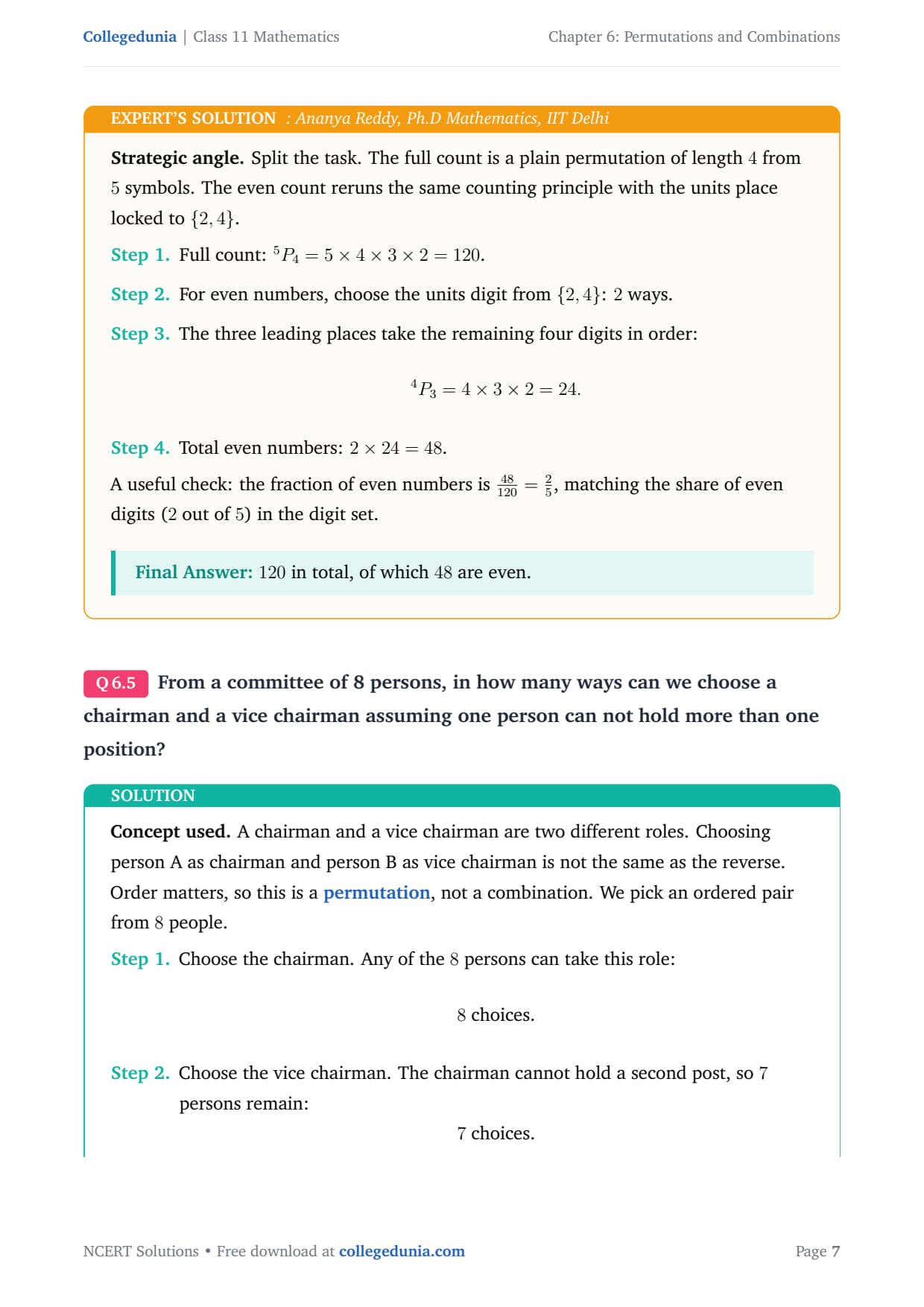
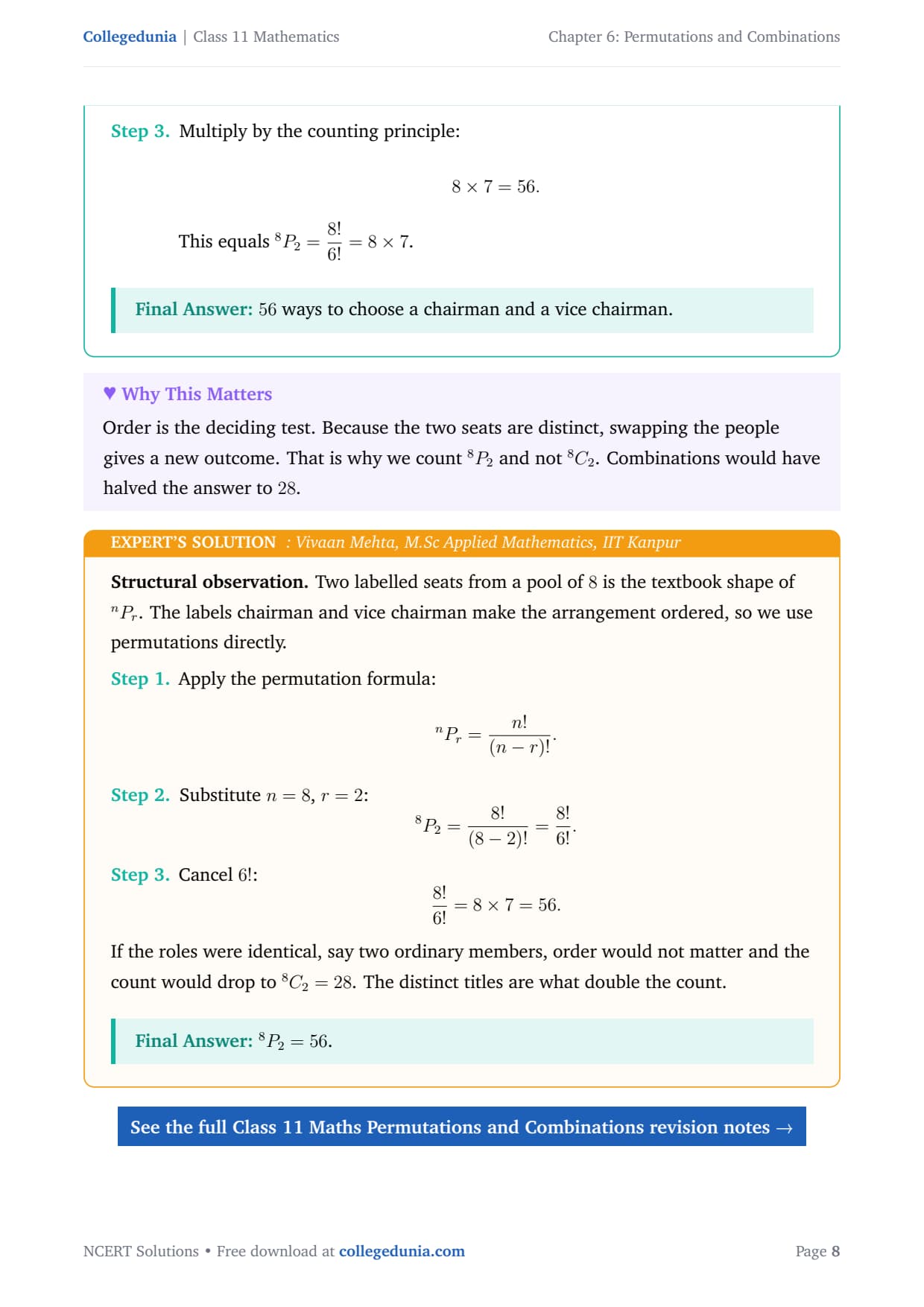
| Q5 | Choose a chairman and vice chairman from 8 people | Ordered selection (nPr) |
| Q6 | Find n if n−1P3 : nP4 = 1 : 9 | Permutation equation |
| Q7 | Find r from given permutation equations | Solving for r |
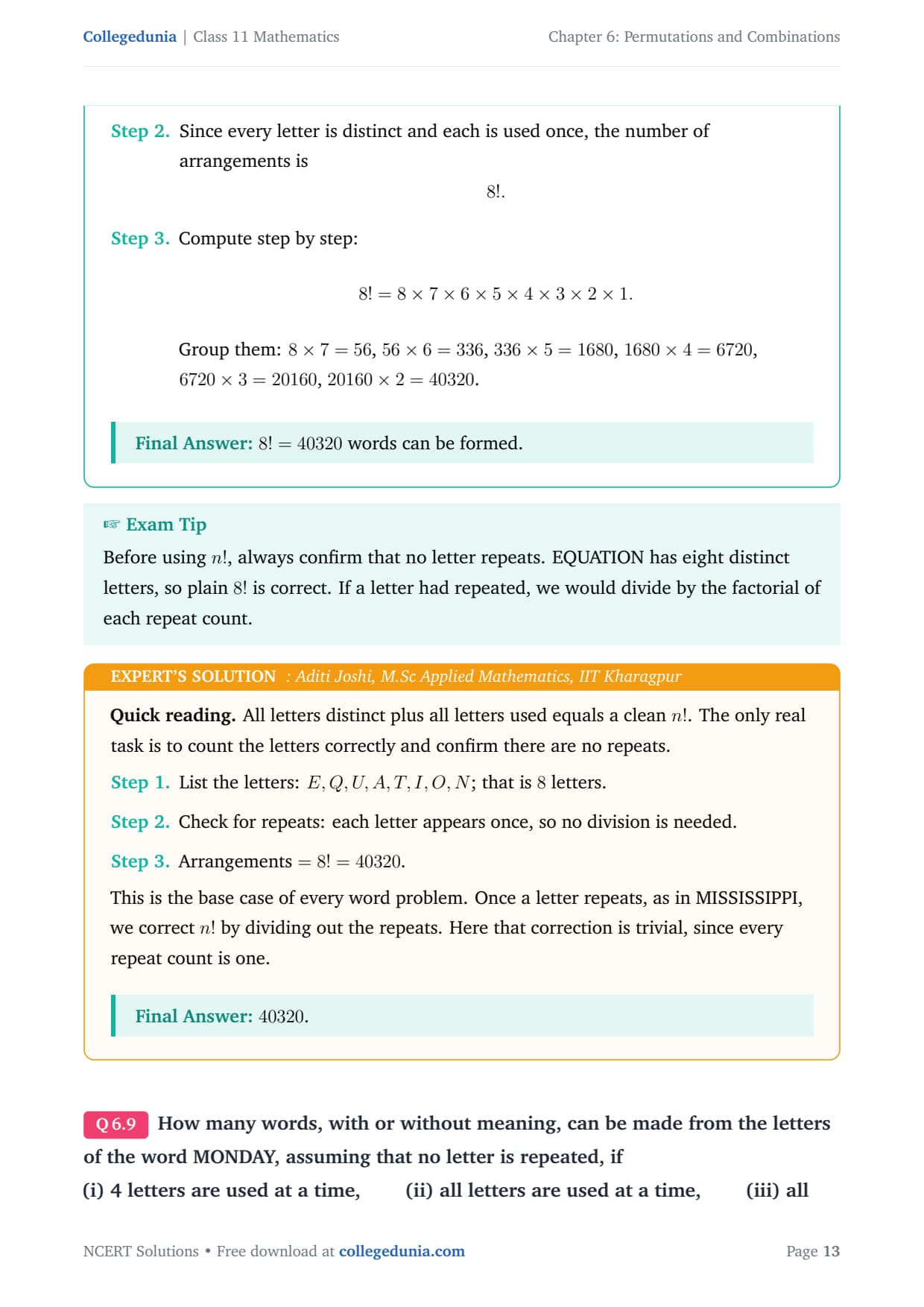
| Q8 | Words using all letters of EQUATION | Permutation of distinct letters |
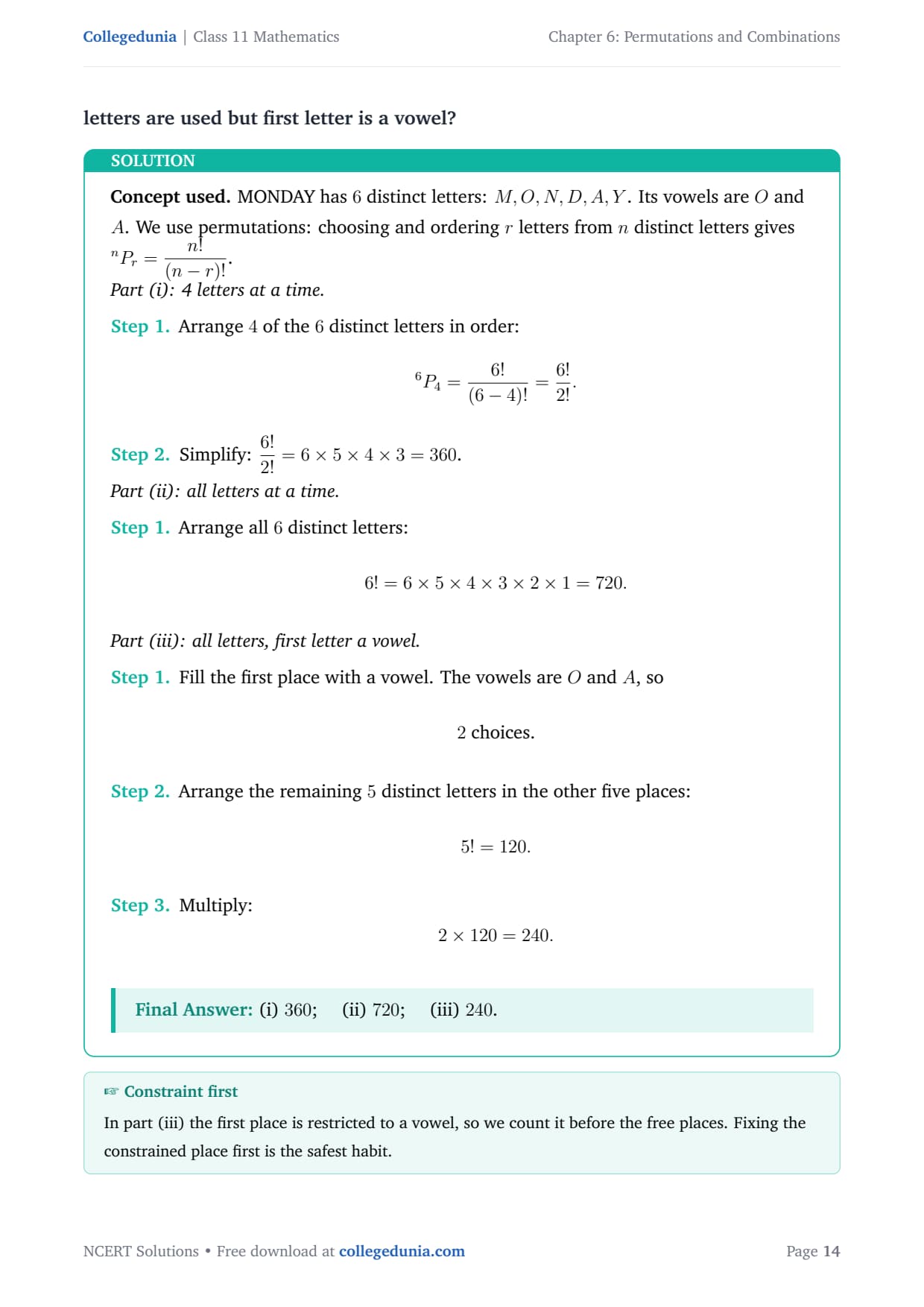
| Q9 | Words from MONDAY under three conditions | Restricted arrangements |
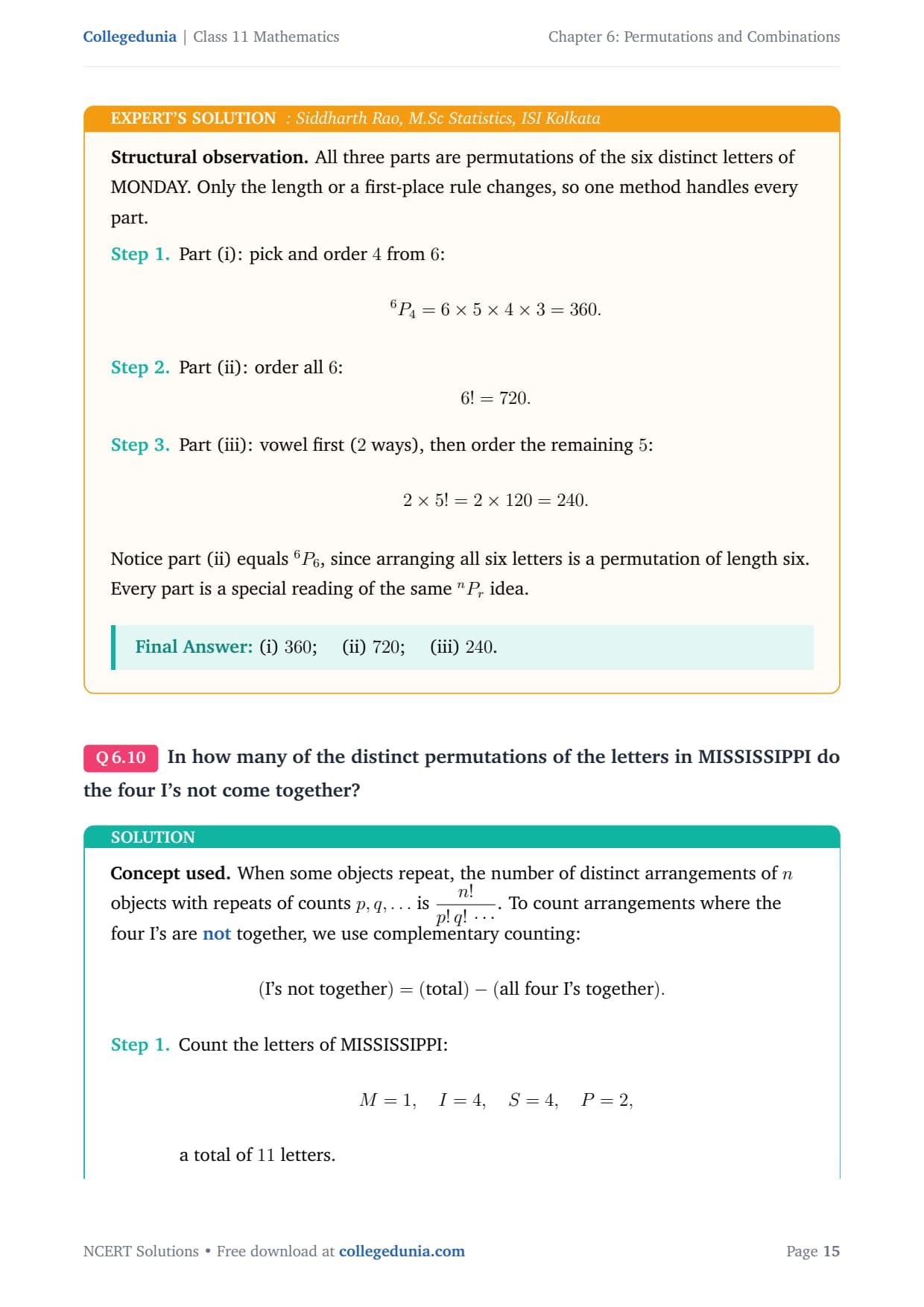
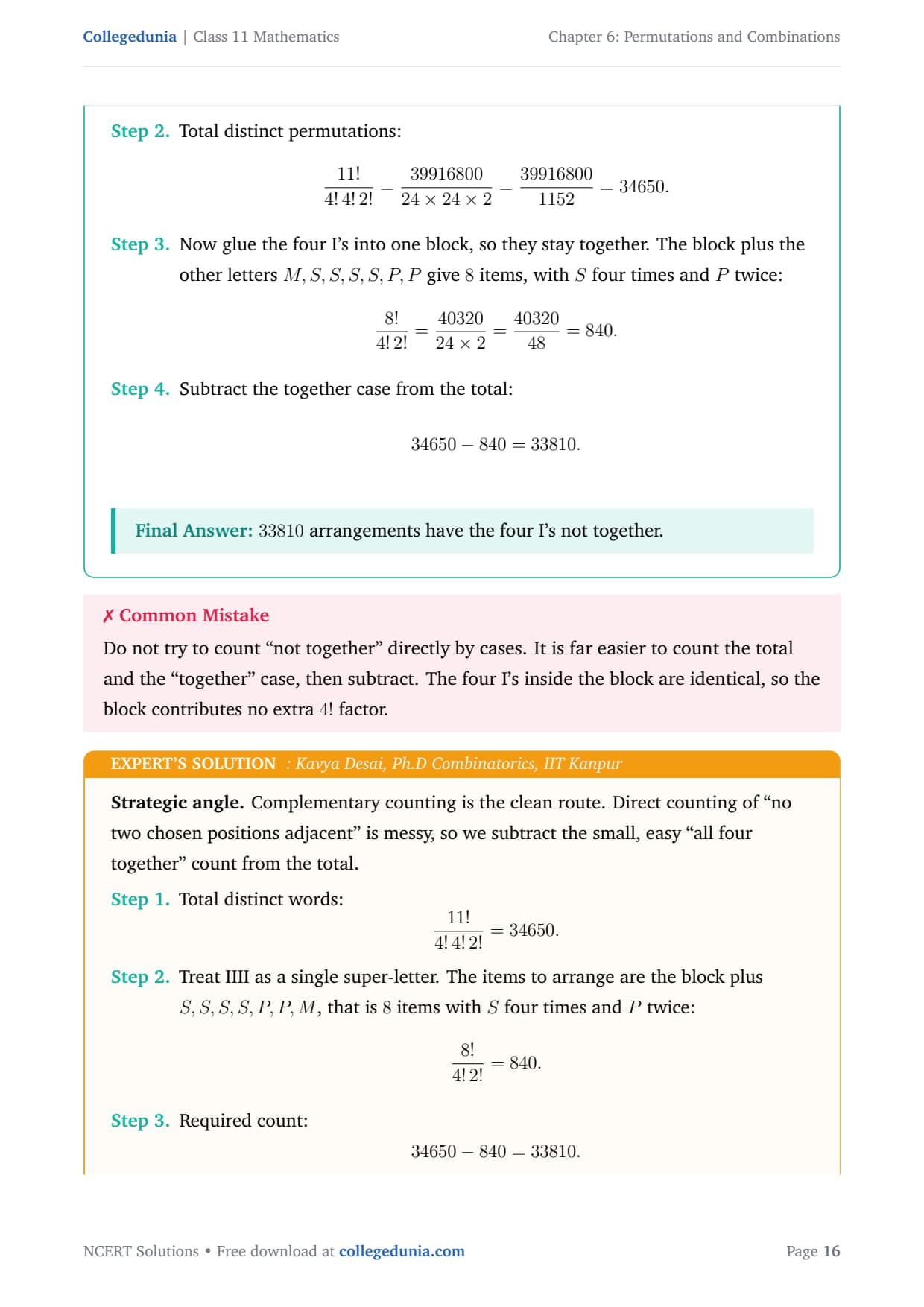
| Q10 | Arrangements of MISSISSIPPI with the four I's apart | Repetition and gap method |
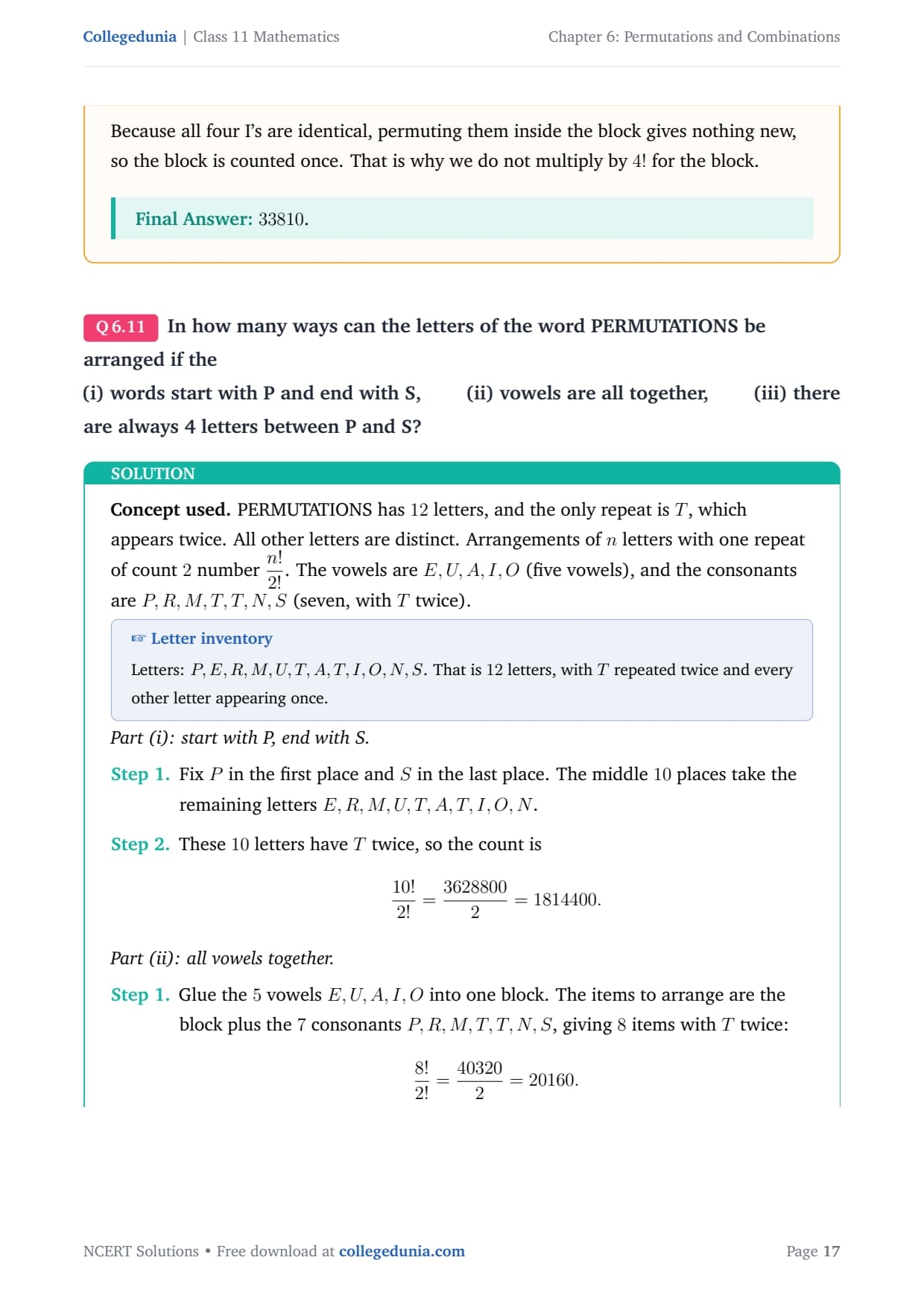
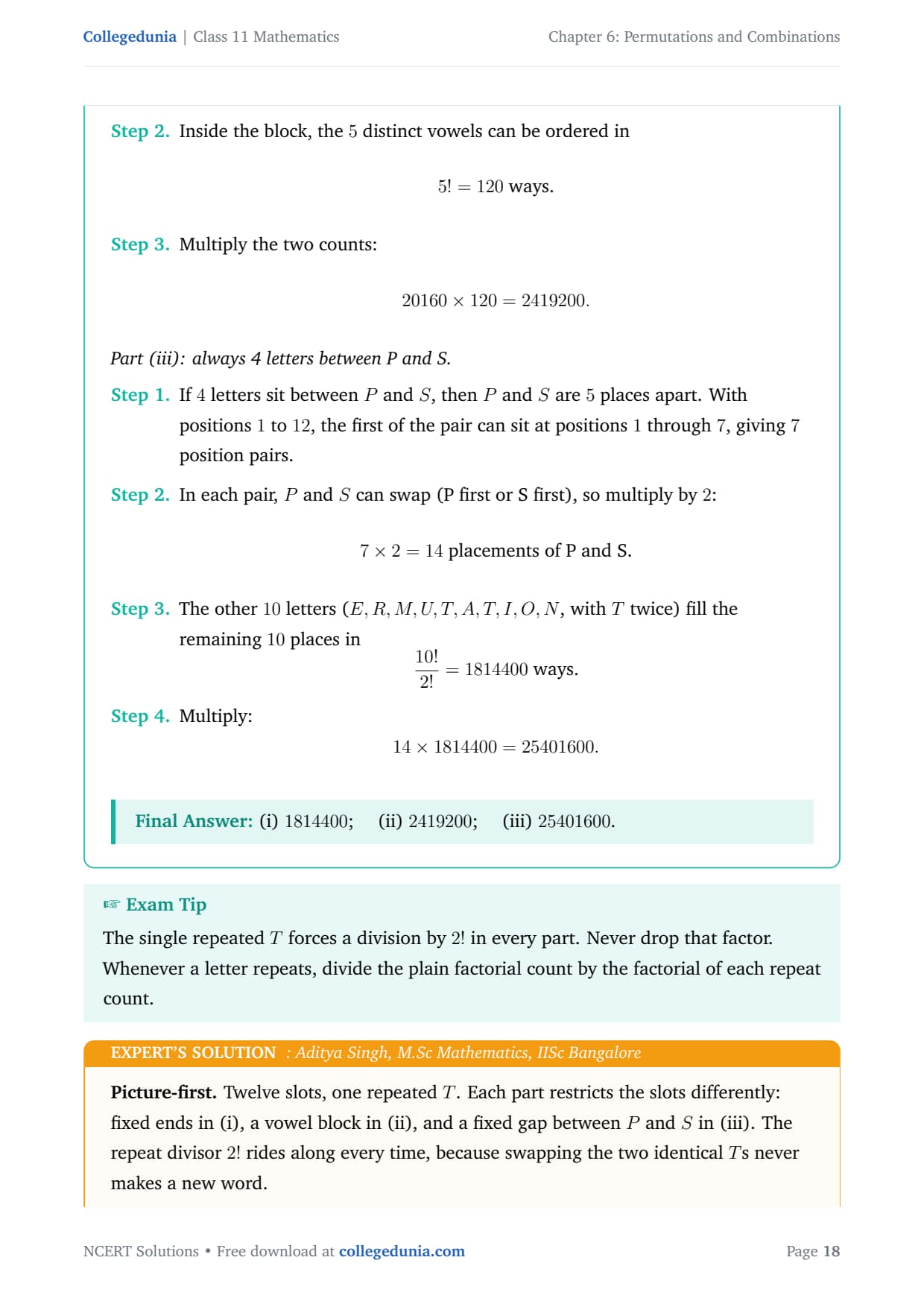
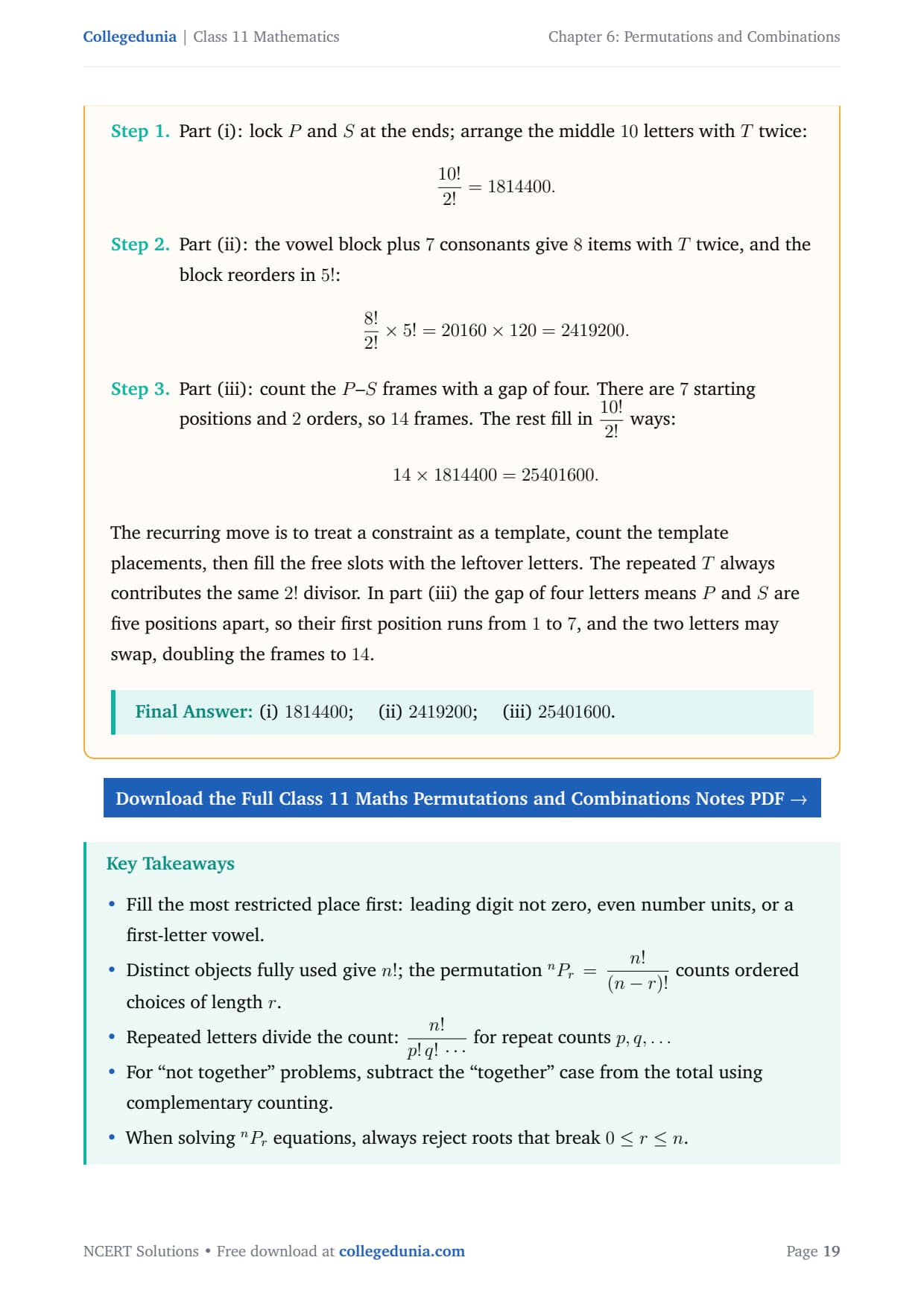
| Q11 | Arrangements of PERMUTATIONS under three conditions | Repetition with restrictions |
The exercise moves from simple number problems to word arrangements with repeated letters, so it is the most important practice set in the chapter.
Key Formulas and Definitions for Exercise 6.3
Exercise 6.3 uses the permutation formula and the rule for repeated objects. Students should keep both ready before starting.
| Formula | Meaning |
|---|---|
| nPr = n! / (n − r)! | Number of ways to arrange r objects out of n distinct objects |
| nPn = n! | Arranging all n distinct objects |
| nP0 = 1 | One way to arrange none |
| n! / (p! q! ...) | Arrangements of n objects where p, q, ... are alike |
| Grouping method | Treat objects that must stay together as one block, then arrange inside |
Tip: for "not together" problems, count the total arrangements and subtract the arrangements where the items are together. This is the fastest route in Question 10.
Common Mistakes in Exercise 6.3
Students lose marks in Exercise 6.3 by mishandling repetition and restrictions. The list below covers the errors that show up most often in class tests on the NCERT Solutions for Class 11 Maths Chapter 6 Permutations and Combinations Exercise 6.3.
- Forgetting to divide by the factorial of repeated letters, so MISSISSIPPI is counted as 11! instead of 11! / (4! 4! 2!).
- Allowing 0 in the leading place of a number, which makes it a shorter number.
- Adding block arrangements instead of multiplying the inside and outside arrangements.
- In "not together" questions, forgetting to subtract the together-case from the total.
Practice Questions for Exercise 6.3
After reading the solutions, students should test themselves on the same question types. The card below opens a set of solved practice questions with step-by-step answers for Exercise 6.3.
Practice Card: Solved Practice Questions for Class 11 Maths Permutations and Combinations Exercise 6.3 — attempt each question, then check the worked solution.
Other Exercises of Chapter 6 Permutations and Combinations
Chapter 6 Permutations and Combinations has four exercises plus a Miscellaneous Exercise. Use the table to move to another exercise once Exercise 6.3 is done.
| Exercise | NCERT Solutions link |
|---|---|
| Exercise 6.1 | Class 11 Maths Permutations and Combinations Exercise 6.1 Solutions |
| Exercise 6.2 | Class 11 Maths Permutations and Combinations Exercise 6.2 Solutions |
| Exercise 6.4 | Class 11 Maths Permutations and Combinations Exercise 6.4 Solutions |
| Miscellaneous Exercise | Class 11 Maths Permutations and Combinations Miscellaneous Exercise Solutions |
More Class 11 Maths Permutations and Combinations Resources
Pair the solutions with the notes and the NCERT book PDF for full chapter revision. All three resources for Chapter 6 Permutations and Combinations are linked below.
| Resource | Link |
|---|---|
| Revision Notes | Class 11 Maths Permutations and Combinations Notes |
| Handwritten Notes | Class 11 Maths Permutations and Combinations Handwritten Notes |
| NCERT Book PDF | Class 11 Maths Permutations and Combinations NCERT Book PDF |
NCERT Solutions for Other Class 11 Maths Chapters
Students can move to the first exercise of any other Class 11 Maths chapter using the cross-sell table below.
| Chapter | NCERT Solutions |
|---|---|
| Chapter 1: Sets | Sets Solutions |
| Chapter 2: Relations and Functions | Relations and Functions Solutions |
| Chapter 3: Trigonometric Functions | Trigonometric Functions Solutions |
| Chapter 4: Complex Numbers and Quadratic Equations | Complex Numbers Solutions |
| Chapter 5: Linear Inequalities | Linear Inequalities Solutions |
| Chapter 6: Permutations and Combinations | You are here |
| Chapter 7: Binomial Theorem | Binomial Theorem Solutions |
| Chapter 8: Sequences and Series | Sequences and Series Solutions |
| Chapter 9: Straight Lines | Straight Lines Solutions |
| Chapter 10: Conic Sections | Conic Sections Solutions |
| Chapter 11: Introduction to Three Dimensional Geometry | Three Dimensional Geometry Solutions |
| Chapter 12: Limits and Derivatives | Limits and Derivatives Solutions |
| Chapter 13: Statistics | Statistics Solutions |
| Chapter 14: Probability | Probability Solutions |
Student Feedback
In a Collegedunia survey of 12,140 Class 11 students conducted before the 2026 exams, 76% of students rated the MISSISSIPPI arrangement in Question 10 as the toughest in Exercise 6.3, while the chairman and vice chairman selection was rated the easiest.
FAQs on NCERT Solutions for Class 11 Maths Chapter 6 Permutations and Combinations Exercise 6.3
Permutations and Combinations NCERT Solutions - Frequently Asked Questions
Ques. How many questions are there in Class 11 Maths Chapter 6 Permutations and Combinations Exercise 6.3?
Ans. Exercise 6.3 has 11 questions. They cover permutations of distinct objects, arrangements with restrictions, solving permutation equations and arrangements of words with repeated letters such as MISSISSIPPI and PERMUTATIONS.
Ques. What is the permutation formula used in Exercise 6.3?
Ans. The number of permutations of r objects taken from n distinct objects is nPr = n! / (n − r)!. It counts arrangements where order matters. Exercise 6.3 uses this formula for numbers, codes and word arrangements throughout.
Ques. How do you arrange letters of a word with repeated letters?
Ans. If a word has n letters where one letter repeats p times and another q times, the number of distinct arrangements is n! / (p! q! ...). For MISSISSIPPI, which has 4 I's, 4 S's and 2 P's, the count is 11! / (4! 4! 2!). This rule is the heart of Questions 10 and 11.
Ques. How do you count arrangements where certain letters are not together?
Ans. First find the total arrangements. Then treat the letters that must stay apart as one block, count those together-arrangements, and subtract from the total. In Question 10, the arrangements of MISSISSIPPI with the four I's together are subtracted from all arrangements to get the I's-apart count.
Ques. Are the NCERT Solutions for Class 11 Maths Chapter 6 Permutations and Combinations Exercise 6.3 free to download?
Ans. Yes. The NCERT Solutions for Class 11 Maths Chapter 6 Permutations and Combinations Exercise 6.3 are free to download as a PDF from this page. Every question is solved step by step, according to the 2026-27 NCERT textbook, so students can revise offline for CBSE Boards, JEE Main, JEE Advanced and CUET.



Comments