




The NCERT Solutions for Class 11 Maths Chapter 6 Permutations and Combinations Miscellaneous Exercise cover every question of the final exercise, according to the latest 2026-27 CBSE syllabus. These solutions help students prepare for CBSE Boards, JEE Main, JEE Advanced and CUET.
Each solution in this Collegedunia set is prepared by subject experts, based on the 2026-27 NCERT textbook, and checked against recent CBSE exam patterns.
The Miscellaneous Exercise mixes permutations and combinations in the same question, testing whether students can decide which tool to use. The exercise has 11 questions built around these skills:
- Combining selection and arrangement in a single problem.
- Handling at least and at most conditions in committee questions.
- Arranging words with repeated letters and dictionary-order counting.
Topics Covered in the Miscellaneous Exercise
This exercise brings together every idea from Chapter 6 Permutations and Combinations. A typical question first selects objects with nCr and then arranges them with a permutation, so students must apply both formulas in order. The Miscellaneous Exercise also revisits repeated-letter arrangements and dictionary-order problems.
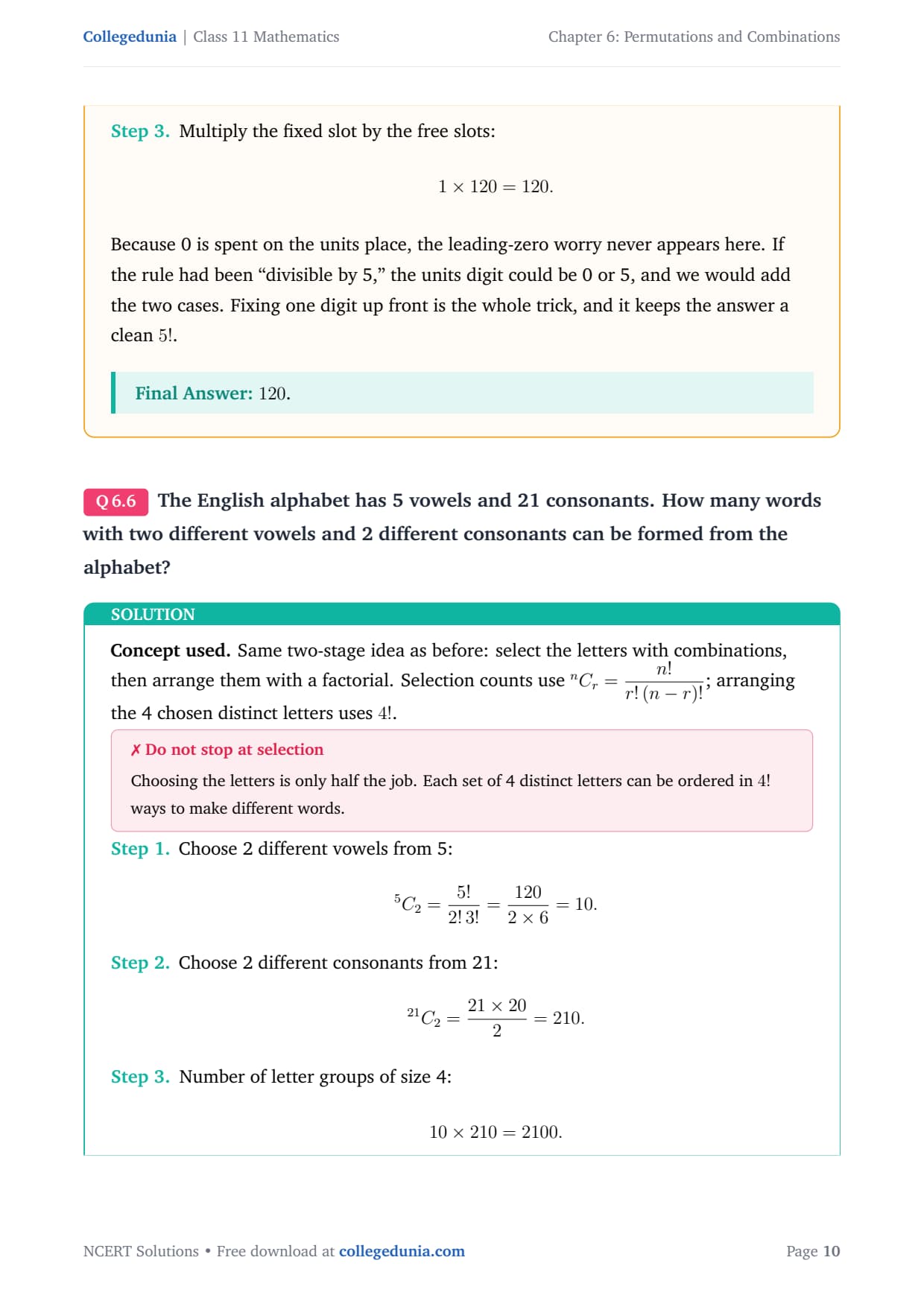
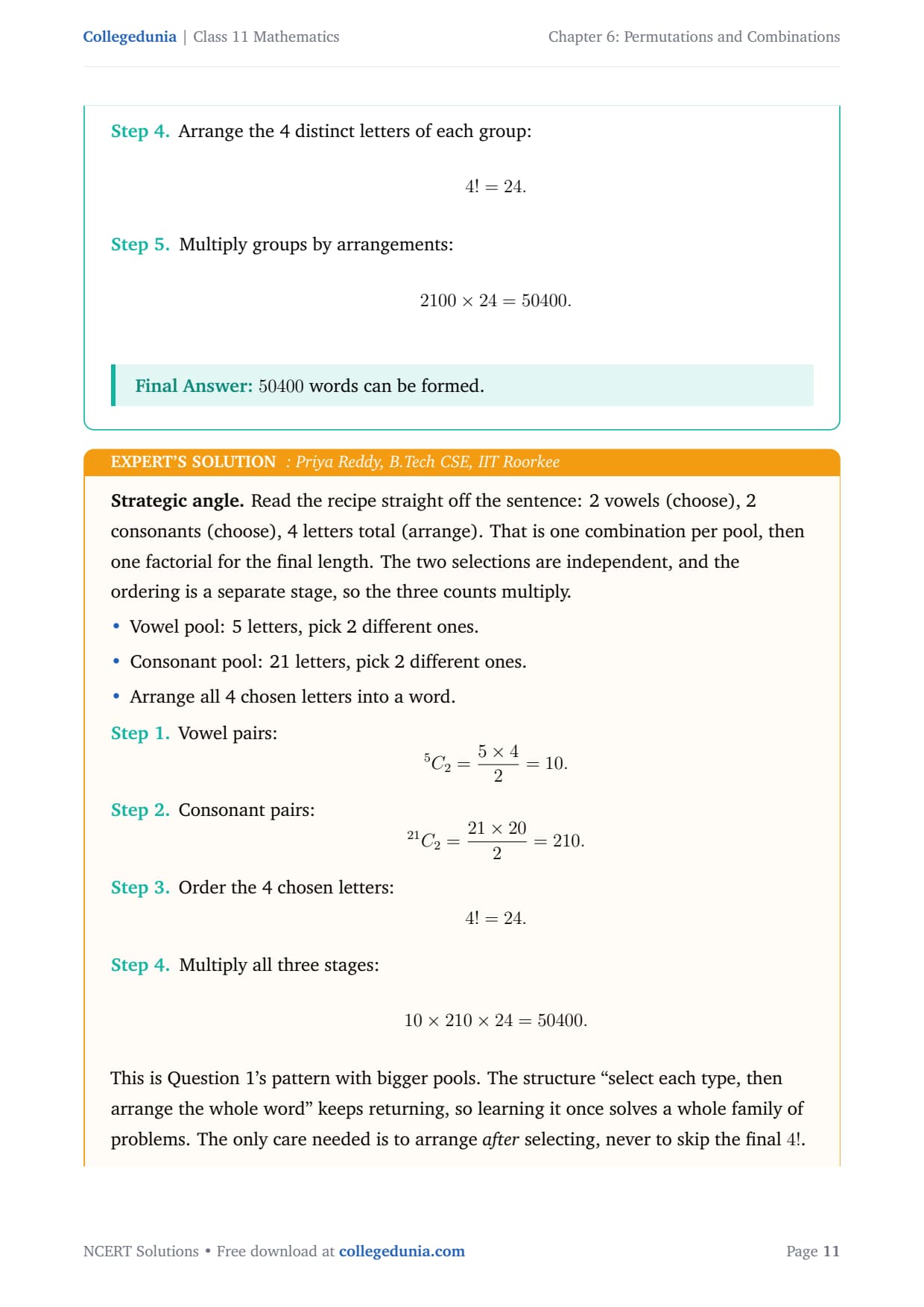
- Select then arrange: choose letters with combinations, then order them with permutations.
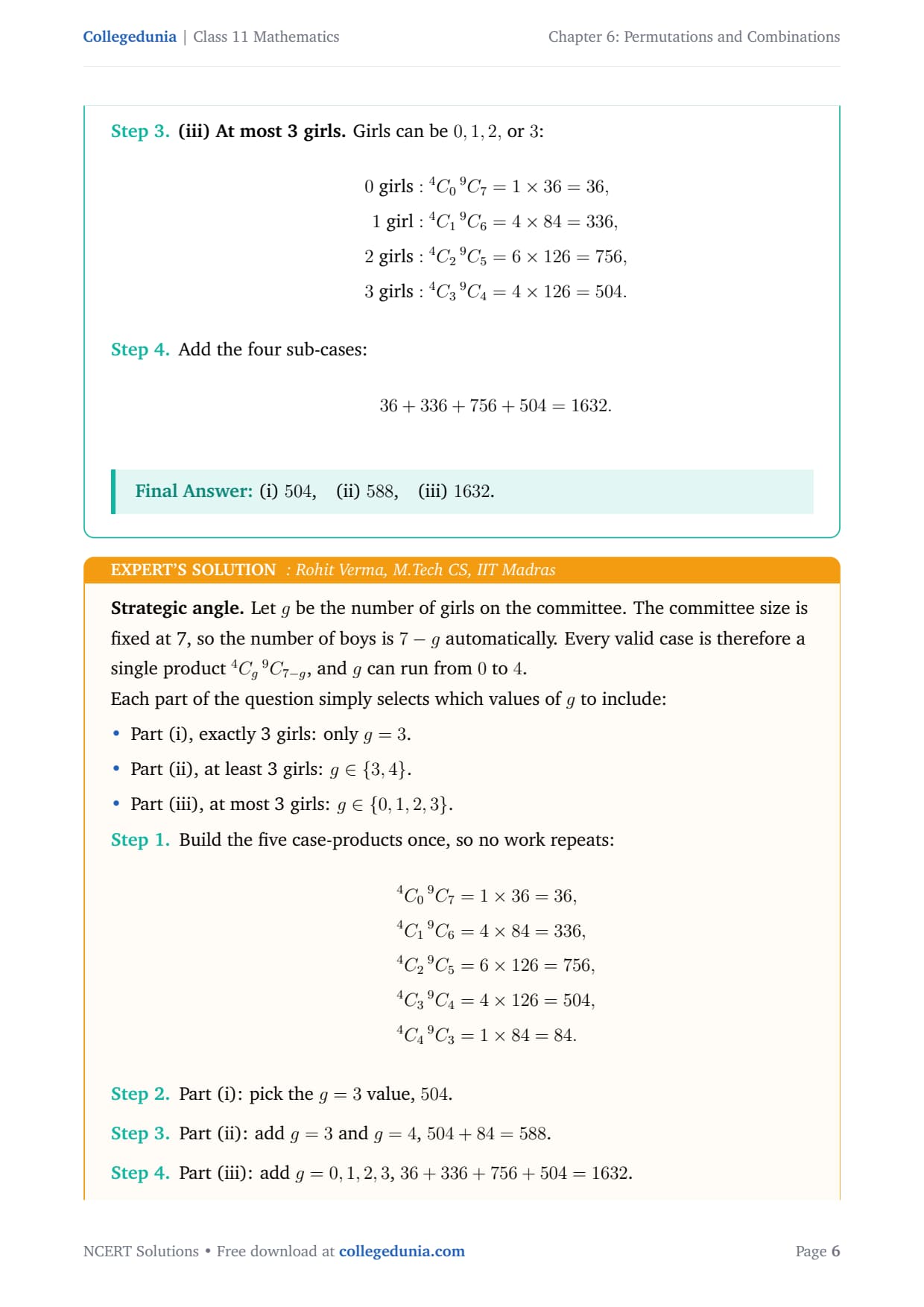
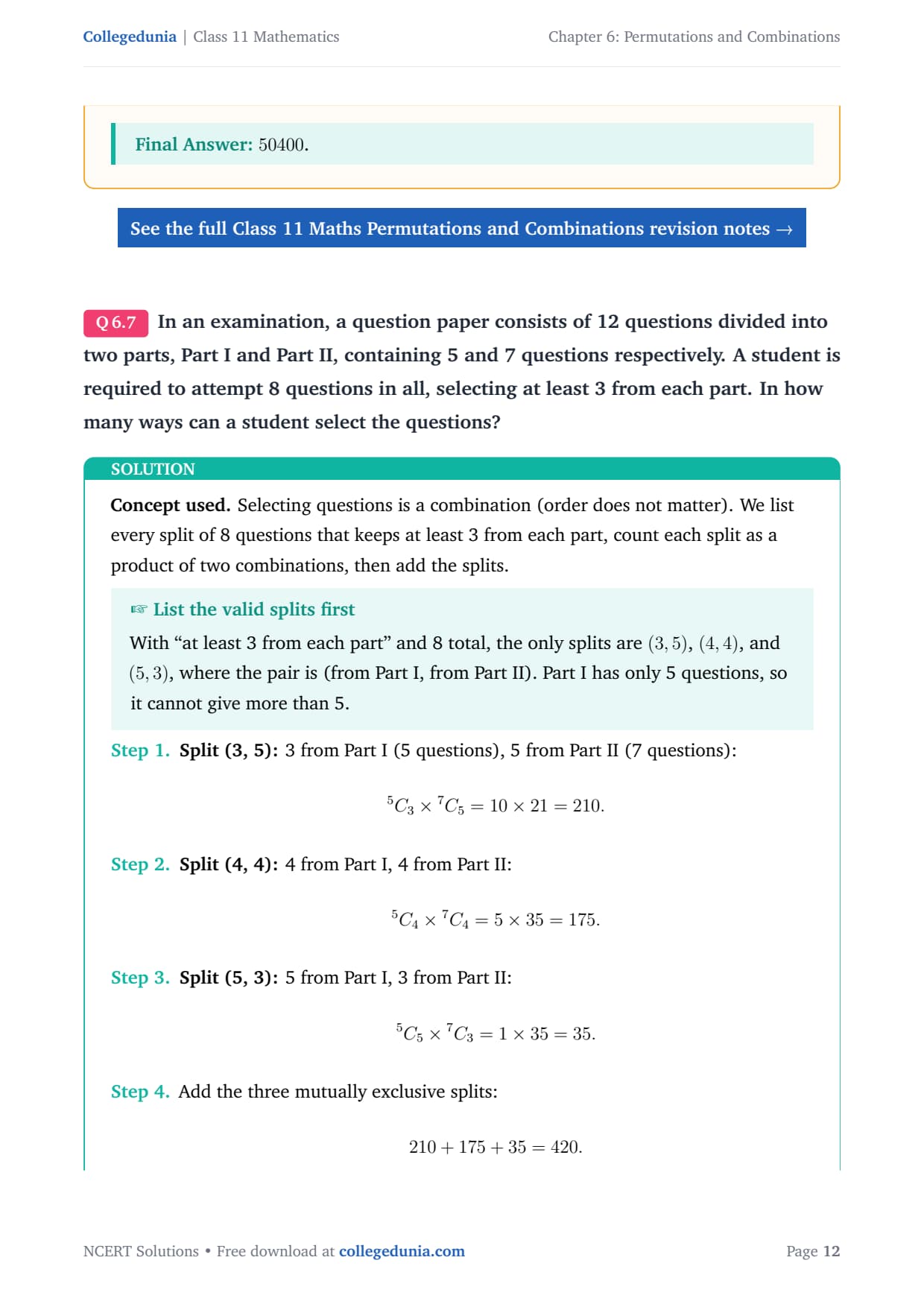
- At least / at most: adding several cases for committee selections.
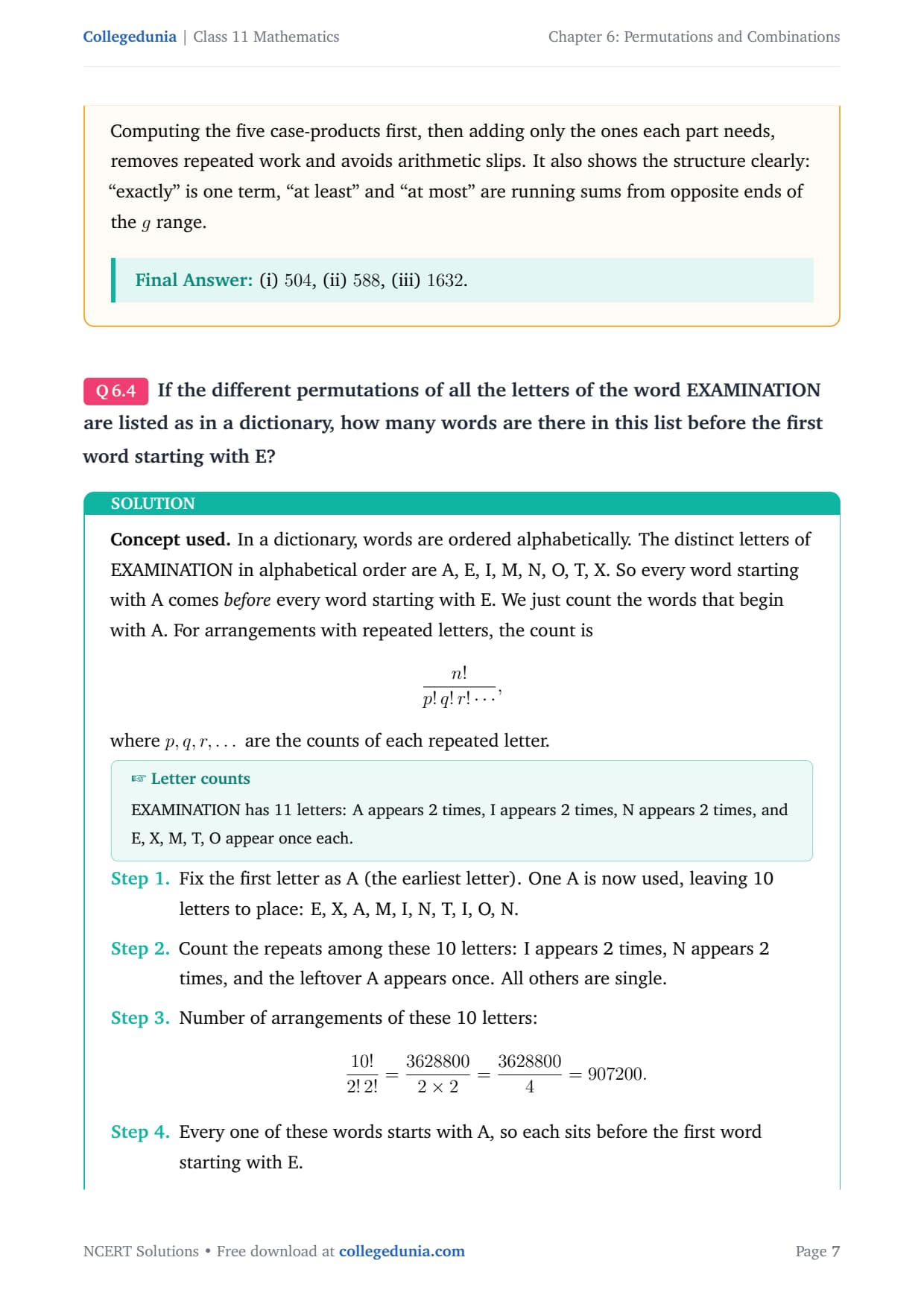
- Dictionary order: counting words that come before a given word.
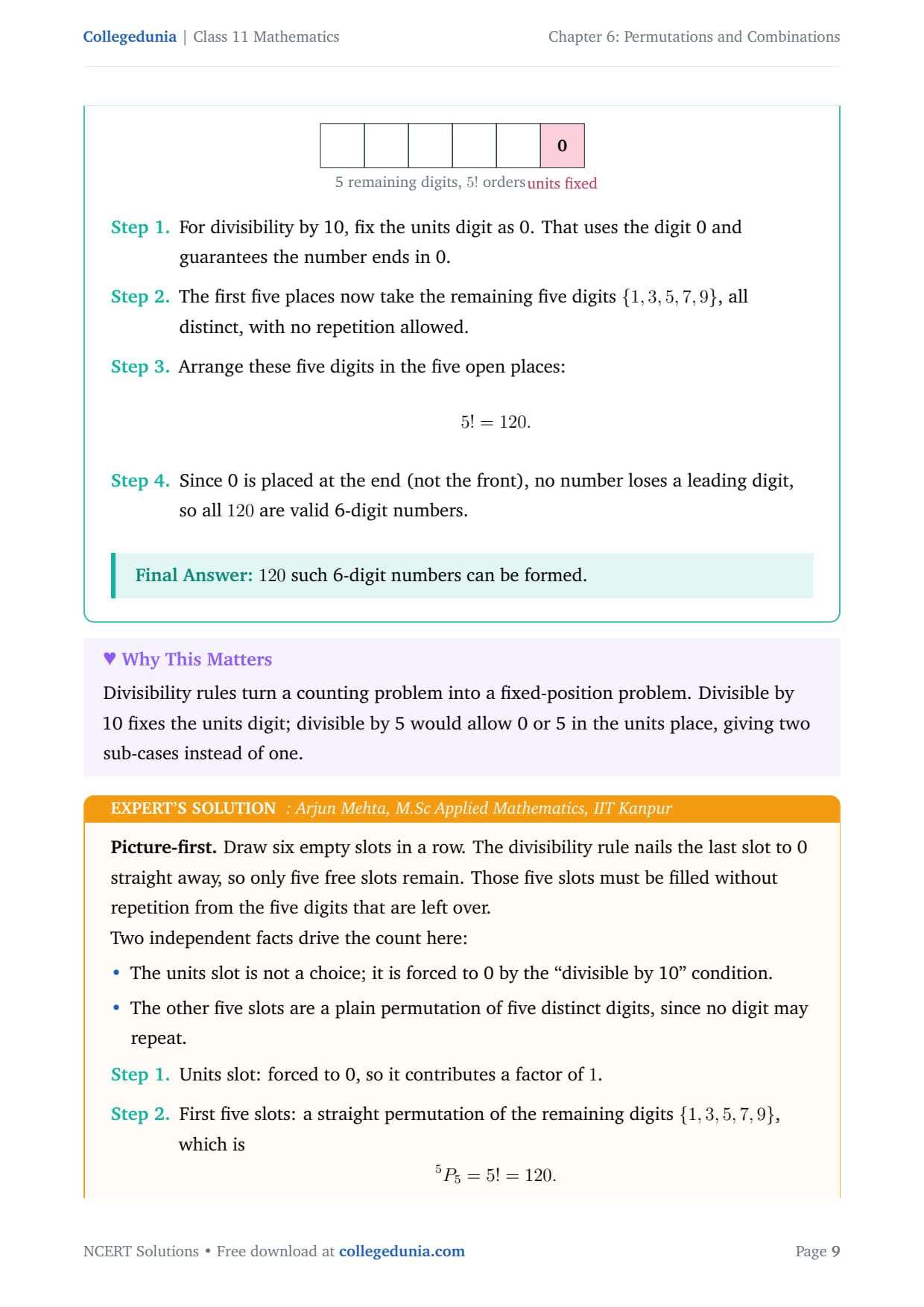
- Divisibility conditions: forming numbers divisible by 10 with no repetition.
- Repeated letters: arranging words like ASSASSINATION with letters kept together.
Important: read each question carefully to decide whether order matters. Many Miscellaneous questions need a combination first and a permutation afterwards.
Question-wise Breakdown of the Miscellaneous Exercise
The NCERT Solutions for Class 11 Maths Chapter 6 Permutations and Combinations Miscellaneous Exercise solve all 11 questions in order. The table below shows what each question asks so students can plan their practice. Full step-by-step answers are inside the PDF above.
| Question | What it asks | Skill tested |
|---|---|---|
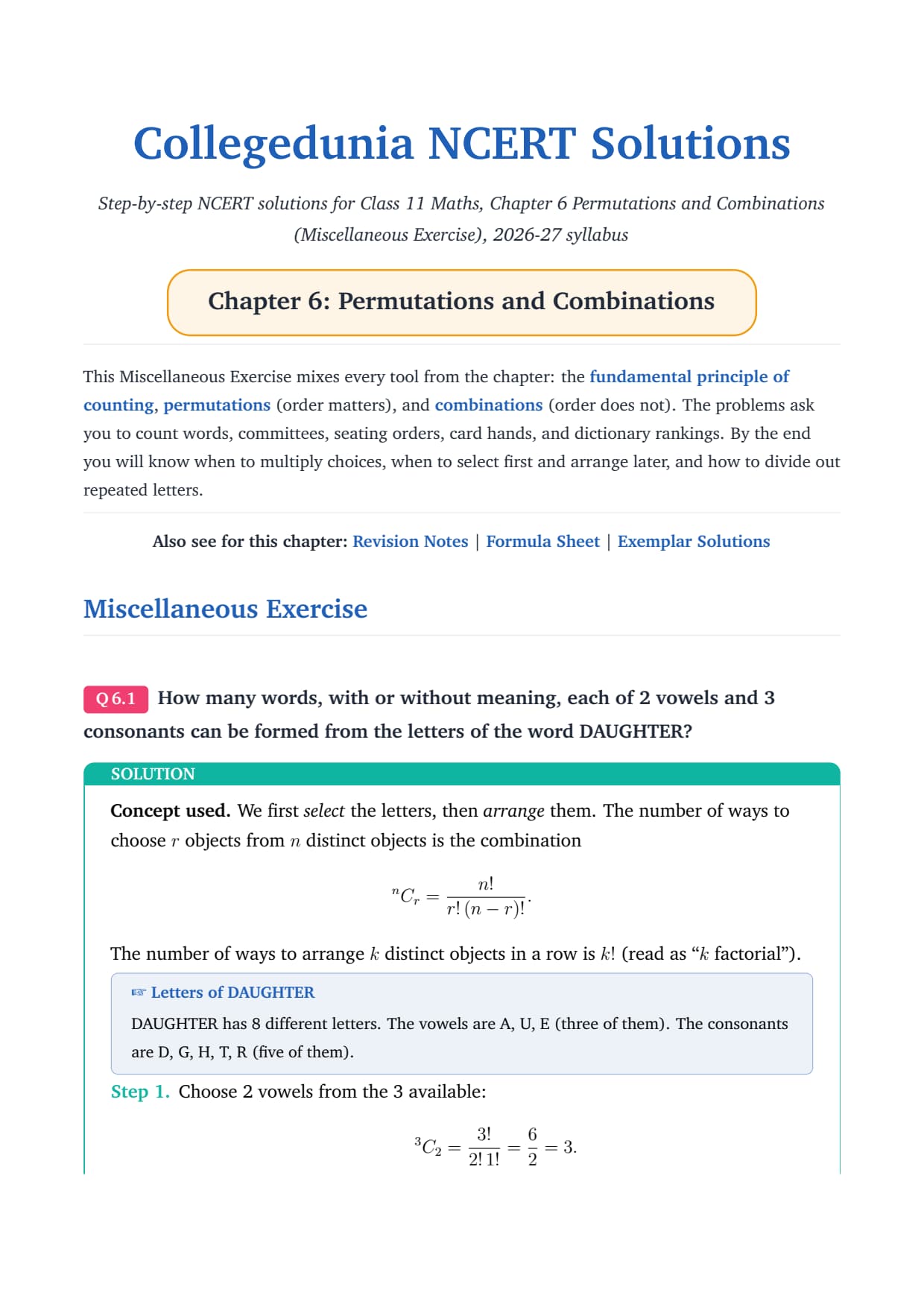
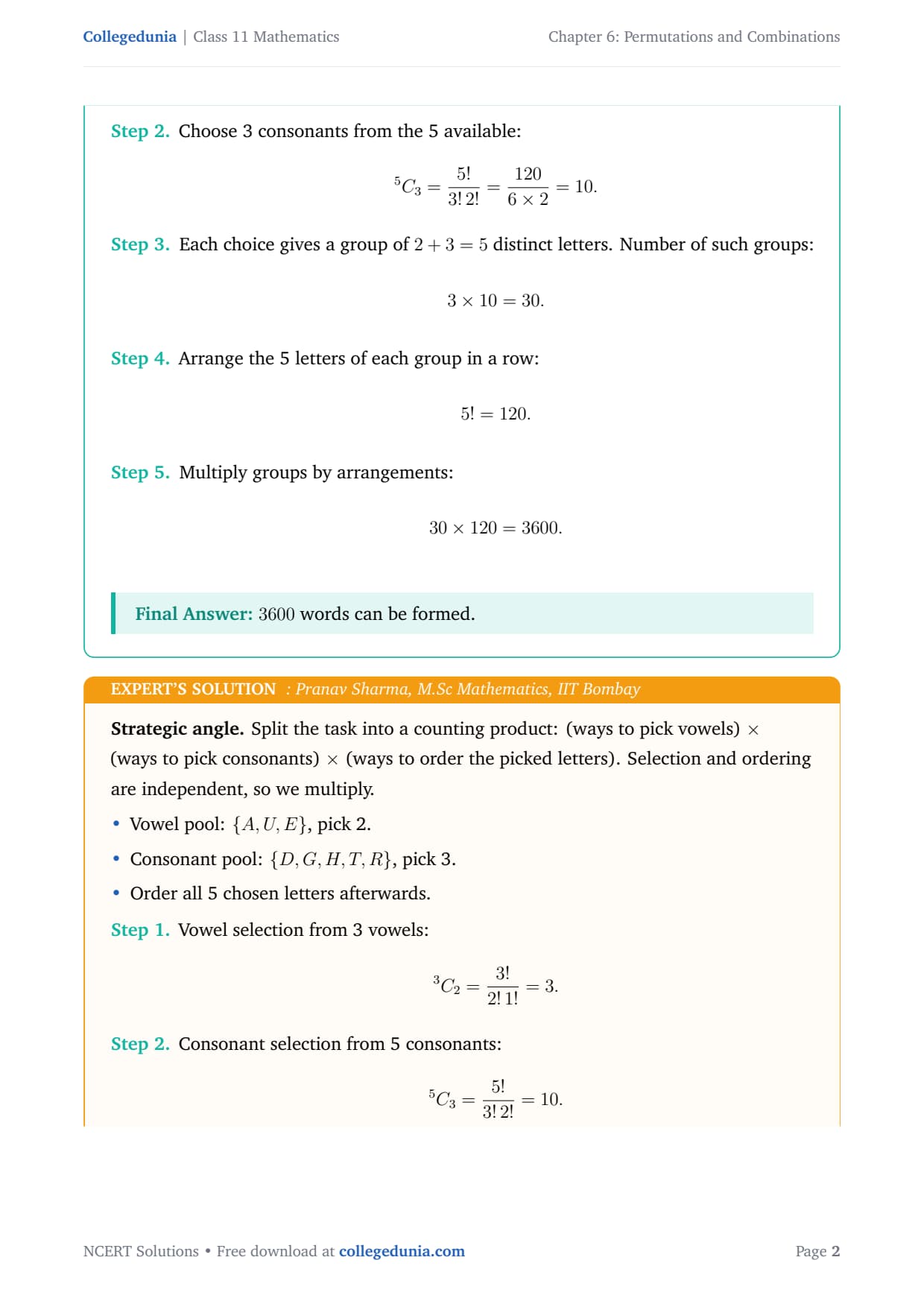
| Q1 | Words of 2 vowels and 3 consonants from DAUGHTER | Select then arrange |
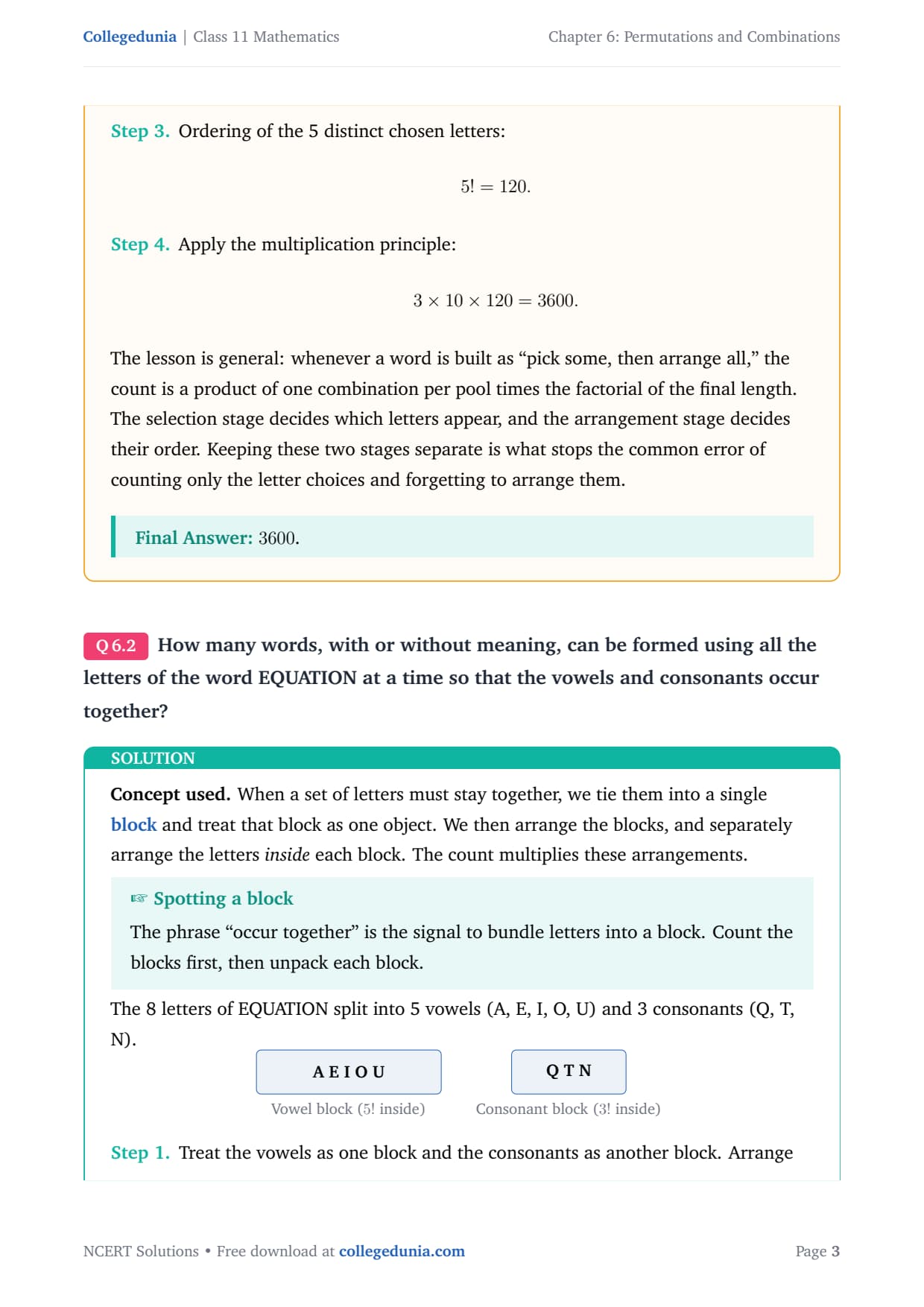
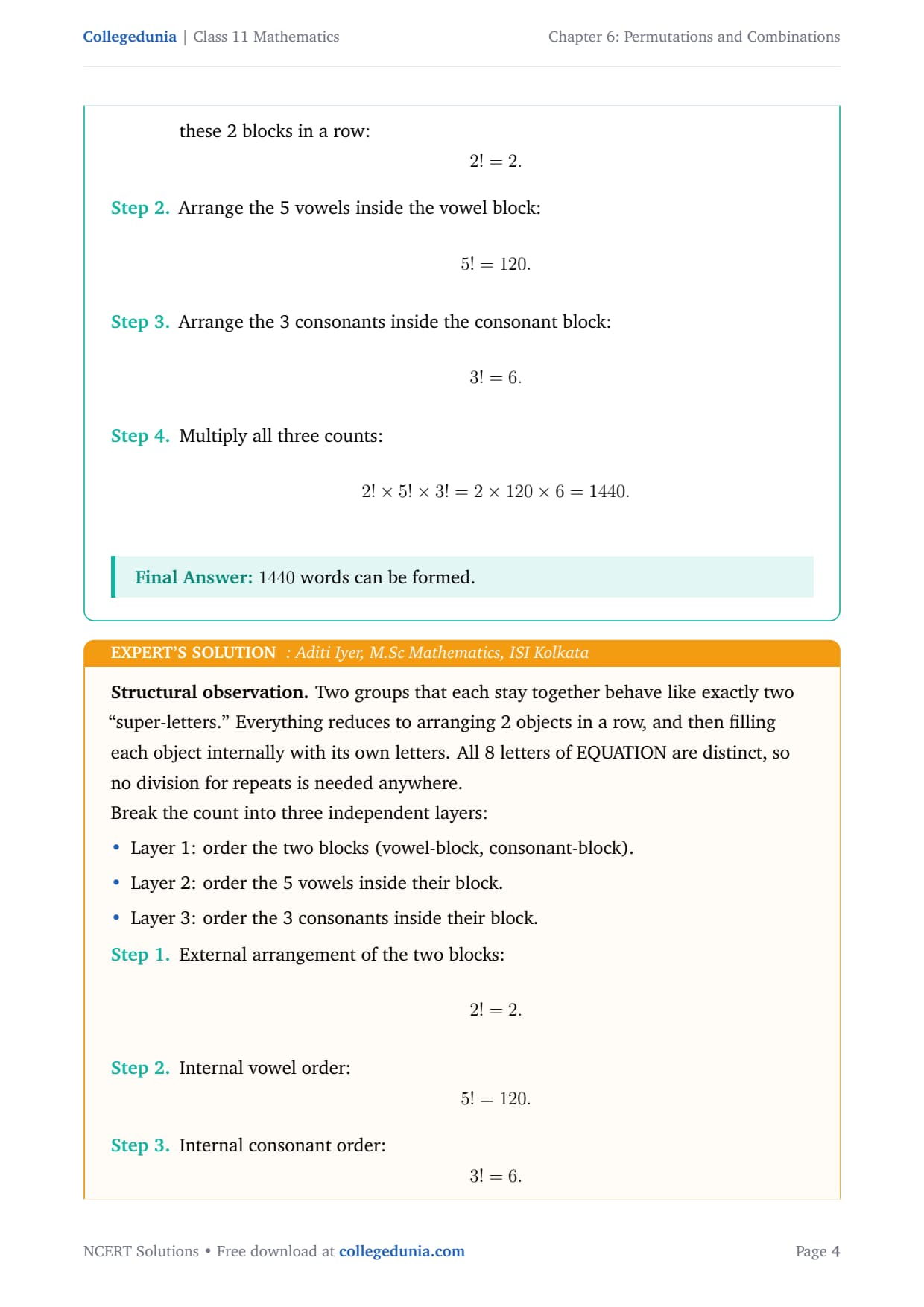
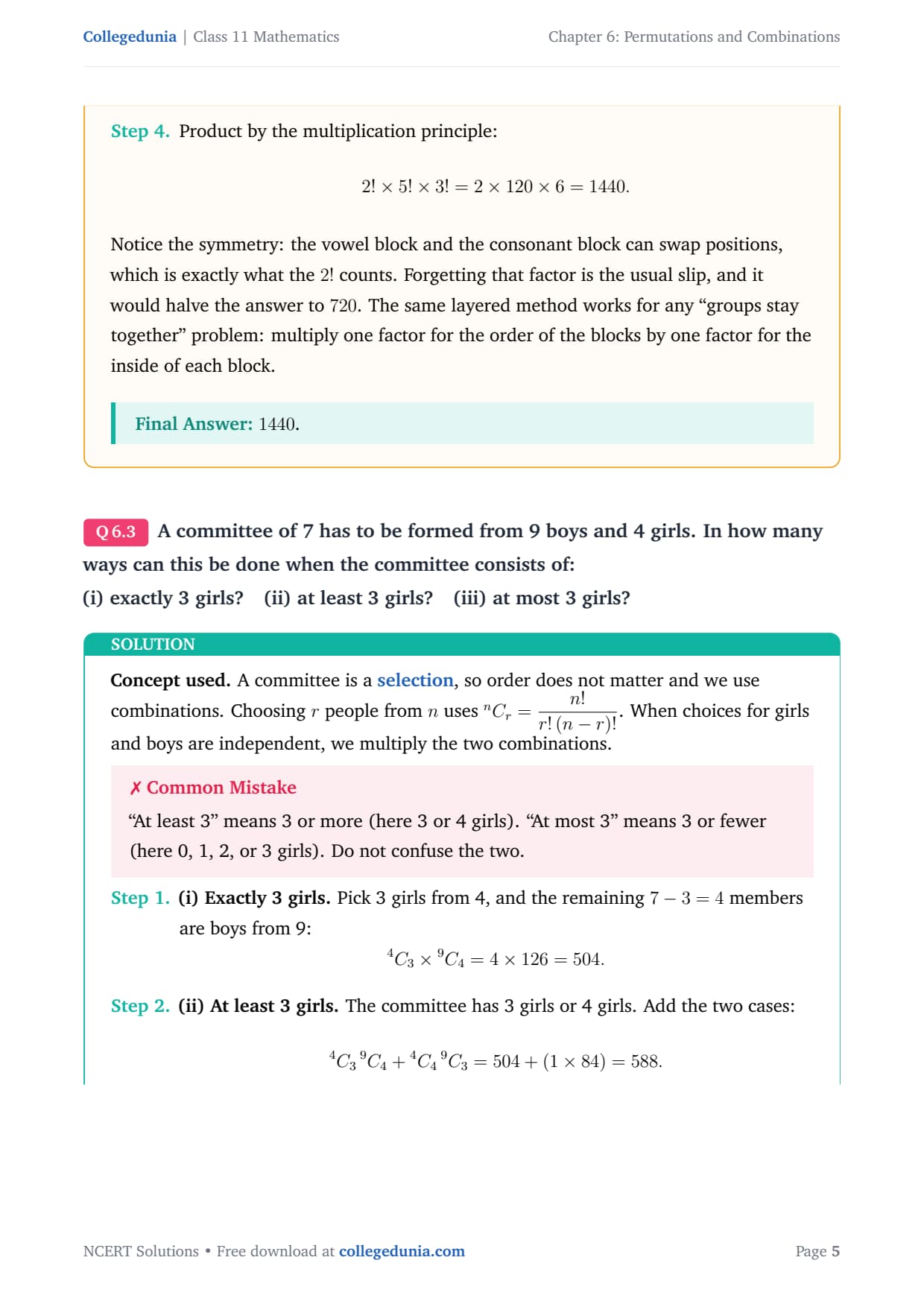
| Q2 | Arrange EQUATION so vowels and consonants stay together | Grouping method |
| Q3 | Committee of 7 from 9 boys and 4 girls under three conditions | At least / at most |
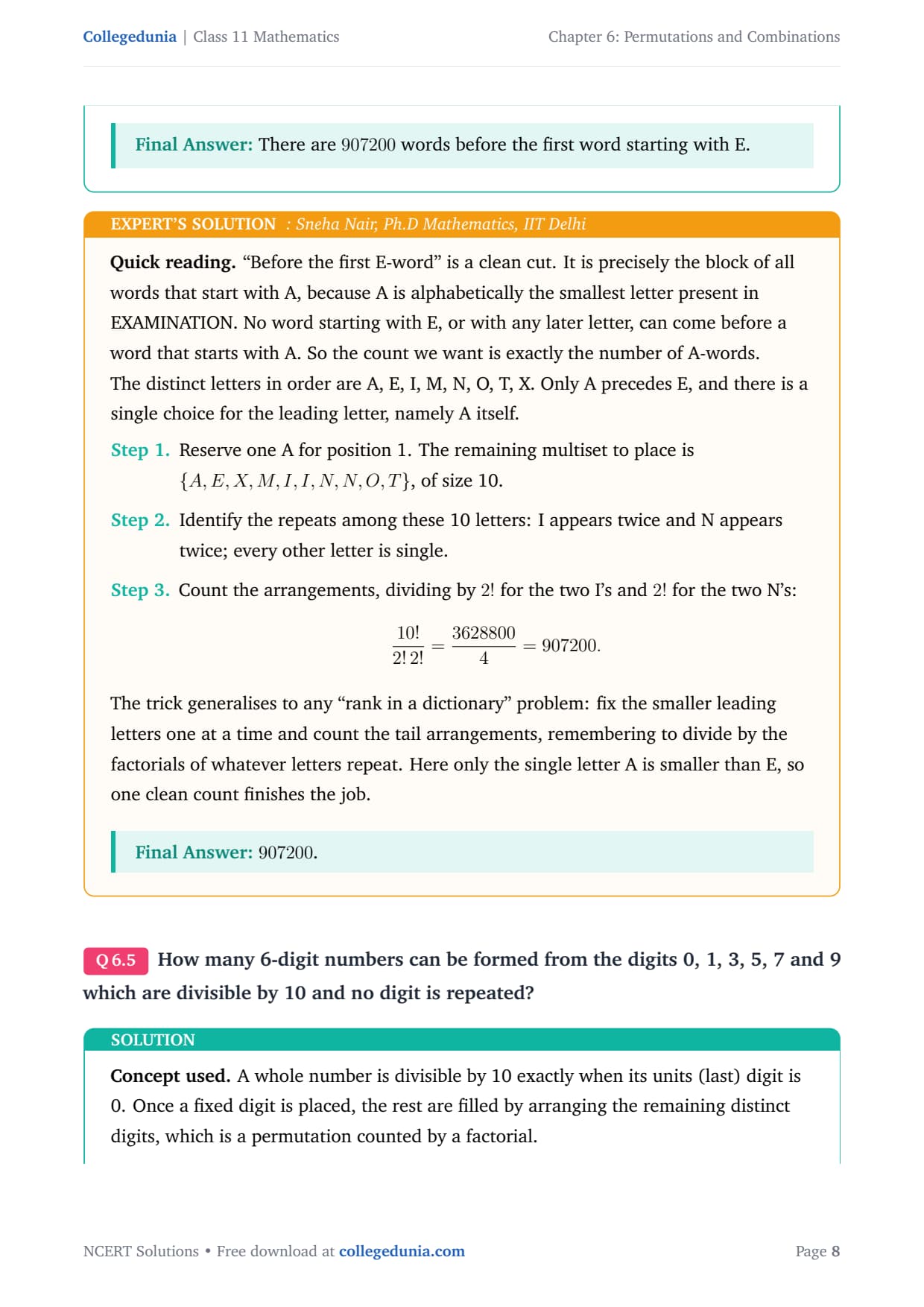
| Q4 | Words of EXAMINATION before the first word starting with E | Dictionary order |
| Q5 | 6-digit numbers from 0, 1, 3, 5, 7, 9 divisible by 10 | Divisibility condition |
| Q6 | Words with 2 vowels and 2 consonants from the alphabet | Select then arrange |
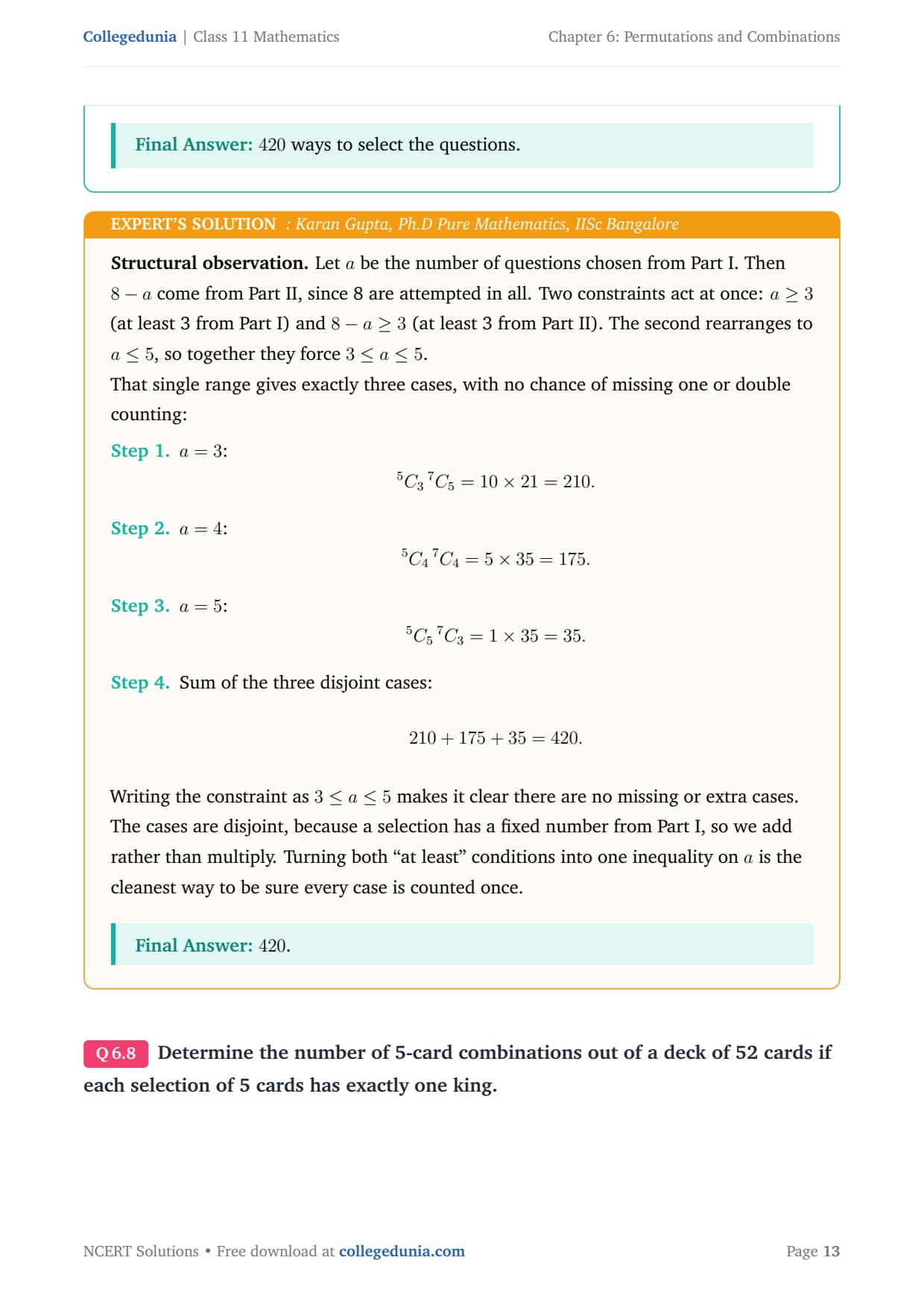
| Q7 | Choose 8 of 12 questions, at least 3 from each part | Case-wise selection |
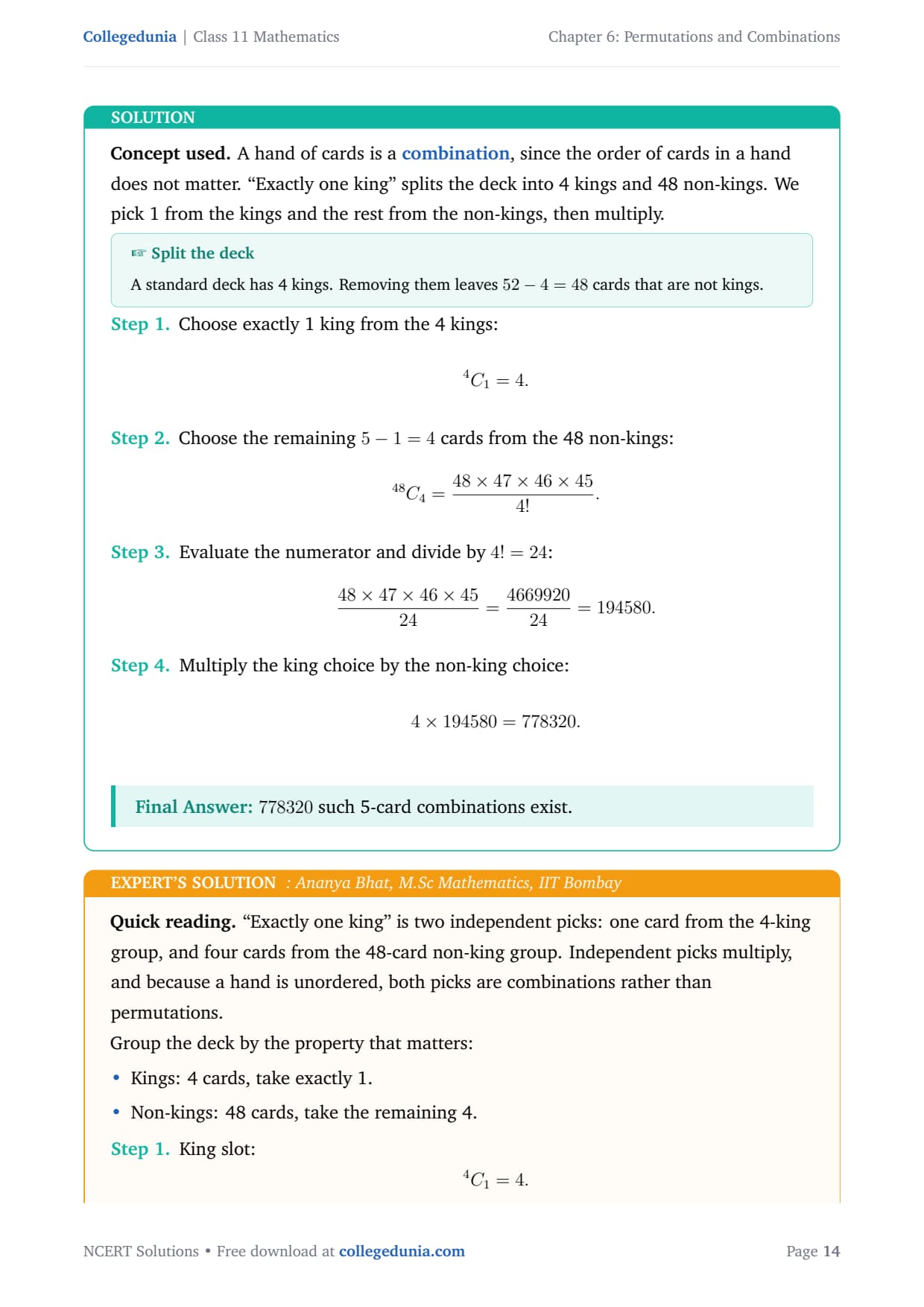
| Q8 | 5-card hands with exactly one king from 52 cards | Conditional selection |
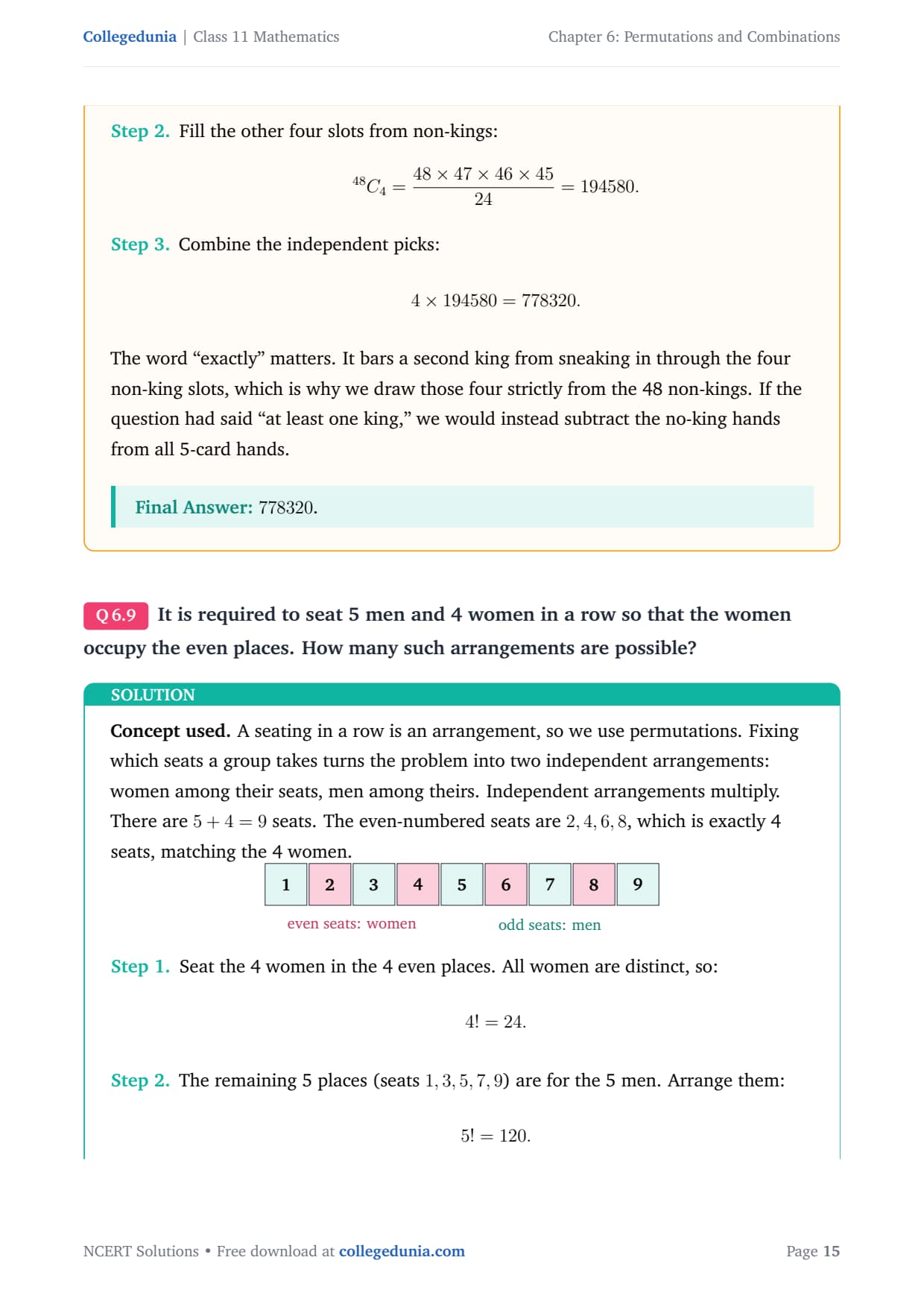
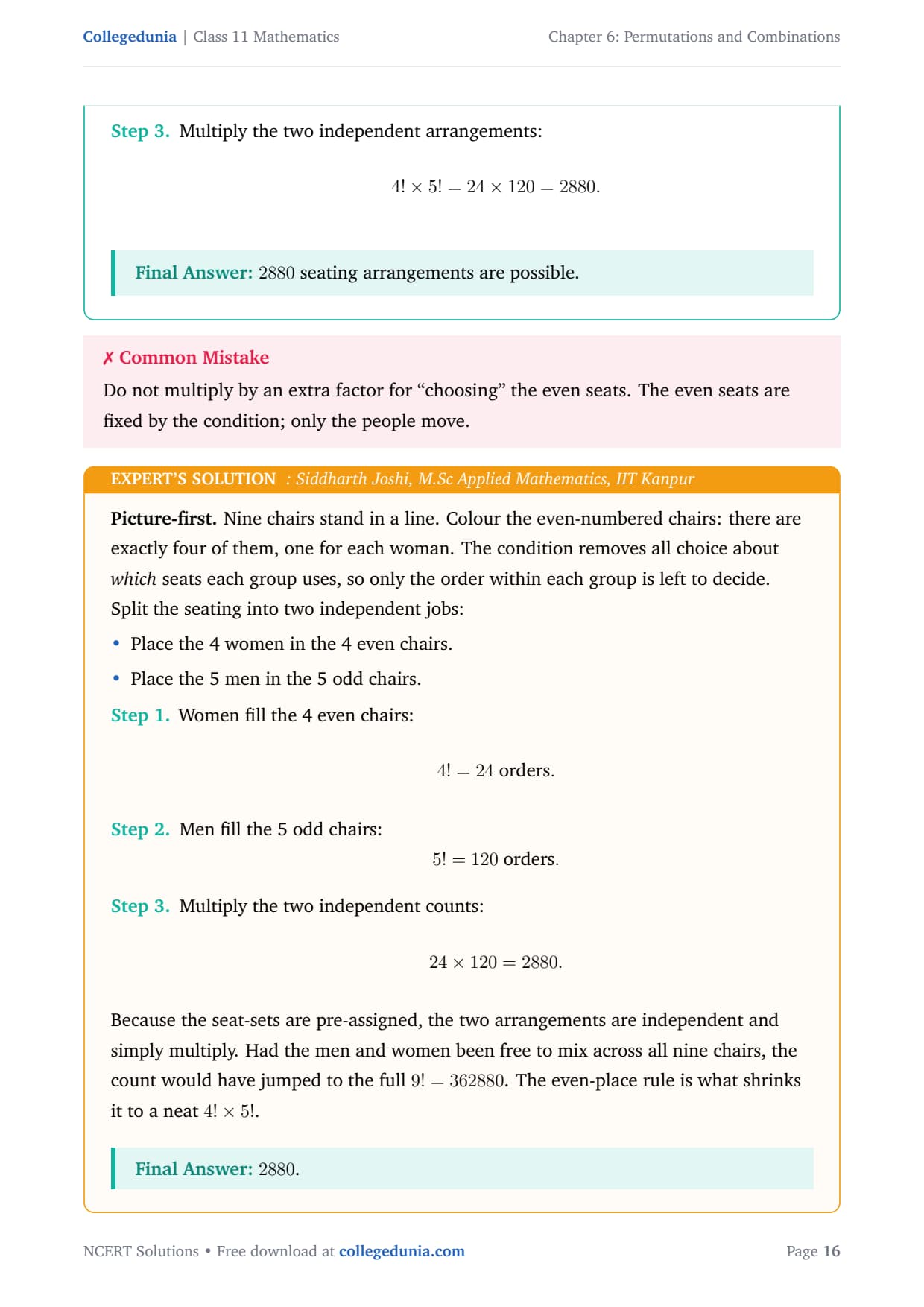
| Q9 | Seat 5 men and 4 women with women in even places | Restricted arrangement |
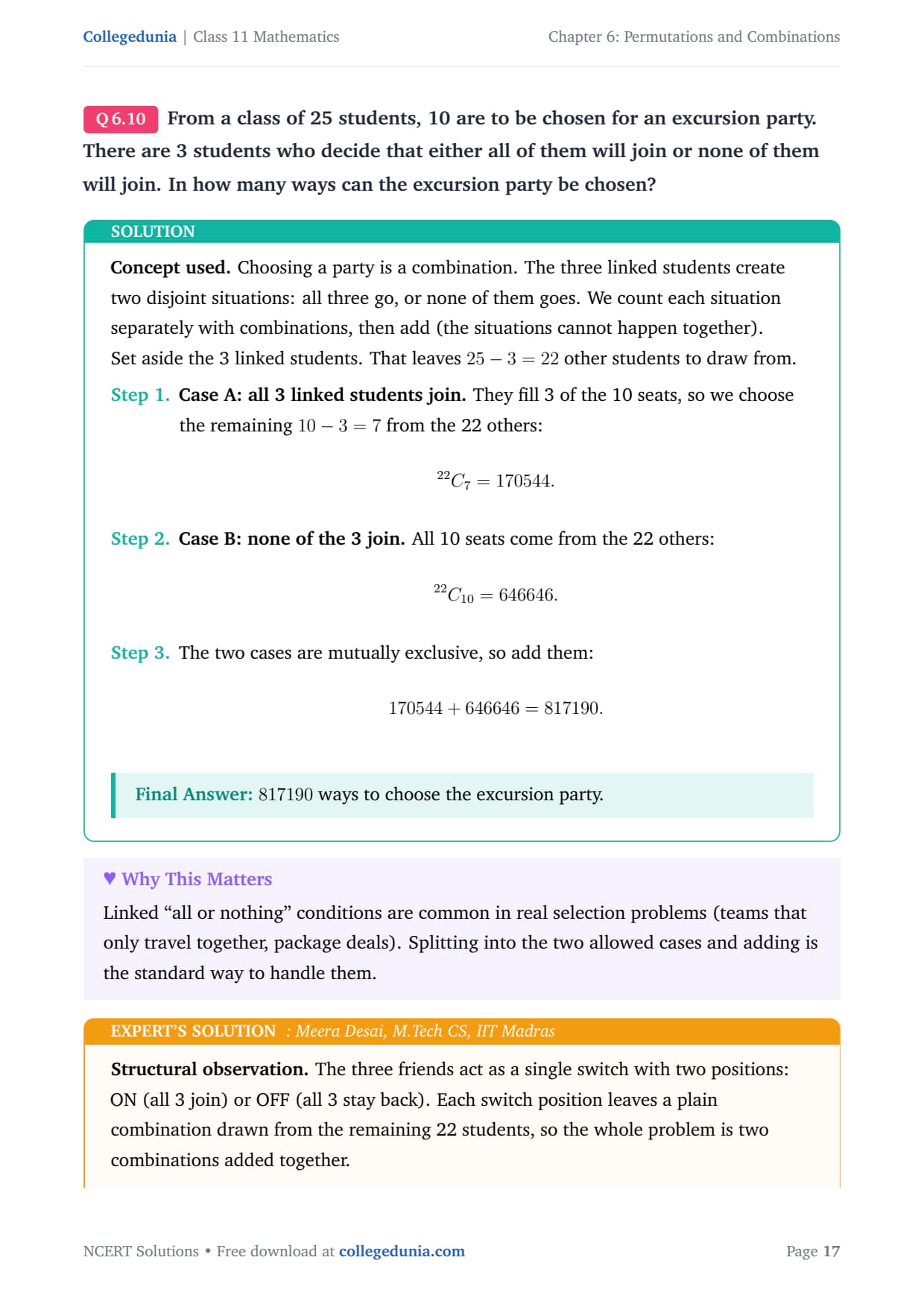
| Q10 | Choose 10 of 25 students with a linked group of 3 | All-or-none case split |
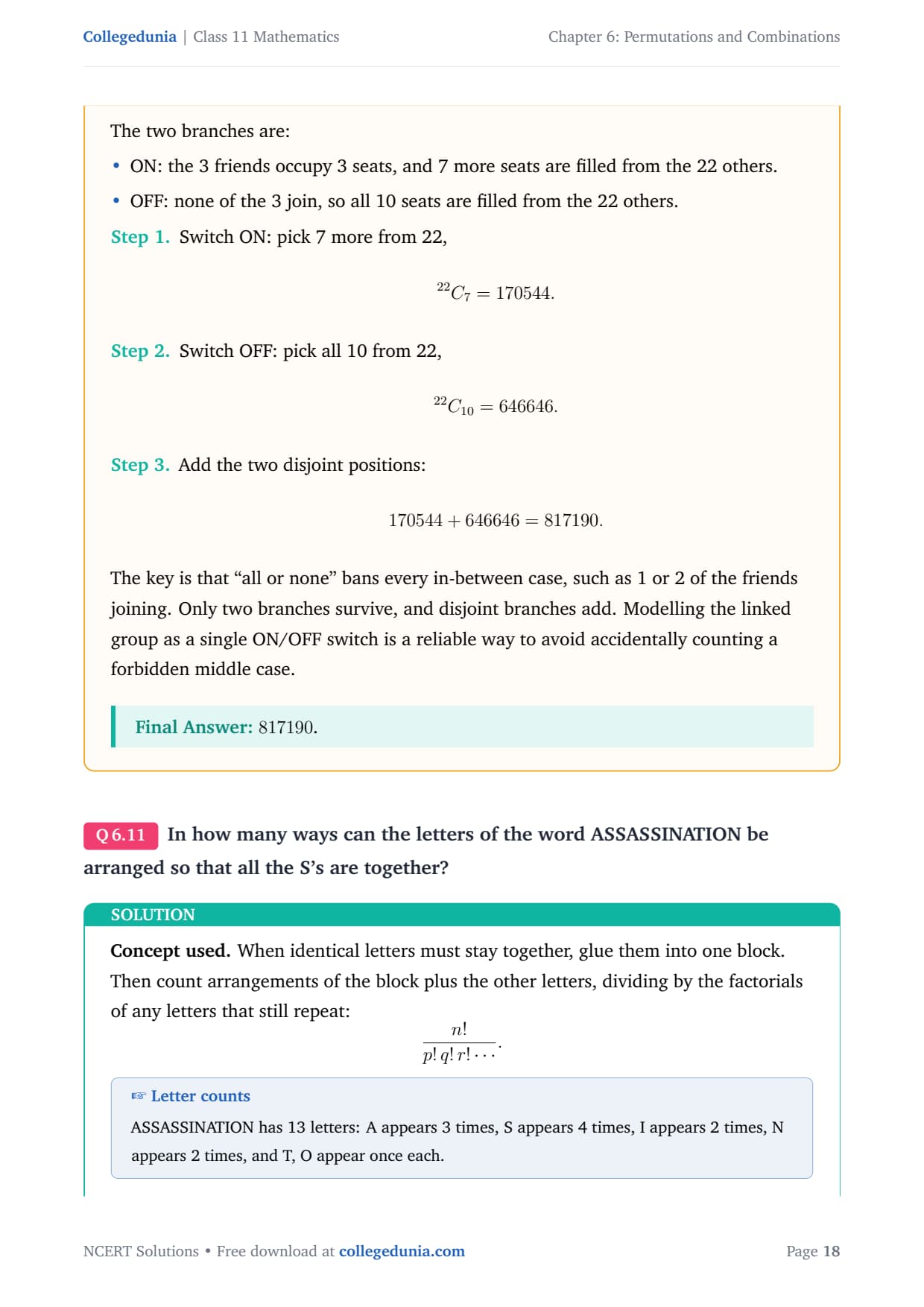
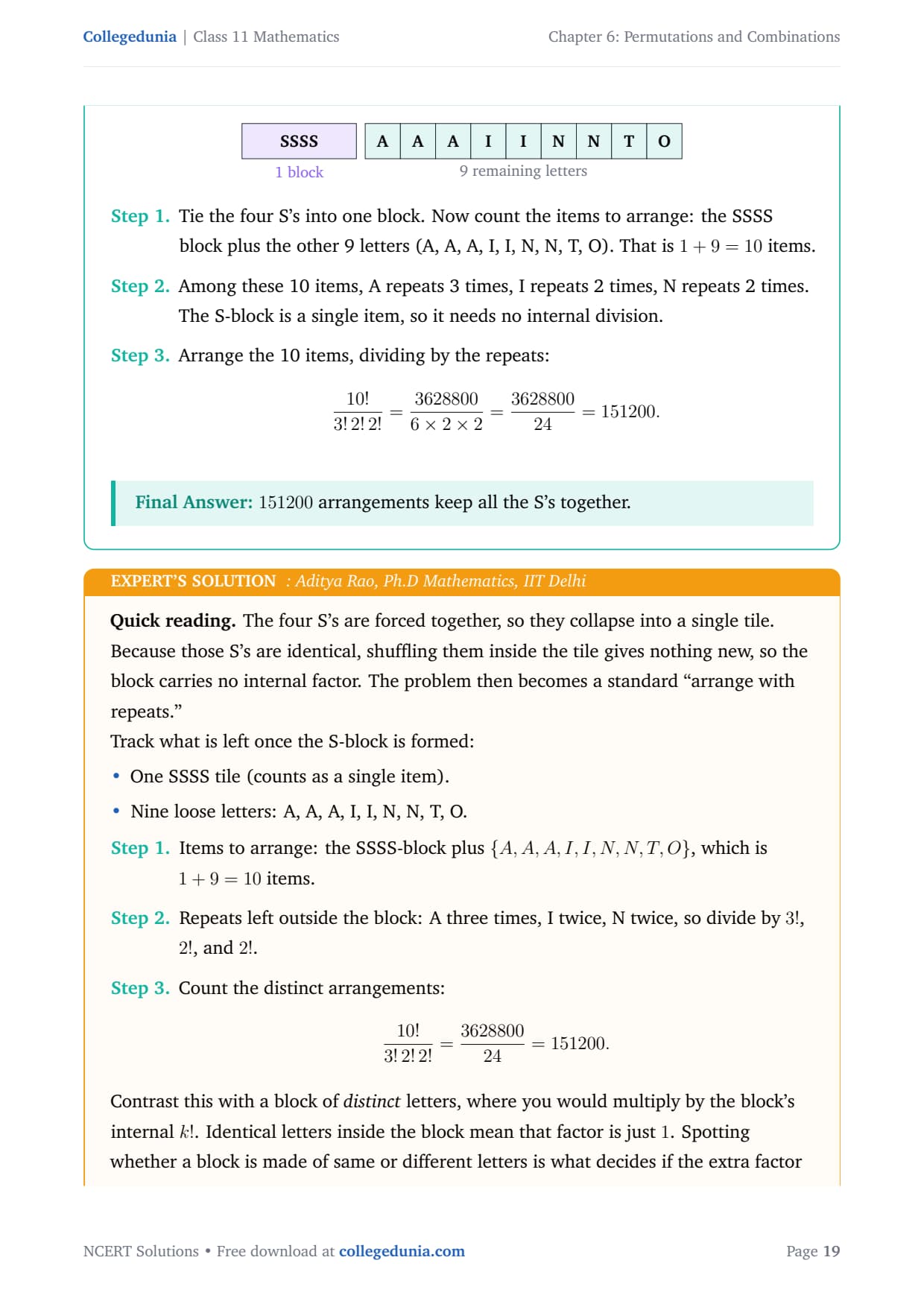
| Q11 | Arrange ASSASSINATION with all S's together | Repeated letters |
Because the questions blend both topics, this exercise is the best final check before the chapter test.
Key Formulas and Definitions for the Miscellaneous Exercise
The Miscellaneous Exercise draws on every formula in the chapter. Students should keep the full list ready.
| Formula | Meaning |
|---|---|
| nPr = n! / (n − r)! | Arrangements of r objects from n, order counts |
| nCr = n! / (r!(n − r)!) | Selections of r objects from n, order not counted |
| n! / (p! q! ...) | Arrangements of n objects with repeated groups |
| Select and arrange | nCr × r! when a chosen group is then ordered |
| Grouping method | Treat a fixed block as one unit, then arrange inside |
Tip: for "at least" conditions, list the allowed cases, count each with combinations, and add. This is the method for Question 3.
Common Mistakes in the Miscellaneous Exercise
Students lose marks in the Miscellaneous Exercise by picking the wrong tool or missing a case. The list below covers the errors that show up most often in class tests on the NCERT Solutions for Class 11 Maths Chapter 6 Permutations and Combinations Miscellaneous Exercise.
- Selecting a group with combinations but forgetting to arrange it afterwards when order matters.
- Missing a case in "at least" or "at most" committee problems.
- Allowing 0 in the leading place of a number, or forgetting the units digit must be 0 for divisibility by 10.
- Not dividing by the factorial of repeated letters in words like EXAMINATION and ASSASSINATION.
Practice Questions for the Miscellaneous Exercise
After reading the solutions, students should test themselves on the same question types. The card below opens a set of solved practice questions with step-by-step answers for the Miscellaneous Exercise.
Practice Card: Solved Practice Questions for Class 11 Maths Permutations and Combinations Miscellaneous Exercise — attempt each question, then check the worked solution.
Other Exercises of Chapter 6 Permutations and Combinations
Chapter 6 Permutations and Combinations has four exercises plus this Miscellaneous Exercise. Use the table to revise any earlier exercise.
| Exercise | NCERT Solutions link |
|---|---|
| Exercise 6.1 | Class 11 Maths Permutations and Combinations Exercise 6.1 Solutions |
| Exercise 6.2 | Class 11 Maths Permutations and Combinations Exercise 6.2 Solutions |
| Exercise 6.3 | Class 11 Maths Permutations and Combinations Exercise 6.3 Solutions |
| Exercise 6.4 | Class 11 Maths Permutations and Combinations Exercise 6.4 Solutions |
More Class 11 Maths Permutations and Combinations Resources
Pair the solutions with the notes and the NCERT book PDF for full chapter revision. All three resources for Chapter 6 Permutations and Combinations are linked below.
| Resource | Link |
|---|---|
| Revision Notes | Class 11 Maths Permutations and Combinations Notes |
| Handwritten Notes | Class 11 Maths Permutations and Combinations Handwritten Notes |
| NCERT Book PDF | Class 11 Maths Permutations and Combinations NCERT Book PDF |
NCERT Solutions for Other Class 11 Maths Chapters
Students can move to the first exercise of any other Class 11 Maths chapter using the cross-sell table below.
| Chapter | NCERT Solutions |
|---|---|
| Chapter 1: Sets | Sets Solutions |
| Chapter 2: Relations and Functions | Relations and Functions Solutions |
| Chapter 3: Trigonometric Functions | Trigonometric Functions Solutions |
| Chapter 4: Complex Numbers and Quadratic Equations | Complex Numbers Solutions |
| Chapter 5: Linear Inequalities | Linear Inequalities Solutions |
| Chapter 6: Permutations and Combinations | You are here |
| Chapter 7: Binomial Theorem | Binomial Theorem Solutions |
| Chapter 8: Sequences and Series | Sequences and Series Solutions |
| Chapter 9: Straight Lines | Straight Lines Solutions |
| Chapter 10: Conic Sections | Conic Sections Solutions |
| Chapter 11: Introduction to Three Dimensional Geometry | Three Dimensional Geometry Solutions |
| Chapter 12: Limits and Derivatives | Limits and Derivatives Solutions |
| Chapter 13: Statistics | Statistics Solutions |
| Chapter 14: Probability | Probability Solutions |
Student Feedback
In a Collegedunia survey of 10,410 Class 11 students conducted before the 2026 exams, 72% of students said the dictionary-order question on EXAMINATION was the hardest in the Miscellaneous Exercise, while the at-least-and-at-most committee question improved most after practice.
FAQs on NCERT Solutions for Class 11 Maths Chapter 6 Permutations and Combinations Miscellaneous Exercise
Permutations and Combinations NCERT Solutions - Frequently Asked Questions
Ques. How many questions are there in the Class 11 Maths Chapter 6 Permutations and Combinations Miscellaneous Exercise?
Ans. The Miscellaneous Exercise has 11 questions. They mix permutations and combinations, including select-then-arrange problems, committee selections with at least and at most conditions, dictionary-order counting and repeated-letter arrangements.
Ques. How do you solve a select-then-arrange question in the Miscellaneous Exercise?
Ans. First choose the required objects using combinations, then arrange the chosen group using permutations, and multiply the two results. In Question 1, the 2 vowels and 3 consonants of DAUGHTER are selected with nCr and then the 5 chosen letters are arranged in 5! ways.
Ques. What does "at least 3 girls" mean in the committee question?
Ans. "At least 3 girls" means the committee can have 3 or 4 girls, so you count each case with combinations and add them. "At most 3 girls" means 0, 1, 2 or 3 girls. Question 3 asks for exactly 3, at least 3 and at most 3, so each part needs a different set of cases.
Ques. How do you arrange the letters of ASSASSINATION with all S's together?
Ans. Join the four S's into a single block, so there are now 10 units to arrange. Divide by the factorials of the other repeated letters (A, I and N each repeat). Question 11 uses this grouping method along with the repeated-letter rule.
Ques. Are the NCERT Solutions for Class 11 Maths Chapter 6 Permutations and Combinations Miscellaneous Exercise free to download?
Ans. Yes. The NCERT Solutions for Class 11 Maths Chapter 6 Permutations and Combinations Miscellaneous Exercise are free to download as a PDF from this page. Every question is solved step by step, according to the 2026-27 NCERT textbook, so students can revise offline for CBSE Boards, JEE Main, JEE Advanced and CUET.



Comments