




The NCERT Solutions for Class 11 Maths Chapter 8 Sequences and Series Exercise 8.1 solve every question of the first exercise, according to the latest 2026-27 CBSE syllabus. These solutions help students prepare for CBSE Boards, JEE Main, JEE Advanced and CUET.
Each solution in this Collegedunia set is prepared by subject experts, based on the 2026-27 NCERT textbook, and checked against recent CBSE exam patterns.
Exercise 8.1 is where students learn to build a sequence from its general term and to write the matching series. The exercise has 14 questions built around these skills:
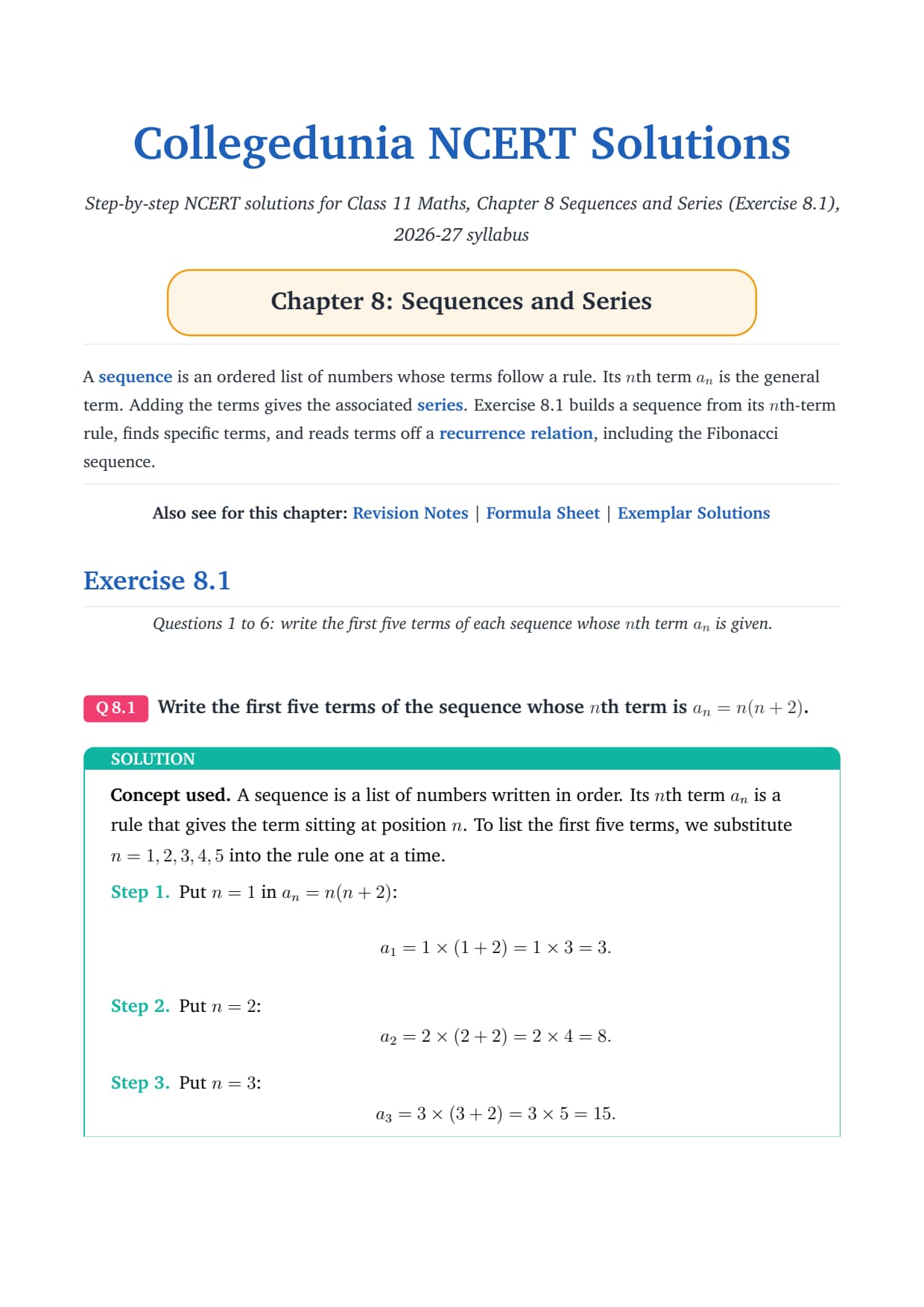
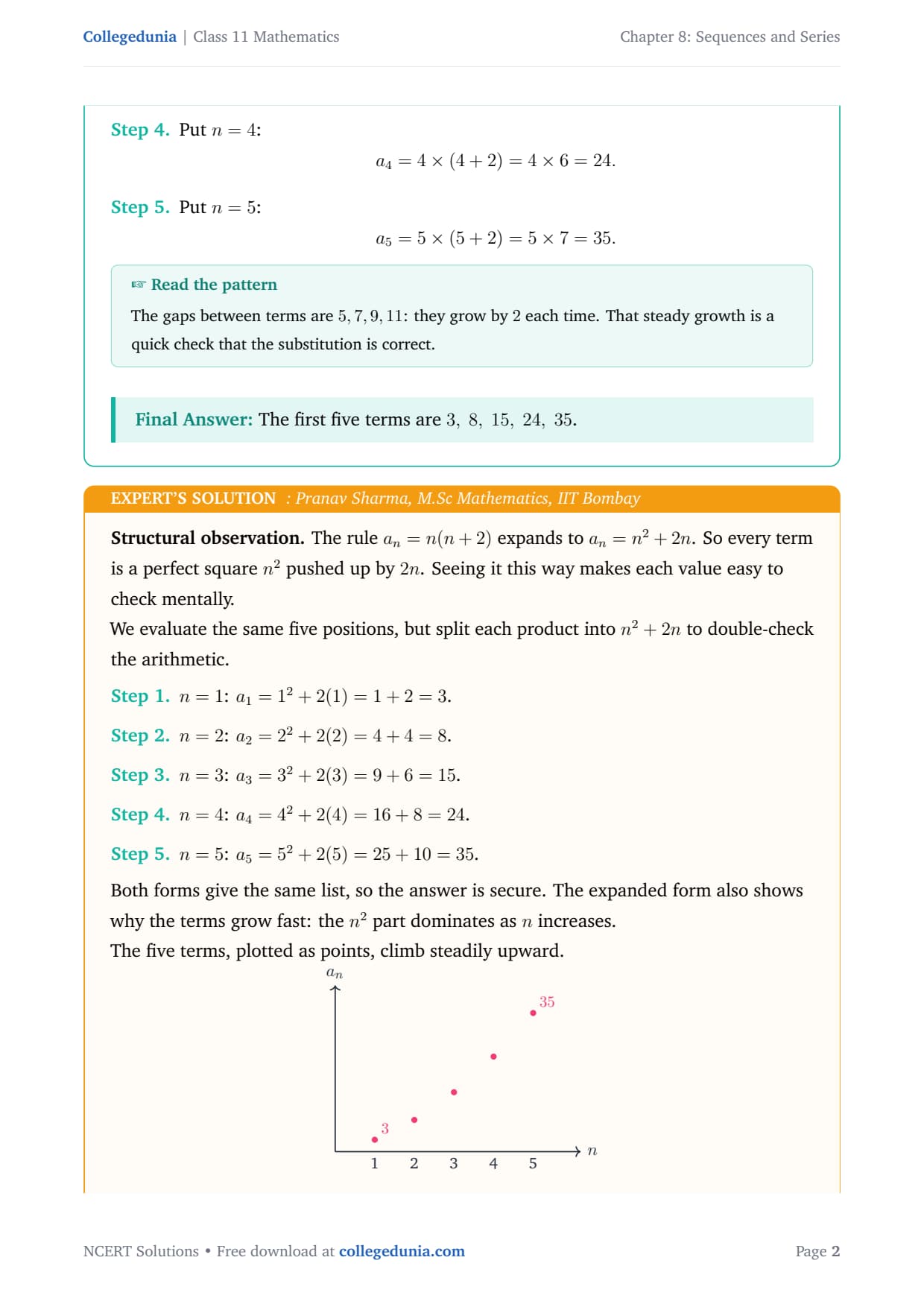
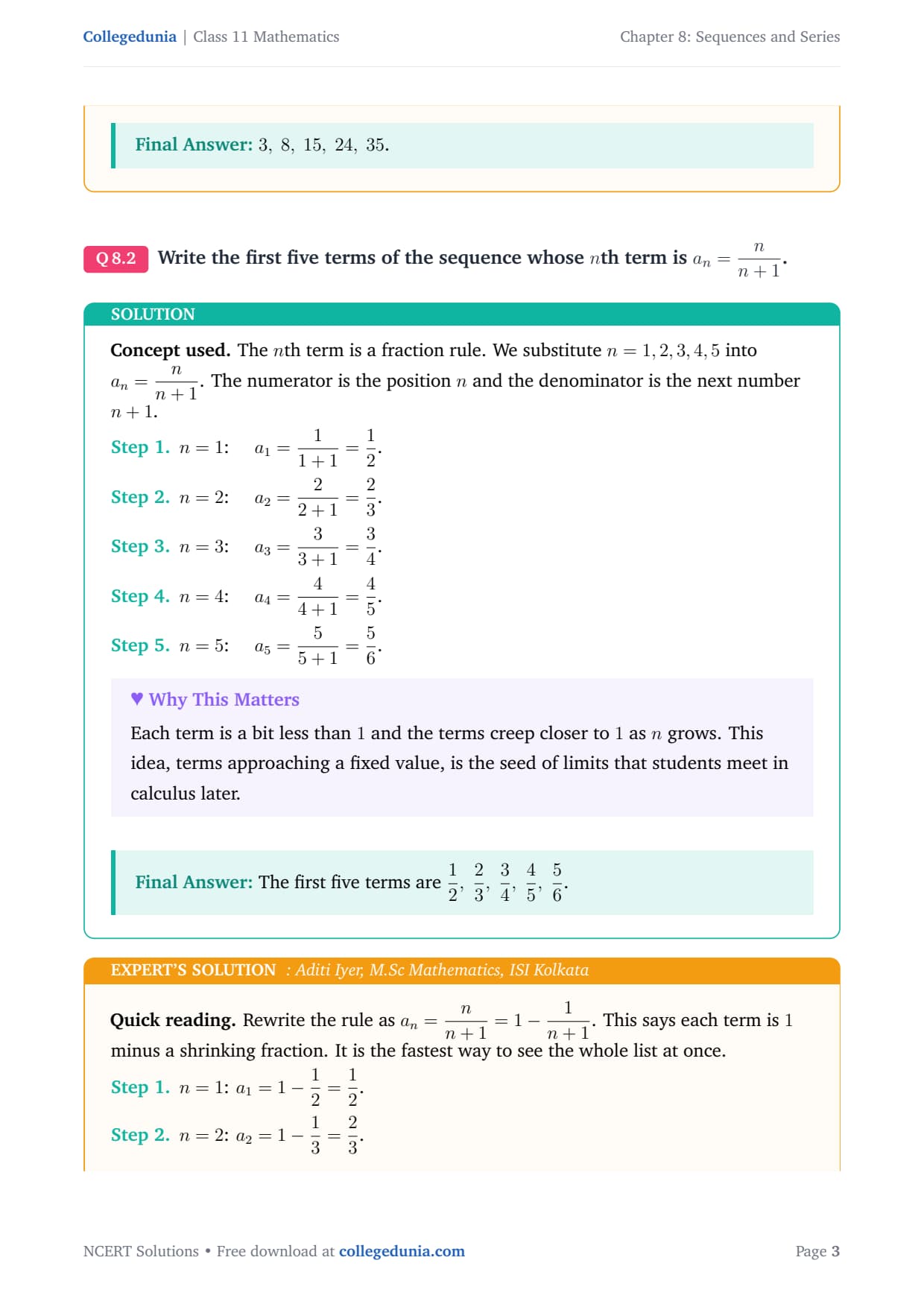
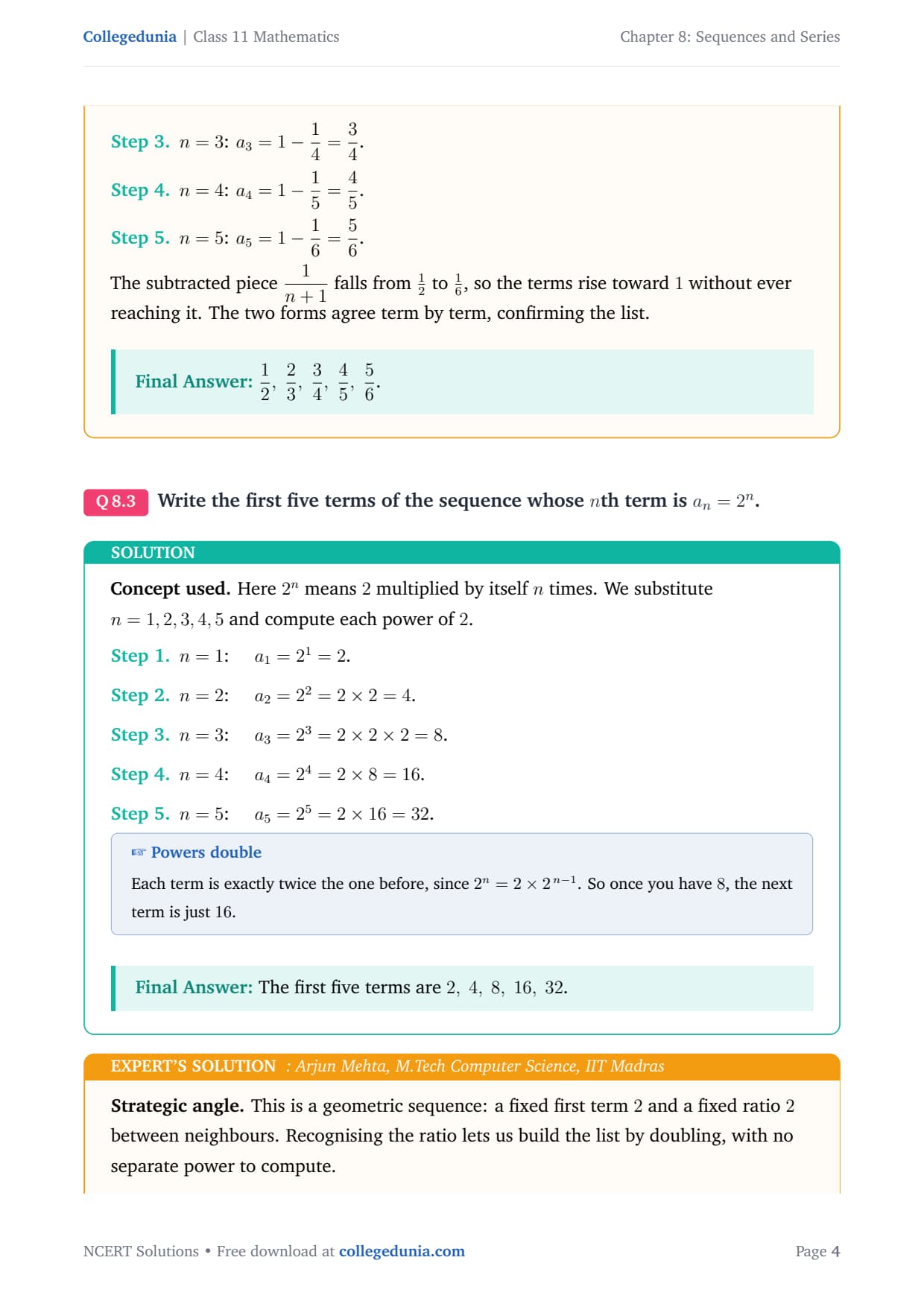
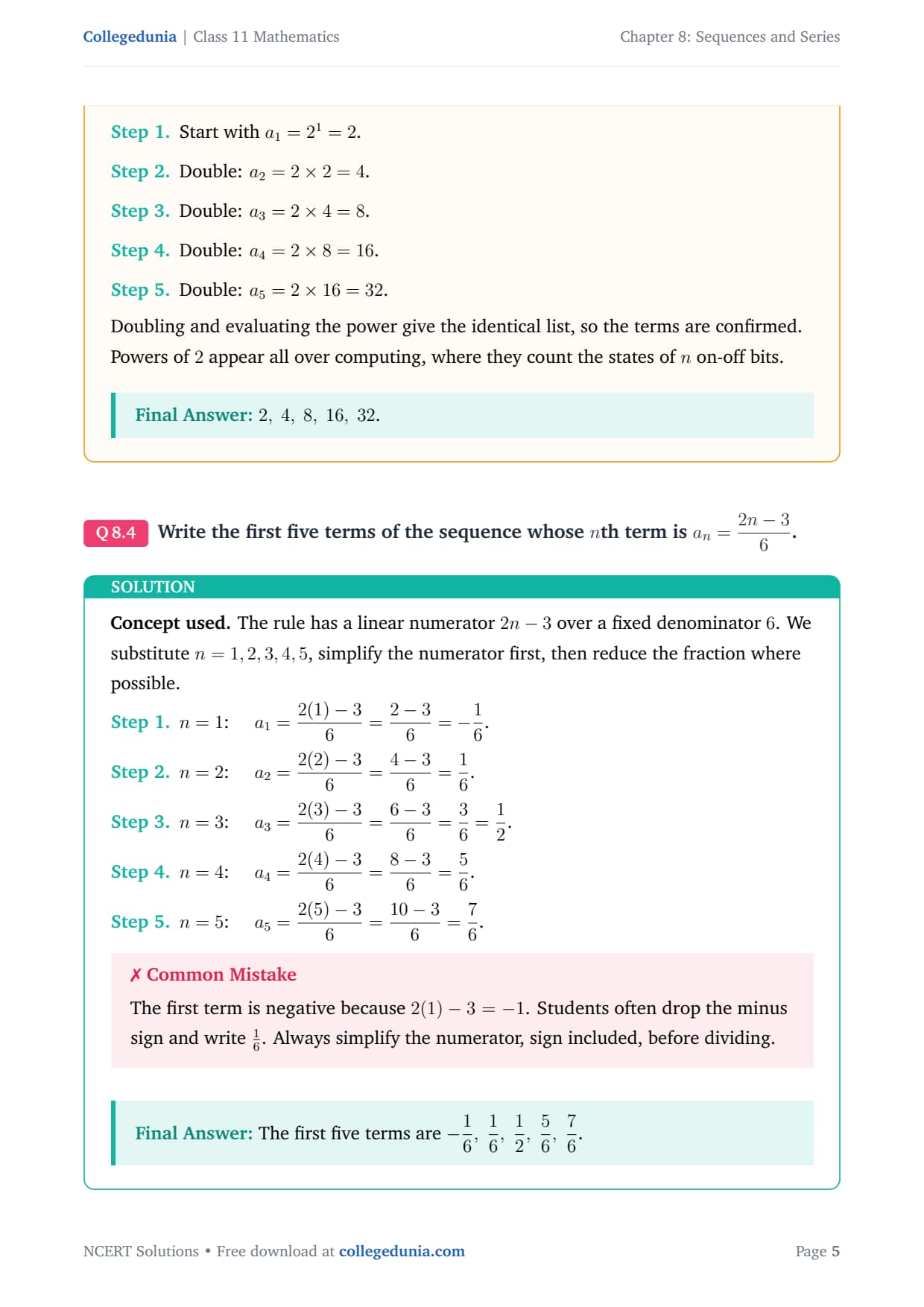
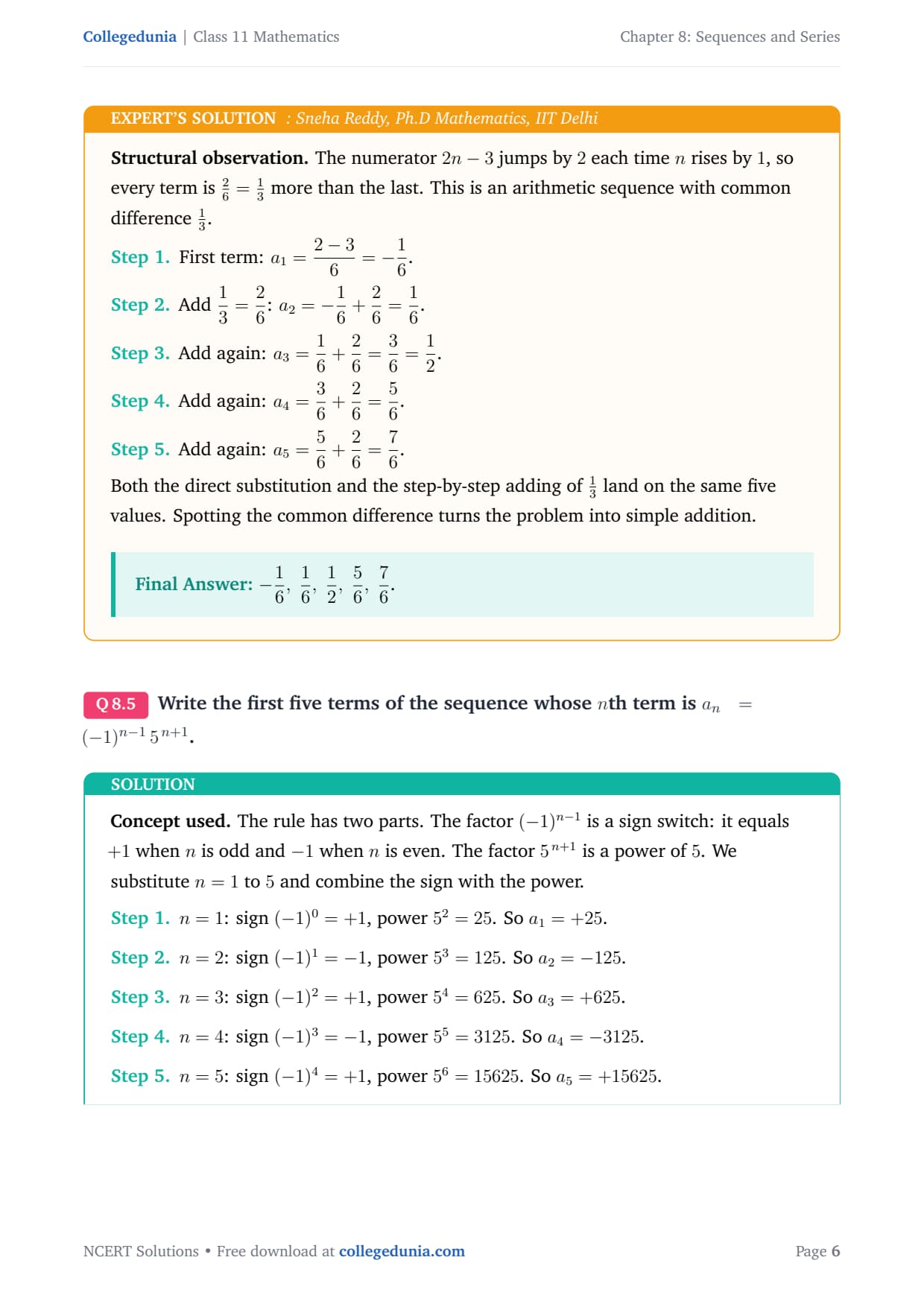
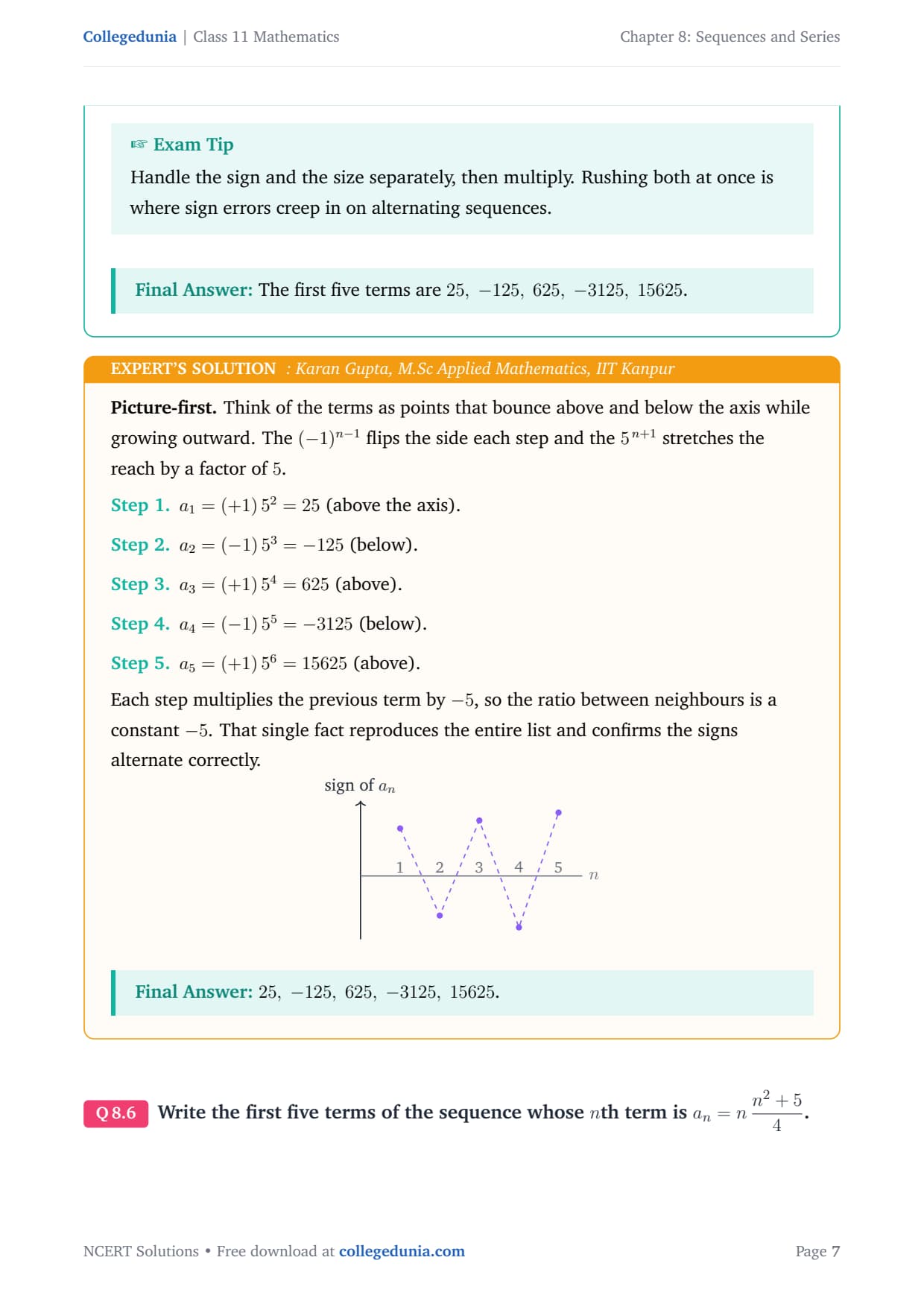
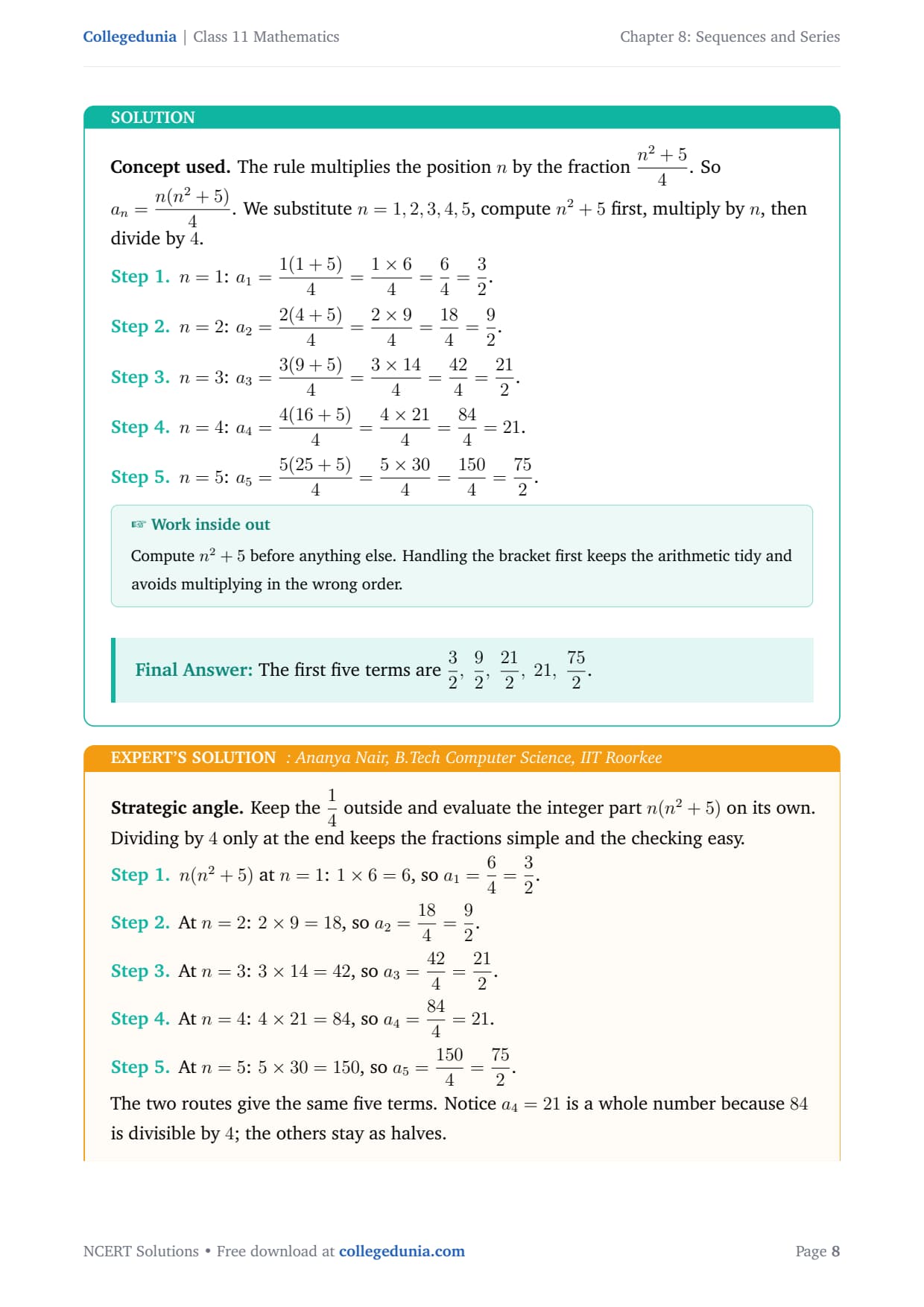
- Writing the first few terms of a sequence when the nth term an is given.
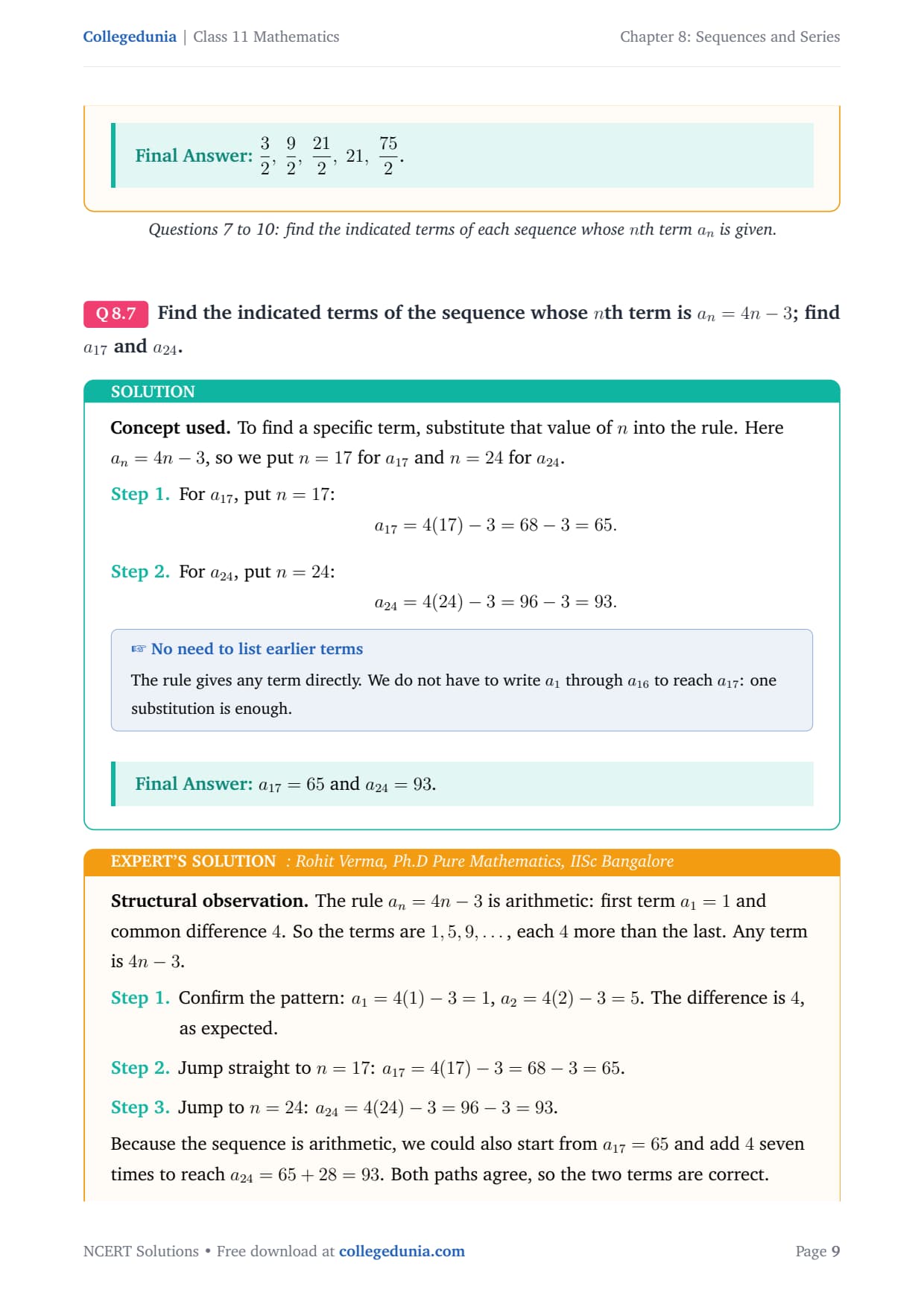
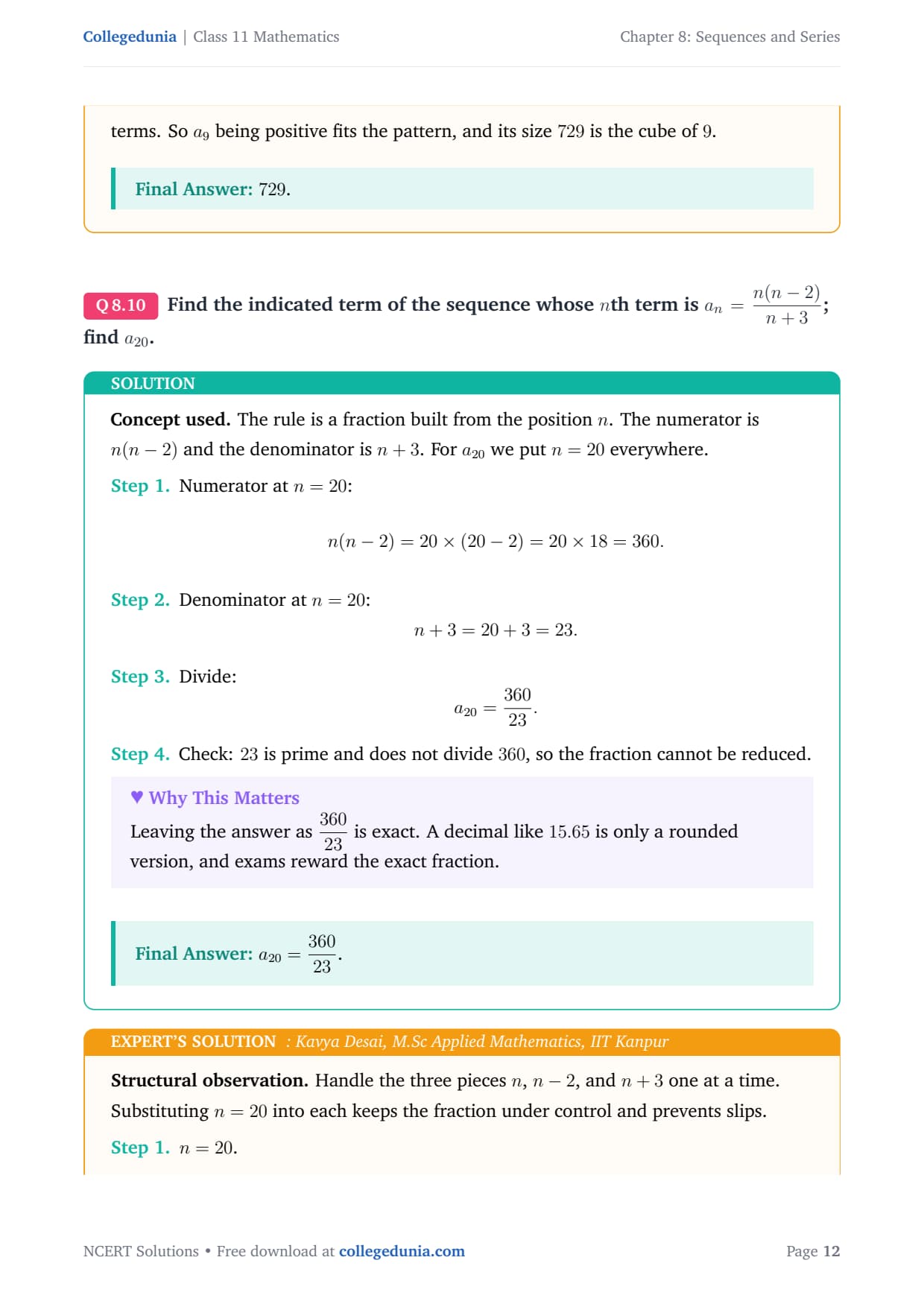
- Finding a specific term such as a17 or a20 by substitution.
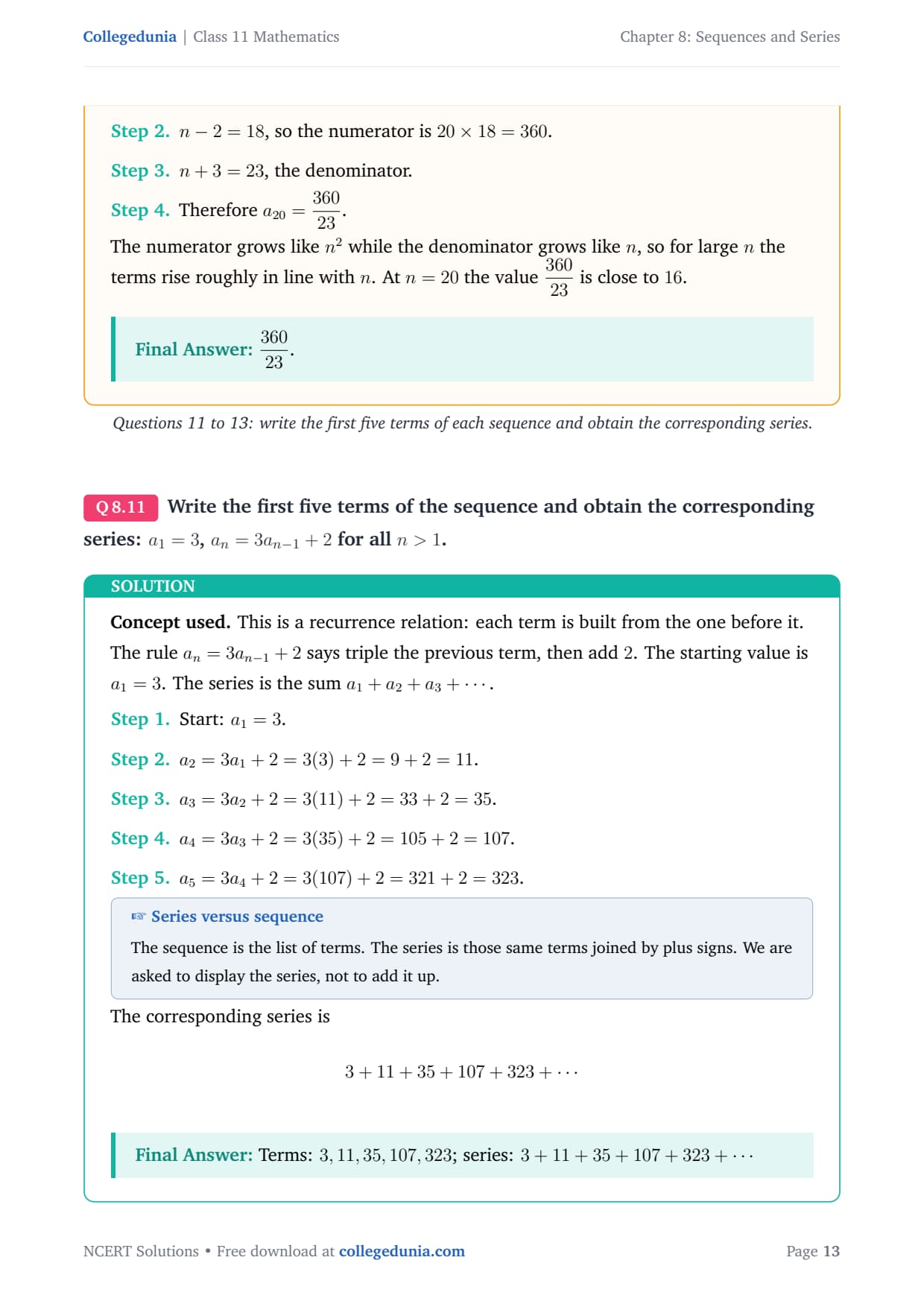
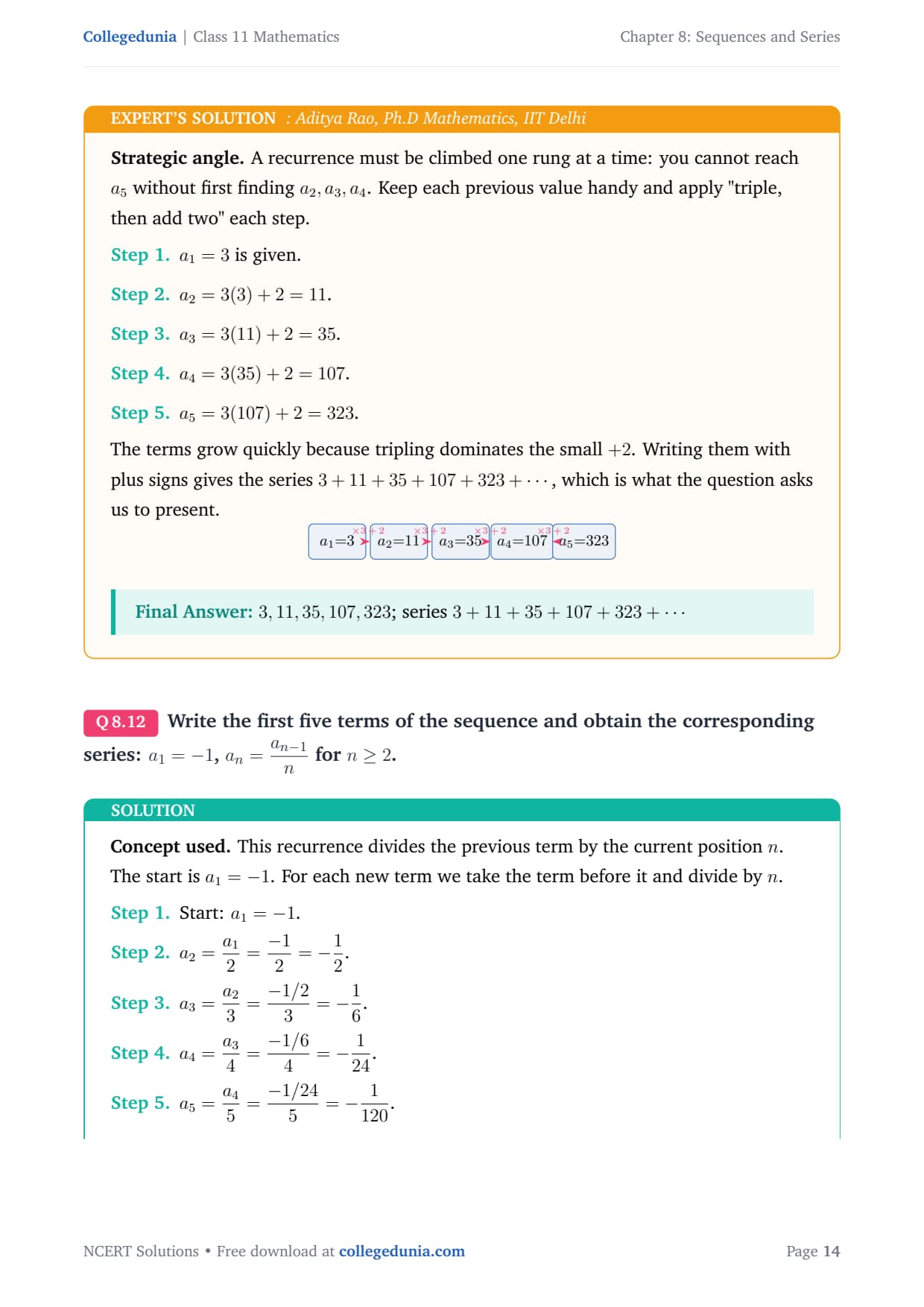
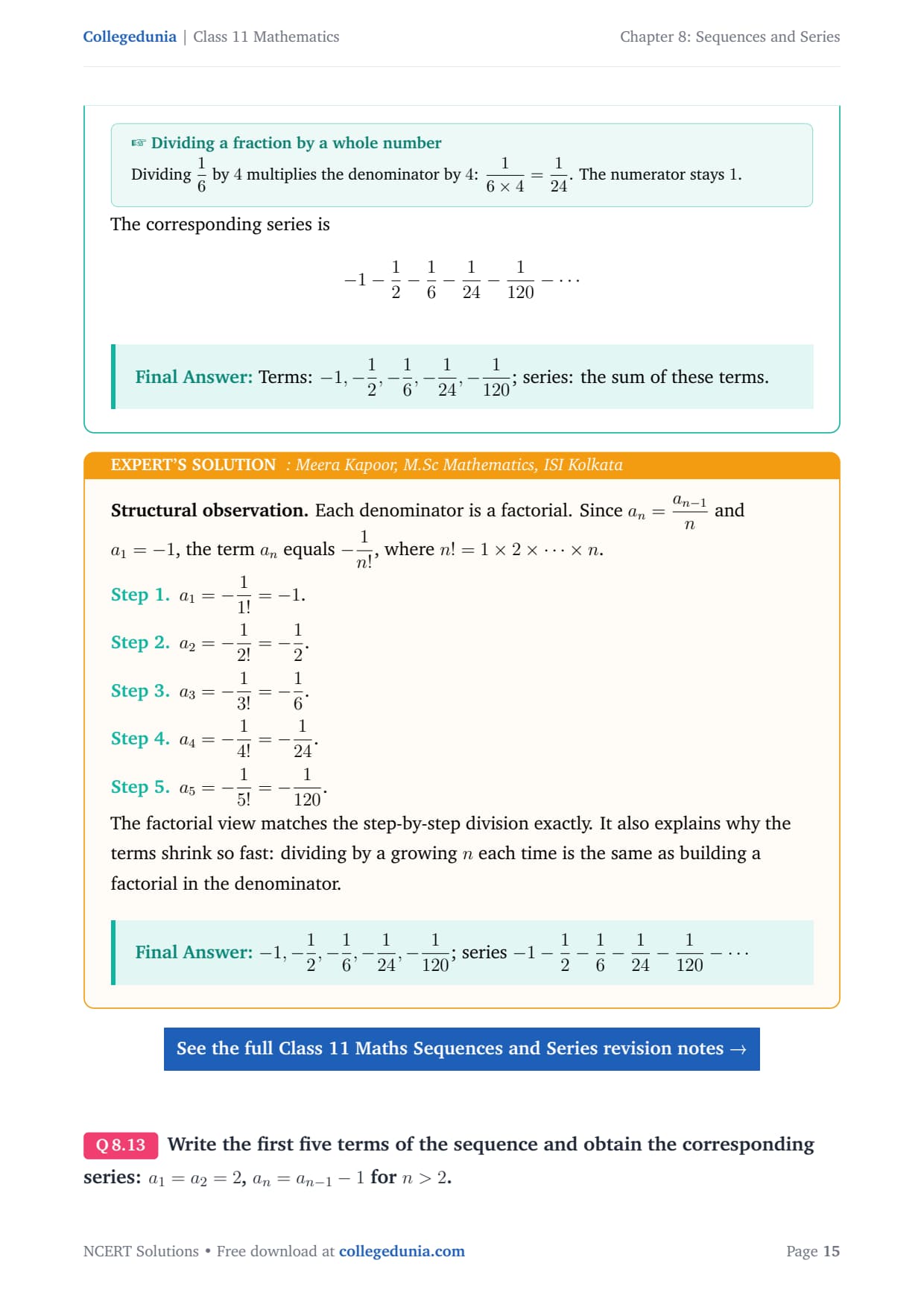
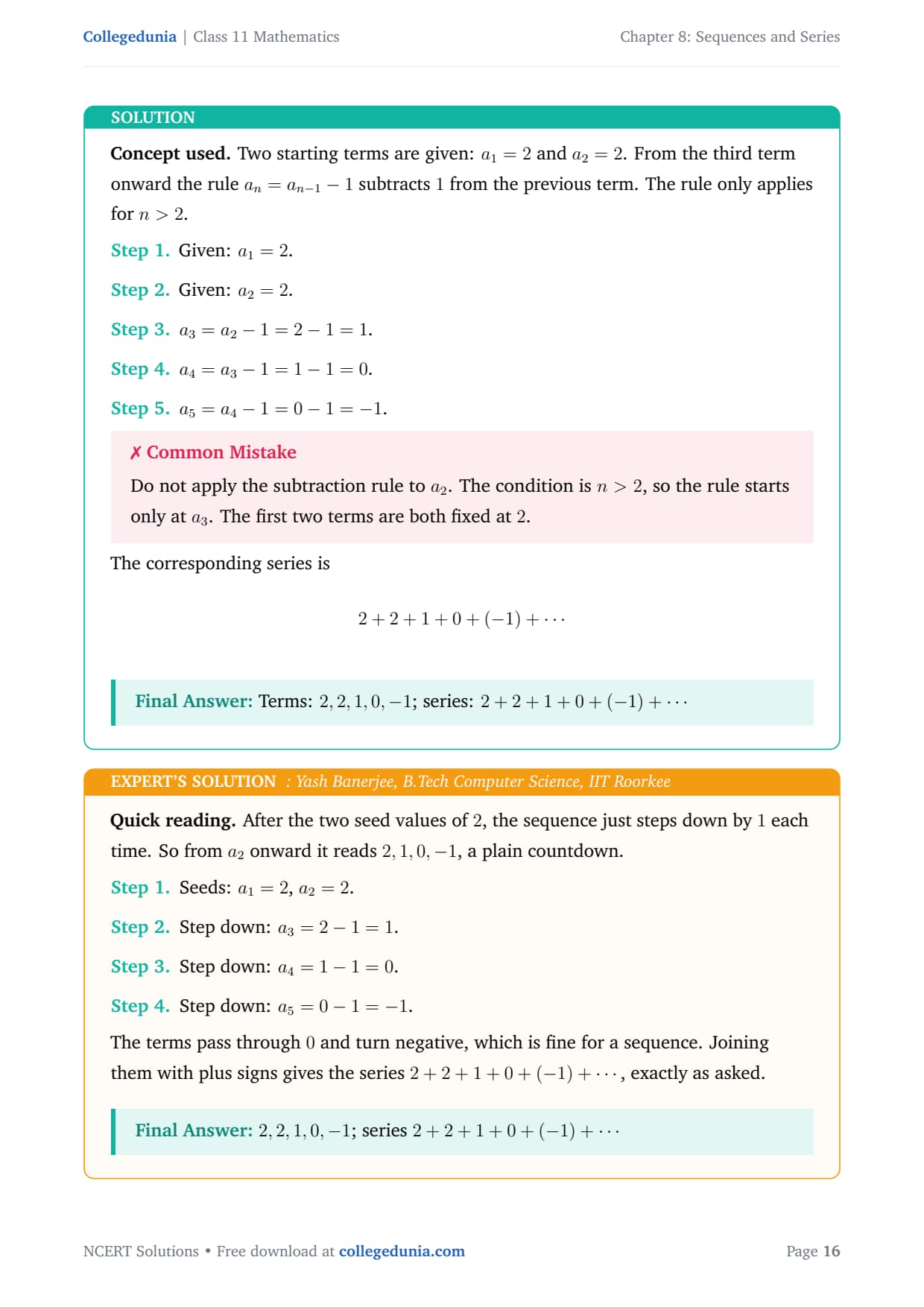
- Generating terms from a recurrence relation and forming the corresponding series.
Topics Covered in Exercise 8.1
This exercise introduces the language of sequences and series. A sequence is an ordered list of numbers written according to a rule, and its nth term an (also called the general term) gives the number at position n. Exercise 8.1 keeps the focus on generating, reading and adding these terms. Note that in the 2026-27 rationalised NCERT, Chapter 8 no longer has a separate Arithmetic Progression exercise (A.P. is now assumed from Class 10); the older Special Series exercise was also merged, so this chapter has only Exercise 8.1, Exercise 8.2 and the Miscellaneous Exercise.
- General term: substituting n = 1, 2, 3, ... into an to list the terms, as in an = n(n + 2).
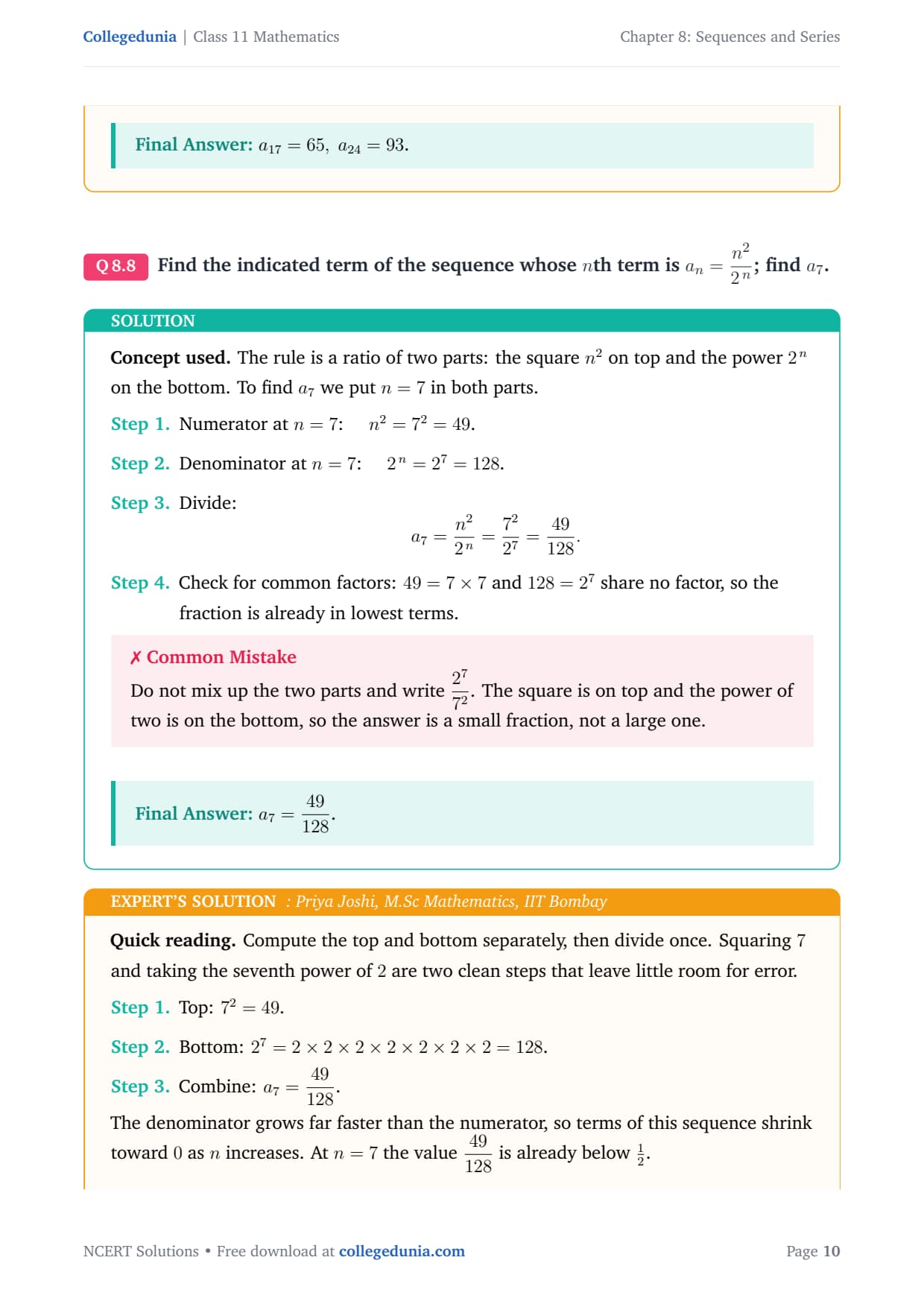
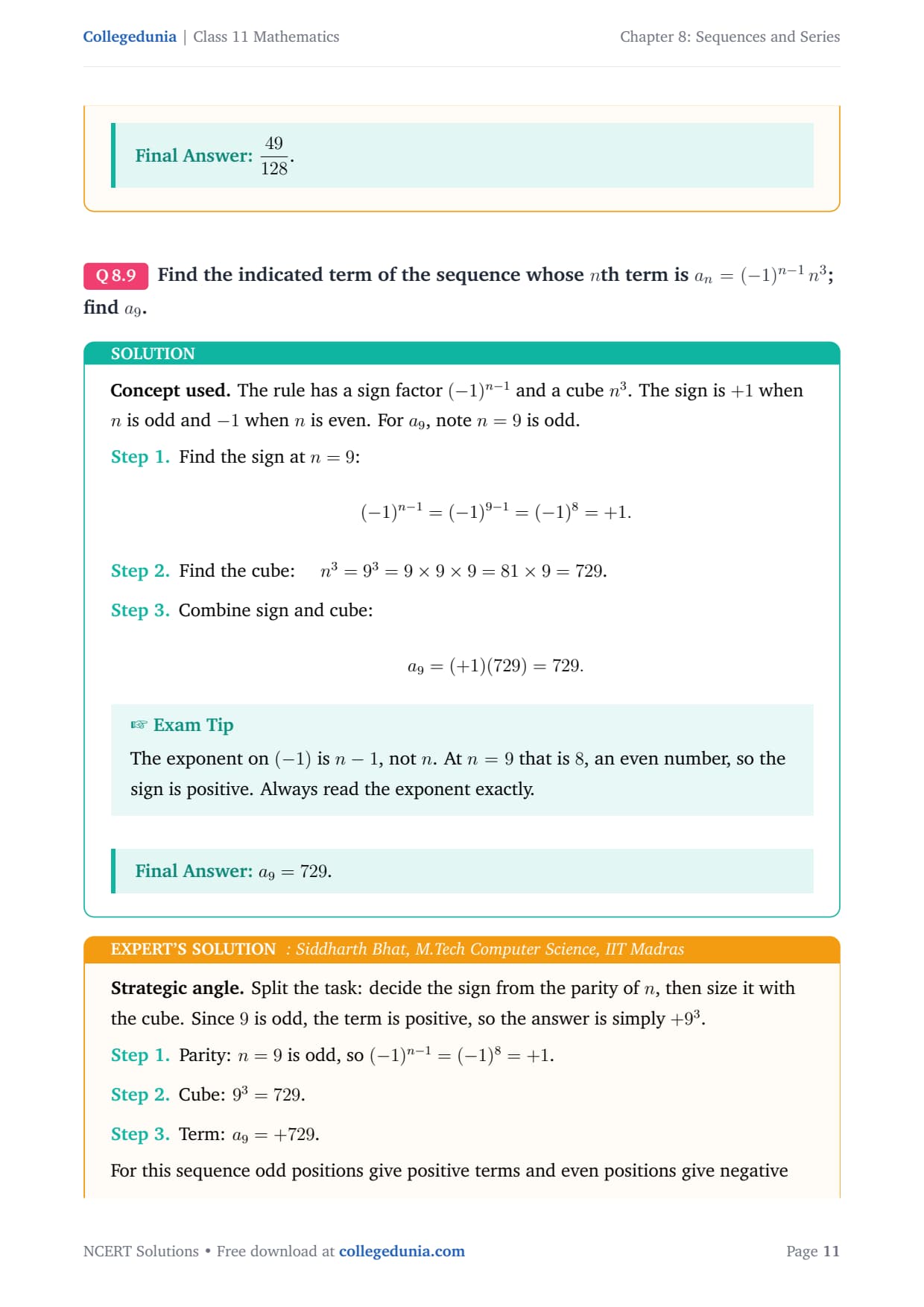
- Indicated terms: putting a fixed value of n to get one term, such as a7 or a24.
- Recurrence relation: defining each term from earlier ones, like a1 = 3, an = 3an−1 + 2.
- Series: adding the terms a1 + a2 + a3 + ... to form the series linked to the sequence.
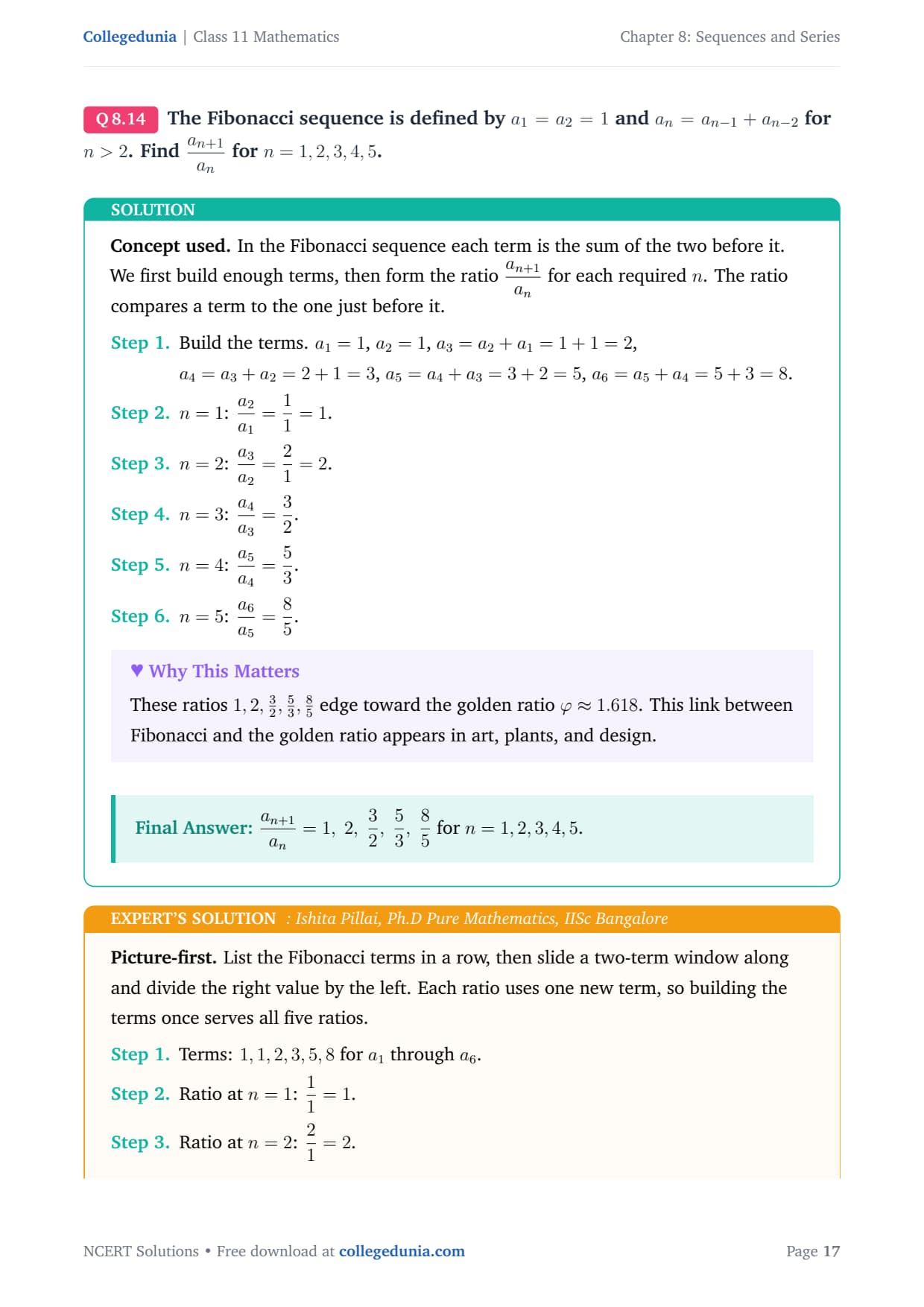
- Fibonacci sequence: the special sequence 1, 1, 2, 3, 5, 8, ... built from an = an−1 + an−2.
Important: a sequence and its series are different ideas. The sequence is the list of terms; the series is what you get after adding them. Question 11 to 13 test both together.
Question-wise Breakdown of Exercise 8.1
The NCERT Solutions for Class 11 Maths Chapter 8 Sequences and Series Exercise 8.1 solve all 14 questions in order. The table below shows what each block of questions asks so students can plan their practice. Full step-by-step answers are inside the PDF above.
| Questions | What they ask | Skill tested |
|---|---|---|
| Q1 to Q6 | Write the first five terms of a sequence from its nth term | Substituting into an |
| Q7 to Q10 | Find the indicated terms (e.g. a17, a7, a9, a20) | Evaluating one term |
| Q11 to Q13 | Write five terms from a recurrence relation and form the series | Recurrence to series |
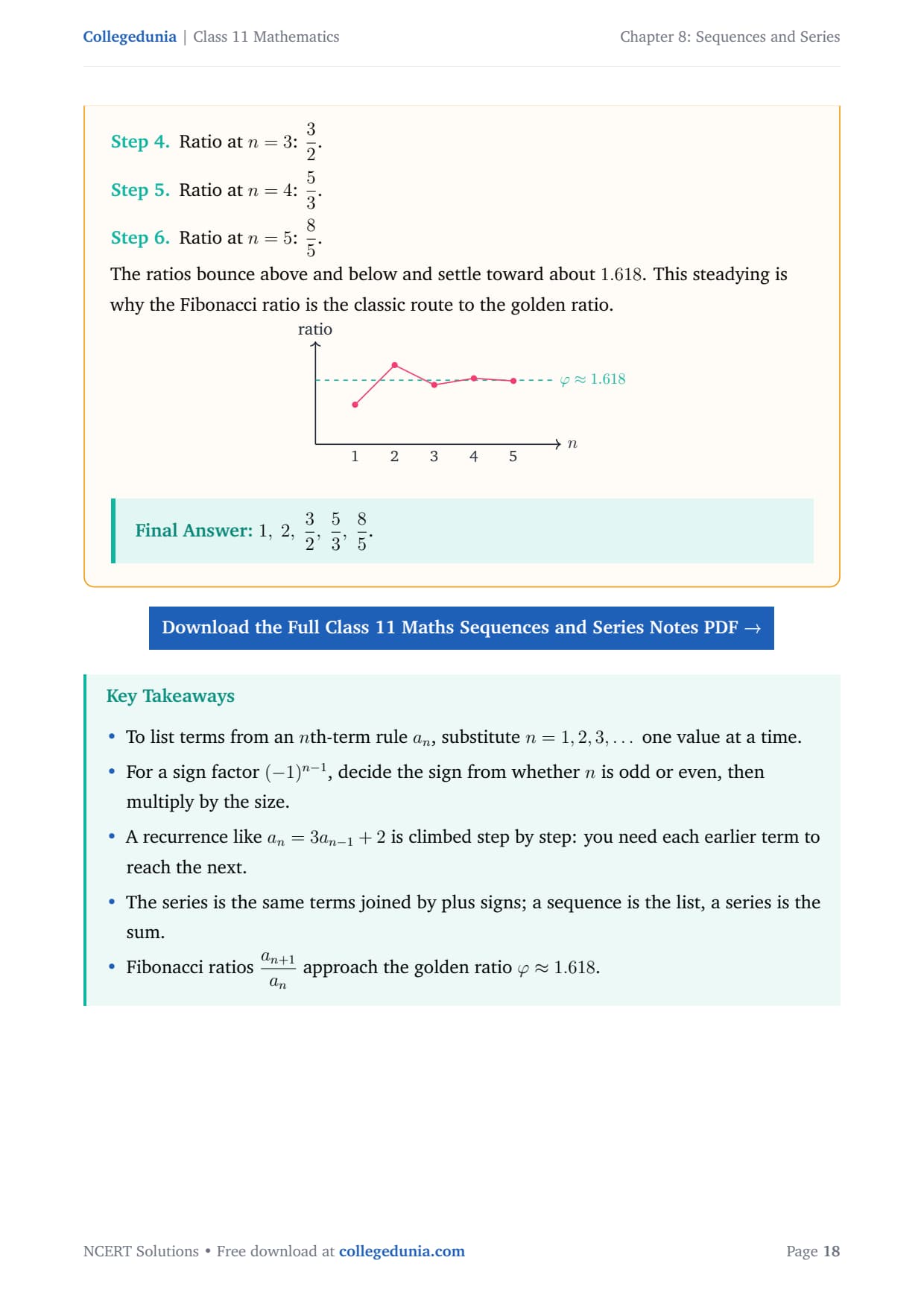
| Q14 | For the Fibonacci sequence, find an+1/an for n = 1 to 5 | Fibonacci ratios |
Several questions carry small fraction or sign traps, so the exercise gives clean practice on careful substitution.
Key Formulas and Definitions for Exercise 8.1
Exercise 8.1 rests on a few clear definitions rather than heavy formulas. Students should fix these before starting.
| Term / Symbol | Meaning |
|---|---|
| Sequence | An ordered list of numbers following a definite rule |
| an | The nth term or general term, giving the term at position n |
| Series | The sum a1 + a2 + a3 + ... + an |
| Sigma notation | ∑ is used to write a series compactly, as ∑ak |
| Finite sequence | A sequence with a countable, ending number of terms |
| Infinite sequence | A sequence whose terms never end |
| Recurrence relation | A rule giving a term from one or more earlier terms |
| Fibonacci sequence | 1, 1, 2, 3, 5, 8, ... where an = an−1 + an−2 |
Tip: when an has a factor like (−1)n−1, work out the sign first and the size second, so the alternating terms come out right.
Common Mistakes in Exercise 8.1
Students lose easy marks in Exercise 8.1 on small slips of substitution. The list below covers the errors that show up most often in class tests on the NCERT Solutions for Class 11 Maths Chapter 8 Sequences and Series Exercise 8.1.
- Starting the count at n = 0 instead of n = 1. For sequences here the first term is always a1, found by putting n = 1.
- Getting the sign wrong in alternating terms with (−1)n−1 or (−1)n.
- Confusing the sequence with the series. Questions 11 to 13 want both the five terms and the added series, not just one.
- In the Fibonacci ratios of Question 14, using an/an+1 instead of the asked an+1/an.
Practice Questions for Exercise 8.1
After reading the solutions, students should test themselves on the same question types. The card below opens a set of solved practice questions with step-by-step answers for Exercise 8.1.
Practice Card: Solved Practice Questions for Class 11 Maths Sequences and Series Exercise 8.1 — attempt each question, then check the worked solution.
Other Exercises of Chapter 8 Sequences and Series
Chapter 8 Sequences and Series has two exercises plus a Miscellaneous Exercise. Use the table to move to the next exercise once Exercise 8.1 is done.
| Exercise | NCERT Solutions link |
|---|---|
| Exercise 8.2 | Class 11 Maths Sequences and Series Exercise 8.2 Solutions |
| Miscellaneous Exercise | Class 11 Maths Sequences and Series Miscellaneous Exercise Solutions |
More Class 11 Maths Sequences and Series Resources
Pair the solutions with the notes and the NCERT book PDF for full chapter revision. All three resources for Chapter 8 Sequences and Series are linked below.
| Resource | Link |
|---|---|
| Revision Notes | Class 11 Maths Sequences and Series Notes |
| Handwritten Notes | Class 11 Maths Sequences and Series Handwritten Notes |
| NCERT Book PDF | Class 11 Maths Sequences and Series NCERT Book PDF |
NCERT Solutions for Other Class 11 Maths Chapters
Students can move to the first exercise of any other Class 11 Maths chapter using the cross-sell table below.
| Chapter | NCERT Solutions |
|---|---|
| Chapter 1: Sets | Sets Solutions |
| Chapter 2: Relations and Functions | Relations and Functions Solutions |
| Chapter 3: Trigonometric Functions | Trigonometric Functions Solutions |
| Chapter 4: Complex Numbers and Quadratic Equations | Complex Numbers Solutions |
| Chapter 5: Linear Inequalities | Linear Inequalities Solutions |
| Chapter 6: Permutations and Combinations | Permutations and Combinations Solutions |
| Chapter 7: Binomial Theorem | Binomial Theorem Solutions |
| Chapter 8: Sequences and Series | You are here |
| Chapter 9: Straight Lines | Straight Lines Solutions |
| Chapter 10: Conic Sections | Conic Sections Solutions |
| Chapter 11: Introduction to Three Dimensional Geometry | Three Dimensional Geometry Solutions |
| Chapter 12: Limits and Derivatives | Limits and Derivatives Solutions |
| Chapter 13: Statistics | Statistics Solutions |
| Chapter 14: Probability | Probability Solutions |
Student Feedback
In a Collegedunia survey of 9,860 Class 11 students conducted before the 2026 exams, 61% of students said the recurrence-relation questions (Q11 to Q13) of Exercise 8.1 took the longest to master, while the direct nth-term substitutions were rated the easiest scoring.
FAQs on NCERT Solutions for Class 11 Maths Chapter 8 Sequences and Series Exercise 8.1
Sequences and Series NCERT Solutions - Frequently Asked Questions
Ques. How many questions are there in Class 11 Maths Chapter 8 Sequences and Series Exercise 8.1?
Ans. Exercise 8.1 has 14 questions. Questions 1 to 6 ask for the first five terms from a given nth term, questions 7 to 10 ask for indicated terms, questions 11 to 13 use recurrence relations to form a series, and question 14 works out ratios in the Fibonacci sequence.
Ques. What is the difference between a sequence and a series in Exercise 8.1?
Ans. A sequence lists numbers in order, such as 1, 3, 5, 7. A series is what you get after adding them, such as 1 + 3 + 5 + 7. Questions 11 to 13 of Exercise 8.1 ask students to first write the terms and then form the corresponding series.
Ques. Does Exercise 8.1 cover Arithmetic Progression?
Ans. In the 2026-27 rationalised NCERT, Exercise 8.1 focuses only on writing terms of a sequence from its general term and on recurrence relations. Arithmetic Progression is assumed from Class 10, and Chapter 8 now has just Exercise 8.1, Exercise 8.2 (Geometric Progression) and the Miscellaneous Exercise.
Ques. How do you find the nth term of a sequence in Class 11 Maths?
Ans. The nth term, or general term, is written as an. To get any term you put its position into the formula. For an = n(n + 2), the first term is a1 = 1(3) = 3 and the third term is a3 = 3(5) = 15. The same method gives the indicated terms in questions 7 to 10.
Ques. Are the NCERT Solutions for Class 11 Maths Chapter 8 Sequences and Series Exercise 8.1 free to download?
Ans. Yes. The NCERT Solutions for Class 11 Maths Chapter 8 Sequences and Series Exercise 8.1 are free to download as a PDF from this page. Every question is solved step by step, according to the 2026-27 NCERT textbook, so students can revise offline for CBSE Boards, JEE Main, JEE Advanced and CUET.



Comments