




Terms, Concepts and their Use in Sociology is the chapter where students lose marks by swapping one definition for its pair. Primary against secondary, ascribed against achieved, formal against informal control. The NCERT Solutions below answer all 5 textbook exercise questions from the 2026-27 Introducing Sociology book, and every answer keeps each pair clearly apart.
- Covers all 5 exercise questions, from why sociology needs its own terms to how status and role change.
- This chapter usually carries 8 to 10 marks in the Class 11 Sociology paper.
- Written according to the 2026-27 NCERT Introducing Sociology book, where this sits as Chapter 2.
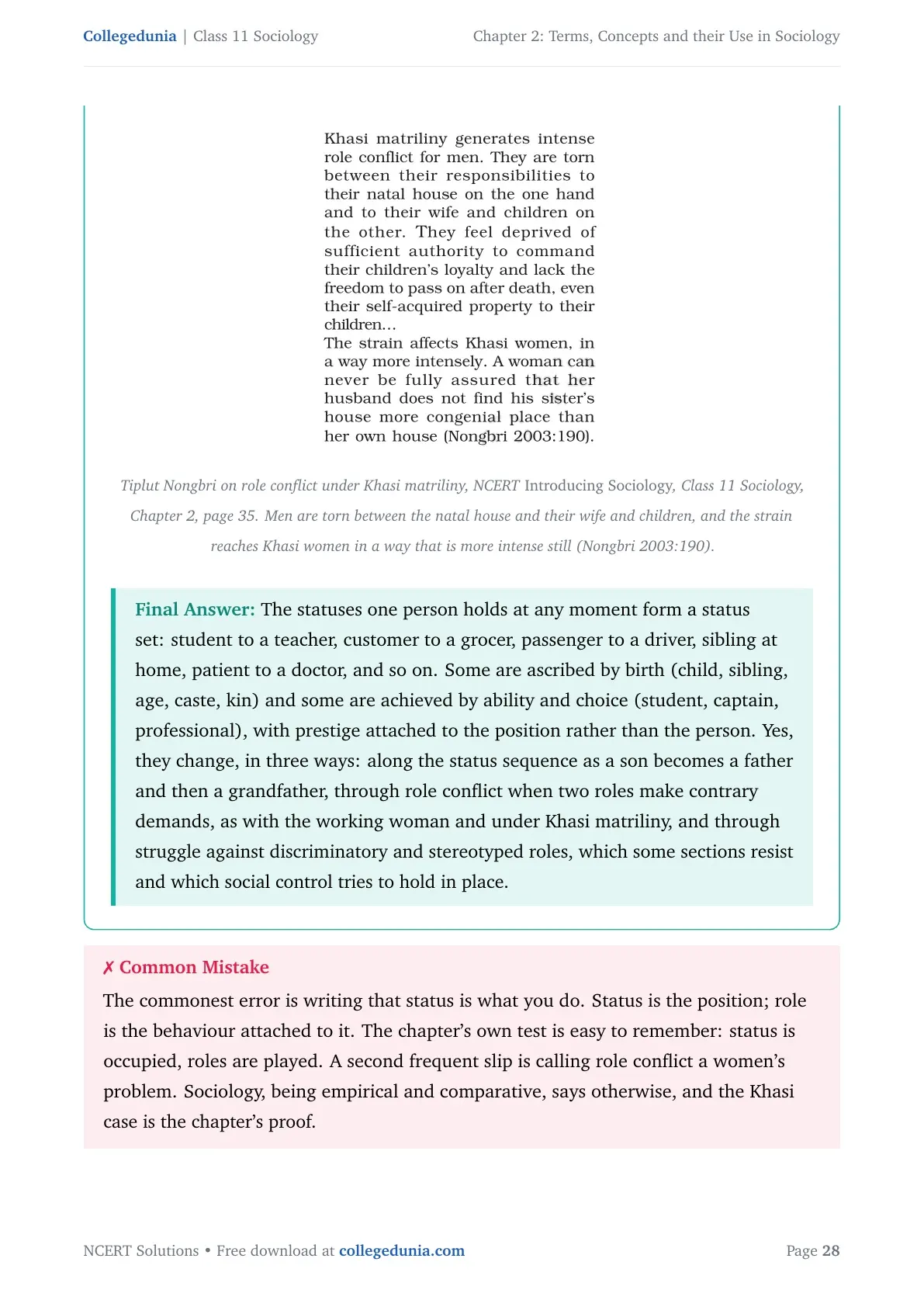
Every answer in this Collegedunia compilation is curated by Class 11 Sociology teachers, checked line by line against the 2026-27 NCERT Introducing Sociology print, and refined against the last five years of school question papers.
Student Feedback: In a Collegedunia poll of 12,460 Class 11 Sociology students taken before the 2026-27 session exams, 68% of the students surveyed mixed up ascribed status with achieved status in at least one answer. Only 31% could name all four historical systems of stratification without looking at the book.
Source: 2026-27 Class 11 Sociology student poll. Sample of 12,460 students from schools across 14 states.
How Collegedunia's Terms and Concepts Answers Help You Score in Class 11 Sociology
This chapter is built almost entirely out of paired terms. The paper rewards students who can state a definition, then separate it from the term sitting next to it. These solutions are written in that shape, so you can lift a definition straight into the answer sheet.
- Each answer opens with the textbook definition, then adds the example NCERT itself uses, so the examiner sees the source at once.
- Every paired term gets a separating line: primary against secondary, community against association, ascribed against achieved, formal against informal.
- Named sources stay attached to their ideas, so Marx, Weber, Durkheim, Berger, Srinivas, Desai and Nongbri are never swapped around.
- The five exercise questions are open ended, so each answer is written at long answer length with three or four clear points.
Terms, Concepts and their Use in Sociology Chapter Summary for Class 11
The chapter has one introduction and four content blocks. Knowing which block a question belongs to is half the answer, because each block carries its own set of terms.
| Section | What it covers | Terms you must be able to define |
|---|---|---|
| Introduction | Why a familiar subject still needs a special vocabulary | Common sense knowledge, naturalistic explanation, micro and macro |
| Social Groups and Society | How people gather, and when a gathering becomes a group | Aggregate, quasi group, social group, social structure |
| Types of Groups | The paired classifications of groups | Primary, secondary, community, association, in-group, out-group, reference group, peer group |
| Social Stratification | Structured inequality and the systems that carry it | Stratification, slavery, caste, estate, class, life-chances, jati, varna |
| Status and Role | Where a person sits, and what a person does there | Status, role, status set, status sequence, ascribed, achieved, prestige, role conflict |
| Society and Social Control | How society brings unruly members back into line | Social control, formal, informal, sanction, deviance |
Why Sociology Needs Its Own Terms When Everyday Words Already Exist
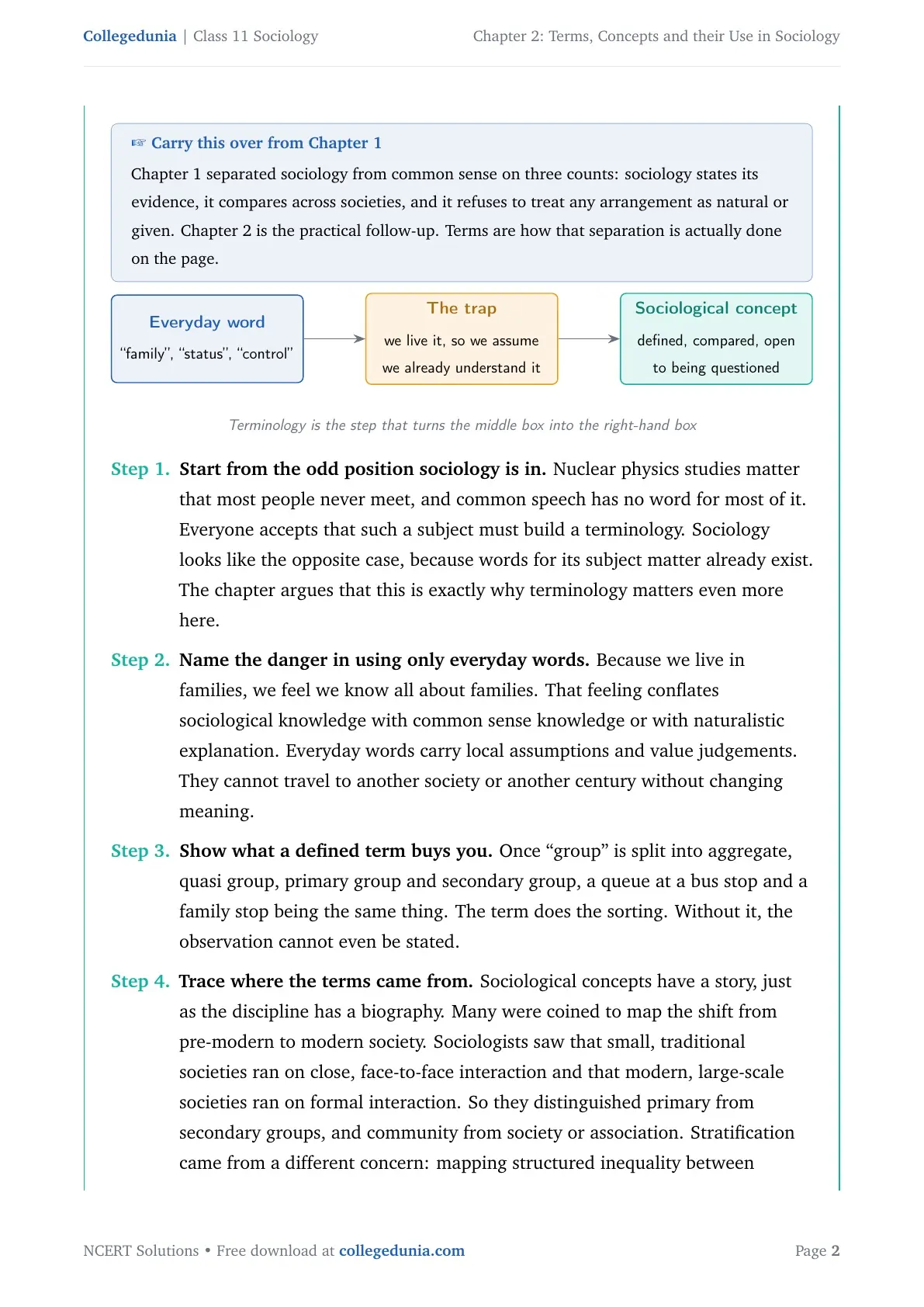
Exercise question 1 asks this directly, so it is worth getting right. Nuclear physics deals with things no one talks about at home, so nobody questions its vocabulary. Sociology has the opposite problem. Its subject matter is familiar, and ordinary words already exist for it.
Peter Berger makes the point that we are so well acquainted with the social institutions around us that we cannot see them clearly and precisely. Because we live in families, we assume we know all about families. That assumption mixes up sociological knowledge with common sense knowledge, which is the mistake Chapter 1 warned against.
- Concepts carry a history. Many of them came from thinkers trying to map the shift from pre-modern to modern society.
- Small, traditional societies showed close, face-to-face interaction. Large, modern societies showed formal interaction. That contrast produced the primary and secondary group pair.
- Different schools use different keys. For Karl Marx the keys were class and conflict. For Emile Durkheim they were social solidarity and collective conscience.
- Some concepts start from the individual, such as status and role. Others start from a larger setting, such as social control and stratification.
NCERT gives you the image to use in the answer. Concepts are keys that open locks. They are entry points, not final answers. If a key is bent or rusted, sociology changes the key rather than the lock.
Social Groups, Status and Role Explained in One Video
Source: Magnet Brains on YouTube
Aggregates, Quasi Groups and the Six Features of a Social Group
Exercise question 2 asks you to look at your own groups sociologically. The answer has to begin by ruling out the gatherings that are not groups at all.
- Aggregates are collections of people in the same place at the same time who share no definite connection. Passengers waiting at a railway station and people watching a film in a cinema hall are the textbook examples.
- Quasi groups lack structure or organisation, and their members may be unaware, or less aware, of the grouping. Social classes, status groups, age and gender groups and crowds are quasi groups.
- Quasi groups can turn into social groups. Caste and class produced political parties, the anti-colonial struggle produced a nation with a shared past, and the women's movement produced women's organisations.
NCERT then lists six features. Reproduce them as a list, because examiners mark them point by point.
- Persistent interaction, which gives the group continuity.
- A stable pattern of those interactions.
- A sense of belonging, so each member is conscious of the group and of its own rules, rituals and symbols.
- Shared interest.
- Acceptance of common norms and values.
- A definable structure.
Social structure here means patterns of regular and repetitive interaction between individuals or groups. A social group is therefore a collection of continuously interacting persons who share common interest, culture, values and norms within a given society.
Primary and Secondary Groups Compared with the Examples NCERT Uses
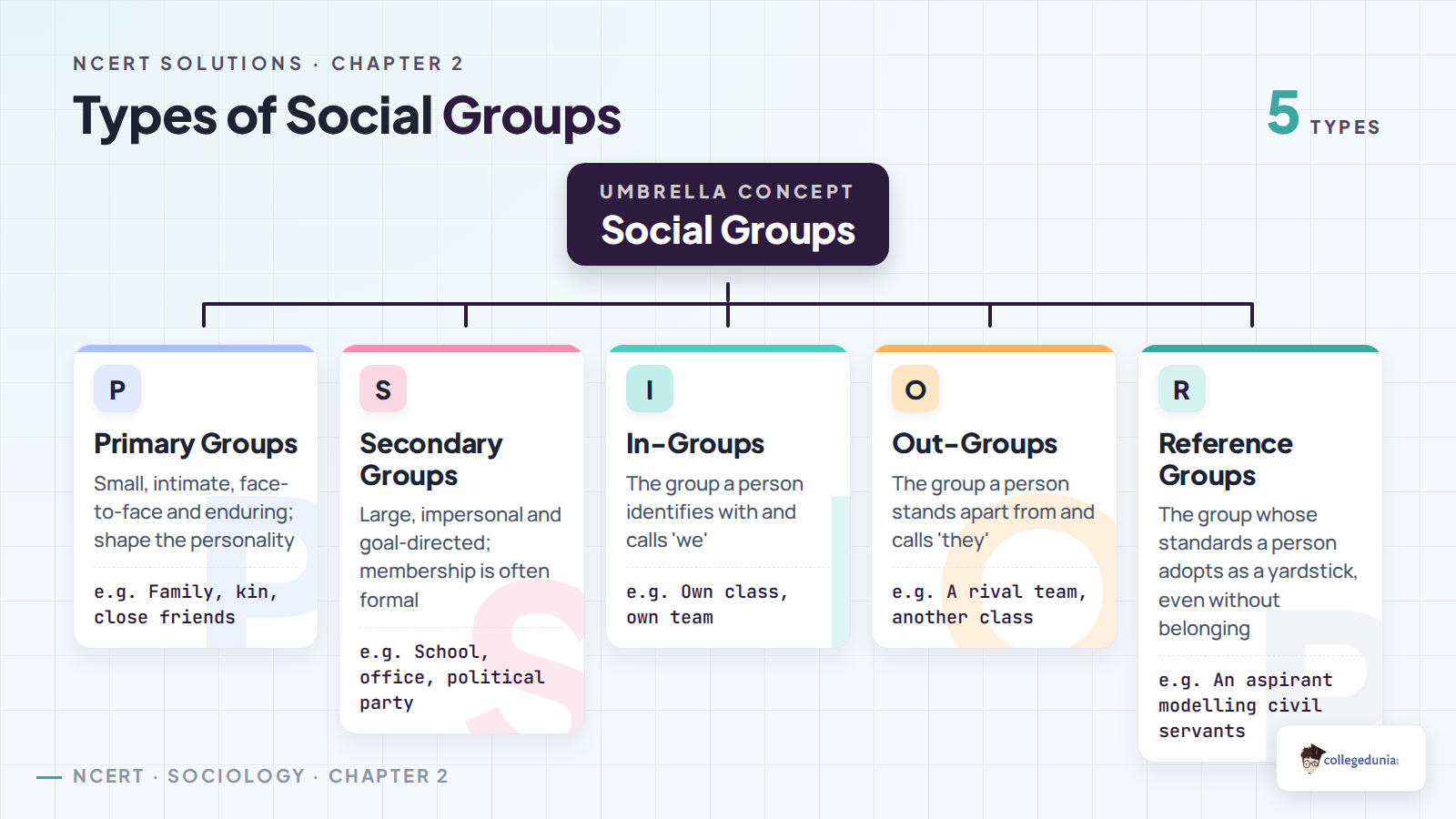
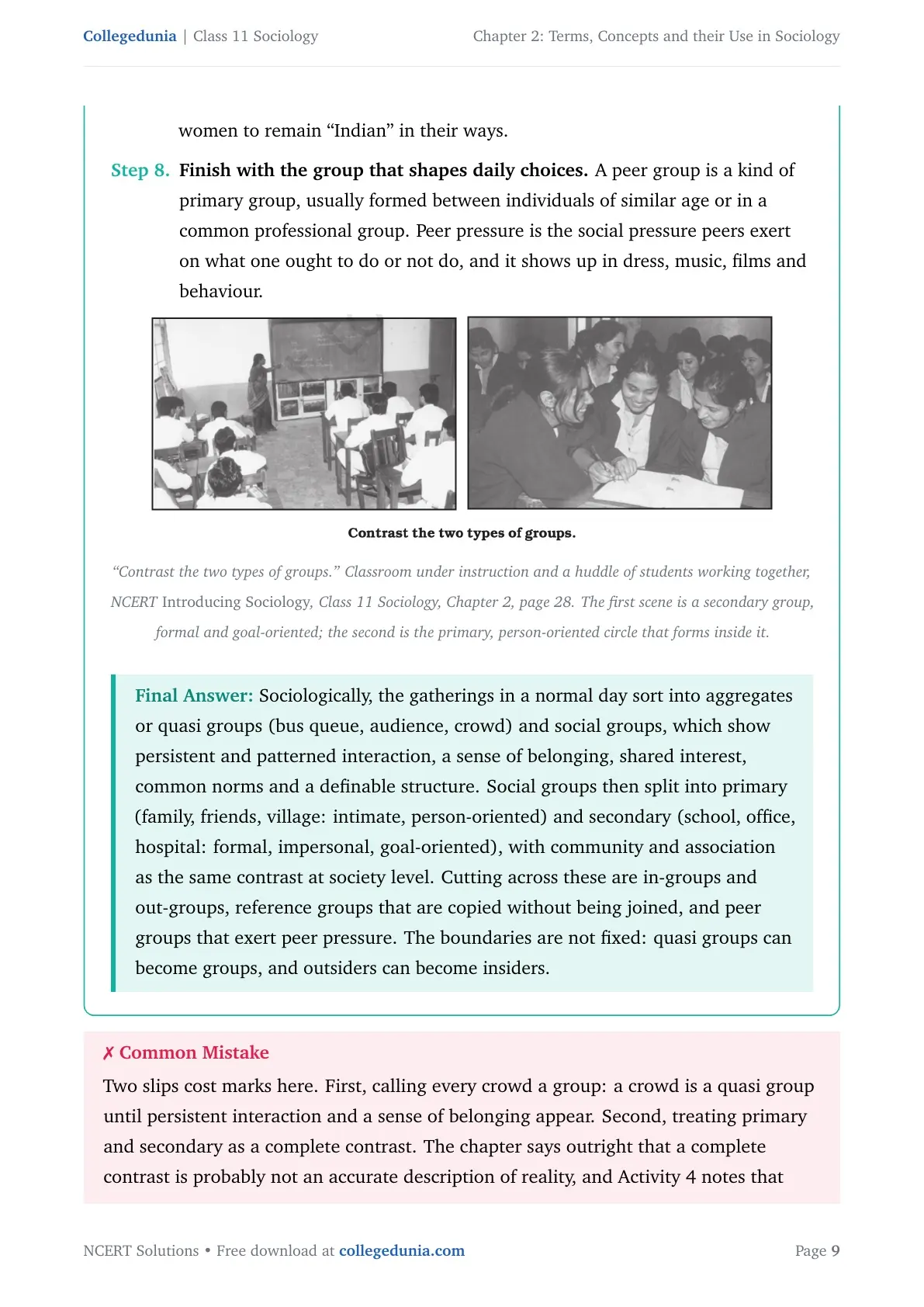
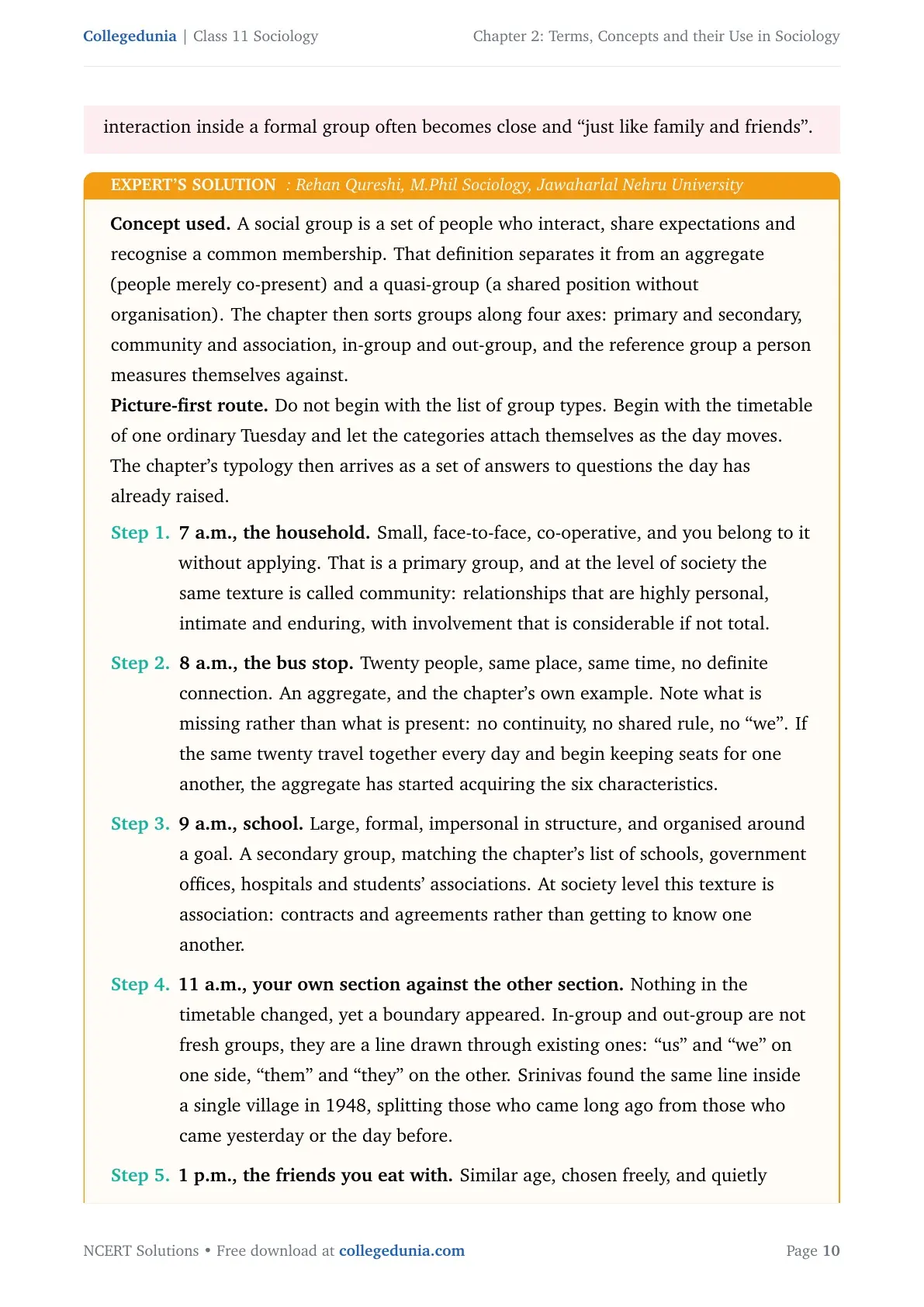
This is the pair students reverse most often. The safest way to remember it is by what the group is organised around. A primary group is organised around persons. A secondary group is organised around a goal.
| Point of difference | Primary group | Secondary group |
|---|---|---|
| Size | Small | Relatively large |
| Contact | Intimate and face-to-face association and co-operation | Formal and impersonal relationships |
| Orientation | Person oriented | Goal oriented |
| Feeling | Members have a sense of belonging | Membership follows from a shared purpose |
| NCERT examples | Family, village, groups of friends | Schools, government offices, hospitals, students' associations |
The peer group is a kind of primary group, formed between people of similar age or in a common professional group. Peer pressure is the social pressure your peers exert on what you ought to do or not do, and it is the one term from this section that turns up in one mark questions.
Community and Association, In-Groups, Out-Groups and Reference Groups
The community and association pair sits directly on top of the primary and secondary pair, and NCERT tells you to draw that parallel. Community means human relationships that are highly personal, intimate and enduring, as in the family or a close-knit group. Association means the impersonal, superficial and transitory relationships of modern urban life, where people make contracts instead of getting to know one another.
| Term | Definition to write | Textbook example |
|---|---|---|
| In-group | A group marked by a sense of belonging, which separates 'us' or 'we' from 'them' or 'they' | Children of one school against children of another |
| Out-group | A group to which the members of an in-group do not belong, and whose members can face hostile reactions | Migrants, though who counts as a migrant changes with time and context |
| Reference group | A group whose lifestyle is emulated. We do not belong to it, but we identify ourselves with it | The English, emulated by many middle class Indians in the colonial period |
M.N. Srinivas supplies the evidence for the out-group idea. While taking a census in Rampura in 1948 he heard villagers separate recent immigrants, described as nenne monne bandavartu, meaning came yesterday or the day before, from old immigrants described as arsheyinda bandavaru, meaning came long ago. Quote either phrase and the answer immediately looks sourced.
The reference group answer needs one extra line that students often drop. The colonial emulation was gendered. Indian men often wanted to dress and dine like British men, while expecting Indian women to stay Indian in their ways.
Social Stratification and the Four Historical Systems of Inequality
Exercise question 3 asks what stratification you see around you and how it affects individual lives. Open with the definition, then move to the effects, because the second half carries the marks.
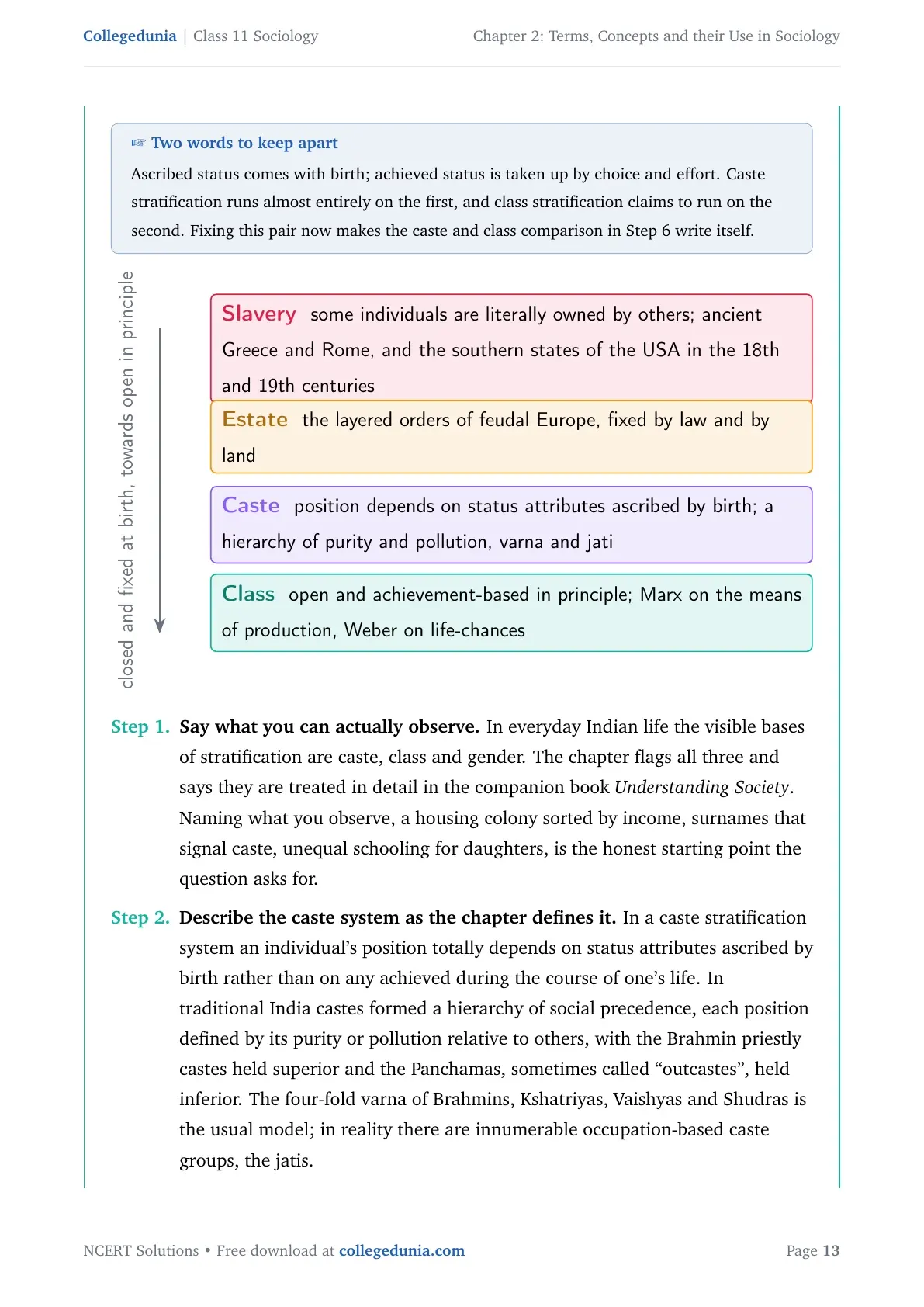
Social stratification refers to structured inequalities between groups in society in terms of their access to material or symbolic rewards. NCERT compares it to the geological layering of rock, with society consisting of strata in a hierarchy, the more favoured at the top and the less privileged near the bottom.
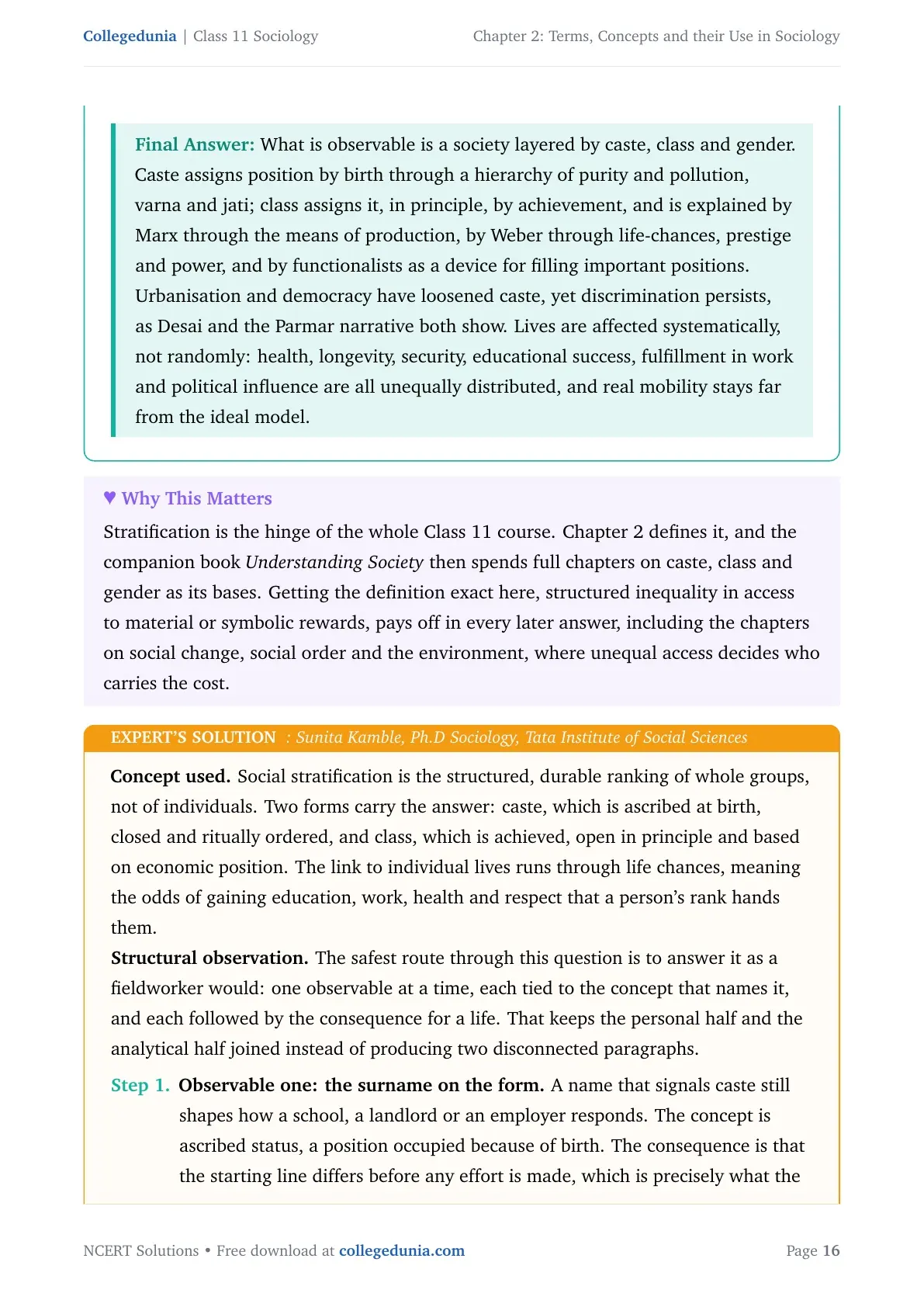
- Stratification is central to sociology because every aspect of the life of every individual and household is affected by it.
- Opportunities for health, longevity, security, educational success, fulfilment in work and political influence are all unequally distributed in systematic ways.
| System | Basis of position | What NCERT says about it |
|---|---|---|
| Slavery | Ownership of one person by another | An extreme form of inequality, seen in ancient Greece and Rome and the Southern States of the USA in the 18th and 19th centuries. Eradicated as a formal institution, though bonded labour continues |
| Caste | Status attributes ascribed by birth | Position depends completely on birth rather than on anything achieved during one's life |
| Estate | Fixed legal orders | Characterised feudal Europe. The book does not go into detail here |
| Class | Economic position and market capacity | Open and achievement based, and taken up in detail in Understanding Society |
Caste and Class as Two Systems of Stratification in the Class 11 Answer
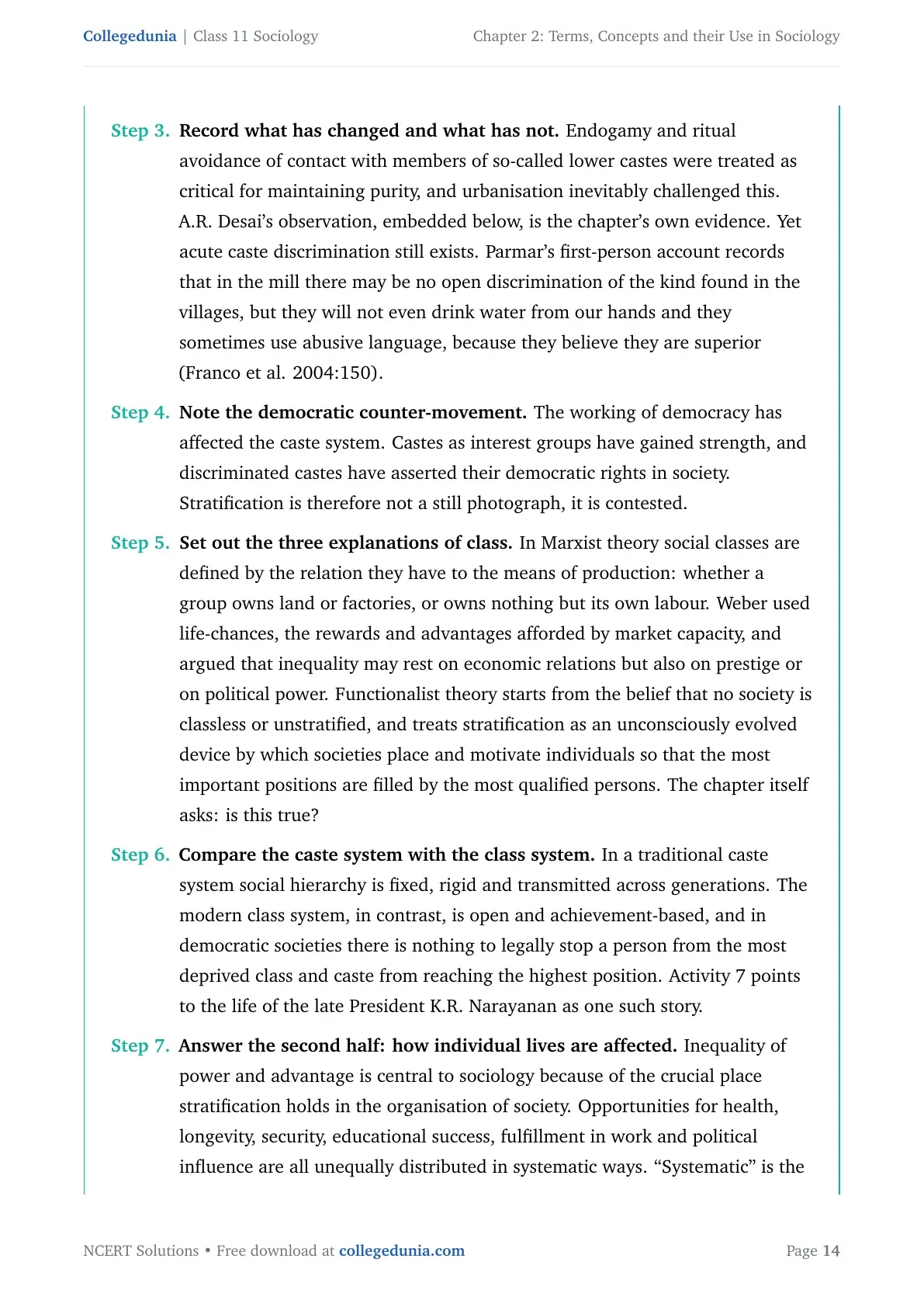
In a caste system, position depends on status attributes ascribed by birth. Each position in the traditional Indian caste structure was defined by its purity or pollution relative to others. The system is generally conceptualised through the four fold varna of Brahmins, Kshatriyas, Vaishyas and Shudras, with the Panchamas placed outside it, while in reality there are innumerable occupation based caste groups called jatis.
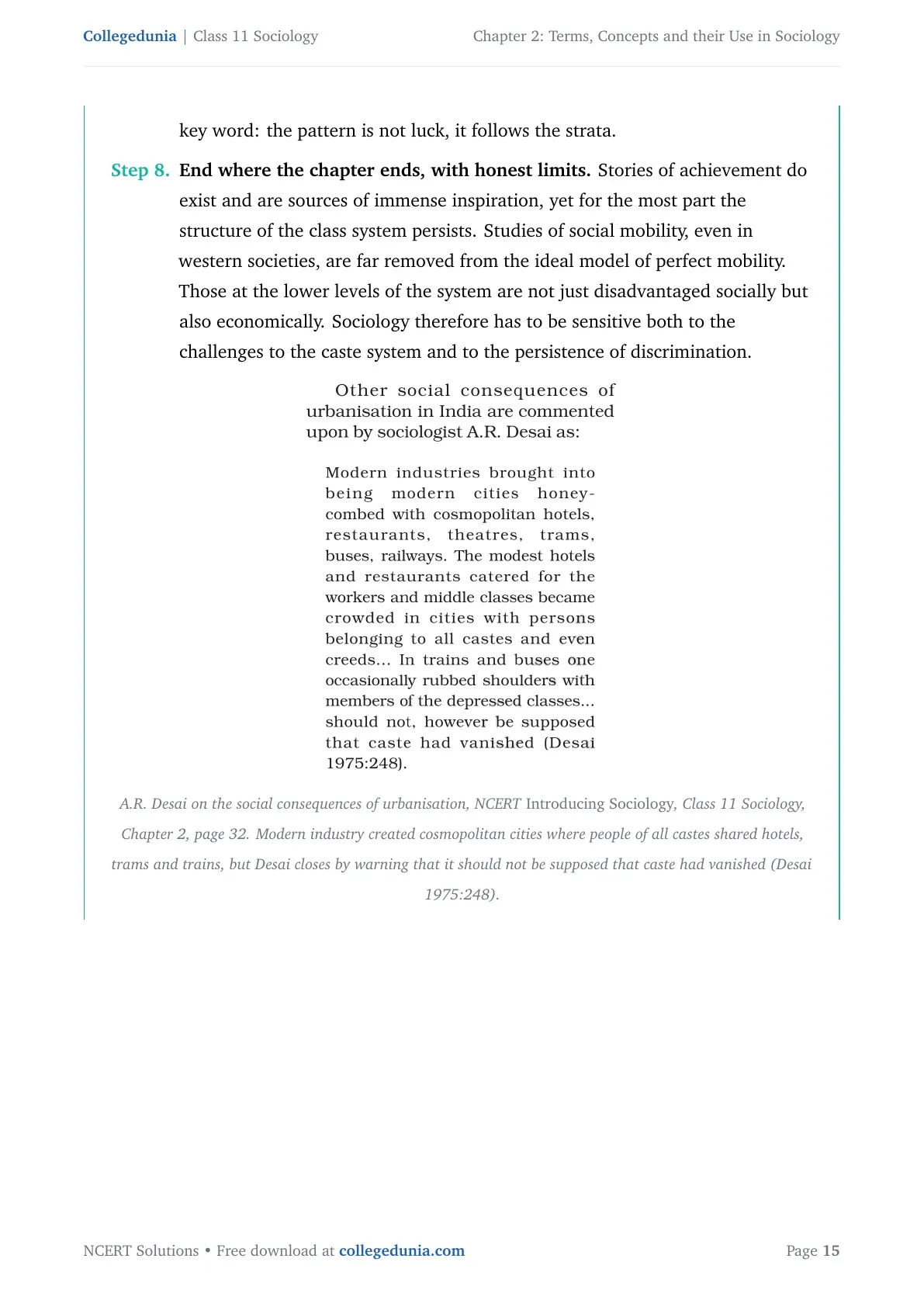
Change and persistence both belong in the answer. A.R. Desai notes that modern industries brought modern cities with hotels, restaurants, theatres, trams, buses and railways, where people of all castes were crowded together, and yet he adds that caste had not vanished. The mill worker Parmar, quoted from a Dalit narrative, says his colleagues will not drink water from his hands however well he dresses.
| Approach | How class is explained |
|---|---|
| Marxist theory | Social classes are defined by their relation to the means of production. Does a group own land or factories, or does it own nothing but its own labour? |
| Weber | Uses the term life-chances, the rewards and advantages afforded by market capacity. Inequality may rest on economic relations, but also on prestige or political power |
| Functionalism | No society is classless. Stratification is an unconsciously evolved device by which societies ensure the most important positions are filled by the most qualified persons |
Close the comparison with the line NCERT gives you. A caste hierarchy is fixed, rigid and transmitted across generations, while a modern class system is open and achievement based. Nothing legally stops a person from the most deprived class or caste from reaching the highest position, and the life of the late President K.R. Narayanan is the example the book points to. Even so, studies of social mobility stay far from any model of perfect mobility.
Status and Role, Ascribed and Achieved, Status Set and Status Sequence
Exercise question 5 asks you to identify your own roles and status and to say whether they change. Definitions first, then the change.
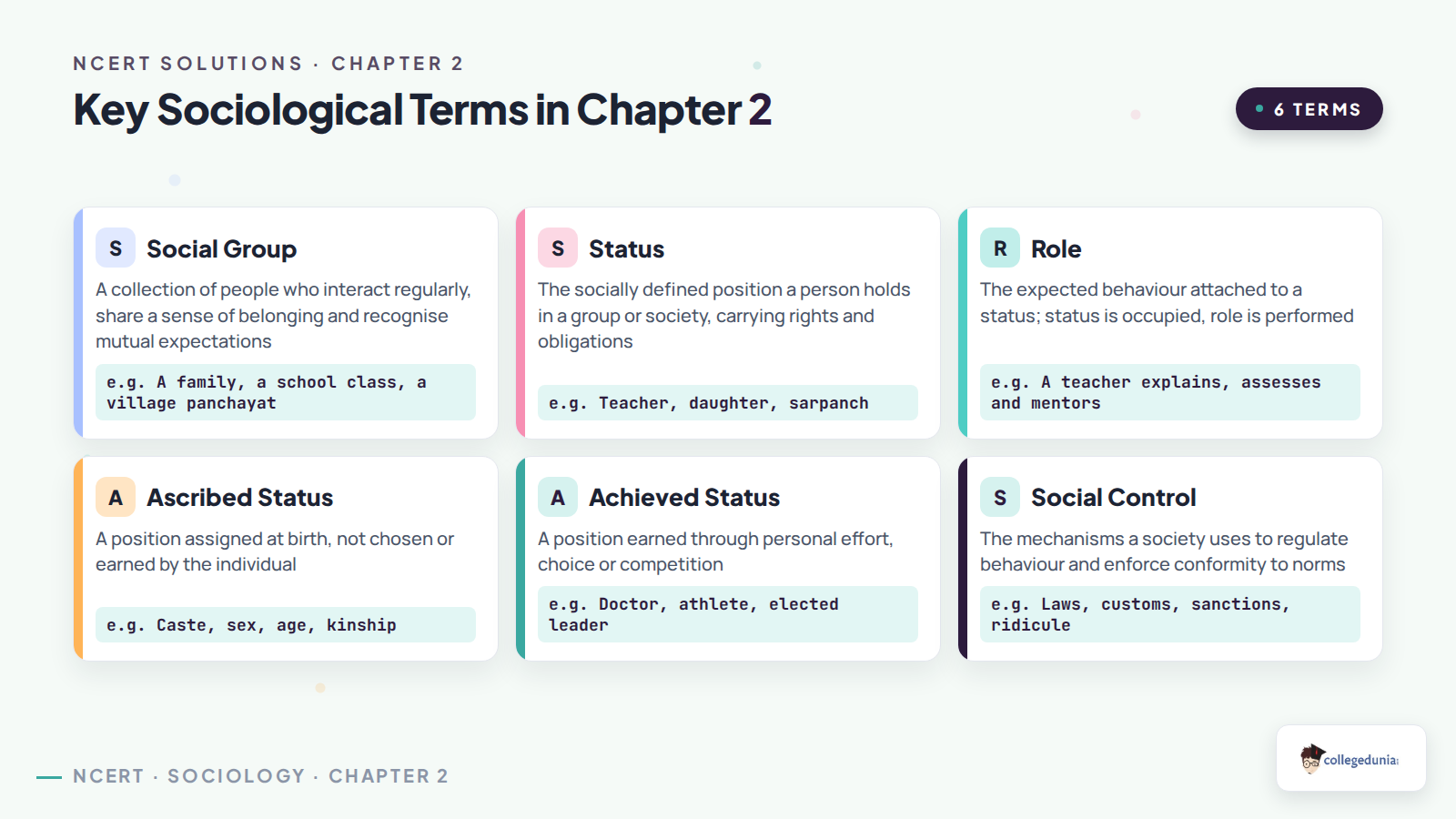
- Status is simply a position in society or in a group, carrying defined rights and duties. A mother occupies a status with its own norms of conduct, responsibilities and prerogatives.
- Role is the dynamic or behavioural aspect of status. Status is occupied, but roles are played. A status is an institutionalised role, one that has become regularised, standardised and formalised.
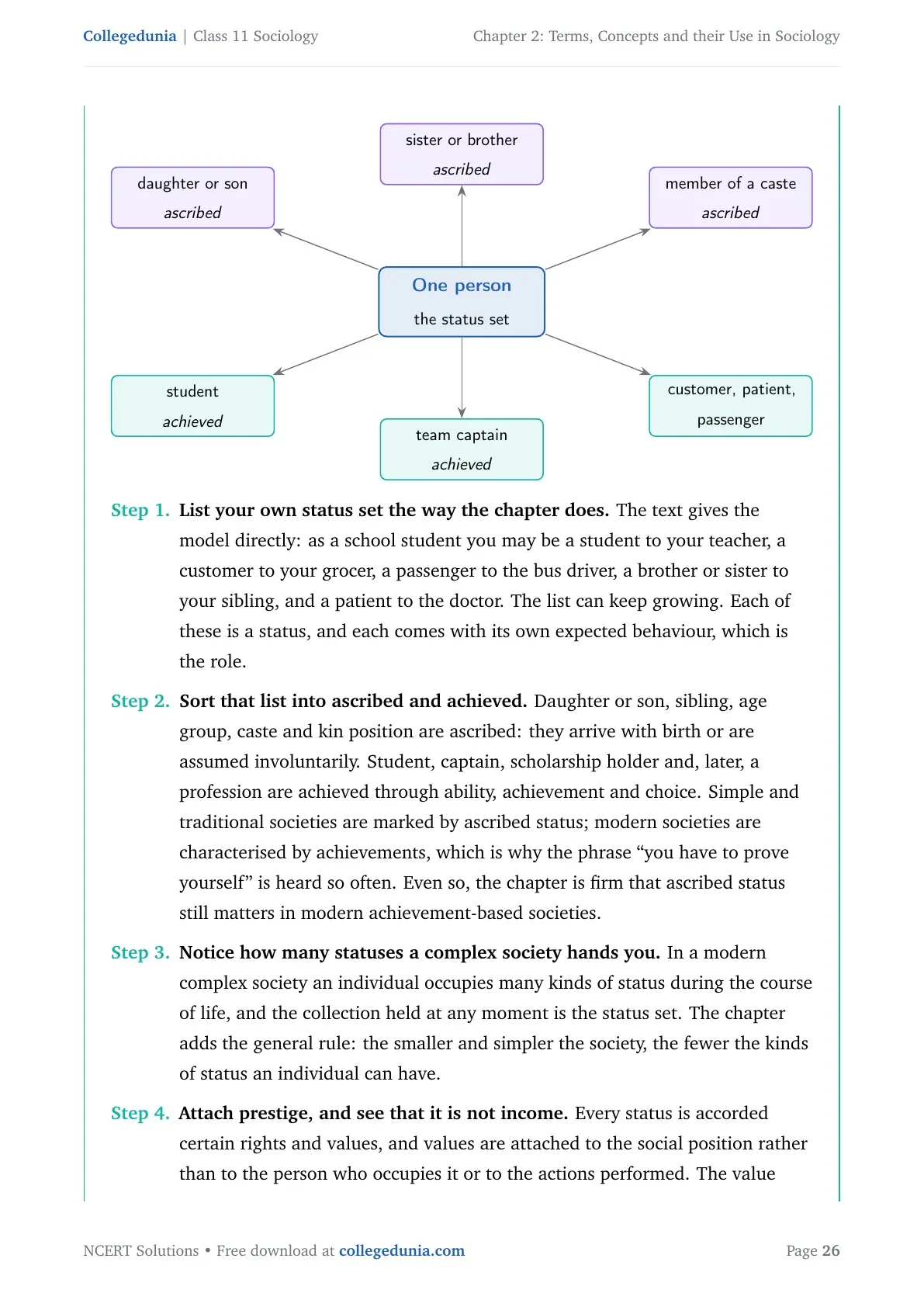
- Status set is the collection of positions one person holds at the same time. You may be a student to your teacher, a customer to your grocer, a passenger to the bus driver and a patient to the doctor.
- Status sequence is the set of positions attained one after another. A son becomes a father, then a grandfather, then a great grandfather.
| Point | Ascribed status | Achieved status |
|---|---|---|
| How it is acquired | By birth, or assumed involuntarily | Voluntarily, by personal ability, achievement, virtue and choice |
| Common bases | Age, caste, race, kinship | Educational qualifications, income, professional expertise |
| Society it marks | Simple and traditional societies | Modern societies, where prestige follows achievement |
Add the prestige line to finish the answer. Value is attached to the position itself, not to the person filling it or to how well it is filled. The prestige of a doctor may be higher than that of a shopkeeper even when the doctor earns less, and which occupations count as prestigious varies across societies and across periods.
Role Conflict, Role Stereotyping and What the Khasi Example Shows
People perform roles according to social expectations, which sociology calls role taking and role playing. A child learns to behave in line with how that behaviour will be seen and judged by others. Two problems follow from this, and both are examinable.
- Role conflict is the incompatibility among roles corresponding to one or more status. It appears when contrary expectations arise from two or more roles.
- The standard example is the middle class working woman who has to juggle her roles as mother and wife at home with her role as a professional at work.
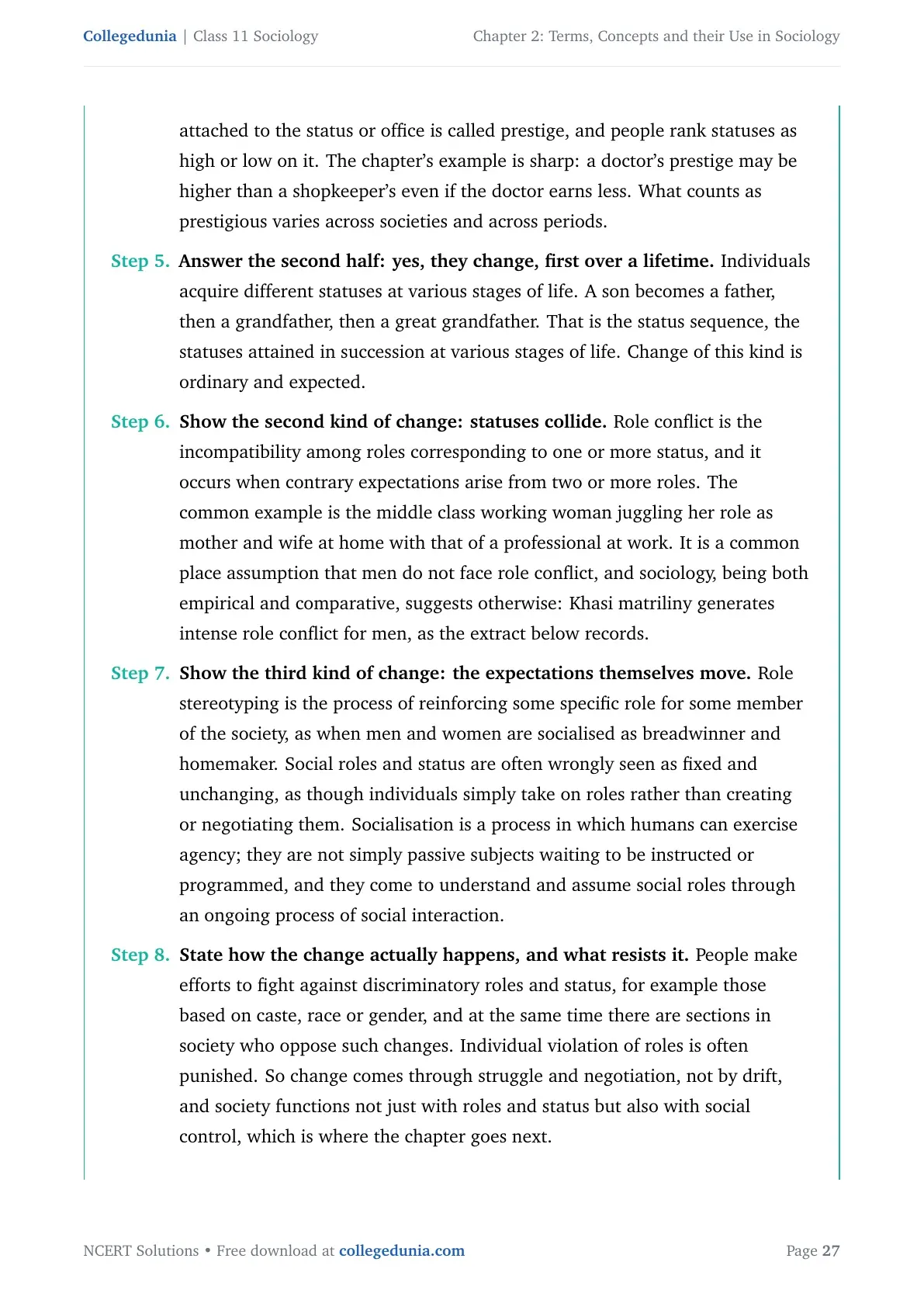
- Khasi matriliny shows that men face role conflict too. Tiplut Nongbri records that Khasi men are torn between duties to their natal house and duties to their wife and children, and lack the freedom to pass on even self-acquired property to their children.
- Role stereotyping reinforces one fixed role for a section of society, as when men and women are socialised as breadwinner and homemaker.
NCERT then corrects a common assumption. Roles are not simply handed out and absorbed. Socialisation is a process in which humans exercise agency, so people negotiate and shape roles through ongoing social interaction rather than waiting to be programmed.
Society and Social Control, Formal, Informal, Sanctions and Deviance
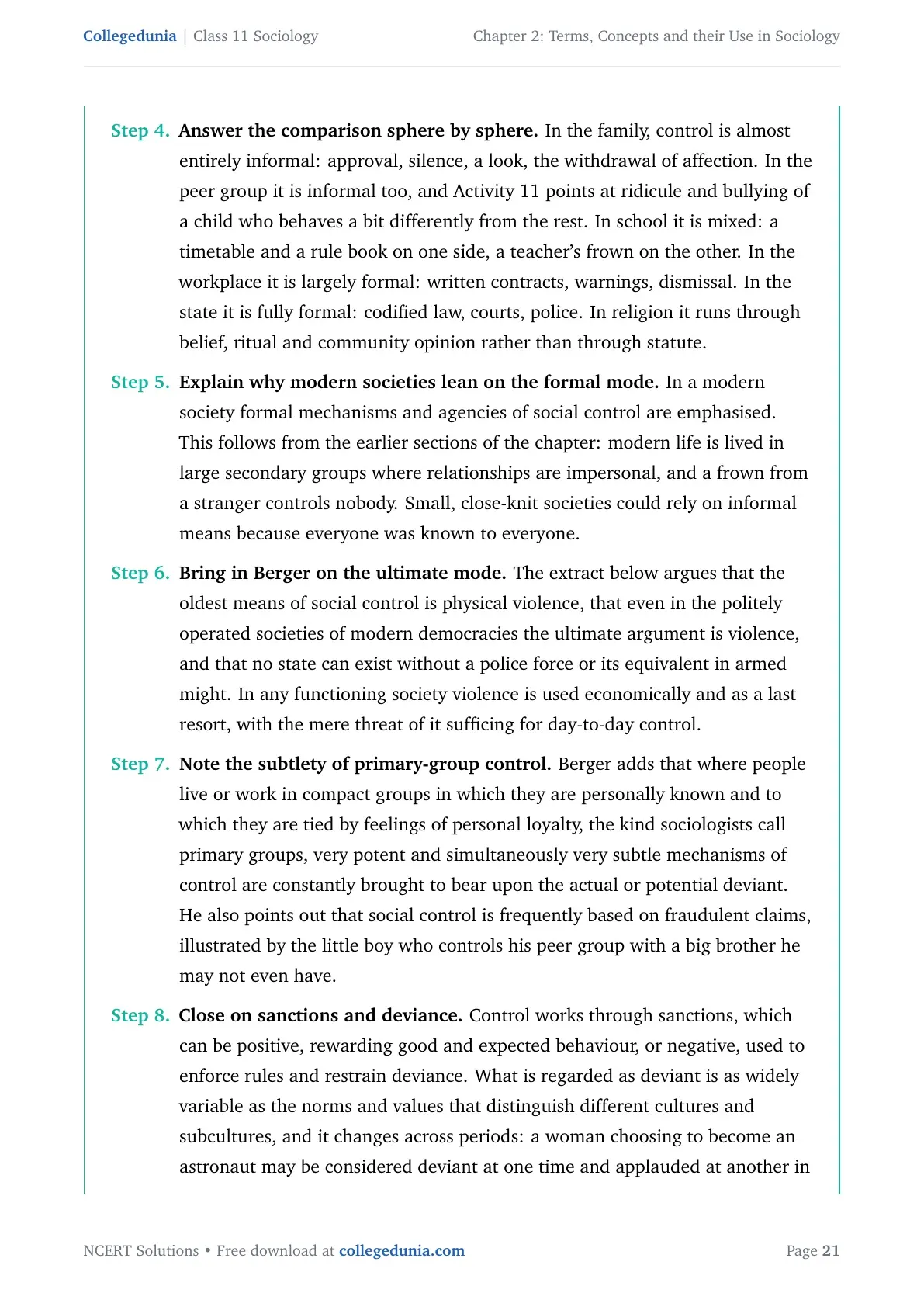
Exercise question 4 asks what social control is and whether it works differently in different spheres. The definition is short. Social control refers to the various means used by a society to bring its recalcitrant or unruly members back into line. The marks come from the two perspectives and the two types.
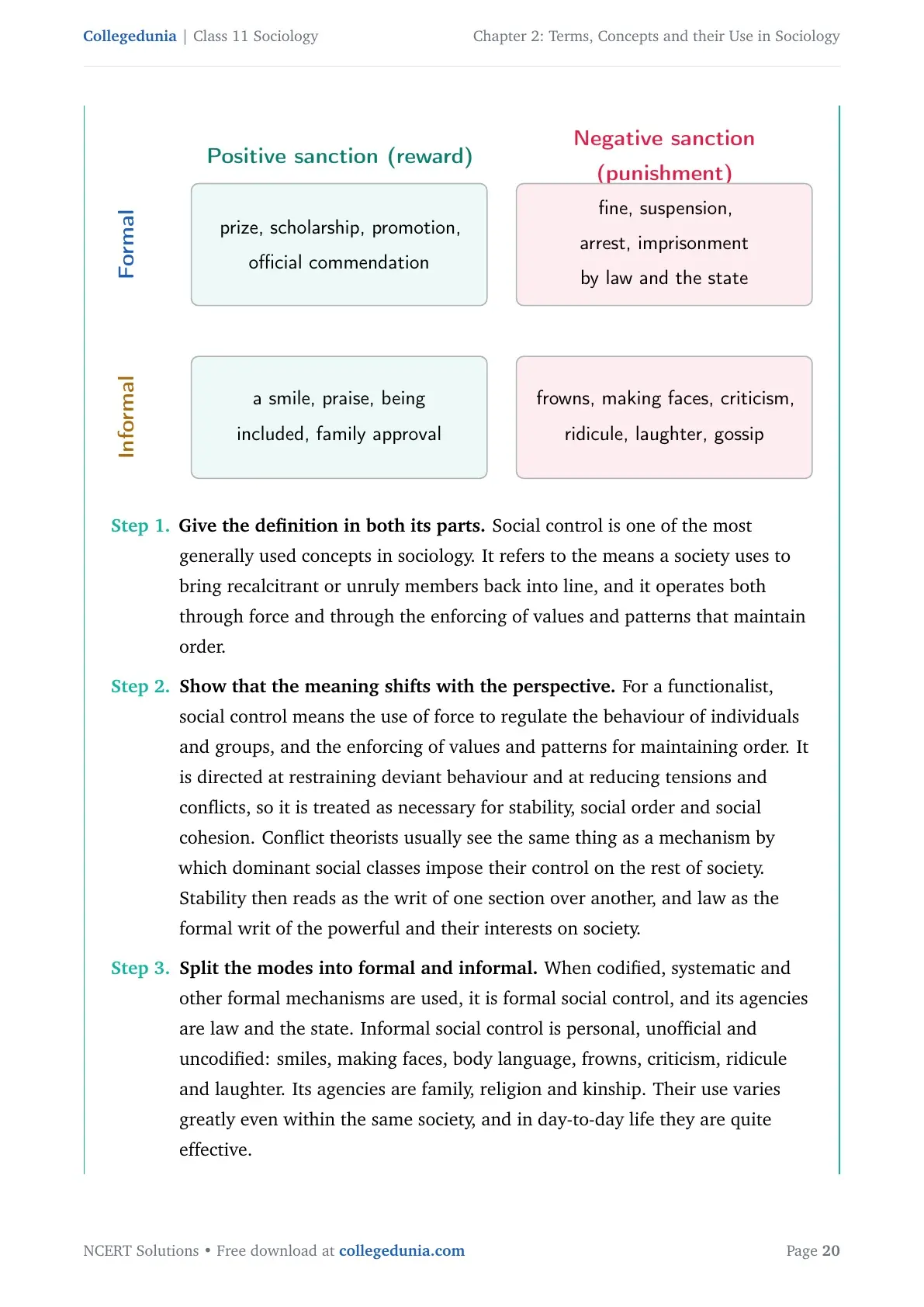
- For functionalists, social control means the use of force to regulate behaviour and the enforcing of values and patterns that maintain order. It restrains deviance, eases tension between groups, and is therefore necessary for stability.
- For conflict theorists, social control is a mechanism through which dominant classes impose their control on the rest of society. Stability becomes the writ of one section over another, and law becomes the formal writ of the powerful.
| Point | Formal social control | Informal social control |
|---|---|---|
| Character | Codified, systematic, official | Personal, unofficial, uncodified |
| Agencies | Law, the state and its machinery | Family, religion, kinship, peer group |
| Methods | Written rules, courts, penalties | Smiles, making faces, body language, frowns, criticism, ridicule, laughter |
| Where it dominates | Modern societies emphasise it | Effective in day-to-day life, with wide variation inside one society |
Two terms close the section. A sanction is a mode of reward or punishment that reinforces socially expected behaviour, so it can be positive or negative. Deviance means modes of action that do not conform to the norms or values held by most members of a group or society, and what counts as deviant changes from one culture and one period to another. A woman choosing to become an astronaut may be treated as deviant at one time and applauded at another in the very same society.
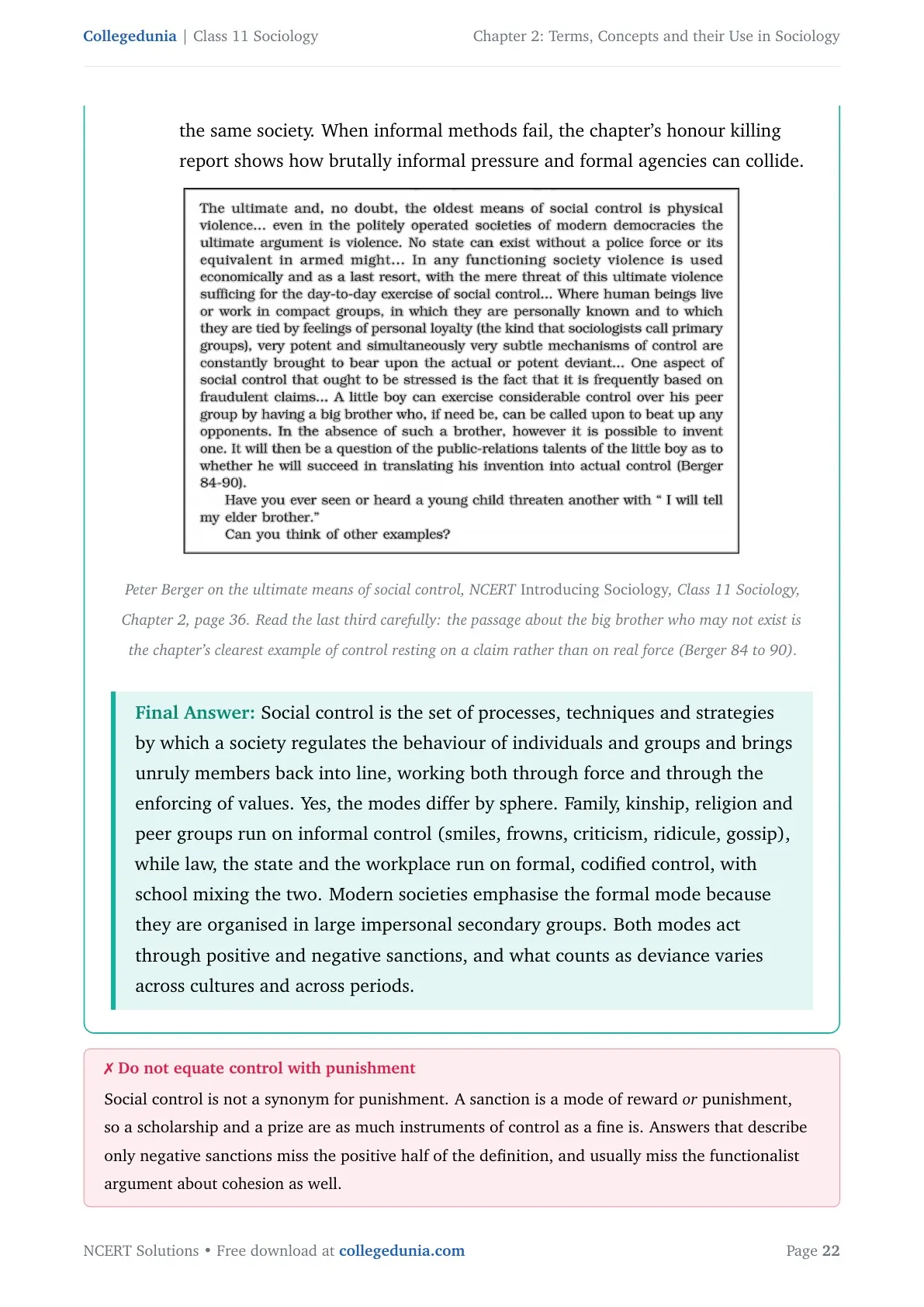
Peter Berger adds the line worth quoting. Physical violence is the oldest means of social control, yet in any working society it is used economically and as a last resort, with the mere threat of it enough for day-to-day control.
All 5 Textbook Questions Covered in These Terms and Concepts NCERT Solutions
Every exercise question here is open ended, so none of them has a one line answer. Use the table to see which section of the chapter each question draws on before you start writing.
| Question | What it asks | What your answer must use |
|---|---|---|
| Question 1 | Why sociology needs special terms and concepts | The familiarity problem, Berger's point, common sense against sociology, concepts as keys |
| Question 2 | How to see your own groups sociologically | Aggregate, quasi group, the six features, primary and secondary, in-group and reference group |
| Question 3 | The stratification system you observe and its effect on lives | The definition, the strata image, the four systems, caste and class, unequal life chances |
| Question 4 | What social control is, and whether it differs across spheres | The definition, functionalist and conflict views, formal and informal control, sanction, deviance |
| Question 5 | Your own roles and status, and whether they change | Status and role, status set and sequence, ascribed and achieved, role conflict, prestige |
How Terms, Concepts and their Use in Sociology Appears in the Class 11 Exam Paper
This chapter behaves like a definitions bank. Short questions come from single terms, and the long question usually comes from stratification or social control. Here is where it sits against the rest of the Class 11 Sociology course.
| Chapter | Title | Usual marks |
|---|---|---|
| Chapter 2 | Terms, Concepts and their Use in Sociology | 8 to 10 marks |
| Chapter 1 | Sociology and Society | 6 to 8 marks |
| Chapter 3 | Understanding Social Institutions | 8 to 10 marks |
| Chapter 4 | Culture and Socialisation | 7 to 9 marks |
| Chapter 5 | Doing Sociology: Research Methods | 6 to 8 marks |
| Chapter 6 | Social Structure, Stratification and Social Processes in Society | 8 to 10 marks |
Because Chapter 6 of the course carries stratification forward, the definitions you fix here are reused later in the year. Learning them properly once saves you a second round of revision.
Common Mistakes Students Make in the Terms and Concepts Chapter
Check your answers for these five before the paper.
- Calling a crowd a social group. A crowd is a quasi group, because it has no structure and its members may not know the grouping exists.
- Writing that a secondary group is simply a big primary group. The real difference is person oriented against goal oriented.
- Treating a reference group as a group you belong to. You do not belong to it, you identify with it.
- Saying caste is ascribed and stopping there. The answer needs the purity and pollution idea, varna and jati, and the changes brought by urbanisation and democracy.
- Giving only the functionalist view of social control. The conflict view is worth its own paragraph in a long answer.
Sample Solved Long Answer on Social Control for the Class 11 Sociology Exam
Here is exercise question 4 written the way a marker wants to read it. Notice how each step is a separate short paragraph, so the examiner can tick as she goes.
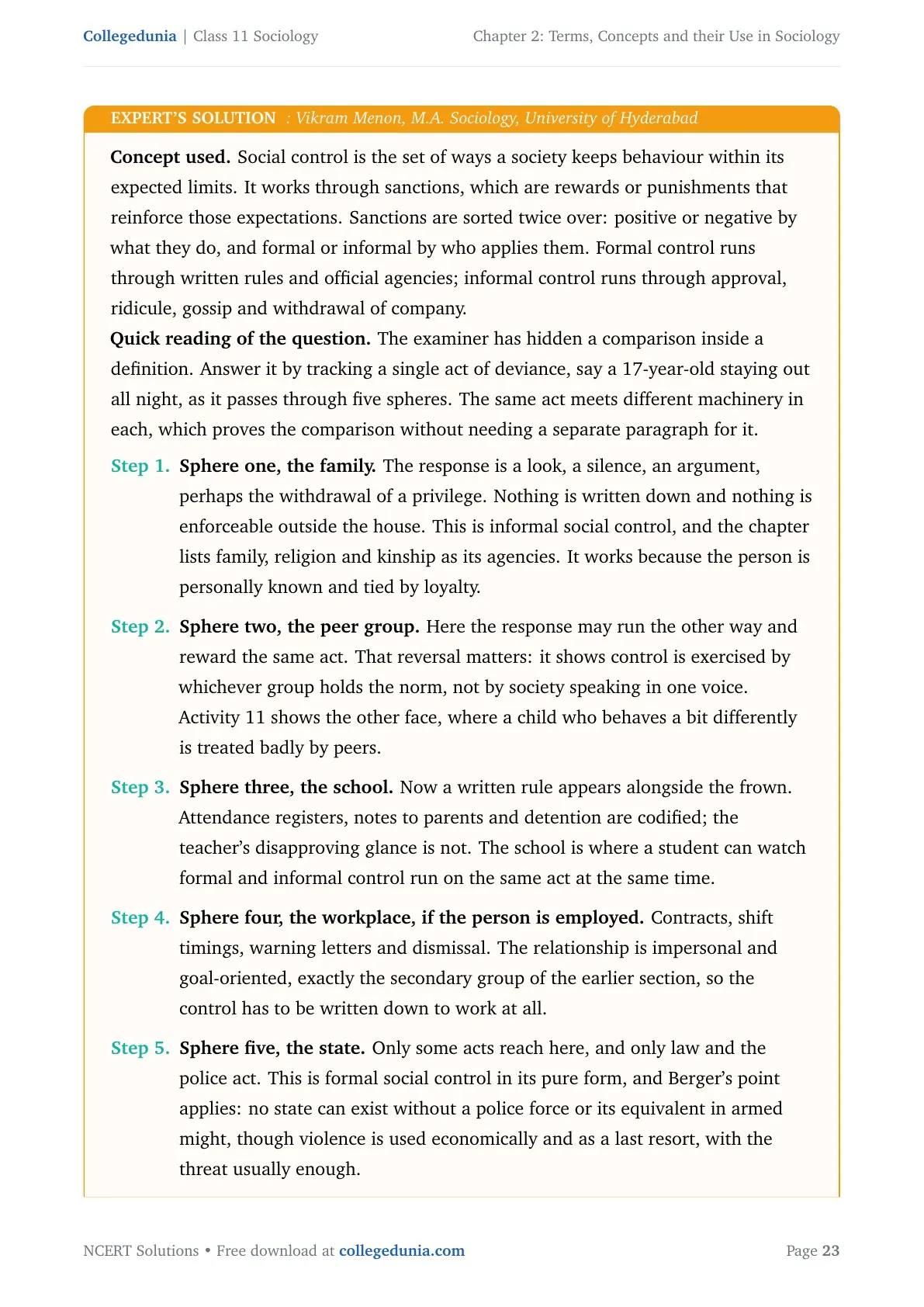
- Definition. Social control refers to the various means a society uses to bring its unruly members back into line, and to the social processes, techniques and strategies through which the behaviour of an individual or a group is regulated.
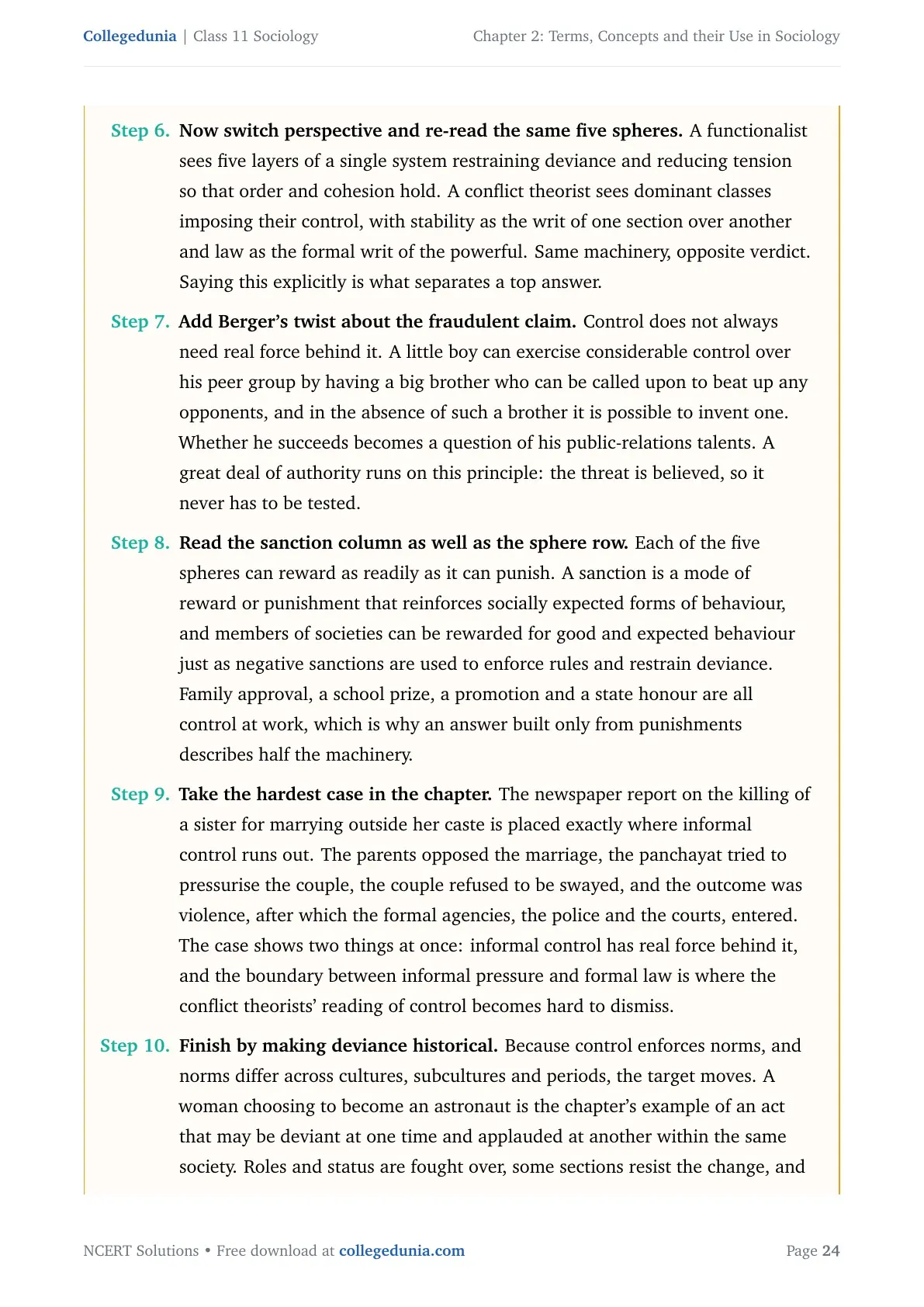
- The two perspectives. Functionalists see it as the use of force plus the enforcing of values that maintain order, and therefore as necessary for stability. Conflict theorists see it as a way for dominant classes to impose their control, with law as the formal writ of the powerful.
- Yes, the modes differ by sphere. Formal control is codified and official, carried by law and the state, and modern societies lean on it. Informal control is personal and uncodified, carried by family, religion and kinship.
- Give the examples. Courts and the police on the formal side. Smiles, frowns, ridicule, criticism and laughter on the informal side, which work quietly but effectively every day.
- Close with sanction and deviance. A sanction rewards expected behaviour or punishes deviance, and deviance itself is whatever fails to match the norms most members hold, so it shifts across cultures and periods.
Key Terms from the Terms and Concepts Glossary Every Class 11 Student Should Know
The glossary at the end of the chapter is a ready-made source of one mark answers. Learn these in the book's own words.
| Term | NCERT meaning |
|---|---|
| Conflict theories | A perspective focused on the tensions, divisions and competing interests in human societies, where scarce and valued resources produce conflict between groups |
| Functionalism | A perspective that explains social events by the function they perform, that is the contribution they make to the continuity of a society |
| Identity | The distinctive characteristic of a person's character, or of a group, relating to who they are and what is meaningful to them. Gender, nationality or ethnicity and social class are main sources |
| Means of production | The means by which material goods are produced in a society, including technology and the social relations between producers |
| Microsociology and macrosociology | Microsociology studies everyday behaviour in face-to-face situations. Macrosociology studies large-scale systems such as the political system or the economic order |
| Natal | Relating to the place or time of one's birth |
| Norms | Rules of behaviour that embody a culture's values, prescribing or forbidding a type of behaviour, and always backed by sanctions |
| Sanctions | A mode of reward or punishment that reinforces socially expected forms of behaviour |
How to Study Terms, Concepts and their Use in Sociology for the 2026-27 Class 11 Exam
This chapter rewards sorting more than reading time. Three short sittings are enough if you use them as described below.
- Sitting one, build the pair cards. One card per pair: primary and secondary, community and association, in-group and out-group, ascribed and achieved, formal and informal. Definition on the front, NCERT example on the back.
- Sitting two, learn the two lists. The six features of a social group and the four systems of stratification. These are the lists examiners mark point by point.
- Sitting three, write two long answers. Attempt exercise questions 3 and 4 without the book, then check them against the solutions on this page.
- Before the paper, revise the glossary and the named sources. Berger, Marx, Weber, Durkheim, Srinivas, Desai and Nongbri cover nearly every one and two mark question in this chapter.
Terms and Concepts Class 11 Sociology Resources Beyond These NCERT Solutions
Also Check: use these alongside the solutions. The handwritten notes work the night before the paper, and the question set lets you attempt each exercise question before reading the answer.
| Resource | Best used for | Link |
|---|---|---|
| Terms and Concepts Class 11 Handwritten Notes | Last minute revision of every paired term the night before the paper | Read the Terms and Concepts Class 11 Handwritten Notes |
| Terms and Concepts Question and Answer Set | All 5 exercise questions with a short Solution tab and an expanded Expert Solution tab | Open the Terms and Concepts question and answer set |
| Understanding Social Institutions Class 11 NCERT Solutions | The next chapter, which builds on status, role and social control | Read the Understanding Social Institutions Class 11 NCERT Solutions |
NCERT Solutions for All Class 11 Sociology Chapters
Related Links: the same answer format runs across every chapter of Class 11 Sociology, so you can move from one to the next without changing how you write. Chapters 1 to 5 come from Introducing Sociology and chapters 6 to 10 come from Understanding Society.
| Chapter | Title | Solutions |
|---|---|---|
| Chapter 2 | Terms, Concepts and their Use in Sociology | Terms and Concepts in Sociology Class 11 NCERT Solutions (this page) |
| Chapter 3 | Understanding Social Institutions | Understanding Social Institutions Class 11 NCERT Solutions |
| Chapter 4 | Culture and Socialisation | Culture and Socialisation Class 11 NCERT Solutions |
| Chapter 5 | Doing Sociology: Research Methods | Doing Sociology Research Methods Class 11 NCERT Solutions |
| Chapter 6 | Social Structure, Stratification and Social Processes in Society | Social Structure and Stratification Class 11 NCERT Solutions |
| Chapter 7 | Social Change and Social Order in Rural and Urban Society | Social Change and Social Order Class 11 NCERT Solutions |
| Chapter 8 | Environment and Society | Environment and Society Class 11 NCERT Solutions |
| Chapter 9 | Introducing Western Sociologists | Introducing Western Sociologists Class 11 NCERT Solutions |
| Chapter 10 | Indian Sociologists | Indian Sociologists Class 11 NCERT Solutions |
All 5 questions with step-by-step solutions
Open the full question set for this chapter, where every exercise question comes with a short Solution tab and an expanded Expert Solution tab. Open the Terms and Concepts Class 11 question and answer set
Terms, Concepts and their Use in Sociology Class 11 Sociology NCERT Solutions FAQs
Ques. Why do we need special terms and concepts in sociology?
Ans. Because sociology studies things everyone already knows something about, and everyday words already exist for them. Peter Berger points out that we are so well acquainted with the social institutions around us that we cannot see them clearly and precisely. Assuming we know all about families because we live in one confuses sociological knowledge with common sense. Special terms give the subject rules of evidence and a shared vocabulary, and they carry the history of thinkers trying to map the shift from pre-modern to modern society.
Ques. What is the difference between an aggregate, a quasi group and a social group?
Ans. An aggregate is a collection of people in the same place at the same time who share no definite connection, such as passengers waiting at a railway station. A quasi group is an aggregate that lacks structure or organisation, whose members may be unaware of the grouping, such as social classes, status groups, age and gender groups and crowds. A social group has persistent interaction, a stable pattern of interaction, a sense of belonging, shared interest, common norms and values, and a definable structure.
Ques. How do primary groups differ from secondary groups?
Ans. A primary group is small, connected by intimate and face-to-face association and co-operation, and its members share a sense of belonging. Family, village and groups of friends are the textbook examples. A secondary group is relatively large and maintains formal, impersonal relationships, such as schools, government offices, hospitals and students' associations. The simplest separating line is that primary groups are person oriented while secondary groups are goal oriented. A peer group is a kind of primary group formed by people of similar age or a common profession.
Ques. What is a reference group and how is it different from an in-group?
Ans. A reference group is a group whose lifestyle is emulated. We do not belong to it, but we identify ourselves with it, and it acts as a source of information about culture, lifestyle, aspiration and goal attainment. An in-group is a group we actually belong to, marked by a sense of belonging that separates us from them. In the colonial period many middle class Indians treated the English as a reference group, and NCERT notes that this emulation was gendered.
Ques. What are the four historical systems of social stratification?
Ans. Slavery, caste, estate and class. Slavery is an extreme form of inequality in which some people are literally owned by others, seen in ancient Greece and Rome and in the Southern States of the USA in the 18th and 19th centuries, and now eradicated as a formal institution though bonded labour continues. Caste fixes position by birth. Estates characterised feudal Europe. Class is open and achievement based, and Class 11 takes it up in detail in the book Understanding Society.
Ques. How do Marx, Weber and functionalism explain class differently?
Ans. In Marxist theory social classes are defined by their relation to the means of production, so the question is whether a group owns land and factories or owns nothing but its own labour. Weber uses the idea of life-chances, the rewards and advantages afforded by market capacity, and adds that inequality may also rest on prestige or political power. Functionalism argues that no society is classless, and treats stratification as an unconsciously evolved device that places the most qualified persons in the most important positions.
Ques. What is the difference between status set and status sequence?
Ans. A status set is the group of positions one person holds at the same time. A school student is a student to the teacher, a customer to the grocer, a passenger to the bus driver, a sibling at home and a patient to the doctor. A status sequence is the set of positions attained one after another at different stages of life, such as a son who becomes a father, then a grandfather, then a great grandfather. The smaller and simpler the society, the fewer the positions a person can hold.
Ques. What is role conflict, and can men face it too?
Ans. Role conflict is the incompatibility among roles corresponding to one or more status, and it appears when contrary expectations arise from two or more roles. The common example is the middle class working woman juggling her roles as mother and wife with her role as a professional. Men face it too. Tiplut Nongbri records that Khasi matriliny leaves men torn between duties to their natal house and duties to their wife and children, and that the strain affects Khasi women even more intensely.
Ques. How is formal social control different from informal social control?
Ans. Formal social control is codified, systematic and official, and its agencies are law and the state. Modern societies emphasise it. Informal social control is personal, unofficial and uncodified, and it works through smiles, making faces, body language, frowns, criticism, ridicule and laughter. Its agencies are family, religion and kinship. Informal control is very effective in day-to-day life, though its use varies widely inside a single society, and it may not always be enough to enforce conformity.
Ques. What is deviance and why does it change over time?
Ans. Deviance refers to modes of action that do not conform to the norms or values held by most members of a group or society. Because norms and values differ across cultures and subcultures, what counts as deviant is just as variable. Ideas of deviance are also challenged from one period to another. NCERT gives the example of a woman choosing to become an astronaut, who may be treated as deviant at one time and applauded at another within the same society.
Ques. How is social stratification defined in Class 11 Sociology?
Ans. Social stratification refers to the existence of structured inequalities between groups in society in terms of their access to material or symbolic rewards. It is often compared to the geological layering of rock, so society is seen as strata in a hierarchy with the more favoured at the top and the less privileged near the bottom. It matters because opportunities for health, longevity, security, educational success, fulfilment in work and political influence are all distributed unequally in systematic ways.
Ques. How many exercise questions are there in this chapter and where can I get the answers?
Ans. The chapter ends with 5 exercise questions, covering the need for sociological terms, social groups, stratification, social control, and roles and status. All five are answered on this page according to the 2026-27 NCERT Introducing Sociology book, and the downloadable PDF carries the same answers in a printable layout. The question and answer set linked above gives you each question with a short Solution tab and an expanded Expert Solution tab so you can attempt it first.



Comments