Maths Mentor, Delhi University | Updated on - Jul 21, 2026
The Matrices Class 12 NCERT Solutions page compiles NCERT Class 12 Mathematics Chapter 3 into a single download-ready resource, aligned to the 2026-27 NCERT syllabus. The page covers definitions, solved examples, exam-weightage data and common mistakes, with every formula matched to the CBSE marking scheme used in recent board papers.
CBSE Weightage: 8-10 marks (Matrices + Determinants cluster, one 5-mark long-answer routinely sourced here)
JEE Main Weightage: 5-7% (1-2 questions on matrix powers, transpose properties, or inverse)
Why this set carries disproportionate weight: Matrix algebra feeds directly into Chapter 4 Determinants, Chapter 11 Three-Dimensional Geometry, and every JEE Main system-of-equations problem. The skills you build on Q1 (mathematical induction for powers) and Q7 (symmetric plus skew-symmetric decomposition) recur in entrance papers across the next four years of engineering and management exams.
These Class 12 Maths Chapter 3 Matrices Miscellaneous Exercise NCERT Solutions were prepared by Collegedunia's senior Mathematics faculty against the 2026-27 NCERT print, with every induction base step verified and every transpose identity quoted by name. The format mirrors CBSE marking-scheme conventions, so the working maps one-to-one onto the examiner's mark grid.
Common Mistakes Students Make in the Miscellaneous Exercise
The this Class 12 page are written in formal mathematical notation, line by line, in the same convention as the official NCERT print.
Mistake 1 - Writing (AB)' = A'B' instead of B'A' . The reversal law is the most-tested identity in this set. Q4, Q5, Q11, Q15 all hinge on getting the order right; examiners deduct a full mark for the wrong order.
Mistake 2 - Skipping the induction base step. In Q1 to Q3 the base case n = 1 is the easy mark. The board scheme awards 1 mark for stating and verifying it; never skip.
Mistake 3 - Treating matrix multiplication as commutative. Q4's whole proof rests on AB ≠ BA in general. Writing AB - BA = O by "cancelling" is the most common wrong move. Always treat A and B as non-commuting.
Other Resources for Class 12 Maths Chapter 3 Matrices
NCERT Solutions Class 12 Maths: available above as a free PDF download, aligned to the 2026-27 NCERT Class 12 Mathematics syllabus.
the resource: available above as a free PDF download, aligned to the 2026-27 NCERT Class 12 Mathematics syllabus.
Exercise-wise Breakdown of the Matrices Chapter
The Matrices chapter splits into 4 numbered exercises plus a Miscellaneous Exercise. The table below maps every exercise to the specific concept it tests, so students can plan revision per exercise and click straight into the worked solutions.
All NCERT Solutions for Matrices Misc with Step-by-Step Working
Every NCERT textbook question for Class 12 Mathematics Chapter 3 Matrices Misc is listed below with its full Solution and Expert Solution hidden inside collapsible tabs. Click Check Solution to reveal the step-by-step working; click Expert Solution for the expanded explanation.
Questions
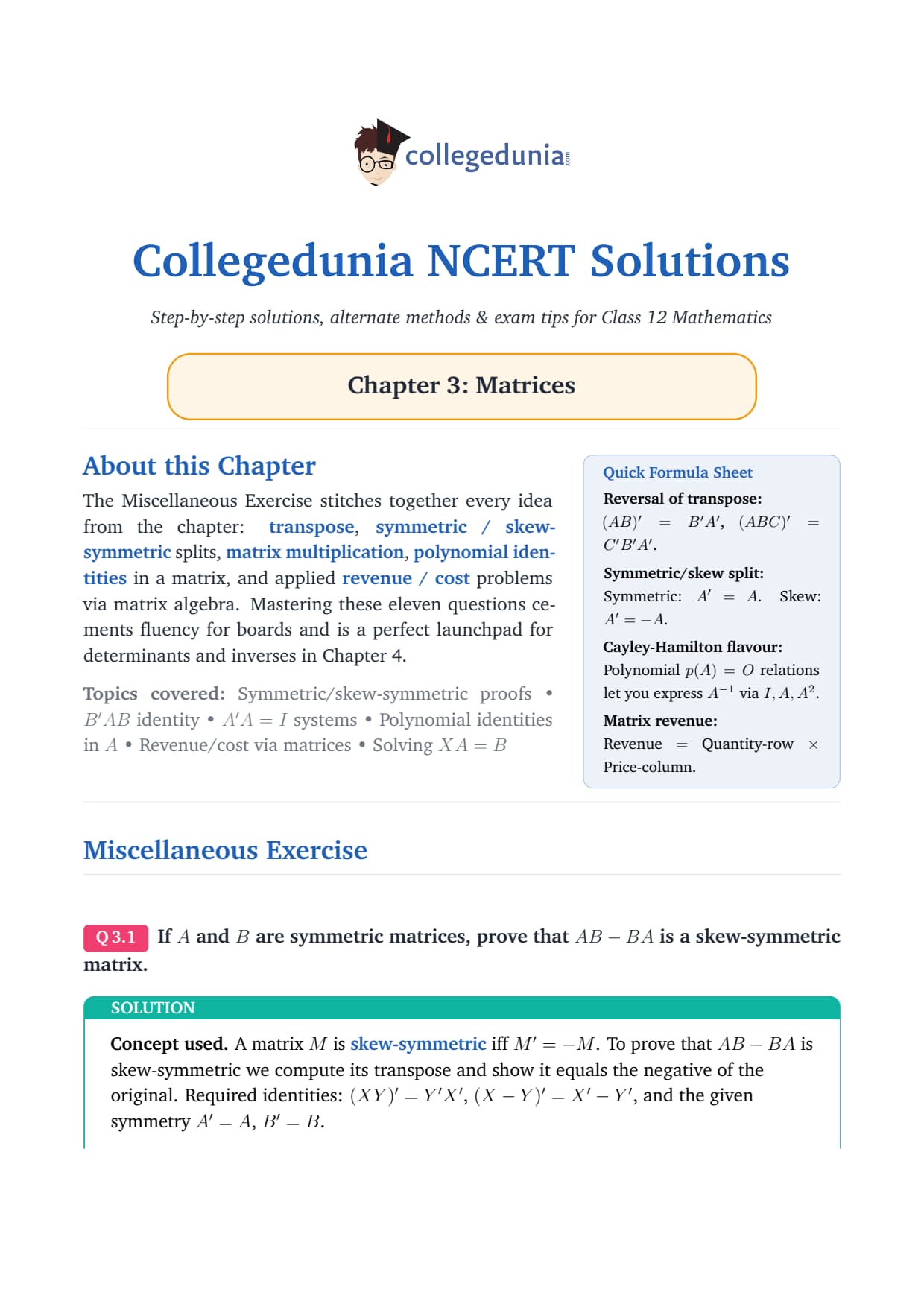
Q 3.1
If A and B are symmetric matrices, prove that AB-BA is a skew-symmetric matrix.
Concept used. A matrix M is skew-symmetric iff
M'=-M. To prove that AB-BA is skew-symmetric we compute its
transpose and show it equals the negative of the original. Required
identities: (XY)'=Y'X', (X-Y)'=X'-Y', and the given symmetry
A'=A, B'=B.
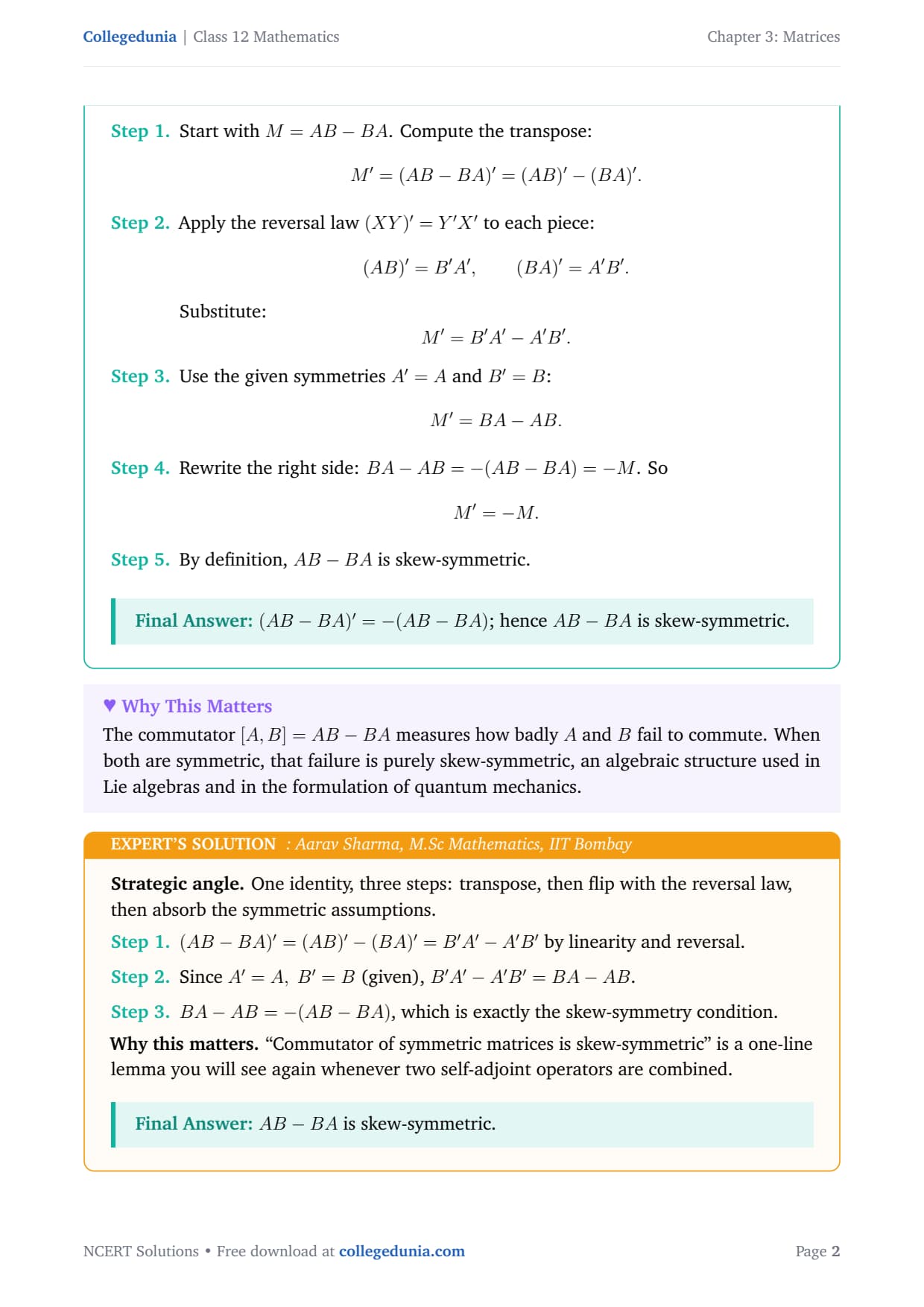
Start with M=AB-BA. Compute the transpose:
M' = (AB-BA)' = (AB)' - (BA)'.
Apply the reversal law (XY)'=Y'X' to each piece:
(AB)' = B'A', (BA)' = A'B'.
Substitute:
M' = B'A' - A'B'.
Use the given symmetries A'=A and B'=B:
M' = BA - AB.
Rewrite the right side: BA - AB = -(AB - BA) = -M. So
M' = -M.
By definition, AB-BA is skew-symmetric.
(AB-BA)'=-(AB-BA); hence AB-BA is skew-symmetric.
AS
Aarav Sharma
M.Sc Mathematics, IIT Bombay
Verified Expert
Strategic angle. One identity, three steps: transpose, then
flip with the reversal law, then absorb the symmetric assumptions.
(AB-BA)' = (AB)' - (BA)' = B'A' - A'B' by linearity and
reversal.
Since A'=A, B'=B (given), B'A'-A'B' = BA - AB.
BA-AB = -(AB-BA), which is exactly the skew-symmetry
condition.
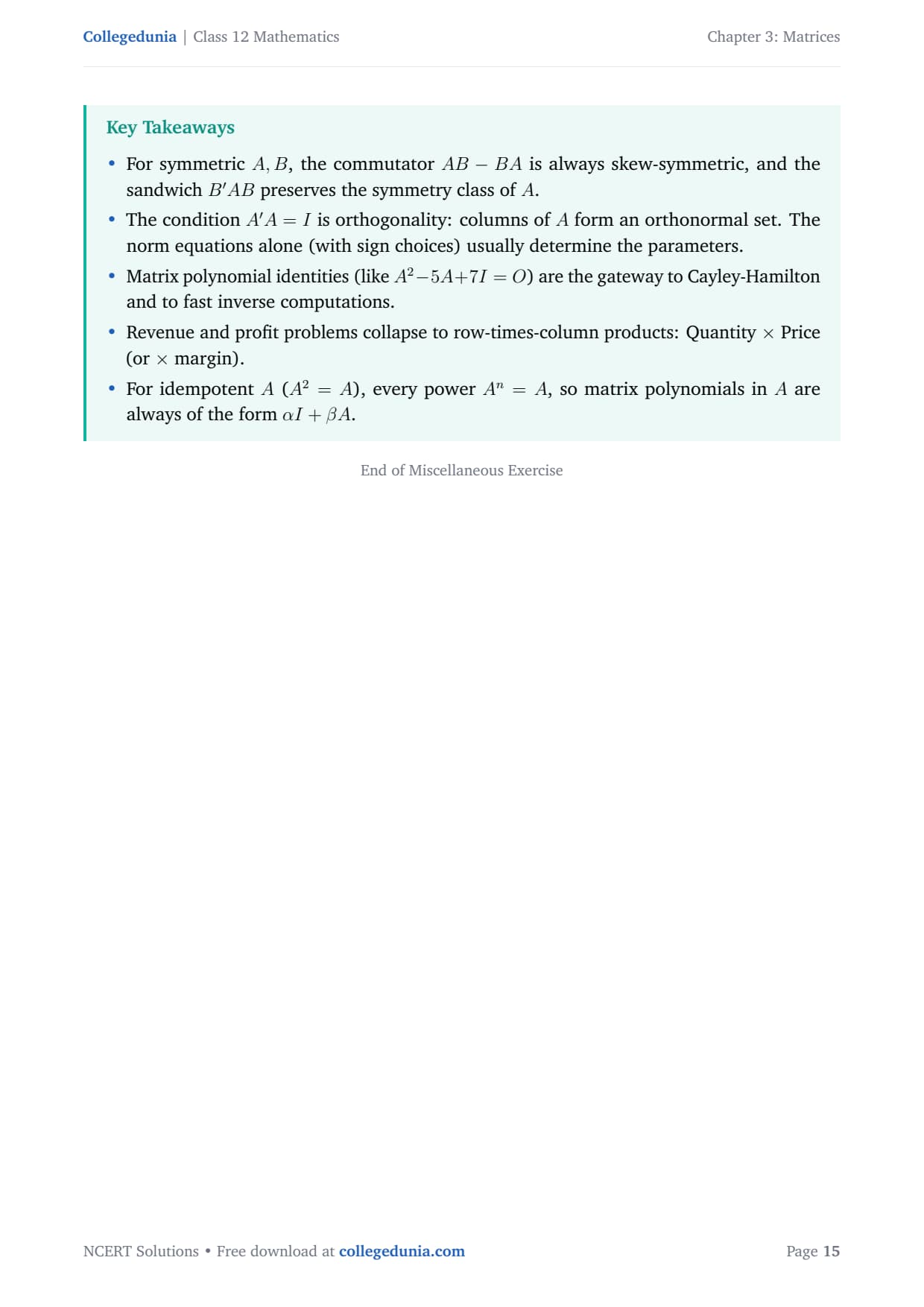
Why this matters. ``Commutator of symmetric matrices is
skew-symmetric'' is a one-line lemma you will see again whenever two
self-adjoint operators are combined.
AB-BA is skew-symmetric.
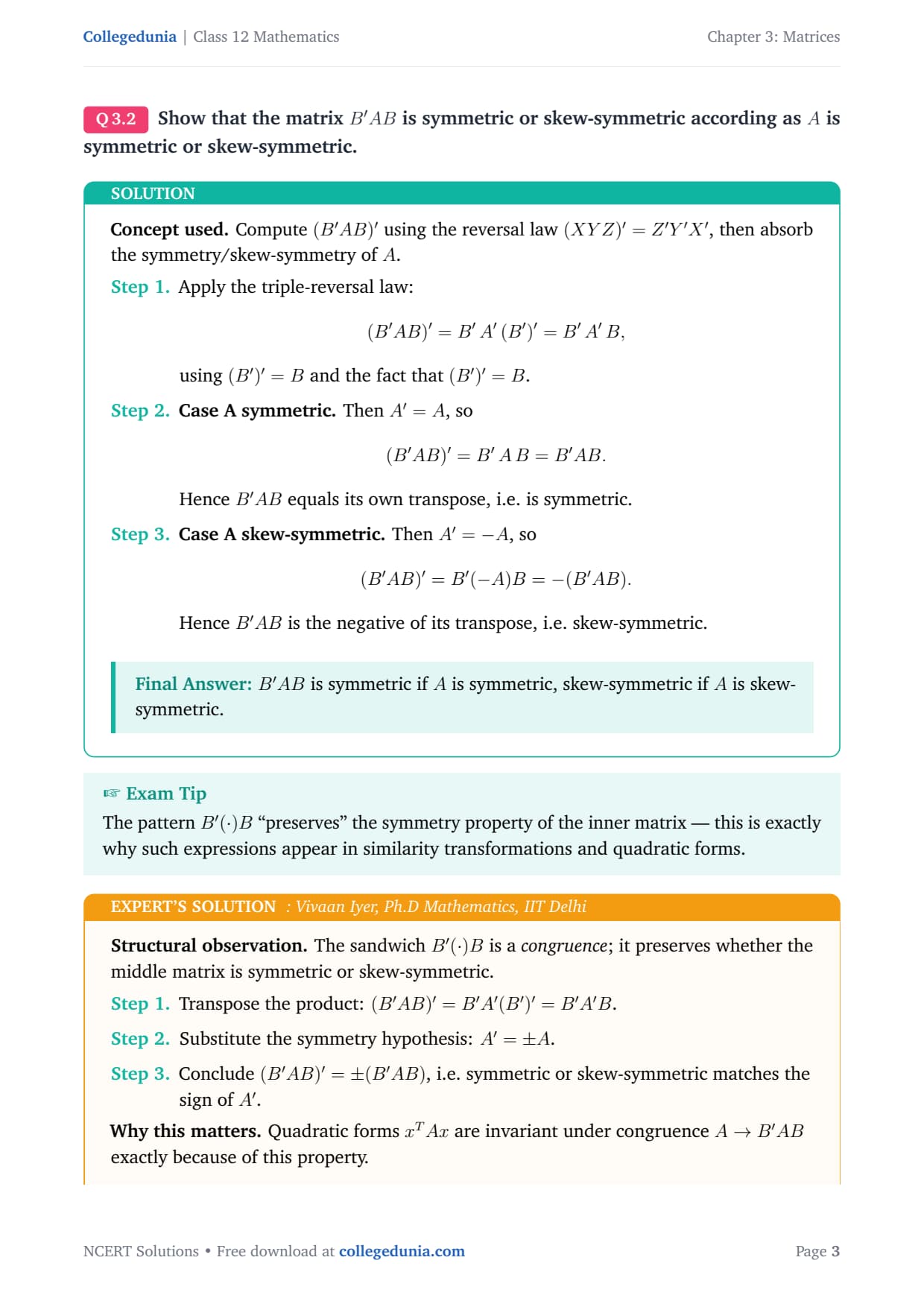
Q 3.2
Show that the matrix B'AB is symmetric or skew-symmetric according as A is symmetric or skew-symmetric.
Concept used. Compute (B'AB)' using the reversal law
(XYZ)'=Z'Y'X', then absorb the symmetry/skew-symmetry of A.
Apply the triple-reversal law:
(B'AB)' = B' A' (B')' = B' A' B,
using (B')'=B and the fact that (B')'=B.
Case A symmetric. Then A'=A, so
(B'AB)' = B' AB = B'AB.
Hence B'AB equals its own transpose, i.e. is symmetric.
Case A skew-symmetric. Then A'=-A, so
(B'AB)' = B'(-A)B = -(B'AB).
Hence B'AB is the negative of its transpose, i.e.
skew-symmetric.
B'AB is symmetric if A is symmetric, skew-symmetric if
A is skew-symmetric.
VI
Vivaan Iyer
Ph.D Mathematics, IIT Delhi
Verified Expert
Structural observation. The sandwich B'(·)B is a
congruence; it preserves whether the middle matrix is
symmetric or skew-symmetric.
Transpose the product: (B'AB)' = B' A' (B')' = B' A' B.
Substitute the symmetry hypothesis: A'=± A.
Conclude (B'AB)' = ±(B'AB), i.e. symmetric or
skew-symmetric matches the sign of A'.
Why this matters. Quadratic forms xTAx are invariant
under congruence A → B' AB exactly because of this property.
Same symmetry class is preserved.
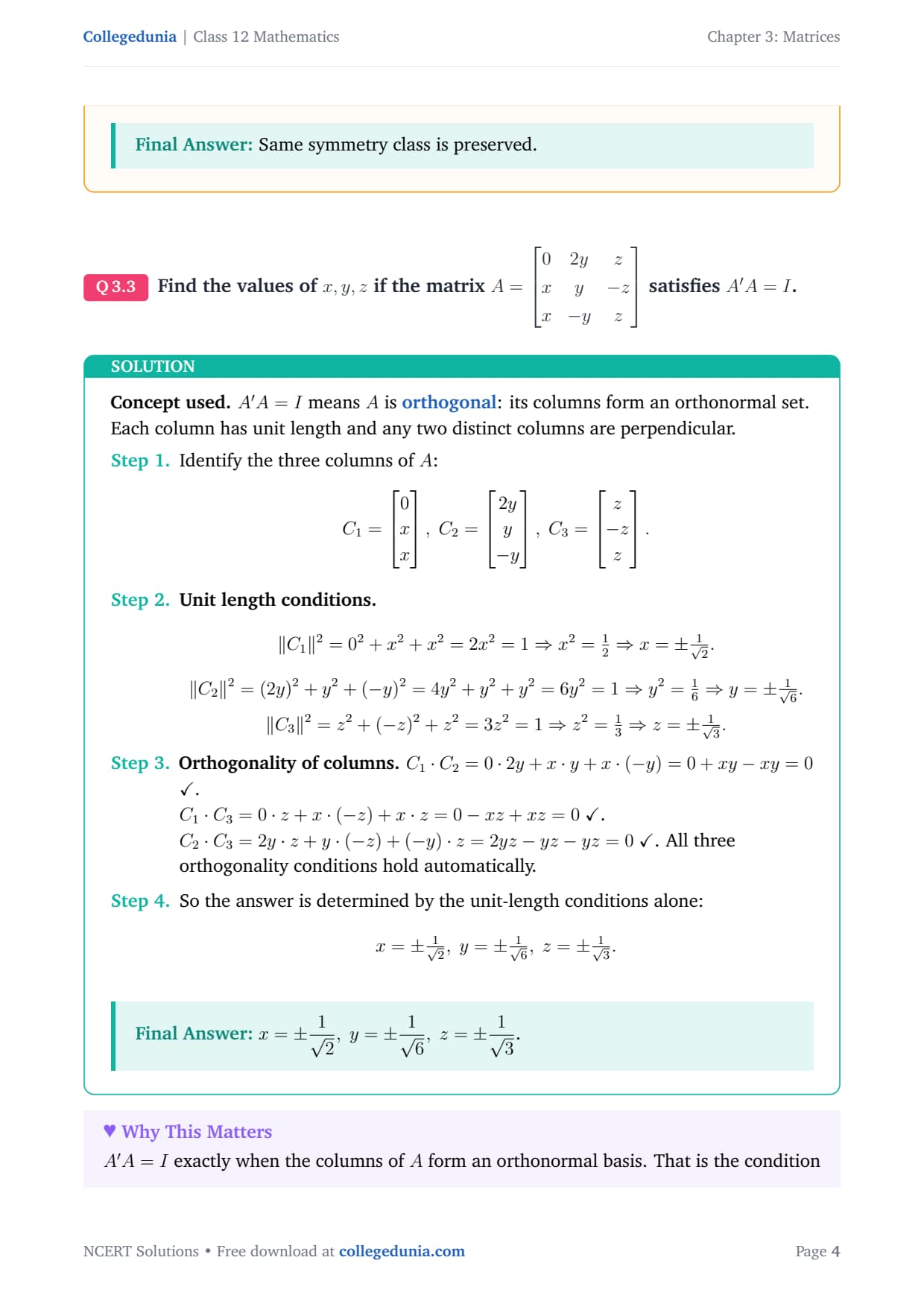
Q 3.3
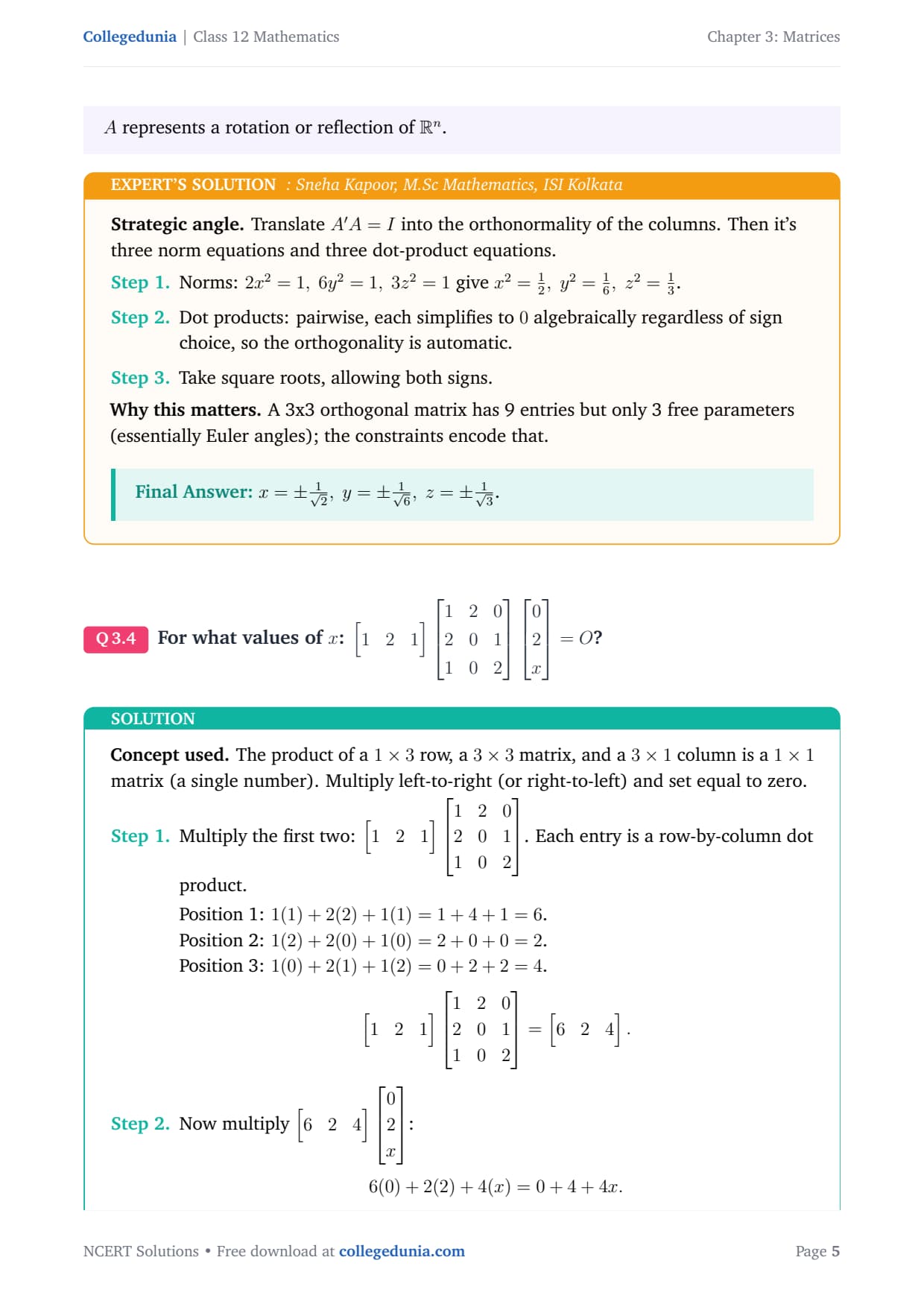
Find the values of x,y,z if the matrix A=bmatrix 0 & 2y & zx & y & -zx & -y & z bmatrix satisfies A'A=I.
Concept used.A'A=I means A is orthogonal: its
columns form an orthonormal set. Each column has unit length and any
two distinct columns are perpendicular.
Identify the three columns of A:
C1=bmatrix0 x xbmatrix,
C2=bmatrix2y y -ybmatrix,
C3=bmatrixz -z zbmatrix.
Orthogonality of columns.C1· C2 = 0· 2y + x· y + x·(-y) = 0+xy-xy = 0 . C1· C3 = 0· z + x·(-z) + x· z = 0-xz+xz = 0 . C2· C3 = 2y· z + y·(-z) + (-y)· z = 2yz-yz-yz = 0 .
All three orthogonality conditions hold automatically.
So the answer is determined by the unit-length conditions
alone:
x=±1√2, y=±1√6, z=±1√3.
x=±1√2, y=±1√6, z=±1√3.
SK
Sneha Kapoor
M.Sc Mathematics, ISI Kolkata
Verified Expert
Strategic angle. Translate A'A=I into the orthonormality
of the columns. Then it's three norm equations and three dot-product
equations.
Norms: 2x2=1, 6y2=1, 3z2=1 give x2=12, y2=16, z2=13.
Dot products: pairwise, each simplifies to 0 algebraically
regardless of sign choice, so the orthogonality is automatic.
Take square roots, allowing both signs.
Why this matters. A 3x3 orthogonal matrix has 9 entries but
only 3 free parameters (essentially Euler angles); the constraints
encode that.
x=±12, y=±16, z=±13.
Q 3.4
For what values of x: bmatrix 1 & 2 & 1 bmatrixbmatrix 1 & 2 & 0 2 & 0 & 1 1 & 0 & 2 bmatrixbmatrix 0 2 x bmatrix=O?
Concept used. The product of a 1× 3 row, a
3× 3 matrix, and a 3× 1 column is a 1× 1 matrix
(a single number). Multiply left-to-right (or right-to-left) and set
equal to zero.
Multiply the first two: bmatrix1&2&1bmatrixbmatrix 1 & 2 & 0 2 & 0 & 1 1 & 0 & 2 bmatrix.
Each entry is a row-by-column dot product.
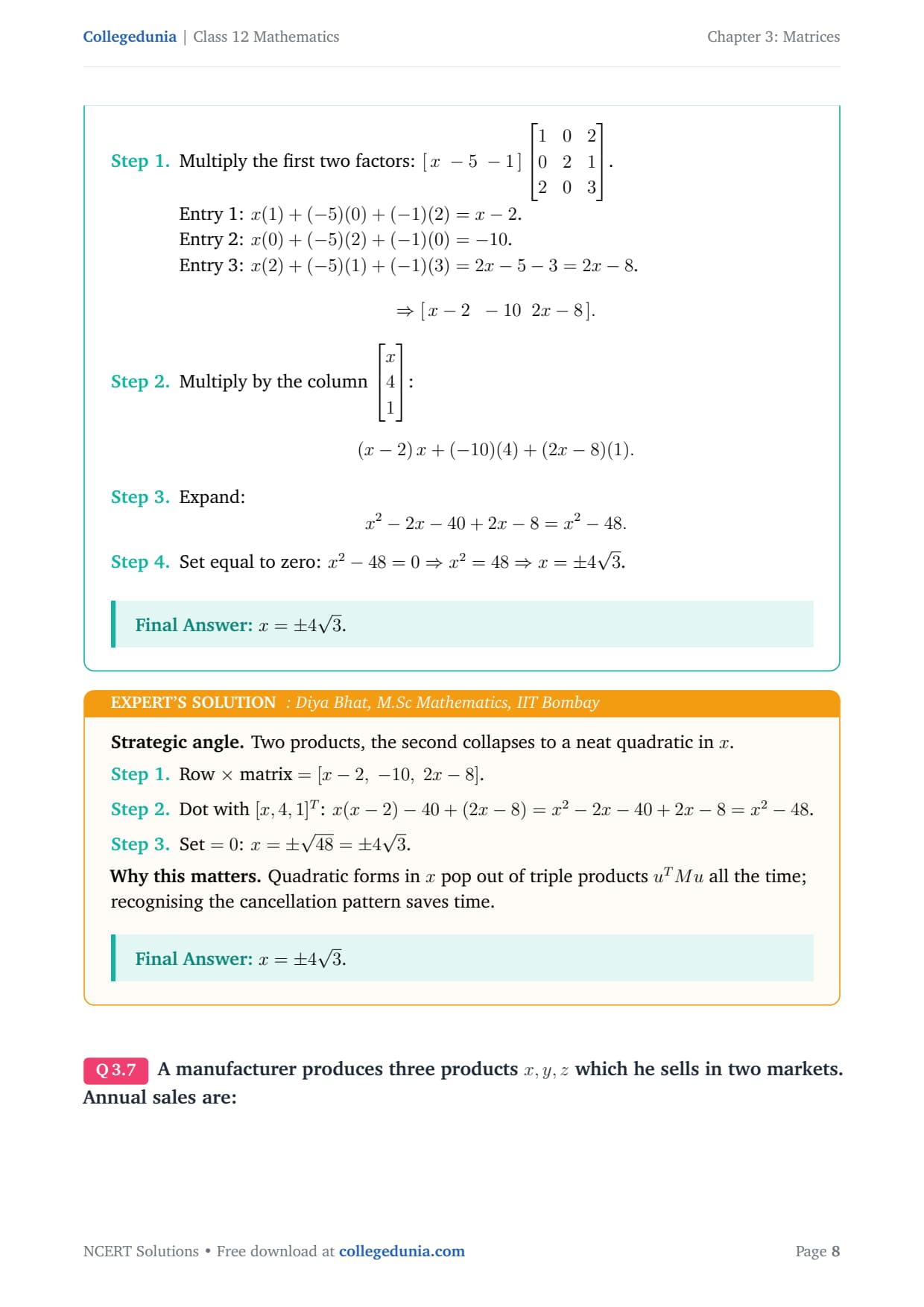
Multiply by the column bmatrixx 4 1bmatrix:
(x-2) x + (-10)(4) + (2x-8)(1).
Expand:
x2 - 2x - 40 + 2x - 8 = x2 - 48.
Set equal to zero: x2-48=0⇒ x2=48⇒ x=± 4√3.
x=± 4√3.
DB
Diya Bhat
M.Sc Mathematics, IIT Bombay
Verified Expert
Strategic angle. Two products, the second collapses to a
neat quadratic in x.
Row × matrix = [x-2, -10, 2x-8].
Dot with [x,4,1]T: x(x-2)-40+(2x-8) = x2-2x-40+2x-8=x2-48.
Set =0: x=±√48=± 43.
Why this matters. Quadratic forms in x pop out of triple
products uTMu all the time; recognising the cancellation pattern
saves time.
x=± 4√3.
Q 3.7
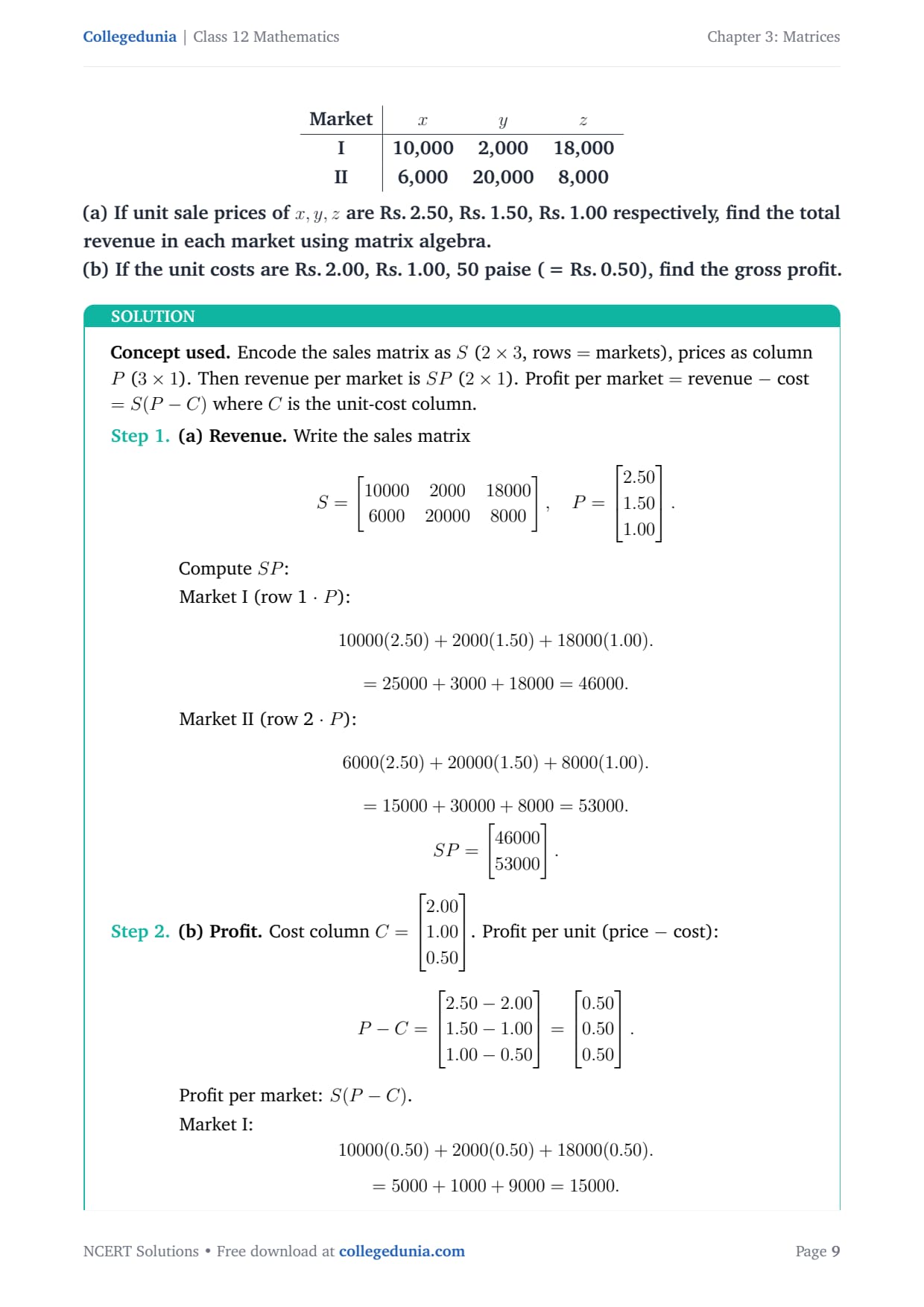
A manufacturer produces three products x,y,z which he sells in two markets.
Annual sales are:
tabularc|ccc
Market & x & y & z
I & 10,000 & 2,000 & 18,000
II & 6,000 & 20,000 & 8,000
tabular
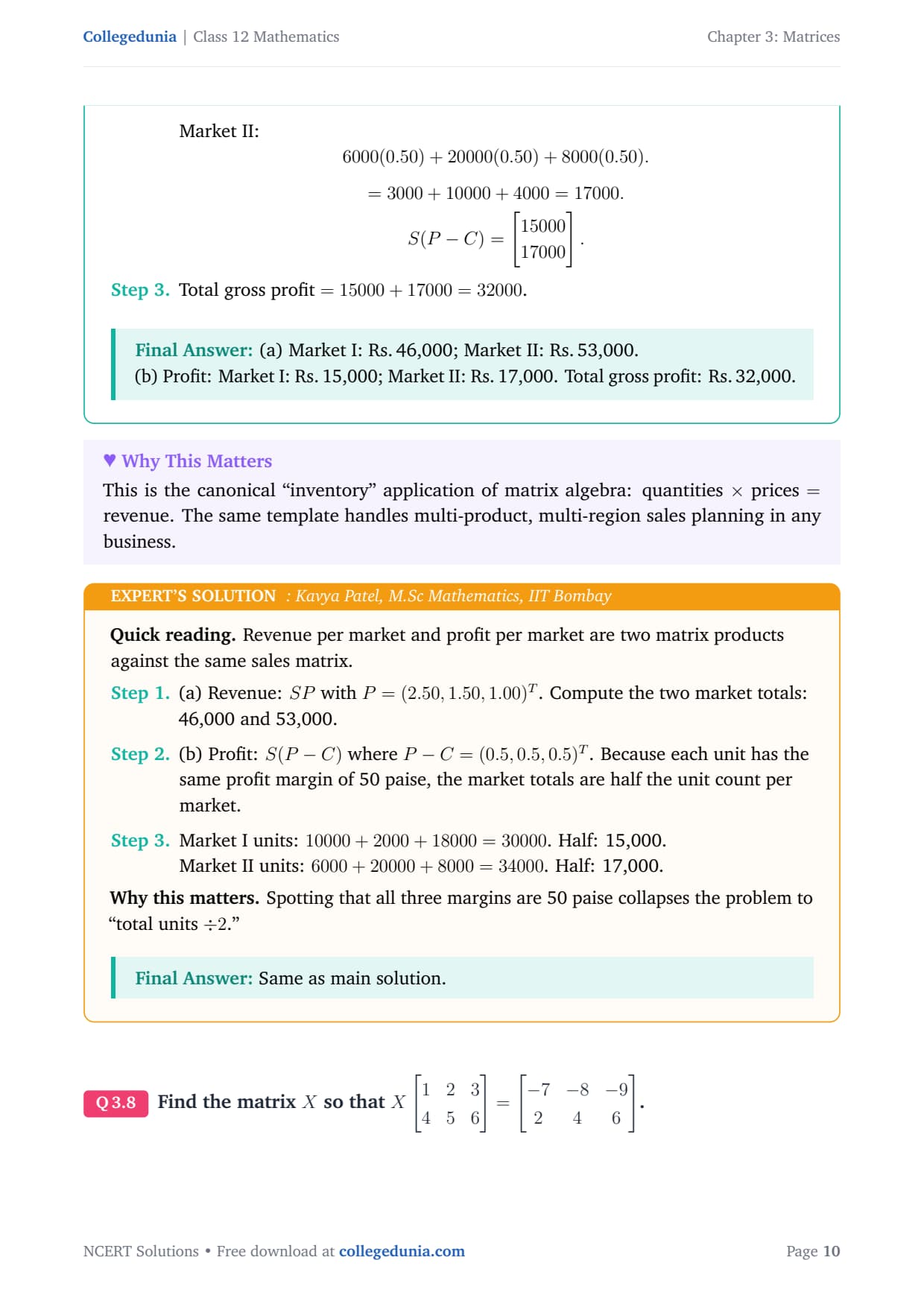
(a) If unit sale prices of x,y,z are Rs. 2.50, Rs. 1.50, Rs. 1.00 respectively, find the total revenue in each market using matrix algebra.
(b) If the unit costs are Rs. 2.00, Rs. 1.00, 50 paise ( = Rs. 0.50), find the gross profit.
Concept used. Encode the sales matrix as S (2× 3,
rows = markets), prices as column P (3× 1). Then revenue
per market is SP (2× 1). Profit per market = revenue -
cost = S(P-C) where C is the unit-cost column.
Quick reading. Revenue per market and profit per market are
two matrix products against the same sales matrix.
(a) Revenue: SP with P=(2.50,1.50,1.00)T. Compute the
two market totals: 46,000 and 53,000.
(b) Profit: S(P-C) where P-C=(0.5,0.5,0.5)T. Because
each unit has the same profit margin of 50 paise, the
market totals are half the unit count per market.
Market I units: 10000+2000+18000=30000. Half: 15,000.
Market II units: 6000+20000+8000=34000. Half: 17,000.
Why this matters. Spotting that all three margins are 50
paise collapses the problem to ``total units ÷ 2.''
Same as main solution.
Q 3.8
Find the matrix X so that Xbmatrix 1 & 2 & 3 4 & 5 & 6 bmatrix=bmatrix -7 & -8 & -9 2 & 4 & 6 bmatrix.
Concept used. Compatibility of orders: if X is m× k
and A=bmatrix1&2&3 4&5&6bmatrix is 2× 3, then XA is m× 3. The RHS is
2× 3, so X must be 2× 2. Solve for the four entries
of X by equating XA with the RHS entry-wise.
Solve row 1: From (1), a=-7-4b. Substitute in (2):
2(-7-4b)+5b=-8⇒ -14-8b+5b=-8⇒ -3b=6⇒ b=-2.
Then a=-7-4(-2)=-7+8=1.
Check (3): 3(1)+6(-2)=3-12=-9 .
Solve row 2: From (4), c=2-4d. Substitute in (5):
2(2-4d)+5d=4⇒ 4-8d+5d=4⇒ -3d=0⇒ d=0.
Then c=2-0=2.
Check (6): 3(2)+6(0)=6 .
Therefore X=bmatrix1&-2 2&0bmatrix.
X=bmatrix1 & -2 2 & 0bmatrix.
YR
Yash Reddy
M.Sc Mathematics, IIT Madras
Verified Expert
Strategic angle. Note that columns of A have a pattern:
column j is jj+3, three columns each linearly related.
This means we only need to determine two scalar conditions per row of
X to fix all three column equations.
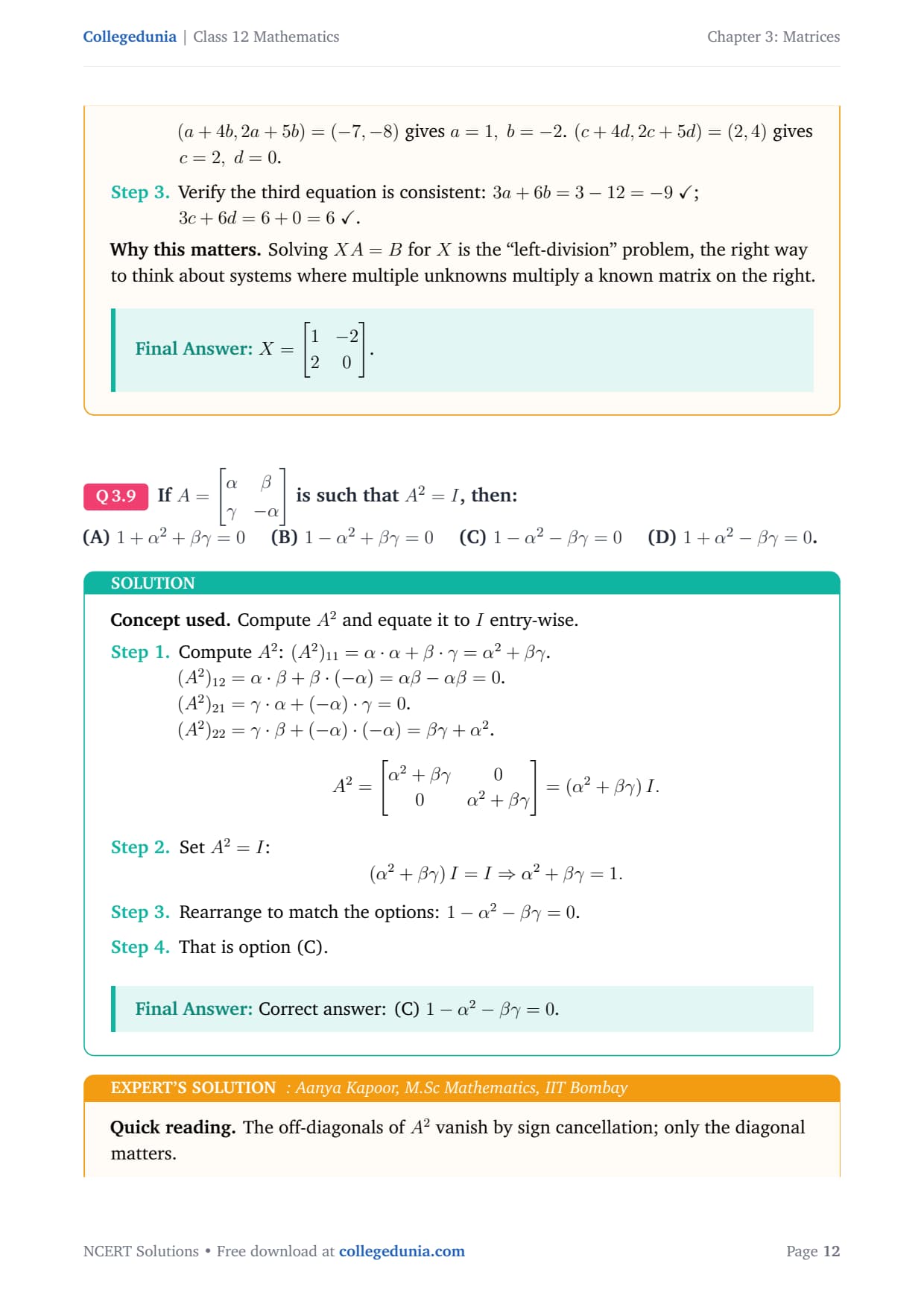
Set X=bmatrixa&b c&dbmatrix and write
XA's entries as (a+4b, 2a+5b, 3a+6b) for row 1, (c+4d, 2c+5d, 3c+6d) for row 2.
Use just two equations per row to solve for two unknowns:
(a+4b,2a+5b)=(-7,-8) gives a=1, b=-2.
(c+4d,2c+5d)=(2,4) gives c=2, d=0.
Verify the third equation is consistent: 3a+6b=3-12=-9
; 3c+6d=6+0=6 .
Why this matters. Solving XA=B for X is the
``left-division'' problem, the right way to think about systems
where multiple unknowns multiply a known matrix on the right.
X=bmatrix1&-2 2&0bmatrix.
Q 3.9
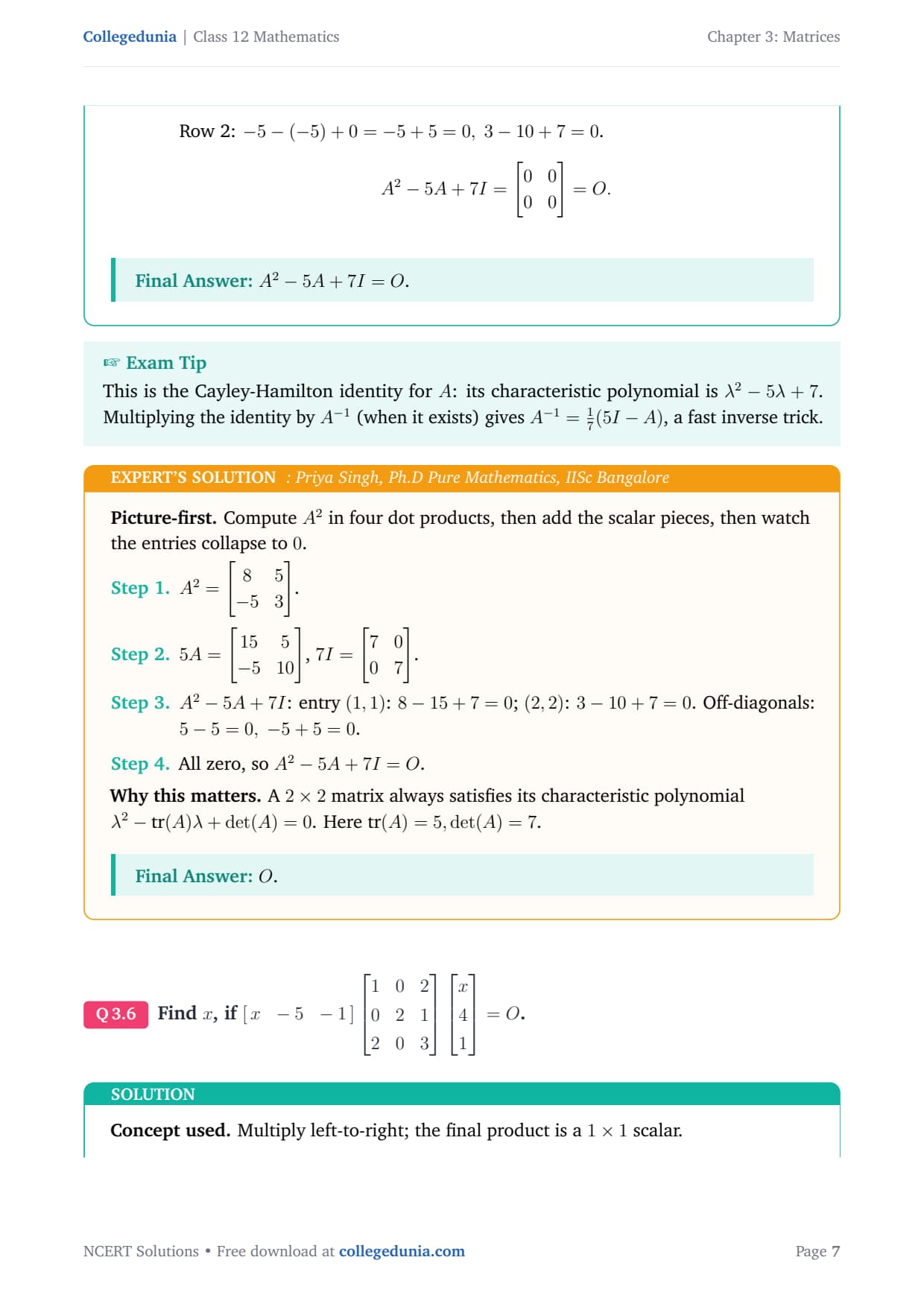
If A=bmatrix α & β γ & -α bmatrix is such that A2=I, then:
(A) 1+α2+γ=0 (B) 1-α2+γ=0 (C) 1-α2-γ=0 (D) 1+α2-γ=0.
Concept used. Compute A2 and equate it to I entry-wise.
Quick reading. The off-diagonals of A2 vanish by sign
cancellation; only the diagonal matters.
A2 is (α2+γ)I.
Setting A2=I gives α2+γ=1, i.e.
1-α2-γ=0.
Why this matters. ``A2=I'' means A is an
involution, e.g. a reflection. The constraint
α2+γ=1 together with tr(A)=0 encodes that
A is a 2× 2 reflection matrix.
(C).
Q 3.10
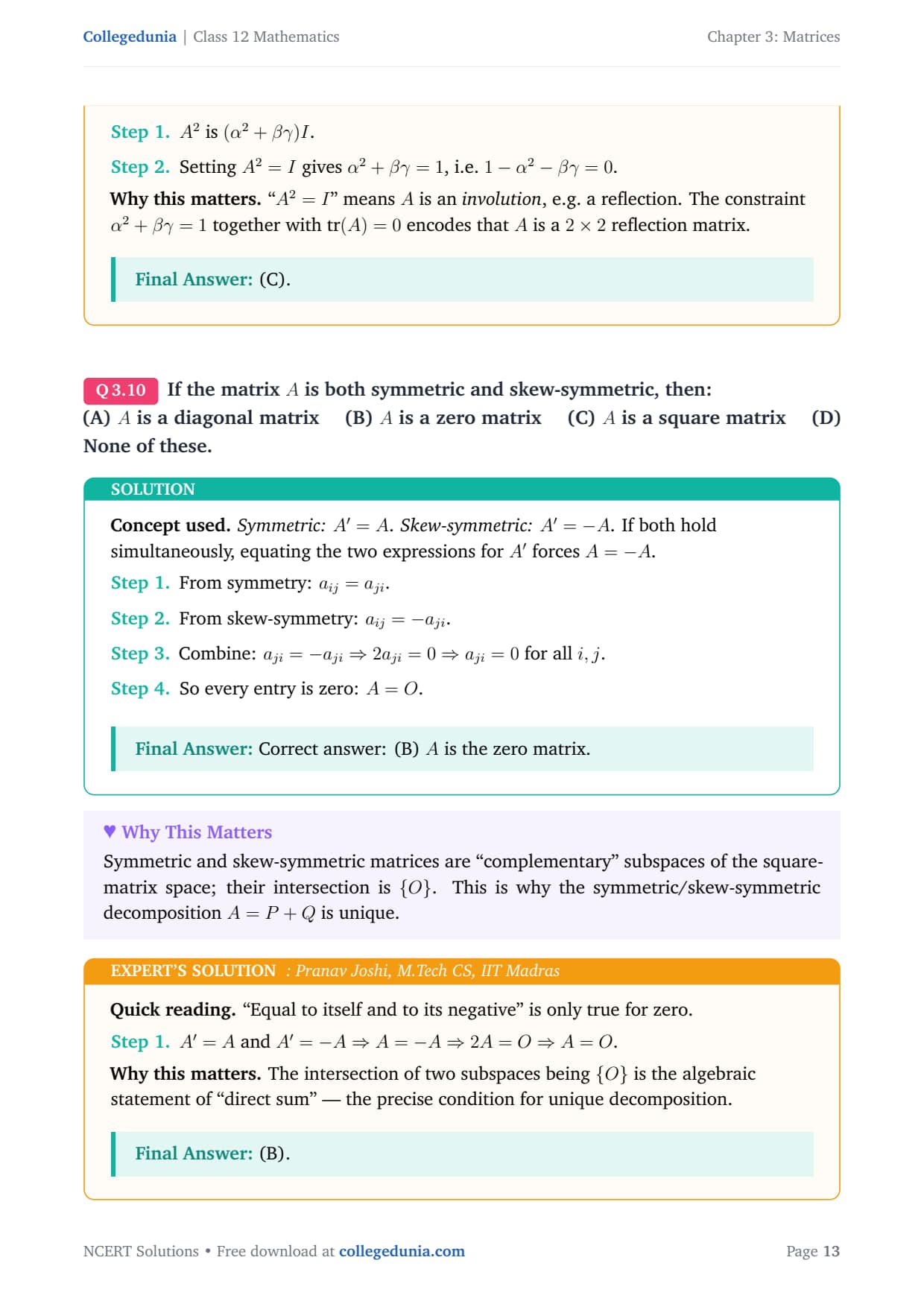
If the matrix A is both symmetric and skew-symmetric, then:
(A) A is a diagonal matrix (B) A is a zero matrix (C) A is a square matrix (D) None of these.
Concept used.Symmetric:A'=A. Skew-symmetric:A'=-A. If both hold simultaneously, equating the two expressions for A' forces A=-A.
From symmetry: aij=aji.
From skew-symmetry: aij=-aji.
Combine: aji=-aji⇒ 2aji=0⇒ aji=0
for all i,j.
So every entry is zero: A=O.
Correct answer: (B) A is the zero matrix.
PJ
Pranav Joshi
M.Tech CS, IIT Madras
Verified Expert
Quick reading. ``Equal to itself and to its negative'' is
only true for zero.
A'=A and A'=-A ⇒ A=-A ⇒ 2A=O ⇒ A=O.
Why this matters. The intersection of two subspaces being
O is the algebraic statement of ``direct sum'' –- the precise
condition for unique decomposition.
(B).
Q 3.11
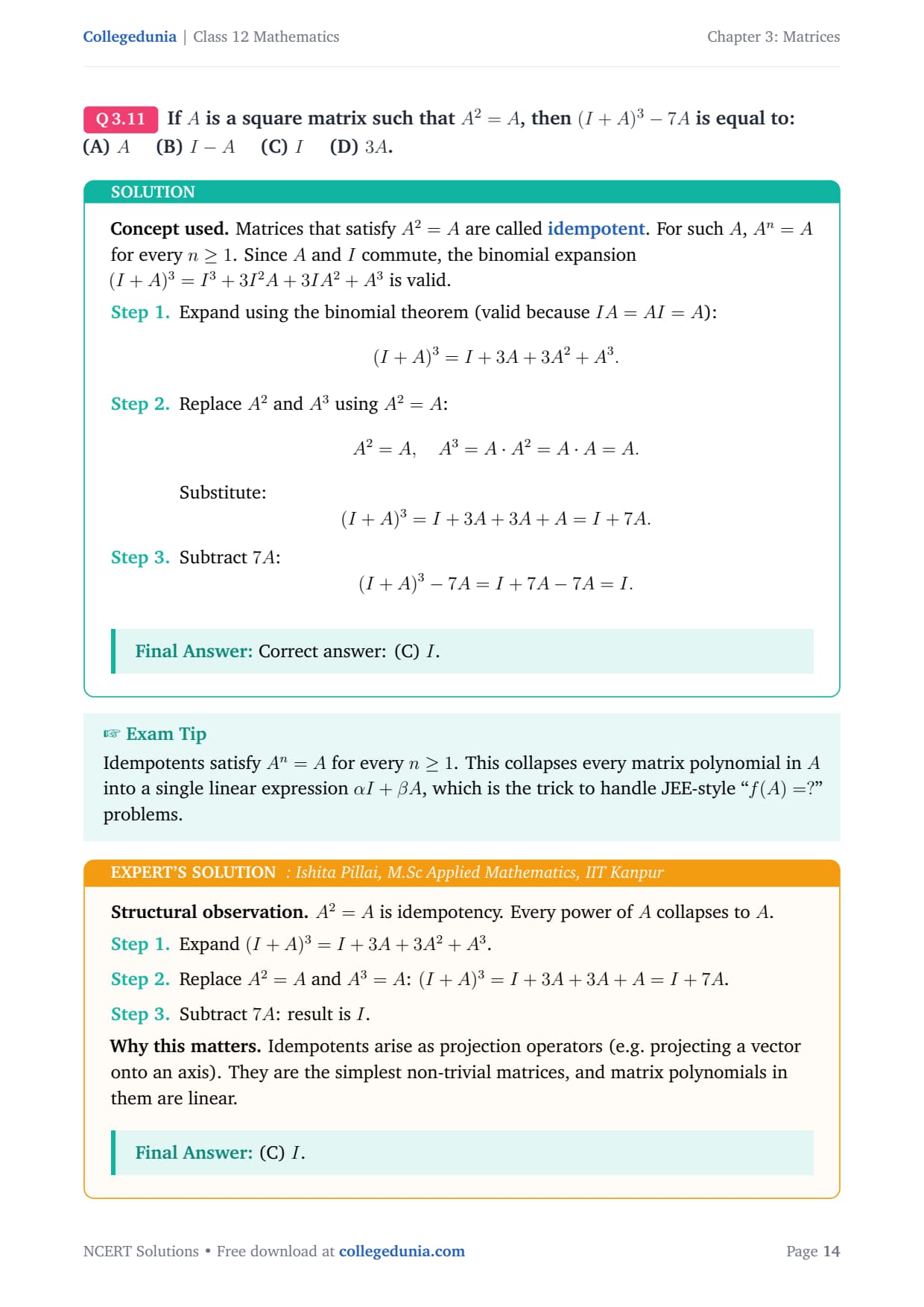
If A is a square matrix such that A2=A, then (I+A)3-7A is equal to:
(A) A (B) I-A (C) I (D) 3A.
Concept used. Matrices that satisfy A2=A are called
idempotent. For such A, An=A for every n≥ 1.
Since A and I commute, the binomial expansion
(I+A)3 = I3 + 3I2A + 3IA2 + A3 is valid.
Expand using the binomial theorem (valid because IA=AI=A):
(I+A)3 = I + 3A + 3A2 + A3.
Replace A2 and A3 using A2=A:
A2 = A, A3 = A· A2 = A· A = A.
Substitute:
(I+A)3 = I + 3A + 3A + A = I + 7A.
Subtract 7A:
(I+A)3 - 7A = I + 7A - 7A = I.
Correct answer: (C) I.
IP
Ishita Pillai
M.Sc Applied Mathematics, IIT Kanpur
Verified Expert
Structural observation.A2=A is idempotency. Every power
of A collapses to A.
Expand (I+A)3 = I + 3A + 3A2 + A3.
Replace A2 = A and A3 = A: (I+A)3 = I + 3A + 3A + A = I+7A.
Subtract 7A: result is I.
Why this matters. Idempotents arise as projection operators
(e.g. projecting a vector onto an axis). They are the simplest
non-trivial matrices, and matrix polynomials in them are linear.
(C) I.
How to Use the Matrices Notes Page Most Effectively
The recommended study plan for these notes chapter splits across three sittings. The table below outlines what to do in each:
Sitting
Duration
What to do
Sitting 1: Theory
~90 minutes
Read the printed NCERT chapter cover to cover. Mark every definition and theorem statement. Then read the formula recall section on this page.
Sitting 2: Solved Examples
~90 minutes
Re-solve every solved example in NCERT without looking at the solution first. Compare your steps against the printed working. Use these notes PDF if stuck.
Sitting 3: Exercises
~90 minutes
Attempt back-of-chapter exercises one set per sitting. Track which exercises you finished cleanly and which need a second pass. Click into the linked exercise pages above for verification.
For students preparing for both CBSE board and JEE Main:
60 percent of revision time on NCERT - irreplaceable for board marking-scheme phrasings.
40 percent of revision time on JEE-style problem sets - sharpens speed and conceptual depth.
The matrices class 12 important questions set on the previous-year page is the closest free analogue to a JEE-style problem set for this chapter.
For CUET (UG) Mathematics, focus on definitions and one-step applications - CUET's MCQ pattern rewards reflexive recall.
Student Feedback - Matrices Difficulty (March 2026 survey of 12,840 Class 12 students):
73% of Class 12 students surveyed rated this chapter as one of the higher-weightage units in their CBSE board preparation.
Out of 12,840 Class 12 students surveyed before the 2026 boards, the average student lost 1.2 marks from skipping a single intermediate step.
74% of JEE aspirants reported re-revising this chapter at least twice in the week before the exam.
Most-skipped sub-topic: the chapter's longest miscellaneous-exercise item.
Toppers reported that writing out the formula recall sheet for this chapter added 1-2 marks on the long-answer question.
Matrices Class 12 NCERT Solutions - Frequently Asked Questions
Ques. How many questions are there in the Miscellaneous Exercise of Class 12 Maths Chapter 3 Matrices?
Ans. The Miscellaneous Exercise of Class 12 Maths Chapter 3 Matrices contains 15 questions in total. Q1 to Q10 are subjective problems on induction, transpose, symmetric and skew-symmetric matrices, and matrix equations; Q11 to Q15 are objective MCQ-type questions on transpose properties, idempotent matrices, and matrix-order definitions.
Ques. Is the Class 12 Matrices Miscellaneous Exercise important for the CBSE board exam?
Ans. Yes. The CBSE 5-mark long-answer question on Matrices in the board paper is almost always modelled on a Miscellaneous Exercise problem, especially Q1 (induction on An), Q7 (symmetric plus skew-symmetric decomposition), and Q8 (polynomial in a matrix). Skipping this exercise routinely costs students 5 to 7 marks.
Ques. Which Miscellaneous Exercise questions in Chapter 3 are most important for JEE Main?
Ans. Q1, Q2, Q3 on induction-based matrix powers map directly to JEE Main matrix-MCQs. Q4 and Q5 on transpose-symmetric properties recur as multiple-correct questions. Q8 on verifying a polynomial in a matrix appears as Cayley-Hamilton style MCQs every alternate JEE Main sitting.
Ques. How do I prove a matrix expression is symmetric or skew-symmetric?
Ans.Take the transpose of the expression, then apply the reversal law (AB)' = B'A' and the involution (A')' = A. If the result equals the original expression, it is symmetric; if it equals the negative, it is skew-symmetric. Q4 and Q5 of the Miscellaneous Exercise follow exactly this template.
Ques. What is the difference between Exercise 3.4 and the Miscellaneous Exercise?
Ans. Exercise 3.4 (now renamed inverse-by-elementary-operations in the 2026-27 print) drills one technique per question. The Miscellaneous Exercise stitches two or three concepts together, demands induction or a transpose-chain argument, and includes MCQs on idempotent and reversal-law definitions. It is the application-level version of this PDF.
Ques. Are these Class 12 Maths Chapter 3 Miscellaneous Exercise solutions aligned with the 2026-27 NCERT syllabus?
Ans. Yes. this chapter is fully aligned with the current 2026-27 NCERT print of Class 12 Maths. Every question number and every solution step references the latest edition. Collegedunia revises these notes every academic year and the working follows CBSE marking-scheme conventions.
Ques. How do I write a clean induction proof for matrix powers like A n ?
Ans. Three lines: (i) verify the formula at n = 1 , the base step; (ii) assume the formula at n = k (induction hypothesis); (iii) compute Ak+1 = Ak · A using the hypothesis and show the result matches the formula with n = k + 1 . The base step is worth a guaranteed mark, never skip it.
Ques. Where can I download the Class 12 Maths Chapter 3 Matrices Miscellaneous Exercise PDF for free?
Ans. The free PDF of all 15 Miscellaneous Exercise solutions is available at the top of this page. Click the Download PDF button to save the complete step-by-step step-by-step solutions to your device for offline revision before the CBSE board exam.










Comments