



Class 6 Mathematics Chapter 9 Symmetry NCERT Solutions help students solve the 2026-27 Ganita Prakash questions on reflection, line symmetry, paper folding and rotational symmetry. The answers below keep the fold test and turn test separate, so students can explain each figure clearly.
- Includes 25 solved items from line symmetry and rotational symmetry.
- Uses simple checks for folds, mirror images, radial arms and angle order.
- Links to a separate question-card view with Solution and Expert Solution tabs.
Chapter9SymmetrySolutions.pdf?page=1&dpi=150)
Chapter9SymmetrySolutions.pdf?page=2&dpi=150)
Chapter9SymmetrySolutions.pdf?page=3&dpi=150)
Chapter9SymmetrySolutions.pdf?page=4&dpi=150)
Chapter9SymmetrySolutions.pdf?page=5&dpi=150)
Chapter9SymmetrySolutions.pdf?page=6&dpi=150)
Chapter9SymmetrySolutions.pdf?page=7&dpi=150)
Chapter9SymmetrySolutions.pdf?page=8&dpi=150)
Chapter9SymmetrySolutions.pdf?page=9&dpi=150)
Chapter9SymmetrySolutions.pdf?page=10&dpi=150)
Chapter9SymmetrySolutions.pdf?page=11&dpi=150)
Chapter9SymmetrySolutions.pdf?page=12&dpi=150)
Chapter9SymmetrySolutions.pdf?page=13&dpi=150)
Chapter9SymmetrySolutions.pdf?page=14&dpi=150)
Chapter9SymmetrySolutions.pdf?page=15&dpi=150)
Chapter9SymmetrySolutions.pdf?page=16&dpi=150)
Chapter9SymmetrySolutions.pdf?page=17&dpi=150)
Chapter9SymmetrySolutions.pdf?page=18&dpi=150)
Chapter9SymmetrySolutions.pdf?page=19&dpi=150)
Chapter9SymmetrySolutions.pdf?page=20&dpi=150)
Chapter9SymmetrySolutions.pdf?page=21&dpi=150)
Chapter9SymmetrySolutions.pdf?page=22&dpi=150)
Chapter9SymmetrySolutions.pdf?page=23&dpi=150)
Chapter9SymmetrySolutions.pdf?page=24&dpi=150)
Chapter9SymmetrySolutions.pdf?page=25&dpi=150)
Chapter9SymmetrySolutions.pdf?page=26&dpi=150)
Chapter9SymmetrySolutions.pdf?page=27&dpi=150)
Chapter9SymmetrySolutions.pdf?page=28&dpi=150)
Chapter9SymmetrySolutions.pdf?page=29&dpi=150)
Chapter9SymmetrySolutions.pdf?page=30&dpi=150)
Chapter9SymmetrySolutions_flat_MobileCard.pdf?page=1&dpi=150)
Chapter9SymmetrySolutions_flat_MobileCard.pdf?page=2&dpi=150)
Chapter9SymmetrySolutions_flat_MobileCard.pdf?page=3&dpi=150)
Chapter9SymmetrySolutions_flat_MobileCard.pdf?page=4&dpi=150)
Chapter9SymmetrySolutions_flat_MobileCard.pdf?page=5&dpi=150)
Chapter9SymmetrySolutions_flat_MobileCard.pdf?page=6&dpi=150)
Chapter9SymmetrySolutions_flat_MobileCard.pdf?page=7&dpi=150)
Chapter9SymmetrySolutions_flat_MobileCard.pdf?page=8&dpi=150)
Chapter9SymmetrySolutions_flat_MobileCard.pdf?page=9&dpi=150)
Chapter9SymmetrySolutions_flat_MobileCard.pdf?page=10&dpi=150)
Chapter9SymmetrySolutions_flat_MobileCard.pdf?page=11&dpi=150)
Chapter9SymmetrySolutions_flat_MobileCard.pdf?page=12&dpi=150)
Chapter9SymmetrySolutions_flat_MobileCard.pdf?page=13&dpi=150)
Chapter9SymmetrySolutions_flat_MobileCard.pdf?page=14&dpi=150)
Chapter9SymmetrySolutions_flat_MobileCard.pdf?page=15&dpi=150)
Chapter9SymmetrySolutions_flat_MobileCard.pdf?page=16&dpi=150)
Chapter9SymmetrySolutions_flat_MobileCard.pdf?page=17&dpi=150)
Chapter9SymmetrySolutions_flat_MobileCard.pdf?page=18&dpi=150)
Chapter9SymmetrySolutions_flat_MobileCard.pdf?page=19&dpi=150)
Chapter9SymmetrySolutions_flat_MobileCard.pdf?page=20&dpi=150)
Chapter9SymmetrySolutions_flat_MobileCard.pdf?page=21&dpi=150)
Chapter9SymmetrySolutions_flat_MobileCard.pdf?page=22&dpi=150)
Chapter9SymmetrySolutions_flat_MobileCard.pdf?page=23&dpi=150)
Chapter9SymmetrySolutions_flat_MobileCard.pdf?page=24&dpi=150)
Chapter9SymmetrySolutions_flat_MobileCard.pdf?page=25&dpi=150)
Chapter9SymmetrySolutions_flat_MobileCard.pdf?page=26&dpi=150)
Chapter9SymmetrySolutions_flat_MobileCard.pdf?page=27&dpi=150)
Chapter9SymmetrySolutions_flat_MobileCard.pdf?page=28&dpi=150)
Chapter9SymmetrySolutions_flat_MobileCard.pdf?page=29&dpi=150)
Chapter9SymmetrySolutions_flat_MobileCard.pdf?page=30&dpi=150)
Chapter9SymmetrySolutions_flat_MobileCard.pdf?page=31&dpi=150)
Chapter9SymmetrySolutions_flat_MobileCard.pdf?page=32&dpi=150)
Chapter9SymmetrySolutions_flat_MobileCard.pdf?page=33&dpi=150)
Chapter9SymmetrySolutions_flat_MobileCard.pdf?page=34&dpi=150)
Chapter9SymmetrySolutions_flat_MobileCard.pdf?page=35&dpi=150)
Chapter9SymmetrySolutions_flat_MobileCard.pdf?page=36&dpi=150)
Chapter9SymmetrySolutions_flat_MobileCard.pdf?page=37&dpi=150)
Chapter9SymmetrySolutions_flat_MobileCard.pdf?page=38&dpi=150)
Chapter9SymmetrySolutions_flat_MobileCard.pdf?page=39&dpi=150)
Chapter9SymmetrySolutions_flat_MobileCard.pdf?page=40&dpi=150)
Chapter9SymmetrySolutions_flat_MobileCard.pdf?page=41&dpi=150)
Chapter9SymmetrySolutions_flat_MobileCard.pdf?page=42&dpi=150)
Chapter9SymmetrySolutions_flat_MobileCard.pdf?page=43&dpi=150)
Chapter9SymmetrySolutions_flat_MobileCard.pdf?page=44&dpi=150)
Chapter9SymmetrySolutions_flat_MobileCard.pdf?page=45&dpi=150)
Chapter9SymmetrySolutions_flat_MobileCard.pdf?page=46&dpi=150)
Chapter9SymmetrySolutions_flat_MobileCard.pdf?page=47&dpi=150)
Chapter9SymmetrySolutions_flat_MobileCard.pdf?page=48&dpi=150)
Chapter9SymmetrySolutions_flat_MobileCard.pdf?page=49&dpi=150)
Chapter9SymmetrySolutions_flat_MobileCard.pdf?page=50&dpi=150)
Chapter9SymmetrySolutions_flat_MobileCard.pdf?page=51&dpi=150)
Chapter9SymmetrySolutions_flat_MobileCard.pdf?page=52&dpi=150)
Chapter9SymmetrySolutions_flat_MobileCard.pdf?page=53&dpi=150)
Chapter9SymmetrySolutions_flat_MobileCard.pdf?page=54&dpi=150)
Chapter9SymmetrySolutions_flat_MobileCard.pdf?page=55&dpi=150)
Chapter9SymmetrySolutions_flat_MobileCard.pdf?page=56&dpi=150)
Chapter9SymmetrySolutions_flat_MobileCard.pdf?page=57&dpi=150)
Chapter9SymmetrySolutions_flat_MobileCard.pdf?page=58&dpi=150)
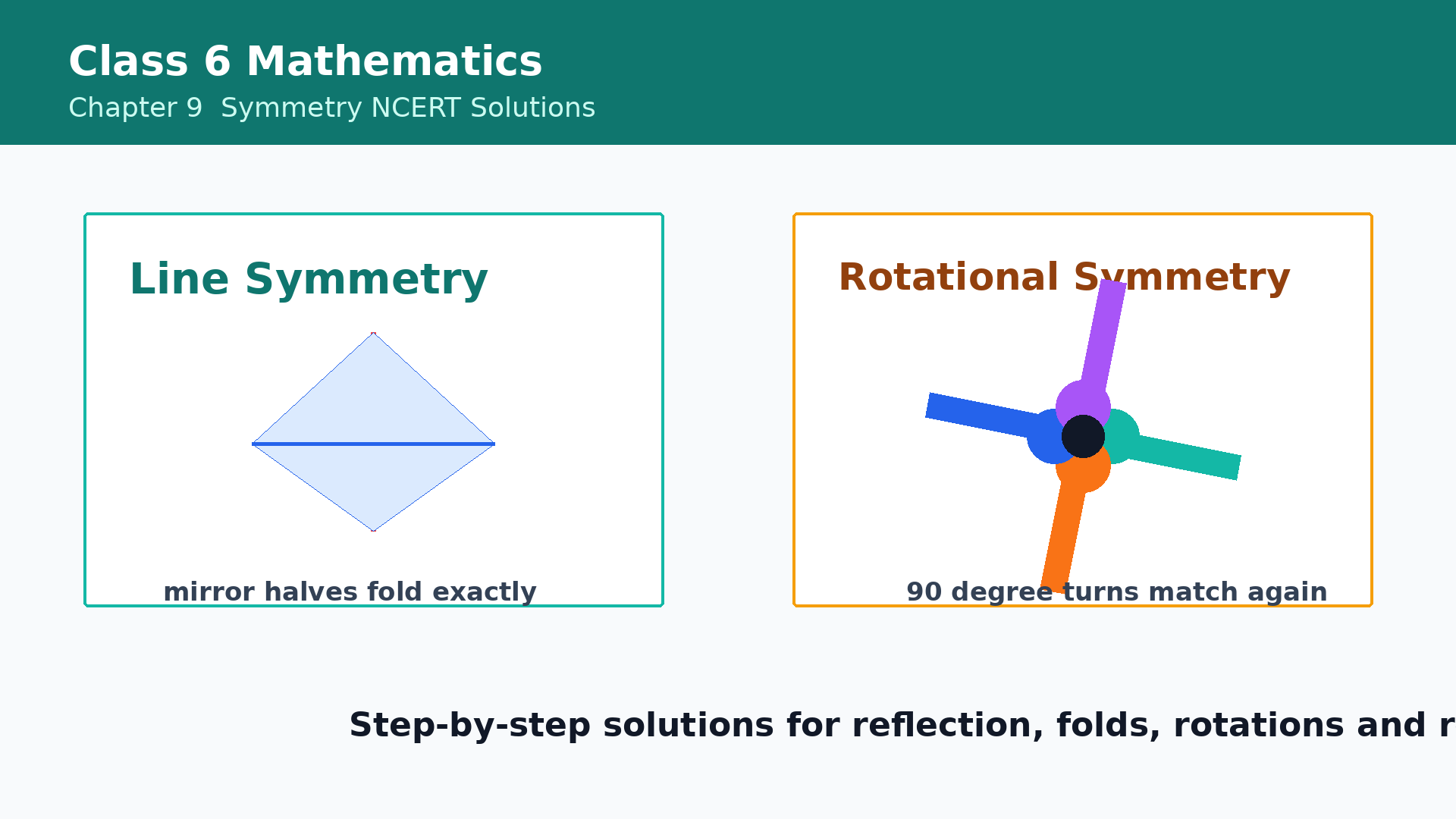
Student Feedback: In a Collegedunia study poll of 6,840 Class 6 students, 71% said symmetry became easier after they practised fold tests and rotation-angle tables together.
Use this PDF with the official NCERT chapter for 2026-27. Focus on exact overlap after folding or rotating, not only on whether a figure looks balanced.
|
Table of Contents |
Chapter 9 Symmetry NCERT Solutions Highlights
Chapter 9 teaches students how repeated parts create symmetry. The first half covers line symmetry, where a figure folds into matching mirror halves. The second half covers rotational symmetry, where a figure matches itself after a turn around a fixed centre. The most important test is exact overlap.
| Topic | Student check | Common answer type |
|---|---|---|
| Line of symmetry | Can one half cover the other after folding? | Draw mirror lines or complete a shape |
| Reflection | Are matching points equally far from the fold line? | Place missing holes or grid points |
| Rotational symmetry | Does the figure match after a turn? | Find angles and order of rotation |
| Regular shapes | Are sides or arms equally spaced? | Count symmetry lines or angles |
Line Symmetry and Rotational Symmetry in Class 6
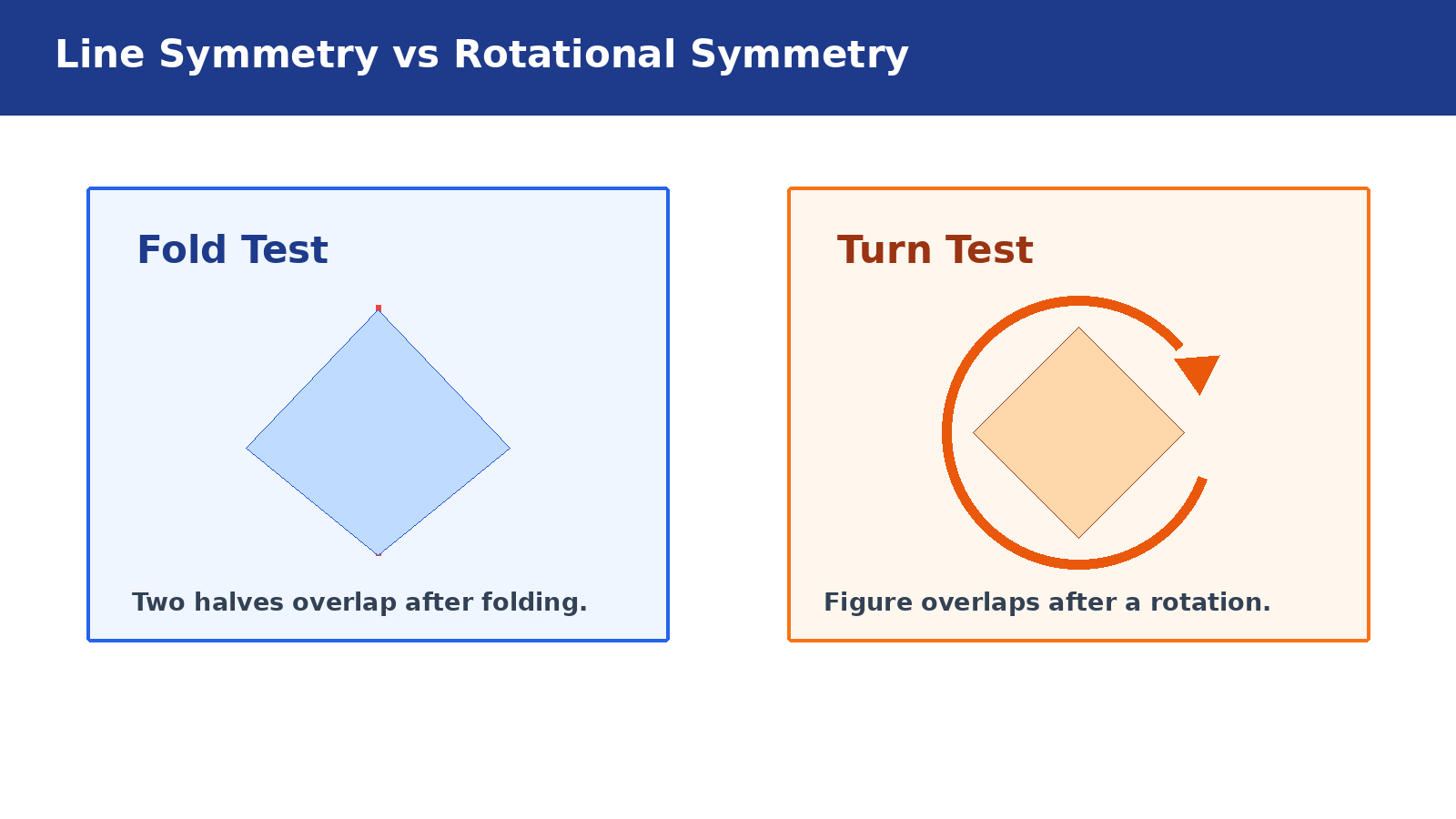
Line symmetry uses a fold. Rotational symmetry uses a turn. Students often mix these two ideas because both make a figure look balanced. In the PDF, every answer first asks which test is needed. A butterfly is a fold example, while a pinwheel is usually a turn example.
- Fold test: look for mirror halves across one straight line.
- Turn test: rotate around the centre and check when the figure matches again.
- Exactness: a rough visual match is not enough for symmetry answers.
Symmetry Class 6 Mathematics Video Explanation
Source: Magnet Brains Education on YouTube
Rotation Angle Table for Symmetry Chapter 9
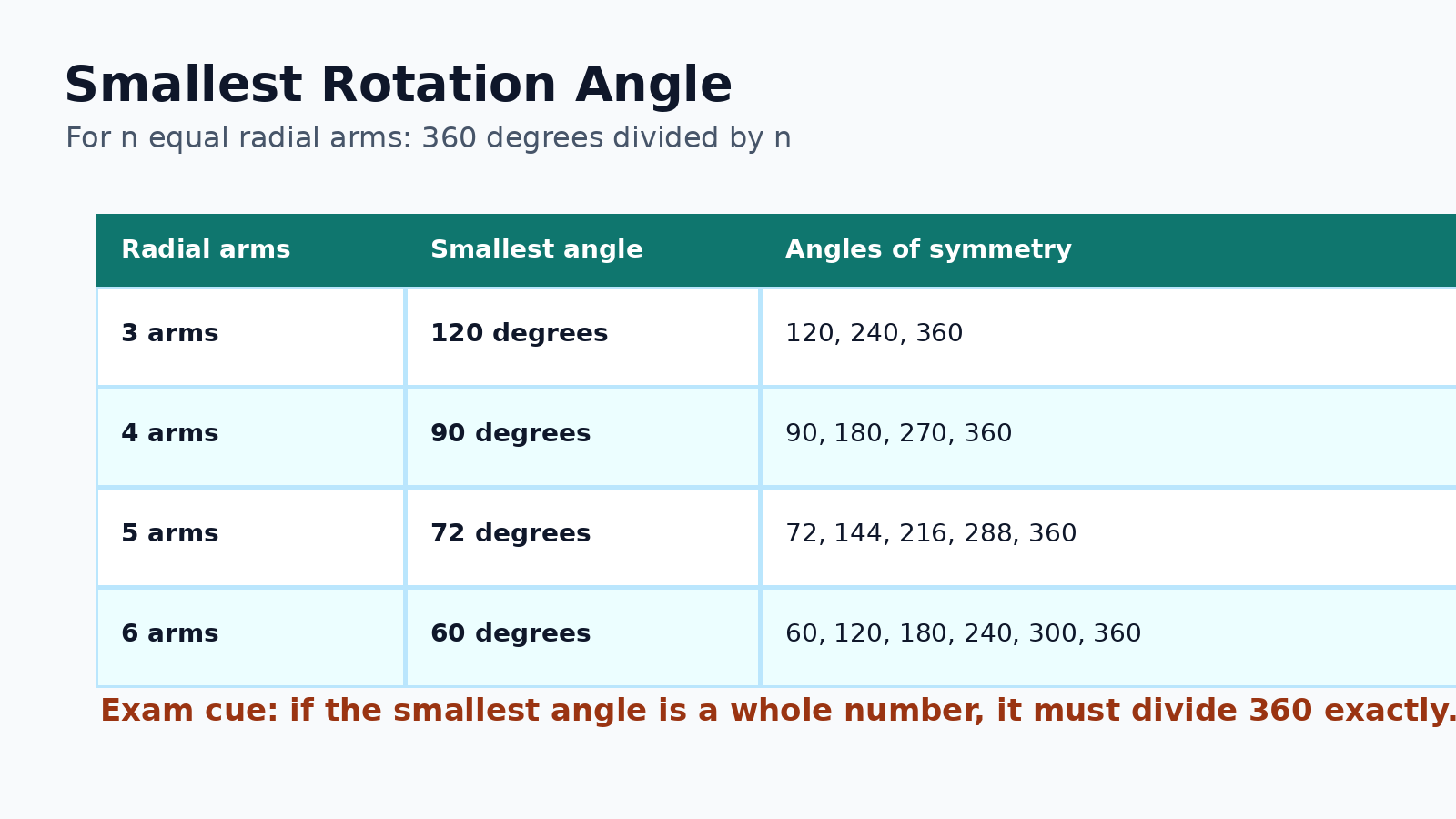
The fastest way to answer radial-arm questions is to divide a full turn by the number of equal arms. For five equal arms, the smallest angle is 72 degrees. For six equal arms, it is 60 degrees. If the smallest angle is a whole number, it must divide 360 exactly.
- Order 3 gives 120, 240 and 360 degrees.
- Order 4 gives 90, 180, 270 and 360 degrees.
- Order 6 gives 60, 120, 180, 240, 300 and 360 degrees.
All NCERT Solutions for Symmetry with Step-by-Step Solutions
The chapter has a companion question-card view where each item opens into Check Solution and Expert Solution tabs. It is useful for quick revision before class tests because students can hide the explanation first and try the answer mentally.
Open all Symmetry question cards with solutions
How to Use the Class 6 Symmetry Solutions PDF
Start with the short answer, then read the steps only if the figure or angle list is confusing. For drawing-based questions, copy the shape on squared paper and mark equal distances from the symmetry line. For rotation-based questions, mark the centre first. This method keeps the answer close to NCERT wording.
- Use a ruler for reflected grid points.
- Write all rotational angles up to 360 degrees.
- Check whether the question asks for lines, angles, or order.
More Class 6 Mathematics Symmetry Resources
Use these resources when you want the same chapter in another format. The official book PDF helps with figures, while notes and handwritten notes are better for fast revision.
| Resource | Best use | Link |
|---|---|---|
| NCERT Book PDF | Read the official chapter text and figures | Open book PDF |
| Notes | Revise definitions, fold tests and rotation rules | Open notes |
| Handwritten Notes | Use a quick visual notebook for one-shot revision | Open handwritten notes |
All Class 6 Mathematics NCERT Solutions
The table below keeps the same resource type together, so students can move chapter by chapter through Class 6 Mathematics solutions.
| Chapter | NCERT chapter title | Solutions |
|---|---|---|
| Chapter 1 | Patterns in Mathematics | Open solutions |
| Chapter 2 | Lines and Angles | Open solutions |
| Chapter 3 | Number Play | Open solutions |
| Chapter 4 | Data Handling and Presentation | Open solutions |
| Chapter 5 | Prime Time | Open solutions |
| Chapter 6 | Perimeter and Area | Open solutions |
| Chapter 7 | Fractions | Open solutions |
| Chapter 8 | Playing with Constructions | Open solutions |
| Chapter 9 | Symmetry | Current solutions |
| Chapter 10 | The Other Side of Zero | Open solutions |
Class 6 Mathematics Chapter 9 Symmetry NCERT Solutions FAQs
Ques. What is the main idea of Class 6 Mathematics Chapter 9 Symmetry?
Ans. The chapter explains line symmetry, reflection, paper folding and rotational symmetry through shapes, patterns and grid activities.
Ques. How many solved items are included in this Symmetry PDF?
Ans. The PDF includes 25 solved items with step-by-step solutions and expert explanations.
Ques. What is the difference between line symmetry and rotational symmetry?
Ans. Line symmetry is checked by folding along a mirror line. Rotational symmetry is checked by turning a figure around a centre.
Ques. How do students find the smallest angle of rotational symmetry?
Ans. For equal repeated arms, divide 360 degrees by the number of arms. Then list the multiples up to 360 degrees.



Comments