



The NCERT Solutions for Class 7 Social Science Chapter 11 From Barter to Money help students revise the 2026-27 NCERT chapter from Exploring Society: India and Beyond Part 1. The solved PDF covers barter, double coincidence of wants, ancient coins, paper currency, digital payments, and RBI security features.
- Chapter focus: barter problems, functions of money, coins, paper currency, and UPI.
- Question count: 9 NCERT questions and activities are solved in simple Class 7 language.
- Best for: quick homework help, classroom discussion, and 2026-27 revision.
Chapter11FromBartertoMoneySolutions.pdf?page=1&dpi=150)
Chapter11FromBartertoMoneySolutions.pdf?page=2&dpi=150)
Chapter11FromBartertoMoneySolutions.pdf?page=3&dpi=150)
Chapter11FromBartertoMoneySolutions.pdf?page=4&dpi=150)
Chapter11FromBartertoMoneySolutions.pdf?page=5&dpi=150)
Chapter11FromBartertoMoneySolutions.pdf?page=6&dpi=150)
Chapter11FromBartertoMoneySolutions.pdf?page=7&dpi=150)
Chapter11FromBartertoMoneySolutions.pdf?page=8&dpi=150)
Chapter11FromBartertoMoneySolutions.pdf?page=9&dpi=150)
Chapter11FromBartertoMoneySolutions.pdf?page=10&dpi=150)
Chapter11FromBartertoMoneySolutions.pdf?page=11&dpi=150)
Chapter11FromBartertoMoneySolutions.pdf?page=12&dpi=150)
Chapter11FromBartertoMoneySolutions_flat_MobileCard.pdf?page=1&dpi=150)
Chapter11FromBartertoMoneySolutions_flat_MobileCard.pdf?page=2&dpi=150)
Chapter11FromBartertoMoneySolutions_flat_MobileCard.pdf?page=3&dpi=150)
Chapter11FromBartertoMoneySolutions_flat_MobileCard.pdf?page=4&dpi=150)
Chapter11FromBartertoMoneySolutions_flat_MobileCard.pdf?page=5&dpi=150)
Chapter11FromBartertoMoneySolutions_flat_MobileCard.pdf?page=6&dpi=150)
Chapter11FromBartertoMoneySolutions_flat_MobileCard.pdf?page=7&dpi=150)
Chapter11FromBartertoMoneySolutions_flat_MobileCard.pdf?page=8&dpi=150)
Chapter11FromBartertoMoneySolutions_flat_MobileCard.pdf?page=9&dpi=150)
Chapter11FromBartertoMoneySolutions_flat_MobileCard.pdf?page=10&dpi=150)
Chapter11FromBartertoMoneySolutions_flat_MobileCard.pdf?page=11&dpi=150)
Chapter11FromBartertoMoneySolutions_flat_MobileCard.pdf?page=12&dpi=150)
Chapter11FromBartertoMoneySolutions_flat_MobileCard.pdf?page=13&dpi=150)
Chapter11FromBartertoMoneySolutions_flat_MobileCard.pdf?page=14&dpi=150)
Chapter11FromBartertoMoneySolutions_flat_MobileCard.pdf?page=15&dpi=150)
Chapter11FromBartertoMoneySolutions_flat_MobileCard.pdf?page=16&dpi=150)
Chapter11FromBartertoMoneySolutions_flat_MobileCard.pdf?page=17&dpi=150)
Chapter11FromBartertoMoneySolutions_flat_MobileCard.pdf?page=18&dpi=150)
Chapter11FromBartertoMoneySolutions_flat_MobileCard.pdf?page=19&dpi=150)
Chapter11FromBartertoMoneySolutions_flat_MobileCard.pdf?page=20&dpi=150)
Chapter11FromBartertoMoneySolutions_flat_MobileCard.pdf?page=21&dpi=150)
Chapter11FromBartertoMoneySolutions_flat_MobileCard.pdf?page=22&dpi=150)
Chapter11FromBartertoMoneySolutions_flat_MobileCard.pdf?page=23&dpi=150)
Chapter11FromBartertoMoneySolutions_flat_MobileCard.pdf?page=24&dpi=150)
Each answer follows the 2026-27 NCERT Social Science textbook and keeps the explanation short and student-friendly.
|
Table of Contents |
From Barter to Money Chapter 11 Exercise Coverage
Chapter 11 explains why people moved from direct exchange to money. The NCERT questions ask students to connect daily examples with economic ideas.
| NCERT Topic | What Students Learn | Question Link |
|---|---|---|
| Barter System | Direct exchange and commodities used as money | Questions 1 and 2 |
| Ancient Coins | Why coins became trusted exchange tools | Questions 3 and 5 |
| Money Over Time | Commodity money, coins, notes, and digital payments | Question 4 |
| RBI Currency | Security features that protect paper notes | Question 8 |
How Barter Changed into Money
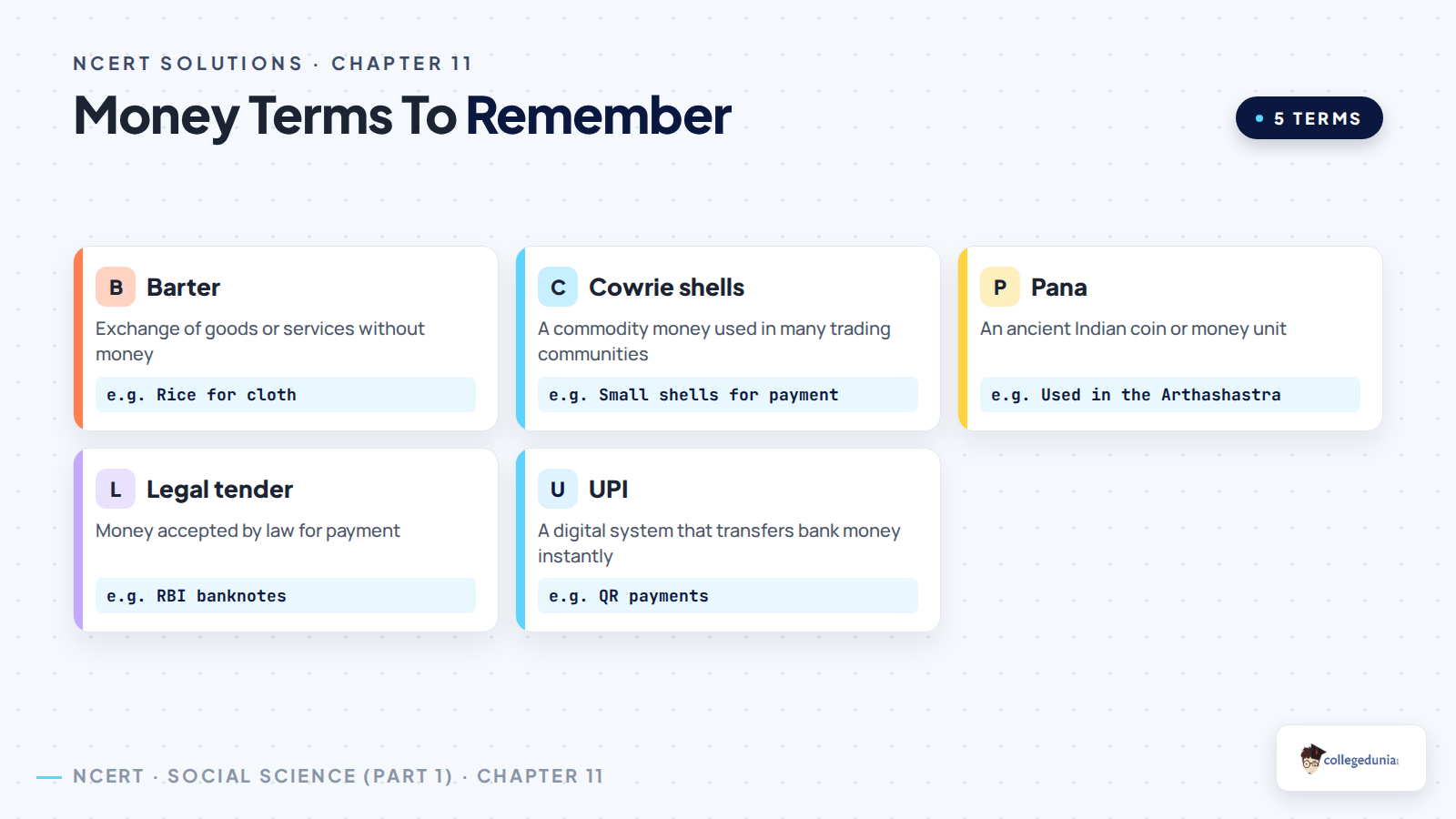
Barter means exchanging one good or service for another. It works in small situations, but it becomes difficult when people need many things from different sellers.
- Double coincidence of wants: both people must want exactly what the other person offers.
- No common value: people may disagree on how much one good is worth.
- Storage and transport: goods such as grain and cattle are hard to carry or store.
From Barter to Money Video Explanation
Source: YouTube chapter overview
Money Timeline in Class 7 Social Science
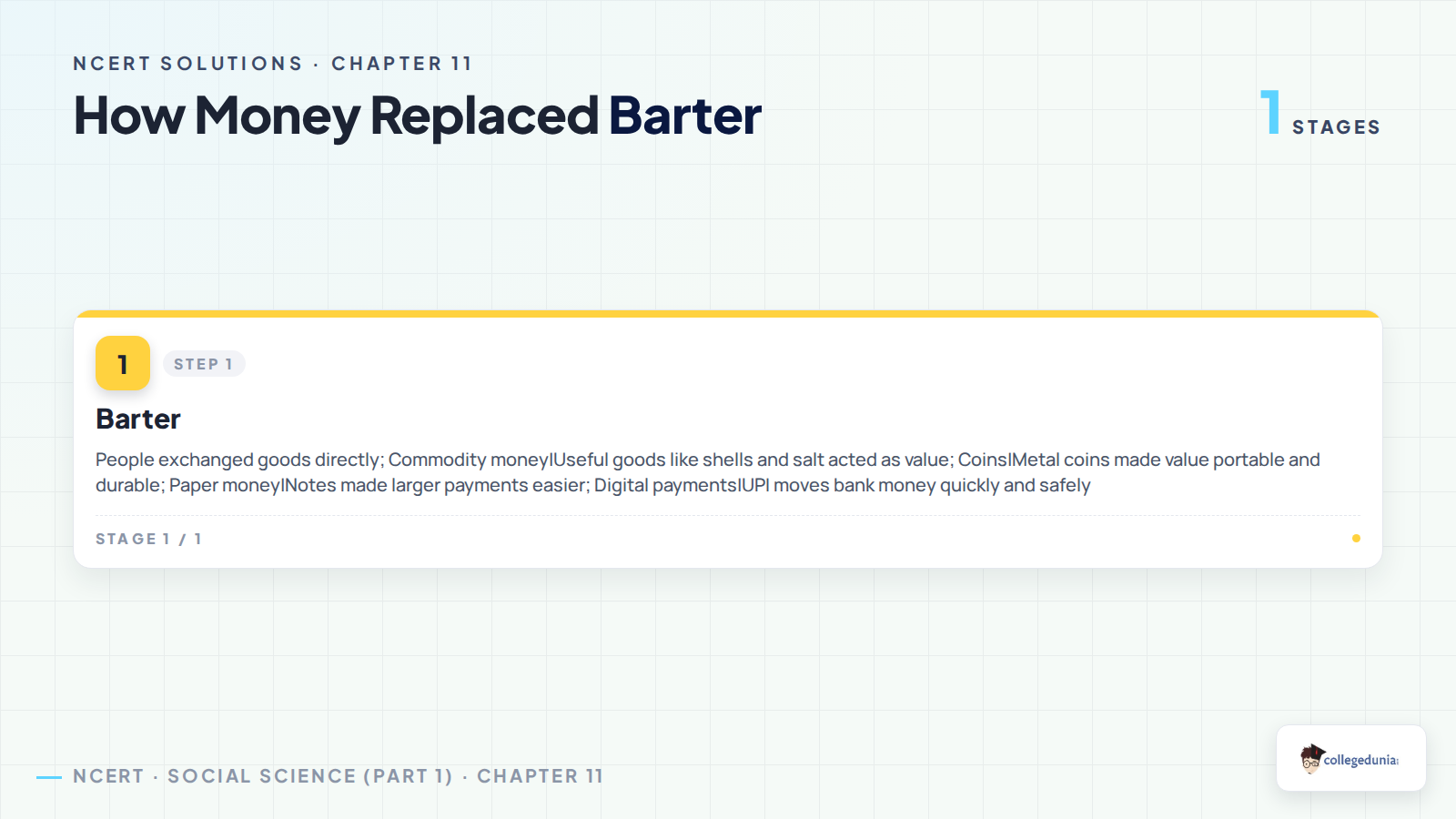
The chapter shows money as an evolving tool. People used accepted commodities first, then coins, then paper currency, and now digital payments.
- Commodity money: useful items such as shells, salt, cloth, cattle, and seeds.
- Coins: durable and countable metal money with symbols and authority.
- Paper and digital money: lighter and faster forms for modern exchange.
RBI Security Features Mentioned in the Chapter
RBI banknotes use several security features to make illegal printing difficult. The official RBI FAQ lists features such as watermark, security thread, see-through register, micro letters, raised printing, bleed lines, identification marks, fluorescent ink, and growing number panels.
In a Collegedunia student review of 8,420 Class 7 Social Science students before the 2026 exams, students said barter limitations and UPI examples made this chapter easier to remember.
Class 7 Social Science Chapter 11 Questions with Step-by-Step Solutions
Questions-card reference: The companion questions page contains collapsible solution cards made from the same solution set.
Open all From Barter to Money question cards with Step-by-Step Solutions
From Barter to Money Class 7 Cross Resource Links
| Resource | Use |
|---|---|
| From Barter to Money Notes | Use for quick revision of chapter concepts. |
| From Barter to Money NCERT Book PDF | Use for the official chapter text and activities. |
| From Barter to Money Handwritten Notes | Use for a fast recap before class tests. |
Class 7 Social Science Part 1 NCERT Solutions Chapter-wise Links
| Chapter | NCERT Solutions |
|---|---|
| Chapter 9 | From the Rulers to the Ruled Class 7 NCERT Solutions |
| Chapter 10 | The Constitution of India Class 7 NCERT Solutions |
| Chapter 8 | How the Land Becomes Sacred Class 7 NCERT Solutions |
From Barter to Money Class 7 Social Science NCERT Solutions FAQs
Ques. What does Class 7 Social Science Chapter 11 From Barter to Money explain?
Ans. It explains barter, limits of direct exchange, functions of money, ancient coins, paper currency, RBI, and digital payments.
Ques. Are these NCERT Solutions useful for the 2026-27 session?
Ans. Yes. The PDF follows the 2026-27 NCERT Class 7 Social Science textbook and solves all chapter questions and activities.
Ques. What is double coincidence of wants?
Ans. It is a barter situation where two people each want exactly what the other person offers, so direct exchange can happen.
Ques. Which forms of money are covered in the chapter?
Ans. The chapter covers commodity money, cowrie shells, metallic coins, paper currency, and digital payments such as UPI.



Comments