



The NCERT Solutions for Class 7 Social Science Part 2 Chapter 8 Banks and the Magic of Finance cover all exercise questions and activities from the latest 2026-27 NCERT book. The chapter explains banks, deposits, loans, compound interest, UPI, stock markets and digital payment safety in everyday language.
- The PDF solves 12 Questions and activities from the textbook exercise.
- Key ideas include financial infrastructure, bank accounts, credit, compound interest, UPI and cyber safety.
- Use the question card link below for direct answers and expert explanations.
Chapter8BanksandtheMagicofFinanceSolutions.pdf?page=1&dpi=150)
Chapter8BanksandtheMagicofFinanceSolutions.pdf?page=2&dpi=150)
Chapter8BanksandtheMagicofFinanceSolutions.pdf?page=3&dpi=150)
Chapter8BanksandtheMagicofFinanceSolutions.pdf?page=4&dpi=150)
Chapter8BanksandtheMagicofFinanceSolutions.pdf?page=5&dpi=150)
Chapter8BanksandtheMagicofFinanceSolutions.pdf?page=6&dpi=150)
Chapter8BanksandtheMagicofFinanceSolutions.pdf?page=7&dpi=150)
Chapter8BanksandtheMagicofFinanceSolutions.pdf?page=8&dpi=150)
Chapter8BanksandtheMagicofFinanceSolutions.pdf?page=9&dpi=150)
Chapter8BanksandtheMagicofFinanceSolutions.pdf?page=10&dpi=150)
Chapter8BanksandtheMagicofFinanceSolutions.pdf?page=11&dpi=150)
Chapter8BanksandtheMagicofFinanceSolutions.pdf?page=12&dpi=150)
Chapter8BanksandtheMagicofFinanceSolutions.pdf?page=13&dpi=150)
Chapter8BanksandtheMagicofFinanceSolutions.pdf?page=14&dpi=150)
Chapter8BanksandtheMagicofFinanceSolutions.pdf?page=15&dpi=150)
Chapter8BanksandtheMagicofFinanceSolutions.pdf?page=16&dpi=150)
Chapter8BanksandtheMagicofFinanceSolutions.pdf?page=17&dpi=150)
Chapter8BanksandtheMagicofFinanceSolutions.pdf?page=18&dpi=150)
Chapter8BanksandtheMagicofFinanceSolutions.pdf?page=19&dpi=150)
Chapter8BanksandtheMagicofFinanceSolutions.pdf?page=20&dpi=150)
Chapter8BanksandtheMagicofFinanceSolutions_flat_MobileCard.pdf?page=1&dpi=150)
Chapter8BanksandtheMagicofFinanceSolutions_flat_MobileCard.pdf?page=2&dpi=150)
Chapter8BanksandtheMagicofFinanceSolutions_flat_MobileCard.pdf?page=3&dpi=150)
Chapter8BanksandtheMagicofFinanceSolutions_flat_MobileCard.pdf?page=4&dpi=150)
Chapter8BanksandtheMagicofFinanceSolutions_flat_MobileCard.pdf?page=5&dpi=150)
Chapter8BanksandtheMagicofFinanceSolutions_flat_MobileCard.pdf?page=6&dpi=150)
Chapter8BanksandtheMagicofFinanceSolutions_flat_MobileCard.pdf?page=7&dpi=150)
Chapter8BanksandtheMagicofFinanceSolutions_flat_MobileCard.pdf?page=8&dpi=150)
Chapter8BanksandtheMagicofFinanceSolutions_flat_MobileCard.pdf?page=9&dpi=150)
Chapter8BanksandtheMagicofFinanceSolutions_flat_MobileCard.pdf?page=10&dpi=150)
Chapter8BanksandtheMagicofFinanceSolutions_flat_MobileCard.pdf?page=11&dpi=150)
Chapter8BanksandtheMagicofFinanceSolutions_flat_MobileCard.pdf?page=12&dpi=150)
Chapter8BanksandtheMagicofFinanceSolutions_flat_MobileCard.pdf?page=13&dpi=150)
Chapter8BanksandtheMagicofFinanceSolutions_flat_MobileCard.pdf?page=14&dpi=150)
Chapter8BanksandtheMagicofFinanceSolutions_flat_MobileCard.pdf?page=15&dpi=150)
Chapter8BanksandtheMagicofFinanceSolutions_flat_MobileCard.pdf?page=16&dpi=150)
Chapter8BanksandtheMagicofFinanceSolutions_flat_MobileCard.pdf?page=17&dpi=150)
Chapter8BanksandtheMagicofFinanceSolutions_flat_MobileCard.pdf?page=18&dpi=150)
Chapter8BanksandtheMagicofFinanceSolutions_flat_MobileCard.pdf?page=19&dpi=150)
Chapter8BanksandtheMagicofFinanceSolutions_flat_MobileCard.pdf?page=20&dpi=150)
Chapter8BanksandtheMagicofFinanceSolutions_flat_MobileCard.pdf?page=21&dpi=150)
Chapter8BanksandtheMagicofFinanceSolutions_flat_MobileCard.pdf?page=22&dpi=150)
Chapter8BanksandtheMagicofFinanceSolutions_flat_MobileCard.pdf?page=23&dpi=150)
Chapter8BanksandtheMagicofFinanceSolutions_flat_MobileCard.pdf?page=24&dpi=150)
Chapter8BanksandtheMagicofFinanceSolutions_flat_MobileCard.pdf?page=25&dpi=150)
Chapter8BanksandtheMagicofFinanceSolutions_flat_MobileCard.pdf?page=26&dpi=150)
Chapter8BanksandtheMagicofFinanceSolutions_flat_MobileCard.pdf?page=27&dpi=150)
Chapter8BanksandtheMagicofFinanceSolutions_flat_MobileCard.pdf?page=28&dpi=150)
Chapter8BanksandtheMagicofFinanceSolutions_flat_MobileCard.pdf?page=29&dpi=150)
Chapter8BanksandtheMagicofFinanceSolutions_flat_MobileCard.pdf?page=30&dpi=150)
Chapter8BanksandtheMagicofFinanceSolutions_flat_MobileCard.pdf?page=31&dpi=150)
Chapter8BanksandtheMagicofFinanceSolutions_flat_MobileCard.pdf?page=32&dpi=150)
Chapter8BanksandtheMagicofFinanceSolutions_flat_MobileCard.pdf?page=33&dpi=150)
Chapter8BanksandtheMagicofFinanceSolutions_flat_MobileCard.pdf?page=34&dpi=150)
Chapter8BanksandtheMagicofFinanceSolutions_flat_MobileCard.pdf?page=35&dpi=150)
Chapter8BanksandtheMagicofFinanceSolutions_flat_MobileCard.pdf?page=36&dpi=150)
Chapter8BanksandtheMagicofFinanceSolutions_flat_MobileCard.pdf?page=37&dpi=150)
Chapter8BanksandtheMagicofFinanceSolutions_flat_MobileCard.pdf?page=38&dpi=150)
Student Feedback: In a Collegedunia student survey of 8,920 Class 7 Social Science students, many students said this chapter became easier after they separated bank services, payment modes and stock market ideas into three revision groups.
Each answer in this Class 7 Social Science Chapter 8 solutions PDF follows the 2026-27 NCERT exercise and keeps numerical working school-exam ready.
|
Table of Contents |
Banks and the Magic of Finance Exercise Pattern
The exercise mixes concept answers, one interest calculation, activity-based questions and safety advice. Students should write short definitions first, then add one textbook example from banks, UPI, stock market or digital fraud prevention.
| Question area | What it checks | Answer method |
|---|---|---|
| Financial infrastructure | Meaning and role | Define and connect it to physical infrastructure |
| Bank accounts | Saving, deposits and access | Explain safety, interest and direct transfers |
| Compound interest | Numerical understanding | Show simple and annual compound working clearly |
| Payment systems | UPI, ATM, cheques and cards | Link convenience with safe use |
| Stock market | Savings and shares | Explain how people invest and companies raise money |
The safest answer frame is concept, example, effect and safety point. It keeps banking answers practical instead of only theoretical.
Banks and Finance Video
Source: Magnet Brains on YouTube
How Money Moves Through Banks
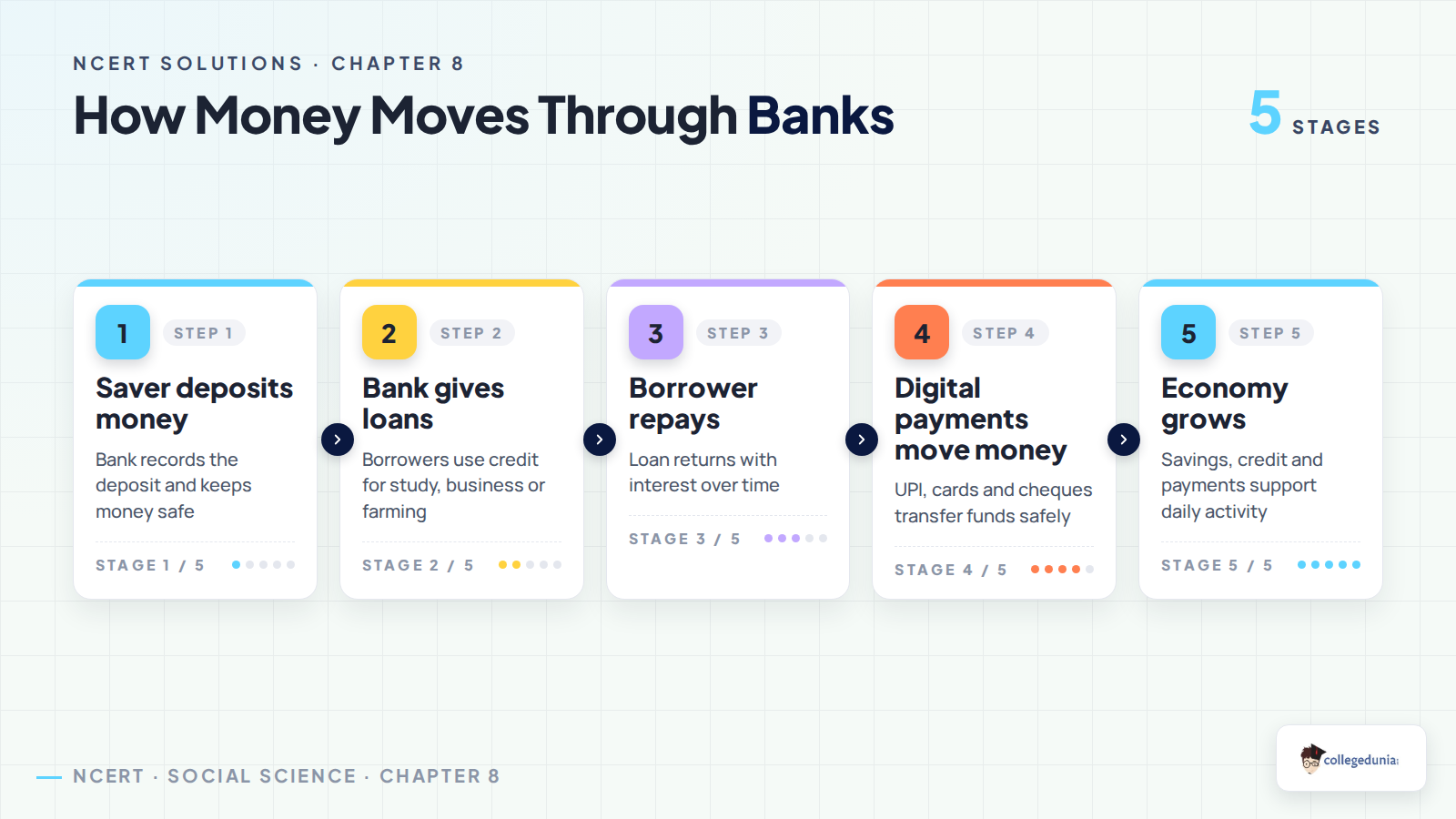
Banks connect savers and borrowers. A person may deposit surplus money in a bank, and another person may borrow from the bank for study, business, farming, transport or other needs. This makes money useful instead of lying idle.
- Deposits: Money kept in a bank account can stay safer than cash at home.
- Loans: Banks lend money to people and businesses for useful purposes.
- Interest: Depositors may earn interest, while borrowers pay interest on loans.
- Payments: UPI, debit cards, cheques and net banking move money between accounts.
Write banks as connectors. They connect savings with credit, and credit with economic activity.
Savings Account vs Fixed Deposit
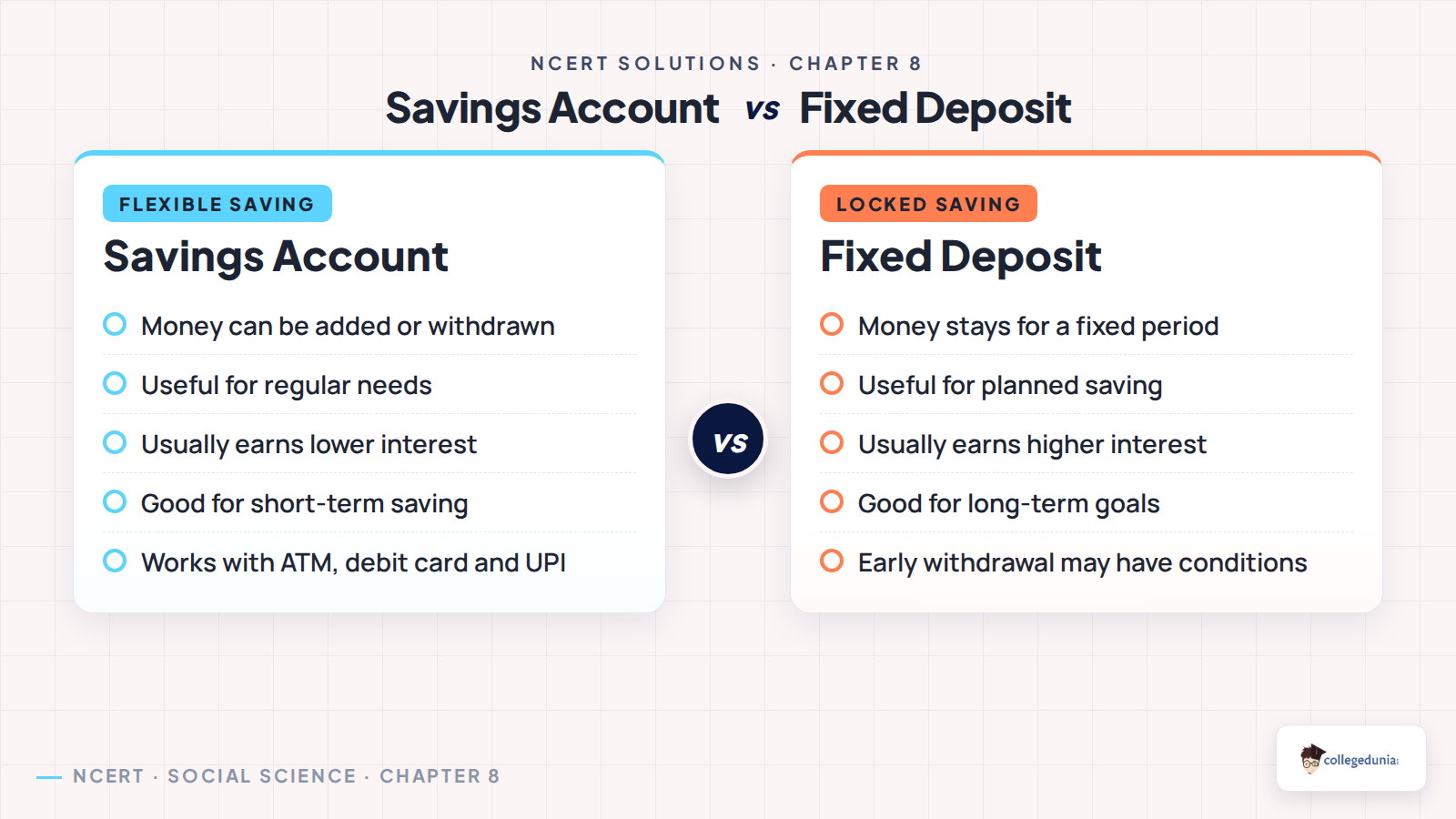
The chapter explains that different bank accounts serve different needs. A savings account is useful for regular deposits and withdrawals. A fixed deposit is useful when money can remain with the bank for a fixed period.
| Account type | Best use | Interest idea |
|---|---|---|
| Savings account | Regular saving and withdrawal | Usually lower interest because money can be withdrawn more easily |
| Current account | Business payments | Usually no interest, but frequent transactions are allowed |
| Fixed deposit | Money kept for a fixed time | Usually higher interest because the bank gets stable funds |
Compound Interest Calculation in Chapter 8
The numerical question asks how much Sahil would have after 3 years on Rs. 10,000 at 12 per cent per year. Since the chapter explains compounding, the solution shows annual compounding and also mentions the simple-interest answer for clarity.
- Simple interest gives Rs. 13,600 after 3 years.
- Annual compounding gives Rs. 14,049.28 after 3 years.
- The compound answer is higher because interest earns further interest.
Common mistake: Do not write only the final amount. Show the year-wise working so the difference between simple interest and compound interest is clear.
Digital Payment Safety Points
Digital payments make transfers quick, but the chapter also warns students about cyber fraud. A good answer should balance convenience with caution.
Watch Out: Fraud often starts with a fake call, unknown link or request for an OTP.
- Never share OTP, PIN, password, card details or account details.
- Check the receiver name before paying through UPI.
- Avoid unknown links, files and apps sent through messages.
- Report suspected fraud quickly through 1930 or the National Cybercrime Reporting Portal.
Exam tip: In safety answers, use action words such as check, protect, avoid and report.
How to Use the Class 7 Social Science Chapter 8 Solutions PDF
Use the PDF in three rounds. First, read the direct answer to each textbook question. Then revise the expert explanation. Finally, practise the activity answers by using your own family, neighbourhood or school examples.
- For definition questions, write one clear meaning and two examples.
- For banking questions, mention safety, records, interest and access.
- For activity answers, keep the format neat and connected to the chapter.
Quick recall: Banks save, lend and transfer. Payment systems move money. Stock markets connect savings with companies.
Banks and the Magic of Finance Question Answers
Need the answer cards? Open the chapter's question set for collapsible Check Solution and Expert Solution tabs.
More Class 7 Social Science Chapter 8 Resources
| Resource | Use it for | Link |
|---|---|---|
| NCERT Solutions | All exercise answers and expert explanations | Banks and the Magic of Finance Class 7 NCERT Solutions |
| Revision Notes | Quick theory and key terms | Banks and the Magic of Finance Class 7 Notes |
| NCERT Book PDF | Original textbook reading and activities | Banks and the Magic of Finance Book PDF |
| Handwritten Notes | Last-minute visual revision | Banks and the Magic of Finance Handwritten Notes |
All Chapters of Class 7 Social Science Part 2 with NCERT Solutions
Use this table to move between the Class 7 Social Science Part 2 NCERT Solutions chapters in order.
Banks and the Magic of Finance Class 7 NCERT Solutions FAQs
Ques. What is financial infrastructure in Class 7 Social Science Chapter 8?
Ans. Financial infrastructure is the network of banks, payment systems, stock markets, post offices and other institutions that help money move safely among people, businesses and the government.
Ques. How many questions are solved in the Chapter 8 NCERT Solutions PDF?
Ans. The PDF solves 12 Questions and activities from NCERT Class 7 Social Science Part 2 Chapter 8 with stepwise long answers and expert explanations.
Ques. What amount does Sahil get after 3 years at 12 per cent interest?
Ans. With simple interest, Sahil gets Rs. 13,600. With annual compounding, he gets Rs. 14,049.28. The PDF shows both calculations clearly.
Ques. How can students stay safe while using digital payments?
Ans. Students should never share OTPs, PINs, passwords or bank details. They should verify payment details, avoid unknown links and report suspected fraud through 1930 or cybercrime.gov.in.



Comments