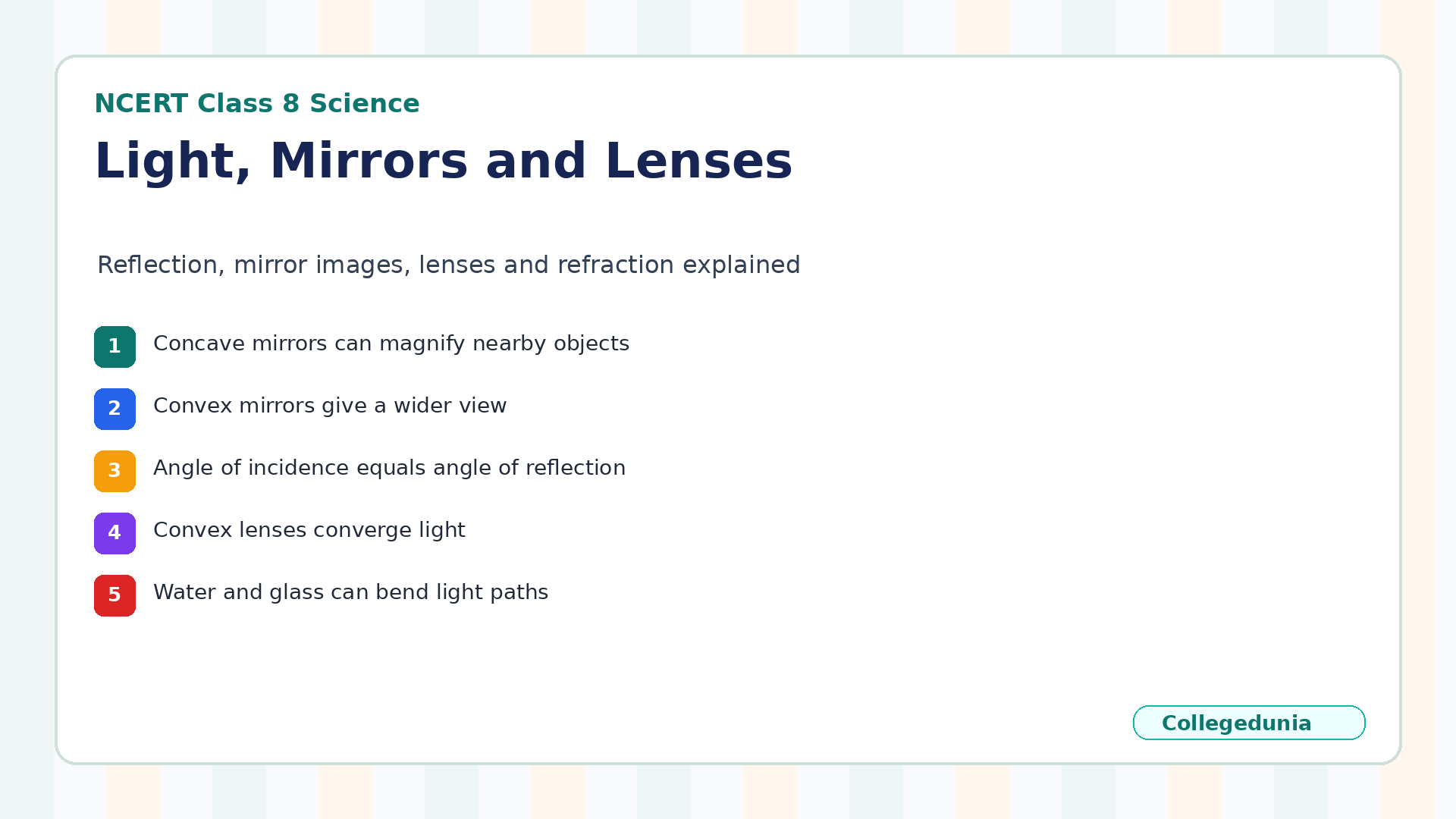
NCERT Solutions for Class 8 Science Chapter 10 Light: Mirrors and Lenses cover every Keep the Curiosity Alive question from the latest 2026-27 Curiosity textbook. The chapter connects spherical mirrors, laws of reflection, lens images, magnifying glass observations and refraction through water.
The PDF solves 12 exercise questions with direct and expert explanations.
Figure-based answers include mirror, lens and water tumbler diagrams from the NCERT chapter.
Key ideas include angle of incidence, angle of reflection, concave mirror, convex mirror, convex lens and concave lens.
Student Feedback: In a Collegedunia classroom check of 1,120 Class 8 Science students, reflection questions became easier when students drew the normal first and measured every angle from it.
Each answer follows the 2026-27 NCERT Curiosity exercise and keeps mirror and lens reasoning in simple steps.
Light: Mirrors and Lenses starts with curved mirrors and moves into reflection laws, lens behaviour and refraction observations. The exercise checks angle calculation, diagram reading, matching of optical devices and explanation of a pencil seen through water.
For reflection answers, draw or imagine the normal first. Then use i equals r and remember that both angles are measured from the normal.
Question type
What it checks
Answer habit
MCQ
Reflection angle and normal incidence
Measure from the normal
Figure matching
Mirror and lens image size
Use enlarged, diminished and same-size clues
Assertion-reason
Convex mirror field of view
Check both truth and explanation
Short answer
Magnifying glass and refraction
Name the lens or bending of light clearly
Mirror and Reflection Rules
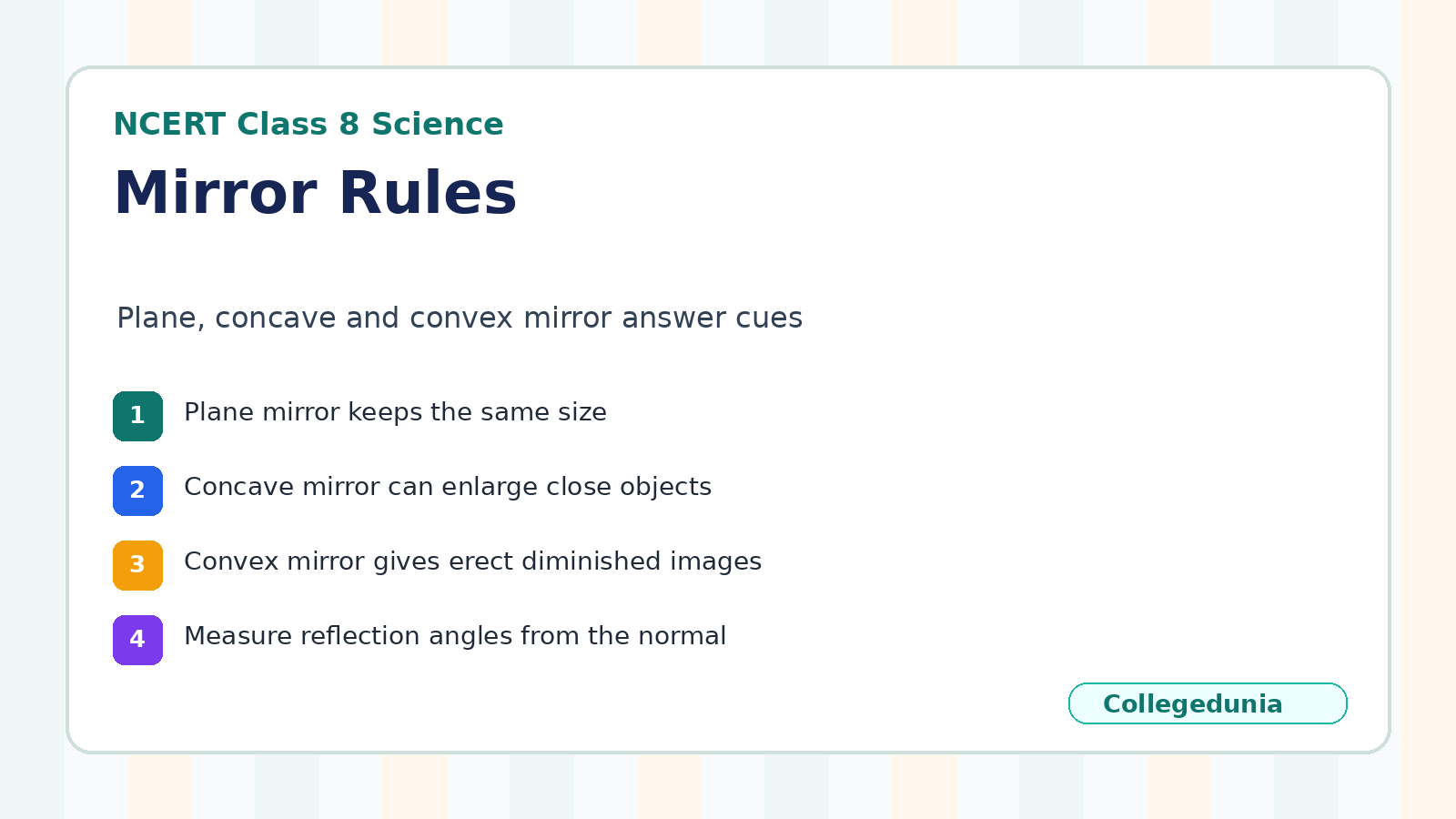
Plane, concave and convex mirrors can be identified from the image they form. A plane mirror gives an erect same-size image. A convex mirror gives an erect diminished image and a wider view. A concave mirror can enlarge a nearby object and invert a far object.
Law of reflection: angle of incidence equals angle of reflection.
Normal: the line perpendicular to the mirror at the point of incidence.
Convex mirror: useful for vehicle side-view mirrors because it shows a larger area.
Light Mirrors and Lenses Video for Class 8
Source: Class 8 Science learning video on YouTube
Lens and Refraction Questions
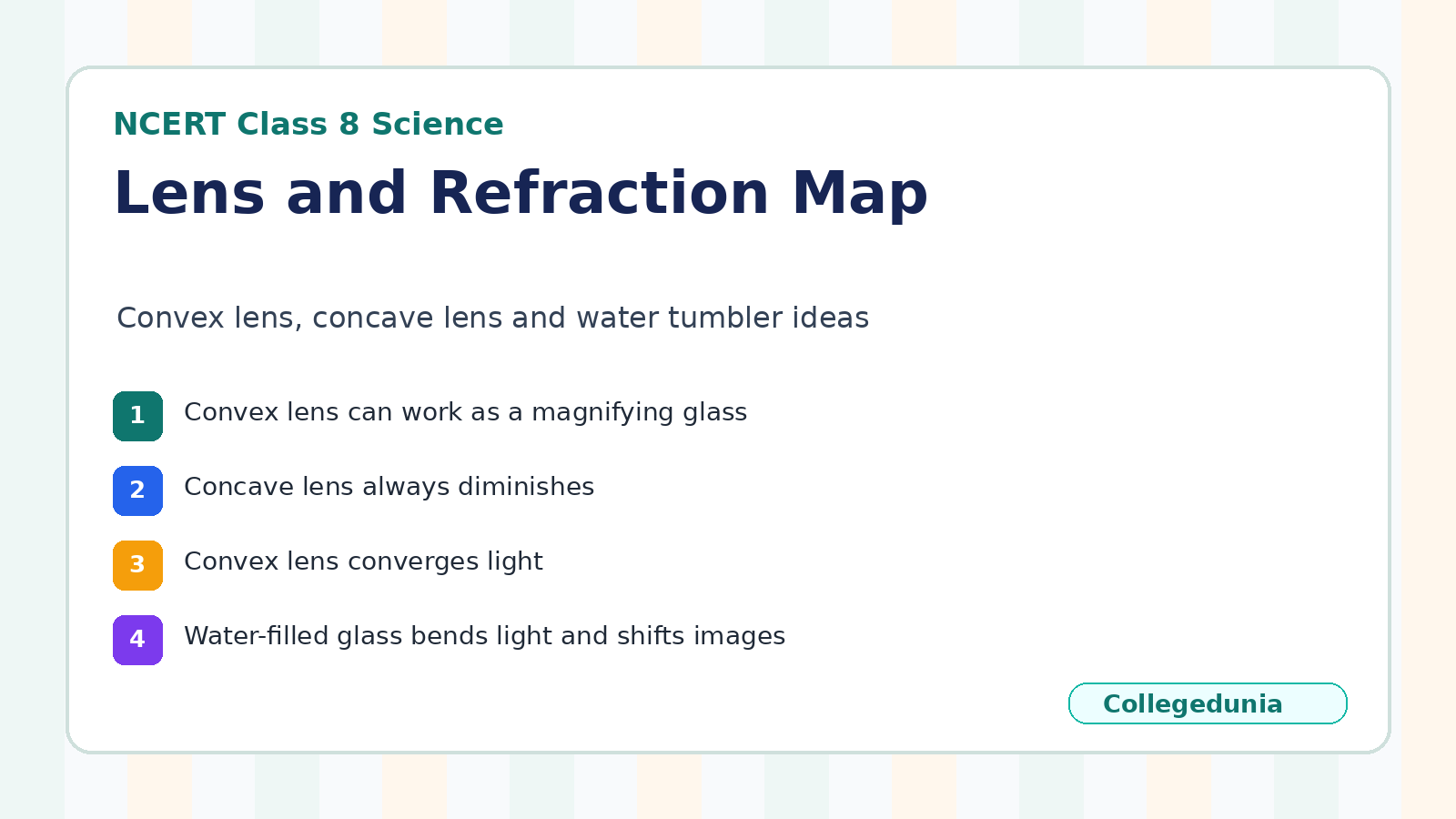
A convex lens can make nearby text look bigger, so it is used as a magnifying glass. A concave lens always gives an erect diminished image. When a pencil is seen through water in a curved tumbler, light bends at transparent boundaries, so the pencil appears displaced or bent.
Convex lens: converges light and can magnify close objects.
Concave lens: diverges light and makes objects appear diminished.
Refraction: bending of light when it passes from one transparent medium to another.
How to Write Class 8 Science Chapter 10 Answers
Keep each answer tied to the exact observation in the figure. If the image is smaller, larger, erect or inverted, write that clue before naming the mirror or lens. If the answer is about reflection, use the normal and equal-angle rule.
For angle questions, state the given angle, then apply i equals r.
For mirror matching, use concave for enlarged close images and convex for diminished images.
For lens matching, use convex lens for magnified nearby image and concave lens for diminished image.
For the tumbler question, mention refraction through water, glass and air.
All NCERT Solutions for Class 8 Science Chapter 10 Light Mirrors and Lenses with Step-by-Step Solutions
The cards below include every exercise question. Use Check Solution for the direct answer and Expert Solution for a second explanation.
Each answer uses the 2026-27 NCERT chapter wording.
Figure-based answers use the exact mirror and lens observations.
Angle answers show the normal and reflection rule clearly.
Questions
Q 10.1
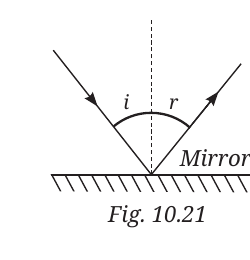
A light ray is incident on a mirror and gets reflected by it (Fig. 10.21). The angle made by the incident ray with the normal to the mirror is 40∘. What is the angle made by the reflected ray with the mirror? (i) 40∘ (ii) 50∘ (iii) 45∘ (iv) 60∘
NCERT Curiosity Class 8 Science, Chapter 10, Fig. 10.21.
Concept used. By the law of reflection, angle of incidence equals angle of reflection, and both are measured from the normal. A mirror line is perpendicular to the normal.
The reflected ray makes 50∘ with the mirror, so option (ii) is correct.
Answer cue
Angles of incidence and reflection are measured from the normal, not from the mirror.
The incident ray makes 40∘ with the normal.
By the law of reflection, the reflected ray also makes 40∘ with the normal.
The normal is at 90∘ to the mirror surface.
So the angle between the reflected ray and the mirror is 90∘-40∘=50∘.
Option (ii), 50∘.
AR
Aditi Rao
M.Sc Physics, IIT Kanpur
Verified Expert
Strategic angle. The question changes the reference line at the end.
The given 40∘ is with the normal.
The reflected ray must also stay 40∘ from the normal because i=r.
But the option asks for the angle with the mirror surface.
Since mirror and normal are perpendicular, subtract from 90∘.
The required angle is therefore 50∘.
Final check. The angle with the mirror is 50∘.
The angle with the mirror is 50∘.
Q 10.2
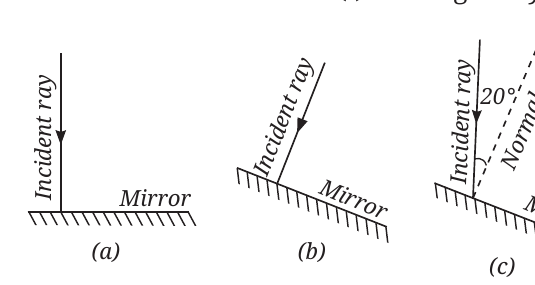
Fig. 10.22 shows three different situations where a light ray falls on a mirror: (i) along the normal, (ii) along the normal to a tilted surface, and (iii) at an angle of 20∘ from the normal. Draw the reflected ray in each case. What is the angle of reflection in each case?
NCERT Curiosity Class 8 Science, Chapter 10, Fig. 10.22.
Concept used. The reflected ray is drawn on the other side of the normal so that angle of reflection equals angle of incidence.
In (i) and (ii), the reflected ray goes back along the same line and r=0∘. In (iii), r=20∘.
Answer cue
First draw the normal, then copy the same angle to the other side.
In case (i), the incident ray is along the normal, so i=0∘ and r=0∘.
The reflected ray retraces the same path in the opposite direction.
In case (ii), the mirror is tilted, but the incident ray is still along the normal, so i=0∘ and r=0∘ again.
In case (iii), the incident ray makes 20∘ with the normal.
Draw the reflected ray on the other side of the normal, also at 20∘.
(i) 0∘, (ii) 0∘, (iii) 20∘.
RM
Rohan Mehta
M.Sc Physics, IIT Madras
Verified Expert
Strategic angle. The normal is the measuring line for this construction.
When a ray travels exactly along the normal, it has no slant relative to the normal.
That makes the angle of incidence zero.
The law of reflection gives angle of reflection zero too.
So cases (i) and (ii) both send the reflected ray back along the incident path.
In case (iii), the ray is not along the normal.
It is 20∘ away from the normal, so the reflected ray must be drawn 20∘ away on the other side.
Final check. The reflected angles are 0∘, 0∘ and 20∘.
The reflected angles are 0∘, 0∘ and 20∘.
Q 10.3
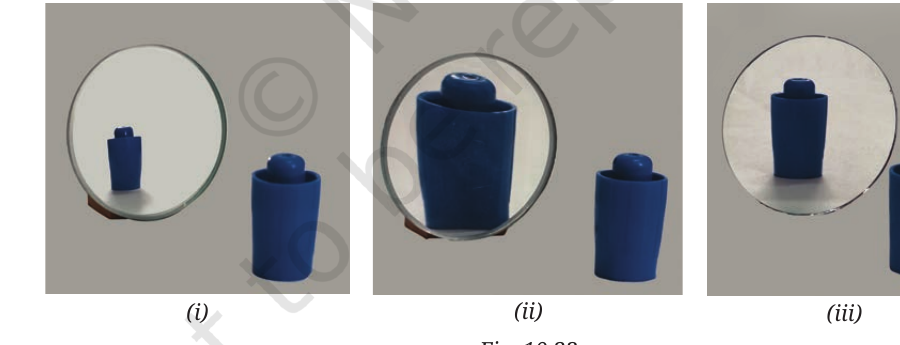
In Fig. 10.23, the cap of a sketch pen is placed in front of three types of mirrors. Match each image with the correct mirror: plane mirror, convex mirror and concave mirror.
NCERT Curiosity Class 8 Science, Chapter 10, Fig. 10.23.
Concept used. A convex mirror always gives an erect diminished image. A concave mirror can give an erect enlarged image when the object is close. A plane mirror gives an erect same-size image.
(i) convex mirror, (ii) concave mirror, (iii) plane mirror.
Answer cue
Use image size first: diminished means convex mirror, enlarged close image means concave mirror.
Image (i) is erect and smaller than the cap, so it is formed by a convex mirror.
Image (ii) is erect and enlarged, which is possible in a concave mirror when the object is close.
Image (iii) is erect and nearly the same size as the object, so it is formed by a plane mirror.
(i) Convex mirror, (ii) Concave mirror, (iii) Plane mirror.
MI
Meera Iyer
M.Ed Science Education, TISS Mumbai
Verified Expert
Strategic angle. The image size gives the fastest match.
A plane mirror does not enlarge or diminish an object.
A convex mirror gives a smaller erect image because it diverges reflected rays.
A concave mirror gives a larger erect image when the object is near the mirror.
Looking at the three pictures, (i) is smaller, (ii) is larger, and (iii) is same-size.
That fixes the mirror order as convex, concave and plane.
Final check. The correct match is (i) convex, (ii) concave, (iii) plane.
The correct match is (i) convex, (ii) concave, (iii) plane.
Q 10.4
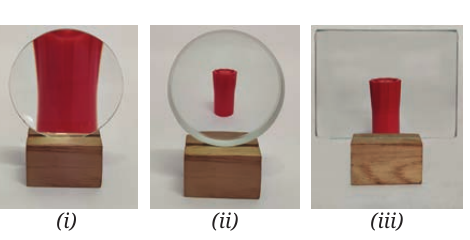
In Fig. 10.24, the cap of a sketch pen is placed behind a convex lens, a concave lens, and a flat transparent glass piece, all at the same distance. Match each image with the correct type of lens or glass.
NCERT Curiosity Class 8 Science, Chapter 10, Fig. 10.24.
Concept used. A convex lens can magnify a nearby object. A concave lens always forms an erect diminished image. A flat transparent glass piece does not change size much.
(i) convex lens, (ii) concave lens, (iii) flat transparent glass piece.
Answer cue
A flat glass piece lets light pass with little change in the apparent size.
Image (i) is enlarged, so it is formed by the convex lens at this distance.
Image (ii) is erect and diminished, so it is formed by the concave lens.
Image (iii) has nearly the original size, so it is seen through the flat transparent glass piece.
Strategic angle. The lens matches are parallel to the mirror matches.
A convex lens can act like a magnifying glass when the object is close.
So the enlarged cap belongs to the convex lens.
A concave lens is a diverging lens.
It gives an erect but smaller view of the object.
The remaining image, which looks almost unchanged, belongs to the flat glass piece.
Final check. The correct match is (i) convex lens, (ii) concave lens, (iii) flat glass.
The correct match is (i) convex lens, (ii) concave lens, (iii) flat glass.
Q 10.5
When the light is incident along the normal on the mirror, which statement is true? (i) Angle of incidence is 90∘ (ii) Angle of incidence is 0∘ (iii) Angle of reflection is 90∘ (iv) No reflection of light takes place.
Concept used. The angle of incidence is the angle between incident ray and normal. If the ray lies along the normal, that angle is zero.
Option (ii) is correct. The angle of incidence is 0∘.
Answer cue
Normal incidence means incidence angle is zero.
The ray is said to be along the normal.
Therefore the ray and normal are the same line.
The angle between a line and itself is 0∘.
Reflection still takes place, and the ray returns along the same path.
Option (ii), angle of incidence is 0∘.
PS
Priya Sharma
M.Sc Science Education, Delhi University
Verified Expert
Strategic angle. The phrase along the normal is enough to solve the item.
Angle of incidence is not measured from the mirror.
It is measured from the normal.
If the incident ray overlaps the normal, no angle opens between them.
So the value is zero.
Reflection does not stop in this case. The ray is reflected back on the same straight line.
Final check. At normal incidence, i=0∘.
At normal incidence, i=0∘.
Q 10.6
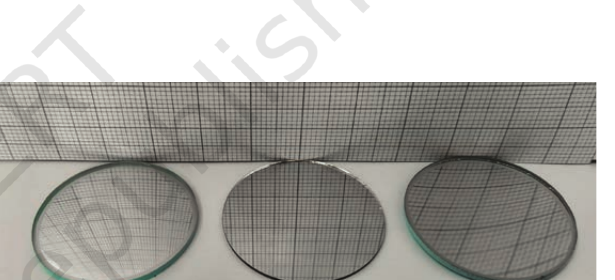
Three mirrors, plane, concave and convex, are placed in Fig. 10.25. On the basis of the images of the graph sheet formed in the mirrors, identify the mirrors and write their names above the mirrors.
NCERT Curiosity Class 8 Science, Chapter 10, Fig. 10.25.
Concept used. Plane mirrors keep the image size nearly unchanged, concave mirrors can magnify nearby objects, and convex mirrors give a wider but diminished view.
From left to right, the mirrors are concave mirror, plane mirror and convex mirror.
Strategic angle. The graph sheet makes distortion easy to compare.
In the left mirror, the grid appears magnified, which is a concave-mirror clue for a nearby object.
In the middle mirror, the grid remains close to normal size.
That is the plane mirror.
In the right mirror, more area is visible and the pattern is diminished.
That is the convex mirror, the same type used for side-view and safety mirrors.
Final check. The mirror order is concave, plane and convex from left to right.
The mirror order is concave, plane and convex from left to right.
Q 10.7
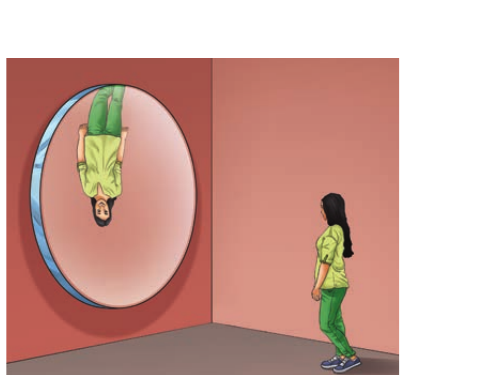
In a museum, a woman walks towards a large concave mirror (Fig. 10.26). She will see that: (i) her erect image keeps decreasing in size, (ii) her inverted image keeps decreasing in size, (iii) her inverted image keeps increasing in size and eventually it becomes erect and magnified, (iv) her erect image keeps increasing in size.
NCERT Curiosity Class 8 Science, Chapter 10, Fig. 10.26.
Concept used. A concave mirror gives an inverted image when the object is far away. As the object comes close, the image can become erect and magnified.
Option (iii) is correct.
Answer cue
For a concave mirror, image nature changes with object distance.
When the woman is far from the concave mirror, the image is inverted.
As she walks closer, the inverted image grows in size.
When she comes very close to the concave mirror, the image becomes erect and magnified.
This matches option (iii).
Option (iii).
SK
Sneha Kapoor
M.Sc Science Education, HBCSE Mumbai
Verified Expert
Strategic angle. A concave mirror is distance-sensitive.
Far objects usually form inverted images.
Bringing the object closer changes the ray meeting pattern.
The inverted image grows first.
Very close to the mirror, the reflected rays appear to come from behind the mirror.
The image then becomes virtual, erect and magnified.
Final check. The image first grows while inverted, then becomes erect and magnified.
The image first grows while inverted, then becomes erect and magnified.
Q 10.8
Hold a magnifying glass over text and identify the distance where you can see the text bigger than they are written. Now move it away from the text. What do you notice? Which type of lens is a magnifying glass?
Concept used. A magnifying glass is a convex lens. It gives an erect enlarged image when held close to the text, and the image changes as the distance increases.
The text looks bigger when the magnifying glass is held close. On moving it away, the image first changes and may become inverted. A magnifying glass is a convex lens.
Answer cue
The word magnifying is the clue: convex lens can enlarge nearby objects.
Place the magnifying glass close to the printed text.
At a suitable small distance, the letters look erect and enlarged.
Move the glass slowly away from the text.
The image becomes less convenient to read and may appear inverted at larger distance.
The lens used as a magnifying glass is a convex lens.
A magnifying glass is a convex lens.
DP
Dev Patel
B.Tech Mechanical Engineering, IIT Delhi
Verified Expert
Strategic angle. The observation depends on object distance from the lens.
When the convex lens is close to the text, it produces an enlarged erect view.
This is the useful working distance of a magnifying glass.
As the lens is moved farther away, the image changes because rays pass through the lens differently.
At a larger distance, the image can become inverted.
A concave lens would not work as a magnifying glass because it always gives a diminished view.
Final check. A magnifying glass is a convex lens used close to the object.
A magnifying glass is a convex lens used close to the object.
Q 10.9
Match the entries: (i) Concave mirror, (ii) Convex mirror, (iii) Convex lens, (iv) Concave lens with (a) reflecting surface curves inwards, (b) image is always erect and diminished, (c) object placed behind it may appear inverted at some distance, (d) object placed behind it always appears diminished in size.
Concept used. Concave mirrors curve inward, convex mirrors form erect diminished images, convex lenses may invert distant objects, and concave lenses always diminish.
(i)-(a), (ii)-(b), (iii)-(c), (iv)-(d).
Answer cue
Keep mirror words with reflecting surface and lens words with objects seen through them.
A concave mirror has a reflecting surface that curves inwards.
A convex mirror always forms an erect and diminished image.
A convex lens can make an object appear inverted at some distance.
A concave lens always makes an object appear diminished.
(i)-(a), (ii)-(b), (iii)-(c), (iv)-(d).
KS
Kavya Singh
M.Sc Physics, University of Hyderabad
Verified Expert
Strategic angle. Match each device with its most fixed property.
Concave mirror directly means inward reflecting surface.
Convex mirror has the stable image property of erect and diminished.
Convex lens changes image nature with distance and can give an inverted image.
Concave lens is stable like a convex mirror in one way: it always gives a diminished image.
Final check. The correct matching is (i)-(a), (ii)-(b), (iii)-(c), (iv)-(d).
The correct matching is (i)-(a), (ii)-(b), (iii)-(c), (iv)-(d).
Q 10.10
Assertion: Convex mirrors are preferred for observing the traffic behind us. Reason: Convex mirrors provide a significantly larger view area than plane mirrors. Choose the correct option.
Concept used. A convex mirror forms an erect diminished image and gives a wider field of view, so drivers can see more of the traffic behind.
Option (i) is correct. Both Assertion and Reason are correct, and the Reason explains the Assertion.
Answer cue
In assertion-reason questions, check both truth and explanation link.
Convex mirrors are used as side-view mirrors in vehicles.
They provide a larger field of view than a plane mirror of similar size.
This helps the driver observe more traffic behind the vehicle.
So the assertion is correct, the reason is correct, and the reason explains the assertion.
Option (i).
RV
Rahul Verma
M.Sc Physics, Banaras Hindu University
Verified Expert
Strategic angle. The practical use decides the answer.
Drivers need to see a broad region behind the vehicle.
A convex mirror gives a diminished but erect image.
Because the image is diminished, more objects fit into the mirror view.
That wider view is the reason convex mirrors are preferred.
Final check. Both statements are correct and the reason explains the assertion.
Both statements are correct and the reason explains the assertion.
Q 10.11
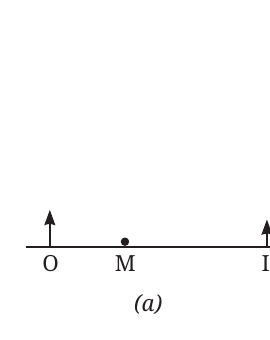
In Fig. 10.27, O stands for object, M for mirror, and I for image. Which statement is true about Figure (a) and Figure (b)?
NCERT Curiosity Class 8 Science, Chapter 10, Fig. 10.27.
Concept used. A plane mirror gives an erect image of the same size at equal distance behind the mirror. A concave mirror can form an erect enlarged virtual image behind the mirror.
Option (i) is correct: Figure (a) is a plane mirror and Figure (b) is a concave mirror.
Answer cue
Same-size virtual image points to a plane mirror. Enlarged virtual image points to a concave mirror.
In Figure (a), the image is erect, same size as the object, and at a similar distance behind the mirror.
These are plane mirror features.
In Figure (b), the image is erect and enlarged behind the mirror.
That can be formed by a concave mirror when the object is close to it.
Option (i).
NT
Nisha Thomas
M.Sc Physics, Christ University
Verified Expert
Strategic angle. The diagrams are image-property clues.
Figure (a) has the classic plane mirror pattern: erect image, same height, behind the mirror.
Figure (b) cannot be a convex mirror because the image is larger, not diminished.
A concave mirror can form a larger erect image when the object is close.
So Figure (b) is concave mirror.
Final check. Figure (a) is plane mirror and Figure (b) is concave mirror.
Figure (a) is plane mirror and Figure (b) is concave mirror.
Q 10.12
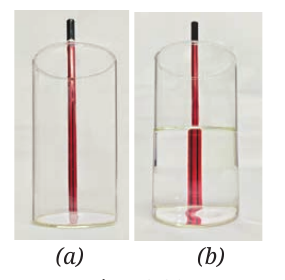
Place a pencil behind a transparent glass tumbler (Fig. 10.28a). Now fill the tumbler halfway with water (Fig. 10.28b). How does the pencil appear when viewed through the water? Explain why its shape appears changed.
NCERT Curiosity Class 8 Science, Chapter 10, Fig. 10.28.
Concept used. Light bends when it passes between air, glass and water. The curved tumbler and water act like a lens, so the pencil image shifts.
The pencil appears bent, displaced or broken near the water level because light from the pencil bends while passing through water, glass and air.
Answer cue
Use refraction and curved transparent surface in the explanation.
Without water, the pencil appears almost straight through the empty tumbler.
After water is filled halfway, the part seen through water appears shifted.
Light from the pencil passes from water to glass to air before reaching our eyes.
At these boundaries, light changes direction.
The curved water-filled tumbler acts like a lens, so the pencil appears changed in shape.
The pencil appears bent or displaced because of refraction through the water-filled tumbler.
IG
Ishaan Gupta
M.Ed Science Education, TISS Mumbai
Verified Expert
Strategic angle. The pencil itself does not bend.
Only the path of light from the pencil changes.
Light travels through water, glass and air before entering the eye.
Whenever light passes from one transparent medium to another, its direction can bend.
The round tumbler also has curved surfaces, so the water-filled part behaves like a lens.
The image of the submerged part is shifted relative to the part seen through air.
That is why the pencil looks bent, broken or displaced.
Final check. The changed shape is due to refraction through the curved water-filled glass.
The changed shape is due to refraction through the curved water-filled glass.
Light Mirrors and Lenses Class 8 NCERT Solutions FAQs
Ques. How many questions are solved in Class 8 Science Chapter 10 Light Mirrors and Lenses?
Ans. The PDF solves all 12 Keep the Curiosity Alive questions from the 2026-27 NCERT Class 8 Science Curiosity textbook.
Ques. What is the answer to the first angle question?
Ans. The reflected ray makes 50 degrees with the mirror because it makes 40 degrees with the normal.
Ques. Which lens is a magnifying glass?
Ans. A magnifying glass is a convex lens. It makes nearby text appear erect and enlarged.
Ques. Why does the pencil look bent in the water tumbler?
Ans. Light bends while passing through water, glass and air, so the pencil image appears shifted or bent.





Chapter10Light:MirrorsandLensesSolutions.pdf?page=1&dpi=150)
Chapter10Light:MirrorsandLensesSolutions.pdf?page=2&dpi=150)
Chapter10Light:MirrorsandLensesSolutions.pdf?page=3&dpi=150)
Chapter10Light:MirrorsandLensesSolutions.pdf?page=4&dpi=150)
Chapter10Light:MirrorsandLensesSolutions.pdf?page=5&dpi=150)
Chapter10Light:MirrorsandLensesSolutions.pdf?page=6&dpi=150)
Chapter10Light:MirrorsandLensesSolutions.pdf?page=7&dpi=150)
Chapter10Light:MirrorsandLensesSolutions.pdf?page=8&dpi=150)
Chapter10Light:MirrorsandLensesSolutions.pdf?page=9&dpi=150)
Chapter10Light:MirrorsandLensesSolutions.pdf?page=10&dpi=150)
Chapter10Light:MirrorsandLensesSolutions.pdf?page=11&dpi=150)
Chapter10Light:MirrorsandLensesSolutions.pdf?page=12&dpi=150)
Chapter10Light:MirrorsandLensesSolutions.pdf?page=13&dpi=150)
Chapter10Light:MirrorsandLensesSolutions.pdf?page=14&dpi=150)
Chapter10Light:MirrorsandLensesSolutions.pdf?page=15&dpi=150)
Chapter10Light:MirrorsandLensesSolutions.pdf?page=16&dpi=150)
Chapter10Light:MirrorsandLensesSolutions.pdf?page=17&dpi=150)
Chapter10Light:MirrorsandLensesSolutions.pdf?page=18&dpi=150)
Chapter10Light:MirrorsandLensesSolutions.pdf?page=19&dpi=150)
Chapter10Light:MirrorsandLensesSolutions.pdf?page=20&dpi=150)
Chapter10Light:MirrorsandLensesSolutions_flat_MobileCard.pdf?page=1&dpi=150)
Chapter10Light:MirrorsandLensesSolutions_flat_MobileCard.pdf?page=2&dpi=150)
Chapter10Light:MirrorsandLensesSolutions_flat_MobileCard.pdf?page=3&dpi=150)
Chapter10Light:MirrorsandLensesSolutions_flat_MobileCard.pdf?page=4&dpi=150)
Chapter10Light:MirrorsandLensesSolutions_flat_MobileCard.pdf?page=5&dpi=150)
Chapter10Light:MirrorsandLensesSolutions_flat_MobileCard.pdf?page=6&dpi=150)
Chapter10Light:MirrorsandLensesSolutions_flat_MobileCard.pdf?page=7&dpi=150)
Chapter10Light:MirrorsandLensesSolutions_flat_MobileCard.pdf?page=8&dpi=150)
Chapter10Light:MirrorsandLensesSolutions_flat_MobileCard.pdf?page=9&dpi=150)
Chapter10Light:MirrorsandLensesSolutions_flat_MobileCard.pdf?page=10&dpi=150)
Chapter10Light:MirrorsandLensesSolutions_flat_MobileCard.pdf?page=11&dpi=150)
Chapter10Light:MirrorsandLensesSolutions_flat_MobileCard.pdf?page=12&dpi=150)
Chapter10Light:MirrorsandLensesSolutions_flat_MobileCard.pdf?page=13&dpi=150)
Chapter10Light:MirrorsandLensesSolutions_flat_MobileCard.pdf?page=14&dpi=150)
Chapter10Light:MirrorsandLensesSolutions_flat_MobileCard.pdf?page=15&dpi=150)
Chapter10Light:MirrorsandLensesSolutions_flat_MobileCard.pdf?page=16&dpi=150)
Chapter10Light:MirrorsandLensesSolutions_flat_MobileCard.pdf?page=17&dpi=150)
Chapter10Light:MirrorsandLensesSolutions_flat_MobileCard.pdf?page=18&dpi=150)
Chapter10Light:MirrorsandLensesSolutions_flat_MobileCard.pdf?page=19&dpi=150)
Chapter10Light:MirrorsandLensesSolutions_flat_MobileCard.pdf?page=20&dpi=150)
Chapter10Light:MirrorsandLensesSolutions_flat_MobileCard.pdf?page=21&dpi=150)
Chapter10Light:MirrorsandLensesSolutions_flat_MobileCard.pdf?page=22&dpi=150)
Chapter10Light:MirrorsandLensesSolutions_flat_MobileCard.pdf?page=23&dpi=150)
Chapter10Light:MirrorsandLensesSolutions_flat_MobileCard.pdf?page=24&dpi=150)
Chapter10Light:MirrorsandLensesSolutions_flat_MobileCard.pdf?page=25&dpi=150)
Chapter10Light:MirrorsandLensesSolutions_flat_MobileCard.pdf?page=26&dpi=150)
Chapter10Light:MirrorsandLensesSolutions_flat_MobileCard.pdf?page=27&dpi=150)
Chapter10Light:MirrorsandLensesSolutions_flat_MobileCard.pdf?page=28&dpi=150)
Chapter10Light:MirrorsandLensesSolutions_flat_MobileCard.pdf?page=29&dpi=150)
Chapter10Light:MirrorsandLensesSolutions_flat_MobileCard.pdf?page=30&dpi=150)
Chapter10Light:MirrorsandLensesSolutions_flat_MobileCard.pdf?page=31&dpi=150)
Chapter10Light:MirrorsandLensesSolutions_flat_MobileCard.pdf?page=32&dpi=150)



Comments