NCERT Solutions for Class 8 Science Chapter 11 Keeping Time with the Skies cover every Keep the Curiosity Alive question from the latest 2026-27 Curiosity textbook. The chapter explains Moon phases, lunar calendars, solar calendars, leap years, festival dates and artificial satellites.
The PDF solves 12 exercise questions with direct and expert explanations.
Figure-based answers include the incorrect crescent Moon picture and Moon phase panels from NCERT.
Key ideas include Full Moon, New Moon, waxing, waning, intercalary month, leap year and artificial satellites.
Student Feedback: In a Collegedunia classroom check of 1,080 Class 8 Science students, Moon phase questions became easier when students first marked the Sun direction and then shaded the Moon.
Each answer follows the 2026-27 NCERT Curiosity exercise and keeps calendar calculations in short steps.
Keeping Time with the Skies connects everyday timekeeping with sky cycles. The exercise checks why phases happen, how Moon positions reveal waxing and waning, why leap years matter, and how satellites help modern life.
For Moon phase answers, never write that Earth's shadow causes phases. Write that we see different parts of the Moon's illuminated half as the Moon revolves around Earth.
Question type
What it checks
Answer habit
True or False
Moonlight, phases and calendars
Correct false statements clearly
Figure reading
Moon phase panels and wrong sky drawing
Use illuminated portion and solid Moon logic
Calendar reasoning
Lunar, solar and luni-solar cycles
Compare cycle lengths
Short answer
Satellites and time units
List uses or periodic phenomena directly
Moon Phase Questions
The Moon's shape does not really change. We see different fractions of the illuminated half as the Moon moves around Earth. A waxing Moon has an increasing bright part, while a waning Moon has a decreasing bright part.
New Moon: the illuminated side faces away from Earth.
Full Moon: the illuminated side faces Earth and the Moon is visible all night.
Crescent: less than half the disc is bright.
Keeping Time with the Skies Video for Class 8
Source: Class 8 Science learning video on YouTube
Calendar and Satellite Questions
Calendars come from repeated sky events. A day is based on Earth's rotation, a month on the Moon's phase cycle, and a year on Earth's revolution around the Sun. Artificial satellites add a modern use of orbital motion.
Lunar calendar: follows Moon phases.
Solar calendar: follows the seasonal year.
Luni-solar calendar: follows lunar months and adds corrections to stay with seasons.
How to Write Class 8 Science Chapter 11 Answers
Keep each answer tied to the exact cycle named in the question. For Moon phases, mention Sun, Moon and Earth positions. For calendar questions, compare day counts. For satellite questions, list practical uses before giving examples.
For phase questions, use the words waxing, waning, crescent, gibbous and Full Moon accurately.
For leap year answers, use one extra day every four years.
For intercalary month answers, compare the lunar year and solar year.
For satellite answers, include communication, navigation, weather, disaster management and science.
All NCERT Solutions for Class 8 Science Chapter 11 Keeping Time with the Skies with Step-by-Step Solutions
The cards below include every exercise question. Use Check Solution for the direct answer and Expert Solution for a second explanation.
Each answer uses the 2026-27 NCERT chapter wording.
Figure-based answers use the exact NCERT Moon phase panels.
Calendar answers show the cycle comparison clearly.
Questions
Q 11.1
State whether the following statements are True or False.
[label=()]
We can only see that part of the Moon which reflects sunlight towards us.
The shadow of Earth blocks sunlight from reaching the Moon causing phases.
Calendars are based on various astronomical cycles which repeat in a predictable manner.
The Moon can only be seen at night.
Concept used. The Moon shines by reflecting sunlight. Moon phases happen because the Sun, Moon and Earth keep changing their relative positions. Earth's shadow causes a lunar eclipse, not regular phases.
(i) True, (ii) False, (iii) True, (iv) False.
Answer cue
Separate Moon phases from eclipses. Phases are monthly and regular, while eclipses are occasional.
(i) is true because only the illuminated part facing Earth sends reflected sunlight towards us.
(ii) is false. Earth's shadow causes lunar eclipses, not the monthly phases of the Moon.
(iii) is true because day, month and year come from repeating astronomical cycles.
(iv) is false because the Moon can be visible in the daytime when it is above the horizon and bright enough.
(i) True; (ii) False; (iii) True; (iv) False.
AR
Aditi Rao
M.Sc Astronomy Education, IUCAA Pune
Verified Expert
Strategic angle. The four statements test two common Moon ideas and one calendar idea.
The visible Moon is the part that is both lit by the Sun and facing Earth.
So statement (i) is true.
Statement (ii) gives the eclipse explanation to phases, which is wrong.
Statement (iii) is true because calendars use repeated sky cycles.
Statement (iv) is false because the Moon does not rise only at sunset.
On many days it can be in the sky during daylight.
Final check. The correct order is True, False, True, False.
The correct order is True, False, True, False.
Q 11.2
Amol was born on 6th of May on a full Moon day. Does his birthday fall on the full Moon day every year? Explain your answer.
Concept used. A birthday date in the Gregorian calendar follows the solar year, while a full Moon follows the Moon's phase cycle of about 29.5 days. These two cycles do not line up every year.
No. His birthday will not fall on a full Moon day every year.
Answer cue
A solar date and a lunar phase repeat by different cycles.
Amol's birthday date, 6 May, is fixed in the Gregorian solar calendar.
A full Moon repeats after about 29.5 days.
A solar year is about 365.25 days, which is not an exact whole number of Moon phase cycles.
So the full Moon date shifts in the Gregorian calendar from year to year.
Therefore 6 May may be a full Moon only in some years, not every year.
No. The full Moon will not fall on 6 May every year.
RM
Rohan Mehta
M.Sc Physics, IIT Madras
Verified Expert
Strategic angle. The birthday is tied to the solar calendar, but the full Moon is tied to the lunar cycle.
About 12 lunar months make only about 354 days.
The solar year is about 365.25 days.
That leaves a difference of about 11 days each year.
Because of this difference, the same Moon phase moves across Gregorian dates.
Amol may get a full Moon birthday occasionally, but not annually.
Final check. Different cycle lengths make the full Moon date drift.
Different cycle lengths make the full Moon date drift.
Q 11.3
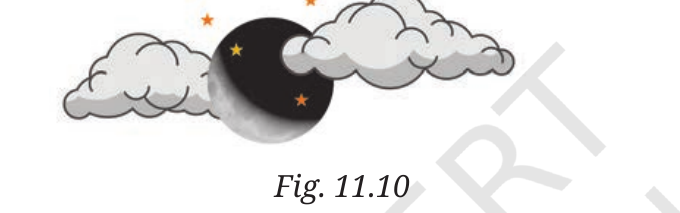
Name two things that are incorrect in Fig. 11.10.
NCERT Curiosity Class 8 Science, Chapter 11, Fig. 11.10.
Concept used. The Moon is a solid object in space. Clouds are in Earth's atmosphere, and stars cannot be seen through the non-illuminated part of the Moon.
Clouds are shown around the Moon, and stars are shown on the dark part of the Moon. Both are incorrect.
Answer cue
The unlit part of the Moon is dark, but it is not empty space.
Clouds form in Earth's atmosphere, not around the Moon in space.
So drawing clouds very close to the Moon is incorrect.
The dark part of the crescent is still the Moon's surface.
Stars cannot be seen through that dark part because the Moon blocks the background sky.
Therefore the stars drawn on the dark part of the Moon are also incorrect.
The incorrect parts are clouds near the Moon and stars visible through the dark lunar disc.
MI
Meera Iyer
M.Ed Science Education, TISS Mumbai
Verified Expert
Strategic angle. Read the picture as a sky model, not as a decorative scene.
The Moon is far outside Earth's atmosphere.
Clouds belong to the atmosphere near Earth, so they cannot surround the Moon.
The crescent shape means only part of the lunar surface is illuminated for us.
The remaining part is still solid Moon.
So background stars cannot appear inside the Moon's dark portion.
Final check. Cloud placement and stars inside the Moon are the two errors.
Cloud placement and stars inside the Moon are the two errors.
Q 11.4
Look at the pictures of the Moon in Fig. 11.11, and answer the following questions.
[label=()]
Write the correct panel label corresponding to the phases: three days after New Moon, Full Moon, three days after Full Moon, a week after Full Moon, and day of New Moon.
List the picture labels of the phases of the Moon that are never seen from Earth.
NCERT Curiosity Class 8 Science, Chapter 11, Fig. 11.11.
Concept used. After New Moon, a thin waxing crescent appears. Full Moon is fully bright. After Full Moon, the Moon wanes, first as gibbous and then half Moon after about a week.
(i) D, E, A, C, B. (ii) B and F are never seen from Earth as shown.
Answer cue
Use the amount of bright part first, then decide whether it is before or after full Moon.
Three days after New Moon is a thin crescent, so it matches panel D.
Full Moon is the completely bright disc, so it matches panel E.
Three days after Full Moon is mostly bright but waning, so it matches panel A.
A week after Full Moon is about half illuminated, so it matches panel C.
Day of New Moon is dark from Earth, so it matches panel B.
Panel B is not visible from Earth on New Moon day, and panel F is not a normal Moon phase because its dark boundary is not the usual curved terminator.
(i) D, E, A, C, B. (ii) B and F.
KN
Kabir Nair
M.Sc Astrophysics, IISc Bangalore
Verified Expert
Strategic angle. The panels can be sorted by illuminated fraction.
Panel E is fully bright, so it is Full Moon.
Panel B is fully dark, so it represents New Moon.
Panel D is a thin crescent just after New Moon.
Panel A is a gibbous Moon a few days after Full Moon.
Panel C is the half Moon about a week after Full Moon.
Panel F is not a regular visible phase because the dark patch is irregular, not the smooth phase boundary.
Final check. The table order is D, E, A, C, B, and the unseen labels are B and F.
The table order is D, E, A, C, B, and the unseen labels are B and F.
Q 11.5
Malini saw the Moon overhead in the sky at sunset.
[label=()]
Draw the phase of the Moon that Malini saw.
Is the Moon in the waxing or the waning phase?
Concept used. A waxing Moon is easiest to spot at sunset. When the Moon is overhead at sunset, it is about a week after New Moon and appears as a half Moon.
Malini saw a half Moon. It was in the waxing phase.
Answer cue
Waxing Moon is easiest to see at sunset, while waning Moon is easiest to see at sunrise.
At sunset, the Sun is near the western horizon.
A Moon overhead at that time is separated from the Sun by about a quarter of its orbit.
This corresponds to a half Moon shape.
Since it is seen well at sunset before Full Moon, the bright part is increasing.
So the Moon is in the waxing phase.
Draw a half Moon; it is waxing.
PS
Priya Sharma
M.Sc Science Education, Delhi University
Verified Expert
Strategic angle. The time of observation gives the phase clue.
A full Moon would rise near sunset, not stand overhead at sunset.
A New Moon would be near the Sun and hard to see.
A half Moon overhead at sunset fits the first-quarter position.
In this part of the cycle, the illuminated fraction is increasing night by night.
Therefore Malini saw a waxing half Moon.
Final check. The answer is a waxing half Moon.
The answer is a waxing half Moon.
Q 11.6
Ravi said, ``I saw a crescent Moon, and it was rising in the East, when the Sun was setting.'' Kaushalya said, ``Once I saw the gibbous Moon during the afternoon in the East.'' Who out of the two is telling the truth?
Concept used. A Moon rising in the east at sunset is nearly opposite the Sun and appears close to full, not crescent. A gibbous Moon can be visible in the afternoon in the eastern sky.
Kaushalya is telling the truth.
Answer cue
Crescent Moon stays close to the Sun in the sky. Full or gibbous Moon is farther from it.
When the Sun is setting in the west, an object rising in the east is nearly opposite the Sun.
The Moon appears full or nearly full when it is opposite the Sun.
So Ravi's crescent Moon rising in the east at sunset is not correct.
A gibbous Moon is more than half illuminated and can be far enough from the Sun to be seen in the eastern sky during afternoon.
Therefore Kaushalya's observation is possible.
Kaushalya is telling the truth.
AM
Arjun Menon
M.Tech Space Technology, IIT Bombay
Verified Expert
Strategic angle. Compare each statement with the Sun's position.
At sunset, the Sun is in the west.
A Moon rising in the east is roughly opposite the Sun.
Opposite-Sun geometry gives a full or nearly full Moon, not a crescent.
Ravi's statement fails this geometry test.
Kaushalya's gibbous Moon can appear in the eastern sky before evening.
So her statement is the truthful one.
Final check. Kaushalya's observation is possible; Ravi's is not.
Kaushalya's observation is possible; Ravi's is not.
Q 11.7
Scientific studies show that the Moon is getting farther away from the Earth and slower in its revolution. Will luni-solar calendars need an intercalary month more often or less often?
Concept used. A luni-solar calendar adds an intercalary month when the lunar year falls behind the solar year. If the Moon's revolution becomes slower, lunar months become longer.
They will need an intercalary month less often.
Answer cue
Slower Moon means longer lunar month, so the lunar year catches up a little.
At present, 12 lunar months are about 354 days.
The solar year is about 365 days, so the lunar year is shorter by about 11 days.
An intercalary month is added to reduce this accumulated difference.
If the Moon revolves more slowly, one lunar month becomes longer.
Then 12 lunar months become closer to the solar year.
So the difference accumulates more slowly and an intercalary month is needed less often.
Less often.
SK
Sneha Kapoor
M.Sc Science Education, HBCSE Mumbai
Verified Expert
Strategic angle. The need for an extra month comes from the gap between lunar and solar years.
A normal lunar year is shorter than the solar year.
That shortfall builds up and is corrected by adding a month.
If the Moon takes longer to complete its phase cycle, each lunar month lengthens.
Twelve such months would no longer fall behind the solar year as quickly.
Because the shortfall grows more slowly, correction is needed less frequently.
Final check. Luni-solar calendars would need intercalary months less often.
Luni-solar calendars would need intercalary months less often.
Q 11.8
A total of 37 full Moons happen during 3 years in a solar calendar. Show that at least two of the 37 full moons must happen during the same month of the solar calendar.
Concept used. If more objects are placed into fewer groups, at least one group must contain two or more objects. This is the pigeonhole idea.
Three solar years have 36 months. Since 37 full Moons occur, at least one month must contain two full Moons.
Answer cue
This is a counting argument: 37 events cannot fit one each into only 36 months.
A solar calendar has 12 months in one year.
In 3 years, the number of months is 12 × 3 = 36.
There are 37 full Moons in these 36 months.
If every month had at most one full Moon, only 36 full Moons could be placed.
But there are 37 full Moons.
Therefore at least one month must have two full Moons.
At least two full Moons must fall in the same solar-calendar month.
DP
Dev Patel
B.Tech Aerospace Engineering, IIT Delhi
Verified Expert
Strategic angle. Think of the months as boxes and the full Moons as events.
Over three years, there are exactly 36 monthly boxes.
The problem gives 37 full-Moon events.
Putting one event in each box accounts for only 36 events.
The remaining one event must share a box with an earlier event.
That shared box is a solar-calendar month with at least two full Moons.
Final check.37>36, so one month must contain two full Moons.
37>36, so one month must contain two full Moons.
Q 11.9
On a particular night, Vaishali saw the Moon in the sky from sunset to sunrise. What phase of the Moon would she have noticed?
Concept used. A full Moon is nearly opposite the Sun. It rises around sunset and sets around sunrise, so it can be visible through the whole night.
She would have noticed a full Moon.
Answer cue
All-night visibility is the easiest clue for Full Moon.
If the Moon is visible from sunset to sunrise, it is in the sky all night.
An all-night Moon is nearly opposite the Sun.
When the Sun sets, a full Moon rises near the eastern horizon.
When the Sun rises, the full Moon sets near the western horizon.
So the phase is full Moon.
Full Moon.
KS
Kavya Singh
M.Sc Physics, University of Hyderabad
Verified Expert
Strategic angle. The Sun and Moon are on opposite sides of the sky at Full Moon.
That is why the Full Moon rises around the time the Sun sets.
It travels across the night sky while the Sun is below the horizon.
By sunrise, it is setting.
This exactly matches Vaishali's observation from sunset to sunrise.
So the observed phase must be Full Moon.
Final check. The phase was Full Moon.
The phase was Full Moon.
Q 11.10
If we stopped having leap years, in approximately how many years would the Indian Independence day happen in winter?
Concept used. Without leap years, the calendar would slip by about one day every four years because the solar year is about a quarter day longer than 365 days.
Approximately 720 years.
Answer cue
One missed leap day every four years means one day of seasonal shift in four years.
A leap day corrects about one extra day every 4 years.
If leap years stop, the calendar shifts by about 14 day each year with respect to seasons.
To move Independence Day from August to winter, we need roughly a half-year shift, about 180 days.
Time needed =180 ÷ 14 years.
This is 180 × 4 = 720 years.
About 720 years.
RV
Rahul Verma
M.Sc Astronomy, Banaras Hindu University
Verified Expert
Strategic angle. The Gregorian calendar uses leap years to keep dates aligned with seasons.
Without leap years, dates would slowly occur earlier in the seasonal cycle.
The slip rate is about one day per four years.
A shift from mid-August to winter is roughly 6 months.
Six months is about 180 days.
At 1 day per 4 years, 180 days need 180 × 4 years.
That gives about 720 years.
Final check. Independence Day would reach winter after roughly 720 years.
Independence Day would reach winter after roughly 720 years.
Q 11.11
What is the purpose of launching artificial satellites?
Concept used. Artificial satellites are human-made objects launched into orbit around Earth. They help us observe, communicate, navigate and study Earth and space.
They are launched for communication, navigation, weather monitoring, disaster management and scientific research.
Answer cue
Write at least four uses and give one simple example such as Cartosat or AstroSat.
Communication satellites support television, telephone and internet services.
Navigation satellites help locate places and guide travel.
Weather satellites observe clouds, storms and other weather patterns.
Disaster-management satellites provide useful images and warnings.
Scientific satellites study Earth, the Sun, stars and other celestial objects.
Artificial satellites help in communication, navigation, weather, disaster management and science.
NT
Nisha Thomas
M.Sc Physics, Christ University
Verified Expert
Strategic angle. Artificial satellites extend our ability to observe and connect.
From orbit, they can cover large areas of Earth.
That helps communication signals travel over long distances.
It also helps maps, navigation and weather forecasts.
During disasters, satellite images help locate damage and plan response.
Scientific satellites such as AstroSat observe stars and other celestial bodies.
So satellites are launched for practical services and space-science studies.
Final check. They support everyday services and scientific study from orbit.
They support everyday services and scientific study from orbit.
Q 11.12
On which periodic phenomenon are the following measures of time based: (i) day (ii) month (iii) year?
Concept used. Time units came from repeating sky cycles: Earth's rotation, the Moon's phase cycle and Earth's revolution around the Sun.
Day: Earth's rotation. Month: Moon's phase cycle. Year: Earth's revolution around the Sun.
Answer cue
Remember the order as Earth spins, Moon phases, Earth orbits.
A day is based on Earth's rotation, seen as the Sun returning to its highest position in the sky.
A month is based on the cycle of the Moon's phases, which takes about 29.5 days.
A year is based on Earth's revolution around the Sun and the cycle of seasons.
(i) Earth rotation; (ii) Moon phase cycle; (iii) Earth revolution around the Sun.
IG
Ishaan Gupta
M.Ed Science Education, TISS Mumbai
Verified Expert
Strategic angle. The three units use three different periodic motions.
Earth rotates about its own axis, giving the day and night cycle.
The Moon revolves around Earth, and the visible phases repeat in about a month.
Earth revolves around the Sun, and the seasons repeat in about a year.
These natural cycles became the basis of calendars and timekeeping.
Final check. Day, month and year are based on Earth's spin, Moon phases and Earth's yearly orbit.
Day, month and year are based on Earth's spin, Moon phases and Earth's yearly orbit.
Keeping Time with the Skies Class 8 NCERT Solutions FAQs
Ques. How many questions are solved in Class 8 Science Chapter 11 Keeping Time with the Skies?
Ans. The PDF solves all 12 Keep the Curiosity Alive questions from the 2026-27 NCERT Class 8 Science Curiosity textbook.
Ques. What causes the phases of the Moon?
Ans. Moon phases happen because we see different parts of the illuminated half of the Moon as it revolves around Earth.
Ques. Why are leap years needed?
Ans. Earth takes about 365.25 days to complete one revolution, so one extra day is added about every four years.
Ques. What are artificial satellites used for?
Ans. Artificial satellites help in communication, navigation, weather monitoring, disaster management and scientific research.




Chapter11KeepingTimewiththeSkiesSolutions.pdf?page=1&dpi=150)
Chapter11KeepingTimewiththeSkiesSolutions.pdf?page=2&dpi=150)
Chapter11KeepingTimewiththeSkiesSolutions.pdf?page=3&dpi=150)
Chapter11KeepingTimewiththeSkiesSolutions.pdf?page=4&dpi=150)
Chapter11KeepingTimewiththeSkiesSolutions.pdf?page=5&dpi=150)
Chapter11KeepingTimewiththeSkiesSolutions.pdf?page=6&dpi=150)
Chapter11KeepingTimewiththeSkiesSolutions.pdf?page=7&dpi=150)
Chapter11KeepingTimewiththeSkiesSolutions.pdf?page=8&dpi=150)
Chapter11KeepingTimewiththeSkiesSolutions.pdf?page=9&dpi=150)
Chapter11KeepingTimewiththeSkiesSolutions.pdf?page=10&dpi=150)
Chapter11KeepingTimewiththeSkiesSolutions.pdf?page=11&dpi=150)
Chapter11KeepingTimewiththeSkiesSolutions.pdf?page=12&dpi=150)
Chapter11KeepingTimewiththeSkiesSolutions.pdf?page=13&dpi=150)
Chapter11KeepingTimewiththeSkiesSolutions.pdf?page=14&dpi=150)
Chapter11KeepingTimewiththeSkiesSolutions.pdf?page=15&dpi=150)
Chapter11KeepingTimewiththeSkiesSolutions.pdf?page=16&dpi=150)
Chapter11KeepingTimewiththeSkiesSolutions_flat_MobileCard.pdf?page=1&dpi=150)
Chapter11KeepingTimewiththeSkiesSolutions_flat_MobileCard.pdf?page=2&dpi=150)
Chapter11KeepingTimewiththeSkiesSolutions_flat_MobileCard.pdf?page=3&dpi=150)
Chapter11KeepingTimewiththeSkiesSolutions_flat_MobileCard.pdf?page=4&dpi=150)
Chapter11KeepingTimewiththeSkiesSolutions_flat_MobileCard.pdf?page=5&dpi=150)
Chapter11KeepingTimewiththeSkiesSolutions_flat_MobileCard.pdf?page=6&dpi=150)
Chapter11KeepingTimewiththeSkiesSolutions_flat_MobileCard.pdf?page=7&dpi=150)
Chapter11KeepingTimewiththeSkiesSolutions_flat_MobileCard.pdf?page=8&dpi=150)
Chapter11KeepingTimewiththeSkiesSolutions_flat_MobileCard.pdf?page=9&dpi=150)
Chapter11KeepingTimewiththeSkiesSolutions_flat_MobileCard.pdf?page=10&dpi=150)
Chapter11KeepingTimewiththeSkiesSolutions_flat_MobileCard.pdf?page=11&dpi=150)
Chapter11KeepingTimewiththeSkiesSolutions_flat_MobileCard.pdf?page=12&dpi=150)
Chapter11KeepingTimewiththeSkiesSolutions_flat_MobileCard.pdf?page=13&dpi=150)
Chapter11KeepingTimewiththeSkiesSolutions_flat_MobileCard.pdf?page=14&dpi=150)
Chapter11KeepingTimewiththeSkiesSolutions_flat_MobileCard.pdf?page=15&dpi=150)
Chapter11KeepingTimewiththeSkiesSolutions_flat_MobileCard.pdf?page=16&dpi=150)
Chapter11KeepingTimewiththeSkiesSolutions_flat_MobileCard.pdf?page=17&dpi=150)
Chapter11KeepingTimewiththeSkiesSolutions_flat_MobileCard.pdf?page=18&dpi=150)
Chapter11KeepingTimewiththeSkiesSolutions_flat_MobileCard.pdf?page=19&dpi=150)
Chapter11KeepingTimewiththeSkiesSolutions_flat_MobileCard.pdf?page=20&dpi=150)
Chapter11KeepingTimewiththeSkiesSolutions_flat_MobileCard.pdf?page=21&dpi=150)
Chapter11KeepingTimewiththeSkiesSolutions_flat_MobileCard.pdf?page=22&dpi=150)
Chapter11KeepingTimewiththeSkiesSolutions_flat_MobileCard.pdf?page=23&dpi=150)
Chapter11KeepingTimewiththeSkiesSolutions_flat_MobileCard.pdf?page=24&dpi=150)
Chapter11KeepingTimewiththeSkiesSolutions_flat_MobileCard.pdf?page=25&dpi=150)
Chapter11KeepingTimewiththeSkiesSolutions_flat_MobileCard.pdf?page=26&dpi=150)
Chapter11KeepingTimewiththeSkiesSolutions_flat_MobileCard.pdf?page=27&dpi=150)
Chapter11KeepingTimewiththeSkiesSolutions_flat_MobileCard.pdf?page=28&dpi=150)
Chapter11KeepingTimewiththeSkiesSolutions_flat_MobileCard.pdf?page=29&dpi=150)
Chapter11KeepingTimewiththeSkiesSolutions_flat_MobileCard.pdf?page=30&dpi=150)




Comments