NCERT Solutions for Class 8 Science Chapter 12 How Nature Works in Harmony cover every Keep the Curiosity Alive question from the latest 2026-27 Curiosity textbook. The chapter explains habitats, populations, communities, ecosystems, food chains, food webs, decomposers, mangroves and sustainable farming.
The PDF solves 9 exercise questions with direct and expert explanations.
Figure-based answers include the population-community-ecosystem diagram and Indian hare food web.
Key ideas include biotic components, abiotic components, nutrient recycling, ecosystem balance and sustainability.
Student Feedback: In a Collegedunia classroom check of 1,060 Class 8 Science students, food-web answers improved when students traced what an organism eats and what eats it.
Each answer follows the 2026-27 NCERT Curiosity exercise and keeps ecosystem links in simple cause-effect steps.
How Nature Works in Harmony connects living and non-living parts of nature. The exercise checks ecosystem hierarchy, decomposers, mangrove protection, food-chain effects, butterflies, sustainable agriculture and food-web changes.
For food-web answers, always explain both directions: what the organism eats and what eats the organism.
Question type
What it checks
Answer habit
Diagram reading
Population, community and ecosystem order
Write the hierarchy clearly
Cause and effect
Food chains, food webs and decomposers
Trace each linked change
Application
Mangroves and butterflies
Connect habitat features to protection or survival
Sustainability
Human-made ecosystems and farming
Balance need with eco-friendly management
Population Community and Ecosystem Questions
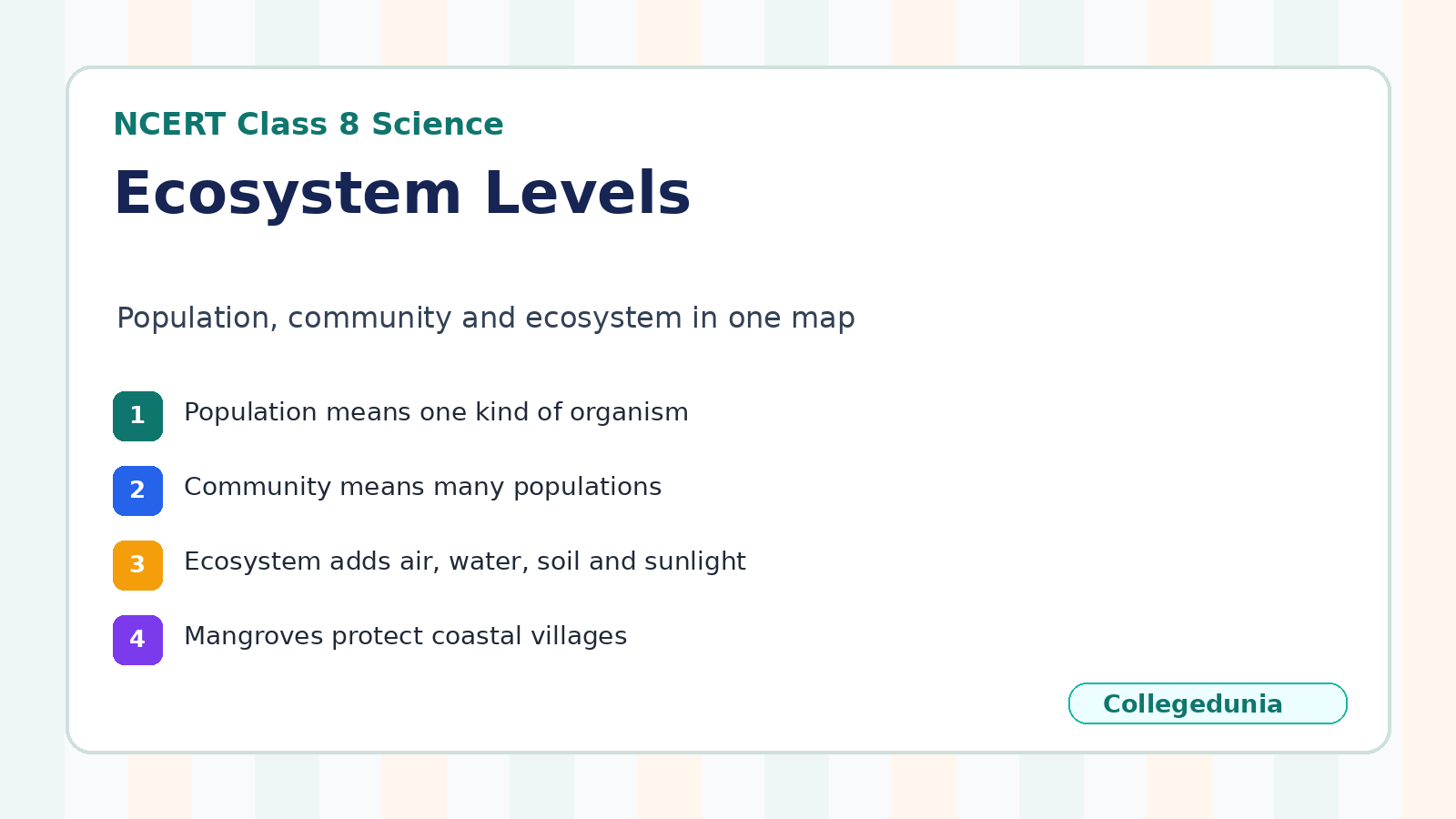
A population is one kind of organism in a habitat. A community is many populations living together. An ecosystem includes that community and the abiotic components such as air, water, soil, sunlight and temperature.
Population: same kind of organism in one place and time.
Community: different populations sharing a habitat.
Ecosystem: community plus non-living surroundings.
How Nature Works in Harmony Video for Class 8
Source: Class 8 Science learning video on YouTube
Food Web and Sustainability Questions
Food chains show one feeding path, while food webs show many connected feeding paths. A small change in one population can affect plants, herbivores and carnivores. Decomposers keep nutrients moving back to soil.
Food chain: simple who eats whom sequence.
Food web: interlinked food chains in an ecosystem.
Sustainable farming: crop production that protects soil, water and biodiversity.
How to Write Class 8 Science Chapter 12 Answers
Use ecosystem words accurately. For diagram questions, state the order first. For decomposer questions, write nutrient recycling. For food chains, explain how predator and prey populations change. For sustainability, mention food need and environmental protection.
Use biotic for living components and abiotic for non-living components.
Write decomposers recycle nutrients from dead matter and waste.
In food-web answers, trace arrows from food to eater.
For farming answers, include compost, crop rotation, natural pest control and careful water use.
All NCERT Solutions for Class 8 Science Chapter 12 How Nature Works in Harmony with Step-by-Step Solutions
The cards below include every exercise question. Use Check Solution for the direct answer and Expert Solution for a second explanation.
Each answer uses the 2026-27 NCERT chapter wording.
Figure-based answers use the exact NCERT diagrams.
Food-web answers show the population effect step by step.
Questions
Q 12.1
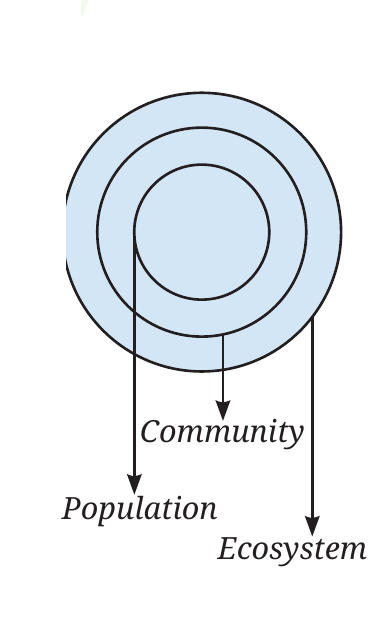
Refer to the given diagram (Fig. 12.19) and select the wrong statement.
[label=()]
A community is larger than a population.
A community is smaller than an ecosystem.
An ecosystem is part of a community.
NCERT Curiosity Class 8 Science, Chapter 12, Fig. 12.19.
Concept used. The order is individual, population, community and ecosystem. A community is made of different populations. An ecosystem includes the community plus abiotic components.
Statement (iii) is wrong. A community is part of an ecosystem, not the other way round.
Answer cue
Remember the order: population, community, ecosystem.
A population is a group of the same kind of organisms living in one habitat at a given time.
A community includes different populations living together in the same habitat.
An ecosystem includes the community and abiotic components such as air, water, soil, sunlight and temperature.
So a community is larger than a population.
A community is smaller than an ecosystem.
Therefore statement (iii), an ecosystem is part of a community, is wrong.
Statement (iii) is the wrong statement.
AR
Aditi Rao
M.Sc Ecology, Delhi University
Verified Expert
Strategic angle. The figure shows a nesting relationship.
The smallest circle represents population.
The next level is community because it contains many populations.
The largest level is ecosystem because it adds non-living components to the living community.
This means the three levels are not separate boxes placed side by side.
Each larger level contains the level before it and adds something new.
Thus the ecosystem cannot be a part of the community.
The reverse is correct: the community is part of the ecosystem.
Final check. The wrong statement is (iii).
The wrong statement is (iii).
Q 12.2
A population is part of a community. If all decomposers suddenly disappear from a forest ecosystem, what changes do you think would occur? Explain why decomposers are essential.
Concept used. Decomposers such as bacteria and fungi break down dead matter and return nutrients to soil. They keep nutrient cycling active.
Dead matter and waste would pile up, soil nutrients would fall, plant growth would reduce, and the whole food web would be disturbed.
Answer cue
Use the phrase nutrient recycling. It is the key role of decomposers.
Decomposers break down dead plants, dead animals, dung and fallen leaves.
This breakdown returns nutrients to the soil.
If decomposers disappear, dead matter and waste will accumulate.
Soil will slowly lose usable nutrients because nutrients will remain locked in dead matter.
Plants will grow poorly in nutrient-poor soil.
Fewer plants will reduce food and shelter for herbivores and then for carnivores.
Thus decomposers are essential for recycling nutrients and maintaining ecosystem balance.
Without decomposers, waste builds up, nutrients are not recycled, plants decline and the forest food web becomes unstable.
RM
Rohan Mehta
M.Sc Environmental Science, IIT Bombay
Verified Expert
Strategic angle. Decomposers are the recycling link of a forest.
They convert complex dead matter into simpler substances.
These substances enrich soil and support plant growth.
If decomposers vanish, nutrients stop returning to the soil at the normal rate.
Fallen leaves, dead bodies and animal waste would keep accumulating.
Plant growth would weaken, so consumers would also be affected.
This would disturb the community and the ecosystem.
Final check. Decomposers are essential because they recycle nutrients.
Decomposers are essential because they recycle nutrients.
Q 12.3
Selvam from Cuddalore district, Tamil Nadu, shared that his village was less affected by the 2004 Tsunami compared to nearby villages due to the presence of mangrove forests. This surprised Sarita, Shabnam, and Shijo. They wondered if mangroves were protecting the village. Can you help them understand this?
Concept used. Mangroves are coastal forests with dense roots. They reduce the force of waves, trap sediments and protect coastlines during storms and floods.
Yes. Mangrove forests act as natural barriers. Their roots and trunks slow waves, reduce erosion and absorb part of the impact.
Answer cue
Link mangroves with wave energy, soil holding and coastal protection.
Mangroves grow along coasts and river mouths.
Their tangled roots and thick vegetation form a living barrier.
When strong waves reach mangroves, the roots and stems slow the water flow.
This reduces the force of waves reaching villages behind them.
Mangroves also hold soil and reduce coastal erosion.
So Selvam's village may have been less affected because the mangrove forest reduced the impact of tsunami waves.
Mangroves protected the village by slowing waves and reducing coastal erosion.
MI
Meera Iyer
M.Ed Science Education, TISS Mumbai
Verified Expert
Strategic angle. Think of mangroves as a natural coastal shield.
Their roots do not stop the sea completely.
But they break the speed and force of incoming water.
That lowers the damage caused by waves before they reach houses and fields.
They also bind muddy soil and keep the shoreline more stable.
Therefore a village behind mangroves can face less damage than a village without this barrier.
Final check. Mangroves reduce wave force and protect coastal settlements.
Mangroves reduce wave force and protect coastal settlements.
Q 12.4
Look at this food chain: Sun, Grass, Grasshopper, Frog, Snake. If frogs disappear from this ecosystem, what will happen to the population of grasshoppers and snakes? Why?
Concept used. In a food chain, each organism depends on the previous organism for food and may be eaten by the next organism.
Grasshoppers will increase because fewer frogs eat them. Snakes will decrease because they lose frogs as food.
Answer cue
Check both sides of the missing organism in the food chain.
In this food chain, frogs eat grasshoppers.
If frogs disappear, predation on grasshoppers reduces.
So the grasshopper population is likely to increase.
Snakes feed on frogs in this chain.
If frogs are absent, snakes get less food.
So the snake population is likely to decrease or move elsewhere.
Grasshoppers increase and snakes decrease.
KN
Kabir Nair
M.Sc Wildlife Biology, NCBS Bengaluru
Verified Expert
Strategic angle. A food chain changes when one link is removed.
The organism before frogs is grasshopper.
Since frogs eat grasshoppers, removing frogs removes a predator.
That allows grasshoppers to multiply.
The organism after frogs is snake.
Since snakes eat frogs, removing frogs reduces food for snakes.
So snakes become fewer unless they find another food source.
Final check. Grasshoppers rise, snakes fall.
Grasshoppers rise, snakes fall.
Q 12.5
In a school garden, students noticed fewer butterflies the previous season. What could be the possible reasons? What steps can students take to have more butterflies on campus?
Concept used. Butterflies need flowering plants, host plants for larvae, safe shelter and low pesticide exposure. Their number changes when these habitat needs change.
Possible reasons are fewer flowers, loss of host plants, pesticide use, pollution, dry weather or habitat disturbance. Students can plant native flowers and host plants and avoid pesticides.
Answer cue
Answer with both cause and action. Do not stop after listing reasons.
Butterflies visit flowers for nectar.
If flowering plants are fewer, butterflies get less food.
Their larvae need specific host plants, so loss of these plants reduces butterfly numbers.
Pesticides can kill butterflies, caterpillars and other helpful insects.
Extreme heat, less water, pollution or garden disturbance can also reduce them.
Students can plant native flowering plants in different seasons.
They can also plant host plants, keep a small water source, avoid pesticides and protect garden corners from trampling.
Improve the garden habitat with native flowers, host plants, less pesticide use and safe spaces.
PS
Priya Sharma
M.Sc Botany, University of Hyderabad
Verified Expert
Strategic angle. Butterflies respond quickly to habitat quality.
A garden with few flowers gives less nectar.
A garden without host plants gives fewer places for eggs and caterpillars.
Pesticides harm both adult butterflies and larvae.
Students can create a butterfly-friendly garden.
Native flowering plants, host plants, leaf litter corners and no pesticide use make the campus safer.
Recording butterfly visits will also help students see whether the steps are working.
Final check. More flowers, host plants and pesticide-free spaces can bring more butterflies.
More flowers, host plants and pesticide-free spaces can bring more butterflies.
Q 12.6
Why is it not possible to have an ecosystem with only producers and no consumers or decomposers?
Concept used. An ecosystem needs producers, consumers and decomposers for energy flow, population balance and nutrient recycling.
Only producers cannot keep an ecosystem balanced. Consumers transfer energy and control populations, while decomposers recycle nutrients from dead matter.
Answer cue
Use three roles: producers make food, consumers transfer energy, decomposers recycle nutrients.
Producers make food using sunlight, water and carbon dioxide.
Consumers feed on producers or other consumers, so energy moves through the food chain.
Consumers also help keep some populations from growing without limit.
All organisms eventually produce waste and die.
Decomposers break down this dead matter and return nutrients to the soil.
Without consumers and decomposers, energy flow and nutrient recycling are incomplete.
So a stable ecosystem cannot have only producers.
Consumers and decomposers are needed for energy flow, balance and nutrient recycling.
AM
Arjun Menon
M.Sc Zoology, University of Kerala
Verified Expert
Strategic angle. Producers are the starting point, but not the whole ecosystem.
They capture sunlight energy and make food.
Consumers pass that energy to other trophic levels.
Decomposers return nutrients from waste and dead organisms to soil.
If decomposers are absent, nutrients remain locked in dead matter.
If consumers are absent, feeding links and population control are missing.
Therefore an ecosystem needs all three groups working together.
Final check. A producer-only ecosystem cannot recycle nutrients or maintain food-chain balance.
A producer-only ecosystem cannot recycle nutrients or maintain food-chain balance.
Q 12.7
Observe two different places near your home or school (e.g., a park and a roadside). List the living and non-living components you see. How are the two ecosystems different?
Concept used. Biotic components are living organisms. Abiotic components are non-living things such as light, air, water, soil, temperature and stones.
A park may have trees, grass, birds, insects, soil, water and shade. A roadside may have weeds, ants, dust, stones, vehicles, heat and less soil moisture.
Answer cue
Make two columns: living components and non-living components.
In a park, biotic components may include trees, grass, shrubs, birds, ants, butterflies and soil microbes.
Park abiotic components may include soil, water, sunlight, air, rocks and shade.
On a roadside, biotic components may include weeds, small grasses, ants, stray animals and some insects.
Roadside abiotic components may include dust, tar road, stones, air, heat, sunlight and little water.
The park usually has more plant cover, more shade, more soil moisture and more animals.
The roadside usually has more disturbance, pollution, heat and less biodiversity.
The two ecosystems differ in biodiversity, moisture, shade, pollution and disturbance.
SK
Sneha Kapoor
M.Sc Science Education, HBCSE Mumbai
Verified Expert
Strategic angle. This answer depends on local observation, but the comparison method stays the same.
First list living components for each place.
Then list non-living components for each place.
A park normally provides more shelter and food sources.
A roadside usually has higher temperature, dust, noise and human disturbance.
So the park may support more organisms than the roadside.
The final comparison should mention both biotic and abiotic differences.
Final check. A park is usually richer and less disturbed than a roadside ecosystem.
A park is usually richer and less disturbed than a roadside ecosystem.
Q 12.8
'Human-made ecosystems like agricultural fields are necessary, but they must be made sustainable.' Comment on the statement.
Concept used. Human-made ecosystems such as farms provide food and livelihoods, but they need careful management to protect soil, water, biodiversity and human health.
Agricultural fields are necessary for food, but overuse of fertilisers, pesticides, water and monoculture can damage soil and biodiversity. Sustainable practices reduce harm.
Answer cue
Balance both sides: necessity and responsibility.
Farms are human-made ecosystems because humans create and manage them for crop production.
They are necessary because they provide food, fibres and livelihoods.
But unsustainable farming can overuse synthetic fertilisers, pesticides and groundwater.
These practices may reduce soil fertility, harm friendly organisms and pollute water.
Growing the same crop repeatedly can reduce biodiversity and affect pollinators.
Sustainable farming uses compost, crop rotation, mixed cropping, natural pest control, careful irrigation and less chemical use.
So farms are necessary, but they should be managed in an eco-friendly way.
Farms are needed for food, but sustainable practices are needed to protect soil, water and biodiversity.
DP
Dev Patel
M.Sc Environmental Studies, TERI SAS
Verified Expert
Strategic angle. The statement is correct because agriculture supports human survival.
However, a farm is still connected to soil organisms, insects, water and nearby habitats.
If farming ignores these links, production may rise for a short time but ecosystem health declines.
Overuse of chemicals can reduce humus, microbes and natural predators.
Heavy water use can lower groundwater.
Sustainable methods keep production while reducing damage.
That is why human-made ecosystems must be managed carefully.
Final check. A sustainable farm produces food without damaging the ecosystem that supports it.
A sustainable farm produces food without damaging the ecosystem that supports it.
Q 12.9
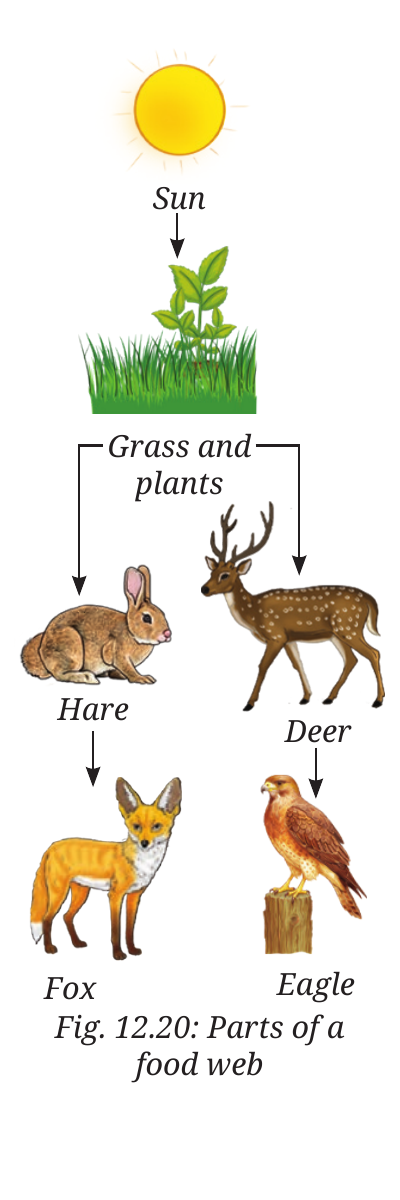
If the Indian hare population (Fig. 12.20) drops because of a disease, how would it affect the number of other organisms?
NCERT Curiosity Class 8 Science, Chapter 12, Fig. 12.20.
Concept used. In the shown food web, grasses and plants feed hare and deer. Hare is prey for fox. Changes in one population can affect other linked populations.
Foxes may decrease or shift to other prey because they get fewer hares. Grass and plants may increase because fewer hares eat them. Other links may also change.
Answer cue
Trace arrows from the hare to its food and to its predator.
In Fig. 12.20, hare feeds on grass and plants.
If hare population drops, less grass and plant material is eaten by hares.
So grasses and plants may increase, if other herbivores do not consume them equally.
The fox depends on hare as a food source in the shown web.
With fewer hares, foxes may get less food.
Fox numbers may decrease, or foxes may hunt other prey if available.
Other organisms linked through the web may also change because food webs are interconnected.
Plants may increase, foxes may decrease or shift prey, and the food web balance may change.
KS
Kavya Singh
M.Sc Ecology, Banaras Hindu University
Verified Expert
Strategic angle. A food web response is not limited to one organism.
The hare is connected below to grasses and plants.
It is also connected above to the fox.
When hare numbers fall, grazing pressure from hares becomes lower.
This does not mean plants will always grow without limit because deer and other plant eaters may still feed on them.
That can allow more plant growth.
At the same time, foxes lose an important food source.
So fox numbers may fall unless they switch to another prey.
If foxes shift to another prey, that second prey population may also feel extra pressure.
Final check. Lower hare numbers can increase plants and reduce fox food.
Lower hare numbers can increase plants and reduce fox food.
How Nature Works in Harmony Class 8 NCERT Solutions FAQs
Ques. How many questions are solved in Class 8 Science Chapter 12 How Nature Works in Harmony?
Ans. The PDF solves all 9 Keep the Curiosity Alive questions from the 2026-27 NCERT Class 8 Science Curiosity textbook.
Ques. Which statement is wrong in Fig. 12.19?
Ans. Statement (iii) is wrong. A community is part of an ecosystem, not the reverse.
Ques. Why are decomposers essential in a forest ecosystem?
Ans. Decomposers break down dead matter and waste, return nutrients to the soil, and support plant growth.
Ques. What happens if frogs disappear from the grass, grasshopper, frog, snake food chain?
Ans. Grasshoppers are likely to increase because fewer frogs eat them, while snakes may decrease because they get less food.




Chapter12HowNatureWorksinHarmonySolutions.pdf?page=1&dpi=150)
Chapter12HowNatureWorksinHarmonySolutions.pdf?page=2&dpi=150)
Chapter12HowNatureWorksinHarmonySolutions.pdf?page=3&dpi=150)
Chapter12HowNatureWorksinHarmonySolutions.pdf?page=4&dpi=150)
Chapter12HowNatureWorksinHarmonySolutions.pdf?page=5&dpi=150)
Chapter12HowNatureWorksinHarmonySolutions.pdf?page=6&dpi=150)
Chapter12HowNatureWorksinHarmonySolutions.pdf?page=7&dpi=150)
Chapter12HowNatureWorksinHarmonySolutions.pdf?page=8&dpi=150)
Chapter12HowNatureWorksinHarmonySolutions.pdf?page=9&dpi=150)
Chapter12HowNatureWorksinHarmonySolutions.pdf?page=10&dpi=150)
Chapter12HowNatureWorksinHarmonySolutions.pdf?page=11&dpi=150)
Chapter12HowNatureWorksinHarmonySolutions.pdf?page=12&dpi=150)
Chapter12HowNatureWorksinHarmonySolutions.pdf?page=13&dpi=150)
Chapter12HowNatureWorksinHarmonySolutions.pdf?page=14&dpi=150)
Chapter12HowNatureWorksinHarmonySolutions.pdf?page=15&dpi=150)
Chapter12HowNatureWorksinHarmonySolutions.pdf?page=16&dpi=150)
Chapter12HowNatureWorksinHarmonySolutions_flat_MobileCard.pdf?page=1&dpi=150)
Chapter12HowNatureWorksinHarmonySolutions_flat_MobileCard.pdf?page=2&dpi=150)
Chapter12HowNatureWorksinHarmonySolutions_flat_MobileCard.pdf?page=3&dpi=150)
Chapter12HowNatureWorksinHarmonySolutions_flat_MobileCard.pdf?page=4&dpi=150)
Chapter12HowNatureWorksinHarmonySolutions_flat_MobileCard.pdf?page=5&dpi=150)
Chapter12HowNatureWorksinHarmonySolutions_flat_MobileCard.pdf?page=6&dpi=150)
Chapter12HowNatureWorksinHarmonySolutions_flat_MobileCard.pdf?page=7&dpi=150)
Chapter12HowNatureWorksinHarmonySolutions_flat_MobileCard.pdf?page=8&dpi=150)
Chapter12HowNatureWorksinHarmonySolutions_flat_MobileCard.pdf?page=9&dpi=150)
Chapter12HowNatureWorksinHarmonySolutions_flat_MobileCard.pdf?page=10&dpi=150)
Chapter12HowNatureWorksinHarmonySolutions_flat_MobileCard.pdf?page=11&dpi=150)
Chapter12HowNatureWorksinHarmonySolutions_flat_MobileCard.pdf?page=12&dpi=150)
Chapter12HowNatureWorksinHarmonySolutions_flat_MobileCard.pdf?page=13&dpi=150)
Chapter12HowNatureWorksinHarmonySolutions_flat_MobileCard.pdf?page=14&dpi=150)
Chapter12HowNatureWorksinHarmonySolutions_flat_MobileCard.pdf?page=15&dpi=150)
Chapter12HowNatureWorksinHarmonySolutions_flat_MobileCard.pdf?page=16&dpi=150)
Chapter12HowNatureWorksinHarmonySolutions_flat_MobileCard.pdf?page=17&dpi=150)
Chapter12HowNatureWorksinHarmonySolutions_flat_MobileCard.pdf?page=18&dpi=150)
Chapter12HowNatureWorksinHarmonySolutions_flat_MobileCard.pdf?page=19&dpi=150)
Chapter12HowNatureWorksinHarmonySolutions_flat_MobileCard.pdf?page=20&dpi=150)
Chapter12HowNatureWorksinHarmonySolutions_flat_MobileCard.pdf?page=21&dpi=150)
Chapter12HowNatureWorksinHarmonySolutions_flat_MobileCard.pdf?page=22&dpi=150)
Chapter12HowNatureWorksinHarmonySolutions_flat_MobileCard.pdf?page=23&dpi=150)
Chapter12HowNatureWorksinHarmonySolutions_flat_MobileCard.pdf?page=24&dpi=150)
Chapter12HowNatureWorksinHarmonySolutions_flat_MobileCard.pdf?page=25&dpi=150)
Chapter12HowNatureWorksinHarmonySolutions_flat_MobileCard.pdf?page=26&dpi=150)
Chapter12HowNatureWorksinHarmonySolutions_flat_MobileCard.pdf?page=27&dpi=150)
Chapter12HowNatureWorksinHarmonySolutions_flat_MobileCard.pdf?page=28&dpi=150)



Comments