NCERT Solutions for Class 8 Science Chapter 7 Particulate Nature of Matter cover every Keep the Curiosity Alive question from the latest 2026-27 Curiosity textbook. The chapter explains constituent particles, interparticle spaces, interparticle attractions, diffusion and the three states of matter.
The PDF solves 10 exercise questions with direct and expert explanations.
Key ideas include solids, liquids, gases, melting, evaporation, dissolving and particle movement.
Use the embedded question cards below for quick revision before class tests.
Student Feedback: In a Collegedunia classroom check of 1,260 Class 8 Science students, many said this chapter became easier after they compared particle spacing, attraction and movement in one table.
Each answer follows the 2026-27 NCERT Curiosity exercise and uses simple Class 8 science language.
Particulate Nature of Matter teaches that matter is made up of extremely small particles. The exercise asks students to apply this model to everyday cases such as salty ocean water, camphor smell, rice grains and the particle arrangement in a candle.
For most answers, write the particle spacing first, then the attraction and movement. This one habit keeps Chapter 7 explanations clear.
Question type
What it checks
Answer habit
MCQ
Solid and liquid particle movement
Compare fixed position with sliding motion
True or false
Melting, solids and camphor vapour
Correct the particle-level reason
Diagram questions
Solid, liquid and gas particle pictures
Show spacing and movement clearly
Application answers
Dissolving, grains and gases
Use particles, space and attraction
Particle Model for Class 8 Science
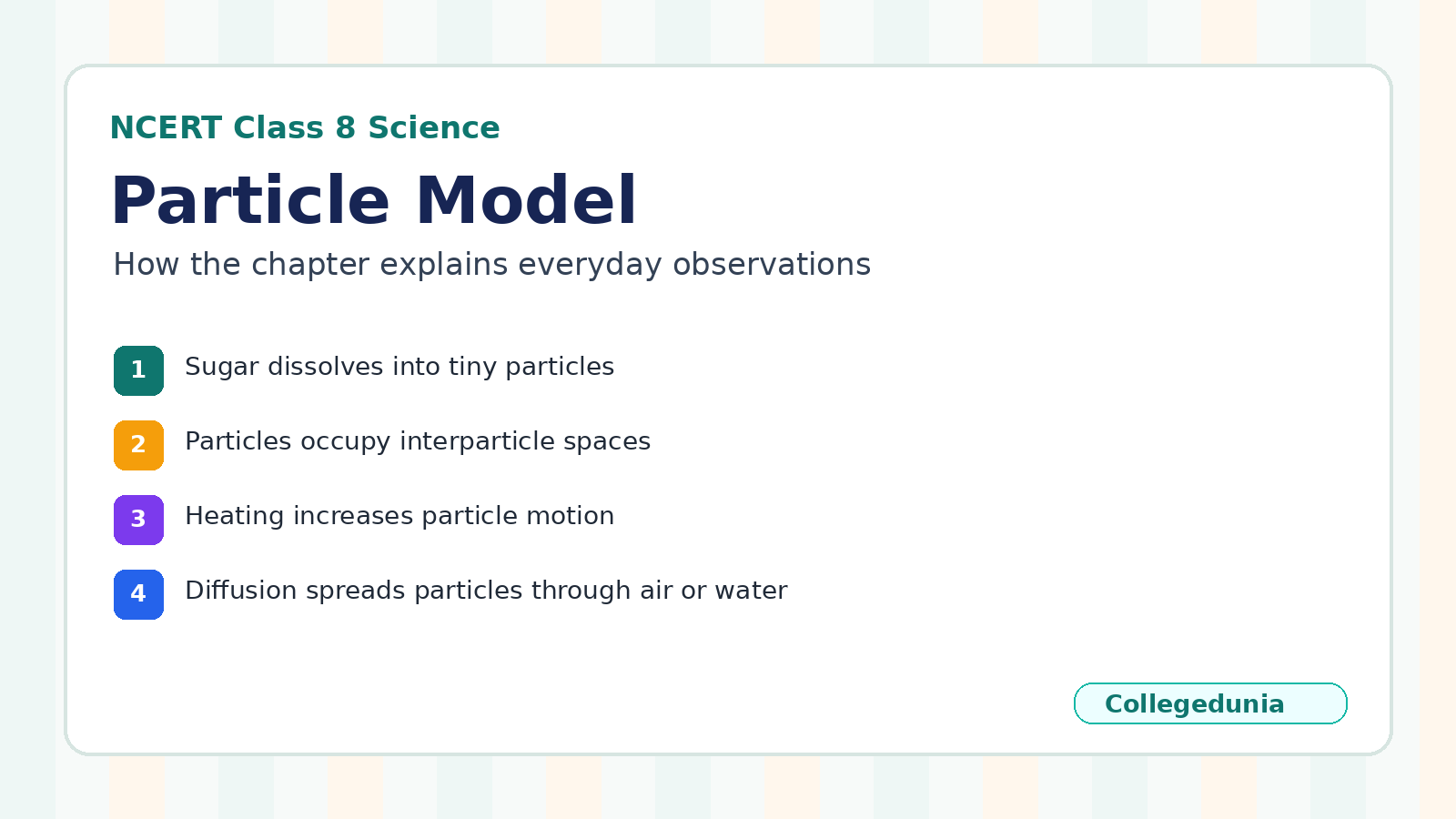
The chapter uses chalk powder, sugar solution, smoke, potassium permanganate and camphor to show that particles are present even when they cannot be seen. Students should write answers through particle evidence, not through guesswork.
Dissolving: solute particles spread into spaces between water particles.
Diffusion: moving particles spread from one region to another.
Heating: particle motion increases when thermal energy is supplied.
Particulate Nature of Matter Video for Class 8
Source: Magnet Brains on YouTube
Solids Liquids and Gases Comparison
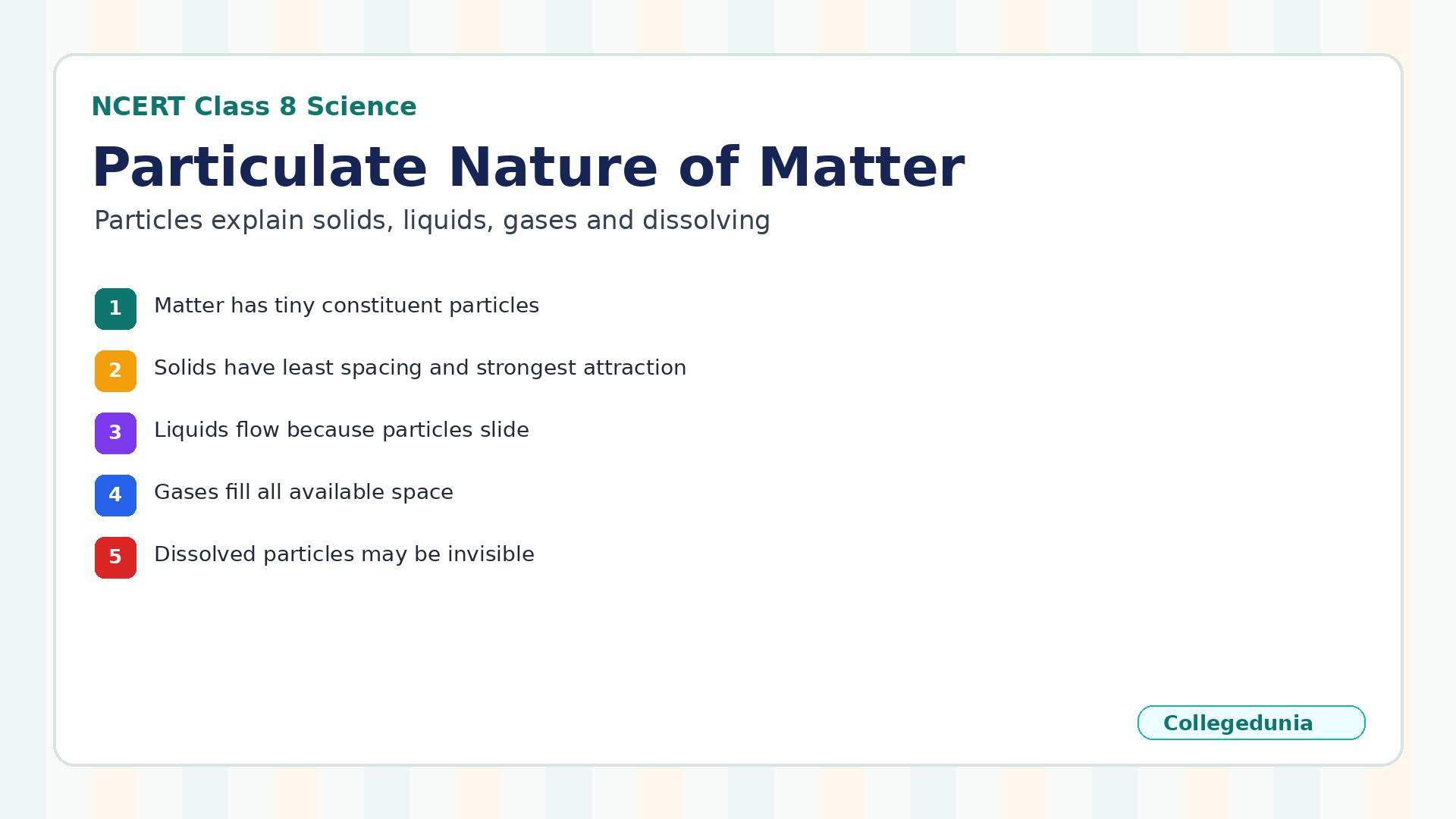
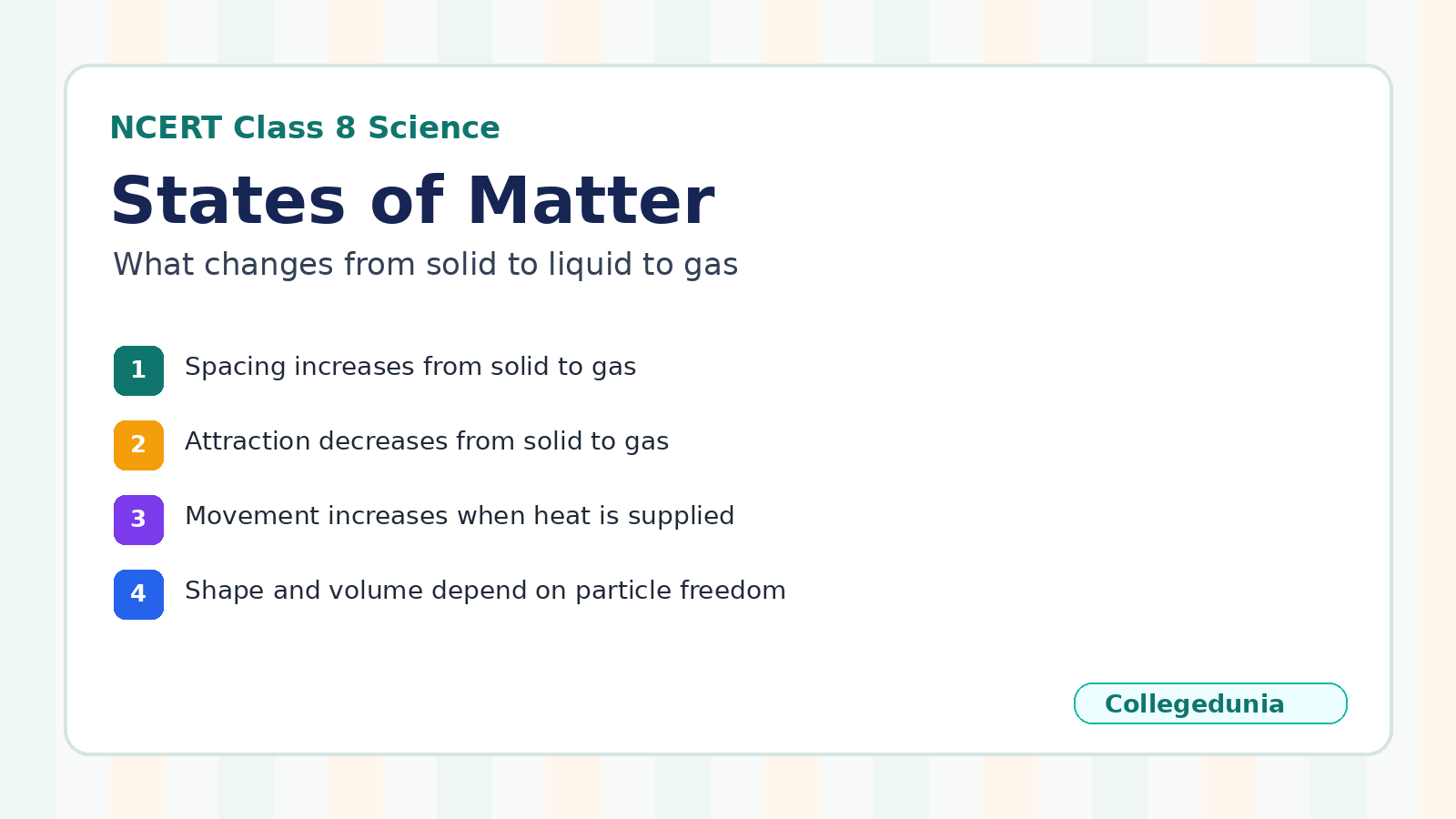
Most answers in Chapter 7 can be written by comparing three features: spacing, attraction and movement. This comparison also explains shape and volume.
Solids: least interparticle space and strongest attraction.
Liquids: particles are close but can move past one another.
Gases: particles are far apart and fill all available space.
How to Write Class 8 Science Chapter 7 Answers
Use one simple structure for most answers. Name the state of matter, describe the particles, then connect the particle behaviour to the observation.
For smell or gas mixing, write about free motion and large spaces.
For dissolving, write about invisible particles spreading between water particles.
For rice grains or flour, judge each grain as a solid.
For diagrams, show spacing and arrows for movement.
All NCERT Solutions for Class 8 Science Chapter 7 Particulate Nature of Matter with Step-by-Step Solutions
The cards below include every exercise question. Use Check Solution for the direct answer and Expert Solution for a second explanation.
Each answer names the particle-level reason.
Diagram questions are supported by the PDF version.
Objective answers were cross-checked against two current solution sources.
Questions
Q 7.1
Choose the correct option. The primary difference between solids and liquids is that the constituent particles are:
closely packed in solids, while they are stationary in liquids.
far apart in solids and have fixed position in liquids.
always moving in solids and have fixed position in liquids.
closely packed in solids and move past each other in liquids.
The correct option is (iv): closely packed in solids and move past each other in liquids.
Concept used. Solids and liquids both have particles fairly close together, but their freedom of movement is different. Solid particles mainly vibrate about fixed positions, while liquid particles can move past one another within a limited space.
Answer cue
For state-of-matter MCQs, compare shape, volume, spacing, attraction and movement separately.
In a solid, interparticle attractions are strong. The particles stay in fixed positions and only vibrate.
In a liquid, interparticle attractions are weaker than in a solid. The particles remain close but can slide past each other.
Option (i) is wrong because solid particles are not completely stationary. They vibrate.
Option (ii) is wrong because solid particles are not far apart.
Option (iii) is wrong because liquid particles, not solid particles, move past one another.
Option (iv) is correct.
AR
Aditi Rao
M.Sc Physics, IIT Kanpur
Verified Expert
Quick reading. The question asks for the main difference, not every property of solids and liquids.
Both solids and liquids have particles close enough to give a definite volume.
The solid keeps its shape because its particles cannot move from place to place.
The liquid flows because its particles can move past one another.
This is why a stone keeps its own shape but water takes the shape of a vessel.
Option (i) is tempting, but solid particles are not motionless. They vibrate in their fixed positions.
Option (ii) reverses the idea of packing, because gas particles are far apart, not solid particles.
Option (iii) gives the wrong moving state. Liquids show place-to-place motion more clearly than solids.
So option (iv) gives the exact contrast needed.
Why this matters. Solids keep shape because particles are fixed in position. Liquids flow because particles slide past each other.
Solids keep shape because particles are fixed in position. Liquids flow because particles slide past each other.
Q 7.2
Which of the following statements are true? Correct the false statements.
Melting ice into water is an example of the transformation of a solid into a liquid.
Melting process involves a decrease in interparticle attractions during the transformation.
Solids have a fixed shape and a fixed volume.
The interparticle interactions in solids are very strong, and the interparticle spaces are very small.
When we heat camphor in one corner of a room, the fragrance reaches all corners of the room.
On heating, we are adding energy to the camphor, and the energy is released as a smell.
Statements (i), (ii), (iii), (iv) and (v) are true. Statement (vi) is false.
Concept used. A true-false answer should test each statement against particle arrangement, attraction and movement. Melting weakens effective attraction enough for particles to leave fixed positions. Smell travels because vapour particles spread through air.
Answer cue
The smell is due to vapour particles reaching the nose, not due to energy becoming smell.
Statement (i) is true. Ice is a solid and water is a liquid.
Statement (ii) is true. During melting, particles gain energy and leave fixed positions, so attraction is effectively overcome.
Statement (iii) is true. A solid has a definite shape and a definite volume.
Statement (iv) is true. Solid particles are strongly held with very small spaces between them.
Statement (v) is true. Heated camphor forms vapour, and vapour particles spread through air.
Statement (vi) is false. Energy is not released as smell. Heating gives energy to camphor particles, and camphor vapour carries the smell.
True statements: (i), (ii), (iii), (iv), (v). False statement: (vi). Corrected (vi): Heating gives energy to camphor particles so they escape as vapour, and this vapour spreads the smell.
RM
Rohan Mehta
M.Sc Chemistry, IIT Madras
Verified Expert
Structural observation. The first four statements are direct particle-model facts.
Ice changing to water is a state change from solid to liquid.
A solid has strong attractions and fixed particle positions, so fixed shape and fixed volume follow.
The camphor statement needs extra care because heating and smell are different ideas.
When ice melts, heat energy helps particles leave their fixed arrangement and move more freely.
For camphor, heating increases particle motion and helps camphor enter the vapour state.
That vapour then mixes with air and reaches different parts of the room.
The smell is sensed because camphor vapour particles reach the nose.
Heat gives the particles enough energy to escape. The spreading particles cause the smell.
Why this matters. Only statement (vi) is false. Smell comes from camphor vapour spreading in air.
Only statement (vi) is false. Smell comes from camphor vapour spreading in air.
Q 7.3
Choose the correct answer with justification. If we could remove all the constituent particles from a chair, what would happen?
Nothing will change.
The chair will weigh less due to lost particles.
Nothing of the chair will remain.
The correct option is (iii): nothing of the chair will remain.
Concept used. Matter is made up of constituent particles. The shape, mass and volume of any object come from its particles and from how those particles are arranged.
Answer cue
Do not say the chair only becomes lighter. Removing all particles removes the whole object.
A chair is matter. It has mass and occupies space.
The chair's wood, plastic or metal is made of constituent particles.
If every constituent particle is removed, no material is left.
Without material particles, there is no mass, volume or structure.
So the chair cannot keep any shape at all.
Option (iii) is correct. Nothing of the chair will remain.
MI
Meera Iyer
M.Ed Science Education, TISS Mumbai
Verified Expert
Concept-first. The phrase all constituent particles is the key.
A chair is not a hollow outline that can remain without matter.
Its visible shape is created by particles packed and bonded in a definite structure.
Remove the particles and both the material and the structure disappear.
Therefore option (ii) is incomplete. It would be true only if some particles remained.
Why this matters. With all particles removed, no chair material remains.
With all particles removed, no chair material remains.
Q 7.4
Why do gases mix easily, while solids do not?
Gases mix easily because their particles move freely with large spaces between them. Solids do not mix by themselves because their particles are fixed in position.
Concept used. Diffusion is the spreading and mixing of particles. Gas particles have large spaces, negligible attractions and free motion in all directions. Solid particles are closely packed and held in fixed positions.
Answer cue
Use the words space, attraction and movement together in this answer.
In gases, particles are far apart from one another.
The interparticle attractions in gases are negligible.
Gas particles move freely in all available space and collide with particles of other gases.
This free motion helps one gas spread into another gas easily.
In solids, particles are closely packed and held by strong attractions.
Solid particles cannot move from place to place, so two solids do not mix on their own like gases.
Gases mix easily due to free particle motion and large interparticle spaces. Solids do not mix easily because their particles are fixed and strongly held.
A gas has particles with enough freedom to travel throughout the available space.
When two gases meet, particles from both gases keep colliding and spreading.
A solid behaves differently because its particles are locked in a packed arrangement.
Strong attractions hold solid particles near fixed positions.
Since they cannot travel through the other solid, large-scale mixing does not happen by itself.
This is why the smell of perfume spreads in air but two solid blocks do not merge when kept together.
They only vibrate in place, so the solid keeps its identity and shape.
Why this matters. Gas particles travel and mix. Solid particles mainly vibrate in fixed positions.
Gas particles travel and mix. Solid particles mainly vibrate in fixed positions.
Q 7.5
When spilled on the table, milk in a glass tumbler flows and spreads out, but the glass tumbler stays in the same shape. Justify this statement.
Milk flows because its particles can move past each other. The glass tumbler keeps its shape because its particles are strongly held in fixed positions.
Concept used. Milk is a liquid, and a tumbler is a solid. A liquid has a definite volume but no fixed shape. A solid has a fixed shape and a fixed volume.
Answer cue
A liquid changes shape with the surface or container. A solid keeps its own shape.
Milk is a liquid. Its particles are close together but can move within a limited space.
Because of this movement, milk has no fixed shape and can spread over the table.
The glass tumbler is a solid. Its particles are closely packed.
Strong interparticle attractions hold the glass particles in fixed positions.
So the tumbler has a fixed shape even when milk is poured out or spilled.
Milk spreads because it is a liquid. The glass tumbler keeps its shape because it is a solid.
PS
Priya Sharma
M.Sc Chemistry, Delhi University
Verified Expert
Comparison method. The sentence compares two states of matter in one situation.
Milk flows because its particles are not fixed like a solid's particles.
The particles can slide past one another, so milk takes the shape of the table surface.
Glass does not behave this way because its particles are strongly attracted.
That fixed particle arrangement gives the tumbler a definite shape.
Why this matters. The same observation proves the liquid nature of milk and the solid nature of glass.
The same observation proves the liquid nature of milk and the solid nature of glass.
Q 7.6
Represent diagrammatically the changes in the arrangement of particles as ice melts and transforms into water vapour.
Draw three boxes: ice with tightly packed particles, water with close but irregular particles, and water vapour with far apart particles.
Concept used. When ice melts and then changes into water vapour, particle spacing and movement increase. Ice has tightly packed particles, liquid water has close but mobile particles, and water vapour has far apart particles moving freely.
Answer cue
In your diagram, increase both spacing and movement from solid to liquid to gas.
!%
[See diagram in the PDF version]
%
In ice, show particles very close together in a regular arrangement.
Mark that these particles mainly vibrate about fixed positions.
In liquid water, show particles still close but less regular.
Mark that liquid particles can move past one another within a limited space.
In water vapour, show particles far apart with arrows in different directions.
Mark that gas particles move freely through the available space.
Ice: close and fixed. Water: close but mobile. Water vapour: far apart and freely moving.
AM
Arjun Menon
M.Tech Materials Science, IIT Bombay
Verified Expert
Picture-first. The diagram should show the same substance in three physical states.
Heating first weakens the fixed arrangement of ice.
The particles then slide as liquid water.
Further heating gives enough energy for particles to move far apart as vapour.
In the first box, dots should almost touch one another and look ordered.
In the second box, dots should remain close but look irregular.
In the third box, dots should be widely separated and should have arrows.
Labels are important because the drawing must show both spacing and movement.
The key change is not a change of substance. It is a change in arrangement, spacing and movement.
Why this matters. The particle diagram changes from packed dots to mobile dots to widely separated moving dots.
The particle diagram changes from packed dots to mobile dots to widely separated moving dots.
Q 7.7
Draw a picture representing particles present in the following: (i) aluminium foil (ii) glycerin (iii) methane gas.
Aluminium foil has close fixed particles. Glycerin has close but irregular mobile particles. Methane gas has far apart particles moving freely.
Concept used. Aluminium foil is a solid, glycerin is a liquid, and methane is a gas. Their particle pictures should match the particle arrangement in these three states.
Answer cue
The material name matters less than its state of matter.
!%
[See diagram in the PDF version]
%
For aluminium foil, draw many dots packed closely in a regular pattern.
For glycerin, draw dots close together but slightly irregular and able to slide.
For methane gas, draw dots far apart with arrows showing random motion.
Label aluminium foil as solid, glycerin as liquid and methane as gas.
Write one property under each drawing: fixed shape for solid, flow for liquid and filling space for gas.
State identification. First classify each substance by state.
Aluminium foil is a solid sheet, so its particles are tightly packed.
Glycerin pours like a liquid, so its particles remain close but can move.
Methane is a gas, so its particles are widely separated.
For aluminium, arrange the dots in rows to show a fixed packed structure.
For glycerin, keep the dots close but not in a strict pattern.
For methane, put only a few dots in the same space and add arrows.
These arrows show that gas particles move freely in different directions.
The drawing should make these three levels of spacing obvious.
Why this matters. Draw particle spacing according to state: solid close, liquid close and irregular, gas far apart.
Draw particle spacing according to state: solid close, liquid close and irregular, gas far apart.
Q 7.8
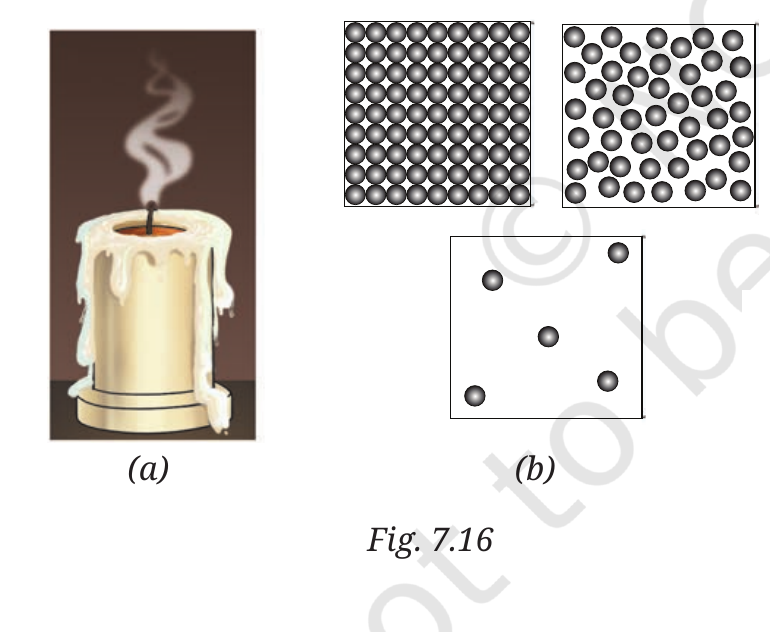
Observe Fig. 7.16a which shows the image of a candle that was just extinguished after burning for some time. Identify the different states of wax in the figure and match them with Fig. 7.16b showing the arrangement of particles.
Fig. 7.16, NCERT Curiosity Class 8 Science, Chapter 7.
Solid wax matches closely packed particles. Molten wax matches close but mobile particles. Wax vapour matches far apart particles.
Concept used. Wax can be present as solid wax, liquid molten wax and wax vapour. These match solid, liquid and gas particle arrangements respectively.
Answer cue
Match the visible part to the particle spacing: hard wax, molten wax, vapour.
The hard body of the candle is solid wax. It matches the tightly packed particle arrangement.
The melted wax near the wick is liquid wax. It matches particles that are close but can move past one another.
The vapour or smoke near the recently extinguished wick contains wax particles in gaseous form.
This vapour matches particles that are far apart and move freely.
So the candle can show all three states of wax around the wick after burning.
Solid wax: close fixed particles. Liquid wax: close mobile particles. Wax vapour: far apart moving particles.
DP
Dev Patel
B.Tech Chemical Engineering, IIT Delhi
Verified Expert
Figure reading. The figure is asking for matching, not only naming.
A candle's main body stays solid because its particles remain fixed.
Heat near the wick melts some wax, so that part becomes liquid.
Some wax changes into vapour near the flame or just after it goes out.
The three particle sketches in Fig. 7.16b represent these three states in the same order of spacing.
Why this matters. Use particle spacing to match the three wax states in the candle.
Use particle spacing to match the three wax states in the candle.
Q 7.9
Why does the water in the ocean taste salty, even though the salt is not visible? Explain.
Ocean water tastes salty because salt particles are dissolved and spread through the water, even though they are too small to see.
Concept used. Dissolution spreads very small solute particles between water particles. The dissolved salt particles are too small to see, but they still remain present in water.
Answer cue
Invisible does not mean absent. Taste can show the presence of dissolved particles.
Salt dissolves in ocean water and separates into extremely small particles.
These particles spread throughout the water.
They occupy spaces between water particles.
The particles are not visible to the eye or an ordinary microscope in this dissolved form.
The tongue can still sense the dissolved salt particles by taste.
Salt is invisible because it is dissolved into tiny particles, but it is still present and gives ocean water its salty taste.
KS
Kavya Singh
M.Sc Physics, University of Hyderabad
Verified Expert
Dissolution angle. The ocean is a solution containing water and dissolved salts.
When salt dissolves, it does not vanish from matter.
Its particles separate and spread evenly between water particles.
This spread makes the salt invisible as grains.
But the salt particles still interact with our taste buds, so the water tastes salty.
Why this matters. Dissolved salt cannot be seen as grains, but it remains in the water.
Dissolved salt cannot be seen as grains, but it remains in the water.
Q 7.10
Grains of rice and rice flour take the shape of the container when placed in different jars. Are they solids or liquids? Explain.
They are solids. The collection takes the container shape because the grains are small and can rearrange, but each grain remains solid.
Concept used. A heap of small solid pieces can pour and settle into a container shape, but each individual grain or flour particle remains a solid with its own shape and volume.
Answer cue
Judge the individual particle, not only the whole heap.
A rice grain has its own definite shape and volume.
A rice flour particle is also a tiny solid particle.
When many such particles are poured into a jar, they rearrange and fill the available space.
This makes the heap look like it has taken the jar's shape.
However, the individual grains or flour particles do not flow like liquid particles.
So rice and rice flour are solids, not liquids.
Rice grains and rice flour are solids. Only the heap rearranges inside the container.
RV
Rahul Verma
M.Sc Chemistry, Banaras Hindu University
Verified Expert
Granular-material angle. This question separates a pile from a liquid.
A liquid changes shape because its own particles can move past one another within the liquid.
Rice and rice flour consist of separate solid pieces.
The pieces can roll, slide or settle when poured, so the group fits the jar.
But each piece keeps its definite shape and volume, which is a solid property.
Why this matters. The collection can settle like a heap, but every grain remains a solid.
The collection can settle like a heap, but every grain remains a solid.
Particulate Nature of Matter Class 8 NCERT Solutions FAQs
Ques. How many questions are solved in Class 8 Science Chapter 7 Particulate Nature of Matter?
Ans. The PDF solves all 10 Keep the Curiosity Alive questions from the 2026-27 NCERT Class 8 Science Curiosity textbook.
Ques. What is the correct MCQ answer for the first exercise question?
Ans. The correct option is (iv), closely packed in solids and move past each other in liquids.
Ques. Why does ocean water taste salty if salt is not visible?
Ans. Salt particles dissolve and spread through water. They are too small to see, but they are still sensed by taste.
Ques. Are rice grains and rice flour solids or liquids?
Ans. They are solids. The heap takes the container shape, but each grain or flour particle keeps its own solid shape and volume.




Chapter7ParticulateNatureofMatterSolutions.pdf?page=1&dpi=150)
Chapter7ParticulateNatureofMatterSolutions.pdf?page=2&dpi=150)
Chapter7ParticulateNatureofMatterSolutions.pdf?page=3&dpi=150)
Chapter7ParticulateNatureofMatterSolutions.pdf?page=4&dpi=150)
Chapter7ParticulateNatureofMatterSolutions.pdf?page=5&dpi=150)
Chapter7ParticulateNatureofMatterSolutions.pdf?page=6&dpi=150)
Chapter7ParticulateNatureofMatterSolutions.pdf?page=7&dpi=150)
Chapter7ParticulateNatureofMatterSolutions.pdf?page=8&dpi=150)
Chapter7ParticulateNatureofMatterSolutions.pdf?page=9&dpi=150)
Chapter7ParticulateNatureofMatterSolutions.pdf?page=10&dpi=150)
Chapter7ParticulateNatureofMatterSolutions.pdf?page=11&dpi=150)
Chapter7ParticulateNatureofMatterSolutions.pdf?page=12&dpi=150)
Chapter7ParticulateNatureofMatterSolutions.pdf?page=13&dpi=150)
Chapter7ParticulateNatureofMatterSolutions.pdf?page=14&dpi=150)
Chapter7ParticulateNatureofMatterSolutions.pdf?page=15&dpi=150)
Chapter7ParticulateNatureofMatterSolutions.pdf?page=16&dpi=150)
Chapter7ParticulateNatureofMatterSolutions.pdf?page=17&dpi=150)
Ch7ParticulateNatureofMatterNCERTSolutions2026-27_flat_MobileCard.pdf?page=1&dpi=150)
Ch7ParticulateNatureofMatterNCERTSolutions2026-27_flat_MobileCard.pdf?page=2&dpi=150)
Ch7ParticulateNatureofMatterNCERTSolutions2026-27_flat_MobileCard.pdf?page=3&dpi=150)
Ch7ParticulateNatureofMatterNCERTSolutions2026-27_flat_MobileCard.pdf?page=4&dpi=150)
Ch7ParticulateNatureofMatterNCERTSolutions2026-27_flat_MobileCard.pdf?page=5&dpi=150)
Ch7ParticulateNatureofMatterNCERTSolutions2026-27_flat_MobileCard.pdf?page=6&dpi=150)
Ch7ParticulateNatureofMatterNCERTSolutions2026-27_flat_MobileCard.pdf?page=7&dpi=150)
Ch7ParticulateNatureofMatterNCERTSolutions2026-27_flat_MobileCard.pdf?page=8&dpi=150)
Ch7ParticulateNatureofMatterNCERTSolutions2026-27_flat_MobileCard.pdf?page=9&dpi=150)
Ch7ParticulateNatureofMatterNCERTSolutions2026-27_flat_MobileCard.pdf?page=10&dpi=150)
Ch7ParticulateNatureofMatterNCERTSolutions2026-27_flat_MobileCard.pdf?page=11&dpi=150)
Ch7ParticulateNatureofMatterNCERTSolutions2026-27_flat_MobileCard.pdf?page=12&dpi=150)
Ch7ParticulateNatureofMatterNCERTSolutions2026-27_flat_MobileCard.pdf?page=13&dpi=150)
Ch7ParticulateNatureofMatterNCERTSolutions2026-27_flat_MobileCard.pdf?page=14&dpi=150)
Ch7ParticulateNatureofMatterNCERTSolutions2026-27_flat_MobileCard.pdf?page=15&dpi=150)
Ch7ParticulateNatureofMatterNCERTSolutions2026-27_flat_MobileCard.pdf?page=16&dpi=150)
Ch7ParticulateNatureofMatterNCERTSolutions2026-27_flat_MobileCard.pdf?page=17&dpi=150)
Ch7ParticulateNatureofMatterNCERTSolutions2026-27_flat_MobileCard.pdf?page=18&dpi=150)
Ch7ParticulateNatureofMatterNCERTSolutions2026-27_flat_MobileCard.pdf?page=19&dpi=150)
Ch7ParticulateNatureofMatterNCERTSolutions2026-27_flat_MobileCard.pdf?page=20&dpi=150)
Ch7ParticulateNatureofMatterNCERTSolutions2026-27_flat_MobileCard.pdf?page=21&dpi=150)
Ch7ParticulateNatureofMatterNCERTSolutions2026-27_flat_MobileCard.pdf?page=22&dpi=150)
Ch7ParticulateNatureofMatterNCERTSolutions2026-27_flat_MobileCard.pdf?page=23&dpi=150)
Ch7ParticulateNatureofMatterNCERTSolutions2026-27_flat_MobileCard.pdf?page=24&dpi=150)
Ch7ParticulateNatureofMatterNCERTSolutions2026-27_flat_MobileCard.pdf?page=25&dpi=150)
Ch7ParticulateNatureofMatterNCERTSolutions2026-27_flat_MobileCard.pdf?page=26&dpi=150)
Ch7ParticulateNatureofMatterNCERTSolutions2026-27_flat_MobileCard.pdf?page=27&dpi=150)
Ch7ParticulateNatureofMatterNCERTSolutions2026-27_flat_MobileCard.pdf?page=28&dpi=150)
Ch7ParticulateNatureofMatterNCERTSolutions2026-27_flat_MobileCard.pdf?page=29&dpi=150)
Ch7ParticulateNatureofMatterNCERTSolutions2026-27_flat_MobileCard.pdf?page=30&dpi=150)
Ch7ParticulateNatureofMatterNCERTSolutions2026-27_flat_MobileCard.pdf?page=31&dpi=150)



Comments