




NCERT Solutions for Class 8 Social Science Chapter 7 Factors of Production cover all 10 textbook questions from the 2026-27 NCERT chapter. The PDF helps students answer questions on land, labour, capital, entrepreneurship, technology and human capital.
- Question count: 10 short-answer and activity questions from the chapter exercise.
- Core idea: production needs resources, workers, money, enterprise and technology working together.
- Best use: revise the PDF after reading the textbook examples on Ratna's restaurant.


Each Class 8 Social Science Chapter 7 solution follows the 2026-27 NCERT text and uses simple economics language for school answers.

Student Feedback: In a Collegedunia study check with 12,600 Class 8 students, 78% said this chapter became easier after separating land, labour, capital and entrepreneurship into four boxes.
Factors of Production Study Map for Class 8 Social Science
Class 8 Social Science Chapter 7 explains how goods and services are produced. Land, labour, capital and entrepreneurship are the four main factors of production, while technology helps them work better.
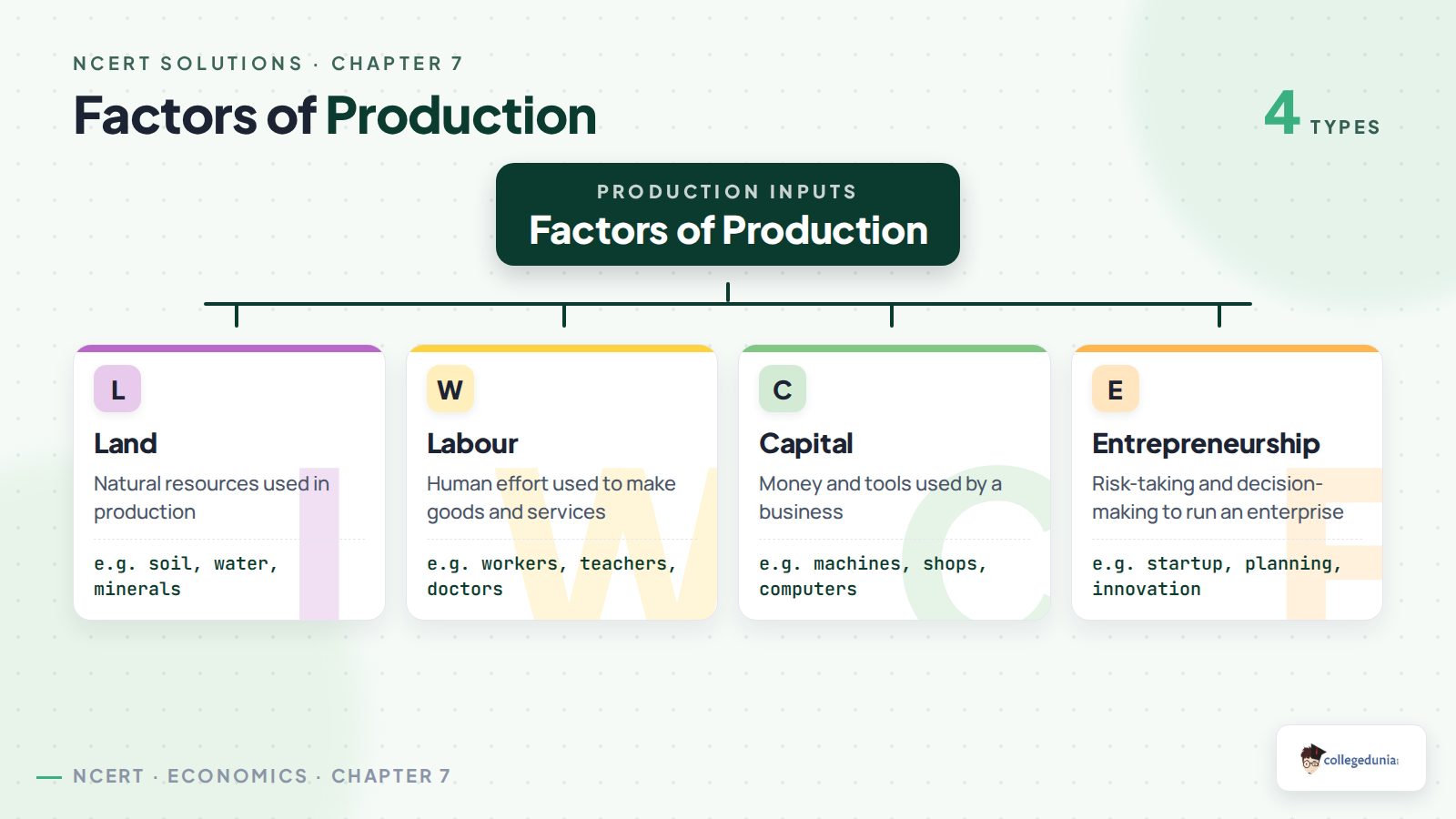
| Factor | Meaning | Example from the chapter |
|---|---|---|
| Land | Natural resources | soil, water, sunlight and minerals |
| Labour | Human effort | workers, teachers, doctors and chefs |
| Capital | Money and human-made assets | machines, carts, shops and computers |
| Entrepreneurship | Risk-taking and decisions | Ratna planning and running Pause Point |
Factors of Production Video for Class 8 Revision
Source: Magnet Brains on YouTube
Human Capital and Technology in the Factors of Production Chapter
Human capital means the knowledge, health, skills and experience people use at work. Education gives basic understanding, while training builds job-specific ability. Education and training usually complement each other, because knowledge and practice both raise productivity.
- Healthcare: healthy workers can work better and miss fewer days.
- Culture: hard work, punctuality and quality habits improve output.
- Technology: online courses, SWAYAM and job portals reduce distance barriers.
Steel Bottle Business Example for Production Inputs
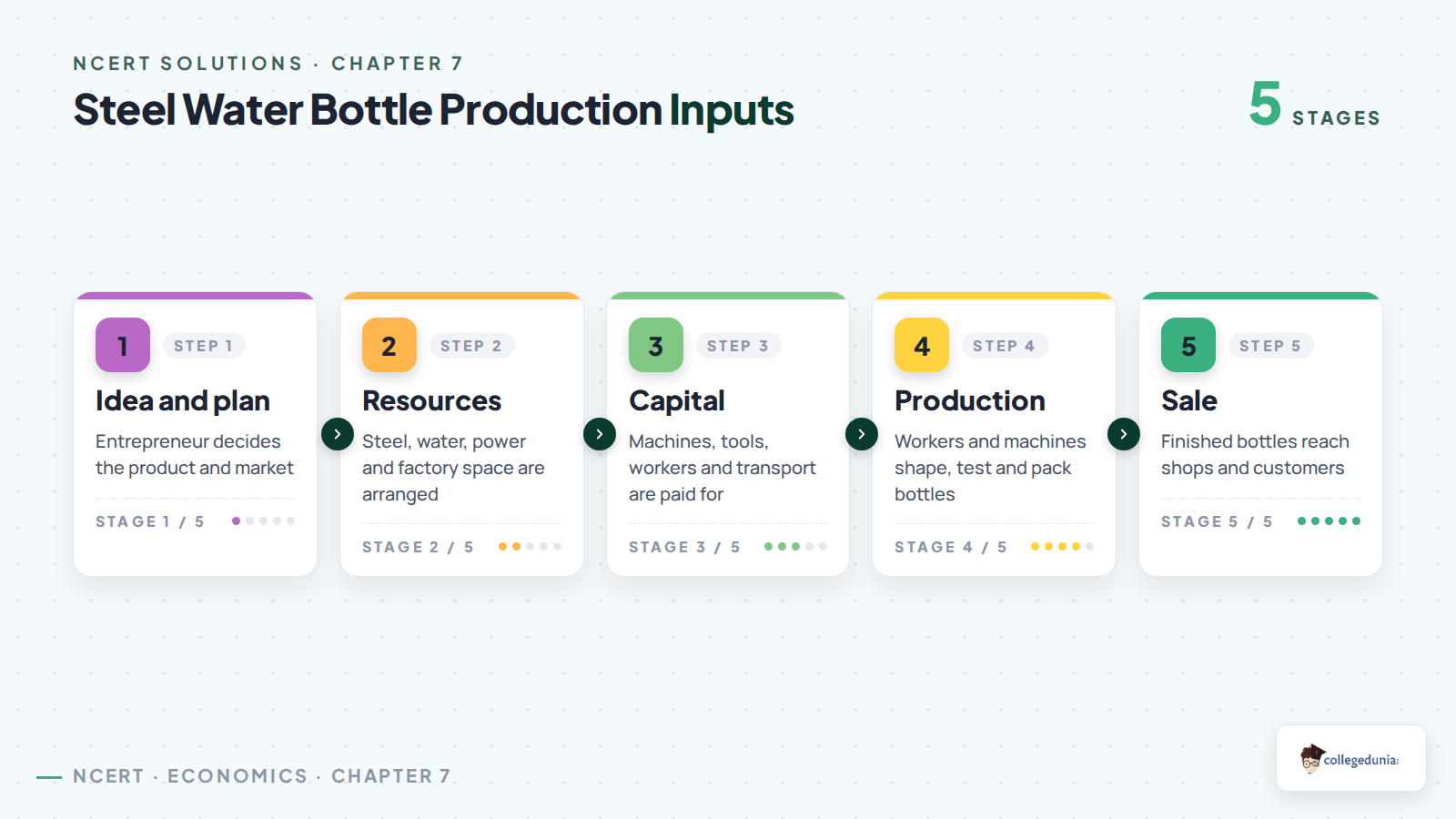
The steel bottle activity in the exercise is a simple way to test the chapter. A business needs factory space, steel, workers, machines, finance, transport and decisions. If one factor is missing, production can slow down or stop.
| Missing factor | Likely effect |
|---|---|
| Raw material | Bottles cannot be made on time |
| Labour | Machines and packing work remain incomplete |
| Capital | Rent, wages and equipment cannot be paid for |
| Entrepreneurship | The business lacks planning and risk-taking |
Related NCERT Resources for Social Science Chapter 7
| Resource | Link |
|---|---|
| Chapter 7 Notes | NCERT Notes Class 8 Social Science Chapter 7 |
| Chapter 7 Book PDF | NCERT Book PDF Class 8 Social Science Chapter 7 |
| Chapter 7 Handwritten Notes | Handwritten Notes Class 8 Social Science Chapter 7 |
Class 8 Social Science Solutions for All Chapters
| Chapter | Solutions |
|---|---|
| Chapter 4 The Colonial Era in India | Open solutions |
| Chapter 5 Universal Franchise and India's Electoral System | Open solutions |
| Chapter 6 The Parliamentary System: Legislature and Executive | Open solutions |
All NCERT Solutions for Class 8 Social Science Chapter 7 Factors of Production with Step-by-Step Solutions
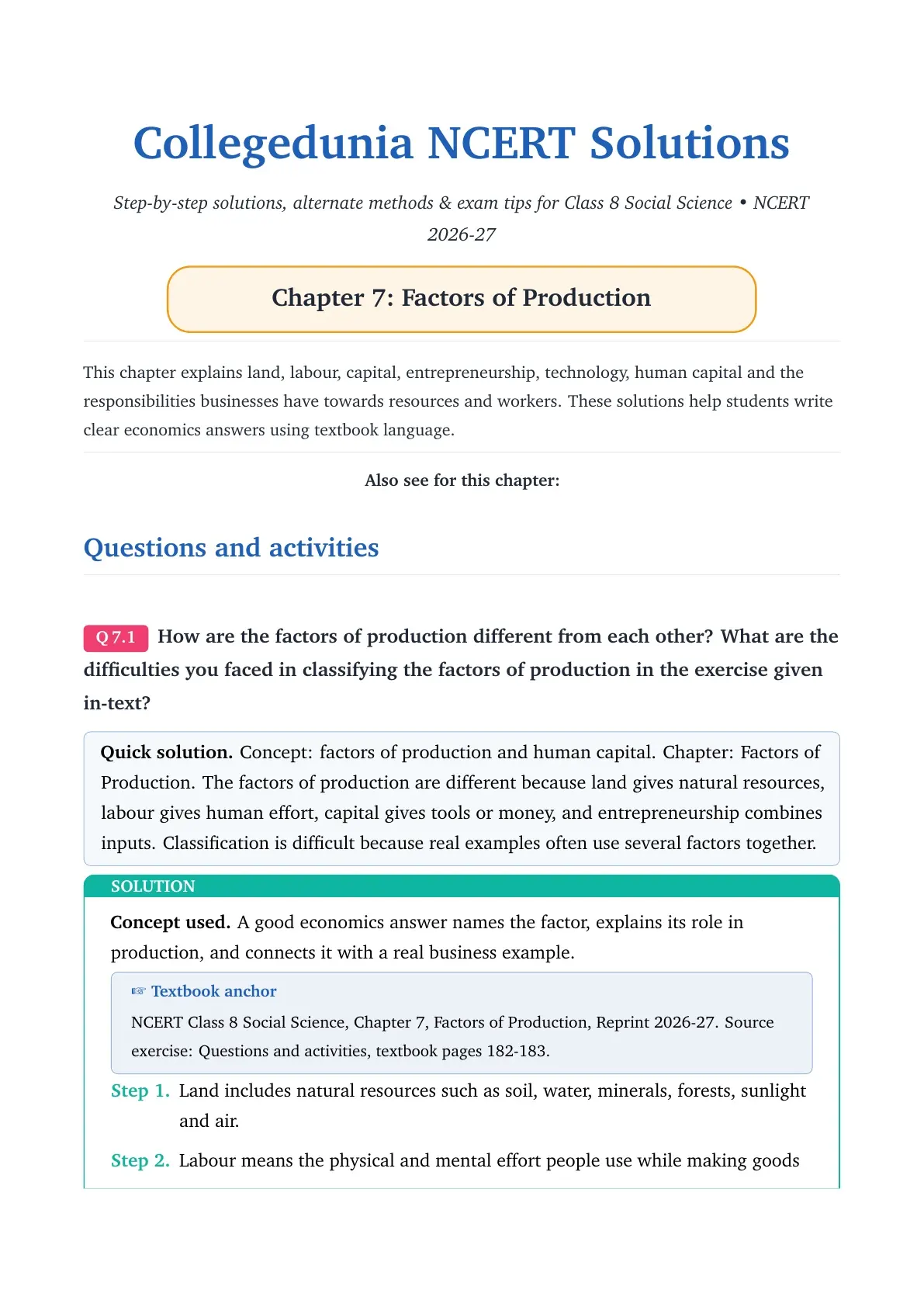
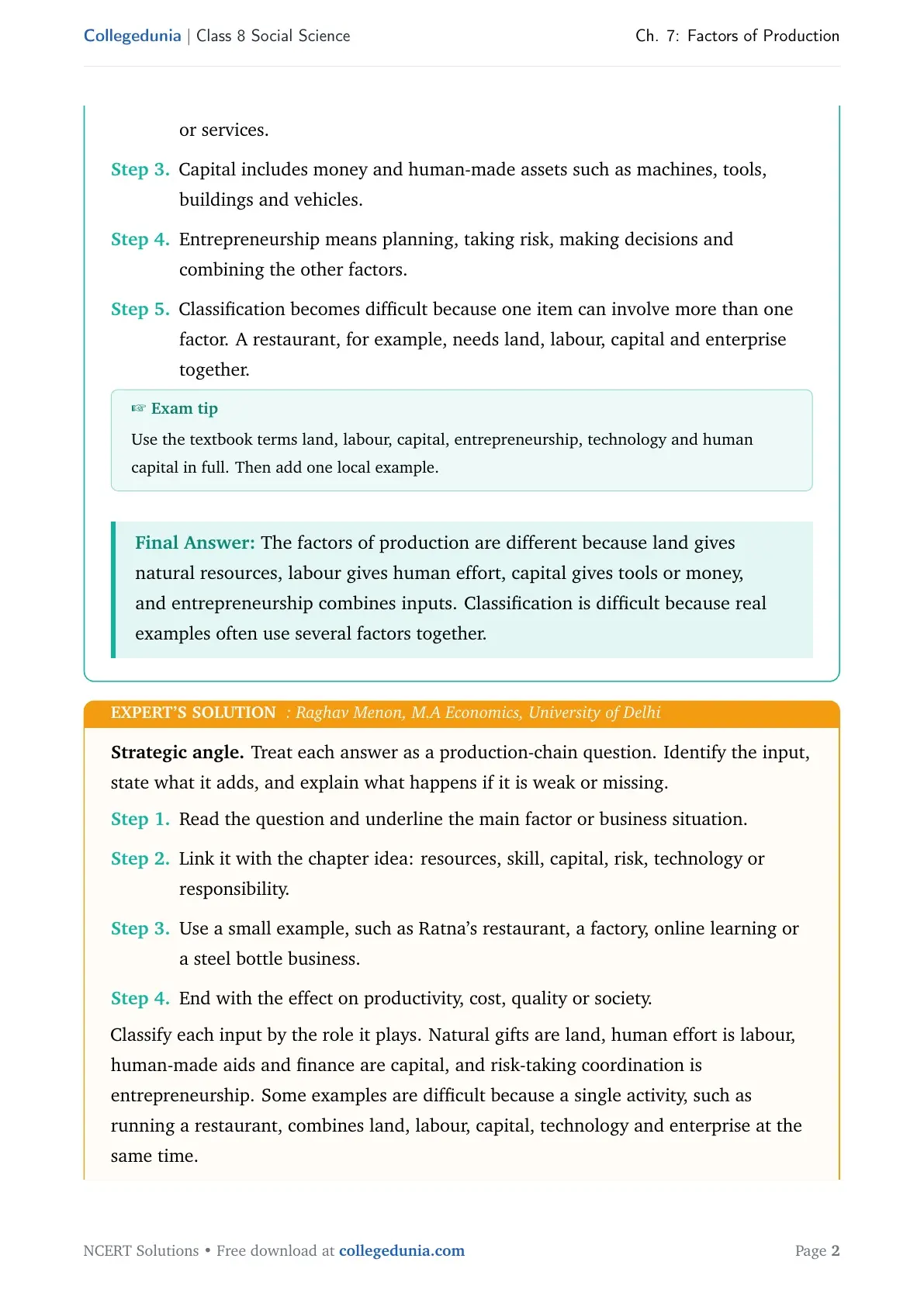
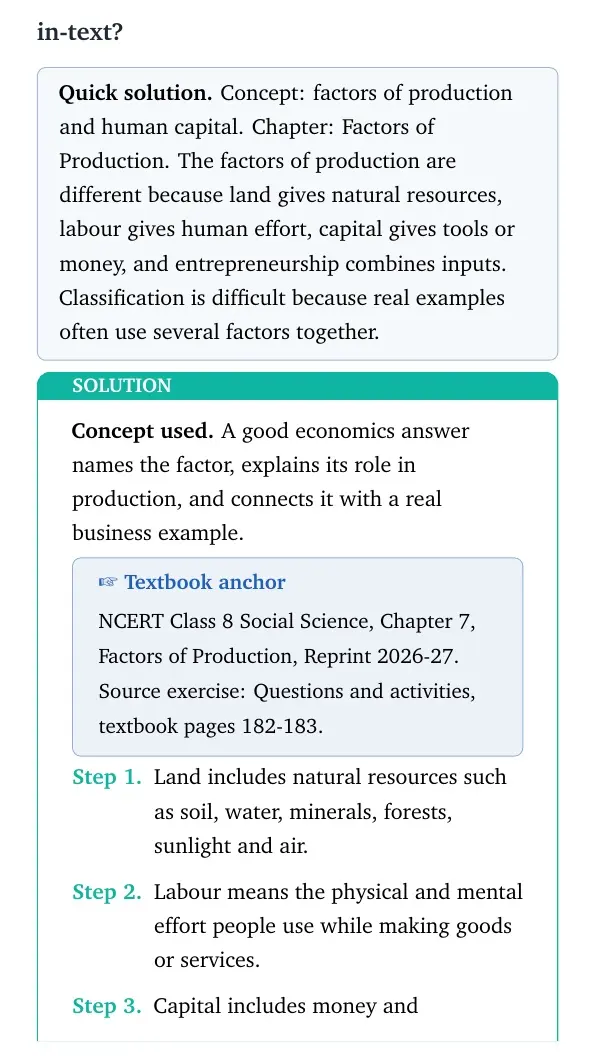
Q7.1 How are the factors of production different from each other? What are the difficulties you faced in classifying the factors of production in the exercise given in-text?
Quick answer: The factors of production are different because land gives natural resources, labour gives human effort, capital gives tools or money, and entrepreneurship combines inputs. Classification is difficult because real examples often use several factors together.
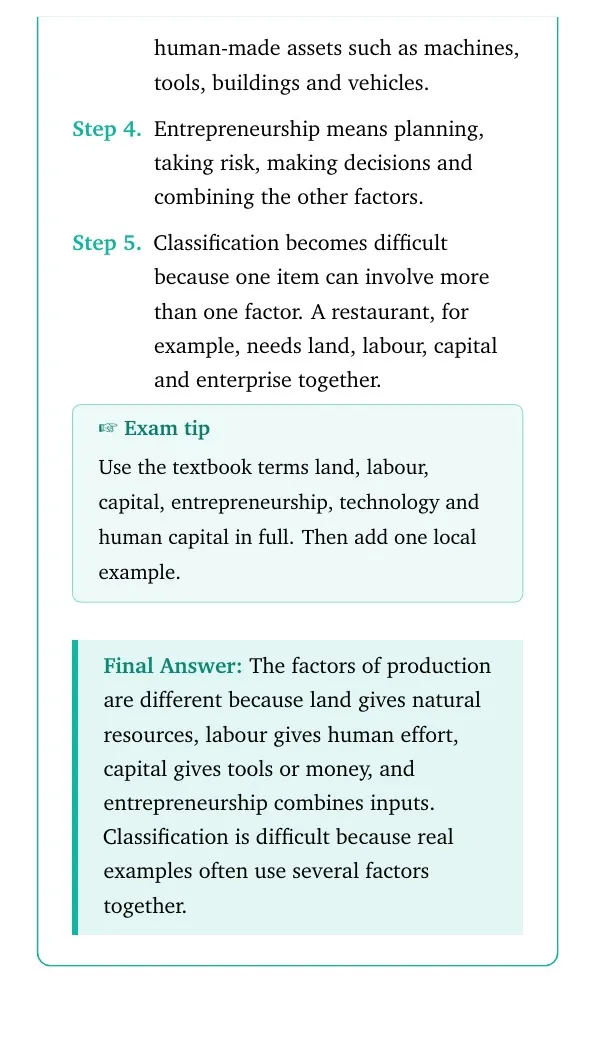
- Land includes natural resources such as soil, water, minerals, forests, sunlight and air.
- Labour means the physical and mental effort people use while making goods or services.
- Capital includes money and human-made assets such as machines, tools, buildings and vehicles.
- Entrepreneurship means planning, taking risk, making decisions and combining the other factors.
- Classification becomes difficult because one item can involve more than one factor. A restaurant, for example, needs land, labour, capital and enterprise together.
Verified Expert
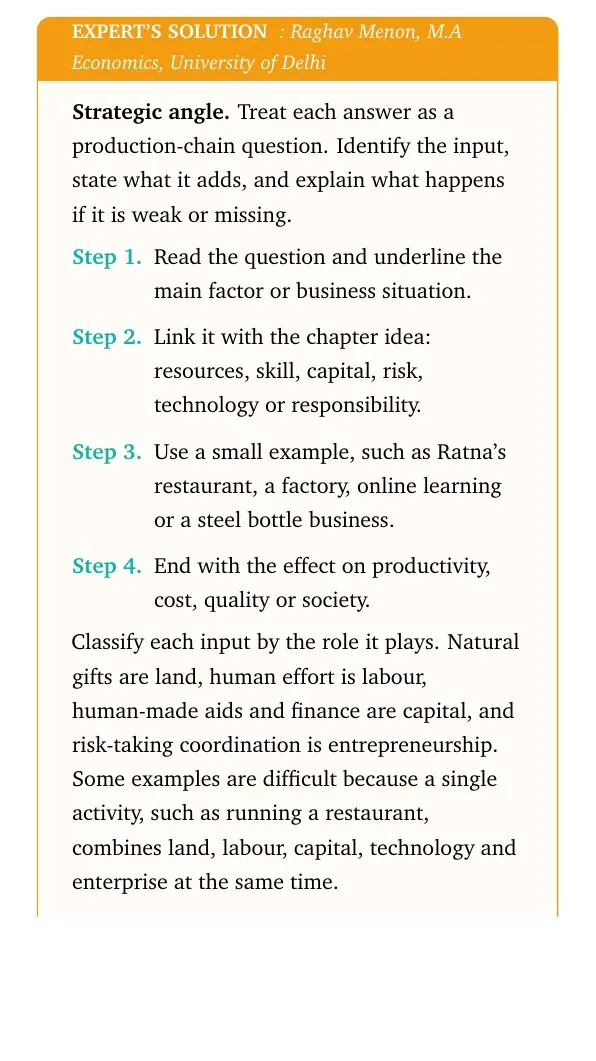
Classify each input by the role it plays. Natural gifts are land, human effort is labour, human-made aids and finance are capital, and risk-taking coordination is entrepreneurship. Some examples are difficult because a single activity, such as running a restaurant, combines land, labour, capital, technology and enterprise at the same time.
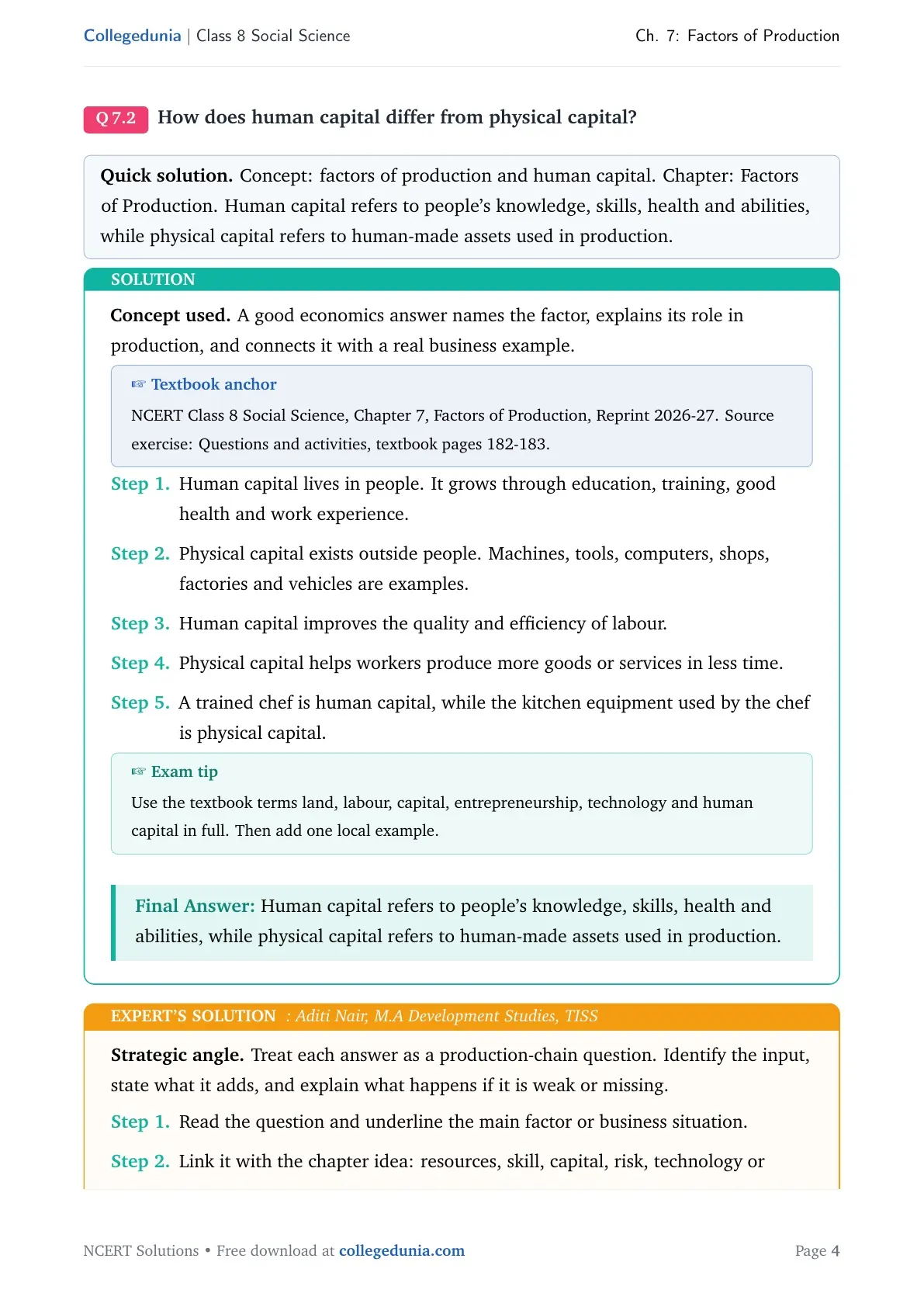
Q7.2 How does human capital differ from physical capital?
Quick answer: Human capital refers to people's knowledge, skills, health and abilities, while physical capital refers to human-made assets used in production.
- Human capital lives in people. It grows through education, training, good health and work experience.
- Physical capital exists outside people. Machines, tools, computers, shops, factories and vehicles are examples.
- Human capital improves the quality and efficiency of labour.
- Physical capital helps workers produce more goods or services in less time.
- A trained chef is human capital, while the kitchen equipment used by the chef is physical capital.
Verified Expert
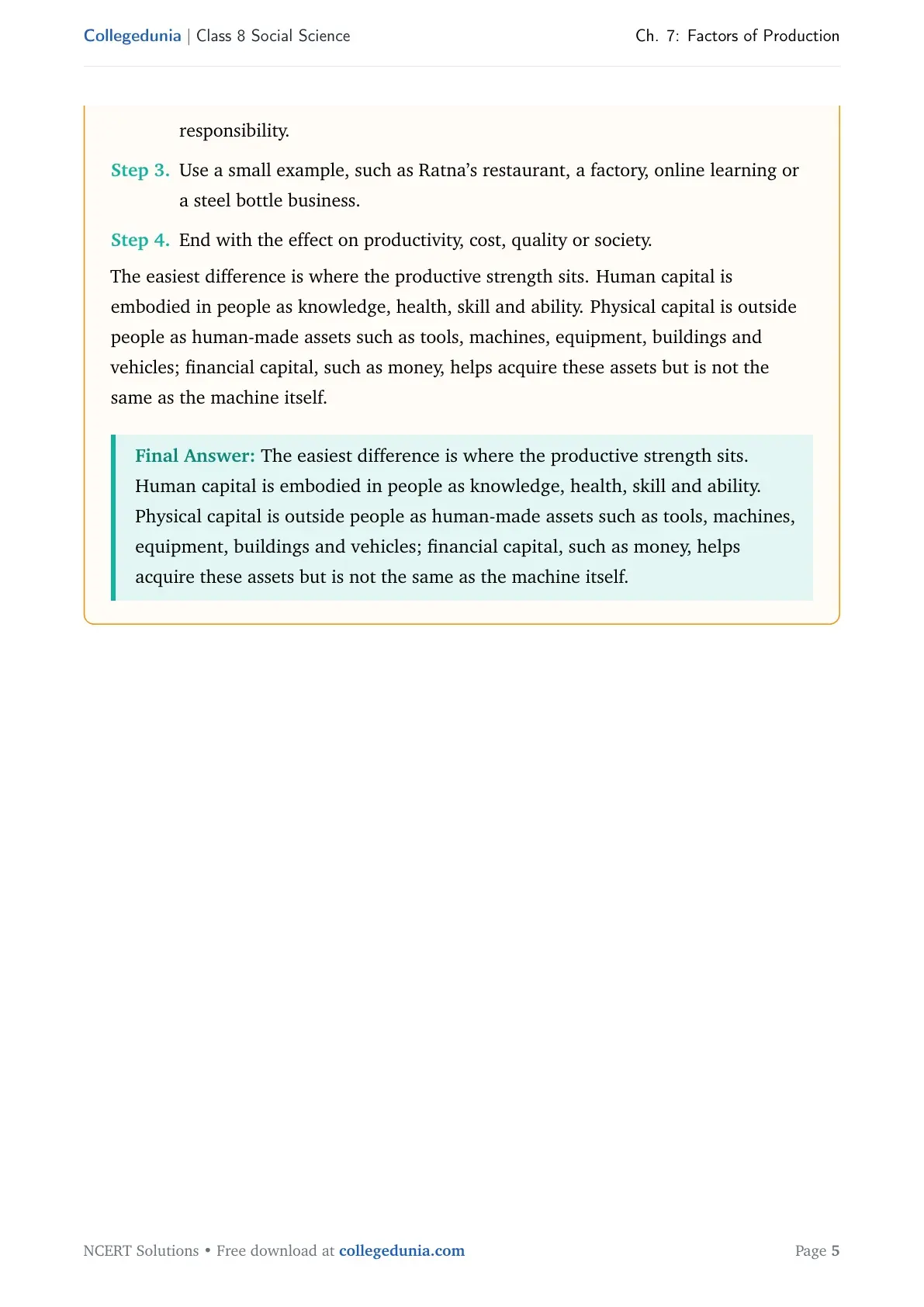
The easiest difference is where the productive strength sits. Human capital is embodied in people as knowledge, health, skill and ability. Physical capital is outside people as human-made assets such as tools, machines, equipment, buildings and vehicles; financial capital, such as money, helps acquire these assets but is not the same as the machine itself.
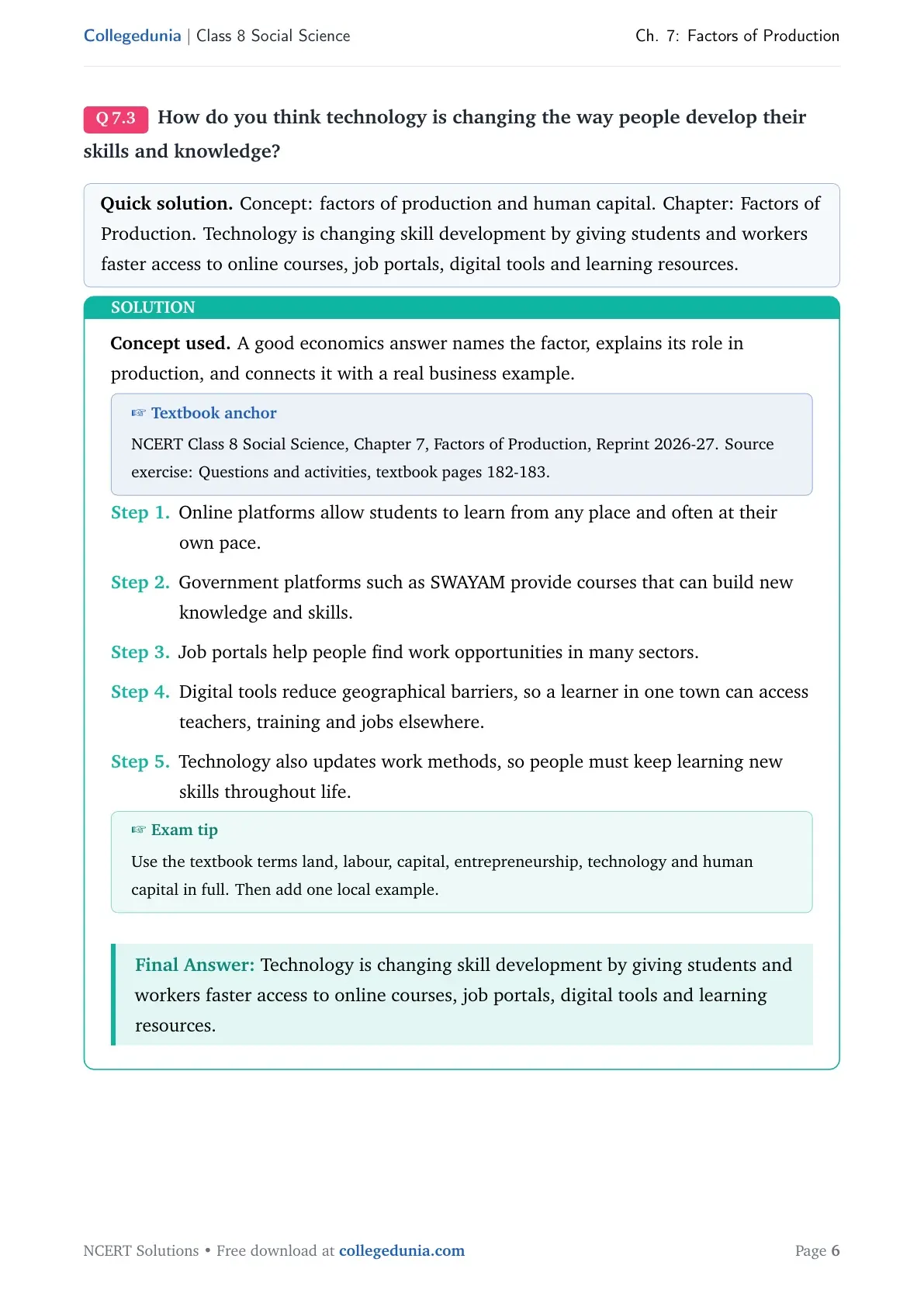
Q7.3 How do you think technology is changing the way people develop their skills and knowledge?
Quick answer: Technology is changing skill development by giving students and workers faster access to online courses, job portals, digital tools and learning resources.
- Online platforms allow students to learn from any place and often at their own pace.
- Government platforms such as SWAYAM provide courses that can build new knowledge and skills.
- Job portals help people find work opportunities in many sectors.
- Digital tools reduce geographical barriers, so a learner in one town can access teachers, training and jobs elsewhere.
- Technology also updates work methods, so people must keep learning new skills throughout life.
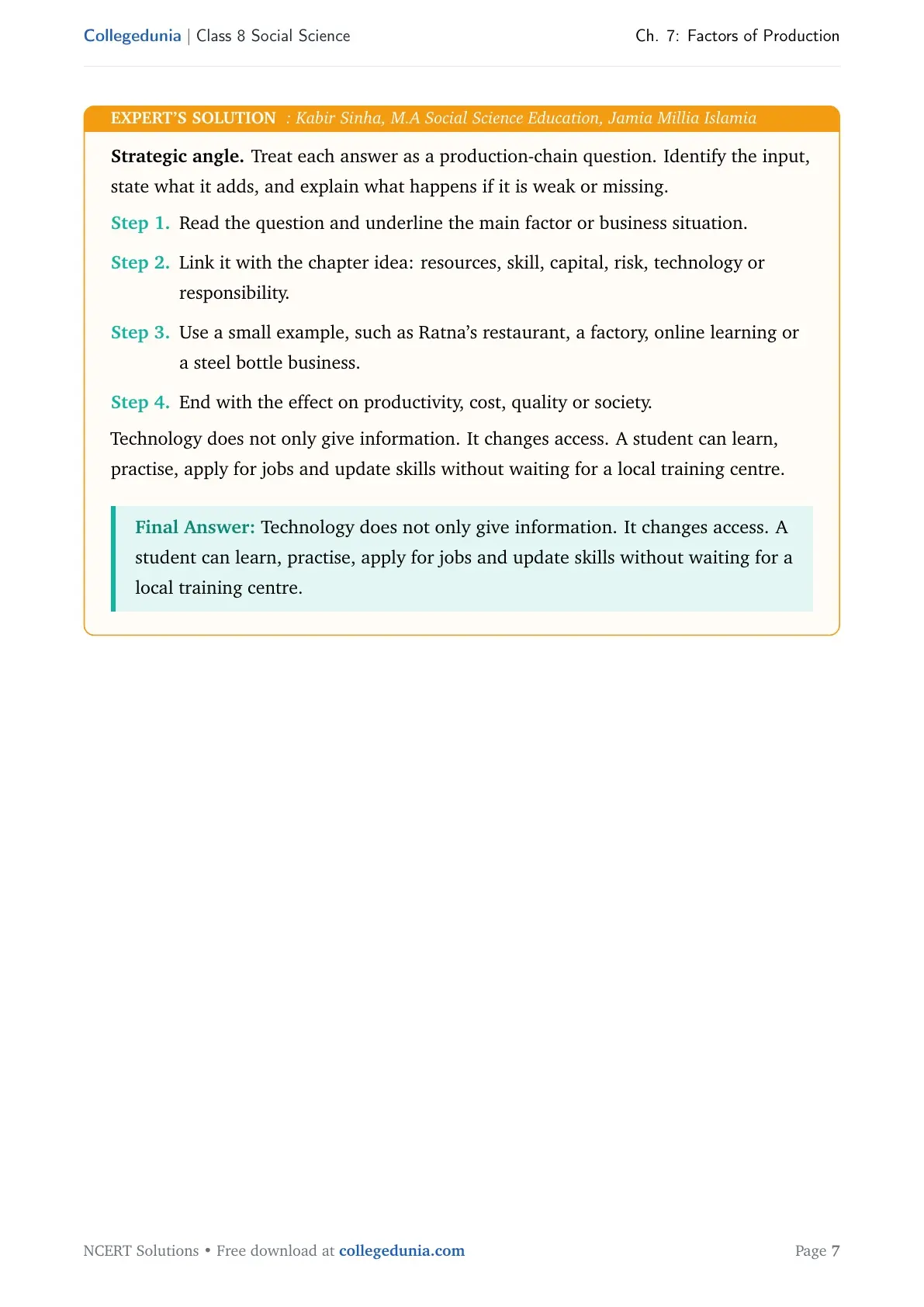
Verified Expert
Technology does not only give information. It changes access. A student can learn, practise, apply for jobs and update skills without waiting for a local training centre.
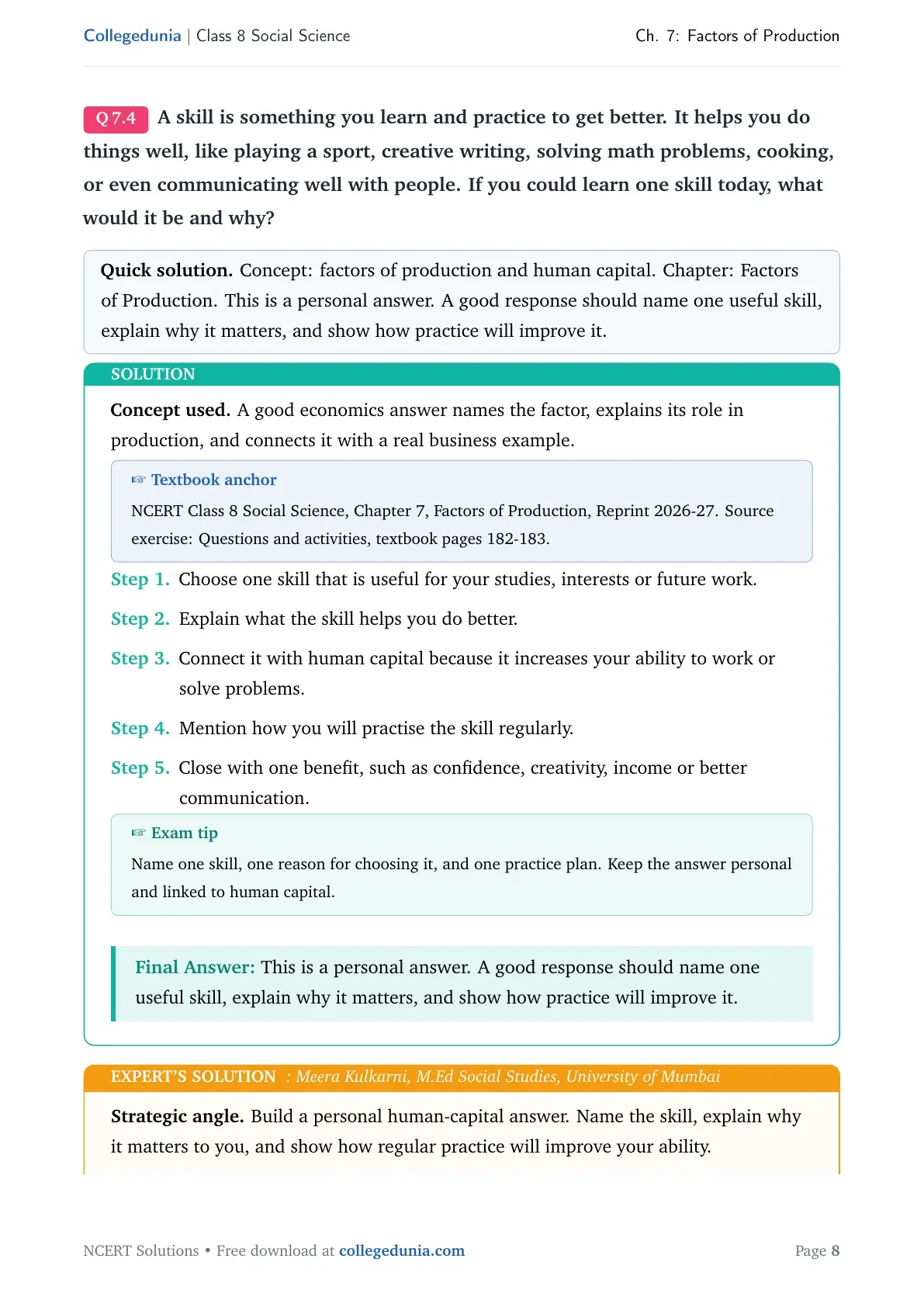
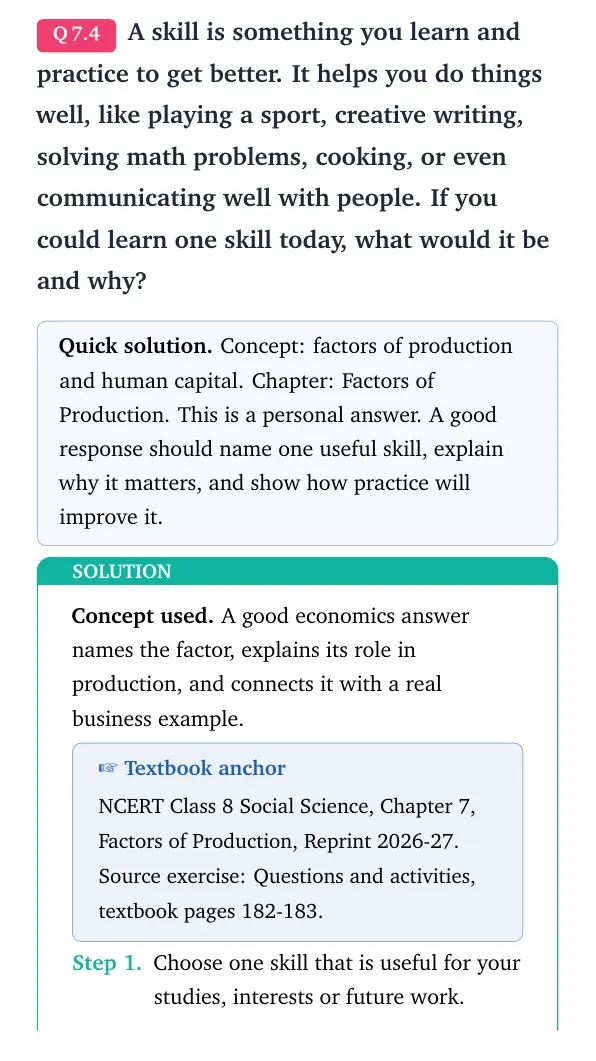
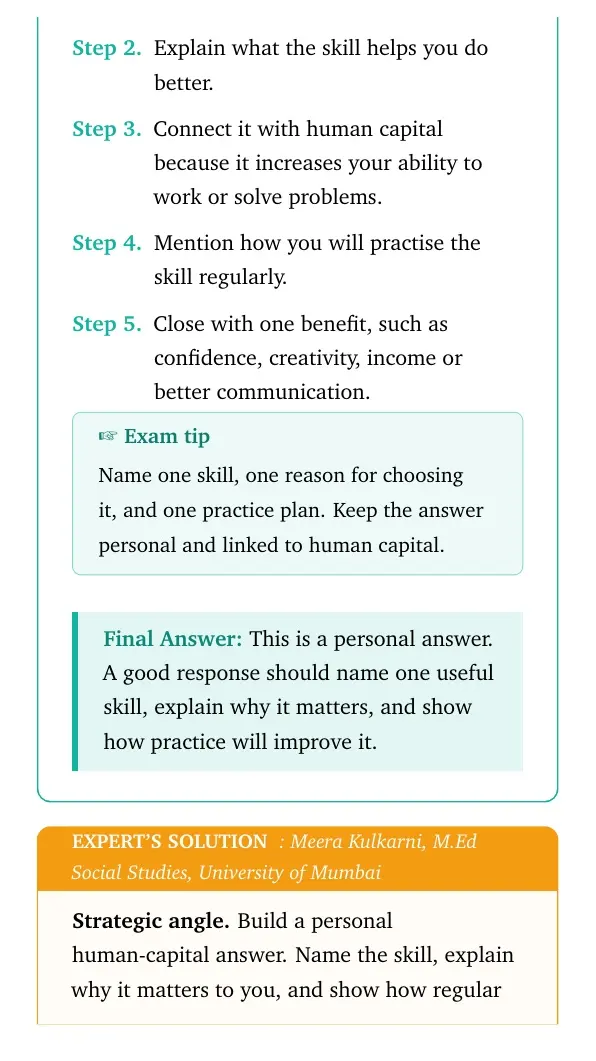
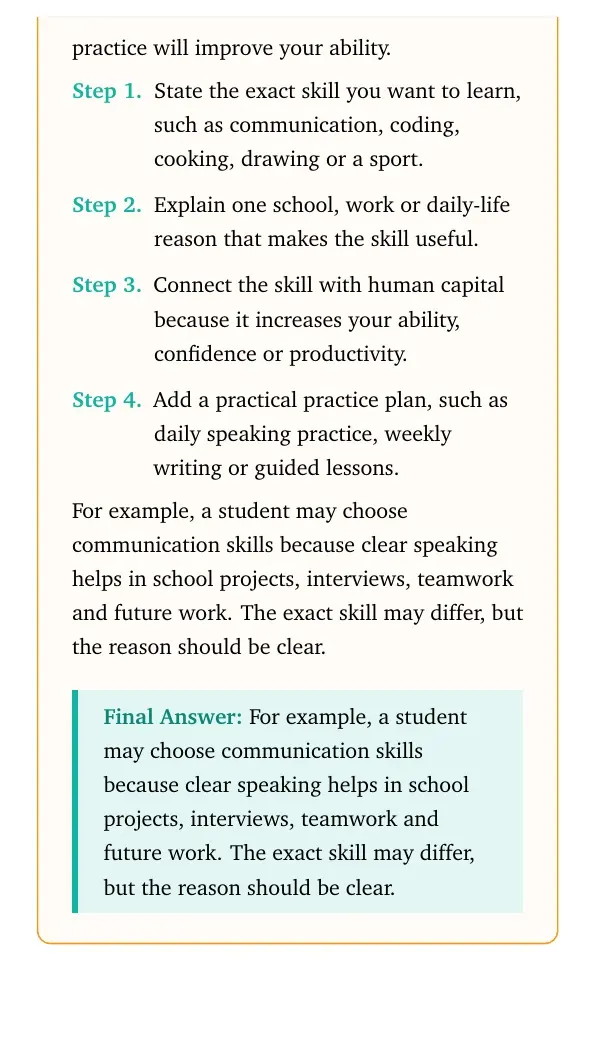
Q7.4 A skill is something you learn and practice to get better. It helps you do things well, like playing a sport, creative writing, solving math problems, cooking, or even communicating well with people. If you could learn one skill today, what would it be and why?
Quick answer: This is a personal answer. A good response should name one useful skill, explain why it matters, and show how practice will improve it.
- Choose one skill that is useful for your studies, interests or future work.
- Explain what the skill helps you do better.
- Connect it with human capital because it increases your ability to work or solve problems.
- Mention how you will practise the skill regularly.
- Close with one benefit, such as confidence, creativity, income or better communication.
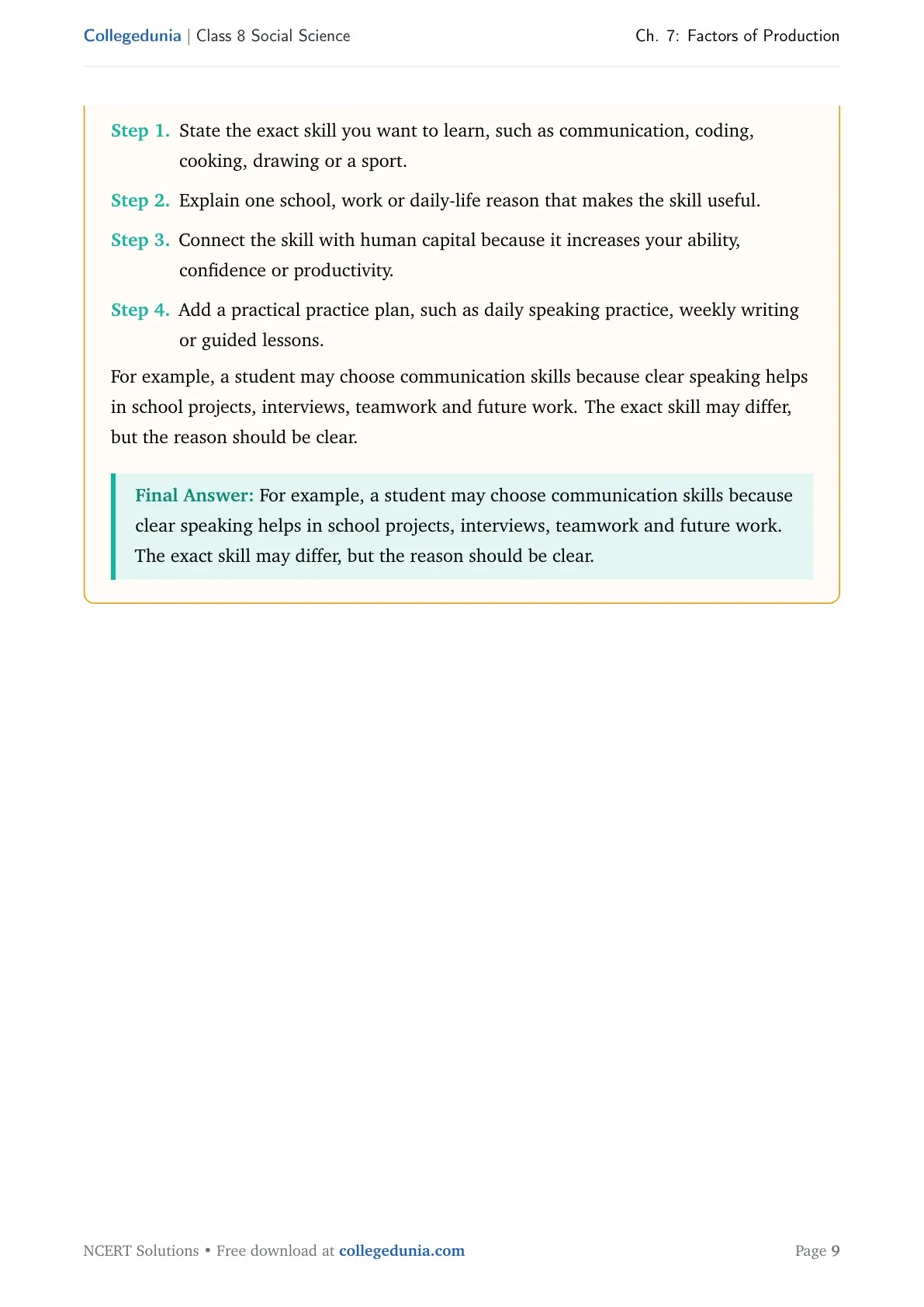
Verified Expert
For example, a student may choose communication skills because clear speaking helps in school projects, interviews, teamwork and future work. The exact skill may differ, but the reason should be clear.
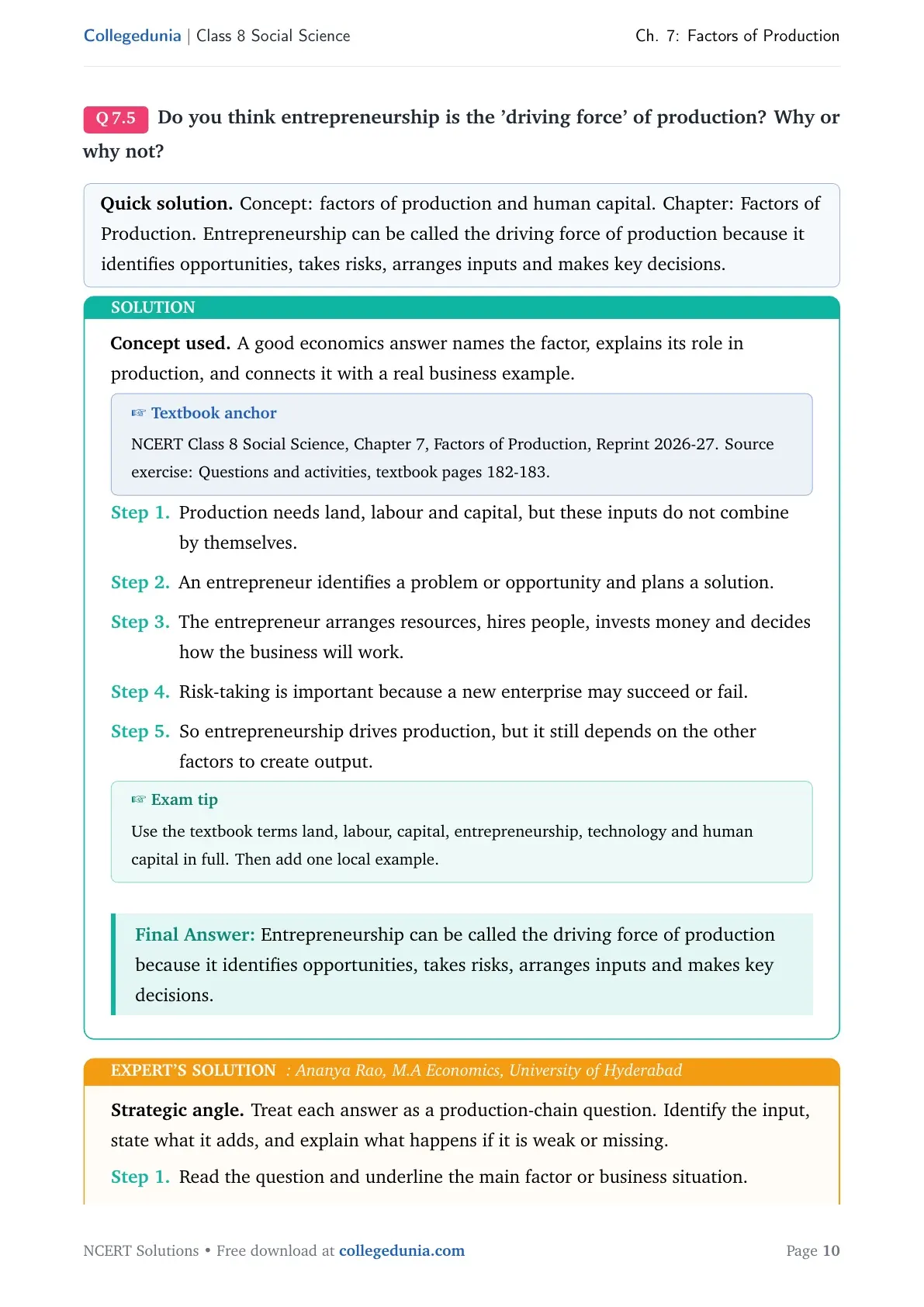
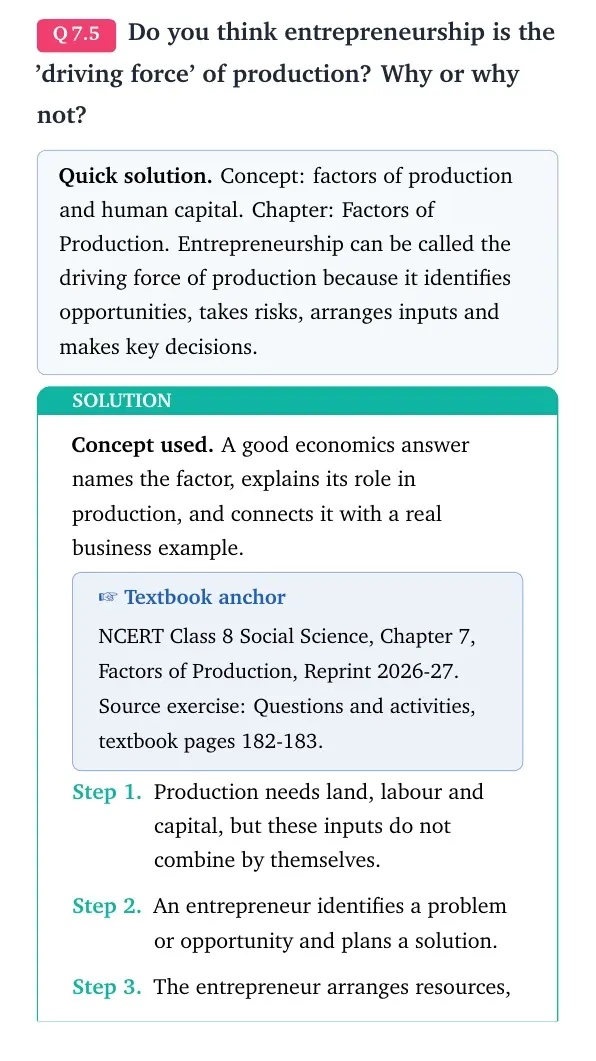
Q7.5 Do you think entrepreneurship is the 'driving force' of production? Why or why not?
Quick answer: Entrepreneurship can be called the driving force of production because it identifies opportunities, takes risks, arranges inputs and makes key decisions.
- Production needs land, labour and capital, but these inputs do not combine by themselves.
- An entrepreneur identifies a problem or opportunity and plans a solution.
- The entrepreneur arranges resources, hires people, invests money and decides how the business will work.
- Risk-taking is important because a new enterprise may succeed or fail.
- So entrepreneurship drives production, but it still depends on the other factors to create output.
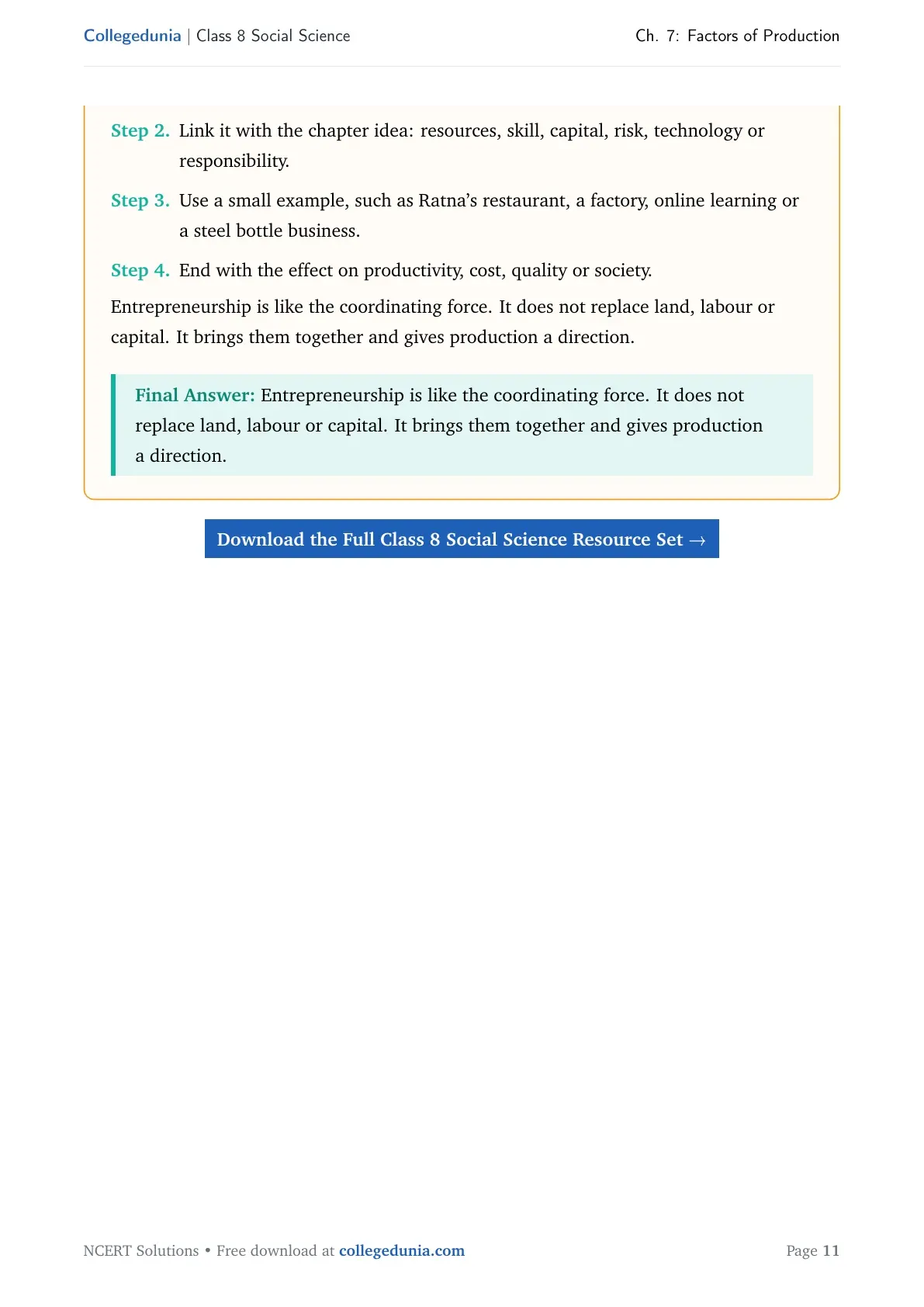
Verified Expert
Entrepreneurship is like the coordinating force. It does not replace land, labour or capital. It brings them together and gives production a direction.
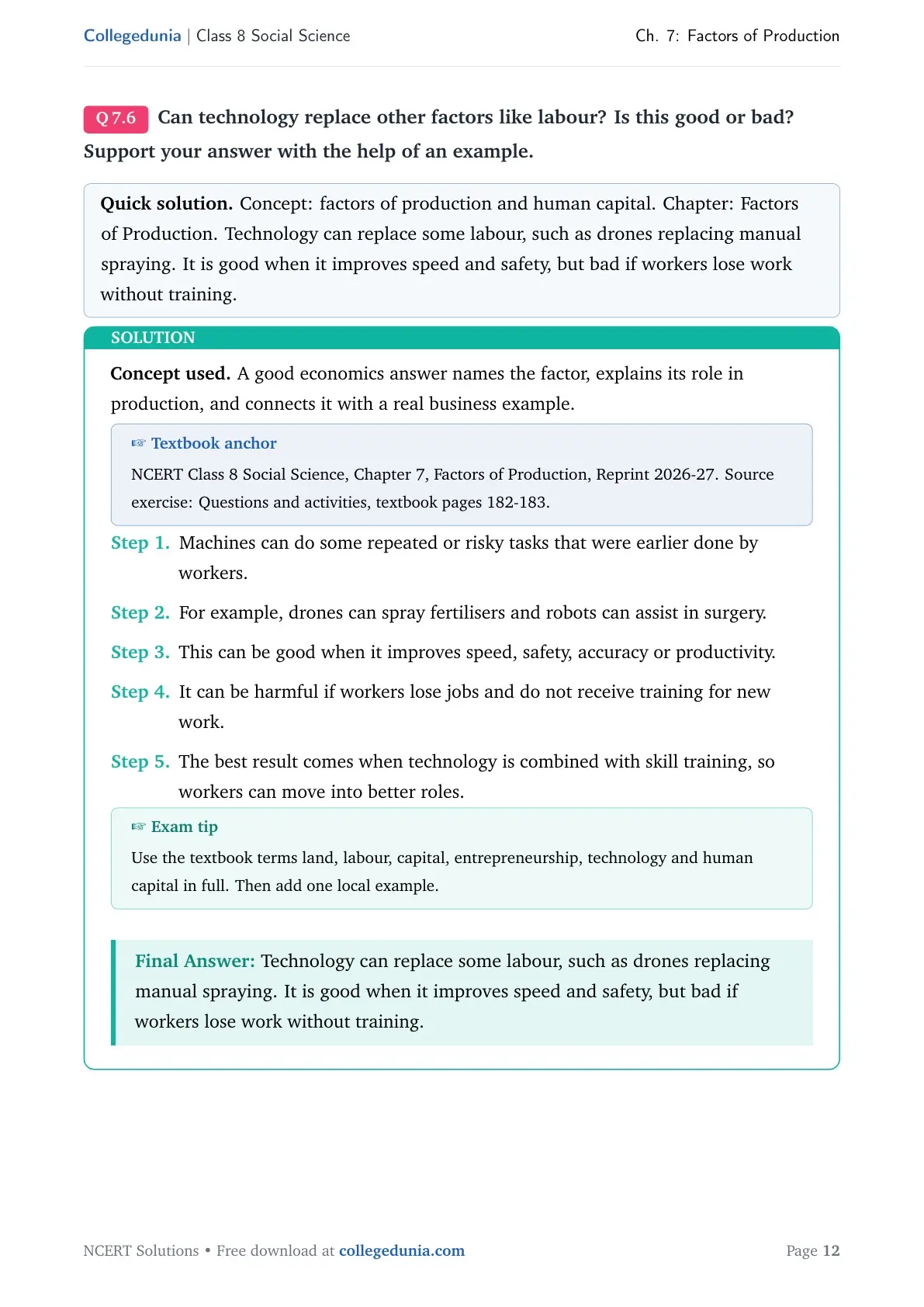
Q7.6 Can technology replace other factors like labour? Is this good or bad? Support your answer with the help of an example.
Quick answer: Technology can replace some labour, such as drones replacing manual spraying. It is good when it improves speed and safety, but bad if workers lose work without training.
- Machines can do some repeated or risky tasks that were earlier done by workers.
- For example, drones can spray fertilisers and robots can assist in surgery.
- This can be good when it improves speed, safety, accuracy or productivity.
- It can be harmful if workers lose jobs and do not receive training for new work.
- The best result comes when technology is combined with skill training, so workers can move into better roles.
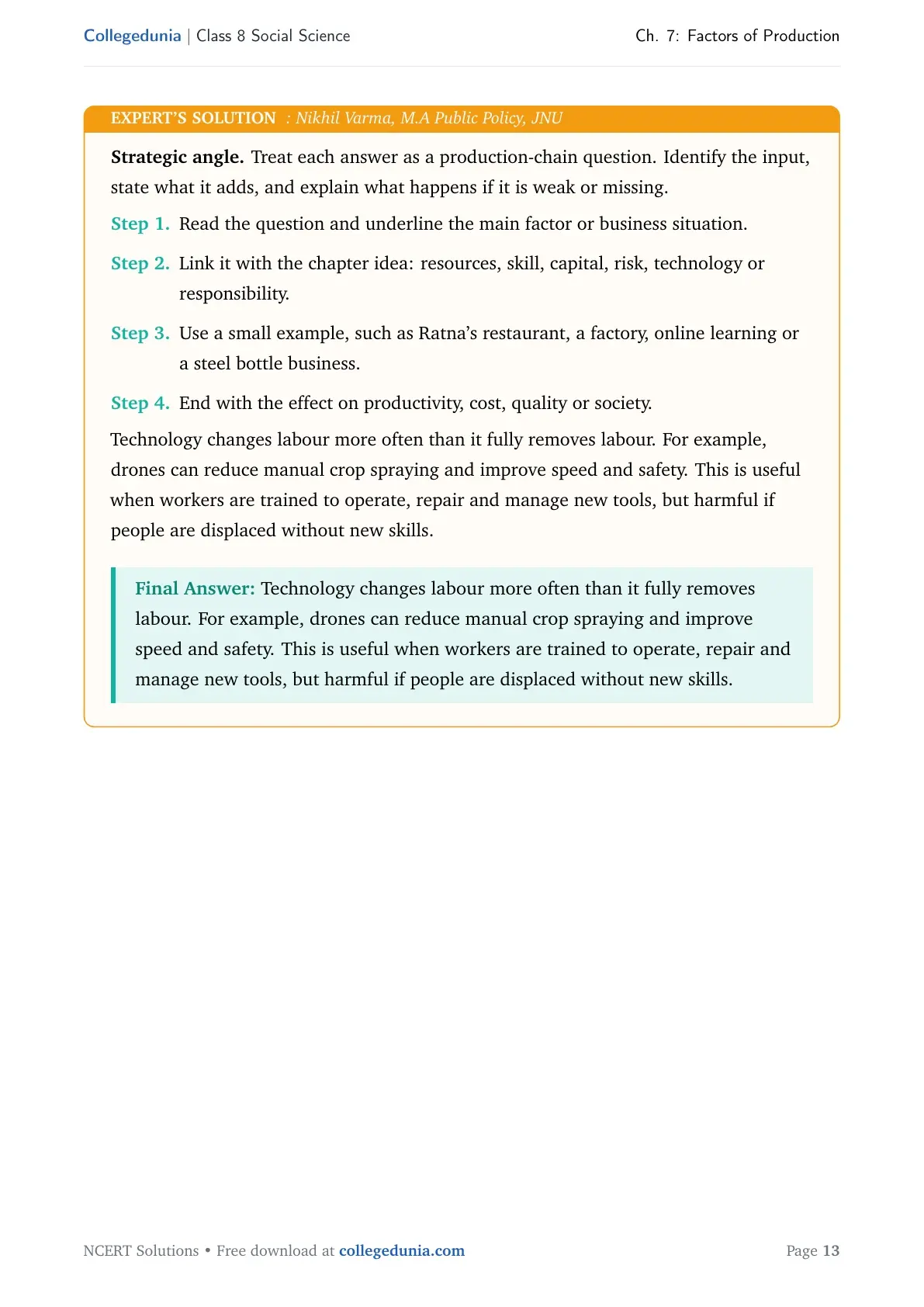
Verified Expert
Technology changes labour more often than it fully removes labour. For example, drones can reduce manual crop spraying and improve speed and safety. This is useful when workers are trained to operate, repair and manage new tools, but harmful if people are displaced without new skills.
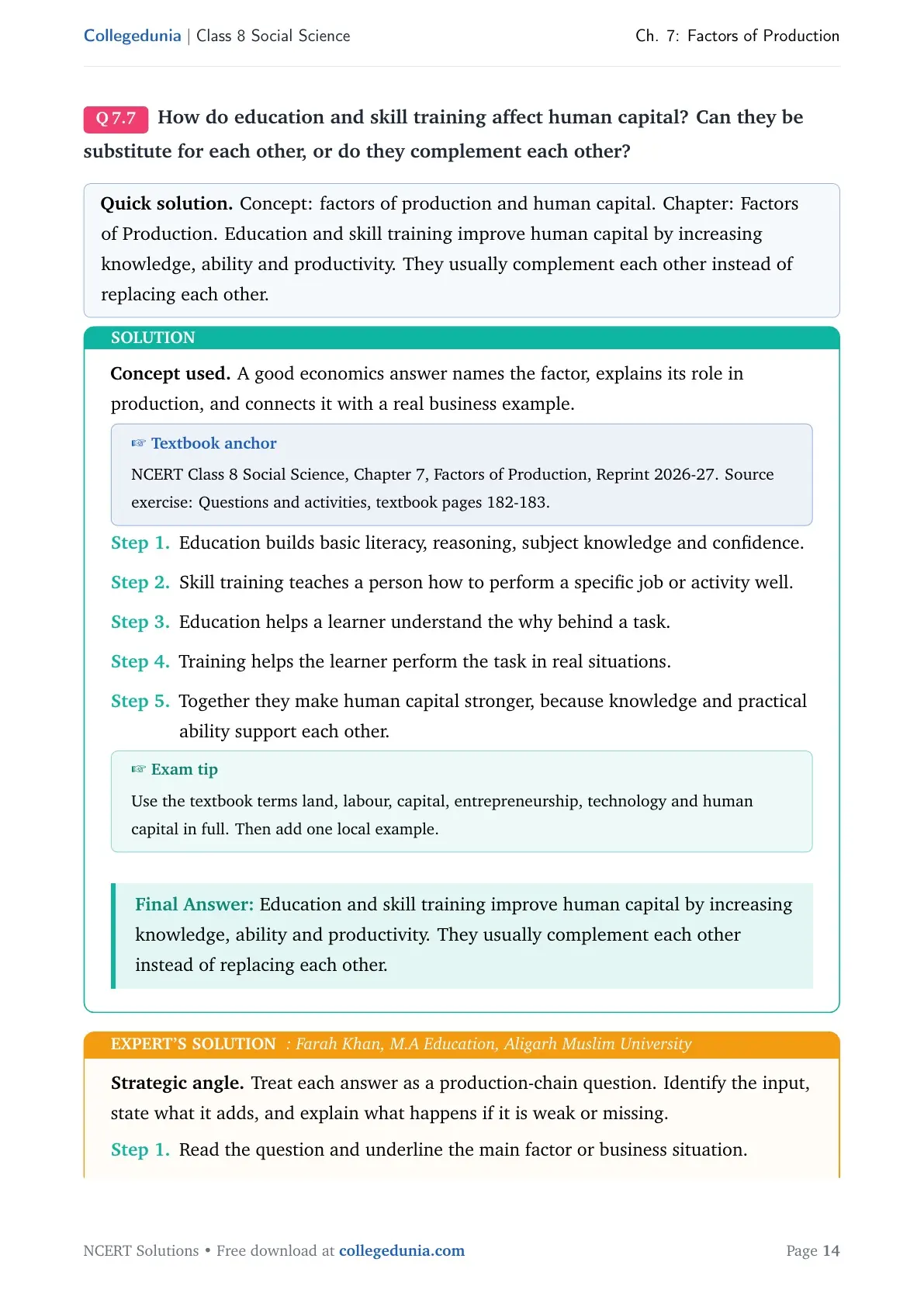
Q7.7 How do education and skill training affect human capital? Can they be substitute for each other, or do they complement each other?
Quick answer: Education and skill training improve human capital by increasing knowledge, ability and productivity. They usually complement each other instead of replacing each other.
- Education builds basic literacy, reasoning, subject knowledge and confidence.
- Skill training teaches a person how to perform a specific job or activity well.
- Education helps a learner understand the why behind a task.
- Training helps the learner perform the task in real situations.
- Together they make human capital stronger, because knowledge and practical ability support each other.
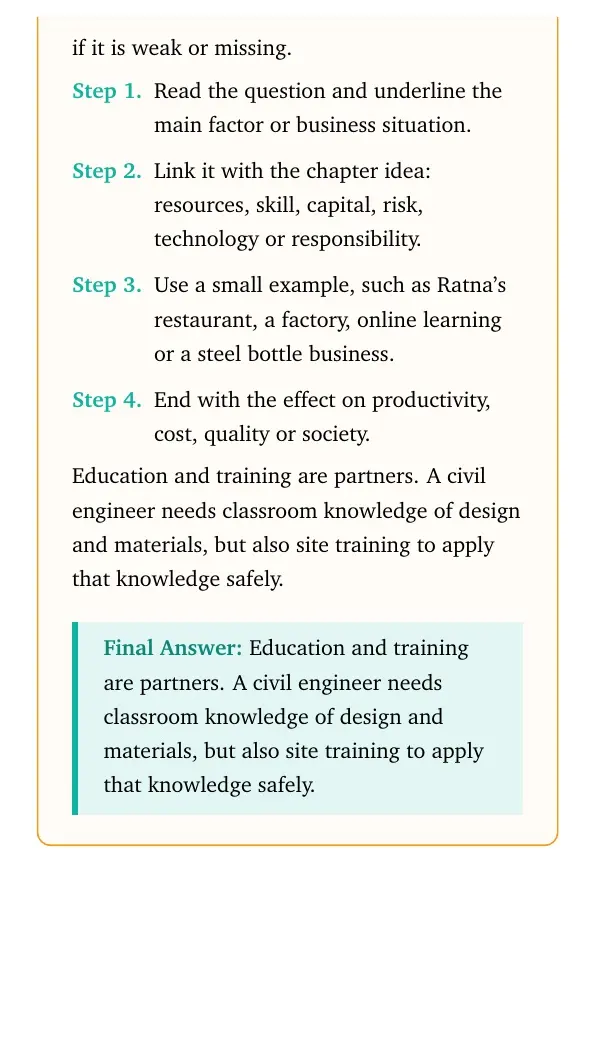
Verified Expert
Education and training are partners. A civil engineer needs classroom knowledge of design and materials, but also site training to apply that knowledge safely.
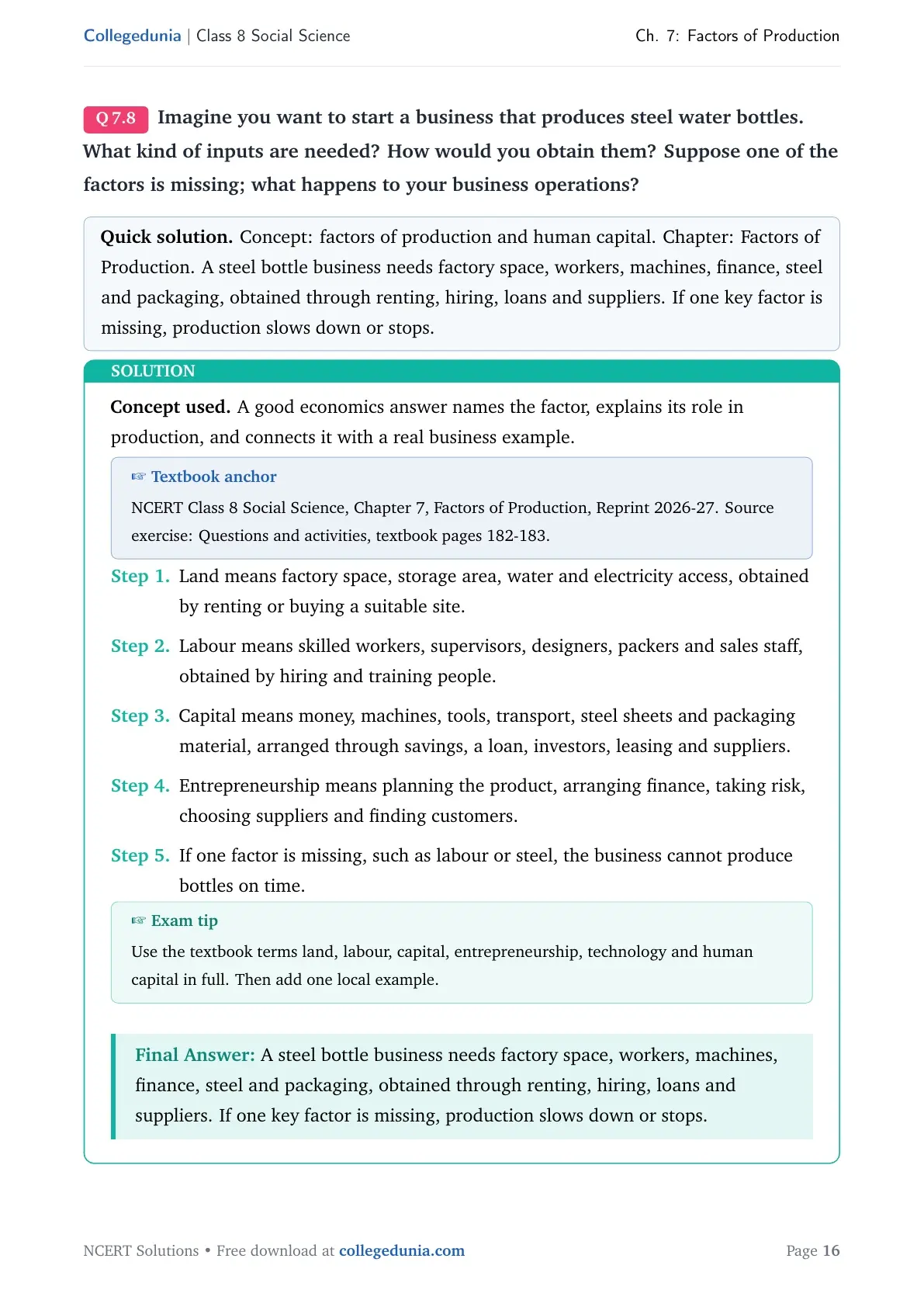
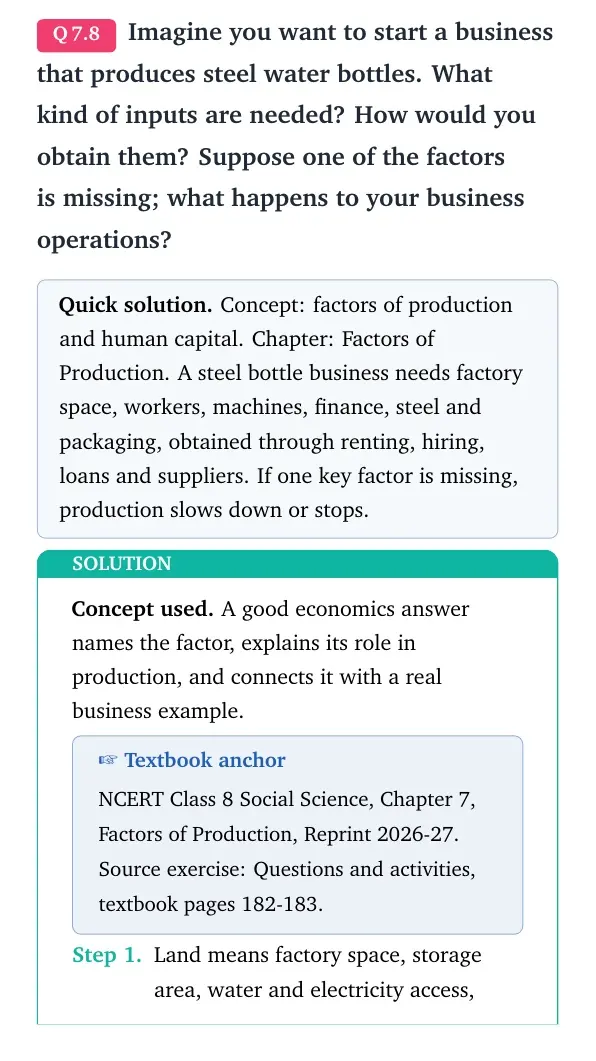
Q7.8 Imagine you want to start a business that produces steel water bottles. What kind of inputs are needed? How would you obtain them? Suppose one of the factors is missing; what happens to your business operations?
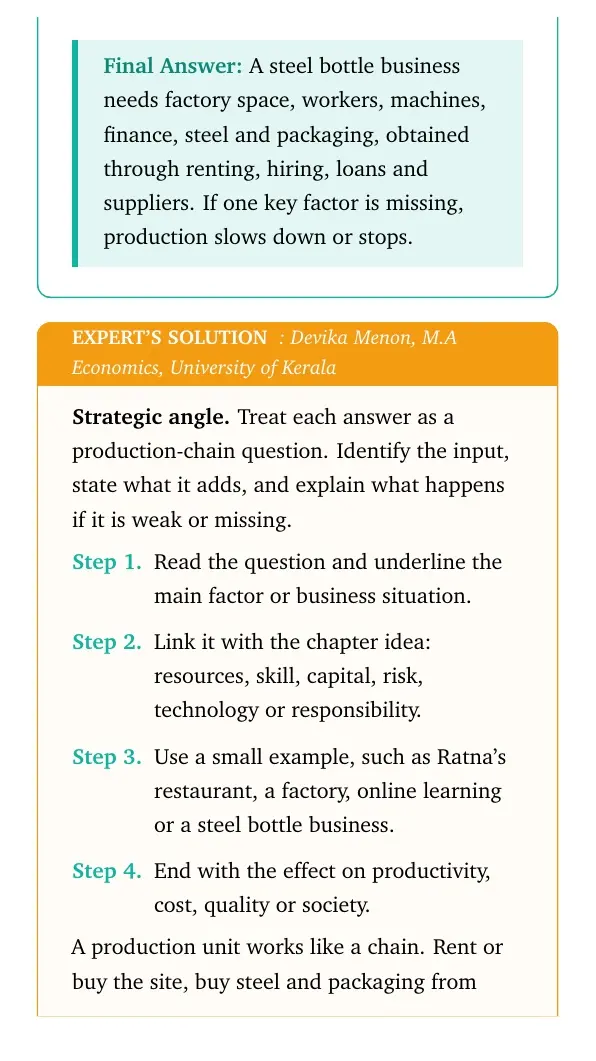
Quick answer: A steel bottle business needs factory space, workers, machines, finance, steel and packaging, obtained through renting, hiring, loans and suppliers. If one key factor is missing, production slows down or stops.
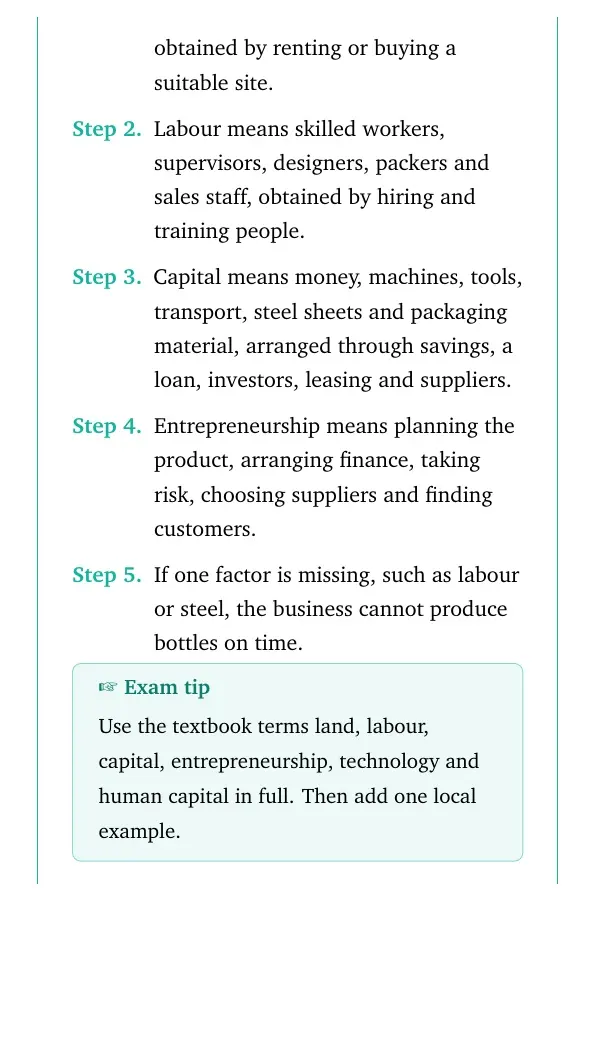
- Land means factory space, storage area, water and electricity access, obtained by renting or buying a suitable site.
- Labour means skilled workers, supervisors, designers, packers and sales staff, obtained by hiring and training people.
- Capital means money, machines, tools, transport, steel sheets and packaging material, arranged through savings, a loan, investors, leasing and suppliers.
- Entrepreneurship means planning the product, arranging finance, taking risk, choosing suppliers and finding customers.
- If one factor is missing, such as labour or steel, the business cannot produce bottles on time.
Verified Expert
A production unit works like a chain. Rent or buy the site, buy steel and packaging from suppliers, lease or purchase machines, arrange finance, hire and train workers, and manage technology and sales. If factory space, workers, machines, finance or decision-making is missing, the chain breaks and operations become inefficient.
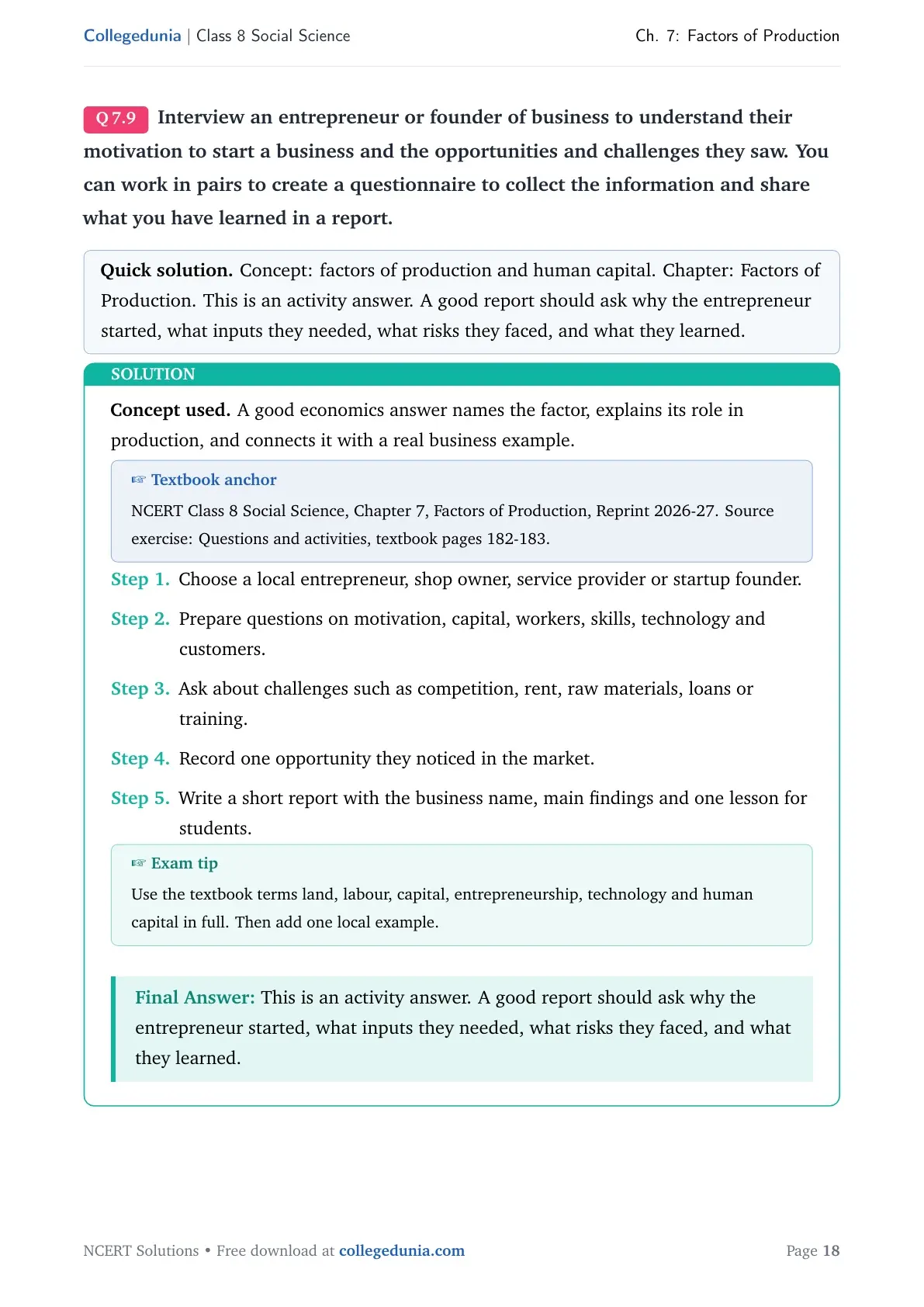
Q7.9 Interview an entrepreneur or founder of business to understand their motivation to start a business and the opportunities and challenges they saw. You can work in pairs to create a questionnaire to collect the information and share what you have learned in a report.
Quick answer: This is an activity answer. A good report should ask why the entrepreneur started, what inputs they needed, what risks they faced, and what they learned.
- Choose a local entrepreneur, shop owner, service provider or startup founder.
- Prepare questions on motivation, capital, workers, skills, technology and customers.
- Ask about challenges such as competition, rent, raw materials, loans or training.
- Record one opportunity they noticed in the market.
- Write a short report with the business name, main findings and one lesson for students.
Verified Expert
The interview should connect a real business with the chapter. Look for the four factors of production and the entrepreneur's role in combining them.
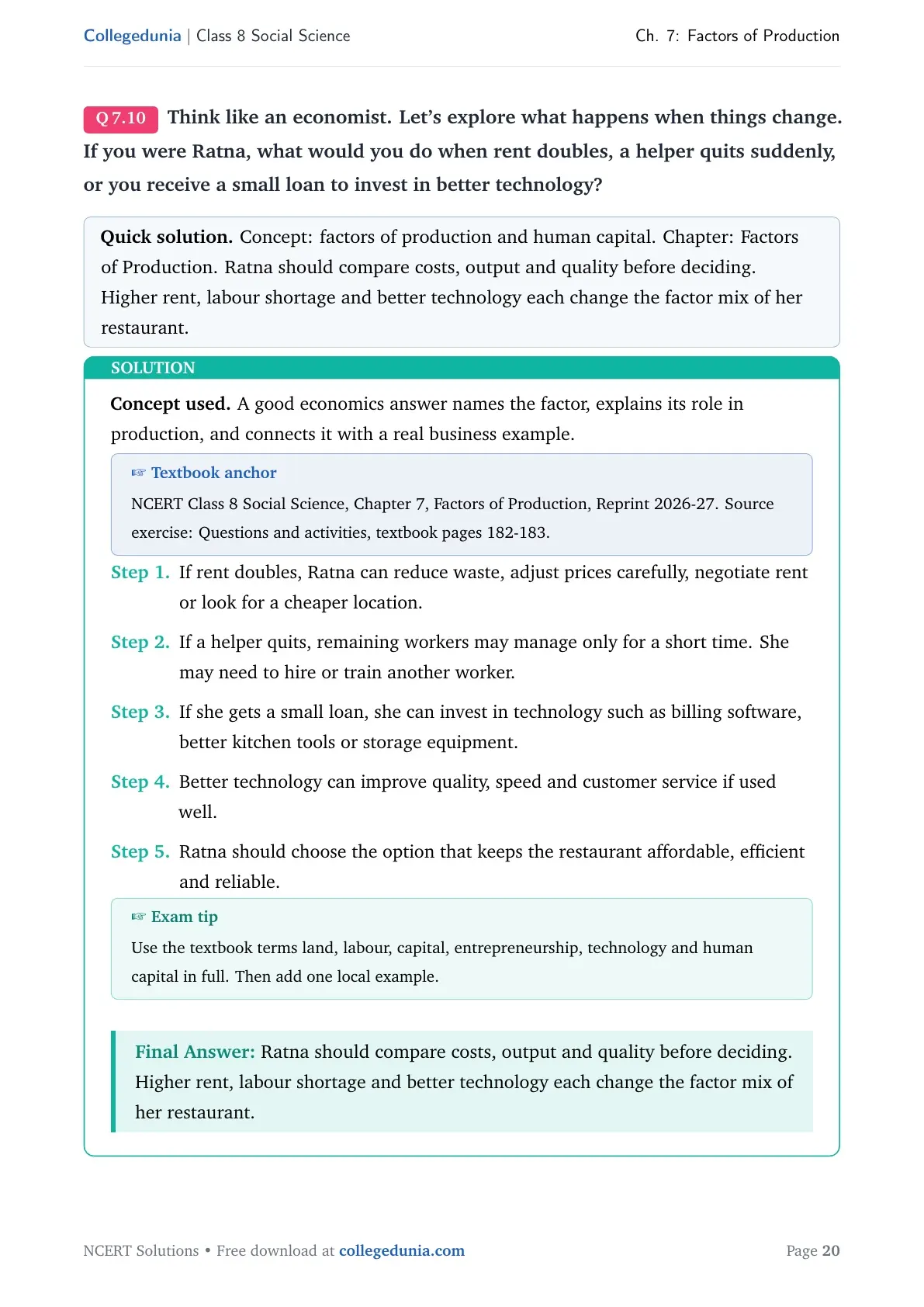
Q7.10 Think like an economist. Let's explore what happens when things change. If you were Ratna, what would you do when rent doubles, a helper quits suddenly, or you receive a small loan to invest in better technology?
Quick answer: Ratna should compare costs, output and quality before deciding. Higher rent, labour shortage and better technology each change the factor mix of her restaurant.
- If rent doubles, Ratna can reduce waste, adjust prices carefully, negotiate rent or look for a cheaper location.
- If a helper quits, remaining workers may manage only for a short time. She may need to hire or train another worker.
- If she gets a small loan, she can invest in technology such as billing software, better kitchen tools or storage equipment.
- Better technology can improve quality, speed and customer service if used well.
- Ratna should choose the option that keeps the restaurant affordable, efficient and reliable.
Verified Expert
This question tests how factors are connected. A change in land cost, labour availability or capital affects price, output, quality and customer satisfaction.
Factors of Production Class 8 Social Science NCERT Solutions FAQs
Ques. What are the four factors of production in Class 8 Social Science?
Ans. The four main factors are land, labour, capital and entrepreneurship. Technology helps these factors work more efficiently.
Ques. How is human capital different from physical capital?
Ans. Human capital means people's skills, knowledge and health. Physical capital means machines, tools, buildings, money and other human-made assets.
Ques. Why is entrepreneurship important in production?
Ans. Entrepreneurship is important because it combines land, labour and capital, takes risk and makes key decisions for the enterprise.
Ques. Can technology replace labour completely?
Ans. Technology can replace some tasks, but it also creates new work that needs trained people to operate, repair and manage technology.



Comments