




NCERT Solutions for Class 8 Social Science Chapter 6 The Parliamentary System: Legislature and Executive cover all 10 textbook questions from the 2026-27 NCERT chapter. The PDF helps students write answers on Parliament, Legislature, Executive accountability, bicameral lawmaking and the Judiciary.
- Question count: 10 activity and short-answer questions from the chapter exercise.
- Core idea: Parliament represents people, makes laws and keeps the Executive answerable.
- Best use: revise the PDF after reading the textbook examples once.
Each Class 8 Social Science Chapter 6 solution follows the 2026-27 NCERT text and uses simple civics language for school answers.
Student Feedback: In a Collegedunia study check with 12,300 Class 8 students, 76% said this chapter became easier after separating Parliament, Legislature, Executive and Judiciary roles.
Parliamentary System Study Map for Class 8 Social Science
Class 8 Social Science Chapter 6 explains how India's democracy works through elected institutions. Parliament is the supreme legislative body, and it represents the voice of the people through elected and nominated members.
| Institution | Main role | Class 8 answer cue |
|---|---|---|
| Lok Sabha | Directly elected House | People choose MPs through universal adult franchise |
| Rajya Sabha | Council of States | Represents the federal structure |
| Executive | Runs the government | Answerable to the Legislature |
| Judiciary | Protects the Constitution | Checks misuse of power |
Parliament, Legislature and Executive Explained
Source: Magnet Brains on YouTube
How a Bill Becomes a Law in Parliament
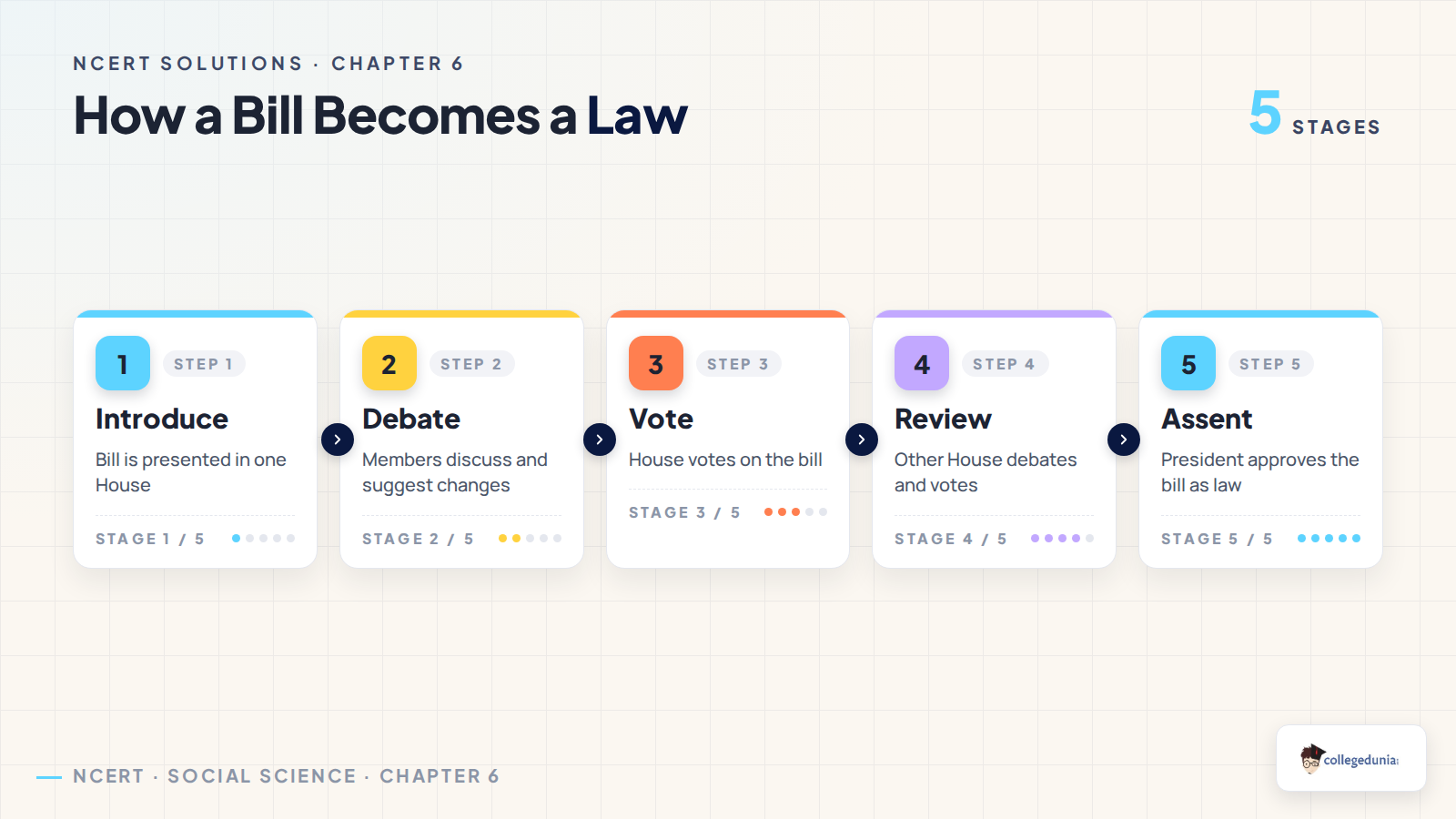
A bill usually moves through introduction, debate, voting in both Houses and Presidential assent. This process matters because law must be discussed before it becomes binding on citizens. Students should use this order for model Parliament activities.
- Introduction: a minister or member presents the bill.
- Debate: MPs discuss reasons, concerns and possible changes.
- Voting: both Houses must pass the bill.
- Assent: the President approves the bill as law.
Legislature, Executive and Judiciary Roles in Indian Democracy
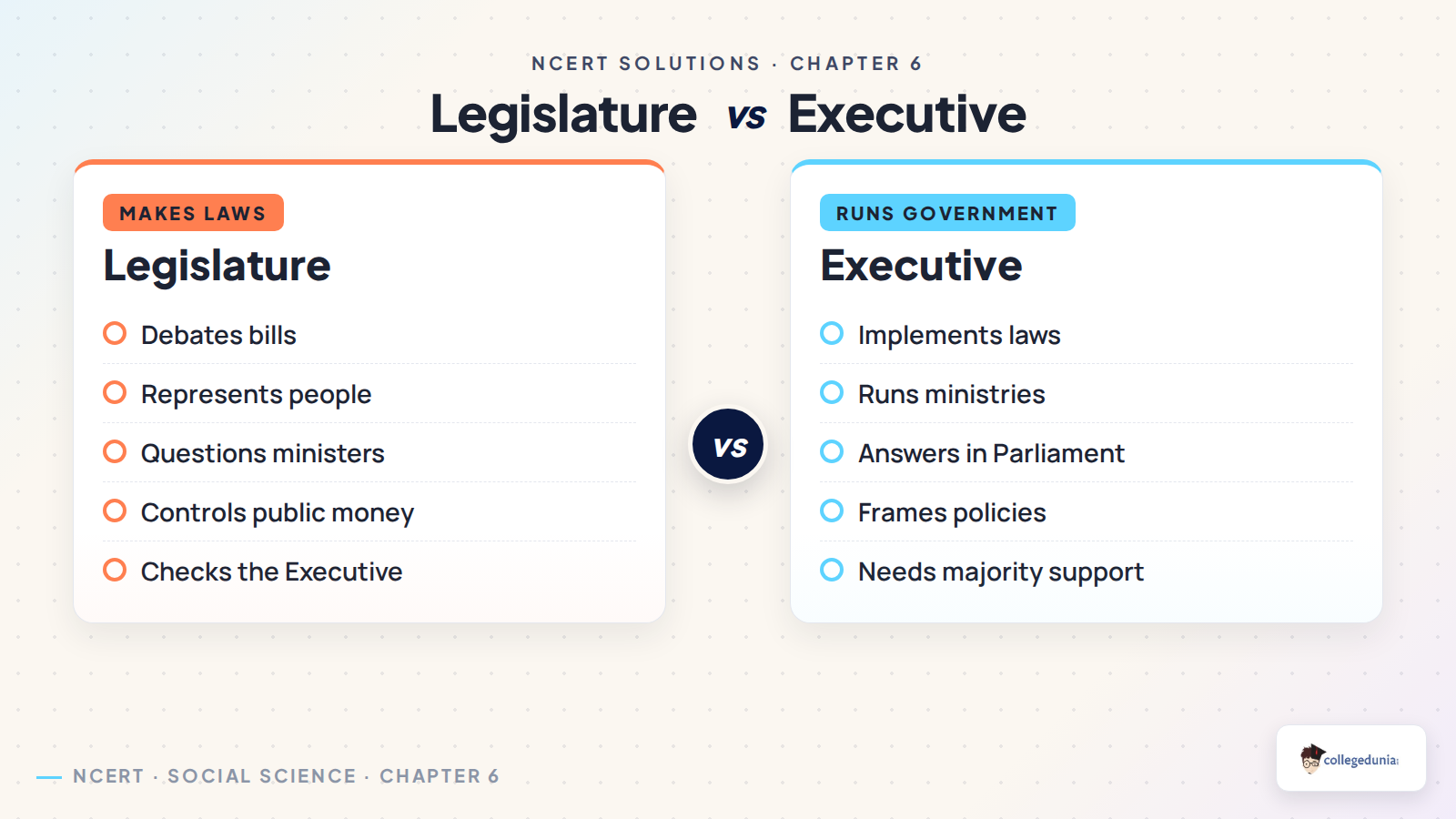
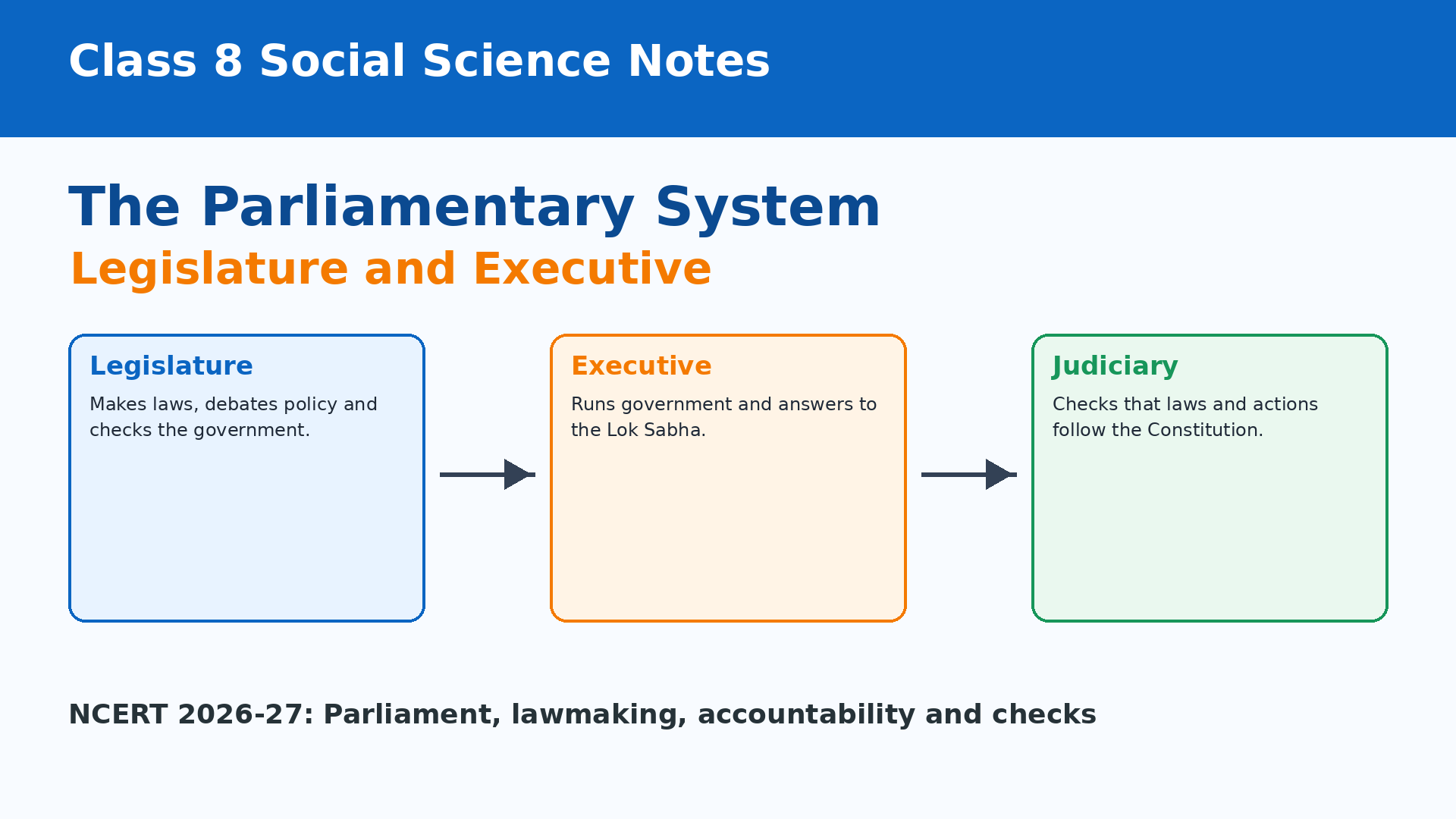
The Legislature makes laws and questions the government. The Executive implements laws and runs day-to-day administration. The Judiciary protects rights and checks whether laws and actions follow the Constitution. This balance is called checks and balances.
| Body | What it does | Why it matters |
|---|---|---|
| Legislature | Makes laws and debates public issues | Gives people a voice through representatives |
| Executive | Implements laws and runs ministries | Turns decisions into action |
| Judiciary | Interprets the Constitution | Protects rights and limits misuse of power |
Related NCERT Resources for Social Science Chapter 6
| Resource | Link |
|---|---|
| Chapter 6 Notes | NCERT Notes Class 8 Social Science Chapter 6 |
| Chapter 6 Book PDF | NCERT Book PDF Class 8 Social Science Chapter 6 |
| Chapter 6 Handwritten Notes | Handwritten Notes Class 8 Social Science Chapter 6 |
Class 8 Social Science Solutions for All Chapters
| Chapter | Solutions |
|---|---|
| Chapter 1 Natural Resources and Their Use | Open solutions |
| Chapter 2 Reshaping India's Political Map | Open solutions |
| Chapter 3 The Rise of the Marathas | Open solutions |
| Chapter 4 The Colonial Era in India | Open solutions |
| Chapter 5 Universal Franchise and India's Electoral System | Open solutions |
All NCERT Solutions for Class 8 Social Science Chapter 6 The Parliamentary System with Step-by-Step Solutions
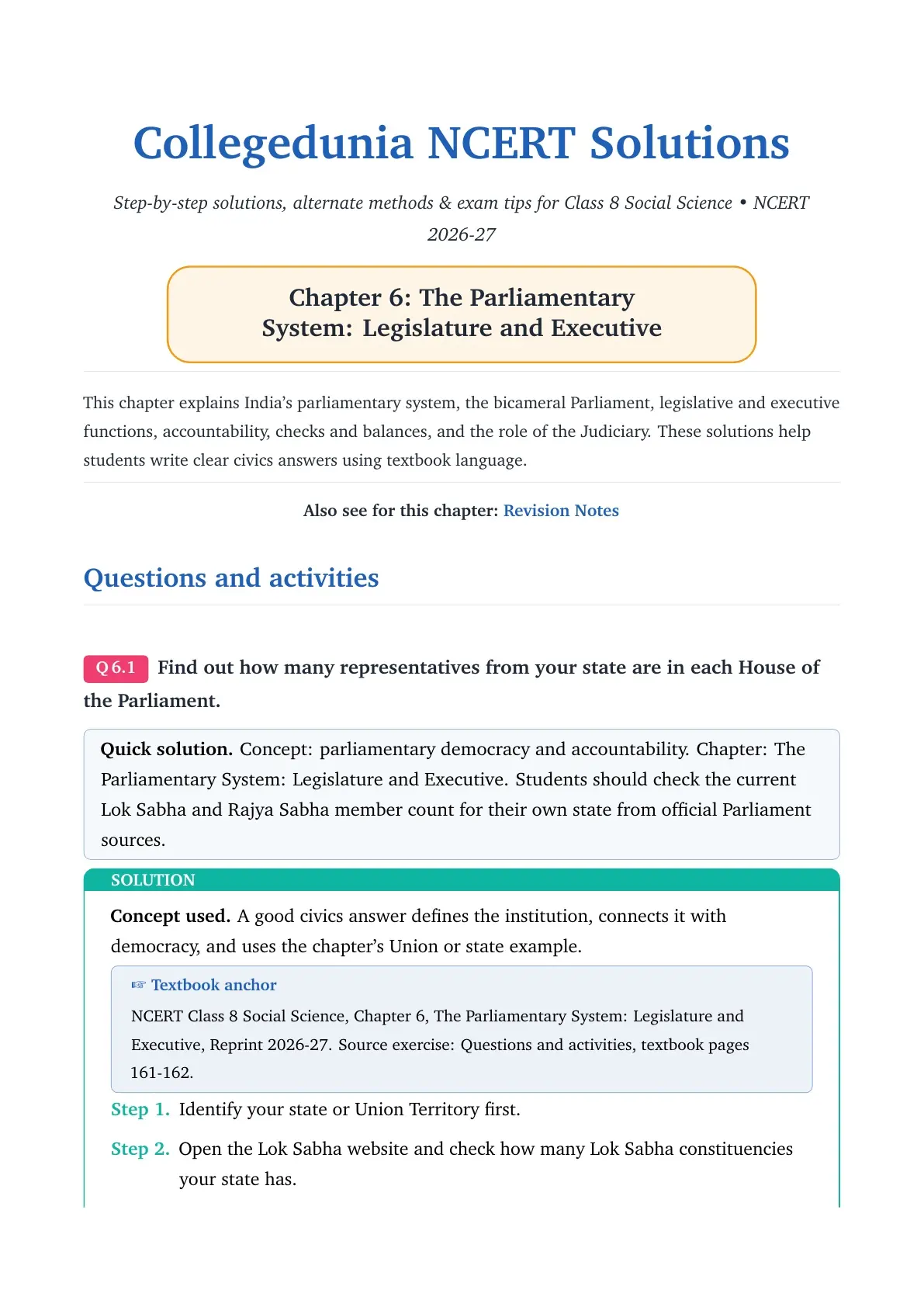
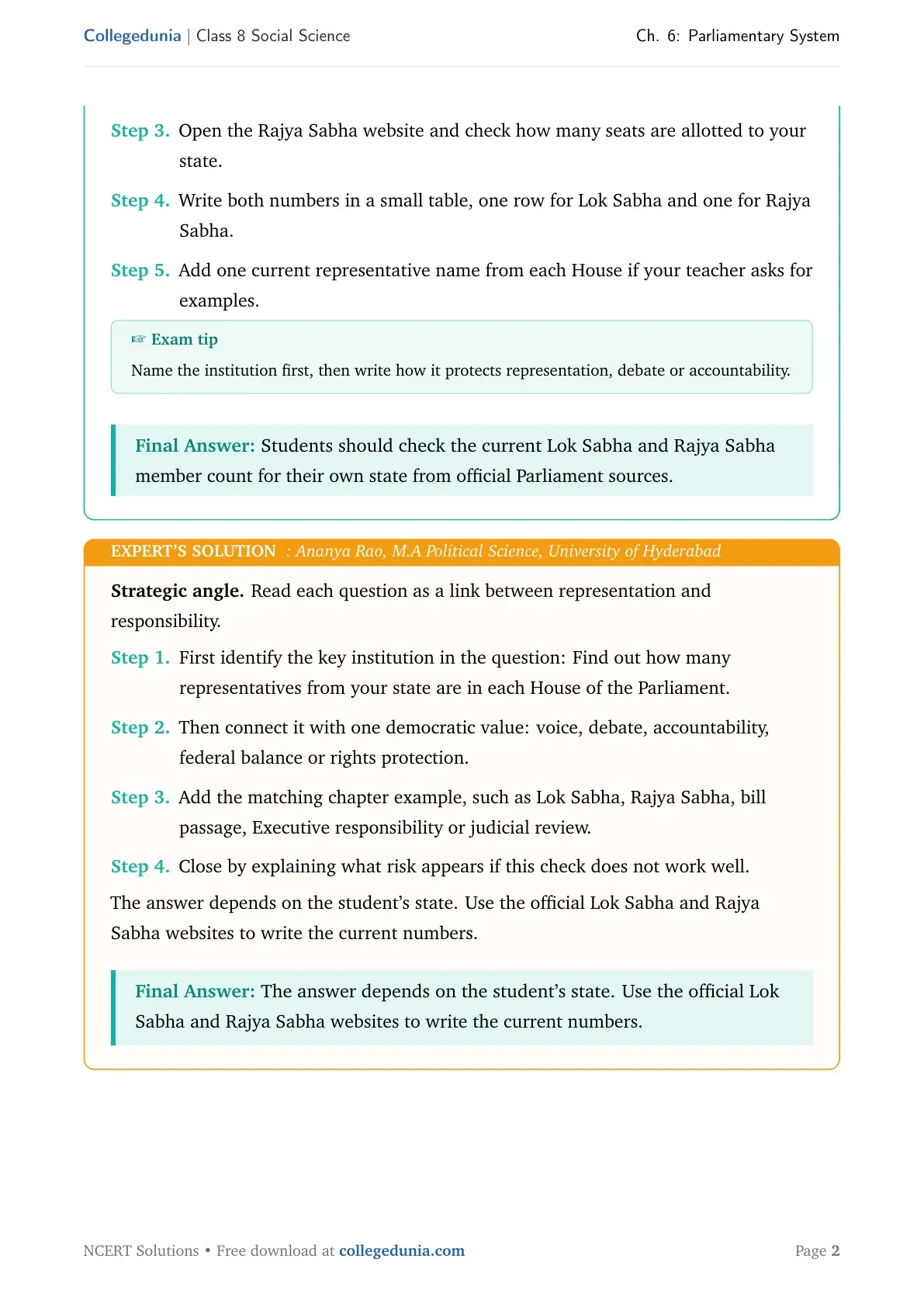
Q6.1 Find out how many representatives from your state are in each House of the Parliament.
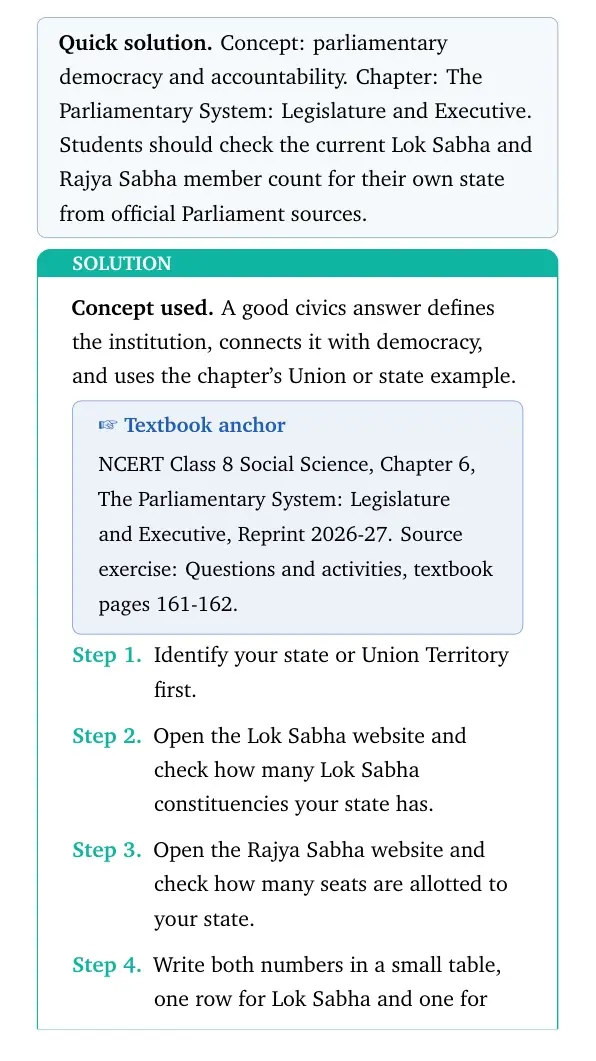
Quick answer: Students should check the current Lok Sabha and Rajya Sabha member count for their own state from official Parliament sources.
- Identify your state or Union Territory first.
- Open the Lok Sabha website and check how many Lok Sabha constituencies your state has.
- Open the Rajya Sabha website and check how many seats are allotted to your state.
- Write both numbers in a small table, one row for Lok Sabha and one for Rajya Sabha.
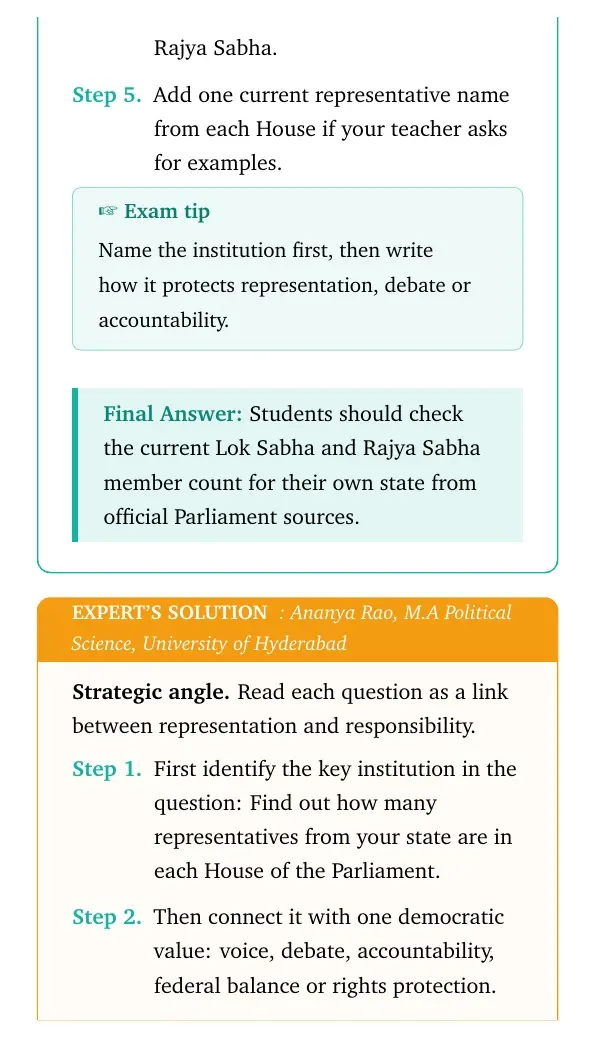
- Add one current representative name from each House if your teacher asks for examples.
Verified Expert
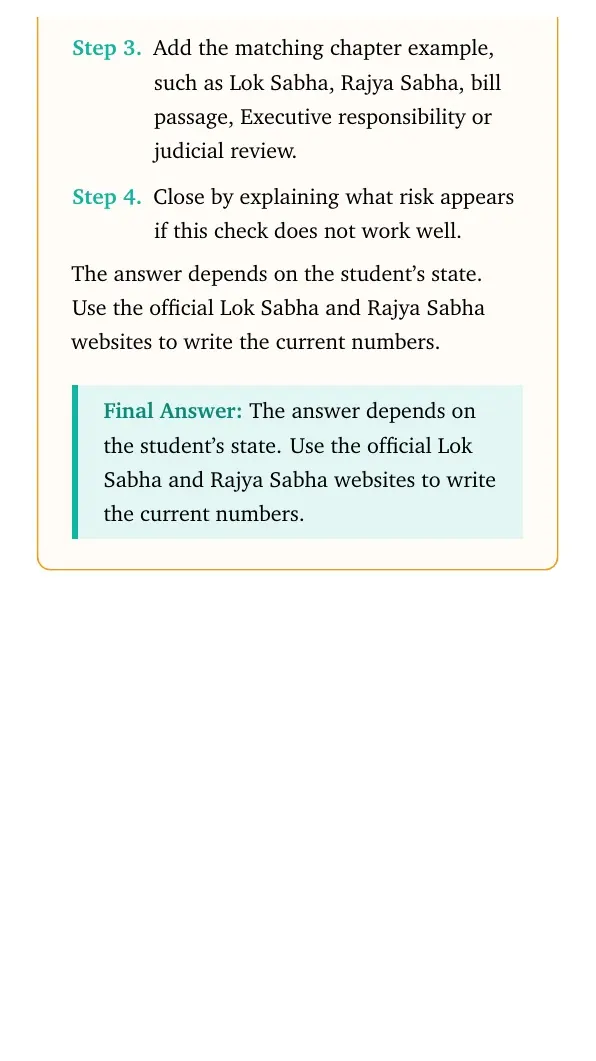
The answer depends on the student's state. Use the official Lok Sabha and Rajya Sabha websites to write the current numbers.
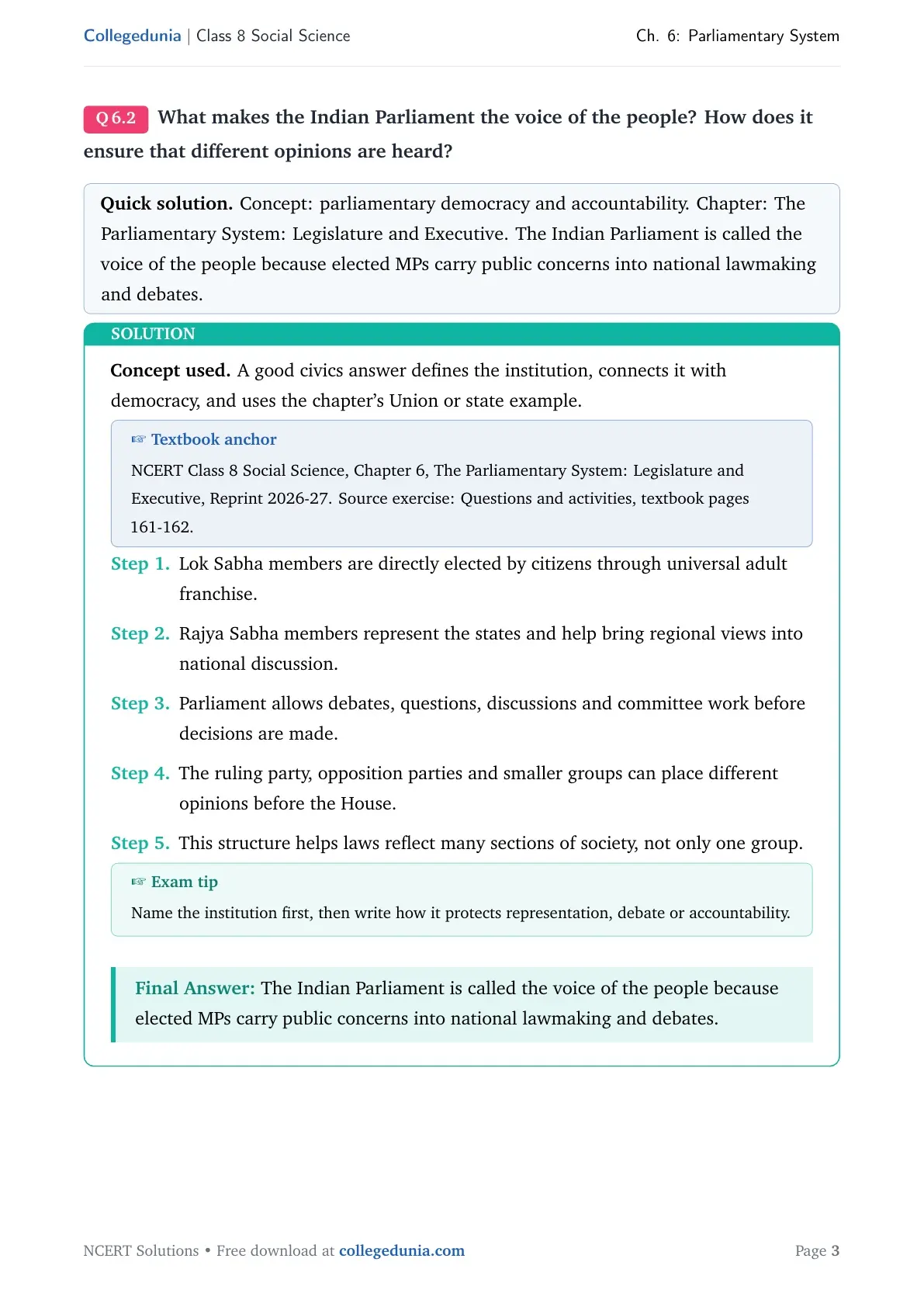
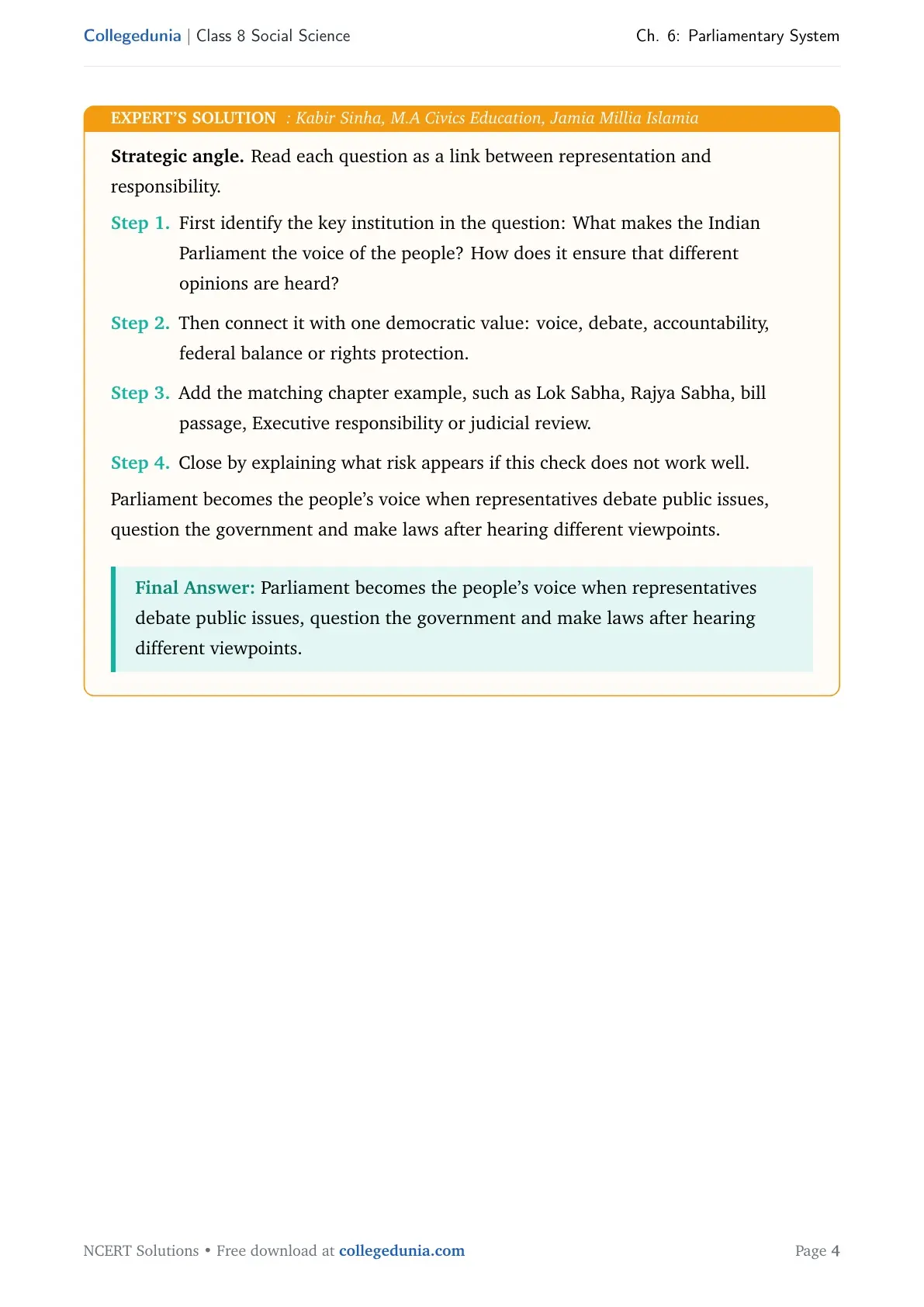
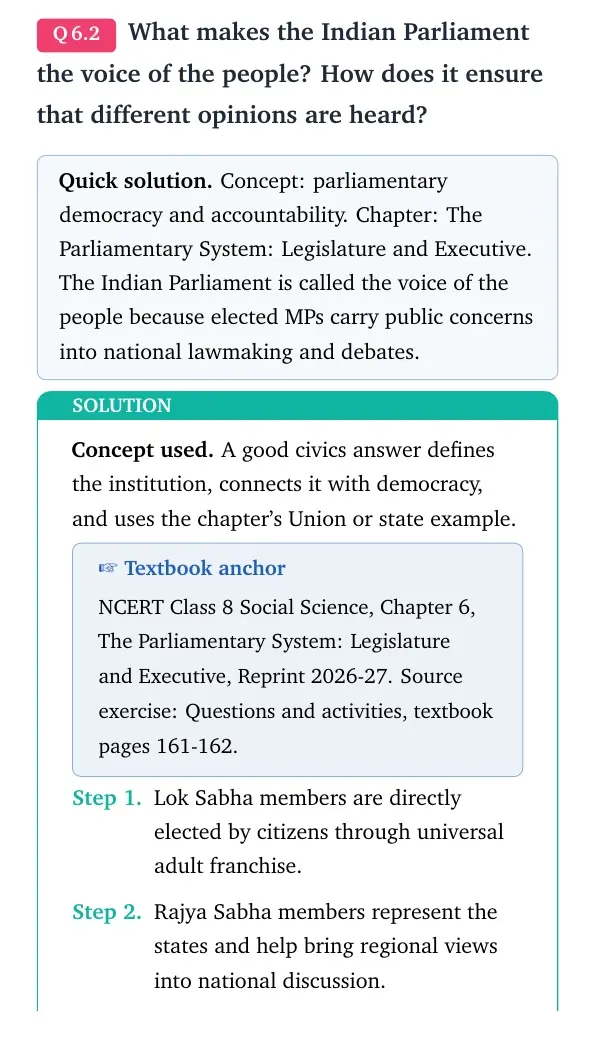
Q6.2 What makes the Indian Parliament the voice of the people? How does it ensure that different opinions are heard?
Quick answer: The Indian Parliament is called the voice of the people because elected MPs carry public concerns into national lawmaking and debates.
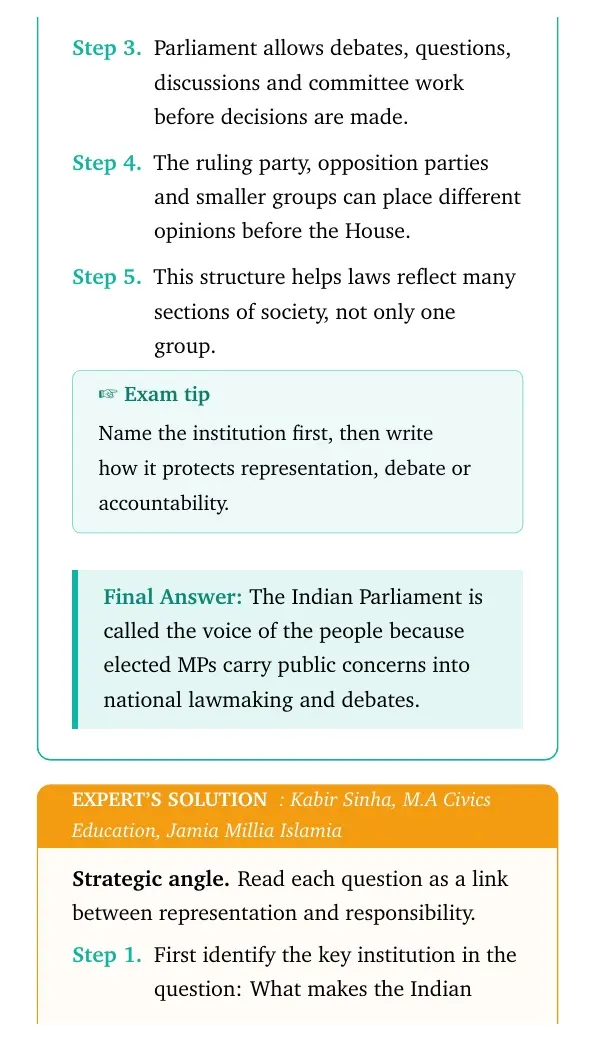
- Lok Sabha members are directly elected by citizens through universal adult franchise.
- Rajya Sabha members represent the states and help bring regional views into national discussion.
- Parliament allows debates, questions, discussions and committee work before decisions are made.
- The ruling party, opposition parties and smaller groups can place different opinions before the House.
- This structure helps laws reflect many sections of society, not only one group.
Verified Expert
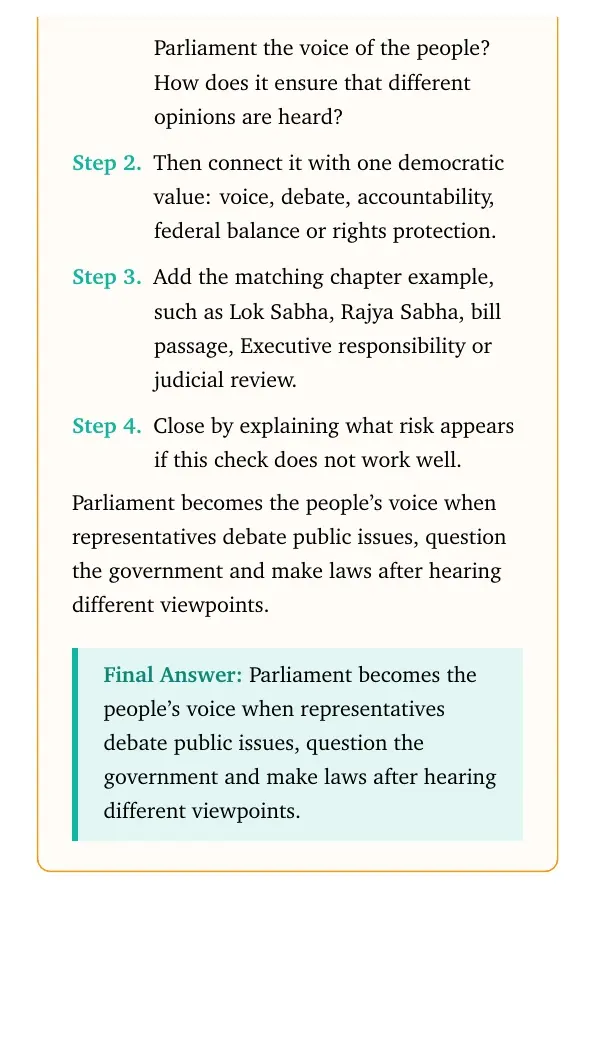
Parliament becomes the people's voice when representatives debate public issues, question the government and make laws after hearing different viewpoints.
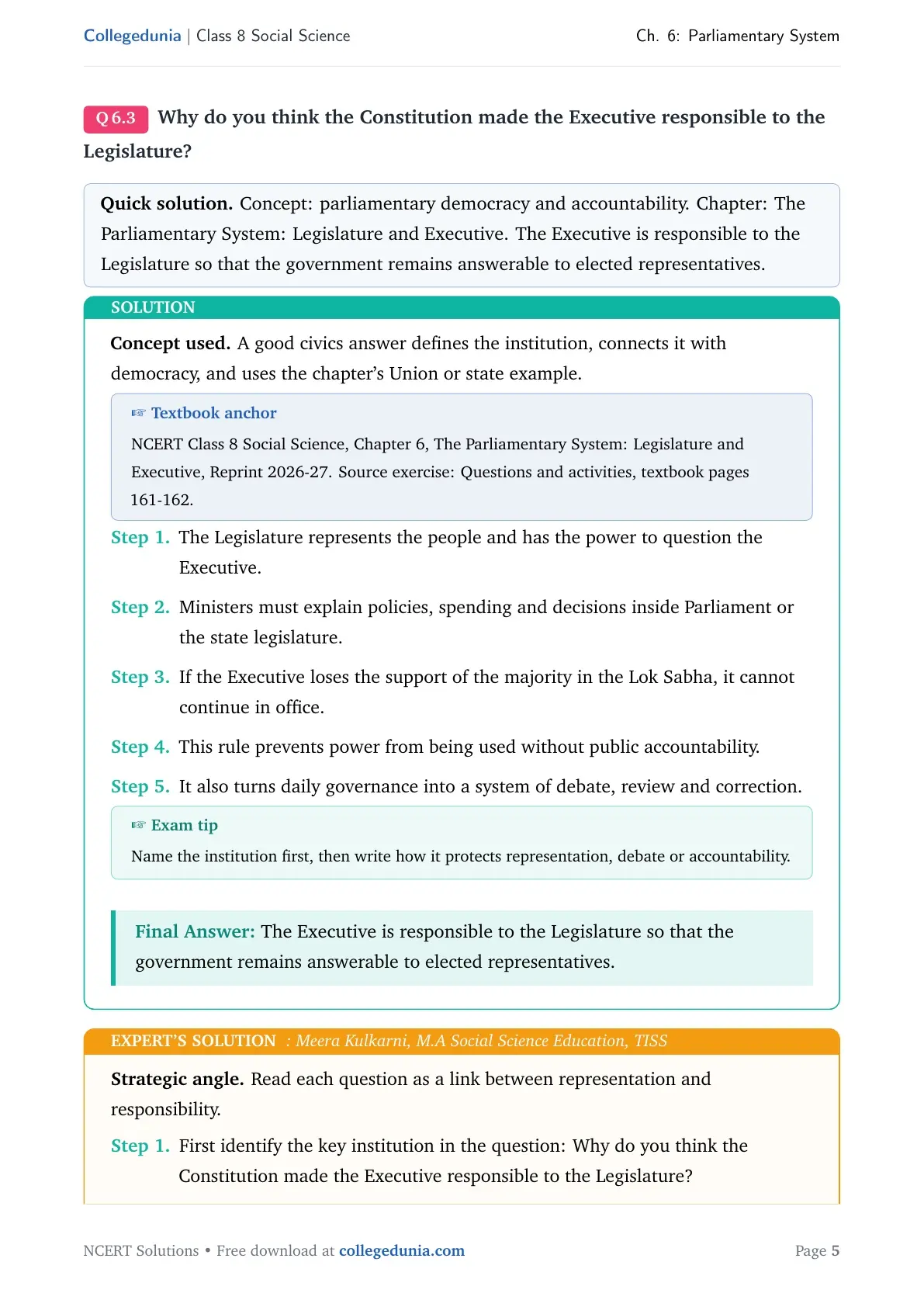
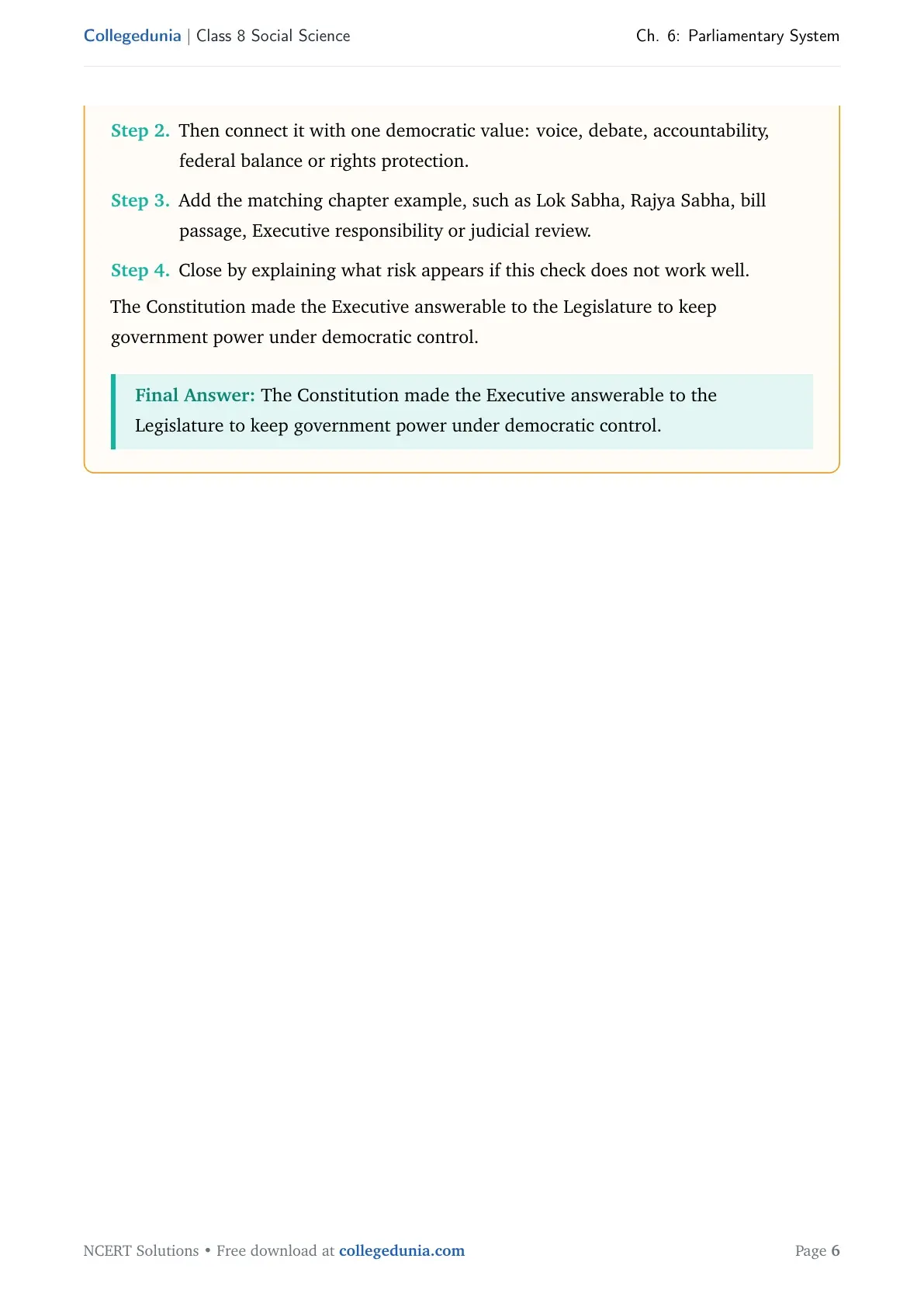
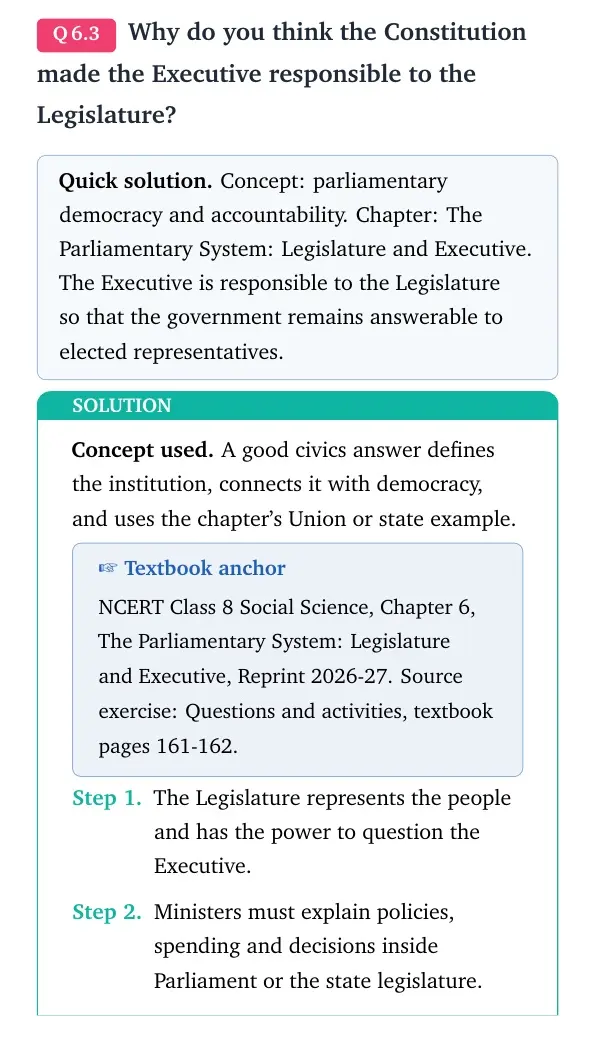
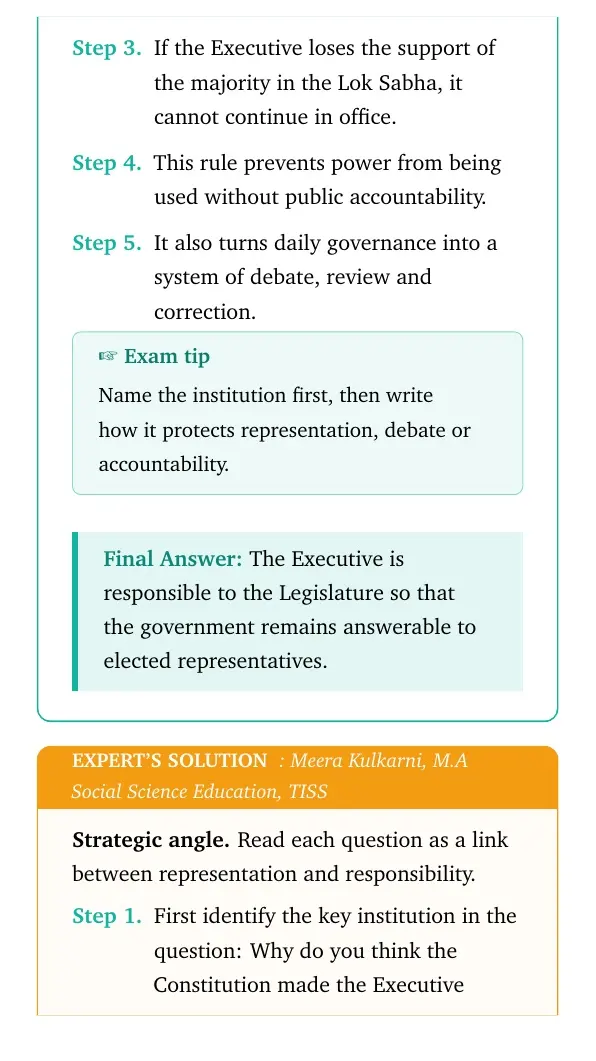
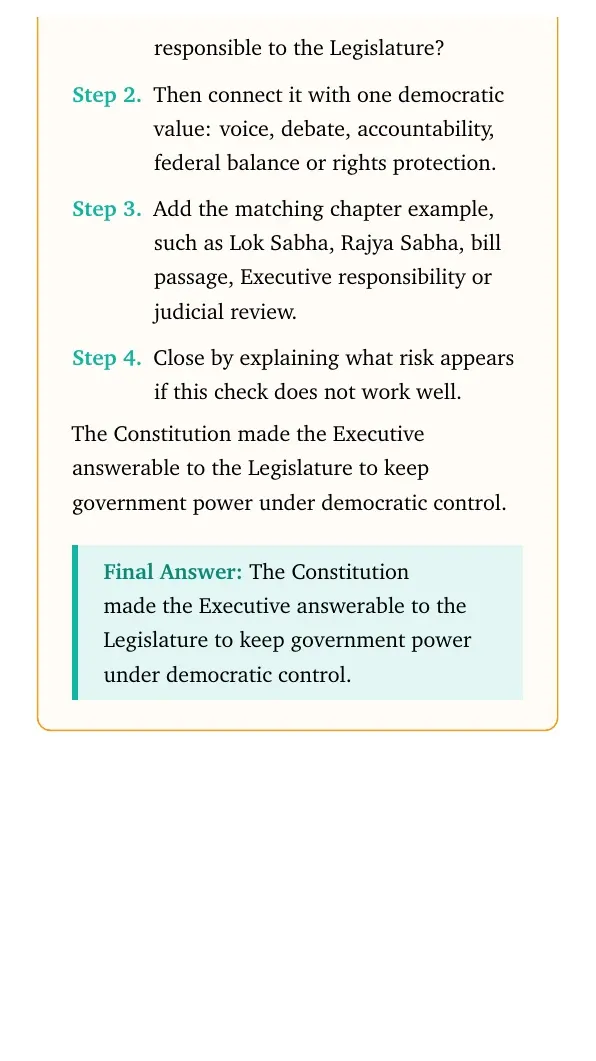
Q6.3 Why do you think the Constitution made the Executive responsible to the Legislature?
Quick answer: The Executive is responsible to the Legislature so that the government remains answerable to elected representatives.
- The Legislature represents the people and has the power to question the Executive.
- Ministers must explain policies, spending and decisions inside Parliament or the state legislature.
- If the Executive loses the support of the majority in the Lok Sabha, it cannot continue in office.
- This rule prevents power from being used without public accountability.
- It also turns daily governance into a system of debate, review and correction.
Verified Expert
The Constitution made the Executive answerable to the Legislature to keep government power under democratic control.
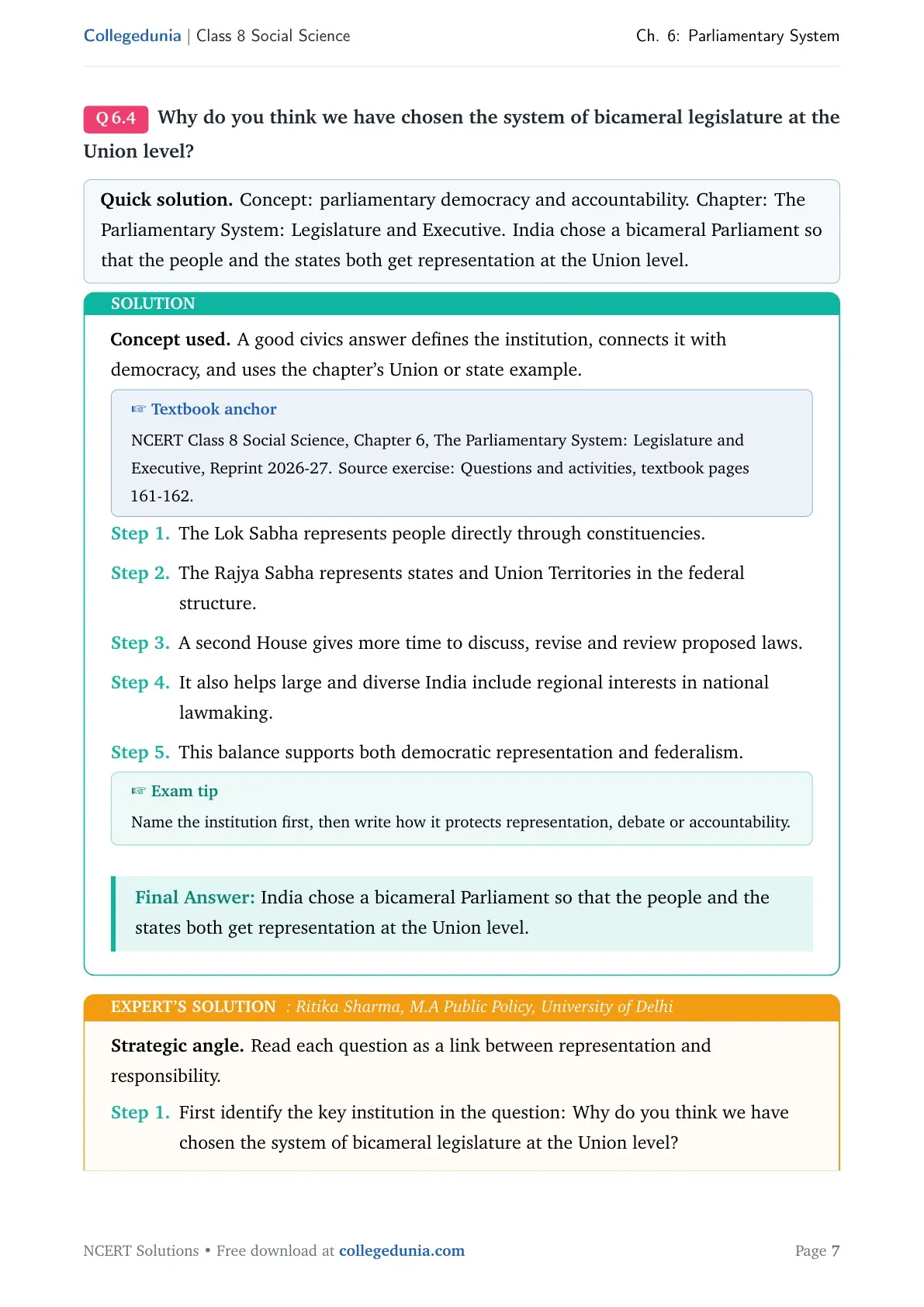
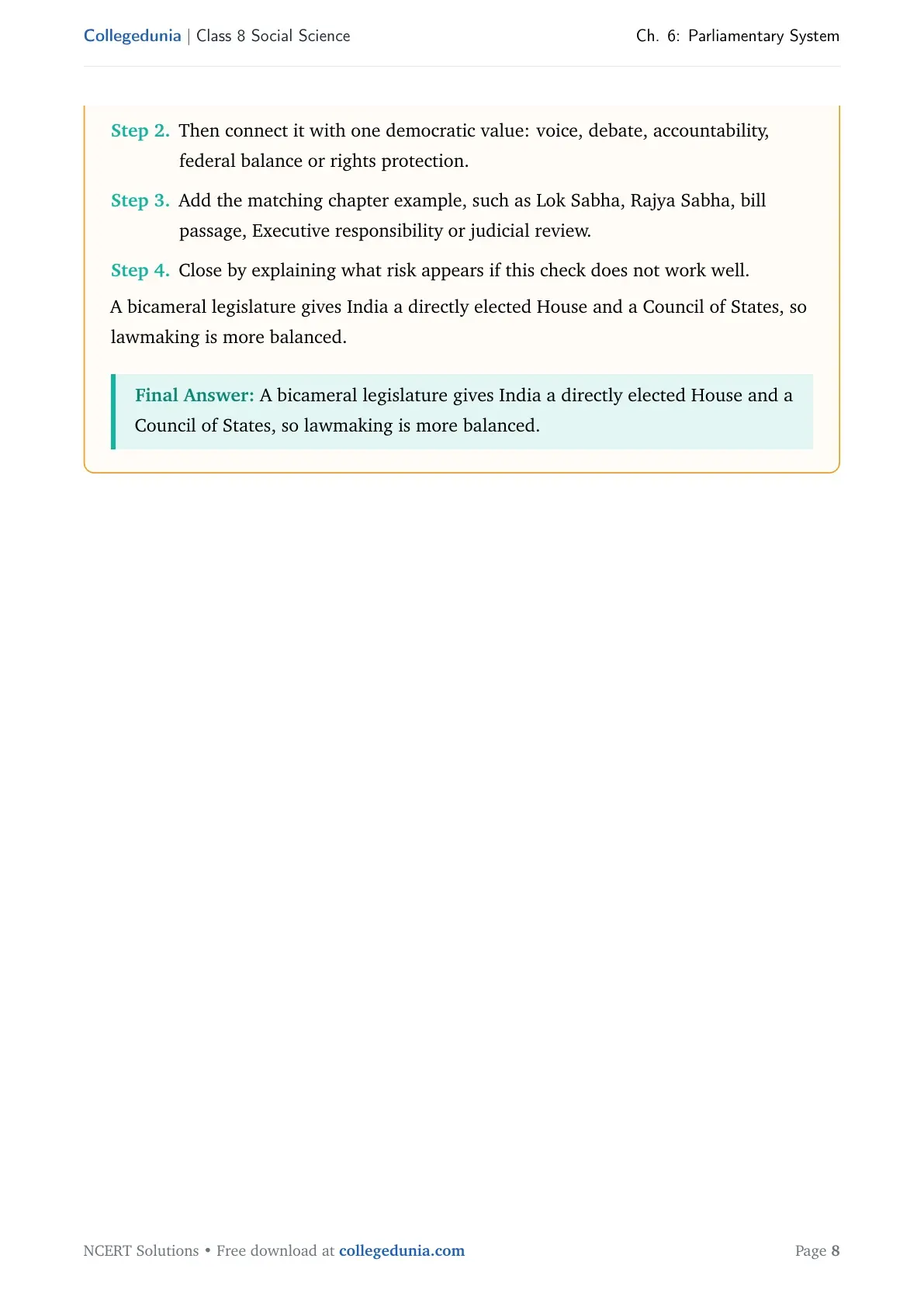
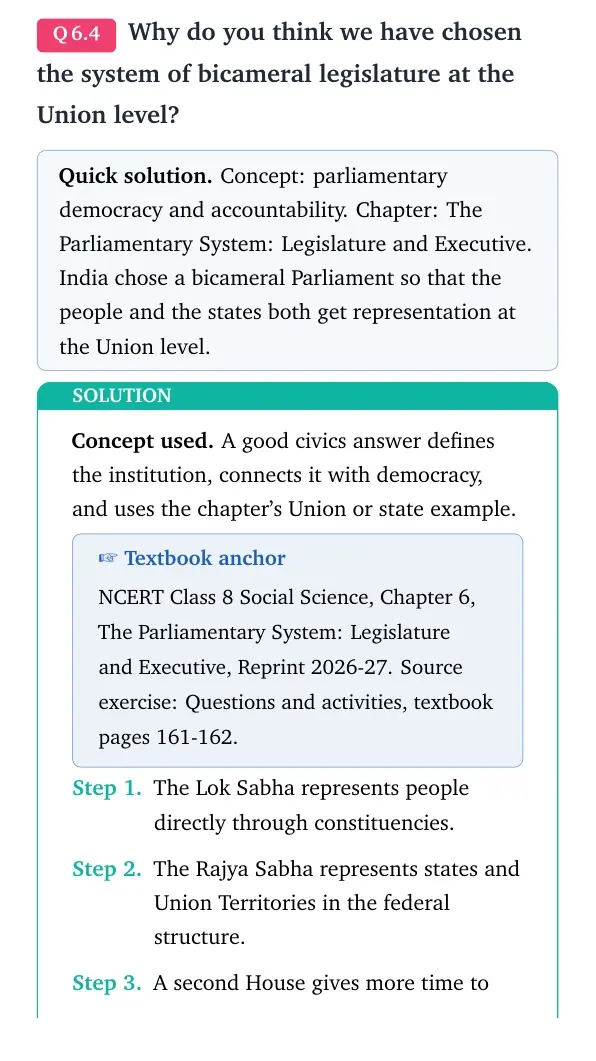
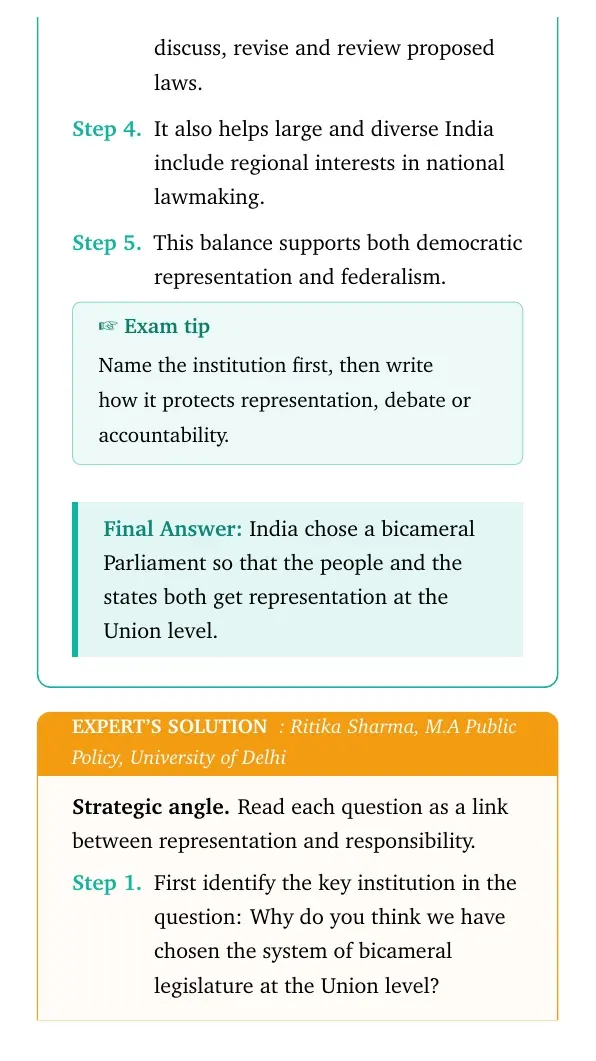
Q6.4 Why do you think we have chosen the system of bicameral legislature at the Union level?
Quick answer: India chose a bicameral Parliament so that the people and the states both get representation at the Union level.
- The Lok Sabha represents people directly through constituencies.
- The Rajya Sabha represents states and Union Territories in the federal structure.
- A second House gives more time to discuss, revise and review proposed laws.
- It also helps large and diverse India include regional interests in national lawmaking.
- This balance supports both democratic representation and federalism.
Verified Expert
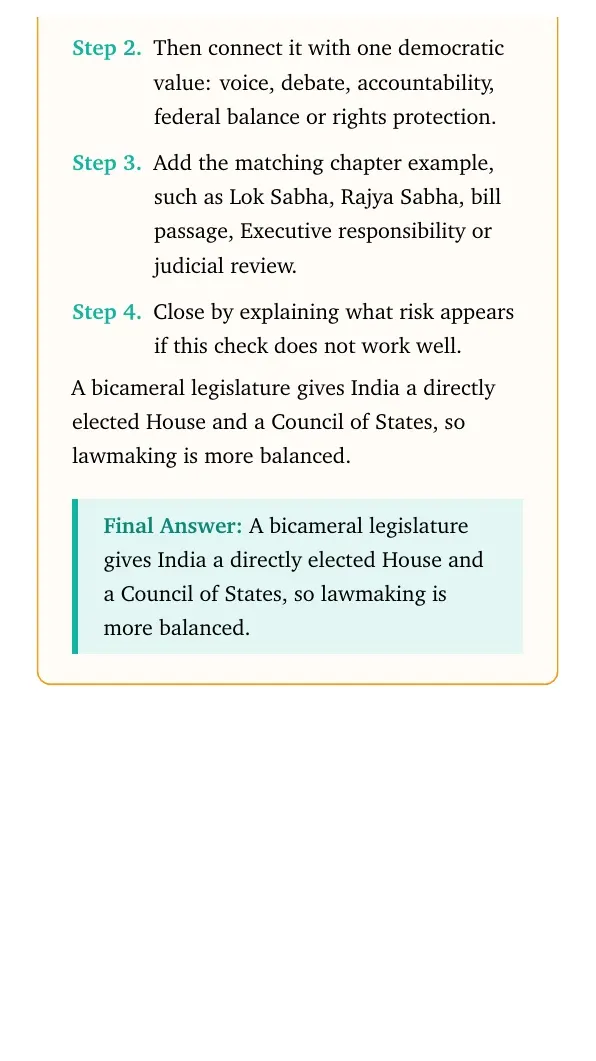
A bicameral legislature gives India a directly elected House and a Council of States, so lawmaking is more balanced.
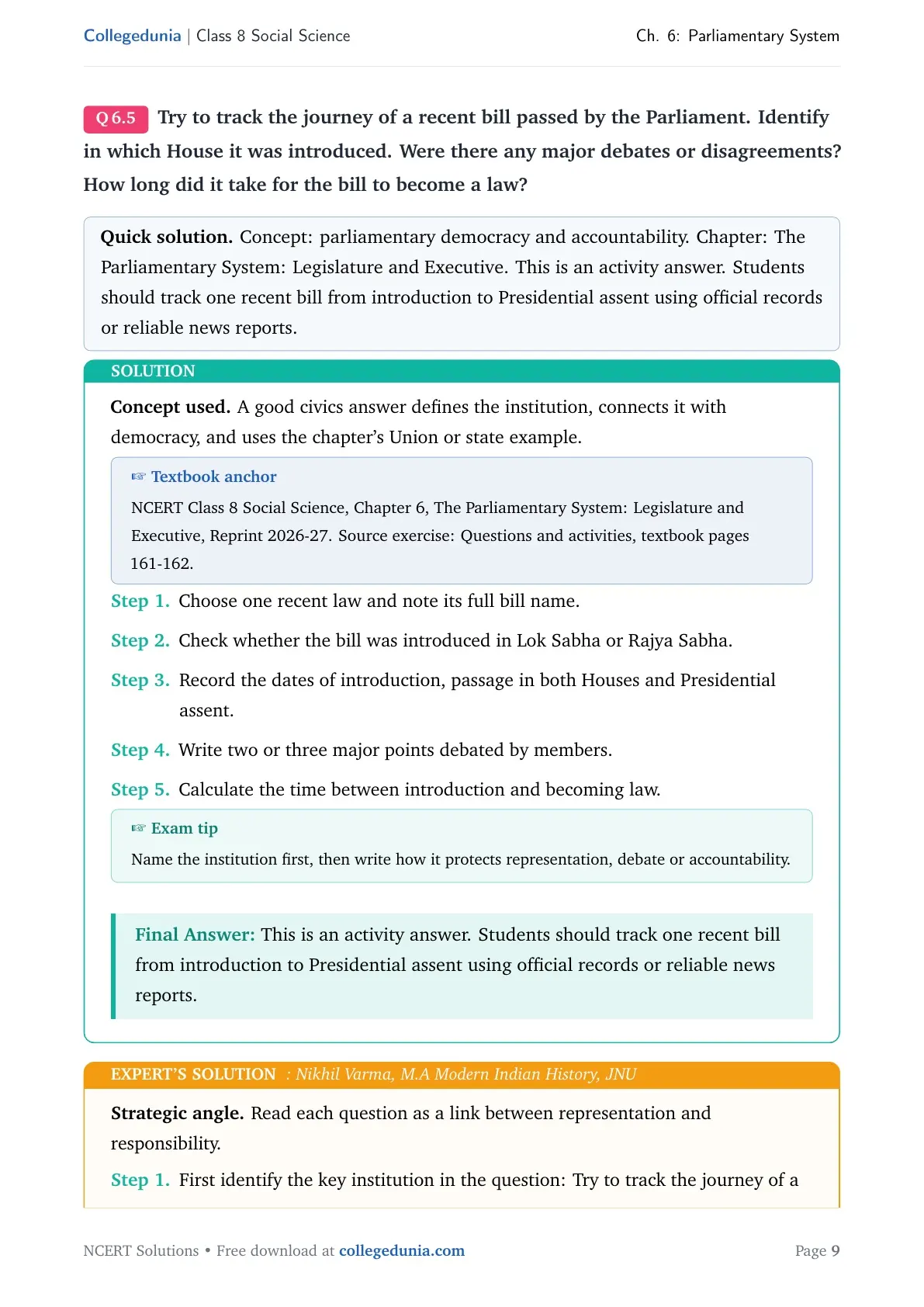
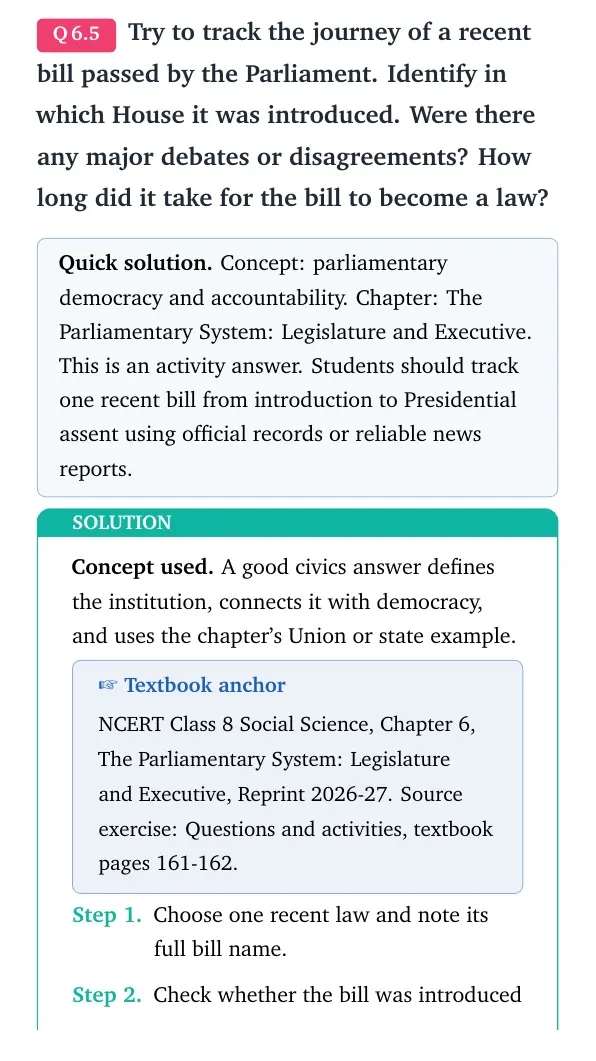
Q6.5 Try to track the journey of a recent bill passed by the Parliament. Identify in which House it was introduced. Were there any major debates or disagreements? How long did it take for the bill to become a law?
Quick answer: This is an activity answer. Students should track one recent bill from introduction to Presidential assent using official records or reliable news reports.
- Choose one recent law and note its full bill name.
- Check whether the bill was introduced in Lok Sabha or Rajya Sabha.
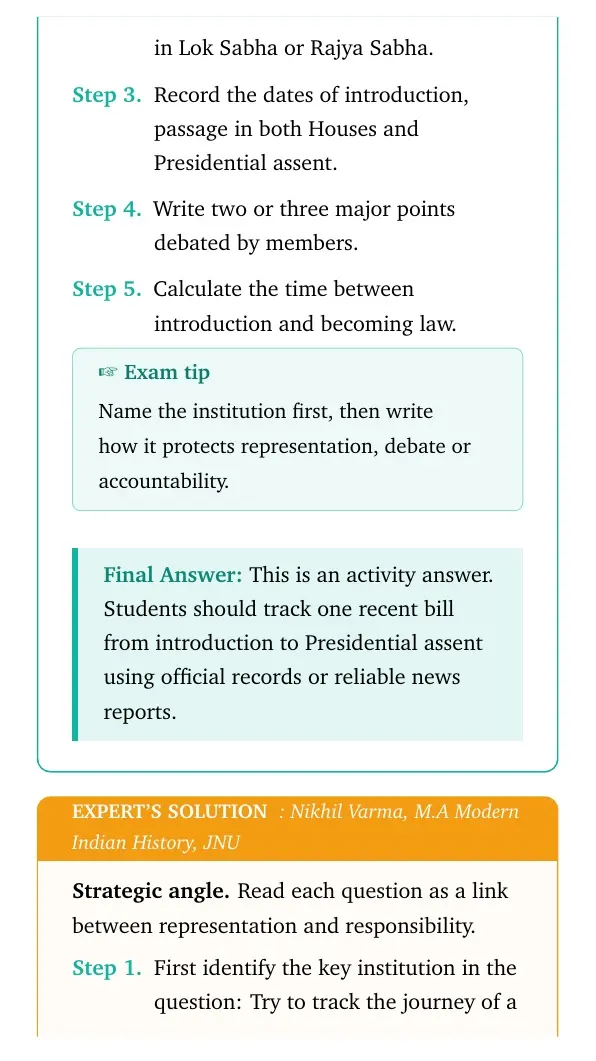
- Record the dates of introduction, passage in both Houses and Presidential assent.
- Write two or three major points debated by members.
- Calculate the time between introduction and becoming law.
Verified Expert
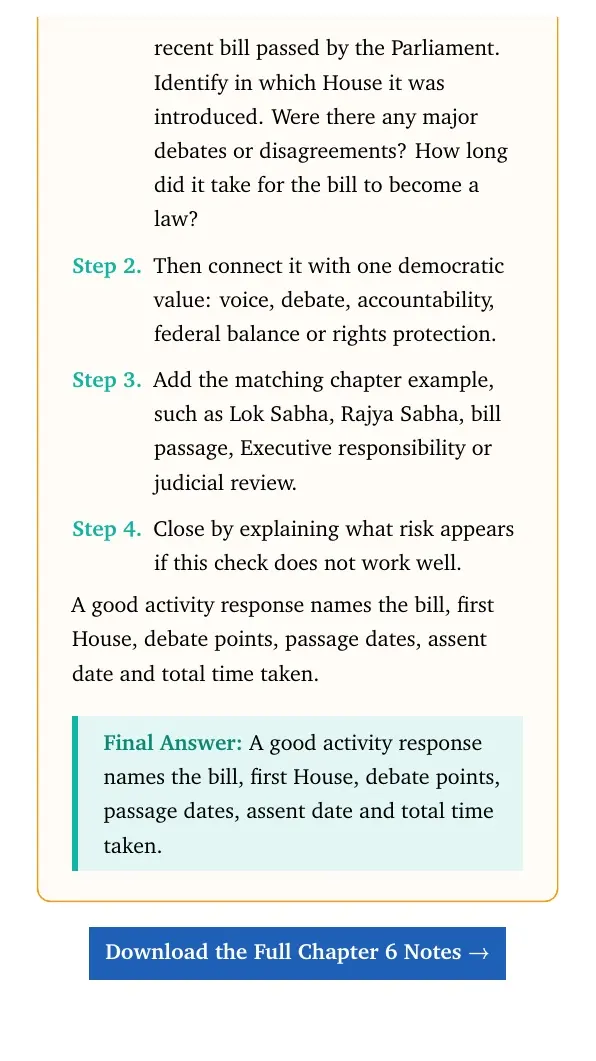
A good activity response names the bill, first House, debate points, passage dates, assent date and total time taken.
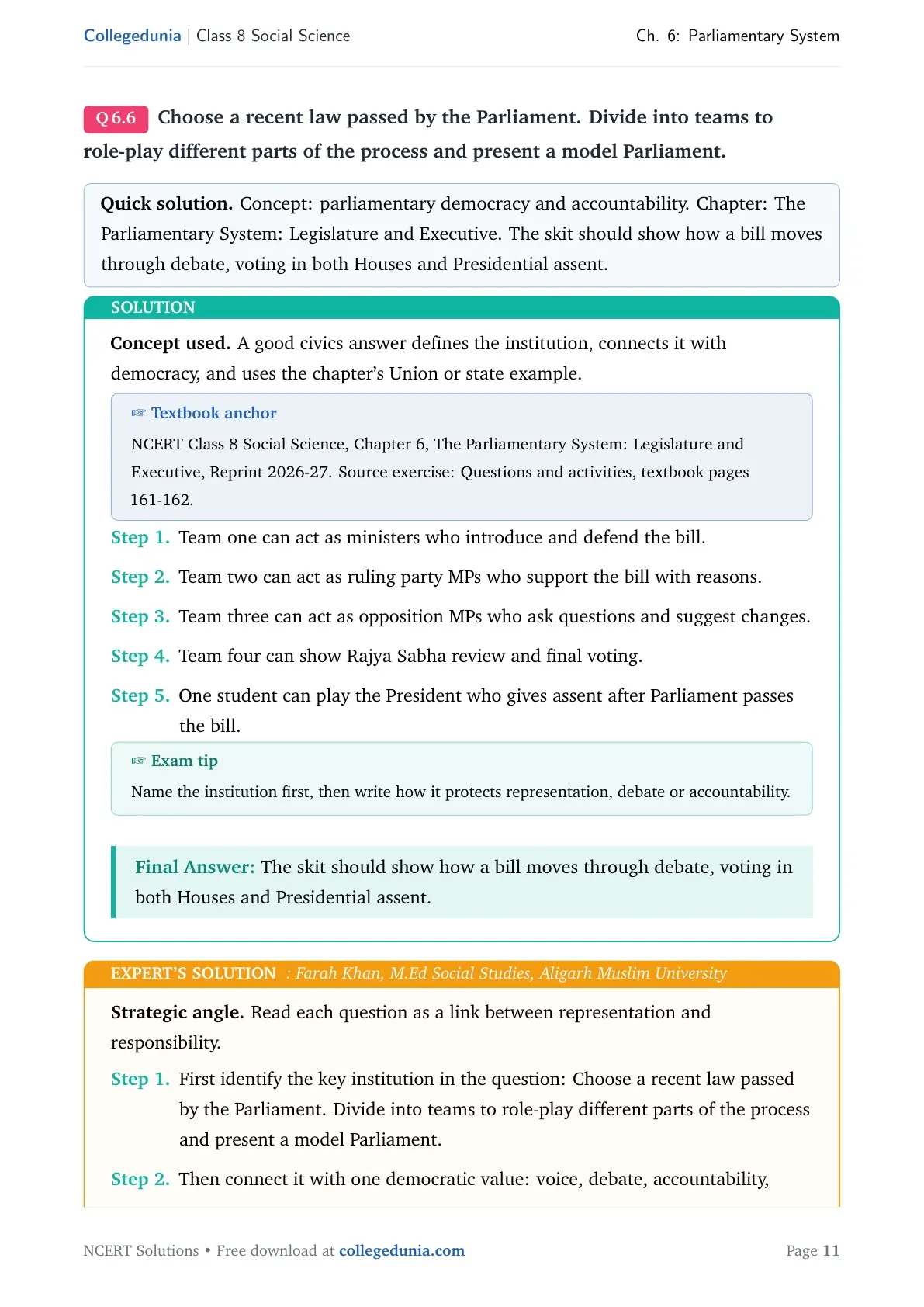
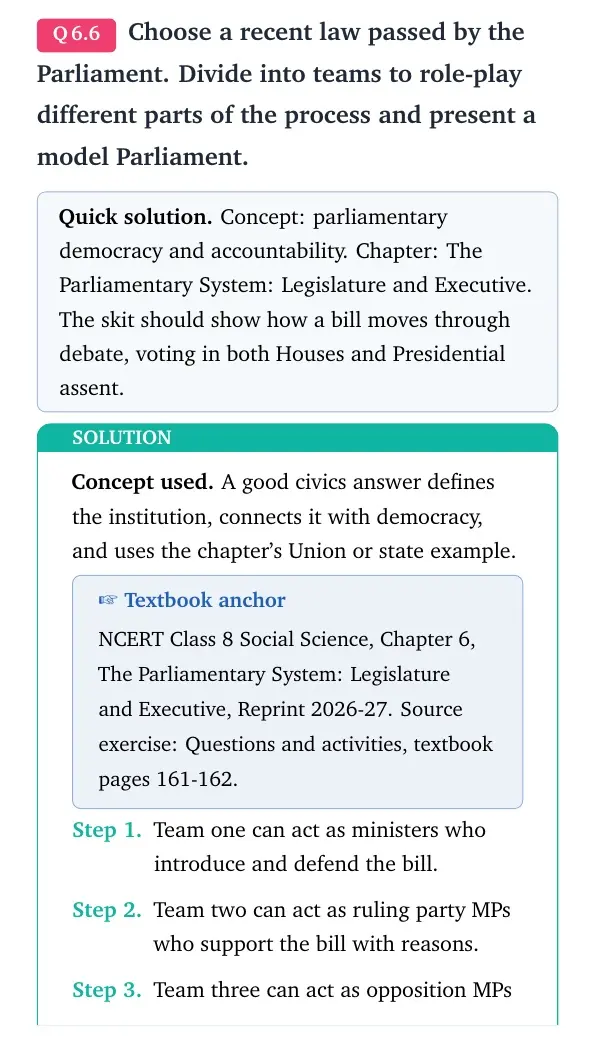
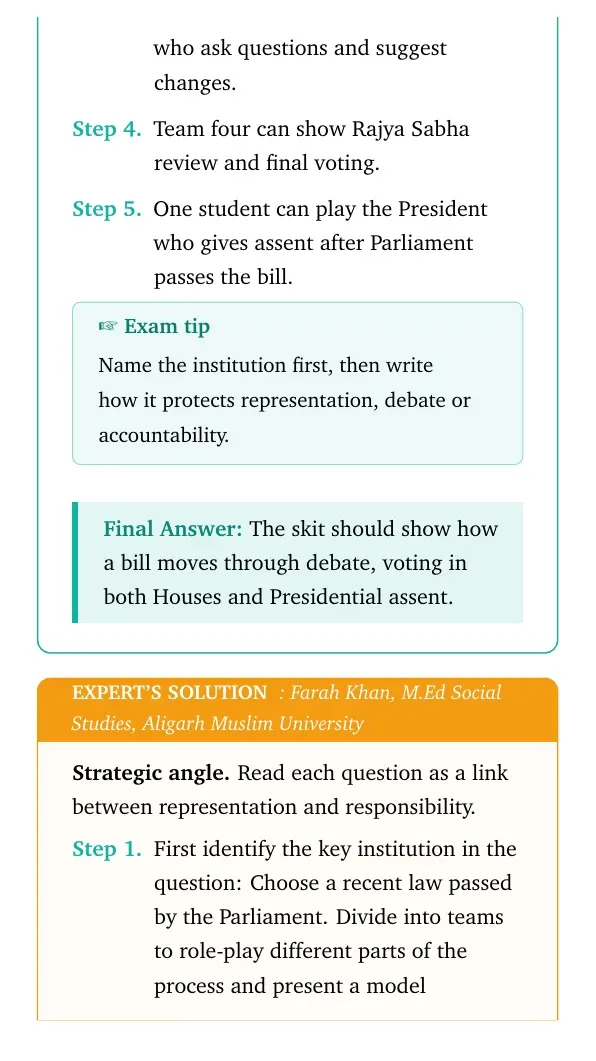
Q6.6 Choose a recent law passed by the Parliament. Divide into teams to role-play different parts of the process and present a model Parliament.
Quick answer: The skit should show how a bill moves through debate, voting in both Houses and Presidential assent.
- Team one can act as ministers who introduce and defend the bill.
- Team two can act as ruling party MPs who support the bill with reasons.
- Team three can act as opposition MPs who ask questions and suggest changes.
- Team four can show Rajya Sabha review and final voting.
- One student can play the President who gives assent after Parliament passes the bill.
Verified Expert
The model Parliament should make the lawmaking process visible: introduction, debate, amendments, voting and assent.
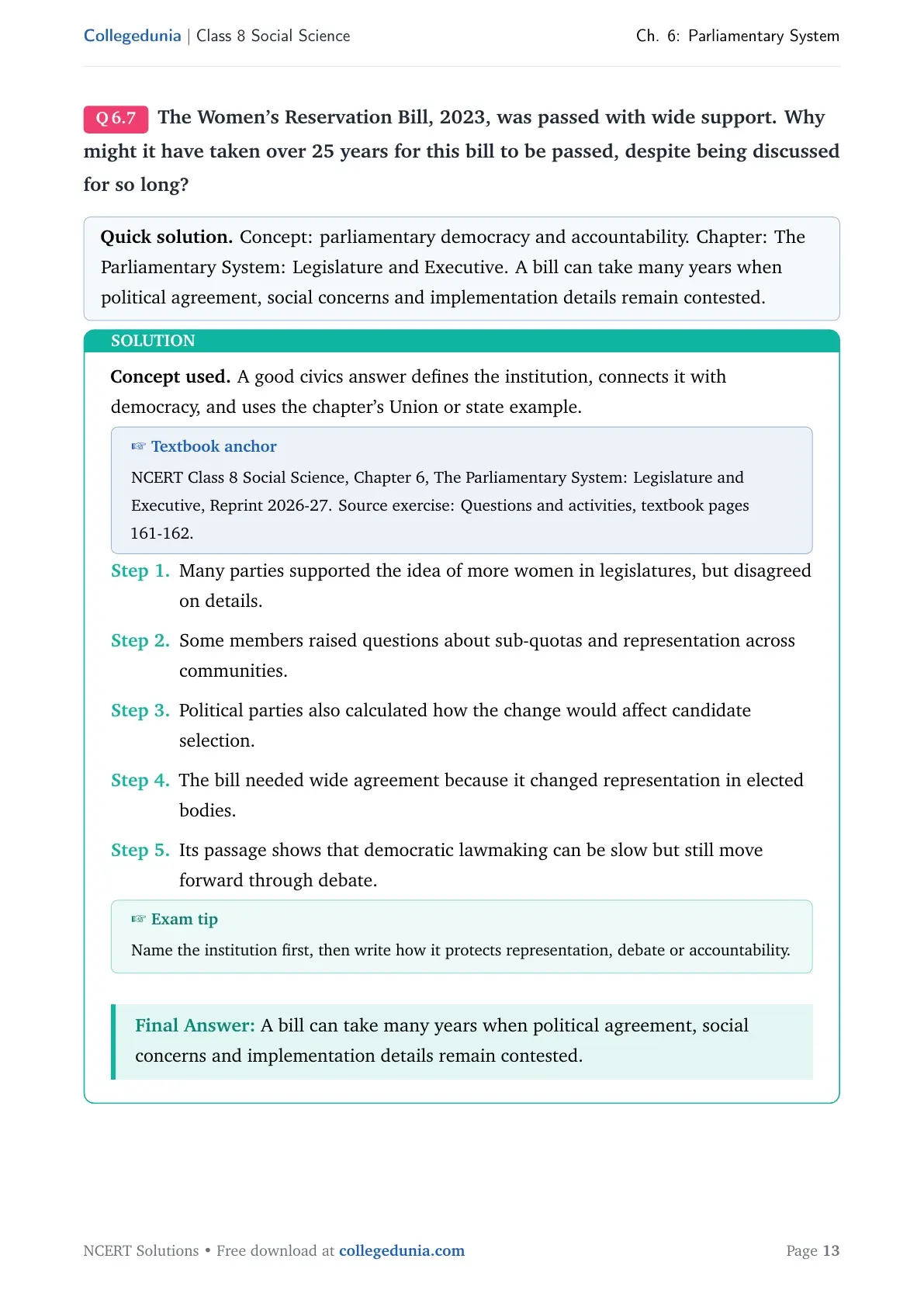
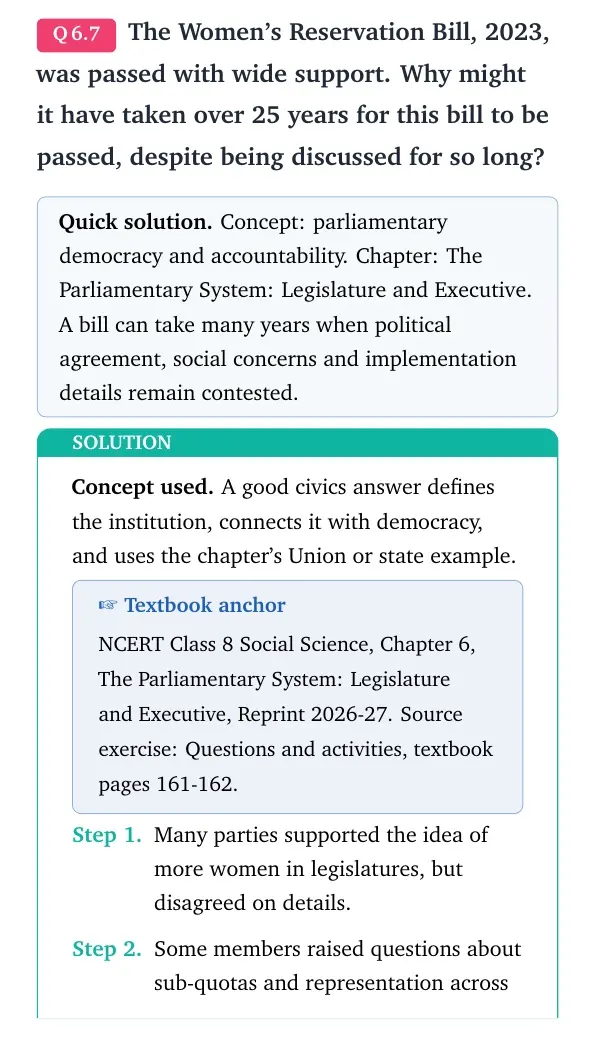
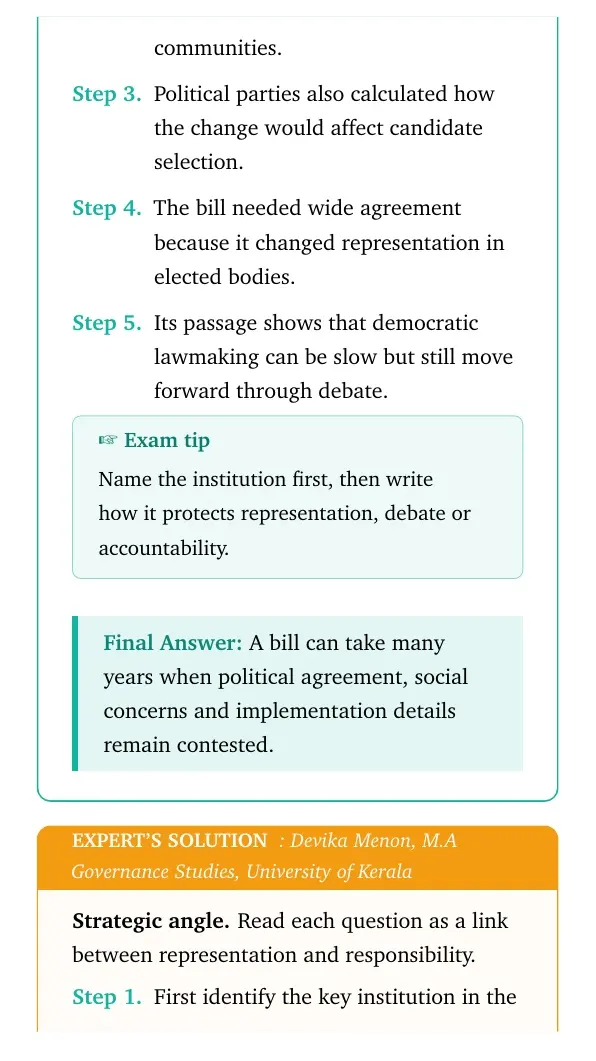
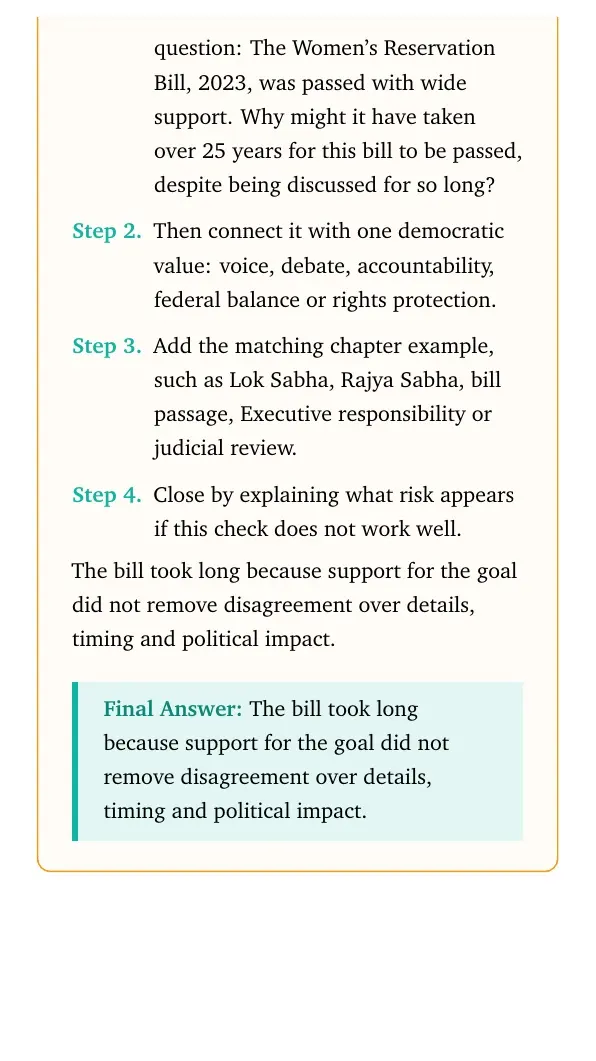
Q6.7 The Women's Reservation Bill, 2023, was passed with wide support. Why might it have taken over 25 years for this bill to be passed, despite being discussed for so long?
Quick answer: A bill can take many years when political agreement, social concerns and implementation details remain contested.
- Many parties supported the idea of more women in legislatures, but disagreed on details.
- Some members raised questions about sub-quotas and representation across communities.
- Political parties also calculated how the change would affect candidate selection.
- The bill needed wide agreement because it changed representation in elected bodies.
- Its passage shows that democratic lawmaking can be slow but still move forward through debate.
Verified Expert
The bill took long because support for the goal did not remove disagreement over details, timing and political impact.
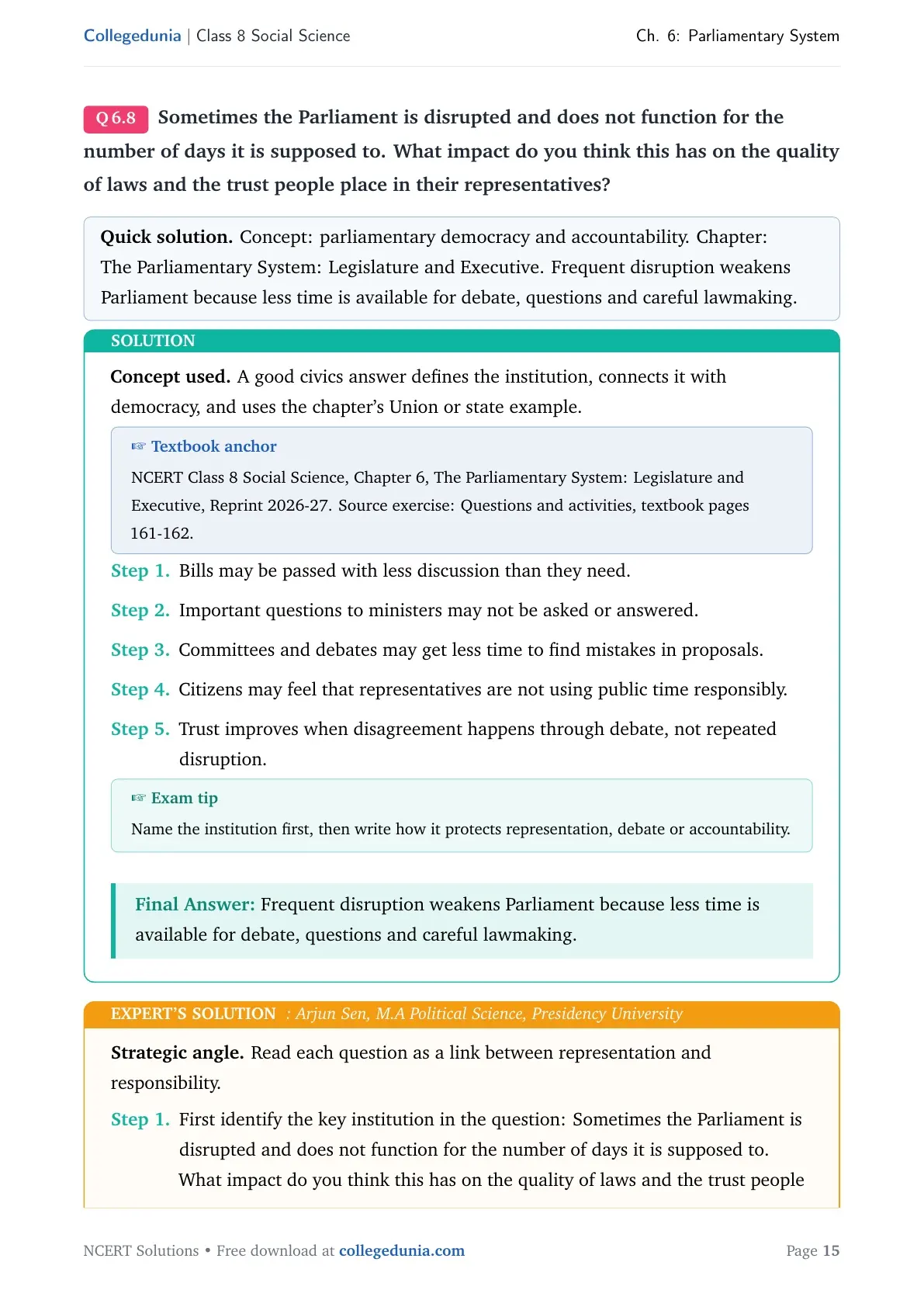
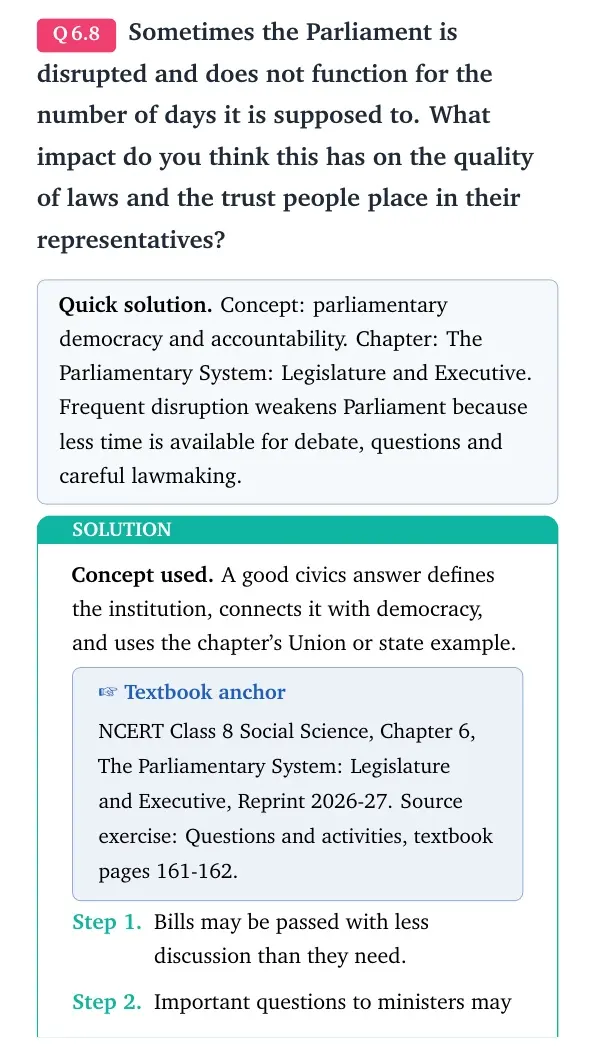
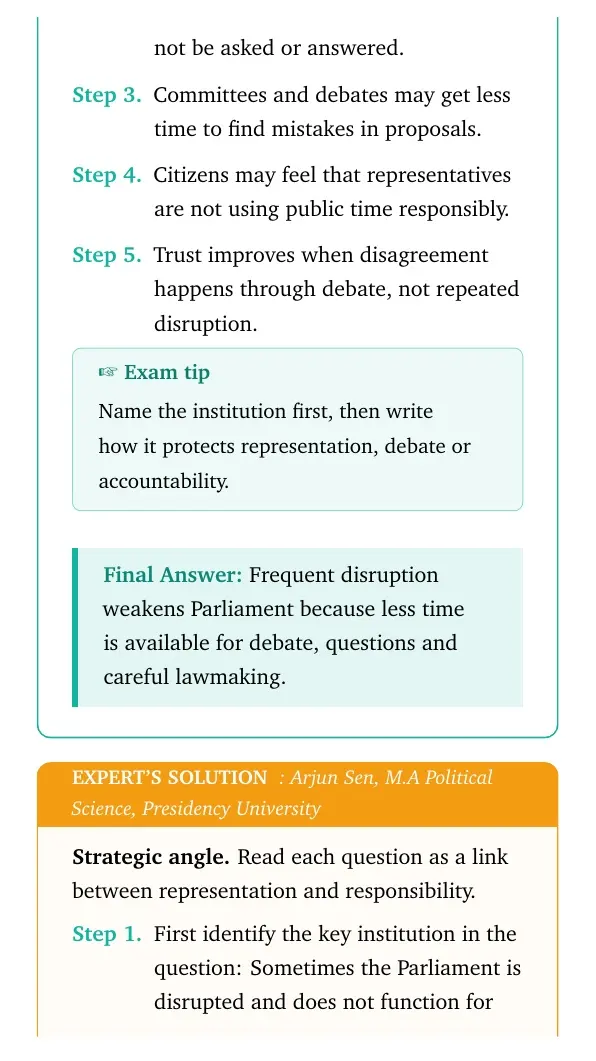
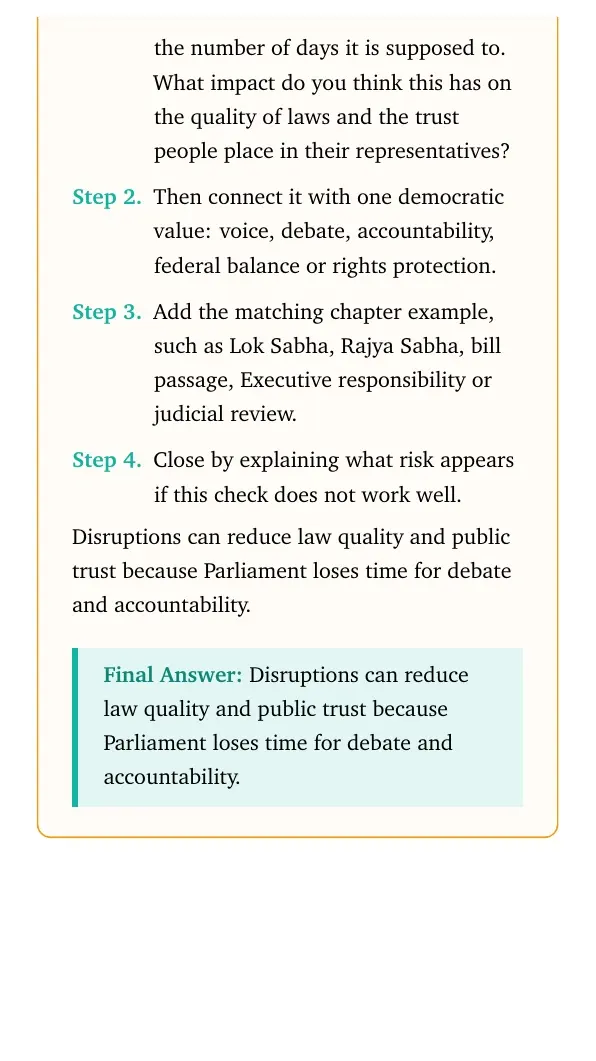
Q6.8 Sometimes the Parliament is disrupted and does not function for the number of days it is supposed to. What impact do you think this has on the quality of laws and the trust people place in their representatives?
Quick answer: Frequent disruption weakens Parliament because less time is available for debate, questions and careful lawmaking.
- Bills may be passed with less discussion than they need.
- Important questions to ministers may not be asked or answered.
- Committees and debates may get less time to find mistakes in proposals.
- Citizens may feel that representatives are not using public time responsibly.
- Trust improves when disagreement happens through debate, not repeated disruption.
Verified Expert
Disruptions can reduce law quality and public trust because Parliament loses time for debate and accountability.
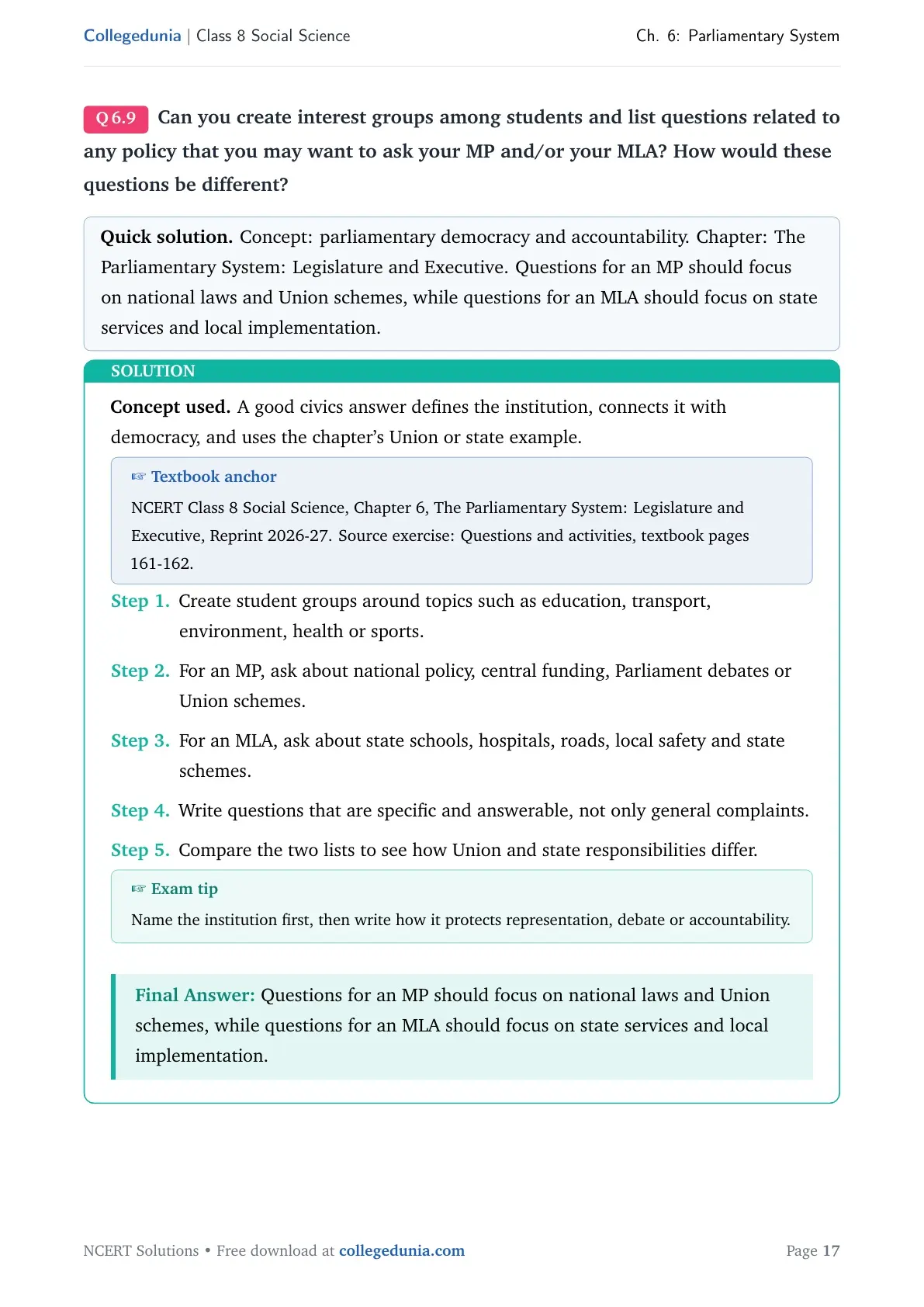
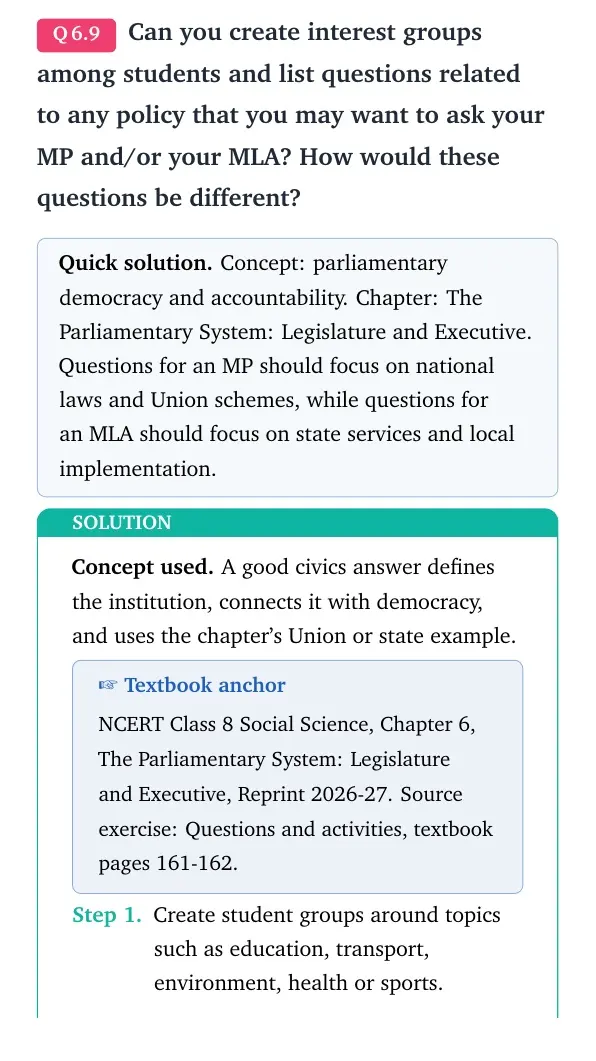
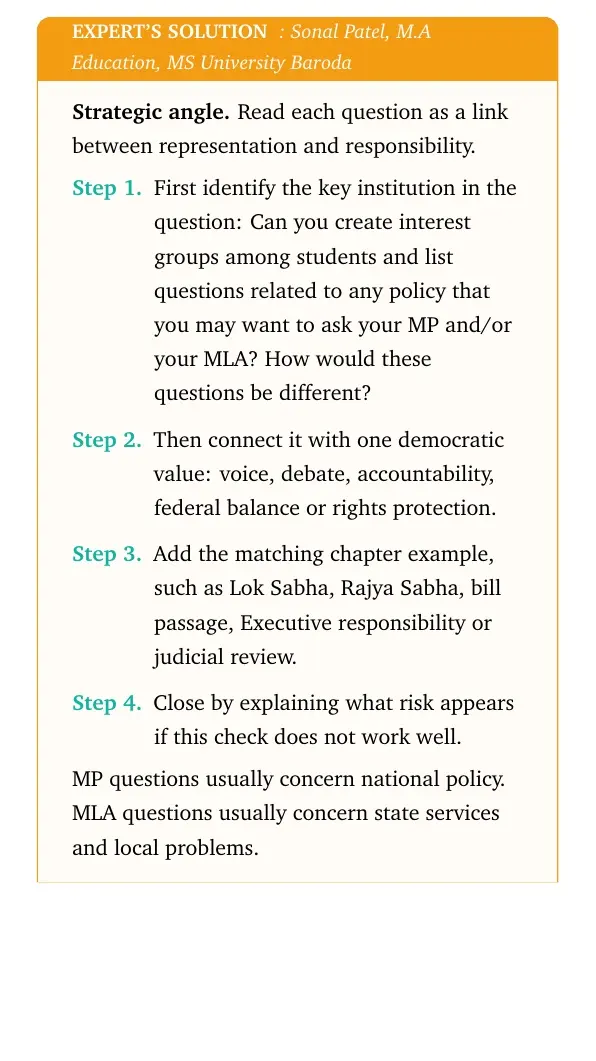
Q6.9 Can you create interest groups among students and list questions related to any policy that you may want to ask your MP and/or your MLA? How would these questions be different?
Quick answer: Questions for an MP should focus on national laws and Union schemes, while questions for an MLA should focus on state services and local implementation.
- Create student groups around topics such as education, transport, environment, health or sports.
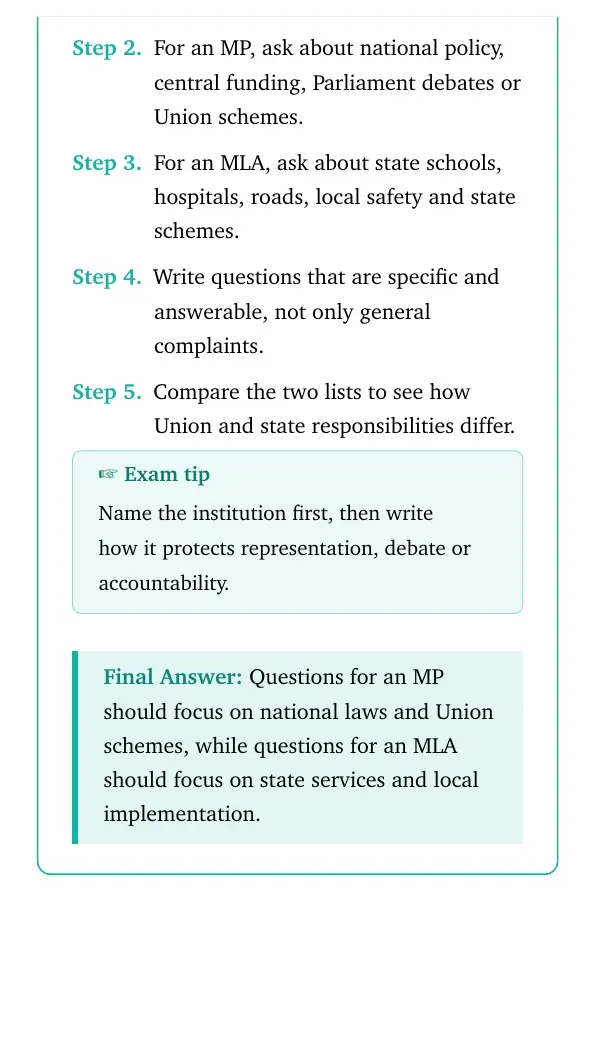
- For an MP, ask about national policy, central funding, Parliament debates or Union schemes.
- For an MLA, ask about state schools, hospitals, roads, local safety and state schemes.
- Write questions that are specific and answerable, not only general complaints.
- Compare the two lists to see how Union and state responsibilities differ.
Verified Expert
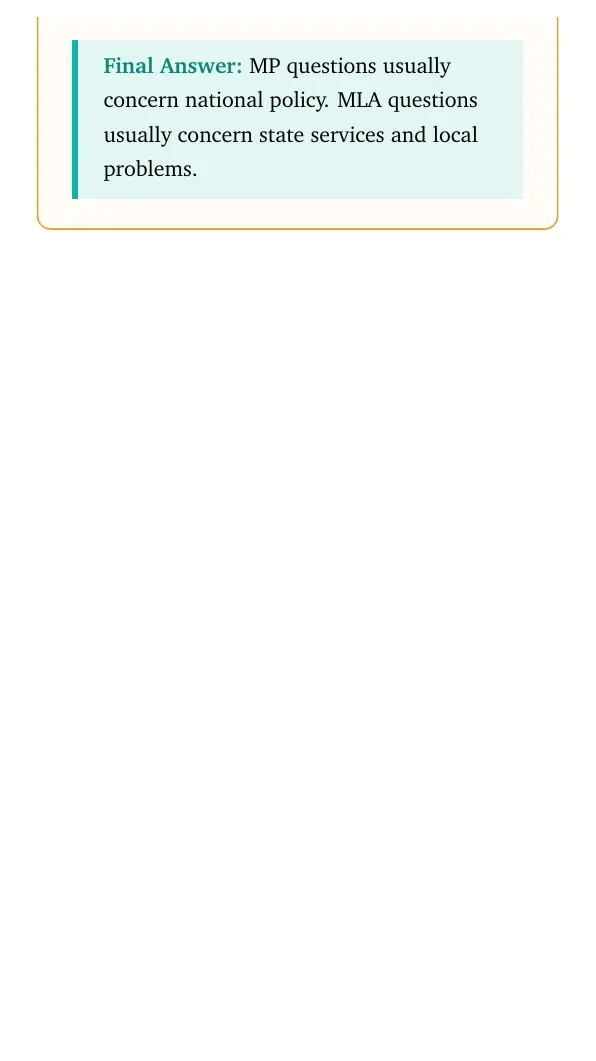
MP questions usually concern national policy. MLA questions usually concern state services and local problems.
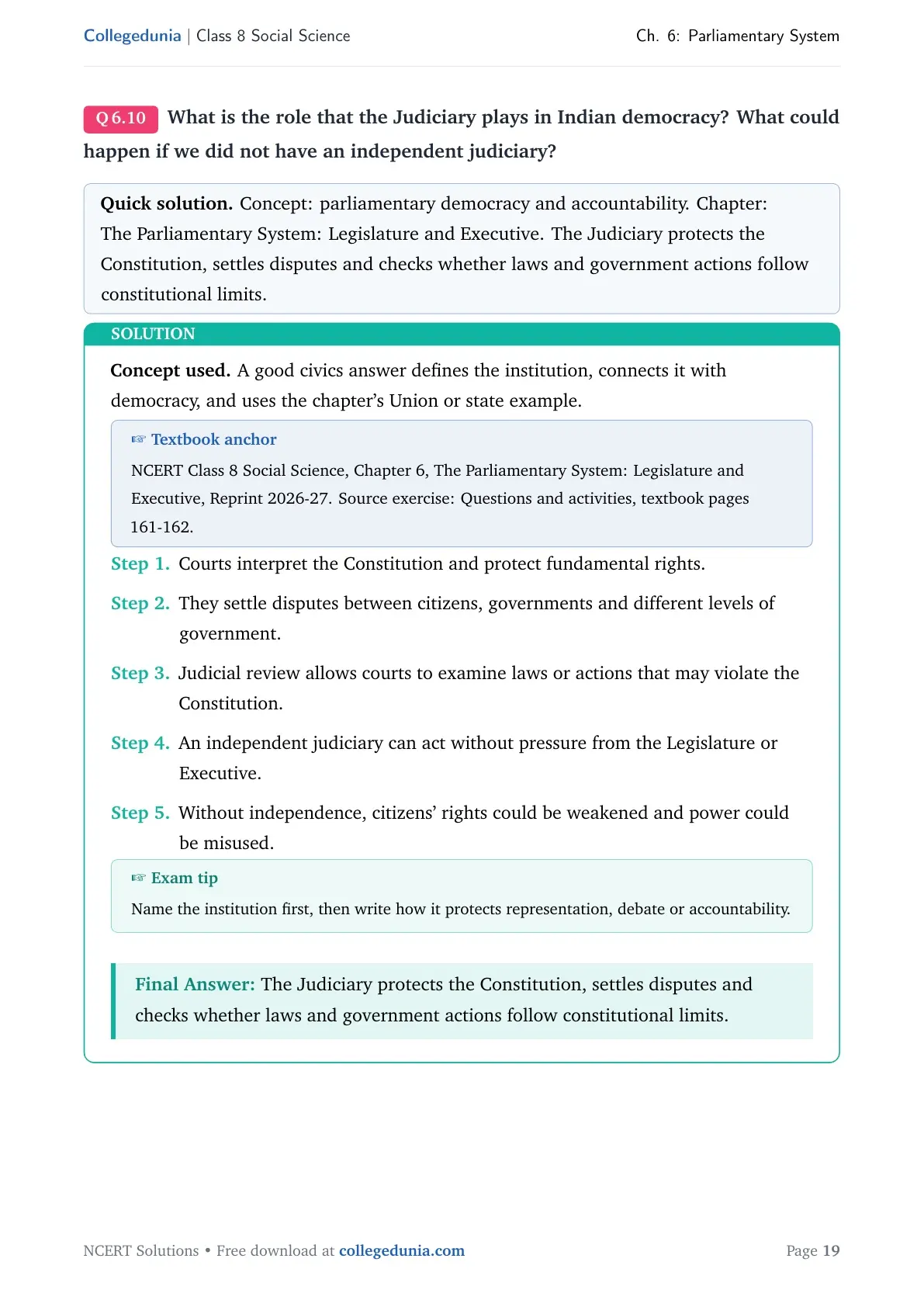
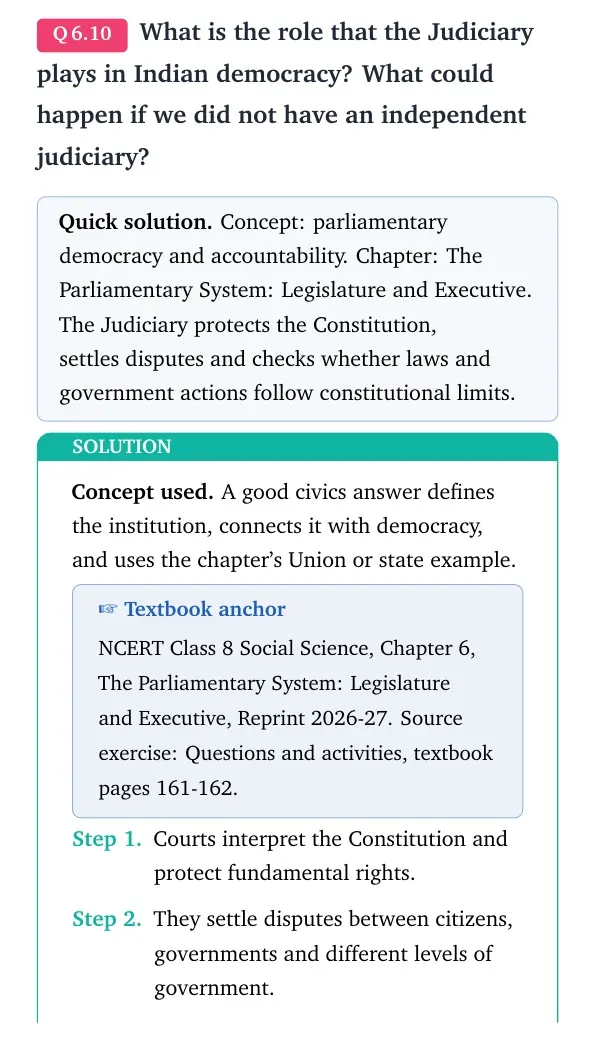
Q6.10 What is the role that the Judiciary plays in Indian democracy? What could happen if we did not have an independent judiciary?
Quick answer: The Judiciary protects the Constitution, settles disputes and checks whether laws and government actions follow constitutional limits.
- Courts interpret the Constitution and protect fundamental rights.
- They settle disputes between citizens, governments and different levels of government.
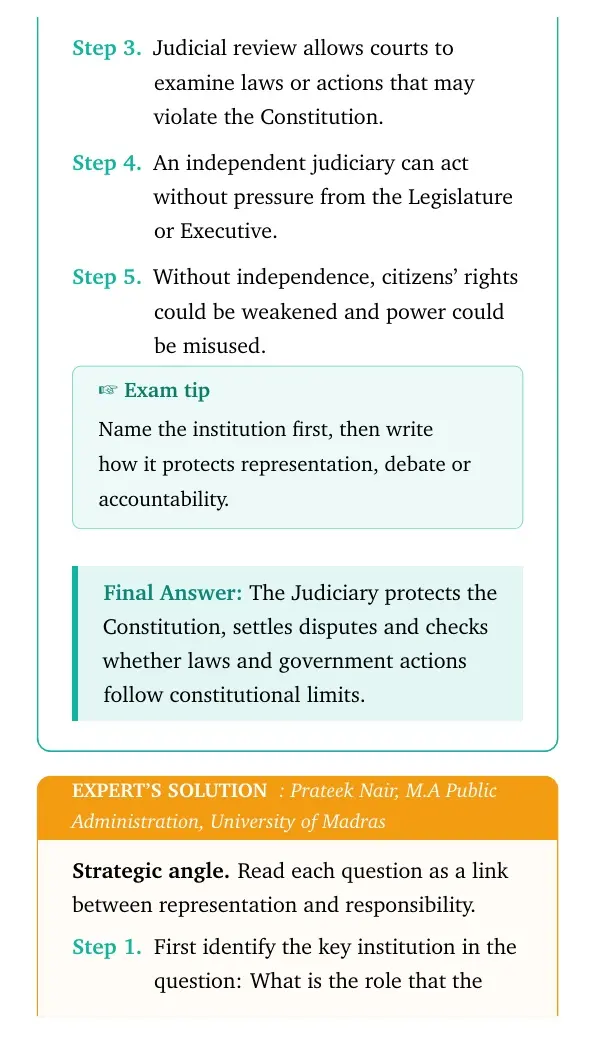
- Judicial review allows courts to examine laws or actions that may violate the Constitution.
- An independent judiciary can act without pressure from the Legislature or Executive.
- Without independence, citizens' rights could be weakened and power could be misused.
Verified Expert
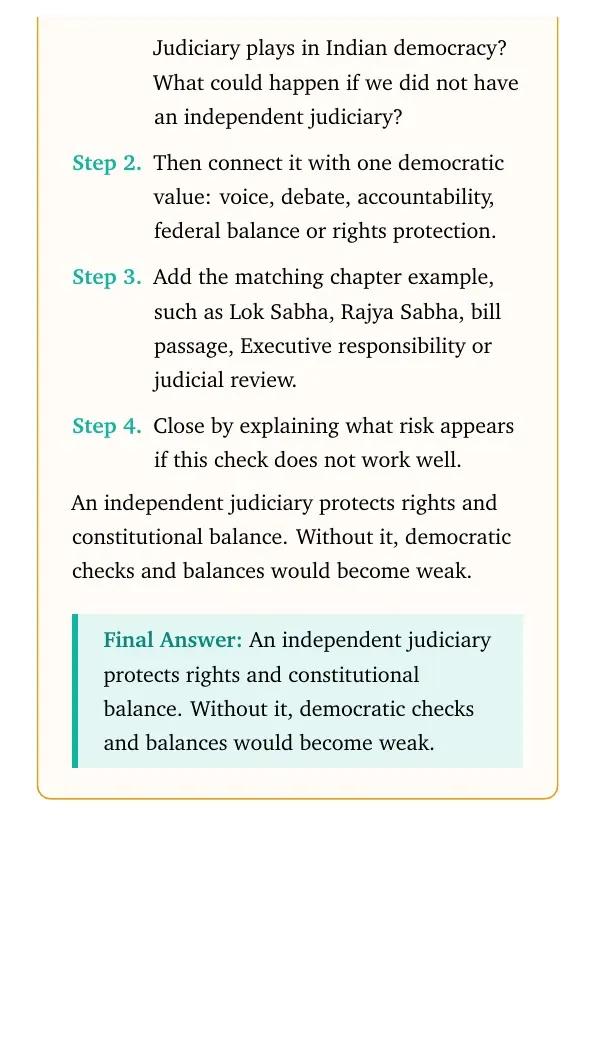
An independent judiciary protects rights and constitutional balance. Without it, democratic checks and balances would become weak.
The Parliamentary System Legislature and Executive Class 8 Social Science FAQs
Ques. What is the Indian Parliament made of?
Ans. The Indian Parliament is made of the President, Lok Sabha and Rajya Sabha. Lok Sabha is directly elected, while Rajya Sabha represents the states.
Ques. Why is the Executive responsible to the Legislature?
Ans. The Executive must answer questions, explain policies and keep majority support. This keeps government power under democratic control.
Ques. What does bicameral legislature mean?
Ans. Bicameral legislature means a lawmaking body with two Houses. In India, these are Lok Sabha and Rajya Sabha.
Ques. What is the role of the Judiciary in democracy?
Ans. The Judiciary protects the Constitution, settles disputes and checks laws or actions that violate constitutional limits.



Comments