




The Linear Polynomials Exercise 2.4 solutions cover all 4 questions from the new Ganita Manjari book. This set is about linear growth and decay, where a quantity rises or falls by the same fixed amount each step. Use these NCERT Solutions Class 9 Maths Chapter 2 Linear Polynomials Exercise 2.4 answers to follow every step.
- Questions solved: all 4 questions on linear growth and linear decay models.
- Main skills: writing a rule of the form start value plus a rate times time.
- Links to chapter: it extends the patterns of Exercise 2.3 into growth and decay.
These solutions are prepared by subject teachers, matched to the current 2026-27 NCERT, and checked step by step so a Class 9 student can follow each line.
What Does Class 9 Maths Chapter 2 Linear Polynomials Exercise 2.4 Cover?
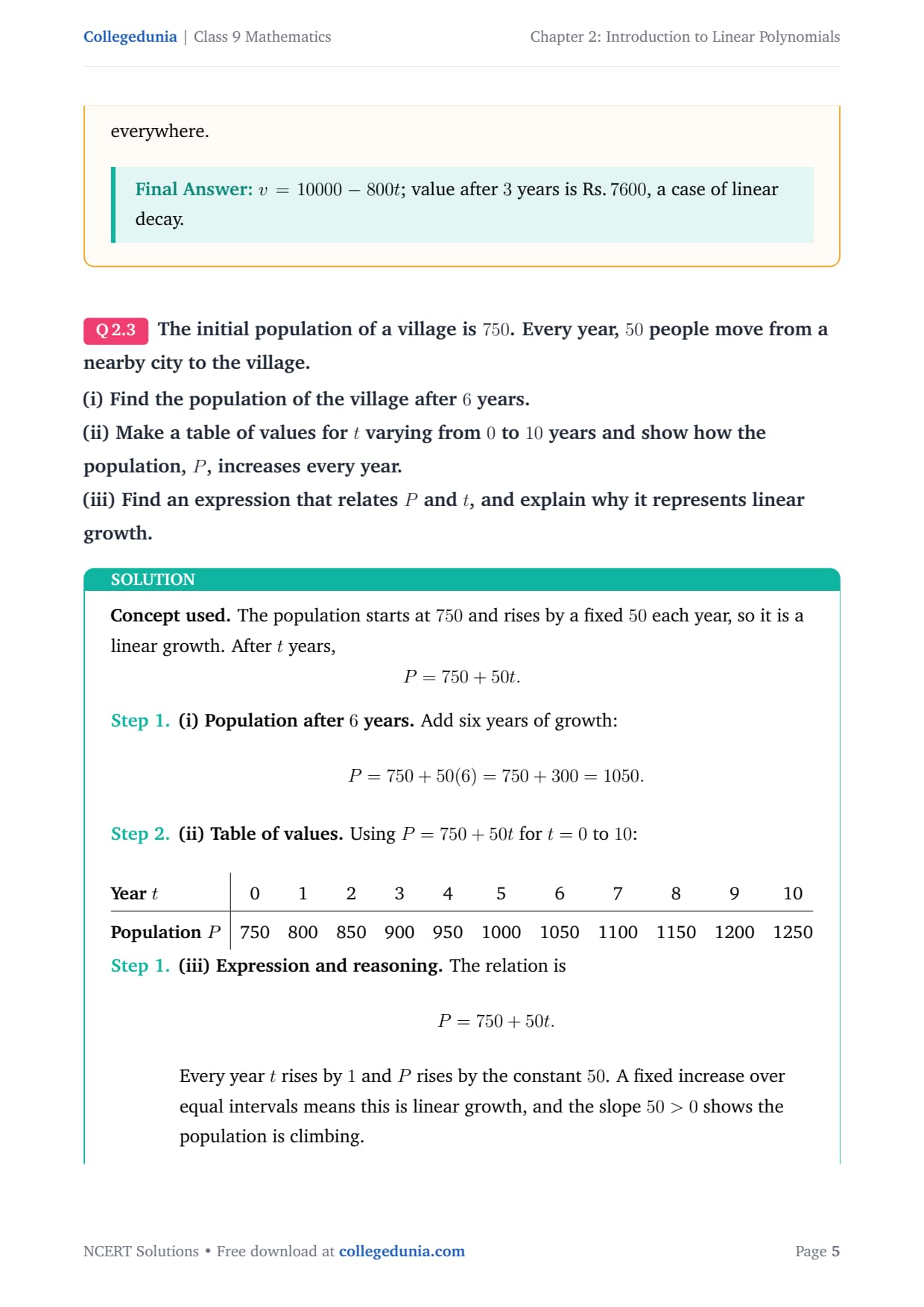
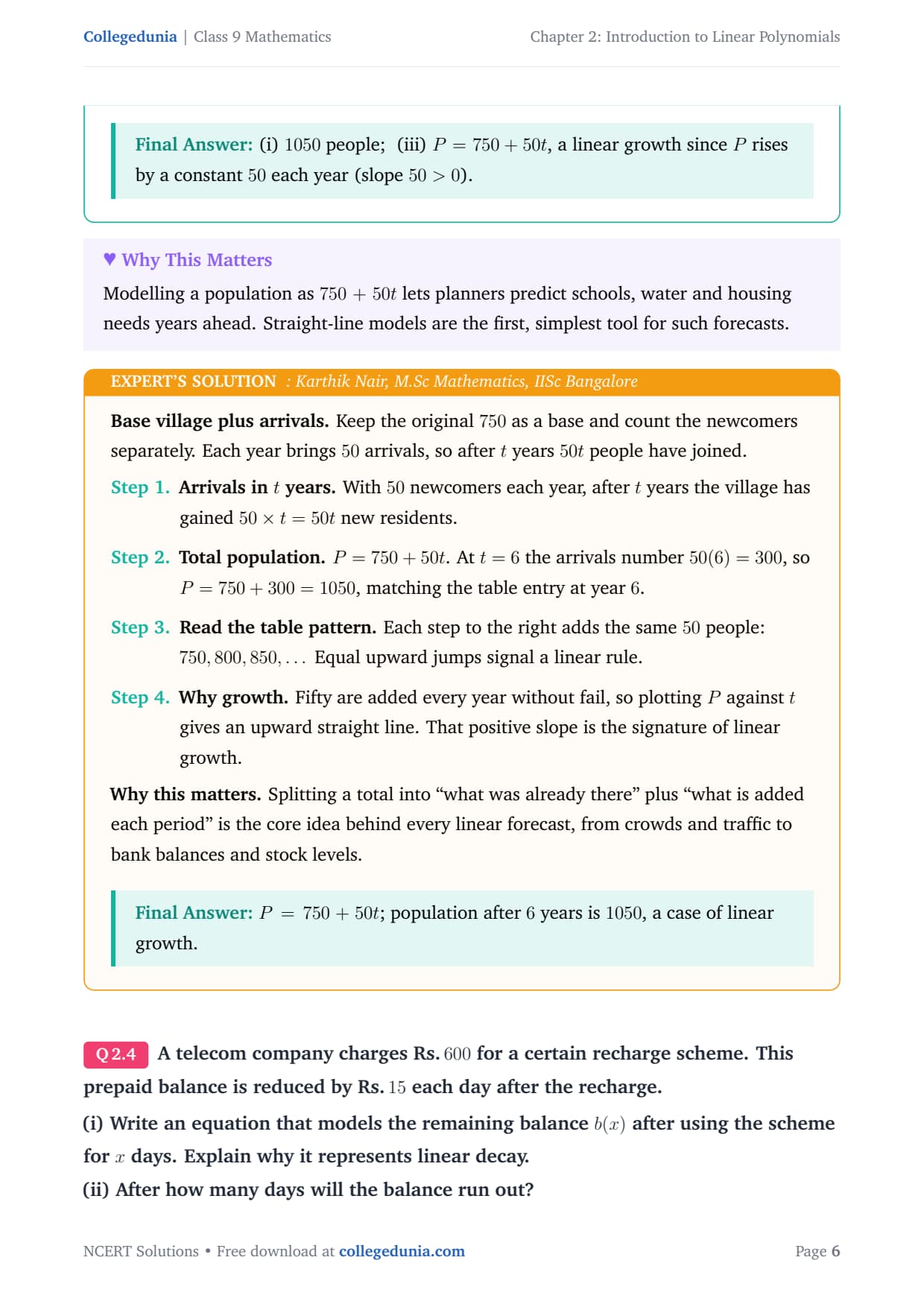
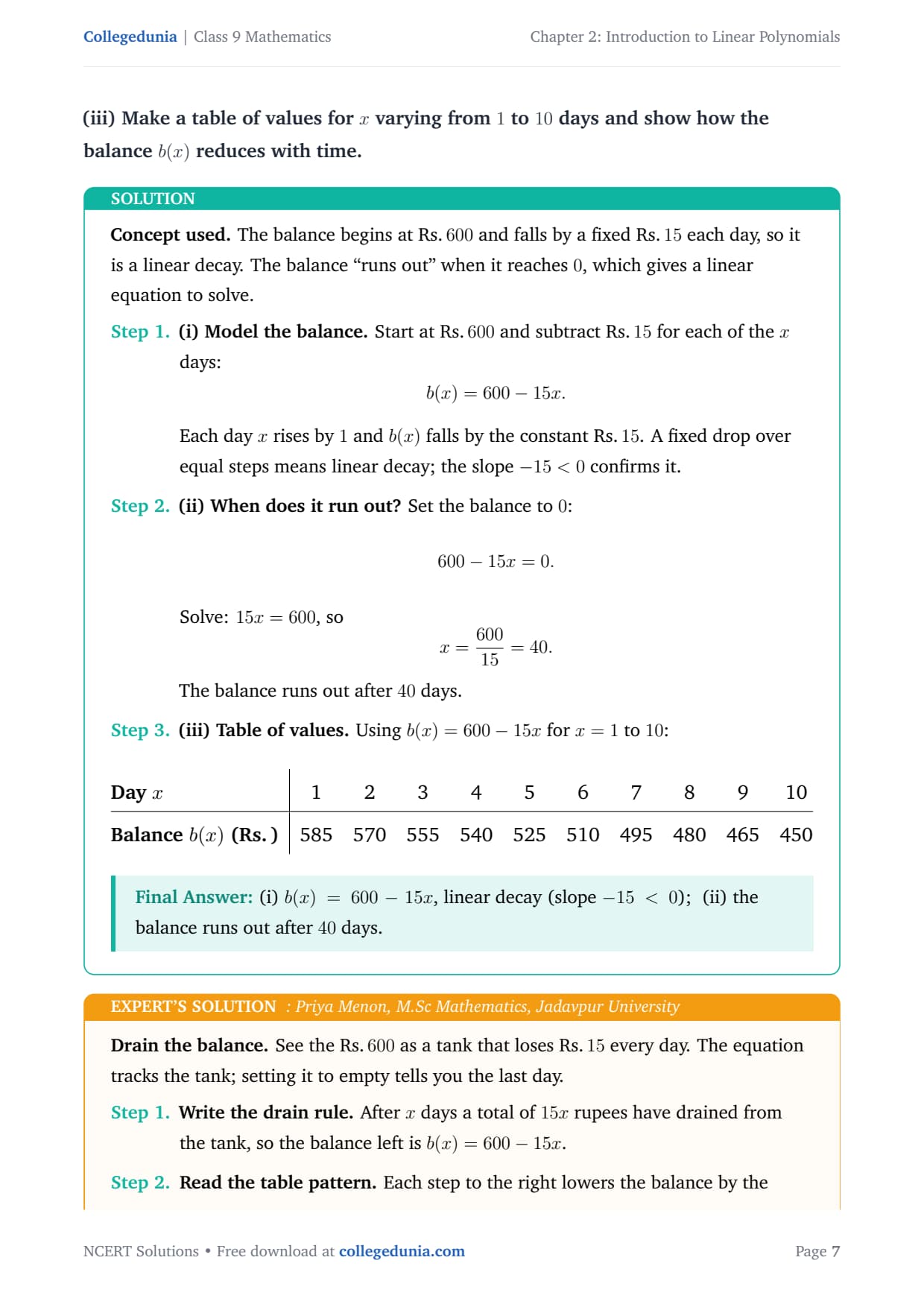
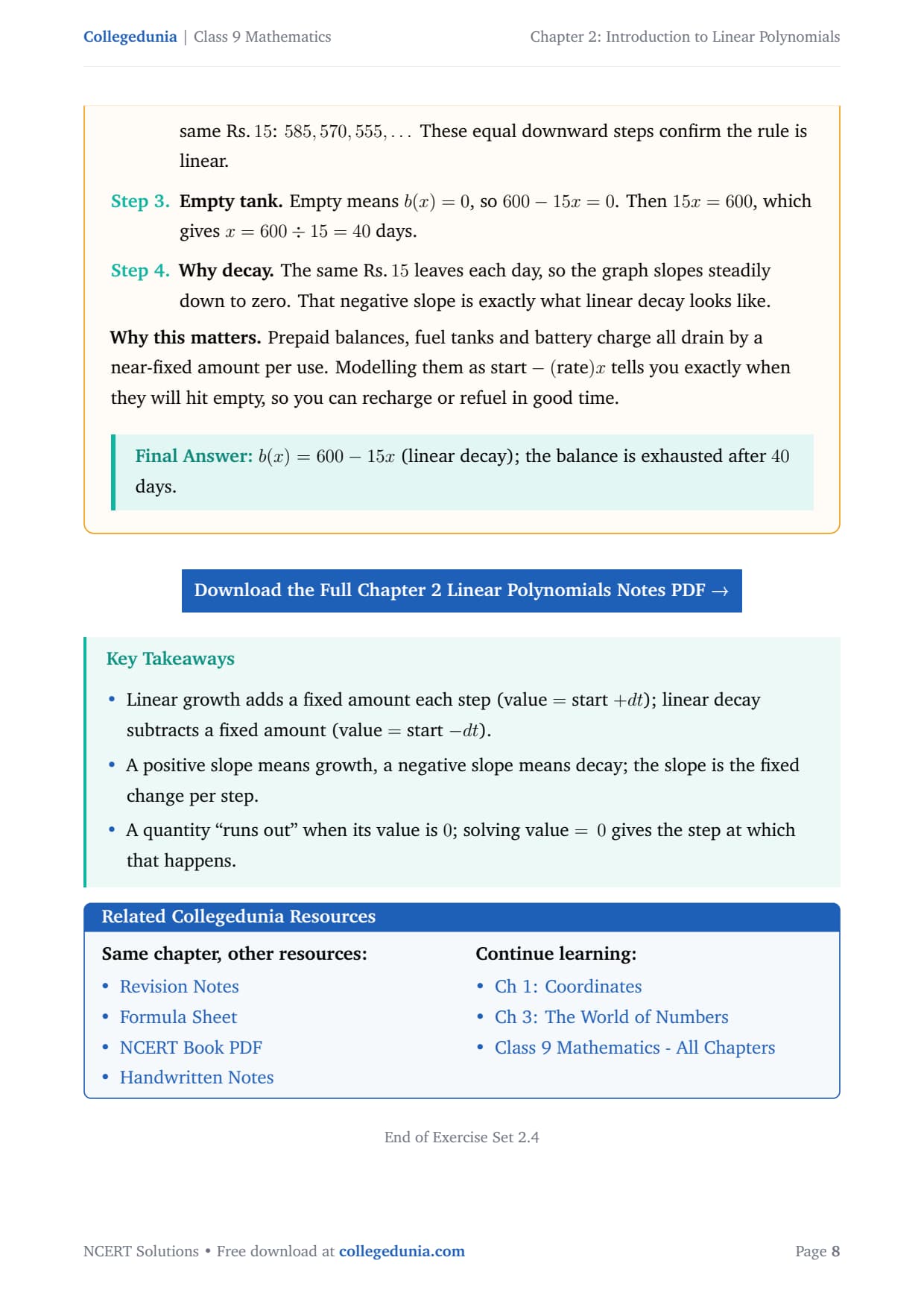
This exercise looks at quantities that change by a fixed amount over time. In linear growth the amount rises each step, like a plant getting taller. In linear decay the amount falls each step, like a phone losing value. In both cases you write a rule as start value plus a rate times time. When the rate is positive the graph rises, and when it is negative the graph falls. This ties Linear Polynomials to real change.
Video Walkthrough
Source: PW Class 9 - NEEV on YouTube
Linear Polynomials Exercise 2.4 Question Breakdown
The exercise has four questions, two on growth and two on decay.
| Question | What it asks |
|---|---|
| Question 1 | A plant that grows by a fixed height each month (linear growth). |
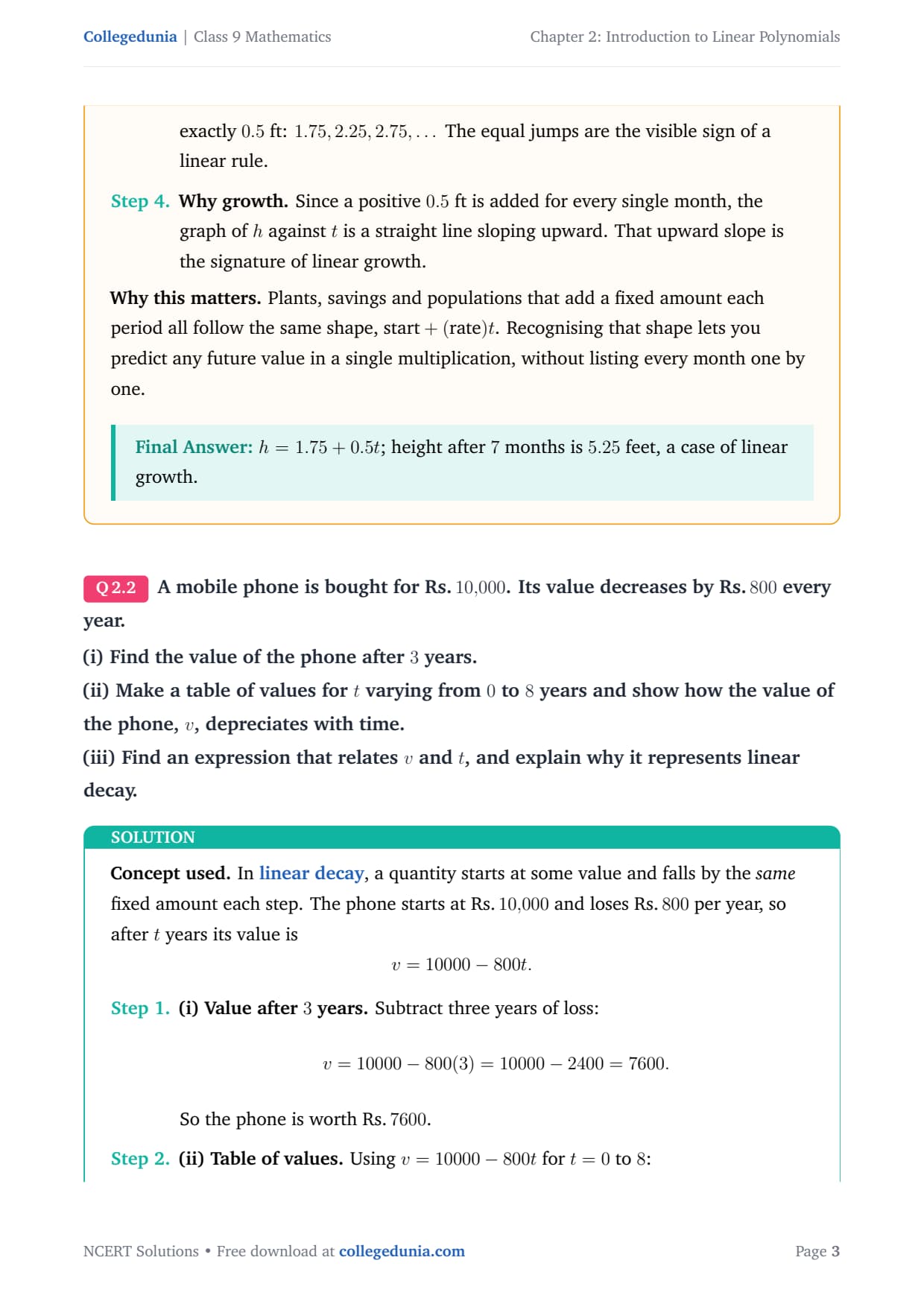
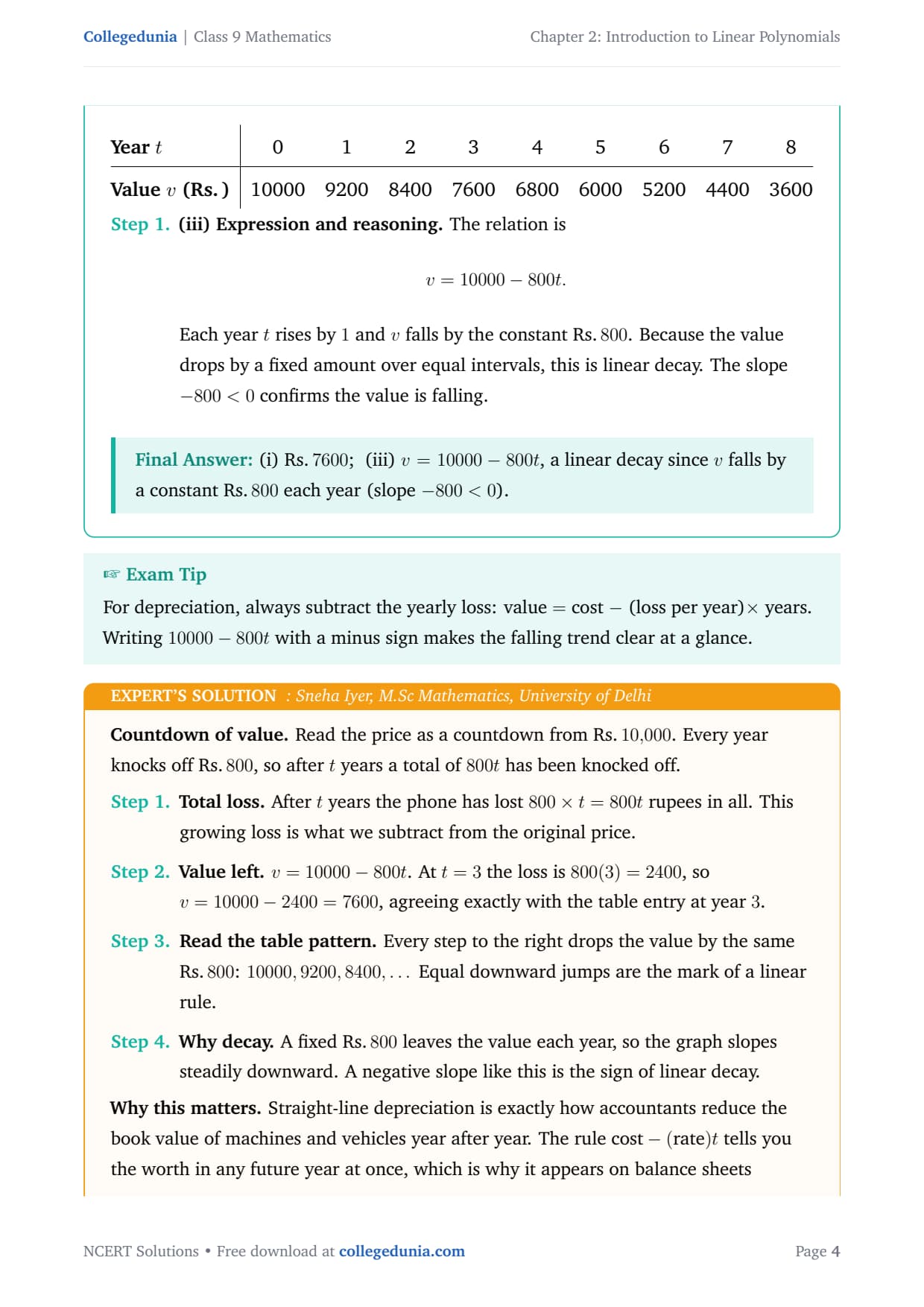
| Question 2 | A mobile phone that loses a fixed value each year (linear decay). |
| Question 3 | A village population that falls by a fixed number each year. |
| Question 4 | A telecom recharge scheme with a fixed charge and rate. |
Sample Solved Question from Exercise 2.4
Here is Question 1, solved step by step, so you can see how growth becomes a rule.
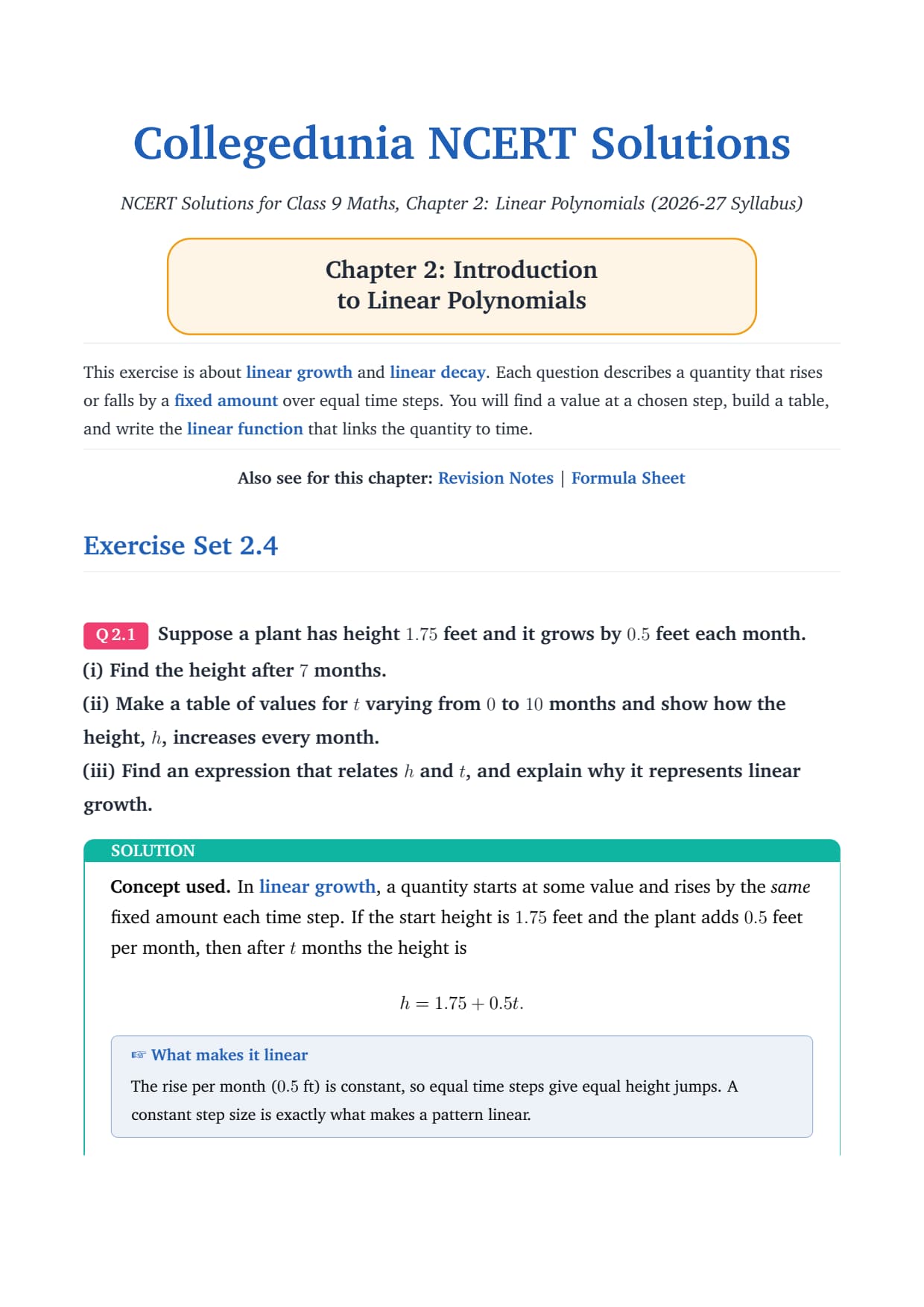
Question: A plant has height 1.75 feet and grows by 0.5 feet each month. Find its height after 7 months, and write a rule linking height h and time t.
Step 1. The start height is 1.75 feet, and the fixed rise is 0.5 feet per month.
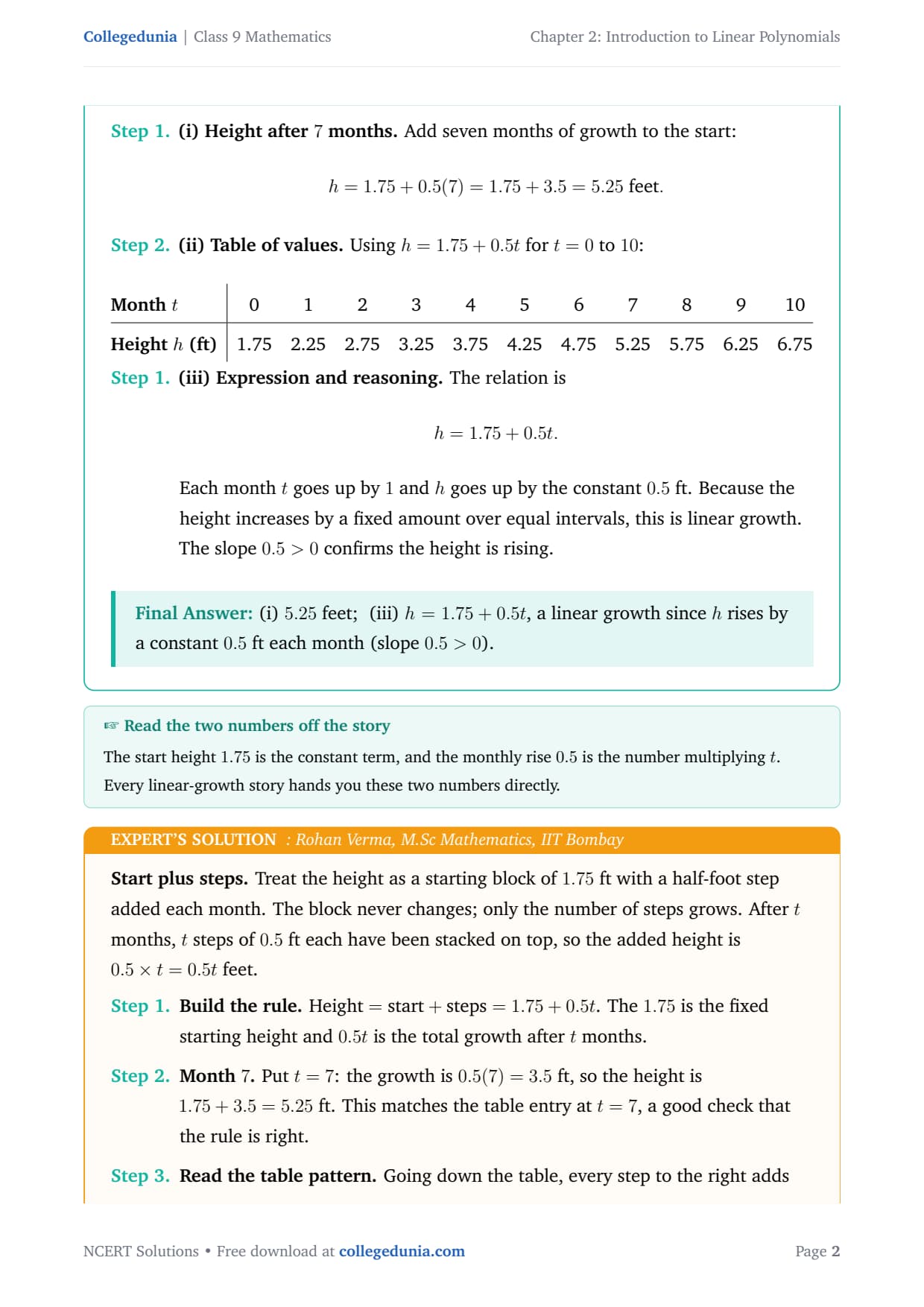
Step 2. After 7 months, add seven months of growth: h = 1.75 + 0.5(7).
Step 3. Simplify to h = 1.75 + 3.5 = 5.25 feet.
Step 4. The general rule is h = 1.75 + 0.5t. The rise 0.5 is constant, so this is linear growth.
Final answer. The height after 7 months is 5.25 feet, and h = 1.75 + 0.5t.
How to Use These Linear Polynomials Exercise 2.4 Solutions
Write the start value and the rate first, then decide if the story is growth or decay. Use the Collegedunia solution to confirm your rule and your final numbers.
- Check whether the quantity rises or falls before you fix the sign.
- Keep the time unit the same as the rate before you substitute.
- Revise these models before your Class 9 annual exam.
More Class 9 Maths Linear Polynomials Exercise 2.4 Solutions
Use the table below to open the full chapter or any other exercise of Linear Polynomials.
| Page | Link |
|---|---|
| Full Chapter Solutions | Linear Polynomials NCERT Solutions |
| Exercise 2.1 | Linear Polynomials Exercise 2.1 Solutions |
| Exercise 2.2 | Linear Polynomials Exercise 2.2 Solutions |
| Exercise 2.3 | Linear Polynomials Exercise 2.3 Solutions |
| Exercise 2.4 | Linear Polynomials Exercise 2.4 Solutions |
| Exercise 2.5 | Linear Polynomials Exercise 2.5 Solutions |
| Exercise 2.6 | Linear Polynomials Exercise 2.6 Solutions |
| End of Chapter | Linear Polynomials End of Chapter Solutions |
Linear Polynomials Exercise 2.4 NCERT Solutions FAQs
Ques. How many questions are there in Class 9 Maths Exercise 2.4?
Ans. Exercise 2.4 has 4 questions. They cover linear growth and linear decay in real settings. Collegedunia solves all of them.
Ques. What is the difference between linear growth and decay?
Ans. In growth the quantity rises by a fixed amount each step, so the rate is positive. In decay it falls each step, so the rate is negative.
Ques. How do I write a linear growth rule?
Ans. Use start value plus rate times time. For a plant of height 1.75 growing 0.5 per month, the rule is h = 1.75 + 0.5t.
Ques. Can I download the Exercise 2.4 solutions PDF?
Ans. Yes. The Linear Polynomials Exercise 2.4 solutions PDF is free on this page, so you can revise offline before your Class 9 exam.



Comments