




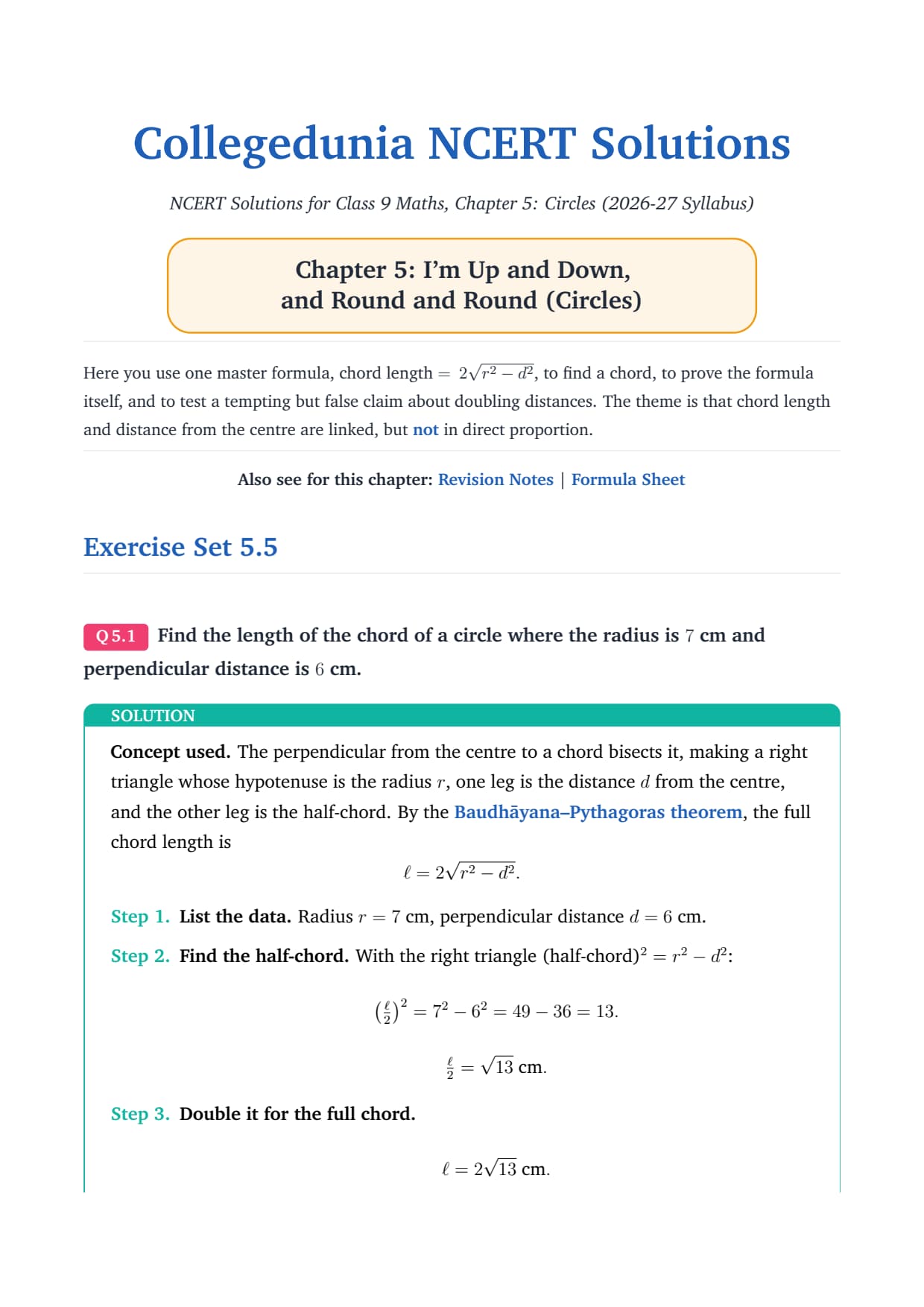
The Circles Exercise 5.5 set puts the chord length formula to work. These NCERT Solutions Class 9 Maths Chapter 5 Circles Exercise 5.5 answers use 2√r2-d2 to find a chord from the radius and distance. You also reason about how a chord changes as its distance changes.
- Questions solved: all 3 problems of Exercise 5.5
- Main skill: using the chord length formula 2√r2-d2
- Chapter link: it applies the right triangle built in Exercises 5.3 and 5.4
These Collegedunia solutions are written by subject teachers, matched to the current 2026-27 Ganita Manjari book, and checked line by line. Each answer stays in plain language, with the reason behind every line spelled out, so a Class 9 student can follow it on the first read.
What Does Class 9 Maths Chapter 5 Circles Exercise 5.5 Cover?
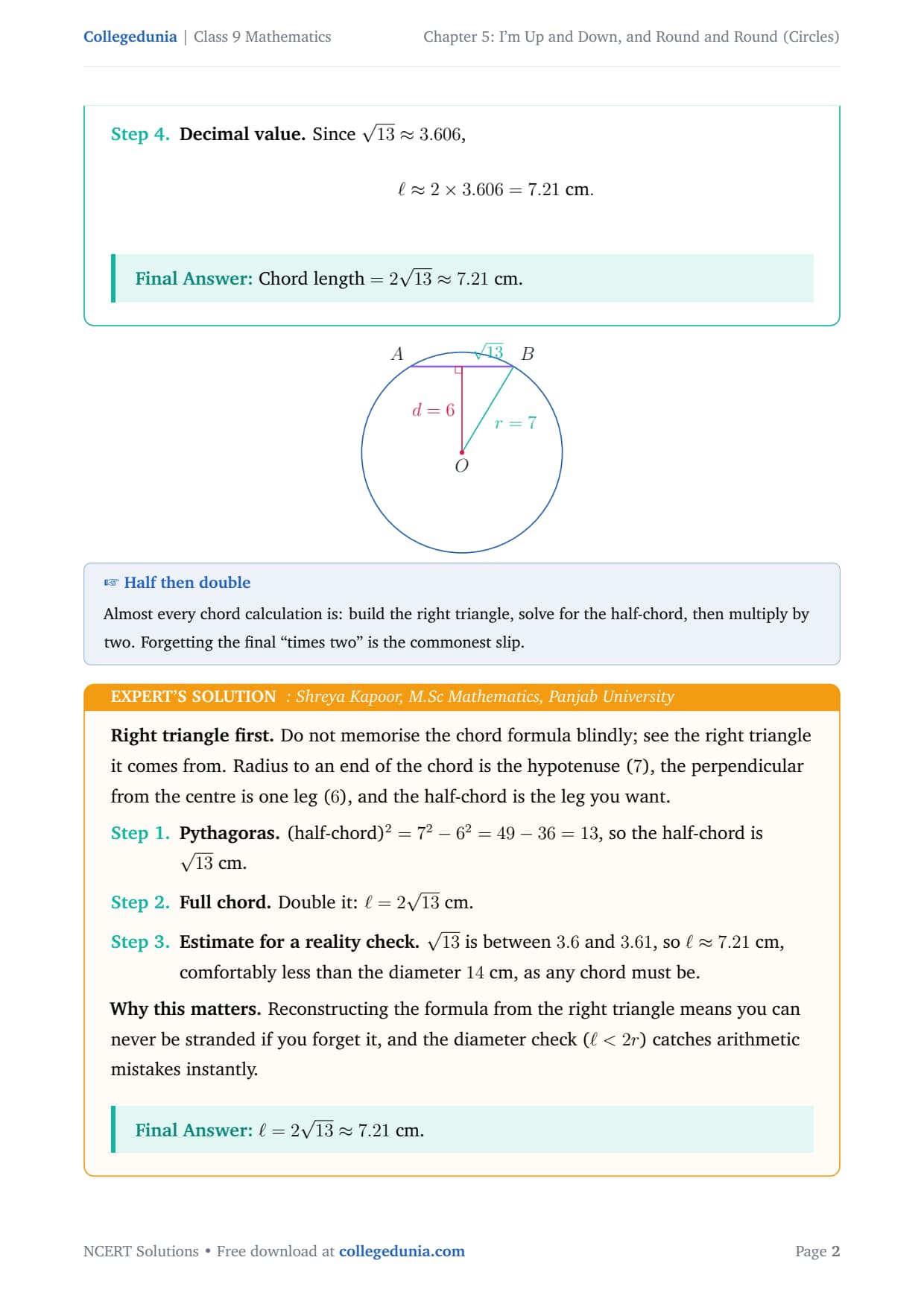
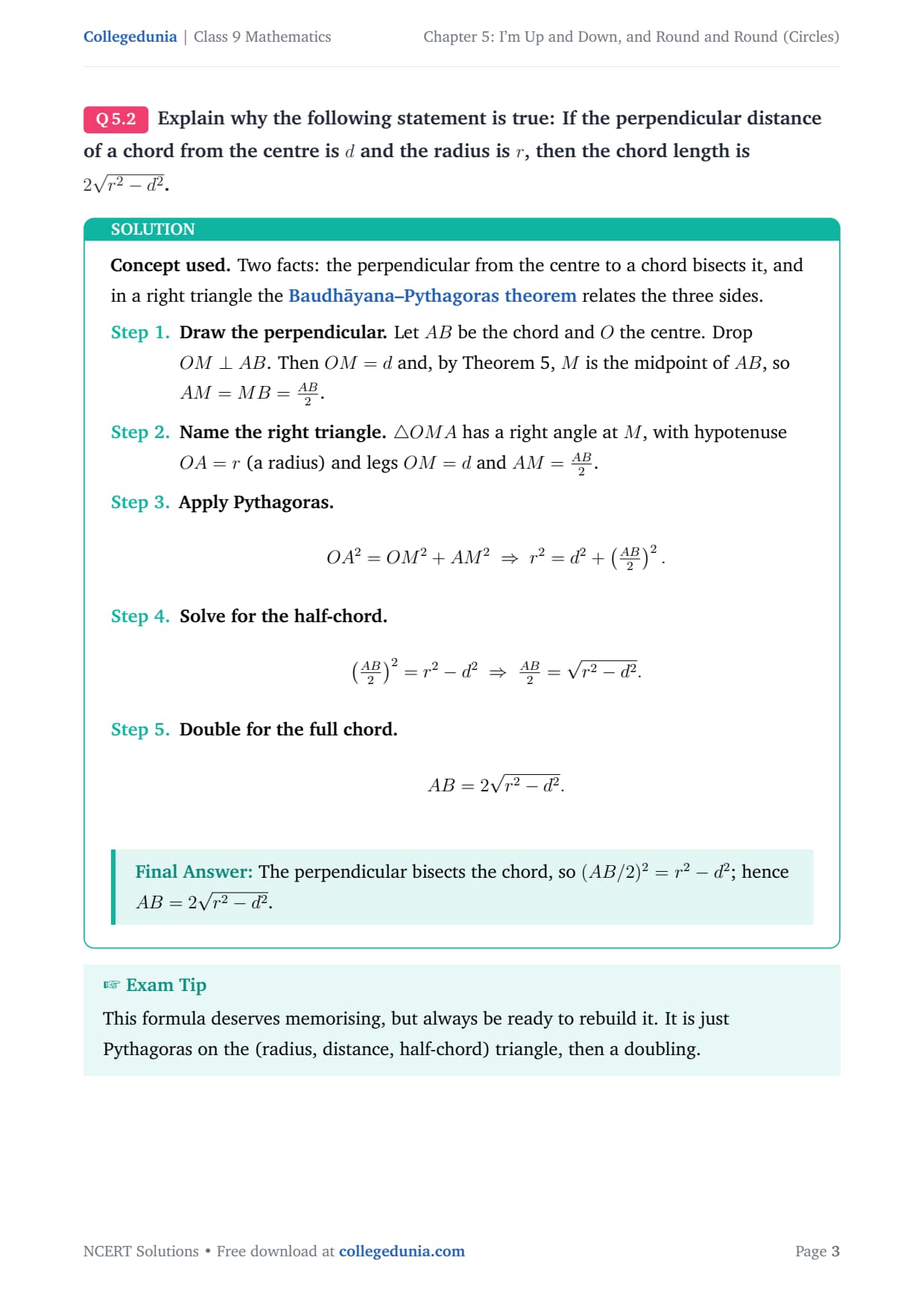
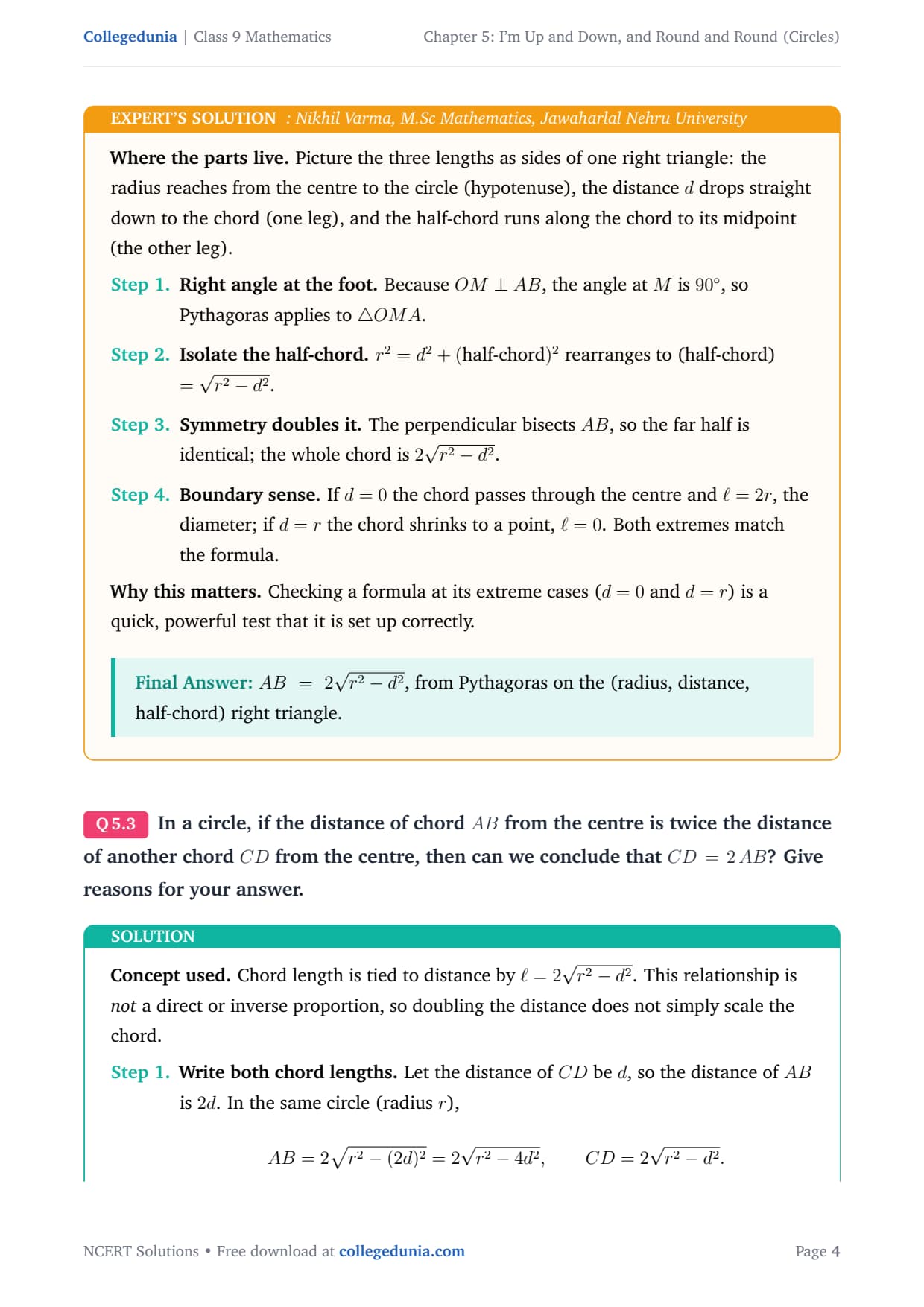
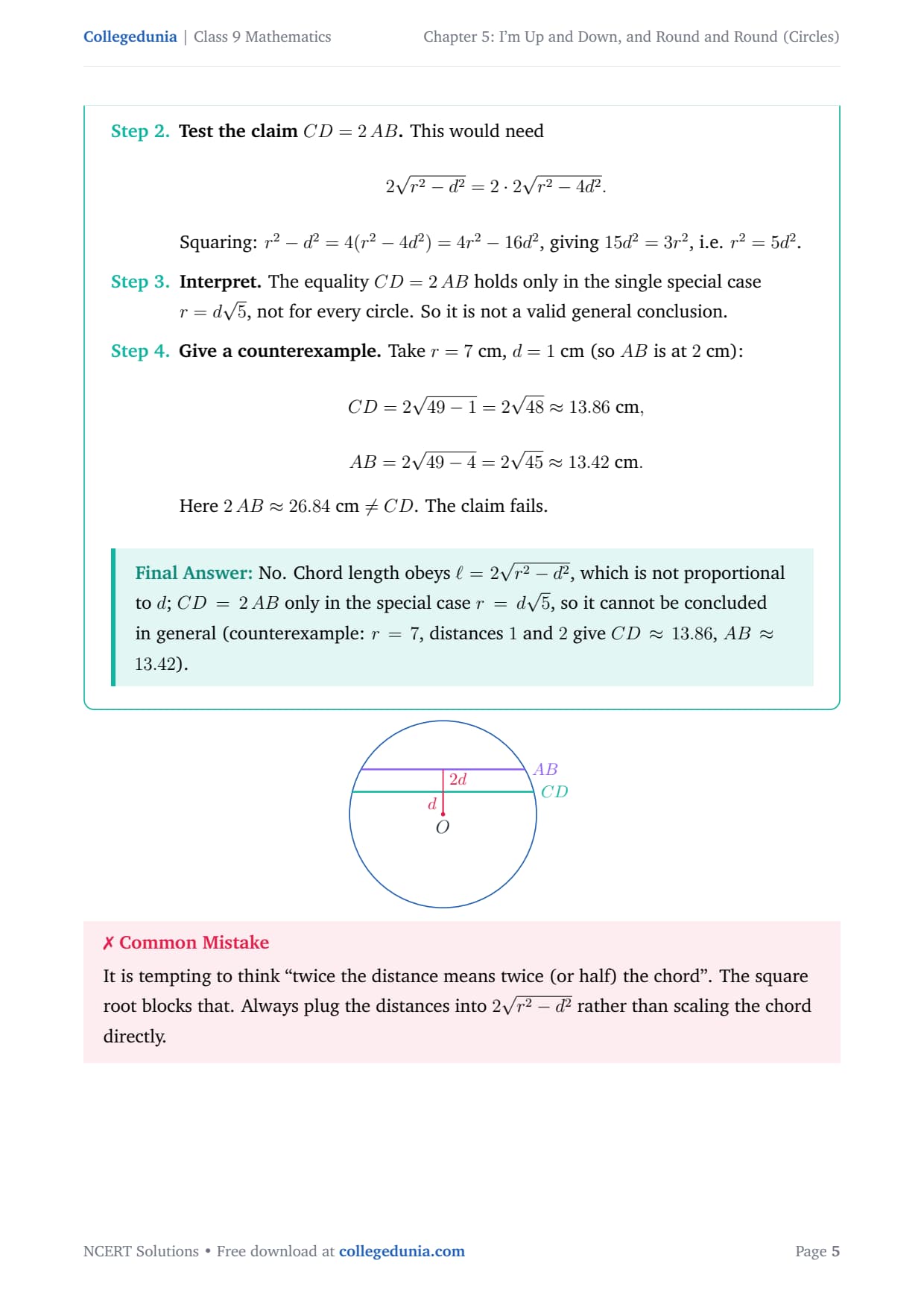
Exercise 5.5 is the calculation set. A chord at distance d from the centre of a circle of radius r has length 2√r2-d2. The first question is a direct number problem. The others ask you to explain a statement and compare chords at different distances. All of them come back to the same half-then-double right triangle. Learn that one method and the whole set becomes routine. You find the half-chord from the right triangle, then double it for the full chord. A quick check is that no chord can be longer than the diameter.
Video Walkthrough
Source: PW Class 9 - NEEV on YouTube
Circles Exercise 5.5 Question Breakdown
The set has three questions.
| Question | What it asks |
|---|---|
| Q1 | Find a chord length when the radius is 7 cm and the distance is 6 cm |
| Q2 | Explain why a stated chord property is true |
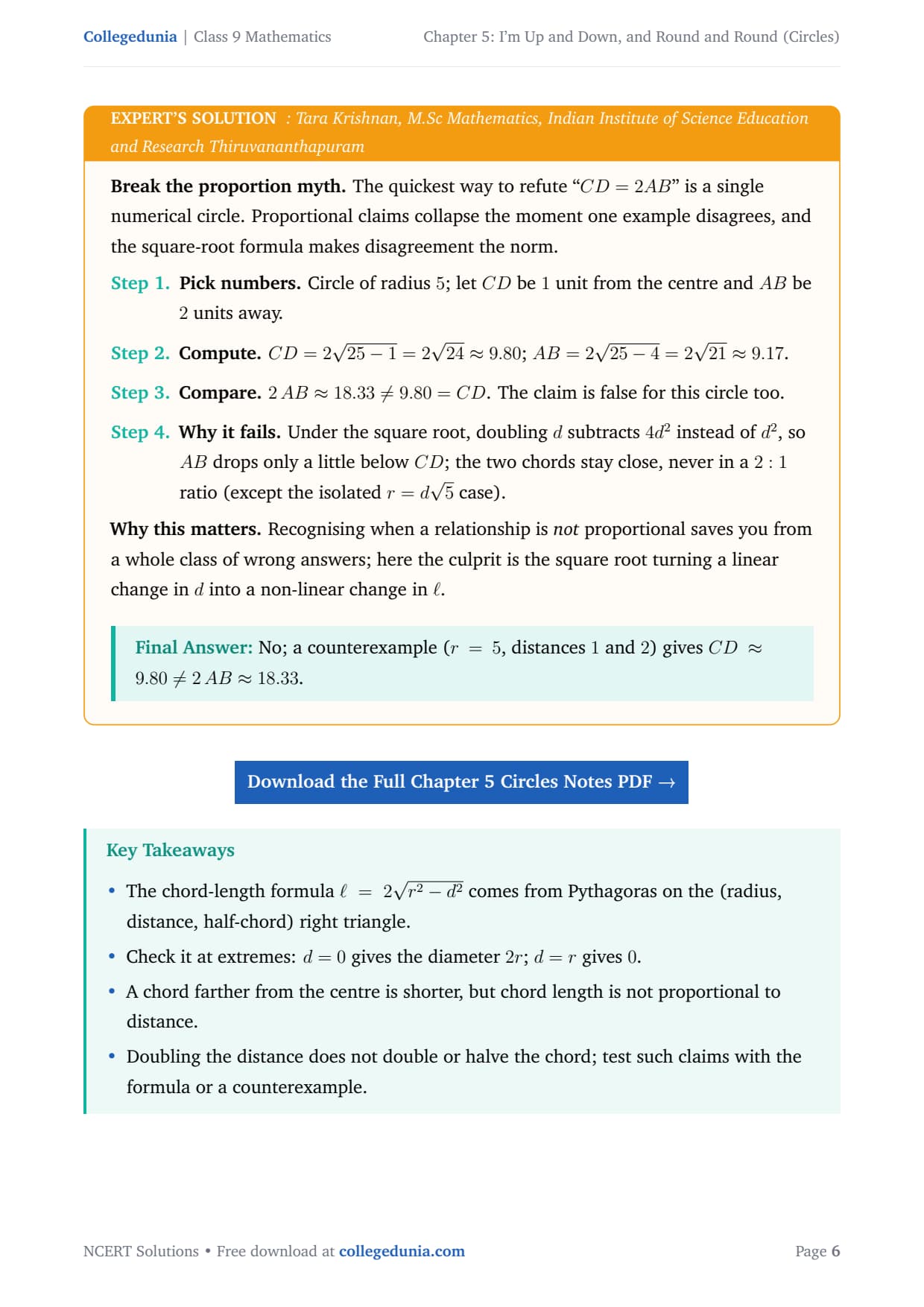
| Q3 | Compare a chord whose distance from the centre is twice another |
Sample Solved Question from Exercise 5.5
Here is Question 1, solved in short steps.
Question: Find the length of a chord of a circle whose radius is 7 cm and whose perpendicular distance from the centre is 6 cm.
Step 1. The perpendicular from the centre bisects the chord, so the half-chord satisfies (2)2=r2-d2.
Step 2. Put in r=7 and d=6: (2)2=49-36=13.
Step 3. So the half-chord is √13 cm, and the full chord is =2√13 cm.
Final answer. The chord is 2√13≈ 7.21 cm, safely less than the diameter 14 cm.
How to Use These Circles Exercise 5.5 Solutions
Collegedunia shows the right triangle behind the formula, so you never memorise it blindly. Use the answers this way.
- Write the formula 2√r2-d2 before you put in any numbers.
- Solve for the half-chord first, then multiply by two.
- Check that your chord is shorter than the diameter 2r.
Work through the questions in order the first time, then use these solutions only to check your own steps. Redoing a question after you read the answer fixes the method far better than reading alone. A short daily set of these problems builds a firm base for the Class 9 annual exam and the circle theorems you meet in the Class 10 syllabus.
More Class 9 Maths Circles Solutions
Open the full chapter or any other exercise of Class 9 Maths Chapter 5 Circles from the table below.
| Page | Link |
|---|---|
| Circles Full Chapter Solutions | Circles Full Chapter Solutions |
| Circles Exercise 5.1 | Circles Exercise 5.1 |
| Circles Exercise 5.2 | Circles Exercise 5.2 |
| Circles Exercise 5.3 | Circles Exercise 5.3 |
| Circles Exercise 5.4 | Circles Exercise 5.4 |
| Circles Exercise 5.5 | Circles Exercise 5.5 |
| Circles Exercise 5.6 | Circles Exercise 5.6 |
| Circles End of Chapter | Circles End of Chapter |
Circles Exercise 5.5 NCERT Solutions FAQs
Ques. How many questions are in Class 9 Maths Circles Exercise 5.5?
Ans. There are three questions. One is a direct chord calculation, and the other two ask for reasoning about chord lengths.
Ques. What is the chord length formula in Exercise 5.5?
Ans. A chord at a perpendicular distance d from the centre of a circle of radius r has length 2√r2-d2.
Ques. Why do we double the answer at the end?
Ans. The perpendicular from the centre bisects the chord, so the right triangle gives only half the chord. You double it to get the full length.
Ques. Where can I download the Circles Exercise 5.5 solutions PDF?
Ans. The free PDF is on this page. It carries the formula and full working for all three questions.



Comments