




The Circles Exercise 5.6 set links central angles to chords and cyclic figures. These NCERT Solutions Class 9 Maths Chapter 5 Circles Exercise 5.6 answers use two radii and the angle between them. You find chord lengths and reason about angles on a circle.
- Questions solved: all 3 problems of Exercise 5.6
- Main skill: central angles, chords, and cyclic figures
- Chapter link: it prepares the mixed problems in the End-of-Chapter set
These Collegedunia solutions are written by subject teachers, matched to the current 2026-27 Ganita Manjari book, and checked line by line. Each answer stays in plain language, with the reason behind every line spelled out, so a Class 9 student can follow it on the first read.
What Does Class 9 Maths Chapter 5 Circles Exercise 5.6 Cover?
Exercise 5.6 studies the angle at the centre. Two radii and the angle between them fix a triangle, so they fix the chord. A central angle of 60∘ is special: it makes the triangle equilateral, so the chord equals the radius. The set also asks about angles in the same segment and a figure where you find an unknown angle. It joins chords, angles, and cyclic shapes. So this set ties together most of the chapter. Draw the radii first, then read the angles from the isosceles triangle.
Video Walkthrough
Source: PW Class 9 - NEEV on YouTube
Circles Exercise 5.6 Question Breakdown
The set has three questions.
| Question | What it asks |
|---|---|
| Q1 | Find chord AB when the central angle is 60∘ and the radius is 12 cm |
| Q2 | Reason about angles that two points make on a circle |
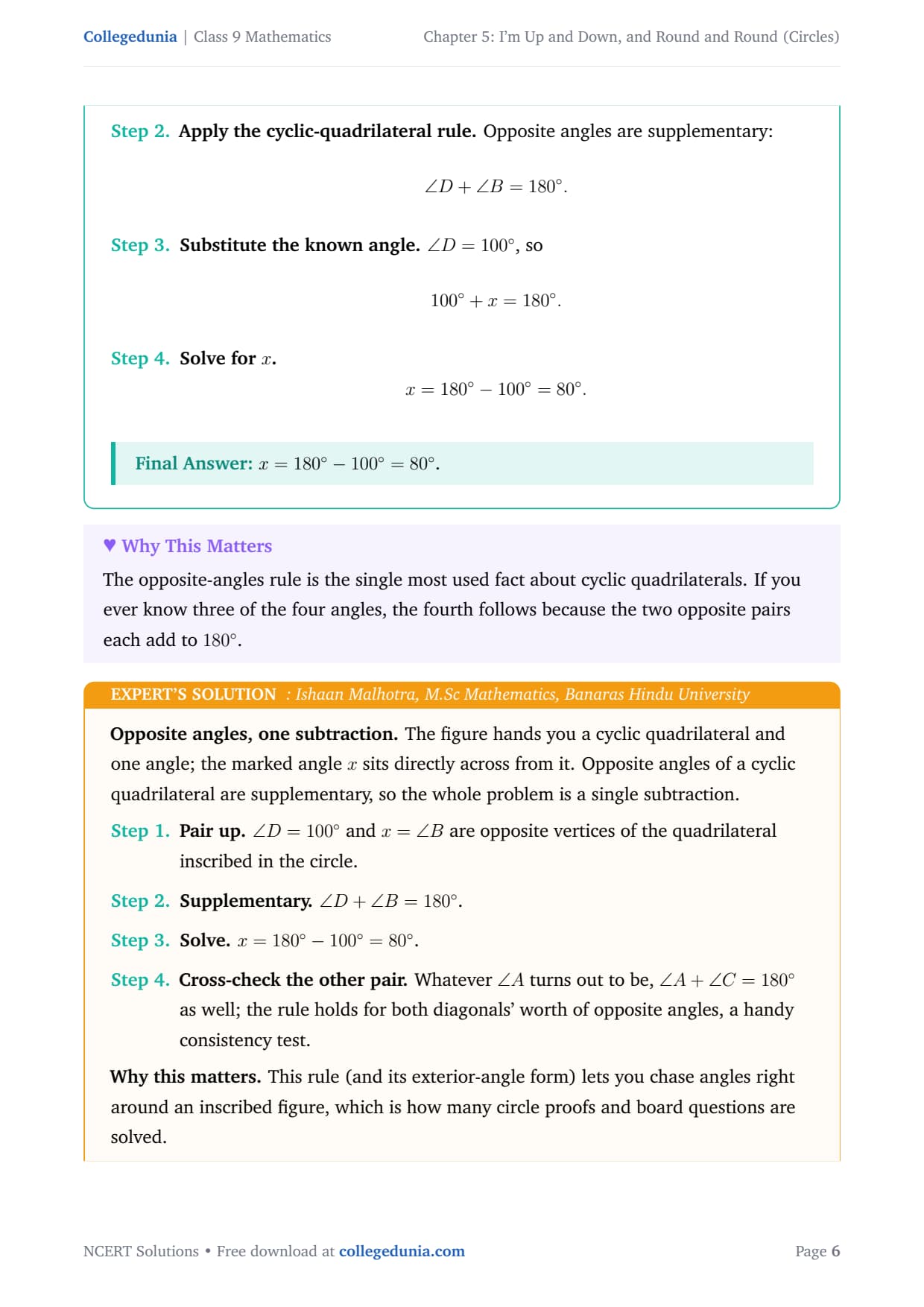
| Q3 | Find the unknown angle x in Fig. 5.26 |
Sample Solved Question from Exercise 5.6
Here is Question 1, solved in short steps.
Question: In a circle with centre O, the central angle AOB is 60∘. If the radius is 12 cm, find the length of chord AB.
Step 1. In triangle OAB, the two radii are equal: OA=OB=12 cm. The angle between them is 60∘.
Step 2. The triangle is isosceles, so the base angles are equal. They share 180∘-60∘=120∘, giving 60∘ each.
Step 3. All three angles are 60∘, so the triangle is equilateral. Every side equals the radius.
Final answer. The chord is AB=12 cm, the same as the radius.
How to Use These Circles Exercise 5.6 Solutions
Collegedunia keeps each angle and chord step separate, with the reason stated. Use the answers step by step.
- Join the chord ends to the centre so you get two equal radii.
- Use the isosceles triangle to find the base angles.
- Watch for the 60∘ case, where the chord simply equals the radius.
Work through the questions in order the first time, then use these solutions only to check your own steps. Redoing a question after you read the answer fixes the method far better than reading alone. A short daily set of these problems builds a firm base for the Class 9 annual exam and the circle theorems you meet in the Class 10 syllabus.
More Class 9 Maths Circles Solutions
Open the full chapter or any other exercise of Class 9 Maths Chapter 5 Circles from the table below.
| Page | Link |
|---|---|
| Circles Full Chapter Solutions | Circles Full Chapter Solutions |
| Circles Exercise 5.1 | Circles Exercise 5.1 |
| Circles Exercise 5.2 | Circles Exercise 5.2 |
| Circles Exercise 5.3 | Circles Exercise 5.3 |
| Circles Exercise 5.4 | Circles Exercise 5.4 |
| Circles Exercise 5.5 | Circles Exercise 5.5 |
| Circles Exercise 5.6 | Circles Exercise 5.6 |
| Circles End of Chapter | Circles End of Chapter |
Circles Exercise 5.6 NCERT Solutions FAQs
Ques. How many questions are in Class 9 Maths Circles Exercise 5.6?
Ans. There are three questions. They cover a central-angle chord, angles in the same segment, and an unknown angle from a figure.
Ques. What is special about a 60 degree central angle?
Ans. The triangle formed by the two radii and the chord becomes equilateral. So the chord has the same length as the radius.
Ques. How do two radii fix a chord?
Ans. Two radii and the angle between them set an isosceles triangle by side-angle-side. That fixes the third side, which is the chord.
Ques. Where can I download the Circles Exercise 5.6 solutions PDF?
Ans. The free PDF is on this page. It gives full working and figures for all three questions.



Comments