




The Introduction to Probability Exercise 7.3 set teaches you to list every outcome of an experiment, called the sample space. These NCERT Solutions Class 9 Maths Chapter 7 Introduction to Probability Exercise 7.3 solve all three questions in clear steps, matched to the new Ganita Manjari book, so you never miss an outcome.
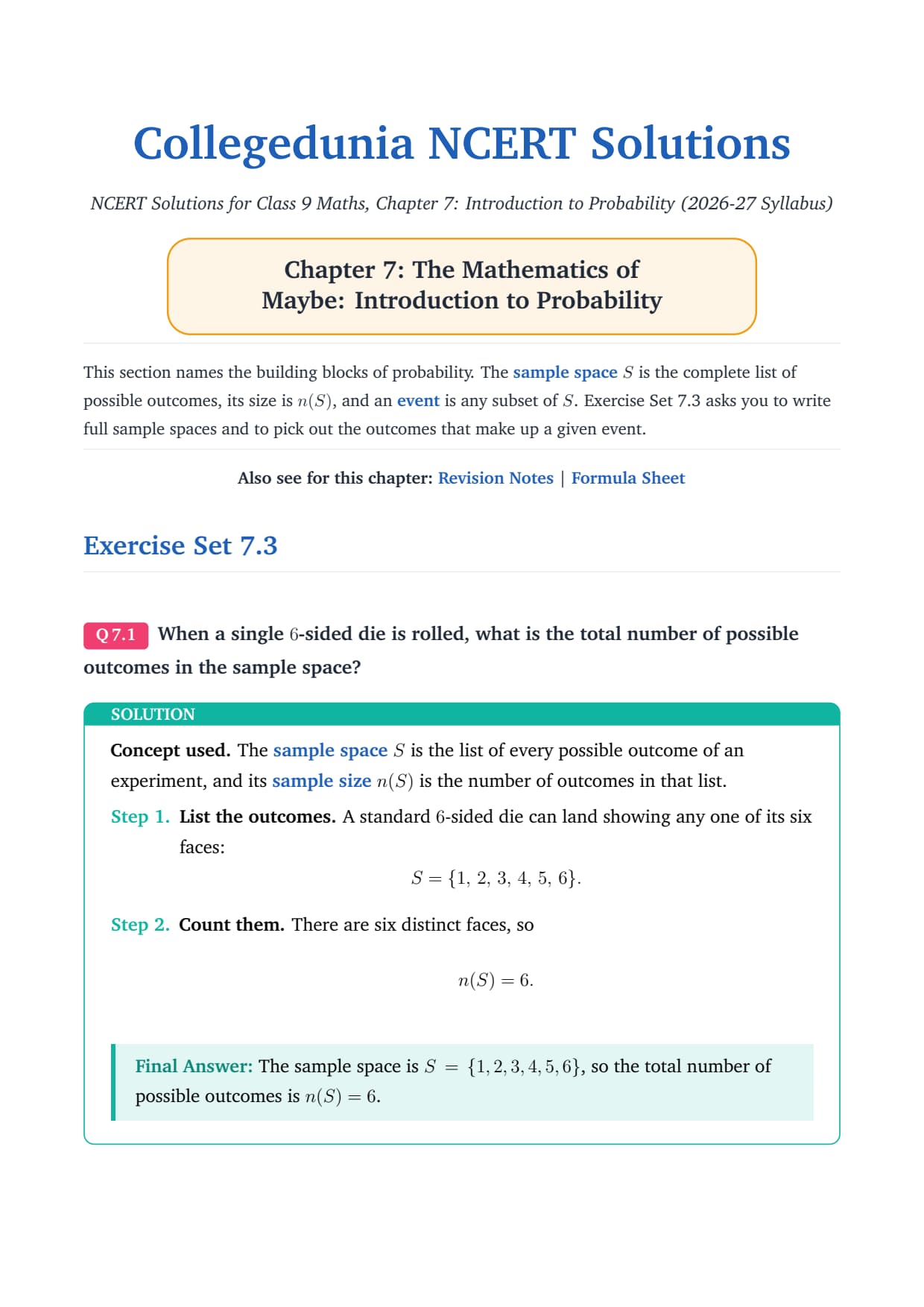
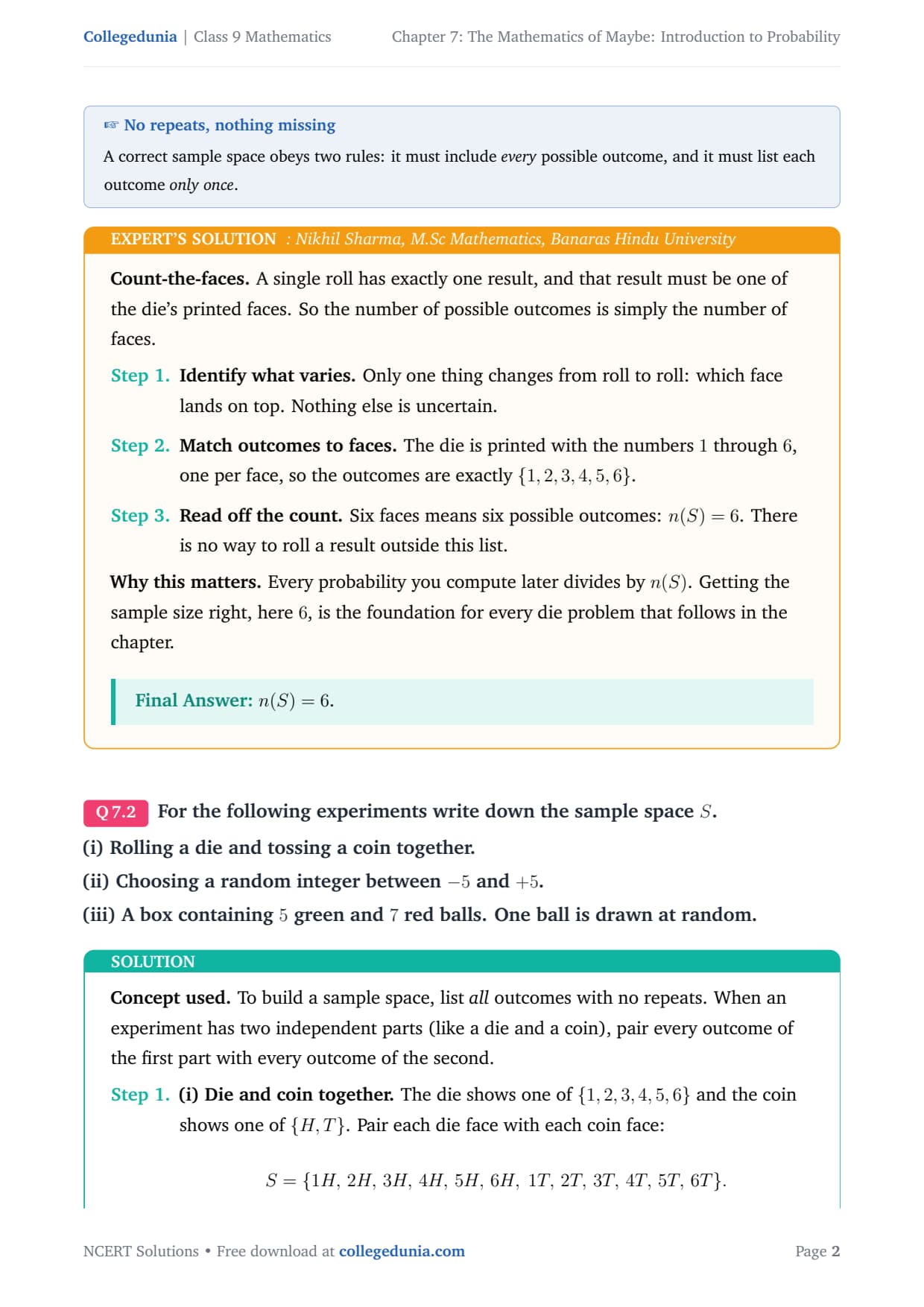
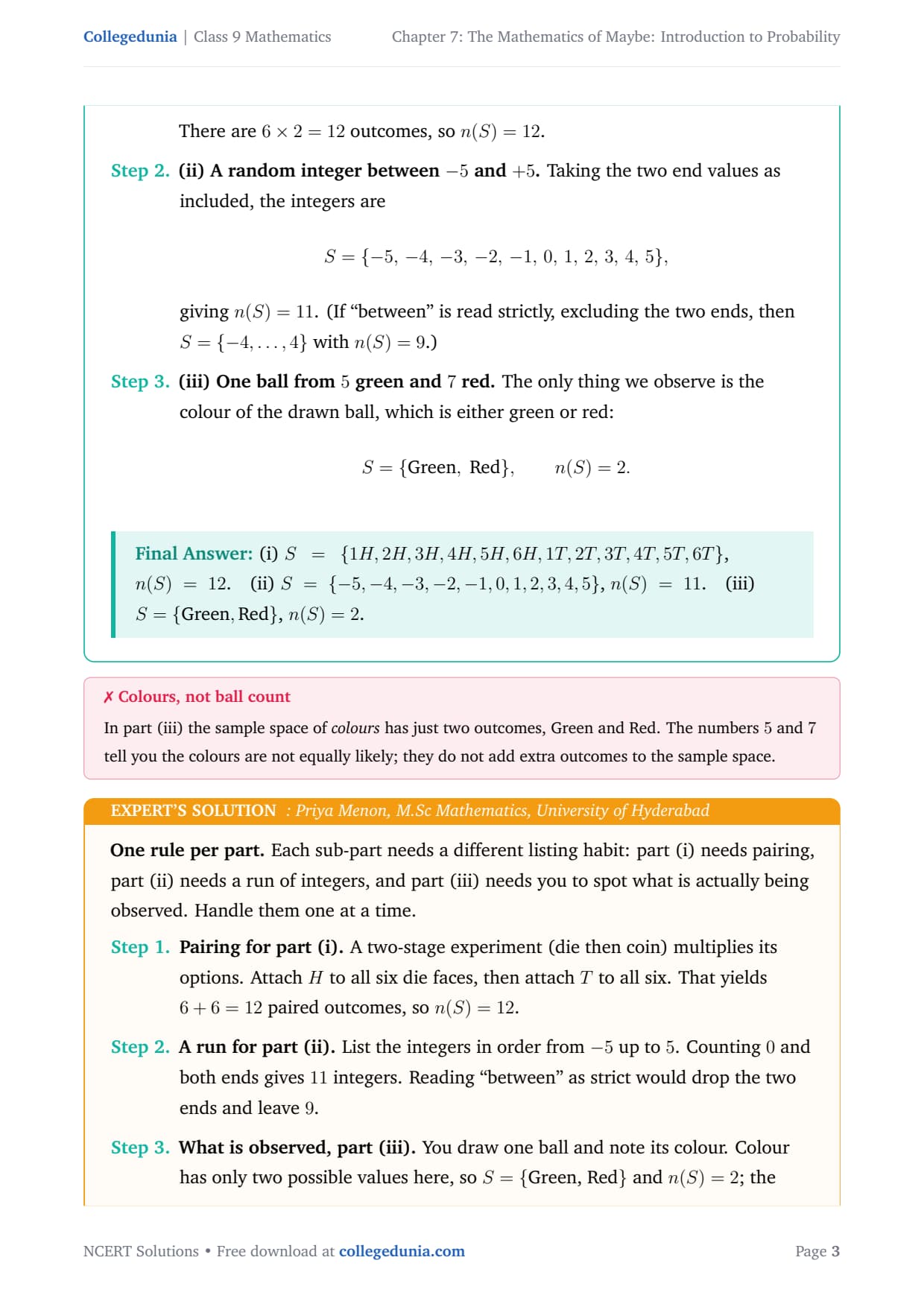
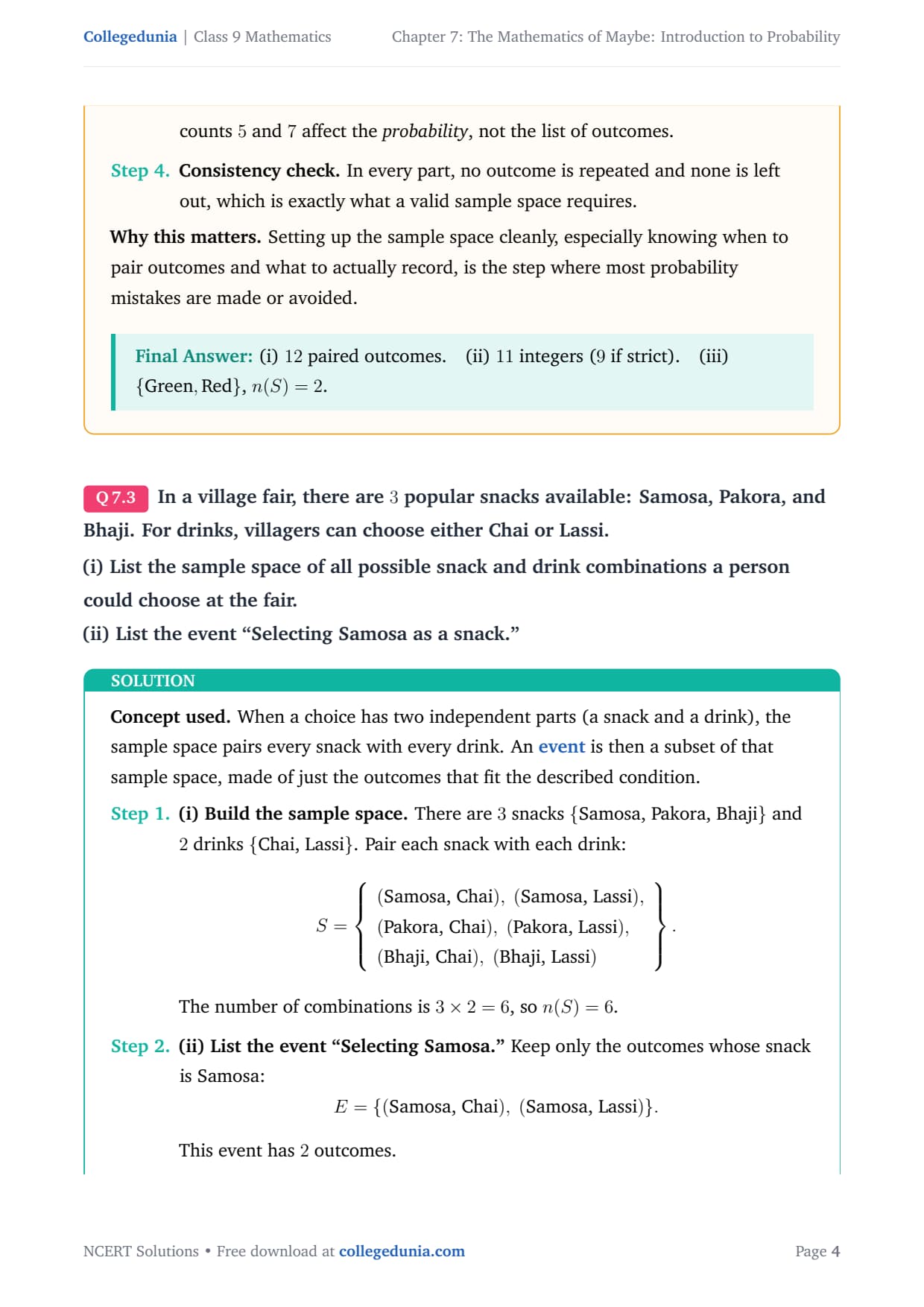
- Questions solved: all 3 questions on writing a sample space.
- Main skill: listing every outcome and counting the sample size n(S).
- Chapter link: it feeds the tree diagrams and combined events in Exercise 7.4.
These solutions are written by subject teachers, matched to the current 2026-27 NCERT book, and checked line by line so a Class 9 student can follow each outcome.
What Does Class 9 Maths Chapter 7 Introduction to Probability Exercise 7.3 Cover?
This exercise builds the idea of the sample space, written as S. The sample space is the full list of every possible outcome of an experiment. Its size, written n(S), is simply the number of outcomes in that list. When a choice has two parts, such as a snack and a drink, you pair each option of one part with each option of the other. This pairing gives a bigger sample space, and the count follows the rule 3× 2=6. You also meet the idea of an event, which is any subset of the sample space that fits a condition. Getting the sample space right is the base for every probability you will find later.
Video Walkthrough
Source: Magnet Brains on YouTube
Introduction to Probability Exercise 7.3 Question Breakdown
Exercise 7.3 has three questions. The bullets below show what each one asks, so you can plan your practice.
- Q1: a single die is rolled, find the total number of outcomes in the sample space.
- Q2: write the sample space S for a set of given experiments.
- Q3: a fair with three snacks and two drinks, list all pairs and one event.
Sample Solved Question from Exercise 7.3
Here is Question 3, solved step by step, so you can see how to pair two choices.
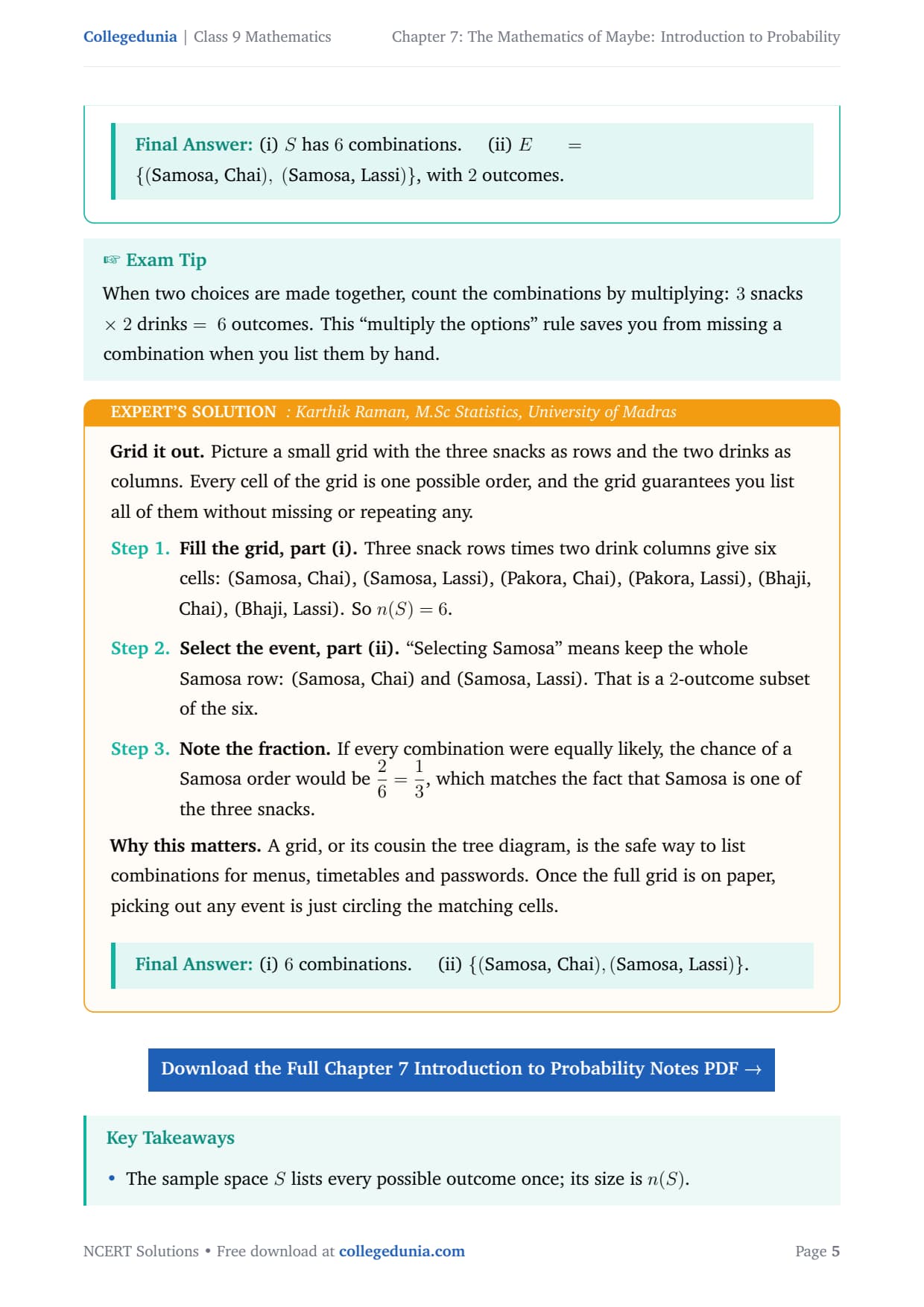
Question: A fair has 3 snacks (Samosa, Pakora, Bhaji) and 2 drinks (Chai, Lassi). (i) List the sample space of all snack and drink pairs. (ii) List the event of selecting Samosa.
Step 1. Pair each snack with each drink. This gives S=(Samosa, Chai),(Samosa, Lassi),(Pakora, Chai),(Pakora, Lassi),(Bhaji, Chai),(Bhaji, Lassi).
Step 2. Count the outcomes. There are 3× 2=6 pairs, so n(S)=6.
Step 3. For the event, keep only pairs whose snack is Samosa: E=(Samosa, Chai),(Samosa, Lassi).
Final answer. The sample space has 6 pairs, and the Samosa event has 2 outcomes.
How to Use These Introduction to Probability Exercise 7.3 Solutions
Write your own sample space first, then use these Collegedunia solutions to check that your list is complete and in a clear order. A neat, ordered list is the fastest way to spot a missing outcome before it costs you a mark.
- Always count your list and confirm it matches the product rule, like 3× 2.
- Keep outcomes in a fixed pattern so none is repeated or dropped.
- Underline the outcomes that form the event before you count them.
More Class 9 Maths Introduction to Probability Solutions
Use the table below to open the full chapter or any other exercise of this chapter.
| Page | Link |
|---|---|
| Full Chapter Solutions | Introduction to Probability NCERT Solutions |
| Exercise 7.1 | Introduction to Probability Exercise 7.1 |
| Exercise 7.2 | Introduction to Probability Exercise 7.2 |
| Exercise 7.3 | Introduction to Probability Exercise 7.3 |
| Exercise 7.4 | Introduction to Probability Exercise 7.4 |
| End of Chapter | Introduction to Probability End of Chapter |
Introduction to Probability Exercise 7.3 NCERT Solutions FAQs
Ques. How many questions are in Class 9 Maths Exercise 7.3?
Ans. Exercise 7.3 has three questions. All of them ask you to write or count the sample space of an experiment.
Ques. What is a sample space in Exercise 7.3?
Ans. The sample space S is the full list of every possible outcome of an experiment. Its size n(S) is the number of outcomes.
Ques. How do I find the sample space for two choices?
Ans. Pair each option of the first choice with each option of the second. For 3 snacks and 2 drinks you get 3× 2=6 pairs.
Ques. Where can I download the Exercise 7.3 solutions PDF?
Ans. You can download the Introduction to Probability Exercise 7.3 solutions PDF free from this Collegedunia page in both Normal and HD versions.



Comments