




The UP Board Class 12 Accountancy question paper with solutions (Set 349 MH) is available here for free download. UP Board Class 12 Accountancy 2026 was conducted by the Uttar Pradesh Madhyamik Shiksha Parishad (UPMSP) on March 11, 2026, as a 100-mark paper of 30 questions to be solved in 3 hours 15 minutes.
| UP Board Class 12 Accountancy Question Paper with Solutions (Set 349 MH) | Download PDF | Check Solutions |
UP Board Class 12 Accountancy 2026 (Set 349 MH) Questions with Solutions
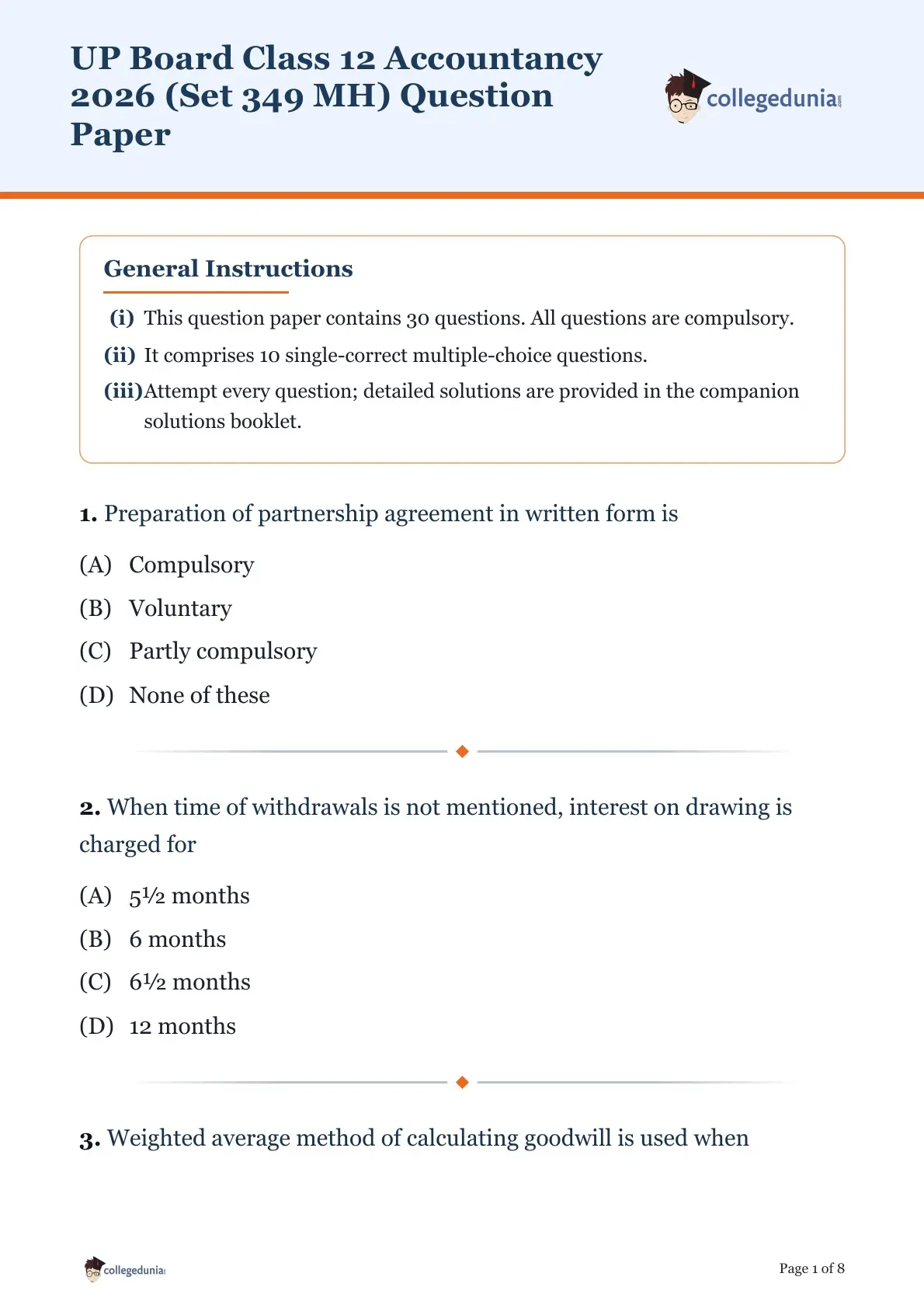
Preparation of partnership agreement in written form is
When time of withdrawals is not mentioned, interest on drawing is charged for
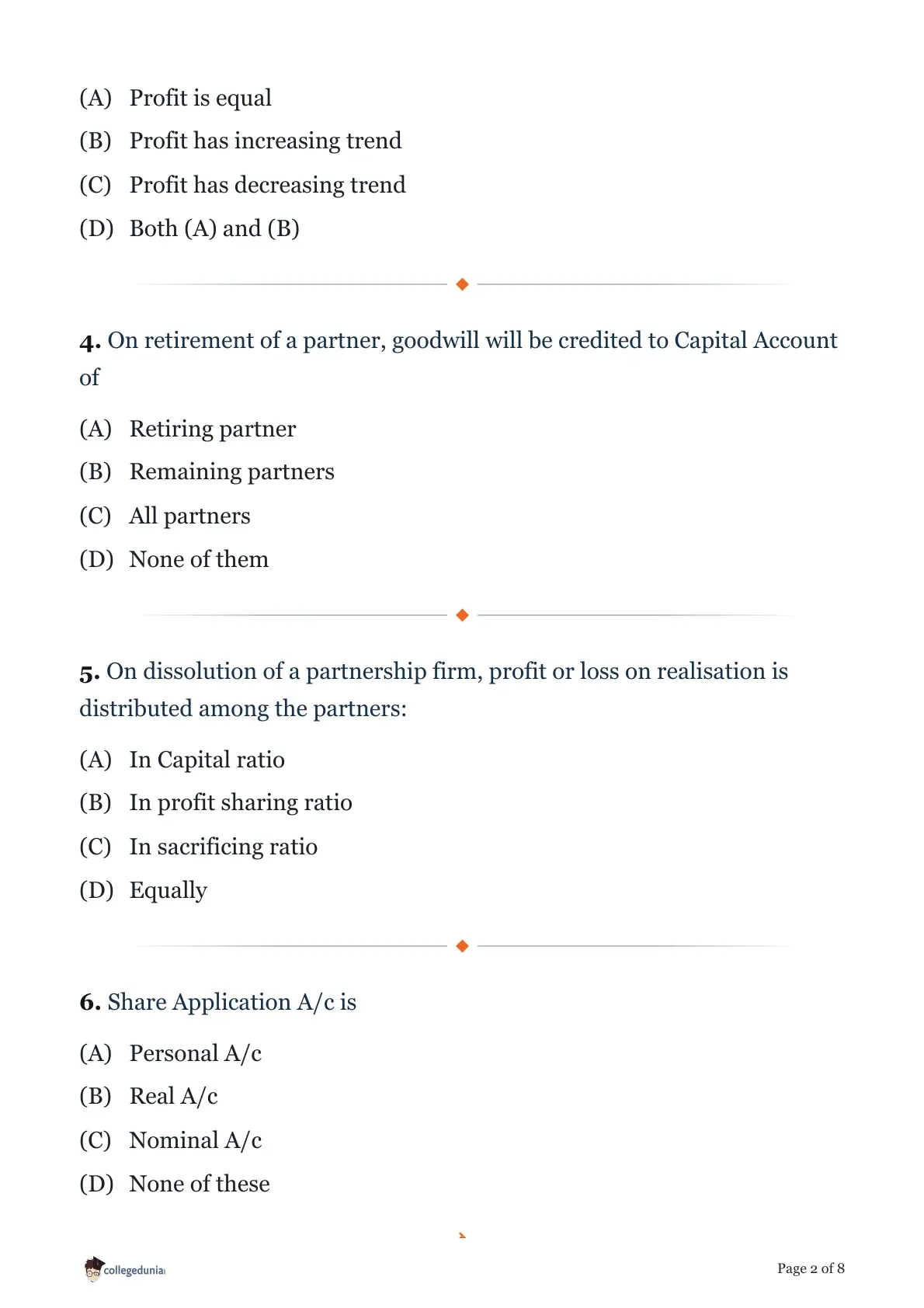
Weighted average method of calculating goodwill is used when
On retirement of a partner, goodwill will be credited to Capital Account of
On dissolution of a partnership firm, profit or loss on realisation is distributed among the partners:
Share Application A/c is
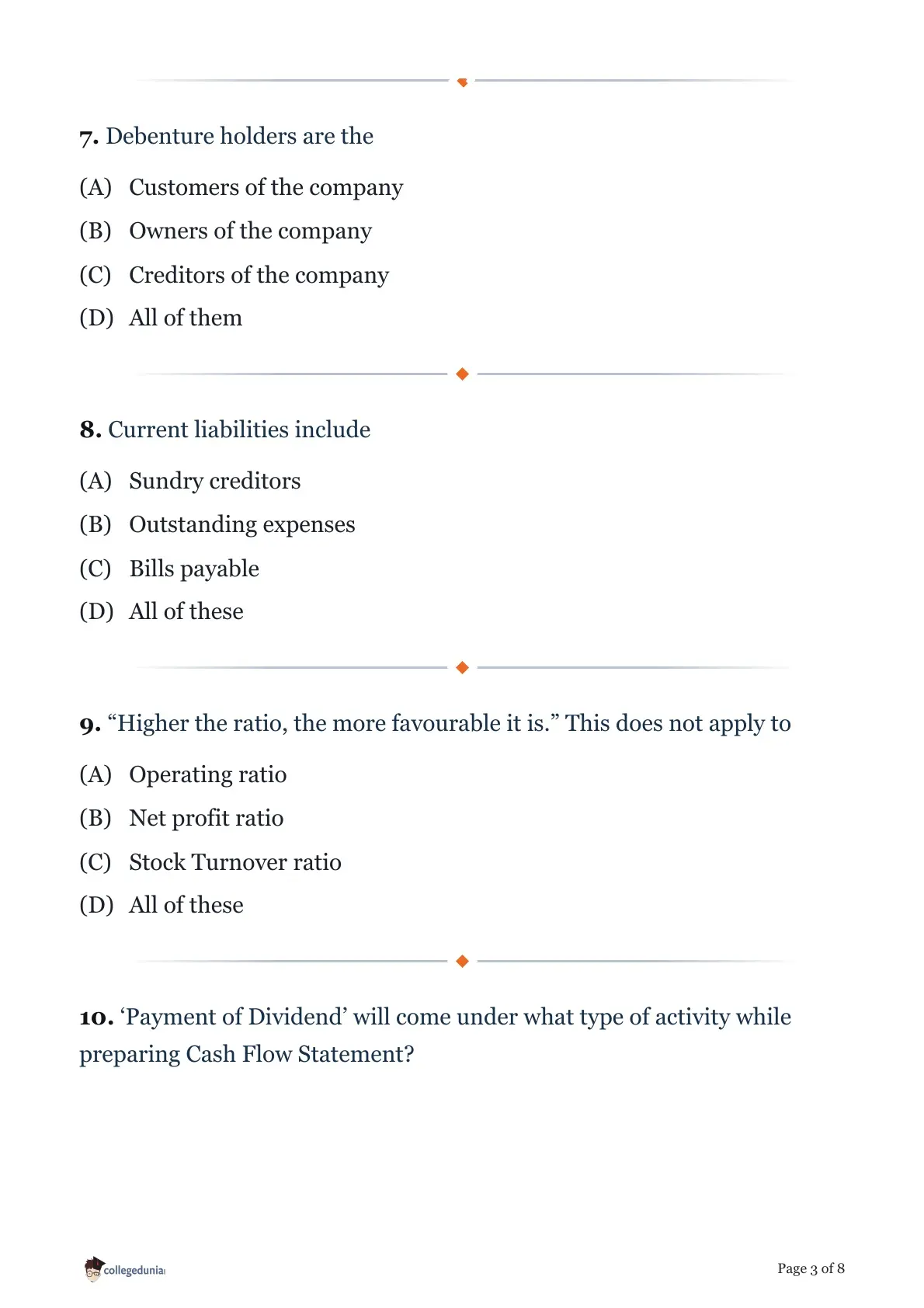
Debenture holders are the
Current liabilities include
“Higher the ratio, the more favourable it is.” This does not apply to
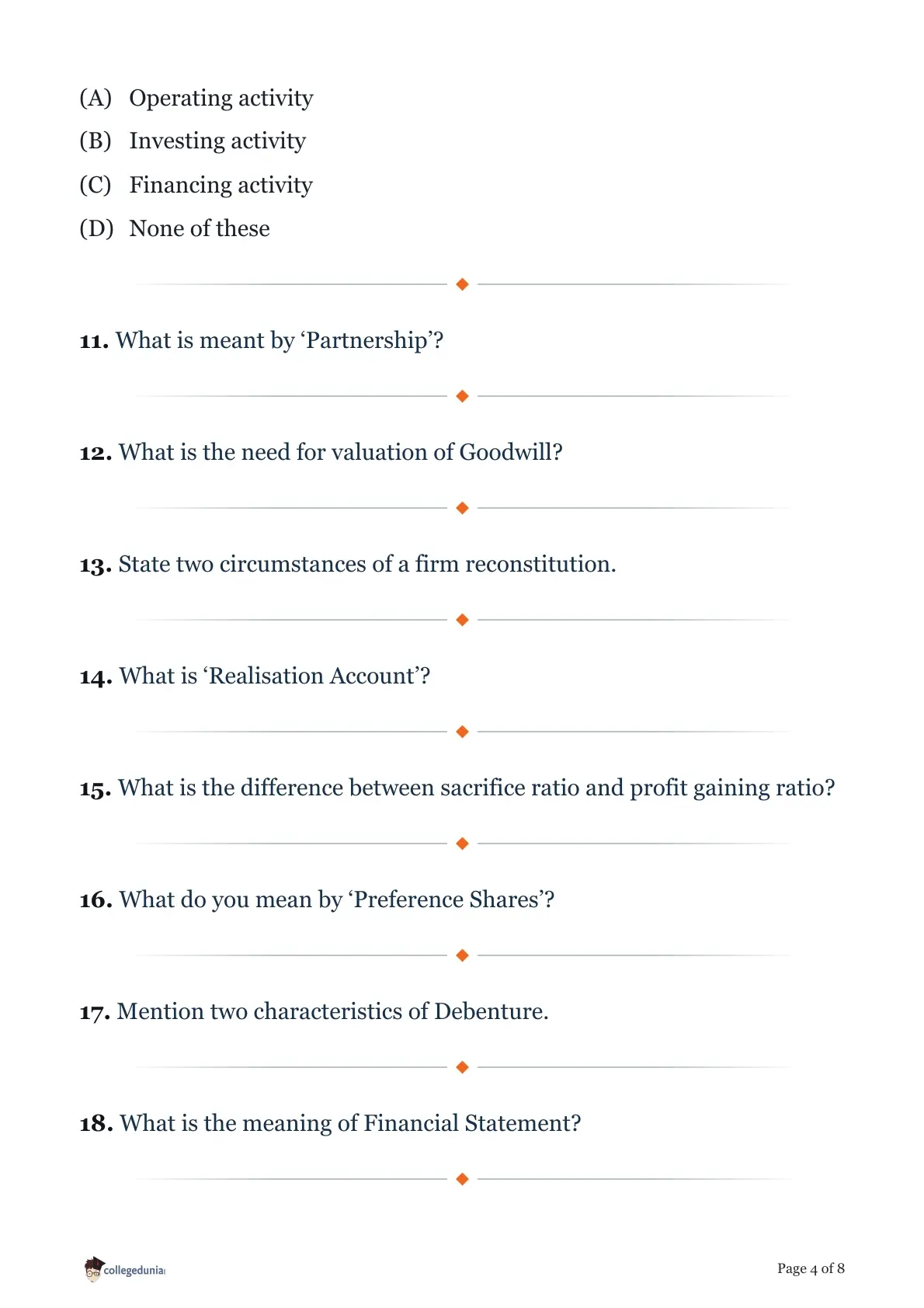
‘Payment of Dividend’ will come under what type of activity while preparing Cash Flow Statement?
What is meant by ‘Partnership’?
What is the need for valuation of Goodwill?
State two circumstances of a firm reconstitution.
What is ‘Realisation Account’?
What is the difference between sacrifice ratio and profit gaining ratio?
What do you mean by ‘Preference Shares’?
Mention two characteristics of Debenture.
What is the meaning of Financial Statement?
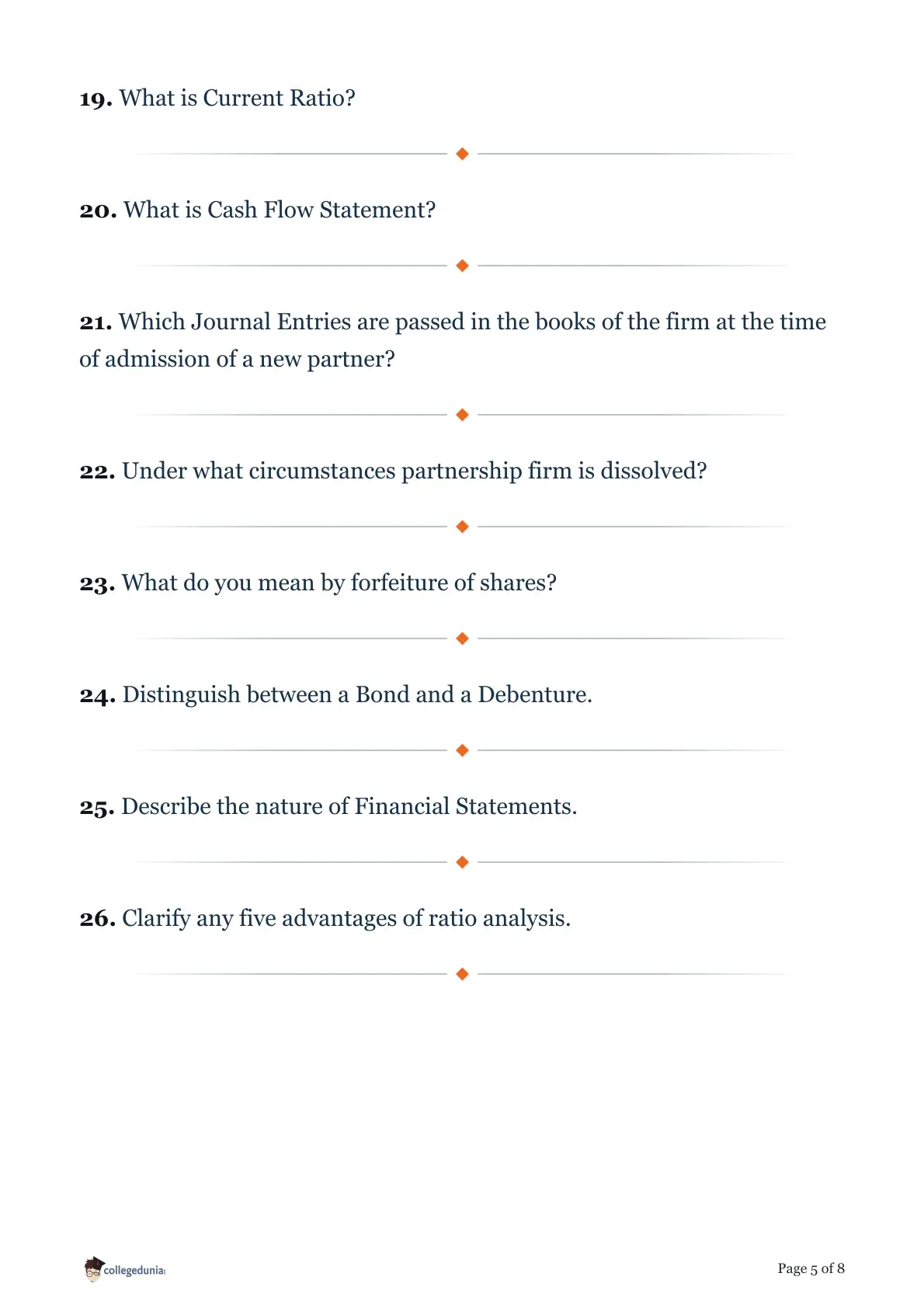
What is Current Ratio?
What is Cash Flow Statement?
Which Journal Entries are passed in the books of the firm at the time of admission of a new partner?
Under what circumstances partnership firm is dissolved?
What do you mean by forfeiture of shares?
Distinguish between a Bond and a Debenture.
Describe the nature of Financial Statements.
Clarify any five advantages of ratio analysis.
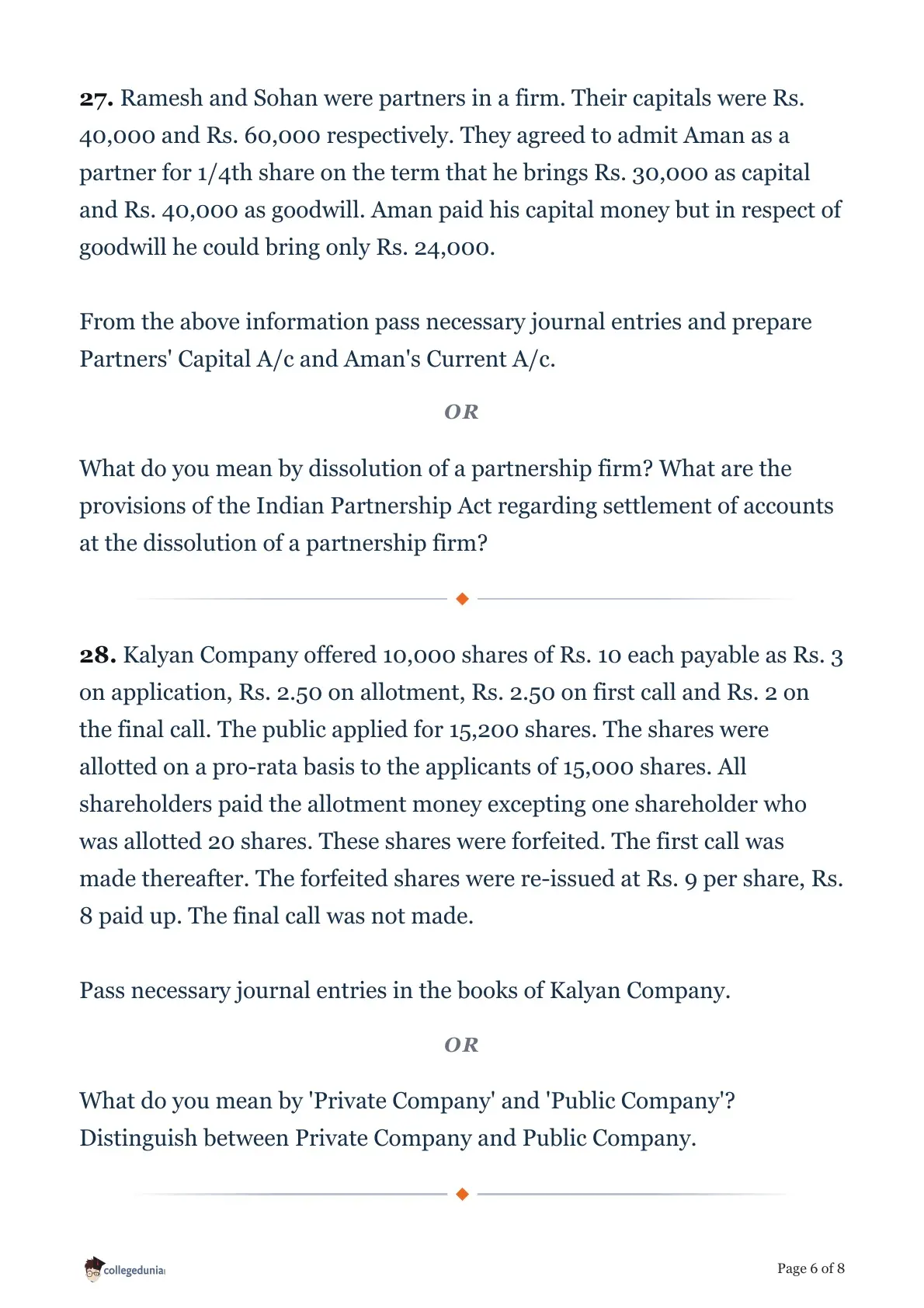
Ramesh and Sohan were partners in a firm. Their capitals were Rs. 40,000 and Rs. 60,000 respectively. They agreed to admit Aman as a partner for 1/4th share on the term that he brings Rs. 30,000 as capital and Rs. 40,000 as goodwill. Aman paid his capital money but in respect of goodwill he could bring only Rs. 24,000.
From the above information pass necessary journal entries and prepare Partners' Capital A/c and Aman's Current A/c.
What do you mean by dissolution of a partnership firm? What are the provisions of the Indian Partnership Act regarding settlement of accounts at the dissolution of a partnership firm?
Kalyan Company offered 10,000 shares of Rs. 10 each payable as Rs. 3 on application, Rs. 2.50 on allotment, Rs. 2.50 on first call and Rs. 2 on the final call. The public applied for 15,200 shares. The shares were allotted on a pro-rata basis to the applicants of 15,000 shares. All shareholders paid the allotment money excepting one shareholder who was allotted 20 shares. These shares were forfeited. The first call was made thereafter. The forfeited shares were re-issued at Rs. 9 per share, Rs. 8 paid up. The final call was not made.
Pass necessary journal entries in the books of Kalyan Company.
What do you mean by 'Private Company' and 'Public Company'? Distinguish between Private Company and Public Company.
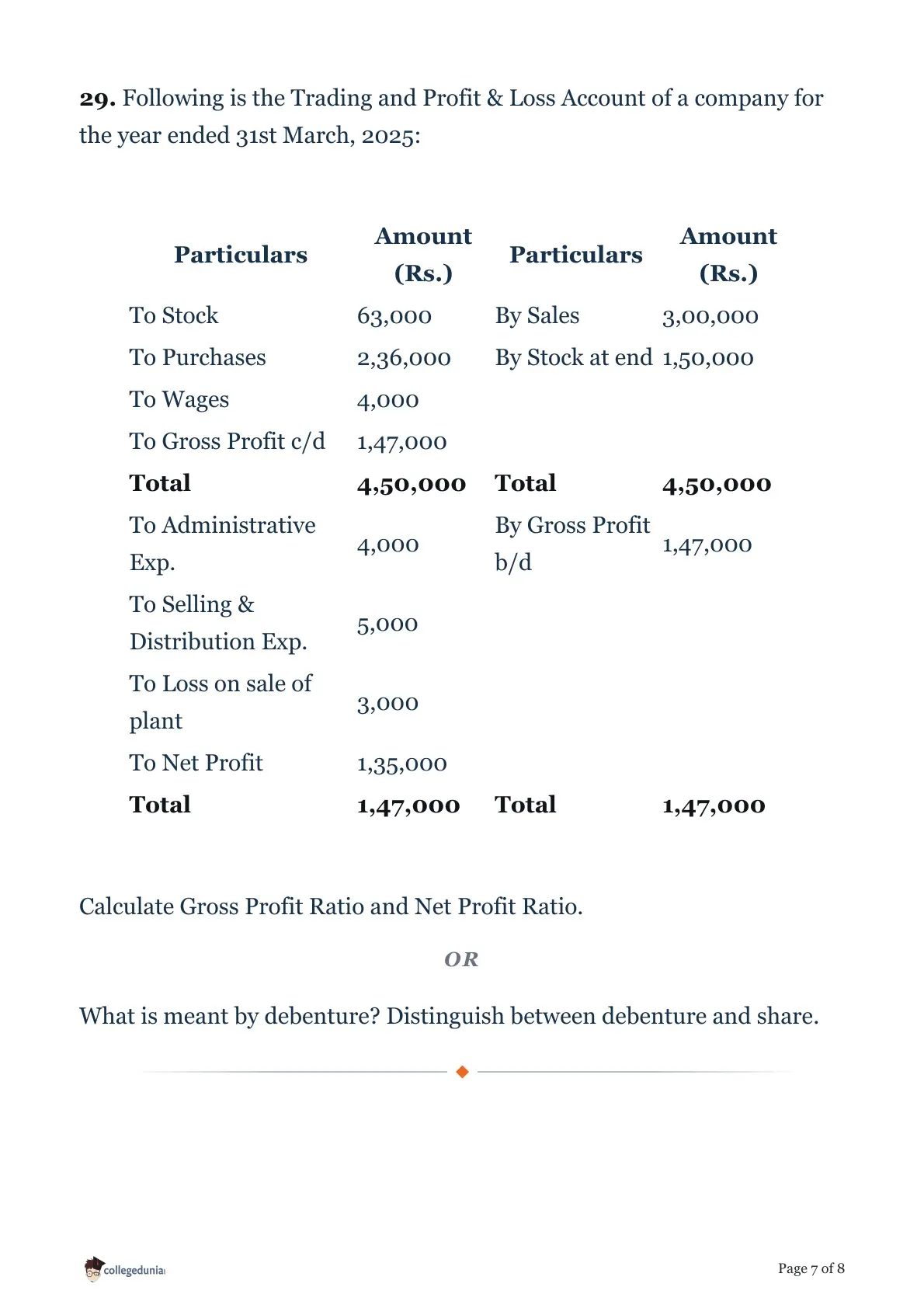
Following is the Trading and Profit & Loss Account of a company for the year ended 31st March, 2025:
| Particulars | Amount (Rs.) | Particulars | Amount (Rs.) |
|---|---|---|---|
| To Stock | 63,000 | By Sales | 3,00,000 |
| To Purchases | 2,36,000 | By Stock at end | 1,50,000 |
| To Wages | 4,000 | ||
| To Gross Profit c/d | 1,47,000 | ||
| Total | 4,50,000 | Total | 4,50,000 |
| To Administrative Exp. | 4,000 | By Gross Profit b/d | 1,47,000 |
| To Selling & Distribution Exp. | 5,000 | ||
| To Loss on sale of plant | 3,000 | ||
| To Net Profit | 1,35,000 | ||
| Total | 1,47,000 | Total | 1,47,000 |
Calculate Gross Profit Ratio and Net Profit Ratio.
What is meant by debenture? Distinguish between debenture and share.
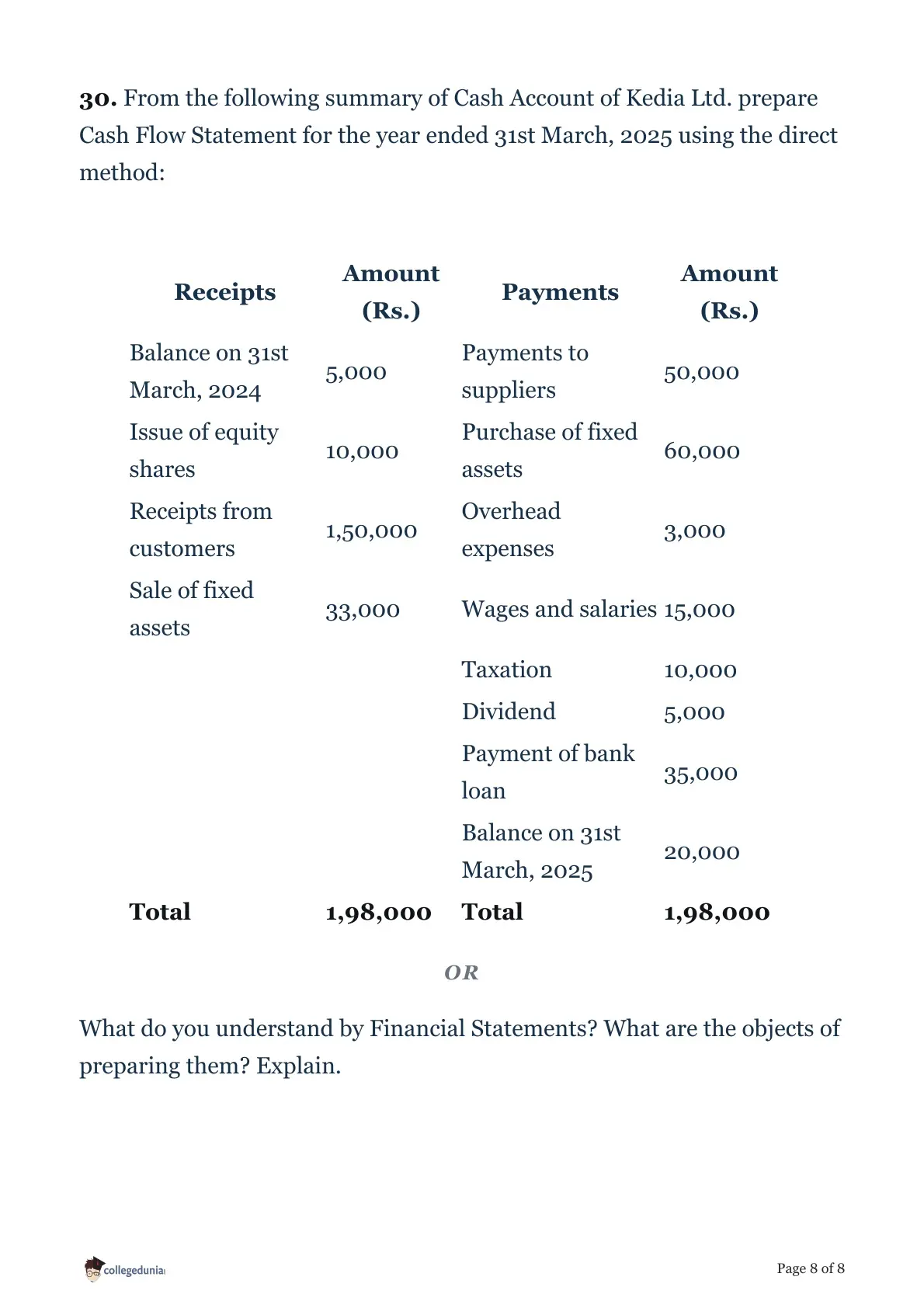
From the following summary of Cash Account of Kedia Ltd. prepare Cash Flow Statement for the year ended 31st March, 2025 using the direct method:
| Receipts | Amount (Rs.) | Payments | Amount (Rs.) |
|---|---|---|---|
| Balance on 31st March, 2024 | 5,000 | Payments to suppliers | 50,000 |
| Issue of equity shares | 10,000 | Purchase of fixed assets | 60,000 |
| Receipts from customers | 1,50,000 | Overhead expenses | 3,000 |
| Sale of fixed assets | 33,000 | Wages and salaries | 15,000 |
| Taxation | 10,000 | ||
| Dividend | 5,000 | ||
| Payment of bank loan | 35,000 | ||
| Balance on 31st March, 2025 | 20,000 | ||
| Total | 1,98,000 | Total | 1,98,000 |
What do you understand by Financial Statements? What are the objects of preparing them? Explain.
UP Board Class 12 Accountancy 2026 Exam Pattern and Marking Scheme Explained
The Set 349 MH paper is bilingual (Hindi and English) and every question is compulsory, apart from the internal choice in the four long-answer questions.
- Total questions: 30 questions - 10 MCQs, 10 very short answer, 6 short answer and 4 long answer
- Total marks: 100 - MCQs 10, very short answer 20, short answer 30 and long answer 40
- Duration: 3 hours 15 minutes, with the first 15 minutes given for reading the question paper
- Word limits: about 30 words for Q11 to Q20 (2 marks each) and about 100 words for Q21 to Q26 (5 marks each)
- Internal choice: each of Q27, Q28, Q29 and Q30 (10 marks) offers an OR alternative
High-Weightage Topics in UP Board Class 12 Accountancy 2026 to Focus On First
The four long-answer questions carried 40 of the 100 marks in Set 349 MH, and each has a numerical option that needs proper practice.
- Long answer (Q27 to Q30): 40 of 100 marks - admission of a partner with goodwill (Q27), issue and forfeiture of shares (Q28), ratio analysis (Q29) and a direct-method cash flow statement (Q30), each with a theory alternative
- Short answer (Q21 to Q26): 30 of 100 marks - journal entries on admission of a partner, dissolution of a firm, forfeiture of shares, bond versus debenture, financial statements and ratio analysis
- Very short answer (Q11 to Q20): 20 of 100 marks - definitions such as partnership, goodwill, realisation account, preference shares, current ratio and cash flow statement
- MCQs (Q1 to Q10): 10 of 100 marks - partnership agreement, interest on drawings, goodwill, realisation, shares, debentures and cash flow activities
UP Board Class 12 Accountancy Sample Paper Solution Video
Source: Commerce Wallah UP Board 11th & 12th
How to Use the UP Board Class 12 Accountancy Question Paper for Practice
Treat this Set 349 MH paper as a timed mock before you check the solutions.
- Attempt all 30 questions in 3 hours 15 minutes under exam conditions first
- Solve both options of Q27 to Q30, since the numerical option and the theory option test different skills
- Write out every journal entry and the cash flow statement in full, because Q27 to Q30 alone carry 40 marks
- Review each answer against the step-by-step solution PDF, not just the final figure
UP Board Class 12 Accountancy 2026 Question Paper FAQs
Ques. When was the UP Board Class 12 Accountancy 2026 exam conducted?
Ans. UPMSP conducted the UP Board Class 12 Accountancy 2026 exam on March 11, 2026, in the morning shift from 8:30 am to 11:45 am, during the intermediate exams that ran from February 18 to March 12, 2026. The official time table is on upmsp.edu.in.
Ques. How many questions are there in the UP Board Class 12 Accountancy 2026 paper, and is there any choice?
Ans. The paper has 30 questions worth 100 marks. All are compulsory, but each of the four 10-mark long-answer questions (Q27 to Q30) gives you an OR alternative.
Ques. What is the marking scheme for UP Board Class 12 Accountancy 2026?
Ans. Q1 to Q10 are MCQs of 1 mark each, Q11 to Q20 carry 2 marks each, Q21 to Q26 carry 5 marks each and Q27 to Q30 carry 10 marks each, for a total of 100 marks in 3 hours 15 minutes.
Ques. Which questions carried the highest weightage in UP Board Class 12 Accountancy 2026 Set 349 MH?
Ans. The four long-answer questions (Q27 to Q30) carried the most marks at 40 of 100, followed by the six short-answer questions at 30 marks and the ten very short-answer questions at 20 marks.
Ques. Where can I download the UP Board Class 12 Accountancy 2026 Set 349 MH question paper with solutions PDF for free?
Ans. You can download both the question paper and the full step-by-step solutions PDF for Set 349 MH from the table at the top of this page, for free.



Comments