




The UP Board Class 12 Chemistry 2026 question paper for Set 347 DZ is now available with full step-by-step solutions for free download. This paper was conducted by the Uttar Pradesh Madhyamik Shiksha Parishad (UPMSP) on February 25, 2026 (2:00 PM to 5:15 PM), and carried 26 questions for 70 marks in 3 hours 15 minutes.
| UP Board Class 12 Chemistry 2026 Set 347 DZ Question Paper with Solutions | Download PDF | Check Solutions |
UP Board Class 12 Chemistry 2026 Set 347 DZ Questions with Solutions
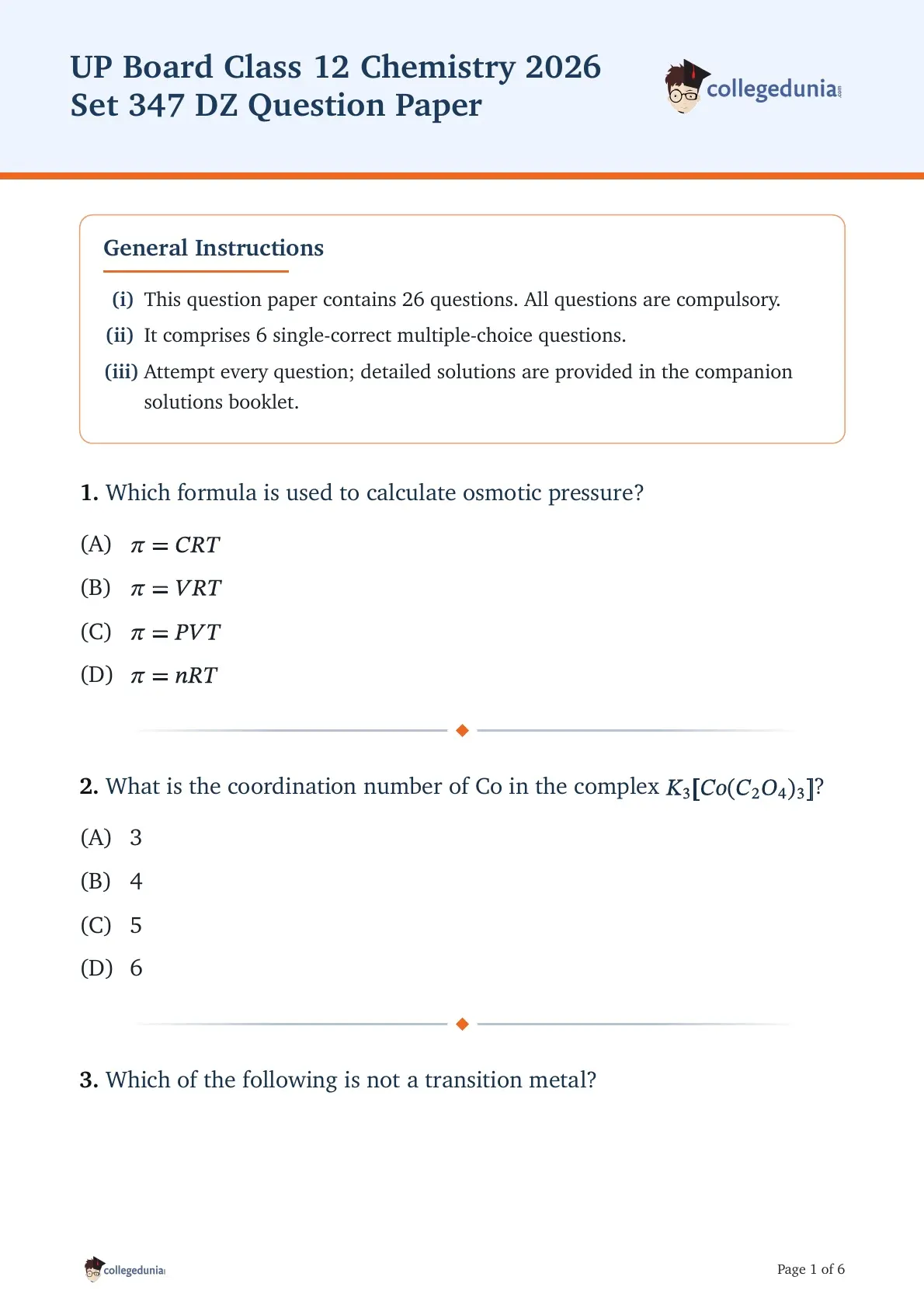
Which formula is used to calculate osmotic pressure?
What is the coordination number of Co in the complex \( K_3[Co(C_2O_4)_3] \)?
Which of the following is not a transition metal?
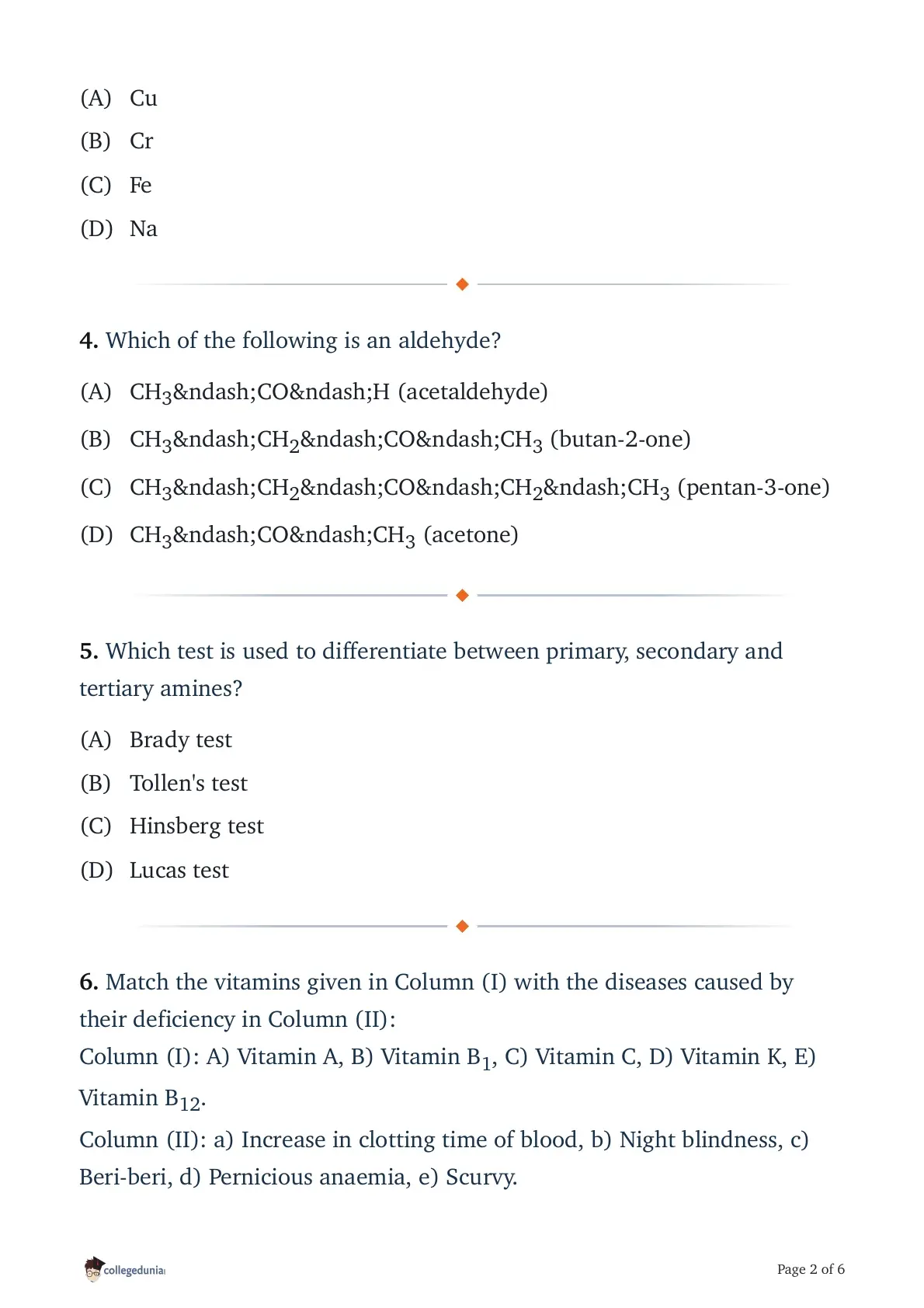
Which of the following is an aldehyde?
Which test is used to differentiate between primary, secondary and tertiary amines?
Match the vitamins given in Column (I) with the diseases caused by their deficiency in Column (II):
Column (I): A) Vitamin A, B) Vitamin B1, C) Vitamin C, D) Vitamin K, E) Vitamin B12.
Column (II): a) Increase in clotting time of blood, b) Night blindness, c) Beri-beri, d) Pernicious anaemia, e) Scurvy.
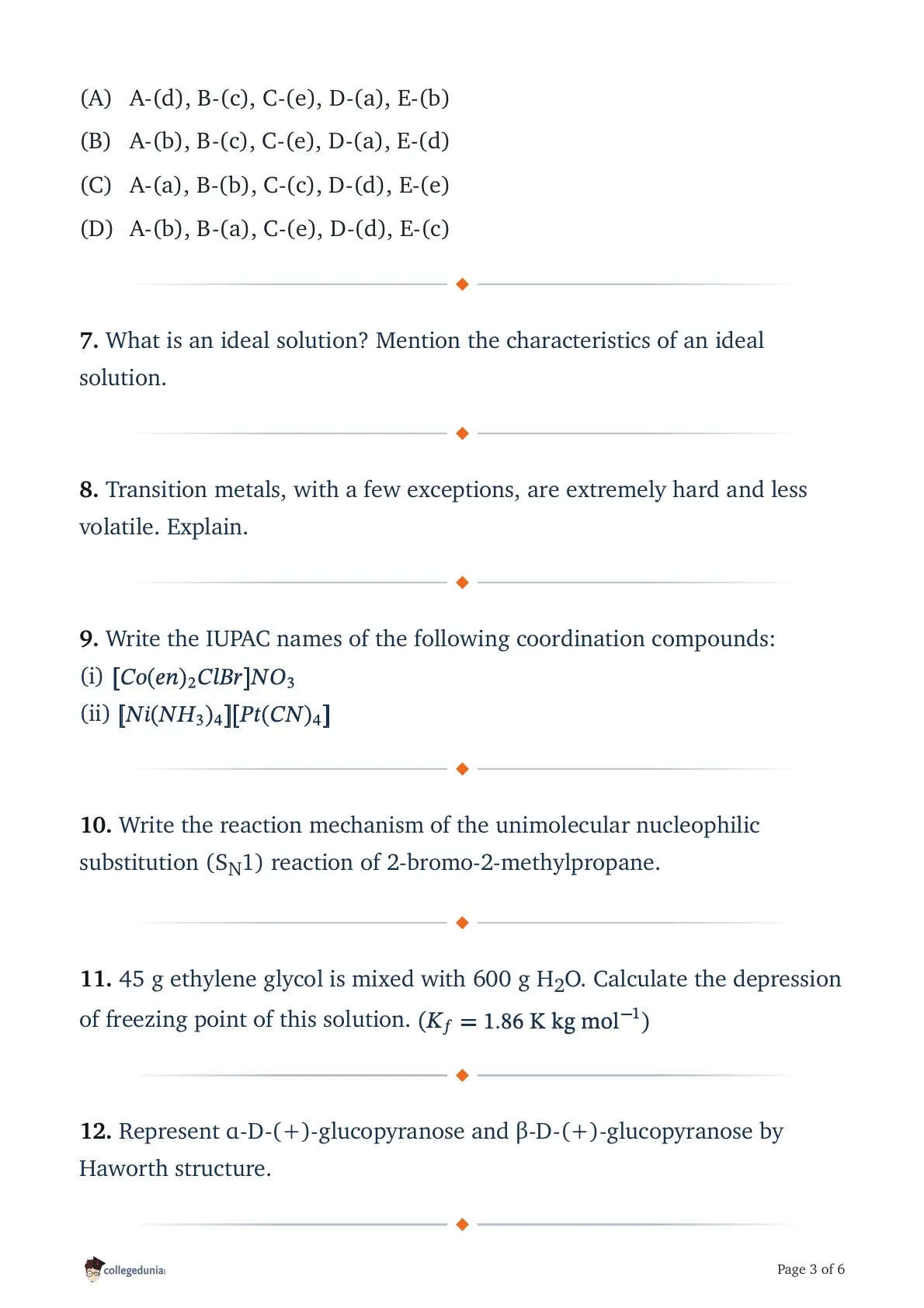
What is an ideal solution? Mention the characteristics of an ideal solution.
Transition metals, with a few exceptions, are extremely hard and less volatile. Explain.
Write the IUPAC names of the following coordination compounds:
(i) \( [Co(en)_2ClBr]NO_3 \)
(ii) \( [Ni(NH_3)_4][Pt(CN)_4] \)
Write the reaction mechanism of the unimolecular nucleophilic substitution (SN1) reaction of 2-bromo-2-methylpropane.
45 g ethylene glycol is mixed with 600 g H2O. Calculate the depression of freezing point of this solution. \( (K_f = 1.86\ \text{K kg mol}^{-1}) \)
Represent α-D-(+)-glucopyranose and β-D-(+)-glucopyranose by Haworth structure.
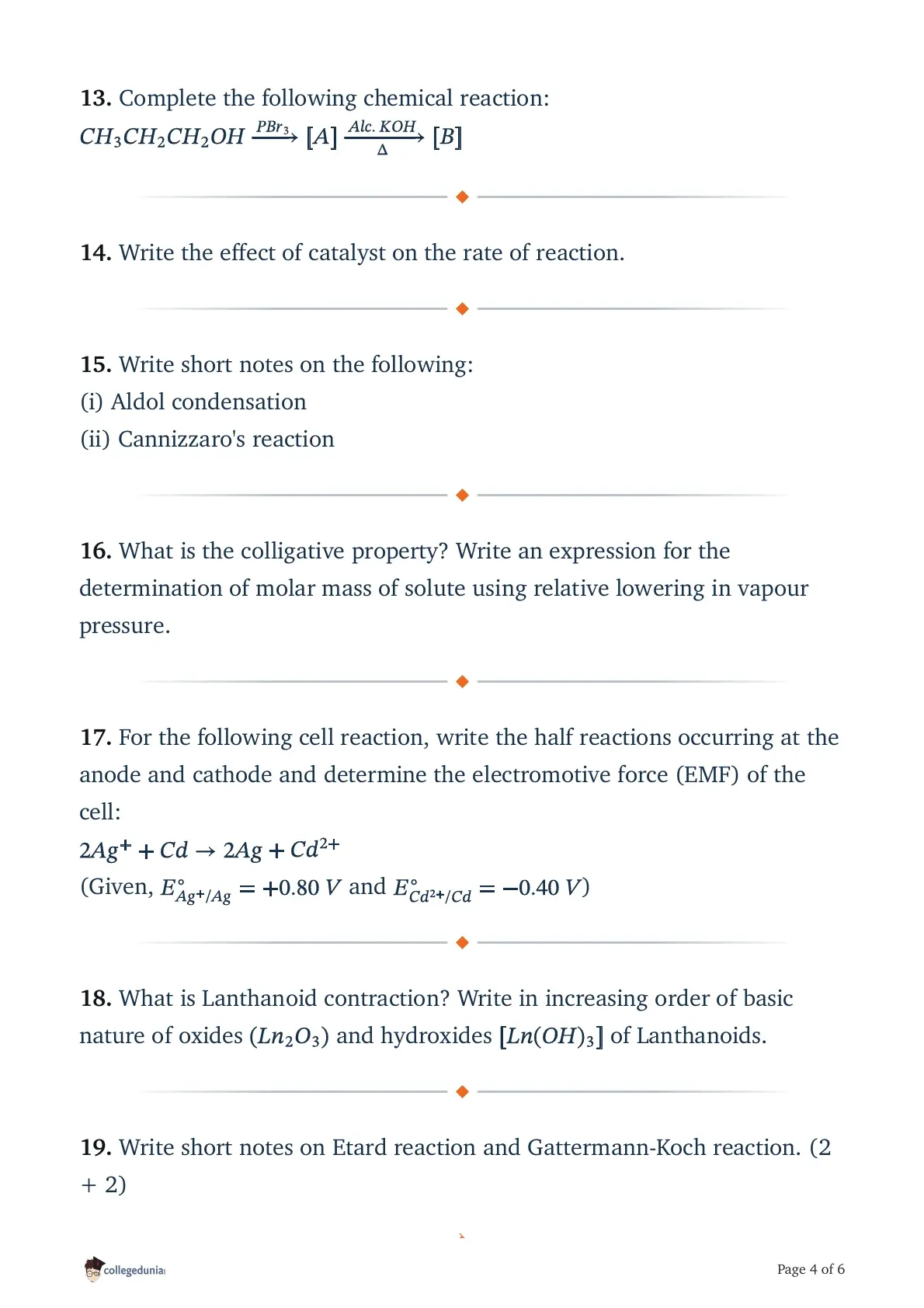
Complete the following chemical reaction:
\( CH_3CH_2CH_2OH \xrightarrow{PBr_3} [A] \xrightarrow[\Delta]{Alc.\ KOH} [B] \)
Write the effect of catalyst on the rate of reaction.
Write short notes on the following:
(i) Aldol condensation
(ii) Cannizzaro's reaction
What is the colligative property? Write an expression for the determination of molar mass of solute using relative lowering in vapour pressure.
For the following cell reaction, write the half reactions occurring at the anode and cathode and determine the electromotive force (EMF) of the cell:
\( 2Ag^+ + Cd \rightarrow 2Ag + Cd^{2+} \)
(Given, \( E^{\circ}_{Ag^+/Ag} = +0.80\ V \) and \( E^{\circ}_{Cd^{2+}/Cd} = -0.40\ V \))
What is Lanthanoid contraction? Write in increasing order of basic nature of oxides \( (Ln_2O_3) \) and hydroxides \( [Ln(OH)_3] \) of Lanthanoids.
Write short notes on Etard reaction and Gattermann-Koch reaction. (2 + 2)
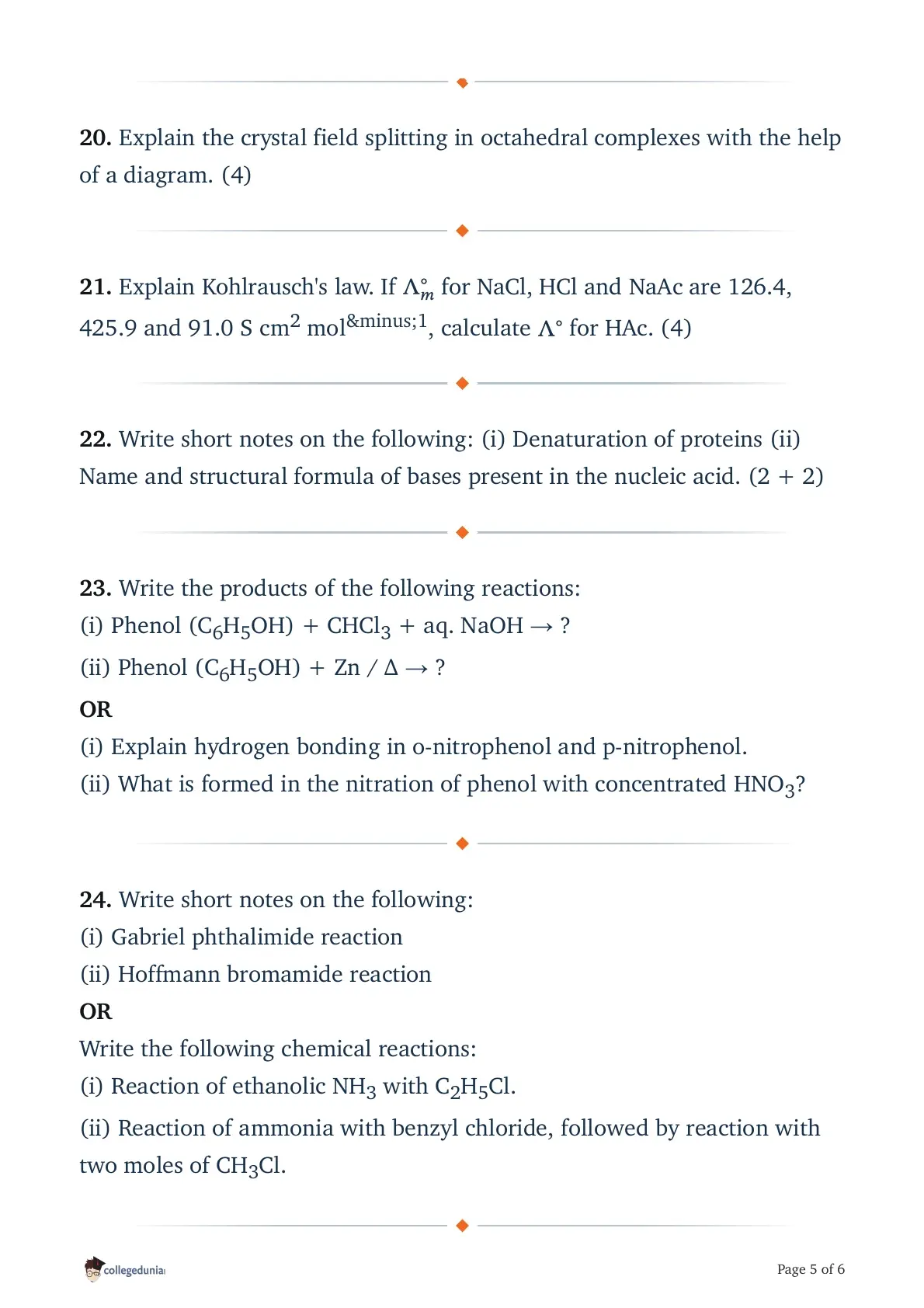
Explain the crystal field splitting in octahedral complexes with the help of a diagram. (4)
Explain Kohlrausch's law. If \(\Lambda^\circ_m\) for NaCl, HCl and NaAc are 126.4, 425.9 and 91.0 S cm2 mol−1, calculate \(\Lambda^\circ\) for HAc. (4)
Write short notes on the following: (i) Denaturation of proteins (ii) Name and structural formula of bases present in the nucleic acid. (2 + 2)
Write the products of the following reactions:
(i) Phenol (C6H5OH) + CHCl3 + aq. NaOH → ?
(ii) Phenol (C6H5OH) + Zn / Δ → ?
OR
(i) Explain hydrogen bonding in o-nitrophenol and p-nitrophenol.
(ii) What is formed in the nitration of phenol with concentrated HNO3?
Write short notes on the following:
(i) Gabriel phthalimide reaction
(ii) Hoffmann bromamide reaction
OR
Write the following chemical reactions:
(i) Reaction of ethanolic NH3 with C2H5Cl.
(ii) Reaction of ammonia with benzyl chloride, followed by reaction with two moles of CH3Cl.
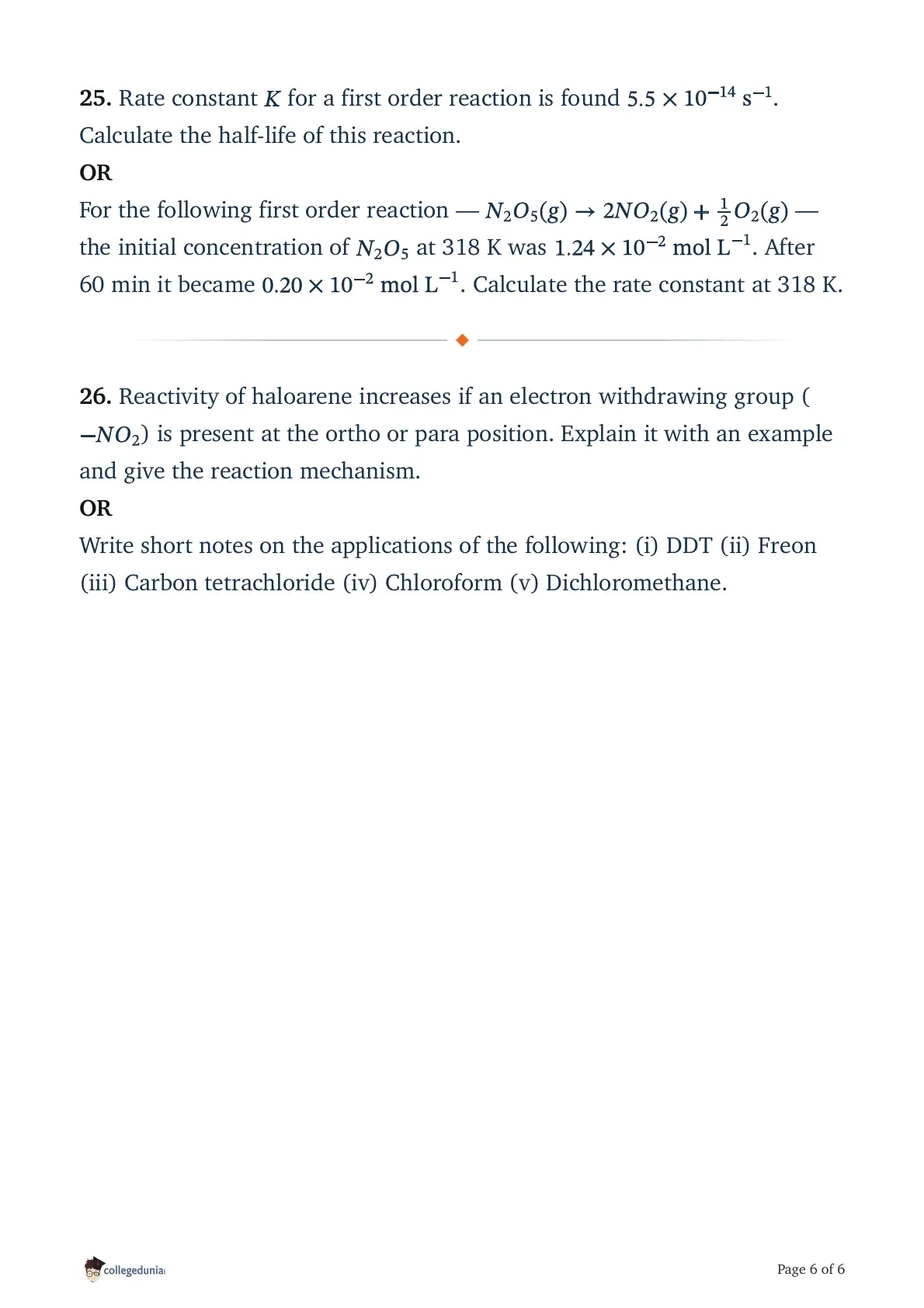
Rate constant \( K \) for a first order reaction is found \( 5.5 \times 10^{-14}\ \text{s}^{-1} \). Calculate the half-life of this reaction.
OR
For the following first order reaction — \( N_2O_5(g) \rightarrow 2NO_2(g) + \tfrac{1}{2}O_2(g) \) — the initial concentration of \( N_2O_5 \) at 318 K was \( 1.24 \times 10^{-2}\ \text{mol L}^{-1} \). After 60 min it became \( 0.20 \times 10^{-2}\ \text{mol L}^{-1} \). Calculate the rate constant at 318 K.
Reactivity of haloarene increases if an electron withdrawing group (\( -NO_2 \)) is present at the ortho or para position. Explain it with an example and give the reaction mechanism.
OR
Write short notes on the applications of the following: (i) DDT (ii) Freon (iii) Carbon tetrachloride (iv) Chloroform (v) Dichloromethane.
UP Board Class 12 Chemistry 2026 Set 347 DZ Exam Pattern and Marking Scheme
Set 347 DZ is a bilingual Hindi and English paper that follows the standard UPMSP Intermediate Chemistry format, moving from 1-mark objective questions to 5-mark long answers in order.
- Total questions: 26 questions across Sections A to E
- Total marks: 70
- Duration: 3 hours 15 minutes (includes 15 minutes of reading time)
- Section A: Question 1 (a to f) is 6 multiple choice questions of 1 mark each
- Sections B and C: short-answer questions of 2 marks each
- Section D: short-answer questions split into 3-mark and 4-mark tiers
- Section E: Questions 6 and 7 are long-answer questions of 5 marks each, with an internal OR (अथवा) choice
High-Weightage Chapters in UP Board Class 12 Chemistry 2026 Set 347 DZ
The Set 347 DZ paper stayed close to the NCERT textbook, and the same six chapters carried most of the 70 marks. Focus on these first when you revise.
- Electrochemistry: the Nernst equation, conductance and a numerical on EMF showed up in the 3-mark and 5-mark tiers
- Chemical Kinetics: order and molecularity, plus a rate-constant numerical, made this a reliable scorer
- Coordination Compounds: IUPAC naming, isomerism and crystal field theory carried short and long answers
- p-Block Elements: group trends and preparation reactions of nitrogen and halogen families appeared in Sections B and C
- Aldehydes, Ketones and Carboxylic Acids: named reactions and organic conversions were a 5-mark favourite
- Amines: distinction tests and the diazonium reactions rounded out the organic weightage
UP Board Class 12 Chemistry 2026 Question Paper Solution Video
Source: Alpha Institute
How to Use the UP Board Class 12 Chemistry 2026 Set 347 DZ Paper for Practice
Treat Set 347 DZ as a timed mock before you check the solutions, so you find out where you lose marks under the real 3 hours 15 minutes.
- Solve the full paper in one sitting with a clock, then score yourself against the solution PDF above
- Attempt all 6 MCQs in Question 1 first, since 6 easy marks are locked in within minutes
- Practise both OR options in the 5-mark Section E questions, as the choice often mixes organic and inorganic
- Redo every organic conversion and named reaction you missed, because these repeat across UP Board years
- Since the paper is bilingual, read the English and Hindi versions of any confusing question together to avoid misreading
UP Board Class 12 Chemistry 2026 Set 347 DZ Question Paper FAQs
Ques. Was the UP Board Class 12 Chemistry 2026 paper hard or easy?
Ans. The 2026 Chemistry paper was rated moderate and textbook-based. Most questions stayed close to NCERT examples, with only small changes in numerical values and organic conversions, so students who revised named reactions and previous year papers found it comfortable.
Ques. Which chapters had the highest weightage in UP Board Class 12 Chemistry 2026 Set 347 DZ?
Ans. Electrochemistry, Chemical Kinetics, Coordination Compounds, p-Block Elements, Aldehydes Ketones and Carboxylic Acids, and Amines carried the most marks. Together these six chapters covered the bulk of the 3-mark, 4-mark and 5-mark questions.
Ques. How many marks is the UP Board Class 12 Chemistry paper and how long is it?
Ans. The paper is 70 marks and runs for 3 hours 15 minutes, including 15 minutes of reading time. It has 26 questions across Sections A to E, starting with 6 one-mark MCQs and ending with two 5-mark long-answer questions that carry an internal OR choice.
Ques. Does UP Board release an official Class 12 Chemistry 2026 answer key?
Ans. No, UPMSP does not publish an official answer key for the Class 12 Chemistry exam. You can download the full solved paper from the table above, and cross-check the original question paper on the official website upboardonline.com.
Ques. Are UP Board Class 12 Chemistry questions repeated from previous years?
Ans. Yes, UPMSP repeats the same pattern and concepts every year with minor changes in numbers. Named reactions, organic conversions and the standard Electrochemistry and Kinetics numericals recur often, so solving 5 to 6 previous year papers is one of the best ways to score above 60.
Ques. Where can I download the UP Board Class 12 Chemistry 2026 Set 347 DZ question paper with solutions PDF for free?
Ans. You can download both the question paper and the step-by-step solutions PDF for free from the download table at the top of this page on Collegedunia. The original paper is also available on the official UPMSP website, upboardonline.com.



Comments