




The UP Board Class 12 English question paper with solutions (Set 316 BW) is available here for free download. UP Board Class 12 English 2026 was conducted by the Uttar Pradesh Madhyamik Shiksha Parishad (UPMSP) on February 20, 2026, as a 100-mark paper of 12 questions to be solved in 3 hours 15 minutes.
| UP Board Class 12 English Question Paper with Solutions (Set 316 BW) | Download PDF | Check Solutions |
UP Board Class 12 English 2026 (Set 316 BW) Questions with Solutions
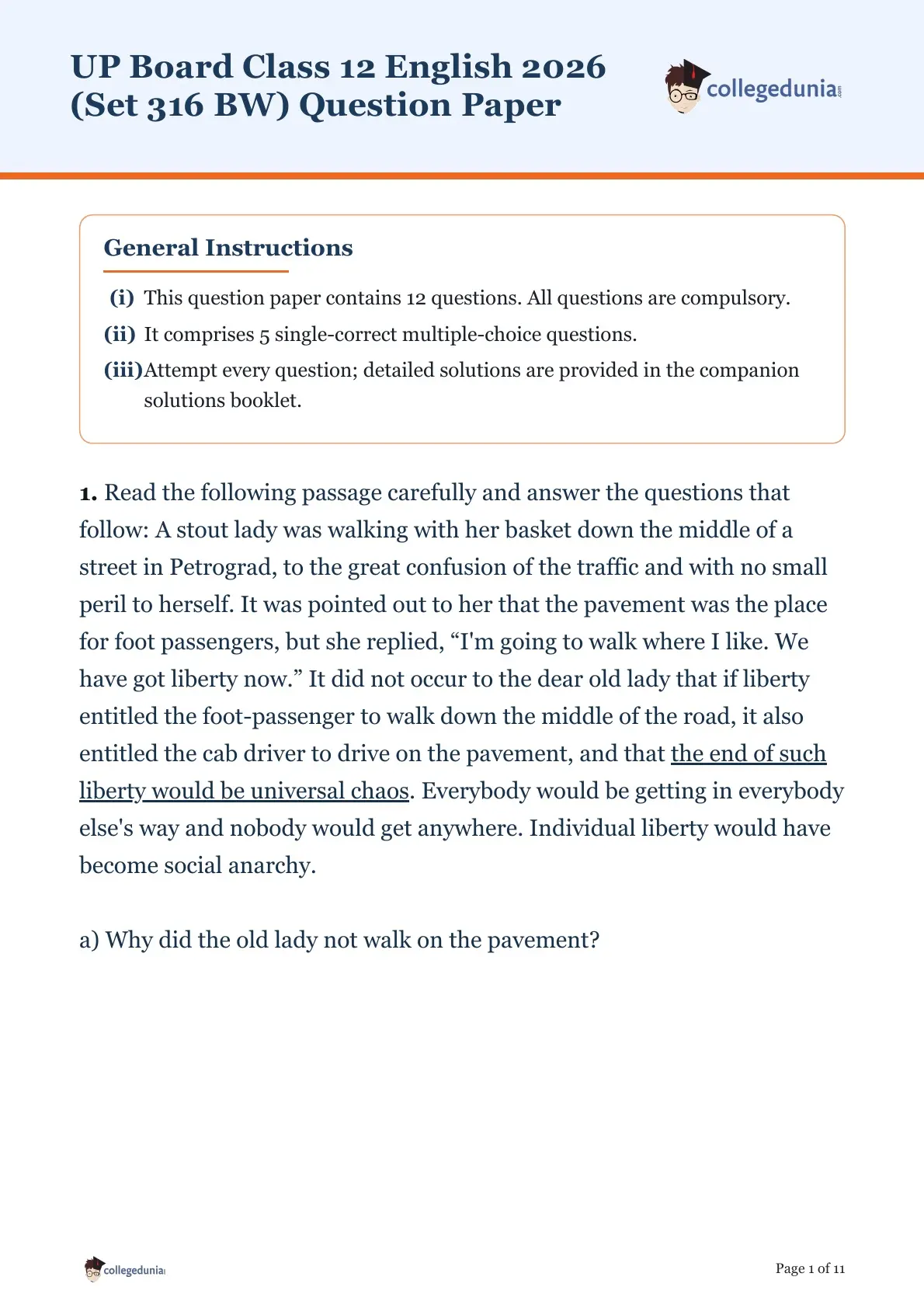
Read the following passage carefully and answer the questions that follow: A stout lady was walking with her basket down the middle of a street in Petrograd, to the great confusion of the traffic and with no small peril to herself. It was pointed out to her that the pavement was the place for foot passengers, but she replied, “I'm going to walk where I like. We have got liberty now.” It did not occur to the dear old lady that if liberty entitled the foot-passenger to walk down the middle of the road, it also entitled the cab driver to drive on the pavement, and that the end of such liberty would be universal chaos. Everybody would be getting in everybody else's way and nobody would get anywhere. Individual liberty would have become social anarchy.
a) Why did the old lady not walk on the pavement?
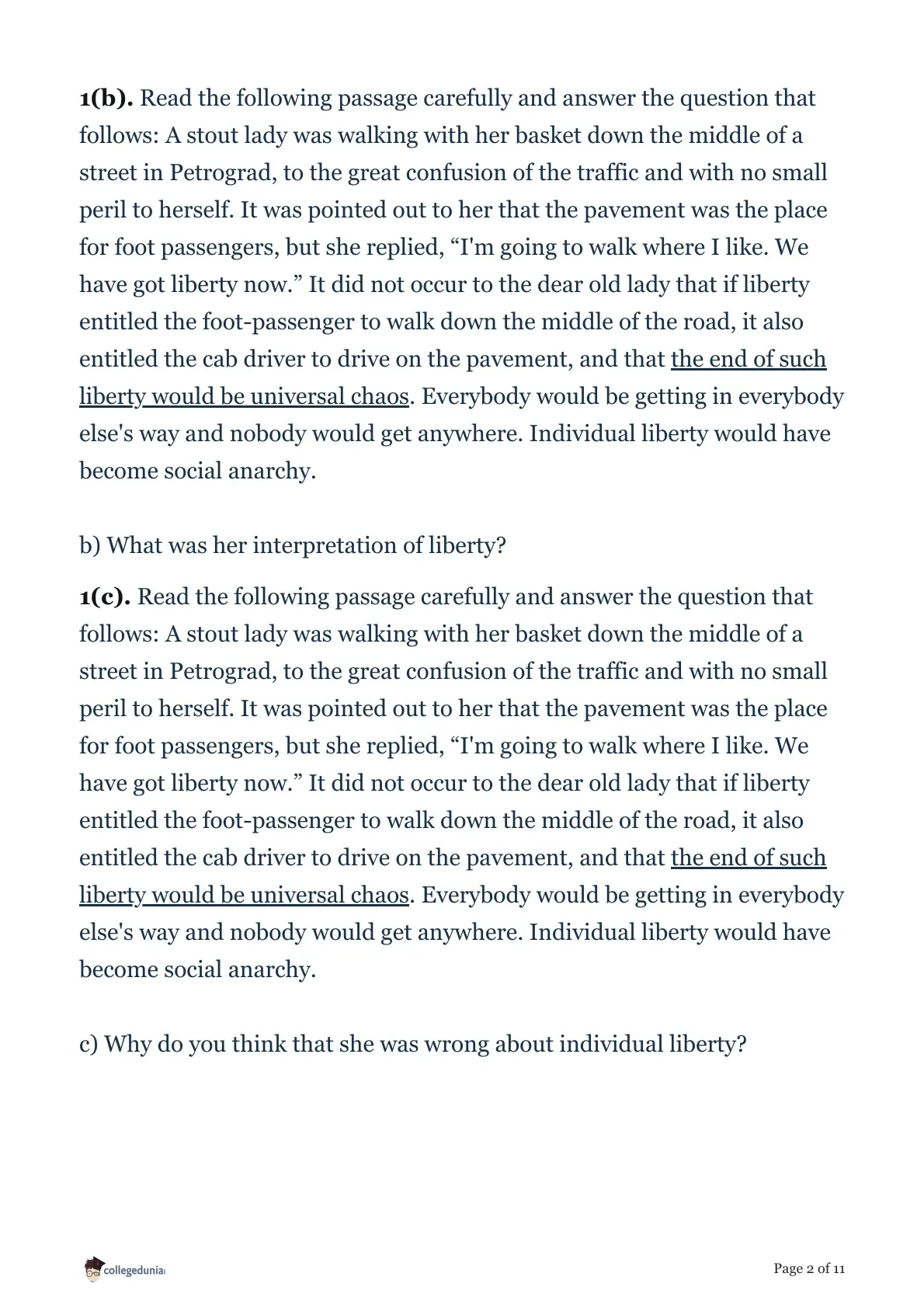
Read the following passage carefully and answer the question that follows: A stout lady was walking with her basket down the middle of a street in Petrograd, to the great confusion of the traffic and with no small peril to herself. It was pointed out to her that the pavement was the place for foot passengers, but she replied, “I'm going to walk where I like. We have got liberty now.” It did not occur to the dear old lady that if liberty entitled the foot-passenger to walk down the middle of the road, it also entitled the cab driver to drive on the pavement, and that the end of such liberty would be universal chaos. Everybody would be getting in everybody else's way and nobody would get anywhere. Individual liberty would have become social anarchy.
b) What was her interpretation of liberty?
Read the following passage carefully and answer the question that follows: A stout lady was walking with her basket down the middle of a street in Petrograd, to the great confusion of the traffic and with no small peril to herself. It was pointed out to her that the pavement was the place for foot passengers, but she replied, “I'm going to walk where I like. We have got liberty now.” It did not occur to the dear old lady that if liberty entitled the foot-passenger to walk down the middle of the road, it also entitled the cab driver to drive on the pavement, and that the end of such liberty would be universal chaos. Everybody would be getting in everybody else's way and nobody would get anywhere. Individual liberty would have become social anarchy.
c) Why do you think that she was wrong about individual liberty?
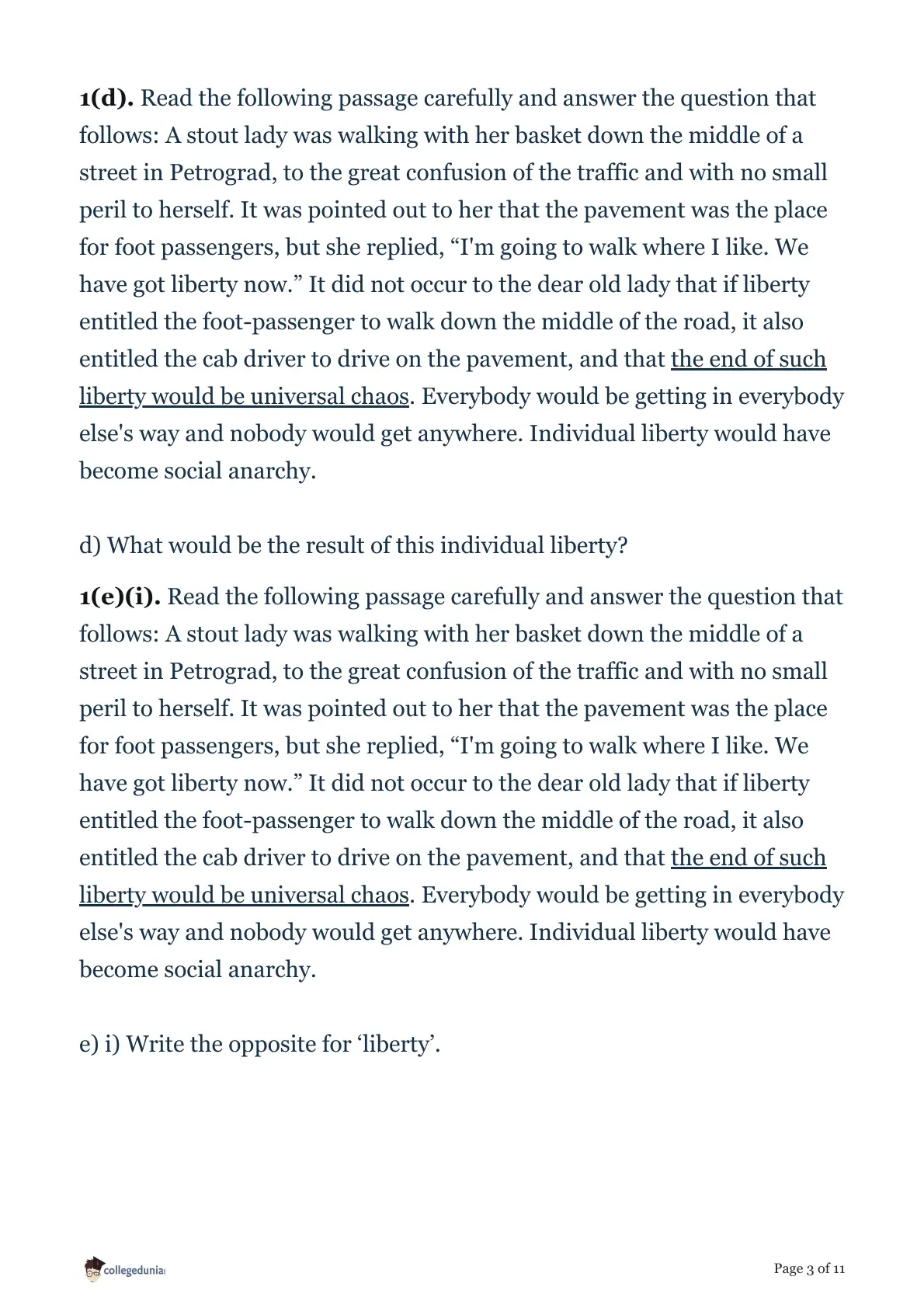
Read the following passage carefully and answer the question that follows: A stout lady was walking with her basket down the middle of a street in Petrograd, to the great confusion of the traffic and with no small peril to herself. It was pointed out to her that the pavement was the place for foot passengers, but she replied, “I'm going to walk where I like. We have got liberty now.” It did not occur to the dear old lady that if liberty entitled the foot-passenger to walk down the middle of the road, it also entitled the cab driver to drive on the pavement, and that the end of such liberty would be universal chaos. Everybody would be getting in everybody else's way and nobody would get anywhere. Individual liberty would have become social anarchy.
d) What would be the result of this individual liberty?
Read the following passage carefully and answer the question that follows: A stout lady was walking with her basket down the middle of a street in Petrograd, to the great confusion of the traffic and with no small peril to herself. It was pointed out to her that the pavement was the place for foot passengers, but she replied, “I'm going to walk where I like. We have got liberty now.” It did not occur to the dear old lady that if liberty entitled the foot-passenger to walk down the middle of the road, it also entitled the cab driver to drive on the pavement, and that the end of such liberty would be universal chaos. Everybody would be getting in everybody else's way and nobody would get anywhere. Individual liberty would have become social anarchy.
e) i) Write the opposite for ‘liberty’.
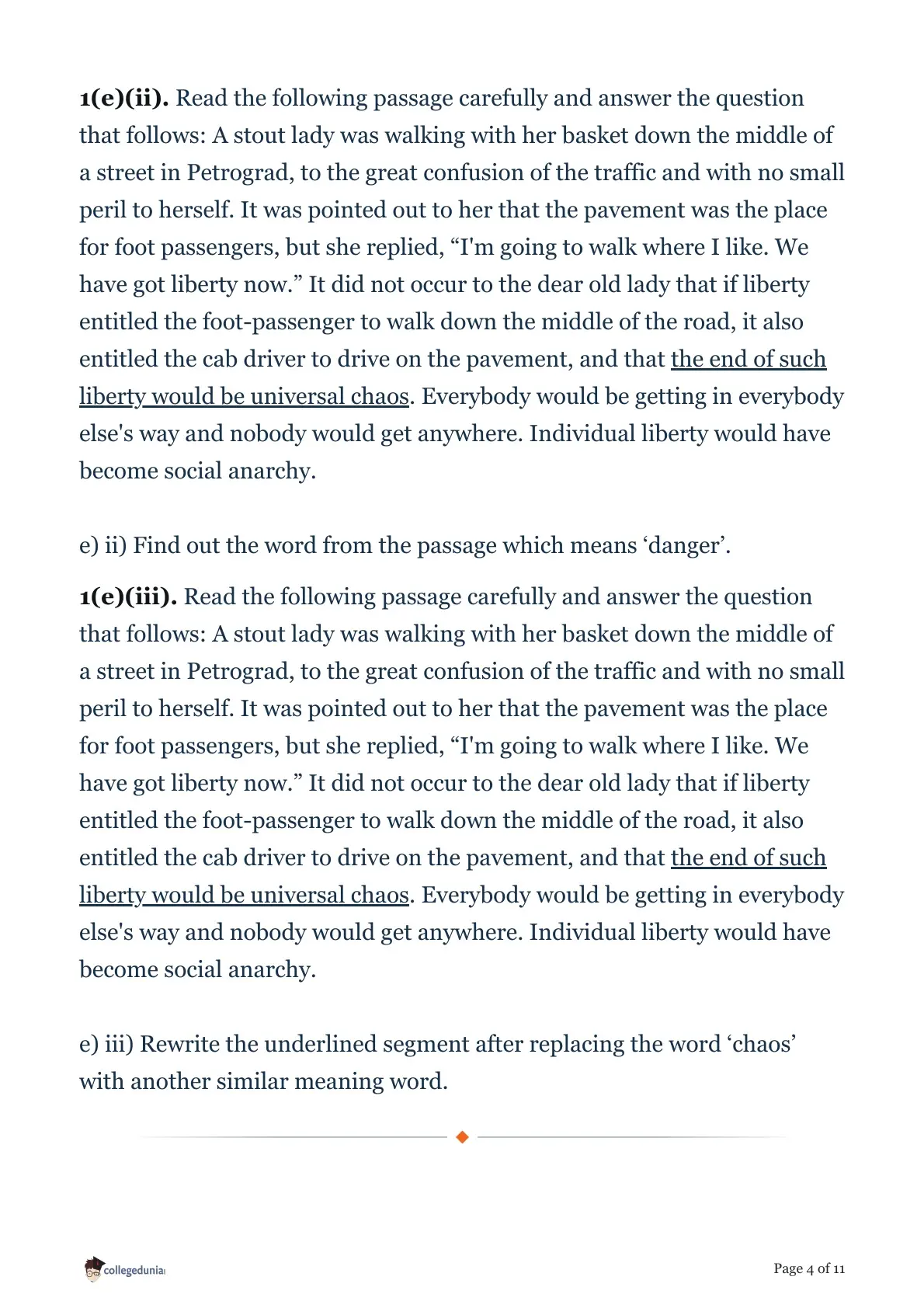
Read the following passage carefully and answer the question that follows: A stout lady was walking with her basket down the middle of a street in Petrograd, to the great confusion of the traffic and with no small peril to herself. It was pointed out to her that the pavement was the place for foot passengers, but she replied, “I'm going to walk where I like. We have got liberty now.” It did not occur to the dear old lady that if liberty entitled the foot-passenger to walk down the middle of the road, it also entitled the cab driver to drive on the pavement, and that the end of such liberty would be universal chaos. Everybody would be getting in everybody else's way and nobody would get anywhere. Individual liberty would have become social anarchy.
e) ii) Find out the word from the passage which means ‘danger’.
Read the following passage carefully and answer the question that follows: A stout lady was walking with her basket down the middle of a street in Petrograd, to the great confusion of the traffic and with no small peril to herself. It was pointed out to her that the pavement was the place for foot passengers, but she replied, “I'm going to walk where I like. We have got liberty now.” It did not occur to the dear old lady that if liberty entitled the foot-passenger to walk down the middle of the road, it also entitled the cab driver to drive on the pavement, and that the end of such liberty would be universal chaos. Everybody would be getting in everybody else's way and nobody would get anywhere. Individual liberty would have become social anarchy.
e) iii) Rewrite the underlined segment after replacing the word ‘chaos’ with another similar meaning word.
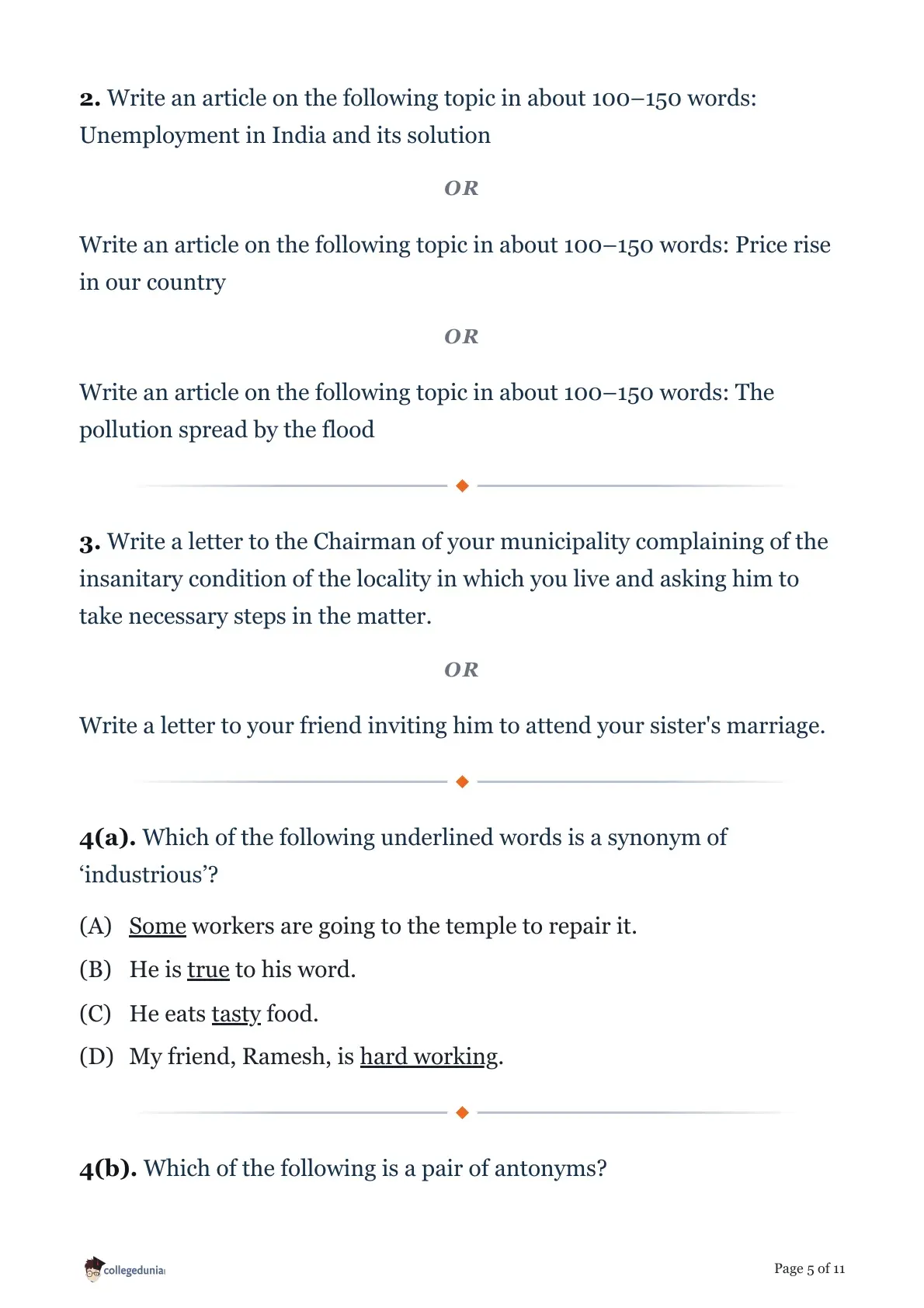
Write an article on the following topic in about 100–150 words: Unemployment in India and its solution
Write an article on the following topic in about 100–150 words: Price rise in our country
Write an article on the following topic in about 100–150 words: The pollution spread by the flood
Write a letter to the Chairman of your municipality complaining of the insanitary condition of the locality in which you live and asking him to take necessary steps in the matter.
Write a letter to your friend inviting him to attend your sister's marriage.
Which of the following underlined words is a synonym of ‘industrious’?
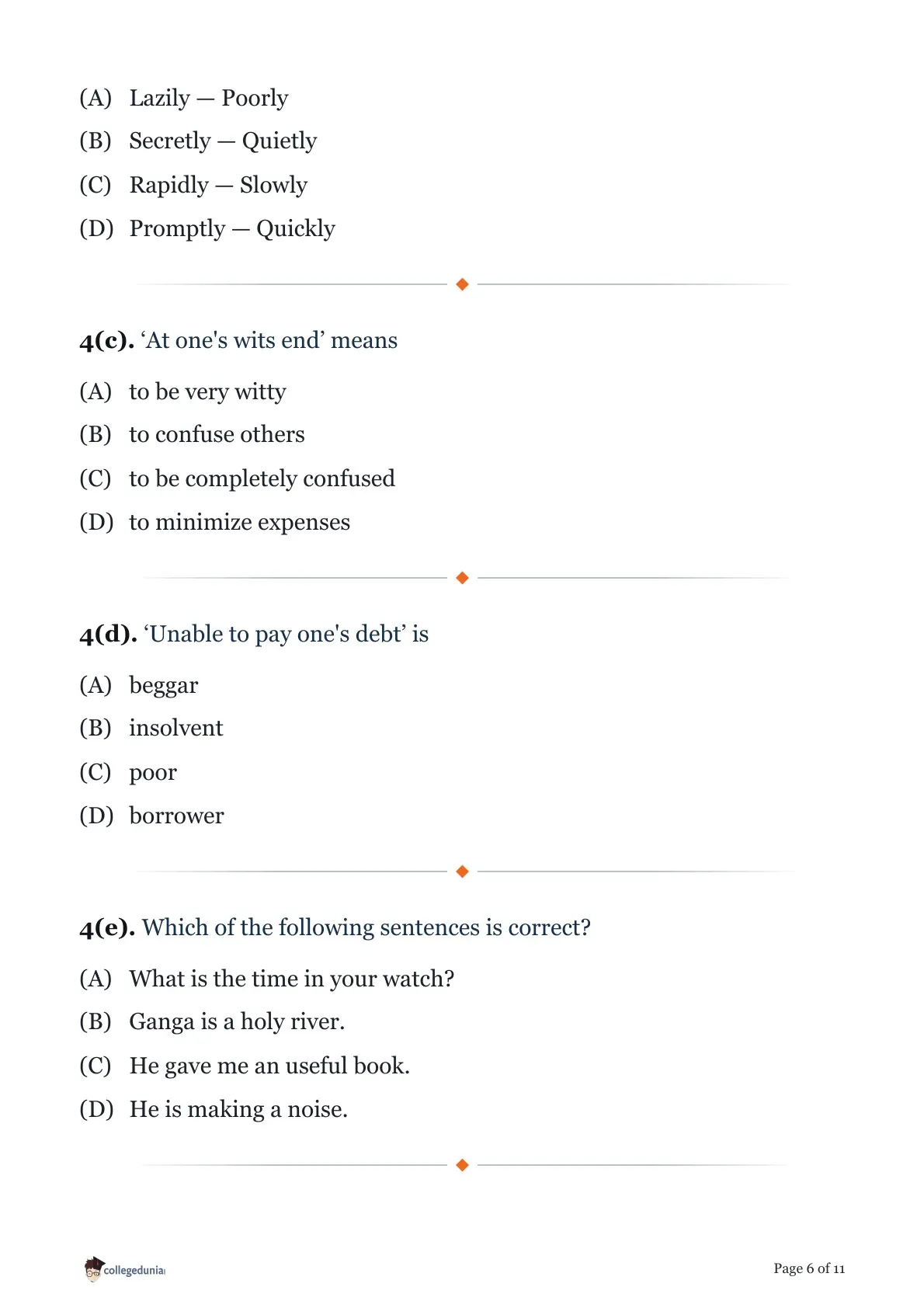
Which of the following is a pair of antonyms?
‘At one's wits end’ means
‘Unable to pay one's debt’ is
Which of the following sentences is correct?
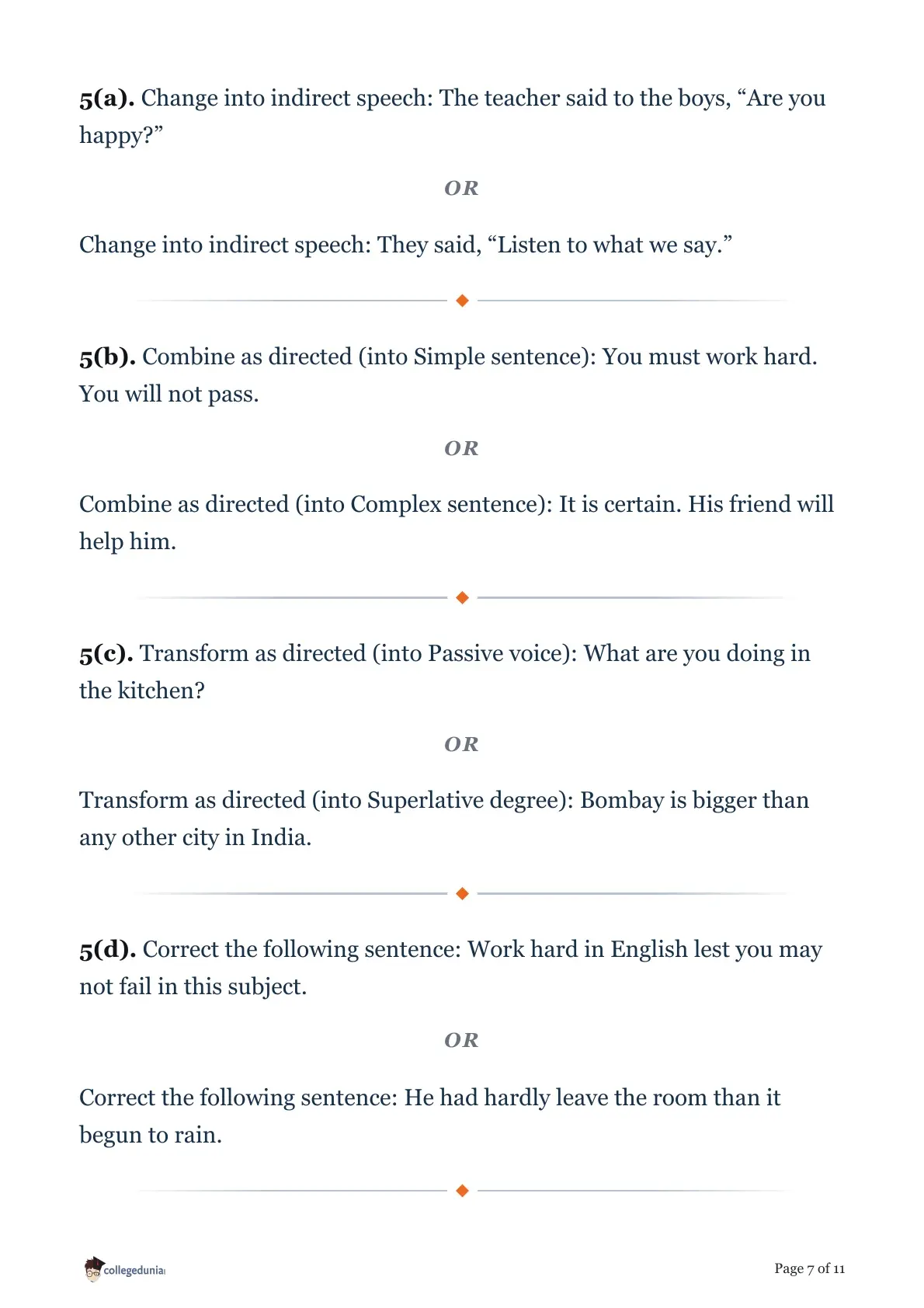
Change into indirect speech: The teacher said to the boys, “Are you happy?”
Change into indirect speech: They said, “Listen to what we say.”
Combine as directed (into Simple sentence): You must work hard. You will not pass.
Combine as directed (into Complex sentence): It is certain. His friend will help him.
Transform as directed (into Passive voice): What are you doing in the kitchen?
Transform as directed (into Superlative degree): Bombay is bigger than any other city in India.
Correct the following sentence: Work hard in English lest you may not fail in this subject.
Correct the following sentence: He had hardly leave the room than it begun to rain.
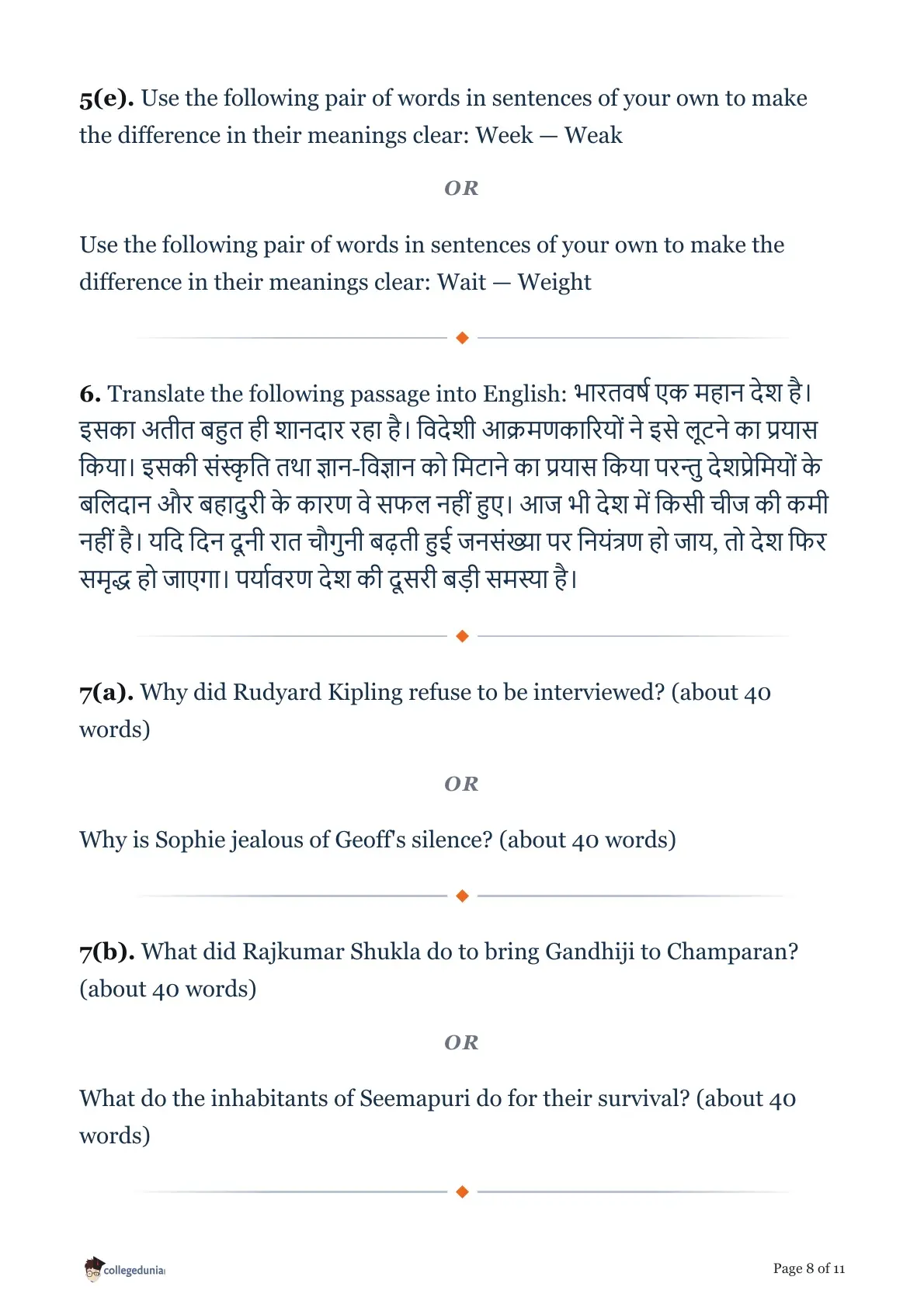
Use the following pair of words in sentences of your own to make the difference in their meanings clear: Week — Weak
Use the following pair of words in sentences of your own to make the difference in their meanings clear: Wait — Weight
Translate the following passage into English: भारतवर्ष एक महान देश है। इसका अतीत बहुत ही शानदार रहा है। विदेशी आक्रमणकारियों ने इसे लूटने का प्रयास किया। इसकी संस्कृति तथा ज्ञान-विज्ञान को मिटाने का प्रयास किया परन्तु देशप्रेमियों के बलिदान और बहादुरी के कारण वे सफल नहीं हुए। आज भी देश में किसी चीज की कमी नहीं है। यदि दिन दूनी रात चौगुनी बढ़ती हुई जनसंख्या पर नियंत्रण हो जाय, तो देश फिर समृद्ध हो जाएगा। पर्यावरण देश की दूसरी बड़ी समस्या है।
Why did Rudyard Kipling refuse to be interviewed? (about 40 words)
Why is Sophie jealous of Geoff's silence? (about 40 words)
What did Rajkumar Shukla do to bring Gandhiji to Champaran? (about 40 words)
What do the inhabitants of Seemapuri do for their survival? (about 40 words)
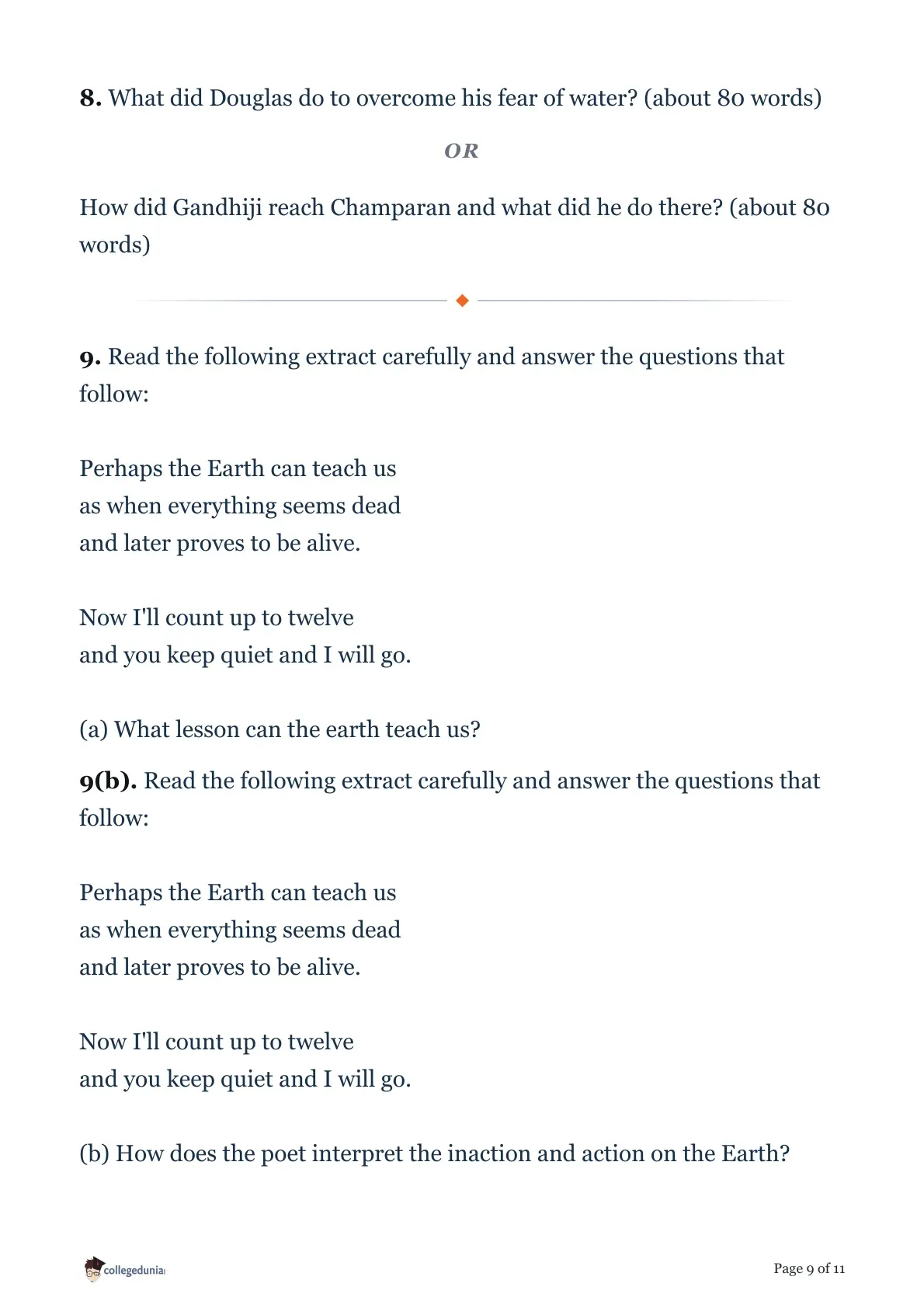
What did Douglas do to overcome his fear of water? (about 80 words)
How did Gandhiji reach Champaran and what did he do there? (about 80 words)
Read the following extract carefully and answer the questions that follow:
Perhaps the Earth can teach us
as when everything seems dead
and later proves to be alive.
Now I'll count up to twelve
and you keep quiet and I will go.
(a) What lesson can the earth teach us?
Read the following extract carefully and answer the questions that follow:
Perhaps the Earth can teach us
as when everything seems dead
and later proves to be alive.
Now I'll count up to twelve
and you keep quiet and I will go.
(b) How does the poet interpret the inaction and action on the Earth?
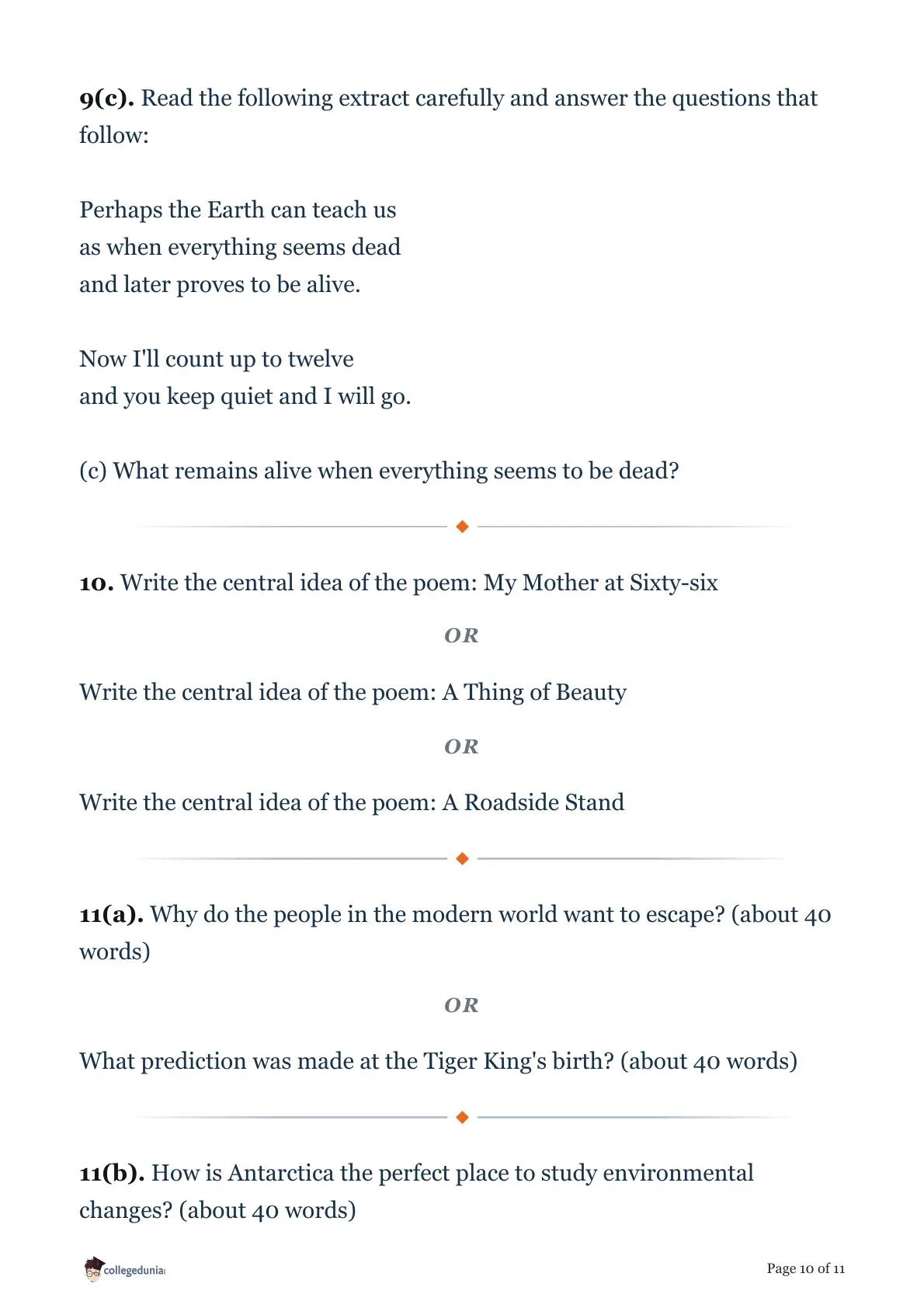
Read the following extract carefully and answer the questions that follow:
Perhaps the Earth can teach us
as when everything seems dead
and later proves to be alive.
Now I'll count up to twelve
and you keep quiet and I will go.
(c) What remains alive when everything seems to be dead?
Write the central idea of the poem: My Mother at Sixty-six
Write the central idea of the poem: A Thing of Beauty
Write the central idea of the poem: A Roadside Stand
Why do the people in the modern world want to escape? (about 40 words)
What prediction was made at the Tiger King's birth? (about 40 words)
How is Antarctica the perfect place to study environmental changes? (about 40 words)
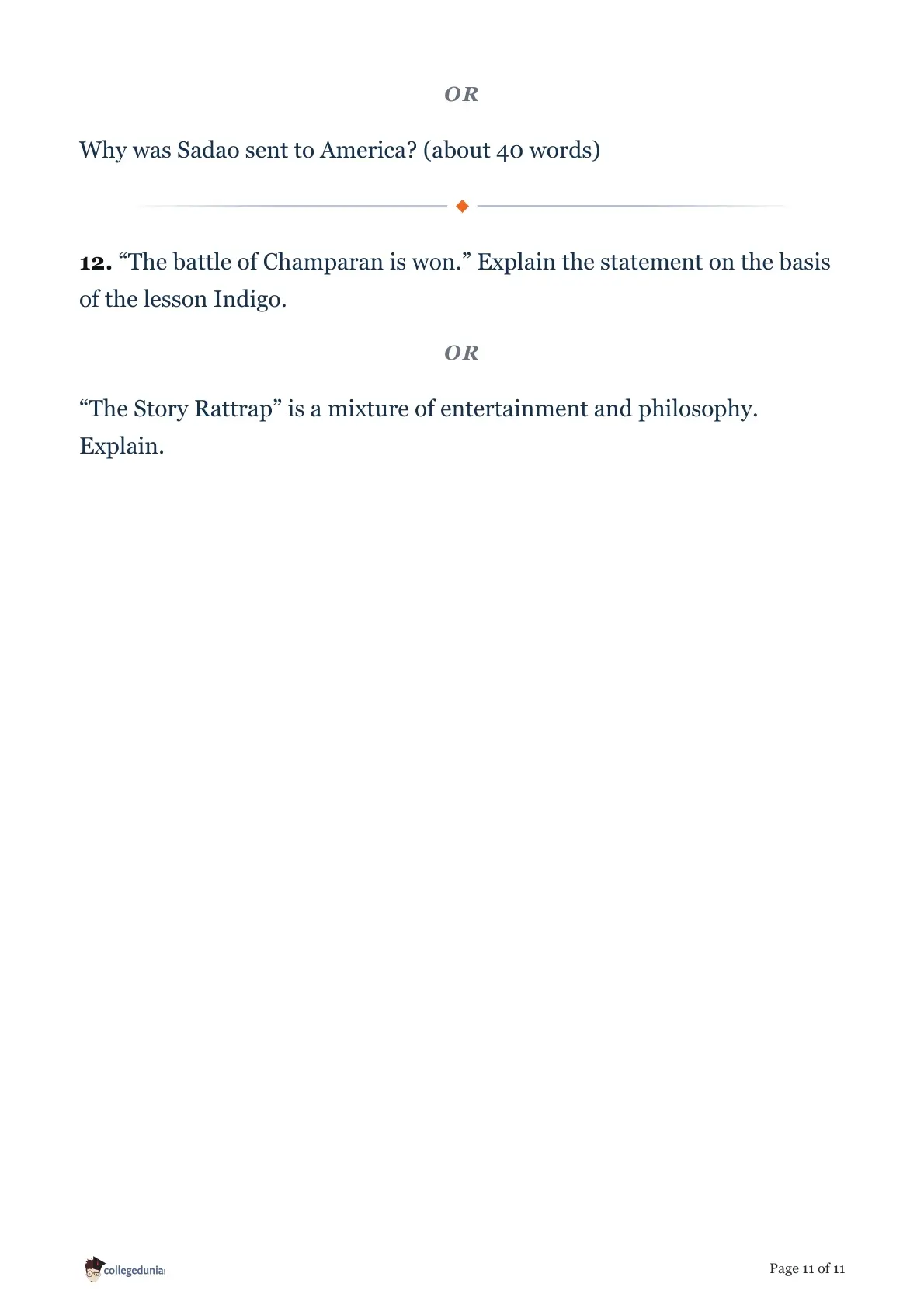
Why was Sadao sent to America? (about 40 words)
“The battle of Champaran is won.” Explain the statement on the basis of the lesson Indigo.
“The Story Rattrap” is a mixture of entertainment and philosophy. Explain.
UP Board Class 12 English 2026 Exam Pattern and Marking Scheme Explained
The Set 316 BW paper has four sections, and every question is compulsory apart from the internal choices below.
- Total questions: 12 questions across Section A (Reading), Section B (Writing), Section C (Grammar) and Section D (Literature)
- Total marks: 100 - Reading 15, Writing 20, Grammar 25 and Literature 40
- Duration: 3 hours 15 minutes, with the first 15 minutes given for reading the question paper
- Question types: 5 single-correct MCQs (Q4), plus passage, article, letter, transformation, translation, extract and literature answers
- Internal choice: 1 of 3 topics in Q2, 1 of 2 in Q3, Q5, Q7, Q8, Q11 and Q12, and 1 of 3 poems in Q10
High-Weightage Sections in UP Board Class 12 English 2026 to Focus On First
Literature carried 40 of the 100 marks in Set 316 BW, more than any other section.
- Literature (Q7 to Q12): 40 of 100 marks - Q7 and Q11 carry 8 marks each, Q8 and Q12 7 each, Q9 6 and Q10 4. Q9 is an extract beginning 'Perhaps the Earth can teach us', and Q10 asks the central idea of any one of My Mother at Sixty-six, A Thing of Beauty and A Roadside Stand
- Grammar (Q4 to Q6): 25 of 100 marks - 5 MCQs (10), five transformation and usage questions (10) and a Hindi to English translation (5)
- Writing (Q2, Q3): 20 of 100 marks - an article in 100 to 150 words on any one of unemployment in India and its solution, price rise in our country and the pollution spread by the flood, plus a letter to the Chairman of your municipality about insanitary conditions, or a letter to a friend inviting him to your sister's marriage
- Reading (Q1): 15 of 100 marks - an unseen passage on a stout lady in Petrograd who insists on individual liberty, with part (e) asking for an opposite of 'liberty', a word meaning 'danger' and a rewrite of an underlined segment
UP Board Class 12 English 2026 Paper Solution Video
Source: Determination Study Platform
How to Use the UP Board Class 12 English Question Paper for Practice
Treat this Set 316 BW paper as a timed mock before you check the solutions.
- Attempt all 12 questions in 3 hours 15 minutes under exam conditions first
- Practise both options of every internal choice - Q2 has 3 article topics and Q10 has 3 poems
- Write the article, letter and translation by hand, since Q2, Q3 and Q6 carry 25 marks together
- Review each answer against the step-by-step solution PDF, not just the final answer
UP Board Class 12 English 2026 Question Paper FAQs
Ques. When was the UP Board Class 12 English 2026 exam conducted?
Ans. UPMSP conducted the UP Board Class 12 English 2026 exam on February 20, 2026, in the afternoon shift from 2:00 pm to 5:15 pm, during the intermediate exams that ran from February 18 to March 12, 2026. The official time table is on upmsp.edu.in.
Ques. How many questions are there in the UP Board Class 12 English 2026 paper, and is there any choice?
Ans. The paper has 12 questions worth 100 marks. Most offer a choice - 1 of 3 article topics in Q2, 1 of 2 in Q3, Q8 and Q12, and 1 of 3 poems in Q10, while Q5, Q7 and Q11 are built from OR pairs.
Ques. What is the section-wise marking scheme for UP Board Class 12 English 2026?
Ans. Section A (Reading) carries 15 marks, Section B (Writing) 20 marks, Section C (Grammar) 25 marks and Section D (Literature) 40 marks, for a total of 100 marks in 3 hours 15 minutes.
Ques. Which section had the highest weightage in UP Board Class 12 English 2026 Set 316 BW?
Ans. Literature (Q7 to Q12) carried the most marks at 40 of 100, followed by Grammar at 25 marks, Writing at 20 marks and Reading at 15 marks.
Ques. Where can I download the UP Board Class 12 English 2026 Set 316 BW question paper with solutions PDF for free?
Ans. You can download both the question paper and the full step-by-step solutions PDF for Set 316 BW from the table at the top of this page, for free.



Comments