




The UP Board Class 12 English question paper with solutions (Set 316 BY) is available here for free download. UP Board Class 12 English 2026 was conducted by the Uttar Pradesh Madhyamik Shiksha Parishad (UPMSP) on February 20, 2026, as a 100-mark paper of 12 questions to be solved in 3 hours 15 minutes.
| UP Board Class 12 English Question Paper with Solutions (Set 316 BY) | Download PDF | Check Solutions |
UP Board Class 12 English 2026 (Set 316 BY) Questions with Solutions
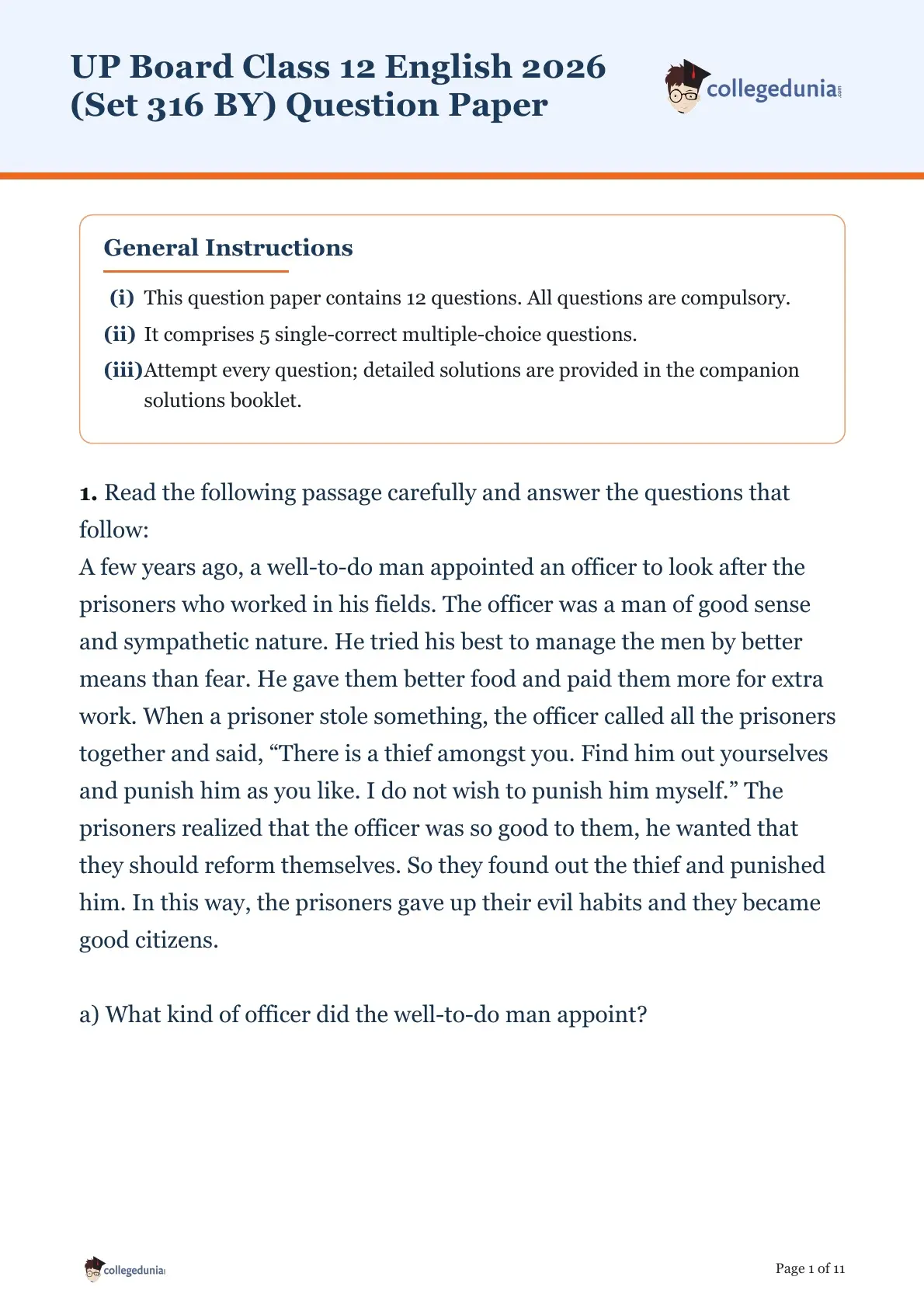
Read the following passage carefully and answer the questions that follow:
A few years ago, a well-to-do man appointed an officer to look after the prisoners who worked in his fields. The officer was a man of good sense and sympathetic nature. He tried his best to manage the men by better means than fear. He gave them better food and paid them more for extra work. When a prisoner stole something, the officer called all the prisoners together and said, “There is a thief amongst you. Find him out yourselves and punish him as you like. I do not wish to punish him myself.” The prisoners realized that the officer was so good to them, he wanted that they should reform themselves. So they found out the thief and punished him. In this way, the prisoners gave up their evil habits and they became good citizens.
a) What kind of officer did the well-to-do man appoint?
A few years ago, a well-to-do man appointed an officer to look after the prisoners who worked in his fields. The officer was a man of good sense and sympathetic nature. He tried his best to manage the men by better means than fear. He gave them better food and paid them more for extra work. When a prisoner stole something, the officer called all the prisoners together and said, “There is a thief amongst you. Find him out yourselves and punish him as you like. I do not wish to punish him myself.” The prisoners realized that the officer was so good to them, he wanted that they should reform themselves. So they found out the thief and punished him. In this way, the prisoners gave up their evil habits and they became good citizens.
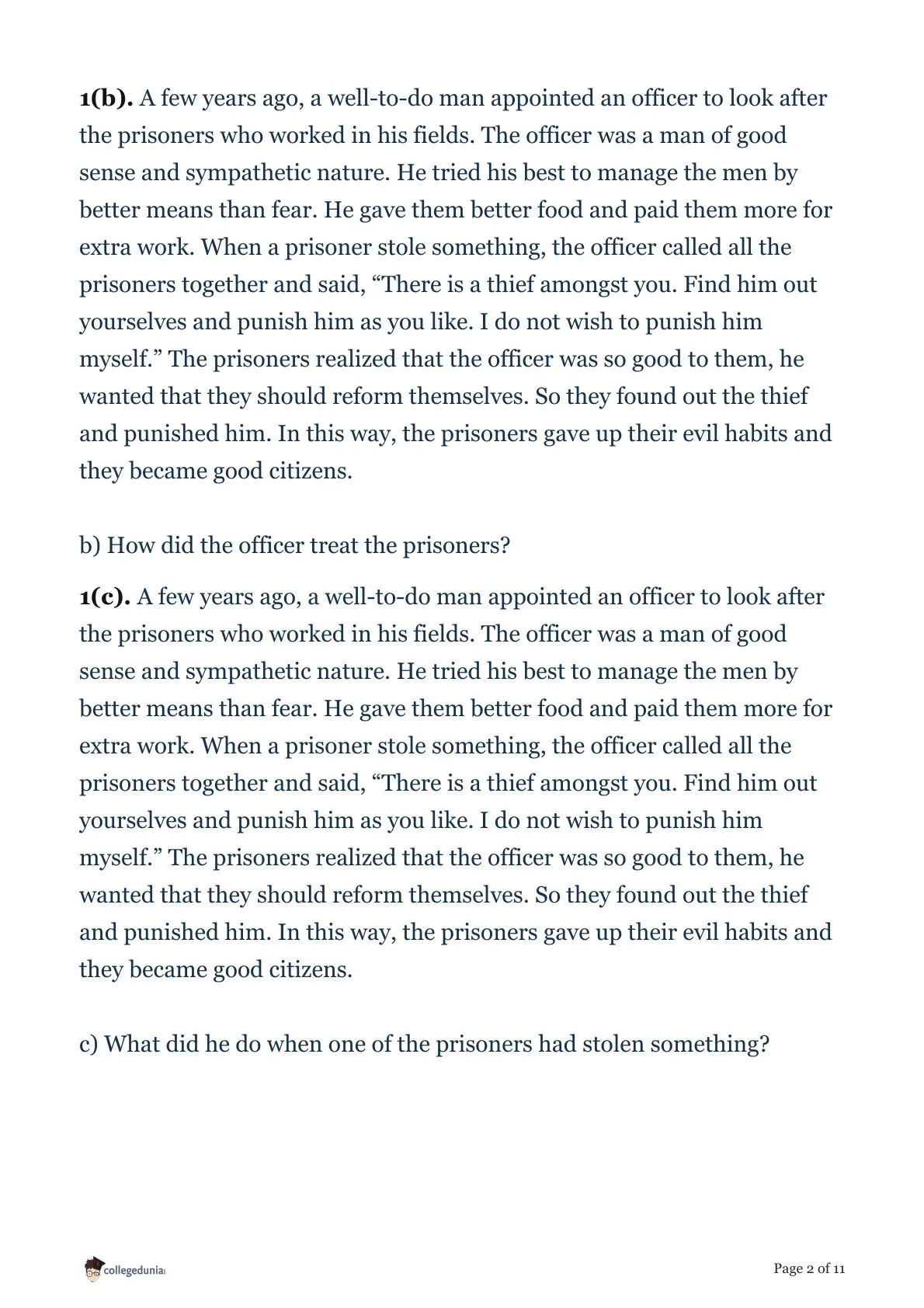
b) How did the officer treat the prisoners?
A few years ago, a well-to-do man appointed an officer to look after the prisoners who worked in his fields. The officer was a man of good sense and sympathetic nature. He tried his best to manage the men by better means than fear. He gave them better food and paid them more for extra work. When a prisoner stole something, the officer called all the prisoners together and said, “There is a thief amongst you. Find him out yourselves and punish him as you like. I do not wish to punish him myself.” The prisoners realized that the officer was so good to them, he wanted that they should reform themselves. So they found out the thief and punished him. In this way, the prisoners gave up their evil habits and they became good citizens.
c) What did he do when one of the prisoners had stolen something?
A few years ago, a well-to-do man appointed an officer to look after the prisoners who worked in his fields. The officer was a man of good sense and sympathetic nature. He tried his best to manage the men by better means than fear. He gave them better food and paid them more for extra work. When a prisoner stole something, the officer called all the prisoners together and said, “There is a thief amongst you. Find him out yourselves and punish him as you like. I do not wish to punish him myself.” The prisoners realized that the officer was so good to them, he wanted that they should reform themselves. So they found out the thief and punished him. In this way, the prisoners gave up their evil habits and they became good citizens.
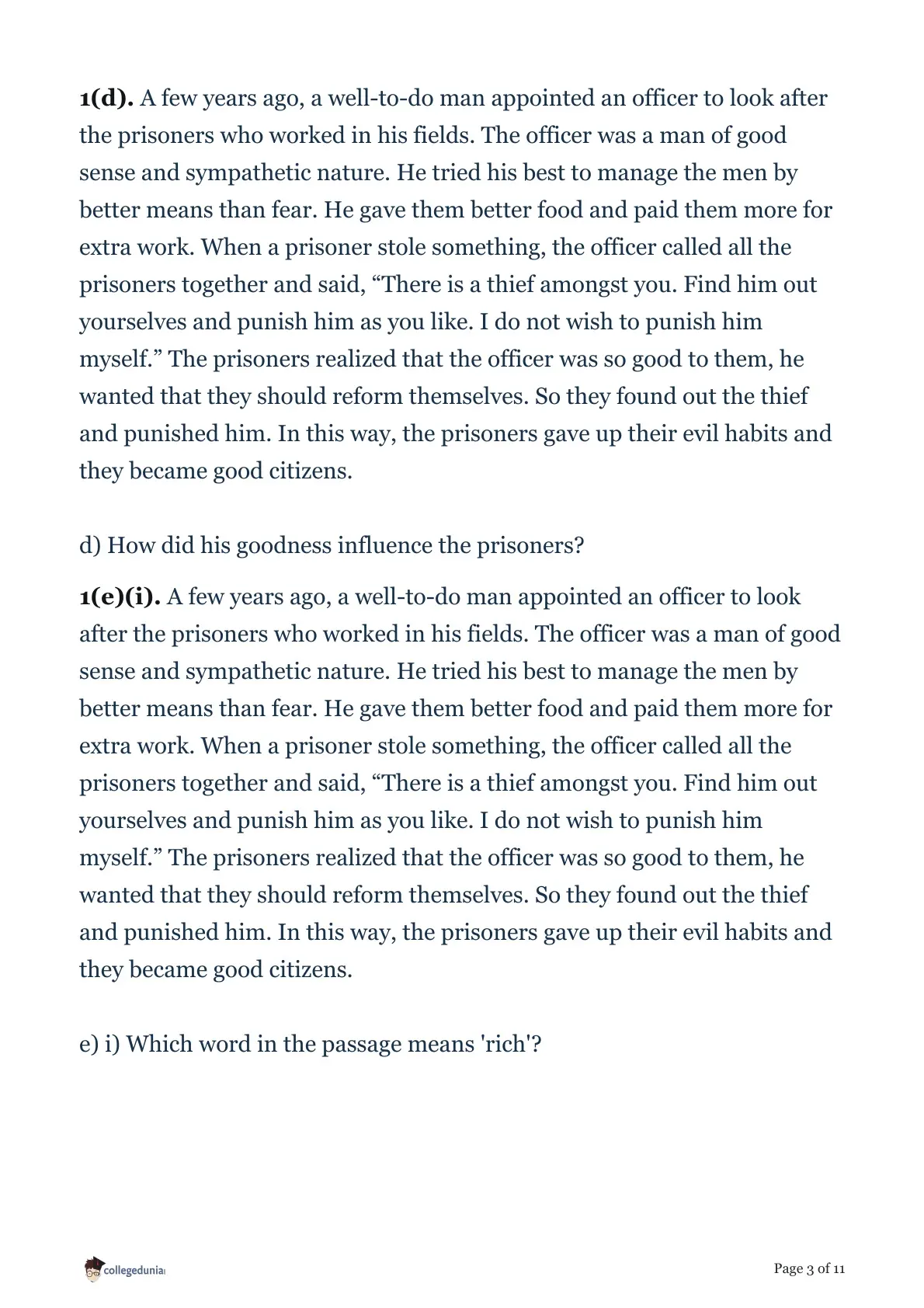
d) How did his goodness influence the prisoners?
A few years ago, a well-to-do man appointed an officer to look after the prisoners who worked in his fields. The officer was a man of good sense and sympathetic nature. He tried his best to manage the men by better means than fear. He gave them better food and paid them more for extra work. When a prisoner stole something, the officer called all the prisoners together and said, “There is a thief amongst you. Find him out yourselves and punish him as you like. I do not wish to punish him myself.” The prisoners realized that the officer was so good to them, he wanted that they should reform themselves. So they found out the thief and punished him. In this way, the prisoners gave up their evil habits and they became good citizens.
e) i) Which word in the passage means 'rich'?
A few years ago, a well-to-do man appointed an officer to look after the prisoners who worked in his fields. The officer was a man of good sense and sympathetic nature. He tried his best to manage the men by better means than fear. He gave them better food and paid them more for extra work. When a prisoner stole something, the officer called all the prisoners together and said, “There is a thief amongst you. Find him out yourselves and punish him as you like. I do not wish to punish him myself.” The prisoners realized that the officer was so good to them, he wanted that they should reform themselves. So they found out the thief and punished him. In this way, the prisoners gave up their evil habits and they became good citizens.
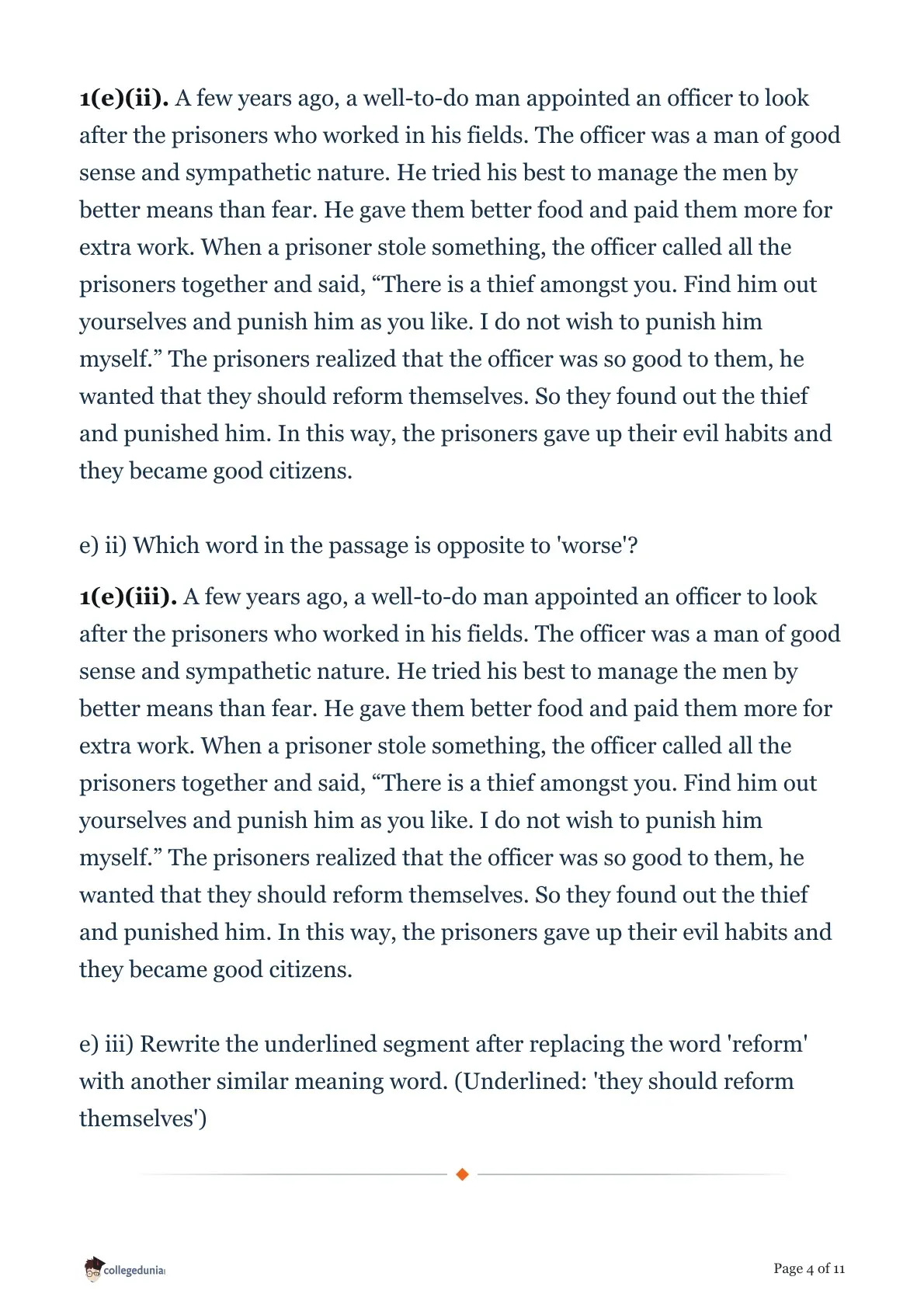
e) ii) Which word in the passage is opposite to 'worse'?
A few years ago, a well-to-do man appointed an officer to look after the prisoners who worked in his fields. The officer was a man of good sense and sympathetic nature. He tried his best to manage the men by better means than fear. He gave them better food and paid them more for extra work. When a prisoner stole something, the officer called all the prisoners together and said, “There is a thief amongst you. Find him out yourselves and punish him as you like. I do not wish to punish him myself.” The prisoners realized that the officer was so good to them, he wanted that they should reform themselves. So they found out the thief and punished him. In this way, the prisoners gave up their evil habits and they became good citizens.
e) iii) Rewrite the underlined segment after replacing the word 'reform' with another similar meaning word. (Underlined: 'they should reform themselves')
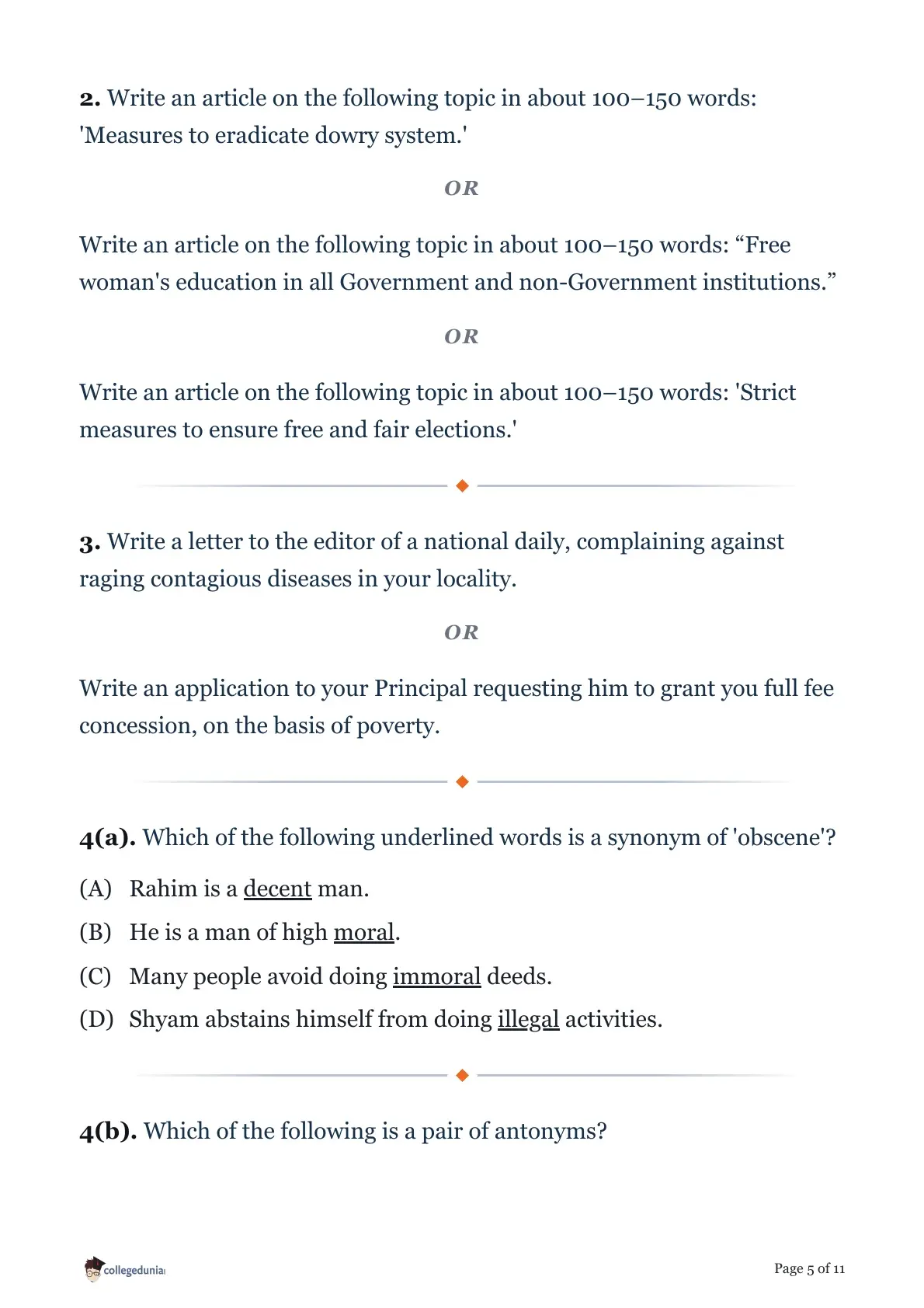
Write an article on the following topic in about 100–150 words: 'Measures to eradicate dowry system.'
Write an article on the following topic in about 100–150 words: “Free woman's education in all Government and non-Government institutions.”
Write an article on the following topic in about 100–150 words: 'Strict measures to ensure free and fair elections.'
Write a letter to the editor of a national daily, complaining against raging contagious diseases in your locality.
Write an application to your Principal requesting him to grant you full fee concession, on the basis of poverty.
Which of the following underlined words is a synonym of 'obscene'?
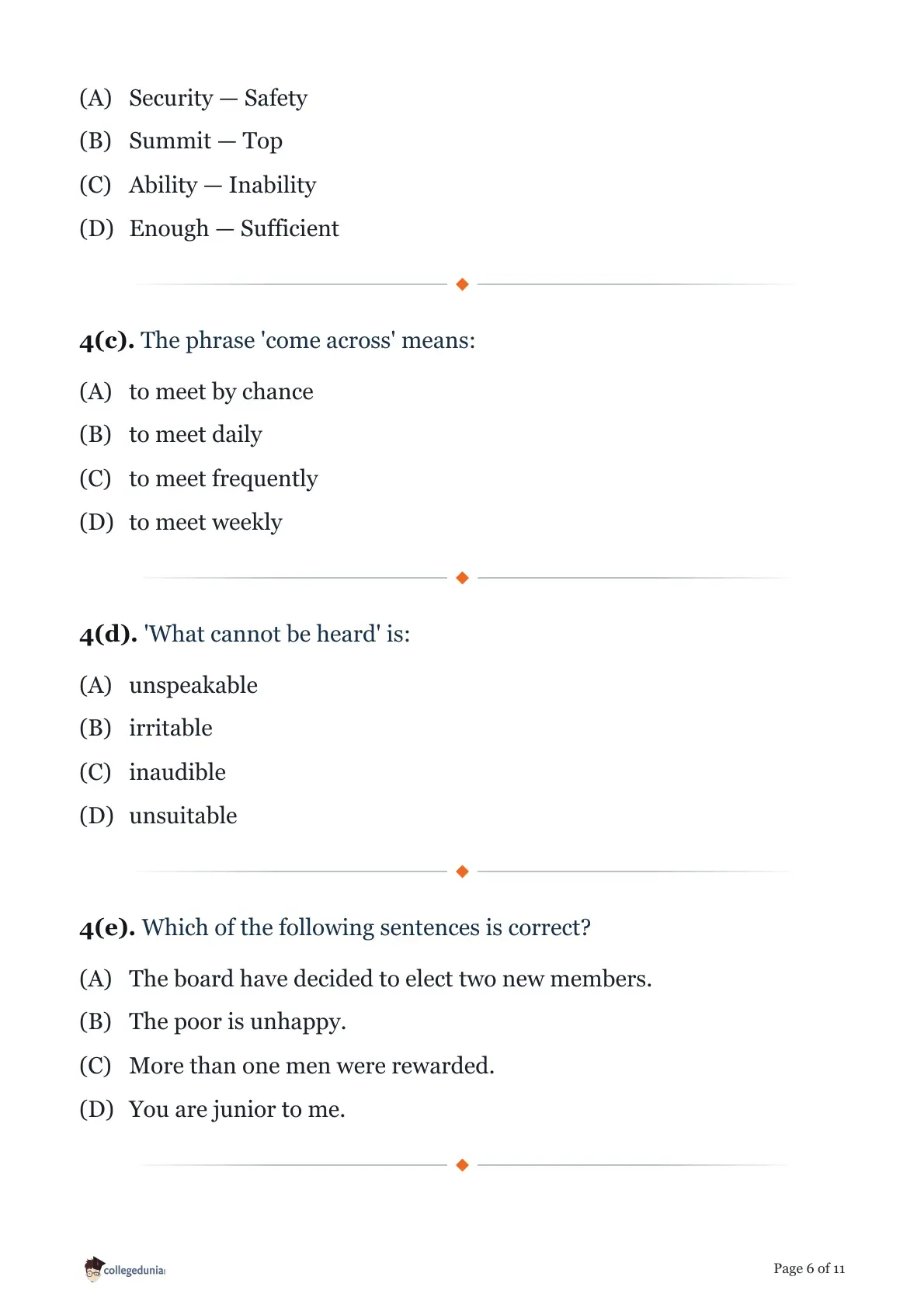
Which of the following is a pair of antonyms?
The phrase 'come across' means:
'What cannot be heard' is:
Which of the following sentences is correct?
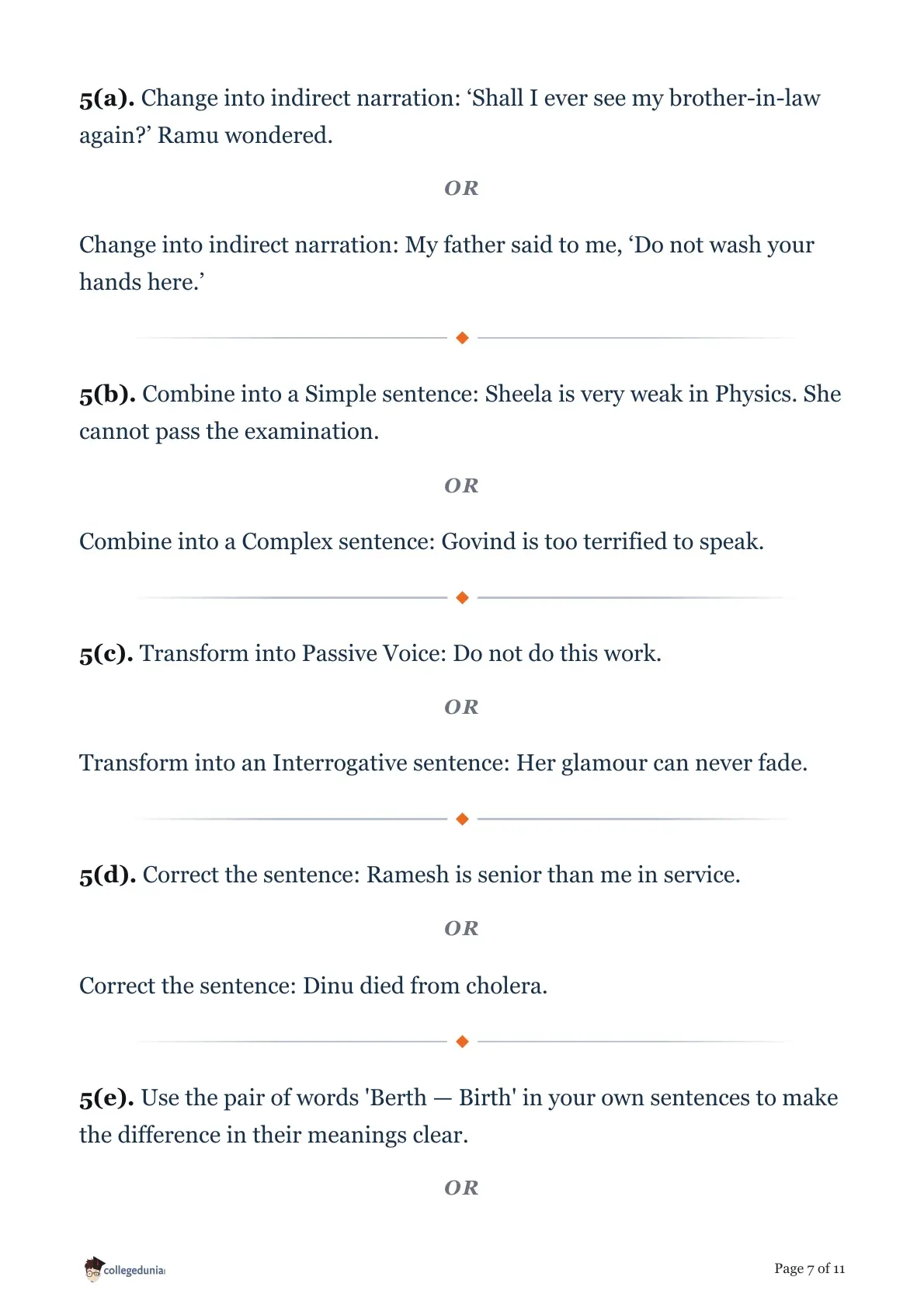
Change into indirect narration: ‘Shall I ever see my brother-in-law again?’ Ramu wondered.
Change into indirect narration: My father said to me, ‘Do not wash your hands here.’
Combine into a Simple sentence: Sheela is very weak in Physics. She cannot pass the examination.
Combine into a Complex sentence: Govind is too terrified to speak.
Transform into Passive Voice: Do not do this work.
Transform into an Interrogative sentence: Her glamour can never fade.
Correct the sentence: Ramesh is senior than me in service.
Correct the sentence: Dinu died from cholera.
Use the pair of words 'Berth — Birth' in your own sentences to make the difference in their meanings clear.
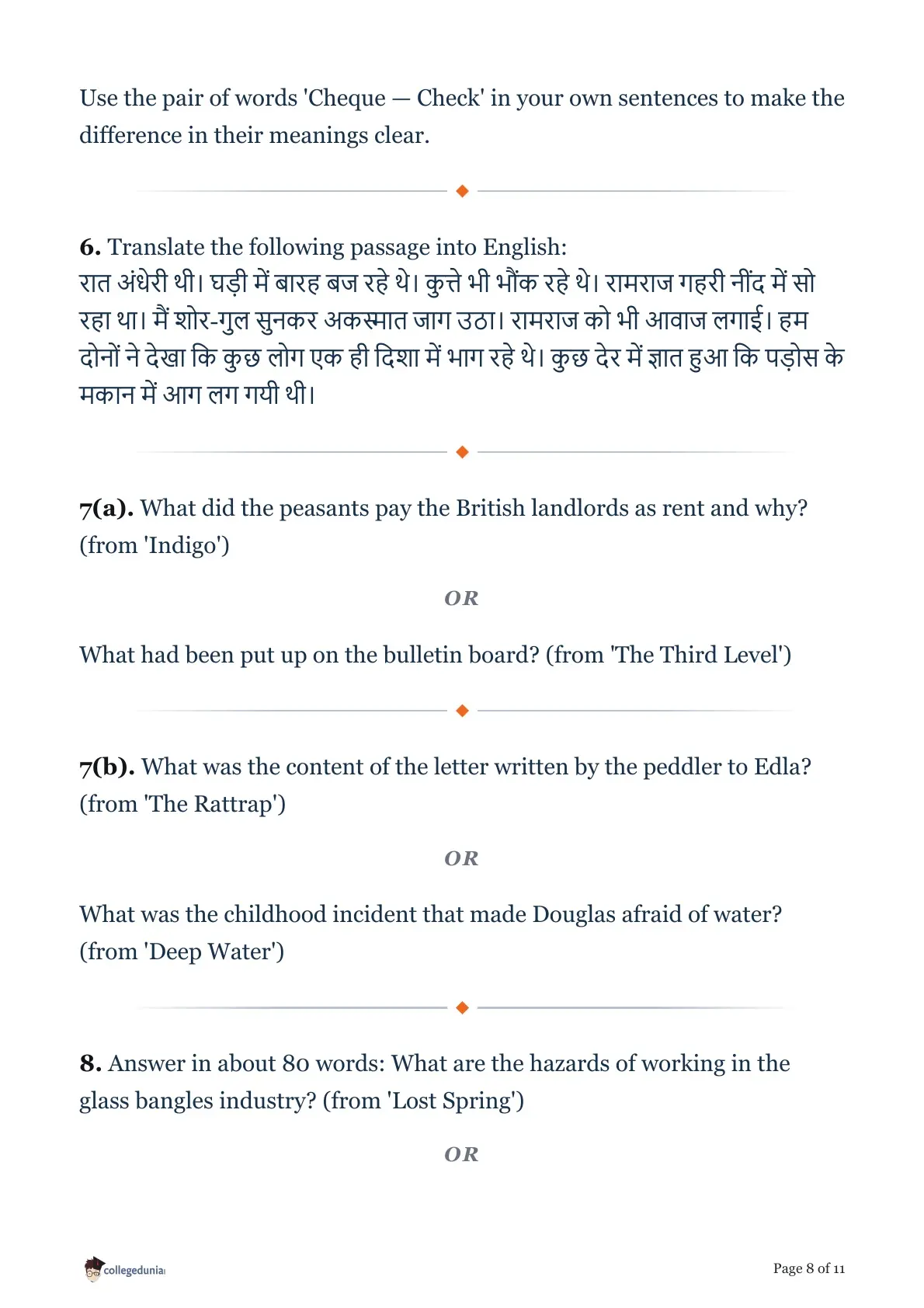
Use the pair of words 'Cheque — Check' in your own sentences to make the difference in their meanings clear.
Translate the following passage into English:
रात अंधेरी थी। घड़ी में बारह बज रहे थे। कुत्ते भी भौंक रहे थे। रामराज गहरी नींद में सो रहा था। मैं शोर-गुल सुनकर अकस्मात जाग उठा। रामराज को भी आवाज लगाई। हम दोनों ने देखा कि कुछ लोग एक ही दिशा में भाग रहे थे। कुछ देर में ज्ञात हुआ कि पड़ोस के मकान में आग लग गयी थी।
What did the peasants pay the British landlords as rent and why? (from 'Indigo')
What had been put up on the bulletin board? (from 'The Third Level')
What was the content of the letter written by the peddler to Edla? (from 'The Rattrap')
What was the childhood incident that made Douglas afraid of water? (from 'Deep Water')
Answer in about 80 words: What are the hazards of working in the glass bangles industry? (from 'Lost Spring')
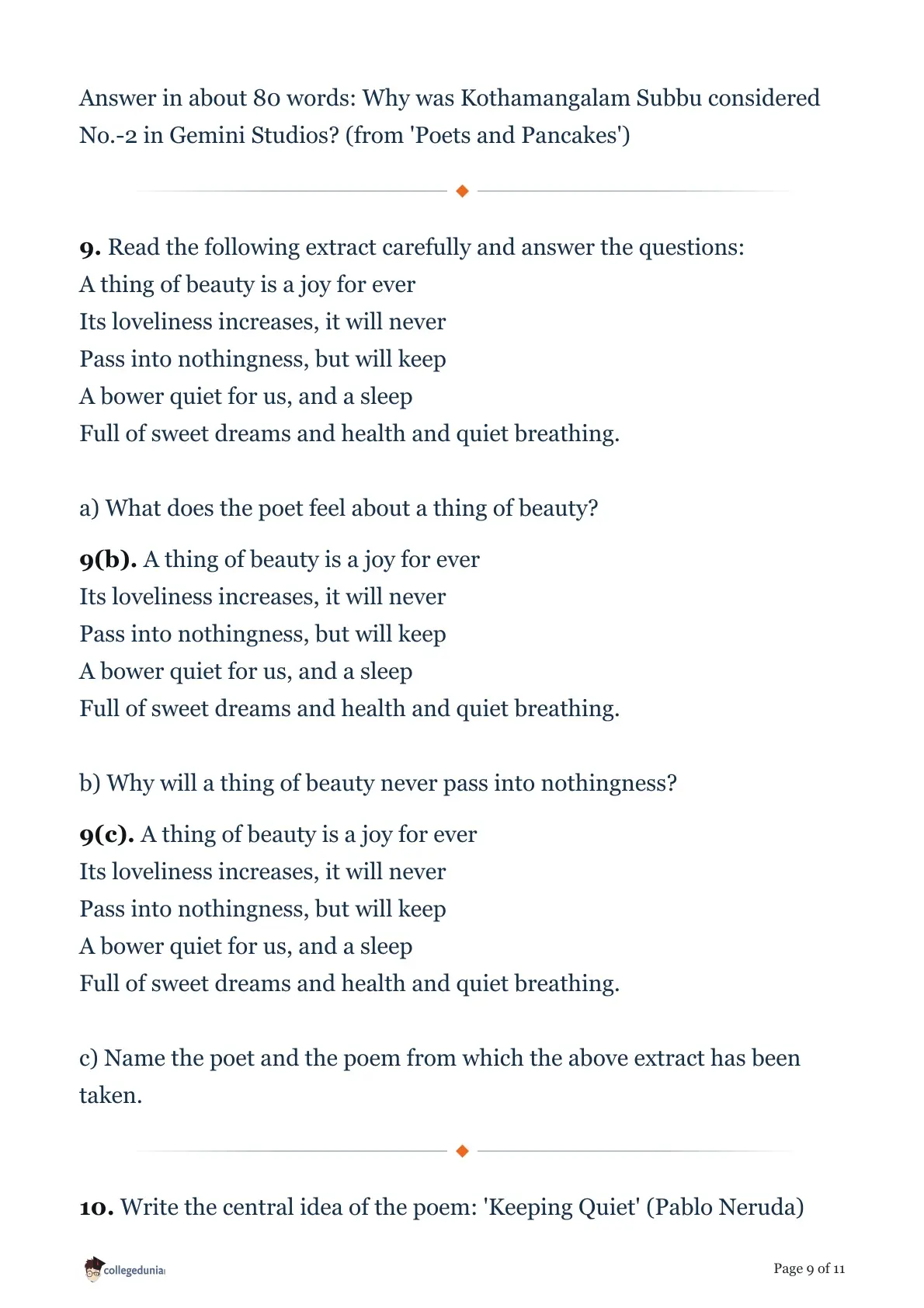
Answer in about 80 words: Why was Kothamangalam Subbu considered No.-2 in Gemini Studios? (from 'Poets and Pancakes')
Read the following extract carefully and answer the questions:
A thing of beauty is a joy for ever
Its loveliness increases, it will never
Pass into nothingness, but will keep
A bower quiet for us, and a sleep
Full of sweet dreams and health and quiet breathing.
a) What does the poet feel about a thing of beauty?
A thing of beauty is a joy for ever
Its loveliness increases, it will never
Pass into nothingness, but will keep
A bower quiet for us, and a sleep
Full of sweet dreams and health and quiet breathing.
b) Why will a thing of beauty never pass into nothingness?
A thing of beauty is a joy for ever
Its loveliness increases, it will never
Pass into nothingness, but will keep
A bower quiet for us, and a sleep
Full of sweet dreams and health and quiet breathing.
c) Name the poet and the poem from which the above extract has been taken.
Write the central idea of the poem: 'Keeping Quiet' (Pablo Neruda)
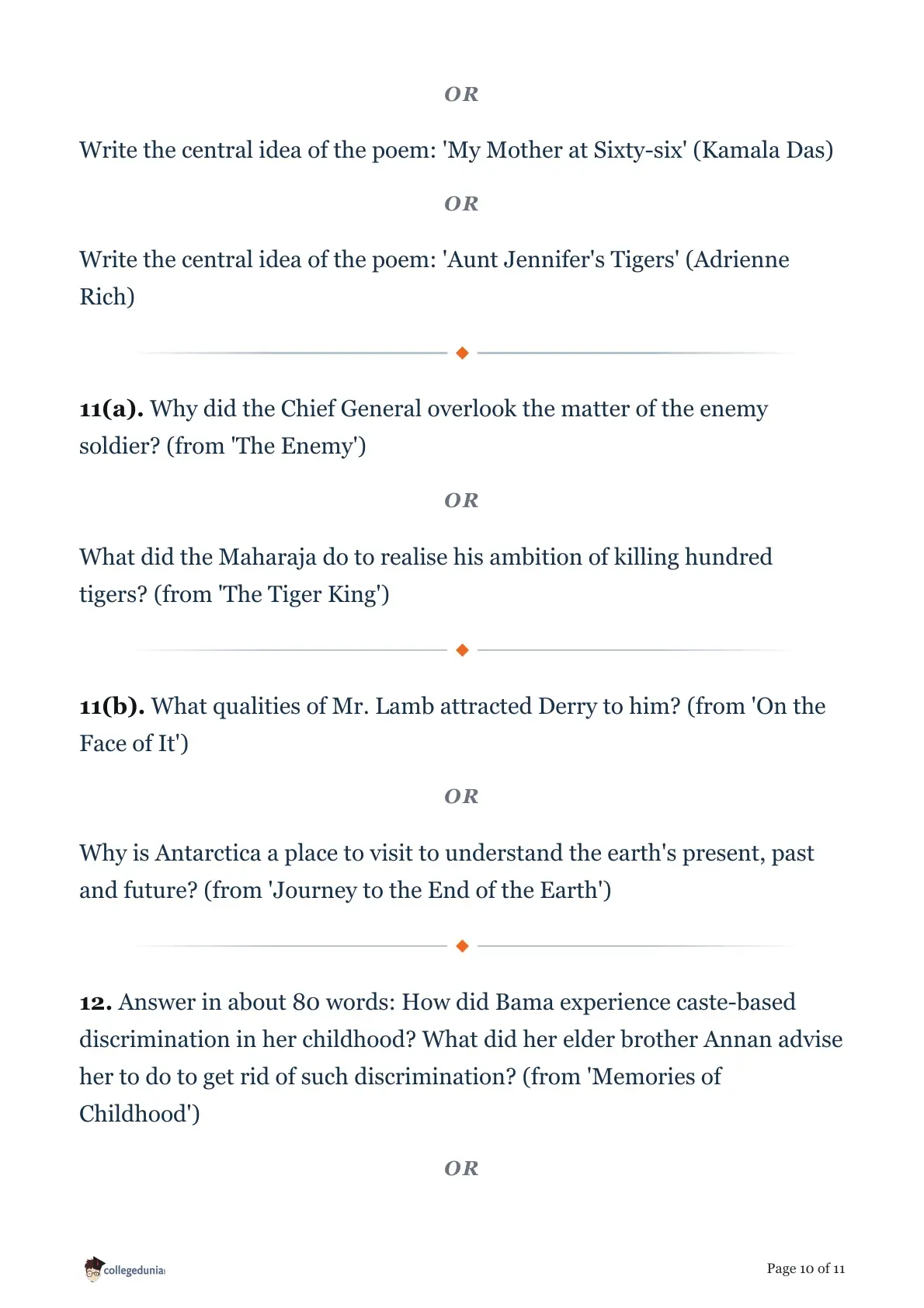
Write the central idea of the poem: 'My Mother at Sixty-six' (Kamala Das)
Write the central idea of the poem: 'Aunt Jennifer's Tigers' (Adrienne Rich)
Why did the Chief General overlook the matter of the enemy soldier? (from 'The Enemy')
What did the Maharaja do to realise his ambition of killing hundred tigers? (from 'The Tiger King')
What qualities of Mr. Lamb attracted Derry to him? (from 'On the Face of It')
Why is Antarctica a place to visit to understand the earth's present, past and future? (from 'Journey to the End of the Earth')
Answer in about 80 words: How did Bama experience caste-based discrimination in her childhood? What did her elder brother Annan advise her to do to get rid of such discrimination? (from 'Memories of Childhood')
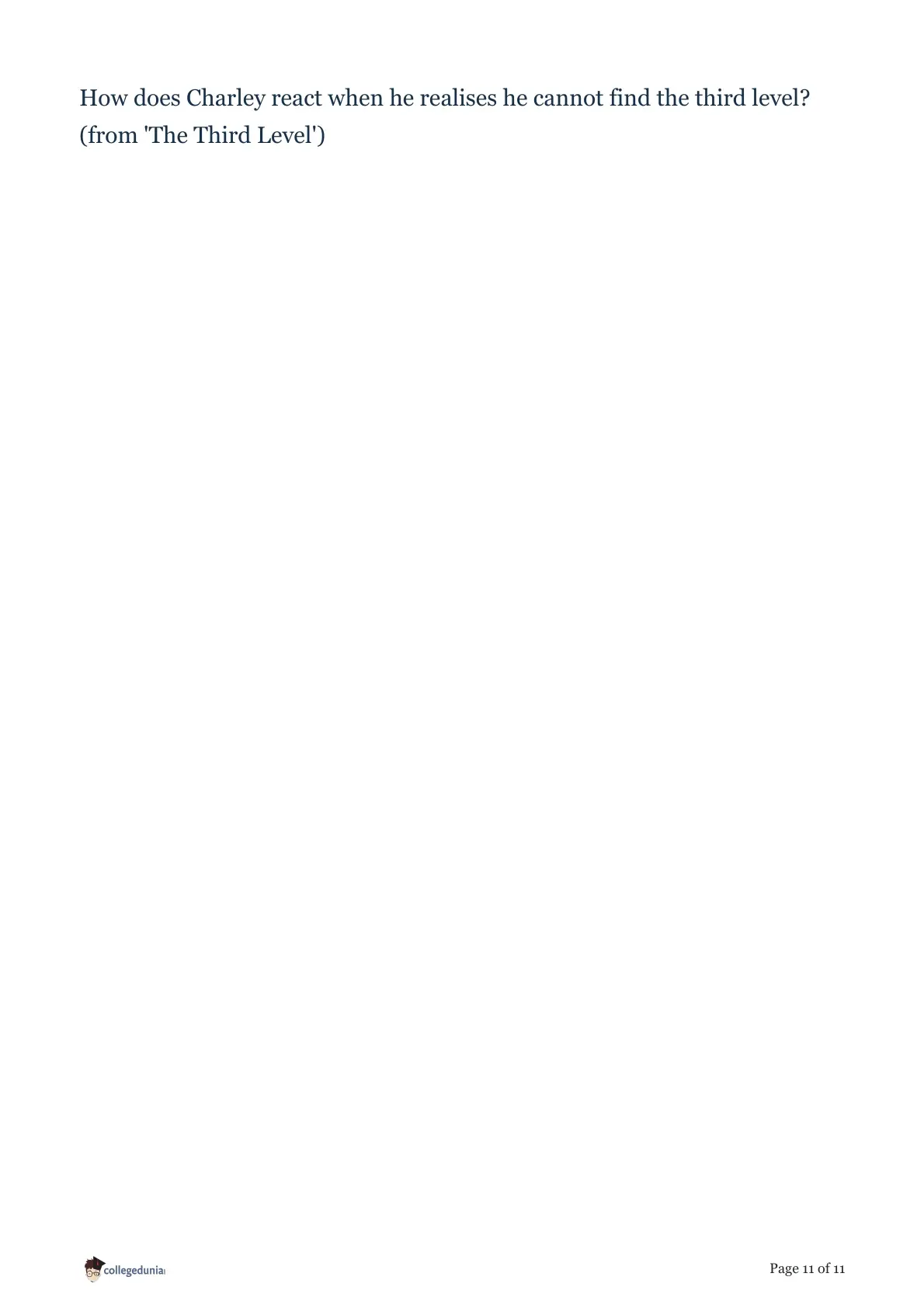
How does Charley react when he realises he cannot find the third level? (from 'The Third Level')
UP Board Class 12 English 2026 Exam Pattern and Marking Scheme Explained
The Set 316 BY paper has four sections, and every question is compulsory apart from the internal choices below.
- Total questions: 12 questions across Section A (Reading), Section B (Writing), Section C (Grammar) and Section D (Literature)
- Total marks: 100 - Reading 15, Writing 20, Grammar 25 and Literature 40
- Duration: 3 hours 15 minutes, with the first 15 minutes given for reading the question paper
- Question types: 5 single-correct MCQs (Q4), plus passage, article, letter, transformation, translation, extract and literature answers
- Internal choice: 1 of 3 topics in Q2, 1 of 2 in Q3, Q5, Q7, Q8, Q11 and Q12, and 1 of 3 poems in Q10
High-Weightage Sections in UP Board Class 12 English 2026 to Focus On First
Literature carried 40 of the 100 marks in Set 316 BY, more than any other section.
- Literature (Q7 to Q12): 40 of 100 marks - Q7 and Q11 carry 8 marks each, Q8 and Q12 7 each, Q9 6 and Q10 4. Q9 is an extract from 'A Thing of Beauty', and Q10 asks the central idea of any one of Keeping Quiet, My Mother at Sixty-six and Aunt Jennifer's Tigers
- Grammar (Q4 to Q6): 25 of 100 marks - 5 MCQs (10), five transformation and usage questions (10) and a Hindi to English translation (5)
- Writing (Q2, Q3): 20 of 100 marks - an article in 100 to 150 words on any one of the dowry system, free education for women in all institutions and strict measures for free and fair elections, plus a letter to the Editor about raging contagious diseases in your locality, or an application to your Principal asking for a full fee concession on the basis of poverty
- Reading (Q1): 15 of 100 marks - an unseen passage on a sympathetic officer who reformed prisoners with kindness instead of fear, with parts (a) to (d) worth 3 marks each and part (e) split into three 1-mark parts
UP Board Class 12 English 2026 Paper Solution Video
Source: Determination Study Platform
How to Use the UP Board Class 12 English Question Paper for Practice
Treat this Set 316 BY paper as a timed mock before you check the solutions.
- Attempt all 12 questions in 3 hours 15 minutes under exam conditions first
- Practise both options of every internal choice - Q2 has 3 article topics and Q10 has 3 poems
- Write the article, letter and translation by hand, since Q2, Q3 and Q6 carry 25 marks together
- Review each answer against the step-by-step solution PDF, not just the final answer
UP Board Class 12 English 2026 Question Paper FAQs
Ques. When was the UP Board Class 12 English 2026 exam conducted?
Ans. UPMSP conducted the UP Board Class 12 English 2026 exam on February 20, 2026, in the afternoon shift from 2:00 pm to 5:15 pm, during the intermediate exams that ran from February 18 to March 12, 2026. The official time table is on upmsp.edu.in.
Ques. How many questions are there in the UP Board Class 12 English 2026 paper, and is there any choice?
Ans. The paper has 12 questions worth 100 marks. Most offer a choice - 1 of 3 article topics in Q2, 1 of 2 in Q3, Q8 and Q12, and 1 of 3 poems in Q10, while Q5, Q7 and Q11 are built from OR pairs.
Ques. What is the section-wise marking scheme for UP Board Class 12 English 2026?
Ans. Section A (Reading) carries 15 marks, Section B (Writing) 20 marks, Section C (Grammar) 25 marks and Section D (Literature) 40 marks, for a total of 100 marks in 3 hours 15 minutes.
Ques. Which section had the highest weightage in UP Board Class 12 English 2026 Set 316 BY?
Ans. Literature (Q7 to Q12) carried the most marks at 40 of 100, followed by Grammar at 25 marks, Writing at 20 marks and Reading at 15 marks.
Ques. Where can I download the UP Board Class 12 English 2026 Set 316 BY question paper with solutions PDF for free?
Ans. You can download both the question paper and the full step-by-step solutions PDF for Set 316 BY from the table at the top of this page, for free.



Comments