




The UP Board Class 12 English question paper with solutions (Set 316 CB) is available here for free download. UP Board Class 12 English 2026 was conducted by the Uttar Pradesh Madhyamik Shiksha Parishad (UPMSP) on February 20, 2026, as a 100-mark paper of 12 questions to be solved in 3 hours 15 minutes.
| UP Board Class 12 English Question Paper with Solutions (Set 316 CB) | Download PDF | Check Solutions |
UP Board Class 12 English 2026 (Set 316 CB) Questions with Solutions
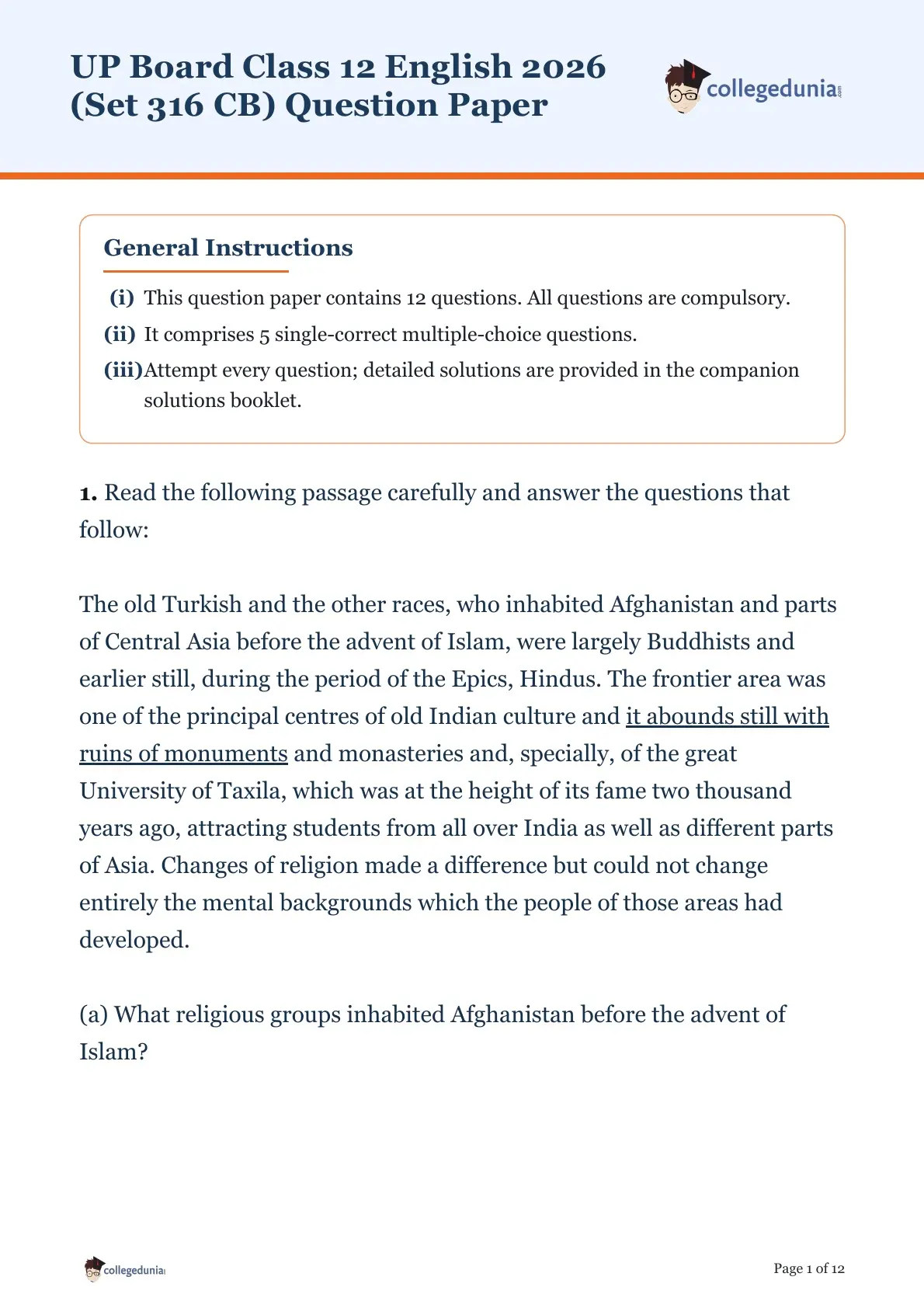
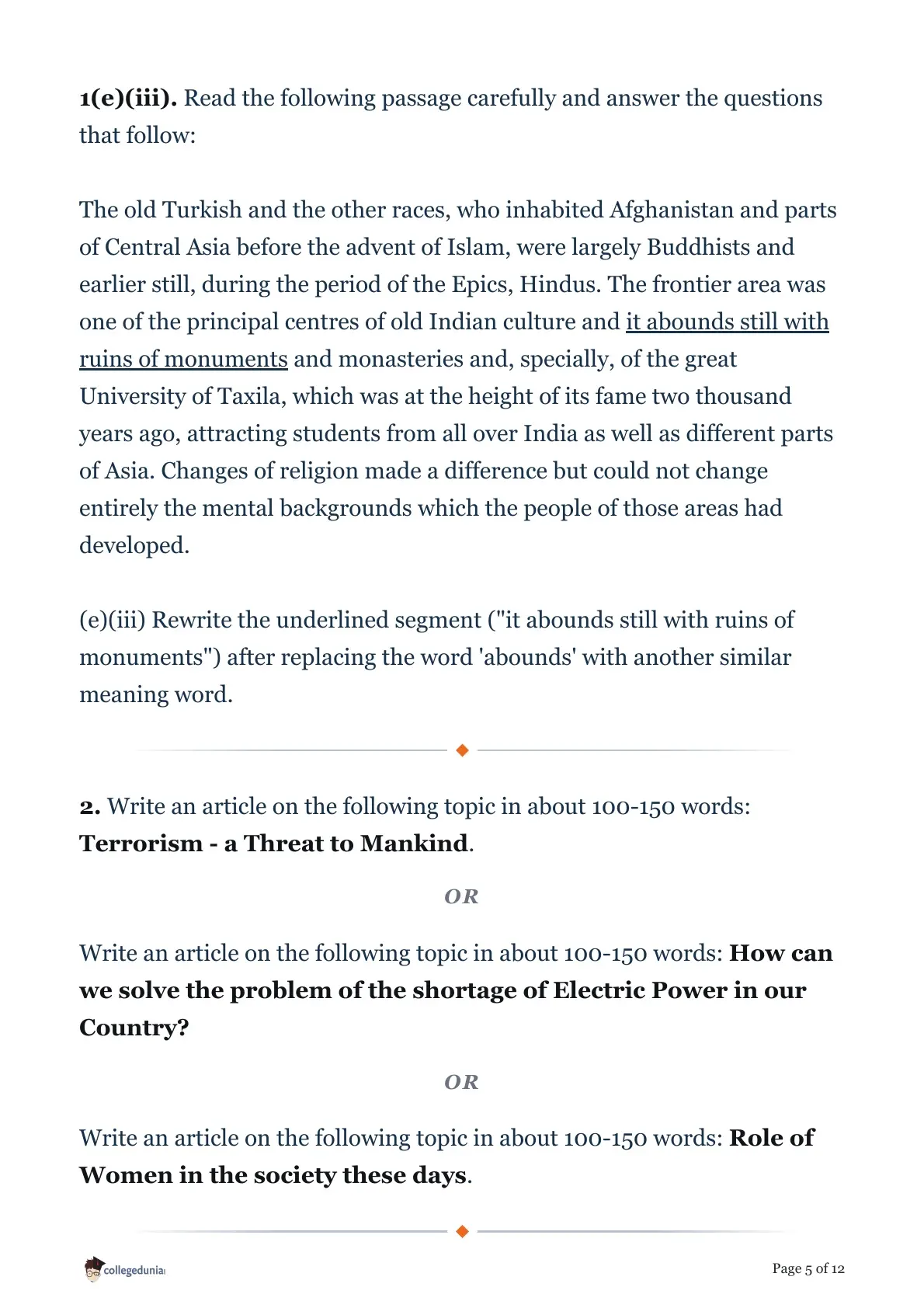
Read the following passage carefully and answer the questions that follow:
The old Turkish and the other races, who inhabited Afghanistan and parts of Central Asia before the advent of Islam, were largely Buddhists and earlier still, during the period of the Epics, Hindus. The frontier area was one of the principal centres of old Indian culture and it abounds still with ruins of monuments and monasteries and, specially, of the great University of Taxila, which was at the height of its fame two thousand years ago, attracting students from all over India as well as different parts of Asia. Changes of religion made a difference but could not change entirely the mental backgrounds which the people of those areas had developed.
(a) What religious groups inhabited Afghanistan before the advent of Islam?
Read the following passage carefully and answer the questions that follow:
The old Turkish and the other races, who inhabited Afghanistan and parts of Central Asia before the advent of Islam, were largely Buddhists and earlier still, during the period of the Epics, Hindus. The frontier area was one of the principal centres of old Indian culture and it abounds still with ruins of monuments and monasteries and, specially, of the great University of Taxila, which was at the height of its fame two thousand years ago, attracting students from all over India as well as different parts of Asia. Changes of religion made a difference but could not change entirely the mental backgrounds which the people of those areas had developed.
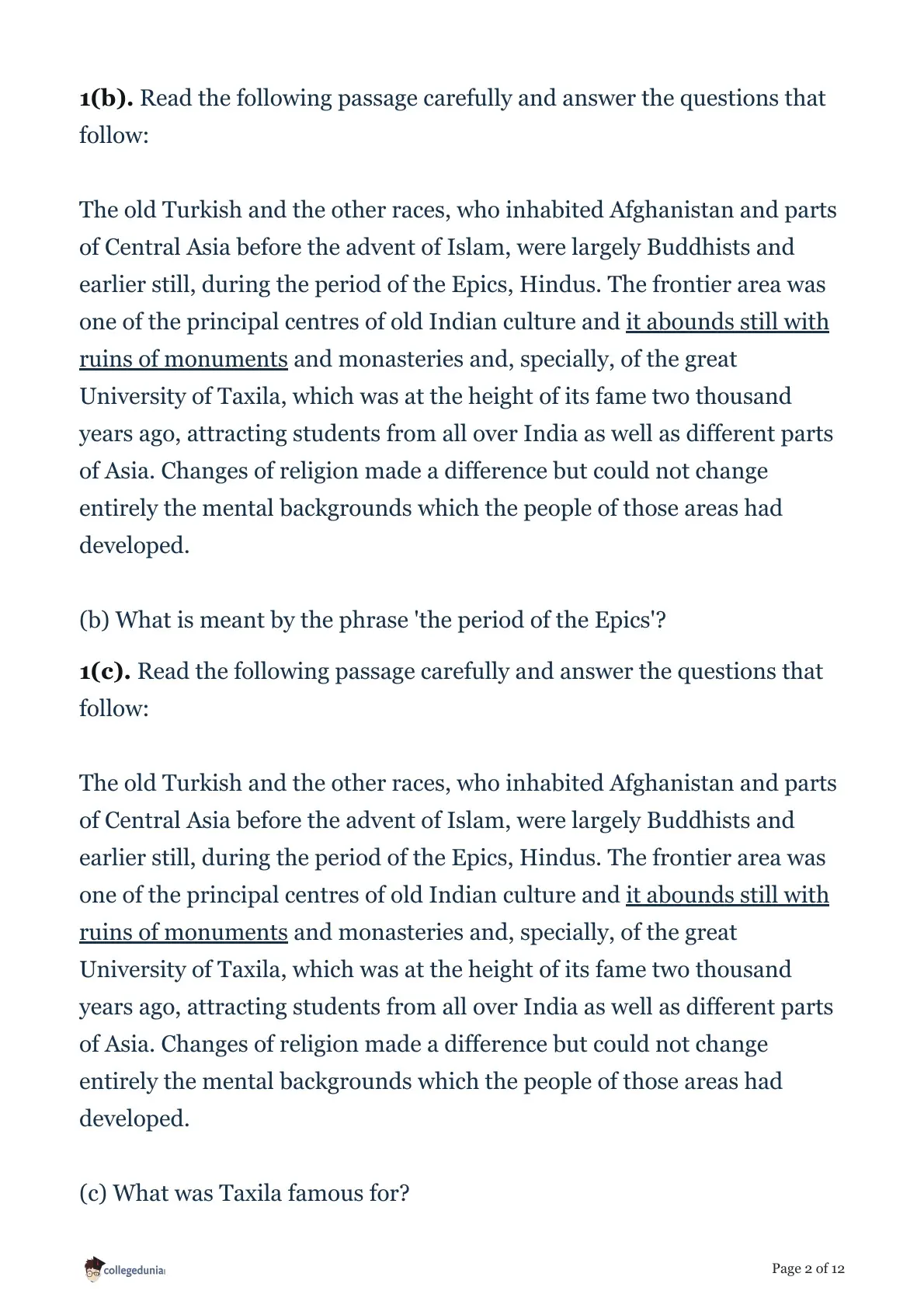
(b) What is meant by the phrase 'the period of the Epics'?
Read the following passage carefully and answer the questions that follow:
The old Turkish and the other races, who inhabited Afghanistan and parts of Central Asia before the advent of Islam, were largely Buddhists and earlier still, during the period of the Epics, Hindus. The frontier area was one of the principal centres of old Indian culture and it abounds still with ruins of monuments and monasteries and, specially, of the great University of Taxila, which was at the height of its fame two thousand years ago, attracting students from all over India as well as different parts of Asia. Changes of religion made a difference but could not change entirely the mental backgrounds which the people of those areas had developed.
(c) What was Taxila famous for?
Read the following passage carefully and answer the questions that follow:
The old Turkish and the other races, who inhabited Afghanistan and parts of Central Asia before the advent of Islam, were largely Buddhists and earlier still, during the period of the Epics, Hindus. The frontier area was one of the principal centres of old Indian culture and it abounds still with ruins of monuments and monasteries and, specially, of the great University of Taxila, which was at the height of its fame two thousand years ago, attracting students from all over India as well as different parts of Asia. Changes of religion made a difference but could not change entirely the mental backgrounds which the people of those areas had developed.
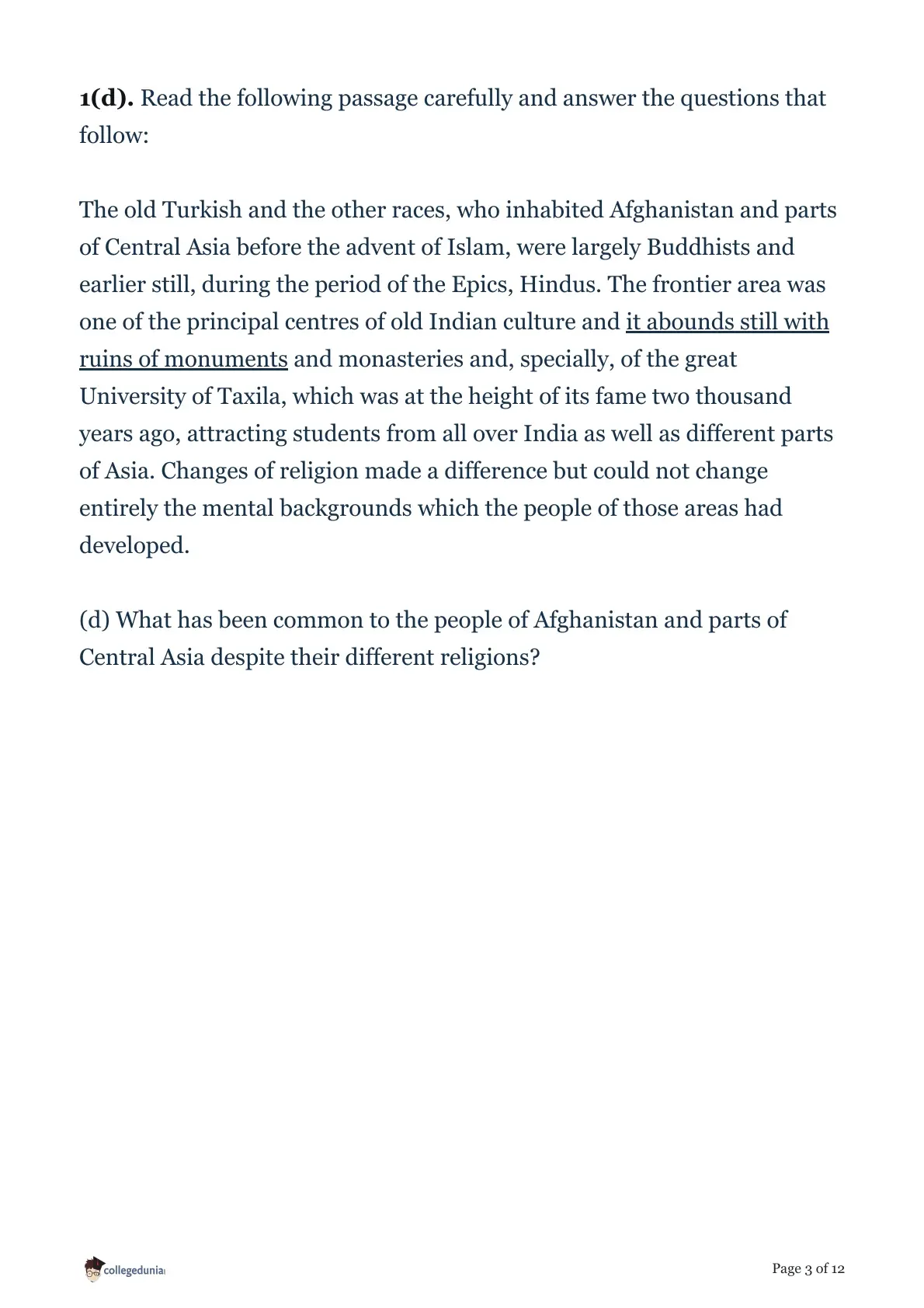
(d) What has been common to the people of Afghanistan and parts of Central Asia despite their different religions?
Read the following passage carefully and answer the questions that follow:
The old Turkish and the other races, who inhabited Afghanistan and parts of Central Asia before the advent of Islam, were largely Buddhists and earlier still, during the period of the Epics, Hindus. The frontier area was one of the principal centres of old Indian culture and it abounds still with ruins of monuments and monasteries and, specially, of the great University of Taxila, which was at the height of its fame two thousand years ago, attracting students from all over India as well as different parts of Asia. Changes of religion made a difference but could not change entirely the mental backgrounds which the people of those areas had developed.
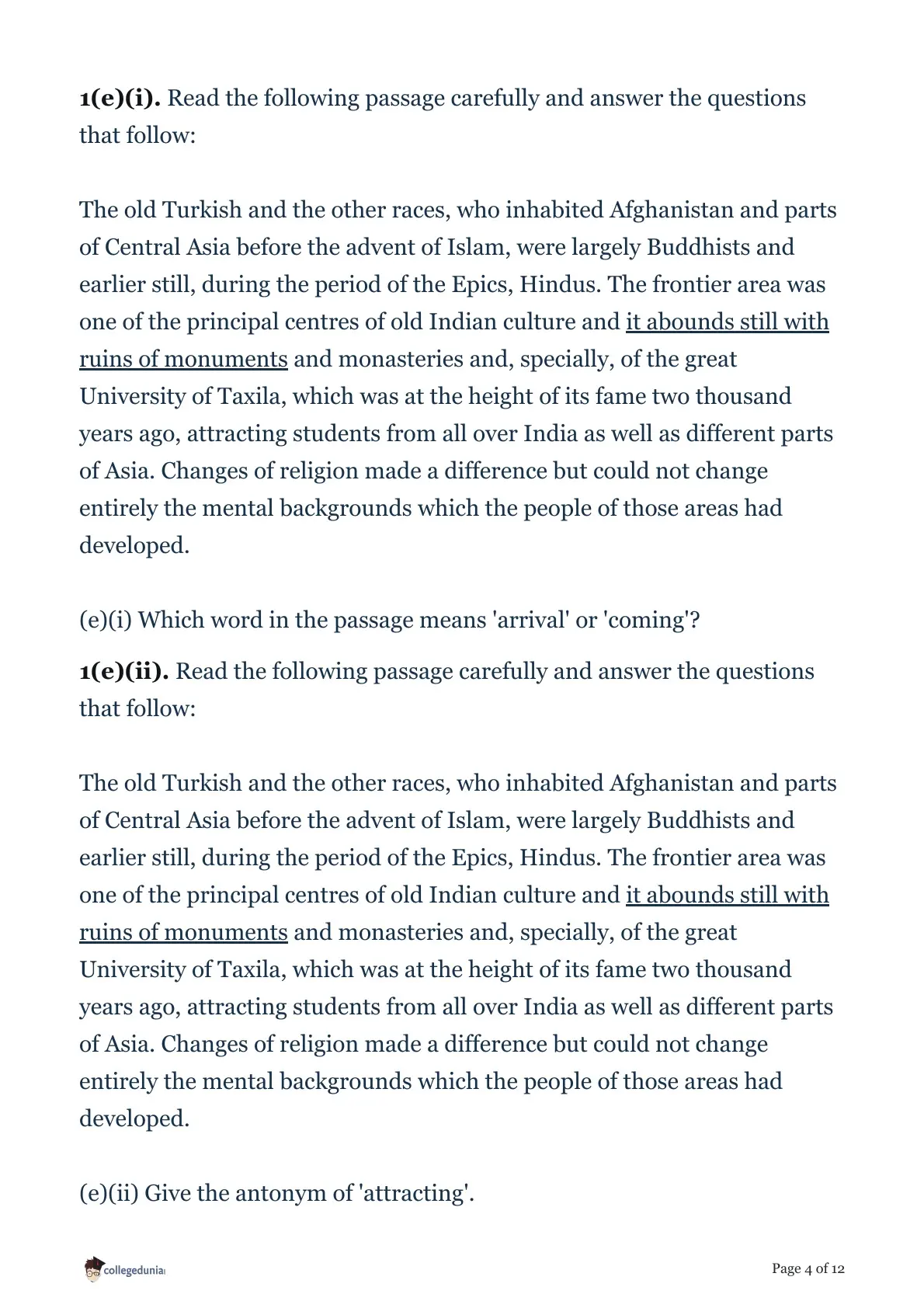
(e)(i) Which word in the passage means 'arrival' or 'coming'?
Read the following passage carefully and answer the questions that follow:
The old Turkish and the other races, who inhabited Afghanistan and parts of Central Asia before the advent of Islam, were largely Buddhists and earlier still, during the period of the Epics, Hindus. The frontier area was one of the principal centres of old Indian culture and it abounds still with ruins of monuments and monasteries and, specially, of the great University of Taxila, which was at the height of its fame two thousand years ago, attracting students from all over India as well as different parts of Asia. Changes of religion made a difference but could not change entirely the mental backgrounds which the people of those areas had developed.
(e)(ii) Give the antonym of 'attracting'.
Read the following passage carefully and answer the questions that follow:
The old Turkish and the other races, who inhabited Afghanistan and parts of Central Asia before the advent of Islam, were largely Buddhists and earlier still, during the period of the Epics, Hindus. The frontier area was one of the principal centres of old Indian culture and it abounds still with ruins of monuments and monasteries and, specially, of the great University of Taxila, which was at the height of its fame two thousand years ago, attracting students from all over India as well as different parts of Asia. Changes of religion made a difference but could not change entirely the mental backgrounds which the people of those areas had developed.
(e)(iii) Rewrite the underlined segment ("it abounds still with ruins of monuments") after replacing the word 'abounds' with another similar meaning word.
Write an article on the following topic in about 100-150 words: Terrorism - a Threat to Mankind.
Write an article on the following topic in about 100-150 words: How can we solve the problem of the shortage of Electric Power in our Country?
Write an article on the following topic in about 100-150 words: Role of Women in the society these days.
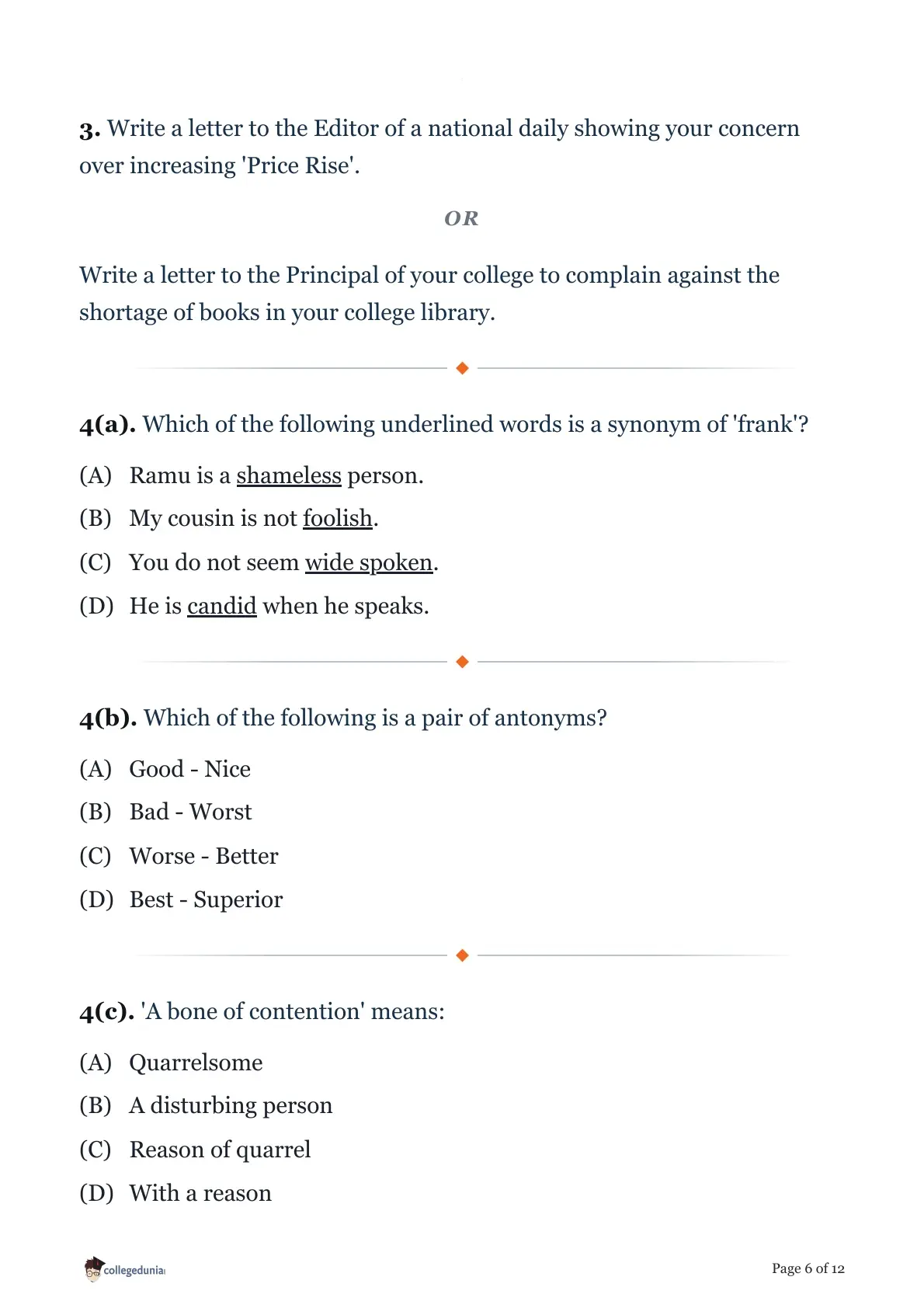
Write a letter to the Editor of a national daily showing your concern over increasing 'Price Rise'.
Write a letter to the Principal of your college to complain against the shortage of books in your college library.
Which of the following underlined words is a synonym of 'frank'?
Which of the following is a pair of antonyms?
'A bone of contention' means:
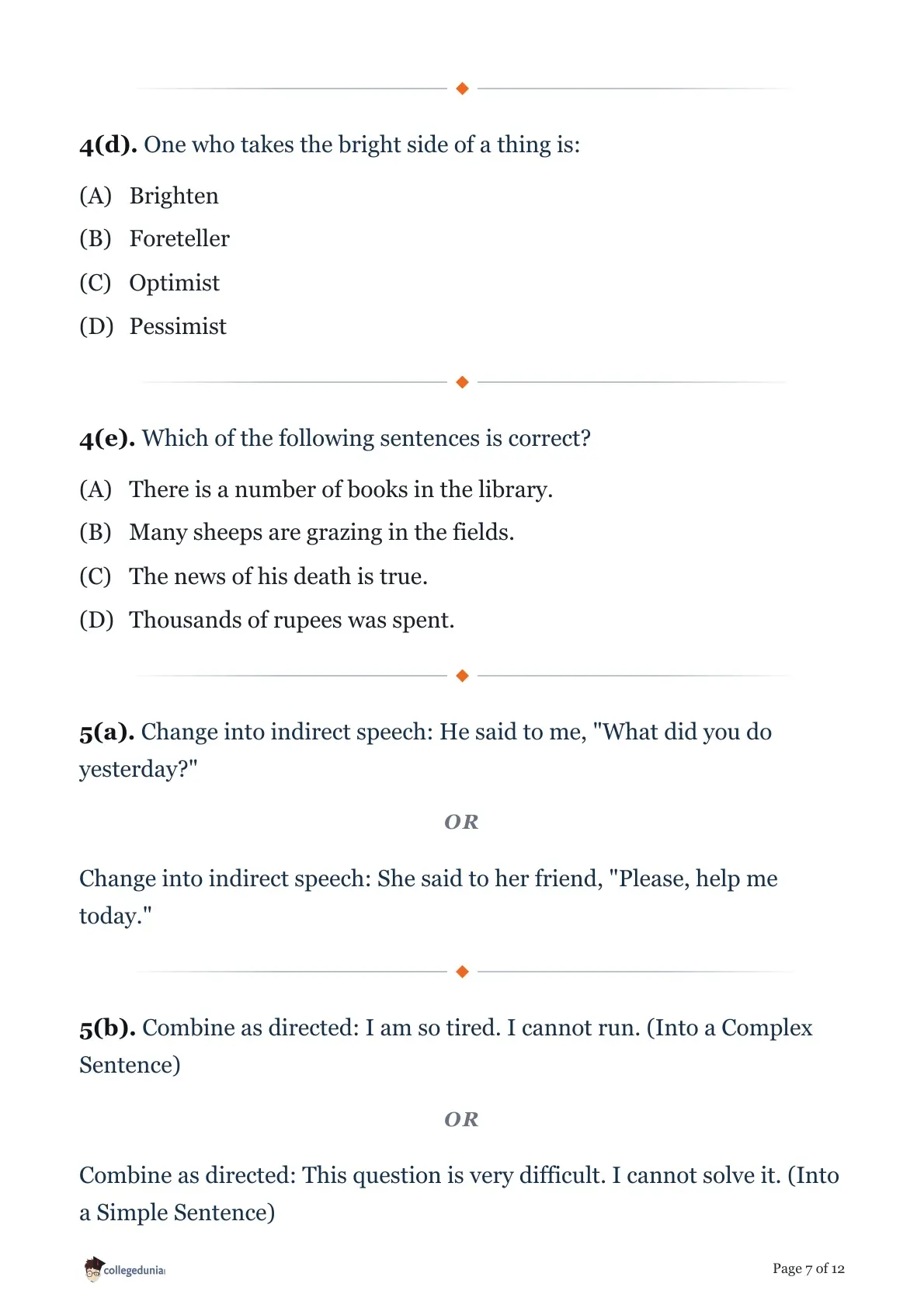
One who takes the bright side of a thing is:
Which of the following sentences is correct?
Change into indirect speech: He said to me, "What did you do yesterday?"
Change into indirect speech: She said to her friend, "Please, help me today."
Combine as directed: I am so tired. I cannot run. (Into a Complex Sentence)
Combine as directed: This question is very difficult. I cannot solve it. (Into a Simple Sentence)
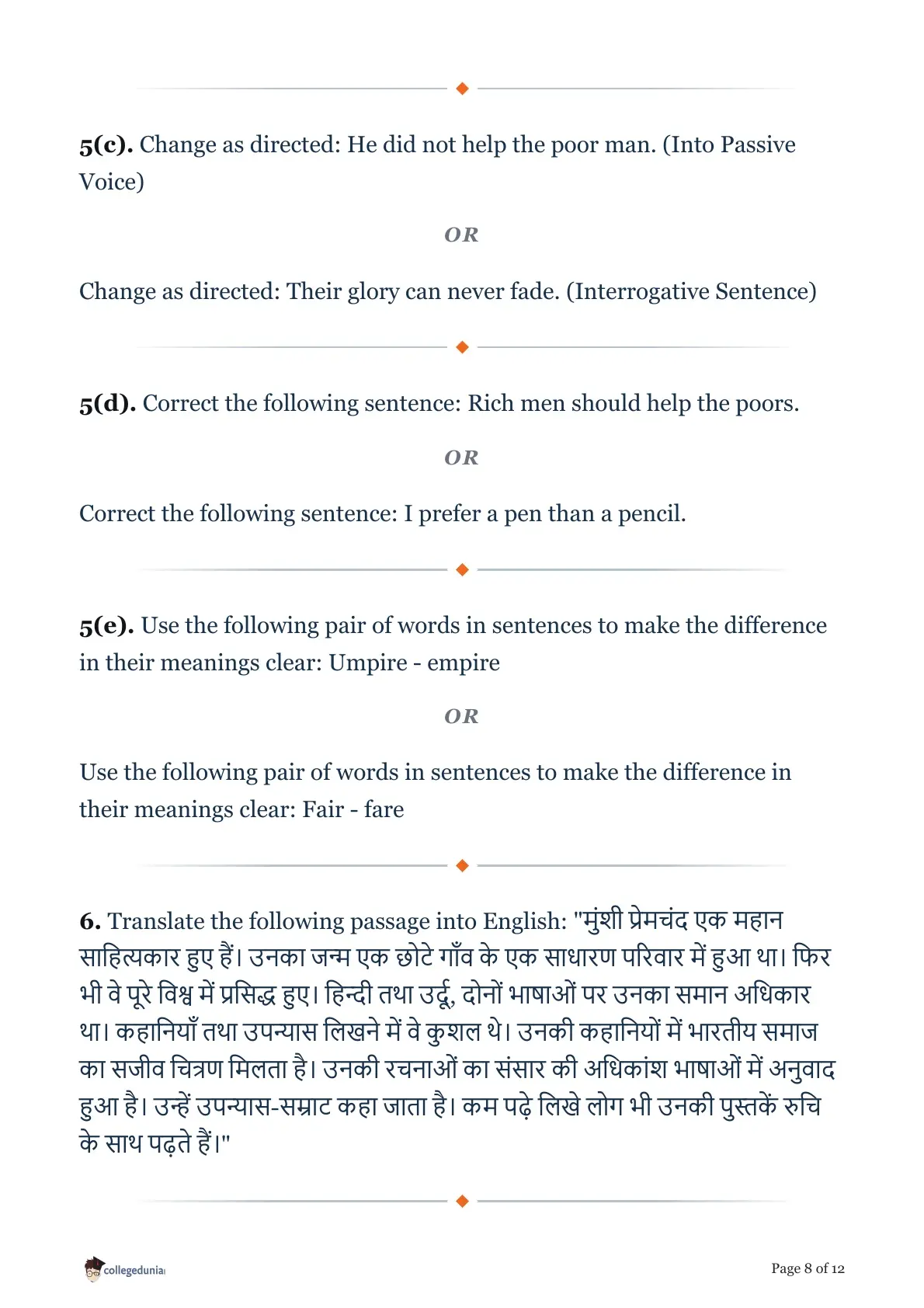
Change as directed: He did not help the poor man. (Into Passive Voice)
Change as directed: Their glory can never fade. (Interrogative Sentence)
Correct the following sentence: Rich men should help the poors.
Correct the following sentence: I prefer a pen than a pencil.
Use the following pair of words in sentences to make the difference in their meanings clear: Umpire - empire
Use the following pair of words in sentences to make the difference in their meanings clear: Fair - fare
Translate the following passage into English: "मुंशी प्रेमचंद एक महान साहित्यकार हुए हैं। उनका जन्म एक छोटे गाँव के एक साधारण परिवार में हुआ था। फिर भी वे पूरे विश्व में प्रसिद्ध हुए। हिन्दी तथा उर्दू, दोनों भाषाओं पर उनका समान अधिकार था। कहानियाँ तथा उपन्यास लिखने में वे कुशल थे। उनकी कहानियों में भारतीय समाज का सजीव चित्रण मिलता है। उनकी रचनाओं का संसार की अधिकांश भाषाओं में अनुवाद हुआ है। उन्हें उपन्यास-सम्राट कहा जाता है। कम पढ़े लिखे लोग भी उनकी पुस्तकें रुचि के साथ पढ़ते हैं।"
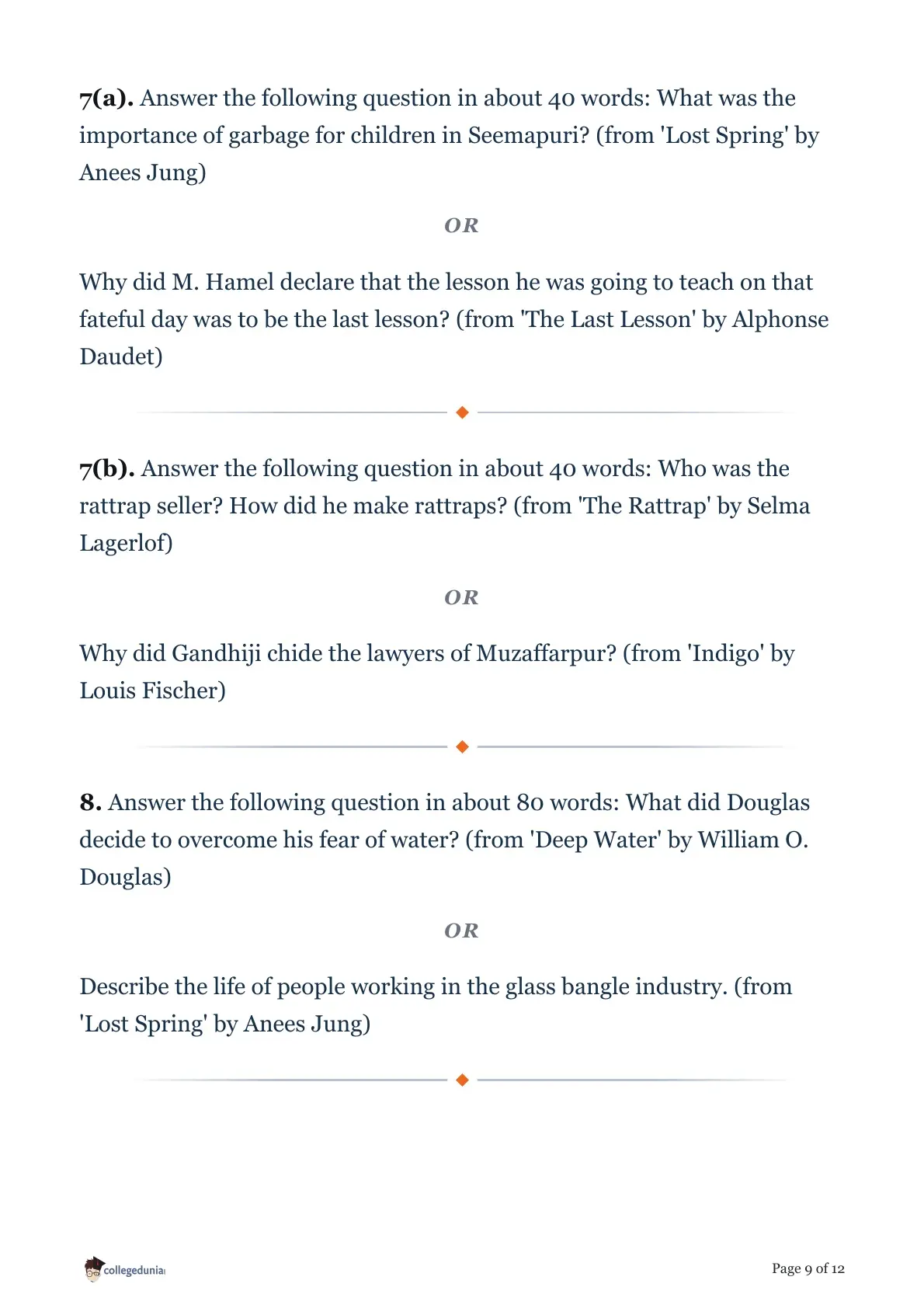
Answer the following question in about 40 words: What was the importance of garbage for children in Seemapuri? (from 'Lost Spring' by Anees Jung)
Why did M. Hamel declare that the lesson he was going to teach on that fateful day was to be the last lesson? (from 'The Last Lesson' by Alphonse Daudet)
Answer the following question in about 40 words: Who was the rattrap seller? How did he make rattraps? (from 'The Rattrap' by Selma Lagerlof)
Why did Gandhiji chide the lawyers of Muzaffarpur? (from 'Indigo' by Louis Fischer)
Answer the following question in about 80 words: What did Douglas decide to overcome his fear of water? (from 'Deep Water' by William O. Douglas)
Describe the life of people working in the glass bangle industry. (from 'Lost Spring' by Anees Jung)
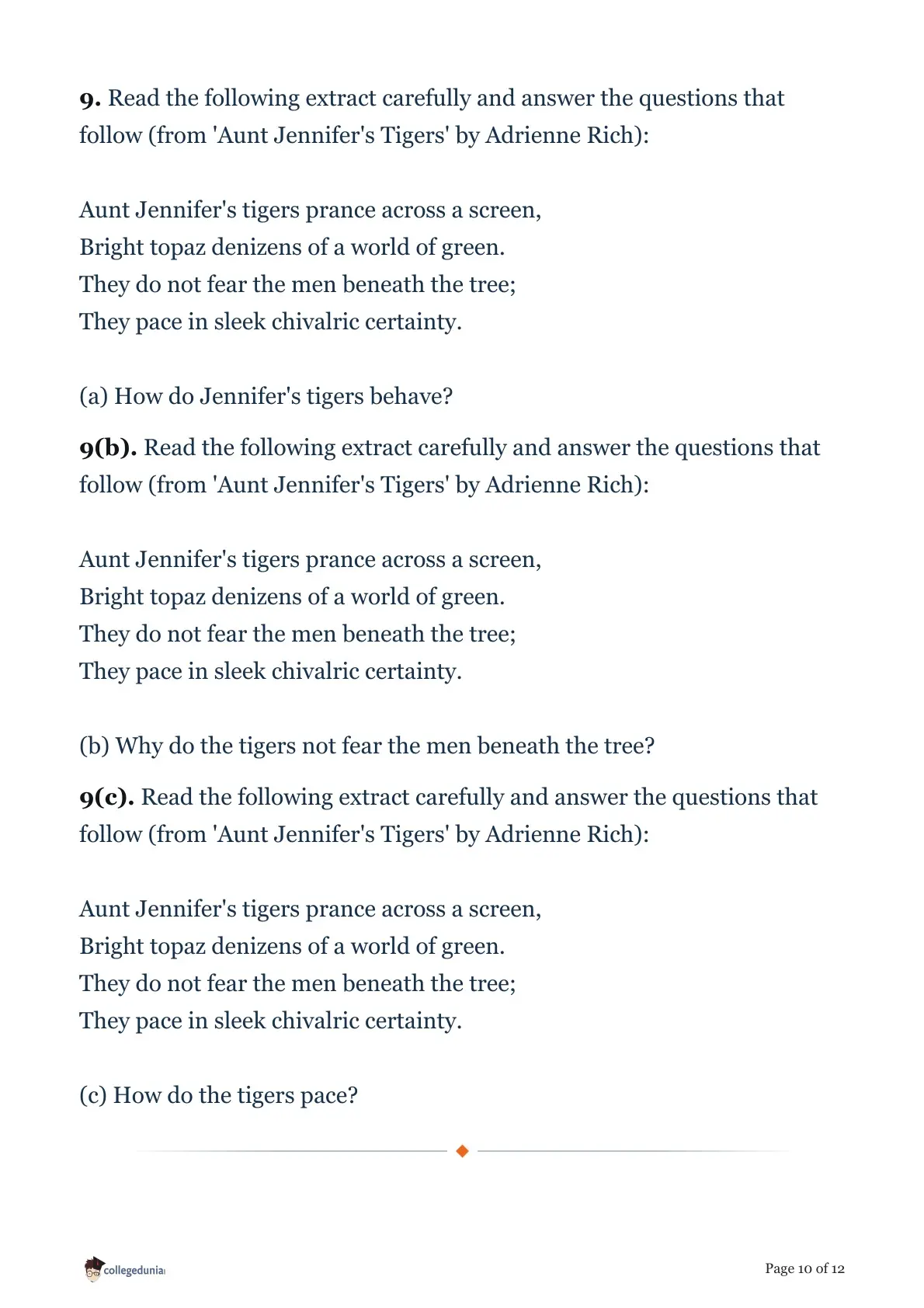
Read the following extract carefully and answer the questions that follow (from 'Aunt Jennifer's Tigers' by Adrienne Rich):
Aunt Jennifer's tigers prance across a screen,
Bright topaz denizens of a world of green.
They do not fear the men beneath the tree;
They pace in sleek chivalric certainty.
(a) How do Jennifer's tigers behave?
Read the following extract carefully and answer the questions that follow (from 'Aunt Jennifer's Tigers' by Adrienne Rich):
Aunt Jennifer's tigers prance across a screen,
Bright topaz denizens of a world of green.
They do not fear the men beneath the tree;
They pace in sleek chivalric certainty.
(b) Why do the tigers not fear the men beneath the tree?
Read the following extract carefully and answer the questions that follow (from 'Aunt Jennifer's Tigers' by Adrienne Rich):
Aunt Jennifer's tigers prance across a screen,
Bright topaz denizens of a world of green.
They do not fear the men beneath the tree;
They pace in sleek chivalric certainty.
(c) How do the tigers pace?
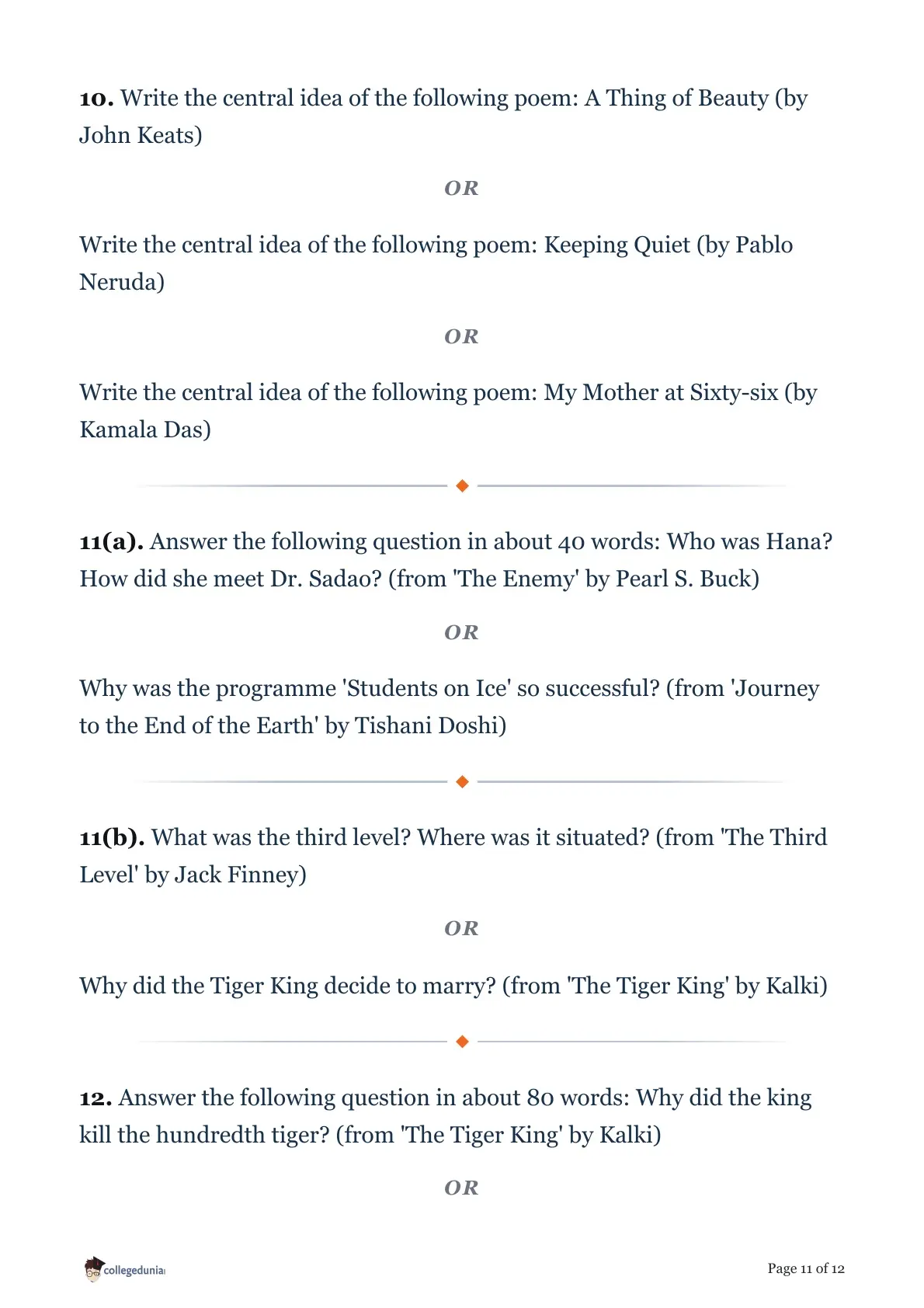
Write the central idea of the following poem: A Thing of Beauty (by John Keats)
Write the central idea of the following poem: Keeping Quiet (by Pablo Neruda)
Write the central idea of the following poem: My Mother at Sixty-six (by Kamala Das)
Answer the following question in about 40 words: Who was Hana? How did she meet Dr. Sadao? (from 'The Enemy' by Pearl S. Buck)
Why was the programme 'Students on Ice' so successful? (from 'Journey to the End of the Earth' by Tishani Doshi)
What was the third level? Where was it situated? (from 'The Third Level' by Jack Finney)
Why did the Tiger King decide to marry? (from 'The Tiger King' by Kalki)
Answer the following question in about 80 words: Why did the king kill the hundredth tiger? (from 'The Tiger King' by Kalki)
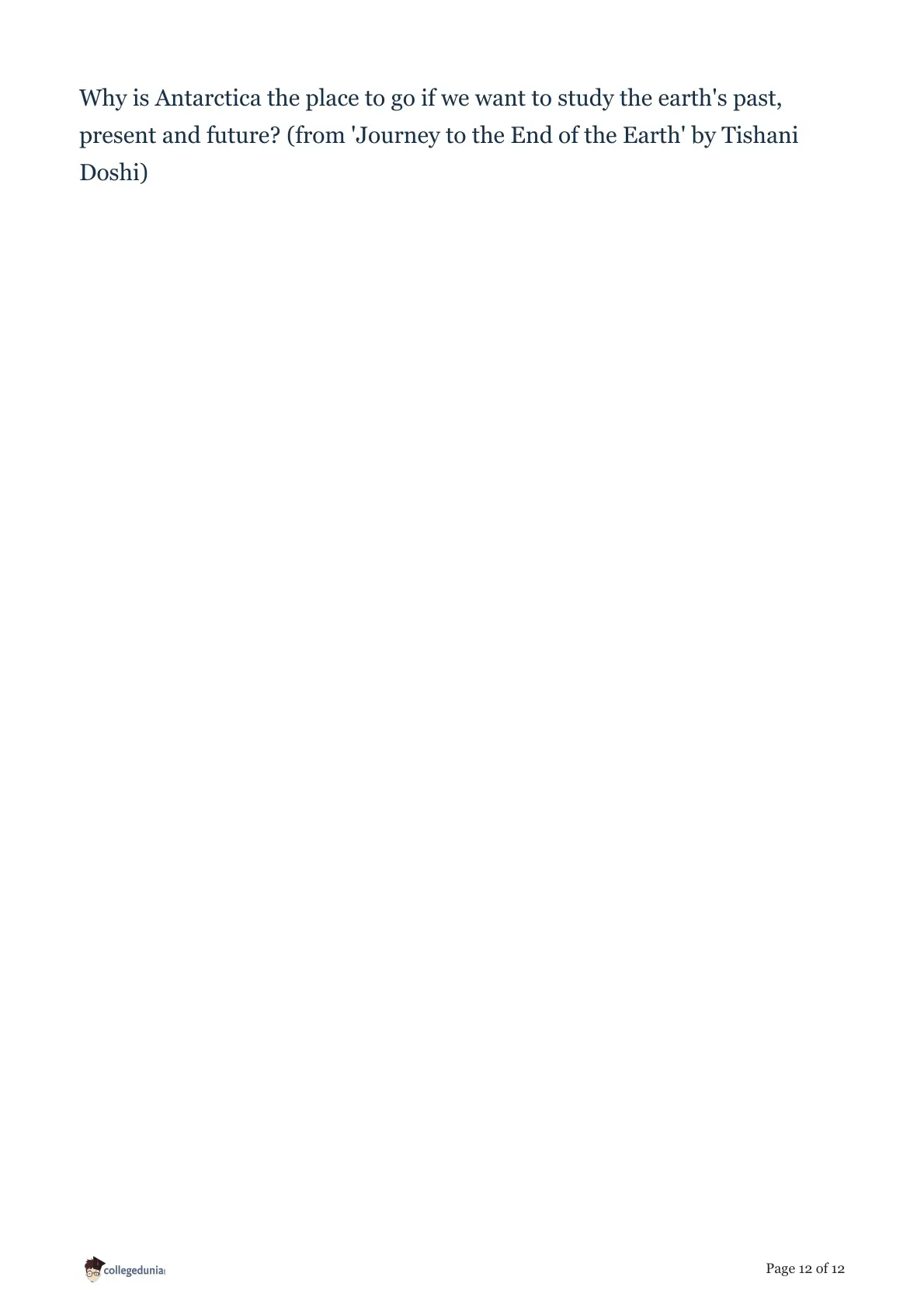
Why is Antarctica the place to go if we want to study the earth's past, present and future? (from 'Journey to the End of the Earth' by Tishani Doshi)
UP Board Class 12 English 2026 Exam Pattern and Marking Scheme Explained
The Set 316 CB paper has four sections, and every question is compulsory apart from the internal choices below.
- Total questions: 12 questions across Section A (Reading), Section B (Writing), Section C (Grammar) and Section D (Literature)
- Total marks: 100 - Reading 15, Writing 20, Grammar 25 and Literature 40
- Duration: 3 hours 15 minutes, with the first 15 minutes given for reading the question paper
- Question types: 5 single-correct MCQs (Q4), plus passage, article, letter, transformation, translation, extract and literature answers
- Internal choice: 1 of 3 topics in Q2, 1 of 2 in Q3, Q5, Q7, Q8, Q11 and Q12, and 1 of 3 poems in Q10
High-Weightage Sections in UP Board Class 12 English 2026 to Focus On First
Literature carried 40 of the 100 marks in Set 316 CB, more than any other section.
- Literature (Q7 to Q12): 40 of 100 marks - Q7 and Q11 carry 8 marks each, Q8 and Q12 7 each, Q9 6 and Q10 4. Q9 is an extract from 'Aunt Jennifer's Tigers', and Q10 asks the central idea of any one of A Thing of Beauty, Keeping Quiet and My Mother at Sixty-six
- Grammar (Q4 to Q6): 25 of 100 marks - 5 MCQs (10), five transformation and usage questions (10) and a Hindi to English translation (5)
- Writing (Q2, Q3): 20 of 100 marks - an article in 100 to 150 words on any one of terrorism as a threat to mankind, the shortage of electric power in our country and the role of women in society these days, plus a letter to the Editor about price rise, or a letter to the Principal about the shortage of books in the college library
- Reading (Q1): 15 of 100 marks - an unseen passage on the races of Afghanistan and Central Asia and the old Indian culture of Taxila, with parts (a) to (d) worth 3 marks each and part (e) split into three 1-mark parts
UP Board Class 12 English 2026 Paper Solution Video
Source: Determination Study Platform
How to Use the UP Board Class 12 English Question Paper for Practice
Treat this Set 316 CB paper as a timed mock before you check the solutions.
- Attempt all 12 questions in 3 hours 15 minutes under exam conditions first
- Practise both options of every internal choice - Q2 has 3 article topics and Q10 has 3 poems
- Write the article, letter and translation by hand, since Q2, Q3 and Q6 carry 25 marks together
- Review each answer against the step-by-step solution PDF, not just the final answer
UP Board Class 12 English 2026 Question Paper FAQs
Ques. When was the UP Board Class 12 English 2026 exam conducted?
Ans. UPMSP conducted the UP Board Class 12 English 2026 exam on February 20, 2026, in the afternoon shift from 2:00 pm to 5:15 pm, during the intermediate exams that ran from February 18 to March 12, 2026. The official time table is on upmsp.edu.in.
Ques. How many questions are there in the UP Board Class 12 English 2026 paper, and is there any choice?
Ans. The paper has 12 questions worth 100 marks. Most offer a choice - 1 of 3 article topics in Q2, 1 of 2 in Q3, Q8 and Q12, and 1 of 3 poems in Q10, while Q5, Q7 and Q11 are built from OR pairs.
Ques. What is the section-wise marking scheme for UP Board Class 12 English 2026?
Ans. Section A (Reading) carries 15 marks, Section B (Writing) 20 marks, Section C (Grammar) 25 marks and Section D (Literature) 40 marks, for a total of 100 marks in 3 hours 15 minutes.
Ques. Which section had the highest weightage in UP Board Class 12 English 2026 Set 316 CB?
Ans. Literature (Q7 to Q12) carried the most marks at 40 of 100, followed by Grammar at 25 marks, Writing at 20 marks and Reading at 15 marks.
Ques. Where can I download the UP Board Class 12 English 2026 Set 316 CB question paper with solutions PDF for free?
Ans. You can download both the question paper and the full step-by-step solutions PDF for Set 316 CB from the table at the top of this page, for free.



Comments