




The UP Board Class 12 History 2026 question paper with solutions (Set 321 CH) is available here for free download. UP Board Class 12 History 2026 was conducted by the Uttar Pradesh Madhyamik Shiksha Parishad (UPMSP), as a 100-mark paper of 42 compulsory questions to be solved in 3 hours 15 minutes.
| UP Board Class 12 History 2026 Question Paper with Solutions (Set 321 CH) | Download PDF | Check Solutions |
UP Board Class 12 History 2026 (Set 321 CH) Questions with Solutions
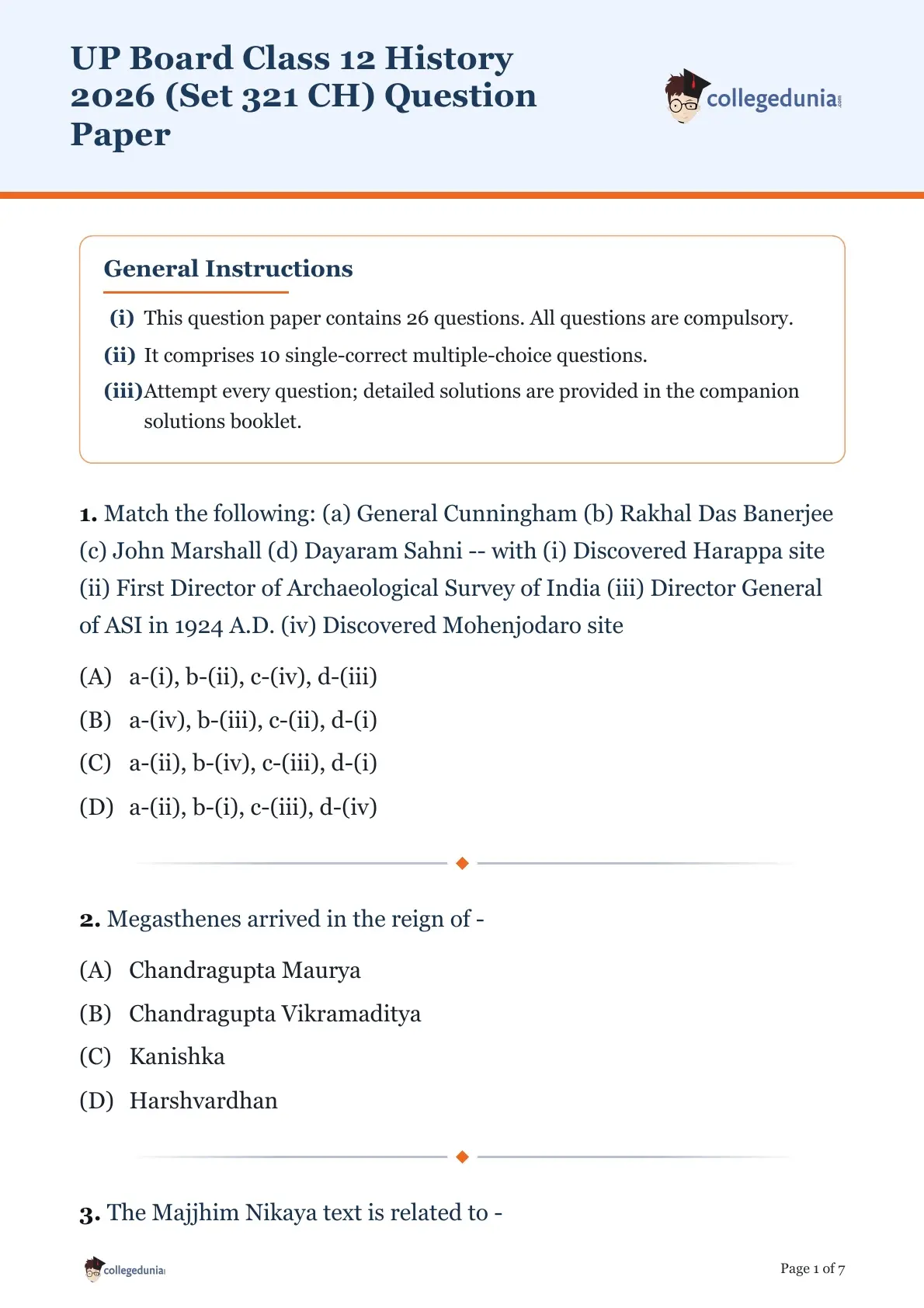
Match the following: (a) General Cunningham (b) Rakhal Das Banerjee (c) John Marshall (d) Dayaram Sahni -- with (i) Discovered Harappa site (ii) First Director of Archaeological Survey of India (iii) Director General of ASI in 1924 A.D. (iv) Discovered Mohenjodaro site
Megasthenes arrived in the reign of -
The Majjhim Nikaya text is related to -
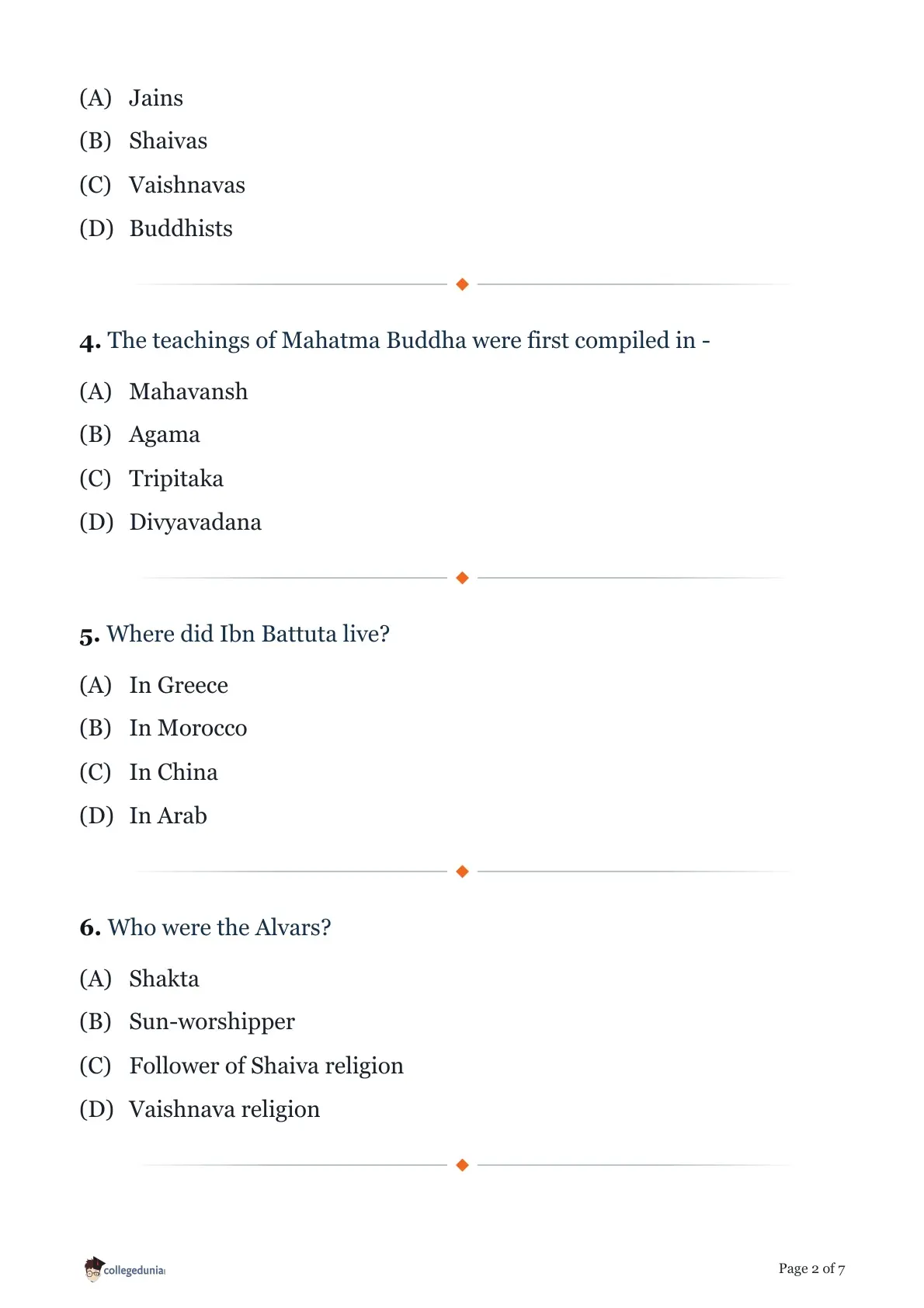
The teachings of Mahatma Buddha were first compiled in -
Where did Ibn Battuta live?
Who were the Alvars?
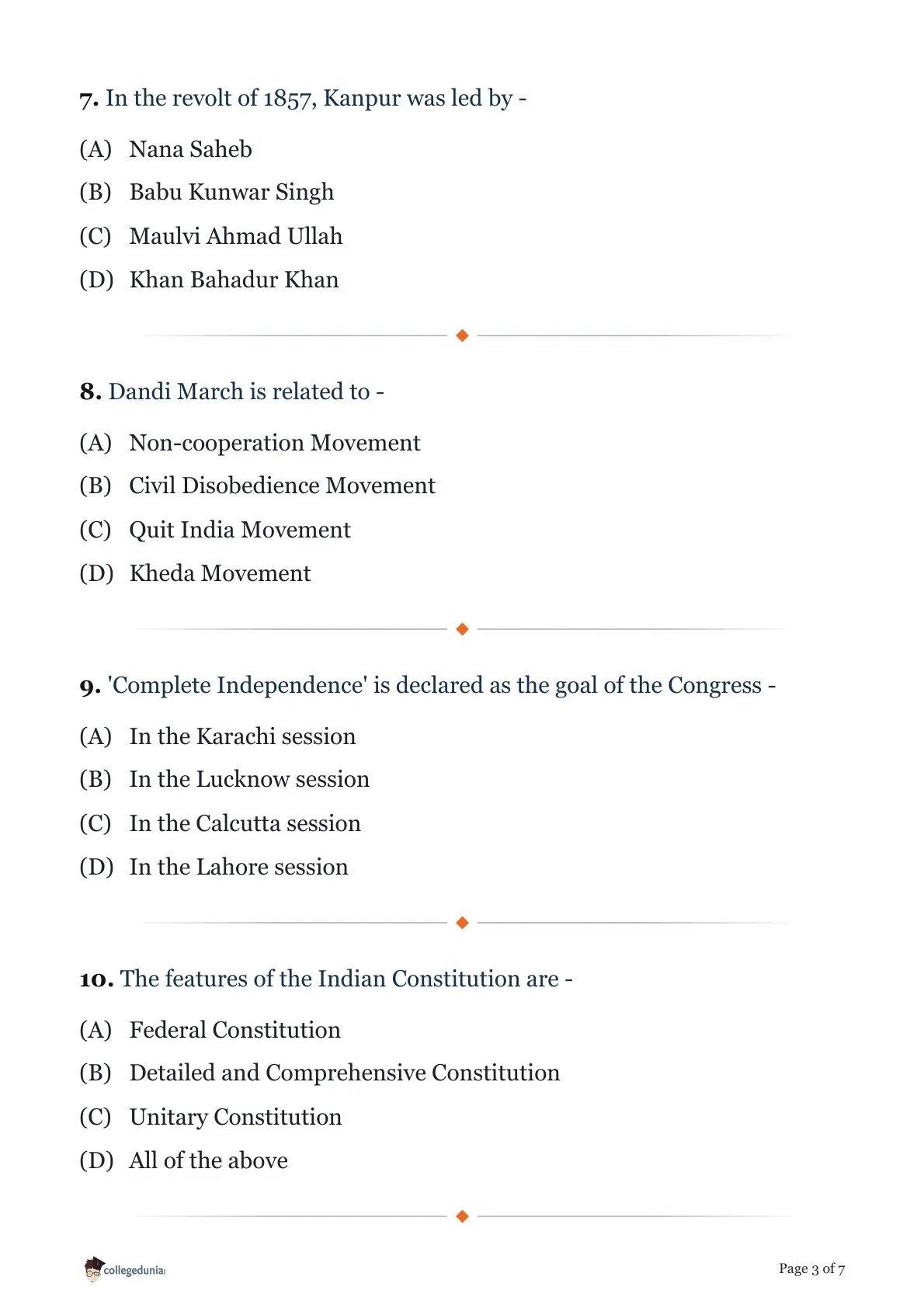
In the revolt of 1857, Kanpur was led by -
Dandi March is related to -
'Complete Independence' is declared as the goal of the Congress -
The features of the Indian Constitution are -
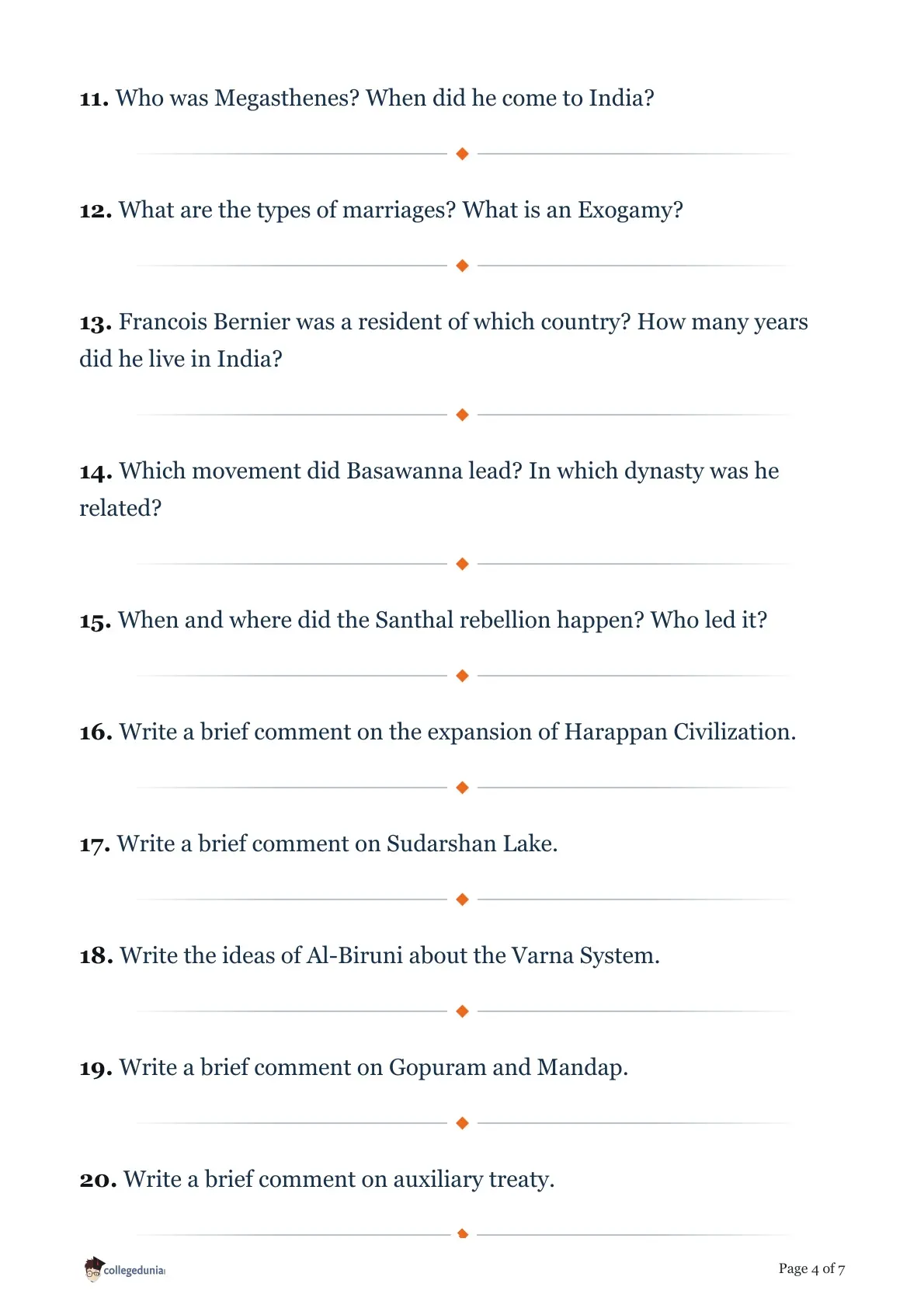
Who was Megasthenes? When did he come to India?
What are the types of marriages? What is an Exogamy?
Francois Bernier was a resident of which country? How many years did he live in India?
Which movement did Basawanna lead? In which dynasty was he related?
When and where did the Santhal rebellion happen? Who led it?
Write a brief comment on the expansion of Harappan Civilization.
Write a brief comment on Sudarshan Lake.
Write the ideas of Al-Biruni about the Varna System.
Write a brief comment on Gopuram and Mandap.
Write a brief comment on auxiliary treaty.
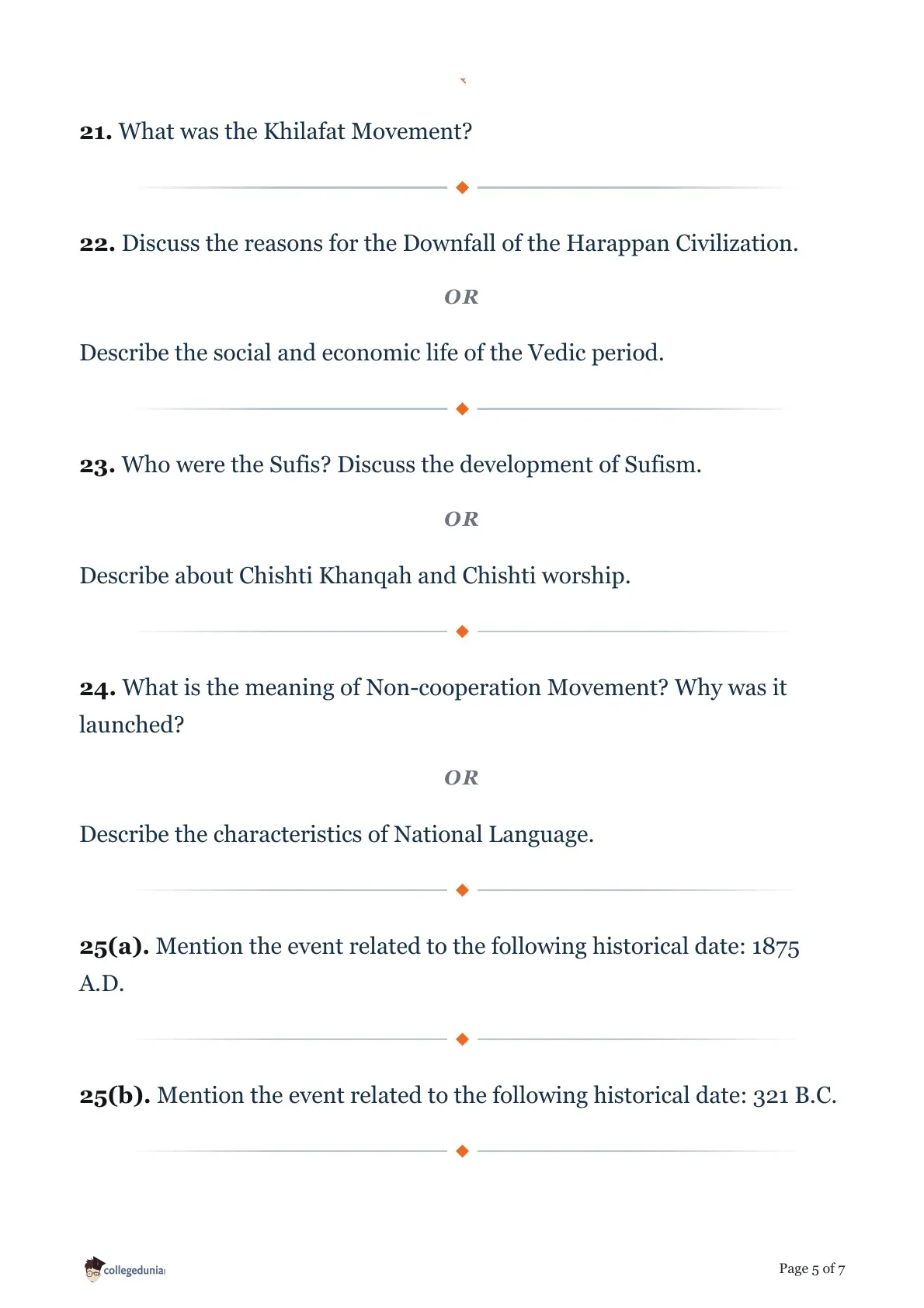
What was the Khilafat Movement?
Discuss the reasons for the Downfall of the Harappan Civilization.
Describe the social and economic life of the Vedic period. (OR alternative to Q22)
Who were the Sufis? Discuss the development of Sufism.
Describe about Chishti Khanqah and Chishti worship. (OR alternative to Q23)
What is the meaning of Non-cooperation Movement? Why was it launched?
Describe the characteristics of National Language. (OR alternative to Q24)
Mention the event related to the following historical date: 1875 A.D.
Mention the event related to the following historical date: 321 B.C.
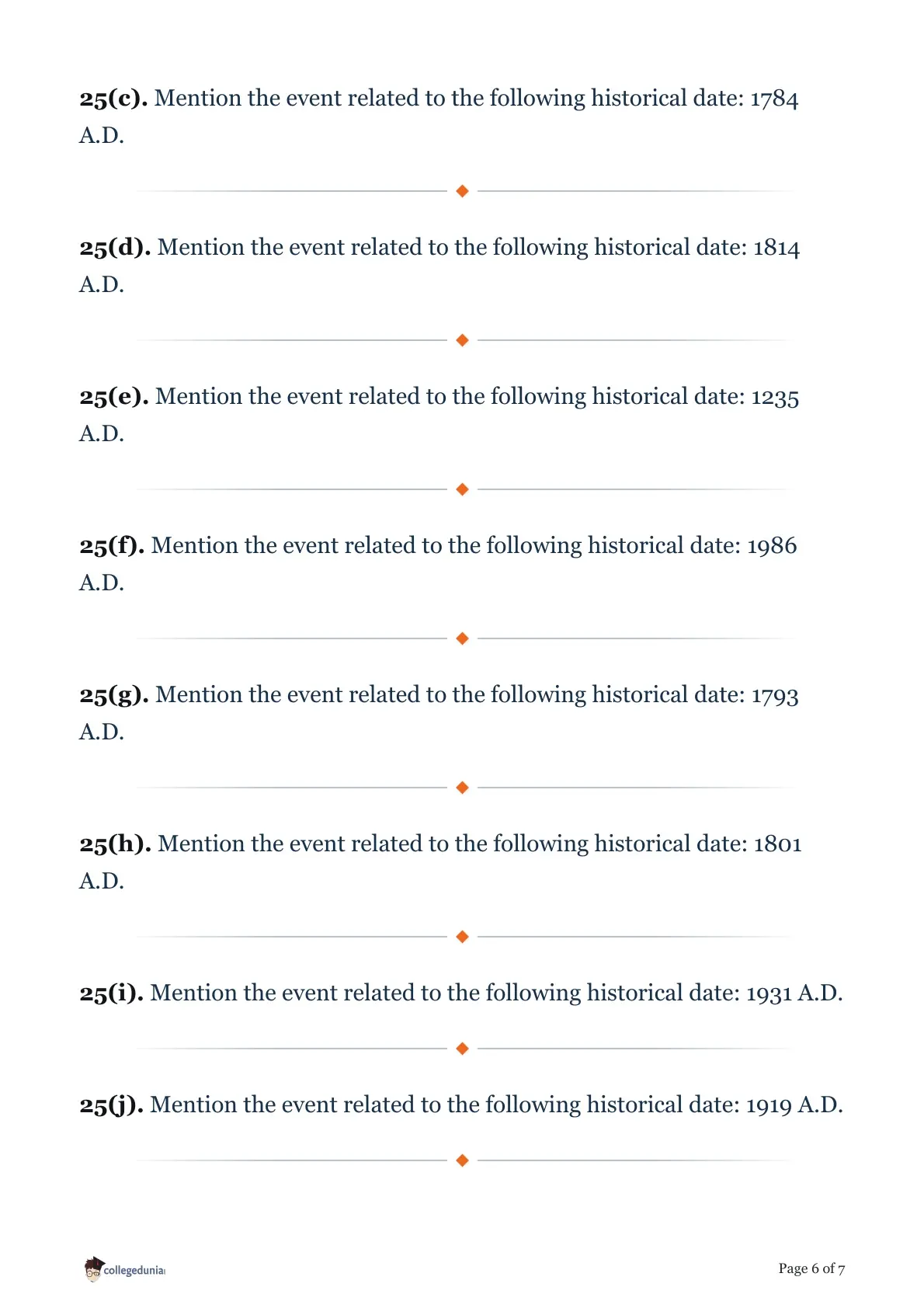
Mention the event related to the following historical date: 1784 A.D.
Mention the event related to the following historical date: 1814 A.D.
Mention the event related to the following historical date: 1235 A.D.
Mention the event related to the following historical date: 1986 A.D.
Mention the event related to the following historical date: 1793 A.D.
Mention the event related to the following historical date: 1801 A.D.
Mention the event related to the following historical date: 1931 A.D.
Mention the event related to the following historical date: 1919 A.D.
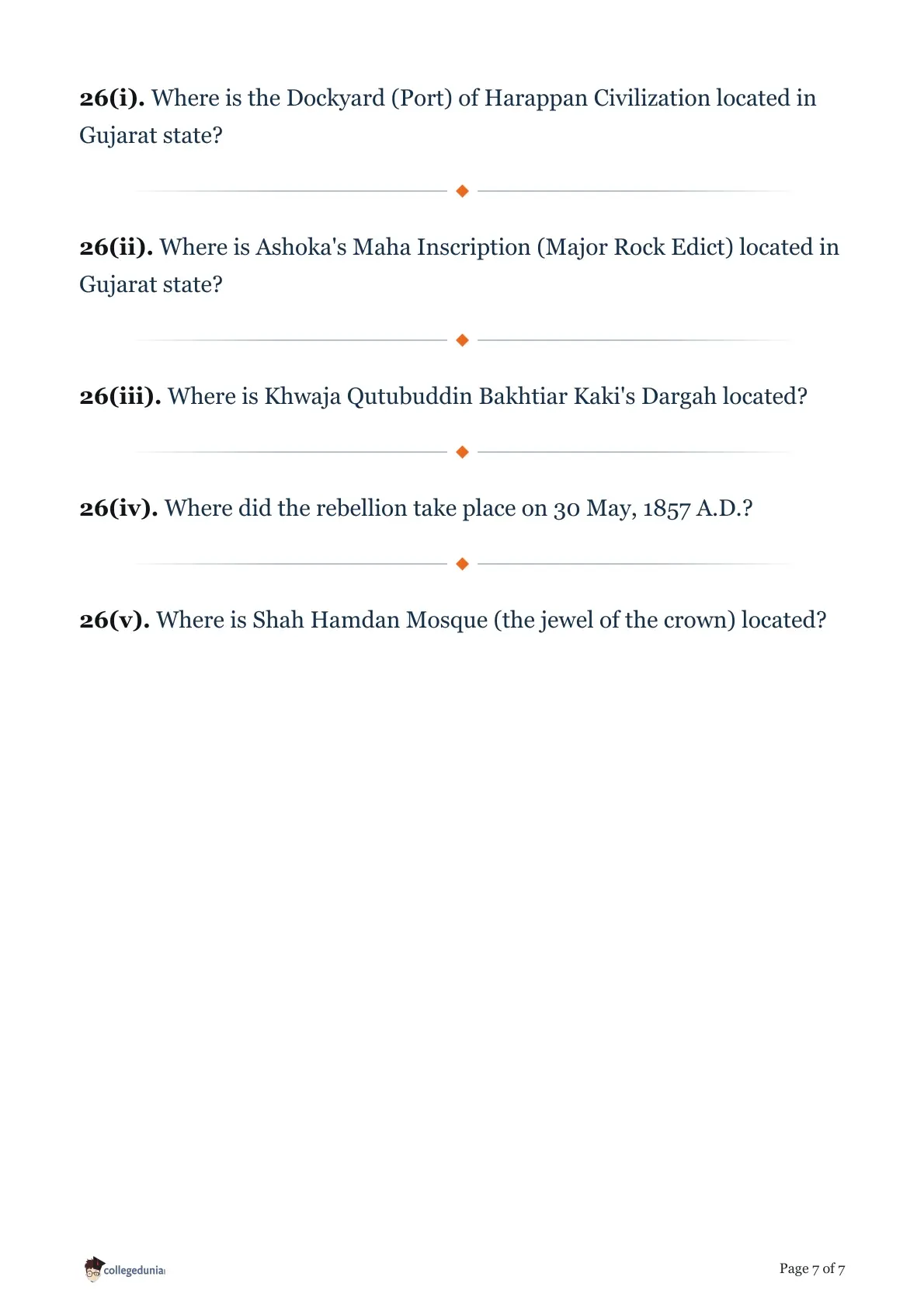
Where is the Dockyard (Port) of Harappan Civilization located in Gujarat state?
Where is Ashoka's Maha Inscription (Major Rock Edict) located in Gujarat state?
Where is Khwaja Qutubuddin Bakhtiar Kaki's Dargah located?
Where did the rebellion take place on 30 May, 1857 A.D.?
Where is Shah Hamdan Mosque (the jewel of the crown) located?
UP Board Class 12 History 2026 Exam Pattern and Marking Scheme Explained
UPMSP set this paper (Set 321 CH) in five sections, with Section D's 3 long-answer questions offering an internal choice.
- Total questions: Section A - 10 one-mark MCQs; Section B - 5 very-short-answer questions of 2 marks each; Section C - 6 short-answer questions of 5 marks each; Section D - 3 long-answer questions of 10 marks each with a choice; Section E - 10 historical-date questions of 1 mark each and 5 map-based questions of 2 marks each
- Total marks: 100
- Duration: 3 hours 15 minutes
- Question types: objective (MCQ), short and long descriptive answers, historical-date identification, and outline-map location work
- Internal choice: Section D's 3 questions (10 marks each, 30 marks total) each let you attempt one of two alternative questions
High-Weightage Topics in UP Board Class 12 History 2026 to Focus On First
Based on this paper's actual question distribution across Sections A-C (50 of the 100 marks, before the choice and Section E questions), a few eras clearly dominate.
- Ancient Indian History: 9 of 50 marks - the single biggest topic, spanning MCQs through short-answer questions
- Indian Freedom Movement: 7 of 50 marks
- The Harappan Civilisation, Varna/Jati and Castes, Art and Culture, and Colonialism: 5 of 50 marks each
Section D's 30 marks let you choose between long-answer essays across multiple eras - practise as many as you can. Section E's 20 marks reward memorising key historical dates and locations on the outline map of India.
UP Board Class 12 History Paper Solution Video
Source: Shivam Study Knowledge
How to Use the UP Board History Question Paper for Practice
Treat this Set 321 CH paper as a timed mock before you check the solutions.
- Attempt all sections, including the historical dates and map work, in 3 hours 15 minutes under exam conditions first
- For Section D, practise both alternatives of the internal choice, not just the one you'd normally pick
- Keep a running timeline of key dates and a labelled outline map handy while revising - Section E is worth 20 marks and rewards quick recall
- Review each answer against the step-by-step solution PDF, not just the final answer
UP Board Class 12 History Student Reactions 2026
- Reactions to this paper were mixed - some students found the matching-type MCQs and colonial-era questions familiar from practice papers, while others found the historical-dates section the hardest to recall exactly under time pressure
UP Board Class 12 History 2026 Question Paper FAQs
Ques. How many questions are there in the UP Board Class 12 History 2026 paper, and is there any choice?
Ans. The paper has 42 questions worth 100 marks across 5 sections. Section D's 3 long-answer questions (10 marks each) each give you a choice between two alternatives - you only need to attempt one from each pair.
Ques. What is the marking scheme for UP Board Class 12 History 2026?
Ans. The paper carries 100 marks in 3 hours 15 minutes: 10 one-mark MCQs, 5 very-short-answer questions of 2 marks each, 6 short-answer questions of 5 marks each, 3 long-answer questions of 10 marks each with internal choice, 10 historical-date questions of 1 mark each, and 5 map-based questions of 2 marks each.
Ques. Which topics had the highest weightage in UP Board Class 12 History 2026 Set 321 CH?
Ans. Based on this paper's actual questions, Ancient Indian History (9 of the first 50 marks) led, followed by the Indian Freedom Movement (7 marks) and The Harappan Civilisation, Varna and Castes, Art and Culture, and Colonialism (5 marks each). Section D's 30 marks cover a choice of long-answer essays, and Section E's 20 marks test historical dates and map locations.
Ques. What does Section E of UP Board Class 12 History 2026 cover?
Ans. Section E has 10 questions asking you to name the event linked to a given historical date (1 mark each), plus 5 questions asking you to mark and name specific locations on the outline map of India (2 marks each).
Ques. Where can I download the UP Board Class 12 History 2026 question paper with solutions PDF for free?
Ans. You can download both the question paper and the full step-by-step solutions PDF for Set 321 CH from the table at the top of this page, for free.



Comments