




The UP Board Class 12 Sociology 2026 question paper with solutions (Set 340 DR) is available here for free download. UP Board Class 12 Sociology 2026 was conducted by the Uttar Pradesh Madhyamik Shiksha Parishad (UPMSP), as a 100-mark paper of 29 compulsory questions to be solved in 3 hours 15 minutes.
| UP Board Class 12 Sociology 2026 Question Paper with Solutions (Set 340 DR) | Download PDF | Check Solutions |
UP Board Class 12 Sociology 2026 (Set 340 DR) Questions with Solutions
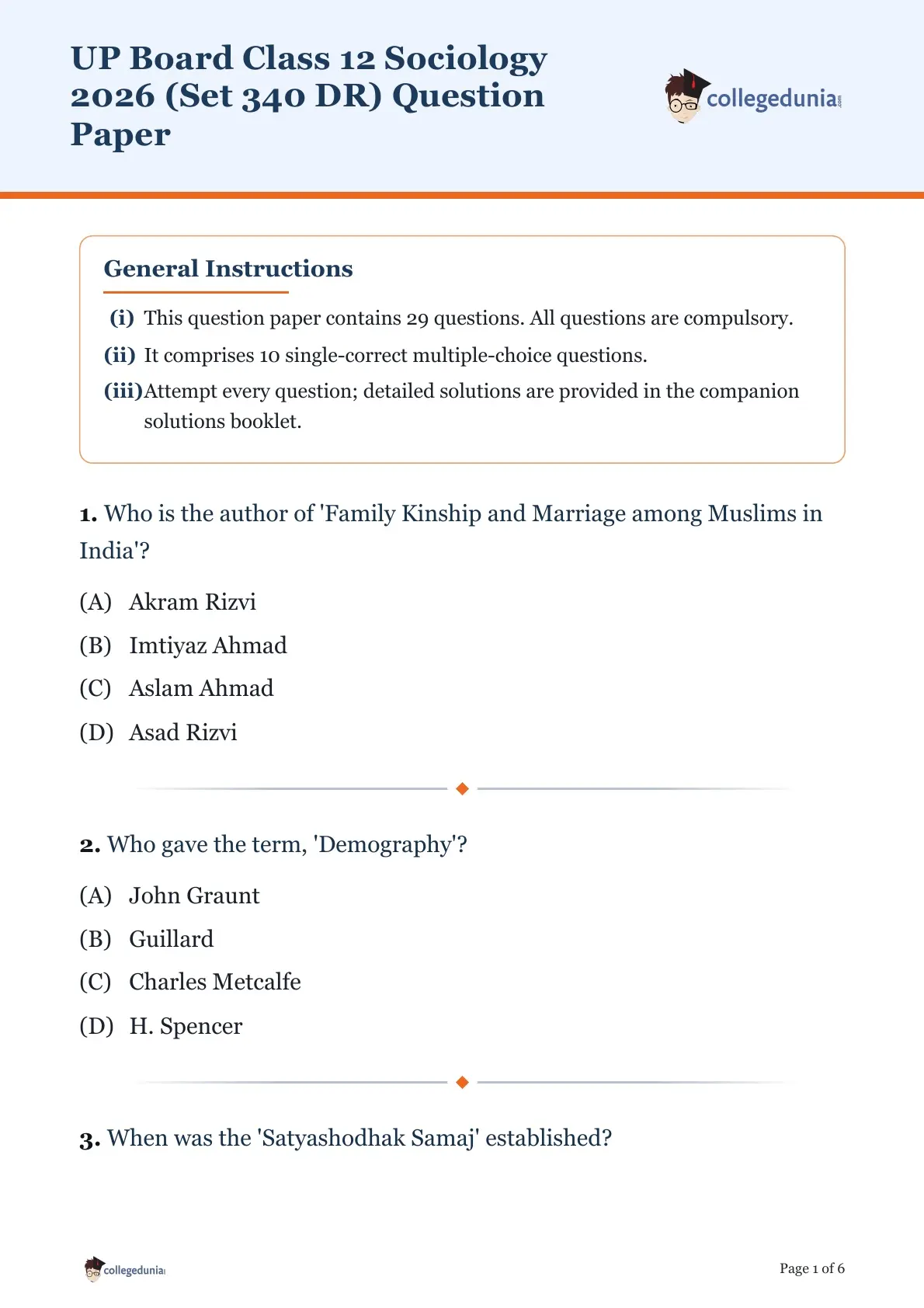
Who is the author of 'Family Kinship and Marriage among Muslims in India'?
Who gave the term, 'Demography'?
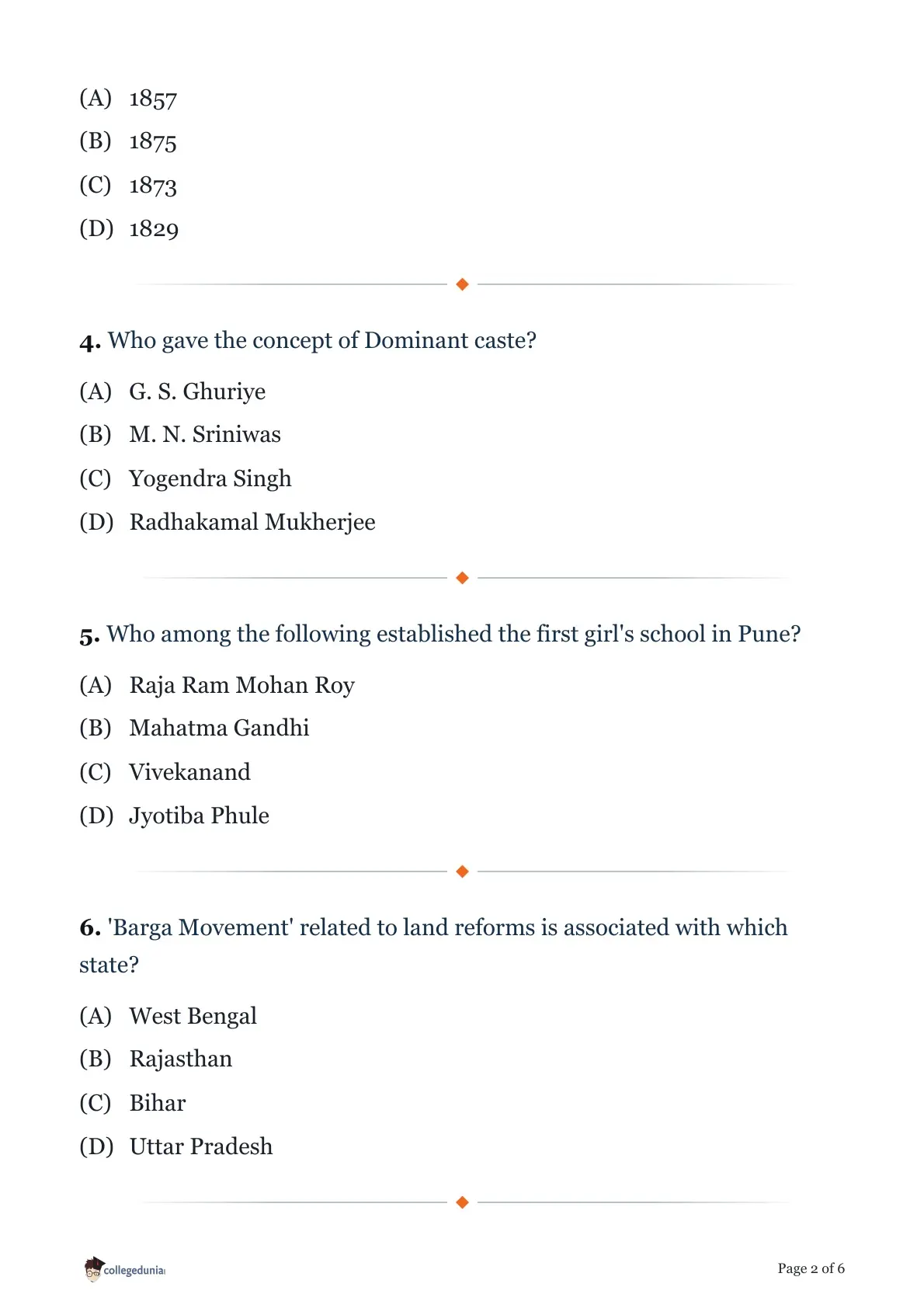
When was the 'Satyashodhak Samaj' established?
Who gave the concept of Dominant caste?
Who among the following established the first girl's school in Pune?
'Barga Movement' related to land reforms is associated with which state?
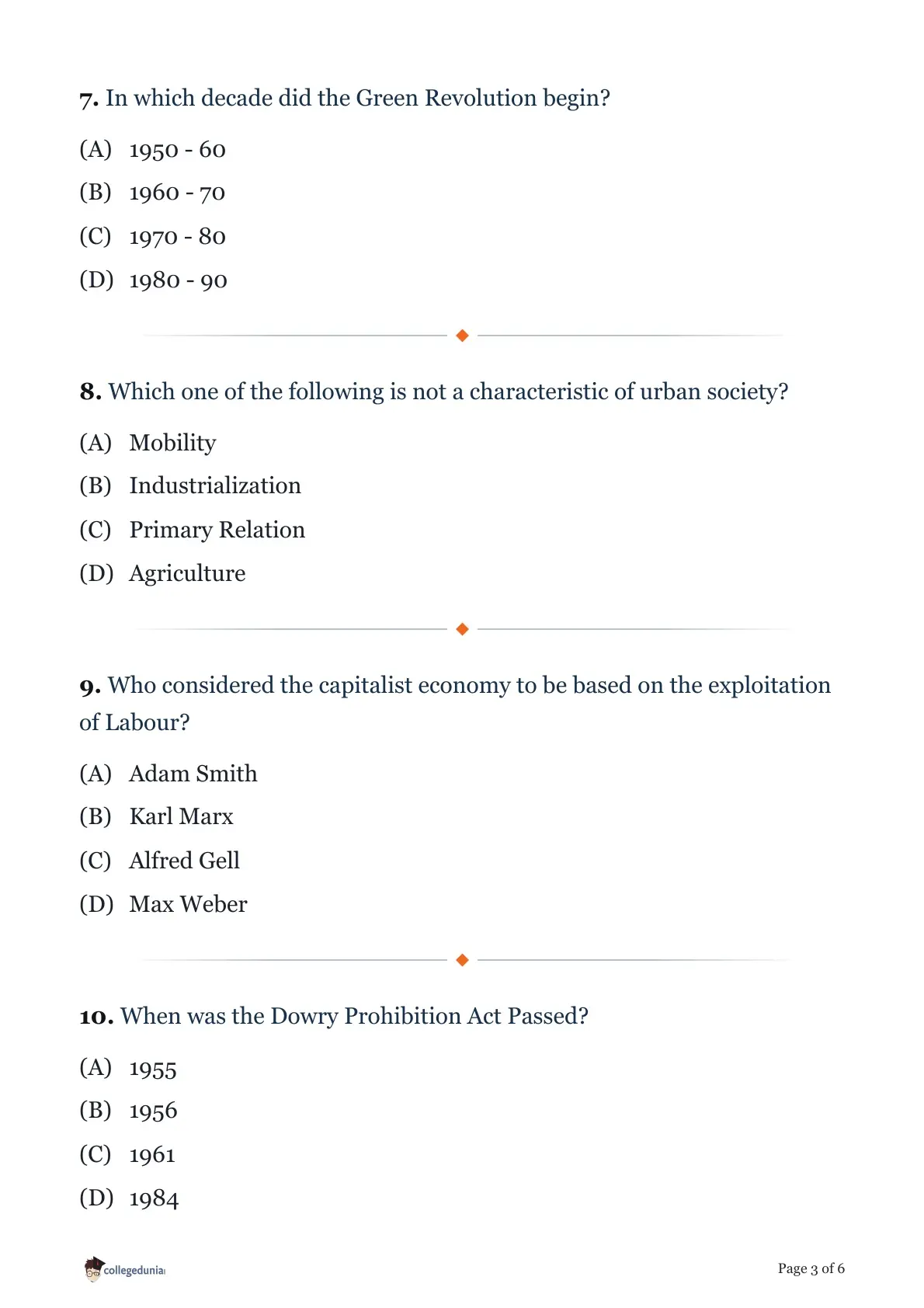
In which decade did the Green Revolution begin?
Which one of the following is not a characteristic of urban society?
Who considered the capitalist economy to be based on the exploitation of Labour?
When was the Dowry Prohibition Act Passed?
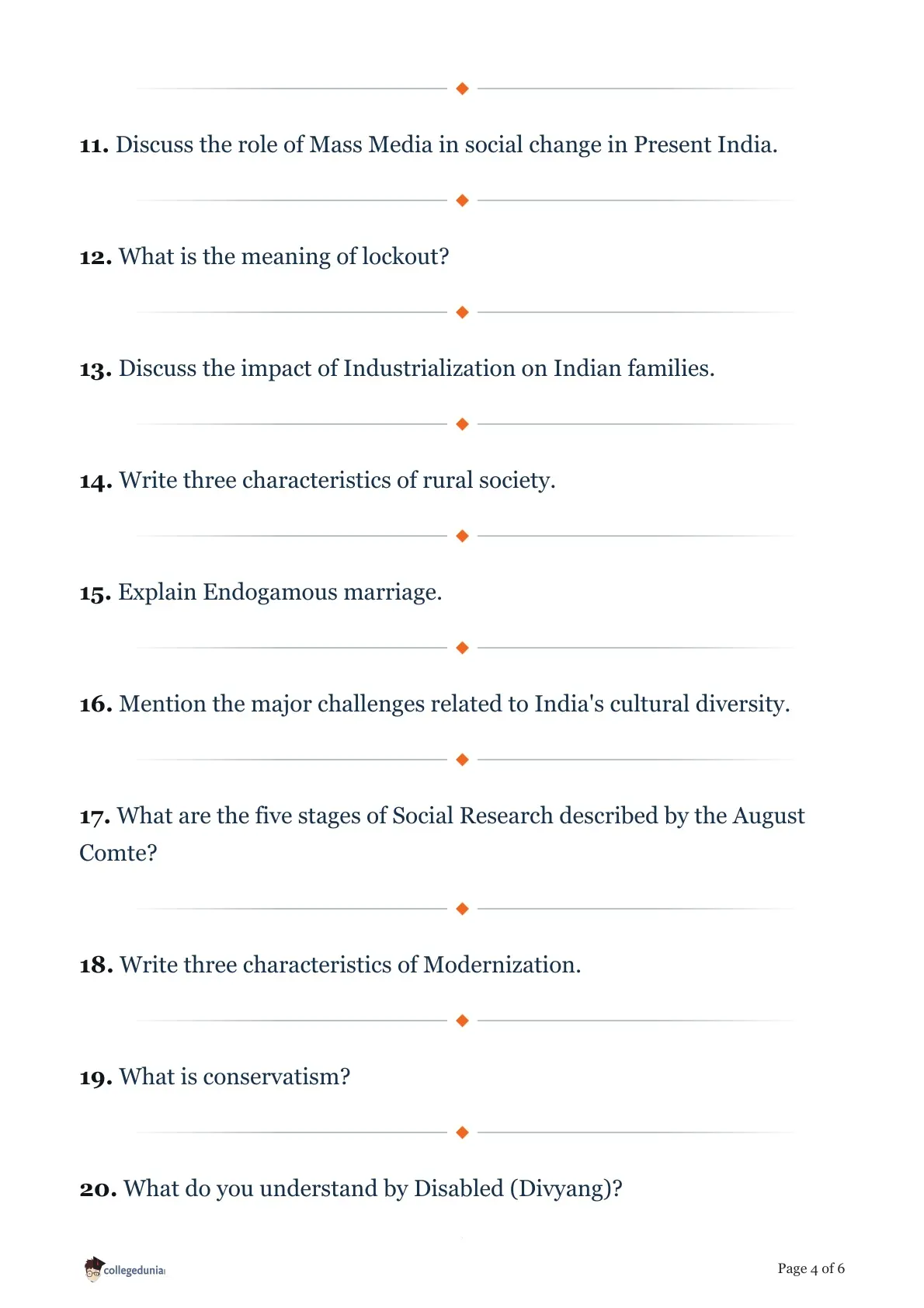
Discuss the role of Mass Media in social change in Present India.
What is the meaning of lockout?
Discuss the impact of Industrialization on Indian families.
Write three characteristics of rural society.
Explain Endogamous marriage.
Mention the major challenges related to India's cultural diversity.
What are the five stages of Social Research described by the August Comte?
Write three characteristics of Modernization.
What is conservatism?
What do you understand by Disabled (Divyang)?
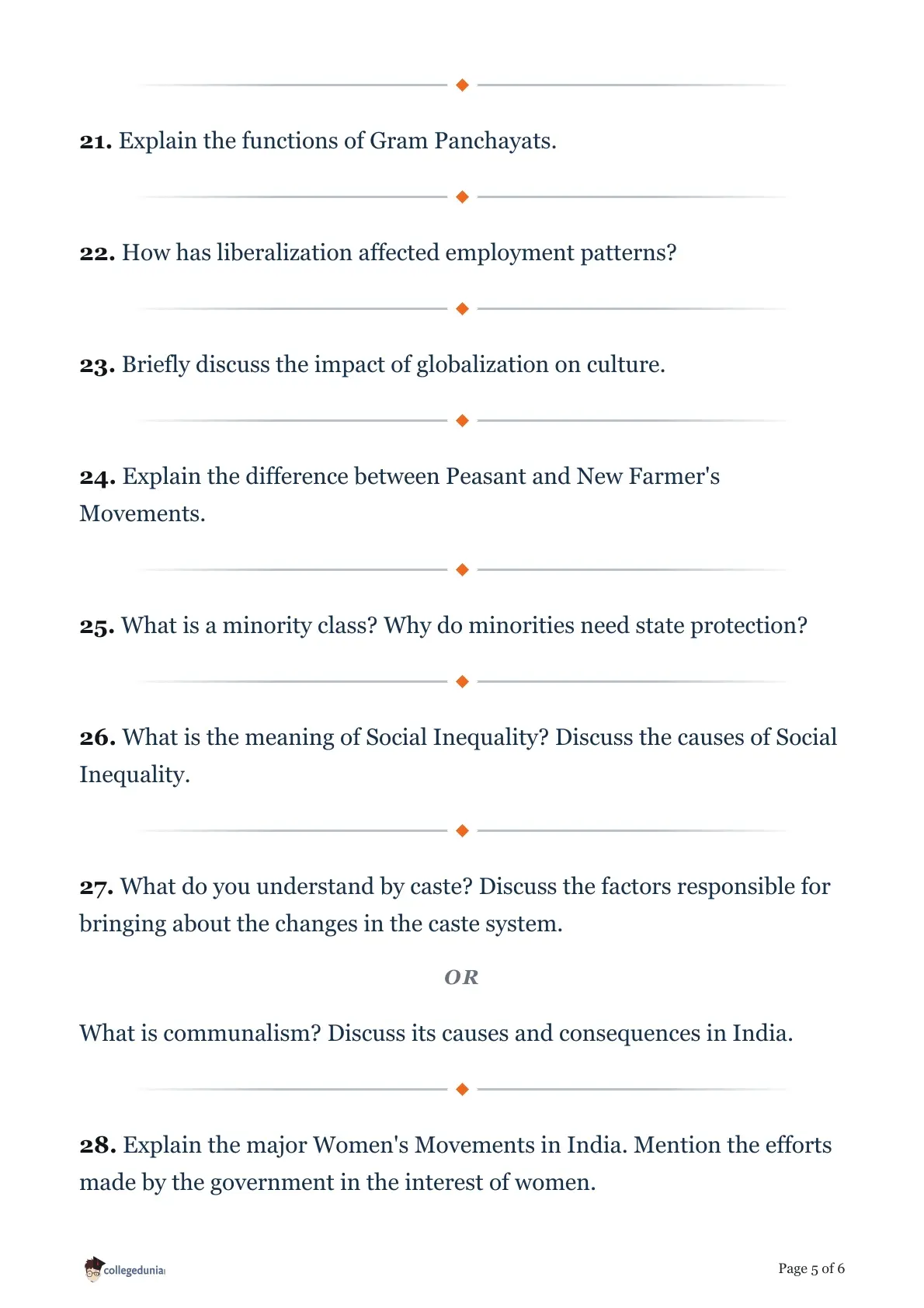
Explain the functions of Gram Panchayats.
How has liberalization affected employment patterns?
Briefly discuss the impact of globalization on culture.
Explain the difference between Peasant and New Farmer's Movements.
What is a minority class? Why do minorities need state protection?
What is the meaning of Social Inequality? Discuss the causes of Social Inequality.
What do you understand by caste? Discuss the factors responsible for bringing about the changes in the caste system.
What is communalism? Discuss its causes and consequences in India.
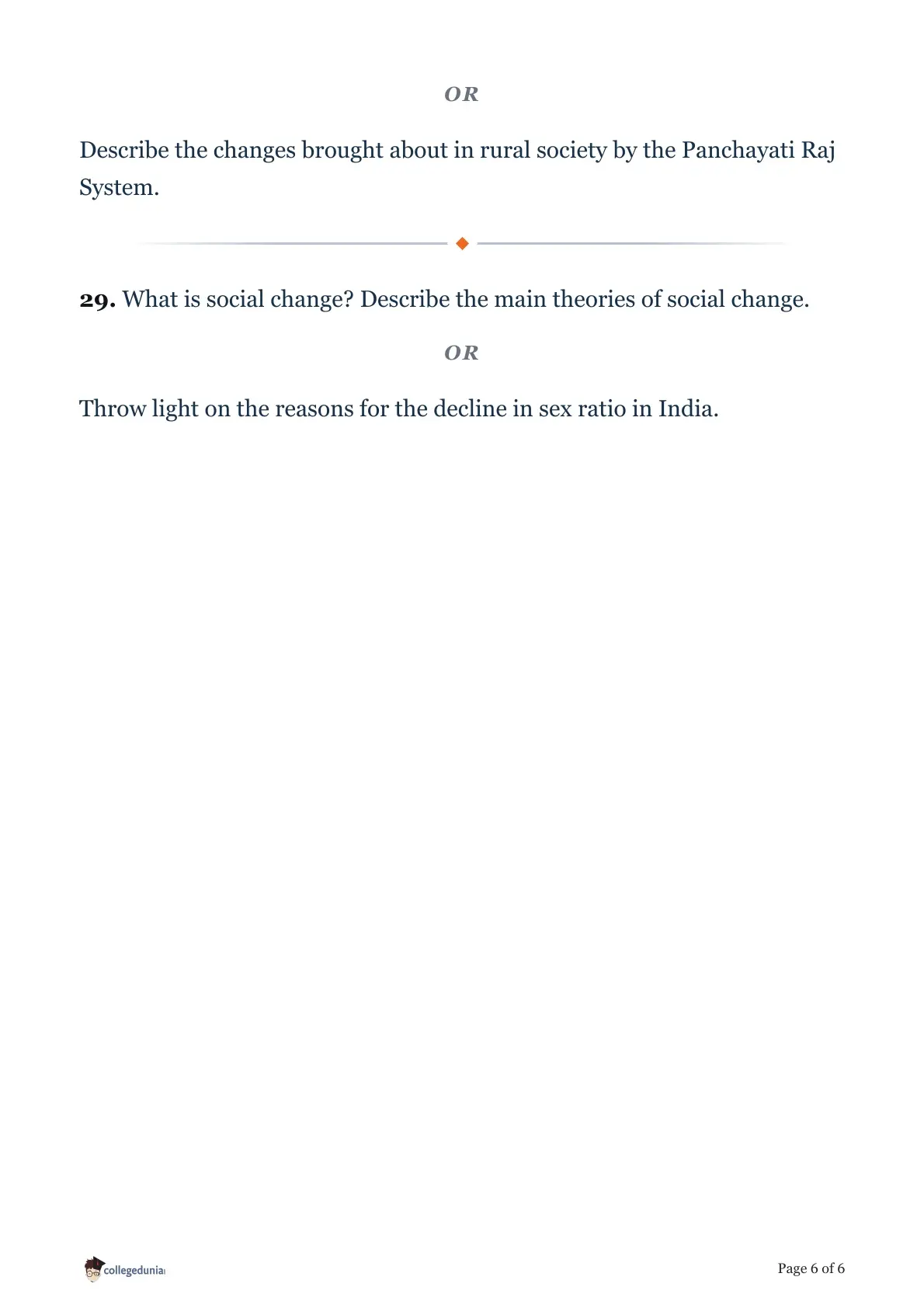
Explain the major Women's Movements in India. Mention the efforts made by the government in the interest of women.
Describe the changes brought about in rural society by the Panchayati Raj System.
What is social change? Describe the main theories of social change.
Throw light on the reasons for the decline in sex ratio in India.
UP Board Class 12 Sociology 2026 Exam Pattern and Marking Scheme Explained
UPMSP set this paper (Set 340 DR) as 29 compulsory questions of rising difficulty, with the last three long-answer questions offering an internal choice.
- Total questions: 10 one-mark MCQs (Q1-Q10), 10 very-short-answer questions of 3 marks each (Q11-Q20, 25 words), 6 short-answer questions of 6 marks each (Q21-Q26, 50 words), and 3 long-answer questions of 8 marks each with a choice (Q27-Q29, 150 words)
- Total marks: 100
- Duration: 3 hours 15 minutes
- Question types: objective (MCQ), very-short and short descriptive answers, and long-answer essays
- Internal choice: Q27, Q28 and Q29 (8 marks each, 24 marks total) each let you attempt one of two alternative questions
High-Weightage Topics in UP Board Class 12 Sociology 2026 to Focus On First
Based on this paper's actual question distribution across Q1-Q26 (76 of the 100 marks, before the internal-choice long-answer questions), one topic clearly dominates.
- Social Inequality and Exclusion: 12 of 76 marks - the single biggest topic, spanning a short-answer question and a longer discussion question
- Class-Based Movements (Workers, Peasants): 7 of 76 marks
- Panchayat System, From Planned Industrialisation to Liberalisation, and Globalization: 6 of 76 marks each
The remaining 24 marks (Q27-Q29) let you choose between long-answer essays on The Caste System, Gender/Religion/Caste, The Struggle for Women's Equality, Panchayati Raj, and Arenas of Social Change - practise as many of these as you can, since you only find out which alternative suits you better once you read the actual questions.
UP Board Class 12 Sociology Question Paper Analysis Video
Source: s p study 3M view's
How to Use the UP Board Sociology Question Paper for Practice
Treat this Set 340 DR paper as a timed mock before you check the solutions.
- Attempt all 29 questions in 3 hours 15 minutes under exam conditions first
- For Q27, Q28 and Q29, practise both alternatives of the internal choice, not just the one you'd normally pick
- Keep to the prescribed word limits - 25 words for very-short answers, 50 for short answers, and 150 for long answers
- Review each answer against the step-by-step solution PDF, not just the final answer
UP Board Class 12 Sociology Student Reactions 2026
- Reactions to this paper were mixed - some students found the definitional MCQs and short-answer questions straightforward, while others found the long-answer choice questions on social movements time-consuming within the word limit
UP Board Class 12 Sociology 2026 Question Paper FAQs
Ques. How many questions are there in the UP Board Class 12 Sociology 2026 paper, and is there any choice?
Ans. The paper has 29 compulsory questions worth 100 marks. The last three questions, Q27, Q28 and Q29 (8 marks each), each give you a choice between two alternative long-answer questions - you only need to attempt one from each pair.
Ques. What is the marking scheme for UP Board Class 12 Sociology 2026?
Ans. The paper carries 100 marks across 29 questions in 3 hours 15 minutes: 10 one-mark MCQs, 10 very-short-answer questions of 3 marks each, 6 short-answer questions of 6 marks each, and 3 long-answer questions of 8 marks each with internal choice.
Ques. Which topics had the highest weightage in UP Board Class 12 Sociology 2026 Set 340 DR?
Ans. Based on this paper's actual questions, Social Inequality and Exclusion (12 of the first 76 marks) was by far the biggest topic, followed by Class-Based Movements (7 marks) and Panchayat System, Planned Industrialisation to Liberalisation, and Globalization (6 marks each). The paper's final 24 marks let you choose from essays on caste, gender, and Panchayati Raj themes.
Ques. Was the UP Board Class 12 Sociology 2026 paper tough?
Ans. Student reactions were mixed - most found the objective and short-answer sections straightforward, while the long-answer choice questions on social movements needed more time to complete within the word limit.
Ques. Where can I download the UP Board Class 12 Sociology 2026 question paper with solutions PDF for free?
Ans. You can download both the question paper and the full step-by-step solutions PDF for Set 340 DR from the table at the top of this page, for free.



Comments