





University of Toronto admissions for Indian students run through Ontario’s OUAC 105 system for undergraduate applications and the School of Graduate Studies (SGS) portal for master’s and PhD study, with an entry floor of roughly 90% in Class XII for competitive undergraduate programs and a mid-B (about 75%) bachelor’s average for master’s admission.
- Next live deadline: Rotman MBA Round 2 closes 11 November 2026; the primary September 2027 UG deadline is 15 January 2027.
- Base international UG tuition starts from around CAD 65,000 (INR 44.51 Lakhs) per year; OUAC 105 application fee is CAD 156 (INR 10,682), SGS graduate is CAD 130 (INR 8,901).
- UG: Class XII 85 to 90%, IELTS 6.5 (no band below 6.0); PG: recognised bachelor’s at mid-B (about 75%) plus IELTS 6.5.
- Estimated acceptance rate 40 to 45% overall; 5 to 15% for Engineering, Computer Science, and Rotman Commerce.
Popular Indian-applicant picks at University of Toronto include Rotman Commerce, Engineering Science, Computer Science, and the Rotman MBA. Students choose U of T over Waterloo or McGill for its downtown St. George campus, three-year Post-Graduation Work Permit eligibility, and consistent top-30 global standing.
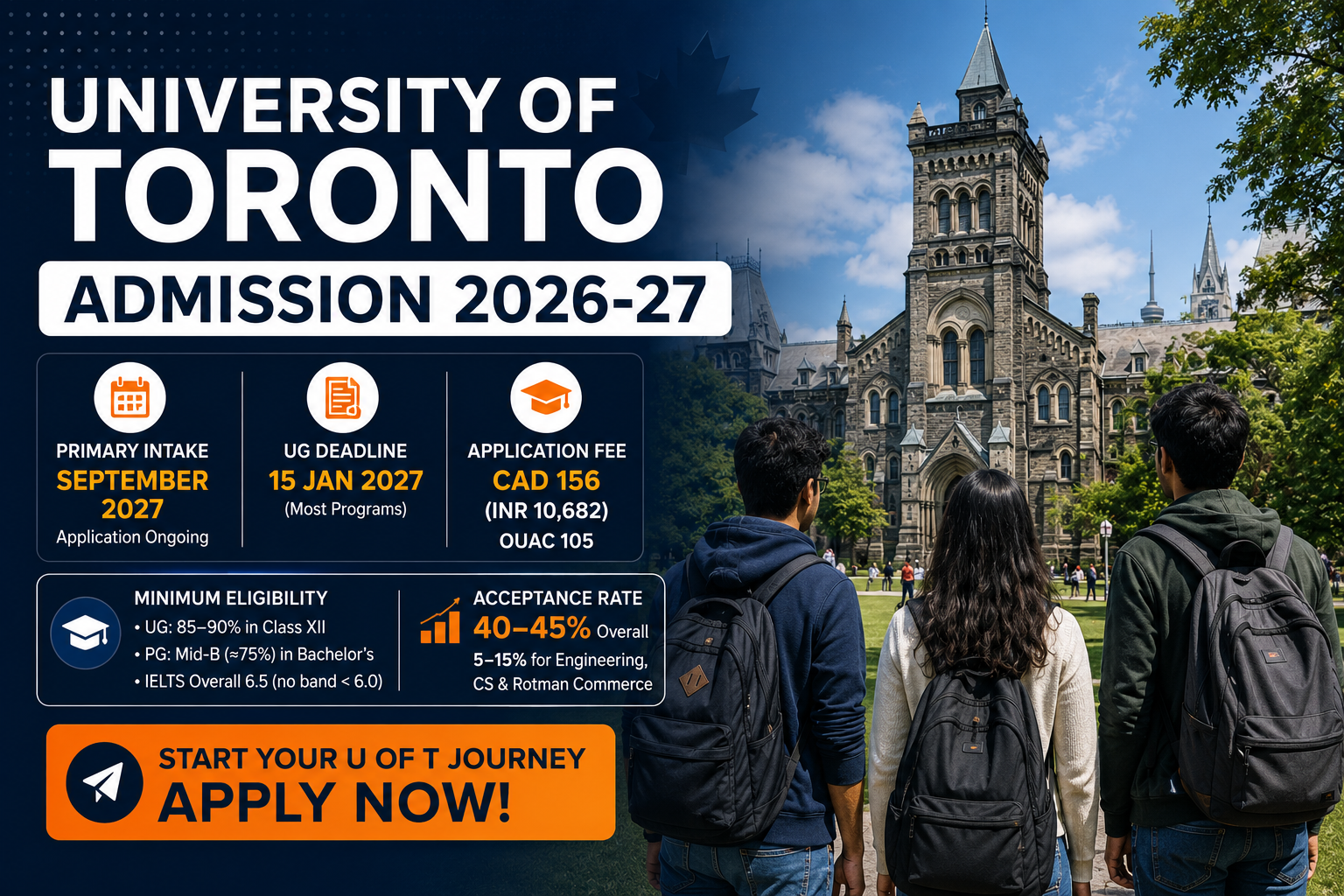
Table of Content
- University of Toronto Application Deadlines
- U of T Eligibility for Indian Students
- University of Toronto PG Programs and English Scores
- U of T UG Programs and Subject Requirements
- Rotman MBA at University of Toronto
- U of T PhD Programs and Funding
- University of Toronto Application Process
- U of T Admission Decisions Timeline
- University of Toronto Documents Required
- U of T Acceptance Rate for Indian Students
- Canada Student Visa for U of T Admits
- Tips and Checklist for University of Toronto Admissions
- Frequently Asked Questions
University of Toronto Application Deadlines for Indian Students
The September 2027 intake is U of T’s primary intake for Indian applicants and covers the widest set of programs across undergraduate, master’s, PhD, and Rotman MBA. Undergraduate applications route through the Ontario Universities’ Application Centre (the OUAC 105 form for non-Ontario applicants). Graduate applications go directly through U of T’s own School of Graduate Studies portal. Dates below are drawn from the U of T official deadlines page and the Rotman MBA admissions page.
| Intake | Level / Faculty | App Opens | Deadline | App Fee | Portal |
|---|---|---|---|---|---|
| Sep 2027 (Primary intake) | UG - Early Consideration | Late Sep 2026 | 7 Nov 2026 (docs by 2 Dec 2026) | CAD 156 (INR 10,682) |
OUAC 105 |
| Sep 2027 (Primary intake) | UG - Applied Science & Engineering | Late Sep 2026 | 15 Jan 2027 |
CAD 156 |
OUAC 105 |
| Sep 2027 (Primary intake) | UG - Arts & Science, Rotman Commerce, Computer Science | Late Sep 2026 | 2 Feb 2027 (docs by 16 Feb 2027) | CAD 156 (INR 10,682) |
OUAC 105 |
| Sep 2027 | UG - Architecture, Landscape, Design | Late Sep 2026 | 2 Feb 2027 | CAD 156 (INR 10,682) |
OUAC 105 |
| Sep 2027 | UG - Kinesiology, Nursing, Music, Physician Assistant | Late Sep 2026 | 15 Jan 2027 | CAD 156 (INR 10,682) |
OUAC 105 |
| Sep 2027 | UG - Bachelor of Information | Late Sep 2026 | 15 Jun 2027 | CAD 156 (INR 10,682) |
OUAC 105 |
| Sep 2027 | UG - UTM & UTSC (late round) | Late Sep 2026 | 10 Aug 2027 | CAD 156 (INR 10,682) |
OUAC 105 |
| Sep 2027 | PG - SGS (most programs) | Open now | Dec 2026 - Jan 2027 (per department) | CAD 130 (INR 8,901) |
SGS portal |
| Sep 2027 | MBA - Rotman Full-Time Round 1 | Open now | 16 Sep 2026 | Paid on Rotman portal | Rotman portal |
| Sep 2027 | MBA - Rotman Full-Time Round 2 | Open now | 11 Nov 2026 | Paid on Rotman portal | Rotman portal |
| Sep 2027 | MBA - Rotman Full-Time Round 3 | Open now | 13 Jan 2027 | Paid on Rotman portal | Rotman portal |
Insider note: Indian MBA applicants should target Round 1 or Round 2. Round 3 leaves under six months for study permit, biometrics, and September onshore arrival — Rotman’s own guidance nudges international candidates to earlier rounds.
Check Out: University of Toronto Fees
University of Toronto Eligibility for Indian Students
U of T’s academic floor is set by faculty, not by campus. The University treats Class XII from CBSE or CISCE as the standard senior-secondary credential; State Board results are considered case by case. Meeting the minimum does not guarantee an offer — competitive faculties like Engineering, Computer Science, and Rotman Commerce routinely admit only students in the mid to high 90s.
- UG general entry (Arts & Science): Class XII at 85% or higher from CBSE or CISCE.
- UG Engineering / CS / Rotman Commerce: Class XII at 90% or higher, with Class XII Standard Mathematics — Applied Mathematics is not accepted for programs needing Calculus.
- PG master’s (SGS floor): Recognised four-year bachelor’s at mid-B final-year average (roughly 75%).
- PhD: Master’s at B+ (about 77%) or direct-from-bachelor’s at A- (about 82%) for exceptional candidates.
The English requirement is set by the University for all applicants whose first language is not English. The floors below are institution-wide; some programs (Rotman MBA, JD, Speech Pathology) publish higher bars.
| Test | U of T Minimum |
|---|---|
| IELTS Academic | Overall 6.5 with no band below 6.0 |
| TOEFL iBT (before Jan 2026 format) | Total 89 with 22 in Speaking and Writing |
| PTE Academic | Overall 65 with no part below 60 |
| Duolingo English Test | Overall 120 with Production 120 |
| Cambridge C1 / C2 | Overall 180 with minimum 170 in each component |
The English waiver is available only to applicants with four or more years of full-time study at an English-medium school in a country where English is dominant (Australia, Singapore, UK, USA, Ireland, and 45+ others). India is not on the exemption list, so Indian-medium schooling does not qualify for a waiver — you must submit a test score even if your school taught in English. All applicants also need a senior-level English course equivalent to Ontario ENG4U.
University of Toronto PG Programs and English Scores
The School of Graduate Studies runs more than 200 master’s and doctoral programs across three campuses. Indian applicants gravitate to the STEM master’s at St. George, plus MMA (Master of Management Analytics), MFE (Master of Financial Economics), MSc CS, and the professional master’s from the Munk School and Dalla Lana. Base international tuition for master’s programs sits in the CAD 30,000 to CAD 65,000 (INR 20.54 to 44.51 Lakhs) per year band depending on program category — for the full course-wise breakdown see the detailed U of T program and course-fees page.
| Programme | Duration | Minimum Eligibility | English Req. Min. |
|---|---|---|---|
| MSc Computer Science | 16-20 months | Bachelor’s in CS or related, mid-A average (about 80%) | IELTS 7.0 |
| MSc Applied Computing (MScAC) | 16 months | Bachelor’s in CS with A- average, coding portfolio | IELTS 7.0 |
| MEng Electrical & Computer Engineering | 12-16 months | Bachelor’s in ECE or EE at mid-B (75%+) | IELTS 7.0 |
| MASc Mechanical & Industrial Engineering | 2 years | Bachelor’s in engineering, mid-B (75%+), research fit | IELTS 7.0 |
| MS Management Analytics (MMA) | 9 months | Bachelor’s in quantitative discipline, GMAT/GRE recommended | IELTS 7.0 |
| Master of Financial Economics (MFE) | 16 months | Bachelor’s in economics or finance with strong math, GMAT/GRE | IELTS 7.0 |
| MPH (Master of Public Health) | 2 years | Bachelor’s, mid-B, health or bio background preferred | IELTS 7.0 |
| MA Economics | 1 year | Bachelor’s in economics with A- average, calculus, real analysis | IELTS 7.0 |
| MEd (OISE, various specialisations) | 1-2 years | Bachelor’s, mid-B, teaching background preferred | IELTS 7.0 |
| Master of Information (MI) | 2 years | Bachelor’s at mid-B, statement of interest | IELTS 7.0 |
Planning note: Most SGS master’s programs push their IELTS floor to 7.0 (with 6.5 in each band) — higher than the SGS institution-wide 6.5. Confirm each program’s English page before locking in a test date.
Note: Program-specific entry requirements, fees, and intake availability may differ from the institution-wide minimums shown above. Always confirm on the official University of Toronto SGS page for your chosen program before applying.
Also Check: Canada Student Visa Guide for Indian Students
University of Toronto UG Programs and Subject Prerequisites
Undergraduate admissions are managed by each faculty, not by SGS. Rotman Commerce and Engineering are the two most competitive routes for Indian students, followed by Computer Science (a Type 3 program within Arts and Science at St. George). Life Sciences and Humanities in Arts and Science have wider admissions bands. Subject prerequisites tie tightly to Class XII — CBSE Applied Mathematics is not accepted for any program that lists Calculus as a prerequisite.
| Programme | Duration | Minimum Eligibility | English Req. Min. |
|---|---|---|---|
| BASc Engineering Science / Core-8 Engineering | 4 years | Class XII 90%+ with Standard Math, Physics, Chemistry, English | IELTS 6.5 |
| BCom Rotman Commerce (Finance / Management / Accounting) | 4 years | Class XII 90%+ with Standard Math, English; supplemental app | IELTS 6.5 |
| BSc Computer Science (St. George) | 4 years | Class XII 90%+ with Standard Math; supplemental app | IELTS 6.5 |
| BSc Life Sciences / Biology | 4 years | Class XII 85%+ with Biology, Chemistry, and Math or Physics | IELTS 6.5 |
| BA Arts & Science (Humanities / Social Sciences) | 4 years | Class XII 85%+ with English | IELTS 6.5 |
| BScN Nursing (Bloomberg) | 4 years | Class XII 85%+ with Biology and Chemistry; interview | IELTS 6.5 |
| Bachelor of Information (iSchool) | 4 years | Class XII 85%+; portfolio and statement of interest | IELTS 6.5 |
Insider note: Rotman Commerce, Computer Science, Engineering Science, and Kinesiology all require a supplemental application on top of the OUAC 105 form. Missing the supplemental deadline is the single most common reason Indian applications get closed without review.
Rotman MBA at University of Toronto for Indian Students
The Rotman Full-Time MBA is a two-year program starting each September, with the September 2027 cohort admitting through four rounds. Rounds 1 through 3 are open to Indian applicants; Round 4 is restricted to domestic candidates and does not apply to international students. Rotman also runs a Morning and Evening MBA (part-time) and an Executive MBA — this article focuses on the Full-Time route most Indian applicants target.
Rotman MBA Eligibility and Test Scores
- Undergraduate degree: Recognised four-year bachelor’s with a minimum 3.0 GPA (B average), in any discipline.
- Work experience: Minimum two years full-time post-graduation experience.
- GMAT Focus 525, GMAT Legacy 550, or GRE 309 minimum — Rotman follows a holistic review, but competitive candidates typically post 680+ on GMAT Legacy.
- English: IELTS 7.0 with 6.5 in each band, or TOEFL iBT 100 with 22 Speaking and 22 Writing.
Rotman MBA Interview and Rounds
Shortlisted applicants complete a recorded video interview: three questions with a 90-second cap per response, covering professional goals and Rotman-specific fit. Select candidates then proceed to a live interview with admissions staff. Base international MBA tuition for the two-year program sits around CAD 145,000 (INR 99.25 Lakhs) total — see the Rotman-specific scholarship funding for Indian students for the merit awards that offset it.
Planning note: Indian applicants should target Round 1 (16 September 2026) or Round 2 (11 November 2026) for the September 2027 cohort. Scholarship dollars concentrate in the earlier rounds, and Round 3 (13 January 2027) leaves a compressed visa window.
Program-specific requirements, deadlines, and fees may differ from the institution-wide minimums above — confirm on the Rotman Full-Time MBA admissions page before applying.
University of Toronto PhD Programs and Funding
U of T offers doctoral study across every SGS division, with the largest Indian intake in Computer Science, Engineering, Life Sciences, and Public Health. Direct-entry PhD from an Indian bachelor’s is possible for exceptional candidates (A- average, roughly 82%), but the standard route is a bachelor’s plus master’s in a related field. Most PhD offers come with a funded package — the University’s base guaranteed funding is CAD 40,000 (INR 27.39 Lakhs) per year for the funded cohort (typically years 1 through 4 or 5), covering tuition and a living stipend through TA, RA, and scholarships.
PhD Application Requirements
- Master’s at B+ (roughly 77%) in a related discipline, or exceptional bachelor’s for direct-entry.
- Research statement aligning with two or more prospective supervisors.
- Two to three academic reference letters, ideally from research supervisors.
- English at IELTS 7.0 with 6.5 per band (higher than the SGS 6.5 floor for most PhD programs).
U of T PhD Funding and Fellowships
Beyond the base package, competitive Indian PhD candidates should target the Vanier Canada Graduate Scholarship (CAD 50,000 / INR 34.24 Lakhs per year for three years), the Ontario Trillium Scholarship (CAD 40,000 / INR 27.39 Lakhs per year), and the SGS Doctoral Completion Award for the post-funded-cohort years.
Insider note: A supervisor’s advance email confirmation matters more than the SGS deadline. Reach out to two to three faculty by August 2026 for a September 2027 start — many departments will not shortlist applications without prior supervisor interest.
PhD stipend, tuition, and funding structure vary by graduate unit. Confirm on your department’s admissions page and the SGS awards page before applying.
University of Toronto Application Process
The undergraduate and graduate routes at U of T look nothing alike. Undergraduates use the Ontario Universities’ Application Centre (OUAC 105 form for non-Ontario applicants); graduates apply directly through the SGS portal; Rotman MBA candidates use the Rotman portal. Follow the sequence below for the September 2027 intake.
Undergraduate Application Steps
- Open an OUAC 105 account when the cycle goes live in late September 2026 and enter basic biographical details.
- Select up to three U of T program choices — one application per program area.
- Pay the application fee of CAD 156 (INR 10,682) on the OUAC 105 portal, plus any U of T supplementary fee where applicable.
- Within about a week you will receive Join U of T portal credentials (or the Engineering Applicant Portal link for engineering choices).
- Upload Class X, Class XII predicted or final marks, IELTS or TOEFL score, and complete any supplemental application (Rotman Commerce, Computer Science, Kinesiology).
- Enable JOINid, track document verification, and respond to any status update inside the portal.
Graduate and MBA Application Steps
- Open the SGS portal at admissions.sgs.utoronto.ca/apply/ (or the Rotman portal for MBA) and select your program.
- Pay the SGS application fee of CAD 130 (INR 8,901) — Rotman MBA collects its fee inside its own portal.
- Upload bachelor’s transcripts, English test, CV, statement of purpose, and two to three academic references.
- Submit any supervisor pre-approval email (PhD) or video interview response (Rotman MBA) as requested.
University of Toronto Admission Decisions Timeline
U of T releases undergraduate decisions in rounds between January and May 2027 for the September 2027 intake. Early Consideration applicants (7 November 2026 deadline) get first-round decisions from mid-January onward. Most regular decisions land between February and April, with a final wave in May. Graduate decisions vary by department but usually arrive within 8 to 12 weeks of the deadline.
- Offer acceptance: Standard acceptance window is 1 June 2027, with an admission deposit due to hold the seat.
- Conditional offers: Most Indian offers are conditional on final Class XII results — you must maintain the offer band right through the CBSE or CISCE result announcement.
- Deferral: One-year deferral requests are considered case by case; submit by mid-September for that year’s admits.
Also Check: Popular Scholarships to Study in Canada
University of Toronto Documents Required for Indian Students
Documentation is uploaded through the Join U of T portal (undergraduate) or the SGS portal (graduate) after you submit the OUAC or SGS application. All transcripts must be attested; predicted marks are accepted for undergraduate conditional offers, with final marks required once results are released.
- Valid Indian passport (validity through the full program duration).
- Class X and Class XII marksheets and passing certificates (CBSE, CISCE, or State Board).
- Predicted Class XII marks for current Year 12 students (undergraduate).
- Bachelor’s transcripts and degree certificate, attested (graduate and MBA).
- English proficiency score report (IELTS, TOEFL iBT, PTE, or Duolingo) sent directly to U of T.
- Statement of Purpose or Personal Statement (graduate; UG supplemental applications where required).
- Two to three Letters of Recommendation (graduate and MBA; academic and professional).
- Updated CV with work experience (graduate and MBA).
- Rotman MBA video interview response (once shortlisted).
- GMAT, GRE, or other program-specific test scores (Rotman MBA, MMA, MFE).
- Financial affidavit and bank statements (needed later for the study permit, not for admission).
University of Toronto Acceptance Rate
U of T does not publish an official institution-wide acceptance rate. The estimated overall figure sits at 40 to 45%, based on public admissions data patterns and past Faculty of Arts and Science reporting — the number drops sharply for the most competitive programs. Even inside a broadly admissive faculty, subject-specific programs (Computer Science, Engineering Science, Rotman Commerce) run in single-digit or low-teen ranges.
Program-Level Selectivity for Indian Applicants
- Engineering Science: Estimated 5 to 10% — the most selective undergraduate stream at U of T.
- Computer Science (St. George): Estimated 7 to 10%, driven by a mandatory supplemental application.
- Rotman Commerce: Estimated 10 to 15%, with strong supplemental essays needed to clear the shortlist.
- Arts and Science general admission: Estimated 40 to 50% for applicants meeting the 85% Class XII floor.
How the Rate Reads Against Peer Universities
Compared to McGill (around 45%) and UBC (around 52%), U of T sits in a similar admissive band overall — but its top-tier engineering and business seats are meaningfully tighter than either peer. The University holds a top-30 QS global ranking band and Canada’s number one position on THE and US News Best Global, which explains the applicant volume Indian students compete against.
Reality check: Meeting the 90% Class XII floor gets your file into the pool. What actually decides the offer is your supplemental application quality, Class XII subject strength (Standard Math versus Applied), and how sharply your extracurriculars map to the specific program.
Canada Student Visa for University of Toronto Admits
Indian admits to U of T need a Canada Study Permit before travel, applied through IRCC once you hold a Letter of Acceptance and the Provincial Attestation Letter (PAL) U of T issues after you accept the offer. Standard processing runs 8 to 12 weeks — start the day you accept. Financial proof required is roughly CAD 20,635 in a Guaranteed Investment Certificate (GIC) plus first-year tuition. Biometrics are done at a VFS Canada centre in India. On-arrival requirements include enrolling in the University Health Insurance Plan (UHIP) at CAD 792 per year.
2026 update: The federal cap on international study permits stays in place for 2027, with Ontario’s share allocated to designated learning institutions. U of T is a designated institution and issues PALs directly, but only after you accept your offer and pay the deposit — do not book your visa slot before the PAL is in hand.
Check Out: Canada Student Visa Guide for Indian Students
Tips and Checklist for University of Toronto Admissions
The tips and steps below are drawn from Indian-applicant patterns at U of T over the last three admission cycles, focusing on the specific traps that close applications before review.
- Lock Class XII Standard Math by end of Class XI if you’re targeting Engineering, CS, Rotman Commerce, or any science program.
- Take IELTS by August 2026 — leaves room for a retake before the 15 January 2027 primary deadline.
- Start supplemental essays by October 2026 — Rotman Commerce and Computer Science supplementals need drafting time.
- Open the OUAC 105 account within a week of the cycle going live in late September 2026.
- Submit the primary UG application by 15 January 2027 and upload all documents by 2 February 2027 for Arts and Science.
- PhD applicants: Email two to three prospective supervisors by August 2026 for a September 2027 start.
- Rotman MBA: Target Round 1 or Round 2 — Round 3 is a compressed visa window and Round 4 is closed to Indian applicants.
- Accept the offer and pay the deposit by 1 June 2027, then apply for the Provincial Attestation Letter and study permit the same week.
U of T rewards deliberate, front-loaded applications. Match the 90% Class XII bar with a supplemental application tuned to the specific program, keep IELTS above the 6.5 floor, and use Round 1 or 2 for the Rotman MBA. Miss the OUAC window and the September 2027 intake is a full year lost.
Frequently Asked Questions
Ques. What is the primary intake at University of Toronto for Indian students?
Ans. September (Fall 2027) is U of T’s primary intake — undergraduate, graduate, PhD, and Rotman MBA all admit their main cohort here. The University does not run a broad January intake for international undergraduates.
Ques. Can Indian students get an IELTS waiver at University of Toronto?
Ans. No. U of T’s English exemption applies only to students with four or more years at an English-medium school in an English-dominant country (UK, USA, Singapore, Australia, etc.). India is not on the exemption list, so an IELTS, TOEFL, PTE, DET, or Cambridge score is required even if your school taught in English.
Ques. What is the minimum percentage required for University of Toronto undergraduate admissions?
Ans. The competitive band is 85 percent Class XII for Arts and Science, and 90 percent plus for Engineering, Computer Science, and Rotman Commerce. The University does not publish a fixed cutoff — admissions are competitive within each program’s applicant pool.
Ques. Does University of Toronto accept SAT or ACT from Indian applicants?
Ans. SAT and ACT are optional supplementary evidence, not required. A strong Class XII record from CBSE or CISCE is the primary academic input. Send SAT (1330 to 1500) or ACT (29 to 34) only if your Class XII is a genuine standout.
Ques. How competitive is Rotman Commerce for Indian applicants?
Ans. Rotman Commerce is estimated at a 10 to 15 percent admit rate for the full applicant pool. Indian applicants typically need 92 percent plus in Class XII (Standard Math, English), a sharp supplemental application, and demonstrated leadership or business exposure to compete.
Ques. What is the application fee for graduate programs at University of Toronto?
Ans. The SGS application fee is CAD 130 (INR 8,901), non-refundable, paid on the SGS portal at submission. Some departments add a small supplementary fee — check your program page before you submit.
Ques. When do University of Toronto undergraduate admission decisions come out?
Ans. Decisions are released in rounds from January to May 2027 for the September 2027 intake. Early Consideration applicants (November deadline) hear from mid-January; most standard offers arrive between February and April.
Ques. Are predicted Class XII marks accepted at University of Toronto?
Ans. Yes — U of T issues conditional offers on predicted Class XII marks. The offer is confirmed once final CBSE or CISCE results are released and your final percentage meets the conditions stated in the offer.
Ques. Does University of Toronto interview Indian applicants for admission?
Ans. Most undergraduate programs do not interview. Rotman MBA runs a recorded video interview for shortlisted candidates followed by a live interview for select candidates. Bloomberg Nursing and a few professional programs (Physician Assistant, OT) include an interview stage.
Ques. What happens if my IELTS is below 6.5?
Ans. The application will not clear the English requirement. U of T does not admit below the 6.5 floor for undergraduate, and most master’s programs sit at 7.0. Retake IELTS before the deadline — most Indian applicants retake once to clear the band-specific 6.0 minimum.
Ques. Can I apply to more than one program at University of Toronto?
Ans. Yes — the OUAC 105 form allows up to three program choices at U of T (one application per program area, across St. George, UTM, and UTSC). Each additional supplementary application must be completed separately for programs that require one.
College Student Profiles

University of Toronto Program Fees & Deadlines
| Program | Important Dates | Fees | Application Fees | Eligibility | Financial Aid |
|---|---|---|---|---|---|
MBA 2 years | USD 49,182 /Yr CAD 70,260 /Yr | 195 | GPA: 3, TOEFL: 5, IELTS: 7 | ||
LLM 1 year | USD 43,502 /Yr CAD 62,146 /Yr | 130 | GPA: 3.0, IELTS: 7.5, TOEFL: 4.5 | ||
BS Psychology 4 years | USD 44,499 /Yr CAD 63,570 /Yr | 192 | IELTS:6.5, TOEFL: 89, PTE: 65, Duolingo: 120 | ||
| USD 56,937 /Yr CAD 81,339 /Yr | 130 | GPA:3.3, IELTS: 7.0, TOEFL: 4.5 | |||
MArch 3 years | USD 45,209 /Yr CAD 64,584 /Yr | 130 | GPA: 3.3, IELTS: 7.0, TOEFL: 4.5 | ||
BA Architectural Studies 4 years | USD 44,499 /Yr CAD 63,570 /Yr | 192 | IELTS:6.5, TOEFL: 89, PTE: 65, Duolingo: 120 | ||
BA Economics 4 years | USD 44,499 /Yr CAD 63,570 /Yr | 192 | IELTS:6.5, TOEFL: 89, PTE: 65, Duolingo: 120 | ||
MA Economics 3 years | USD 25,655 /Yr CAD 36,650 /Yr | 130 | GPA: 3.0, IELTS: 7.0, TOEFL: 4.5 | ||
BS Neuroscience 4 years | USD 44,499 /Yr CAD 63,570 /Yr | 192 | IELTS:6.5, TOEFL: 89, PTE: 65, Duolingo: 120 | ||
| USD 44,365 /Yr CAD 63,379 /Yr | 130 | GPA:3.0, IELTS: 7.0, TOEFL: 4.5 |
Do you think the Dates are wrong ? Report Here
Important Alerts
| Events | Dates |
|---|---|
| Management Analytics Application Deadline For September Round 1 2027 Intake | Closing in 27 days |


Course Finder - Search from 50K+ courses
Popular Streams:
Reviews
Most Popular Tags
82 Reviews Found
Likes
- The college infrastructure is very nice
- There is an clean environment maintained by the college
- College provides a lot of facilities to us to feel us comfort
Dislikes
- The college should work on the strictness to the behaviour of students
- There should be improvement in the old college building
- College should give some leaves to students
Likes
- Academic excellence - The teaching staff comprised professors who were eminent personalities in their chosen discipline.
- Impressive Infrastructure
- Course Diversity
Dislikes
- Lack of University Housing - I had to find off-campus housing because of the scarcity of housing for graduate students.
- LLM's were not allowed to be a part of JD committees.
- Lack of post-grad career support resources.
Scholarship
- I’m not entirely sure about the exact figures, but the University of Toronto does offer several scholarships for the LLM programme, including the Faculty of Law Graduate Fellowships and the James Campbell Scholarship.
- A few classmates have received partial awards, but the number and amounts vary each year. I remember one student named Kunwar Bir Singh, who was my batchmate who received a full scholarship.
Likes
- Very rich equity, diversity and inclusion policy
- The University campus is permissive to students’ recreational activities as well
- Highly encouraging of international students as reflected by their high acceptance rate.
Dislikes
- International students are limited by the number of available scholarships
- For teaching assistantship or other campus jobs, domestic students are prioritized over international students
- Campus housing are overly priced
Scholarship
- The full programme is covered by your PhD stipend, which is around 40000 CAD. On top of which you can have scholarships that are given as a top-up of a max of 1500 CAD.
- Most of the provincial and federal scholarships are for domestic students or canadian permanent residents.
- There are barely any external scholarships available for international students.
- There are other lesser known scholarships that you can keep an eye on, that you are eligible to apply within the 1st 2 years of your PhD, even if you are an international student
Likes
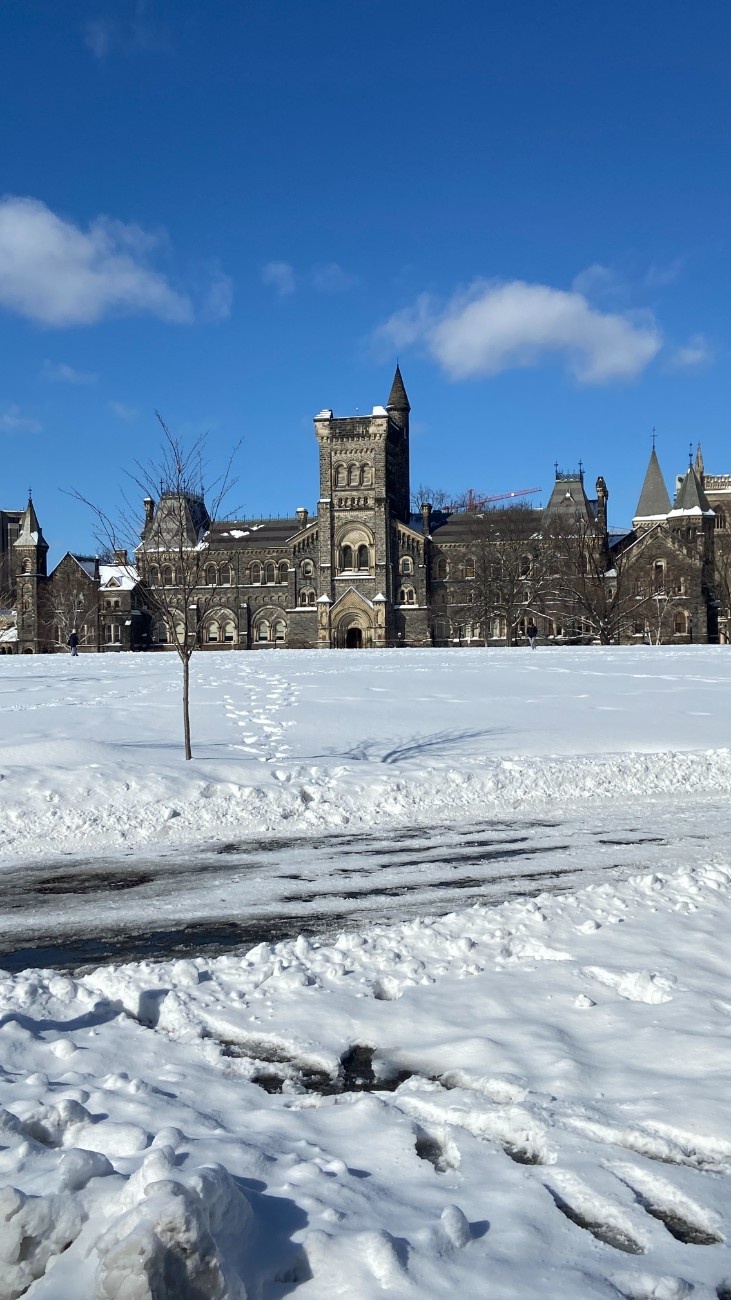
- Amazing Faculty. The professors are highly qualified PHD scholars, super passionate about their subjects and their teaching methods are so amazing that you genuinely enjoy the classroom lectures and try to understand the subjects beyond the exams prep in some cases
- Amazing Curriculum
- Multiple Clubs related to the career path you are interested in, they are there to help you fill in the gaps to better understand the industry and prepare for interviews
Dislikes
- For the college their is nothing specific that I dislike. Only challenging thing is the Canadian Market. It is very difficult for international students to get internships and jobs because the opportunities are limited, and Canadian students or people who have backgrounds working in the roles similar to they are applying to, (or CFAs for example, in Finance) have an edge over other students.
- This students who are looking for career change will have to hustle a little more than others, but college is there to provide support and guidance

Likes
- The ambience and the atmosphere is next level.
- Hangout areas are well connected.
- The college crowd is best.
Dislikes
- The security is so strict some time they irritate us.
- They are so many students who makes noises.
- University students clubs are not easy to access.
Likes
- The events organised in collaboration with different firms - this allowed us connect with various people from the industry hence increasing our network
- Case competitions - we had a variety of case competitions to choose from allowing us to gain knowledge in the desired sector for eg: portfolio management, big data, risk management etc.
- Infrastructure - The Infrastructure was really good which allowed us to spend our major time at college. The availability of study rooms allowed us to collaborate with people from different courses at the same place.
Dislikes
- Career Services - there could have been more collaboration from different firms to generate more opportunities. The overall resume feedback and career guidance was really good but the connection with industries was below par.
- Connectivity with different schools - there were no inter school events in general which restricted in minimal contact from folks from different branches apart from the one's in management.
- Career fairs: there were very few career fairs and they could have done better with the same.
Scholarship
- Yes, there are different scholarships available. I got the entrance award as well as a vector scholarship in AI, which was provided to students who had contributed in the field of AI prior to the course.
- The total amount of both the scholarships cumulatively was about 25000 CAD.
- Many people from my batch received scholarships. Some received awards similar to mine but the overall amount might vary. There were scholarships for women, people from Ontario, etc.
- Can't comment about the average number of students but if I was supposed to make an estimate, it would be around 20%. Can't comment about the award though, there would be a high amount of variance for the same.
Likes
- The school offers Diverse electives
- The cohort is enriched with diverse backgrounds and incredible people
- The professors are incredibly supportive and the teaching methods and very stimulating
Dislikes
- The term structure where you have new subjects each term
- The pace of teaching can be quite difficult to deal with, especially as an international student
- The events and case comps clash with exam times
Scholarship
- There are many different scholarships available for students throughout the year and they may even be specific for your background. For example, there are scholarships for people from an arts background, people in finance, women in stem, etc.
- The most common scholarship would be the entrance award that's given based on your GMAT score. Each 6 months there's a list of awards that could be awarded that you should keep an eye out for.
Likes
- I admire the faculty we have who are open to dealing with our problems and issues throughout the day. They urge all students to attend office hours offered by various departments for external help and clarifications.
- I love the amazing opportunities we have on campus such as joining clubs, being a part of the varsity (our mascot) as well as representing our community and university in a bunch of sports like football, cricket, and basketball.
- There are quite a few options for a good meal on campus as well right from their canteen to Tim Hortons, Starbucks, and Subway!
Dislikes
- The timings of our canteen and other food places on campus are limited during the days and shut down early on weekends.
- Our classes are huge consisting of about 300-500 students which might be a problem sometimes as the professor does not get to address every student individually.
- No student is in their intended major in the first year as we have an additional requirement to be cleared which is to make POST (Program of our choice) to which we are admitted in our second year. This makes the university highly competitive and filters out students at the initial stage itself.
Overview
I chose this university because UofT has always been my dream university since my brother was admitted here. He recently graduated. I always used to hear him boast about how UofT is such a great school and a huge opportunity for international students to grow in and explore further. The competitiveness of UofT is one thing that was scary but attractive as well as it filters out the best students from all over the world and provides opportunities to all of them through resources on campus such as on-campus jobs, clubs, and even co-ops. UofT also has a variety of teachers from all over the world, some of which who are the most experienced and the best in their field in terms of knowledge and experience. In addition, knowing that UofT is ranked 25 in the world was capitative. I feel that UofT provides its students with opportunities not only in academics and careers through Co-ops but also in all kinds of sports, while also giving us a chance to be a part of Varsity Blues. Additionally, UofT also ensures involvement on and off campus by promoting different cultural, academic, and career-oriented clubs alongside Co-ops and on-campus jobs (the opportunity to experience different industries). My experience so far at the University of Toronto has surely been delightful and enigmatic only due to the different experiences I've had. The competitiveness of my university has allowed me to understand and push myself from what I thought I could achieve and try to undertake more challenges in order to try to overcome them and succeed. UofT helped me explore the different industries I could possibly be a part of, helped me become familiar with the culture and people abroad, as well as help me become independent and ensure I do all my work myself and manage multiple tasks with no one's help right from doing my laundry to managing my studies and being productive. I have learned how to adapt to different situations, become a risk-taker, and communicate with different people, organizations, and faculty members. So far, this has truly been an experience that I will cherish for the rest of my life.
Scholarship
No, I have not received any scholarship from UTM.
Likes
- I like the sporting facilities, the way things are being taught! Also the way the ranking of the university helped me in getting into various events.
Dislikes
- Less fun activities than other universities. I would say uoft is more academically focused with less activities happening in comparison to other universities.
Overview
I chose this university because of the course and ranking of the university , these aspects impacted my decision. Overall experience is really great, lots of things to learn , the campus is really pretty with good professors.
Scholarship
I received an entrance scholarship of $3000.
Likes
- The atmosphere and the choices of studies
- The people were nice and helpful made lots of friends
Overview
It was quick and simple, and my advisor was very helpful with the process. She helped me fill out all of the correct forms and helped me apply for financial aid. Went over the best route for the course in my field of study.
interested in this College ?
Follow & Share this college to get information about admission.



Comments
Found 2 Comments
At the University of Toronto, undegraduate applications are submitted through the OUAC portal while graduate applications are submitted through the university’s online portal. But before you start your application process it is recommended that you check the admission requirements for the program you have chosen. For more information regadring the admission procedure, please visit to the University of Toronto Admission.
The University of Toronto offers a Bachelor of Science (B.Sc) program in Pharmacology. The admission will be based on your previous academic achievement (the average of their six highest senior-level credits, including required courses). You must have completed at least 4.0 FCEs and achieved a minimum grade of 70% to be considered for admission. You must also be qualified in IELTS or TOEFL and PTE.