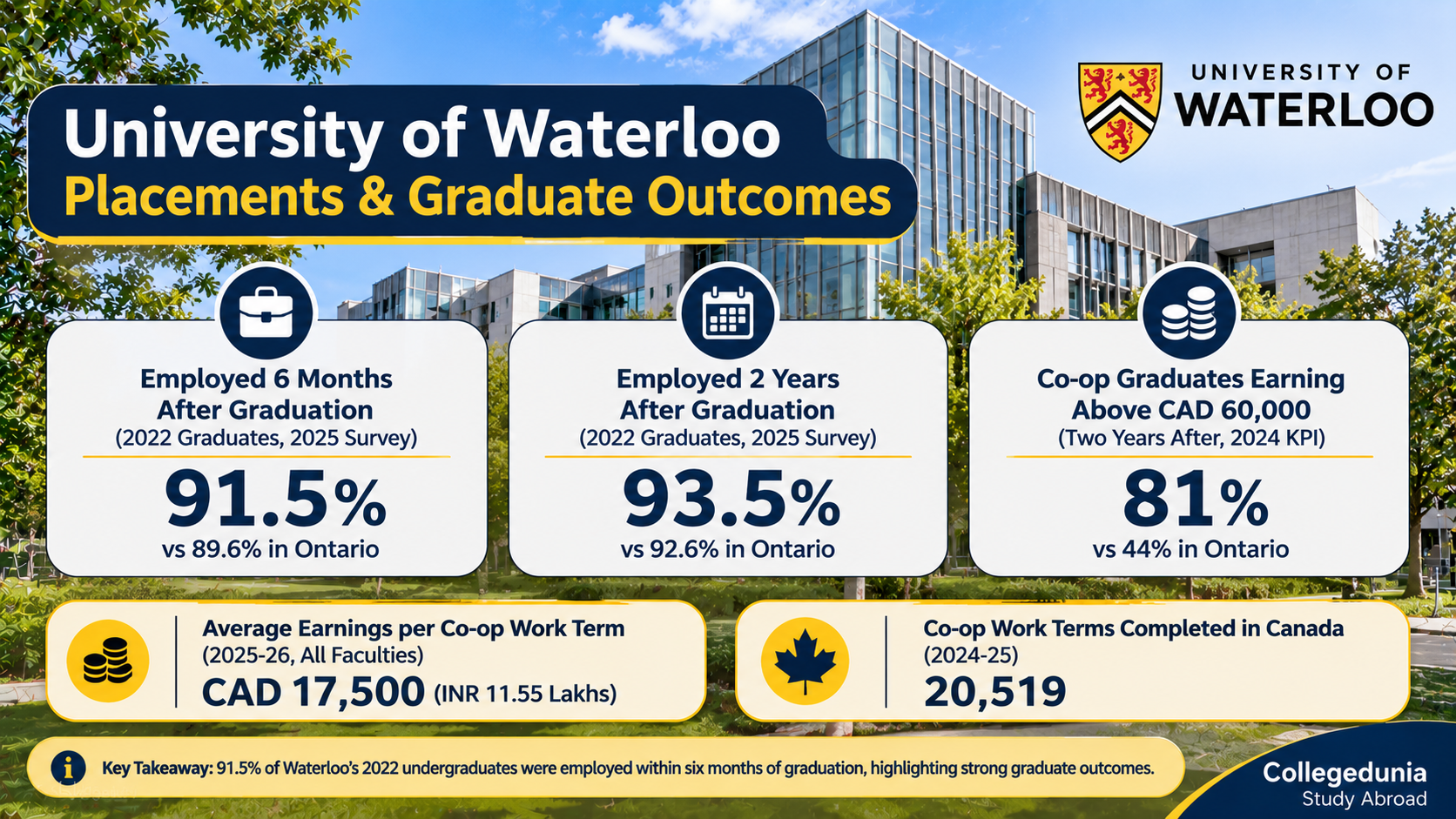
University of Waterloo placements data comes from the Ontario government's graduate survey. It found 91.5 per cent of Waterloo's 2022 undergraduates employed six months after graduating and 93.5 per cent two years after. The University of Waterloo is a public university in Waterloo, Ontario, Canada. Its co-op page reports that 81 per cent of co-op graduates earn more than CAD 60,000 (INR 39.59 Lakhs) two years after graduation.
- Employed six months after graduation (2022 graduates, 2025 survey): 91.5 per cent, against an Ontario average of 89.6 per cent
- Employed two years after graduation (2022 graduates, 2025 survey): 93.5 per cent, against an Ontario average of 92.6 per cent
- Co-op graduates above CAD 60,000 (INR 39.59 Lakhs) two years after (2024 KPI release): 81 per cent, against 44 per cent across Ontario
- Average earnings per co-op work term (2025-26, all faculties): CAD 17,500 (INR 11.55 Lakhs)
- Co-op work terms completed in Canada (2024-25): 20,519
Waterloo reports graduate outcomes, not campus placements. It also runs what it calls North America's largest co-op programme, so this article keeps two sets of figures apart. One is the employment rate after graduation from the Ontario survey. The other is pay earned during the degree on co-op work terms.
Currency Note: All INR figures used in the article use CAD 1 = INR 65.98 and USD 1 = INR 94.15 on November 2026. Rates move daily, so treat INR values as indicative.
![]()
Also Check: University of Waterloo Admission 2026 for Indian Students
Waterloo Placements and Employment Rate
The University of Waterloo reported an employment rate of 91.5% six months after graduation and 93.5% two years after graduation for undergraduate students who completed their degrees in 2022. These figures come from the Ontario University Graduate Survey, which is part of the Key Performance Indicators (KPIs) that the Ministry of Colleges and Universities requires universities in Ontario to report. Waterloo published the 2025 survey results in May 2026 on its Institutional Analysis and Planning page.
In Canada, a placement generally refers to a co-op or work term completed during a degree, rather than campus recruitment after graduation. The University of Waterloo does not conduct campus recruitment drives for graduating students or publish an official placement percentage. Therefore, the figures mentioned above represent graduate employment rates, not campus placement rates.
| Measure (Ontario graduate survey, 2022 undergraduates, 2025 survey) |
Waterloo |
Ontario system |
| Employed six months after graduation |
91.5% |
89.6% |
| Employed two years after graduation |
93.5% |
92.6% |
| Co-op graduates in jobs related to Waterloo skills, six months after (2024 KPI release) |
96% |
83% |
| Undergraduate degree completion by 2023 (2016 entry cohort) |
87.0% |
78.5% |
- The survey covers undergraduate degree graduates of Ontario universities and is not split by domicile, so the rates are not an international or Indian-student figure.
- Waterloo does not publish the survey's response rate on its KPI page.
- The 96 per cent figure covers co-op graduates only, as Waterloo's co-op page states, and the comparison group is all Ontario university graduates.
- Degree completion is understated for Waterloo because students who transfer to another university count as not completing, as the KPI page notes.
Source: University of Waterloo, Institutional Analysis and Planning, Key Performance Indicators 2025 (survey of 2022 graduates); University of Waterloo co-op pages citing the 2024 KPI release.
Note: The Ontario survey asks graduates about work six months and two years after graduation. It does not report salaries, so Waterloo's pay figures come from separate sources described in the next section. Graduate-level outcomes for master's and PhD students are not part of this survey.
Also Check: University of Waterloo Rankings 2026
Waterloo Average Salary After Graduation and Co-op Pay
81 per cent of Waterloo co-op graduates earned more than CAD 60,000 (INR 39.59 Lakhs) two years after graduation. The Ontario figure was 44 per cent. The source is the 2024 KPI release quoted on Waterloo's co-op page. Waterloo publishes no median or average graduate salary, so salary bands and co-op pay are the only official pay figures.
An earlier reading of the same Ontario survey appears in the EY impact report on Waterloo's site. It cites the 2021 survey. In that survey 67 per cent of Waterloo graduates reported salaries above CAD 50,000 (INR 32.99 Lakhs) six months after graduation, against 45 per cent across Ontario. The two figures come from different survey years and graduate groups, so they sit side by side rather than in one series.
| Salary measure |
Waterloo |
All Ontario university graduates |
Threshold in INR |
Source year |
| Co-op graduates earning above CAD 60,000, two years after graduation |
81% |
44% |
INR 39.59 Lakhs |
2024 KPI release |
| Graduates earning above CAD 50,000, six months after graduation |
67% |
45% |
INR 32.99 Lakhs |
2021 survey, EY report 2025 |
| Co-op graduates earning above CAD 60,000, two years after graduation |
70% |
49% |
INR 39.59 Lakhs |
2021 survey, EY report 2025 |
- Both sources describe the share of graduates above a salary line, not a median, so no single Waterloo salary can be quoted.
- The 2024 release shows a higher share above the two-year threshold than the 2021 survey, but the two cover different graduating years.
- Neither source splits the figures by domicile, so none of them is an international-student salary.
Source: University of Waterloo co-op pages citing the Ontario Key Performance Indicators 2024 release; EY, University of Waterloo socioeconomic impact report, 2025, citing the Ontario University Graduate Survey 2021.
Note: A median is the middle salary of those who replied, and Waterloo publishes none for its graduates. Co-op pay below is a different measure again. It is what students earn while still enrolled, reported through WaterlooWorks. It excludes international work terms, stipends and unpaid terms.
Co-op pay is published in detail. Waterloo's performance indicator puts the average earnings per co-op work term at CAD 17,500 (INR 11.55 Lakhs) in 2025-26, across all faculties. Mathematics is highest and Health lowest. A work term runs four months. The university's co-op page says students typically earn CAD 9,600 (INR 6.33 Lakhs) to CAD 23,400 (INR 15.44 Lakhs) per term in Canada.
| Faculty |
Average earnings per co-op work term 2025-26 (CAD) |
INR |
Average hourly rate, first work term 2025 (CAD) |
INR |
| Mathematics (including Computer Science) |
CAD 20,900 |
INR 13.79 Lakhs |
CAD 22.76 |
INR 1,502 |
| Engineering |
CAD 18,400 |
INR 12.14 Lakhs |
CAD 21.67 |
INR 1,430 |
| Arts (including Accounting and Financial Management) |
CAD 14,400 |
INR 9.50 Lakhs |
CAD 21.40 |
INR 1,412 |
| Environment |
CAD 14,100 |
INR 9.30 Lakhs |
CAD 20.98 |
INR 1,384 |
| Science (excluding Pharmacy) |
CAD 13,500 |
INR 8.91 Lakhs |
CAD 20.34 |
INR 1,342 |
| Health |
CAD 12,100 |
INR 7.98 Lakhs |
CAD 18.75 |
INR 1,237 |
- Hourly pay rises with each term: Mathematics students averaged CAD 34.15 (INR 2,253) per hour by their sixth work term in 2025.
- Engineering students averaged CAD 31.53 (INR 2,080) per hour in their sixth work term in 2025.
- United States work terms pay more: Mathematics students averaged USD 52.36 (INR 4,930) per hour in their sixth term in 2025.
- Every figure is an average with a wide low-to-high range, and Waterloo states that employers are not required to follow these rates.
Source: University of Waterloo, Performance Indicators, average co-op earnings by faculty, 2025-26. Co-operative Education, co-op earnings for Canadian and United States work terms, 2025.
Key Insight: Six work terms at the 2025-26 Mathematics average add up to CAD 125,400 (INR 82.74 Lakhs), calculated as 6 × CAD 20,900 before tax. The Engineering figure is CAD 110,400 (INR 72.84 Lakhs), calculated the same way. That is money earned during the degree, not a graduate salary. International work terms are excluded from the averages.
The co-op earnings performance indicator excludes international student wages from its averages, as its definition page states. Indian students' co-op earnings are therefore not in the published figures. Treat the averages as the market rate for the role rather than a promise of pay.
Also Check: Study in Canada: Top Universities, Admissions and Deadlines
Waterloo Placements by Course and Salary
Computer Science graduates had the highest six-month employment rate at Waterloo. 96.9 per cent of 2022 graduates were employed six months after graduation, against 82.6 per cent for Computer Science across Ontario. Business and Commerce graduates reached 97.7 per cent two years after, the highest two-year rate among the large groups.
The Ontario survey reports by programme category rather than by named degree, so the rows below group Waterloo's courses the way the Ministry does. The pay column shows the 2025-26 average co-op term earnings for the faculty that runs each category, because Waterloo publishes no graduate salary by course.
| Programme category (2022 graduates) |
Employed at six months |
Employed at two years |
Ontario six months |
Co-op term earnings 2025-26 (CAD) |
INR |
| Computer Science |
96.9% |
94.9% |
82.6% |
CAD 20,900 (Mathematics) |
INR 13.79 Lakhs |
| Kinesiology, Recreation and Physical Education |
96.9% |
90.0% |
92.1% |
CAD 12,100 (Health) |
INR 7.98 Lakhs |
| Business and Commerce |
94.4% |
97.7% |
91.7% |
CAD 14,400 (Arts) |
INR 9.50 Lakhs |
| Humanities |
93.9% |
90.0% |
87.1% |
CAD 14,400 (Arts) |
INR 9.50 Lakhs |
| Engineering |
93.1% |
94.3% |
89.8% |
CAD 18,400 (Engineering) |
INR 12.14 Lakhs |
| Mathematics |
91.2% |
93.8% |
86.1% |
CAD 20,900 (Mathematics) |
INR 13.79 Lakhs |
| Social Sciences |
90.8% |
93.2% |
88.1% |
CAD 14,400 (Arts) |
INR 9.50 Lakhs |
| Health Professions |
88.3% |
95.2% |
89.9% |
CAD 12,100 (Health) |
INR 7.98 Lakhs |
| Other Arts and Science |
83.5% |
90.1% |
88.1% |
CAD 13,500 (Science) |
INR 8.91 Lakhs |
| Physical Science |
82.4% |
86.1% |
86.9% |
CAD 13,500 (Science) |
INR 8.91 Lakhs |
| Agriculture and Biological Science |
77.3% |
85.1% |
85.7% |
CAD 13,500 (Science) |
INR 8.91 Lakhs |
- Computer Science, Engineering, Mathematics and Business all beat the Ontario average at six months, by margins of 2.7 to 14.3 percentage points.
- Physical Science and Agriculture and Biological Science sit below the Ontario average at six months, so science applicants should weigh the two-year figure as well.
- Pharmacy and Optometry reached 100 per cent two years after graduation, the only categories at that level.
- The co-op pay column is a faculty average for enrolled students and is not the salary those graduates earn after finishing.
Source: University of Waterloo, Institutional Analysis and Planning, Key Performance Indicators 2025 (survey of 2022 graduates); Performance Indicators, average co-op earnings by faculty, 2025-26.
Key Insight: For an Indian applicant choosing between Computer Science and Engineering, the 2022 cohort shows a 3.8 point gap at six months in favour of Computer Science. At two years Computer Science still leads, by 0.6 points. Both beat the Ontario average by a wide margin, so choose on the course, not on these rates.
Also Check: University of Waterloo Courses and Fees 2026
Top Recruiters Hiring Waterloo Graduates and Co-op Students
Waterloo says more than 8,000 employers in more than 70 countries hire its co-op students. More than 24,000 full-time positions are posted on its WaterlooWorks job board each year. The university names employers on its co-op and hiring pages. It does not publish how many students each one hires, or which ones hire graduates rather than co-op students.
The employers below are named on Waterloo's own pages. Its co-op page lists them by sector, and the groups below follow that page with names from the hiring pages added.
| Sector, as Waterloo groups it |
Employers named on Waterloo pages |
| Technology |
Google, Microsoft, Tesla, Amazon, NVIDIA, Shopify, Stripe, Square, Uber, Autodesk, Electronic Arts, OpenText, BlackBerry, Splunk, Swap Robotics, Trexo Robotics |
| Business and finance |
RBC, TD Bank Group, Scotiabank, CIBC, Mastercard, KPMG, Deloitte, Manulife, TD Insurance, Gore Mutual, MAC LLP |
| Government and research |
Canada Revenue Agency, Environment and Climate Change Canada, National Research Council of Canada, Policy Horizons Canada, Regional Municipality of York, CanmetENERGY |
| Health |
Hospital for Sick Children, University Health Network, Sunnybrook Health Sciences Centre, Odette Cancer Centre, Canadian Institute for Health Information, Veeva |
| Consumer and industrial |
SC Johnson, Bosch, Canadian Tire, BMW North America, Maple Leaf Foods, Nissan Canada, The Home Depot Canada, Maple Leaf Sports and Entertainment |
| Education and non-profit |
Massachusetts Institute of Technology, D2L, Sheridan College, Food Bank of Waterloo Region, Habitat for Humanity, United Way |
- These employers are named by Waterloo as hiring its co-op students; the university does not rank them or state annual hiring numbers.
- Waterloo's 2023 report names Bosch, Geotab, Loopio, Liberty, Dundas Life and Ceragen as its 2022 Employer Impact Award winners.
- MAC LLP, an accounting firm, hires eight to ten Waterloo students each year, as a Hire Waterloo story from February 2024 states.
Source: University of Waterloo, future students co-op page, tech talent page, Hire Waterloo pages and Co-operative and Experiential Education annual reports, 2021 to 2025.
Waterloo also reports that its students accounted for 86 per cent of all co-op work terms in the United States reported by Canadian universities between 2016 and 2022. They made up 44 per cent of international co-op work terms outside the United States. Those figures come from CEWIL Canada data quoted in Waterloo's 2023 report, and they describe work terms during the degree.
Also Check: University of Waterloo Scholarships 2026 for Indian Students
Internships and Co-op at Waterloo
Waterloo students completed 20,519 co-op work terms in Canada in the 2024-25 academic year. The count excludes United States and other international terms, according to the EY impact report on Waterloo's site. Co-op is built into the degree. Most co-op programmes take five years, with eight study terms and four to six paid work terms of four months each.
Co-op at Waterloo is paid work, arranged through the WaterlooWorks job board or found by the student. The rules that matter to an Indian applicant are listed below, each from Waterloo's own pages.
- Structure: four to six work terms of four months, up to 24 months of paid experience by graduation, with some programmes offering eight-month terms.
- Co-op fee: CAD 836 (INR 55,159) per school term in 2026-27, charged for a set number of terms that varies by programme.
- Pay: typically CAD 9,600 (INR 6.33 Lakhs) to CAD 23,400 (INR 15.44 Lakhs) per four-month term in Canada.
- Unpaid terms: approved for co-op credit only in limited cases under Waterloo's unpaid and underpaid guidelines.
- Engineering sequence: six work terms, with many majors including an eight-month term, and a visa such as the J-1 possibly needed for United States terms.
- Employment rate definition: employed students divided by students taking part in recruitment, excluding those who change sequence or join WE Accelerate.
- Work permit: since 1 April 2026, post-secondary students no longer need a co-op work permit for required work placements, as the Government of Canada states.
Waterloo publishes the co-op employment rate only inside its login-protected Co-op Data Hub, updated every two weeks, so this article quotes no co-op placement percentage. It does state that some students secure a job up to four weeks into the work term, the final date for co-op credit. Students in the Waterloo Experience Accelerate programme are excluded from the rate, as the statistics page states.
Tip for Indian Students: Ask Waterloo for the letter confirming that work placements are a required part of your programme. The Government of Canada asks for it in place of the old co-op work permit. Budget for the co-op fee and for a possible slow first search. Waterloo's own definition shows that not every student is employed when the term begins.
Also Check: Canada Student Visa Guide for Indian Students
Waterloo Placement Trend by Year
Waterloo's six-month employment rate was 91.5 per cent for 2022 graduates, down 2.1 points from 93.6 per cent for 2021 graduates. The 2021 figure was 6.5 points above the 87.1 per cent for 2020 graduates. The two-year rate fell 1.4 points in each of the same two steps, calculated. All three cohorts come from the Ontario Key Performance Indicator survey on Waterloo's Institutional Analysis and Planning pages.
| Graduating cohort (survey year) |
Waterloo six months |
Waterloo two years |
Ontario six months |
Ontario two years |
| 2022 graduates (2025 survey) |
91.5% |
93.5% |
89.6% |
92.6% |
| 2021 graduates (2023 survey) |
93.6% |
94.9% |
90.6% |
94.1% |
| 2020 graduates (2022 survey) |
87.1% |
96.3% |
86.2% |
95.1% |
- Waterloo stayed above the Ontario six-month average in all three cohorts, by 0.9, 3.0 and 1.9 points, calculated from the two columns.
- The two-year rate moved with the Ontario figure, falling 2.8 points for Waterloo and 2.5 points for Ontario between the 2020 and 2022 cohorts, calculated.
- Waterloo does not explain the year-to-year movements on its KPI pages, so this article offers no cause.
Source: University of Waterloo, Institutional Analysis and Planning, Key Performance Indicators 2023, 2024 and 2025 (surveys of 2020, 2021 and 2022 graduates).
Note: The 2024 KPI release reported the 2021 graduating cohort from a 2023 survey. The 2025 release reported the 2022 cohort from a 2025 survey. The gap between the last two surveys is therefore two years rather than one. Compare cohorts, not release years.
Also Check: Intakes in Canada for International Students 2026-27
Waterloo Career Services for International Students
Co-operative and Experiential Education runs the co-op programme, the WaterlooWorks job board and the professional development courses taken alongside work terms. Waterloo's pages describe no separate service for international students.
- WaterlooWorks carries more than 24,000 full-time postings a year, as the Hire Waterloo page states.
- Velocity, the university's incubator, has supported more than 500 start-ups and 1,200 founders since 2008, as the 2025 EY report states.
- Employers rated 95 per cent of co-op students very good to outstanding on their 2021 work terms, an employer rating rather than an employment outcome.
These are services and ratings, not job outcomes. The employment rates in the earlier sections are the only outcome measures Waterloo publishes.
Post-Study Work After Waterloo for Indian Students
Indian graduates of Waterloo apply for the Post-Graduation Work Permit, or PGWP. A programme of two years or more earns a PGWP of up to three years. Since 15 February 2024 a master's degree of at least eight months also qualifies for three years. Shorter programmes earn a permit matching their length.
- Bachelor's, master's and doctoral graduates have no field-of-study requirement.
- University degree graduates must show Canadian Language Benchmark 7 for applications made on or after 1 November 2024.
- Apply within 180 days of confirmation that the programme is complete; the permit cannot outlast the passport.
- During study, international students can work up to 24 hours per week off campus in academic sessions and unlimited hours in scheduled breaks.
- Required co-op placements have no weekly hour limit and, since 1 April 2026, need no separate co-op work permit.
The Government of Canada sets these rules and changes them often, so check the canada.ca PGWP pages on the day you apply.
Also Check: PGWP Canada: Duration, Eligibility and Application Process
The University of Waterloo offers strong career opportunities, particularly for students who want practical work experience through its co-op programmes. With 91.5% of 2022 undergraduates employed six months after graduation and co-op students earning an average of CAD 17,500 (INR 11.55 Lakhs) per work term in 2025-26, the university provides opportunities to gain industry experience while studying. However, students should also consider the limitations in the available data, as the university does not publish median graduate salaries or publicly share its co-op employment rate.
Before accepting an offer, check your programme category in the course fee table, include the additional co-op fee in your budget, and confirm your Post-Graduation Work Permit (PGWP) eligibility based on your chosen programme. This will help you understand the actual cost of studying at Waterloo and plan your career options in Canada.
FAQs
Ques. What is the University of Waterloo graduate employment rate?
Ans. 91.5 per cent of Waterloo's 2022 undergraduates were employed six months after graduation and 93.5 per cent two years after, according to the Ontario Key Performance Indicators 2025. The Ontario averages were 89.6 per cent and 92.6 per cent.
Ques. What is the average salary of University of Waterloo graduates?
Ans. Waterloo publishes no median or average graduate salary. Its co-op page reports that 81 per cent of co-op graduates earned more than CAD 60,000 (INR 39.59 Lakhs) two years after graduation. That figure is from the 2024 KPI release, against 44 per cent of Ontario graduates.
Ques. How much do University of Waterloo co-op students earn?
Ans. Co-op students averaged CAD 17,500 (INR 11.55 Lakhs) per four-month work term across all faculties in 2025-26. Mathematics averaged CAD 20,900 (INR 13.79 Lakhs) and Engineering CAD 18,400 (INR 12.14 Lakhs). First-term hourly averages in 2025 ran from CAD 18.75 (INR 1,237) in Health to CAD 22.76 (INR 1,502) in Mathematics.
Ques. Does the University of Waterloo have placements for Indian students?
Ans. Waterloo does not run campus placement drives. It runs Canada's largest co-op programme, with four to six paid work terms built into most degrees. Indian students use the same WaterlooWorks job board as domestic students.
Ques. Which companies hire University of Waterloo students?
Ans. Waterloo's own pages name Google, Microsoft, Tesla, Amazon, NVIDIA, Shopify, RBC, TD Bank Group, Deloitte, KPMG and Mastercard. They sit among more than 8,000 co-op employers in more than 70 countries. The university does not publish hiring numbers per employer.

























Comments