



Content Curator
Absolute and relative error is the approximation error of a data value which is a discrepancy between the exact value and that approximation. Absolute error is the number of discrepancies) and relative error refers to the absolute error divided by the data value.
Absolute error is defined as the absolute value (or magnitude) of the difference between the measured value and the true value whereas the relative error is defined as the absolute error with respect to the size of the measurement.
| Table of Content |
Key Takeaways: absolute and relative error, absolute error, relative error, standard deviation, errors
Definition of Absolute Error
[Click Here for Sample Questions]
Absolute error is defined as the difference between a measured or derived value of a quantity and an actual value.The meaning of the absolute error depends on the quantity to be measured. Absolute errors are not enough because there is no information about the meaning of the error.
- At street distances, such as in large quantities, small errors in centimeters are negligible. When measuring the length of machine parts, the error of centimeters is large.
- In both cases the error is shown in centimeters, but the error in the second case is more important. When measuring distances between cities that are kilometers apart, errors of a few centimeters are negligible and irrelevant.
- Consider another case where the centimeter error when measuring a small mechanical part is a very significant error .Both errors are on the order of centimeters, but the second error is more serious than the first.
Also Read: Linear Approximation Formula
Absolute Error Formula
If x is the actual value of the quantity
x0 is the measured value of the quantity, the absolute error value can be calculated using the following formula:
Δx = x0–x
Here, Δx is called the absolute error.
When considering multiple measurements, the arithmetic mean of the absolute error of each measurement should be the final absolute error.
Example of Absolute Error
Here are some examples of absolute mistakes in real life.
Suppose you want to measure the length of the eraser.
The actual length is 35mm and the measured length is 34.13mm.
Therefore, absolute error = actual length measurement - length = (35 - 34.13) mm = 0.87mm
Classification of Absolute Error
[Click Here for Sample Questions]
Absolute Accuracy Error
Absolute accuracy error is the other name of absolute error.
The formula for absolute accuracy error is written as
E = Eexp – Etrue,
where E is the absolute accuracy error,
Eexp is the experimental value
Etrue is the actual value.
Mean Absolute Error
Mean absolute error is the mean or average of all absolute errors. The formula for Mean Absolute Error is given as,
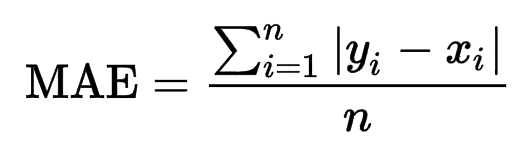
Mean Absolute Error
Definition of Relative Error
[Click Here for Sample Questions]
Relative error is defined as the ratio of the absolute error of the measured value to the actual measured value.
- Using this method, you can determine the amount of absolute error with respect to the actual size of the measurement. If you don't know the actual measurement of the object, you can find the relative error from the measurement.
- Relative error indicates how good the measurement is in relation to the size of the object being measured.
- Note that the relative error is dimensionless. When writing relative errors, it is common to multiply the decimal error by 100 and express it as a percentage.
Relative Error Formula
Relative errors are calculated by the absolute error ratio and the actual amount value. If the absolute error is the measurement Δx, the actual value x0 is x and the relative error is -
(x0 - x)/x = (Δx)/x
Here, XR is a relative error.
Example of Relative Error
Here is an example of an actual relative error.
Suppose the actual length of the eraser is 35mm.
Here, the absolute error = (35 – 34.13) mm = 0.87 mm.
Therefore, relative error = absolute error / actual length = 0.87 / 35 = 0.02485
Accuracy of Relative Error Measurement
Relative error is often a measure of accuracy. At the same time, it can be used as a measure of accuracy. Accuracy is the degree of knowledge about how accurate a value is compared to its actual or true value.
Students can only find the accuracy of the RE if they know the true or measured value.
For simplicity, there is an expression that calculates the RE accuracy given as
Accuracy = actual error / true value * 100%.
Things to Remember
- There are two types of errors affected by measuring tool accuracy, absolute error and relative error.
- Formula of absolute error: Δx = x0–x,
- Formula of relative error: (x0 - x)/x = (Δx)/x
- Absolute error indicates the magnitude of the error, and relative error indicates the magnitude of the error for the correct value.
- Mean Absolute Error is the average of all the absolute errors in the collected data. Abbreviated as MAE (Mean Absolute Error).
Read also:
Sample Questions
Ques. The time T, taken for a complete oscillation of a single pendulum with length l , is given by the equation: T = 2π√(l/g), where g is constant. Find the approximate percentage error in the calculated value of T corresponding to an error of 2 percent in the value of 1. (2 Marks)
Ans:
T = 2π√(l/g)
T = 2π(l/g)1/2
log T = log 2π + (1/2) [log l - log g]
(1/T) dT/dl = 0 + (1/2) [(1/l) - 0]
dT/T = (1/2) (1/l) dl
Percentage error = (1/2) (1/l) × 0.02 l × 100
= 1%
Ques. Find the absolute and relative errors. The actual value is 125.68 mm and the measured value is 119.66 mm. (2 Marks)
Ans:
Absolute Error = |125.68 – 119.66| mm= 6.02 mm
Relative Error = |125.68 – 119.66| / 125.68= 0.0478
Ques. Find out the absolute and relative errors, where the actual and measured values are 252.14 mm and 249.02 mm. (2 Marks)
Ans:
Absolute Error = |252.14 – 249.02| mm = 3.12 mm
Relatives Error = 3.12/252.14 = 0.0123
Ques. The radius of a circular plate is measured as 12.65 cm instead of the actual length 12.5 cm. find the following in calculating the area of the circular plate:
(i) Absolute error (ii) Relative error. (5 Marks)
Ans: (i) Absolute error:
Absolute error = Actual value - Approximate value
Actual length = 12.5 cm approximate value = 12.65 cm
Area of circle A(r) = πr2
Actual change in area = π(12.65)2 - π(12.5)2
= π[160.0225 - 156.25]
= π(3.7725)
= 3.7725π ---(1)
Approximate change = A'(12.5) x change in radius
= 2π(12.5) x 0.15
= 25π x 0.15
= 3.75π ---(2)
(1) - (2)
Absolute error = 3.7725π - 3.75π
= 0.0225π cm2
(ii) Relative error = (Actual value - Approximate value)/Actual value
Relative error = 0.0225π / 3.7725π
= 0.0059 cm2
Ques. Absolute error of a number is 5 and Relative error for the same number is 0.2. Find out the actual value of the number. (3 Marks)
Ans: Relative error = Absolute error/ Actual value
Given, the relative error is 0.2
Absolute error is 5.
So, actual value = 5/0.2
= 25
Hence the actual value is 25.
Ques. If absolute error and actual value of a number are 5, 15. What is the relative error? (2 Marks)
Ans: Relative error = absolute error/ actual value
Absolute Error = 5
Actual Value = 15
Hence,
Relative error = 5/15
= 1/3
Ques. A scale incorrectly measures a value as 6 cm because of some marginal errors. If the real measurement of the value is taken as 10 cm then what will be the percentage of error. (2 Marks)
Ans: Given,
Approximate value/wrong value = 6 cm
Exact value = 10 cm
Percentage Error = (Approximate Value - Exact Value)/Exact Value) × 100
Percentage Error = (10 – 6)/10 × 100
= 40 %
Ques: If the actual value of a shaft diameter is 1.605 inches and the shaft is measured and found to be 1.603 inches, determine the relative and absolute error. (3 Marks)
Ans. We know that, Absolute error = true value - measured value
= 1.605 – 1.603
= 0.002 inches
The relative error = absolute error/ true value × 100
= 0.002 / 1.605 × 100
= 0.1246 %
Ques: The table is 150 cm wide. When measured with a school ruler, it equals to 150.2 cm. Calculate the absolute and relative error. (2 Marks)
Ans: Real value = 150 cm
Measured value = 150.2 cm
Absolute error = real value - measured value
150 - 150.2
= 0.2 cm
Relative error = 0.2150 × 100
= 0.1 %
Also Read:



Comments