



Content Curator
Precision is the amount of information that is conveyed in terms of digits. It refers to the resolution or limit of the measurement. Precision is independent of accuracy. Accuracy denotes how close the measured value is to the true value of a given quantity. On the other hand, precision refers to the resolution or limit of the quantity measured. In simple terms, precision is the total number of significant decimal or other digits. It has nothing to do with the closeness to the target number.
| Table of Content |
Key Takeaways- Precision, Precision Formula, Accuracy, Recall, Resolution, True Positives, False Positives
Also Read: Maxima and Minima
What is Precision?
[Click Here for Sample Questions]
Precision connotes the amount of information that is conveyed by a number in terms of digits. It tells us about the magnitude of the resolution or limit the quantity is measured. In other words, precision is a measure of how much detailed information has been given and to what degree the exactness has been applied.

Precision
For instance, the value of a certain length was 4.678 cm and in one experiment, using a measuring instrument with resolution of 0.1 cm, the value was found to be 4.5 cm. Then in another experiment using a measuring tool with the resolution of 0.01 cm the value was found to be 4.38 cm. Here, the second measurement is more precise as the resolution of the measuring tool was higher (0.01cm) irrespective of which measurement is closer to the actual value.
Also Read:
Precision Formula
[Click Here for Sample Questions]
Precision evaluates the fraction of rightly classified instances or samples among the ones classified as positives. Therefore, the formula of the precision can be mathematically written as,
Precision = True Positives / (True Positives + False Positives)
Precision = TP / (TP + FP)
A true positive refers to an outcome where the model correctly predicts the positive class whereas a true negative denotes the outcome where the model correctly predicts the negative class. A false positive is an outcome when the model incorrectly predicts the positive class.
Also Read:
Precision Example
[Click Here for Sample Questions]
Let us assume a binary model makes predictions and predicts 200 samples belonging to section X, out of that 125 were correct and 75 were incorrect. Calculate the precision value for this model.
Solution: From the given model,
True Positives (TP) =125
False positives (FP)= 75
Using the formula,
Precision= TP/ (TP+FP)
= 125/ (125+75)
= 125/200
= 0.625
Thus, the precision for the given model is 0.625.
Also Read: Linear Programming
Precision and Accuracy
[Click Here for Sample Questions]
Although Precision and Accuracy are two closely related and easily confused terms, yet they are distinguishable. Accuracy of a measurement refers to how close the measured value is to the true value of the quantity. On the other hand, precision refers to the resolution or limit the quantity is measured.
Let us consider the value of ‘pi’ that is .142857143
Now, based on some experiments it is found out that the value is 3.14. It is accurate based on closeness and no other number with three digits can get closer to that target. Thus, the value shows good accuracy but bad precision.
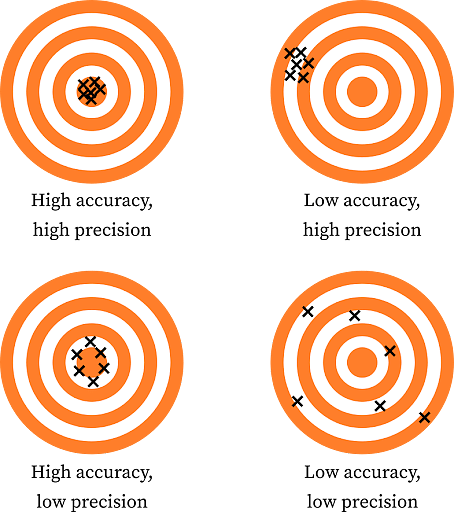
A pictorial representation showing a difference of accuracy and precision
Now, based on some other experiments the value of pi was found to be 3.1353426789054. It should be considered to be very precise as it gives more information but not accurate as it is not near the target. It is just a measurement with better resolutions. Here, the value shows less accuracy but more precision.
Now, in the third set of experiments, the value of pi was found to be 3.1419254638. It is the only number that is close to the target number but also with great resolution. Thus, this number is more accurate and precise than the values found in previous sets of experiments. Here, the found value is both accurate and precise.
Also Read: Permutations and Combinations
Precision and Recall
[Click Here for Sample Questions]
In pattern recognition and machine learning, precision and recall are the performance matrices that are applied to the data retrieved from a sample space or a collection. Here, precision refers to the fraction of relevant instances amongst the retrieved instances while recall is the fraction of relevant instances that were actually retrieved.

Precision and Recall
Things to Remember
- Precision refers to the amount of information that is conveyed by a number in terms of digits.
- It tells about the magnitude of resolution or limit the quantity is measured.
- The formula of the precision is as follows;
Precision = True Positives/ (True Positives + False Positives)
Precision = TP / (TP + FP)
- Accuracy of a measurement refers to how close the measured value is to the true value of the quantity.
Also Read:
Sample Questions
Ques. What is Precision? (1 Mark)
Ans. Precision is the amount of information that is conveyed by a number in terms of digits. It tells us about the magnitude of resolution or limit the quantity is measured.
Ques. State the formula of Precision. (2 Marks)
Ans. The formula of the precision can be given as follows;
Precision = True Positives/ (True Positives + False Positives)
Precision = TP/ (TP+FP)
Here, true positive = an outcome where the model correctly predicts the positive class
true negative = outcome where the model correctly predicts the negative class.
false positive = outcome when the model incorrectly predicts the positive class.
Ques. What is accuracy? (1 Mark)
Ans. Accuracy of a measurement refers to how close the measured value is to the actual value of the quantity.
Ques. What is the difference between precision and accuracy? (2 Marks)
Ans. Precision and Accuracy are often regarded as two closely related and easily confused terms, however, they are distinguishable. Accuracy of a measurement refers to how close the measured value is to the true value of the quantity. On the other hand, precision refers to the resolution or limit the quantity is measured.
Ques. What is bias? (2 Marks)
Ans. Bias refers to the gap between the expected value of an estimate and the true value of the parameter being evaluated. Here, precision refers to how similar several estimates are to one another rather than how close they are to the target value (which is bias). Thus, accuracy has two separate components: precision and bias.
Ques. How can we determine if a measurement is accurate or precise? (3 Marks)
Ans. Let us take an example to understand if a measurement is accurate or precise-
The true value of ‘pi’ is 3.142857143
Now, based on some experiments it is found that the value 3.14, it is accurate based on closeness. But it does give much information about the digits i.e. the resolution is low. Thus, the value shows good accuracy but bad precision.
Now, based on some other experiments the value of pi was found to be 3.1353426789054. It is not accurate as it is not near the target. It is just a measurement with better resolutions. Here, the value shows less accuracy but more precision.
In the third set of experiments, the value of pi was found to be 3.1419254638. This number is more accurate and precise than the values found in previous sets of experiments.
Ques. What are the different types of measurement bias? (2 Marks)
Ans. Any systematic and non-random inaccuracy that happens in the collection process of the data in research is referred to as measurement bias. It is also known as ‘detection bias’. There are different types of biases, some of them are;
- Bias in recall
- Bias of the observer
- Bias of expectation
- Verification bias
- Bias in lead time
- Bias in response
Ques. What is precision and recall with respect to pattern recognition and machine learning? (2 Marks)
Ans. In pattern recognition and machine learning, precision and recall are used as the performance metrics that are applied to the data retrieved from a sample space or a collection. Here, precision refers to the fraction of relevant instances amongst the retrieved instances while recall is the fraction of relevant instances that were actually retrieved.
Read Also:



Comments