



Content Curator
Acetate is a salt formed when acetic acid combines with a base (alkaline, earthy, metallic, non-metallic, or radical base). It is depicted by the formula C2H3O2-. The term "acetate" also refers to the conjugate base or ion (particularly, the negatively charged ion called an anion) typically found in an aqueous solution.
The acetate ion and a positive ion combine to form neutral molecules, and these are often called "acetates" as well. The most basic of these is hydrogen acetate (also known as acetic acid), having its corresponding salts, esters, and a polyatomic anion CH3CO2-, or CH3COO-.
Read Also: Importance of pH in Everyday Life
| Table of Content |
Structure of Acetate
The structure of an acetate ion is as follows:

Structure of Acetate
Forms of Acetate
An acetate has three forms. All of these originate from acetic acid, which is the parent molecule.
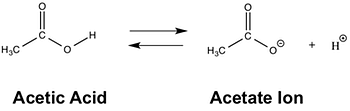
The first form of acetate is its anion. A negatively charged ion is called an anion. On losing a proton (H), acetic acid becomes charged, which is known as the acetate ion.
CH3COOH \(\rightleftharpoons\) CH3COO-+H+
The second form of acetate is salt. The tendency of several acetate salts to dissolve well in water indicates that they are ionic. Sodium acetate, a white solid made by mixing vinegar and sodium bicarbonate, is a widely found acetate in households.
CH3COOH+NaHCO3→CH3COO-Na++H2O+CO2
Check More: Properties of Bases
The last form of acetate is an ester. Esters are organic compounds made by replacing the hydrogen of an acid with an alkyl or other organic group. The esters of acetate can be used to create cosmetic products. It can also be used to create decaffeinated coffee owing to its range of uses. The esters are the most popular types of acetate on the market.

The general formula for its ester form is stated below:
CH3CO2R where R is an organyl group.
Also Read:
Fermentation of Acetate
The dismutation reaction that Acetic acid undergoes generates carbon dioxide and methane.
The reaction is stated below:
CH3COO-+H+→ CH4+CO2 ΔG°=-36 kJ/mol
The presence of catalyst methanogen archaea is required to carry out this reaction. One single electron transfers from the carboxylic group to the methyl group of acetic acid. This generates methane gas and carbon dioxide.

Fermentation of Acetate
Properties of Acetate
The properties of Acetate are stated below:
| Formula for Acetate Ion | C2H3O2-- |
|---|---|
| Molecular Weight of Acetate | 59.04 g/mol |
| Monoisotopic Mass of Acetate | 59.013 g/mol |
| Complexity | 25.5 |
| Conjugate Acid | Acetic Acid |
Read More: Difference between Acid and Base
Difference between Acetate and Acetic Acid
The primary distinction between acetic acid and acetate is that the former is a neutral compound, whereas the latter is an anion with a net negative electrical charge.
Acetic acid is an organic compound that aids in the production of vinegar, and the acetate ion is the conjugate base of acetic acid. Most crucially, the acetate ion is formed when the hydrogen atom in the carboxylic group of acetic acid is removed.
Also Read:
Uses of Acetate
- Acetate is used as a solvent in paints, inks, coatings.
- Cellulose acetate is used in eyeglass frames.
- Potassium acetate is used as a food preservative.
- Sodium acetate is used in condiments like mustard.
- It is used in laboratories.
- Aluminum acetate is used as an astringent.

Uses of Acetate
Things to Remember
- An acetate is a salt formed by the combination of acetic acid with a base (like alkaline, earthy, metallic, non-metallic, or radical base). It is depicted by the formula C2H3O2-.
- An acetate has three forms: anion, salt, and ester. Acetic acid loses a proton (H) and becomes charged to form an anion. The tendency of several acetate salts to dissolve well in water indicates that they are ionic. Acetate esters have the general formula CH3CO2R, where R is an organyl group. The esters are the dominant forms of acetate in the marketplace.
- Acetic acid undergoes a dismutation reaction to generate carbon dioxide and methane. The presence of catalyst methanogen archaea is required to carry out this reaction.
Also Read Fruther:
Sample Questions
Ques. How is acetate produced? (2 marks)
Ans: Acetic anhydride reacts with high purity wood pulp to form acetate fiber. This chemical reaction produces acetate flakes, which are dissolved in a solvent, filtered, and adjusted to derive a solution for spinning stock.
Ques. What are the advantages and disadvantages of acetate? (2 marks)
Ans: Advantages: This cloth is one of the most flexible and also wrinkle-resistant. It has a silky texture and feels pleasant to touch. Disadvantages: The dyes have a tendency of fading or bleeding. They are also heat-sensitive and are low-quality fibers.
Ques. Is acetate a base or an acid? (2 marks)
Ans: Because sodium acetate is a basic salt, the acetate ion will deprotonate water, causing the pH of the solution to rise. The basic salt is produced when a strong base and a weak acid react to neutralize each other.
Ques. What are the differences between acetate and acetic acid? (2 marks)
Ans: Acetate differs from acetic acid in that acetic acid is a neutral molecule, whereas acetate is an anion with a net negative electric charge. Acetic acid is an organic compound that aids in the production of vinegar, and the acetate ion is the conjugate base of acetic acid.
Ques. What are the various forms of acetate? (2 marks)
Ans: There are three forms of acetate. The first is its anion, the second is a salt and the third is an ester.
Ques. What is the catalyst required in the fermentation reaction of acetate? (2 marks)
Ans: The presence of catalyst methanogen archaea is required to carry out the reaction of fermentation of acetate.
Chemistry Related Notes:



Comments