



Content Curator
Soaps are the salt of fatty acid and are used in a variety of cleansing and lubricating products. Similarly, detergents are surfactants i.e. a cleaning agent and generally are used for cleaning dirty laundry (clothes). In this article, we will discuss the various properties of these substances and the prime differences between soaps and detergents.
What are Soaps and Detergents?
Soaps and detergents, both are compounds made up of a mixture of different chemicals and are primarily used as cleansing agents for domestic purposes. Soap is basically a different combination of fatty acids of either sodium or potassium salt. It has some cleaning action on the water. Detergents are generally alkyl benzene sulfonates which have a much better cleaning action mainly because they are not affected by the hardness of the water.
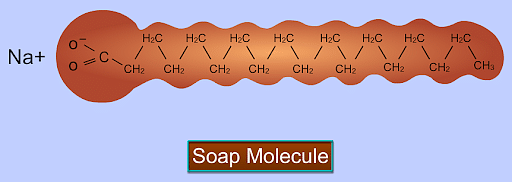
Soaps have a long aliphatic chain attached to them. One end is the carboxylate or hydrophilic end, and the hydrocarbon tail comprises the hydrophobic end. The grease and oils attach themselves to this hydrocarbon chain and repel water.
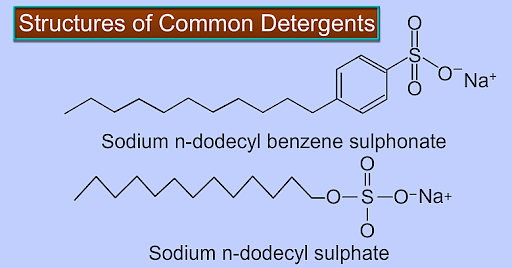
The sulfonate group in a detergent molecule makes it readily soluble and produces foam. The most common detergent used for household purposes is alkyl benzene sulfonates.
Soap
- It consists of several fats as well as oils.
- These are either potassium or sodium salts of a carboxylic acid.
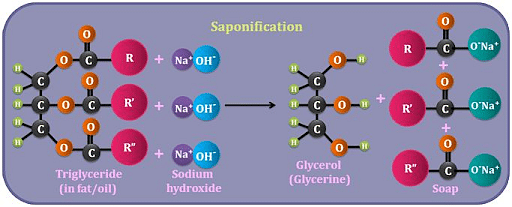
- It is manufactured generally by the saponification process of fats and oils.
- In a soap molecule, the hydrocarbon tail is hydrophobic whereas the carboxylate end is hydrophilic.
- Soap is widely used as a surfactant and thus helps in the emulsification of oils in water.
Detergents
- These are generally the potassium or sodium salts of a long alkyl chain ending with a sulfonate group.
- They are a superior cleaning agent to soap since they are soluble in hard water.
- One of the main components of the surfactants is made with petrochemical solutions like sulphur trioxide, sulphuric acid, ethylene oxide, and oleochemicals.
- The sulfonate group present in a detergent does not attach itself to the ions present in hard water, which increases its solubility.
- For domestic purposes, commonly, anionic detergents are used.
Soaps: Manufacturing Process
Soap production consists of the different following methods:
Saponification
This is the most common method used to prepare soaps. This process involves heating up a greater number of fats and oils and making them react to a liquid alkali, producing soap, water, and glycerine.
Neutralization
In this process, oils and fats get hydrolyzed with high pressurized steam to produce rude fatty acids along with glycerine. These fatty acids are later purified by the process of distillation and then neutralized by an alkali which ultimately produces water and soap.
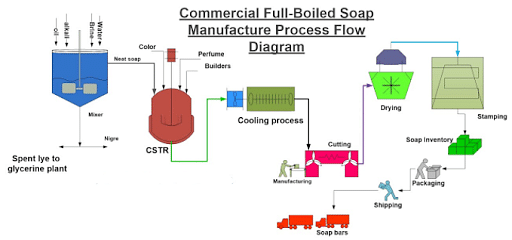
The soaps produced with sodium used as an alkali are much harder and solid compared to soaps made with potassium as the alkali agents. The latter soaps are much softer and are used to make shaving creams and liquid hand soaps. Hard water or water containing impurities will affect the soap’s cleansing properties.

Detergents: Manufacturing Process
Detergents are manufactured through the following processes –
Anionic Surfactants
The hydrocarbons extracted from the fats and oils or petroleum undergo a chemical reaction to produce newer acids that are similar to the fatty acids. After this, an alkali liquid is used to produce anionic surfactant molecules.

Non-ionic Surfactants
The hydrocarbons that have been extracted are converted to alcohol and are then made to react with ethylene oxide. After this, acids containing sulfur react to form another kind of anionic surfactant.

Difference between Soap and Detergent
The major differences are given below –
| Soaps | Detergents |
| It consists of a ‘-COONa’ group attached to a fatty acid having a long alkyl chain. | It consists of a ‘-SO3Na’ group attached to a long alkyl chain. |
| It is not useful in hard water or saline water. | It is effective even in hard water and saline water. |
| All soaps are completely biodegradable. | Detergents having a branched hydrocarbon chain are not biodegradable. |
| They generally form scum when reacted to hard water. | These do not produce scum. |
| They are derived from natural substances such as vegetable oils and animal fats. | They are generally a derivative of a synthetic compound. |
| Soaps are environmentally friendly products. | Detergents form a thick layer of foam over water killing aquatic life. |
| Soaps are used for cleaning and also for lubricating purposes. | Besides their use for cleaning purposes, these are also used as biological reagents and fuel additives. |
Soaps and Detergents: Applications
Any soiled surface or substance is cleaned in a four-step process.
- The first step includes making the substance to be cleaned wet with water.
- The next step calls for applying soap or detergents and letting it get absorbed.
- In the third step, clothes are often rubbed together or put in washing machines, and hard surfaces are scrubbed to loosen the dirt from the substances and to clean them. The dirt molecules get loosened due to the reaction of surface-active agents and are deposited in the water.
- The final or the fourth process involves preventing the dirt molecules from re-depositing on the surface of clean clothes or a clean surface. The dirt particles are enveloped in the soap or detergent molecules and make them suspended in water until it is washed away with rinsing.
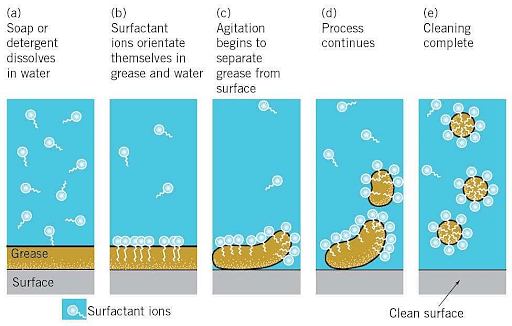
These compounds are also called surfactants. The surface-active molecules present in soaps and detergents dissolve in water and in turn, it helps loosen the surface tension and dissipates the force holding the dirt molecules together. It ultimately helps water to spread easily over a surface and soak into the substance along with the cleaning agent.
Things to Remember
- Soaps and detergents are compounds consisting of mixtures of different chemicals and are primarily used as cleansing agents for domestic purposes.
- Soaps are manufactured through Saponification or Neutralization processes
- Detergents are created from Anionic and Non-ionic Surfactants.
- Soaps consist of a ‘-COONa’ group attached to a fatty acid having a long alkyl chain while detergents consist of a ‘-SO3Na’ group attached to a long alkyl chain.
- Surfactants are surface-active molecules present in soaps and detergents which help loosen surface tension and dissipate the force holding the dirt molecules together.
Sample Questions
Ques. Are soaps and detergents basic?
Ans. Soaps are basically fatty acid salts of potassium or sodium. These are made with either fats and oils or their fatty acids and chemically treating them with heavy alkali. They have simple properties in them and hence can be considered as simple salts.
Ques. What is the chemistry of soap?
Ans. The making of soaps involves reacting fats or oils with a solid base of hydroxide, to form glycerine and soap (fatty acid salts). The fat/oil molecules (triglycerides) consist of a glycerine molecule that is chemically bound to three fatty acid molecules.
Ques. What is the difference between soap and detergent?
Ans. The sodium salts of carboxylic acids in long chains are called soap whereas the sodium salts of long-chain benzene sulphonic acids are called detergents. In comparison to general detergents, all soaps have a relatively weaker cleaning action.
Ques. What is the chemical reaction of soap?
Ans. Saponification or naturalization are the names of soap-producing chemical reactions. Fats are converted to soap (fatty acid salts) and alcohol by mixing the fats with water and applying heat. An alkali solution is also needed to treat the solution and separate the salts for soap.
Ques. What are the properties of soap and detergents?
Ans. Soaps tend to react with the mineral salts and form an insoluble precipitate called scum or otherwise known as soap film. In the case of detergent, it forms micelles with the fats and oils and dissolves them into an organic chain whereas the dirt and dust usually get dissolved in the micelle’s ionic portion.



Comments